Goodbye to All That?

Eight years ago, I spent inauguration day freezing to death in Washington D.C. I was a Georgetown freshman, and there was no other place to be, particularly in the aftermath of an election that, whatever one’s politics, was certainly historic. Living in what was then (but is no longer now) a majority black city also gave me an added window into what Barack Obama’s ascendance meant for some people, particularly on election night, when I saw tears and joy that, I understood, were for something I would never be able to feel.

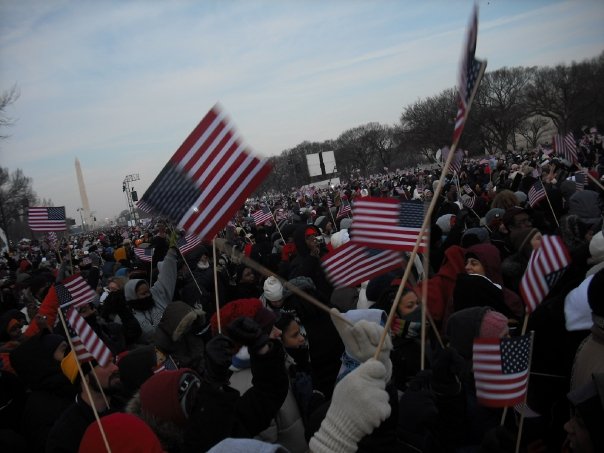
Not that a Midwestern white boy couldn’t try. I made sure to drink it all in: a national day of service event at RFK Stadium, a star-studded inaugural concert at the Lincoln Memorial. My cousin and his friend drove in from Indiana for the spectacle–I didn’t sleep the night before, as I awaited his arrival–and my dorm became a boarding house, with bodies sprawled across the common room. A group of us started down to the Mall around 4:30 and stood, huddled and chilled, for hours amid a throng of millions. Barack Obama was just a speck in the distance from our spot on the lawn, somewhere near the Hirshhorn Museum. We had a better view of the snipers on the roof of the National Gallery than we did of the new President, and the hike back to the Hilltop involved dazed weaving through mazes of port-o-potties. Still, it was all worth it, and I’m reminded of it almost every day: a few of those American flags they gave us to wave about still decorate my apartment.

inaug

I knew I was living history. I knew that, somehow, I needed to capture what this moment felt like so that I’d remember it. And so I wrote a few paragraphs. I was nineteen, and had only started writing in any serious sense a couple of months before. I had potential, though I also had a rookie’s penchant for florid prose:

The ceremony is to be a re-affirmation of the American faith in democracy. Its venue, the world’s most austere cathedral; the vast morning sky reaching from horizon to horizon in its embrace. There is no ceiling, least of all one of glass; simply the sky reaching towards the heavens…”

Yikes. The glass ceiling line is kinda cute, but come on, Karl. Are you really shamelessly comparing your country to a church? And seriously, that verb construction in the first line?

Fortunately, despite being an idealistic kid consumed by Washington’s atmosphere at the time, I was not among those who expected some sort of grandiose change out of Obama. Not that it mattered. That sweeping rhetoric, both the root of his appeal and the eventual source of disappointment for a number of his allies and disgust for many of his opponents, created a mythology that distracted from the actual art of governance. Later in the essay, I nail it:

There are no messiahs in politics. There are only humans, resplendent in their glories and glaring in their flaws. Time is short; there is work to be done. Soon the aura shall fade into memory, and unforgiving reality shall continue its steadfast march. To see the mountaintop is not enough; to stay upon the mountaintop remains an impossibility.

But for one day, such realities can be cast aside, and the awe-inspiring might of symbolism can run rampant in the mind. Often the import of great events lies not in actuality but in the power they wield in the human perception. And in this sense, this day can trump them all.

I can only laugh wryly at my verb choice in that last line.

In retrospect, that last paragraph was truer than I imagined, and Donald Trump’s election is as good a sign of that as any. So much of politics is emotion and symbolic power—what is ‘Make America Great Again’ if not symbolic?—especially on a distant national level when we’ve never met the people involved. I can be, and often am, more pleased by some election results than by others. But I will never be able to say I understand the joy black people felt upon Obama’s election, just as I’ll never be able to understand how Donald Trump could cause great joy in others, either. This isn’t to claim these emotions are in some way equivalent, but merely to marvel at how much a person we’ve never met can elicit life-defining sensations.

Part of me has grown downright scornful of this impulse to put faith in someone’s election, no matter the reason. This is the most insidious of vicarious lives, to cast one’s hopes on to some inevitably flawed human; Caesarism at its worst, a hopeless projection of hopes and dreams on to some distant figure of power when the most important work one can do to secure those aspirations is right here at home. But another part of me suspects I’d be fighting a losing war against human nature if I were to rail against this impulse full throttle.

It’s something of a paradox. I have little trouble being coldly rational in how I weigh most things, including the effectiveness of politicians I agree with or my own reactions to momentous events. And yet there are few things that have as much of a pull on me as passionate youth, and (joking a few paragraphs ago aside), I pass no harsh judgment on my earlier words. We tend to experience the world more vividly in our formative years, to live more fully in emotional surges. And while it requires the proper mindset, I do actually enjoy revisiting some of my old writing, understanding it as an essential part of growth and not just some fixed moment of an incomplete self. Those glimmers we get in those formative years are among the most important moments we encounter. Joan Didion: “one of the mixed blessings of being twenty and twenty-one and even twenty-three is the conviction that nothing like this, all evidence to the contrary notwithstanding, has ever happened to anyone before.”

Inauguration Day 2009 was the peak of an arc that eventually swung through a park in Mexico City two years later, an outburst of troubled words in the days after I left Washington, and has landed me right back where I came from, delighted to be where I am. Joan Didion eventually said Goodbye to All That, and she was right to do so. It’s all happened before, will probably all happen again. There’s nothing so unique about this moment that past experience can’t speak to.

But that doesn’t mean the insight from this moment isn’t real, doesn’t mean the emotion that comes out of it can’t continue to course through what we do, in some way or another. So if I shrug impassively at this next inauguration, it’s not because I’ve abandoned what I felt eight years earlier. It’s merely its natural culmination. A deeper fire still burns. I have work to do.

A Whirlwind Week of Hockey

Between the past two Saturdays I attended seven hockey games in eight days, an exhausting string even for someone who watches as religiously as me. It was blistering tour featuring all of northeast Minnesota’s State Tournament contenders, plus a pair of Lake Conference powers who came north to visit. I enjoyed long nights and raucous arenas, not to mention connections with friends old and new at all of them, except for the one in Hermantown, where I instead had the misfortune of being surrounded by Hermantown parents displaying typical Hermantown parent behavior.

It all got off to an inauspicious start, as Minnetonka came to play Duluth East on Saturday the 7th. After a start to the season defined largely by consistent efforts, the Hounds were MIA from puck drop at the Heritage Center, and the Skippers pummeled them to the tune of 6-0. It was one of the ugliest losses of the Mike Randolph era—an inordinate number of said losses do seem to come against Minnetonka—but it shows how far things can all go to pieces when a normally disciplined team lapses. The Skippers, meanwhile, looked like world-beaters, and while they have potential, they’ve failed to back that up with any consistency. They are a perplexing program, one with perpetual talent but just one trip to state in the past ten years. Maybe this new rising generation will be the one that changes things, but I’ll wait until March to draw conclusions.

The Hounds were again on my calendar for Monday for their crosstown rivalry with Duluth Denfeld, and in the early stages, they again looked nothing like they should. Slowly, however, the offense took over, and while it took a few power plays that sent Denfeld coach Kevin Smalley into cahoots, the final shots (54-15) showed the completeness of the Greyhound domination from the middle of the first period on. Denfeld goalie Benjamin LaFont gets credit for keeping it somewhat close, a feat he repeated during Thursday night’s 5-1 loss to Hermantown. This has been a dark year for the Hunters, with just two wins to their name and no junior varsity. After stringing things along for a few seasons thanks to a handful of strong bloodlines and transfers, the bottom seemed to have fallen out. But this week’s rivalry games showed a group of Hunters that still have their pride intact, and look stout enough to at least make things interesting in the 7A playoffs.

“Interesting” is not normally a word associated with the 7A playoffs these days, and the Hermantown Hawks reminded us why on Tuesday, when they outlasted AA power Grand Rapids for a third straight win over the Thunderhawks. This was the most entertaining game I’ve seen all year, a back-and-forth, open affair brimming with emotion. A coaching chess match came to the fore in the second period, when Rapids’ Trent Klatt started looking for ways to get his elite threesome at forward—Blake McLaughlin, Micah Miller, and Gavin Hain—away from Hermantown’s Ryan Sandelin-led top line. Sandelin and company contained the Big Three whenever they were on the ice together, and Bruce Plante was wily enough to keep up in the line-matching game. Hermantown, meanwhile, exploited the mismatch of the second lines, and Logan Judnick’s goal held up as the game-winner. The Hawks were clinging to life in the late stages as the Big Three surged forward, but did enough for a 4-3 win, and some frustrated Grand Rapids defenesemen started a scrum in the corner after the buzzer sounded. It was a painful error: two of them were given game misconducts, and had to miss Thursday’s contest with Duluth East.

Few regular season games were as anticipated as this one, as the Greyhounds welcomed in the team that ended their 7AA dynasty in exhilarating fashion the year before. The atmosphere at the Heritage Center was the best I’ve ever seen, and both teams had something to prove: East needed to win to show it belonged in the 7AA conversation, while a loss could consign Rapids to the 3-seed, despite their strong start to the year. With so many thrillers in recent memory between these two, it had the makings of another classic.

The game, however, didn’t offer much in the way of drama. Thursday was one of those defining Duluth East games, a dominant performance that offered Greyhound hockey at its finest. East went on the attack early and never let up, controlling the puck for long stretches yet still showing enough discipline to make the Rapids stars seem fairly pedestrian when they did go on the rush the other way. They unleashed a barrage on Rapids goalie Gabe Holum, and while he held the game to 1-0 for a period and a half, the floodgates burst loose late in the second. The 5-0 final was East’s finest statement to date, and after Elk River stumbled against Centennial on Saturday, they suddenly look like they’re right there in the heart of the 7AA race.

The Thunderhawks, meanwhile, face a conundrum. Their amazing top line carried them through a dominant December, but with just one win in five games before a recovery effort in their win over Cloquet on Tuesday the 17th, there are some cracks in the walls. It’s not hard to look good when a team returns a group of stars with incredible chemistry, but as the competition builds its own combinations and settles into its systems, it grows more difficult for a good AA team to thrive off sheer skill alone. If ever a team could, it’s this Thunderhawk group, but a concurrent decline in team discipline has been their bête noir. Trent Klatt has played with splitting up his now-somewhat-stoppable trio, a move I’ve judged as wise give the realities of AA hockey: one-line teams seldom win tough sections. But the Big Three have a chemistry together that’s hard to shrug aside, and Trent Klatt faces far more critical choices than he did a year ago, when he had the depth to run with the likes of East and Elk River. Few teams will be as interesting to watch down the stretch.

For East, the win was as much a display of talent as it was a win for the program’s famed systems. Mike Randolph teams are renowned for their offensive zone cycling and ability to shut down the opposition, but they’re at their very best when there are added wrinkles of creativity that display some of the natural skill on the team. We saw some flashes of that against Grand Rapids. Garrett Worth, the most technically skilled East forward since Jake Randolph, dangled all over the place. Ian Mageau was a physical force, disrupting the opposition and creating plays of his own, with three assists on the night. And while Luke LaMaster didn’t have a huge night on the scoresheet, his poise in his own zone started many a fluid Hound breakout. The machine work is all lovely and important, but it’s going to be these individual moments of brilliance that make or break this team’s playoff run.

Those top line Hounds had precious few chances to show their greatness against Eden Prairie on Saturday. Matched against Casey Mittelstadt and the Eagle top line, they were left in a mostly defensive role, which they filled with aplomb, though at the expense of some scoring chances. For its part, the East system held up well against the state’s most talented team. In a display of depth, the third line scored both goals, and the defensemen were equal to the task against Mittelstadt. The ending, however, was something no system can account for, as goaltender Kirk Meierhoff mishandled a lob in from the blue line by Nick Leivermann just ten seconds into overtime. It was an unfortunate twist for Meierhoff, who’s shown genuine improvement and been a bright spot for East this year, and recalled memories of some previous overtime affair between these two that ended on a crazy goal. But, no matter: the Hounds showed this week that they have the formula to run with the best when they’re on their game.

This was my second look at Eden Prairie on the weekend, as I’d seen them turn in a fairly pedestrian performance in a 3-1 win over Cloquet the night before. Under Lee Smith this season, the Eagles are the anti-Grand Rapids, deliberately avoiding heavy reliance on their stars in the service of a deep lineup and grinding performances. Perhaps it’s an attempt to atone for last season, when the Eagles lost the title game to a deep defensive team, and it’s not without risks, as games can stay tighter than they might be if they turned into a track meet. But winning it all in AA takes discipline, and with their new approach—and, one might add, with a certain hotheaded forward unavailable due to a misconduct the night before—Eden Prairie kept its poise and rolled its lines when East ramped up the pressure in the third period. Sure, East effectively shut down Mittelstadt, but the Eagles never panicked, and when a questionable call gave them a late penalty, they pressed in, creating a deluge of chances late in regulation before Leivermann’s fateful flip.

Perhaps these are all important turning points; perhaps these moments in January are just little skips that won’t be at all relevant when we look back in two months at the moments that defined these teams’ seasons. Either way, these teams delivered some of the cheapest, most entertaining theater available out there. We’re headed into the stretch run now, and it only gets better from here.

Yes, Defense Does Win Championships

“Defense wins championships” is among the older sports clichés out there, but it’s out there because it’s true, and Minnesota high school hockey fits the bill as well as any sport. Whether it’s a team built around tough defensive hockey like last year’s Wayzata Trojans or an overwhelming Edina team that just happens to have three or four D-I defensemen in back, the eventual state champion never has a weakness on the back end. A firm defense is the common denominator for basically every state champion over the past 25 years.

If you want to know if a team has what it takes to win, one of the easiest metrics is its number of Division One defensemen. There have only been four AA state champions with less than two D-I defensemen in the two-class era, and one of those comes with a huge asterisk, as Patrick Finnegan of Duluth East was one of the best defensemen in the state in 1998, but went the Canadian major junior route instead, as did another Hound defenseman on that team, Jon Hedberg. The remaining three are 1997 Edina, 2005 Holy Angels, and 2007 Roseau. The 97 Hornets, who stunned undefeated Duluth East in the title game, were masters of the trap. The 07 Rams’ single D-I d-man was one of the best in the past 15 years, and with Scott Oliver at the helm, they were a tough team that wasn’t going to take anything lying down. That leaves the 05 Stars as the only thing at all resembling an outlier.

Defense is the common denominator to so many state champions, especially when we get outside of the dynastic Bloomington Jefferson, East, Holy Angels, or Edina teams that had boatloads of talent everywhere. The Poehling brothers got all the hype, but I contended all along that the most important piece of the perfect 2015 Lakeville North team was its incredible defensive corps. When we’ve had lower seed state champions (2008 Hill-Murray, 2016 Wayzata), it comes on the strength of defense. 2003 Anoka may have only had three D-I players, but two of them were, you guessed it, defensemen. A solid group in back can cover for weak forward talent by just depressing scores and venturing into the attack at times; a solid group of forwards can’t possibly make up for fundamental defensive lapses.

We also can’t understate the power of a single elite defenseman in the high school game. 2006 Cretin-Derham Hall only had 4 D-I players, the second-lowest total for a champion of the two-class era, but one of them was Ryan McDonagh. 2009 Eden Prairie was very young outside of Nick Leddy, but Nick Leddy was Nick Leddy. Hank Sorensen drove some people nuts in his time with Wayzata, but there’s little doubt his hits were a key difference-maker for last year’s Trojans. Even a truly elite forward with something of a supporting cast, like Grand Rapids’ Avery Peterson, never had nearly the influence of a top-tier defenseman like Duluth East’s Phil Beaulieu when those two collided. Peterson deserved his Mr. Hockey award, but Beaulieu ran the show when East played Rapids in 2014, and a fairly thin Hounds team (by East standards) had little trouble beating the Thunderhawks. Once at State, they lost to a similar tough Eagan squad carried by one Nick Wolff.

At the same time, a lack of defensive discipline can doom a team that has the talent to win. I’ve leveled the same criticism at St. Thomas Academy in each of their three years in AA, and I’m going to do so again this year. Their aggressive play and deadliness in transition was a good style for making thin Class A teams look silly, but it’s often too fast and loose for AA. There’s a reason they’ve suffered three upset playoff losses (of varying degrees) in three years in AA. If Hermantown were to ever make the jump without any adjustments in style of play, I’d expect a similar result. (It’s exactly what happened when they twice collided with the rare Class A team that could play that tough defensive style, those East Grand Forks 2014 and 2015 teams.) There’s a reason that perennial powers like Duluth East and Hill-Murray always try take care of things on their own end of the ice first, no matter what sort of talent they have up front: their coaches have been around the block, and know what it takes to win.

I’m not saying offense-first teams can’t ever win. If there was an exception in recent memory, it was 2013 Benilde-St. Margaret’s; sure, they had four D-I defensemen, but three of them were very young, and that team was built purely around speed and a prolific offense. They only had one of the two or three best pure snipers of the two-class era in Grant Besse, and an overload of weapons around him. And even then, a very young Edina team had them on the ropes in the first round at State, and the two teams that were well-built stylistically to take them down, Eagan and Duluth East, decided to go and lose in the quarterfinals. Benilde’s inability to make State the following year, when Besse was a senior, and in 2016, when they went undefeated in the regular season, had a lot to do with playing a style that had no Plan B when it ran up against teams that didn’t roll over and make mortal mistakes.

Being defensive-minded alone isn’t going to win a state championship. One does, after all, need goals, and some measure of creativity for that inevitable playoff game when a team doesn’t quite play up to its potential, or gets knocked off its game. Teams of all varieties fall short, and there are plenty of scripts for upsets to follow. But if I need to choose among possible state champions, give me the team that rules the blue line. History doesn’t lie.

Escape to Palisade Valley

There’s a nice coherence in having one’s birthday right up against the new year, even if it did mean enduring a childhood of “Merry Christmas…and Happy Birthday All at Once!” presents. Year-end reflections and any thoughts that come with turning a year older happen all together, and each calendar year lines up nicely with a year in my life. I’ve never been one for resolutions or remaking myself in any fundamental way, but an added year is always a welcome chance to step back to recalibrate some. I’m skeptical of  any overarching sense of human progress as destiny, but I do think the power of introspection and stopping to learn from the past is one of the things that makes human life worth living.

Twenty-seven feels like a heavy one. Maybe because it’s certifiably “late twenties” now, but more likely because it’s my first birthday as a full-time adult with a career and no diversion from that career in sight. This is life now, and I’m just going to pile up the years as I go on with my working life. Each turn of the calendar page just brings me closer to middle age, puts on a little more pressure to check off the next set of boxes on the list of goals, especially after a year in which there was an awful lot of box-checking. Not everything needs to happen at once, and measuring life only by checked boxes is a poor way to think about things. But I won’t pretend that checking those boxes doesn’t set a strong foundation that allows everything else to flourish, and it’s hard to understate the benefits of finally having things all lined up. Wandering through a portion of one’s twenties is only worthwhile if one learns some necessary lessons. Mission accomplished, I suppose.

Before I get to work on those remaining boxes, though, I need to stop for a moment, and to think about what I’m really aiming for next. This holiday season, rich and rewarding in so many respects, left little time for introversion: this was my first weekend at home without houseguests in over a month, following journeys to Minneapolis and Chicago and Wisconsin, and playing host for New Year’s. I need these moments.

So, this Sunday, I set out to find some solitude on a skiing adventure. It was nothing that would trouble a seasoned skier, but it was still a healthy 15-plus kilometer trek over sometimes shaky trails, from the Northwoods ski area north of Silver Bay to a small camp in the heart of Tettegouche State Park on Lake Superior’s North Shore. It’s a trip I’ve long wanted to make, and now was as good a time as any. And so I set out with my skis, a lunch, and a bottle of whiskey with a few sips left in it from New Year’s festivities.

20170108_104536

Northwoods is already the prettiest ski area in the region, thanks to its thick stands of balsams along the Beaver River and its beautiful outlet on to the floor of cliff-lined Bean Lake. (Alas: a sign at the parking lot alerts us to an impending, and probably necessary, thinning of the balsams by loggers.) Just as the trail turns away from the Beaver toward the daunting Herringbone Hill, an alluring spur offers a five-ish kilometer connection to Tettegouche. (Signs and maps offer differing distances, but it’s somewhere between 4.8 and 5.5). The trail is ungroomed, but sees enough traffic that there’s a healthy track at the start. Ungroomed trails offer constant undulations, and occasional needs to skirt frozen pools, or to climb or descend hills covered by small plants that resemble barren sticks in winter. It’s slow going. There are no brutal hills on the Tettegouche connector, and it’s little enough used that it’s never fast, but there are a few slopes that require careful negotiation.

Keeping one’s eyes on the tracks, however, can be difficult on this trail. The reason is simple: this is, by several degrees of magnitude, the most beautiful stretch of trail I’ve ever skied. The trail enters the Palisade Valley and snakes between walls of talus, these rugged ridges that score the earth north of Silver Bay. Pictures can’t quite capture the completeness of the beauty as I slide along between snow-covered boulder fields, frozen ponds dotting the route below. I start to climb gently, the leafless trees allowing views far across the valley. I cross a few snowmobile trails, and come to a spot where some furry animal met its demise from the skies. I climb the steepest hill on the trail to a view between looming twin erratics; a sign welcomes me to Tettegouche. Before long, I come to a long, somewhat narrow clearing, and the trail dies completely. But it seems clear enough that I should cross this opening, and I edge forward with some caution, as I suspect Palisade Creek is somewhere beneath me. I stick to the top of drifted snowy ridges, figuring something must hold it all up beneath. At times I sink deep into the drifts, at times I glide along the top without leaving a track. My geography skills haven’t failed me: a faint trail appears on the opposite end of the long clearing, and I immediately encounter an intersection with a map.

20170108_111153

Perhaps the biggest adjustment to working life has been the structure. Suddenly, there is always a map, and little time to explore its less worn trails. While I’m not busier than I was in school, being in an office from 8 to 5 is just a very different lifestyle from a haphazard student schedule. I hardly expect much sympathy if this is one of my greater worries, and it’s driven by my own ridiculous need to be doing something (and maybe multiple things) every single waking moment. But as valuable as structure can be, it can come at the expense of serendipity, and leaves moments of wonder too few and far between. It seems paradoxical to schedule in time to for beauty and wonder, but in these parts, one doesn’t have to travel far to find it.

Beyond the intersection the trail is packed down by snowshoes, and moves quickly up and down through a silent pine grove. Faster than expected, I sail down an easy slope to the Tettegouche camp, a collection of four cabins and a communal lodge in the heart of the state park on Mic Mac Lake, accessible only by trail. It’s empty when I arrive, but an older couple skis into camp from the north just after I break into my lunch in the lodge. We chat as I eat, colder when stationary in this unheated building than we were when skiing along. (For the non-northern Minnesotans who wonder how we do it, cross-country skiing is enough work that it doesn’t require a heavy jacket, even on a single-digit day like this one.) The woman admires the route I’ve taken, wishes that her body could still handle that many kilometers. I only hope that I, like her, can find someone who will still go with me on spontaneous adventures like this when I’m her age. After they leave me, I wander down to the frozen lake, sublime in repose, and then begin my trip back.

20170108_124307

As always, return journeys are faster, with familiar landmarks dotting the route. A number of stretches are a cross-country skier’s greatest delight, those easy, steady, incredibly long downhills. I can lull into thought here, develop a new plan of attack for adult life. I take my last slug of warming beverage in a spot where I can see hills rising up in all directions: a rock-strewn cliff to the right, the walls of Bear Lake up to the left, lonely Round Mountain and hulking Mount Trudee, subject of many a vulgarity on my post-graduation hike this past summer, visible behind. I don’t need the whiskey to feel a warm burn. The sun, stuck behind a grey wintry haze after some moments of morning clarity, sinks toward the top of the ridge that separates me from Bear and Bean Lakes, even at this early afternoon hour. Back on the Northwoods trails, my muscles start to protest; this stretch seems longer than I’d remembered. The trail system is empty, just me and the balsams, though a large crew with young children is just setting out when I finally coast back into the parking lot. I expect I’ll be doing that in the not so distant future, too.

It’s an hour drive back to Duluth. The morning sea smoke has lifted, and Lake Superior is a steely grey; for once, the clouds are welcome, as they blot out the sun that always seems to hang in one’s eyes during winter drives back down the Shore. I may be a little older now, and my knees are a bit cranky, but as I tune in the Packers’ playoff game and accelerate past Split Rock Lighthouse, I feel the youngest I have in months. As long as I can still blend that ambition with that sense of wonder, I can still channel the best of that kid who left Duluth for Georgetown, the best of those instincts that pulled me home, the best of those thrusts outward and journeys back through this endless cycle I live.

20170108_111147

I already knew all of this, of course. It’s no secret. But it’s so incredibly easy to let that slip away. At the very least, a few sore muscles will remind me for the next few days, and with any luck, this latest jolt will pierce through the dragging everydayness that too often grinds down that ambition and wonder. There’s no stopping now. There’s no telling how many kilometers of unbroken snow separate me from home.

The Case for Small Cities

Many talented people around my age or slightly younger are drawn to large cities. It only makes sense: they’re interesting places filled with interesting people, with easy access to cultural amenities and excitement that just don’t come around in suburbia or small towns. I’m skeptical that this supposed millennial “back to the city” movement will endure once my generation (or, rather, the highly educated fraction of my generation) starts having kids en masse, and even now, suburban growth still outpaces urban growth. I’m certainly not going to rain on the progress made in cities in recent years, many of which have enjoyed renewed life after decades of declining populations and disinvestment.

I am, however, going to make a case for the cities that I think are the best for young adults. These are what we might call the second tier cities: metropolitan areas between 100,000 and 500,000 people; places that stand alone as their own functioning economies, but will never capture the national imagination of our biggest cities. They may not be as glamorous, but the opportunities they provide young people are second to none. They are also the cities that need injections of smart, talented young people who can carry them forward and keep them thriving. Big cities will have that no matter what, but these smaller cities can face more complicated futures, and their ability to adapt to the 21st century economy could well make or break this country: are its benefits confined to a few scattered enclaves, or can it reach across the country and include these supposed flyover towns that have suddenly become a source of political angst?

And so I will make my case for smaller cities, as someone who has just gone home to a small city after spending six of the past eight in large cities. The target audience here is well-educated white-collar millennials, but I think these can be tweaked to apply to other groups, too. Here are 12 things they have to offer that larger cities don’t:

  1. The cost of living is much lower. Sure, the starting pay also may be lower, but the overall financial picture often works out well. My savings in rent alone since coming to Duluth are probably equal to about $3,000-$5,000 in annual salary compared to Minneapolis; if I were in DC or New York or San Francisco, we might be talking tens of thousands of dollars.
  2. Commute time: nonexistent. Do I really need to elaborate? I live a few miles from work, yet it literally takes me longer to walk from my car to the office than it does to drive from home to the place where I park. The savings in time and mental anguish are remarkable.
  3. Access to positions of influence is significantly easier. In a few locations, good old boys’ networks can act as gatekeepers, but for the most part, anyone who wants an in can have it. Most of these cities love seeing fresh young blood come in to serve in leadership positions. For the politically inclined, reasonably talented people can win elections in their 20s, and don’t need to raise tons of money to do it. Provide some basic initiative, and you’ll be well on your way.
  4. As one gets older, those interesting things about cities that drew one in at the start become less important. Good restaurants, cultural opportunities, big dating pools…most people come to have less time or need to explore these things as they age, and as other family-related commitments arise. A small city will still have enough of these to keep most people going, too; don’t underestimate the amount of creativity a small place can produce.
  5. Speaking of family commitments, smaller cities are great places to raise kids. Access to reasonably good schools doesn’t cost an arm and a leg in real estate, and even the bottom end of educational options is probably a lot higher than in most big cities. Sure, the top end might not provide the easy pipeline to elite colleges that you see in wealthy suburbs, but if a kid comes from a strong home environment, the sky is still the limit. Factor in family-friendly neighborhoods, where crime and speeding traffic are negligible concerns, and it all adds up to a pleasant home life without trying very hard. Moreover, these places are small enough that even “wealthy” schools will give kids access to a fairly broad socioeconomic range. There’s much less of a bubble effect when everyone is thrown in together.
  6. Access to nature is so much easier. You need not be a tree-hugging hippie or a backwoodsman to appreciate this: free space means clean air and escapes from crowds and their annoyances, and facilitates everything from an adventure in the wilderness to an easy drive along picturesque country roads. This is refreshing for everyone.
  7. In smaller cities, it’s much easier to escape political or social bubbles. Even if the city itself may be a bit of an island, it’s probably surrounded by something else, and again, things are small enough that you’ll have some interaction with everyone. This may not always be fun, but at least you’ll understand what’s going on in several different swaths of the country. It’s hard to do that in the suburbs, and even in a large city with lots of surface level diversity, it’s very easy to cloister oneself, intentionally or not, and only interact with like-minded people.
  8. You can do more for the place you live, immediately. The utility of adding a talented new person to a small city is much greater than adding a new one to a metropolitan area. Being one of twenty people with an Ivy League degree in your small city provides way more influence than the 1,000th in a large one. Band enough of these people together, and you’ve got yourself a movement. A small core of committed people can completely turn the tide for an entire city. (Sidebar: not every local leader needs to go off to some elite school. It’s valuable to have some who do, so as to provide perspective, but it’s equally valuable to have some lifers who really get all the details. People who have seen the outside world are conversant in a common language and culture that’s useful in dealing with national issues, but credentials from distant schools say nothing about a person’s professional or political talents, or ability to harness them.)
  9. If you start a career in a smaller place, you’re highly unlikely to be pigeon-holed into one task or job function. You’ll probably be in an office that’s small enough that forces you to take on a variety of tasks, some of which will probably get you out of your comfort zone and make for a great learning experience. Jobs are far less likely to be “safe,” and that’s an excellent thing for résumé development, and generally just for enjoying one’s job.
  10. At the same time, though, people in smaller cities value work-life balance. There are no 100-hour-a-week slavish jobs here, unless you enjoy it so much that this is what you actually want to do. And if that is what you want to do, people will probably respect that.
  11. People like stories of converts or prodigal children, and anyone who can make that outsider’s case for a place is going to be compelling to outside audiences. Small cities need this so as to make their appeal clear to people who aren’t already singing along with the choir. Move to one of these places and accept it as it is, and you’ll have a chance to be its champion. Big cities don’t need such champions; inertia provides this on its own. But in choosing to take a different path, you instantly become a leader of sorts.
  12. You get to say you are actually “from” somewhere, instead of pretending that your suburban childhood connects you with a larger center city that you visited only for sports and museums when growing up. Sure, there are some mild quirks that separate most middle-to-upper-end suburbs, but for all intents and purposes, they’re the same. People may not know what it means when you say you’re from Duluth, but you do, and other people who are also from Duluth get it. If you value a sense of place, that’s huge.

I won’t pretend it’s all easy. Moving to a smaller city takes a conscious rejection of the easy trends for most young people, which push them to familiar networks and the largest paychecks. If you’re not from a place, it can take a little while to break in. And yes, the dating pool really is smaller. (Sigh.) But there is so much wealth to be found here, and these cities are practically begging for ambitious young people to sweep in and leave their mark. Take the jump. It’s worth it.

Hounds for the Holidays

Eight games into Duluth East’s hockey season, the defining feature so far is, perhaps, a blissful lack of drama. The past two seasons have been tumultuous in so many ways, with deeply frustrating valleys in December of each year. A large group of seniors that carried East to great heights and some frustrating lows graduated in 2016, leaving us with some very young Hounds with a different look and a different attitude. While this season has had its high points and low points, the Hounds are more or less where we might have expected them to be: 5-3 and in the 10-15 range of rankings, showing flashes of great potential but with plenty of work to do if they hope to come out of a loaded section.

The Hounds have played the three teams that should wind up ranked 4-6 in Section 7AA, all of whom have beaten or tied them over the past two years. This time around, they handled all three, winning by a combined 16-2 score. Two of their losses were by one goal (one with an empty-netter) to top ten teams, and the third was the season opener to a surprise White Bear Lake team that is now making its own bit for a top ten ranking. They also have wins against a struggling but dangerous defending state champion, Wayzata, and a stout Bemidji team. There’s room for improvement; the Centennial loss in particular stung, as they went from looking like world-beaters with a 2-0 lead in the first period to melting into ineptitude later on. But on the whole, the team looks respectable and steady, which is not always the case in December, even with highly skilled East teams.

There have been some pleasant surprises to date. Coming in, I worried the scoring might be top-heavy, and over-reliant on the top line; they have been anything but. East is rolling four lines, all generating offensive zone time and putting up some points. The second line of Ricky Lyle, Logan Anderson, and Nick Lanigan has been a real bright spot, with quality production and excellent puck control. Despite their inexperience, this team’s forwards are already playing that classic Mike Randolph cycle with more precision than they mustered in the past two seasons.

de1617

The young defense is largely living up to its promise, avoiding stupid mistakes outside of a few ill-advised penalties. Perhaps most encouragingly, the healthy competition between returning senior Kirk Meierhoff and sophomore Lukan Hanson seems to have produced the intended results. Hanson put in some strong performances before a struggle against Centennial last week, but Meierhoff has elevated his game, and boasts a .968 save percentage and just three goals allowed in four and a half games. The job, I suspect, is his until further notice.

If there’s one thing that could make the Hounds more dangerous, it’s more offensive production out of the top line of Garrett Worth, Ian Mageau, and Ryder Donovan. They’re leading the team in points and certainly look like the top line, but the numbers aren’t anything awe-inspiring, and with the star power that the other contenders in 7AA feature, they need their top forwards to step into leading roles and carry the load when necessary. An obvious way to improve: fix up that power play, which lately has spent most of its time retrieving the puck from its own end. So often here, less is more, and they can lead if they avoid forcing things and take it all naturally.

It could also behoove the team to have some sort of Plan B. Randolph’s cycling master classes are fun to watch, and can beat teams into submission. But at times the opponent diagnoses it and throws East off its game, and the team needs to be able to respond in positive ways when they do lose that control. Whether that involves something tactical or simply turning a few top players loose and letting them do their thing, another course of attack makes them that much more lethal.

They will need that lethal touch to do much of anything in the playoffs. This isn’t one of those years where East can just lock down defensively and expect to get out of 7AA: Elk River and Grand Rapids currently sit ranked #2 and #3 in the state, respectively. The Elks may be the deepest team in the state, while the Thunderhawks have one of the most dangerous collections of top-end talent in recent years. This is the peak year for both, their best chance at glory in decades (for Rapids) or since the early 00s (for Elk River). Both teams lurk on the schedule later in the year, and the Hounds have some work to do if they want to be more than a possible spoiler. There will be a talent gap, and coaching can only go so far to bridge it; work ethic and leadership, those staples of the 2015 run, must do the rest. Convincing wins over some amped-up rivals are a good start; now, they need to take that to the next level, and not get frustrated when other top teams throw them off their game.

Whatever comes next, I’m happy to be home to watch them regularly after a couple years away, and to know that I’ll be doing this for a long time to come. As today’s News Tribune story shows, this is something that spans generations and endures, not just some passing fancy of convenient demographic growth. The crowds at the Heritage Center (and at Mars for the Marshall game on Thursday) are the best they’ve been in years, and people just seem to get what an enjoyable ride this is, and why this culture can help pull back kids like me who’ve gone to see everything the world has to offer and decide we belong right back here. With that kind of legacy, how can this not be fun?

Full Range of Possibility

The Iron Range is a land of legend for Duluth kids like myself, a realm of blue-collar grit that makes our east side homes feel like the last bastion of civilization in the frozen north. Its history is no older than the rest of Minnesota, but it is much more aware of that history than anywhere else, perhaps because that past too often seems brighter than its future. The Range is no Appalachia, but in an otherwise well-off state, it has become emblematic of the struggles of the white working class, a group that once dug up America’s building blocks but now suffers from stagnant incomes, crumbling families, and a sudden surge in drug overdose deaths. The Range only needs a third of the workers it did in the 70s to mine the same amount of ore, and imports have risen as well; even when steel prices are high, blue-collar work is no longer seen as the engine of the national economy, but instead an afterthought in an age of information. Small wonder that this longtime bastion of labor politics suddenly broke for Donald Trump.

But even as the mines rise and fall, hockey remains a constant on the Range. These northern towns steamrolled the rest of the state for several decades after the birth of Minnesota hockey, and nearly every small town in the region has taken its turn at dominance. Their legacy lingers, both in the banners of the historic rinks and in the present day big city powerhouses, whose rosters are littered with names that have their roots on the Range a generation or two earlier. I grew up in an era of dwindling Range hockey success, and am young enough that I remember more State Tournaments without Range teams than those with them; only if we count Grand Rapids as a Range city—a subject of eternal debate—is there are still anything more than a prayerful hope of present glory. But there is still talent here, still are flirtations with greatness, and now that I’m back in Duluth, it’s time to go see Range hockey as it is today.

The site of the game I attend on a Tuesday in mid-December is the town of Hibbing, home to the mine that won two World Wars and, as of last week, a Nobel Laureate in literature. Hibbing is still the largest city on the Range, its high school a stunning monument to early 20th century industry, and a time when the Iron Range quite literally created the foundations of American growth.  Its hockey program lacks any one dominant era, but has been remarkably consistent across the years, and has two titles to its name. As recently as the late 90s they were there with the best; the 1997 final at Hibbing Memorial between the Bluejackets and Duluth East might have offered the absolute pinnacle of section hockey atmosphere in my lifetime. Lately, however, the Jackets have worn thin; they’re frequent visitors to the late rounds of the Section 7A playoffs, but only bust through as a serious threat when carried by an Adam Johnson or a Scott Perunovich. Last year’s dream team behind Perunovich crumbled in the 7A final, whipped by a Hermantown program whose depth has come to overwhelm the Range teams, year after year. Amid a hushed-up scandal that drove head coach Todd Versich from his job, Perunovich and star goaltender Ryan Ullan left for junior hockey over the offseason, leaving the Jackets with an uncertain future. Still, enough talent remained, and the Jackets got off to a solid 3-1 start in the young season.

20161213_192257

Hibbing’s opponent on Tuesday night, Greenway, collects kids from two high schools and a smattering of towns across eastern Itasca County. Perhaps no part of the Range endured more uncertainty during the most recent mining downturn than these hamlets between Grand Rapids and Hibbing. Keetac in Keewatin remains idled, its future murky; Magnetation out of Grand Rapids went belly-up; and the Essar direct reduced iron project in Nashwauk, once touted as the future of Range mining, sits unfinished and mired in debt left by an incompetent management group from India. (New investors emerged in the past week to offer new hope on the last two, but it’s all still speculative, and the towns’ fates remain chained to the fortunes of the mines.) The Greenway hockey program, twice state champions in the late 60s and darlings of the AA tournament as recently as 2001, stood on the brink of demise toward the end of the 00s. Hope, however, springs eternal: the Raiders rebuilt from the ground up and returned to prominence last season, going 22-5 and making the section semifinals for the first time since 2003. Life returned to the Snakepit in Coleraine, and the Raiders entered Tuesday night a perfect 6-0.

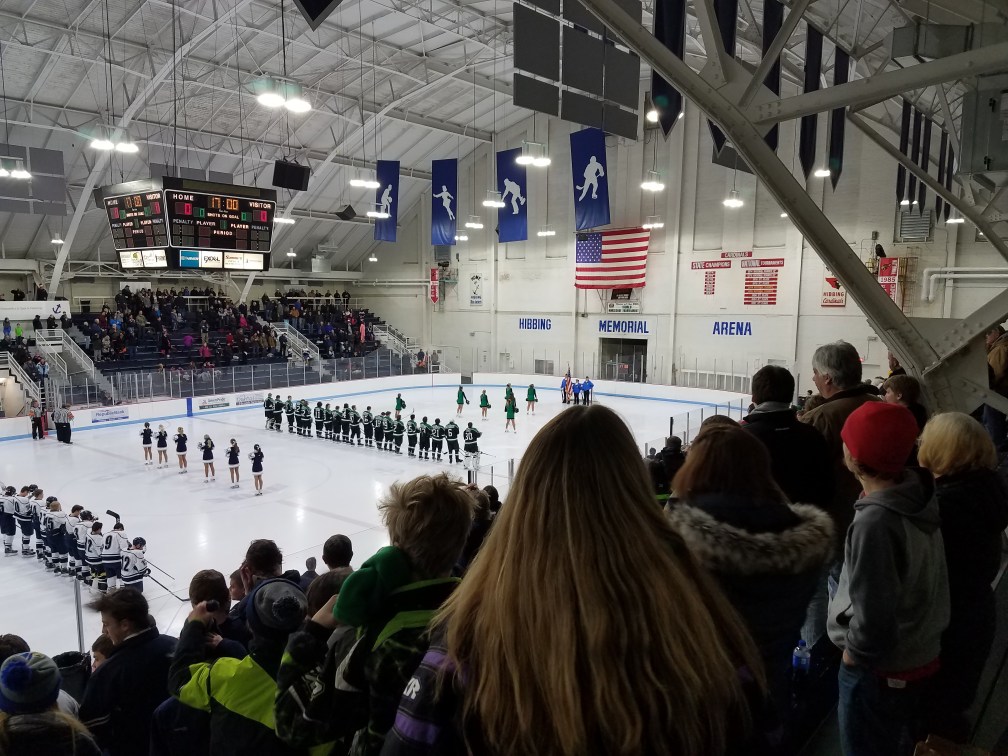
I head to Hibbing right after work and arrive an hour early to secure my perch for the game. I needn’t have worried too much: the crowd is respectable, perhaps just under 2,000, but there’s plenty of space at cavernous Hibbing Memorial. Still, I’m glad for my early arrival, as it gives me time to meander up and down its aisles and gaze up at those old pictures, banners, and majestic arched ceiling. It’s the oldest artificial ice on the Range, dating to 1935, but the upkeep is impeccable, a perfect blend of new paint and a few historic touches to remind us we’re on hallowed hockey ground. A reverent silence grips the arena long after the anthem ends, as the local VFW chapter retires the colors; finally, a kid in the Hibbing student section shatters it. “It’s gonna be a long night, Raiders!” he bellows. On cue, the arena erupts into life, just as it has for eighty years.

The Bluejackets are true to the words of their instigator in the stands. Greenway may come in as the higher-ranked team, but Hibbing strikes immediately on a goal by Tristan Birdsall, the lone sophomore skater on a veteran-laden squad. Hibbing’s puck movement is superior; the Raiders, their top two talents inexplicably separated on different lines, fail to generate much punch beyond individual moments of flashy stickhandling from Taylor Lantz or pure power moves by Grant Troumbly. Greenway assumes the mantel of powerful northern hockey and unloads the hits, but Hibbing does just enough to hold serve. Late in the first period, Lantz and Troumbly momentarily join forces, and Greenway instantaneously has its best shift of the period. But when the second period opens, they’re apart again, and won’t be back on the same line until the game is out of reach. Maybe coach Grant Clafton is trying to wear Hibbing down in an ill-fated search for depth; maybe he’s being coy or experimental, waiting to unleash his finest talents later in the season. For now, however, it fails to generate much.

In front of me, the Hibbing students, scattered into friend groups at the start, congeal into a unified mass. In the Metro, students bounce beach balls around to annoy the ushers; here, they are purists, and keep a hockey puck aloft for a spell. They are all choreographed, sit as one when a Hibbing player goes down hurt midway through the first period, and repeat the ritual when a top Greenway defenseman’s leg crumples in the third. When the Greenway cheerleaders take the ice between periods, they turn their backs on them; these harmless antics that have been beaten out of student sections elsewhere still live on the Range. Later, “Rapids Rejects” joins the usual arsenal of victorious chants as the clock winds down. These kids are engaged, locked in on the game, having fun: a pleasure to see. One sees me taking notes, and asks if I’m a scout. No, kid, just a traveler from afar, drinking it all in.

Shots on goal read 4-3 Hibbing after the first period, a deathly low total that reflects the physical pacing of the game. In the second, however, the Bluejackets begin to open it up, and their sharp power play creates quality chances. Finally, late in the period, they’re rewarded, as Zach DeBoom’s bullet gets lost behind the Greenway goalie, and Riley Versich collects the garbage goal. Troumbly claws one back for the Raiders early in the third, but DeBoom unloads again shortly thereafter, and this time he doesn’t need a tip to reclaim a two-goal lead. From there, the Jackets settle into control and pop in two more goals for a 5-1 victory. For now, at least, the Iron Range’s steadiest power retains its crown in a longtime rivalry, and states its case for a little more respect in the rankings.

The best player on the ice is Jarrett Lee, a Hibbing junior winger who’d lived in Scott Perunovich’s shadow his entire career. This team is his now, though, and in the absence of a superstar, several Hibbing players had a chance to share in the load. A small but gritty player, Lee takes control when he sees the ice, running the Bluejacket power play from the point and darting about the offensive zone. Like many who have endured the ups and downs of local industry, Lee is also a survivor: he overcame a cancer scare in eighth grade.

Boom cycles will come through the Range, just as Perunovich-caliber players will roll through from time to time. When they do, Rangers will delight in the riches and artistry they create. But the lean times will come as well, and there will be times when players across the Range need to wear those sweaters with pride and go into corners to dig out pucks, no matter the odds. The Range I saw on Tuesday still has its sense of history, still has its sense of community, and it has a future, so long as the loyalty in the stands and the work ethic on the ice still prevail. No one offers a better window into its struggles and its promise than these high school kids.

There will be easy scapegoats, from Hermantown to China, and they may indeed play by different sets of rules. But easy fixes aren’t always there in hockey or in life, and there are things to learn from the resilience of a Jarrett Lee or a Greenway program that brought itself back from the brink. Lord knows the Range faces its challenges, but no one can really understand it from a heap of data or an elegiac piece of journalism. To do that, one must go to the Range and live it, if only for a little while.

Trekking

This is the seventh part of a fictional series that began here (though it was the first to appear in writing on this blog). It has been updated somewhat to remain consistent with the six posts that precede it within the arc of its story.

Evan’s legs, their movements all mechanical by this point, come to a halt. Since the last village it’s been absence and silence save for the reassuring footsteps behind him, the dull clank of a cooking pot against a water bottle in another backpack. Now, the silence is total.

“Don’t tell me you want to stop now,” he grumbles.

“You gave me the heavy pack again. What do you think I am, a goddamn Sherpa?”

“You really need to be more sensitive to the local people.”

“Their own damn fault for playing into that stereotype.” Evan sighs and stakes out the tent, while Mark slumps into a rocky seat with a groan and nurses his aching knee, wrestles off his hiking boots and rubs his fingers over his blossoming blisters. He only joined Evan here three days ago, and yet this lifelong athlete has never felt so physically drained. He sucks down some thin Himalayan air, toys with the fake jade Buddha trinket he’d bought at a market in Kathmandu. He’s never had much use for gods or faith since he’d first learned of his ever-so-pious parents’ affairs back in middle school, but now, as darkness falls and they hurry to make camp on a cleft in the side of a ridge, he could use some otherworldly strength, or at the very least some indifference to pain.

“Sorry I’m out of your favorite medicine,” says Evan as he assembles tent poles with deliberate smoothness.

Mark grumbles as he sits back up. “I brought ya something. Knew your stock would be gone by now, so…” He perks up and produces a bottle of bourbon from deep inside his pack.

“Now if you’d just mentioned you had that, I never would’ve given you shit about stopping.” Evan uncorks the bottle, throws back his head, and takes a deep swig. He sinks next to his friend on a barren patch of grass. After a month of trekking, he melts right into the rock, immune to any discomfort.

“You look like a straight-up mountain man,” Mark laughs. “What’s Bridget gonna say when she sees that beard?”

“I probably should shave it as soon as we’re back in civilization…or, at least, before we go up to her parents’ cabin next Saturday. When we get back to Kathmandu, well…I’m buying a ring.”

“Took you long enough.” Mark’s wide smile belies his sarcasm. “You’ve only been dating her since before we even met. I’d say she’s a saint for sticking with you for all these years, but nah, I know how much effort you’ve made to get all the little things right.”

“Not that I haven’t wavered some, done some stupid shit…”

“Shut it. You’re as steady as they come. Wish I had your discipline, instead of just being this fuckboy that I am.”

Evan snorts. “If that’s really what you want to call scoring some of the hottest girls in the Ivy League…”

Mark shrugs, concedes the point. “Great times, don’t get me wrong. But even if you made a mistake or two, you knew what you had to do to get her back. You weren’t going to lose her, not for all the lamas in Lhasa.”

“Hah. Or what’s left of them once the Chinese have had their way, anyway.”

“You always were a little bit of a hippie, and now you’re starting to look like one, too.”

“Sorry I care about people getting their culture totally bulldozed.”

“We’re all Nietzscheans now.”

“Easy there, Yale.”

“Nice try pretending you’re not a nerd, too.”

“Fine, explain it.”

“Means we can’t go two seconds without thinking about the politics of something. Without thinking of the power relations between us all and how it affects everything, oppressors and oppressed. No gods, no tradition…unless we can use them for power.”

“You’re good, even if you are just a chunk of raw red meat.”

“Just trying to save the world from all you self-obsessed lefties.”

“Says the kid who follows his lefty bud to the end of the earth.”

Mark peels off into laughter, too delirious for a deeper discourse on Ubermenschen. Evan grins and starts up his camp stove. He could go on if he wished, lecture Mark on the troubles in Tibet, but Mark probably knows all of this already, simply trolls him for his own pleasure. And why shouldn’t he? They’re two college grads on their final night on a Himalayan trek, all alone and powerless up here, and whether it’s conscious or not, he knows what Mark is driving at. Here, even the weightiest of world affairs seem small.

“When did you decide to buy the ring?” Mark asks. “All those monks droning about suffering make you want to give marriage a try?”

“Something like that. I’ve always known it was coming. And, corny, I know, but when I looked up and saw Everest, I just knew it was time. I’ve been building to that for years.”

“Ugh. But, I’m proud of you, I really am. Gonna have to take you and her to dinner once we’re back in Duluth.”

“You’ll have a couple weeks back home before you head back east, right?”

“I will,” Mark says. “Last time I’ll call it home, at least for a little while.”

“Any grand plans?”

“Nothing really…just hang with you and anyone else who’s in town. And visit my dad, I think. He’s getting a lot less mobile.”

“Still living in his lonely palace on top of that hill up the shore?”

“Of course.” Mark laughs as he pats the wall of his tent and sweeps his gaze across a valley touched by the last lingering tinges of dusk. “Lonely palace atop a hill, single after a life of sleeping around…I’m my father’s son, alright.”

“Father’s son,” Evan muses, reminding Mark why his friend took this trip in the first place. Evan’s father died before Mark ever met Evan, and his friends had pulled him through that adolescent grief. This trip was to be a long-delayed memorial for Evan’s late father, his chance to reckon with it all on his own, at least before Mark showed up at the end to lead him home.

Evan, however, has failed in his task. The ashes are still with him, and while he’s been a good Buddhist student throughout the trek, he feels no closer to nirvana than before. As he’s plodded along, his mind has spent far more time on wedding planning and the potential of the future than lingering in the past, least of all on a stolid Minnesota hockey dad who’d probably never recognize his scruffy globetrotting son, wouldn’t have known the first thing about finding noble truths or eightfold paths.

Evan has worried all along this journey was just a flight of vanity, and Mark has been all too willing to judge him for it. He’s a cultural tourist, and he knows it. Part of him begrudges Mark for clouding his spiritual seeking, but he’s needed someone to keep him grounded. And, by and large, Mark is right: he’ll head home refreshed and full of stories, but fundamentally unchanged. He’s been in these Nepalese passes for three weeks longer than Mark now, yet aside from his scruffy hair and beard, he’s displayed his singular talent for making a Himalayan trek no less stressful than a meander up the beach. If only the rest of the world knew the work it took to maintain this flawless act: simply Evan in his equanimity, ever the model that leaves even Mark slightly jealous.

It is a marvel, Mark thinks, how little of that there’s been since he moved to Minnesota nine years earlier. It survived all those seasons of agony and ecstasy as hockey teammates, four years as they went to college a thousand miles apart, two cross-country road trips, and a summer of hostel-hopping across Europe. Not that Evan hasn’t been on the receiving end of some of Mark’s more hotheaded lashes, and even Evan lapsed into bitter frustration after Mark lost their passports in Prague. Each has acknowledged his debt to the other before, but only here, clean on the opposite side of the globe, can Mark truly appreciate how lucky they are to have found each other. At times he’d worried Evan would dither too much and never buy his girlfriend that ring, but now that he’s declared his plans, a small part of him feels a pang: he won’t be his alone anymore.

“Yak steak?” Evan asks as he flips a slab of meat on his tiny griddle.

“I’ll pass,” Mark sighs, reaching for the trail mix and the bourbon at once.

“You should eat more than that.”

“Call it a simple diet. A purge. Getting in touch with those parts of your mind you don’t normally find. Your Buddhists would appreciate that, right?”

“Hardly, I’d think,” Evan frowns. “Just as long as you don’t push yourself to puke the way you did in practice sometimes. I’m not cleaning up your shit up here.”

Yes, Mark admits, he’s being reckless; perhaps it’s the thin air, or perhaps it’s all of these adult life questions weighing on his mind. But he’s no stranger to pushing the limits of his body.  He’s undertaken so many brutal workouts that they all blur together, though one rears up in his mind now: the run he’d gone on the day his mother and father had the last and greatest shouting match of their failing marriage. For once, instead of making a passive-aggressive racket in the background, he’d marched in between them, told them how horrible they were, and announced his departure. He ran until he vomited, ran until his legs screamed in agony, and yet he just kept running, running until he finally came out on a rocky ledge over Lake Superior, lost in the fog and his mind equally lost in that fog. He collapsed in a heap, jerked off to dull his senses, and solemnly swore he’d never again stay silent when he had something to say. He’d freed himself.

When his mother, blubbering and incoherent, finally found him on the side of the road at dusk, he’d shrugged and said he’d done what he’d needed to do. She’d grounded him, but he didn’t care. His father, as usual, just ignored his antics, and he was fine with that, too. That purge has carried him through ever since, not that there aren’t peaks and valleys nearly every day. But he’s never forgotten his mission, and now he’s joined Evan here at the tail end of his journey to the roof of the world, here where the towering peaks make laughingstocks of those old shoreline bluffs he came to know in his childhood pursuits. Their wildness seems intimate when set against these infinite heights, heights he’s delighted in conquering but that will never be home. Even the eternal striver knows his place.

“You know what I’ve missed the most, being out here? The water. I need the water,” says Mark.

“You always say you need all these things, man. I’m not really Buddhist, but if I can take something away from all these monasteries, it’s that ability to release yourself, achieve that indifferent state.”

“Easy for you to say, you’ve got it all lined up so smoothly. I’m just…drifting.”

“The kid who says he needs the water is drifting. Maybe what you’re looking for is right beneath you.”

“Or maybe I’m just doomed to wander.”

“You sound dark, Marky.”

“Look up, look around you, Evs…it’s all darkness. And us, just looking for little moments of light here in the middle of it all.”

“There you go again.”

“I’ve always been a bit…haunted. Not that you haven’t, I guess. But some things linger.”

Evan nods, but turns away from his old friend and searches the gathering darkness for an adequate response. It doesn’t come. Through all their time together he’s always looked up to Mark as the more brilliant half of the pair, the restless achiever who’d gone to Yale, always an object of mild awe. But some part of him has always known he’s the more stable one, and this point of pride now seems like something he’s failed to share, some secret he could have imparted. But he has no such power, and that makes him somehow inadequate. Mark’s demons play out every time he goes home, while his had the convenience, the closure of a death that made the what ifs far more speculative.

“I came to join you to try to find that glimmer,” says Mark. “And I did, when I tracked you down up at Tengboche, and I’m getting there tonight…but it seems like it gets harder and harder every year.”

“We’re not kids anymore,” Evan shrugs. “We don’t get that rush every time we do something new now. We’ve settled on our vices”—he hoists up the bourbon bottle—“and we know we can’t do too much else. I don’t know that it’s a loss. You focus in on what really does make you happy…nah, not what makes you happy, not exactly. What makes you live in line with the life you believe in. That slow, satisfied burn instead of the occasional rush.”

“Guess those monks taught you something useful.” Mark takes a long slug from the bottle and grits his teeth in relish. “Just as long as I can still get those rushes sometimes. Wouldn’t trade those for the world.”

“Course,” says Evan. “There are times when it only makes sense to grab them. Just don’t force it when it’s not there.”

“Fair enough.” Mark hands Evan the bourbon and moves from one rocky seat to another in a hopeless search for comfort. “Just need to figure out when those moments are…it’s stupid. I’ve put in all this time and effort, Yale degree, did everything the way we’re supposed to…and I don’t regret any of it, it’s set me up better than any other way could have. But in the end, it just comes down to instincts. Knowing when to make a move.”

Evan stops mid-drink, and a dawning look plays across his face. “Right. Yeah.” He stares into the darkness at nothing, and Mark tracks his gaze intently. Evan pitches the bottle back to Mark, reaches into his pack, and pulls out a small bag. He wanders over to the edge of the cliff, opens it, takes a handful of ashes, and sticks his closed fist out over the chasm before him. He’s come to this point four times on this trip already, and each time he’s pulled his hand back. Is it really right, to scatter his father so far from anything he knew, to leave what little trace he has left in some unnamed gorge he’ll never see again?

“Do it,” Mark orders him. “Let go.”

Evan turns his hand over and slowly lets the ashes sift out from between his fingers. When half his burden is gone, he throws his hand open and casts the rest down into the abyss. It is done. He’s not sure he feels any better for completing the task; maybe he doesn’t completely believe what he just told Mark, that this lack of feeling is in some way natural. But it is done now, and for the first time on his journey, he feels tired. He slinks back to his friend’s side and blinks away the gathering tears.

“More booze?”

“Nah…not now. Just water.”

Mark smiles. “Always the water.” He fishes a bottle out of his pack. “Wash it down, clear it out, whatever you need to do. You’ve got needs, too.”

“Glad I’ve got you and Bridget in my life to remind me of that.”

“How does it feel? You get what you wanted?”

Evan shrugs. “I was hoping for closure. But now I realize that it never really happens. And that’s okay.”

This collection continues here.
Gateways, Past and Future

Now that I am the proud owner of my very own fake Christmas tree, I’ve inherited some of the old ornaments that used to decorate the trees of my childhood. Amid the collection of silver balls, apples, eight-year-old Karl’s favorite cartoon characters, and Oscar the Grouch in a trashcan made out of a film canister (remember those things?) sits this ornament, with its rather bold claim:

20161205_202905

Gateway to the world? I guess we do have a big port and all, but this sounds like it’s straight out of that 1800s copy that called Duluth the “Zenith City of the Unsalted Seas” or whatever delightful hyperbole this city’s founders used. I couldn’t tell you where the ornament came from, or how long we’ve had it. And in spite of that, it’s still my favorite.  For me, it’s true. This city was my gateway to the world, and now I’m back here to make sure it remains a gateway to the world for generations to come.

The routines of Christmas always help to recall the past, and this history makes otherwise inane tasks warm and fuzzy. The music often tires me by mid-December, yet I’ll crank a recording of the Duluth East rendition of “Little Drummer Boy”—it somehow becomes tolerable when there are 800 people playing and singing it at once—any number of times this month. I find gaudy light displays tacky, yet I trim my own apartment with a bunch of strings of lights. I’m not much of a shopper and am now at a point where there are few affordable material things that I wouldn’t just go out and buy myself if I really wanted them, yet I feel duty-bound to participate in that side of things, at least to some extent. I’d add long car trips to the list, though I’ve learned over the past year that I actually enjoy long car trips on their own merits.

It’s easy to tire of all of this, and there’s an understandable instinct to withdraw from it at times. As an introvert, I’ll certainly have my moments this season. But participation in Christmas requires recognition that this holiday, whether in its religious form or even its secularized variants, is bigger than oneself, and as such requires surrender of oneself at times. We should always value in carrying something forward from the past, and perhaps—perhaps—losing touch with that past has played no small part in creating our present political moment. Credit Dickens for understanding how those Christmas ghosts past and future can loom over us, make us stop and think about what where we’ve come from, and where we’re going to end up. The opportunities to gain perspective on events great and small never end, and some of the more important revelations I’ve ever had have been somehow tied up in this holiday.

This blog has become politics-heavy over the past month, and it’s time to shake that up a bit. All these worries about affairs of state that matter so much distract us from things that endure; things that matter not just now, but mattered for our ancestors, and will matter again for our descendants. Also, it’s hockey season. It’s time to start another cycle.

How Good Is That School, Anyway?

How do we measure the quality of a high school? Some schools have high test scores or send lots of kids to good colleges, but family and friends and general atmosphere probably matter far more for students’ odds at success. There are basic metrics such as the standardized tests du jour, which are very good at measuring how well students take standardized tests. The caliber of the hockey program is, of course, also an important consideration. (I jest…mostly.) Accurate measures are hard to find, though I’d still find more value in things like graduation rates and ACT or SAT scores, which, for all their flaws, are remarkably good predictors of college success. But  assumes these schools are all starting from the same place, which they simply are not. A better question asks how schools work with the students they have, rather than wishing they had.

There’s no elegant way to control for income and parents’ education and all those things, but free/reduced lunch rates are one option. What happens, for example, if we graph average ACT scores from 2012-2015 in comparison to the free/reduced lunch rates at all traditional public high schools in northeast Minnesota? Well, this happens:

act1215

Click all images to enlarge.

Three schools stand out here: Duluth East, Esko, and Hermantown sit off by themselves at the upper left end of the graph. This shouldn’t be terribly surprising, as basically all of the wealthiest neighborhoods in the region feed into these three schools. Those demographics are friendly to strong test scores, but don’t necessarily mean a school is doing an especially good job in and of itself. Take Hermantown, for example: it’s a growing town, and invariably, young people who consider moving there talk about “the schools” as one of the reasons. Yet this graph suggests that Hermantown’s schools do a decidedly average job—even a slightly below average job—for the population they serve. People may think they’re moving for the schools, but whether they realize it or not, they’re moving for a demographic makeup that makes it easy to have a good-looking school by traditional metrics with far less effort. This is not to pick on Hermantown, which still does a reasonably good job of things, and there’s plenty to be said for wanting one’s children surrounded by other like-minded achievers. But it does show what a disservice we do when we rate schools by the most basic metrics.

At the risk of sounding a bit smug about my alma mater, East’s over-performance is actually pretty impressive given that it is already toward the high end; that said, it’s probably worth noting that East’s attendance area, while holding more poverty than Esko or Hermantown, also contains some uniquely wealthy and highly educated neighborhoods that may pull scores up. Its large student body also probably insulates it from dramatic year-to-year swings. The larger Range schools, meanwhile, perform quite well, as does Cloquet.

Denfeld, which is too often the source of less-than-happy stories about local education, modestly overachieves compared to the region. The school’s struggles when compared to its east side counterpart are entirely predictable based on who goes there, and this data suggests that’s not really the fault of the school. There may still be reasons to be leery of a place like Denfeld if it’s failing to offer the same advanced courses or difficult for students to build a schedule that incorporates those classes, but the school itself and its instructors seem to be doing fine. Places like Proctor and Wrenshall, though, where a number of kids in the Denfeld attendance area go to open enroll, actually underachieve. Floodwood, Carlton, and Bigfork all raise big red flags. High-poverty Deer River, meanwhile, exceeds expectations by a solid margin.

But wait, this may or may not be the most accurate way to do this: not everyone took the ACT until 2016, when the state of Minnesota required all students to sit for it. This is what happens when all students take the test, not just those who want to:

act16

It’s one year of data, so the smaller sample is somewhat limiting, but the shift after the new requirement was predictable. Scores dropped across the board, since a lot of students who are not college-bound sat for a college aptitude test. Generally, this change makes well-off schools look better, and poorer schools look worse, as the steeper trendline shows. The wealthiest schools all hover around the lowest score drops, which probably reflects the fact that the bottom end in these schools is a lot higher than it is elsewhere. Meanwhile, we see big drops on the Range and in some of the poorer schools, including some schools that looked pretty good in the data from previous years, like Virginia and Cloquet. (To Cloquet’s credit, it still does pretty well.)

schoolactchg

Drop in ACT scores when all students required to take test. The statewide average drop was 1.6.

There are two very contradictory ways to interpret this: one, these schools’ great scores from before tear down the curtains and suggest they’re not really that great, but instead serve their top students well while the rest shuffle along. Two, the ACT is not a great measure of what a high school is supposed to do: not every kid is destined for college, and maybe these schools are also educating the less academically-inclined kids well, and just channeling their talents in different directions. Most likely they are both true to some extent.  (Worth noting: this region has an exceptionally high number of people with associate’s degrees or other degrees that are “less” than a bachelor’s degree, but can be tickets to good, steady employment in certain trades. At the same time, the region’s average ACT score is somewhat lower than the statewide average, whereas its graduation rate outpaces the state.)

One way to plausibly better judge a school’s performance is to measure graduation rates against free-reduced lunch rates. Even if kids aren’t going on to college, they’re still equipping kids with the basic skills and credentials for whatever they do next. Of course, one could also argue that these schools are just funneling under-qualified students through the system.

gradrate

And, sure enough, if we correlate graduation rates and free/reduce lunch rates, we get a more complicated picture than with the test score graph, and see that some poor schools do an excellent job of getting students diplomas, while others do not. Here, the three affluent schools all under-perform the trendline mildly—though maybe the trendline should flatten out somewhat at higher levels—places like Greenway, Carlton, and Bigfork do a good job of graduating their students despite weak test scores.

The fundamental point here: just because a school has lower poverty rates does not necessarily mean it is good; just because it has higher rates does not mean it is bad. And yet educational reforms that supposedly aim to improve outcomes somewhere along the line, such as making all students take college aptitude tests whether or not they’re going to college or efforts to block teachers from teaching courses for college credit—a pitiful example of credential obsession at its worst—only tend to make the rich look richer and the poor look poorer. The rest becomes a self-fulfilling prophecy, as students drain out of the weaker-seeming schools and flock to the ones that appear strong, whether or not they really are actually better. Few things make my blood boil quite like educational bureaucracy and the underwhelming efforts to get around it.

The idea of rating schools is always fraught with difficulty, and I wouldn’t want to try to reduce the complicated things that go into an education to a single number. College rankings are trashy enough, and I say that even as someone who probably puts more stock in the value of educational prestige than most. If I had to pick out a few things I’d like to see to judge a school’s performance, though, I’d look for a high school’s college graduation rate (separated out for both bachelor’s and associate’s degrees). I’d also want a raw percentage of students earning the very highest test scores (say, ACTs over 30). And I’d control it by free/reduced lunch rate, because not all success is as it seems. It’s not a perfect way to gauge schools, but it’s at least an improvement over the poverty of current methods.

Data source: Minnesota Department of Education. Northeast Range High School (Babbitt) excluded due to lack of data.