7AA Soup

Call it a rock fight, call it mid, call it the weakest Section 7AA since the two-class split, doomed to slaughter in the first round of the State Tournament at the hands of Minnetonka or Moorhead. Objectively, it’s all true. It’s also great theater. Five teams have a legitimate shot at a section title, making for as wide open a race as you’ll ever see in AA Minnesota high boys’ school hockey, promising a great last two rounds of playoffs at Amsoil Arena in Duluth in late February. Here is a breakdown of the five contenders, none of whom will go down in history as a great team, but all of whom nonetheless have some chance at a section title.

Grand Rapids

Overall record: 7-11-1

PageStat rating: 19.52 (#25)

Record among 7AA contenders: 1-1-1 (win over Duluth East; loss to Forest Lake; tie against Duluth East)

Games vs. 7AA contenders remaining: at Duluth Marshall, Jan 27; at Rock Ridge, Jan. 30

The good: Wins over Elk River, Andover, and Lakeville South are some of the best non-section results anyone here can claim; also just suffered a final minute loss to Hill-Murray

The bad: The loss to Forest Lake; no individual results here are really that bad, but there is the question of the accumulated weight of their poor record.

Why they could win it: They’re the most proven commodity here. This senior class has played in a State Tournament, and while neither the depth nor the high-end talent are exceptional, the top unit, with Jacob Garski, Seth Carlson, Ander Rajala, Will Shermoen, and Alexander Salisbury are experienced and can compete with just about any top unit here. They’ve got a coach with a proven track record in Grant Clafton, and they are going through a meat grinder of a schedule to prepare for big moments in late February. Forget the record: they are playing the best hockey of anyone here right now.

Cause for concern: For the first time in what seems like decades, goaltending is a real question mark in Minnesota’s greatest goalie factory. Four different tenders have split time this season, and only in the past week has sophomore Luke Sherlock stepped up and laid claim to the job. If he can keep it up, I like the Thunderhawks’ odds.

Keep an eye on: Garski, the star senior forward who has missed time due to injury this season; he has decent numbers, but hasn’t set the world on fire. He’s capable of some big things, and if he gets rolling, Rapids will be a tough out.

Section seeding fate: Control their own destiny and can grab the top seed with wins over Marshall and Rock Ridge. Lose one and they’re 2nd or 3rd; lose both and they’re in the 4/5 game.

Duluth Marshall

Overall record: 14-2-1
PageStat Rating: 19.07 (#33)

Record among 7AA contenders: 1-0 (win over Rock Ridge)

Games vs. 7AA contenders remaining: vs. Grand Rapids, Jan. 27; at Duluth East, Feb. 10

The good: For the second year in a row, they tied rival Hermantown; ran out to an impressive lead in a win over Rock Ridge

The bad: A loss to a Superior team that tied the likes of Duluth Denfeld; needing overtime to beat Rochester Lourdes; a loss to Cloquet

Why they could win it: Depth. Marshall has been building toward this season for a while, and while they do not have the star power of some of their rivals here, they are chalk-full of B-plus players like Benson Peterson, Bennett Scissions, Kyler Black, Leyton Anderson, and Sam Berry. In a section without any elite teams, that is usually a pretty good formula.

Cause for concern: The schedule. There are weak schedules, and then there is Marshall’s schedule, which is possibly the weakest I have ever seen for any realistic AA section contender ever. There’s no doubting there is talent here, and the Hermantown and Rock Ridge games show they can give good teams a run. But when you’re playing against the likes of Greenway, Anoka, Irondale, and Pine City most weeks, it’s hard not to fall into bad habits that simply don’t work against higher quality teams, especially when you need to win a couple tough games in a row.

Keep an eye on: Viljami Sinisalo, the Finnish exchange student who has contributed some key goals, helping to make up for the holes in the Hilltopper lineup left by a couple of early departures. This team’s balance is the key to its success, and if they can outmatch other teams’ lower lines and play smart defensive hockey, they have the pieces to a run through sections.

Section seeding fate: Can grab the top seed with wins over Rapids and East. Lose one of those and they’re in the 2/3 range; lose both and they’re probably in the 4/5 game. If it gets really messy, it’ll be fascinating to see what other coaches make of this schedule.

Forest Lake

Overall record: 11-7

PageStat rating: 18.42 (#40)

Record among 7AA contenders: 2-1 (wins over Rock Ridge and Grand Rapids, loss to Duluth East

Games vs. 7AA contenders remaining: None

The good: Those overtime stunners against two 7AA frontrunners catapulted the Rangers toward the top of 7AA. For a team that has so long lingered in the middle tier of this section, this is a rare, golden opportunity to make a serious run.

The bad: Lost to Duluth East when they had a chance to wrap up the top seed; lost to a weak Woodbury team

Why they could win it: They’ve won the big games against the section’s preseason favorites. Coach Jay Ekman seems to have this group believing, and it’s easy to build a Rangers-against-the-world narrative given their humble history and the departure of freshman wunderkind Maverick McKinnon for St. Thomas Academy before the season. Their Suburban East Conference schedule gives them ample tests against quality Metro competition, and they seem comfortable playing without the puck, able to withstand some tough shot margins and strike in transition to change the tenor of a game.

Cause for concern: Depth, or lack thereof. They’re going to get outshot in most big games and have a thin margin for error. Those two dramatic overtime section wins were cool, but home games around New Year’s are a far cry from playoff success for a program that has never won a section semifinal.

Keep an eye on: Ryder Siedow, the senior forward who is having a huge year and scoring clutch goals. Sidekick Nate Peterson has helped the cause plenty, too. They’ll go as far as their stars can carry them.

Section seeding fate: Have a chance at the top seed, but need Grand Rapids and Duluth Marshall to both lose section games down the stretch. More likely to land at #2 or #3.

Rock Ridge

Overall record: 9-9

PageStat Rating: 19.07 (#32)

Record among 7AA contenders: 1-2 (win over Duluth East, losses to Duluth Marshall and Forest Lake)

Games vs. 7AA contenders remaining: vs. Grand Rapids, Jan .30

The good: Frankly, for their talent level, they do not have any particularly impressive results.

The bad: Spotted Duluth Marshall a 5-goal lead with some ugly play in an eventual 6-4 loss; could not finish off Forest Lake

Why they could win it: They’ve got the best player in the section by a healthy margin in Caz Carlson, along with his sidekick Colton Bialke, and they have enough strong forwards to round out two pretty good lines. They are a fiery group, capable of laying big hits and showing off real talent. Pound for pound, they are the most talented team in this section, and if they can play to that potential, they have the best odds of winning the thing.

Cause for concern: Consistency and performance under pressure. This team is Jekyll and Hyde: they have parts of games where they look like a top 15 team in the state, controlling the pace with their heavy play. They also have moments where they look utterly discombobulated, and when things start to go downhill, they struggle to recover that swagger. Discipline is a somewhat regular concern, too. Do they have that championship mettle?

Keep an eye on: The easy answer would be Carlson, the star who needs to control his emotions and put the team on his back. My other name to watch is sophomore forward Jackson Bartovich. The flashy sophomore is the key to the Wolverines’ depth, and if he can help carry a second productive line, they’ll be a load.

Section seeding fate: Probably stuck in the 4/5 game unless they can beat Grand Rapids, and even then may need some help; #3 is their ceiling.

Duluth East

Overall record: 6-10-2

PageStat rating: 17.70 (#53)

Record among 7AA contenders: 1-2-1 (win over Forest Lake; losses to Grand Rapids and Rock Ridge; tie with Grand Rapids)

Games vs. 7AA contenders remaining: vs. Duluth Marshall, Feb. 10

The good: Section win over Forest Lake and tie with Grand Rapids; a couple of competitive top 20 losses

The bad: Losses to East Ridge and Roseville; a tie with lowly Mounds View

Why they could win it: East is the fifth of the five teams in 7AA at the moment on body of work, but the upside may be the highest of anyone. They have the best core of young talent, headlined by defenseman Liam Brooks and forward Zane Medlin. The defensive corps, one through five, is probably the deepest here.

Cause for concern: Chemistry is always a real question mark on teams where the sophomore class is the most talented. Coach Steve Pitoscia and company have their work cut out for them as they try to lean into the youth movement while also weaving in some of the older kids who have paid their dues and have some imperfect talents; the young group can’t carry the load alone. Too often, these Hounds look like a collection of individuals trying to do things themselves rather than a complete team.

Keep an eye on: Where the goals will come from. The defensive point production from Brooks and fellow sophomore Greyson Medak is nice, but it has never felt like the forward lines have settled into a productive hierarchy; there’s a lot of aimless rotating of bodies without committing to combinations that make real sense, and I scratch my head at the continued use of four lines. Medlin and McKennen Kramer have the points, Jax Edgerton has an all-around game I really like, and a few others like Easton Orhn and Fin Kuzmuk bring different skills that could cohere; can the whole come to exceed the sum of the parts?

Section seeding fate: Currently in line for the 5-seed, but could rise up to #3 or so if they can beat Duluth Marshall and perhaps get a little help.
Eyes Closed Dreams

“Modern man likes to think that he is thinking wide-awake. But this wide-awake thinking has led us into the mazes of a nightmare in which the torture chambers are endlessly repeated in the mirrors of reason. When we emerge, perhaps we will realize that we have been dreaming with our eyes open, and that the dreams of reason are intolerable. And then, perhaps, we will begin to dream once more with our eyes closed.”

– Octavio Paz, The Labyrinth of Solitude

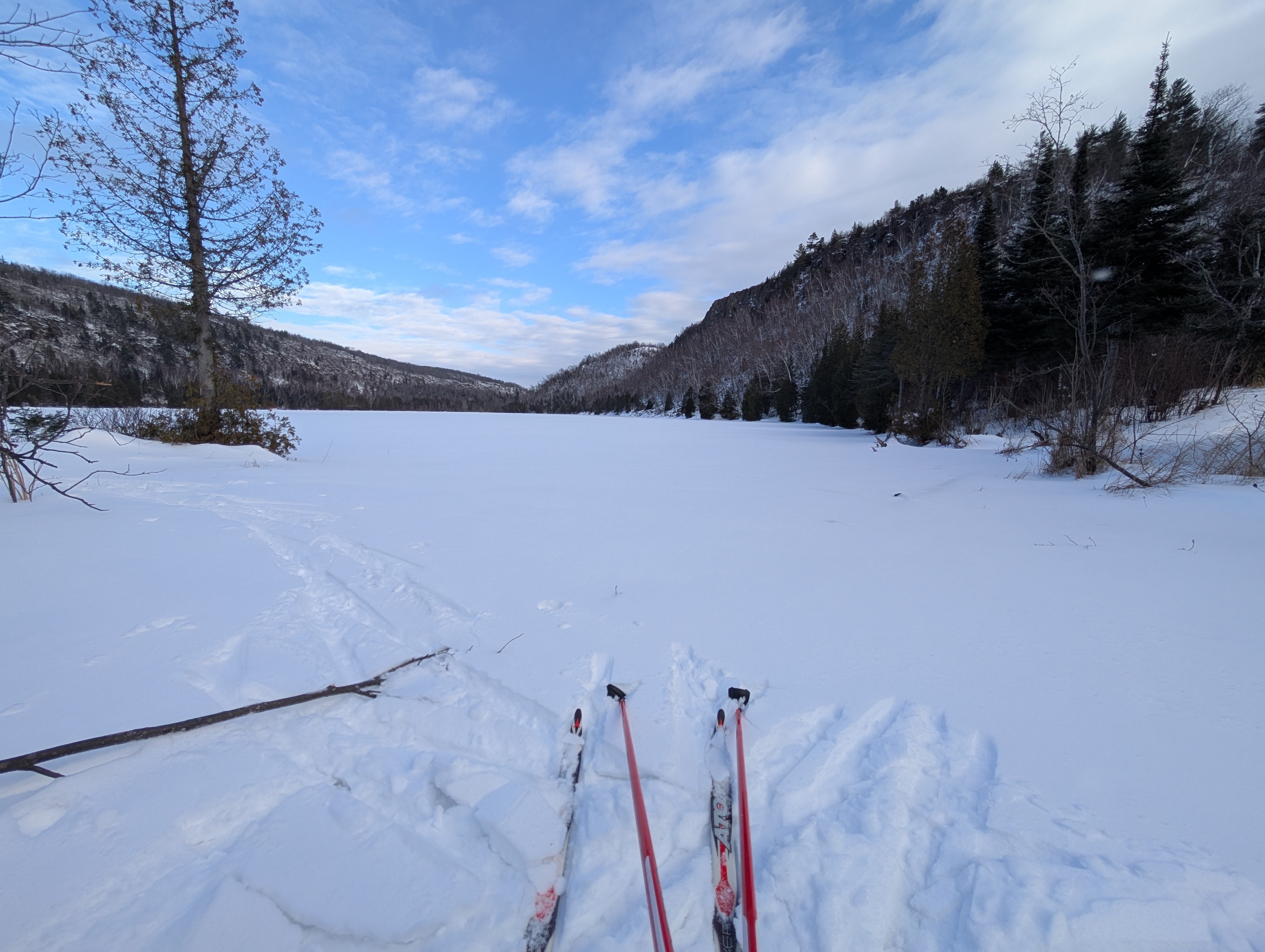
I start 2026 on the Northwoods ski trail outside Silver Bay. Conditions are poor: the snow is icy crust, the trail littered with debris. The trail to Palisade Valley, the greatest of Northland skis, is ungroomed and overgrown. No matter. There is nowhere else I’d rather be.

I follow someone else’s tracks on the ungroomed trail to Bean Lake, where I sit on a log for a minute. The grey clouds open up in a circle over the lake, a dreamy baby blue; an eagle glides the length of the lake and pauses overhead. Sunlight filters through, makes the lake’s floor and walls glitter. It splashes across my notebook page, a pulse of warmth on a single-digit day. I think back on past visits to this lake, drift into a realm of dreams.

What do you get when you strip away all the rationalizations, dip into those deeper corners of the psyche? I defend much of what civilization has given us, its incredible progress and smoothed rough edges off our greatest extremes. But there is a dialectic here, an ear willing to listen for the tune of things. Feel the more primal urges, the pull of the wilderness, the desire for communion.

It comes out in rootedness to the land; the instinct that will drive me into a grotto along a plunging stream or out into a cathedral of pines or along these silent white trails, a drift out of linear time and into the rhythms and cycles that are at once more opaque and more meaningful. It comes in a hunger for the language of faith, not because I am deeply devout but because I think we chop off some fundamental piece of the human experience when we cannot go there, get left with fairy tales and happily ever after pablum (or, worse yet, defeated resignation) instead of the full triumph and tragedy of humanity. We can construct a rational vision of a future with a career and a credential checklist and a house and even a lifestyle and some idealized family life, but a mission-driven push toward that eyes-open rational dream loses some ability to trust the waves, cannot quite lose itself in deeper communion with an awesome external force. True rootedness, true vocation, true love: the source of their strength is somewhere in here.

In 2026, I will trust the pull into parts unknown. Quit the scrolls, touch grass (or snow) and chase deep into the places where the pinging device cannot dictate action. Stay out for that extra conversation, that last drink at the end of the night. Let the eyes wander, ask questions, try out new ways of moving through and find people who share that intensity.

I have only ever been an intermittent dreamer. Rarely do I remember much. But when I do it almost always brings a warm glow, usually some pulse of youthful intensity, one with some kid who breaks down the barriers of his reserve and finds his flow state, his pace. Dreams may not be reality, but sometimes they tell us more about the true nature of things than a lifetime of careful calculations ever could. My belief has never been deeper.

Building from Within

Through seven games there has been no obvious moment of arrival, no loud statement. But slowly, steadily, the Duluth East Greyhounds are stirring to life. They have some talent, flashing some genuine skill and a deadly power play. There is some real depth. They play feisty hockey, willing to throw some hits without tipping over the edge. After the dark depths of last season, Greyhound hockey is starting to resemble its great legacy again.

The Hounds have taken care of the teams they should beat. They are winless in four games against top 15 teams, and while the first two were lopsided, the more recent ones show signs of progress. First, they took Holy Angels to overtime, pestering a rising power and coming very close to a tie; later, after struggling in the early going against Eden Prairie, they seized the initiative and pushed the Eagles to the brink in a 4-3 loss. They’ve also got a tie against Grand Rapids, a statement to a rival and section favorite that they can hang with them. East hockey is entertaining again.

The key to the fresh look is a youth movement, which is especially pronounced at forward. Marccus Anttila is the lone senior on the top three lines. Sophomore Zane Medlin is starting to flash his skill, leading the team in scoring and looking genuinely scary when he gets loose. Mckennen Kramer and Fin Kuzmuk have some good moves; if they can round into complete hockey players with vision on the ice, they will be a lot of trouble for opposing teams. Jax Edgerton is a candidate for most improved player, while Easton Orhn adds some welcome fire. The lower lines can play intelligent system hockey and hold their own much more often than they could the past few couple seasons.

The defensive corps is solid. Liam Brooks is the showstopping sophomore star, perhaps the best next-level Hound prospect since Ryder Donovan. But Landon Pearce and Henrik Spenningsby are stalwart seniors who have gutted it out through rough years and are now team leaders, Wally Lundell’s big presence makes a difference, and Greyson Medak is contributing right away, too. Throw in a veteran in net in Nolan Nygaard and there is a lot to like on the back end.

There are limitations. Even if Medlin rounds into form rapidly, scoring up front is going to have to be by committee. The team needs to keep flushing out the dumb habits that aggravated me so thoroughly over the past two seasons. There have been and no doubt will be plenty more youthful moments. The coaching staff needs to keep working through its collection of interesting pieces, find combinations that click, and put kids in positions to succeed. (They also need to bring back the black jerseys.) The right-sized schedule gives them a chance at a winning season while still providing a healthy number of real tests against quality teams. I could see them cracking the top 25, but they are not yet the top-15 type of squad we came to expect out of East for decades.

But, in this season’s Section 7AA, what they are is enough for legitimate contention. No team here is elite. Rock Ridge has the flashy top line, but has some question marks in back as they look to play complete games against good teams. Grand Rapids has a lot of returning experience but has not looked particularly impressive in the early going. Undefeated Duluth Marshall has a solid core of seniors and juniors and will likely peak this season; it’s a golden chance for the Hilltoppers to cash in on a quality core. Their high end is not overwhelming, though, and their paper-thin schedule raises real questions about their preparedness for serious playoff tests.

There is a deeper current to my optimism, too: no matter where this season goes, this doesn’t look like a flash in the pan. The Duluth East youth teams, all the way down, are somewhere between good and great. There is legitimate talent, and it will be flowing into the Heritage Center in the coming years. It is a testament to patience, to building from within and the hard work of a lot of good people who knew that the valleys this program has faced this decade could not hold up: the east side of Duluth just has too strong an infrastructure for a good community-based hockey program. Now I will make a few more requests: a renewed student presence, and the families coming together as a group instead of hanging out in clumps of twos or threes. (Can we also get more than three cheerleaders, and perhaps a ten-piece band that shows up for ten games a year instead of a 50-person ensemble that appears at random with such volume to render speech in the Heritage Center impossible? As long as I’m dreaming, I might as well make the request.) Let’s take care of our cultural inheritance, please.

Enough of the soapbox, though. To all of my current and future friends in the program, keep putting in the work; for all the long nights and occasional dramas, we’re doing a lot right. If you’re one of my casual East fan readers, get out there and see this team. It’s not peak Dave Spehar or Garrett Worth Greyhounds, but it is lively, competitive hockey, and a healthy reminder of what this program, and this sport, can be. Just keep building.

The Price of Commitment

In the late stages of Duluth East’s dismal 2024-2025 hockey season, I commiserated with a dad with whom I watched many games that year about the state of the program. The dad listed off a heap of players who were no longer with the program and sighed as he watched his own kid, one of the relative talents on a bad team, struggle to do what he could. “This is what we get for being loyal,” I lamented.

It was a strange, spontaneous comment whose bitterness has stuck with me since. Why was I so down? Loyalty is a value I hold deeply, both to people and to place. Such conviction comes at a price, and the tests of those things held most deeply reveal true character. People who know themselves, writes Joan Didion in “On Self-Respect,” “are willing to invest something of themselves; they may not play at all, but when they do play, they know the odds.” In that momentary lapse in a hockey arena, I forgot my respect for the odds, forgot that certain sacrifices are worth it if we truly believe what we say we do. I hope not to do so again.

Hockey was among the least consequential areas where I felt the price of loyalty this year. I fell deeper into a relationship than I have in years, and then I fell out of it, largely because my ex and I could not reconcile ourselves with the quasi-spiritual tie I feel to my hometown, where she does not live. I enjoyed my time with her, but I had to deal with the consequences of questioning one of my most deeply held articles of faith, and that faith won. At work, I dealt with the whims of powerful people beyond my circles of influence that have battered my employer; I got to be the executioner for a layoff. And yet, after fighting through the worst of that, I have found some of my past career ambivalence overrun by a deep commitment to the work I do and the places that I do it. I have come out of this year like a soldier who has been to war: bloodied, bruised, saddened by losses, and more committed to my core loyalties than ever.

As I worked through new life challenges, I realized what a hardened soul I can be. “You’re going to find that you are very set in your ways,” a friend who entered a long-term relationship with her now-husband in her late 30s warned me as I entered mine this year. She was spot-on. I am set not only in certain habits and what gets on my nerves, but also in how I manage conflict. I can dither, take too long to say important things, but when I make decisions, I do not second-guess them. I am not so bold as to claim I always make the right decisions, but I think I make the best decisions I can make for myself in the light of what I know, and that knowledge is enough. Again, from the Didion essay: “To have that sense of one’s intrinsic worth which constitutes self-respect is potentially to have everything: the ability to discriminate, to love and to remain indifferent.”

I am more confident than ever that I have that self-respect. I can discriminate with some confidence, even when I know it will hurt to do so. I know the tools I need to find a necessary level of inner calm. With that calm, I can accept that I have given everything I could, note any mistakes for future reference, and solider on. Explained poorly this thought process could feel heartless, but it is sustained by a flame burning beneath me, a restless fire of life that refuses to dwell, refuses to lapse into too dark a place because there is too much more to do. I know where to go when struggles arise: sometimes into the woods, sometimes into these words, perhaps into the arms of a few people who have been there through it all. But I go there and I make my commitments and that is that.

My confidence in these decisions gets some juice from the recognition that even a heavy year did not appear to age me much. In a weird way, I rediscovered some youth over recent months, gained insights into that flame beneath. “Don’t let the old man in,” repeated Uncle Bob on our summer hike in the Uncompahgre, a mantra for a man entering retirement who can still power up fourteeners. I am in a different stage of life, but I took those words to heart this year as I worked out more than ever, kept up my own travel pace, and found myself grumbling when other people preferred to sit and vegetate. Call it the Rob Jones effect (named for Uncle Bob’s son, my literally tireless cousin and semi-regular travel companion), call it some restless spirit, but it is core to who I am. I want to chase new experiences, say yes to things that make me a little uncomfortable, stay out until the end of the night if the situation demands it.

That value of youth was one of several things I learned or re-internalized over these tumultuous months. I can sometimes be a bit thermostatic, channeling the moods of people around me; that adaptability is a part of who I am. But beneath that there is a core, or at least a preferred set of modes I like to channel. The careful rationalizing of how my skillsets may complement another person’s, which works well in the work world, makes much less sense in a relationship. Instead I must trust the instincts, trust the passion, trust the pursuits I cannot shake. They are right more often than not, and even if they miss the mark, I can walk away with only the right regrets.

One of the beauties of being a writer, one that helps immensely when wrestling with tough questions, is that I have often pre-written the words I need to deal with just about anything. I reread parts of my blog in trying times this year: my last two year-end posts, the posts about my travels, each of which finds new ways to reveal something about who I am. But the core is the fiction I play around with, where the relevance of a few passages are obvious enough.

Here, a character named Evan ponders the suicide of his father some years prior:

It strikes him suddenly that, unlike ever-questioning Mark, he’s never really been consumed asking why. He wonders what went through his father’s mind, certainly, and wishes he’d had the power break his fall, been given some insight into the sickness that plagued the man so that he could have expended every ounce of his energy into saving him. Easy to say now, he thinks, but he does like to believe he could have done so, and even if he couldn’t, would have been able to make peace knowing he did all he could.

This is his style, he thinks to himself, a smile growing on his face. He is comfortable in reality, knows his limits, all guided by his faith. Faith in what? It almost doesn’t even matter since it just works for him, day in and day out, the lows never too low.

He wishes he could talk to his dad again, yes. He knows he carries some part of him inside him. He will never know what could have been. And yet, there it is: from the start, he’s managed to accept that nothing he can do can change what is done, and that it is his solemn task to take tragedy and turn it into something that can empower him. It seems almost cold. He can picture himself trying to explain this to his mother or Bridget and coming off as robotic, the self-improvement machine moving on with no need for pity. Perhaps this is why he can’t say a word about it.

And then Evan’s friend Mark, running trails on Nantucket, hung over after the pursuit of a woman did not go quite as planned:

He’s not quite sure how long his agony lasts, whether it is five minutes or half an hour, but it doesn’t matter. This is more than some stray hangover. He is a piece of trash, a useless scum, a kid with promise who’s pissing it away in a silly performative world of endless nothing. This will be the end of the line, the wake-up call he needs and the liberation of a sickened soul. No more descents into hedonism without purpose, no more sad nights alone in his room. And then there, squatting in a bush, clothing caked in sweat, hands buried deep in his disheveled hair, he turns his gaze upward and his closed eyes perceive the world through those of a child, future or past he cannot be sure, and suddenly he feels the pain easing away, drained out into this sandy Nantucket soil where it can remain.

Mark rises and begins a steady trot back to the beach house, ready to guide his charges out on a tour of the island’s lighthouses and feed them a fresh seafood dinner. His stomach rumbles softly. The wind tugs his hair in and out of his eyes. He smiles a manic smile. He’s found his pace.

I thought of these words as I laughed off a theatrical stumble on a ridgetop trail run of my own the weekend of my breakup. It hurt, but I kept on going, and there is so much to look forward to. Family holiday season is upon us. Winter is here. Ski trails beckon and hockey rinks call. I have next adventures to plan, decisions to make over how to pursue deeper commitments. A ferocity of life takes hold, and I push onward at my own pace.

Gateways and Arrivals

Arrival in Florida feels like one prolonged wait. Upon landing in Miami, my mom and I undertake an arduous trek to the rental cars. A four-hour drive means our entrance to the Keys comes in darkness, a journey across suburban strips and swamp and long, lonely bridges into the night. We are on a journey to celebrate my mother’s retirement, freed from city politics and social service provision after many long years at the Duluth Public Library. We’d planned a version of this trip in April 2020, but after the world intervened then, we are now free to do it well.

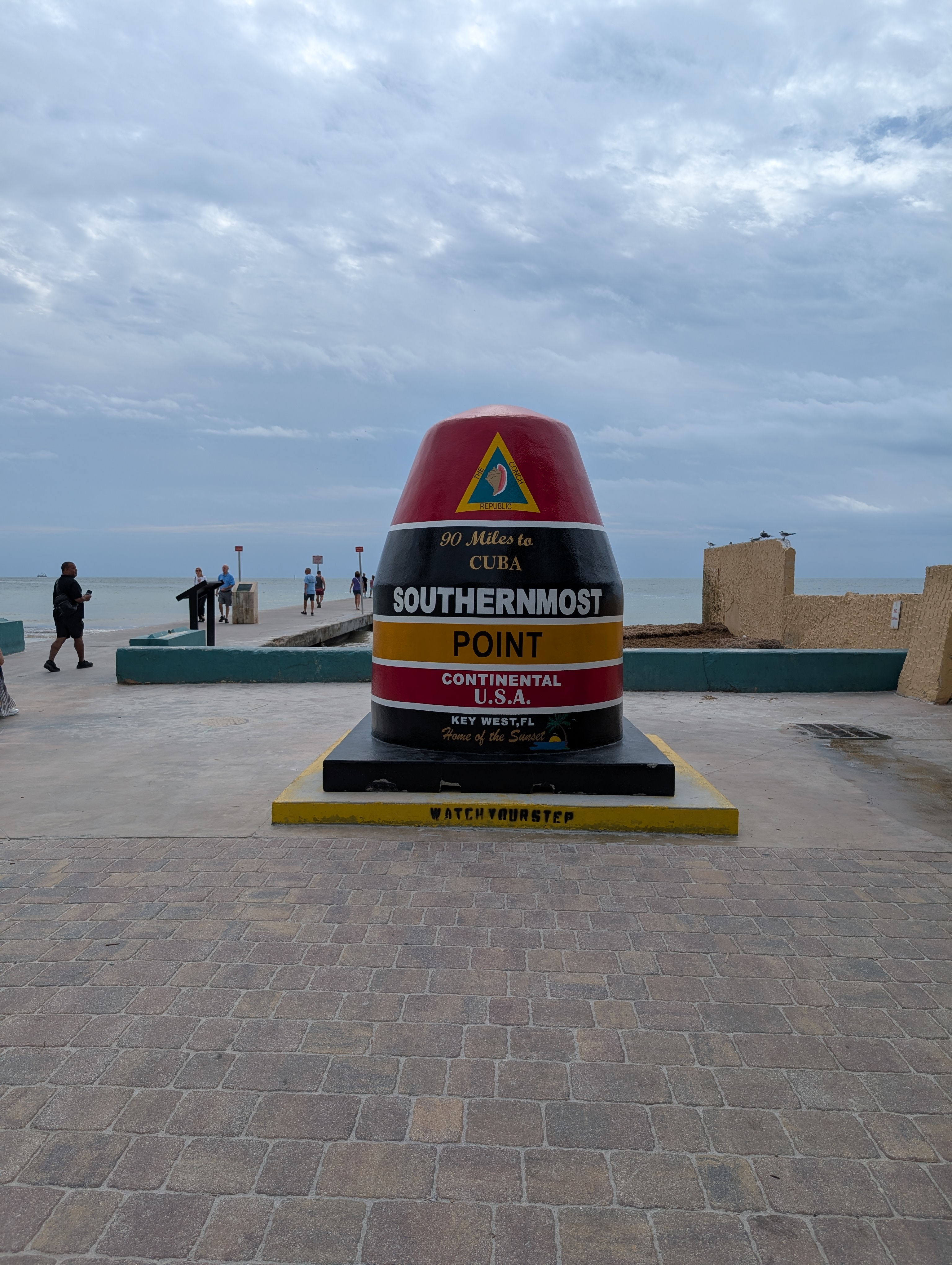
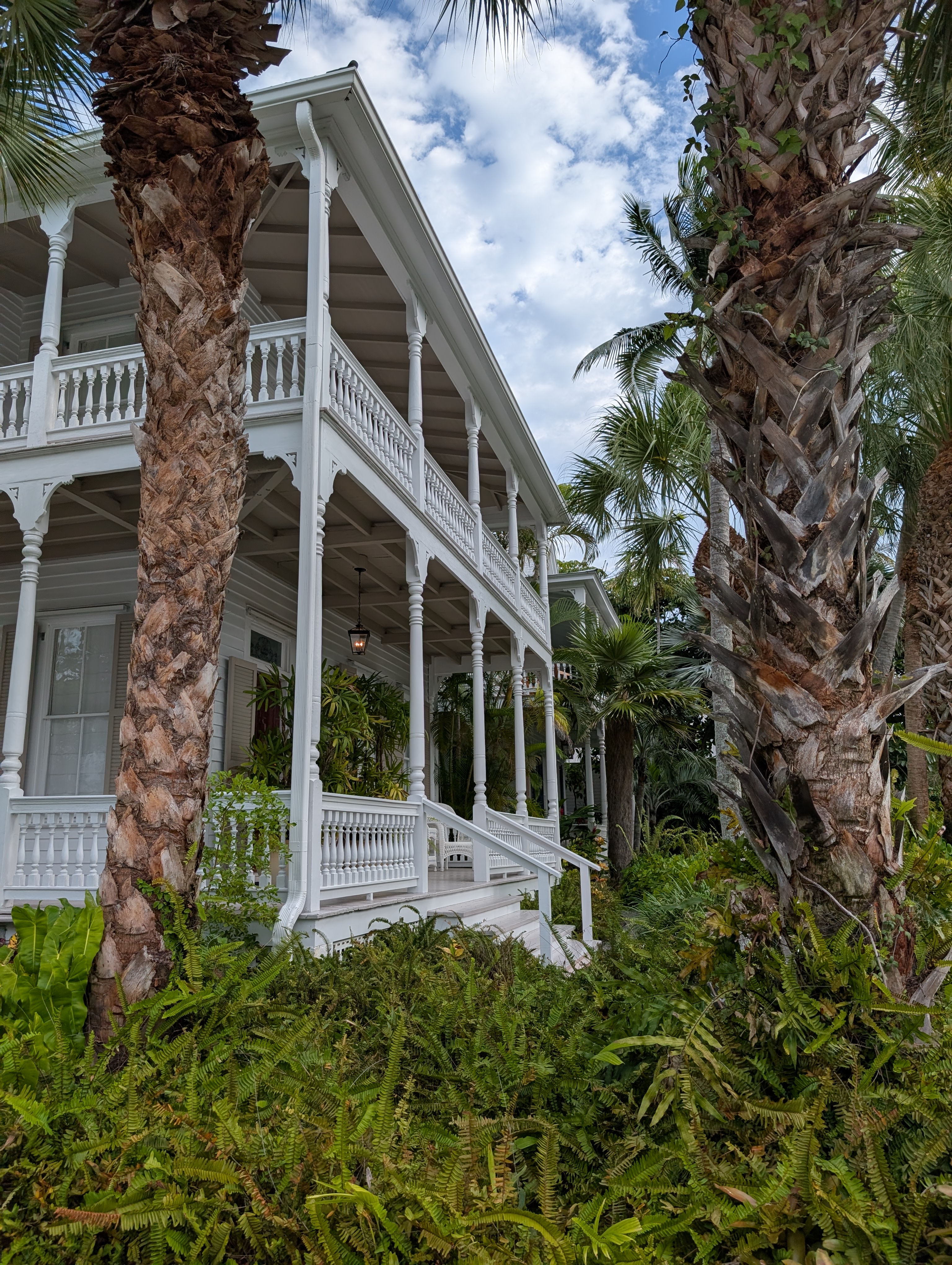
At the end of the bridges sits Key West, a land of tasteful bungalows and grand verandas, the whole island colored by a tropical languor, the stately repose of a retreat at the end of the road. Grey skies put it in a sense of slumber, a promise not quite fulfilled upon arrival. We are here midweek in the offseason, but the party goes on every night at Sloppy Joe’s and Captain Tony’s and a few dozen other tiki bars along its main drag. Duval Street is a Bourbon Street for middle aged white people, live guitars in every bar and beer and cocktails around every corner. A power boat race is in town this week, with souped up trucks to match; just about every man looks like he is here to fish. Here there is some risk of paradise as a commodity, a repeat soundtrack of Bob Marley and Jimmy Buffett, endless references to the drinking that will happen here. I am not here to fish. I am here to have a few drinks, but we are not exactly set on shutting down the bars, either. I am not really here to escape, but instead to take a pause that lets me write, be with the companion I’ve traveled with more than anyone.

We take up rooms at the Eden House east of the city center. The rooms themselves are tight ground floor spaces, but I am of the camp that doesn’t much care about the interior of a hotel room beyond the basics: it is a launching point to go do other things. The Eden House’s pool deck has seating for all types, and a second story veranda is the hotel’s steal, one of those venues for Southern graciousness that is too often lost from later architecture. I sit out here and write three ways at once, this post and a possible follow-up and some musings on where my fiction goes from here. This town has punched above its weight as a retreat for writers for over a century, and I can only dream to catch a hint of that inspiration.

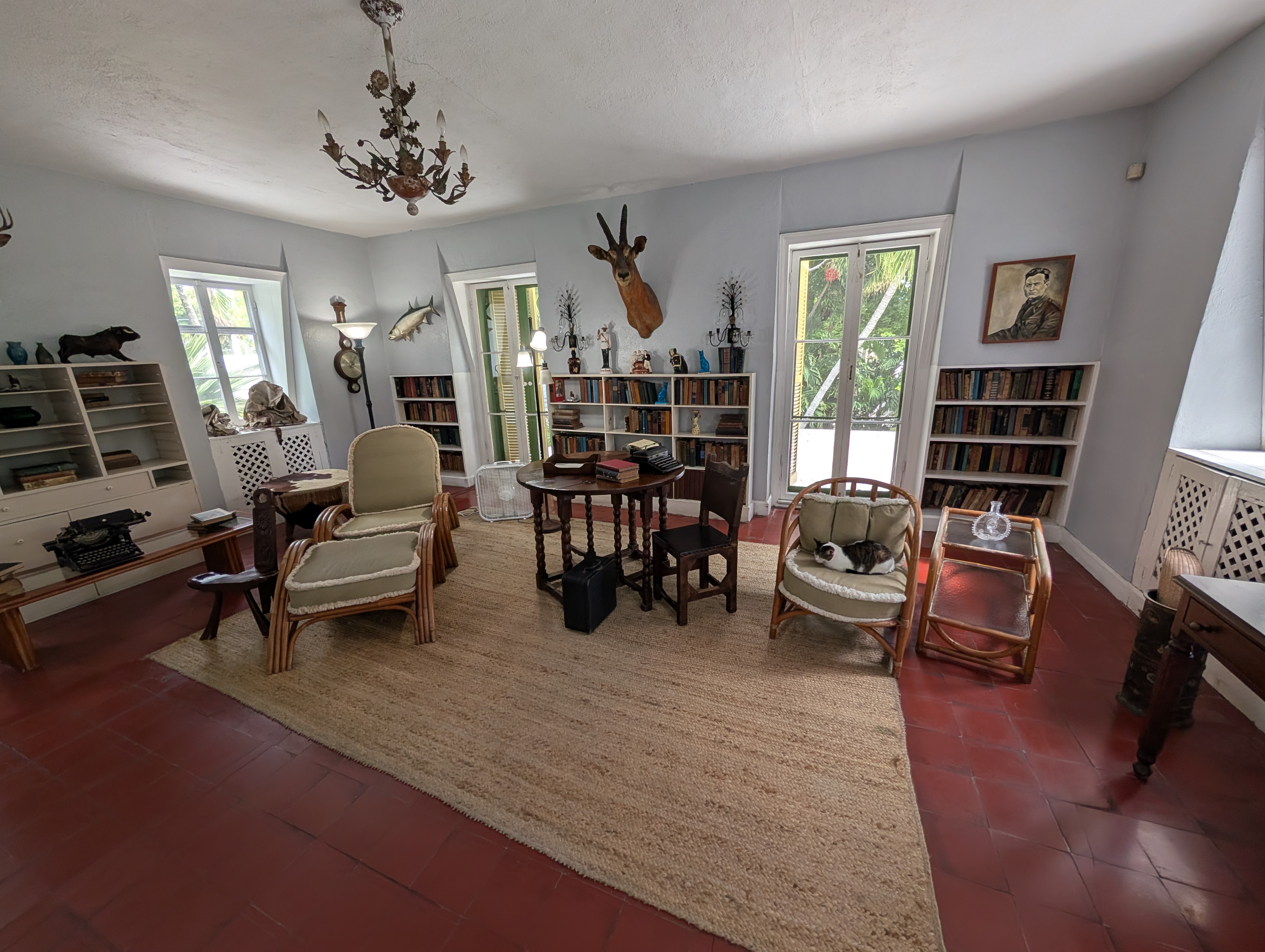
The Hemingway House is the highlight of Key West. The 61 cats prowl about and the writing studio sits in repose, books and typewriters and trophies from a life without limits, mementos of boxing and bullfights and fishing trips and safaris far afield. Here I find some of that awe, this time at that masculinity unleashed: the women and the parties for a warrior and a thinker, a man drawn to the questions of his time and the places where the action was, his pursuit straight up to the edge and then straight over it because what other way is there to live? Here the old man met the sea, fought it at times, churned out many of his greatest hits. He produced a legacy that smashes the underlying tragedy. The cost may or may not have been inevitable but it is a reality and it does just boost the mystique.

Ernest Hemingway’s crisp clarity defined modernity, his simple precision that can lead a 21st century reader to swoon about trout fishing in the hills above Pamplona or bring a pack of Two Hearted Ale to the mouth of the Two Hearted River in Michigan. (Yes, I have done this.) Joan Didion taught herself to write by copying down his sentences, and I have taught myself to write by toying with Joan Didion’s work. Of course from certain lenses Hemingway’s life can now be judged or even canceled; artistry with prose faces some headwinds in a flattened world of AI summaries and messages dumbed down to the lowest common denominator. Moreover the Hemingway mystique can swallow the human tale beneath, the depression coursing through his work turned into some tragic heroism that satisfies a certain narrative of tortured genius. As a writer whose instincts are not all that depressive I wonder if I’m missing some key ingredient that I would prefer to never have, but I decide I can make do with that tradeoff.

The cherished home of a long-departed author underscores the permanence of words. Sure, the novel may lack the cultural power it had in Papa’s prime. But fifty years from now no one will be watching TikToks made in 2025. They will still be reading Hemingway. Putting down words creates a record, both in print and in type, that the ephemeral world of live video does not. Of course there are some snippets that will last, but the power to both capture and interpret, provide witness and critical distance, will remain all the stronger.

It would be easy to look around at the denizens of Key West and draw a harsh divide: us few, proud people of words who stand athwart the vapid party, immune to the siren call of the anomie of endless swipes. On a certain level I do believe some version of this argument: that is the point of a conviction. But there can still be pathways in for anyone, and pulling up the drawbridge to hold on to a snooty high culture isn’t going to change it. I instead prefer to own it, sit on a beach reading or writing and make it look good, share the best snippets here and there. And for anyone looking for a way in, Hemingway’s deceptively simple prose and chasing of great adventures isn’t a bad place to start.

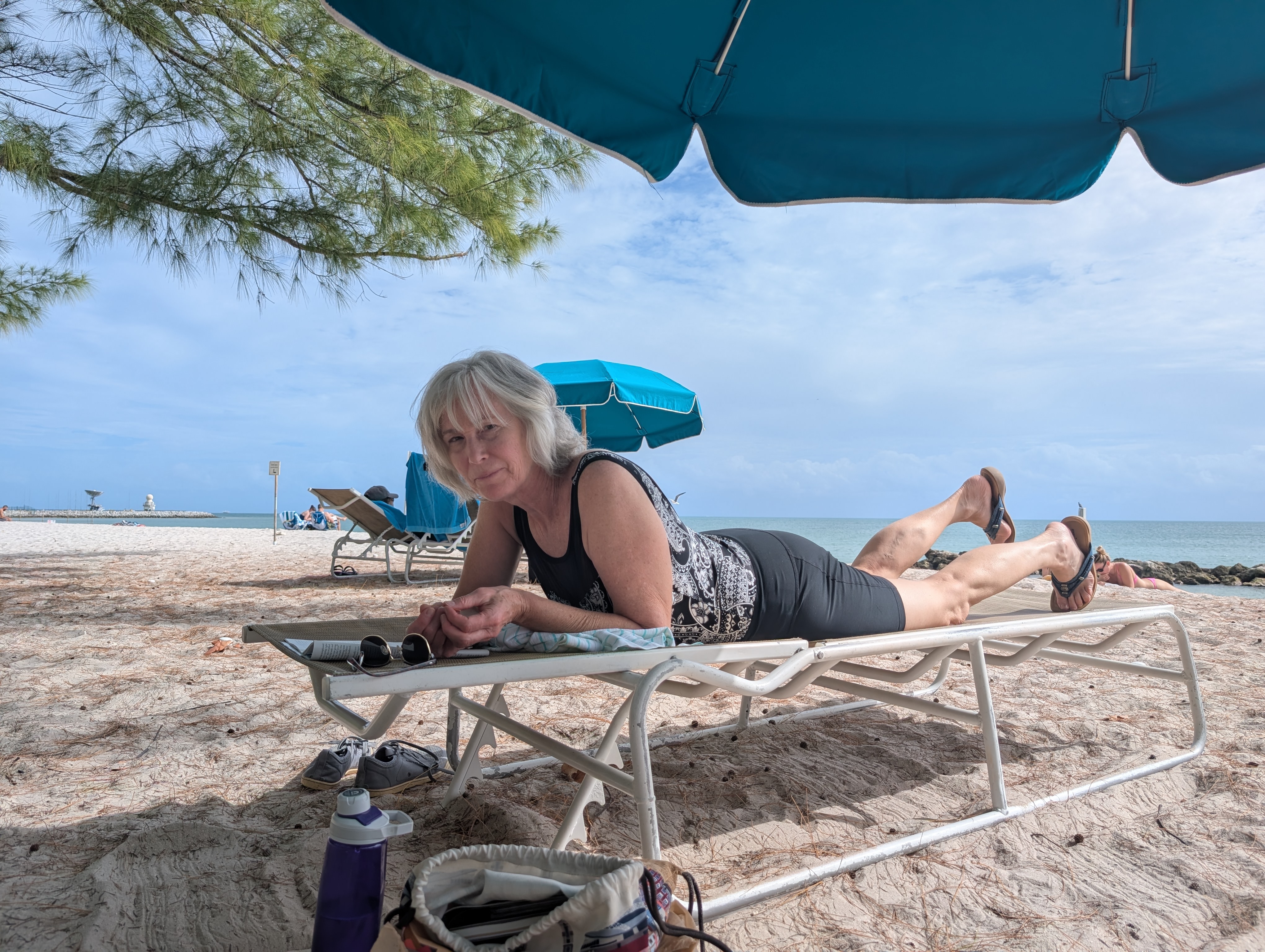
Slowly, Key West shows more as we scrape beneath the surface. We visit Judy Blume’s bookstore, wander in search of beers and a spot on the beach beneath a soft curtain of an Australian pine’s wispy needles. Truman’s summer White House is here, and the ferry to Dry Tortugas beckons for a future visit, perhaps when the campground facilities are not shuttered thanks to a government shutdown. We tour the Audubon House, never visited by its namesake but a keystone for the preservation of Key West’s grace, a spendy preservation movement that nonetheless keeps it a step removed from sinking into the tourist trap ensnaring much of the rest of the Keys. The Conch Republic puts in the effort to maintain its independence.

After three nights on Key West, we are on the move again. This, I think, is my style of travel: a meander up an island chain, flashes of both wilderness and city, parts unknown and the center of the action. As we drive up the Keys we stop at a state park for halfhearted snorkeling, a bit of beach time, a stroll up the old railroad bridge that first knitted the islands together. Later we pause at a roadside carnival show named Robbie’s, where we feed some tarpons and see some manatees and dodge the scavenging ibises and pelicans. From there we are off through the wet lowlands and back to Miami.

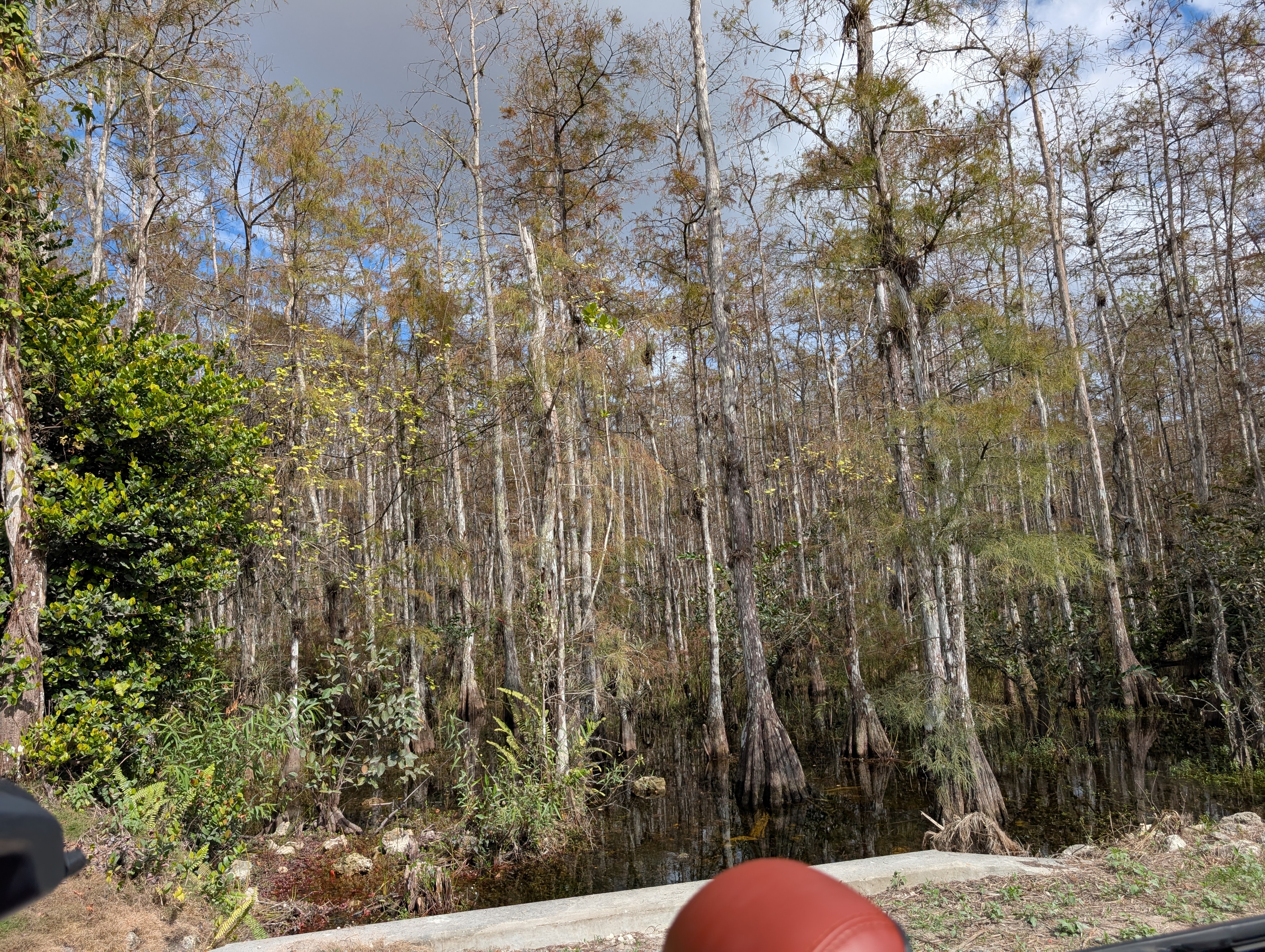
In Miami the skyline glows as warmly as many of the well-toned bodies, but for all the glaze it cannot quite hide how it is paving over a swamp. On our second to last day in Florida we immerse ourselves in that swamp and shoot up the Tamiami Trail, a 1920s causeway that colonized the interior of the Everglades. Even now, it is a wild place, the kind of locale an ambitious xenophobe would set up a migrant internment camp. (Sure enough, loud signs announce the presence of Alligator Alcatraz.) South Florida’s history is a series of battles against the rising waters, a desire to tame them and cut back that thick, oppressive brush to replace it with orderly rows of palm trees. This region’s boosters sought to roust the beasts who live in these swamps and the last people who hid away in these refuges, or at least tame them into a roadside attraction.

A circuit on the Big Cypress National Preserve’s loop road is a safari through a menagerie of birds, a few dozen alligators, and a slow roll through everything from dense watery forests to reedy cypress savannas to a tangled mass of endless scrub. It contains a wildness and a secrecy that the open West cannot match, the eyes only so much good in trying to explore it. Even a short hike on a nature trail leaves a little claustrophobia, a question of what might lie around the next bend, the mosquitoes rising up and some mysterious scat marking territory in the middle of the trail.

On the way out we visit the Miccosukee, a Native tribe that battled the U.S. government beside the Seminoles and later retreated deep into the swamp to retain some independence for as long as they could. Their roadside attraction of a village is sleepy today; the expected tour guide never appears. But the camp is well-tended, the museum behind carved alligator doors tells the story well enough, and a show demonstrating how to properly tame one of their rescue gators is a window into a different world.

Out of this landscape rises Miami, one of the nation’s largest metros. Miami’s story is an updated version of a very American story, a gateway city haphazardly absorbing immigrants. It has all of this country’s greatness and all its flaws: a rush of development, a hunger for freedom and parties and sexy bodies, out with the old and in with the new. It was famed for crime and coke in past generations but is now more of a place where people instead seek to properly model their bare chests or sports bras. With its borderland status comes tension as culture remains stubborn and ties to old countries complicate the politics. (Miami is one of the very few American cities that can still reliably elect Republicans to higher office, thanks largely to the particularities of the Cuban diaspora.) The beach gives it an allure that other Sun Belt cities cannot match; its closest analogue is LA, though it is more niche than LA, lacks its cultural power beyond the Hispanic community.

Within that community, though, Miami is everything. In my travels, I’ve learned that Latin Americans aspire to Miami as much as any American city. The heart of the allure is of course in economic opportunity, in political freedom, in glitz and glamor on the beach. But old ties are hard to break, and a visit to Little Havana is an object lesson: this neighborhood is home to a court in exile and a continuation of pure Cuba, of salsa rhythms and cigars and dominoes over cafecitos. Even with a collection of people branded with Royal Caribbean stickers strolling the streets, it feels alive, something carried forward and a place where a Hispanophile can feel very much at home.

Miami is a city of gleaming beachfront towers, but it is also home to graceful Art Deco neighborhoods from an earlier era, that great triumph of American architecture serving as the perfect backdrop for this modern-day white city. Beneath the gleaming façade, color explodes, and never more so than in Wynwood, where we spend two nights. Wynwood is gentrification central just north and west of downtown, the inevitable boxy apartment blocks and trendy restaurants crowding out the bedraggled old concrete single-story homes and empty lots. I linger on these grungy old homes, wonder what stories they have told over the decades, which immigrant lives may have launched from here. Even as Wynwood changes there is an easy drift between Spanish and English here, a dance between two worlds, and I wonder how well it will hold on to its art. Miami is strongest in the places where it keeps the tension alive.

This trip is a perfect escape to celebrate a retirement, to find some well-earned rest and adventure all at once and think about what might come next. For my part, I am not sure how high Florida is on my list for a return visit. It is a land of leisure, but not one of awe, and as a pursuer of awe this easy luxury will never quite be me. I am not drawn to resorts or creature comforts, the overly sanitized or scheduled trip. Vacations should be a little bit hard, and I don’t mind a little snow, I think as the season’s first snowflakes wander down on the drive north from Minneapolis.

On the beach on Key West I read “The Snows of Kilimanjaro.” This short story was the first Hemingway piece to capture my imagination, and like all good fiction, it tells us something that we do not know that we know. “Snows” is a writer’s lament for the things he has not yet written and may never write, a call to me to get to work. It is a confession of the fumbles with women drawn in by the Hemingway-style pursuit, with Harry in the tale pushing Helen in ways that both give her new meaning and wound her, Harry at once proud of her but still questioning the whole exercise. And it closes with a drift away from even the heaviest of earthly concerns on to greater heights, to beauty, to the white snows at the end of the line. There are so many worthy goals here, so much to unpack and to reach for. And with that, I write.

Wilderness Calling

Summer draws to a close, and the days for carefree outdoors enjoyment dwindle. In the past six months I have been to Spain and the Caribbean and Colorado and Chicago, but I have neglected the more immediate opportunities. My dad tugs me into the Boundary Waters for the first time in four years, too long an absence for someone with wilderness in the backyard.

Our gateway to the BWCA comes at the Brandt Lake entry point off the north end of the Gunflint Trail. We set out with ambitions of revisiting Adams Lake, a gem deep in the interior of the BWCA; if we cannot reach that lofty goal, we will at least settle for exploring a little-traveled chain of lakes between it and better-known destination lakes like Gabimichigami and Little Saganaga. My dad tweaks his knee on day one, however, and our itinerary shortens considerably. We settle for a three-night jaunt in and out, puddle-jump over seven portages to Bat Lake, where we spend two nights before working our way back over two days, a journey of no great physical feats that instead turns to gentle release.


It has been a wet late summer in northern Minnesota. The first portage has standing water for much of its length, and the second and third are only marginally better. The fifth has developed a mid-path waterfall. The mosquitoes of legend, usually in remission by September, are still about, though tolerable. The grey skies are steady throughout our trip. The Canadian Shield has been stained black by rainfall, steady drips off overhanging cliffs into the water below. My favorite spot on the trip is Gotter Lake, a small, marshy expanse lined whose narrow points are lined by cliffs, the looming mists clinging to the walls and drifting over the grasses. We turn into the wrong arm on our way across it, but I don’t mind the extra paddle.

Some fall foreplay is emerging in the trees, first hints of the golden eruption that will strike in the coming weeks. Even across four days, we see a real difference. The nights settle into a perfect sleeping temperature. A steady procession of geese makes its way southward, their flying Vs audible long before they are visible. A flock of cranes, meanwhile, heads west. I contemplate the stray geese who do not quite get the memo about flying in formation: is it ineptitude, or rebellion? We fend off an intrepid chipmunk who darts about the site. We reach for our cameras when something emerges from our lake; from a distance it could be a moose, but it is just another canoe. I extract a leech from its feasting grounds on my foot. We watch something steadily work its way along currents on the lake against the wind. It is a leaf.

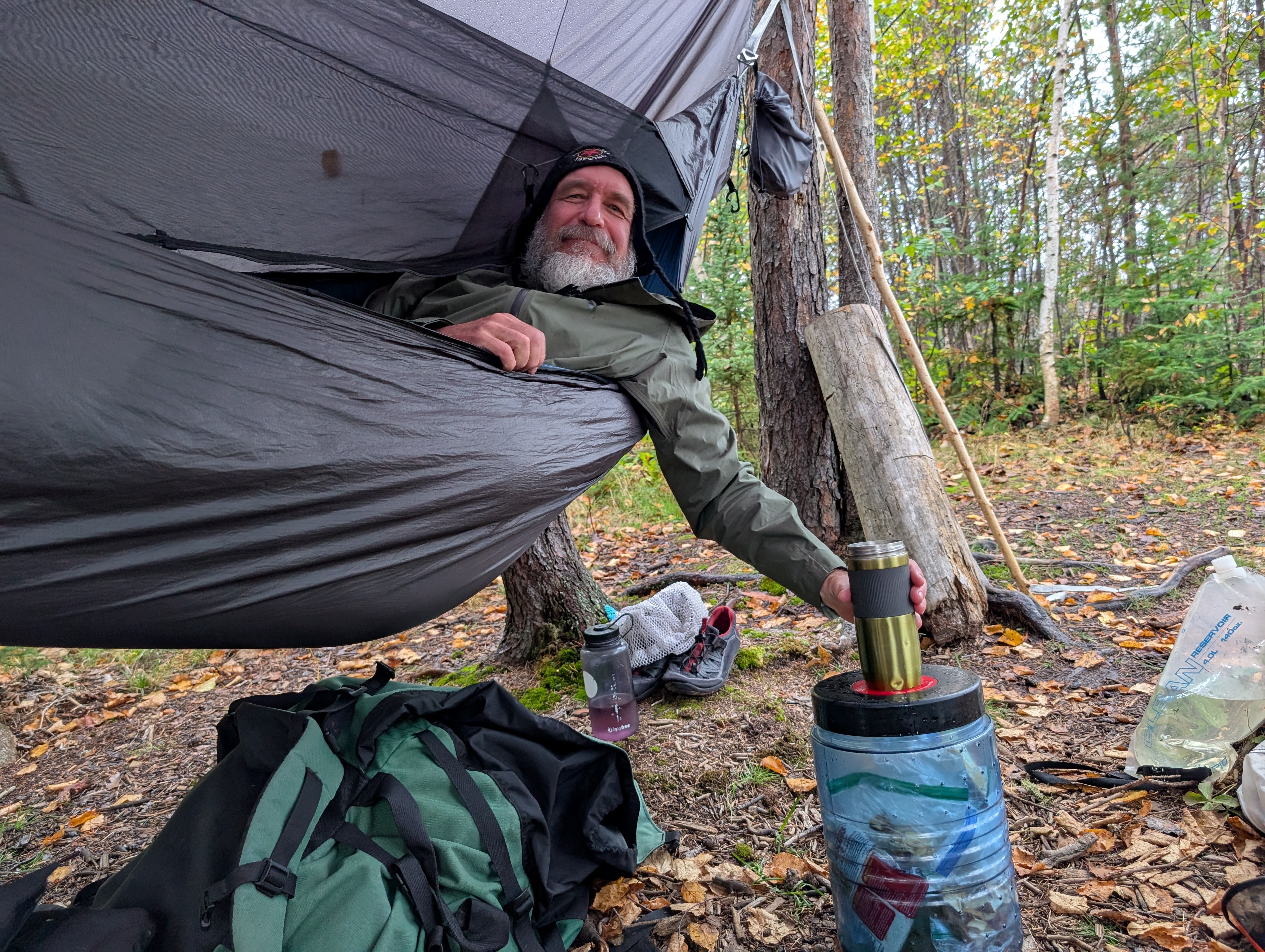
There is no boredom here, though. My dad continues to perfect the art of hammock camping, and while I stay in my trusty tent, I too set up a hammock and hang between trees to read and write and watch nights fade into darkness. This is wilderness but there are still people to liven up our days: six Brits flying the Union Jack from their lead canoe pass us on the way out and two good Samaritans take some of our gear as they double-portage in the opposite direction, sparing a second traverse of one of the longer portages on the gimpy knee. People ask about the fishing, on which we have no insight. Paddling and portaging is enough.

We grade our campsites. The site on Bat Lake is a B, with a nice sitting rock by the shore and a well-appointed kitchen and plenty of tent and hammock space. Its biggest demerit is the clear view of the latrine from the kitchen, and while it is quite likeable there is no real wow factor. Bat is not a destination lake, but it is a pleasant hideaway one portage short of better-known Gillis Lake. The site on Brandt Lake on the way out, however, is an A-plus. The kitchen sits right behind a rocky outcropping, which gives a commanding view of the lake and a place to bask in the sun or stargaze in better weather. It remains secluded, hidden from the nearest site by a protruding island, and offers a glimpse of prime moose territory in a back bay swamp. The tent pads are quality but not overused, and there are ample spots to string up a hammock for a lake view. Here the latrine is appropriately hidden, though a hint of lake is visible from a seat atop the throne.

Our conversation drifts about, from wilderness observations to retirement life to where I might travel abroad next. (Nepal? Brazil or Peru? Mount Kilimanjaro? Eastern Europe and on to Istanbul? Time will tell.) We appraise the amount of scotch we’ve brought with some disappointment at these deceptively small flasks. I read a book in the hammock and, for the first time in years, am not writing or editing the same damn short stories—one that had one installment written on a previous canoe trip—because I have made good on my promise from San Diego last November and am actually trying to do something with them.

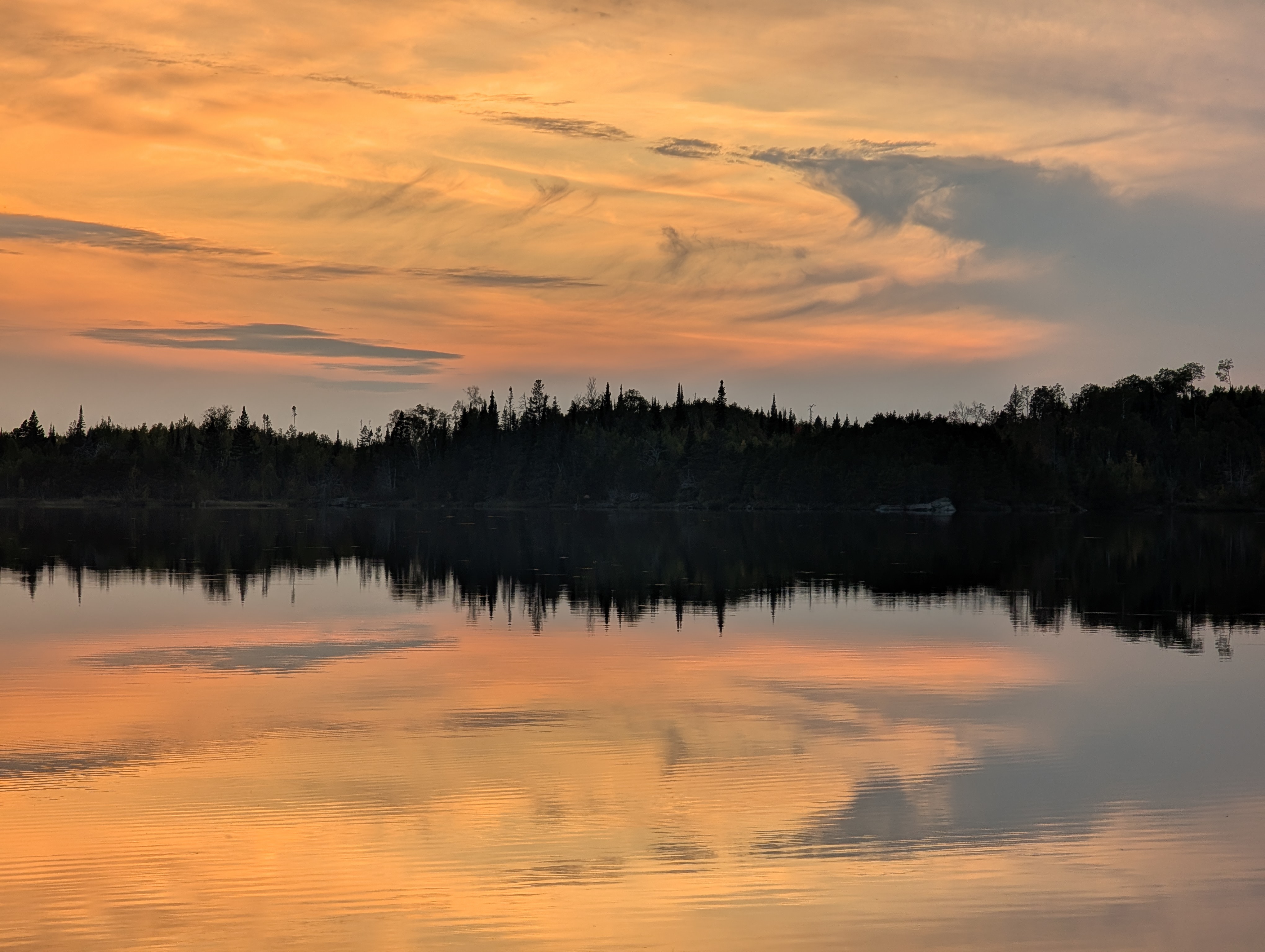
Where that goes is of little import out here. The only demands are the most immediate, and the release from other obligations and communications and intrusive virtual worlds becomes more precious over time. Here we can just listen to what the wilderness tell us. We hear a whippoorwill, a distant white-throated sparrow; a few voices echo up the lake from the next campsite. A fish jumps, a beaver tail slaps, and the aspen leaves quake overhead. This home calls to me, even if I do not visit often enough.

The call, for whatever reason, seems deeper now, more pressing. Its immediacy has something to tell me. We make plans to try for Adams sometime again soon.

A Landscape of Yearning

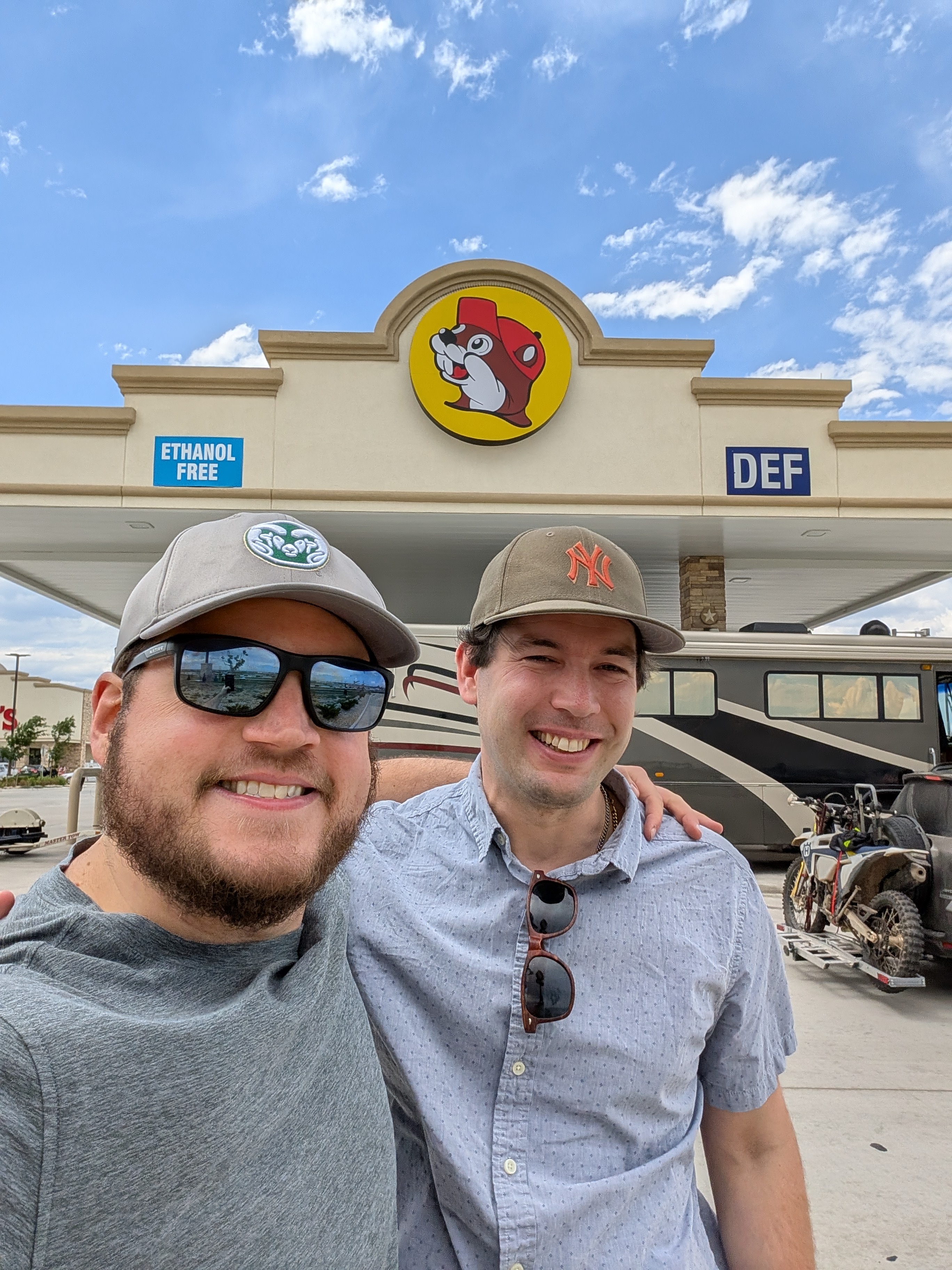
Last year I wrote that I go west for new beginnings, but this year’s trip starts with a blast from the past. I start my annual venture with a diversion away from my hiking crew’s rendezvous point in Denver and head to Fort Collins, Colorado. This Front Range college town exceeds all expectation with its verdant core, a green grid with a pedestrian mall and college bars and teeming life. A good guide helps, of course: in this case it is Joe, one of my oldest friends, a connection sustained since second grade. He gives me and a few of his friends a behind-the-scenes private tour of New Belgium, a leisurely three-hour affair that goes deeper than any other brewery visit I’ve done. The night carries on from there into the morning, dinner and drinks and debate and a blending of worlds would never have otherwise mixed. And yet it is as if we have not missed any time, our interests evolving on parallel tracks into the political world and urban planning and good beer too. This is a deep cut at a time of deep feeling, one in which words do not always come easily to me as feelings surge and demand examination, but a certainty in the paths I trod only grows.

As kids, Joe and I bonded over the Civilization computer game franchise, a fond memory for several people in our Fort Collins dinner party. That game had a certain influence on my way of being: a desire to build worlds, to advance a society toward greater glory, and perhaps to leave the Babylonians in smoldering ruins. But the game has to stop here and there, and it is time for my annual escape from civilization with my usual backpacking crew, a ritual renewed.

The venture gets off to an inauspicious start. Ed, a stalwart member of our party, injures himself on the drive west and has to abandon the trip. Our planned acclimation day-hike at the Black Canyon of the Gunnison goes up in flames as a wildfire shuts down that national park. We plan to start our official hike on the Bear Creek Trail just south of Ouray, but trail maintenance has closed that, too. As we pull up to the Middle Fork trailhead instead, signage warns us that several hikers have been attacked by sheepdogs, including one party just nine days before we set out. But the show must go on. Amy, Bob, Rob, and I head for the Uncompahgre Wilderness in the San Juan Mountains, an escape even many Coloradans do not know. This, I say, is kind of the point.

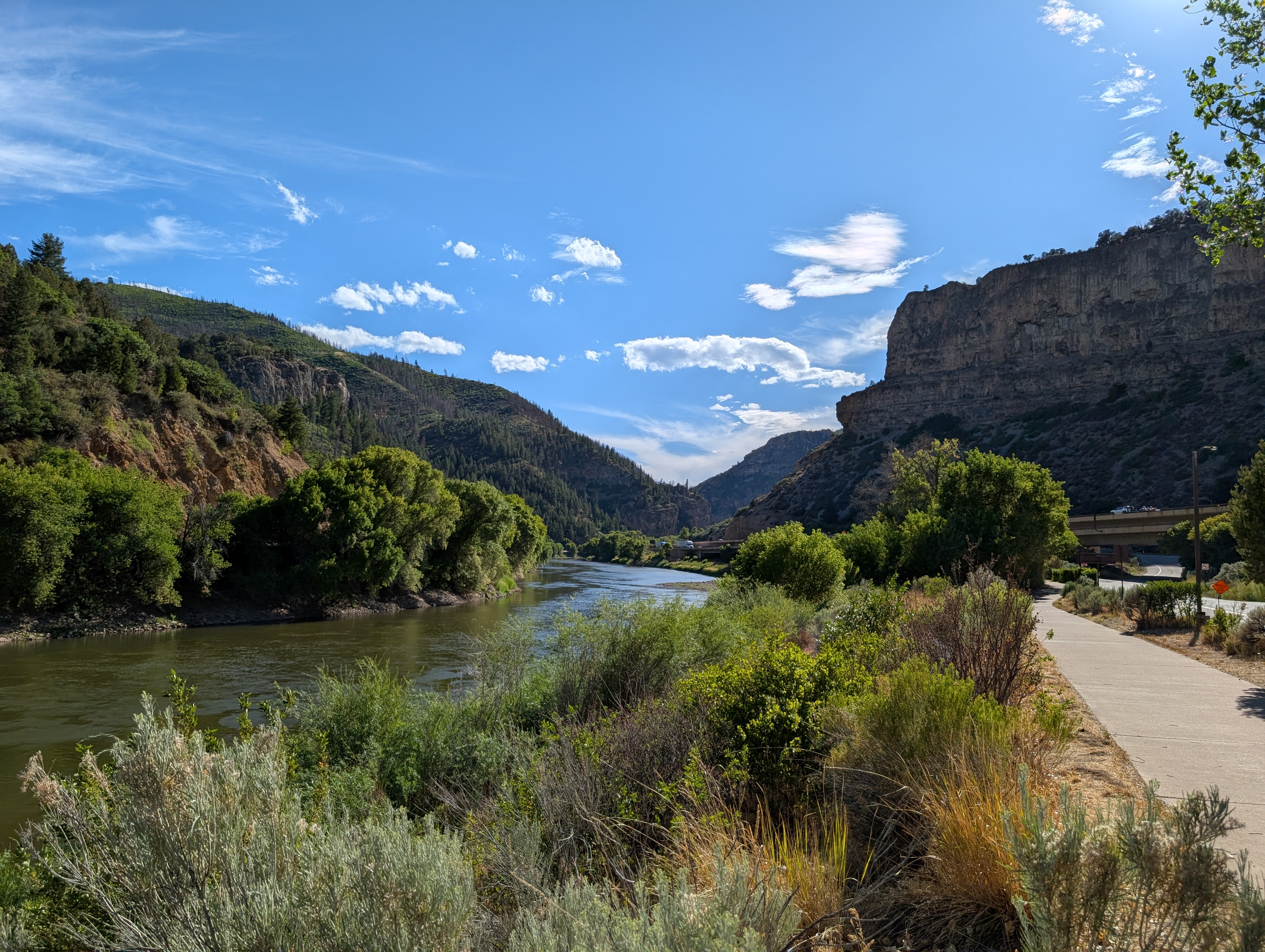
West of Denver, I-70 is the scenic showpiece of the interstate highway system. I have memories etched in amber of an Amtrak venture down this corridor at age fourteen: gazing out the observation car through Glenwood Canyon, the divinity of a Palisade peach. Somewhere on these stretches, beyond the Front Range traffic and the most extreme grades at Loveland and Vail Passes, I find my western release. We cruise down an austere river valley where dusty towns watch the world fly by, a simultaneous invitation offered and challenge posed by a landscape of yearning. It calls forth, speaks of more to find. Its treasures draws in seekers, from 19th century gold to today’s powdery slopes, from conquest of fourteeners to backcountry solitude. The Western Slope is far from the cradle of familiar northern Minnesota woods, not a safe harbor but land that won’t ever quite be so well charted and is all the better for it.

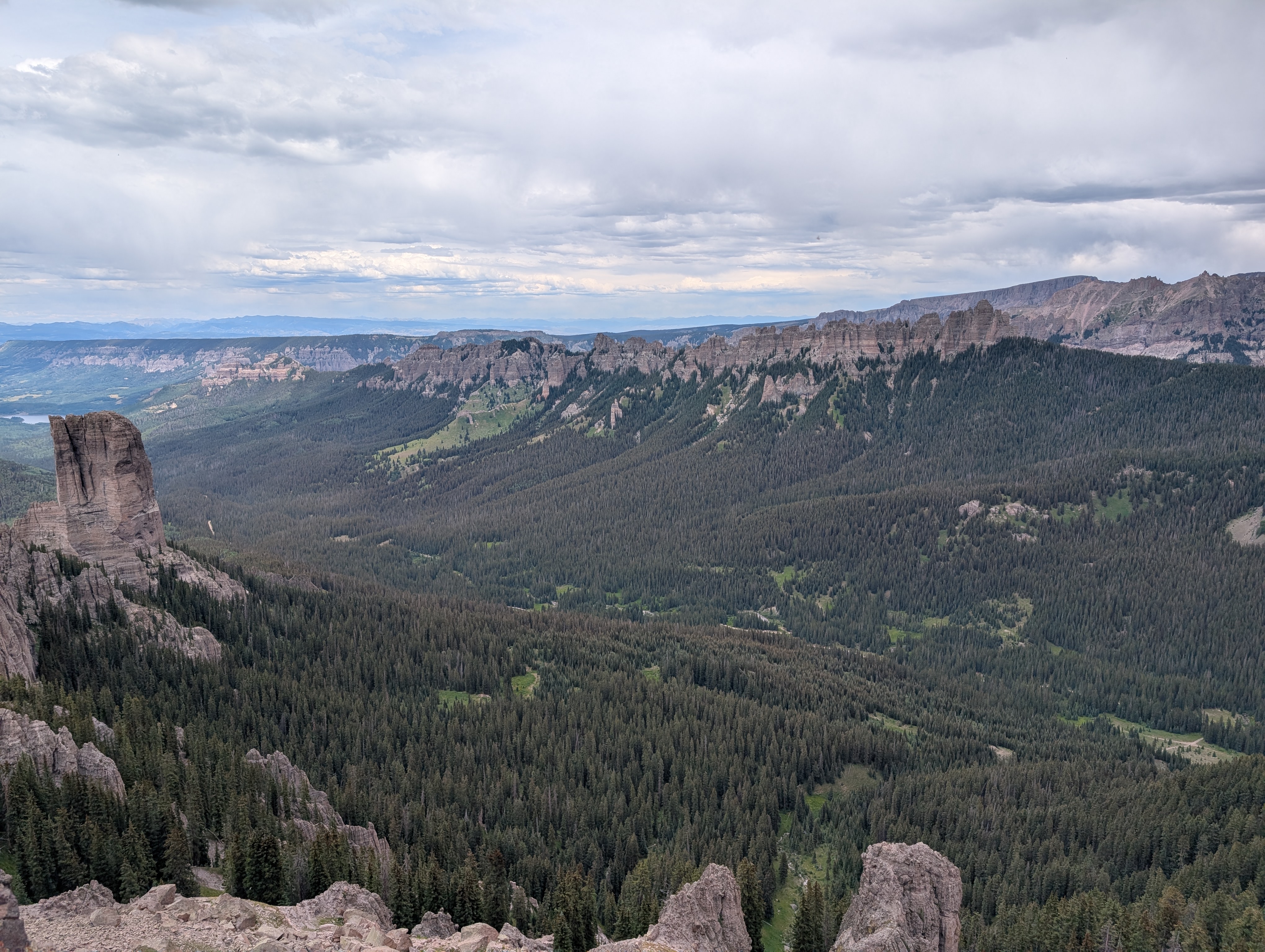
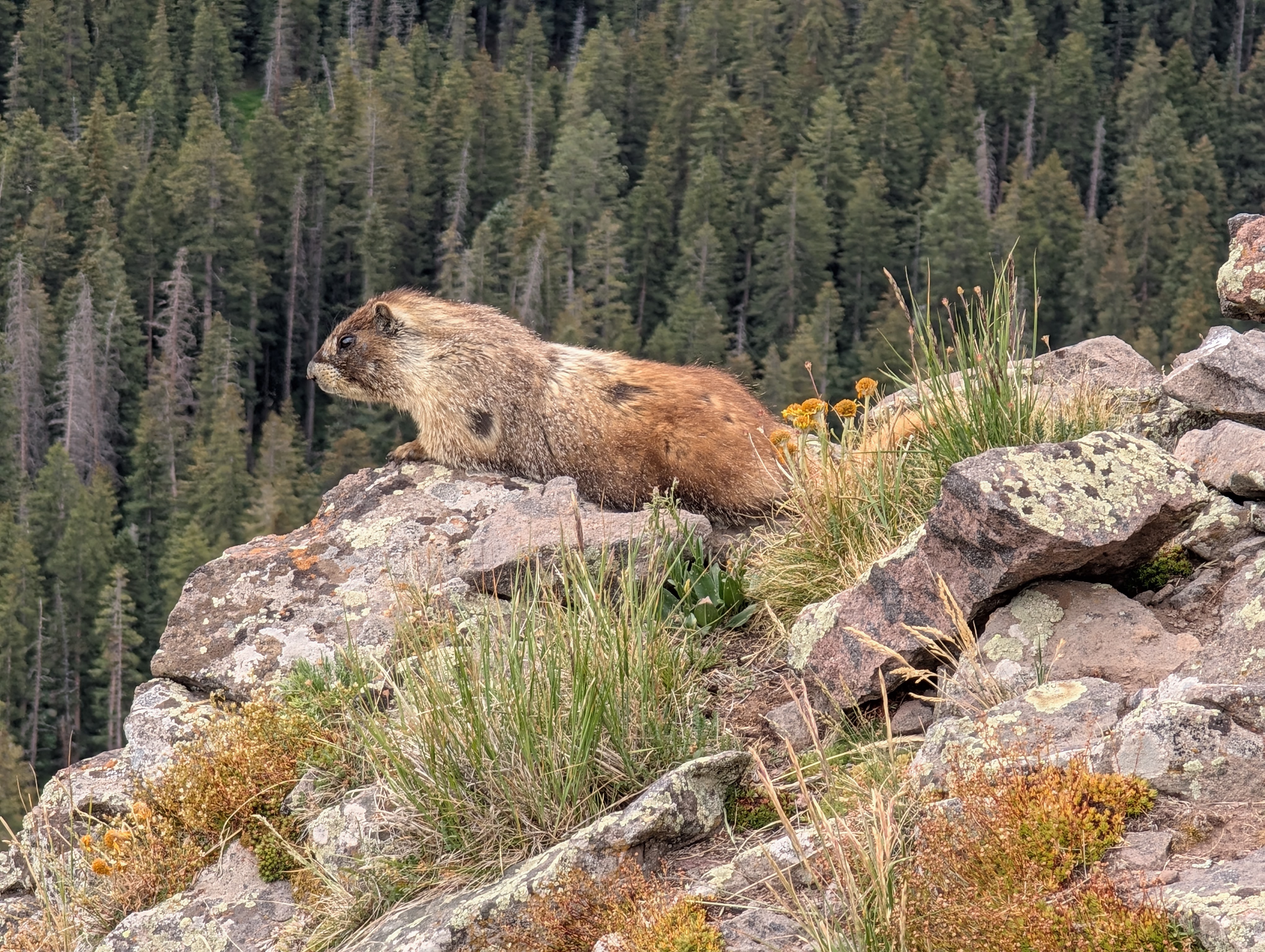
The alpenglow over the Uncompahgre beckons as we swing south from Grand Junction for a night in Montrose. We summit Courthouse Peak for a warmup hike and scramble, gaze down on the field where John Wayne finished off some bad guys in the original True Grit, and enjoy the company of a fat marmot on top. We spend the next night in Ouray, a vein of gold tucked between red cliffs along the Uncompahgre River, its sloping Main Street in classic Colorado style leading up toward the Million Dollar Highway to Silverton. Here we enjoy one of our best pre-trail meals ever at Brickhouse 737, though my pasta with rabbit cannot compete with the eight-year-old at the next table who orders the hibachi smores and roasts his marshmallows over a small flame. We pack in record time in a cozy motel beside the rushing river, breathing easier after a few days at elevation. It’s time to enter the wilderness.

Oftentimes on these trips the first day is a plod to get to nicer things, but in the Uncompahgre, the beauty is immediate. The valley of the Middle Fork of the Cimmaron River, one of three long tines cutting into the northern side of the wilderness, is just wide enough to show its ramparts, a jumble of jagged peaks reaching skyward. We camp the first night atop a meeting of rushing streams, with views up the bowl to the south and down the Fork to the north. The sun bathes the valley in gold as it sets, and a faint crescent moon gives the night a touch of light. All is quiet, and I am where I want to be.

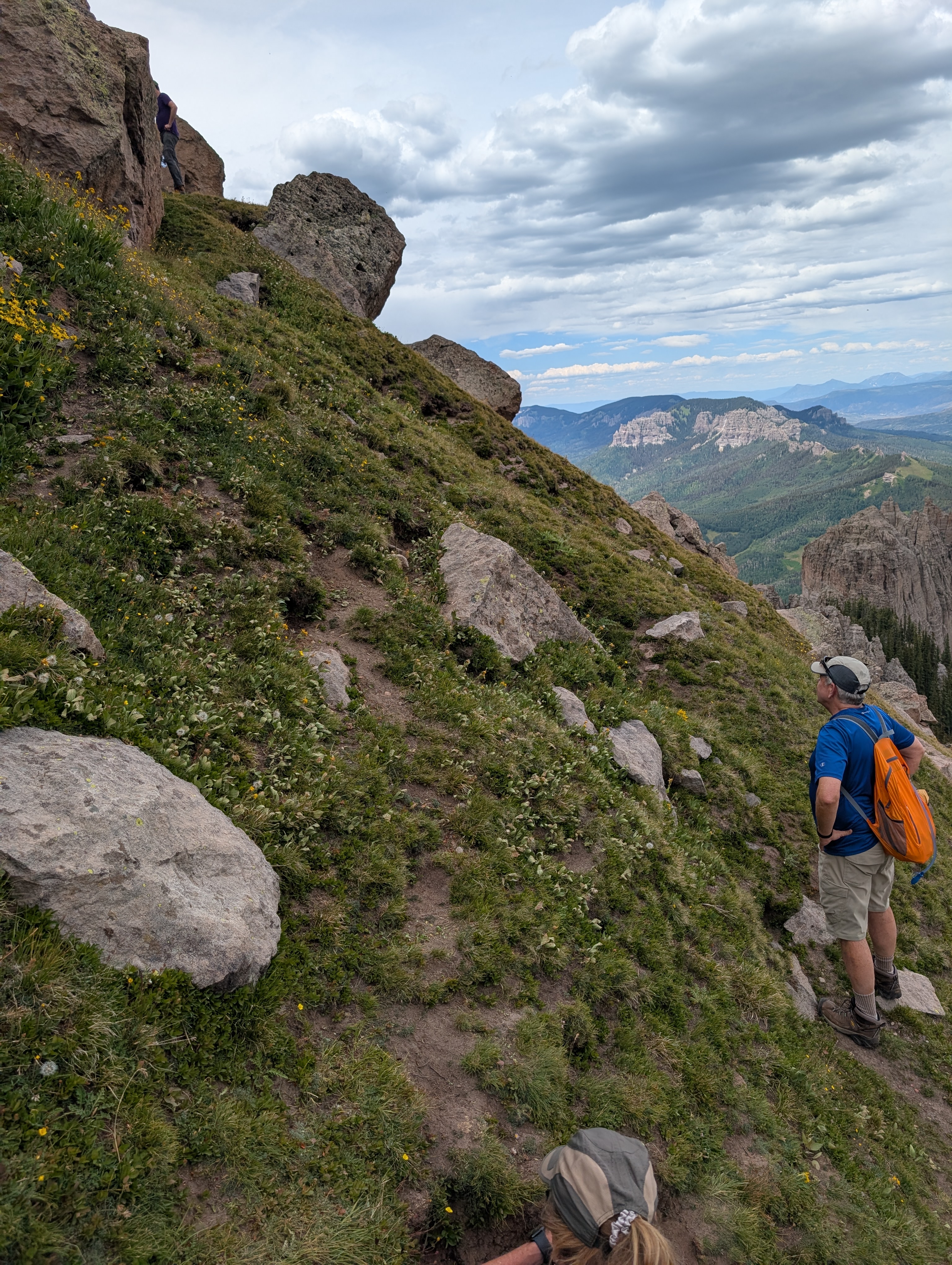
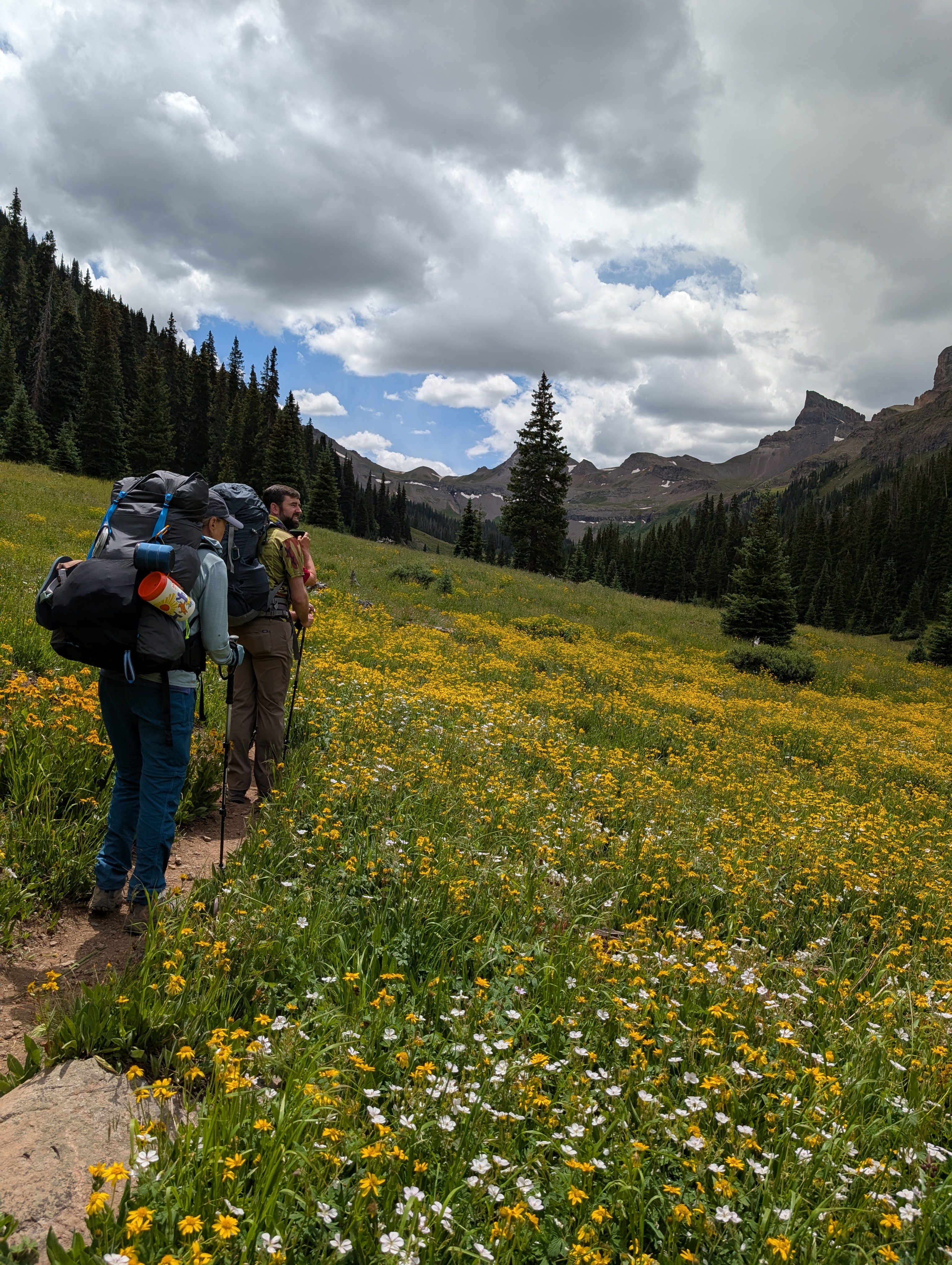
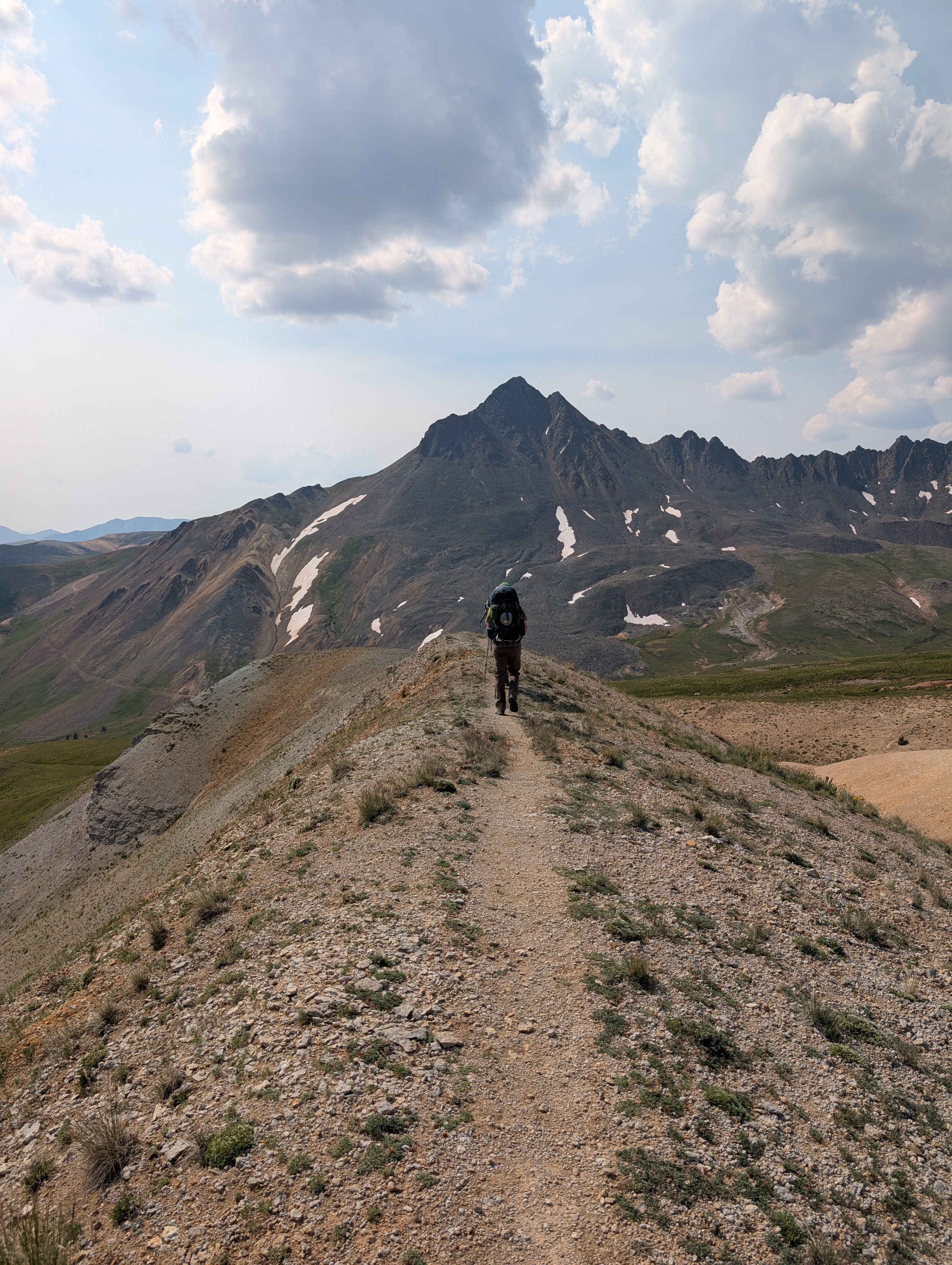
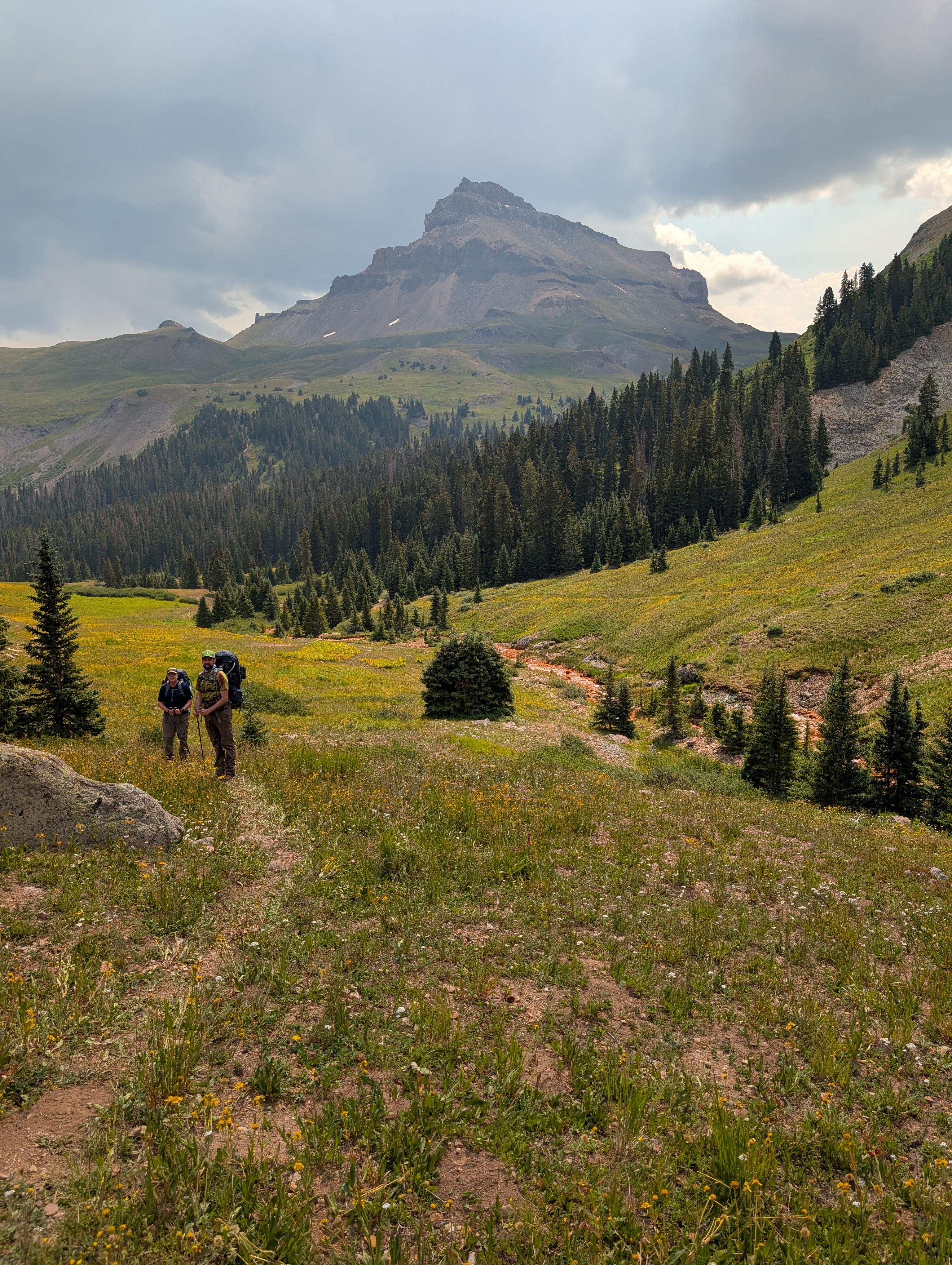
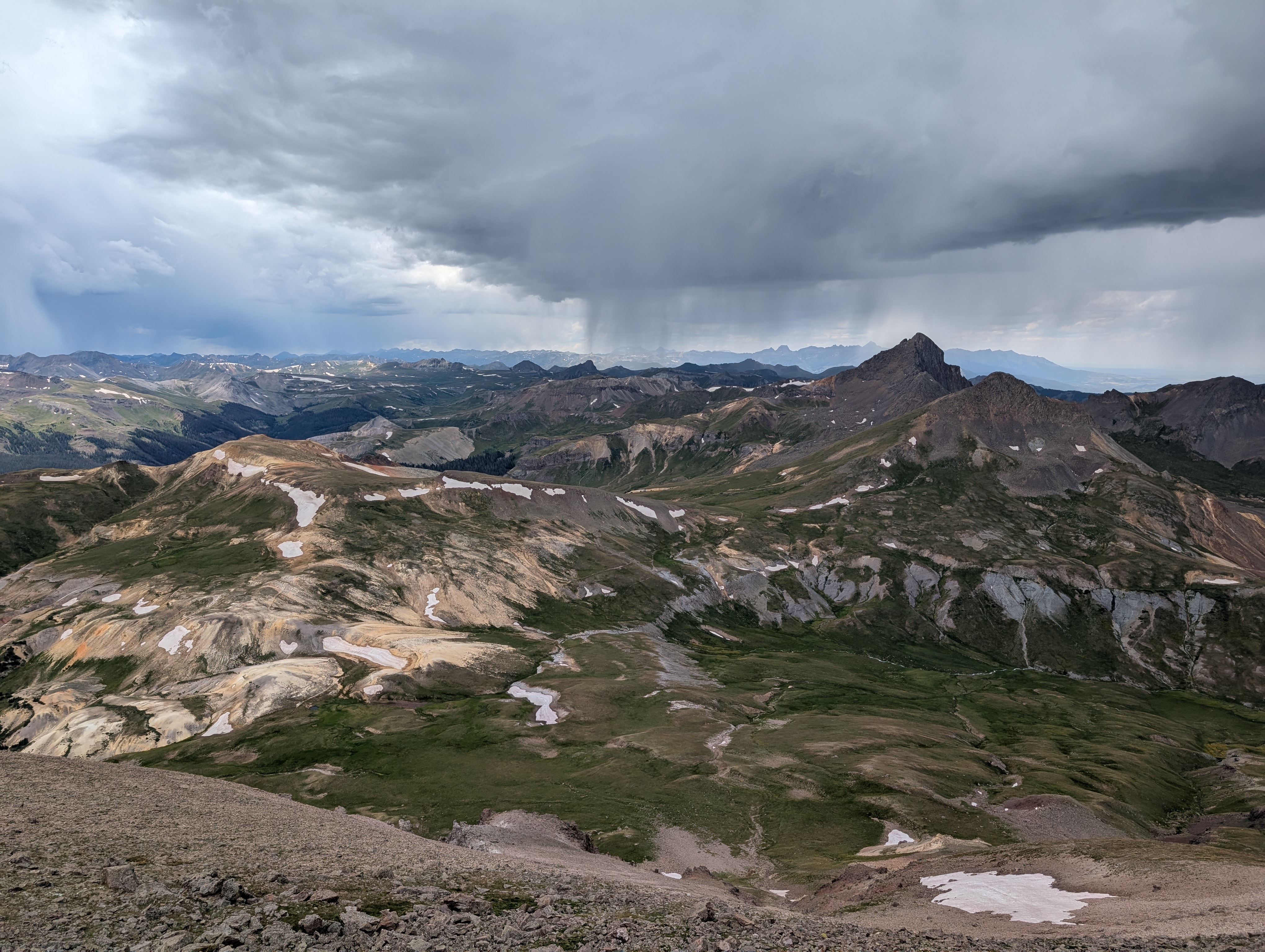
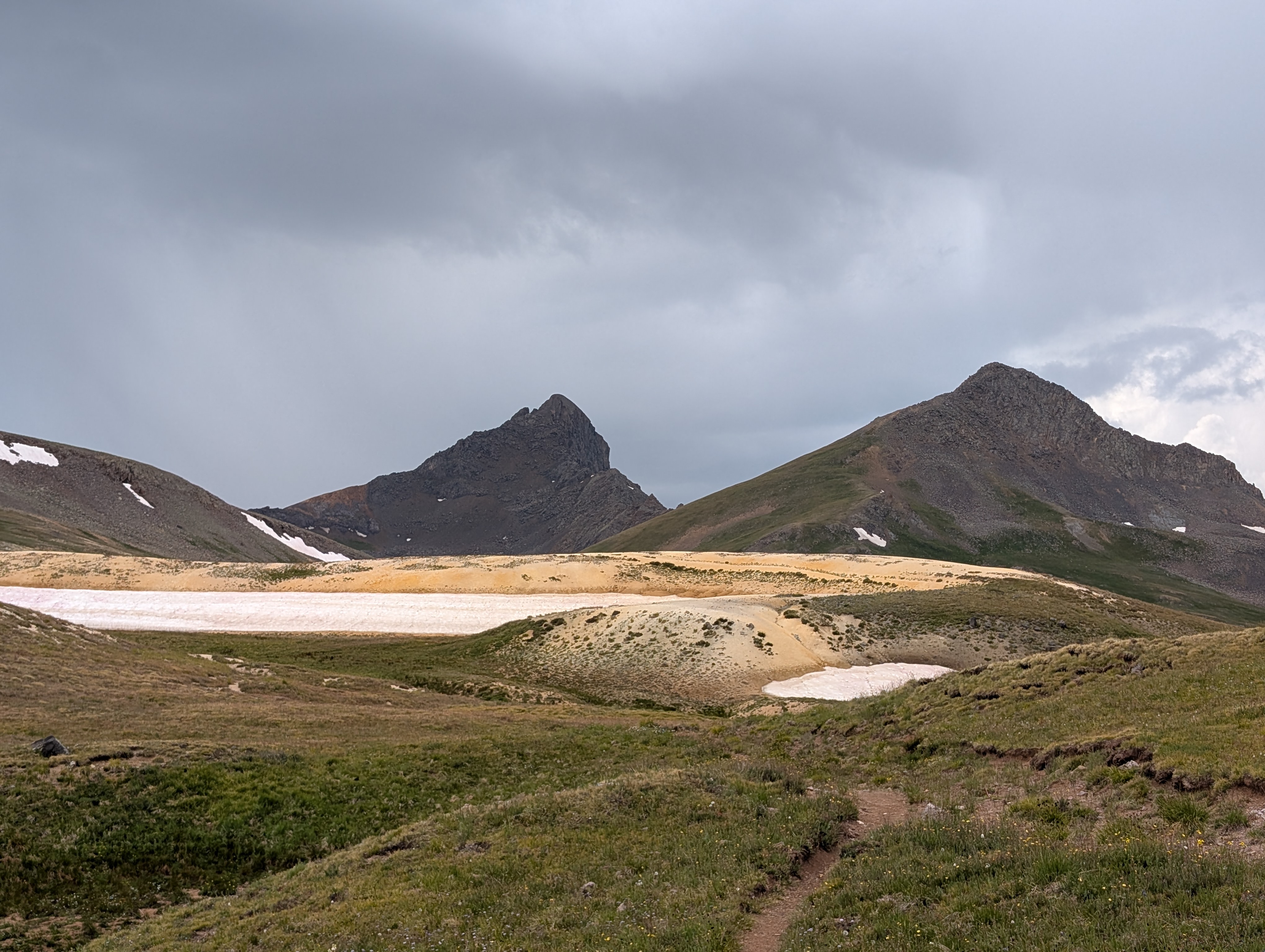
On day two we immediately climb 1,000 feet to a pass between the Middle and East Fork drainages. After we rise above the trees we are in an upward sloping glade of yellow flowers, and after a steady push we come over a pass that reveals the three greatest peaks at the heart of this wilderness: the striking Wetterhorn; the Matterhorn, reminiscent of its namesake Alp; and, to the east, a broad beast greater than all of them, Uncompahgre Peak. With eyes still turned upward at the giants around us we descend from the pass, ford an orange-tinted creek, and scramble up a lightly maintained shortcut trail to an eventual camp by some falls on the East Fork at the root of Uncompahgre. We are settled into camp before the afternoon storm rolls through.

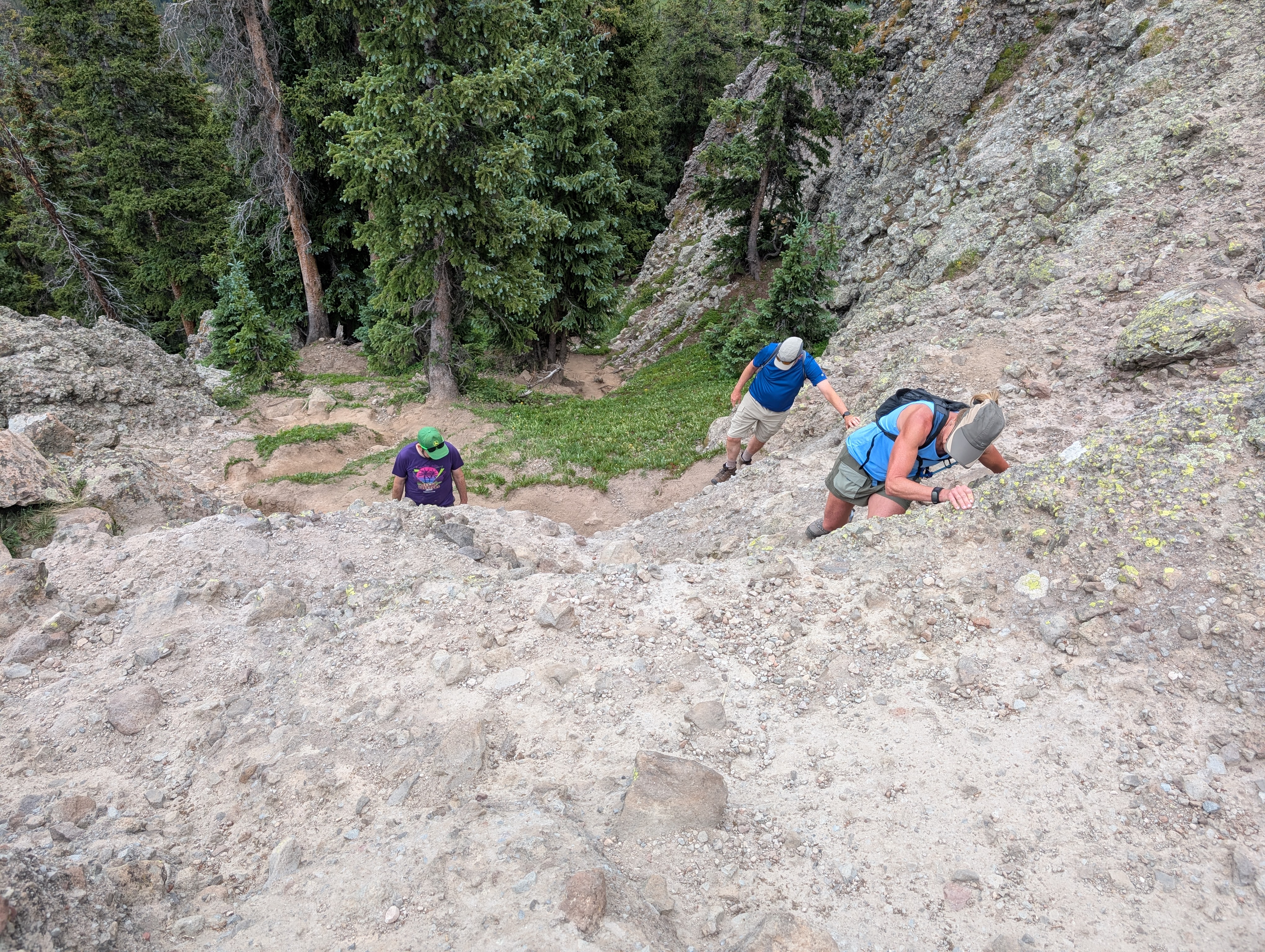
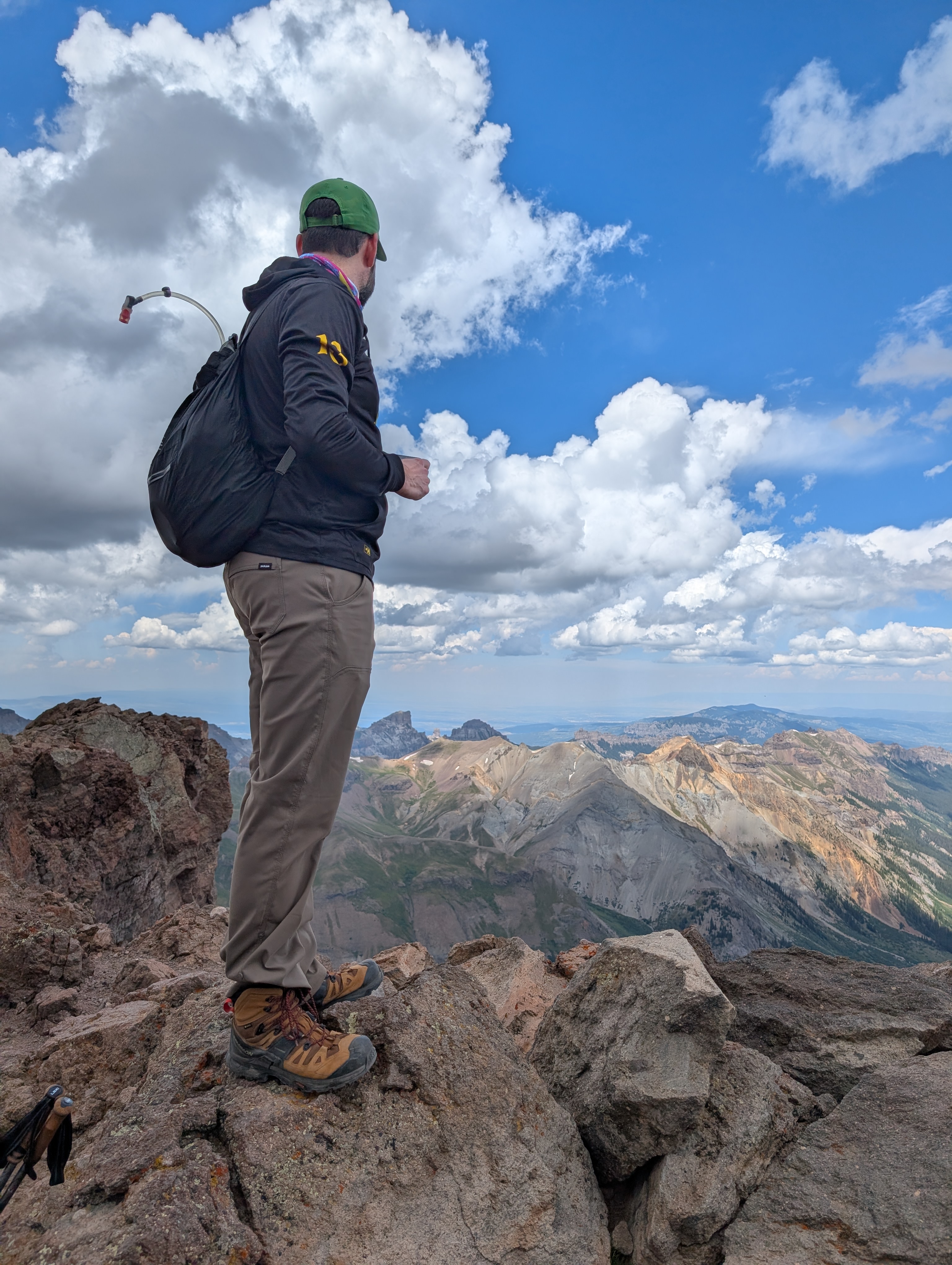
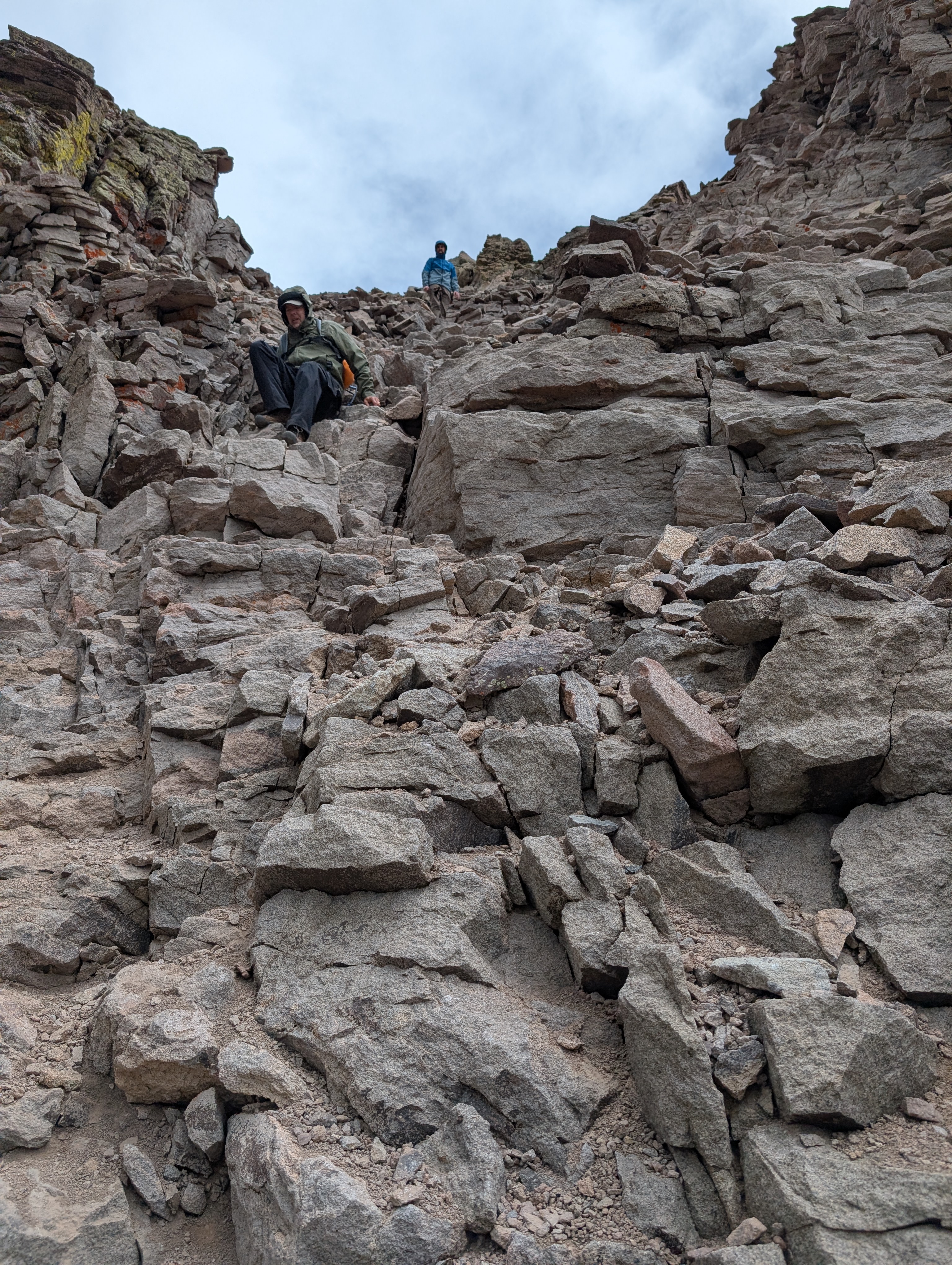
On day three, Bob, Rob, and I set out to bag Uncompahgre Peak. We climb along the creek, up through meadows of yellow and purple and white blooms, an open country trek upward as we circle the peak from northwest to southeast, where the main approach lies. Past the looming Matterhorn, up along sudden tan sands and lingering snow, on up the rolling green ramparts beneath the gothic cathedral spires and concave couloirs of Uncompahgre’s south face. A scramble up a harsh grade begets a long, steady ramp up past pikas and yet more flowers and ground set aside for endangered butterflies. Just shy of 14,000 feet, a wall requires some scrambling, but beyond that is a steady, limited-oxygen stroll to the top. From the summit we have a 360 panorama, sun here and storms there, our arrival just in time: distant thunder rumbles, Rob’s hair on his hand perks straight up as he stands astride the peak, and a few snowflakes start to wander down. Every manner of precipitation falls on our now urgent descent: the snowflakes, some sustained graupel, sleet, a little hail, and finally the rain, which picks up in earnest as we approach camp. When we look back up at Uncompahgre, its upper reaches have a light coating of snow. As day hikes go, this is one of the best I’ve ever done, the looming storm only enhancing the conquest of the summit.

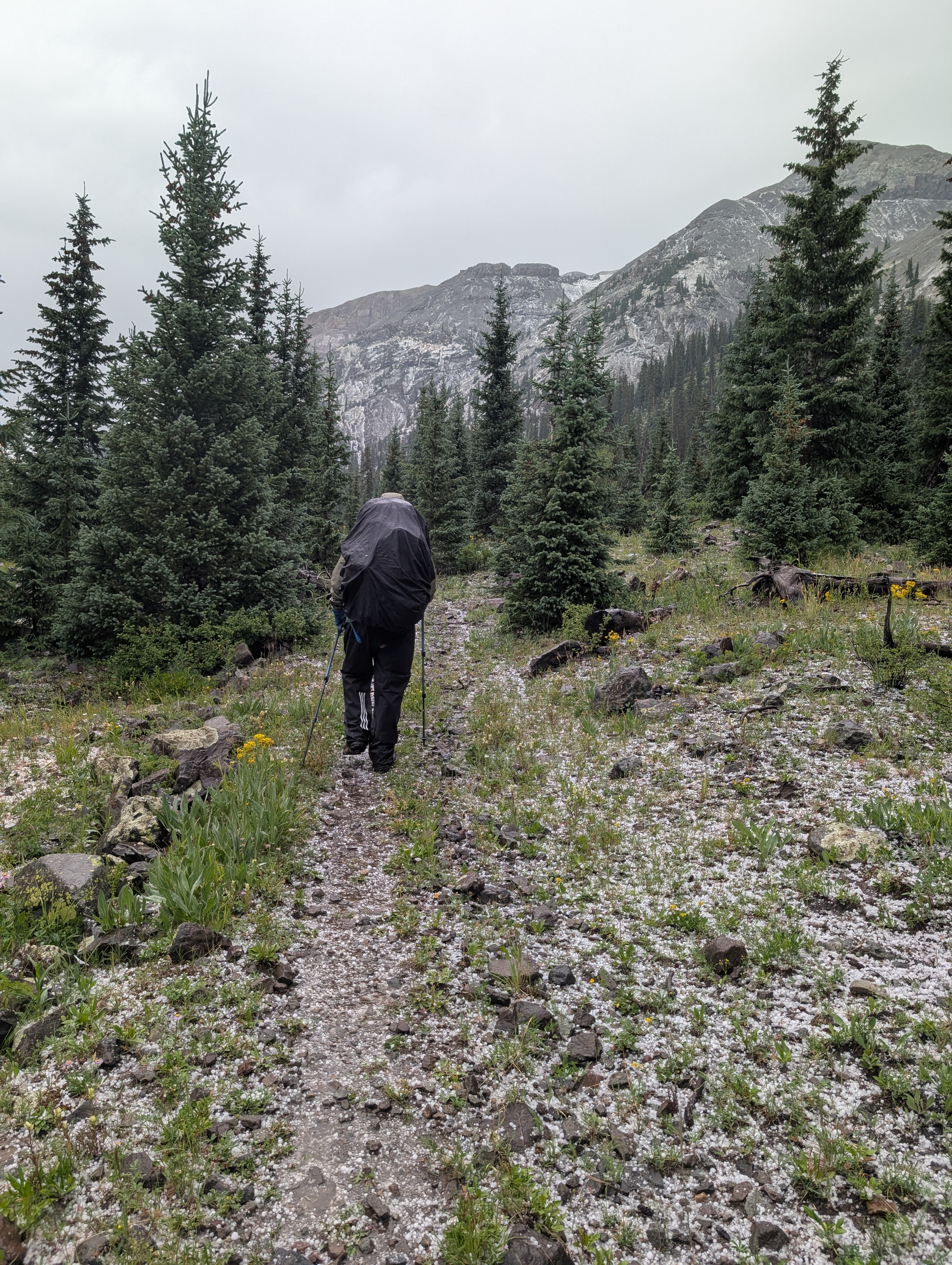
The fickle San Juans weather continues on the hike out on day four. Rain gear goes on and off all day as we descend the East Fork, a graceful vale that proceeds from high peaks to scree fields to avalanche-prone slopes of spruce to red towers reminiscent of Zion. Right at a shaky river crossing, however, comes the coup de grace: a sudden onslaught of hailstones, many as large as chickpeas, comes crashing down and sends us hustling for tree cover. After they have fallen the landscape is strewn with tiny white pellets, the walls to the east coated and glittering and the rutted path below us now a soupy mess of water and floating ice. This is not the least pleasant thing underfoot on the East Fork, however: that title goes to the cowpies, left by a lowing chorus of cattle that harmonizes as we walk by. At least we evaded the sheepdogs.

On the final evening we car camp off the Middle Fork, mission accomplished in spite of the absurd hail. Here we have the definition of Type Two Fun, a few minutes of misery that blossom into absurdist laughter and a memory that we can look back on forever, a random Friday on the first of August now immortalized, a remember when we did this, pushed out of comfort and saw a rare new beauty that will only pour gas on this blazing yearning for more of the world. The cattle go quiet and the creek rolls on and Rob and I stand out to watch the stars appear above our stand of aspen, musing on other yearnings we have.

Our two Ford Expedition rentals misbehave on the way back to Denver. The car alarm on Bob’s goes off three times in the night of our final evening, while the one I drive has the tire pressure light go on twice, growing worryingly low after dinner in Denver and prompting an early return. But it is a beautiful ride. We cruise along the Blue Mesa Reservoir, one of those manmade oases that dot the West, both a triumph over and a failure to fully tame nature. Lunch comes in Gunnison, with its bustling downtown, and we then ascend Monarch Pass back over the Continental Divide. The Arkansas River Valley and South Park would look like South Dakota but for the Collegiate Peaks and the backside of the Front Range looming over the high plain. We ascend once more, wind down the Platte Canyon, negotiate our way into Denver for the final night before heading out.

In some ways, Colorado has conquered America. The country vibe that has consumed pop culture this decade may get funneled through places like Nashville, but it has deeper roots in the cowboy west than the history-laden South. This is America as the open frontier, home to the pot-smoking libertine and the fitness-focused weekend warrior. But the frontier is over: after each weekend the chasers of peaks and slopes head back down the passes on I-70 and settle into the creature comforts of the subdivision on the outskirts, the escape to their safe retreats. Something is lost here but we don’t know quite what it is and so we yearn for it, nod to the past and chase a future. In this way, Denver and its environs may be the most American of all cities, spared the extremes of the coastal giants; as a newer city of many transplants, it lacks the particularity of other heartland metropolises, yet maintains a hold on reality absent in the likes of Las Vegas. There is a freshness and youth here, and I get the allure, an American reinvention that avoids the sterility or museumification of older societies. But while I feed off that youth, I need more than it.

My split personality gives me clues to what it misses. I crave communion, relish tapping into these ties old and new, and over the past several months a shared life has been taking shape through careful steps and weekend drives down I-35. And yet I demand solitude, reflexively rebel in contrarian ways, possess within me a deep instinct to disappear into mountains or at the very least drive off into some anonymous western town where no one knows me and where I can be something other than my staid, disciplined, ever so rational self. The constant in all these strains is a rootedness to the land, a spirituality of place that I find more and more at the core of my being, whether that is in ventures outward to new beauty or a return to the North Shore cradle that birthed my oldest friendships and more recent dreams. These landscapes tell the stories of who we are.

27

Fade as the blue nights fade.

Go back into the blue.

I myself placed her ashes in the wall.

I myself saw the cathedral doors locked at six.

I know what it is I am now experiencing.

I know what the frailty is, I know what the fear is.

The fear is not for what is lost.

What is lost is already in the wall.

What is lost is already behind the locked doors.

The fear is for what is still to be lost.

You may see nothing still to be lost.

Yet there is no day in her life on which I do not see her.

-Joan Didion, Blue Nights

Happy 27th, bro.

Spain 2025, Part IV: Against Dereliction

This is the fourth and final piece in a series that began here.

Sated on San Sebastián and ready to head the province of La Rioja, Andrew and I pick up a rental Cupra, which is Spain’s effort at a sporty car. We roll down a winding Basque tollway and up into the Cantabrian Mountains, where we seek out the Salto del Nervión. In wet times this is the highest waterfall in Spain, but today, it is just a pretty cliff. We chat with two older ladies who are taking a new car for a spin and get some sense of how it should look. The forests are lush, the karst formations jarring, and a few toros wander on to the road. We are back in rural Spain.

The number of elderly people who get out for this several-mile hike is a statement on Spanish superiority. The life expectancy in this country is 84, between second and sixth in the world depending on the source and inclusion of micro-states, even though booze consumption per capita is not low and smoking remains more ubiquitous than it is across the pond. The culprits would appear to include a lot of walking, a lot of olive oil, and a densely knit lifestyle that keeps people enmeshed in social networks long into old age. On the streets of Briones, the small town where we spend the next two nights, the average age appears to be about 70. But everyone is still shuffling about in their little friend groups, gathering on squares, no one warehoused away or struggling much beyond the inevitable physical toll. Almost no one is overweight, and the drinking seems like a steady social activity instead of a lonely or perpetual rush to blackout. There is an art to living well to a ripe old age here, and it comes not through self-denial but through keeping everything in its place.

Speaking of old, the Monasterio de San Millán qualifies: the twin monasteries of Suso and Yuso date to the sixth century, and we stop by Yuso, which is open for tours. The first recorded writing of Spanish (and of Basque) took place here, an attempt by a monk to bridge the Latin of the church and the vulgar Latin of a Visigoth-ruled Iberia around the year 1000. It is also home to one of the few complete sets of giant books of Gregorian chants for each day of the year, all stashed in a specially built chamber to control their humidity. Yuso’s 11 remaining Augustinians honor San Millán, a hero from that area who, like St. James along the nearby Camino de Santiago, got drafted into slaying some Moors on behalf of the Reconquista. A few pilgrims have made the side trip up here, including a Spaniard who started in Barcelona and a couple from Iowa City for whom we translate the tour. I feel the pull to don a pack and start walking.

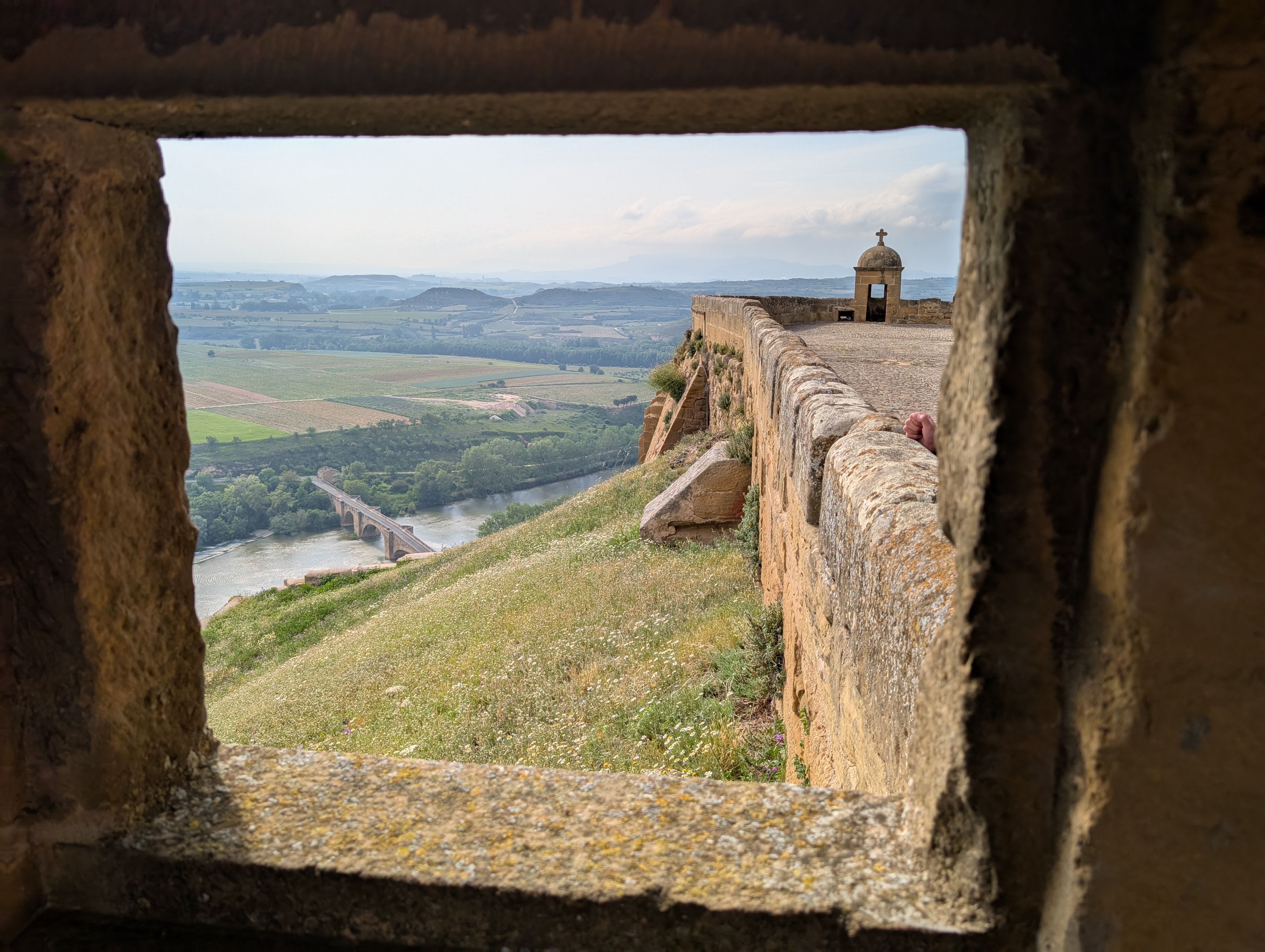
As it is, however, driving around Rioja is a beautiful way to spend a few days. Roads swing their way around ridges and vineyards, a view off to the next hilltop town or castle always somewhere in sight. Clouds hang over the mountains to the north, much closer in person than they appear on a map, and the valley of the Ebro River drinks in the sunlight that filters through them. Briones, where we stay at a restored old stone manor named Santa Maria Briones, is a quiet hilltop town that feels frozen in a different era. Once upon a time it was an outpost in competition with the even larger castle across the Ebro in San Vicente de la Sonsierra, a contested zone between the kingdoms of Castile and Navarre. Now, it feels about as far from war as a place can be, basking in wine country sun as the bell on the great old church tolls out the quarter hours and its residents shuffle into their later days.

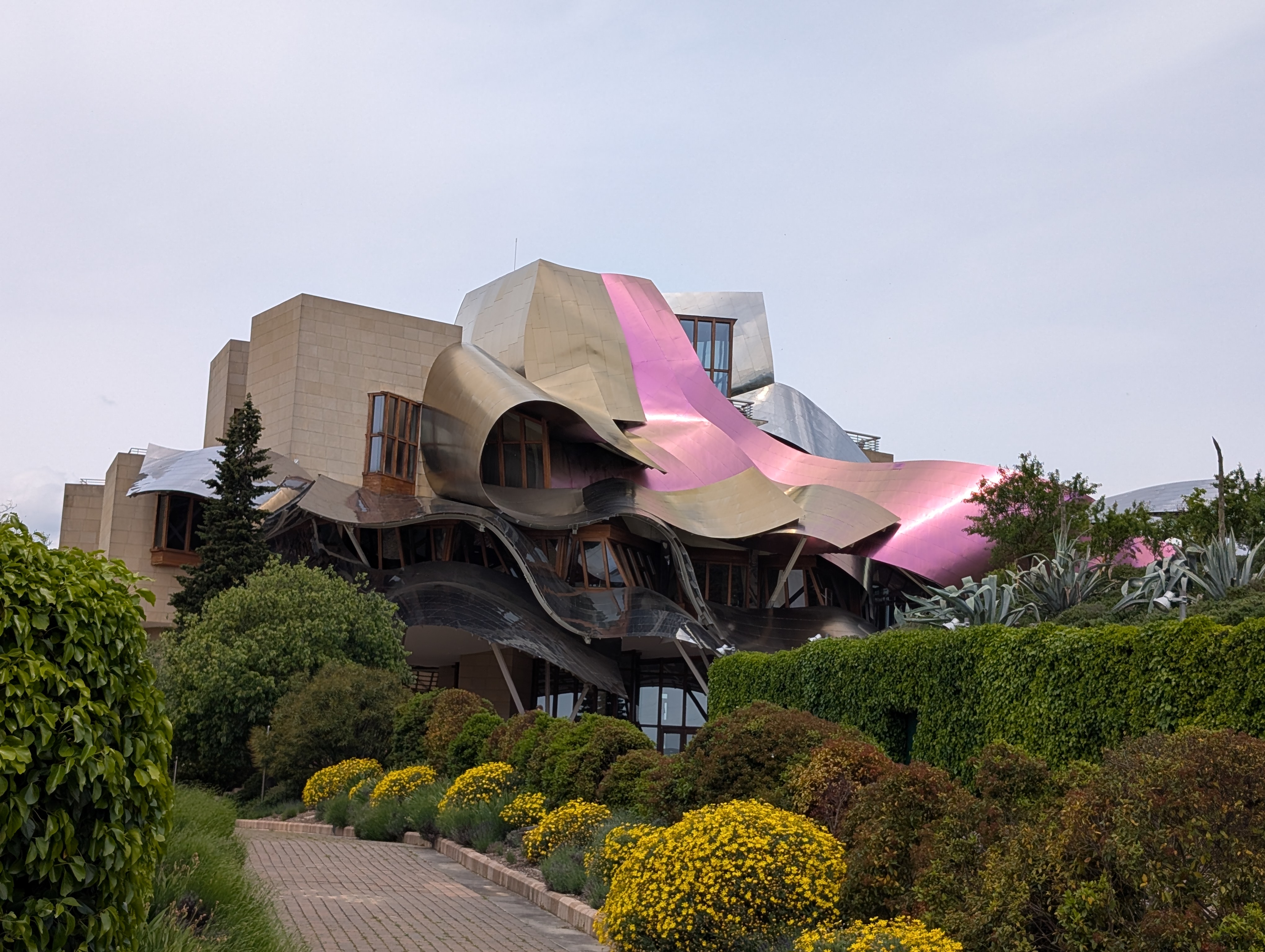
We are of course in Rioja to drink wine. We schedule three tastings, and the two on day one are contrasts in the scale available here. First we visit Miguel Merino, a small producer that we can walk to in Briones, where it’s just us and Lorena, one of the five people employed by this operation founded by an exporter and carried on by his son, relying on small batches and doing some experimentation as they get into many Michelin-starred restaurants. Later, we tour the Marqués de Riscal, an industrial-scale pillar of Rioja complete with a Frank Gehry hotel reminiscent of the Guggenheim, with a dash of wine purple added to the color palette here. The place is massive, a winemaking machine in full force, though the Marquis himself still sits in a corner with some friends sampling the product. Up in Haro, one of the larger towns in the region, we stroll past some of the other big Rioja names in its neighborhood of bodegas and do lunch on a convenient patio at Muga.

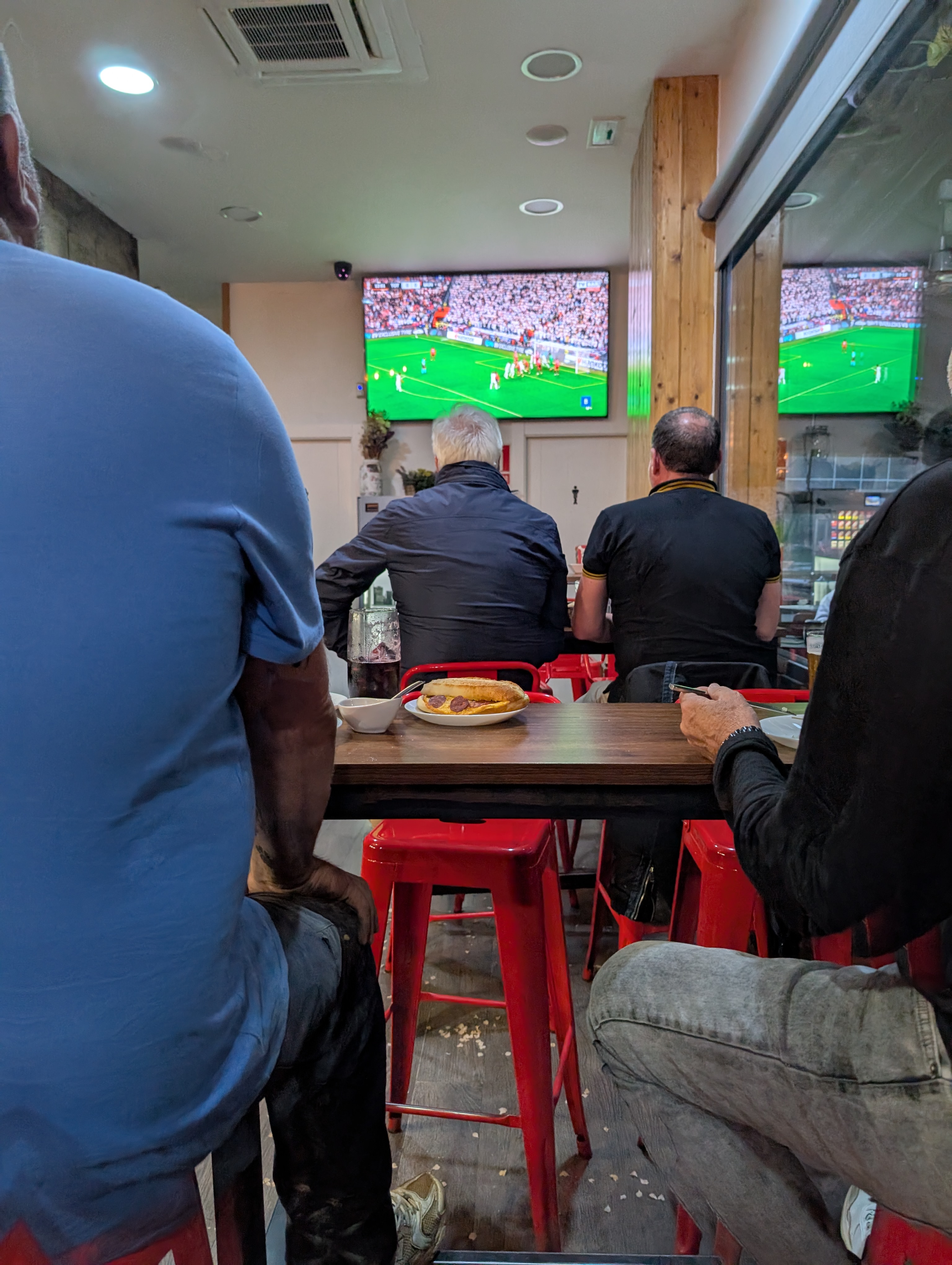
Our two nights here, meanwhile, are a marked contrast. On the first we eat at Allegar, the restaurant at Santa Maria Briones. Seventeen small plates come out through the course of the tasting menu, each with a major element from Rioja itself, along with wines to match. The three-hour tour is a culinary peak of a trip of nonstop great food. The next night, Andrew, a diehard fan of Tottenham Hotspur, must find a spot where we can watch Spurs’ Europa League final against Manchester United in Bilbao. We wind up in an Haro sports bar surrounded by large, booze-fueled Spanish men. They approve of our allegiances (“fook Mahnchesta”) and provide some high-fives when Spurs, one spot above relegation from the Premier League, improbably hold off United in a fairly disgusting soccer game. The aesthetics do not matter to Andrew, who is giddy, and I am amused as we watch Spanish sports talk into the night.

We have one final wine tasting on our way south back toward Madrid. When we pull up in the town of Sojuela, I’m worried I’ve made a mistake: the address for the Ojuel winery takes us to an unmarked door on a nondescript house in a town much further off the beaten path than Briones; the website is down and the phone number we have doesn’t work. But an ancient lady calls down to us from the upper floor and says someone is on her way, and before long Mila, the daughter-in-law of our greeter and the mother of the winemaker, is taking us on what is, by several orders of magnitude, the most memorable wine tasting tour I’ve ever had.

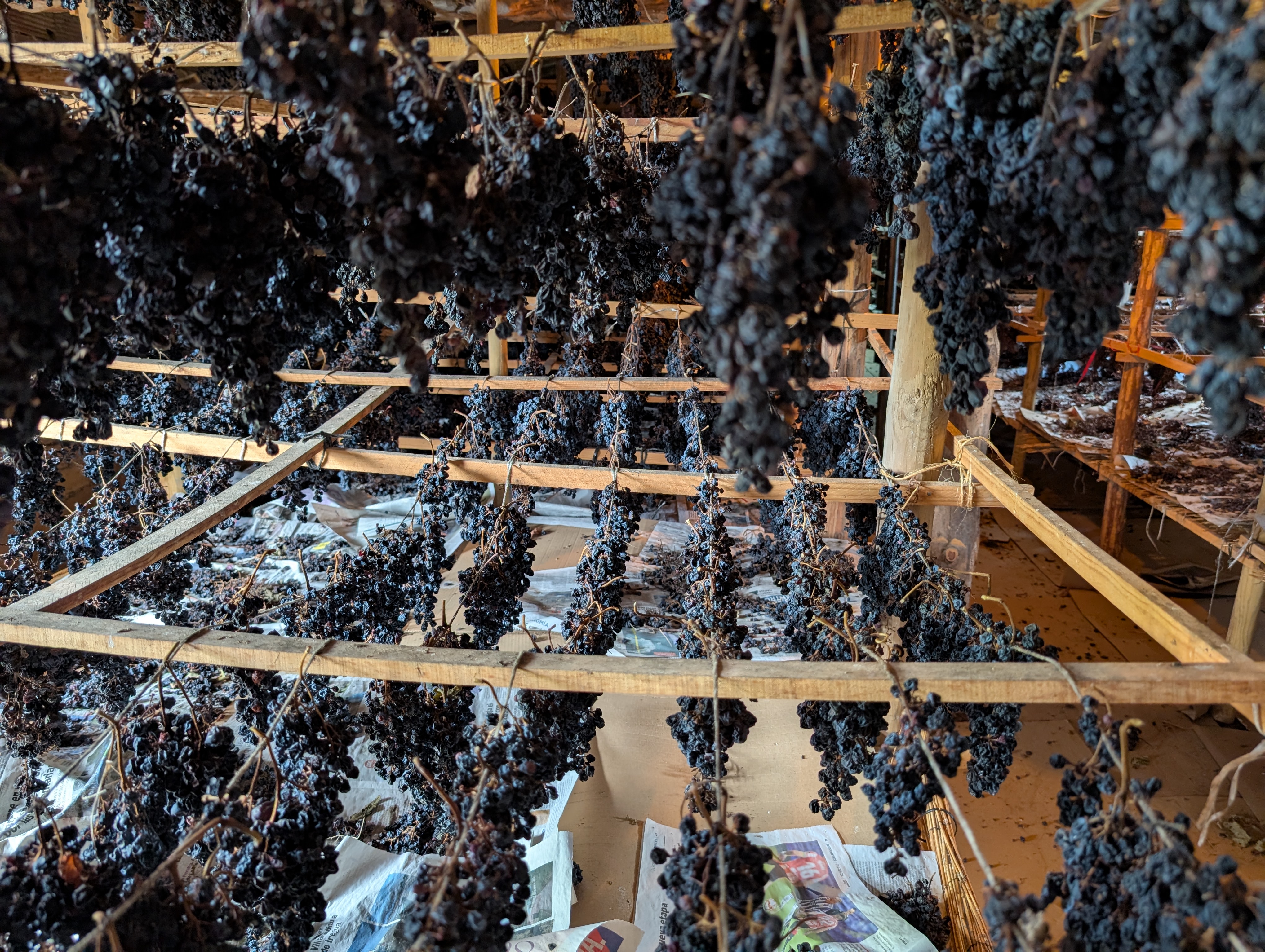
Mila takes us in her car up to a vineyard. This is an all-natural, all-organic operation, and all Ojuel bottles feature a different butterfly in honor of these pollinators. The contrast with the neighboring field is striking, these gnarled smaller vines with weeds tangled around their bases separated by a wall of vegetation from the monoculture beyond. (Grapes from the first few rows are sold to other winemakers who don’t care as much about purity, lest any pesticides have drifted in.) This plot’s history is deep, as a stone set here traces its owners back for generations and lists the varietals grown here, though two of the nine are not listed because they have been effectively lost to time. We learn of how Mila’s son Miguel did some oral history work, pulling out old wives’ tales of the supurao wine made for holidays and special celebrations in the youths of some village elders, and reproducing their methods by hanging grapes to dry to produce that rare beast, a delicious sweet wine.

For the tasting, Mila throws a few bottles in a tin pail and takes us on a walk to a couple tiny old bodegas dug into the hill, a gathering place where locals would create their own stocks back before mass commercialization, where people would gather for a few drinks in the climate-controlled holes slowly dug out with pickaxes. Those not associated with Ojuel are now rotting away, but these have been lovingly restored and put to use aging barrels. Ojuel rebels against the Rioja control board, experimenting with new things; at one point, Mila pulls out a turkey baster and dips it into a barrel so she can draw out some wine and offer it to us. This is deep winemaking, pulling on old tradition in ways that can now feel radical, experimentation and rejuvenation and daring to let things be different. Long live the Ojuels of the wine world, in firm revolt against the unthinking present and the decay of rural Spain.

After Ojuel, it is time to return to Madrid. Our Spanish road trip is smooth sailing, packing a lot into a few hours. Just south of Sojuela the N-111 winds along red cliffs dotted with green reminiscent of the American Southwest; soon, it climbs up a long cut through the Sierra de Cebollera, where spring is still in its earliest stages. We descend to the plain, try to figure out how the city of Soria functions when every single road is under construction, and then cruise easily across Castilla y León and Castilla-La Mancha, that rolling open green country that could have been dropped in from the Great Plains. Spanish highway etiquette is immaculate, everyone weaving in and out of appropriate lanes based on their speeds. Over four days of driving Google Maps has the occasional misfire where it sends us down some very sleepy, bumpy back lane and the narrowing of streets through town centers is at times harrowing, but all in all I enjoy my time behind the wheel in Spain.

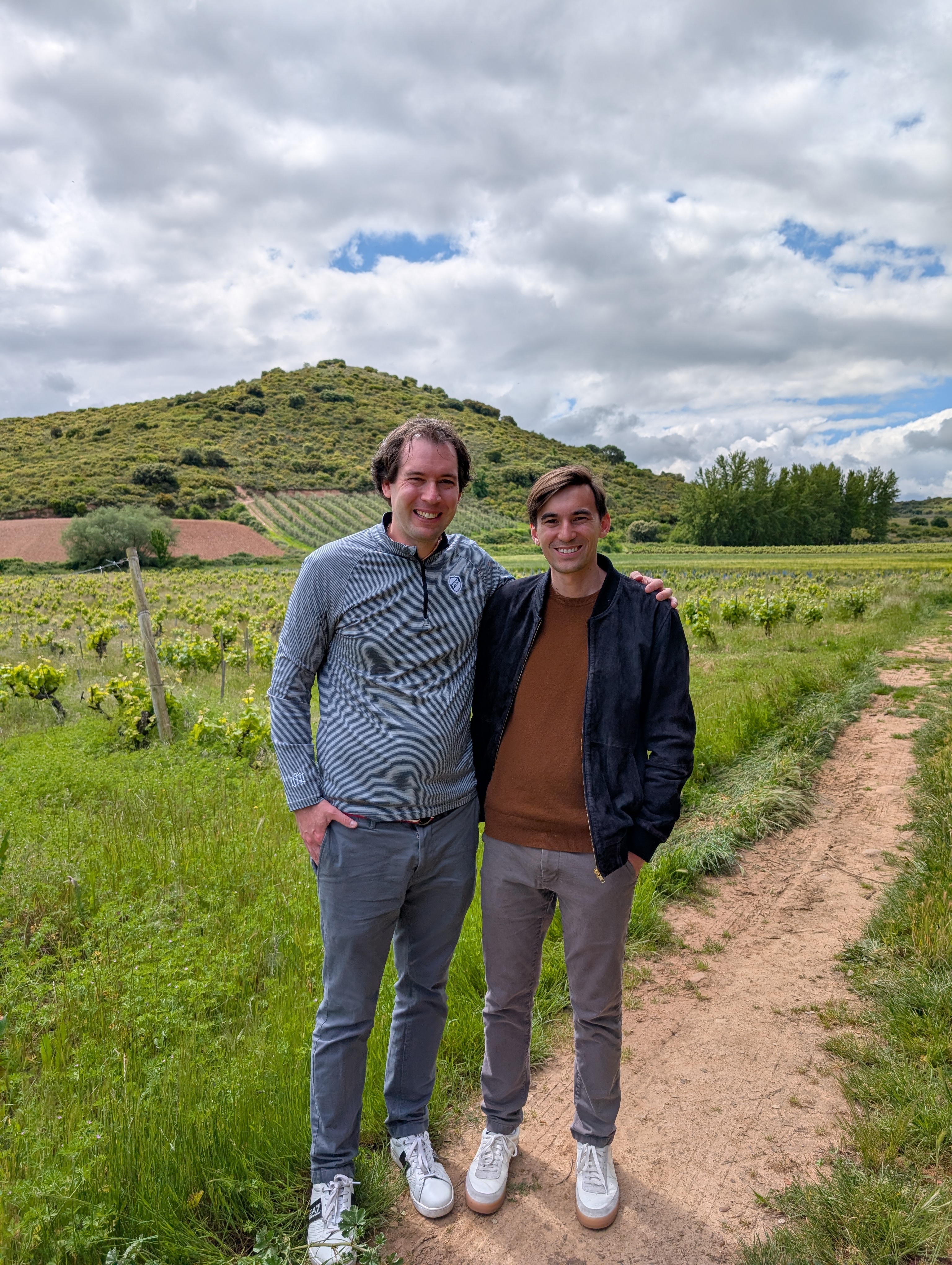
Andrew and I get to do a circuit of central Madrid together and share one final meal before my very early flight out the next morning. Unfortunately this is where I hit the wall, so I do not have my reflections in good order that evening, but it has been a joy to take this trip with Andrew. We survived a two-week road trip together as we both shifted between phases of life in 2016, and we are able to jump back in and seamlessly do it again now that we have attained some modicum of professional stability. Of course sharing tight European lodging with even a good friend for ten days will reveal some neuroses and see us both cycle through moments when exhaustion or annoyance catches up with us, but we share a commitment to the pace, a hunger to eat and drink it all up in short order, and that can power us both through anything that might drag us down.

We are a funny pair here, more capable in Spanish than the vast majority of tourists, one who could pass for a German and speaks like a Mexican alongside a half-Filipino who speaks like an Argentine, and I am amused by how often we confuse people. At Ojuel, Mila tells us Americans are the best tourists they get, respectful and curious about experimentation and eager to spread the word to their friends. It is not hard to juxtapose us against the loud, boozy British who make no effort to speak Spanish and the famously insular French. The Spanish resignation to bad tourists is at its worst in San Sebastián, where some waitstaff continue to talk to us in awful English even when we demonstrate some Spanish capability, but when we show that clichéd American enthusiasm for taking stabs at new things in Rioja, the people we meet are delighted. Of course the American tourists who get to second-tier European destinations clutching Rick Steves guidebooks and lists of Michelin-recognized restaurants are unlikely to be of the same demographic as those who go to Gulf Shores for spring break; this filtering is not present among the British, for whom Spain can be a quick weekend jaunt. But I do think there is something uniquely fetching in an American hunger to absorb the European deep histories and cultures that our imperial reality so often buries.

I am on that nonstop search on this trip even though I don’t think I am ever quite at one hundred percent. I develop a gross nagging cough early on, while my back does not seem to like the backpack I wear; bad sleep, a sporadic but lifelong scourge of mine, returns at times. For a second straight trip I make a dumb mistake with my writing tablet, this time losing its stylus (replacement cost: a disgusting $150) on the first plane flight. Because of that I never hit the reflective rhythm I aspire to, don’t have my thoughts organized the way I should when Andrew the lawyer probes me about our trip or our world beyond us. I worry I am too much a chameleon, am not reflecting as thoroughly as I should on recent developments in work and in the personal sphere, am only barely scratching a few deep yearnings I find welling up within.

But that is alright. These annoyances show I know I have work to do, and I will do it at whatever pace I can. For now, I can smile easily as I think of two weeks well-lived, of a drift down Spanish streets, of good art and good food, a drive up the coast and a sip of special wine. A hearty gracias (and an eskerrik asko) to this country I have come to love, though after three straight years it is probably time to try somewhere new next. We have so much to explore.

Spain 2025, Part III: La Boca del Cielo

This is the third in a four-part series that began here.

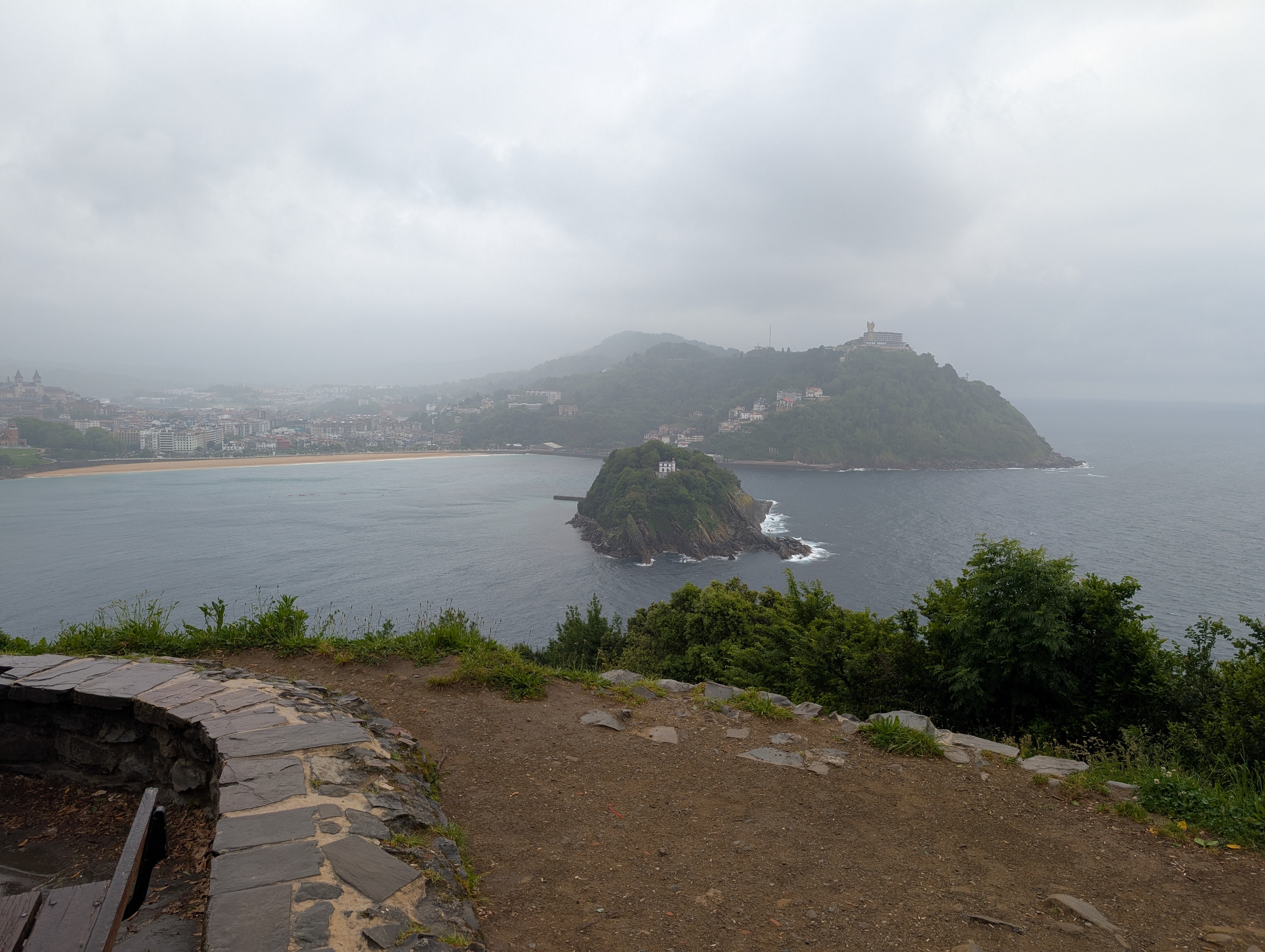
The list of cities on earth whose setting can compete with San Sebastián, Spain, is a short one. Called Donostia by the Basques, its centerpiece is La Concha, a shell-shaped bay wrapped by a beach for nearly its entire length. The Parte Vieja (old town) wedges between the western end of La Concha and the broad Urumea River, and the grand shopping avenues strike out south from it. Three sentinels stand watch over the harbor: a Rio-reminiscent statue of Jesus on Monte Urgull above the Parte Vieja, a tower atop the highest point at Monte Igeldo at the other end of the mouth, and the striking island of Santa Klara between them. Miramar, a Tudor manor home built by the Spanish royals, sits upon the one interruption in the beach, and the city rises up gracefully into the Basque hills as it recedes from the water.

San Sebastián is too pretty not to have been discovered. It may not yet be on the level of the French Riviera or some of its Italian counterparts, but it is a city filled with beautiful people being beautiful, of large crowds and moments when one will find oneself surrounded by people speaking French and German and English. But I am a sucker for it, unapologetic for my basic tastes: incredible food scene, stunning scenery, and a stellar beach, an urban ballet that becomes an easy party into the night, that Spanish triumph of life done right.

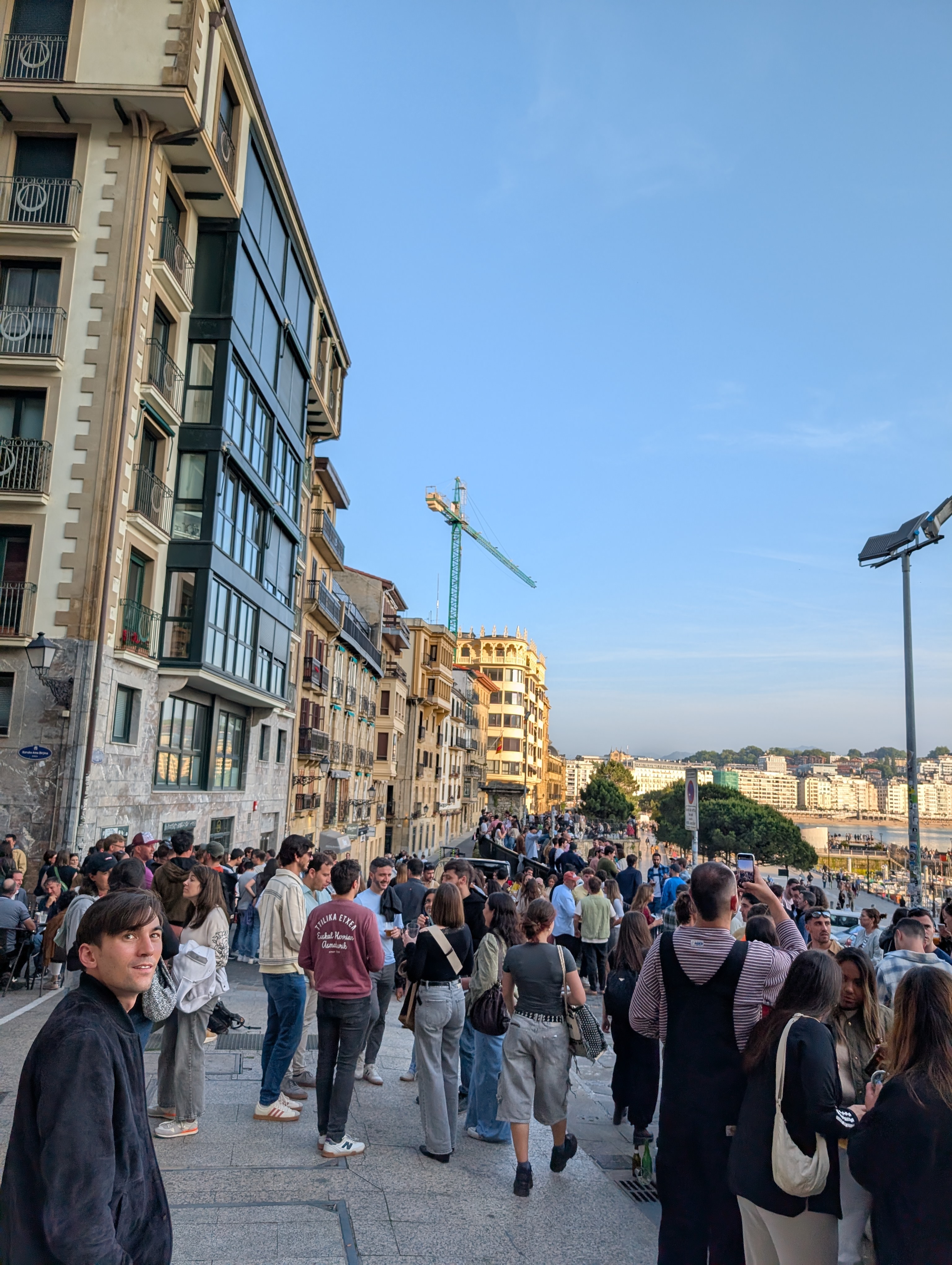
Andrew and I stay in a hotel tucked just beneath Monte Urgull and just off the water, alongside a staircase up the Monte that becomes a party scene every night. The room is cramped and unremarkable, but the setting is on point. Just stepping out of it is immersion in the Spanish street scene, the crowd already building as others wander down to the waterfront, basking in the haze over La Concha as the sun sets behind Monte Igeldo. Here the pintxos crawl goes from an idle stroll to full-fledged fiesta, thousands from around the world seeking out the delicacies tucked into tiny storefronts, lines building where the most famed chefs produce the hallmarks of Basque cuisine alongside their own experimental takes. It is a culinary paradise.

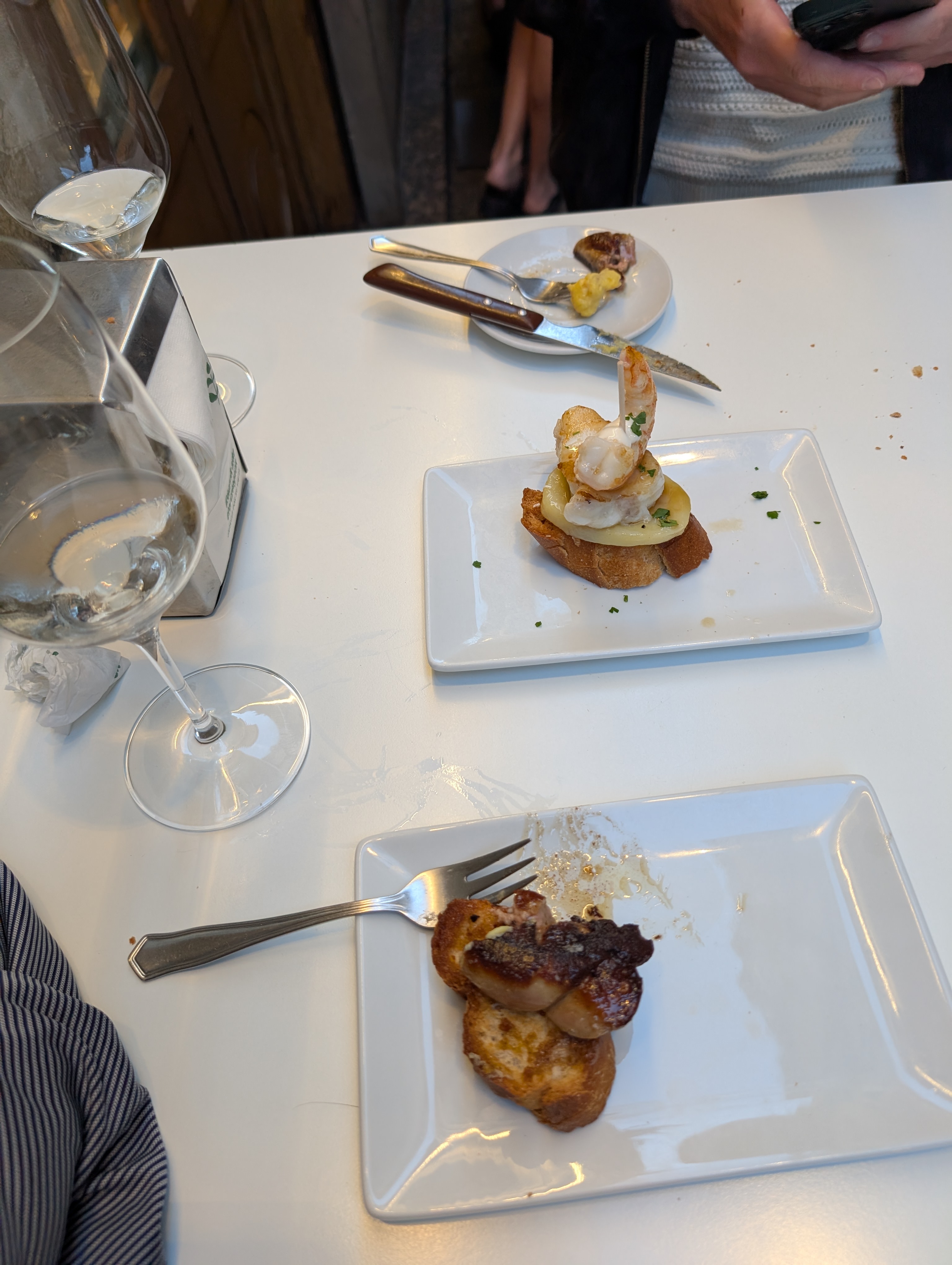
On the first night we do a classic San Sebastián pintxos tour. We start at Ganbara, which Anthony Bourdain called “my favorite place,” and slurp down monkfish, foie, shrimp, crab, and croquetas that melt in the mouth. Despite a massive crowd it is a well-oiled machine, a carefully tended line down the street invited to tables, and there is no rush once seated (or stood, I suppose, as we are at a table on the street). The same cannot be said for several places we try afterward, which are a Lord of the Flies competition for counter space or seats, and in the end we are relieved simply to let a waiter guide us to a table on Konstitizio Plaza, even if the fare is nothing memorable. At some point in the night everyone heeds a silent summons to a place that churns out cheesecake by the boatload, and while it can’t match Casa Rufo it is satisfying, and for a nightcap we sample the local macrobrew, Keler, which is bad.

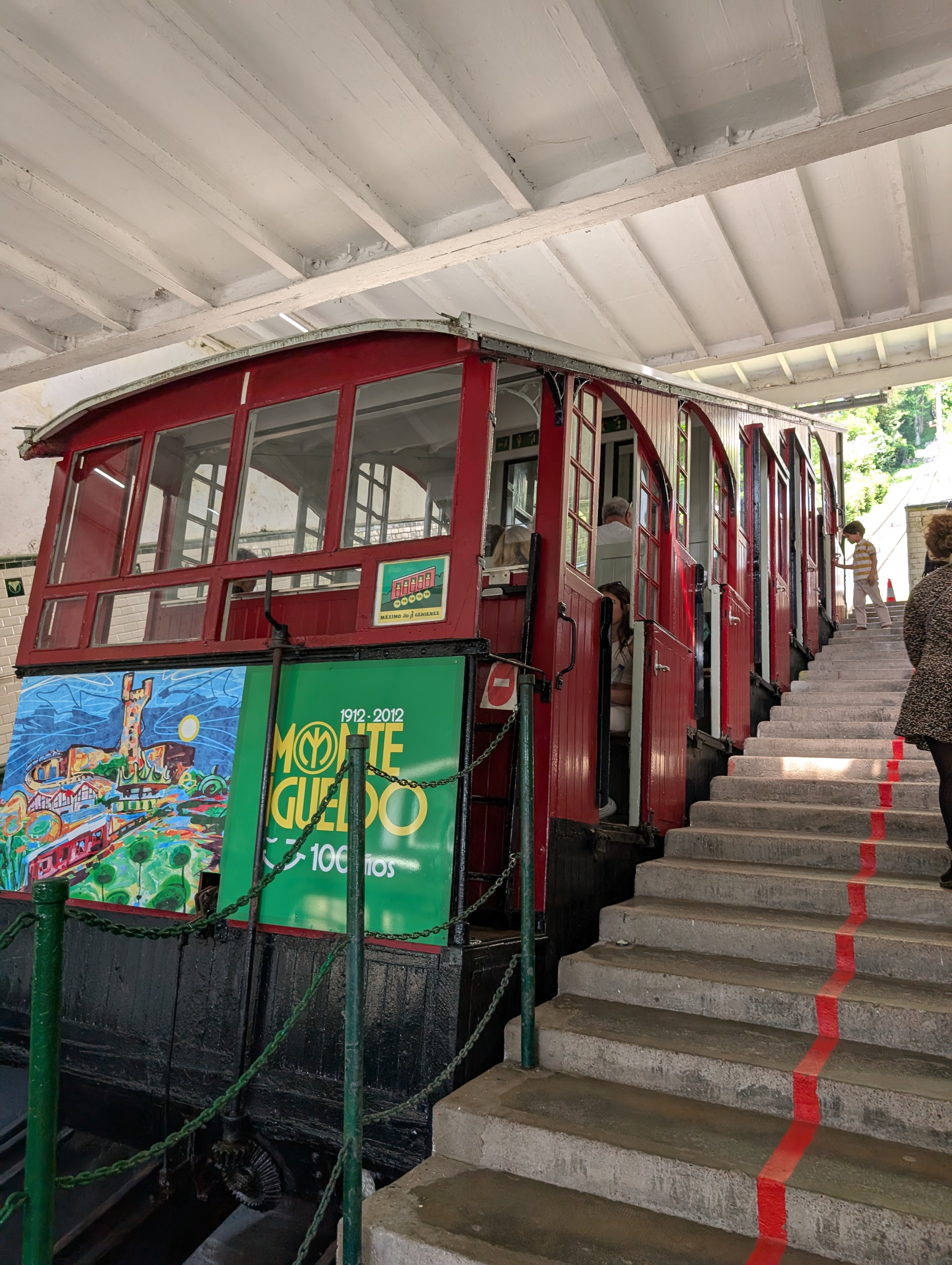
The next day is San Sebastián in an ideal state. We walk the length of La Concha’s beaches and ride the funicular up Monte Igeldo, an overlook plus amusement park that includes a “rio misterioso” (a lazy river that seems precariously close to the edge of the cliff). We befriend the keeper of the tower at the very top of the mountain, perhaps because we, unlike the Brits in line in front of us, understand that, when she says “tunel” and makes a tunnel with her hands, she is trying to convey the word “tunnel.” We ask her why Monte Igeldo’s puttering roller coaster, which would normally be called a montaña rusa (literally, Russian Mountain) in Spanish, is called a montaña suiza (Swiss Mountain) and she explains this was a Franco era maneuver to avoid any hint of communism and suggest as much neutrality as possible. She rants about Trump at us for a while but drifts into sadness that her own daughters haven’t given her more than one grandchild, a commentary on that we do not have time to unpack before the next tourists come to request their tickets.

The guardian of the tower on Monte Igeldo is not off the mark. Spain’s birth rate has plummeted to 1.1, nearly half the rate a population needs to stay even. Even with increasing immigration, that trend plus long life expectancies could leave the nation with a financially terrifying ratio of 1.5 workers per retiree by midcentury and a whopping 33% population drop by 2100. The below replacement birth rate is now a reality across the entire developed world excepting Israel, though it is particularly acute in Spain. (Neighboring France, meanwhile, is keeping pace with the somewhat more stable United States.) One could speculate that societal change has been particularly impactful in countries with the longest histories of harsh gender divides and machismo (see Spain’s companions at the bottom of the birth rate list such as Italy, South Korea, and Japan), but it is only a matter of degree; whatever the cause of this digital era birth plunge, the trend is real, and only just now starting to alter Spanish life.

There are so many things I adore about Spanish culture that it is somewhat haunting to think about this looming collapse, a concern that all these lovely and sustainable Spanish lifestyle choices are caught up in a culture that is choosing, either intentionally or through happenstance, not to sustain its very own self. The Madrids and San Sebastiáns of Spain will likely get by just fine thanks to in-migration, though they will have to fight that very European fight to avoid becoming total museums or tourist playgrounds. But things are different in the older towns and dusty cities in the center of the country, which I have come to know both on this trip and on my Camino across Galicia last year.

My lifetime may see the diminishment and even death of many pockets of Spanish culture, of some of these funny little cultural quirks that make this country so easy to visit again and again. But unlike American boomtowns, which are rarely built to last, the stone walls of Spanish towns ensure a very old history will fade very slowly. Historical memory runs deeper, faces a proportionately deeper loss, and it should bring out deeper fixations. Even in an era of Trump unleashed, successful navigation of reality does not come in day-to-day headlines or a doom loop of algorithmic content, but instead in finding ways to live in deeper touch with both the past and the future.

Achieving that state is easy to do among the attractive humans on display on La Concha beach this afternoon. After catching some sun we spend the evening in Gros, which is across the Urumea River from the Parte Vieja. This is an updated version of San Sebastián as a beach town, its apartment blocks well-built but modern, its beach dominated by locals with genuine surfing and volleyball skill. We have beers at Basqueland Brewing, pintxos at a good wine bar, and dinner at a Basque-Mexican fusion place, all of which deliver. Tonight’s nightcap comes on the steps of the Santa Maria basilica amid the crowd of revelers, easy laughter across a mix of tongues, and never am I more relaxed on this trip than on those steps beneath that gothic facade with a whisper of change flowing in on a cool breeze off the Cantabrian Sea.

Day three reveals a different San Sebastián. Gone is the riviera feel: suddenly it is a moody seaside town from the Pacific Northwest. We venture out in a light drizzle and climb through the pines on Monte Urgull to a fortress atop the harbor, ramparts and cannons left behind by Napoleon’s French and the British who fought their way into Basque Country by sea. (They appear never to have left.) The foreboding mood continues as we visit the gothic cathedral, shelter from rain over a long lunch involving beets and mackerel, and tour the local aquarium, the first half of which is a historical exhibit on Basque seafaring and fishing in these choppy waters instead of the expected tanks of fish. By the time we emerge, some stray sunlight casts a delicate glow, and we can stroll the promenade along La Concha again. Over in Gros, the surfers are all over the big waves thrown up by the sea. An inky dark squid seems an appropriate entrée at Bodegón Alejandro, a first-rate basement restaurant in the Parte Vieja, and we stroll a little and take that nightcap one last time.

San Sebastián could just be a dream state place, one that gives of endless days on a beach and climbing hills and long dinners and drinks among friends. And yet it still has history, still has some semblance of a local consciousness even under the crush of tourists. The final day showed a depth that eternal Caribbean bliss cannot muster, gave me new appreciation for those November gale days back in my own similarly sized hometown back in northern Minnesota. Seeing San Sebastián even makes me wonder a little more about what Duluth could yet be. A city set on a hill cannot be hidden.

Part four is here.