I last visited Thunder Bay, Ontario a quarter century ago, and had not felt a strong itch to return. My lingering childhood impression of this city just across the Canadian border from my home was of a very large version of Superior, Wisconsin: it is a Canadian rust belt town, faded and battered by time. The first impression on a return visit upholds what my 11-year-old eyes saw. Thunder Bay’s housing stock creaks and groans, and there are several tent cities near its waterfront. A large paper mill is the first sight as one drives from the south; the north end is dominated by faded grain elevators. Thunder Bay makes headlines in Canada for its rates of murder, human trafficking, and crime. The city has a large First Nations population, and its struggles are evident.
Thunder Bay is an invention of convenience. It arose as two separate towns, Fort William and Port Arthur, that only merged in 1970. It is a lonely outpost in the middle of a vast nation whose flyover country is less in the western Plains, where it is in the US—there one finds metros like Winnipeg and Edmonton and Calgary, engines of Canadian energy and agriculture—but instead in the vast forests between greater Toronto and the start of the breadbasket in Manitoba. Thunder Bay is one of that region’s two urban centers, an entrepot of the natural resources economy, there to funnel goods along to other places.
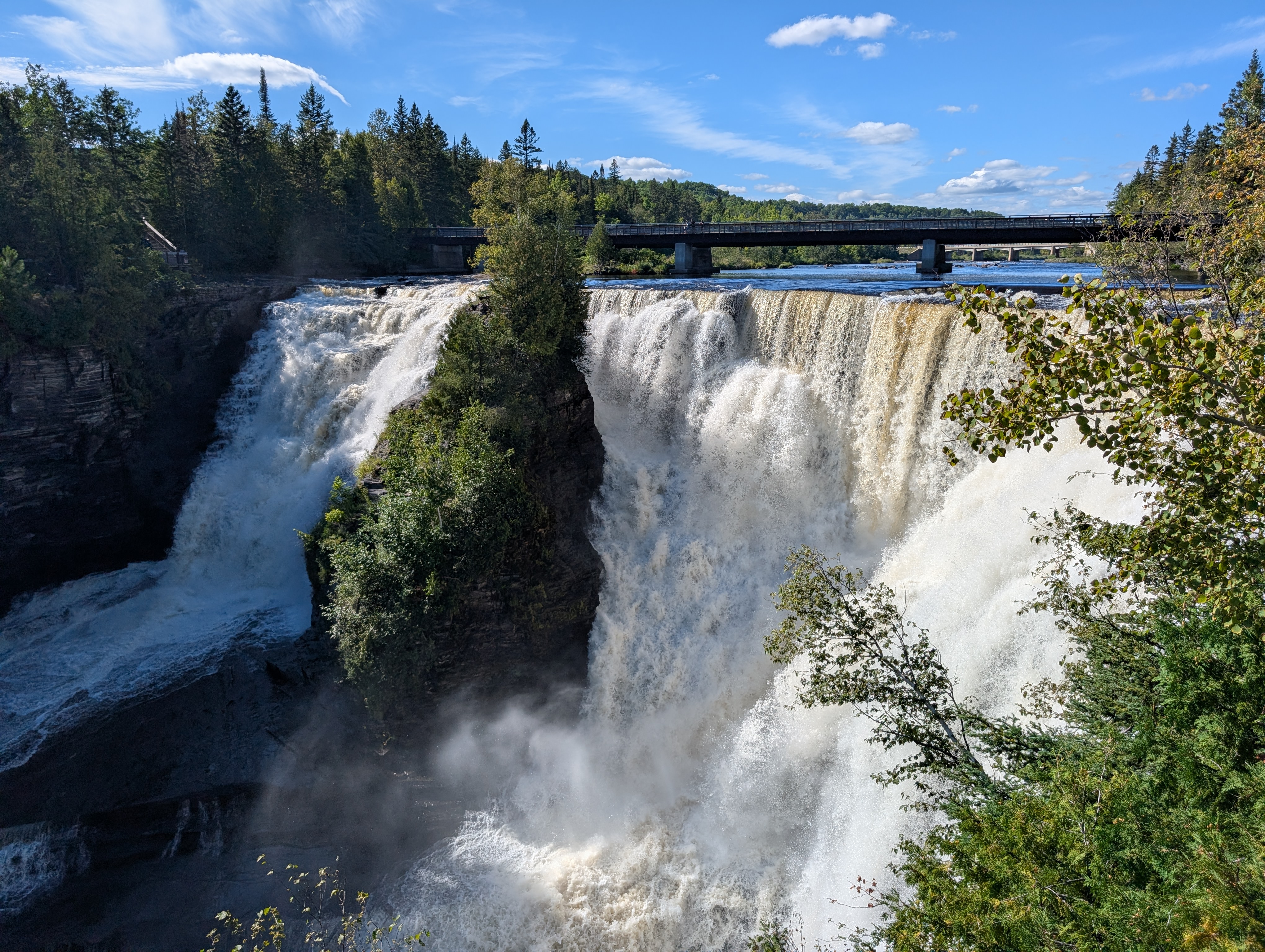
But places of convenience are still very real places, and the people who inhabit them shape them, mold communities into places they love, sometimes in spite of it all. People are drawn here for the same reasons they come to parts of the Upper Midwest: a low-key culture, a beautiful setting, achievable real estate. There are stirrings of turn toward the city’s greatest asset, its namesake bay enveloped by broad mesas. A new hotel development and a park with some fountains has appeared across from a handful of lively downtown blocks. At a handful of overlooks in town, older couples sit in their cars and gaze out and smile. Just west of town, the Kaministiquia River thunders down Kakabeka Falls and then past the paper mill out into the lake. Here on Labour Day weekend, license plates from all across Canada (and a chunk of the US) are visible, a steady migration of explorers, whether here to sit and gaze or push our bodies in the wilderness.
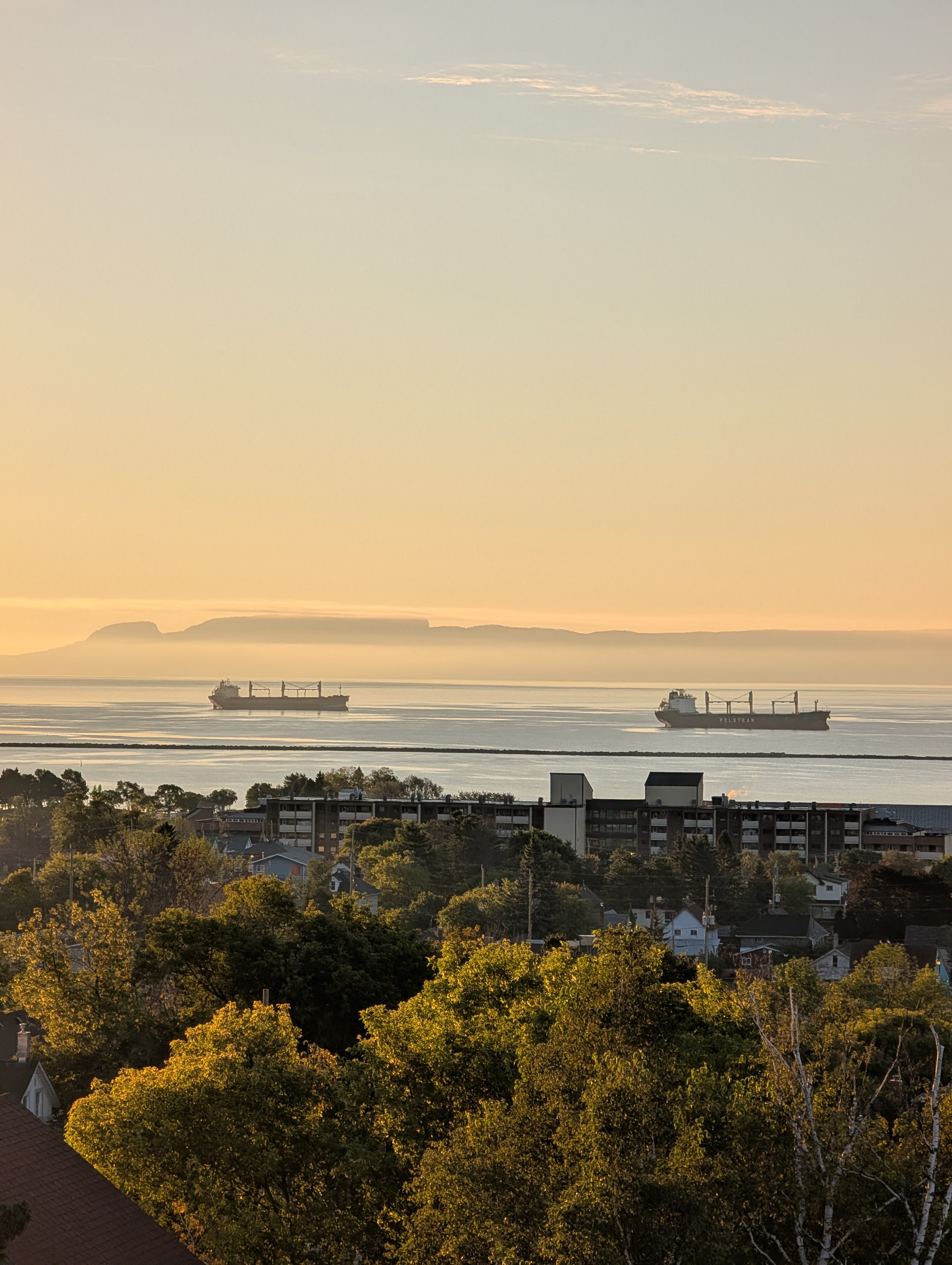
I am in the latter category, and in spite of Thunder Bay’s warts, my return trips my appetite. Lake Superior’s northern shore makes northeast Minnesota look positively tame. The steady slopes of Minnesota’s Sawtooth Range are here ground into tall molars with the sharp cliffs that form the region’s mesas of Canadian Shield. A drive along the Trans Canada Highway beside an endless string of freight provides sweeping views into this nation’s vastness: the scenery that makes northeast Minnesota unique in America is just the southernmost slice of a massive expanse of boreal forests and serene lakes and only a few scattered outposts of civilization. The now annual fire season that periodically sends smoke down across the US is a reminder of just how much these wilds can still affect our livelihoods.
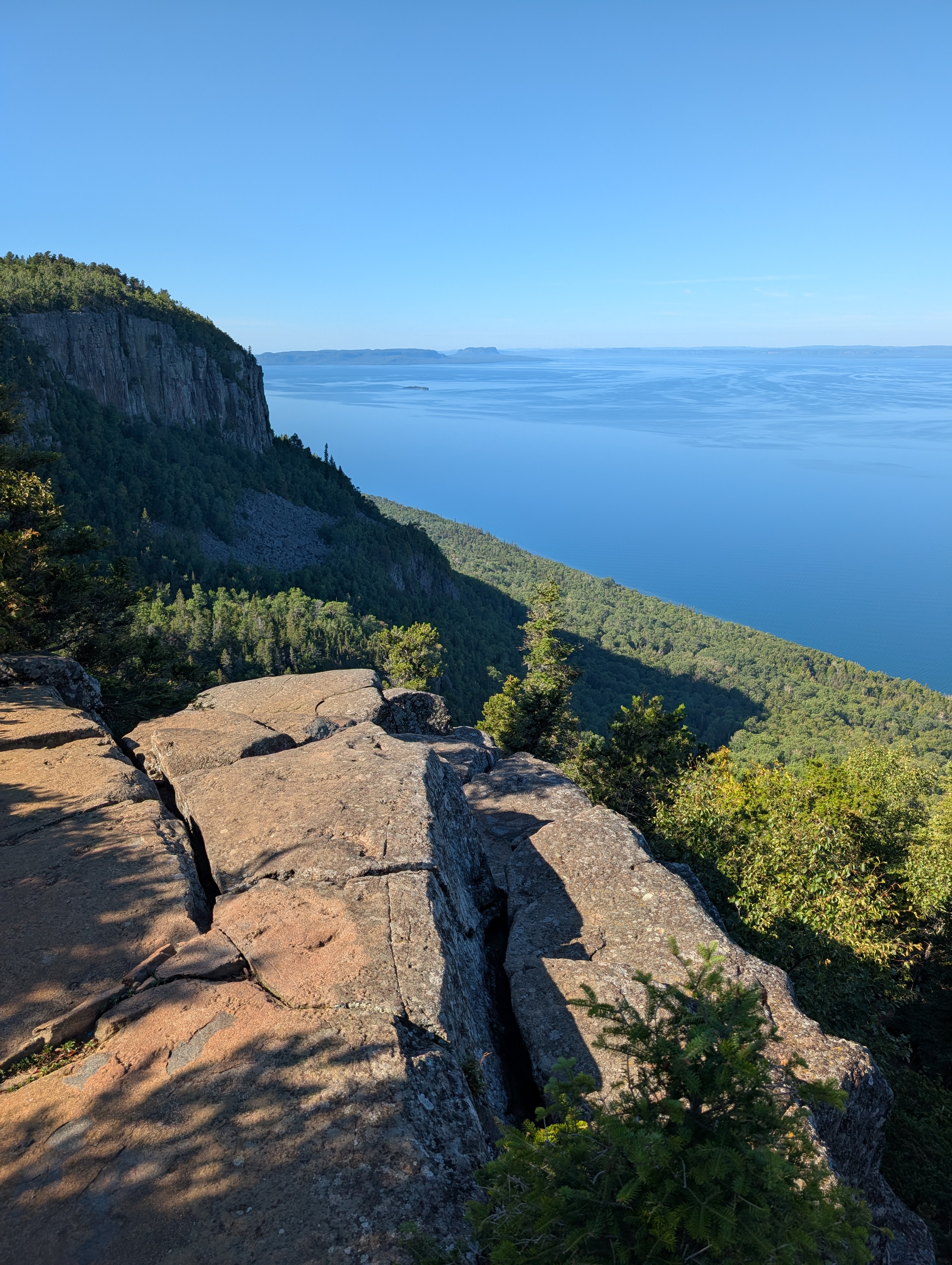
Sleeping Giant Provincial Park is named for the cliffs along the Sibley Peninsula hemming in one side of Thunder Bay, which do indeed resemble a prone figure with his feet sticking out into the lake. I do a 23-kilometer circuit here, beginning with a turn north on the Sawyer Bay Trail to scale the Giant’s head. The 1.4-km push to the top is nearly a 1,000-foot (soorey, 300 meter) climb, and from the head there are broad views east across the peninsula, west across the bay, and south over the Giant’s neck and down toward his ripped chest. When I was here as a child, I scrambled up the now defunct Chimney Trail, a marvelous so-called path that featured a boulder field, a scramble up a scree-covered slope, and a clamber up the trail’s namesake shaft through the rock that gave me some new insights into my mother’s vocabulary. This time the climb is mostly just a march up powered by hiking poles, with just one slightly dodgy spot near the top where someone has tied a semi-helpful rope to provide extra purchase.
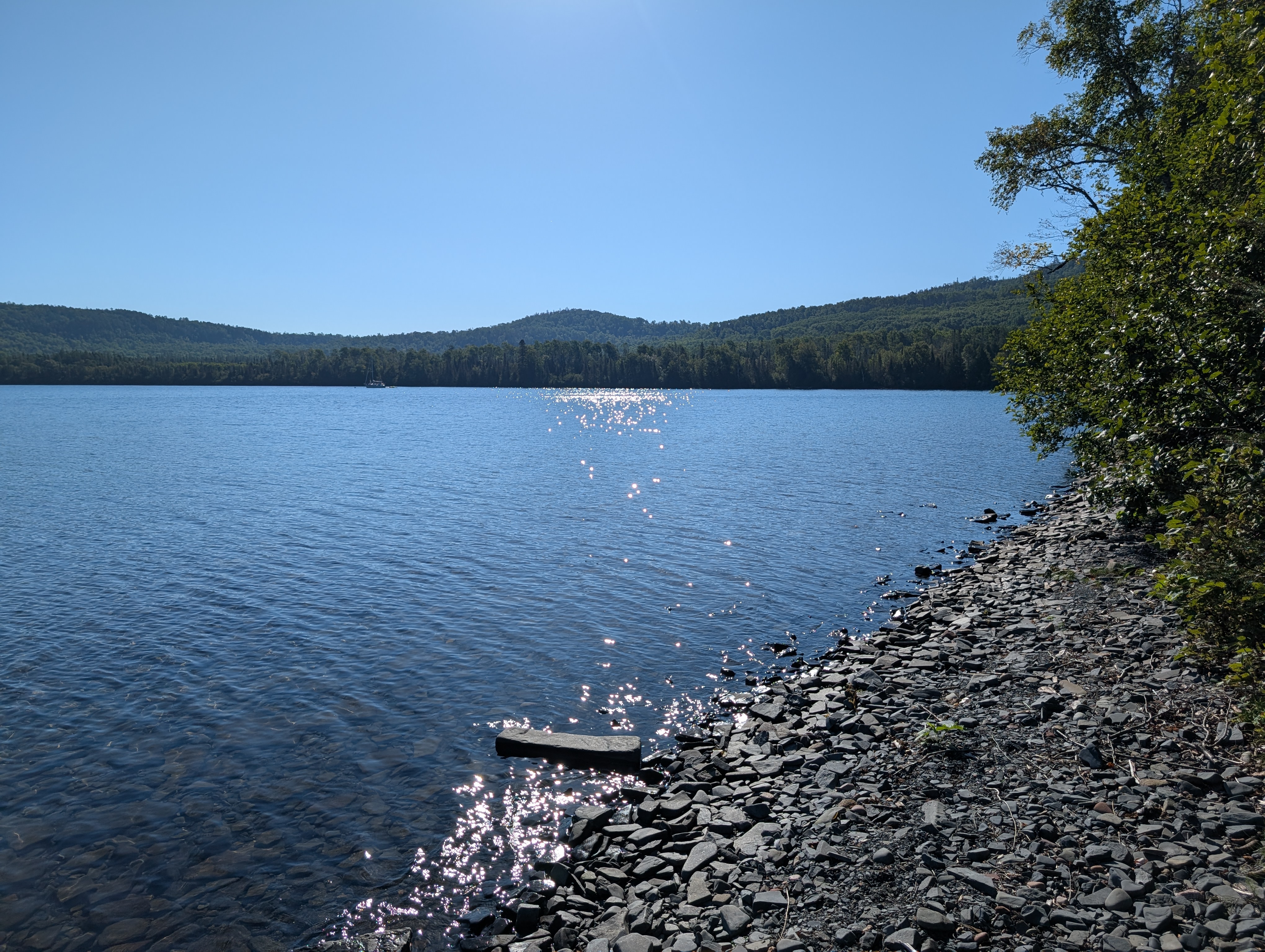
After penning a few words in a journal atop the Giant’s head I descend to Sawyer Bay. Sun splashes on the water where a couple sailboats have anchored, and a few hikers roll into the backpacking sites along the shore. “Well this is paradise,” says one of them upon his arrival, and it’s hard to disagree. But I do not linger in this particular paradise. I instead plow up and over the Talus Lake Trail, a lonely path wedged between the Giant and Thunder Mountain on the inland side. It begins with another huge climb and is sometimes just as steep as the head, first as it traces a babbling brook and then down past three sparkling lakes beside boulder fields. I see no one else on this trail, but find the crowds on the southern end of the Sibley Peninsula, where they work their way toward the Top of the Giant Trail, the replacement for the Chimney Trail up his knees.
The southern route to the Sleeping Giant is a veritable Tower of Babel. There are Sikhs and other South Asians and Africans of various origins, along with some German cyclists and of course the Francophone Quebecois who are about. For so long Canada drifted by as America’s quaint northern neighbor, distinguishable only by a few goofy quirks. Now, this nation of 40 million is diversifying rapidly, its face changing just as it has been cast adrift by its old friend to the south. Suddenly, Canadians might have to stand for something.
This January in Davos, Canadian Prime Minister Mark Carney warmed my international politics classicist heart by citing Thucydides’ Melian Dialogue when he laid bare the void left by the American retreat from multilateral leadership, its step back from its role as the beast of burden turning the world away from its natural state of anarchy. In the dialogue, the powerful Athenians tell their Melian neighbors that all of their appeals to morality and reciprocity are useless: “the strong will do what they can, and the weak will suffer what they must.” Thucydides had a subtle and grander point to make in his History of the Peloponnesian War; the Athenian abandonment of morality is the point at which the war with Sparta turned. While they won short-term victories in their annihilation of the Melians, they got bogged down in other foreign wars shortly thereafter, and the Spartans took advantage of their hubris.
This summer the view from Melos, like those from the Canadians’ fellow middle powers that I visited in Europe a few months ago, is one of a long-stable society awakening to a reality that it may have to play a more robust role in an international drama. These countries are generally comfortable if not exactly glittering with wealth like many US metros, and the tent cities belie any easy claim that they are better caretakers of their marginal populations than the Americans are. A dark read of them suggests a land of shrunken ambition and a senescent drift toward a subordinate status on the world stage.
Like European nations, Canada faces a paradox as the old order breaks down: it needs to think more about national defense and better protect its own interests, should rally around its flag and rediscover some vital forces lest it drift into a comfortable decay. But at the same time, given its size, economic power requires integration. As nations like Spain and Italy have learned the easy way and the British are learning the hard way, they are not big enough to compete on their own. That reality is made more immediate by that long, sleepy border the Canadians share with a restive hegemon and the great oceans separating them from fellow middle powers in Europe and Asia.
How these middle powers handle a changing world is one of the great geopolitical questions of our time. The US and China will do what they can, but Canada, Europe, and the Pacific Rim are not so weak that they are doomed to suffer what they must in the face of a new international rivalry. Can these states that are more dependent on cooperation still cooperate, and can they still create an order that views geopolitics as a problem to be partially solved, and not a fixed Hobbesian conflict? Can they offer a model for good life, not just of bureaucratic excess? The obstacles to making it work are considerable, but together, these nations could just be, well, a sleeping giant.
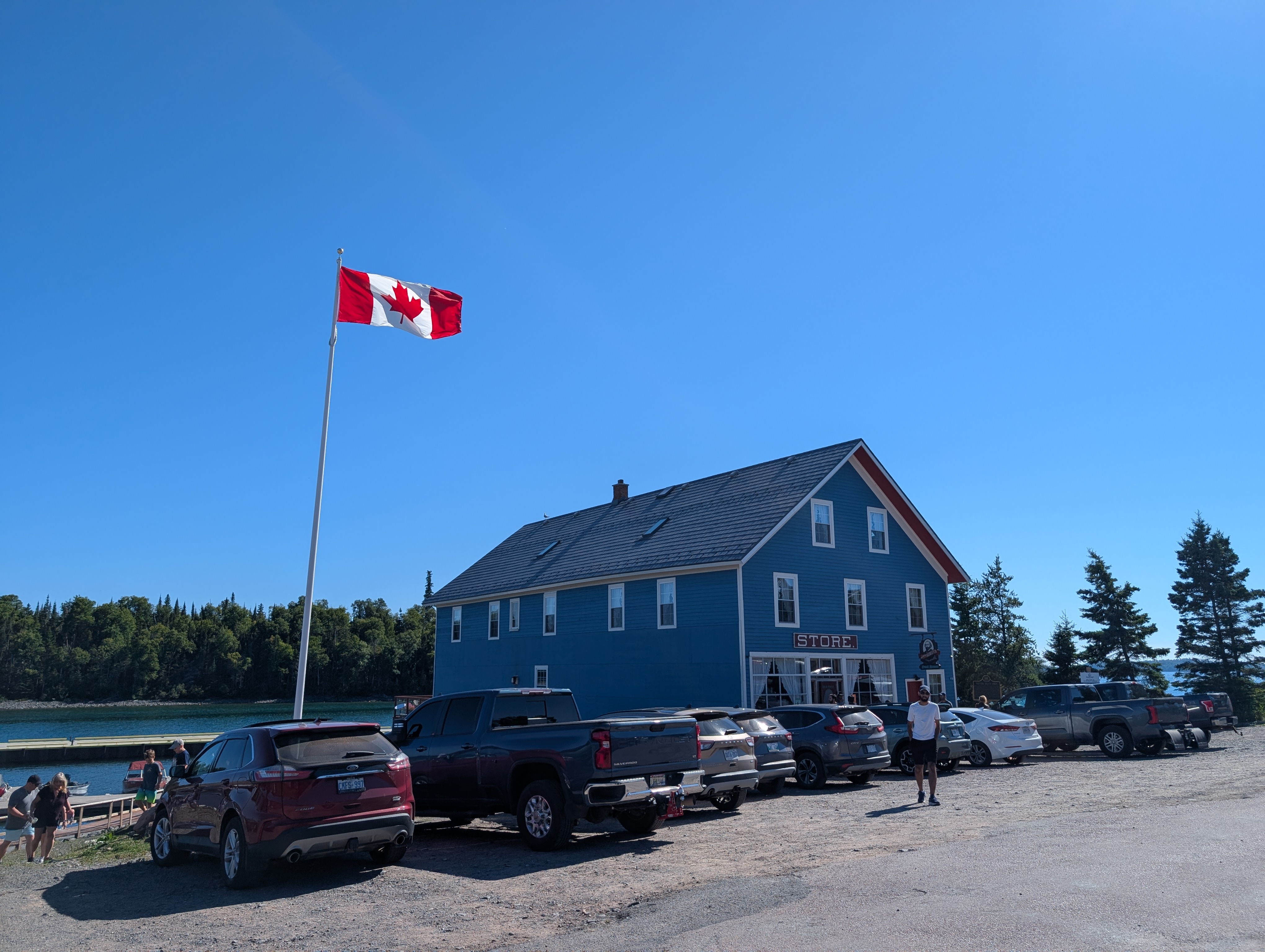
Over my weekend in Canada no one shares any opinions on trade war politics with me, and there are no hints of a thoroughly unnecessary heated rivalry between nations. Instead there are testaments to what the good life in one of these societies offers, and why it is worth protecting. At the end of the Sibley Peninsula, past Sleeping Giant Provincial Park, is a small settlement called Siver Islet, where the tea room at the 150-year-old general store delivers blueberry pie and iced tea. Out here I find some version of the Canadian Dream, with cozy cottages nestled along the water and a few boats puttering past, locals and tourists alike basking on a beautiful late summer day, a vision recognizable from the Maritime Provinces to Vancouver Island. Life goes on, and it is a beautiful one. It will be less than 25 years before my next return.
 A Patient Cycle