There Might Be Sleeping Giants

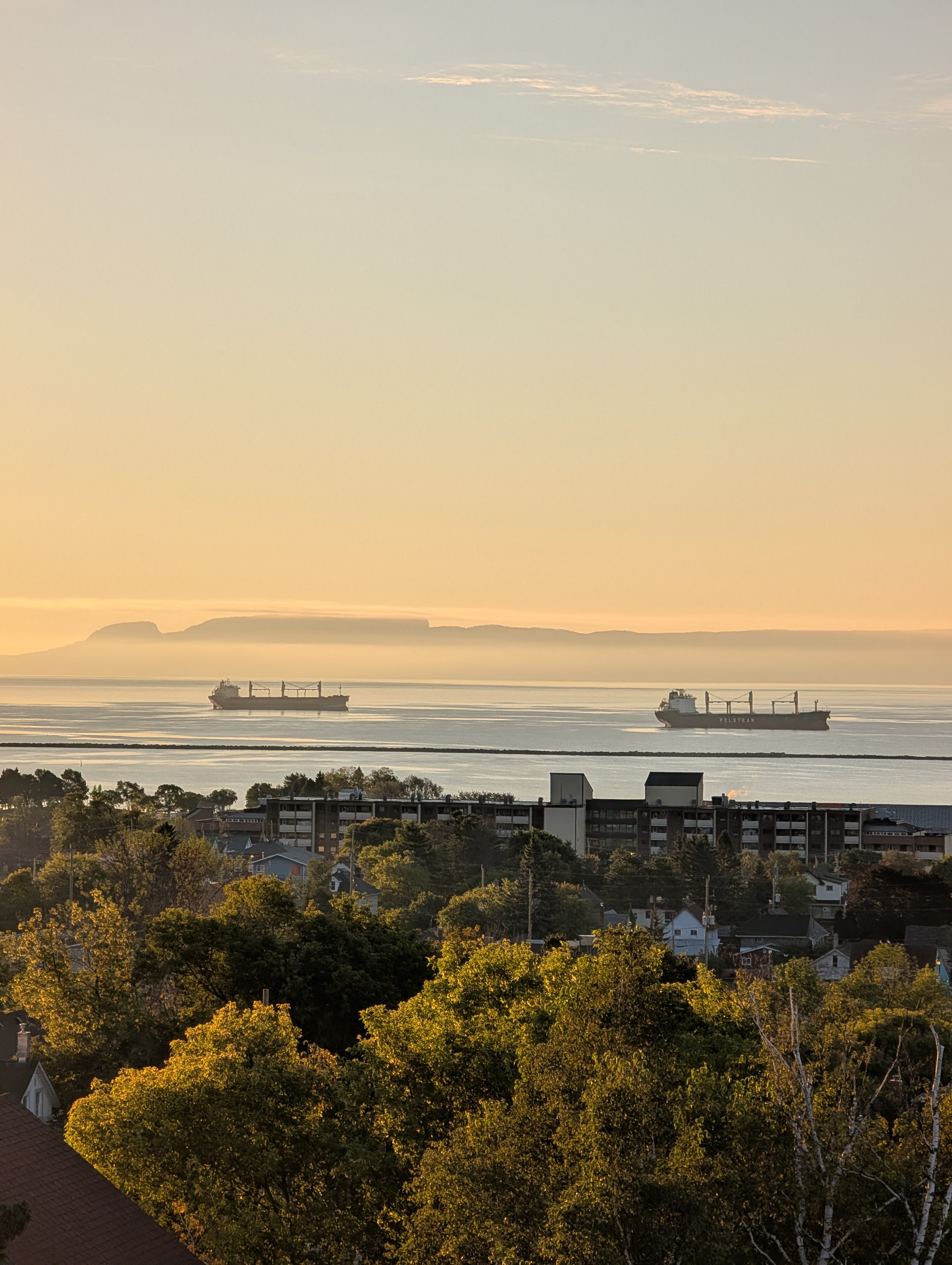
I last visited Thunder Bay, Ontario a quarter century ago, and had not felt a strong itch to return. My lingering childhood impression of this city just across the Canadian border from my home was of a very large version of Superior, Wisconsin: it is a Canadian rust belt town, faded and battered by time. The first impression on a return visit upholds what my 11-year-old eyes saw. Thunder Bay’s housing stock creaks and groans, and there are several tent cities near its waterfront. A large paper mill is the first sight as one drives from the south; the north end is dominated by faded grain elevators. Thunder Bay makes headlines in Canada for its rates of murder, human trafficking, and crime. The city has a large First Nations population, and its struggles are evident.

Thunder Bay is an invention of convenience. It arose as two separate towns, Fort William and Port Arthur, that only merged in 1970. It is a lonely outpost in the middle of a vast nation whose flyover country is less in the western Plains, where it is in the US—there one finds metros like Winnipeg and Edmonton and Calgary, engines of Canadian energy and agriculture—but instead in the vast forests between greater Toronto and the start of the breadbasket in Manitoba. Thunder Bay is one of that region’s two urban centers, an entrepot of the natural resources economy, there to funnel goods along to other places.

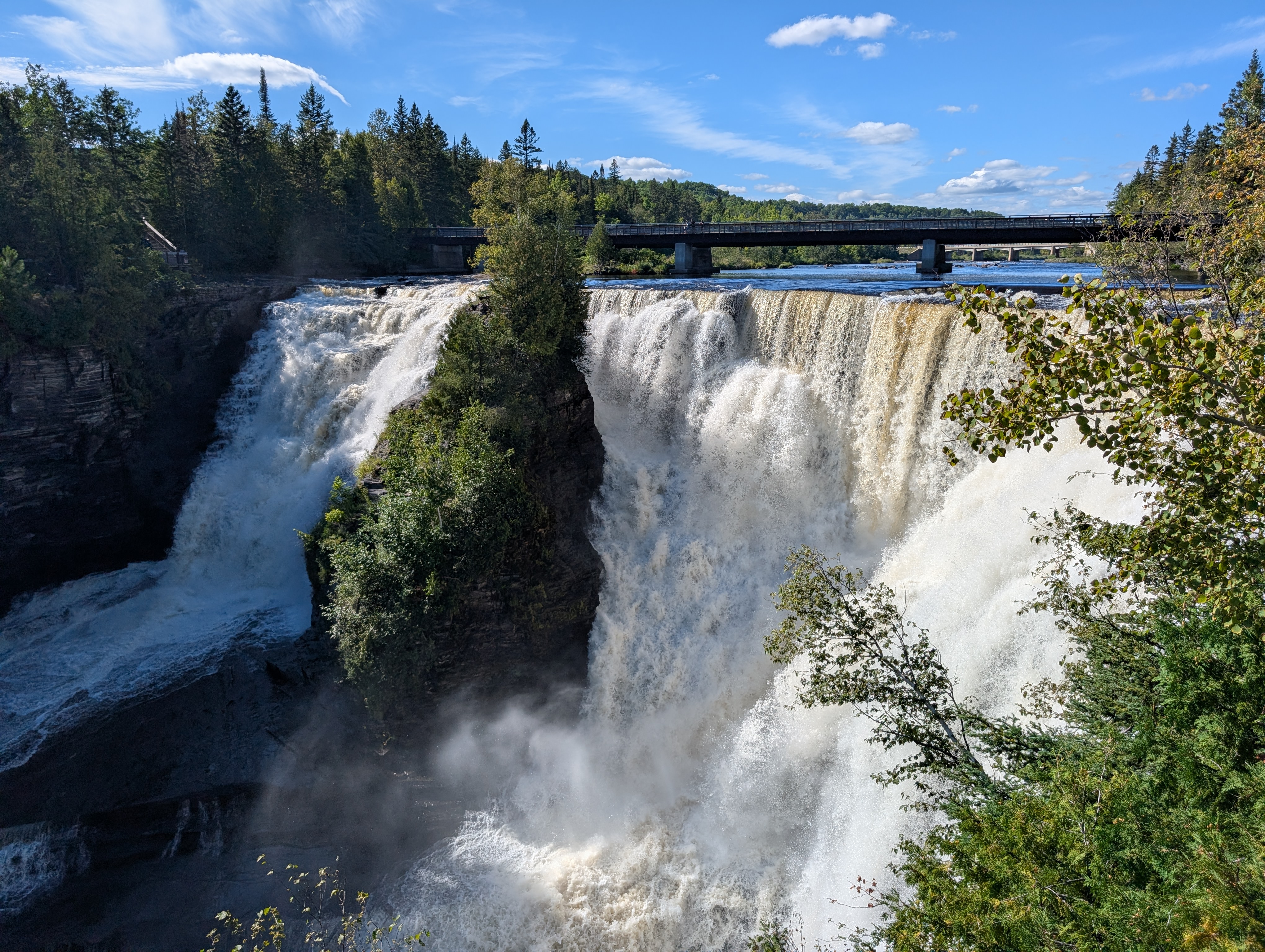
But places of convenience are still very real places, and the people who inhabit them shape them, mold communities into places they love, sometimes in spite of it all. People are drawn here for the same reasons they come to parts of the Upper Midwest: a low-key culture, a beautiful setting, achievable real estate. There are stirrings of turn toward the city’s greatest asset, its namesake bay enveloped by broad mesas. A new hotel development and a park with some fountains has appeared across from a handful of lively downtown blocks. At a handful of overlooks in town, older couples sit in their cars and gaze out and smile. Just west of town, the Kaministiquia River thunders down Kakabeka Falls and then past the paper mill out into the lake. Here on Labour Day weekend, license plates from all across Canada (and a chunk of the US) are visible, a steady migration of explorers, whether here to sit and gaze or push our bodies in the wilderness.
I am in the latter category, and in spite of Thunder Bay’s warts, my return trips my appetite. Lake Superior’s northern shore makes northeast Minnesota look positively tame. The steady slopes of Minnesota’s Sawtooth Range are here ground into tall molars with the sharp cliffs that form the region’s mesas of Canadian Shield. A drive along the Trans Canada Highway beside an endless string of freight provides sweeping views into this nation’s vastness: the scenery that makes northeast Minnesota unique in America is just the southernmost slice of a massive expanse of boreal forests and serene lakes and only a few scattered outposts of civilization. The now annual fire season that periodically sends smoke down across the US is a reminder of just how much these wilds can still affect our livelihoods.

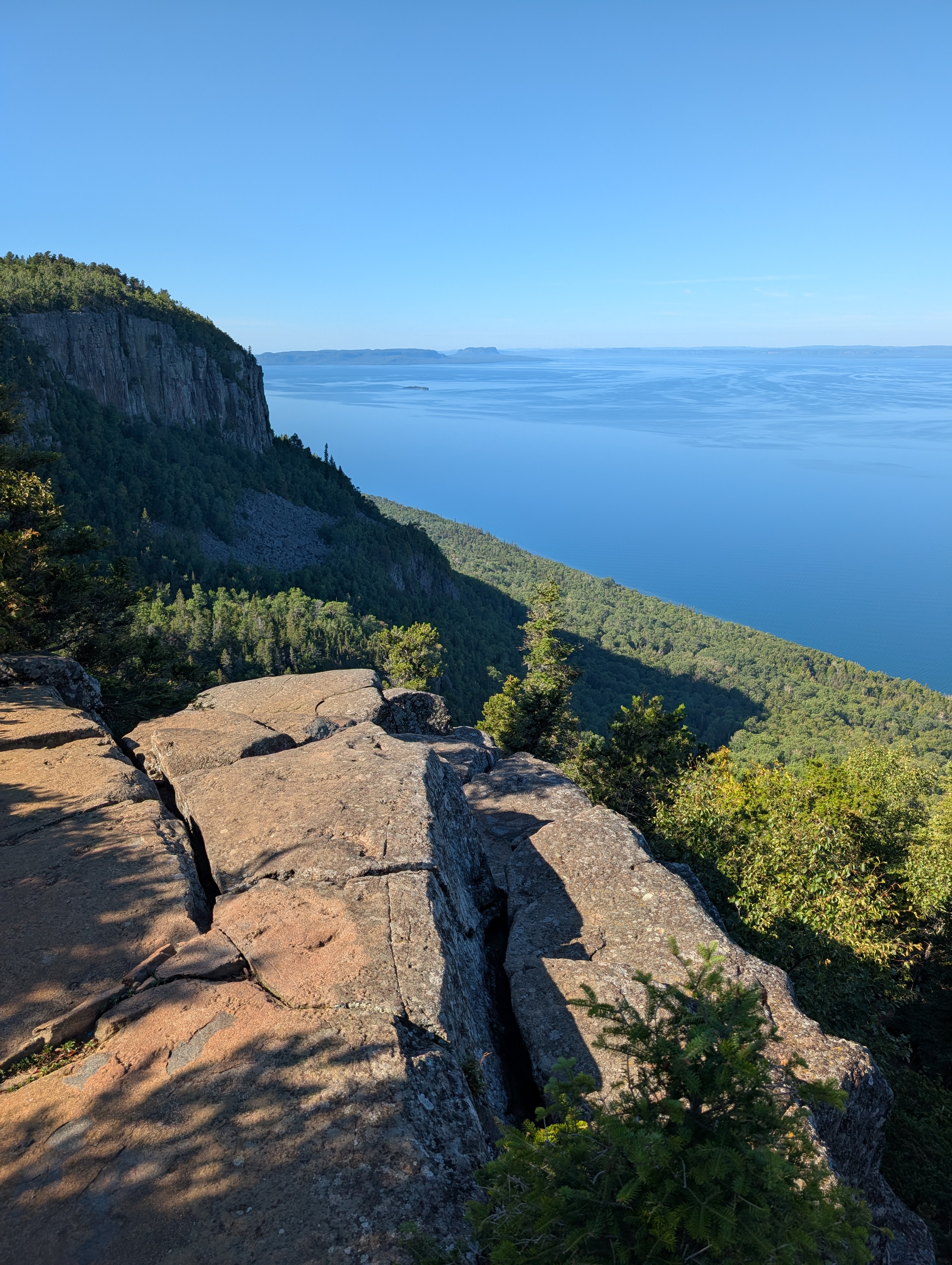
Sleeping Giant Provincial Park is named for the cliffs along the Sibley Peninsula hemming in one side of Thunder Bay, which do indeed resemble a prone figure with his feet sticking out into the lake. I do a 23-kilometer circuit here, beginning with a turn north on the Sawyer Bay Trail to scale the Giant’s head. The 1.4-km push to the top is nearly a 1,000-foot (soorey, 300 meter) climb, and from the head there are broad views east across the peninsula, west across the bay, and south over the Giant’s neck and down toward his ripped chest. When I was here as a child, I scrambled up the now defunct Chimney Trail, a marvelous so-called path that featured a boulder field, a scramble up a scree-covered slope, and a clamber up the trail’s namesake shaft through the rock that gave me some new insights into my mother’s vocabulary. This time the climb is mostly just a march up powered by hiking poles, with just one slightly dodgy spot near the top where someone has tied a semi-helpful rope to provide extra purchase.

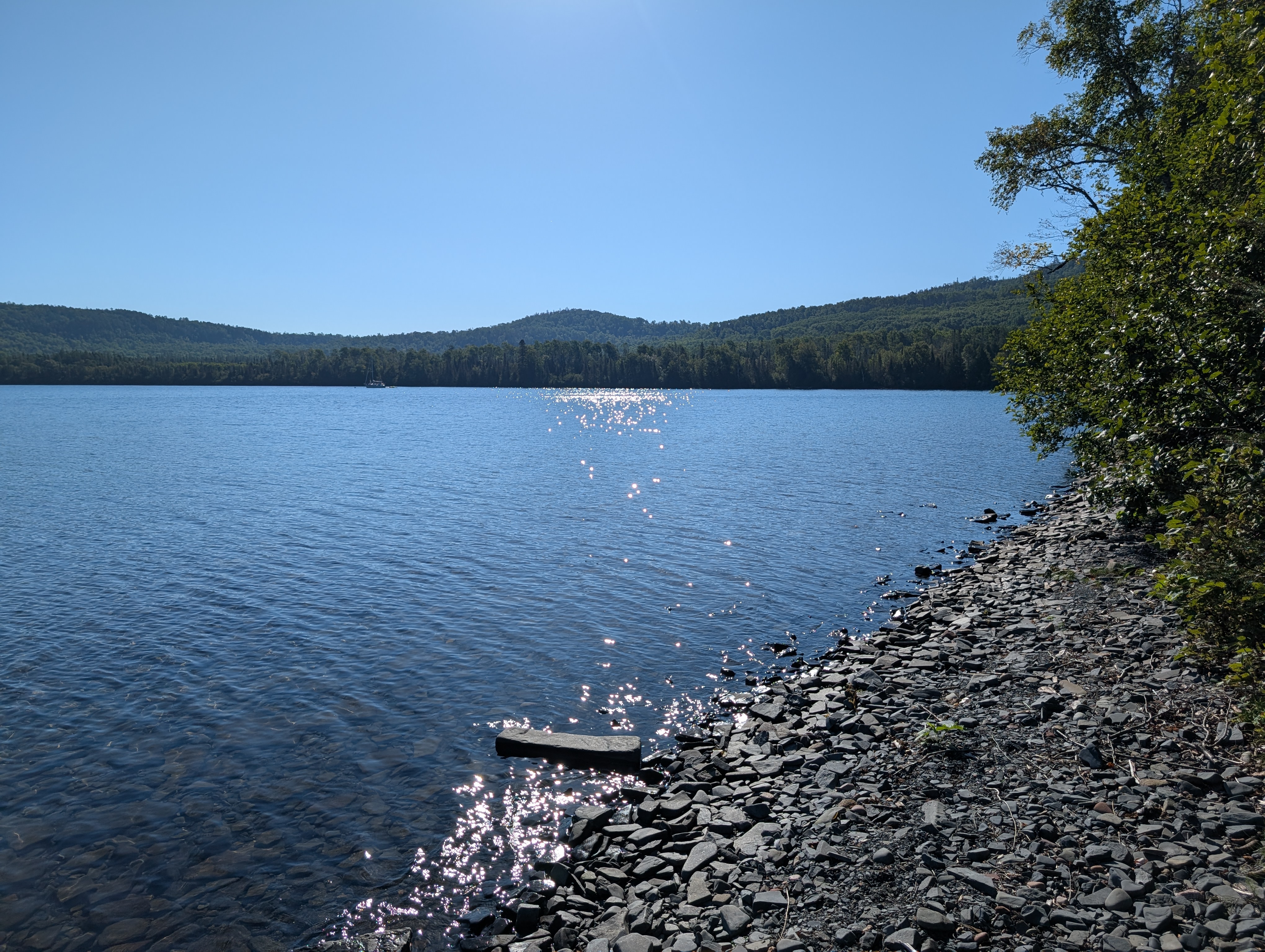
After penning a few words in a journal atop the Giant’s head I descend to Sawyer Bay. Sun splashes on the water where a couple sailboats have anchored, and a few hikers roll into the backpacking sites along the shore. “Well this is paradise,” says one of them upon his arrival, and it’s hard to disagree. But I do not linger in this particular paradise. I instead plow up and over the Talus Lake Trail, a lonely path wedged between the Giant and Thunder Mountain on the inland side. It begins with another huge climb and is sometimes just as steep as the head, first as it traces a babbling brook and then down past three sparkling lakes beside boulder fields. I see no one else on this trail, but find the crowds on the southern end of the Sibley Peninsula, where they work their way toward the Top of the Giant Trail, the replacement for the Chimney Trail up his knees.

The southern route to the Sleeping Giant is a veritable Tower of Babel. There are Sikhs and other South Asians and Africans of various origins, along with some German cyclists and of course the Francophone Quebecois who are about. For so long Canada drifted by as America’s quaint northern neighbor, distinguishable only by a few goofy quirks. Now, this nation of 40 million is diversifying rapidly, its face changing just as it has been cast adrift by its old friend to the south. Suddenly, Canadians might have to stand for something.
This January in Davos, Canadian Prime Minister Mark Carney warmed my international politics classicist heart by citing Thucydides’ Melian Dialogue when he laid bare the void left by the American retreat from multilateral leadership, its step back from its role as the beast of burden turning the world away from its natural state of anarchy. In the dialogue, the powerful Athenians tell their Melian neighbors that all of their appeals to morality and reciprocity are useless: “the strong will do what they can, and the weak will suffer what they must.” Thucydides had a subtle and grander point to make in his History of the Peloponnesian War; the Athenian abandonment of morality is the point at which the war with Sparta turned. While they won short-term victories in their annihilation of the Melians, they got bogged down in other foreign wars shortly thereafter, and the Spartans took advantage of their hubris.

This summer the view from Melos, like those from the Canadians’ fellow middle powers that I visited in Europe a few months ago, is one of a long-stable society awakening to a reality that it may have to play a more robust role in an international drama. These countries are generally comfortable if not exactly glittering with wealth like many US metros, and the tent cities belie any easy claim that they are better caretakers of their marginal populations than the Americans are. A dark read of them suggests a land of shrunken ambition and a senescent drift toward a subordinate status on the world stage.

Like European nations, Canada faces a paradox as the old order breaks down: it needs to think more about national defense and better protect its own interests, should rally around its flag and rediscover some vital forces lest it drift into a comfortable decay. But at the same time, given its size, economic power requires integration. As nations like Spain and Italy have learned the easy way and the British are learning the hard way, they are not big enough to compete on their own. That reality is made more immediate by that long, sleepy border the Canadians share with a restive hegemon and the great oceans separating them from fellow middle powers in Europe and Asia.

How these middle powers handle a changing world is one of the great geopolitical questions of our time. The US and China will do what they can, but Canada, Europe, and the Pacific Rim are not so weak that they are doomed to suffer what they must in the face of a new international rivalry. Can these states that are more dependent on cooperation still cooperate, and can they still create an order that views geopolitics as a problem to be partially solved, and not a fixed Hobbesian conflict? Can they offer a model for good life, not just of bureaucratic excess? The obstacles to making it work are considerable, but together, these nations could just be, well, a sleeping giant.

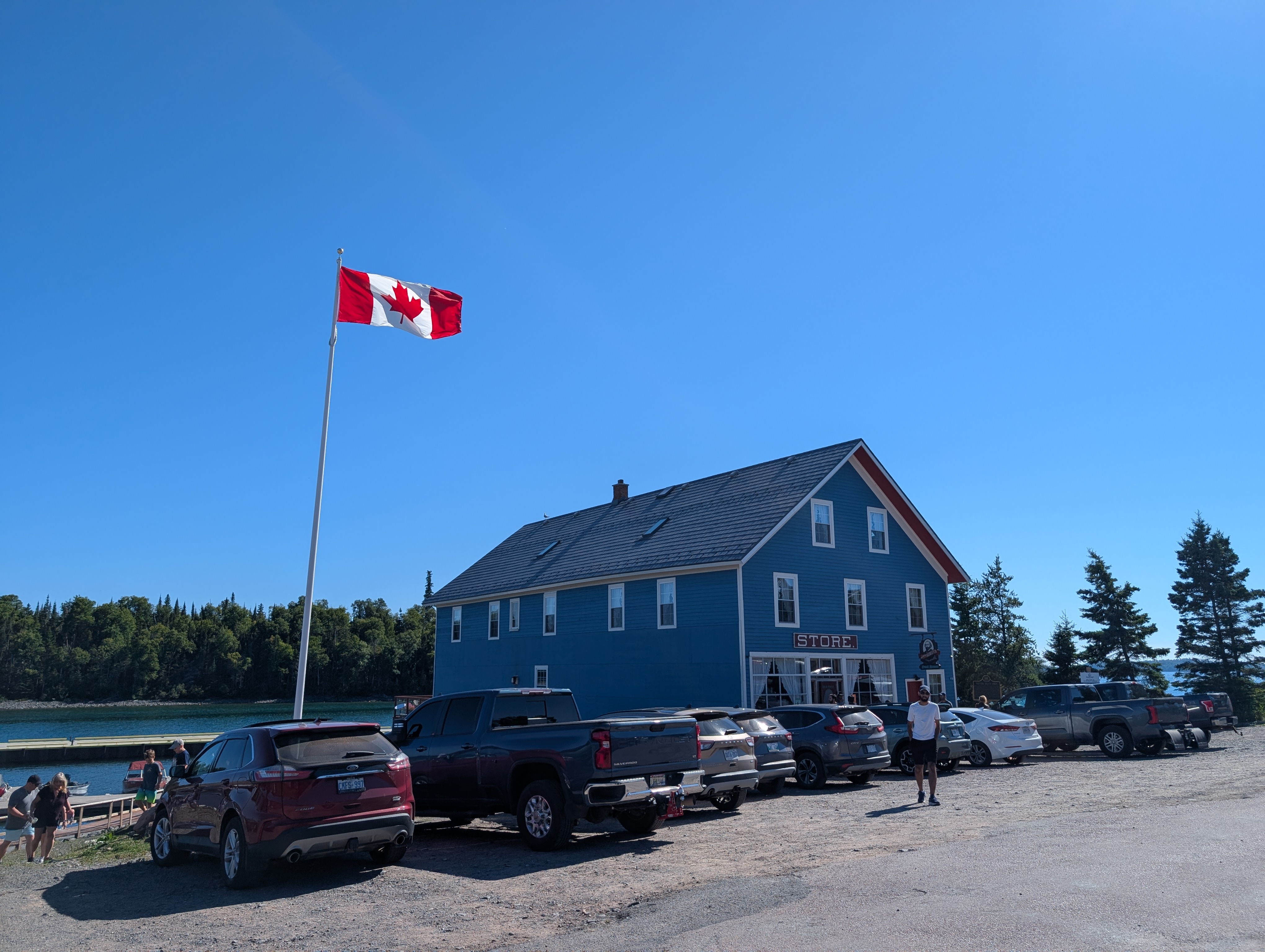
Over my weekend in Canada no one shares any opinions on trade war politics with me, and there are no hints of a thoroughly unnecessary heated rivalry between nations. Instead there are testaments to what the good life in one of these societies offers, and why it is worth protecting. At the end of the Sibley Peninsula, past Sleeping Giant Provincial Park, is a small settlement called Siver Islet, where the tea room at the 150-year-old general store delivers blueberry pie and iced tea. Out here I find some version of the Canadian Dream, with cozy cottages nestled along the water and a few boats puttering past, locals and tourists alike basking on a beautiful late summer day, a vision recognizable from the Maritime Provinces to Vancouver Island. Life goes on, and it is a beautiful one. It will be less than 25 years before my next return.

The Not-So-Quiet American

Holbrooke wanted more. He wasn’t a grand strategist, but his frenetic public presence made him the embodiment of certain ideas in action. He believed that power brought responsibilities, and if we failed to face them the world’s suffering would worsen, and eventually other people’s problems would be ours, and if we didn’t act no one else would. Not necessarily with force, but with the full weight of American influence. This was the Holbrooke doctrine, vindicated at Dayton. But it didn’t come out of government experience, much less analytical rigor. His views, like everyone’s, emerged from his nervous system, his amygdala, the core of his character, where America stood for something more than just its own power. He was that rare American in the treetops who actually gave a shit about the dark places of the earth.

At no time in recent memory has a book consumed me as much as the one I read over the past week. On its surface, George Packer’s Our Man: Richard Holbrooke and the End of the American Century doesn’t seem like the sort of book that will pack an overwhelming punch. It’s a biography of a diplomat who garnered respect in certain circles, but never became a household name or rose to the highest positions he craved. I expect Holbrooke will be lost to history in a generation or two, and his flaws were glaring enough that he doesn’t deserve any posthumous sainthood. But as an analogy for the apogee and decline of American power, his story is too perfect, and Packer, a master craftsman, the grand elegist of the broken American Dream, is our man to tell the tale.

Holbrooke served every Democratic president from Kennedy to Obama. He joined the Foreign Service in 1962 as an acolyte of the builders of the post-World War II order, and went straight to Vietnam, where he vainly struggled to expand the vision of what it would take to win. Holbrooke and his fellow rising stars in the Foreign Service all read Graham Greene’s The Quiet American, and, instead of seeing themselves in Greene’s blindly optimistic American agent Alden Pyle, earnestly believed they could do better. But that was only the start of a long and industrious career that barreled along at breakneck pace right up until his aorta burst in a meeting with Hillary Clinton in 2010. He was, Packer argues, the ultimate symbol of American global ambitions in the twilight of the nation’s hegemony.

Foreign policy is a particularly Hobbesian realm of endless war between large egos measured against blurry standards. It’s rarely an issue that drives the polls, and one observer’s great act of diplomacy is another’s unconscionable sellout. The realists and idealists collide, and in his early years, Holbrooke’s ideals often left him on the losing side of arguments. The military shunted aside the nation-builders in Vietnam, and in the Carter years, Zbigniew Brzezinski’s Cold War realism had little time for humanitarian concerns in southeast Asia. Defenders of diplomacy were at their peak after World War II but found increasingly less room to operate, especially when the military, whether in Vietnam or Afghanistan, gave presidents—particularly Democrats scared of coming across as weak on national security—instant credibility and concrete body counts that can generate good headlines.

Diplomacy is the trickiest form of politics, more art than science and yet insistent upon clear results. Statements almost always come with subtext and hidden agendas, and even the greatest can fail to find the real meaning, the real goals, the real sources of power. A sympathetic Pakistani ambassador likened the drama in central Asia to “a theater in which everyone understood their part, except for the Americans,” and Holbrooke saw it as his job to understand that part. At his best, he was a master of complexity, never more so than in Bosnia. He traveled there on his own before Bill Clinton’s inauguration and spent a chaotic New Year in besieged Sarajevo, took that passion into an administration with no foreign policy direction to speak of, and somehow got a bunch of squabbling warlords to accept the Dayton Accords. Another high point was his tenure as ambassador to the United Nations, as he was able to show even isolationist conservatives the value in propping up an international system favorable to U.S. interests and ideals. He could disarm large egos that others thought lost causes.

Perhaps his comfort with this complexity is why Holbrooke clashed horribly with the Obama administration in the final phase of his career. The law professor of a president wanted crisp arguments and decisive rhetoric, not murky maneuvers and dealings with questionable characters. For a president whose story was to be a revival of the American Dream, there was no room for Holbrooke’s lessons from Vietnam, an analogy Obama rejected out of hand. “By the end he was living each chapter of his life simultaneously—Kennedy and Obama, Vietnam and Bosnia and Afghanistan…All that accumulated experience—we Americans don’t want it,” writes Packer. “We’re almost embarrassed by it, except when we’re burying it. So we forget our mistakes or recoil from them, we swing wildly between superhuman exertion and sullen withdrawal, always looking for answers in our own goodness and wisdom instead of where they lie, out in the world, and in history.”

Holbrooke knew he faced long odds in Afghanistan, but it didn’t stop him. Despite his ego and bluster, he built an idiosyncratic team of the best people he could find, from prolific academics to a woman who tried to lecture him on an airport shuttle. Their role, he told his team, was to break through the turf battles, process over substance. He loved them like his own children (whom he neglected until later in their lives, though there is a superb sequence in which his prep school reject teenage son moves into his New York bachelor pad and leaves him notes like “I suppose leaving half the Grape-fruit Juice out to Spoil is your way of Leading by Example”), and tracked his way all over south and central Asia in search of some way to stop the region’s entropy. But none of it mattered, because Hillary Clinton was the only person in the administration who didn’t think he was a pompous windbag from another era, and even she could only expend so much political capital on one lonely diplomat working a long-shot battle to open dialogue with the Taliban and end a war the military could not win. It still hasn’t.

Our Man is a lament for the decline of American international influence, and Packer’s turning point is the late 90s. He demolishes the American hubris of that era in a few pages that I could quote in full. At the unquestioned peak of American power, there was no serious strategy, just Holbrooke and a few colleagues using the lessons of a lifetime of experience to bring peace. The U.S., terrible imperialists, looked for quick solutions instead of managing chaos. Al-Qaeda’s bombings of two American embassies in Africa elicited only a perfunctory volley of cruise missiles in response, and Washington spent a full year, in Packer’s elegant phrasing, on “Oval Office cocksucking.” (That year, 1998, was also the year the Yankees won 114 games and the World Series and Duluth East last won a state hockey title. It really has been all downhill since.) “Our leaders believed they had the luxury to start tearing one another apart, and they’ve never stopped,” Packer pontificates. “Did any country ever combine so much power with so little responsibility? And slowly, imperceptibly at first, we lost that essential faith in ourselves.”

Holbrooke, somehow, never lost that faith. His ambition pushed him along in dogged pursuit of glory. It also killed two marriages and left a third on life support, cost him many of his friends, and shameless lobbying ruined his chances at being Secretary of State or winning a Nobel prize. He was a vainglorious to the end, though it was a complex egotism. In the words of Tony Lake, his Vietnam era best friend and later-stage mortal enemy, “‘What Holbrooke wants attention for is what he’s doing, not what he is…That’s a very serious quality and his saving grace.’” As I’ve long believed, ambition is both the source of human greatness and the root of human demise. “And if, while following him, you ever feel a disapproving cluck rising inside your palate, as I sometimes do, don’t forget that inside most people you read about in history books in a child who fiercely resisted toilet training,” Packer writes. “Suppose the mess they leave is inseparable from their reach and grasp?”

* * *

Why did Our Man hit me so personally? Probably because, for a healthy chunk of my life, I wanted to become Richard Holbrooke. I wanted to be the globetrotting diplomat who could dive in and end age-old wars through sheer power of will. I wanted to believe in an open and democratic world order, and I wanted to believe my country could learn from its past sins and use its power as a force for decency. I went to Georgetown’s School of Foreign Service, where I brushed shoulders with Holbrooke’s two great rivals (Lake and Madeleine Albright, both on the faculty at the time) with the express purpose of following this path.

And yet I didn’t, and found myself tunneling into old journals to remind myself why. Did I lack the killer instinct that drove Holbrooke both to glory and the grave? Was I doomed from the start by a lack of WASPy cred, a wishful believer in a dream I never could achieve? Was my reaction to life in DC too visceral, too uncompromising and unwilling to make sacrifices? Was I too consumed with other events in my life that turned me inward and homeward? All of the above, I think, to varying degrees.

And so, around the exact time Holbrooke died, my belief in his project also died. I’d prepared myself for a world that was already halfway gone by the time I graduated from college. I’m at peace, or so I tell myself: most people learn to leave behind childhood dreams, and I have a new vision of a good life that I’m pursuing. Our Man is not a flattering window into American government, and a career in that world seems to break down so many who do undertake it: petty infighting, endless politicking, 20-hour days that ruin families. Even Lake, ever Holbrooke’s foil, ever the more noble and cautious and thoughtful counterpart, succumbed to the same miseries.

As a child of a different era, I’m more skeptical of the liberal internationalist order than Packer is and Holbrooke was. But after a decade of Obama-led “managed decline” (Packer’s words) and the incoherent bluster of its America First successor, the virtues of that belief in American goodness, for all its flaws, also undergirds so many of the steps the world has taken in a saner direction since the end of World War II. And while it makes for brilliant writing, Packer’s requiem for a superpower may be premature as well. If future diplomats can harness both that spirit and apply some hard-earned lessons from the past, the U.S. could yet arrive at a foreign policy befitting of this moment in history. The ambition lurks within, repressed but still very much alive.

Turkish Dismay and the U.S. in the Middle East

Turkish Dismay and the U.S. in the Middle East

The Middle East is not for the faint of heart. While there are clear trends and cultural ties that pull it together, it is such a large and complex collection of nations that it is incredibly easy misunderstand it. A number of people who will remain anonymous make a living doing so. In fact, one might even go so far as to say that thinking of the Middle East as a region with a coherent political history only weakens one’s understanding of what is going on in its constituent nations.

Take the Arab Spring, which began with a self-immolating pushcart vendor in Tunisia, set off a wave of instability that toppled several autocratic regimes, and sent ripples into even the most stable countries in the region. At first, it was hard not to be swept up in the fervor; I recall pulling up a live stream of al-Jazeera on one of the first days to be greeted by a horde of protesters storming across a bridge and pushing a bus into the Nile and thinking “this is pretty cool.” While there was plenty of chaos and heartbreak in the streets of Cairo as the weeks went by, there were also acts of true heroism and an explosion of hope that us Westerners can barely fathom. It looked like an inspirational moment that might swing the future of an entire region, especially when one considered Egypt’s cultural and political prominence in the Middle East.

Since then, the dream has soured somewhat. Egypt is far from the Western democracy some idealistic observers hoped it might become; instead, it is an unstable mess governed by the Muslim Brotherhood. Yet it was one of the more peaceful revolts, when compared to the brutal repression in several countries, the NATO-supported war in Libya (which has now spilled into Mali), and the horrific civil war in Syria. The future is anything but predictable, but it seems safe to say that history most any historical rendering of its events will have to be very, very nuanced.

The U.S. response to the crises has likewise been frustrating to anyone who expects any sort of symmetry: intervention in Libya, general support for the Egyptian opposition, hand-wringing in Syria, and steadfast support of the regime in Bahrain. The awkward response is understandable, given the limits of geopolitical reality and the measured sobriety in the wake of intervention in Afghanistan and Iraq. Moreover, most of these conflagrations offer two bad choices: an existing autocrat or a complete power vacuum that tends to wind up empowering the well-organized hard-line Islamic groups (though there is plenty of variety within and among these groups). “Better the devil we know,” many sensible people say, but this presents a false choice. Even if Hosni Mubarak had stayed in power, he wouldn’t have lasted forever. Autocracies can appear stable because they often have the same leader for years and years, but in the end, they all fall in one way or another. Ideally they go gently and gradually, as in Myanmar or South Africa, but when they don’t know when to let go, it’s near-impossible to get a happy ending. Change, in this case, is inevitable. The real question for the United States is one of how to react to events that one cannot fully control.

All of this brings us to Turkey, where recent protests spurred me to write this post. Over the past decade Turkey had, by in large, stood at safe removal from the discord in the rest of the region. With its “zero problem” foreign policy, Prime Minister Recep Tayyip Erdogan’s administration, now in its twelfth year, harnessed political Islam and economic growth to form a stable and democratic government largely unconcerned with the tribulations in other nations. Of course, Turkey had always been different: it is populated by Turks instead of Arabs, has a longer democratic tradition, and its proximity to Europe meant it was often at some remove from the Middle Eastern lands it once ruled back when it was the Ottoman Empire. But with accession to the European Union stalled and looking less desirable after the financial crisis, the Turks turned their eyes back southward. Suddenly Erdogan had things to say about everything in the region, and ruffled some feathers in the U.S. and Israel. Part of this was out of necessity; the war in Syria has sent refugees spilling across its borders. But under the leadership of ambitious Foreign Minister Ahmet Davutoglu, the Turks have started to posture as a regional leader, perhaps in search of a “Pax Ottomana,” with imperfect but stable Turkey as the ideal for the rest of the region.

The riots in Istanbul could unsettle that narrative, particularly if Erdogan continues to make a mess of these protests. But Turkey’s fall from grace has even deeper repercussions. Writes Daniel Larison:

Erdogan’s heavy-handed and tone-deaf response to the protests in Turkey is a continuation of how he has treated internal dissent for a long time, but it is also an expression of his assumption, reinforced by multiple general election victories, that he and his party really do speak for the majority of the country. Turkey has become more democratic in important respects over the last decade, but it has also become more illiberal, which is what can happen when populist majoritarian political forces displace an unrepresentative, less democratic system.

It is worth noting that the immediate catalyst for the riots was not an increased religious bent by the Erdogan government (though there certainly has been some of that); it was a plan to develop a public park in a manner the local residents did not like. It was not religious tyranny, but rather tyranny of the democratically-elected national government over the local. It is a classic case of state overreach by a leader who has probably been in power a bit too long, and who has lost sight of the things that got them into politics in the first place. Erdogan and his allies have now conflated themselves with Turkey, and have got their political agenda mixed up in a project of national greatness. It’s unfortunate, given the subtleties and successes of his government, and there is a small chance that Erdogan will recognize his folly. But the more likely outcome is a blow to the Turkish ideal for the rest of the Middle East. Even if the political consequences of the riots are minor, it will now be difficult for the Turks to pass themselves as some perfect fusion of democratic and Islamic ideals. While Erdogan may be able to atone for this error, he and his party will now be under much greater scrutiny, and the longer this goes on, the more Turkey looks more comparable to Egypt than to Europe.

This is not necessarily some great tragedy or lost opportunity. In fact, the Pax Ottomana dream was probably doomed from the start. The overarching theme here is one of foreign policy hubris. Just as Turkey cannot remake the Middle East in its image, the United States is largely powerless. Tearing down an unsavory regime is one thing, but when it comes to nation-building afterwards, it’s hard to think of any real success stories. Non-Westerners who try to slap Western institutions atop their own cultures don’t have a very good track record, either. It is also no less absurd for nations to sit around posturing as examples for others than it is for individual humans do so. Turkey is a fascinating country for a plethora of reasons, but it is not the answer to the Middle East’s democratic aspirations. It is merely Turkey, caught up in its own rich narrative that will continue to evolve of its own accord. It should be treated as such, not as some extension of Europe or the Middle East but as somewhere caught up somewhere between the pull of both, yet capable of writing its own future.

I’m not saying the situation is hopeless for widespread Middle Eastern liberal democracy; after all, those initial Arab Spring revolts did rise up organically, and many people in the region clearly want a political future that breaks from their political past. But they will have to decide their futures for themselves, a fact that can be both liberating and terrifying for the rest of the world. The result will most likely be convoluted, and different in every country, reflecting the nuances of each. We’ll have to learn to work with it, and instead of a Middle Eastern policy, the U.S. needs a Syria policy, an Egypt policy, a Turkey policy, and a policy for everyone else. If that sounds overwhelming, well, it should. The world is an overwhelming place, and a nation half the world away has few roads to safely insert itself into the internal affairs of countries in that part of the world. In many cases, it is probably best not to, obtuse and distant as that course of action may seem.