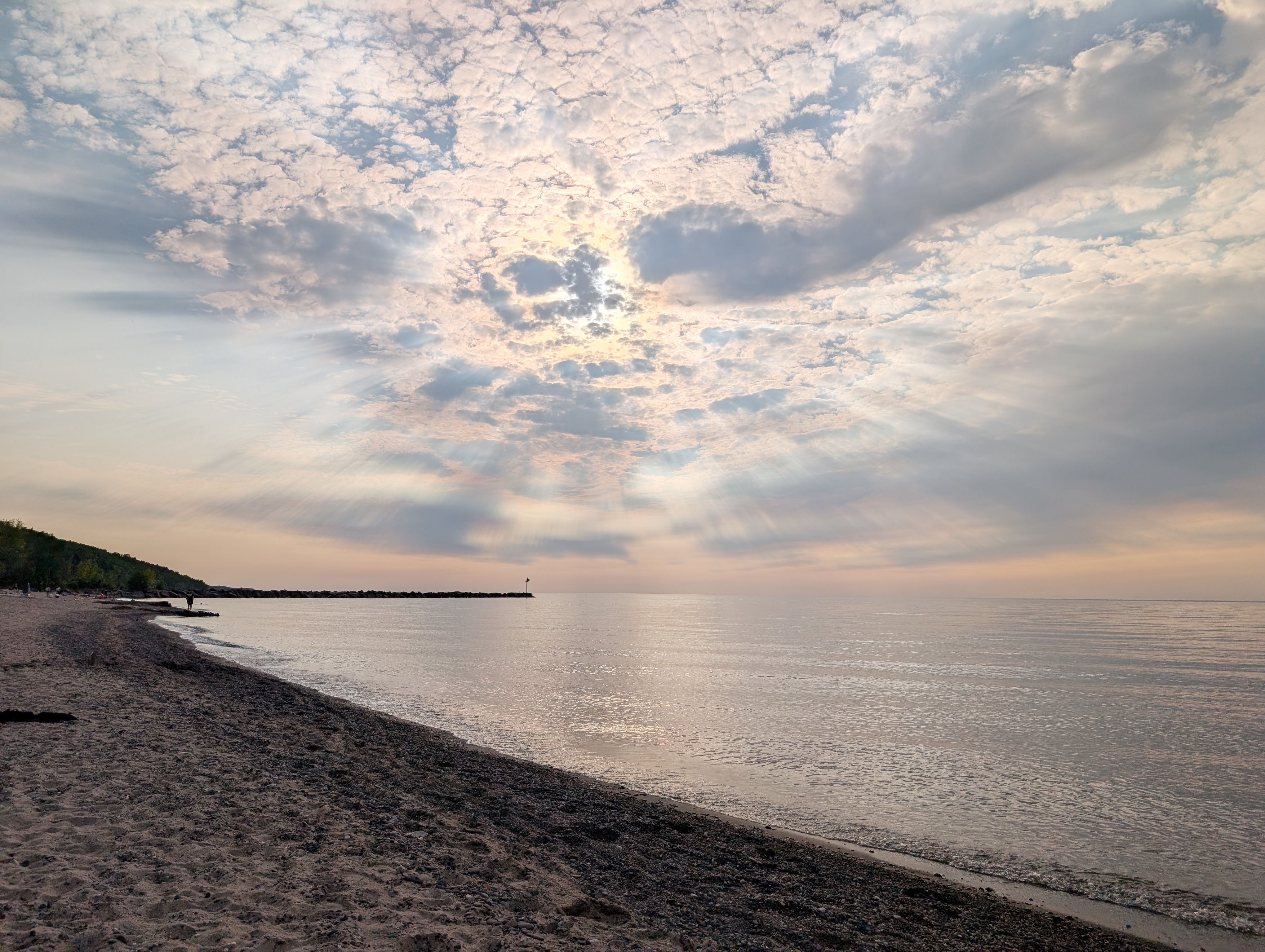
The harbor presently on my mind is that at the mouth of the Black River in Michigan’s Upper Peninsula, a river mouth wedged between the Wisconsin border and the Porcupine Mountains wilderness area I explored two years ago. To the west the sun tucks behind some small, light clouds, radiates out beams that glint blue and green and lavender, a shimmering iris in a brilliant eye. The to the east, blue expanses fade toward a haze, a thin blue line along the horizon the lone disjunction in the reach toward eternity. Straight up, a cloud of bugs: this is nature, after all. But they let me be. All is glittering, and I am one with it.
A notion of how to move through the world first took root in my brain my senior year in college. I took a class in which the one thing we did was read Don Quixote. I relished it; the story of the wandering wannabe knight unfolded beautifully, but it was also the story of the birth of the novel as an art form and the planting of the seeds of modernity in imperial Spain, freshly unified and laying claim to a new world. Possibilities of exploration and individuality opened in a way they had not before.
Professor Barbara Mujica had a theory on the lessons of the knight errant’s adventures, however, and they added nuance to the “Man from La Mancha” hero’s quest. She envisioned a Quixotic life as a figure-eight: travels outward and returns homeward, an endless cycle. A patient one, we might say; this was the image in my mind when, a year later, I needed to give this outlet for my thoughts a name.
In the abstract, it’s a basic concept, perhaps stupidly obvious. We leave and then we go home, again and again. But it works because it squares a circle: it maintains a vision of life in motion that still revolves around a fixed core. As a college student I was asking a lot of questions about what that core was, and I have typically framed that intellectual journey in tandem with my return home. My rootedness was a rebellion against the liquid modernity of the world in which I swam, deeper gods forgotten in pursuit of a blind course of upper middle-class life. But even as I settled into the life I’d chosen, I got restless again, leaned outward.
The spark for my eventual turn back out was the oppressiveness of pandemic era life, its accelerant a pretty mundane fact: I now had enough money to afford a few more meanders while still maintaining a cozy base back home. But it has become a habit and will remain one. I am always planning that next push outward, thirsting for it, wanting it. In the rare moments when I am lacking one, life comes to a pause: the engine of life has gone missing, and I blink about before finding it again, exactly where I know it to be.
Three years ago I found another name for this phenomenon: the harbour mind, as Adam Nicholson called in in his book that blended a history on the origins of Greek philosophy and his journeys to visit the beguiling isles where these thoughts arose. The origins of Western thought came from island-hopping traders, not great kings or empires; an exploration of borderlands and a comfort with tension. This summer, inspired by The Odyssey, the harbour mind is back in my brain. It is even rising toward the level of a unifying theory, a paradox for a committed fox but here we are. It’s clear enough to me on this weekend retreat to the UP, my story of how I live, or at least the start of one, since I relish knowing there will always be another cycle outward that can expand Einstein’s circle, the horizon of what we do not know.
Pushing that edge maintains a hunger to explore it in many walks of life, an escape from defeatist cynicism or anxious energy manufactured by an immediate panic. Whether it is a work project with no known solution or the intimidation of a new technology or a turn down a mysterious street where no one speaks my language, I can find what I need to press on. Each journey takes a step outward, a turn inward, finds resolution as my eyes turn back out to the next one. Perspective holds, and I avoid any false sense of finality. The fires just keep burning, and the coals of one push still glow as the next plan gets lit. No quit: I know what these Ithakas mean.
 A Patient Cycle
One thought on “Harbour Mind Revisited”