I’ve written a lot about Duluth politics in recent months, with coverage of every city council and school board meeting, plus some coverage of yesterday’s election (results here). Lost in most of this political talk, however, was mayor Don Ness.
The lack of Ness coverage is, in part, his triumph. In this recent NPR interview, he said his goal was to make Duluth politics “boring” again. Six years into his tenure, he’s done that. He remains incredibly popular, and with good reason, considering the successes of the causes he’s supported. The economy has been fairly resilient despite a rough national economic climate. The city has won some major victories against noted antagonists, most notably Jim Carlson. Duluth has a bunch of new schools; despite some wobbly moments due to the way those schools were pushed through, they will be well-funded thanks to the passage of the two levies. Funding for libraries and parks has increased. The city even confronted its huge retiree debt burden and, while it probably hasn’t gone as far as conservatives want it to go, the Ness Administration has proven it isn’t beholden to special interest groups, and that it tries to avoid tax increases when at all possible. Don Ness is the dream mayor of the center-left, and if he is so inclined, he could easily make a strong run in a state or national race. (He even has the adorable children necessary for that sort of thing.) Ness’s warmth has rubbed off on people around him, as eight of the nine City Councilors now lean left. This city has been thoroughly renovated in the image of Don Ness.
However, underneath all of the solid colors that appear on the election maps are a lot of details that are worth exploring. The somewhat unexpected results of three races jumped out at me: Zack Filipovich surpassing Barb Russ for first in the City Council At-Large race after finishing second in the primary, the passage of the second ISD 709 levy question, and Art Johnston’s re-election to the School Board.
All three of these results underscore the east-west divide in Duluth. That’s a delicate topic, as School Board Member-Elect Harry Welty learned with his “gangrene” comments, and obviously it generalizes, and there are plenty of people on both sides of the city who cut against the east-west stereotypes. Still, one trend clearly emerges in election results: the west side’s rejection of the east side liberal establishment.
It’s especially significant when you consider that people from the west side are not a demographic you’d normally associate with conservatism. It’s not a wealthy or suburban/rural region, and in state and national races, it’s still reliably Democratic. This is no bastion of the Tea Party or libertarianism, as shown by the passage of the first levy question in all but one precinct and Ryan Stauber’s inability to break through in many places. Still, the west side is not moving in lockstep with the Ness agenda, and it’s worth asking why.
We’ll start with a look at the City Council At-Large race, in which I’ve mapped out the winners of each precinct using the wonders of Microsoft Paint:
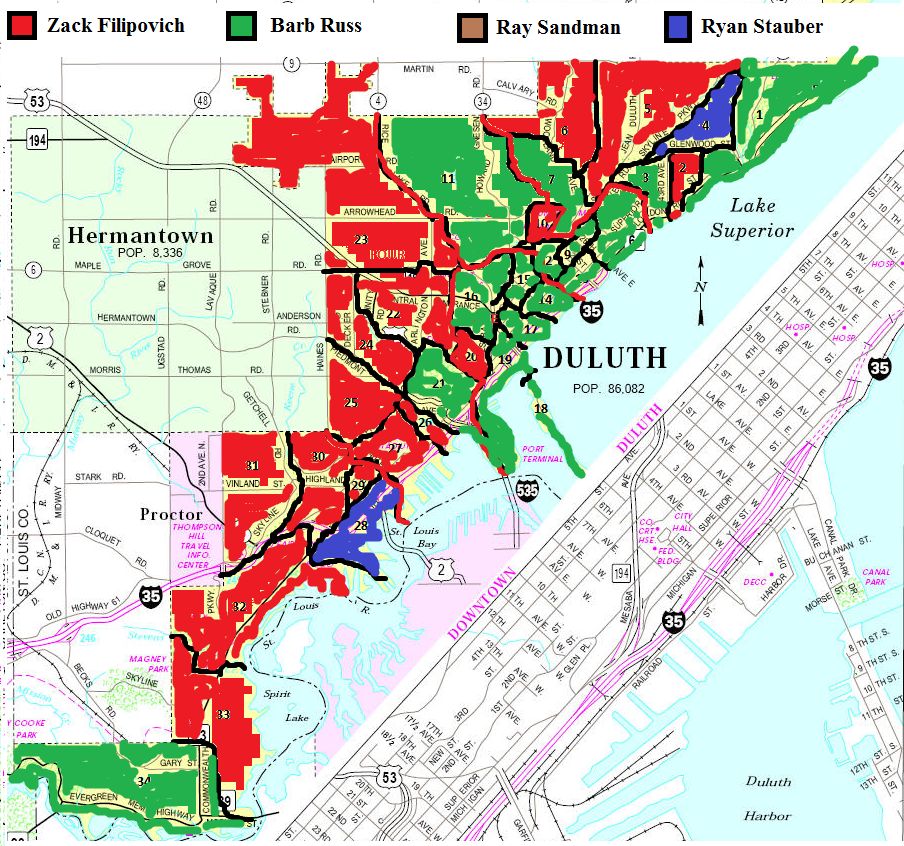
Zack Filipovich, as you can see, had a very strong showing on the west side. As a recent college grad working in finance, Filipovich doesn’t really fit the blue-collar stereotypes one associates with the west side. Still, his campaign (whether by design or not) was certainly less explicitly liberal than Barb Russ’s, and since he’s young and fresh, he’s not really an establishment figure. Unlike Russ, he made a concerted push to get beyond the establishment, and campaigned out west. For that reason, I suspect he was able to generate a lot more support, especially in an election where voters could choose two candidates. Ryan Stauber was an easy first choice for Duluth’s more conservative voters, but I’d hazard to guess that Filipovich, who remained rather vague and upbeat in his campaign, was most likely to be their second choice. That coalition probably carried him to a lot of victories on the west side.
This anti-establishment-liberal pattern is even more distinct in other recent elections, with the west side being far less interested in sending more money to the city than the east side. In Ness’s first election, he won the east side and lost the west side to the more conservative Charlie Bell. Jay Fosle, the lone conservative on the Council, represents a far west district. Garry Krause, the recently-resigned conservative District Four councilor, was from the west side, and got a decent share of the vote despite having withdrawn from the race. If he’d stuck around, I suspect he would have won. If you want a map that really underscores this trend, though, take a look at the way the city voted on the school board levies:
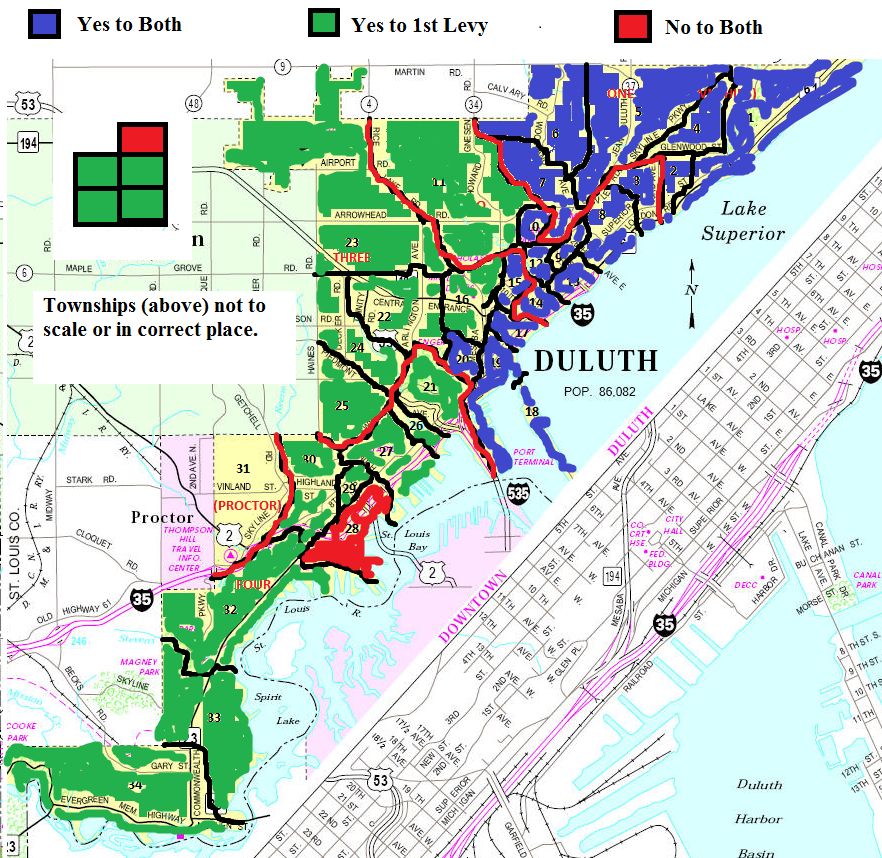
This really wasn’t a case of the city coming together to support the second levy. It was a case of the east side having just enough votes to drag the west side along with it.
While much of the rest of the city is exasperated by anti-Red Plan crusader Art Johnston, he was re-elected to his far west side district. In the West End area, there seemed to be a lot of passion over the school board race: Bolgrien’s base of support was right around Denfeld High, and Johnston had a bunch of signs in the areas just beyond the Bolgrien core. Heading east into Lincoln Park, however, there were hardly any yard signs. Even so, Lincoln Park broke for Johnston. It wasn’t a vicious rejection of Ness and his School Board allies, but it was a clear one.
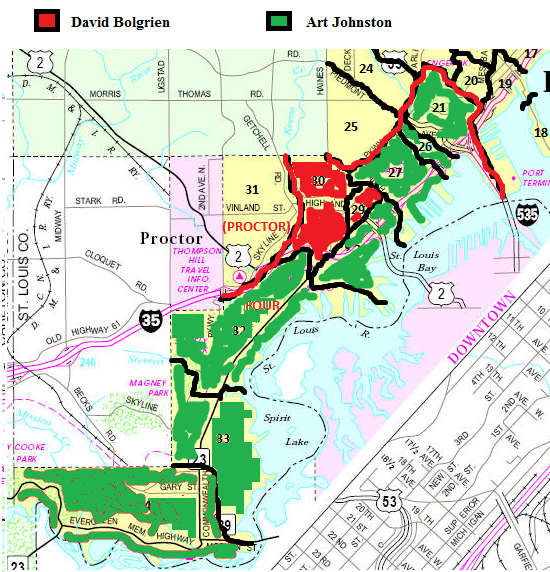
I rarely agree with Art Johnston, but to his very real credit, he too has acknowledged these trends. He posed the question to the Board at a recent meeting, perhaps not realizing that his own presence on the Board is a product of these trends: why does it appear that west-siders do not share the east side’s emphasis on education, and willingness to open the pocketbook to support it? No one answered him, and he deserves an answer.
Part of it may be demographics. The school-aged population is much higher on the east side, so more people have a stake in the schools there. East side voters, content with the generally high test scores at their schools, see the value in supporting the District, while west side voters, seeing more mixed results, may not. (I have never understood the logic behind giving struggling schools less money, but plenty of people explain their votes that way.) Perhaps most importantly, the west side has more people living on fixed or lower-middle-class incomes who are nonetheless not living in poverty or qualifying for many government support programs. Because of that, they tend to be less willing or able to handle a tax increase. That fact can explain the fiscally conservative bent one sees in the west side’s city councilors, too.
But while socioeconomics may explain a lot of the divide, they are not destiny. To that end, it’s important to understand why a number of Duluthians (no matter which neighborhood they live in) may not be completely thrilled with Don Ness’s Duluth. For that, I’d point readers toward my post from a few months ago on Duluth’s future. It’s a long and meandering post, so I’ll summarize one key part here.
Under Ness, Duluth has made a concerted effort to reinvent itself. It has also made itself a desirable place for young people to live, harnessing its natural beauty and developing a decent artistic and culinary scene. (Yay, good beer!) It has spent a lot of money making itself attractive, and to date, I think that move has been reasonably successful. With the decline in U.S. manufacturing, it was necessary to take that stand and create a new brand for the city, and while I have my quibbles here and there, I’m largely on board with Ness. I was also a staunch supporter of both levies, and I believe world-class public schools are essential to this whole project. However, former Councilor Krause raised an essential concern, and one I am not sure the Ness camp has properly addressed: is Duluth’s interest in shiny, new things coming at the expense of the mundane? Yes, it’s great to attract new people, but what about those who have been here for a long time, and are simply trying to get by?
No matter how many elections Ness and Friends may win, these questions will still exist. They need to be magnanimous in victory, and recognize that simply cruising along with a mandate still leaves some people on the outside looking in. No, they can’t satisfy everyone all of the time, but no one should be left behind because they never got a chance to be heard.
Speaking of being on the outside, the lack of racial diversity here is also worth mentioning: after this election, everyone on the School Board and City Council will be white. This isn’t terribly shocking in a city that is over 90 percent white, and there were two minority candidates this fall who simply did not run very impressive campaigns. Mary Cameron had a very long tenure on the School Board, proving that minority candidates certainly can do well in Duluth. Several of the white elected officials have long histories of work with minority groups. Even so, there is a trend in modern American liberalism in which people politely acknowledge minority interests while doing little to actually address them. I’ve talked up the east-west divide here, but downtown can’t be lost in the shuffle, either.
This all brings me back around to “boring” government. Yes, boring government is certainly better than people screaming at each other nonstop, but there is a danger here, too. This quote from Councilor-Elect Howie Hanson in the October 29 News-Tribune comparing himself to his predecessor brings it out clearly:
“I think Garry [Krause] was a little frustrated because he was in the minority on a lot of votes,” he said, noting that Krause frequently found himself at odds with Mayor Don Ness’ administration and much of the council.
“If we’re going to move Duluth forward, I think you need to set aside your personal agenda and petty politics and get everyone on the same page,” Hanson said.
This bothers me somewhat, and I do not think it is an accurate characterization of Krause’s work, even if I didn’t always agree with Krause. Good governance does not involve everyone being on the same page and rubber-stamping one another’s proposals. It needs constructive, perhaps even heated, arguments. To its immense credit, the City Council has managed that in recent years; the School Board, on the other hand, has not, as it went from being a rubber stamp machine during the Red Plan days to a fractious and ugly war zone during Art Johnston’s first term. With Welty and a possibly conciliatory Johnston on the School Board, I have some hope that it might finally come to a healthy balance. The new Council, with its new left-leaning supermajority, must make sure it doesn’t fall into one of those twin traps that bogged down ISD 709 in recent years.
Duluth’s politicians have the potential to do some great things in the next few years, and the future is there for the taking. We’ll see how they do.
 A Patient Cycle