Gateways and Arrivals

Arrival in Florida feels like one prolonged wait. Upon landing in Miami, my mom and I undertake an arduous trek to the rental cars. A four-hour drive means our entrance to the Keys comes in darkness, a journey across suburban strips and swamp and long, lonely bridges into the night. We are on a journey to celebrate my mother’s retirement, freed from city politics and social service provision after many long years at the Duluth Public Library. We’d planned a version of this trip in April 2020, but after the world intervened then, we are now free to do it well.

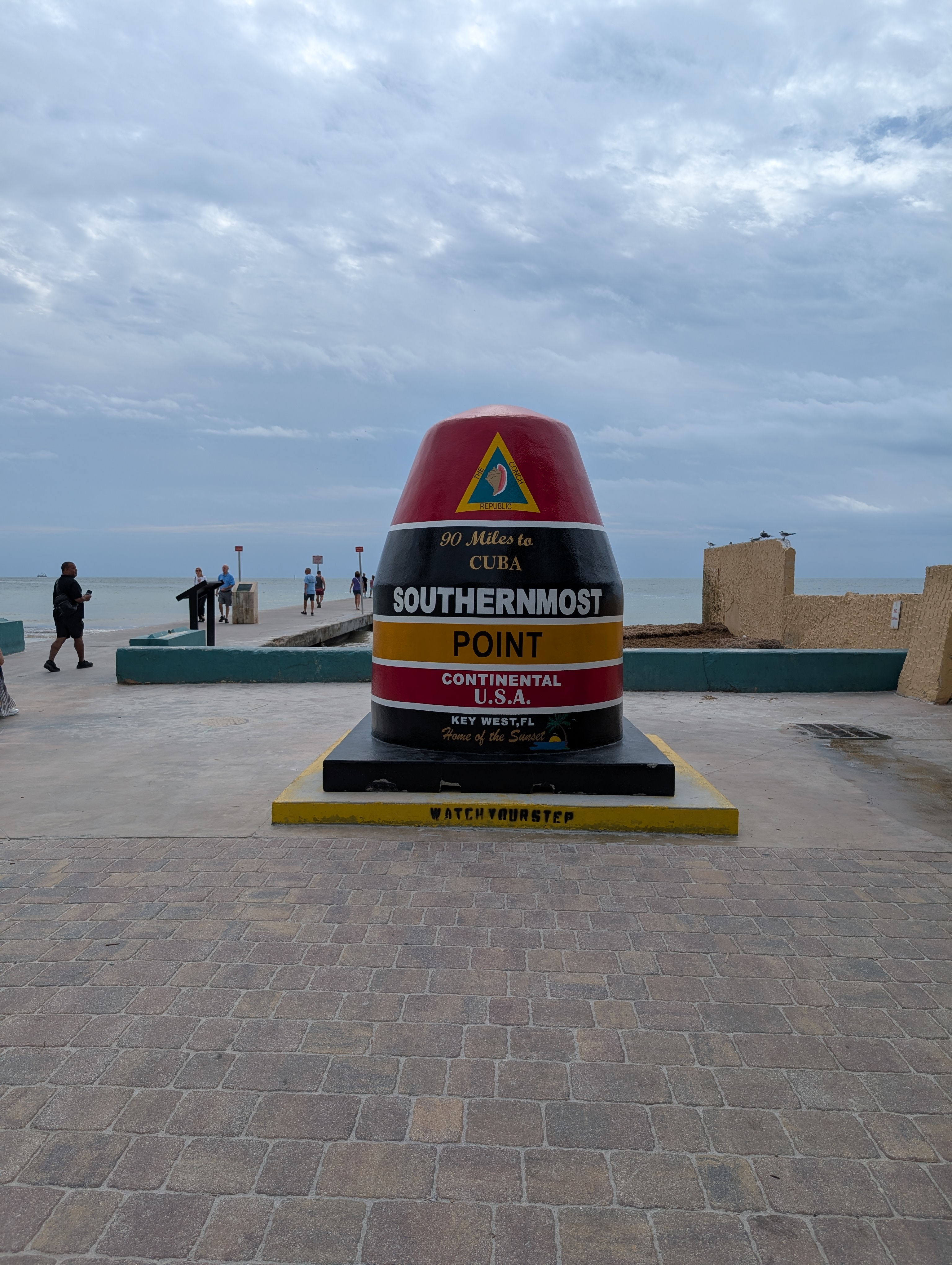
At the end of the bridges sits Key West, a land of tasteful bungalows and grand verandas, the whole island colored by a tropical languor, the stately repose of a retreat at the end of the road. Grey skies put it in a sense of slumber, a promise not quite fulfilled upon arrival. We are here midweek in the offseason, but the party goes on every night at Sloppy Joe’s and Captain Tony’s and a few dozen other tiki bars along its main drag. Duval Street is a Bourbon Street for middle aged white people, live guitars in every bar and beer and cocktails around every corner. A power boat race is in town this week, with souped up trucks to match; just about every man looks like he is here to fish. Here there is some risk of paradise as a commodity, a repeat soundtrack of Bob Marley and Jimmy Buffett, endless references to the drinking that will happen here. I am not here to fish. I am here to have a few drinks, but we are not exactly set on shutting down the bars, either. I am not really here to escape, but instead to take a pause that lets me write, be with the companion I’ve traveled with more than anyone.
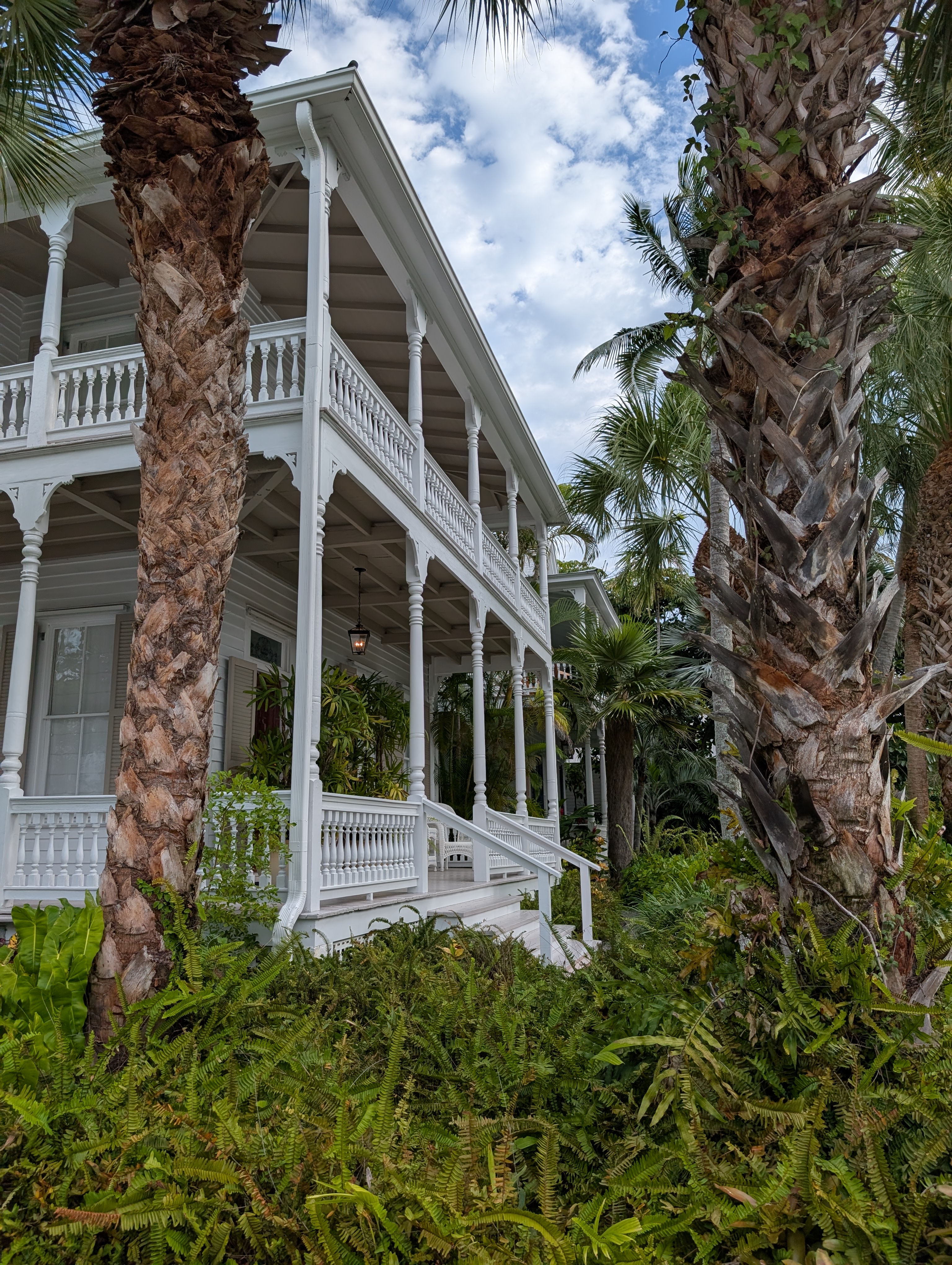
We take up rooms at the Eden House east of the city center. The rooms themselves are tight ground floor spaces, but I am of the camp that doesn’t much care about the interior of a hotel room beyond the basics: it is a launching point to go do other things. The Eden House’s pool deck has seating for all types, and a second story veranda is the hotel’s steal, one of those venues for Southern graciousness that is too often lost from later architecture. I sit out here and write three ways at once, this post and a possible follow-up and some musings on where my fiction goes from here. This town has punched above its weight as a retreat for writers for over a century, and I can only dream to catch a hint of that inspiration.

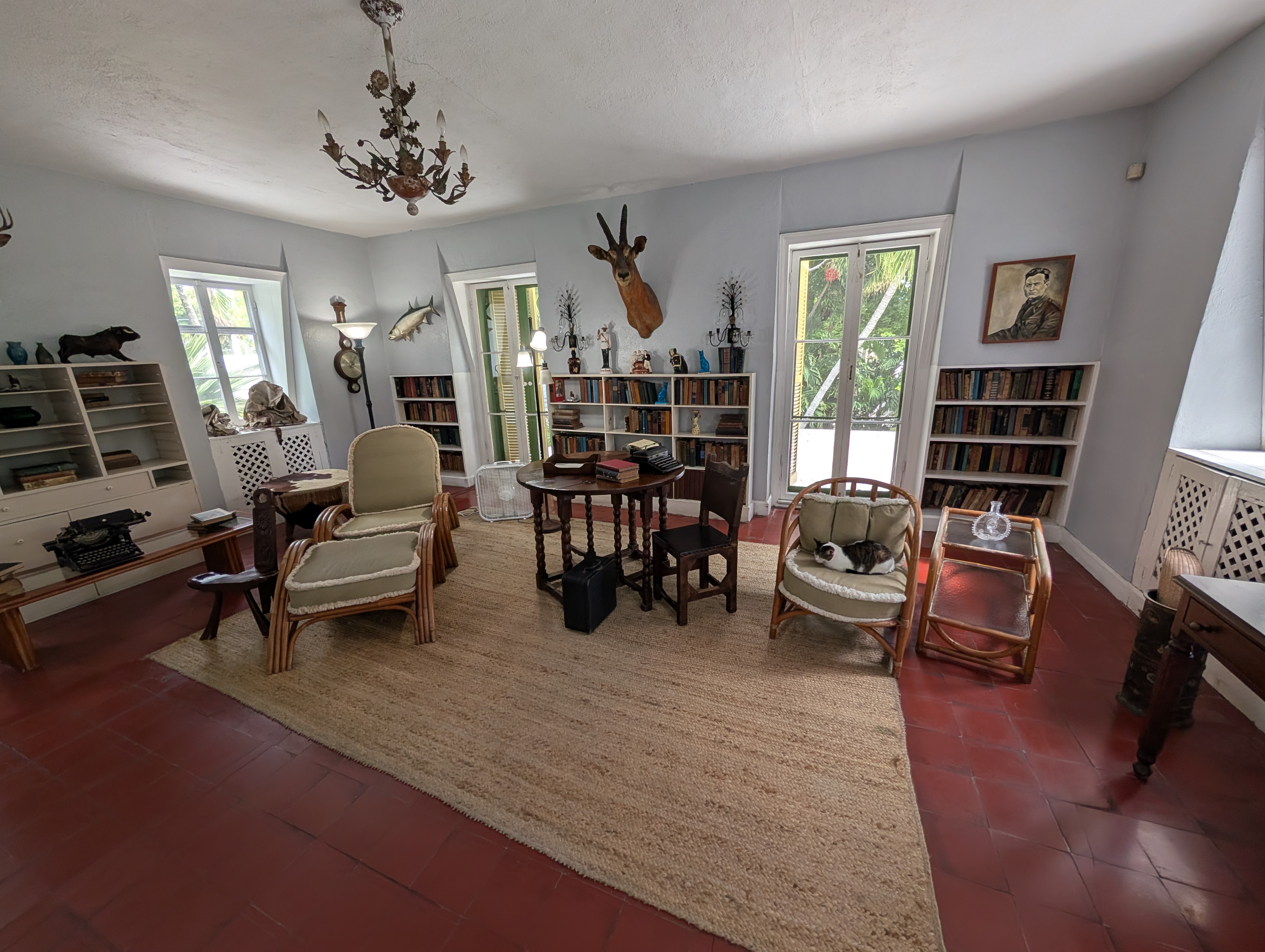
The Hemingway House is the highlight of Key West. The 61 cats prowl about and the writing studio sits in repose, books and typewriters and trophies from a life without limits, mementos of boxing and bullfights and fishing trips and safaris far afield. Here I find some of that awe, this time at that masculinity unleashed: the women and the parties for a warrior and a thinker, a man drawn to the questions of his time and the places where the action was, his pursuit straight up to the edge and then straight over it because what other way is there to live? Here the old man met the sea, fought it at times, churned out many of his greatest hits. He produced a legacy that smashes the underlying tragedy. The cost may or may not have been inevitable but it is a reality and it does just boost the mystique.

Ernest Hemingway’s crisp clarity defined modernity, his simple precision that can lead a 21st century reader to swoon about trout fishing in the hills above Pamplona or bring a pack of Two Hearted Ale to the mouth of the Two Hearted River in Michigan. (Yes, I have done this.) Joan Didion taught herself to write by copying down his sentences, and I have taught myself to write by toying with Joan Didion’s work. Of course from certain lenses Hemingway’s life can now be judged or even canceled; artistry with prose faces some headwinds in a flattened world of AI summaries and messages dumbed down to the lowest common denominator. Moreover the Hemingway mystique can swallow the human tale beneath, the depression coursing through his work turned into some tragic heroism that satisfies a certain narrative of tortured genius. As a writer whose instincts are not all that depressive I wonder if I’m missing some key ingredient that I would prefer to never have, but I decide I can make do with that tradeoff.

The cherished home of a long-departed author underscores the permanence of words. Sure, the novel may lack the cultural power it had in Papa’s prime. But fifty years from now no one will be watching TikToks made in 2025. They will still be reading Hemingway. Putting down words creates a record, both in print and in type, that the ephemeral world of live video does not. Of course there are some snippets that will last, but the power to both capture and interpret, provide witness and critical distance, will remain all the stronger.

It would be easy to look around at the denizens of Key West and draw a harsh divide: us few, proud people of words who stand athwart the vapid party, immune to the siren call of the anomie of endless swipes. On a certain level I do believe some version of this argument: that is the point of a conviction. But there can still be pathways in for anyone, and pulling up the drawbridge to hold on to a snooty high culture isn’t going to change it. I instead prefer to own it, sit on a beach reading or writing and make it look good, share the best snippets here and there. And for anyone looking for a way in, Hemingway’s deceptively simple prose and chasing of great adventures isn’t a bad place to start.

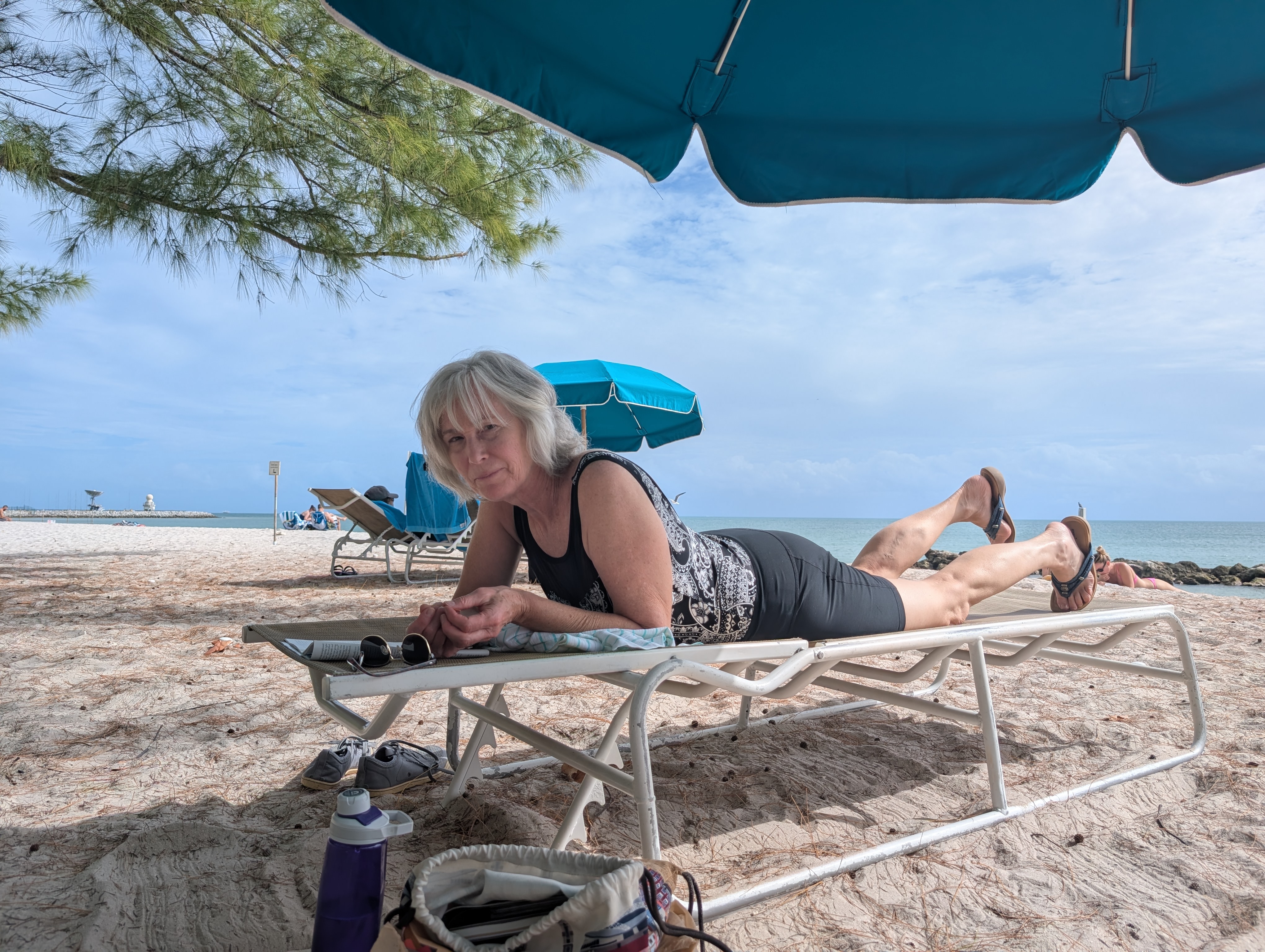
Slowly, Key West shows more as we scrape beneath the surface. We visit Judy Blume’s bookstore, wander in search of beers and a spot on the beach beneath a soft curtain of an Australian pine’s wispy needles. Truman’s summer White House is here, and the ferry to Dry Tortugas beckons for a future visit, perhaps when the campground facilities are not shuttered thanks to a government shutdown. We tour the Audubon House, never visited by its namesake but a keystone for the preservation of Key West’s grace, a spendy preservation movement that nonetheless keeps it a step removed from sinking into the tourist trap ensnaring much of the rest of the Keys. The Conch Republic puts in the effort to maintain its independence.

After three nights on Key West, we are on the move again. This, I think, is my style of travel: a meander up an island chain, flashes of both wilderness and city, parts unknown and the center of the action. As we drive up the Keys we stop at a state park for halfhearted snorkeling, a bit of beach time, a stroll up the old railroad bridge that first knitted the islands together. Later we pause at a roadside carnival show named Robbie’s, where we feed some tarpons and see some manatees and dodge the scavenging ibises and pelicans. From there we are off through the wet lowlands and back to Miami.

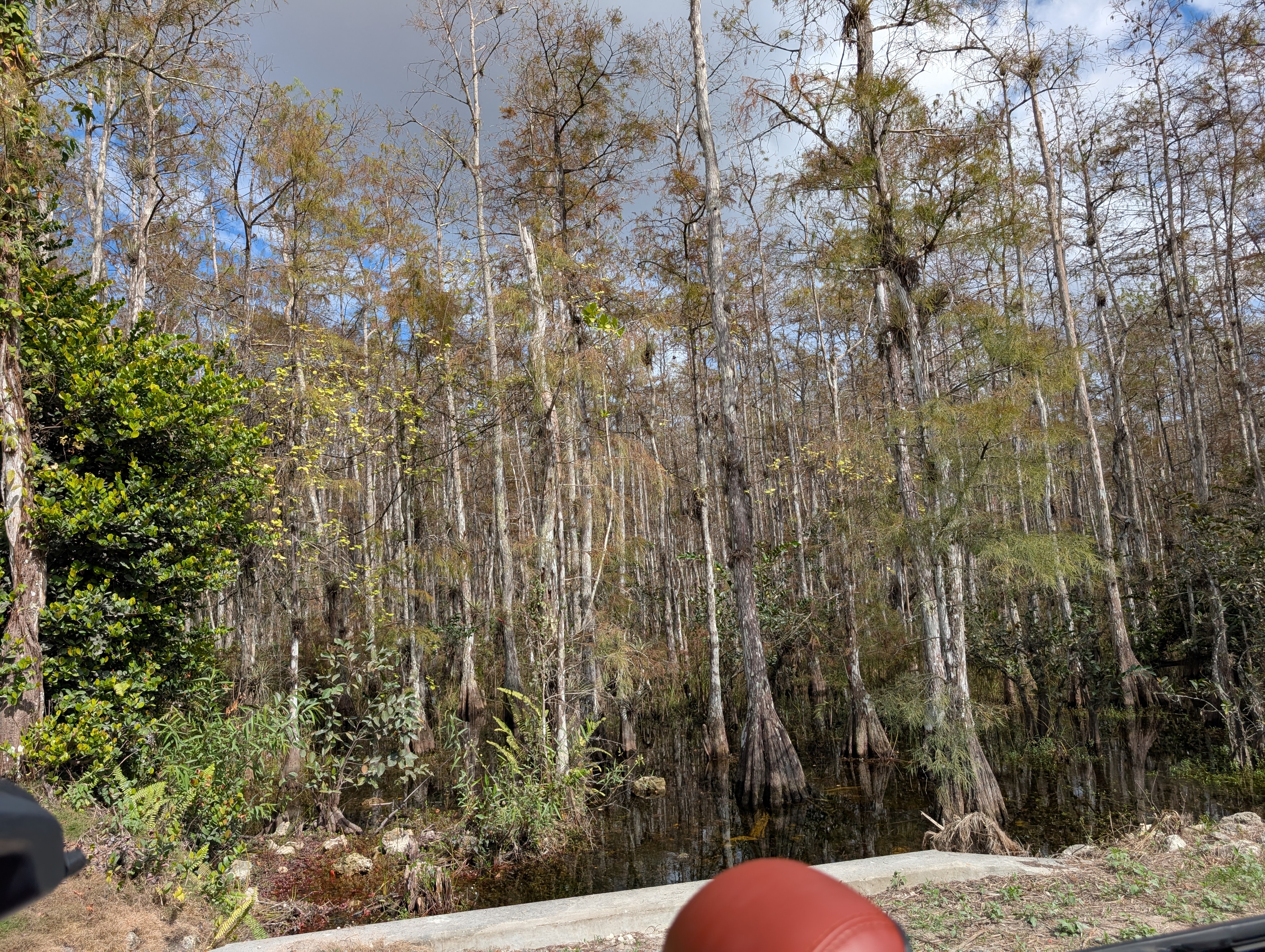
In Miami the skyline glows as warmly as many of the well-toned bodies, but for all the glaze it cannot quite hide how it is paving over a swamp. On our second to last day in Florida we immerse ourselves in that swamp and shoot up the Tamiami Trail, a 1920s causeway that colonized the interior of the Everglades. Even now, it is a wild place, the kind of locale an ambitious xenophobe would set up a migrant internment camp. (Sure enough, loud signs announce the presence of Alligator Alcatraz.) South Florida’s history is a series of battles against the rising waters, a desire to tame them and cut back that thick, oppressive brush to replace it with orderly rows of palm trees. This region’s boosters sought to roust the beasts who live in these swamps and the last people who hid away in these refuges, or at least tame them into a roadside attraction.

A circuit on the Big Cypress National Preserve’s loop road is a safari through a menagerie of birds, a few dozen alligators, and a slow roll through everything from dense watery forests to reedy cypress savannas to a tangled mass of endless scrub. It contains a wildness and a secrecy that the open West cannot match, the eyes only so much good in trying to explore it. Even a short hike on a nature trail leaves a little claustrophobia, a question of what might lie around the next bend, the mosquitoes rising up and some mysterious scat marking territory in the middle of the trail.

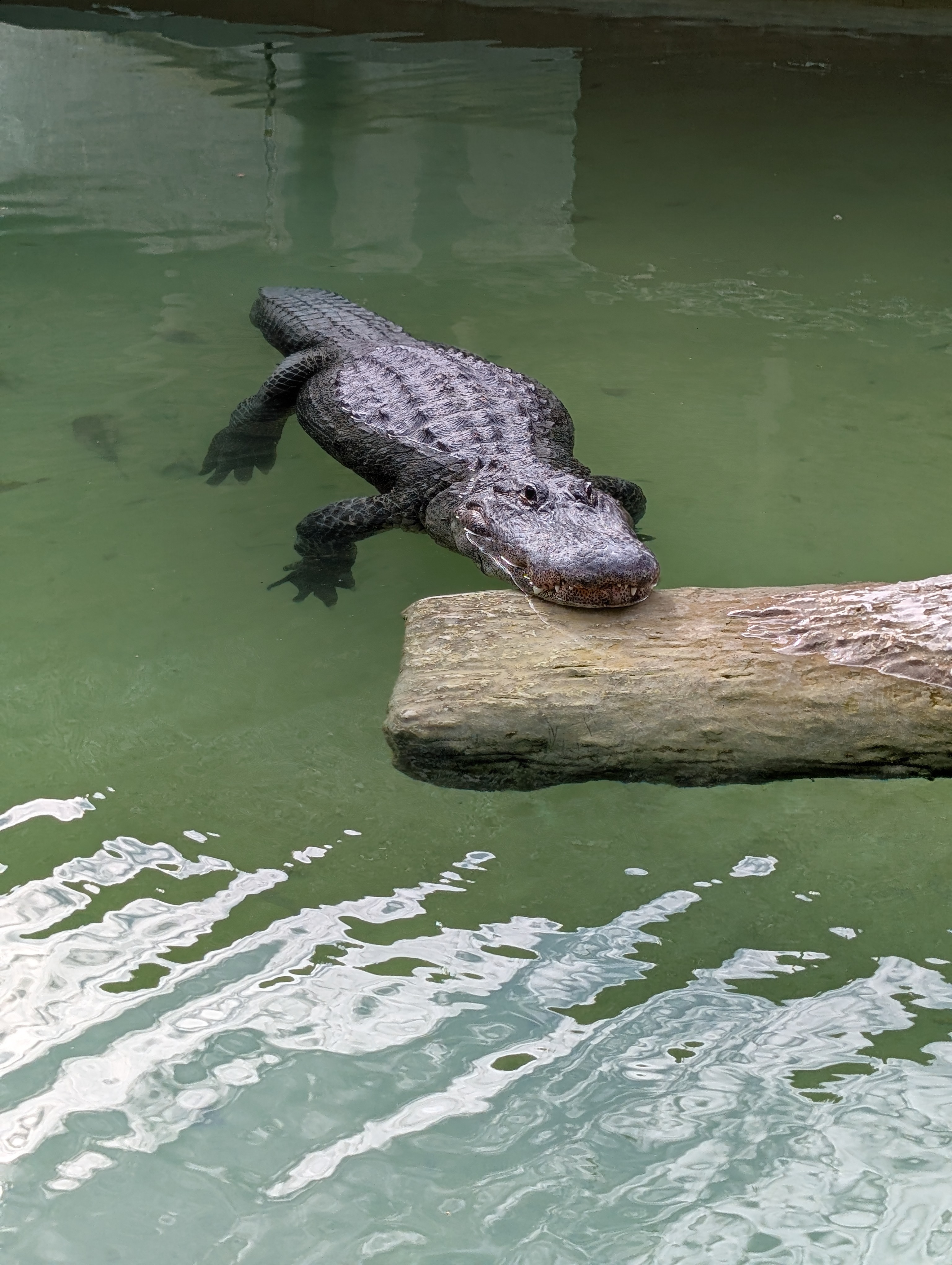
On the way out we visit the Miccosukee, a Native tribe that battled the U.S. government beside the Seminoles and later retreated deep into the swamp to retain some independence for as long as they could. Their roadside attraction of a village is sleepy today; the expected tour guide never appears. But the camp is well-tended, the museum behind carved alligator doors tells the story well enough, and a show demonstrating how to properly tame one of their rescue gators is a window into a different world.

Out of this landscape rises Miami, one of the nation’s largest metros. Miami’s story is an updated version of a very American story, a gateway city haphazardly absorbing immigrants. It has all of this country’s greatness and all its flaws: a rush of development, a hunger for freedom and parties and sexy bodies, out with the old and in with the new. It was famed for crime and coke in past generations but is now more of a place where people instead seek to properly model their bare chests or sports bras. With its borderland status comes tension as culture remains stubborn and ties to old countries complicate the politics. (Miami is one of the very few American cities that can still reliably elect Republicans to higher office, thanks largely to the particularities of the Cuban diaspora.) The beach gives it an allure that other Sun Belt cities cannot match; its closest analogue is LA, though it is more niche than LA, lacks its cultural power beyond the Hispanic community.

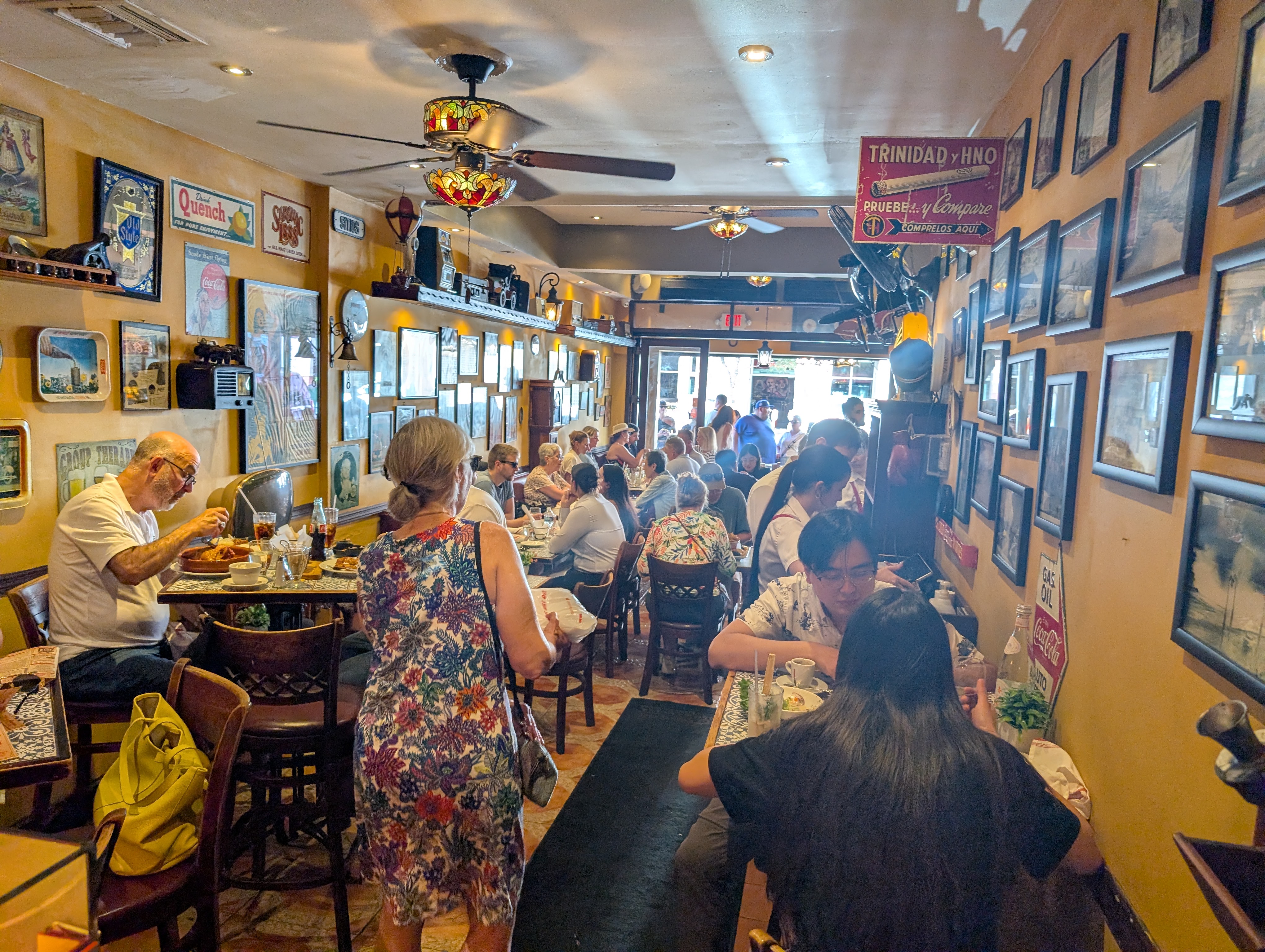
Within that community, though, Miami is everything. In my travels, I’ve learned that Latin Americans aspire to Miami as much as any American city. The heart of the allure is of course in economic opportunity, in political freedom, in glitz and glamor on the beach. But old ties are hard to break, and a visit to Little Havana is an object lesson: this neighborhood is home to a court in exile and a continuation of pure Cuba, of salsa rhythms and cigars and dominoes over cafecitos. Even with a collection of people branded with Royal Caribbean stickers strolling the streets, it feels alive, something carried forward and a place where a Hispanophile can feel very much at home.

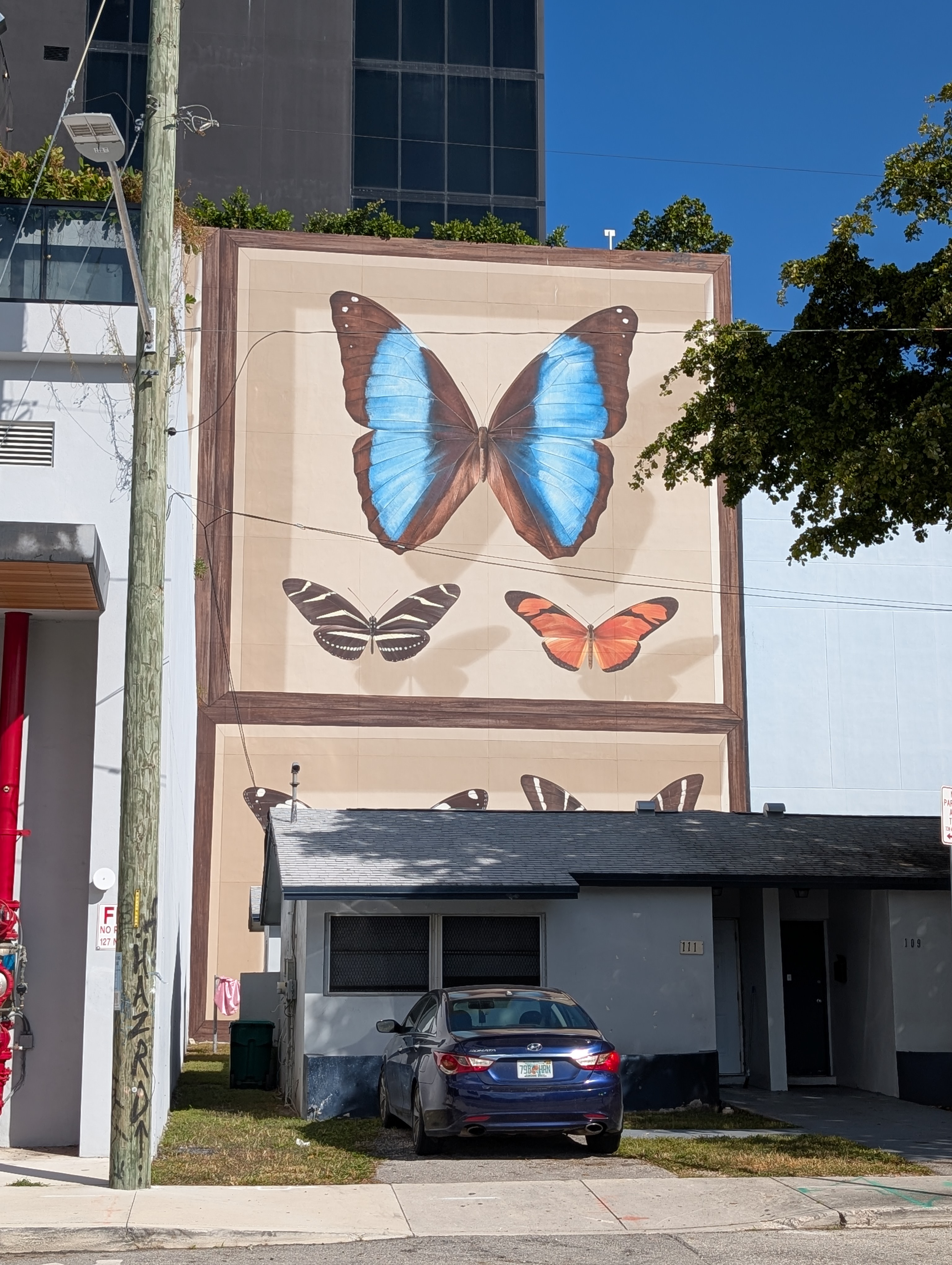
Miami is a city of gleaming beachfront towers, but it is also home to graceful Art Deco neighborhoods from an earlier era, that great triumph of American architecture serving as the perfect backdrop for this modern-day white city. Beneath the gleaming façade, color explodes, and never more so than in Wynwood, where we spend two nights. Wynwood is gentrification central just north and west of downtown, the inevitable boxy apartment blocks and trendy restaurants crowding out the bedraggled old concrete single-story homes and empty lots. I linger on these grungy old homes, wonder what stories they have told over the decades, which immigrant lives may have launched from here. Even as Wynwood changes there is an easy drift between Spanish and English here, a dance between two worlds, and I wonder how well it will hold on to its art. Miami is strongest in the places where it keeps the tension alive.

This trip is a perfect escape to celebrate a retirement, to find some well-earned rest and adventure all at once and think about what might come next. For my part, I am not sure how high Florida is on my list for a return visit. It is a land of leisure, but not one of awe, and as a pursuer of awe this easy luxury will never quite be me. I am not drawn to resorts or creature comforts, the overly sanitized or scheduled trip. Vacations should be a little bit hard, and I don’t mind a little snow, I think as the season’s first snowflakes wander down on the drive north from Minneapolis.

On the beach on Key West I read “The Snows of Kilimanjaro.” This short story was the first Hemingway piece to capture my imagination, and like all good fiction, it tells us something that we do not know that we know. “Snows” is a writer’s lament for the things he has not yet written and may never write, a call to me to get to work. It is a confession of the fumbles with women drawn in by the Hemingway-style pursuit, with Harry in the tale pushing Helen in ways that both give her new meaning and wound her, Harry at once proud of her but still questioning the whole exercise. And it closes with a drift away from even the heaviest of earthly concerns on to greater heights, to beauty, to the white snows at the end of the line. There are so many worthy goals here, so much to unpack and to reach for. And with that, I write.
Conversation in the Cathedral

I don’t think I have ever felt compelled to re-post a previous post on here, but right now, I am going to re-post the content of this one, which is in itself mostly just an extended quote from the 2010 acceptance speech for the Nobel Prize in literature. Farewell, Mario Vargas Llosa, one of the true giants of world literature, and one who inspired my own writing life immensely.

Literature is a false representation of life that nevertheless helps us to understand life better, to orient ourselves in the labyrinth where we are born, pass by, and die. It compensates for the reversals and frustrations real life inflicts on us, and because of it we can decipher, at least partially, the hieroglyphic that existence tends to be for the great majority of human beings, principally those of us who generate more doubts than certainties and confess our perplexity before subjects like transcendence, individual and collective destiny, the soul, the sense or senselessness of history, the to and fro of rational knowledge.

I have always been fascinated to imagine the uncertain circumstance in which our ancestors – still barely different from animals, the language that allowed them to communicate with one another just recently born – in caves, around fires, on nights seething with the menace of lightning bolts, thunder claps, and growling beasts, began to invent and tell stories. That was the crucial moment in our destiny, because in those circles of primitive beings held by the voice and fantasy of the storyteller, civilization began, the long passage that gradually would humanize us and lead us to invent the autonomous individual, then disengage him from the tribe, devise science, the arts, law, freedom, and to scrutinize the innermost recesses of nature, the human body, space, and travel to the stars. Those tales, fables, myths, legends that resounded for the first time like new music before listeners intimidated by the mysteries and perils of a world where everything was unknown and dangerous, must have been a cool bath, a quiet pool for those spirits always on the alert, for whom existing meant barely eating, taking shelter from the elements, killing, and fornicating. From the time they began to dream collectively, to share their dreams, instigated by storytellers, they ceased to be tied to the treadmill of survival, a vortex of brutalizing tasks, and their life became dream, pleasure, fantasy, and a revolutionary plan: to break out of confinement and change and improve, a struggle to appease the desires and ambitions that stirred imagined lives in them, and the curiosity to clear away the mysteries that filled their surroundings.

This never-interrupted process was enriched when writing was born and stories, in addition to being heard, could be read, achieving the permanence literature confers on them. That is why this must be repeated incessantly until new generations are convinced of it: fiction is more than an entertainment, more than an intellectual exercise that sharpens one’s sensibility and awakens a critical spirit. It is an absolute necessity so that civilization continues to exist, renewing and preserving in us the best of what is human. So that we do not retreat into the savagery of isolation and life is not reduced to the pragmatism of specialists who see things profoundly but ignore what surrounds, precedes, and continues those things. So that we do not move from having the machines we invent serve us to being their servants and slaves. And because a world without literature would be a world without desires or ideals or irreverence, a world of automatons deprived of what makes the human being really human: the capacity to move out of oneself and into another, into others, modeled with the clay of our dreams.

From the cave to the skyscraper, from the club to weapons of mass destruction, from the tautological life of the tribe to the era of globalization, the fictions of literature have multiplied human experiences, preventing us from succumbing to lethargy, self-absorption, resignation. Nothing has sown so much disquiet, so disturbed our imagination and our desires as the life of lies we add, thanks to literature, to the one we have, so we can be protagonists in the great adventures, the great passions real life will never give us. The lies of literature become truths through us, the readers transformed, infected with longings and, through the fault of fiction, permanently questioning a mediocre reality. Sorcery, when literature offers us the hope of having what we do not have, being what we are not, acceding to that impossible existence where like pagan gods we feel mortal and eternal at the same time, that introduces into our spirits non-conformity and rebellion, which are behind all the heroic deeds that have contributed to the reduction of violence in human relationships. Reducing violence, not ending it. Because ours will always be, fortunately, an unfinished story. That is why we have to continue dreaming, reading, and writing, the most effective way we have found to alleviate our mortal condition, to defeat the corrosion of time, and to transform the impossible into possibility.

Not bad inspiration for someone who has felt a surge of fictional inspiration in the past few weeks.

Olympian Distances

I’m not telling you to make the world better, because I don’t think that progress is necessarily part of the package. I’m just telling you to live in it. Not just to endure it, not just to suffer it, not just to pass through it, but to live in it. To look at it. To try to get the picture. To live recklessly. To take chances. To make your own work and take pride in it. To seize the moment. And if you ask me why you should bother to do that, I could tell you that the grave’s a fine and private place, but none I think do there embrace. Nor do they sing there, or write, or argue, or see the tidal bore on the Amazon, or touch their children. And that’s what there is to do and get it while you can and good luck at it.

-Joan Didion, Commencement Address at the University of California Riverside, 1975

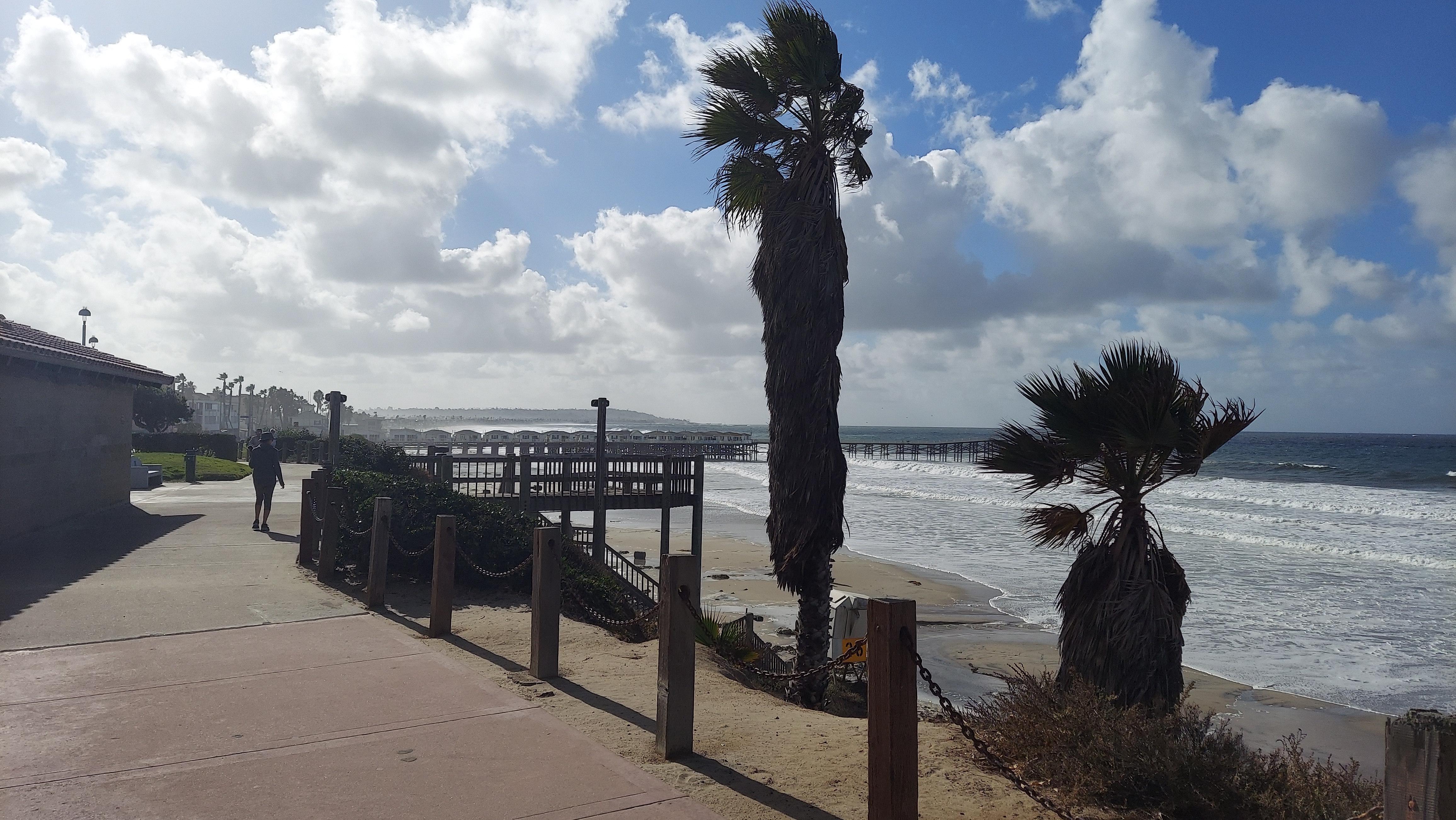
2024 approaches its close and I am aloft again, flitting this time to San Diego. I stay at the Diamond Head Inn at the head of Diamond Street in Pacific Beach, close enough for a sliver of an ocean view and to be lulled by the soothing crashes of giant waves through the night. I am not sure I prefer San Diego to some other haunts on the California coast that are becoming repeat destinations, but it is certainly the right place for this escape to cap a year of great escapes.

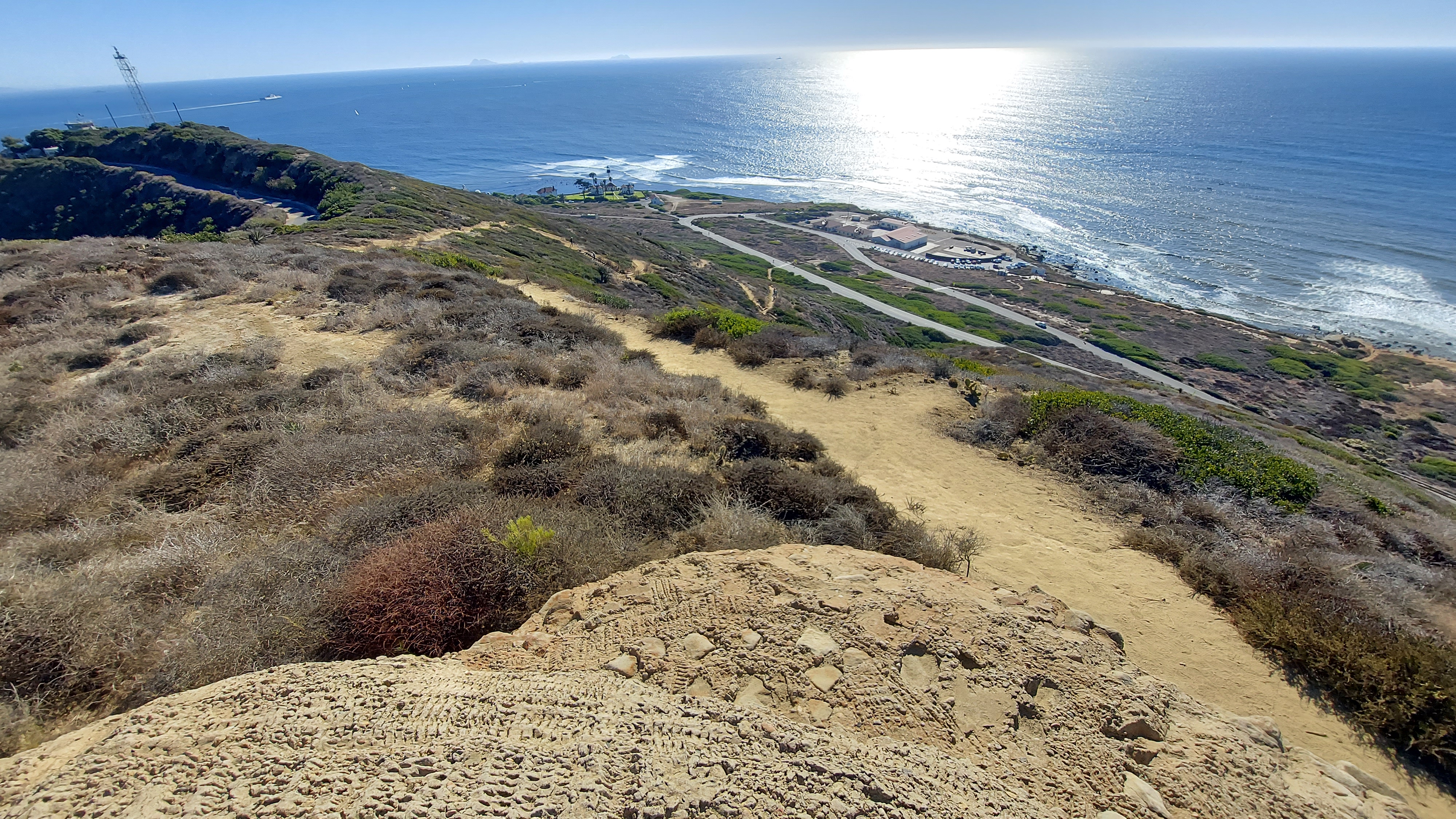
I run north through La Jolla, where the streets teem with the economy necessary to keep up the opulence of this headland: gardeners, renovation crews, cleaners, pest control. I run south along the length of Mission Beach, past miles of volleyball and beach bums and rows of vacation retreats, winding through the steady march of a three-day breast cancer walk whose path crosses mine on each of my days here. I grab a car for a day and venture down to the commanding views of Point Loma and up to spend a few hours with a college friend and his ever-expanding brood in Oceanside. But mostly I drift between the hotel and the beach and the clump of establishments along the Pacific Beach streets named for precious stones. Even with the Third Fleet looming in the harbor and Camp Pendleton to the north, San Diego feels removed from any great national dramas, a place where ambitions settle into yoga studios and waves and IPAs, a paradise now a bit overcrowded and at times a bit vapid but still holding to its beach life core.

A few people ask me if a beach escape was an election reaction, but it isn’t. Over the past few years I have found myself drifting out of political obsession and toward Joan Didion’s way of being in the world, not to forsake that realm but instead by finally internalizing the oft-neglected aspirations of my earlier self. My happiness is not ideological. I try not to let politics get me down, and through both an intentional effort and probably the simple passage out of youthful fervors and into my petite-bourgeois 30-something world, I am more or less there now. State and national affairs still matter to my moral universe, still matter to my job, but the privilege of not living in a state of anxiety over the world is, indeed, a privilege in the old-fashioned sense of the term, something one is lucky to have. To live in a place where anxiety does not drag one down, and where righteous anger does not consume one, is not in and of itself a defect.

This privilege allows me to seek to understand many ways of being while stripping away some preconceptions. It conveys a certain power: the ability to drink in experiences, to assume full presence in a particular moment, to say why not and just do things. To be always intrigued, ever nimble, always questioning, sometimes explicitly but also sometimes just in my mind so those around me can just be themselves. And it is not a realm of frivolity and luxury: the Olympian distance it can provide is the wellspring for reflection and insight that is hard to manage when wearing certain blinders.

Such distance can leave one in a lonely place, and it has taken time to embrace it as a real path when others are more clearly trodden. I can be a man in the arena, have perhaps even strengthened those skills considerably over the years, but I am not sure that doing so is the greatest use of my ability to come at stories from different angles, deep in the nuance. I am not by nature a fighter in the trenches, and I am drawn to realms upstream of politics, to places of culture and group dynamics and the deeper pulls of the human psyche. And I also now know that none of this is a binary choice, that I can step out for reflection but then dive back into messy human affairs in short order. (My stay in Pacific Beach also involved its share of time at beachfront bars, which are the definition of messy human affairs.)

My main method for my reflection has been writing. I gave up on a writing life after sweeping rejections from MFA programs over ten years ago, settling for sporadic posting on this blog instead of chasing any writing income. That failure has, on the whole, been a gigantic win for my mental health and financial security. But the itch has never died. The truth is that, if I have something resembling a vocation, it is not in anything terribly related to the job that earns me my income (though it is good work) but instead in being someone who has some useful things to say. I know that, in both triumph and crisis, I can sit down and come up with words that will both commemorate and help heal. People seem to like my stuff, if and when they find it.

I say I go San Diego to sit on a beach, but there is an ulterior motive: it is a retreat to begin compiling the episodic story collection on this blog into a manuscript, and I will be seeking professional feedback on it. This may seem like the ultimate Olympian turn, a retreat into fictional clouds at a time for engagement with reality. But this decade-in-the-making story is nothing but a response to questions about meaning in a fluid world, about coming of age, about masculinity and complicated family and coping with loss. I can think of no more urgent project for the skills I have.

I do not know what this story has to tell a broad audience; unlike everything else I write on here, the only feedback I’ve ever really gotten on it is from random people on the internet. But it is a story that is mine to tell, so I may as well tell it, take a chance on my attempt to get the picture and take pride in it. Progress may not necessarily be part of the package, but its possibility, whether sweeping or only in a few stray lives, is still a victory.

Making it Count

On a night in late March I mummified myself in every garment I had. Ice pellets pelted my tent, whose central pole was held up only by an elaborate pile of rocks nervously heaped along its base. I was miles from the nearest human, and a cruel wind ripped across the exposed ridgetop where I’d made my home. My sleeping bag liner was in the trunk of a car some twelve miles off, and any extra water would have to come from melted snow. I was exhilarated, never more alive and yet still able to settle into some just-warm-enough restfulness that would carry me through the night. At dawn, a glittering golden light burst over the mountains of southern Utah. I had reached Zion.

That night, and the reflections that built upon it over the remainder of that trip, have often been on my mind since. It was the culmination of a journey, or so I believed, that began in pandemic grit and then burst outward on a series of great adventures in 2021, from St. John to Montana, from New York to Tucson and various stops in between. My return to Zion was to be a final step up a Grand Staircase, a surge into a new layer of time in my life, to borrow my metaphor at the time. No more need for ventures like this, I proclaimed: I’d done what I’d set out to do, and now I could go all in back home, building the life I imagined.

On the surface, the next nine months went well enough. Yes, my work life was at times all-consuming and stressful, but I learned and I grew and I knew where I was going with it. I still went on some worthwhile ventures, from a college reunion to the peaks of Colorado. Perhaps most gratifyingly, out of loss, I found new pride in one half of my family history, and the joy with the other half continues. My Duluth networks, from politics to hockey and beyond, grew deeper, richer. And yet if you were to ask me how I was doing at nearly any point during this stretch, I would have almost never responded with joy or even self-satisfaction. I was drained, yearning for things I did not have, turning a Joan Didion quote from “Goodbye to All That” over and over in my mind: “It was in that year, my twenty-eighth, when I was discovering that not all of the promises would be kept, that some things are in fact irrevocable and that it had counted after all, every evasion and procrastination, every mistake, all of it.”

Perhaps I was lapsing into melodrama. My audiobook choice for my most recent drives across northeast Minnesota might provide some evidence here: Finding Everett Ruess details the story of a 1930s-era Into the Wild figure, a teenage boy who completed epic traverses of the American Southwest before he disappeared into the Escalante canyon country, never to be seen again. I have in me some of that romantic, wandering soul on some solitary transcendent quest, and while I count myself fortunate to be free of Ruess’s melancholy and any yearning for eternal escape, I can identify with those impulses to place oneself amid a grand narrative of destiny, driven by powerful feeling.

To make sense of that narrative I have tended to lean on classics and a web of metaphor. My loose outlook on the world, and perhaps my staid reserve that keeps me from any emotional overdrive, comes from Aristotle, who observed the world as it was and understood what was good in it in light of that reality. But a duality has always hovered, and it was no coincidence that, upon my decent from that ridge in Zion, I quoted Plato’s Symposium on true beauty, a true form of unsustainable yet ever-alluring perfection. I leaned deeper into that pursuit this year, as did several people around me, often with mixed results. I cannot regret it: paths were there to take, and we must nurture both Athens and Jerusalem, reason and faith twinned, and find them both. Living in the shadow of a modern-day Roman empire this can at times be hard to do, and it is in fiction (all tagged ‘Rome’ on this blog), that I have tried to sort it out. And as I do so I feel compelled to extend my metaphor: at the end of a murky middle age, it is now time for a Renaissance.

My artistic output this year has been less than I hoped for, a common writer’s lament. This blog has far fewer posts than in any year since its launch, and my fiction on the side is stillborn. And yet I am almost universally happy with what I did put out, a rare feat indeed, and am lately enjoying the mere act of writing as much as I ever have. I’ve supplemented this progress with a new toy: this post was written almost entirely on a reMarkable, a writing-only, paper-like tablet that has already proven an ally in a quest for focus. When there is focus I can write, and when I can write I can shape my fate, and from there I can thrive.

Nine months after Zion, as an even more vicious storm battered my home in Duluth, I was just as solitary, burrowing into my blankets with equal purpose, and rather less excited about the looming shoveling than I had been about the hike down out of the clouds. But the triumph of that night hovered in my mind, a warm glow that carried me to sleep as the wind howled around me and toppled a neighbor’s tree. Zion, it seemed, had not marked a firm layer in time—that will yet come—but it was very much a moment that did count, and I was proud it had.

So, as I begin my thirty-third year, I will look for more moments that count. Many of the old excuses no longer hold, and the opportunities to flourish through a Renaissance are all right there, perhaps as literally as can be, with Venice and Rome and Florence all on the calendar for this coming summer. As I complete another pause before tacking all my Duluth winter activities I find myself liberated from chic doomsaying, filed with gratitude, and ready to live more fully than ever.

My Year of Imaginary Thinking

Travel is useful; it exercises the imagination. All the rest is disappointment and fatigue. Our journey is entirely imaginary. That is its strength.

Céline, Journey to the End of the Night (lifted from the credits of La Grande Bellezza)

I began 2021 with the particular belief of a convert to a new faith. It was hard not to, since I started it by diving into a pool at a mountaintop estate on a Caribbean island, my crash into its depths a burst through the din of jungle fauna and steel drum bands echoing in the distance. A couple months later, I received my second stab of Moderna and penned what I hoped would be a victory essay over the virus that had disrupted the previous year of life. I had grand travel plans, I would see family again, work would move away from the misery of Zoom, and I would find undying love.

I wasn’t so naïve as to think it would be that easy, which is good, because it wasn’t. New variants surged, a dream of optimism curdled into an air of mystery, the general malaise lingered, and while I generally went about my life, the world did not. I certainly have no judgment for those who continued to take strong precautions for various reasons and would always work to reach their levels if need be. But to sacrifice any more of my rapidly dwindling youth to a climate of fear that was unlikely to afflict me in any serious way seemed a high price to pay, and trying to negotiate a world in which everyone was on a different page on this issue added another layer of complexity. To be a conscientious friend in 2021 was to live in a state of hyper-aware caution, and the escape of obstinacy grew ever more attractive.

I proceed with family and friends more or less as I did before the pandemic, but my social circles have not grown much, and arranging anything with anyone feels like a considerably larger chore than it used to, the serendipity of stray days together now a rare occurrence. My friend group is a busy one, and a lot of them have been pairing off and reproducing while I have not, a divergence that both keeps them occupied and is wont to drive me to brood. I field questions about my house as if contemplating the excitement of a new garage door is a comparable life step to having a child. For that matter, I have been traveling too much and too caught up in my day job when I am home to get around to acquiring the garage door.

The year took its tolls. I lost a grandmother, an aunt, and a cousin, and endured a funerary marathon for all three of them over one week in July. Somehow, this was not the most draining stretch of family time in 2021; that dubious accolade instead goes to a visit, two weeks later, to the other side of my family, on which I will not elaborate much out of respect for my relatives except to say that no human should ever be allowed to own more than three cats. The less weighty but still disruptive milestones mounted: in the hockey world, a man who was an ordering principle for my drive in life lost his job, a complex but significant era drawn to a close; at work, my colleagues and I were too good at our jobs, in short order overwhelmed by requests for help and pushed to the brink by a taxing schedule, a herd of Sisyphean retrievers forever chasing the ball. It took me until some time after that to see that I was slipping into those same dragging tendencies that had annoyed me about the rest of the world, and another period of time after that to correct course.

I sought my freedom from days of exhaustion and low-grade dread through bursts out into different worlds. It started in the Virgin Islands, made its way to some wilderness retreats in my own backyard, wound its way through another grand western road trip, and popped off to New York and St. Louis and Tucson for punchy weekends. I kept the pace going right up until the end: a week of professional development in Minneapolis featured not only full days of classes, but a different form of scheduled programming each evening as I caught up with family and friends, then topped the whole thing off with a 48-hour jaunt to Chicago for the Christmas party that, every year, manages to put every other party I attend to shame.

All this travel is dangerous. At times it makes me ponder other realities, roads not taken and potentialities looming within a kid who is still capable of quite a bit when he puts his mind to it. I come home from these trips a jumbled mess, always in need of recovery, at once enlivened and invigorated and yet sapped by long hours on the road and disappointed by the return to routine and possessed of a poorly directed energy. The magic does not necessarily last. But how I lived on these trips: sweating up slopes and treading blissful waters, fine dining and good drinks, revelry till the end of the night in the presence of delightful people who, consciously or unconsciously, understand what I mean when I quote Joan Didion and say I want not a window on the world but the world itself.

Didion has been my muse for pandemic era reckoning, and 2021 delivered one final blow when it stole her away this past week. Her death saddened me as much as that of any person I never met in the flesh. No contemporary writer had a greater influence on how I think about the art of prose, or gave me a better sense of how to frame my view of the world. Didion learned to write by copying down Hemingway sentences, and I have learned to write by copying down Didion sentences. An essayist adoring Didion is about as original as a classical music buff lauding Beethoven or a hockey person saying there’s something worth emulating in that Gretzky dude, but sometimes greatness is so plainly obvious, so transcendent of subjective standards, that it can stand up even amid the rush of cliches that inevitably pursue it like fame-hungry paparazzi.

It was amid the rush of Didion homages, all consumed breathlessly this past week, that I realized that what sustained me through 2021 was not the travel itself but the opportunities the travel gave me to write. “Her work was her own answer to the question of what writing and living is for. It ought to be ours, too,” wrote Nathan Heller in a New Yorker obituary. There is no personal crisis I cannot resolve, no looming burden I cannot overcome, by taking a moment to jot it into one of several notebooks or clattering away at a keyboard. The act itself, whether it resolves into a single flowing tale or disjointed marginalia, is enough. Through it, I am made whole at the end of every day, and increasingly in the middle of days when I need reminders to escape the tunnel of the mundane.

From a mesmerized gaze at waves on a beach to the solemn donning of a funeral suit, from the hubbub of a brewing party to curling up with some essays as a wintry wind howls outside, here is to the power of the written word. Here is to their power not to exact immediate results but to create the pieces by which, over time, a new idea can assemble itself, word by word and line by agonized line of authorial reflection and search for just the right turn of phrase. The words may or may not capture my reality in full, but that was never the goal. The goal was to change it.

Maloney Nights

Bring us all together again, one gentle blur of an evening, a dance played out a hundred times over and yet born anew as it if had never been done before. Wine and craft beer flow freely, our lubricant and our vice; clumps of conversation arise in every corner, and we drift from one spot to the next, life updates and stray jokes, some holding down tables for the party to come to them or others bringing the party with them wherever they go, a small court emerging here, yard games over there, a dance floor emerges whether there is one or not, some cigars in one corner, and of course euchre in full force in another. Before long it is late, very late, and there everyone is in your hotel room, nightcaps and literary talk and deeply honest riffs and a bag of Bugles, obligated to host because your body knows not to waste one second, not one chance to descend down the rabbit hole and tease out some old history, some powerfully held opinion, some source of debate we can all drive at but then step away from again because these ties here are much too thick for it to be any other way.

Somewhere amid it all is a moment of clarity, that fleeting instant when you can at once be fully immersed in the full pageant but also able to step out and see it for all it is. A panoramic photo tries but fails to capture it because it is just life, the action instead of the place that makes this all work, each of us moving on an unseen orbit that brings us in and out of one another’s spheres, enriched a little bit by each passing turn. Escape to your room, recharge for a few minutes, flop on the bed or revisit your canon of choice for the words that give you what you need, that reminder to dive right back into all of this at its fullest, back in spite of it because how could you not. The parties grow loud and raucous but we all take that time, escape into our words or our lyrics or our woods, out from suburban comfort or vivacious city-dwelling to see every corner of what this world has to offer and return armed with stories, regale the rest when we meet again on a brewery patio or in the hotel lobby or just in that quiet corner we are apt to share with a few confidantes, each with our own way of casting off the madness before we dive back in.

In the fall of 2021 we gather in the absence of our matriarch, a generation now lost to us, the effort needed to pull together this sprawling expanse somewhat greater than it used to be, your own generation nearly all now into adult phases of our own with its myriad new responsibilities, gardens to tend to and new lives to grow that spring beyond the confines of the past, but you can’t help but think that the utmost we can gift to the members of a next generation is a chance to live a few of these nights themselves. But in the more immediate realm, well, you may go home exhausted, drained from all of that expense of energy and anxious over looming commitments beyond but you may find that in spite of it all here you are writing freely, your torpor finally broken, and the possibilities that these nights make visible spill out in one quick rush, renewed and ready for new beginnings, the faith that makes it all worth it once again.

Good Writing, 10/30/19

In this edition of my recurring feature, I highlight articles come to me from friends and colleagues who sent me articles thinking I’d like them. They were right, and each of them ties into some piece of my semi-recent writing. Hey, maybe this whole concept can take off.

First, we pay a visit to James Fallows at the Atlantic, who offers up one of the more impressive Karl-baiting articles I can remember: his theme is one I have played with, both subtly and not so subtly, on here before. The decline and fall of the Roman Empire, he argues, was not such a horrible thing for humanity. Instead, for most people, life went on. Many of the monasteries and breakaway provinces retained the most valuable pieces of antiquity and formed the foundations of the modern world. If our American moment is indeed analogous to the late Roman Empire, is that really such a horrid thing? Scale makes national politics nothing more than cultural signaling, and the real work of governance happens close to home. Fallows and his wife, Deborah, wrote about Duluth when they traveled the country looking for examples of how this localism could work.

In the New Yorker, Adam Gopnik spends some time in my field of urban planning, and gives some nuanced revisionism of the critiques of mid-century urban renewal. Said renewal gave us a lot of ugly, bad buildings with no concept of the cities surrounding them, but it also aspired to grand solutions. Not all of them were elites glibly or malevolently displacing people of color to facilitate commerce; in fact, many had some of the noblest intentions, and at times they did a much better job of creating access for people than the contemporary ethos of preservation, which often has the effect (whether intended or unintended) of privileging people who already live in a place and making it different for others to break in. As with Pruitt-Igoe, maybe the fault is less with the planners and architects than with a political environment that never gave their ideas a chance.

Gopnik points out many of the ironies of urban political alliances–developers with housing-seeking liberals, conservatives and radical leftist preservationists–and nudges toward a conclusion that attractive architecture and design are what really matters. Our urban moment is very different from that of the past half-century, and Gopnik concludes by abolishing rent control (correctly) and urban planning departments (well, that’s awkward). This kid trained as a planner thinks he is on to something when he says that different times should make us consider rescuing the best of the past era of planning, such as its noble grand attempts to confront pressing issues, while doing away with the ugly architecture and the paternalism. Somewhere in this mess lies an answer, and we can yet find it.

Finally, since I’ve been writing some things about different generations lately, I’ll offer up a New York Times piece by Taylor Lorenz that shows how Generation Z is starting to have some snarky fun at the expense of Baby Boomers (or, at least, a subset of baby boomers that seems particularly naive to some of the challenges that now afflict young people). As noted in my June post, this broad-brush generational portrait is fairly narrow and perhaps enjoys some New York Times confirmation bias, but I am nonetheless amused.

I’ll close with two quotes about writing. The first comes from Zadie Smith, my favorite part of a sparkling, complex essay in the New York Review of Books that explains why fiction is still valuable, particularly in an era when intellectual currents challenge writers’ ability to enter into the experiences of others and accurately represent them.

[I]n our justified desire to level or even obliterate the old power structures—to reclaim our agency when it comes to the representation of selves—we can, sometimes, forget the mystery that lies at the heart of all selfhood. Of what a self may contain that is both unseen and ultimately unknowable. Of what invisible griefs we might share, over and above our many manifest and significant differences. We also forget what writers are: people with voices in our heads and a great deal of inappropriate curiosity about the lives of others.

Amen.

The second, in much the same vein, comes from Sally Rooney’s Normal People, which I reviewed earlier this year:

He knows that a lot of literary people in college see books primarily as a way of appearing cultured. When someone mentioned the austerity protests that night in the Stag’s Head, Sadie threw up her hands and said: No politics, please! Connell’s initial assessment of the reading was not disproven. It was culture as class performance, literature fetishized for its ability to take educated people on false emotional journeys, so that they might afterward feel superior to the uneducated whose emotional journeys they liked to read about. Even if the writer himself was a good person, and even if his book really was insightful, all books were ultimately marketed as status symbols, and all writers participated to some degree in this marketing. Presumably this was how the industry made money. Literature, in the way it appeared in these public readings, had no potential as a form of resistance to anything. Still, Connell went home that night and read over some notes he had been making for a new story, and he felt that old beat of pleasure inside his body, like watching a perfect goal, like the rustling movement of light through leaves, a phrase of music from the window of a passing car. Life offers up these moments of joy despite everything.

Shards of a Broken Sublime

I have been a writer, in some sense of the word, for over a decade now. On paper, this development was no great surprise. I’m the son of an academic and a librarian, and one side of my family has a strong literary strain to it. I read voraciously as a kid, and had snobby tastes even then. I invented worlds throughout my childhood, some of which endure in recesses of my brain like long-lost friends or fondly remembered vacations. Sometimes I wrote these worlds down, and sometimes they lived only in my mind, but never did I imagine myself a writer as an adult. I was just a somewhat creative kid who grew up in a literary milieu.

That all changed during my freshman year at Georgetown. One night, in the dark of a New South dorm room long after my roommate had passed out, I began to pound out a few lines of a novel. For the next year and a half, I continued to chip away at it every day. While I finished that draft and made some halfhearted efforts to edit it, I immediately undertook additional writing projects as well. My fictional universes grew. I invented people, towns, races, even full-blown theologies, all of which fed on themselves and grew outward even as I went about my daily life as a student. I quietly churned out hundreds of thousands of words that I shared with no one.

My writing birth came at a time when I had no shortage of material. I was astute enough to recognize that, decades later, I might look back on my eighteenth year as the most dramatic of my own life. (I had an older fictional character share this possibility with a teenage protagonist.) From my own journey out of high school to the East Coast to family upheaval to broader a political drama in which I was a bit player, I careened across a full range of emotion, and I had to write about it, both to process what it all meant and to capture it all for my memory. My twentieth year, which included four months in Mexico, brought forth a similar sense of urgency. The intensity of life demanded an outlet, and I’m not sure I would have found it if I hadn’t gone through or done some of the things I did in those handful of years where ambition became reality.

In retrospect, I am in awe of how naturally all of that came. While I still finish most of my nights writing or rereading some of my past writing, my output is a fraction of what it was in those prolific early years. For a long time, I had no concept of writer’s block, no sense of what it was like to ever sit down to write and fail to produce. It was absolutely uninhibited, which may have been the source of its ease. While there were vague pretensions of publication floating around in my mind, I was writing strictly for myself. Not a soul knew about my little project, and there were no expectations.

Maybe some unconscious awareness that I’d lose that freedom was the reason I told no one of my writing life for years. When I finally did start my halting explanations of my efforts, that ease came crashing down, and I began suffering from the aggravating blocks that still plague me to this day. I’d gone from a person who wrote in secret to someone who aspired to the title of writer, and I had to perform. There was no turning back, though: it had become too much a part of my life to hide, and if my writing had half the insight within it that I thought it had, it deserved more than one reader. My writing life aged out of carefree childhood and found its teenage angst.

Recently, as I transferred files from an old laptop to a new one, I took some time to revisit some of those old musings. They had their moments of insight and their moments that don’t deserve to ever be read by anyone else, but above all I was struck by the intensity of the emotion of that teenage author. At that point I was still entranced by the possibility of everything that Georgetown represented to me, still had a sense of unquestioned destiny and a certainty that I would write history. In time I came to doubt this sense, but it never truly left me. That captivation with the power of words and with my youthful dreams has, with distance, returned with renewed strength, albeit through a world-weary recognition of how ephemeral it can all be.

As I looked for an easier outlet for my writing than unmanageably large works of fiction, I started to blog. Or, more accurately, I became an essayist, and had the good fortune to come of age as an essayist when it became the easiest it’s ever been to do so, thanks to a platform that allows for easy dissemination. I wrote my earliest essays from the perspectives of my various fictional characters, an attempt to respond to developments in the 2010 elections from a number of different angles. In time, the stronger of those writing voices emerged as my own, and I decided I had enough material to share on a semi-regular basis. On to a WordPress platform it all went, and has stayed ever since.

As I’ve shared before, blogging comes with its challenges, but is a welcome outlet. Essays allow for much more precise reflection on specific topics, which did a lot of good for the writing development of someone whose fiction tends toward the all-encompassing. (I write novels that look to explore a full swath of society! That plumb the depths of the human psyche! And meta-allegories! And coming-of-age stories! And…you get the idea.) Essays were a valuable bridge between the academic writing I’d honed in school and the fiction I’d honed in isolation. They taught me to be far more precise and concise, two qualities that I have since sought to infuse into both my fiction and my research-related writing in my work life (and really just into life in general). All those styles come with distinct voices, but the fundamentals beneath them never change.

Once I gave up the idea of making a living as a writer, certain things grew easier again. While I still sought to perform for an audience, it was a slightly less existential push, though existential it remained. I also just got older, and developed some maturity as I moved from a passionate sharer of all emotions toward a craftsman trying to perfect his art. Such a claim comes with a certain pretension, clearly, but so, too, does any attempt at authorship. The privilege of writing is accessible to all with a certain level of comfort with the ideas they seek to share; the privilege of being read comes to those who have found some way to consistently craft something memorable.

My writing life was made possible by good fortune and support from parents willing to put up with literary experimentation, and I’ve put in my ten thousand hours since. I wish I could say it gets easier over time, but it doesn’t. Standards rise, the critical eye grows ever more discerning, and when it becomes an expectation, failure to write is a burden. I suspect many writers must first learn how to over-write and over-share, and only with time come to learn how to cut out the excess and hone in on the core message with a deliberate precision.

Good writing, I think, benefits from a natural reticence. There’s a reason we writers have chosen the written word to express our thoughts instead of saying it all aloud to anyone around us. I don’t like to over-share, and while I think stream-of-consciousness has its virtues, the good stuff isn’t something I’d idly write on a lazy Tuesday night. At our best, we find ways to cut through the clutter and form coherent story arcs, and impose order on a world that otherwise can so often lack it. One of my first posts on this blog quoted Mario Vargas Llosa’s Nobel Prize lecture, and I can’t think of any truer words on the function of good written storytelling.

My writing life, after some time out in the working world, is now at a crossroads. I’m perfectly content to write for myself, and will probably continue to do so on some level for as long as I am able. It’s a method of processing, a method of exploration, a cathartic release. But if I am going to write for an audience beyond my hockey work (where I’ve got my little cult following) or the occasional reaction to a life event (which gets reliably read by people who know me), it needs to evoke a reaction.

Writers may respond differently to the array of responses their work inspires, but for me, nothing is more aggravating than silence. Straight praise, while welcome, also often feels incomplete. My writing has never been a claim to perfection but instead a struggle toward it, a struggle that demands engagement and criticism, and without it, writers are left guessing, or worse, looking at view counts and turning their output into a crass popularity contest. Did we make you think? What about our writing draws you in, or puts you to sleep? On which topics are we at our best or worst? Where to next? If we didn’t want people to engage with us, we would have left our writings in those vast unpublished archives of our minds.

This rambling setup is all a way of saying that I’m going to invest some time over the next few months to see if my writing life can progress beyond the state it’s inhabited for several years now. I don’t know quite what this means yet beyond a certain level of time commitment. I have no shortage of material that is probably a good editor away from publication, from things I could adapt from past essays to a novel draft I finished before grad school to the episodic story collection that I put out on this blog. I need to explore the worlds of writing submissions and publishing, which is foreign to me, and apparently requires one to be comfortable with rejection, which has never been one of my strong suits. I also need to do all of this while keeping up my day job and a couple of other pursuits that will still be central to my life.

No matter where this little experiment goes, though, I will go on writing. The title of this post comes from the New Yorker review of one of my favorite films, Y tu mamá también: the protagonists, writes Anthony Lane, “may spill over with sauce and silliness, but that is the privilege of the young; and it is the job of the adult artist to dig back into that time, and to unearth, from the ridiculous, the shards of a broken sublime.”

Aside from capturing the theme of so much of my writing, that sentiment sums up my writing itself. If I have a task, perhaps even a calling, well, that’s it. Unreason and entropy threaten to drag down lives into despair or apathy, but we have the power to take those downward spirals and turn them to insight, to humor, and to those glimmers of revelation that allow us to reclaim that sublime. It’s time for me to try to share that, such as I can.

Ouch.

The New Yorker accurately skewers my writing life:

ouch

So excuse me while I stay true to form and go drown my sorrows in a wine bottle.

Anyway, I took the past week off from writing after finishing my marginally autobiographical plot-lite exploration of driven-yet-wandering teens who later become twenty-somethings who express their wants and needs in fits and starts. (See? I’m not totally typecast!) It was strange, and somehow resulted in me having no more free time than I normally do. I couldn’t see it when in the middle of that week, but I was directionless.

I think I can officially declare myself an addict. I write to make sense of the world, but for all of the sense-making I do, I’m not happy unless I continue to write and continue to make more sense of my world. Except in rare spurts of stream of consciousness, or when I write about topics that require less mental exertion like hockey or horse race politics, I’m an exacting writer. My process is slow, choppy, and full of long tunnels of frustration punctuated by very rare spurts of certainty and inspiration. (Somewhere in here is yet another obnoxious metaphor for life.) Rarely would I call myself happy as I write, but one of my characters did have a pretty good quote about happiness in that last installment in my story, so maybe he has some wisdom for me there.

The busier I am in my day-to-day life, the more value I place on finding time to write. I suspect this is because a hectic life gives new value to opportunities for slow thought. The instant reaction, the hot take, the sound bite or Tweet: so many demands of contemporary punditry militate against the slow, careful reasoning necessary to parse through different arguments or reflect on the past. (For a take on why this is important, revisit this Joseph Epstein quote factory on what it takes to be cultured.) Writing, which forces me to put care into thoughts, is the perfect vehicle for working toward that pursuit of understanding.

Fiction is the most satisfying writing I do because it is in many ways the slowest. There was no timeline on any of the posts in that series, and no need to come up with my own quick response in the dialogue. Not once did I slide something into one of those stories in response to some recent development in my life; many of the thoughts had been forming for years, while many dealt with things I have never experienced. It was patient, exacting, and had no need to answer to anyone or anything other than my own curiosity over how certain debates and situations could plausibly play out. Fiction is a playground to explore realities like our own without actually living through them.

None of it happens in a vacuum, of course. This latest installment had handful of guides, including books like Hannah Arendt’s The Human Condition, Peter Matthisen’s The Snow Leopard, and William Finnegan’s Barbarian Days, and films like La Grande Bellezza and Y tu mamá también and The Grand Budapest Hotel. (Film weighs heavily here, I suspect, due to the episodic nature of the story; curiously, I can’t name a single novel that directly influenced my efforts, though I suppose there are hints of Gatsby and Wallace Stegner lurking in there.) Deep in my memory, I can probably recollect some stray conversation about Havasu Falls and the tale of John Muir and Theodore Roosevelt, and while only one of the eleven installments had any direct autobiographical undercurrents, my own life certainly courses through much of it in subtle ways.  Fiction can come to seem like an incoherent hodgepodge of influences, or an author’s attempt to show off a vast knowledge. My previous efforts often came across that way, so this story collection tried to rectify that.

Beginning with that first story about Evan on his surfboard, which still might be my favorite of the bunch, there was a deliberate attempt to strip away all artifice and focus only on the world inhabited by the two characters. “Less is more,” I told myself time and again, purging away useless details and chopping out aimless dialogue. I intentionally avoid most all markers of time; other than establishing their use of cell phones and perhaps some of their slang, there’s very little in the stories that can pin the characters at any point over the past fifty years. I used some descriptive language to set scenes and interrupt long runs of dialogue, but I tried to live in the characters’ minds and in the tasks immediately before them that consume their thoughts. If I haven’t put readers directly into their minds instead of some obvious extension of my own, I haven’t succeeded.

When I was fully invested and writing well, my fiction almost becomes an out of body experience. Mark and Evan have existed in some form since my undergraduate days, but they took on new life over the past year and a half, when they became two influential and sometimes warring factions in my head. As a writer of fiction, I sometimes feel like I’m living four or five parallel lives, and if I ever seem lost in some other world, it may be because I’ve wandered down one of those other paths that I’ve invented, at least for a little while. I tend to reject strict methods of categorizing people or a sense of a “true self” because I can inhabit several different, sometimes conflicting selves, and I don’t see this inherent tension as necessarily problematic. If anything, it expands horizons, and makes the rich variety of the world and human experience possible, if only in a fleeting way, to someone who otherwise can get bogged down in the lurches of emotion of day-to-day life. Fiction, in its ability to transport readers, makes us free.

So, perhaps in that spirit, this blog will now move on to some very different ways of being. I have to offer up some bread and circuses to go along with the invented worlds, so we’ll gear up for elections in my next post, and hockey season is just around the corner, too. Thanks, as always, for bearing with all of this eclectic slow thought.

A Celebration of Literature

PBS is currently running a series that seeks to identify Americans’ most beloved novels. I haven’t watched it, but as the son of a Duluth librarian who is coordinating several panels on the series with local literature professors, I’ve been lured into attending a couple of events. This is the sort of thing I would probably attend anyway: by my count I’ve read 35 of the 100 short-listed novels, and have also seen film or TV adaptations of another 13, and read other works by nine authors who make the list (each could make the list only once). These events, which feature good discussion with (disappointingly) small groups, pose the vital questions that surround any such effort: what does it mean to develop a literary canon, what and who gets left out of a canon, and whether these things should be popularity contests or if some cadre experts can decree what constitutes good fiction and what does not. (While there were some limitations, the PBS series is largely a popularity contest, with works like Fifty Shades of Grey and Twilight making the short list alongside War and Peace and Great Expectations.) Whatever the masses end up choosing, it’s a good launching point for discussion, and a chance to spill my own thoughts.

I have little trouble naming favorite works or authors of non-fiction, but find it a much greater struggle to do so with fiction. Still, the PBS series compels me to offer up a few. One Hundred Years of Solitude sits near the top of my list for its layers of allegorical power, and Mario Vargas Llosa’s The War of the End of the World still wows for its ability to recreate a world and the full range of people within it. I reread The Great Gatsby in the past two years, and it resonated far more than I remember it doing in high school, perhaps in part because I’ve lived a slight flavor of the Nick Carraway and Jay Gatsby journey, drifting from Minnesota to East Coast money and trying to find my way between those two worlds. As a literary work, though, it is near-perfect: so tightly wound, so well-constructed, and yet still so easy to access eighty years later. If anything can claim the ‘Great American Novel’ title, Gatsby is probably it. If forced to choose one book, though, I still might lurch back to the novel that began all novels, Don Quixote. It does help when one takes an entire class on a book in one’s undergraduate days from an awesome professor to get the full historical context behind a book of brilliant social commentary.

There are other works I would not put on the same pedestal as those few, but have changed how I live my life in one way or another. Jonathan Franzen’s Freedom was a marvelous blend of people in places I have lived, all trying to make some statement on contemporary American life, and inspired my own fictional attempts. Alan Paton’s Cry, the Beloved Country came to me as I contemplated a life of foreign service of some sort, while the dry iconoclasm of Graham Greene fit the mood of a more jaded, older kid. Virginia Woolf’s To the Lighthouse gave me a metaphor that still informs many of my pursuits, and at a later stage, the criminally undervalued Wallace Stegner came along with Crossing to Safety to shower some wisdom on someone wrestling with both career ambitions and a love of place. I read them all at the right time.

Before we go any further, I’ll confirm my credentials as a literary snob: my list of great novels will all fall somewhere within the realm of realism, or at least magical realism. Even though I thoroughly enjoyed both as a kid, I have some reservations at the appearance of things like Harry Potter and Lord of the Rings alongside Dostoevsky and Adichie. My literary tastes have progressed since then. I’ve done little dabbling in science fiction or fantasy as an adult, perhaps because I’m the sort of person who, upon discovering the burdens and frustrations of life, goes running for the most depressing and heavy stuff to try to find out how other insightful people have wrestled with such questions instead of looking for escapes. Some books in those genres do go in this direction: for example, Frank Herbert’s Dune downplays the tech side of science fiction and offers a rich commentary on society (and may yet inspire me to launch a Butlerian jihad), and the study of mythology and imagination behind Tolkien’s world-building has had an overwhelming influence on literature. They build complex plots, and it’s easy to fall into their worlds.

As someone who writes, however, I often find that my fondness for good writing overpowers my identification with the story. While I want to read novels that are both good stories and well-written (duh), if forced to choose, I’ll take good writing about topics that don’t fascinate me over an entertaining story. I’m not a lover of Hemingway, but he has glimmers of some of the most pristine prose I’ve ever read when he takes readers along on a fishing expedition in the Spanish countryside in The Sun Also Rises. A Prayer for Owen Meany is a fun book, but John Irving is capable of making paint drying sound amusing, and that turns a good story into a great novel. The prose of Marilynne Robinson’s Gilead perfectly pairs with the heartland Protestant austerity of Reverend John Ames as he writes his letters to his son, and other writers, from Wendell Berry to Flannery O’Connor to William Faulkner, blur language with a sense of place in our minds. Perhaps this love of well-wrought prose is at the root of my dismissal of science fiction and fantasy as great literature: so often, even when they do manage to be insightful about human nature, those novels fixate on plot over structure and artistry, or devolve into sequels and expanded universes instead of standing on their own very real power. Their worlds fall in on themselves, instead of cycling back out to the one we live in.

I enjoy fiction that inhabits worlds similar to my own, and my world is a very large, rich place. While my defense of a concept of good writing makes me broad-brush defender of some sort of literary canon, I certainly believe in an expansive version of said canon that captures the written tradition of any number of societies. The Great American Read list is fairly thin on books translated from other languages; it is confined to a couple of Russian and French giants, Don Quixote, and One Hundred Years of Solitude. This is a mild source of frustration for someone whose literature consumption, especially in his college days, was driven by Latin American Boom authors, and expanded from there. It started with García Márquez in high school but soon wandered over toward the delightful absurdity of Julio Cortázar, the stunning range of Vargas Llosa, the posthumously beloved Roberto Bolaño, and a number of other lesser-known masters of Spanish prose. I didn’t confine my voracious reading to writers in one language, either: my reading list has often been populated by the likes of Arundhati Roy, Orhan Pamuk, Hiroki Murakami, and Edwidge Danticat. In an era of vogue scorn for the dead white men who traditionally dominated many lists of great literature, my reaction has often just been a shrug: I’ve never had any trouble incorporating a lot of people who are not like me at all into my own expansive idea of a canon. I can learn from all of them.

Despite all of this love for different worlds, the novels that affect me most tend to be coming-of-age stories. I have a deep fondness for angst-ridden teenage boys, and this has not waned even as I move further away from that phase of my own life. Thankfully, one can get a lot of mileage out of Holden Caulfield’s search for authenticity in The Catcher in the Rye, the competitive fire that makes and breaks Finny and Gene in A Separate Peace, and the question of destiny that motivates Owen and John’s friendship in A Prayer for Owen Meany. Even Harry Potter becomes a good bildungsroman when one can look beyond its magical trappings, even if it has diseased an entire generation with an overuse of adverbs.

Perhaps my favorite novel of the past ten years is The Art of Fielding, which falls into the same genre. While it bears many of the telltale signs of a debut novel in Chad Harbach’s attempts to show off his range, that flaw almost made me love it even more. It had so much in common with some of my own stumbling attempts to write fiction, and is exactly the sort of debut novel I would have been satisfied to produce. As long as they can attain some measure of distance in its perspective, youthful writings about youth resonate the best. I have little memory of reading The Outsiders in seventh grade, but suspect it would hold up well upon a second reading. (Fun aside: one of my hockey colleagues turned S.E. Hinton into a diehard St. Cloud Apollo hockey fan when he asked her for permission to play off the book while doing a story on the program’s fight for survival a few years back.) Alas, teenage boys are not a large literature market these days, which is problematic for my own stillborn writing career. If I do ever get around to publishing something, though, it will likely fall somewhere in this genre.

Speaking of which, I had a spurt of fictional inspiration this week, so I’m going to finish this blog post and stay up even later to head back to the nearly-complete story I’ve been spitting out on this blog for the past year. Long live the novel as an art form, and may all of my readers continue to read fiction for fun, even if it is trashy smut not worth the paper it’s printed on. (Actually, that sounds like it might be kinda fun. Pass along your recommendations.)