Data on the State of Affairs: Duluth and the Iron Range

My new job has me hanging out with Census data some, and this spins nicely into a blog post that builds on some of my past studies of the Duluth area. Last time, I focused just on Duluth and outlying areas in St. Louis County. This time, I’ve expanded it beyond Duluth for a few reasons. One, there are parts of the Duluth ecosystem—most obviously Superior and Douglas County, Wisconsin, but also large parts of Carlton County and even bits of Lake County. The U.S. Census does publish statistics for metropolitan areas (MSAs), which they determine by county. However, when one of the counties in question is the size of Connecticut, as St. Louis County is, that’s going to wreck the data. As far as the Census is concerned, a cabin on Lake Kabetogama is in the Duluth Metro, and the area’s population lands around 280,000. For our purposes, I chop out everyone from the Iron Range on north, while also subtracting outlying bits of Carlton and Douglas Counties and adding Two Harbors, which the Census does not count as within the area. I was also curious about the Iron Range, a big region that I now work with on a near-daily basis, so I decided to pull its data, too. The end result: I have numbers on St. Louis, Douglas, Carlton, Lake, and Itasca Counties, and subdivide those five into regions so that we can draw some conclusions about different areas.

I subdivide the cities and regions in ways that try to explain a few things about them. To clarify this first table, “Outlying Towns” refers to communities like Cloquet, Proctor, and Two Harbors, which can stand alone as identifiable towns, but are within the Duluth commute shed. There are some differences between them, but they share a general trajectory. A separate, very large category is the wide swath of semi-rural area around Duluth and Superior, from townships to the north and south to Esko and Midway to the west. I include Hermantown and Rice Lake here because, unlike the cities in the previous category, they lack the defined town centers and history of planned development, and have indisputably arisen as outgrowths of the Duluth metro.

I divide the Range into four portions: Grand Rapids and its surrounding rural areas, the West Range (basically, from Coleraine to Chisholm), Central Range (Quad Cities and surrounding townships), and East Range (beginning with Biwabik and ranging all the way up to Ely). Apologies if anyone is offended by these groupings, deal with it; census tract names are also my own. Anything that doesn’t nest comfortably into any of the above categories gets lumped into the “Rural Areas” group, which I’m not going to devote a lot of attention to here: basically, they are shrinking, much older, and generally somewhat wealthier, probably due in part to the elevated age. Here are population, household income, and age statistics by region:

2014popincage

First off, for all the moaning about the struggles of northeast Minnesota in the current economy, the region modestly outperforms the nation in a lot of areas. Population growth may be lower, but income growth is higher, and household median income hovers above the national average. Some of this may be due in part to an older population; old people just generally make more money. But on the whole, I think these numbers are more of a reason for optimism about the area, at least when painting with the broadest strokes.

Also, to combat another common narrative, greater Duluth is not shrinking, nor flat in population growth. Since 1990, when the economy and population basically bottomed out, the region has had steady, modest growth, all driven by the outlying areas. Sure, it’s slower than national growth, but it’s real. The populations of Duluth and Superior have been remarkably stable over that 24-year stretch.
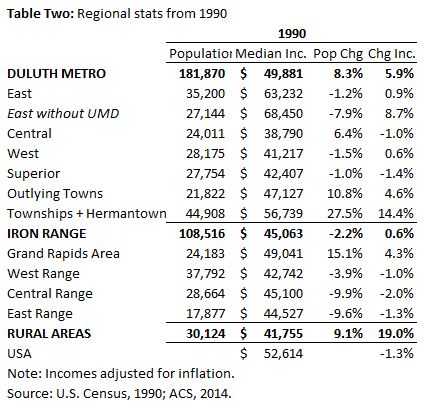
1990comparison

It’s not happy for everyone, though, and as Table Two shows, there is certainly evidence of divergence. Duluth, predictably, dominates both the top and the bottom of the income list, with pockets of great wealth and realms of substantial poverty. Those areas haven’t changed much since 1990—in fact, I was a bit surprised to see so little movement near the top, given the growth of the exurban areas—but the rich do seem to be getting richer while the poor get poorer. (See the table at the end for a breakdown by census tract.) This is less extreme on the Range, but it is noticeable in places, especially around Grand Rapids. It’s worth noting that the “Grand Rapids – South” tract split in two over this time period; I kept it together for consistency’s sake, but the southern, more rural part followed the trajectory of the wealthier areas around Pokegama Lake, while the more central parts slumped a bit.

The influence of Duluth’s colleges is also unavoidable. I split out East Duluth stats with and without UMD to show what an effect they have on incomes in that part of the city, while at the same time boosting an otherwise shrinking population, especially on the far west end of the area. Student housing has spread further afield, and the Census has also made more of a commitment to counting students where they live instead of counting them as living with their parents. (For my part, I’m not a fan of this decision, as I think it distorts things and gives an inaccurate account of the economic standing of students’ situations and of the area they live in, but no one asked me.) This leads university campuses to look like poverty-stricken wastelands; just check out the University of Minnesota campus sometime. Given the number of students, the income measured in a neighborhood like Lower Chester in Duluth is actually pretty substantial, even though it appears below average.

The Range, again predictably, is older and poorer than the Duluth area, and parts of it do worse than the national average. Grand Rapids—whose labeling as “Iron Range” is always a source of controversy anyway—also really carries the region economically. And while the East Range as a whole struggles, it could easily be split between the Ely and Lake Vermilion areas (which are growing in income, though still not rich, and fairly old) and East Range towns like Hoyt Lakes, Aurora, and Biwabik. These are among the worst-hit areas over this 24-year stretch, with the 2001 closure of LTV Steel in Hoyt Lakes looming large. Basically, the areas that have emerged as vacationlands are doing better than the more mining-dependent regions, and this is probably only even more true following the steel price downturn of the past two years.

It’s true that hospitality jobs don’t pay a ton. Ely and Tower aren’t getting rich off their recent tourism growth. But diversification does allow them to do somewhat better than their neighbors, and have something to fall back on in difficult mining times. The advantages are real, and are even more real around Grand Rapids, which benefits from being somewhat closer to the Twin Cities and on a couple of major highways.

Now, we’ll boil it all down to census tracts, which usually have 2,000-6,000 people and are roughly aligned with neighborhoods and towns.
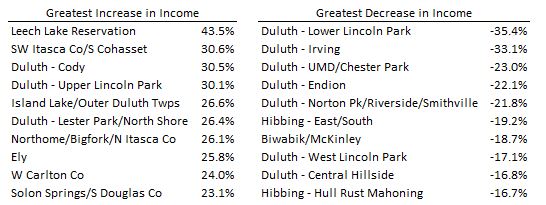
ChgsinIncome.JPG

The tract with the greatest income growth was a surprise to me: Leech Lake Reservation west of Grand Rapids in Itasca County. The other reservation tract, Fond du Lac, also did quite well for itself. Granted, these native communities are both coming from very low starting points, but it’s worth acknowledging that success, and taking a broader look at outcomes across the board in these areas. The other big gainers are mostly exurban lake country and a handful of Duluth neighborhoods that have seen some growth on the fringes plus, I suspect, some turnover as an older generation fades and gets replaced by a younger, upwardly mobile one. The biggest drops are in UMD tracts, a few of Duluth’s poorest areas, and in mining communities.

youngestoldest

The age table reinforces the effects of the colleges. I’m over the median age in my own Endion neighborhood, proving once again that I am an evil gentrifier who is ruining the neighborhood. The oldest tracts, excepting the two central Duluth areas with large retirement complexes, are all very rural, and the top of the list stays very rural beyond the top ten, too. Central Duluth also trends young, and this is worth watching: are the people here upwardly mobile, and will they move up in time, and perhaps move east or west? Or is this another generation of entrenched poverty?

Answers to a lot of these questions will have to wait, but our friends at the Census can give us some clues. I’ll continue this series at some point, too. As an appendix, I here add the table with income stats on all 98 census tracts in the five counties I looked at:

AllTractsDLH.png

Planning Duluth: Endion and East Side Traffic

Oh Duluth politics and planning blogging, how I’ve missed you. My return was inspired by this recent Perfect Duluth Day post on mall access on Duluth’s east side, an idea that includes big plans for 21st Avenue East, a major artery in the near east Endion neighborhood. In the next month, I’ll become a resident of Endion, so I feel entitled to an opinion here. Endion is a funny neighborhood; one that makes sense only in terms of its history. The U.S. census splits it into two tracts, and my future home is on the 20th Ave. E. dividing line; one side of the street has a median household income that’s $45,000 more than the other. I’m on the poorer side, so I guess I’m an evil gentrifier coming to ruin the neighborhood.

Endion is an area where three different Duluths collide. First, there’s old money Duluth, the realm of stately old homes. Go eight blocks east and you’re in the wealthiest pocket of northern Minnesota, but over by me, it’s a jumble of well-maintained beauties and faded grandeur. Next, there’s Duluth as a Rust Belt city, a realm of lifelong renters in often transient states of poverty. Head eight blocks west, and you’re in Duluth’s poorest area. Third, there’s college town Duluth, which has slowly leached down the hill over the decades. The big old houses get carved up into student apartments; some are clearly declining student properties, while others are hard to tell apart from the single family homes. It’s a complicated place with an unclear future, and several paths open up before it.

The poster on PDD suggests turning 21st Avenue East into a four-lane highway, which is both a terrible and an unrealistic idea. Four-lane streets aren’t any more efficient at moving people, unless they become limited access highways, in which case we’re talking widespread destruction of homes. It’s even worse when we factor in such considerations as 1) unless given some even more destructive switchbacks, it won’t lessen weather concerns—in fact, as a viaduct, it will worsen them; 2) 21st is not a federal highway like Piedmont, so it would have to be built on the dime of a city that already struggles to fill potholes, and 3) as someone who’s spent most of the past eight years living part-time in larger cities, I giggle at this alleged “bad” traffic on 21st. (I drove it at rush hour today for kicks, and got to my destination maybe ten seconds slower than I would have otherwise.) Such a project would be a horrid waste of money, and it won’t happen. But, thankfully, it does open up a conversation about planning the Endion neighborhood as a whole.

The commenter mentions college-driven housing stock decline in justifying the 21st Ave. project, but this mistakes the symptom for the disease. Some college spread is inevitable, and anyone who buys a house within a few blocks of a college should expect some residual effects. But in the long run, college properties spilling down into Endion don’t do anyone much good. It leaves students with long, unpleasant commutes, and ups the odds of drunken incidents involving vehicles. It encroaches on neighborhoods that might reasonably not expect it, and leads to headaches for neighbors and universities as they try to keep the peace. The root cause of declining housing along 21st isn’t the spread of college students; it’s decades of poor development practice that led them to fan out in the first place.Colleges are more fun for everyone when they’re relatively self-contained, tight-knit communities.

The solution is simple: densify the area around campus. Pull down the worst of the student slum housing and replace it with things that can hold more people. Fortunately, this is already under way with Bluestone and Kenwood Village; ideally, these higher-end properties will allow other nearby homes to filter down and become affordable. As a corollary, build things students enjoy next to the university so that they’re less inclined to go traipsing down the hill in search of a good time. I have some quibbles with the design of Bluestone, which appears awfully proud of its parking lots, but it’s hard not to argue it’s been an economic success, and that organic explosion of development is pretty remarkable in a city that doesn’t usually grow a whole lot. The demand is obviously there.

Elsewhere in Endion, the commenter is right to call out London Road and its lame “stroad” status: it seems so wide that it’s trying to be a highway, but has the speed limits and business development patterns of a city street. (Though I would defend futons from Mr. Marohn’s unjustified slur.) The thing needs work. Once again, there’s progress: the Endi development at 21st and London Road has some potential to galvanize that whole stretch, and there’s room to make the current sprawly commercial and retail space a lot more attractive to us neighbors. I drove down this as well today, and there’s more than enough vacant or underused property to develop a serious commercial corridor, with a ready-made consumer base and workforce in neighboring areas. The PDD commenter complains that the East Side doesn’t have easy enough access to mall-land, but with the right developments, maybe East Siders will have more convenient options than trekking up to Duluth Heights or Hermantown.

I beg to differ with some of the commenter’s characterizations of the city’s development patterns. If downtown is dying, what’s with the new maurices building? East Superior Street? The Tech Village may not be stuffed with innovative incubators, but it is basically full, as is every other newer project downtown. Build it (or renovate it), and they will come. That said, the person isn’t wrong to emphasize the growth patterns over the hill. I’m not one of those urbanists who thinks the suburbs are about to stop growing, and that everyone will magically move back to the city. The exurbs have driven the Duluth area’s population growth since 1990, and will continue to grow at a faster rate than the built-up East Side. Barring an armed invasion of Hermantown, I don’t see Duluth hitting that 100,000 target population anytime soon.

Much as I’d like to see growth, though, I don’t think it should be the goal in and of itself. Instead, I want to see new life in somewhat shabby neighborhoods, and intelligent planning that builds communities that offer a bit more than carbon copy suburban development, and a tax base to fund all these bright ideas. If we want to recharge this city, it takes two steps: first, retain us young professional millennials, whether they’re recent grads or kids like me who come home; and second, keep us here with reasonable starter homes, career growth opportunities, and decent schools for our kids. Better highways won’t do that; better amenities and intelligent planning will.

I’m moving to Endion because I think it has a ton of potential: easy access to downtown (where I work, and do most of my play), reasonably good (and improving!) amenities around it, and architecture that would be a treasure with a little updating (expanded renovation funds, anyone?). It will take some work, though, and these scattered thoughts are, at least, a starting point for the city’s new comprehensive plan discussion, which kicks off at Denfeld High tomorrow. It’s time to radically rethink the solutions to those “stressed” street corridors identified in the previous plan. Don’t treat the symptoms; treat the underlying cause.

Family Planning

In planning, we’re careful to say we’re planning “for people” or (better yet) “with people,” as a way to juxtapose us against those mid-century planners who pushed through giant, home-destroying highway projects in the name of efficient transportation, or from those architects who value form over function. It’s our way of showing we care about public opinion instead of self-interest or some ideological program.

At the same time, however, some efforts to plan run the risk of adopting some ideology of people based on whichever abstract version of humanity it chooses to adopt. Maybe it’s majority opinion, maybe it’s the opinion of the handful of people who show up to the public meeting or write angry emails, or maybe it’s a group that we believe will be ignored (if not actively damaged) by the powers that be. There are defensible reasons for choosing any one of these ideas of the public, and for ignoring them all in the service of some other end. The simple reality is that there is no logically coherent “people” we can claim to serve all of the time, so we have to make some careful choices.

Right next to the definition of the public we serve, however, there’s another important, often forgotten element of planning and policymaking: its temporal dimension. We not only have to consider the people we’re planning for now, but how the histories of the people and places we’re planning for affect things, and how they will affect people in the future. And when we think in that way, short-term decisions about which group of people we’re planning with can prove directly at odds with what might be right ten, twenty, or fifty years down the road.

This leads me to a recent piece by Benjamin Schwarz, and two accompanying follow-ups at The American Conservative (obligatory disclaimer: their definition of “conservative” is not what you think it is). Schwarz leans on planning prophet Jane Jacobs to show the importance of planning for cities with children, and how the rising urban young adult playground neighborhoods (called “vibrant urban neighborhoods,” or VUNs), which have revitalized some parts of large cities after years of decline, ignore them. (Think Williamsburg in Brooklyn, the Mission in San Francisco, Wicker Park in Chicago, or Uptown or the North Loop in Minneapolis). These neighborhoods, models for many in my field, are just shells of the bustling neighborhoods Jacobs lauded in The Death and Life of Great American Cities. Sooner or later, these neighborhoods will need to accommodate children, or they’ll just stay on as temporary resting places for young adults before they head out to their suburban destiny. The “back to the city” trend will sputter out.

This emphasis on children is something I’ve instinctively looked for in communities: long before I considered becoming a planner, my first question in evaluating neighborhood health was, ‘are there children playing freely outdoors’? These may just be the instincts of a Duluthian who expects a ten-acre park a couple blocks from home, but even in fairly dense urban environments, this is more than possible, as Jacobs’ tales of mid-century Manhattan show. If we believe it to be a worthy goal, true urban recovery from the planning horrors, economic troubles, crime waves, and political disinvestment of the mid-to-late 20th century has to reach into childhood.

Maybe I’m wrong, but I also don’t think this is always a chief concern for many in my planning cohort. This is probably because most of my peers are twenty-somethings who, like me, have foregone child-rearing until after graduate school, if they ever expect to go there. Our slow lurch toward family life feeds into broader debates about my generation, which is famous for marrying and having children at later ages than its predecessors. Among planners and my fellow Georgetown alumni, it’s mostly a calculated move for career-life sanity and near-assured economic stability; say what you will about that trend, but it stems from genuine and understandable concerns. But elsewhere in my millennial cohort, it’s often an entirely different picture, and we’d be blind not to acknowledge that many of us still do settle down at young ages, and that others possibly would if there weren’t so many barriers discouraging them.

Schwarz is pessimistic about attacking these barriers due to economic forces, but does have one memorable line: “Two words begin and end any real effort to create truly vibrant city neighborhoods: public schools.” In the second comment, Emily Washington expands on this point, but only to make a vague argument for “education reform.” The details are unclear, but it’s obviously important. And yet, somehow, there’s no hint of education policy in planning school curriculum. School districts may not be governed by city planners, but they are an essential part of planning cities, and we ignore them at our own peril.

There are hopeful hints in planning ideas like “safe routes to school” and “lifecycle housing” that get back to some idea of planning for families. Still, in the end, a philosophical disconnect lingers: we plan for the individual abstract person, not the person within a dense network of relationships that define human interaction—of which the family is the most fundamental part. For related reasons, family-level thinking has been somewhat lost in the shuffle among the many important and necessary victories for women over the past half-century, as they’ve escaped potentially crushing norms and climbed toward economic equality with men. These are essential steps for sane policy as well, but in the process, talk about families and their roles in personal formation have often posited them as something to be liberated from instead of a goal to build toward. Both can be true, depending on the situation, but the state is a crude substitute for the closest of bonds. The future of cities is inseparable from future generations of humans, and a stake in its fate requires a stake in humanity that transcends the here and now. Trite as the phrase may be, families are the building blocks of society, and its motor forward into whatever comes next. There are enough economic and other issues pushing against them that we can ill afford to let planning trouble them.

Schwarz is right when he says that Jane Jacobs-style neighborhoods aren’t coming back. But there are still other ways to build more family-friendly cities. The solutions need to look beyond VUNs and the highly educated, upwardly mobile young people (like me) they seem to want to cater to. That alone won’t keep me here. We need housing that allow for more variation in family type that can accommodate multi-generational families or large families, instead of single-bedroom units. We also need varieties of housing types, both in age and style, from starter homes to modern-day palaces, from “luxury” flats to modest apartment buildings. Building this sort of city means real pedestrian infrastructure and connections to parks and schools, and assurances of public safety along those corridors. It means green space, both in backyards and inviting parks. It spreads people out somewhat, instead of segregating rigidly by stage of life.

The list could go on; the solutions aren’t secrets. But maybe more fundamentally, we need an understanding human life that remembers that people’s closest ties are often the most important drivers of decisions. Unless plans take meaningful steps to include the next generation, the cities they build for will have a hollowness at their core.

Masters of Reality

I’m not normally one thrilled by public speaking, but for some reason, the idea of giving a commencement speech has a certain allure that would cause any anxiety to melt away in a heartbeat. Alas, that day will have to wait until I’m famous and one of my alma maters invites me back. Perhaps fittingly, I’ll settle for a written version. This has been percolating since last December, and now it’s time to share some collected thoughts from my nineteen years in school, which come to an end this weekend.

Masters of Reality

Hey, we’re done. We did it. We finished graduate school. Now what the hell did we just do for the past few years?

Hard to say. What’s a graduate degree for, anyway? A credential to help us up a job ladder, and little more? On the most cynical of days, when I plowed through some of my less inspiring papers or group projects, it was hard to think otherwise. A pursuit of knowledge for knowledge’s sake, and nothing more? Spare me. In my own wing of our dear modernist mecca on the Mississippi, the Master of Urban and Regional Planning program, there’s even a common complaint that we don’t get nearly enough practical skills, to the point where I had to suppress a laugh when the first question in a recent job interview asked about my experience reading zoning code. Instead, we get taught how to think, whatever that means. I eat this up, but it’s such a fluffy description that it can crumble under the duress of yet another slog through a group project.

This is a public affairs school, so this means there must be some sort of overarching vision…though anyone who took Intro to Planning with Ryan Allen probably isn’t sure how to define the public good anymore anyway. Still, there are frequent nods underlying mission here, one rife with clichés about public service and human progress and peace and justice for all. To find the most eloquent flavor of this take that’s weighed on me over the past few months, I’m going to commit a Humphrey School sacrilege and quote one of Hubert’s rivals for the 1968 Democratic nomination, Robert F. Kennedy. RFK’s words to an Indianapolis crowd on the night of Martin Luther King, Jr.’s assassination laid out a simple mission in the shadow of death: “Let’s dedicate ourselves to what the Greeks wrote so many years ago: to tame the savageness of man and make gentle the life of this world.”

OLYMPUS DIGITAL CAMERA

1968 might have been the messiest year in American politics this side of the Civil War, but 2016 could be a contender before all is said and done. We’re graduating into a world where reality doesn’t quite cooperate by the rules we’ve tried to impose on it in our studies. Theories of international politics and democratic order that I learned as an undergraduate have never seemed so tenuous. Political upheaval has come to this country in a presidential campaign that shreds all our political niceties and assumptions of proper decorum, and it strikes home here in Minneapolis, where, in the past year, we’ve had glimpses behind our façade of Minnesota Niceness and found a community with rifts we still need to heal.

Moments like this are a reminder of how tenuous our quest for knowledge can be, how all our careful efforts to catalogue each event before us and filter it through our rational methods never quite manage to capture everything. It makes us realize how radical RFK’s project was. Humans are savage creatures, capable of falling to great depths in craven, base lusts for power, and even a constitution with the most meticulous checks and balances may not guarantee any sanity. A master’s in public affairs can only tame so much. The very name of the degree seems oddly archaic, suggests this piece of paper gives us a right to own or at least control other people: what exactly have we mastered, anyway?

As master’s students, we sit around and argue and opine from on high; not that we didn’t do these things already, but hopefully we’re a little better at it now. We learn our history, though there’s little consolation in recounting past failures to ease our inhumanity and bend history toward justice, whatever that might look like. The more we know, the more we realize we don’t know, and we risk that moment of sheer terror when we realize how small and clueless we are.

And so we find ourselves part of a generation mugged by reality, forced to confront an uncertain world where we don’t have easy answers. And it doesn’t get any easier. We endure tragedy, and before long, none of us are young anymore, marked by a string of steady losses and shocks, some grand and political; the most jarring, deeply personal. It is in these darkest hours when we are often at our most human, our most able to be honest with those around us and hone in on what we truly value. Pain and suffering prove necessary steps along the road to excellence.

So much of freedom, you see, is a myth. We’re forever bounded by who we are and where we come from, and the days of fundamental change are probably gone: we can only become more and more our true selves. But we do have the power to author our stories, to pull all these scattered events that happen to us into a narrative, give it a trajectory that pushes us toward some yet unseen end. We can choose whether we’re tragic heroes or triumphant survivors, whether we drown in hubris or rise up in humility.

GU

Knowledge of this choice requires a rare self-awareness. It requires us to take a step back and assess the whole story, either in a salon of trusted confidantes or alone with one’s mind in the dark of night. This isn’t a skill anyone has innately; it’s something we have to cultivate carefully, time and again, to be able to crawl out of the ongoing string of nothing to remember why it is we do what we do. At times we endure long tunnels of darkness of the soul, or at the very least of a Humphrey computer lab, but it’s all worth it for those little glimmers of light, those little moments of wonder or awe that give life its driving force.

And so the great benefit of this broad education is the power to stop and process everything. It is the ability to recognize these narratives and impose a small dose of mastery, however brief it may be. And if we take that imperative seriously, follow it to its furthest conclusion, it presents a great burden. Every certainty comes under scrutiny, and every last object of worship threatens to fall away. We’re forced to confront our most unsettling worries, and it can bring out the best and the worst in us, depending on how we respond. Down here, we see how our greatest strengths and our greatest weaknesses so often stem from the same source.

The trouble is, for all of this human drama, few will care what we wrestle with. Any inner turmoil isn’t of much interest beyond our inner circle, and the Humphrey, for all its strengths, doesn’t always set up easy dialogue outside of that circle. The question of our time is how we respond in a world of indifference, and in one where we resort to grabbing attention by the cheapest of means: knee-jerk righteous anger, 140 characters, and snarky dismissal. Delicious as these may be, they are always shortcuts, never quite able to admit nuance or submit to the vulnerability of knowing that, no matter how far we reach, we will never know all the answers. We all have our blind spots, must take our leaps of faith, and none of us can truly master it all.

The diversity of human experience is too great, and if we stop to appreciate the extent of that diversity, we understand just how hard it is to bring people together into some sort of community. It’s so hard because it should be: even people from fairly similar backgrounds come to radically different outlooks, and no amount of imposed education will produce the same worldview. Sobering, perhaps, but maybe a source of hope: it’s all still a mystery, and mystery begets curiosity, an endless, restless search. And as this search continues, we must always cling to that sense of wonder, even amid the daily tides of tiring monotony that come in reliably every day. This wonder takes commitment, and with commitment and love poured into people or a cause, there is always the risk of further heartbreak and pain.

We must choose carefully, make sure those ends to which we direct our lives are worth the faith we place in them. We have a narrative; we might not be able to explain exactly where we’re going, but we need some idea of how to get there, and why everyone else should come along for the ride. If we urban planners can contribute something, it is a scale on which we can think about starting our efforts: right here, in our most immediate communities, where we can know the details intimately and have the power to turn vague wishes into concrete action. Grounded, we’re free to plot out our dives into the arena in search for moments of glory.

murps

I’m reminded of a line from Rollo May: the opposite of love is not hate, but apathy. To resist that apathy is not just one option among many, but an imperative, one that requires a moral courage to claim that, in our wanderings, we’ve found something to live for. And while those dreams and ideals help frame our work, no abstraction can substitute for what we learn from living in and among the people closest to us, entranced by the whole spectacle. Instead of living a dream, live reality: realize that what we have before us is all we’ve got, and it’s up to us to take that history we’ve lived and turn it into something coherent, to blend all those disparate threads into one. Somewhere in here lies the mastery of reality, as best we fallible humans can achieve it.

And so we head forth to pursue it. This can’t be a burden, something we do out of some resigned sense of duty. We must do it with panache, with a joie de vivre that fuels the fire through the tremendous barriers we confront and the thousand insidious, nagging bites that drag us down, day by day. Life is not about balance. Balance implies stasis, a resting place; life is instead a constant flow in among any number of streams that pull us along, tugging this way and that and leading us down toward whatever destiny may await. We will waver on our way, and at times it will be anything but tame. Mastery cannot mean an imposition of control, but instead only momentary escapes, and in the times when we don’t have that lucidity, a knowledge of how to ride the waves, catch the swells and surge and retreat as we see fit.

How do we do that? I can’t see far into the future, but right now, it all seems simple enough. It’s time to bring these grandiose words to a close and head out into a beautiful Minnesota spring, to spend time with family and friends and revel in what we’ve done over these past few years. And then, renewed, we can head forth and leave our marks on reality as we see fit. We’ve finished countless assignments over the past few years, but our real work is only beginning.

On Student Leadership

I’m finishing graduate school in less than a month. This is simultaneously exhilarating and terrifying, and this weekend’s end-of-year banquet at the Landmark Center in St. Paul made it all that much more real. I’ll have a lot to say about my two years as a Gopher in the coming month, and I will also reserve greater judgment until I’ve had more distance, as I did with my Georgetown blog post some two-plus years after graduation. (Even now, upon rereading, that post seems overly critical.) But first, I want to reflect a little on my time as a student leader for two very distinct student organizations. I didn’t do anything earth-shattering with either one, but in retrospect, they’ll certainly define my time at the U of M more than anything else.

First, I served as President of the student group that represents my graduate program, the Planning Student Organization (PSO). This was one of the true highlights of graduate school. We dramatically ramped up the PSO’s capacity, and cleaned house and left as much positive institutional memory as possible. Some of the work I am most proud of was exceptionally boring, as it involved writing out agendas and doing a lot of bureaucratic slogging in the hope that my successors will be able to apply for larger budgets. Still, it rarely felt like work. I was fortunate to have an excellent team of people with me, all of whom I’d count as good friends, and we managed to have a fair amount of fun along the way.

My time with PSO was also my own little experiment in hyper-local government. I grumble a bit when I learn that both the Dean and Assistant Dean of the Humphrey School have no knowledge that we exist, even though we probably hold as many events as any group in the school. But in reality, we’ve rather intentionally closed ourselves off from the affairs of state in the broader graduate school. Often, a leaner operation with less oversight makes for a much more flexible, less fraught environment. We have the good fortune of having an exceptional new program director, and he certainly made the context easier to navigate. Instead of complaining to a dean when things went awry, we tried to solve them through internal capacity. If we think the admissions office is short-changing our program in its visit days, we politely work with them, but find our own way to rope in new students.  While I’m willing to sign on to a few things and certainly spoke my mind about things that bothered me from time to time, I prefer this only as a last resort. Give me direct action over grumpy letters to the dean any day.

The Humphrey School is at times fractious, its meetings full of controversy and intrigue. In our little wing of the building, there was no such drama. A small program size helps, and we have our own issues of homogeneity and groupthink to work through. Still, it’s an eclectic group with a wide array of academic and experiential backgrounds, but all unified by a vague ideal of community and a desire to have a stake in its future. To the extent that we could invite people in to that and further their goals along this path, we succeeded.

My other commitment did get me out a bit more, as I served as the Managing Editor of the Humphrey Public Affairs Review. We’re still wrapping up our spring issue, and I’m sure I have a few frantic late nights left. Once again, I put in most of my work behind the scenes, going through the same group registration process and writing a syllabus for a class that I kinda sorta co-taught. The day-to-day work involved incessant emails, keeping up with editing teams and tracking down authors and making sure the whole issue is ready to go to press.

HPAR hasn’t always been easy to manage: it’s a new publication still building up its capacity, and its members’ diversity of interests, in many ways a strength, means we’re often not in the same place as the others. Generating submissions can be a challenge, especially when the people who signed up to be PR people never showed up to anything. I’ve never been a salesman, and I probably could have lightened up on my pathological penny-pinching and sprung for a few more marketing materials. Still, we found creative ways to use editors’ talents and connections to fill the void.

A year ago, back before I served on anything, I reflected on how student organization leadership seems both a political training ground and little league at once. I still think that. I honed valuable management skills here, and at times had to work around disinterest, neglect, or just sheer obliviousness from higher-ups. The low-stakes atmosphere lets this come with ease, and students can run things in a low-key, somewhat irreverent way that lessens the stress of commitments and leadership. Without seeming to try very hard, it builds community through ease and proximity.

Half the battle seems to involve just keeping the lights on and constantly having an agenda, looking for ways to do more and achieve those fairly basic goals laid out in mission statements. After that, simply sitting down with people and getting them in the room does most of the rest of the work. This can be especially difficult when everyone has frantic schedules, and there’s something about the calendar-invite era that seems especially counterproductive to having quick, easy check-ins. If everyone part ways with clear roles and distinct action items, things will get done.

My HPAR experience even further underscored the value of human contact. In our paper review process, all our submissions are edited without names attached, so as Managing Editor, it was my job to correspond with authors. This meant a fair amount of softening the sometimes vicious copy-edits that are all too easy to slap on an essay when there’s no name attached to it (something I was just as guilty of the year before) into something more constructive. On a few occasions, this involved setting up in-person meetings with authors and sitting down with them to talk out issues, further humanizing the process. It’s amazing how talking out what points one was trying to make in writing can show exactly what changes are necessary in a paper.

Above all, it’s important to identify when things are sliding off course early and say something right away, otherwise one will be left in one of those situations where one is writing a grumpy or bitter letter. As prolific a writer as I am sometimes, all the pixels in the world can’t convey many of the things that we can share in a conversation. Constant awareness and communication skills, in the end, are what make it all work. By staying transparent in my own operations, I hoped to create an environment where others were free to be transparent with me. There are occasional moments when leadership demands bold stands or declarations, but on a day-to-day basis, it mostly involves the mundane work of gentle stewardship and guidance.

I’ll concede to feeling a bit strange as I close in on the end: I poured myself in for a very brief amount of time, and now I’ll be disappearing (though still in touch). I’m far from perfect; I had a few moments of trial by fire, and a few things that I’d do differently in retrospect. It’s a bit absurd to consider the amount of time I spent doing grunt work for which the only compensation is a bit of sap at transition events and year-end parties. Career ladders are such that leadership skills aren’t always the most relevant things to one’s first post-graduation position, as evidenced by any PSO curriculum discussion in which people worry about their lack of “hard” skills. But even though I’ve wavered, I still learned a lot more about how to work with people and get things done than I ever could have in a classroom. There was never a dull moment, and even if my time here was fleeting, the connections should endure.

Orfield v. Goetz

The University of Minnesota is the home to two high-profile housing scholars who are highly articulate, impassioned advocates, and hate each other’s guts. In one corner of the great housing debate is Ed Goetz, a professor at the Humphrey School of Public Affairs and head of the Center for Urban and Regional Affairs. His sparring partner is Myron Orfield, a law professor who served in state congress for twelve years who heads the U of M’s Center on Race and Policy. I’m the sort of person who can be entertained by high academic drama, so I’ve spent a chunk of the past year exploring their dispute, from participating in an abortive effort to get them to debate in person to settling for taking both of their classes at once. Today, Goetz’s class finally fleshed out their debate in full, giving me a chance to be accused of being a “closet integrationist,” among other things. (We were assigned sides, and being myself, I was trolling pretty hard.)

In its simplest form, the Orfield-Goetz debate boils down to this: Orfield’s acolytes believe that the most effective way to create opportunity for low-income populations and people of color is to scatter more affordable housing throughout a metropolitan area.  An agenda of full-scale desegregation is the most effective way to improve educational and economic outcomes, and policies that further concentrate low-income people in center cities or declining suburbs only reinforce cycles of poverty. Goetz’s backers, while not opposed to scattered-site housing, believe it is overly paternalistic to speak of moving black people to white neighborhoods so that they can benefit from living around white people. Goetz claims there is an affordable housing crisis in all parts of cities, and that we can’t be too picky about the siting; abandoning work in currently distressed areas will only make them worse.

The main point of contention appears to be Orfield’s treatment of community development corporations and other affordable housing developers that do the bulk of their work in already distressed areas. He calls out these developers for perpetuating inequalities, marshaling social science data to show the clear improved outcomes for low-income individuals living in “neighborhoods of opportunity.” Goetz counters by noting the extreme political obstacles to desegregation, a lack of evidence demonstrating success when programs are implemented, and the troubles left behind when investment pulls out of areas that are already struggling. He also questions the data and methods Orfield uses to arrive at his conclusions.

I can posture easily on either side, and it’s easy to toss about charges of racism or segregationism here and there. In this blog post, however, you’re stuck with me, so you’re going to get an unsatisfying and complicated answer. In writing this, I’m making some gross over-simplifications to reflect general perspectives in a debate; both scholars are considerably more complicated than this. Goetz in particular seems to appreciate a good argument wherever it comes from, and just finds Orfield’s lacking.

Orfield is something of a persona non grata in the urban planning program, but I’m still glad I sought out his class this semester, and doubt my planner colleagues would be as dismissive of him if they heard his in-person pitch. His perspective is a unique one, and he brings in new dimensions, such as schools. Urban planning, for reasons I do not entirely understand, rarely discusses education policy, and yet it is perhaps the biggest driver of residential choice out there. Case in point: both Orfield and Goetz, along with a whole host of U of M academics, live in Southwest Minneapolis, the one corner of the city with strong public schools. As someone who spends a little too much time over-thinking how I’ll handle this sort of decision when I have kids of my own, I can’t fault them at all. One’s own children are often where ideals go to die.

Goetz won’t dispute education’s potential, though the two can wrangle over the details. Still, one of the most striking things about this argument is the amount of common ground that these two share. Both seem to have fairly similar politics, are well-versed in the major literature and court cases around the issue, and infuse plenty of nuance into their arguments. They know housing policy doesn’t operate in isolation. In their debates, they tend to agree on 95 percent of things. And yet somehow that other five percent has become deeply personal, to the point that they won’t appear on stage together.

Both make the argument that the other side wants to limit choice, with the Orfield vision forcing people out into suburbs they may not want to live in and the Goetz version preventing people from any access to the potential perks of higher-income communities. (Neither one will work alone; both acknowledge this.) Both views appear overly idealistic in their own way, as Orfield puts his faith in the glacial tide of Fair Housing Act enforcement to create meaningful anti-segregation measures, while Goetz’s side would like to think that investment in long-suffering neighborhoods will somehow flip trends that have seemed so intractable for so long. (Fair points on both sides.)

Goetz’s most powerful counterpoint to Orfield’s skepticism of focus on already distressed areas has its roots in history: the current situation in inner cities is the direct result of decades of disinvestment, both public and private, and pushing people to leave will only further the decline. These places aren’t going away, and people will continue to live there. The only response here is deeply cynical: how can anyone in the housing world, knowing what has happened over time, trust that politics won’t continue to reinforce these divides? Better to hedge one’s bets and build things where wealthy white people will continue to live, as these areas will continue to do well, say Orfield’s people. The courts, at least, can push through a pro-integration agenda while being somewhat shielded from public opinion. The dreams of serious investment in distressed areas won’t work barring a political revolution, and even then, it threatens to degenerate into an us-versus-them dynamic that ends poorly for everyone.

Orfield is perhaps at his most radical when he attacks self-segregation by people of color: in his view, an all-Somali school in Minneapolis that seeks to empower its students is an unacceptable obstacle to integration. The question, then, is whether the right to self-determination and the bonds built by such concentrated schools and neighborhoods trump the social science that shows questionable outcomes. What’s the real goal here, the freedom to choose one’s own way, or a cohesive and fully integrated nation-state? As Orfield would ask, can separate schools and neighborhoods truly be equal? Or are we content to measure “success” on each community’s own terms, with no relation to the other?

The trouble here is that the “black community” (or any other racial or ethnic group, including white people) is not a monolith. Some people want to live around people who look like them, some actively want to live in diverse places, and plenty of people outside of academia or in certain chambers that react directly to it (where racial issues are always lurking under the surface even when not explicit) don’t care a whole lot. We have results from racial preference surveys that show that, for example, blacks and whites have different ideal “racial mixes” for their neighborhoods, and these dynamics, barring outside forces, will trend toward re-segregation. Still, all of this seems a horribly crude way to think about public policy and the people involved. Goetz points out that we often blur the line between whether housing policy focuses on places or people, and how one deals with that has serious implications.

When a couple of students discussed the debate with Goetz at the start of the school year, he expressed discomfort with two white men in their respective ivory towers deciding the fate of residents of low-income housing. It’s a fair point, and one consistent with his broader argument: the people who live in these places should be driving these decisions. For Orfield, on the other hand, higher ideals overpower the choices of individuals, which may on the whole create collective action problems as everyone acts in their own sorry self-interests. It’s an ancient debate, one that hearkens back to Aristotle observing the world around him while Plato looked to the sky in search of the perfect vision.

I started planning school because I was pulled by the instincts that guide Goetz: to build communities from the ground up. I still tend in that direction, though I’ve rediscovered some sense of ambition and a few crosses worth dying on, to say nothing of disgust with the bureaucratic morass that has pulled out my inner Robert Moses at times. My decidedly unsatisfying conclusion is to preach patience: collect more data, run more studies on what works, let different places experiment with different approaches to see what they can achieve. And whichever direction we go, invest more, period.

I’m glad both Goetz and Orfield do what they do, because these questions don’t have easy answers, and this sort of honest debate is exactly what future planners need to wrestle with. As proud as we may be for seeing the light and coming to this program with our visions of how the world could be better, we still should be in awe of our own ignorance and inability to “solve” things with a few easy ideas. That ignorance should not inspire sadness at our smallness in the face of the world, but relish: we have a problem to attack here, and we need to get to the bottom of it. This is what graduate school is for, and these are the debates I hope we continue to have even after we head out into the world and become real people. This is the challenge to which we’ve devoted our careers, and it won’t get any easier beyond the halls of the academy. We’d better learn how to enjoy the ride.

A Patient Cyclist

Fall is kicking in to gear in Minnesota, which means that it will soon be time for those of us who are not ambitious winter bicyclists to stash our steeds away for a few months. For reasons that now elude me, I was never a big biker as a kid; the bike helmet strapped to my bag is a new addition, and given the choice, I’d rather just walk everywhere. But my graduate program contractually obligates me to begin something akin to a Tour de France training regimen, and so I have begun my education.

As Adam Gopnik writes in a recent urban planning omnibus New Yorker piece (alas, it’s behind the paywall), cycling rose to prominence in the 1890s not because it was cheap or necessarily fun, but because it was the fastest way to get around at the time. This became true for me this summer, as construction fouled up traffic between Uptown and Downtown Minneapolis. I took a certain glee in whizzing past the people trapped in their cars along Hennepin Avenue every morning, and Minneapolis’s generally excellent bike infrastructure made the decision to abandon the bus an easy one. When safe lanes are in place, the cyclists will follow.

As the summer went along, though, I began to take a few trips beyond the route of my daily commute. My Tours de Minneapolis never did quite enough to make my runner’s knees totally happy on a bike, but there’s something deeply satisfying in coasting through Theodore Wirth Park or pushing the pace past laboring cyclists on the few inclines this city has to offer. I would around the lakes, cruised along the river, and even made my way over to St. Paul from time to time. A bike camping trip out to the crimson trees of Maple Grove this past weekend seemed the ideal way to cap my first summer as a regular biker. It’s a pleasurable way to cruise about a city, with every corner suddenly at one’s disposal; nimble and versatile, both leisurely and a decent workout, depending on one’s desires.

Defenders of the bicycle are locked in a long-running, low grade war against their great antagonist, the automobile, and no self-conscious cyclist can pedal away from the debate. A lot of drivers are supremely ignorant of cyclists, and I’ve witnessed more than a few cyclists returning the favor by weaving recklessly in and among cars. If this is how rule-conscious, respectful Minnesotans handle things, I can’t imagine the battles elsewhere. As a runner, I’ve also endured countless cyclists who either give no indication of their presence or like to think they own the entirety of a shared path. Such is the grey zone of cycling etiquette, and the frequent imbalance between the letter of the law and what proves good practice on city streets.

In the end, people remain people, often inclined to vent their disgust at other anonymous individuals hurrying off to wherever it is they need to go; sometimes they simply have larger machines with which to express their pathologies. My code on the roads ignores rigid rules and settles for basic common sense. Cyclists need not come to a halt at every stop sign and red stoplight if there is no traffic in sight; a simple yield will do. For pedestrians’ sake, bicyclists should stick to streets when possible, but it is no sin to escape to the sidewalk on particularly dangerous streets. Signaling turns is the polite, and safe, thing to do. Please, cyclists, announce your presence (without sounding passive-aggressive, as if your presence should be self-evident) when approaching pedestrians who appear oblivious or might risk wandering into one’s path. And drivers, open your eyes: you do not have a monopoly on the use of our streets, and never will.

As long as I’m on the topic, I’d be remiss not to add a few stray words on Duluth’s bike controversy this summer. Even though I think the Michigan Street compromise was the most practical option—and for the skeptics of it, I always took Michigan Street both ways on the handful of occasions that I bicycle commuted from my childhood home out east to jobs on the west side of Downtown—I couldn’t help be a bit sad to see the Superior Street push fail. I understand the practical limitations, but it otherwise seems like Duluth is going all in on the bicycle mecca development plan, and the lack of any accommodation for them on the city’s signature street is a glaring miss. (Suggestion for making the Michigan Street corridor work: get a ramp from Lake Place down to the street. Lugging a bike up and down those stairs isn’t ideal.) As long as the network continues to grow and people can learn what a cheap, fast, and valuable form of transport bikes can be, the end result will be a happy one.

The Story of Duluth in Data, Part II: Tables and Methodology Notes

(Link to the original post)

Tables

The following tables show the top and bottom ten census tracts in various categories using 2010 boundaries. Here again is the link to those boundaries.

I. Change in Population, 1970-2010

DuluthPopChg

Click to enlarge all images. Colors denote region according to map in Part I.

Unsurprisingly, the big gainers are almost all on the edges of the city or beyond, and the losers are in the center or on the near west side of the city, save the unique East End tract.

II. Change in Poverty Rate, 1970-2010

DuluthChgPov

The tracts that lost poverty over time are all over the map, but again excepting East End, they all enjoyed new development over the 40-year span, and some of them had a lot. It’s not surprising to see many of the biggest gainers in the center, but it is notable how poverty has leeched west out of Lower Lincoln Park (which was a high-poverty area to begin with) into its once less poor neighbors. Morgan Park and Chester Park are next to each other on the list, but their reasons for decline—loss of a steel mill versus the arrival of college students—could hardly be more different.

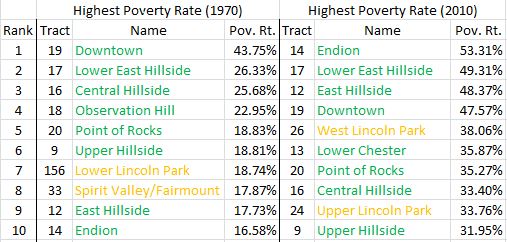
III. Highest Poverty, 1970 and 2010

DuluthHiPov

Most of these stay the same over time and are predictable, but the real eye-opener is just how much poverty has increased in these tracts over time. The poor have very clearly gotten poorer relative to everyone else, and much more concentrated.

IV. Lowest Poverty, 1970 and 2010

DuluthLowPov

A couple of west side middle-class tracts drop off the list here, and are replaced by exurban areas. No surprises on the 2010 list, save maybe Lakeside landing at the very top.

V. Changes in Per Capita Income, 1970-2010

DuluthChgPCI

The exurbs had the farthest to climb, so it makes sense that they dominate the growth list. Most of the east side settles in just below them, all ahead of the national average. With a sample size of 38 tracts, it’s incredible to note that nearly a third of them had little or negative income growth over the 40-year period, despite the national average rising 50% over this time.

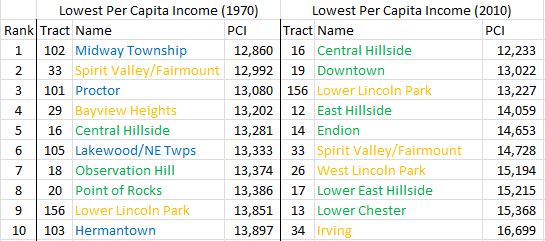
VI. Lowest Per Capita Income, 1970 and 2010

DuluthLowPCI

It’s interesting to note how many tracts are both low income and low poverty in 1970, particularly in the exurbs. Such tracts just don’t exist in 2010, with the low-income list coming to increasingly resemble the high poverty list. The closest thing to an exception is Bayview Heights, followed by the better-off west side tracts.

VII. Highest Per Capita Income, 1970 and 2010

DuluthHiPCI

No surprise to see the east side dominate the 1970 list, though a few rising exurbs and Park Point edge a few of those tracts down the list over time. Other than the growth in the college population in Hunters Park/Morley Heights, this really isn’t due to east side decline; just as there are more poor tracts in 2010, there are more comparatively rich ones as well. The city has stratified, as the much larger bands on the income map legend in the previous post show. The gap between the lower middle and the upper middle has grown significantly.

Methodology Notes

All of the data here comes from the U.S. census; 2000 and 2010 data is readily available online, and anything earlier comes from the University of Minnesota’s archives. Census tracts change somewhat over time, which is why a handful of west side tracts, which were once subdivided into several tracts, now have such large numbers. The census also reclassified UMD at some point, eliminating tract 8 and creating tract 157. The 1970 also overall figures include people residing on ships based out of Duluth, who are assigned to sub-tracts of the existing tracts. I threw them out of the comparison tables, though.

I focused on population and financial data because these are probably the easiest way to show general rise and decline. I use the federal government’s definition of the poverty line in each year. All income figures have been adjusted for inflation, in terms of 2010 dollars, using the Bureau of Labor Statistics’ Consumer Price Index Calculator. Analyses of job location, housing values, race, and various environmental factors could also prove fruitful in creating a more complete picture.

I made the maps with ArcGIS, census tract shapefiles available from the state, and the census data.

One could easily nitpick over some of my regional choices, and I wouldn’t disagree about many of them. For example, I waffled over where to put Tract 4 (Kenwood); it’s centrally located, but its 1970 demographics have more in common with east side neighborhoods than those in the center, and it’s also over the hill, and has seen considerable growth. Because of that growth, I ultimately put it in with the exurbs, though I could see arguments for other places. Tract 10 (Chester Park) also awkwardly straddles a few different areas, but since a little more of its population looks to be toward the east side, I put it there instead of in the center. One will also note that boundary with Hermantown and a township or two don’t line up with census tracts, so it’s impossible to get city-level data using the tract method. (That could be easily fixed by using census-designated places, but that would rob us of the ability to make comparisons among neighborhoods.) As mentioned in the main post, Bayview Heights’ placement is also debatable.

I threw out Census Tract 157 (UMD) from the tables above, as the census seems to count students differently over time, so the numbers lurch all over the place. Its numbers remain in use for area-wide analyses, though. There are cases for doing the same with Tract 10 (Chester Park), Tract 4 (Kenwood), and perhaps even places like Tract 5 (Hunters Park/Morley Heights), Tract 14 (Endion), and Tract 13 (Lower Chester). The effects of the colleges are seemingly so large that, if I were to do this again, I might make those neighborhoods their own area separate from all the others. Duluth is part college town, and those colleges dramatically shape the urban fabric.

Don’t hesitate to comment if you have any questions. I’m happy to do follow-ups, time and data-permitting.

The Story of Duluth in Data, 1970-2010

How do we tell the story of a city? The most compelling way probably involves walking across it, listening to stories and using one’s eyes, letting the stories tell themselves. I’ve done that for Duluth before, and historians more learned (and aged) than I am could do a much better job of reaching back into history to create something far better than a simple blog post. No one can really claim expertise without truly getting lost in the woods—in Duluth’s case, quite literally.

And then there’s data. It has its limits. It’s been overhyped in an era when reams of it are available with a few easy clicks. Too often, it’s taken as destiny, its sweeping trends that elide the human dramas playing out every day, across the years and in ever little corner apartment or dead-end street on the hill. But it also takes all of those stories and boils them down into something we can see clearly, and allows us to better understand the broader forces that catalyze events in those lives. It lets us fly above the woods for a bit and see it all before coming back down to earth.

This post uses U.S. census data since to tell the story of Duluth since 1970. I use tract-level data, which usually lines up roughly with neighborhood boundaries. The official map for 2010 is here. I also include the suburbs and outlying townships in St. Louis County; these are an essential part of Duluth’s urban evolution, and using longstanding city boundaries makes for an unhelpful cut-off for a dynamic process. (Someday, I might throw Superior and eastern Carlton County into the hopper, but this will do for now.) I won’t bore casual readers with the methodology notes, but if you want to know how I made these categories, there’s a section on this in the follow-up to this post, which also includes a bunch of supplemental tables.

Actual billboard from Duluth, 1980s. Duluth News Tribune.

Actual billboard from Duluth, 1980s. Duluth News Tribune.

This forty-year span was not kind to Duluth. The area of study clocked in 121,398 residents in 1970; just 20 years later, it was down to 108,024. Poverty climbed across the board. This is also only a snapshot: the decline really begins in 1960, which was the high-water mark for the city’s population. Most of the second half of the 20th century was a depressing downhill slide, and stagnation followed before things began to tick upward again. To dig into the details, however, I’ve divided the city into four separate areas that tell different stories about the city and its changes: the east side, the center city, the west side, and the exurban areas. Each one reveals something different afoot in Duluth’s neighborhoods.

DuluthRegions

Click any image to enlarge it.

After rock-bottom around 1990, though, things start to change. There’s stagnation in some places and resiliency in others; growing gaps in some areas, and dramatic rises elsewhere. Sure, the city’s population has barely budged, and the neighborhood descriptions a mid-90s real estate map I recently discovered—something a map-obsessed kid kept from his parents’ move to Duluth when he was in first grade—could have been written yesterday, and I doubt anyone would know the difference. Yet there are subtle changes here and there, and one has to look beyond the city limits to understand things, too.

A couple of quick notes before we tour Duluth: I’ve tried to name the neighborhoods as they line up with census tracts, but I had to get creative in a few places. Apologies for any grave sins on that front, and check out the map linked to above to see actual boundaries. I’ll also add the necessary warning for all 2010 census data: most of it was collected in 2009, in the depths of the Great Recession, and it therefore tends to make things look a bit worse financially than overall trends would suggest.

East Side Steadiness

Like all of Duluth proper, the east side lost population over the 40 years, but the rate was much slower than in the rest of the city. Population loss is no great surprise in built-up neighborhoods, especially as family sizes decrease. The poverty rate has also held pretty steady, and the few changes have more to do with college students moving in than economic decline. With occasional variation in the difference, incomes stay ahead of the national average. The old streetcar suburbs of Lakeside/Lester Park and Woodland are steady bastions of middle-to-upper-middle-class comfort—I was surprised to see “Lakeside” (roughly 40th to 50th Avenues East) was the lowest-poverty tract in the city. Congdon, meanwhile, remains Duluth’s realm of highly concentrated affluence; if it were its own municipality, it would rank 13th in the state in per capita income, right behind some of the small, opulent enclaves along Lake Minnetonka. One of the more interesting tracts is East End, the area below 4th Street between 20th and 26th Avenues East, which lost a lot of population, but also saw a decrease in poverty and had distinct rise in per capita income. Many of the people who remain are in its grand old houses, and the longstanding Congdon area prestige has withstood Duluth’s post-industrial phase.

CongdonsGonnaCongdon

Congdon, summarized in one image.

There were noticeable increases in poverty in Hunters Park/Morley Heights and especially Chester Park, though I’d hazard to guess that most of these are the product of growing numbers of college rentals in these areas. I included UMD proper in the east zone, so the school’s growth may help hide some population loss on the east side, though the wider impact of off-campus housing has clearly changed neighborhood dynamics in that area. And while the colleges may cause some decline in the neighborhoods that immediately border them, they more than make up for this by providing very stable, well-paying jobs, both for their employees and their graduates. Time will tell if new apartment developments in the area will stem the tide of converting single-family homes into rentals.

DuluthChgPop

The east side may no longer be the home of many captains of industry, but it has become the home of white-collar professionals, from teachers to doctors for the growing hospitals to the financial and government workers who run the city. Its income may flatline somewhat; there’s not a whole lot of space for development left, and barring aggressive redevelopment—of which there has been some—home values tend to decline with age. But the key anchors are all still there, most indicators are healthy, and there is little reason to expect any changes to this anytime soon. East will remain east.

The Center Collapses

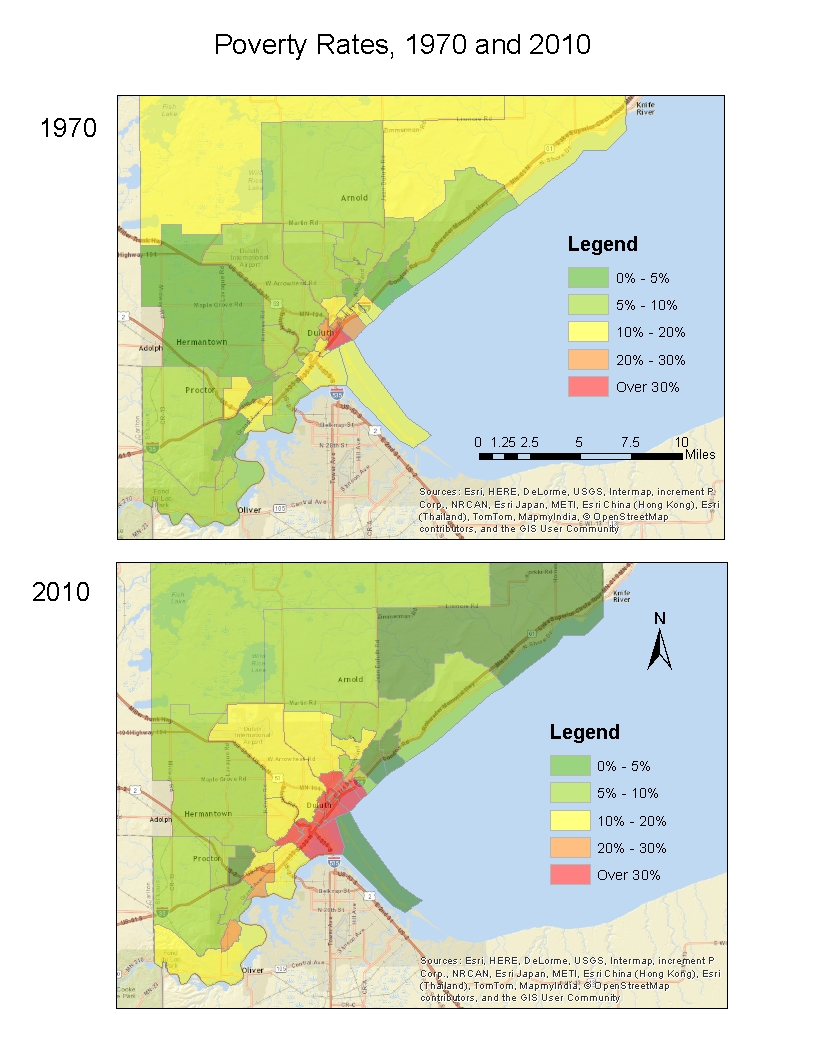
Central Duluth has been slowly hollowed out over the past forty years. It was at the bottom to begin with, but its poverty rate makes for a perfect scissors graph (to borrow a phrase from Robert Putnam), in which the plight of the poor gets steadily worse while the rich hold steady or do better. Duluth is often defined by its east-west gap, but its most glaring divide lies somewhere in the high teen Avenues East. The census tract with the highest poverty rate (Endion) borders the one with per capita income levels that would put it in the company of Edina and Minnetonka on a statewide list (East End).

DuluthPovByArea

A chunk of the Endion, East Hillside, and Lower Chester poverty is probably college-related, but those poverty rates glide easily into the neighborhoods in the center of the city, which are undeniably Duluth’s poorest. There’s really no way to spin the statistics for all of these neighborhoods in the center of the city; most were fairly poor in 1970, and are now very poor and continuing to shed population. The one obvious exception is Park Point, whose beachfront lots have only grown more attractive to developers; Observation Hill has also rebounded enough to escape the “lowest” lists, most likely thanks to those fancier houses up near the ridgeline. One other eye-popping statistic, Downtown’s increase in population, dates to the first decade of the study, meaning the likely cause was the construction of high-rises like the Gateway and Lenox towers. It’s been mostly flat ever since.

DuluthPov

A tour of the Hillside today will reveal a few changes, from a few new apartments and urban gardens to some serious reclamation efforts of historic buildings, both by the city (as on downtown East Superior Street) and by intrepid owners. I don’t think it’s coincidental that some of Duluth’s most committed public servants, including current mayor Don Ness and his likely successor, Emily Larson, are Hillsiders: these people see several different paths for Duluth around them every day, and are committed to making things right. Things seem to be moving in the center now, with some new low-income housing that will do nothing to disperse poverty, but should at least improve living conditions. Downtowns around the United States are largely on the rebound, and Duluth may someday follow suit. Still, it won’t happen overnight.

The West Side: Post-Industrial Variety

There are a lot of things going on in the data out west, and it’s hard to find an overarching story. The most basic rule to the west side is that wealth gathers on top of the hill: Piedmont ranks right up there with the middle-class east side neighborhoods in 1970 and isn’t far behind in 2010, Cody and the area just above Denfeld does alright for itself, and Bayview Heights saw considerable new development, flipping from the high-poverty list in 1970 to the low-poverty list in 2010. (There’s a decent case for lumping Bayview in with the exurbs, given its greater proximity to Proctor than any part of Duluth.) Lincoln Park mostly behaves like the center of the city, though its poverty has crept outward over time. Denfeld/Oneota, Spirit Valley, Irving, and Morgan Park are on the lower end of things, though not on the level of the center city. Smithville/Riverside/Norton Park, able to reap the benefits of the riverfront without any industry in the area, is somewhat better off, while Gary New Duluth/Fon-du-Lac has grown some, too. The city’s west side redevelopment plan calls for taking advantage of the river, but the neighborhoods with good river access are already doing relatively well compared to the rest of the west side. (I’m not saying there’s an easy policy solution to that, but it’s worth noting.)

DuluthIPC

The most telling west side statistics may come in a comparison of poverty rates across time. In 1970, poverty was pretty evenly distributed on the east and west sides; two of the four lowest-poverty tracts were out west, and with a couple of exceptions, they are low across the board. The west side wasn’t rich in 1970, but most everyone had access to decent-paying jobs and could stay out of poverty. In 2010, the script has flipped: only a handful of holdouts still have those low poverty rates. While not as extreme as the center, the gaps persist and grow.

DuluthPCIByArea

Things came apart with the collapse of the manufacturing base in the 1970s and 1980s. A comparison of per capita incomes over time shows fairly steady lines for most of the regions (and the nation as a whole), but the west side takes a sudden detour downhill in the 70s and especially the 80s, the decade in which the U.S. Steel mill in Morgan Park shut down. The west side has bounced back some since, but on the whole, it subtle scissors graphs show a trajectory closer to that of the poverty-stricken center than the steady east or the rising exurbs. This is the demise of blue-collar America in one simple graph.

The Rise of the Hinterlands

A glance at Duluth’s population stats would suggest the city has had flat growth for a long time now, but in reality, the region has been growing since the population bottomed out in 1990. Some growth has happened in areas up “Over the Hill,” but most of the growth has happened beyond the city limits, in a number of townships and Duluth’s two incorporated neighbors, Hermantown and Proctor. Excepting central Proctor and the part of Hermantown that bleeds into Miller Hill Mall, these areas are very sparsely populated; this is why I’ve called them “exurbs” rather than “suburbs.”

DuluthPopByArea

In 1970, these exurban areas had low poverty rates, but also low income rates; they were mostly basic rural areas where not much was happening. That means they’ve had plenty of room to go up, and have indeed dominated the lists of greatest ‘climbers’ ever since, both in population and income. Proctor and Midway Township have had modest population losses since 1970, and Rice Lake Township, which was already somewhat built up, has only grown slightly. Otherwise, these areas have all grown by 20 percent or more, and this growth has been accompanied by concurrent gains in wealth. (The only exception to that is the sprawling Kenwood census tract, which has the college population to contend with.) Especially impressive is the strong rise in income between 2000 and 2010, despite the effects of the recession. (The Duluth area as a whole actually held up quite well through the recession, as the center and west declined less than the national average and the east stayed even.) While only a few of them have cracked the “highest income per capita” list, they are on the way up, and poverty remains universally low. Duluth’s middle class, so hollowed out by the industrial decline, has been able to rebound somewhat in the exurbs, where land is cheap and taxes tend to be lower.

So long as the regional economy grows, this trend should carry on. There’s still plenty of space out there, with the caveat that much of its allure stems from its rural character, and that could change as it gets built up. Poverty has made its move toward the inner suburbs in many larger cities, so it will be interesting to see if Duluth follows suit at all; Duluth doesn’t really have inner-ring suburbs, as it had stopped growing at the time most of those arose nationally. That may actually wind up being an asset, as neighborhoods with uniform housing stocks all decay at the same rate, and many Duluth neighborhoods (probably by accident) do a decent job of avoiding that. And while the exurbs have nearly closed the gap in income with the east side, I also suspect that may level off at some point; it’s not as if Duluth has a booming class of nouveau riche, and the pace of development isn’t enough to justify an explosion of McMansions that could topple Congdon from the top of the income list anytime soon.

ShutUpProctor

Thanks a lot, Proctor.

Duluth coexists awkwardly with its exurbs. Township members have forcefully rebuffed occasional attempts to annex territory, and the city has been largely inelastic over the past century. Predictably, township residents have little interest in paying taxes to prop up Duluth’s underclass, and predictably, Duluth points out how much these townships enjoy jobs, shopping, and cultural opportunities without paying to support them. It’s an endless cycle that has been played out in countless cities, though the state of the squabble is usually a good indicator of the economic health of the metro area. When the area is growing, everyone does better, and growth in one area need not come at the expense of another; when things are more stagnant, one’s neighbors become the easy targets for blame. During the worst of the downturn in the 1980s, the exurban areas lost population, just like the rest of the city. Exurban growth is now reality, but stands to gain even more if the more downtrodden parts of Duluth can get back on their feet. It is not a zero-sum game.

Conclusions

Not much here is wildly surprising to anyone who’s paid attention to these things around Duluth, but the numbers and trends throw things into sharp relief. It also fits pretty cleanly with the dominant narrative of American cities since 1970: widening gaps, the isolation of the super-wealthy, the hollowing out of the center, the loss of blue-collar jobs, the rise of the exurbs, and a new creative class. Duluth fits the general mold and that is unlikely to change, though it will be interesting to see if some of the Don Ness Era innovations can push Duluth to the vanguard of the changes instead of trailing along behind the rest of the country. The City of Eternal Air Conditioning is beyond the point where it can just ape the narrative of other mid-sized cities on the Great Lakes. It has to write its own.

See Part II (Tables and Methodology) here.

On Bad Architecture

A wise professor once told me to never trust architects. He was only half-joking. Architects do good work, of course; they’re visionaries who manage to translate vague ideas into the solid, real buildings that we use every day. I’ve met, and even studied under, some brilliant ones. (“Some of my best friends are architects!”) That said, the downsides of the profession are all too obvious. Studying architecture gives some people a certain sense of power and superiority, an inflated belief in the ability of buildings to change the world of people. They become religious crusaders for principles of design or exemplify some of the worst traits of those solipsistic modern artists for whom self-expression is the only thing on earth that matters. Seven attempts to defend awful architecture in a recent New York Times magazine piece show just how obnoxious they can be.

Alright, alright, they’re not all bad. The most compelling of the seven is the response to the Tour Montparnasse: yes, it is a bad design, but it was also the only hope for keeping central Paris from becoming anything but a living museum. Haussmann’s city, all uniformly dated and with little variety in the housing stock, does not have the density necessary to make it affordable. The middle classes and poor have been priced out of the city center, leaving it as a playground for the rich and a realm for tourists to wander, but otherwise dead. The reviewer of the Empire State Plaza also has some decent ideas for doing something with an otherwise awful space. Beyond that, sadly, no one really takes a human element into account beyond a facile ideological treatment. It also shows the importance of getting the design right, or else the hope of the affordable city will be dead upon arrival. Washington D.C., take note.

But then we come to things like the defense of the Centre Pompidou, which more or less boils down to saying that, for something to be “democratic,” it must be “shocking”, which is a code word for “ugly.” We’ve had a stable democracy for a few centuries now, so why on earth should a “democratic” building be shocking? Democracy implies public participation, not some conceited architect marching in and imposing a design on the unsuspecting populace. The result is incoherent: it’s democratic but imposed, shocking in the name of a form of government that aims to make politics boring by channeling it through institutions and equal rights. If this is the sort of architecture we must suffer if we want to be democratic, then long live the aristocracy. At least they have standards.

Wedging humans into soulless concrete silos or shocking them repeatedly, it turns out, does not make them very happy. Most people have little appreciation for the vagaries of modern design unless they have practical implications, but unlike modern art, which can be consigned to forgotten corners of museums when it is bad, bad architecture gets imposed on everyone. And yet architects continue to spew vomit about the importance of ‘liberation’ in their creations, as if this were the highest ideal. I don’t want a building I am in to liberate me; in fact, I’d rather it keep me safe from liberation. And when buildings are designed to “reject” neighborhoods, no one should be surprised when the neighborhoods reject them in turn. People and places all must weave their way into an urban fabric, and this requires subtlety and creativity, not tiresome double-speak employing a bevy of buzzwords to make an idea sound like it’s on some cutting edge.

This is where architects will claim to be misunderstood, and nod toward the ideals they aim to uphold. See the defense of the Vele di Scampia and the utopian socialist-modernist thinking behind it, in which Ada Tolla informs us that the architecture is actually brilliant, but it was everything that came afterward that turned it into the setting for the Neapolitan version of “The Wire.” This is all rather fitting, since it sounds like the argument made by many socialists after their project went all wrong: the idea was perfect, but all those stupid humans being human got in the way. Realities of human nature have never been a very important point for idealists of any stripe. If we’re sympathetic, we might be able to view Le Vele as a cute experiment and lament the poor implementation, but it was all in vain if no one bothered to learn anything from its categorical failure.

Tolla at least recognizes this, and is right to note that simple demolition isn’t necessarily the answer. My old professor learned this first hand, as he once played a role in a Minneapolis scheme to demolish crowded, drab public housing units. The architects came in touting the transformative power of New Urbanism and built a bunch of pretty houses that improved no one’s lives and left the city with far fewer housing units than they had to begin with. The designs have changed, but the rhetoric remains the same, as does the end result. Witness a map of how poverty has bloomed outward in Chicago since the destruction of its hellish projects, or how the misery of St. Louis’s Pruitt-Igoe has been replaced by the sad drama of Ferguson. The buildings may have exacerbated problems, but they were never the root cause, and anyone who treats them as such is in for a rude surprise.

Throwing aside the ideology, there is one other claim that appears several times in the Times piece: hey, at least it’s big and impressive! (One wonders if architects need a certain blue pill in their lives.) This isn’t to say monumentality and austerity can’t be impressive in a modern building. Consider the austerity of the Vietnam Memorial, or perhaps the empty room overlooking Boston Harbor at the end of the John F. Kennedy presidential library; the massive new Freedom Tower, a symbol of defiance, also comes to mind. What all those spaces share, however, is a sense of history; the monumentality and austerity conveys something specific to that particular space, and it is usually a sense of loss. Something haunts these spaces, and fills the emptiness with meaning. Without that meaning, monumental architecture is bleak and sterile. The defense of the Berlin Airport makes some sense in this context, whereas the Empire State Plaza recognizes no great part of history other than Nelson Rockefeller’s ego.

This isn’t a rejection of grand or monumental things. Grandness inspires and serves as a rallying point for cities and nations. But it should be worthy of the name: if everything aspires to grandeur, does anything at all manage to be grand? Aspiring to grandeur creates a natural hierarchy of places, and the ones that claim the top spot must truly be special. Make no mistake, we need these places to orient ourselves, and they can and should inspire. Of late, some revisionist historians have started to look back on Robert Moses with some sympathy: sure, he steamrolled over a ton of people as he ran the show in mid-century New York City, but at least big things actually got done. Certain problems require big thinking, particularly in third-world countries where population growth is so explosive that a lot of people need housing very quickly.

Grandeur and monumentalism don’t imply a lack of interest in detail and intricacy. Consider the precision of the beauty of European cathedrals or Islamic mosques, full of niches or corners where every little detail is ornamented in some way. Contemporary architects such as César Pelli usually mind the details and make sure their buildings’ nods to the past aren’t stupid artistic abstractions. Their work shows genuine care and attention, and they go beyond simply slapping up blank walls that try to speak for themselves. Walls need to have seen things to be able to speak, and no architect can manufacture history or community.

Those must emerge themselves, often slowly, and over time. Frustrating, perhaps, to those whose egos compel them to go forth and shock the world. And we urban planners probably shouldn’t throw stones, considering our own checkered past. No one has all the answers. This calls for debate, not ideology, and a careful understanding: who are we building this for, and why are we building it anyway? Anyone who aspires to build things for other people ought to have an answer.