Road Trip Journal I: Minneapolis to Salt Lake City

(Preview post)

Day One: The All-American Road

My friend and I are on our way, ready to discover what we can of a country across two weeks. The trip begins with a gentle wind down the Minnesota River, through small towns whose names I know but which I’ve never seen. For the most part, they’re well-appointed, and we don’t pause to ponder them. We’ve seen a few Minnesota farms in our lives, and we’ll see more again before this trip is up. We plow on beneath a low sky, pick up I-90 in Worthington, and have lunch alongside a cornfield just past Sioux Falls.

In South Dakota, the twin ribbons of road undulate over rolling hills, slowly but steadily rising upward. One of the few pauses comes at the Missouri River, here wide enough to be a lake, and with an unnatural, greenish tinge. In time, the Badlands appear, the green grass falling away in cliffs and along buttes with such precision that it looks like they’ve been mined out of the plain. Ten thousand signs alert us to the presence of the Corn Palace and Wall Drug (we skip both), but just one sign gives any indication of the Pine Ridge reservation, which we skirt past. Just beyond these kitschy frontier towns lies one of the most destitute corners of America, a desolate and poverty-stricken zone where the future is as bleak as in any inner city. Drive down this highway, however, and you’d probably never know. Aircraft and helicopters buzz over us at the Ellsworth Air Force Base just outside of Rapid City, and after a bypass around the largest outpost in western South Dakota, we come to the Black Hills.

We climb into the hills, made dark by their scores of ponderosa pines. My first recollection, curiously enough, is of the Mexican highlands: dry pine forests, crowded winding roads, and an endless string of attempts at tourist attractions the entire way. These let up some when we enter the national forest, but there’s still a steady stream of them intermingled with signs warning us of bighorn sheep. Many of the attractions seem frozen in a different time to a couple of urbane city kids, but the culture that produced these roadside curiosities is alive and well beyond our limited cosmopolitan world. We eat it all up, too.

DSCF0012

We pitch our tent a short ways north of the main highway. Home for the night is the Sheridan Lake South National Forest Campground, just north of Hill City. It sits among the pines along a small lake, and its whispering breezes evoke the Boundary Waters for us Minnesotans, though the RVs just down the way are a new wrinkle. We set up our tent and head into Hill City for dinner. We pass a series of wineries; we’ll have time for wine later. Instead, we end up on its Old West main drag, and we dodge motorcycles (Sturgis is just north of here) for dinner at the Bumpin’ Buffalo, which has a fairly empty deck with a view of the town. Further underscoring the Mexican instinct, we’re serenaded by the cowboys singing about cerveza in mediocre Spanish at the Mangy Moose across the way. Satisfied, it’s on to Mount Rushmore.

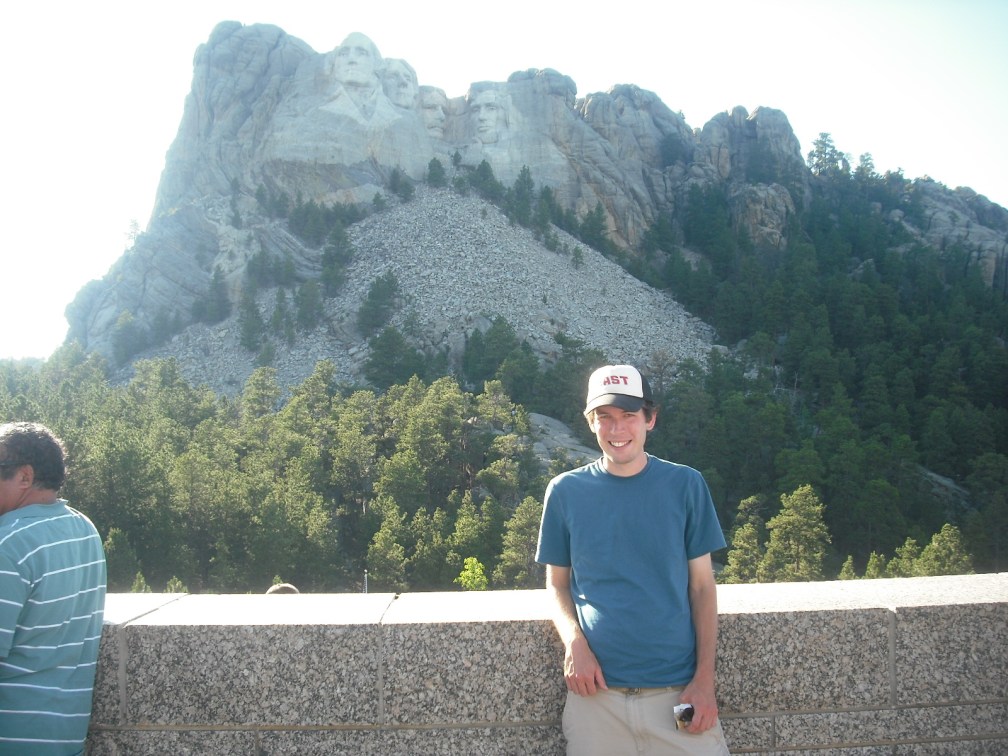
We come at the mountain from the south, and get a profile view of George Washington before coming around to fork over a heap of cash to the National Park Service for the privilege to park. We head up an avenue of flags and concrete arches to behold the quartet of presidents, all gazing over the valley below. Rushmore is so legendary that it seems almost small to me upon first sight, but even from our considerable distance, it’s a marvel of sculpture and ambition. I now appreciate its remoteness, and what Gutzon Borglum and company went through to sculpt this into being. The site museum adds some background, and the short walk back out passes some six thousand or so boy scouts. Bruce Springsteen serenades us as we drive away.
DSCF0017

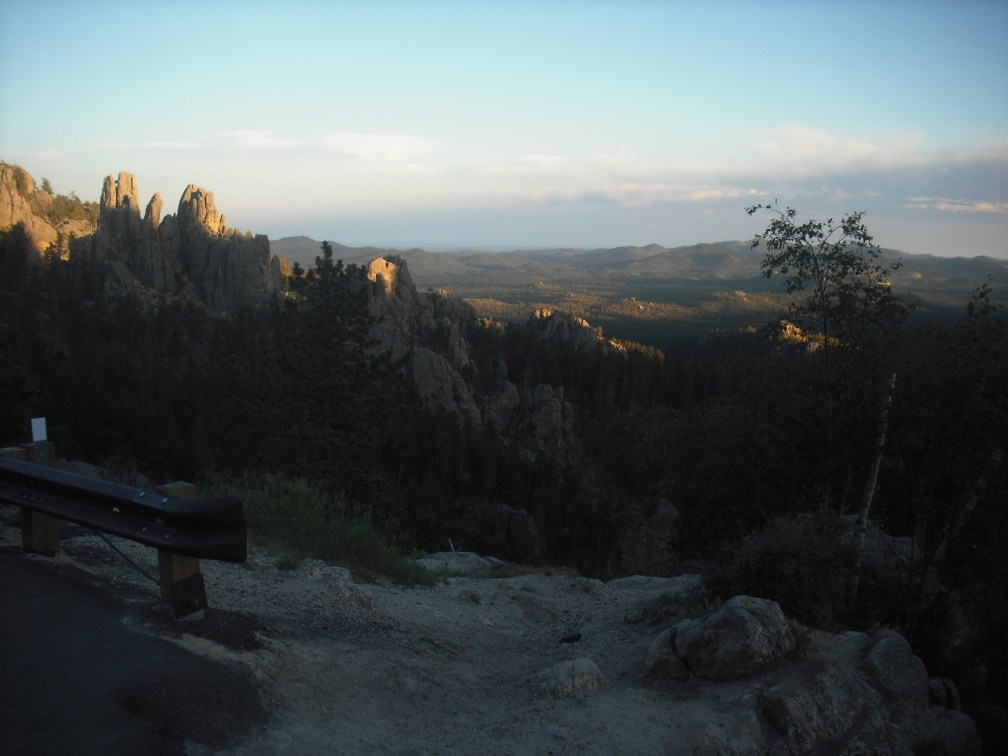
We swing south through the Hills toward the Crazy Horse memorial, still very much a work in progress; at $11 a person, we sheepishly snap a photo from a distance and instead drive on for a loop around Custer State Park. We work our way back up the Needles Highway, a narrow, sometimes precarious stretch of road that winds endlessly through the hills at a painstaking pace. Before long, however, we’re rewarded: the road climbs up into a forest of stone towers, culminating in the Cathedral Spires that support the ceiling of these hills. The view extends all the way back to the plain from which we came, the Badlands now illuminated in setting sun. The golden glow catches the top of the spires, and after every turn we’re compelled to stop again and jump out for another look. We inch through a few one-way tunnels, one of which is blocked up by some sheep; a whole herd of them dances down the mountainside, and we get a moment to admire their scraggly, shedding winter coats.
DSCF0038

It’s nearly dark by the time we’re back in camp, and we linger down by the water for a little while before we crash. The stars, no doubt, were pristine, but in midsummer the sunlight lingers until late, and between our exhaustion and a rising moon, we have no real chance to gaze upward. Day one is done, a complete rush into a West that, while still vast an empty and hauntingly beautiful, is no frontier. It’s now an attraction, with Custer and Crazy Horse, those best of old friends, together on road signs, directing us onward to the next attraction. The Black Hills are the ultimate road trip destination for a car-loving country, distinctly American in so many ways. Yes, it has a side to it that produces t-shirts of Sarah Palin and Donald Trump together on a Harley, but it also brings forth a simpler era and nostalgia for a family on the road together, off to see beauty and building some memory they’ll always have. A fitting start to our journey.

Day Two: Dispatch from Deseret

We’re on the road early again the next morning, passing back through the Black Hills before coming into the high plains of Wyoming. The Equality State (so called for its early provision of women’s suffrage) is, for much of its expanse, a vast tract of nothingness, and we spend the majority of our day traversing it. It starts out as high plains, with ranches here and there. We cruise down the desolate federal highways, the towns rarely more than highway junctions. It’s nothing but space, and I have newfound respect for the old natives who called it home and the settlers who crossed it without asphalt and air conditioning.

DSCF0059

The road southwest from Casper offers a little more scenery. State Highway 220 travels down a valley with the North Platte River at its start, weaving along the longest expanse of water we’ve seen since the Missouri. We have lunch at Independence Rock, the halfway point on the Oregon Trail, still covered in pioneer graffiti and evoking memories of cholera outbreaks in the old computer game. In time, we come to I-80, which for a stretch is even duller: gone are the layer cakes of colored rock, and we’re left with steady marches of empty green hills. A sudden squall beyond the Red Desert slows the endless convoys of trucks, and the downpour washes away the graveyard of bug guts on our windshield. We pass a few more vaguely familiar Oregon Trail locales: the Green River, Fort Bridger. To the south, the Uintas rise, their whitish peaks perhaps still bearing some snow. The land grows slowly greener, and we understand why the Mormons, in exodus on this very route a century and a half before, thought they might finally come to a promised land.

The engine protests some as we push up and down passes through the Wastach Mountains and snake past the ski slopes of Park City. After a twenty-mile descent, we’re in Salt Lake, our largest city since Minneapolis, suddenly teeming with late rush hour life. We check in at an Airbnb in the suburb of Bountiful, whose chief bounty is a neighboring oil refinery. Our host, a jovial Mormon ready with suggestions, tells us we can catch a Mormon Tabernacle Choir rehearsal in Temple Square. Intrigued, we head back into the city, though we’re distracted by the stunning state capitol first. Other capitols can match its size and grandeur, but few can equal its commanding position on a hill over the city, and its white-and-grey marble has a pristine quality absent from the sandier stone in the Midwest.

DSCF0099

We hike down the hill to Temple Square. It’s in the upper 90s, but dry enough that it feels nowhere near so hot. The Latter-Day Saints have built themselves a lush marvel of a plaza, and we slowly approach the temple along fountain-lined promenades, the archangel Moroni beckoning us in. Mormon elders are on hand to explain some history, and direct us to the concert hall, which is so overcrowded that a line has formed, and the coordination of the line leaves something to be desired. After a wait, we make it in and catch a few songs from the choir. They’re brilliant, as we’d expect, even amid the din of bored children and cell phones. When we emerge, the line for this mere rehearsal is wrapping around the square. Nonbelievers aren’t allowed inside the Mormon temples (of which there are just 50 or so worldwide), but a visitor’s center gives a few glimpses of the events inside. Famished, we leave the complex and past a statue of a perplexed Brigham Young gesturing toward the Zions Bank tower across the street.

DSCF0090

Salt Lake is built on the vast scale of cities of the West, with streets the width of eastern freeways and a rigid grid of numbered streets. Still, the space allows for innovation: there are bike lanes, a new light rail, and a fleet of pedicabs scurrying around downtown. It seems clean and orderly, as the LDS capital should be. Still, Salt Lake is surprisingly non-Mormon for Utah; many of its establishments could be anywhere, and we find a bustling brew pub to our liking for dinner. Day two closes with further examination of the Mormon faith, and a fair amount of respect on my part: they’ve built a remarkably strong institution that supports a distinctive way of life, but yet their integration with everyone around them remains impressive. Others who are in this world but aspire to ends beyond it have something to learn from the Latter-Day Saints, whatever we may think of their theology and nametags.

For now, though, it’s far too late already, and the wastes of Nevada await tomorrow. Onward to San Francisco.

(Part II)

West Coast Road Trip 2016

Tomorrow morning, a friend and I are setting out on a road trip west. Now that I’m out of school and will be settling into a life of 9-to-5 in short order, this is the time to go. As much as I love travel, timing and student budgets have tended to leave me with nothing but short meanders through convenient woods unless I’m traveling on business or on someone else’s dime. In reality, this is the first trip I’ve ever taken out of Minnesota that is spontaneous travel for travel’s sake, and not at least vaguely tied to family or school or some volunteer activity. I’ve had some great journeys of those varieties, but at times we need things that are more profoundly our own.

WestCoastTrip

This isn’t to say it’s unstructured travel; that’s not really how I operate. I have each day’s driving itinerary carefully scheduled out, and have spent the past week and a half obsessing over plans. But there’s room for some bounded spontaneity within it, and while I’m a rigid scheduler, I’m also ready to take any shake-ups in good humor. My favorite part about the trip we’ve designed is the sheer variety: there will be nights with relatives and old friends, and nights alone in cities I do not know; there will be nights in some of America’s great cities, and nights in some of the less tamed expanses of this massive country. Some nights I’ll stay in comfortable beds; some nights I’ll be in a tent. I’ll cross plains and climb mountains, traverse deserts and come to oceans. There will be some fine dining with old friends and a day in wine country, and there will be a fair number of bland meals of car food.

The West is an ongoing source of allure for so many Americans, and I’m no exception. The open plains and towering peaks just stir something in that frontier mentality, and remind us of how incomplete this great American project to tame this giant nation is. The West offers up incredible vastness and variety, both in people and in land. The promise of San Francisco the Pacific Northwest is especially alluring after three long days of driving. I’ve traveled west just once before, on a hilariously tumultuous Amtrak journey back when I was fourteen that remains vivid to this day. Even as I strike out on new roads, the cycle continues: the son of the friends who hosted my mother and me in Utah on that trip will host me in Portland this coming week.

The travel clichés will come easily. This won’t quite be anything on the scale of On the Road or Y tu mama también, but it’s certainly a much-needed stab outward. I’m prone to cynicism about journeys of intentional self-discovery—I think the things that tend to define us usually are in reaction to things that happen to us, not in things we self-consciously seek out—so I won’t force that angle, but would hardly be disappointed to find something. As the scattered list of expectations shows, there’s no unifying theme, and while I may be able to catch snapshots of America (or its West, at the very least), I hardly aspire to anything so grandiose. It’s just an adventure, a chance to live fully, and perhaps a chance to put the rat race of my past two years, and whatever is to come, in perspective.

I’ll try to write about this trip every step of the way, though activities, exhaustion, and internet access will dictate whether this means live-blogging or merely the occasional check-in and a lot of notes that appear here when it’s all over. Even with two drivers, there won’t be a whole lot of time to linger anywhere. That, I suppose, is what the writing is for. Feel free to travel along with me.

(Part I)

Driftless

This past weekend I made that road trip again, this time only as far as an idyllic little town west of Madison. It is a lush, green country draped about the steady marches of sandstone hills, untouched by the glaciers that leveled the rest of the upper Midwest. It feels old; it is old, and though change does come, it comes at its own pace. In a few places the virgin oak savanna endures, though nowadays it is mostly a relic of the past, still tucked away off a winding ribbon of road. The farms hidden away in the valleys carry on in a peaceful slumber, and the Main Streets are more than some talking point repeated by a politician in desperate search of folksy cred.

Of course, I can’t help but see it through colored glasses. So much of my story starts in and around Madison. That story isn’t always a happy one, and it feels incomplete in several ways as well, a sense recently reinforced by a second rejection of Badger red and white.  I probably won’t ever share my parents’ alma mater, with money and friends winning out over nostalgia. And yet somehow my Wisconsin roots still somehow tie me to the land there in a way no other place can. One side of my family comes from a farm I was never a part of and can’t really go back to; the other owes its considerable strength to its people, not to any real place. I may seem a Duluthian to the core now, but until fairly recently I was torn, never quite sure where I was from. (More on that in a couple of days.) Memory here runs deep, even as new developments go up and the people move on. It is still that enchanted garden of childhood, where all of nature has a soul and wonder still seems commonplace, distant enough that each visit is a novelty, yet close enough that it isn’t too hard to remember the details.

There are plenty of tangible ties that bind. There’s the quintessential Madison: Farmer’s Market on Capitol Square, or a walk up State Street for a bit of summer bliss on Memorial Union Terrace. The thunderclouds roll in and out on humid summer days, but somehow, the weather is always perfect in the center of the city, and the lakes offer some respite from the sweltering heat. A bratwurst off the grill, a bag of cheese curds, a beer, fruits and vegetables reminding that their ilk are not all created equal: some taste so much crisper, so much more real. A curious little observation from the latest trip: even the parking ramps have their own smell. And, of course, the endless people-watching in this city full of curiosities.

Too much of that? Head west. The place I know best is Mount Horeb, a quaint town of Norwegian and troll kitsch that somehow still manages to welcome in a world-weary cynic, both in its small-town feel and its easy access to Madison. A town where one can wander up from a worn but cozy motel to a coffee shop or a bar named The Grumpy Troll. But there is so much more out here. Glacial Devil’s lake, otherworldly Parfrey’s Glen, parks atop the highest bluffs and caves beneath them, the Wisconsin River. New Glarus; Mineral Point. A hill or a stream or a stand of trees tucked away in some recess of childhood memory, a back corner that barely seems like the same life. Bob Uecker on the radio, the bugs splattering all over the windshield, and a few miles stuck behind a tractor or some other slow-moving piece of farm machinery. American Pastorale.

This time around, it’s a high school graduation, yet another event that pulls me back into youth. The moment comes. A moment where the mind, perhaps aided by the sticky heat and a bit of beer, imagines a world that could have been. In the past it’s been a source of anguish, but no more: now it simply is. Reality blurs into something that defies everything we’ve come to know, and even if it is only a fleeting instant, it endures, lingering without overstaying its welcome. An anchor, a reminder that we humans, for all our dreams and aspirations, are always part of a story whose authorship we can’t quite control. Roots may bind, but they nourish in a way nothing else can. We may be stuck with them, but we do have some measure of control over how we interpret that list of facts of who we are and where we come from. Finally, I’ve managed it, even as it  all fades further into the summer haze.

The world of enchantment may be gone now; it may never even have been. Just something that only exists in a nostalgic corner of the mind. Chasing those waves for their own sake will only bring about frustration. But they are no lie, and when they do come along, spontaneously, they are to be cherished; affirmations that, whatever it is we’re doing here, it’s a delight. And then, recharged, we can cycle back out for a night of revelry, too deep in to even be conscious of that reverie, the disparate strands of our complicated selves becoming one. As it should be.

(Driftless II)

Forward, and into the Past

It is just over 450 miles from Duluth, Minnesota to the western suburbs of Chicago. Growing up in the former and but coming from a family built around the latter, I cannot count how many times I’ve made that drive. It is not a particularly thrilling ribbon of road; while the Northwoods of northern Wisconsin and the rolling hills around Madison are pleasant, they don’t stand out in any obvious way, and as with most any freeway in this country, there are long stretches of blah suburban sprawl. But it’s a drive I’ve made so many times that even the most indistinct farmhouses and office buildings lining the road take on a certain familiarity. With familiarity comes comfort, comfort lends itself to repetition, and before long, improbable traditions are born.

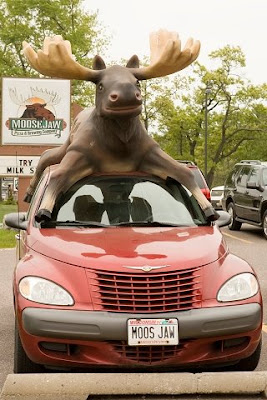
There’s the cheese barn in Tomah, where we always stop for a hunk of 5-year cheddar; there’s the rest area near Black River Falls with a hiking trail up a convenient bluff—the perfect way to get one’s legs moving after several hours in the car. Sadly, the Rocky Rococo’s Pizza Parlor is no longer in Wisconsin Dells; it wasn’t particularly remarkable pizza, but we always stopped there anyway, and now have to improvise, either by heading on to another Rocky’s in Madison or going to the sit-down pizza place up the road with the fantastic giant moose atop their delivery cars. (The Dells are still an attraction in themselves, being one of the most impressive monuments to American consumer kitsch this side of Vegas.) There’s the ABS Beef billboard with its witty slogans, the offbeat coffee shop in Eau Claire, and the Illinois border, always a welcome sight despite the looming tolls and inevitable construction clogging up the last hour or two of the drive.

In southern Wisconsin, there are places that have a deeper place in my psyche than merely passing amusement. There is Madison, where my parents met and went to school; even though I’ve never lived there, it still brings out all the nostalgia of a former home. No summer is quite complete without an afternoon basking in the sun on the Memorial Union Terrace, or wandering up State Street in search of the most obscure possible culinary experience. (“Nah, we went to one of the Afghan places last summer; let’s try the Nepali restaurant this time.”) I see a lot of Madison in myself: a mix of Midwestern homeliness and university life (including both its intellectual and, um, “less refined” delights), interested in both the wider world and every move of the local sports teams. (I adopt the Badgers for sports in which my alma mater doesn’t compete.) It all adds up to one of the most vibrant small cities this country can offer, and on this road trip, it’s always a reassuring sign to see the capitol dome rising above the skyline.

After filling my granola quota in Madison, a short drive south takes me past the place where our old Honda once broke down and on to Edgerton. Edgerton is a town of some 5,000 residents, and in many ways couldn’t be further from the cosmopolitan pretension of Madison. To the passerby, it’s no different from any of the other towns lining the freeway, and the one or two facts one might learn of it—home to the world’s largest Culver’s restaurant! home of an annual “Tobacco Days” festival!—hardly inspire the casual driver. Further digging might reveal some things that might intrigue a few people: say, the home of children’s author Sterling North, or perhaps the intriguing political dynamics of a town halfway between lefty Madison and its industrial southern neighbor, Janesville—the hometown of Congressman Paul Ryan. Still, Edgerton seems exactly the sort of town people imagine when they hear the words “flyover country.”

But Edgerton will always be more than that: it was where my first memories were formed. I wasn’t born there, and it proved a fairly brief stop, convenient for its location between my mother’s graduate program in Madison and my father’s work in another Wisconsin town. I don’t know anyone who lives there anymore, and the memories are so distant that I only barely recognize the landmarks. What remains is a profound sense of rightness, one that comes rushing back when we make a pit stop at the old gas station, swing past the handful of places I remember: the house with the little creek in the back yard, a land I claimed as my kingdom; the school where I tormented my kindergarten teacher by making her look up the names of bizarre dinosaurs while other, more sensible children picked normal spelling words; the park with the pool whose water slide I was never quite tall enough to use; the library with its card catalogues; the daycare where I’d sit in the kitchen on a cot with pile of books during naptime because I couldn’t sleep.

On my most recent drive along this route, down from Duluth to Chicago with my mother to visit her mother on Mother’s Day, we listened to a book on disc, as we often do on these road trips. Our selection this time was Wallace Stegner’s Angle of Repose. It was an ideal book for this drive: a story of pioneers that takes its time, buried in so much rich detail that one can zone out along the road for a spell without missing much, but also drift back in to find a sudden gem of brilliance. It is the story of a retired history professor who, at an advanced age, finds himself divorced and unable to relate to his own son, alienated from the modern world he lives in. Lost in the present, he returns to the past, and sets out to write a fictionalized family history, following his grandparents across the American West. It’s a very long book, so we only made it halfway through, but the incisive opening passages were all I really needed to set my mind thinking about the past.

Perhaps Edgerton is the reason why, despite a lifelong fascination with the countries whose cuisine one finds lining State Street, I am still most at home in Middle America. Perhaps it is why I can take these apparently plain little towns and see not a cultural waste, but a diversity just as rich as that of any other place, all hidden in the details and waiting to be discovered. It is almost certainly why my own lurching attempts to write fiction always come back to places not so very different from Edgerton.

I try to be suspicious of nostalgia. It can lie, make us believe we should go back to a past whose faults have faded from memory, leaving only a false, pleasant haze. But we also shouldn’t dismiss it as irrational; instead, we need to reflect on it over time, recognize that it ties us to things that are part of who we are, and things that are worth carrying forward. There is value in any history if we read it carefully, and that is exactly what that drive across Wisconsin invites, no matter how distant my life may wander from it.