The Story of Duluth in Data, 1970-2010

How do we tell the story of a city? The most compelling way probably involves walking across it, listening to stories and using one’s eyes, letting the stories tell themselves. I’ve done that for Duluth before, and historians more learned (and aged) than I am could do a much better job of reaching back into history to create something far better than a simple blog post. No one can really claim expertise without truly getting lost in the woods—in Duluth’s case, quite literally.

And then there’s data. It has its limits. It’s been overhyped in an era when reams of it are available with a few easy clicks. Too often, it’s taken as destiny, its sweeping trends that elide the human dramas playing out every day, across the years and in ever little corner apartment or dead-end street on the hill. But it also takes all of those stories and boils them down into something we can see clearly, and allows us to better understand the broader forces that catalyze events in those lives. It lets us fly above the woods for a bit and see it all before coming back down to earth.

This post uses U.S. census data since to tell the story of Duluth since 1970. I use tract-level data, which usually lines up roughly with neighborhood boundaries. The official map for 2010 is here. I also include the suburbs and outlying townships in St. Louis County; these are an essential part of Duluth’s urban evolution, and using longstanding city boundaries makes for an unhelpful cut-off for a dynamic process. (Someday, I might throw Superior and eastern Carlton County into the hopper, but this will do for now.) I won’t bore casual readers with the methodology notes, but if you want to know how I made these categories, there’s a section on this in the follow-up to this post, which also includes a bunch of supplemental tables.

Actual billboard from Duluth, 1980s. Duluth News Tribune.

Actual billboard from Duluth, 1980s. Duluth News Tribune.

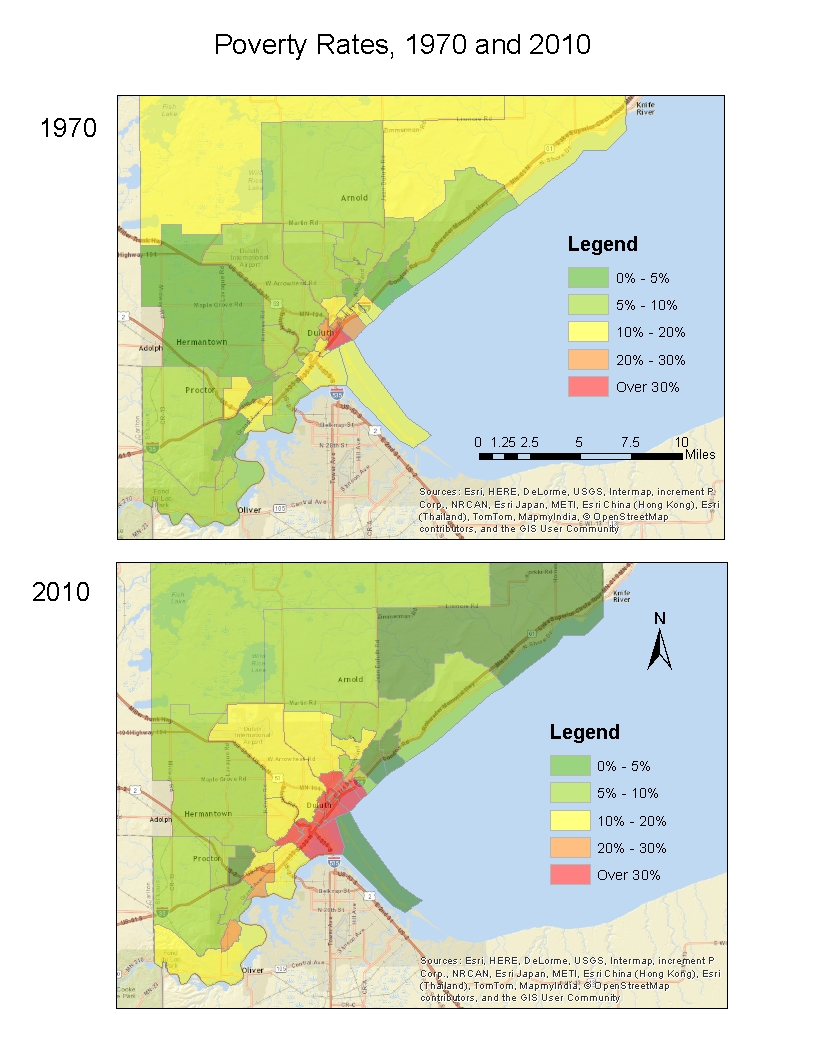
This forty-year span was not kind to Duluth. The area of study clocked in 121,398 residents in 1970; just 20 years later, it was down to 108,024. Poverty climbed across the board. This is also only a snapshot: the decline really begins in 1960, which was the high-water mark for the city’s population. Most of the second half of the 20th century was a depressing downhill slide, and stagnation followed before things began to tick upward again. To dig into the details, however, I’ve divided the city into four separate areas that tell different stories about the city and its changes: the east side, the center city, the west side, and the exurban areas. Each one reveals something different afoot in Duluth’s neighborhoods.

DuluthRegions

Click any image to enlarge it.

After rock-bottom around 1990, though, things start to change. There’s stagnation in some places and resiliency in others; growing gaps in some areas, and dramatic rises elsewhere. Sure, the city’s population has barely budged, and the neighborhood descriptions a mid-90s real estate map I recently discovered—something a map-obsessed kid kept from his parents’ move to Duluth when he was in first grade—could have been written yesterday, and I doubt anyone would know the difference. Yet there are subtle changes here and there, and one has to look beyond the city limits to understand things, too.

A couple of quick notes before we tour Duluth: I’ve tried to name the neighborhoods as they line up with census tracts, but I had to get creative in a few places. Apologies for any grave sins on that front, and check out the map linked to above to see actual boundaries. I’ll also add the necessary warning for all 2010 census data: most of it was collected in 2009, in the depths of the Great Recession, and it therefore tends to make things look a bit worse financially than overall trends would suggest.

East Side Steadiness

Like all of Duluth proper, the east side lost population over the 40 years, but the rate was much slower than in the rest of the city. Population loss is no great surprise in built-up neighborhoods, especially as family sizes decrease. The poverty rate has also held pretty steady, and the few changes have more to do with college students moving in than economic decline. With occasional variation in the difference, incomes stay ahead of the national average. The old streetcar suburbs of Lakeside/Lester Park and Woodland are steady bastions of middle-to-upper-middle-class comfort—I was surprised to see “Lakeside” (roughly 40th to 50th Avenues East) was the lowest-poverty tract in the city. Congdon, meanwhile, remains Duluth’s realm of highly concentrated affluence; if it were its own municipality, it would rank 13th in the state in per capita income, right behind some of the small, opulent enclaves along Lake Minnetonka. One of the more interesting tracts is East End, the area below 4th Street between 20th and 26th Avenues East, which lost a lot of population, but also saw a decrease in poverty and had distinct rise in per capita income. Many of the people who remain are in its grand old houses, and the longstanding Congdon area prestige has withstood Duluth’s post-industrial phase.

CongdonsGonnaCongdon

Congdon, summarized in one image.

There were noticeable increases in poverty in Hunters Park/Morley Heights and especially Chester Park, though I’d hazard to guess that most of these are the product of growing numbers of college rentals in these areas. I included UMD proper in the east zone, so the school’s growth may help hide some population loss on the east side, though the wider impact of off-campus housing has clearly changed neighborhood dynamics in that area. And while the colleges may cause some decline in the neighborhoods that immediately border them, they more than make up for this by providing very stable, well-paying jobs, both for their employees and their graduates. Time will tell if new apartment developments in the area will stem the tide of converting single-family homes into rentals.

DuluthChgPop

The east side may no longer be the home of many captains of industry, but it has become the home of white-collar professionals, from teachers to doctors for the growing hospitals to the financial and government workers who run the city. Its income may flatline somewhat; there’s not a whole lot of space for development left, and barring aggressive redevelopment—of which there has been some—home values tend to decline with age. But the key anchors are all still there, most indicators are healthy, and there is little reason to expect any changes to this anytime soon. East will remain east.

The Center Collapses

Central Duluth has been slowly hollowed out over the past forty years. It was at the bottom to begin with, but its poverty rate makes for a perfect scissors graph (to borrow a phrase from Robert Putnam), in which the plight of the poor gets steadily worse while the rich hold steady or do better. Duluth is often defined by its east-west gap, but its most glaring divide lies somewhere in the high teen Avenues East. The census tract with the highest poverty rate (Endion) borders the one with per capita income levels that would put it in the company of Edina and Minnetonka on a statewide list (East End).

DuluthPovByArea

A chunk of the Endion, East Hillside, and Lower Chester poverty is probably college-related, but those poverty rates glide easily into the neighborhoods in the center of the city, which are undeniably Duluth’s poorest. There’s really no way to spin the statistics for all of these neighborhoods in the center of the city; most were fairly poor in 1970, and are now very poor and continuing to shed population. The one obvious exception is Park Point, whose beachfront lots have only grown more attractive to developers; Observation Hill has also rebounded enough to escape the “lowest” lists, most likely thanks to those fancier houses up near the ridgeline. One other eye-popping statistic, Downtown’s increase in population, dates to the first decade of the study, meaning the likely cause was the construction of high-rises like the Gateway and Lenox towers. It’s been mostly flat ever since.
DuluthPov

A tour of the Hillside today will reveal a few changes, from a few new apartments and urban gardens to some serious reclamation efforts of historic buildings, both by the city (as on downtown East Superior Street) and by intrepid owners. I don’t think it’s coincidental that some of Duluth’s most committed public servants, including current mayor Don Ness and his likely successor, Emily Larson, are Hillsiders: these people see several different paths for Duluth around them every day, and are committed to making things right. Things seem to be moving in the center now, with some new low-income housing that will do nothing to disperse poverty, but should at least improve living conditions. Downtowns around the United States are largely on the rebound, and Duluth may someday follow suit. Still, it won’t happen overnight.

The West Side: Post-Industrial Variety

There are a lot of things going on in the data out west, and it’s hard to find an overarching story. The most basic rule to the west side is that wealth gathers on top of the hill: Piedmont ranks right up there with the middle-class east side neighborhoods in 1970 and isn’t far behind in 2010, Cody and the area just above Denfeld does alright for itself, and Bayview Heights saw considerable new development, flipping from the high-poverty list in 1970 to the low-poverty list in 2010. (There’s a decent case for lumping Bayview in with the exurbs, given its greater proximity to Proctor than any part of Duluth.) Lincoln Park mostly behaves like the center of the city, though its poverty has crept outward over time. Denfeld/Oneota, Spirit Valley, Irving, and Morgan Park are on the lower end of things, though not on the level of the center city. Smithville/Riverside/Norton Park, able to reap the benefits of the riverfront without any industry in the area, is somewhat better off, while Gary New Duluth/Fon-du-Lac has grown some, too. The city’s west side redevelopment plan calls for taking advantage of the river, but the neighborhoods with good river access are already doing relatively well compared to the rest of the west side. (I’m not saying there’s an easy policy solution to that, but it’s worth noting.)

DuluthIPC

The most telling west side statistics may come in a comparison of poverty rates across time. In 1970, poverty was pretty evenly distributed on the east and west sides; two of the four lowest-poverty tracts were out west, and with a couple of exceptions, they are low across the board. The west side wasn’t rich in 1970, but most everyone had access to decent-paying jobs and could stay out of poverty. In 2010, the script has flipped: only a handful of holdouts still have those low poverty rates. While not as extreme as the center, the gaps persist and grow.

DuluthPCIByArea

Things came apart with the collapse of the manufacturing base in the 1970s and 1980s. A comparison of per capita incomes over time shows fairly steady lines for most of the regions (and the nation as a whole), but the west side takes a sudden detour downhill in the 70s and especially the 80s, the decade in which the U.S. Steel mill in Morgan Park shut down. The west side has bounced back some since, but on the whole, it subtle scissors graphs show a trajectory closer to that of the poverty-stricken center than the steady east or the rising exurbs. This is the demise of blue-collar America in one simple graph.

The Rise of the Hinterlands

A glance at Duluth’s population stats would suggest the city has had flat growth for a long time now, but in reality, the region has been growing since the population bottomed out in 1990. Some growth has happened in areas up “Over the Hill,” but most of the growth has happened beyond the city limits, in a number of townships and Duluth’s two incorporated neighbors, Hermantown and Proctor. Excepting central Proctor and the part of Hermantown that bleeds into Miller Hill Mall, these areas are very sparsely populated; this is why I’ve called them “exurbs” rather than “suburbs.”

DuluthPopByArea

In 1970, these exurban areas had low poverty rates, but also low income rates; they were mostly basic rural areas where not much was happening. That means they’ve had plenty of room to go up, and have indeed dominated the lists of greatest ‘climbers’ ever since, both in population and income. Proctor and Midway Township have had modest population losses since 1970, and Rice Lake Township, which was already somewhat built up, has only grown slightly. Otherwise, these areas have all grown by 20 percent or more, and this growth has been accompanied by concurrent gains in wealth. (The only exception to that is the sprawling Kenwood census tract, which has the college population to contend with.) Especially impressive is the strong rise in income between 2000 and 2010, despite the effects of the recession. (The Duluth area as a whole actually held up quite well through the recession, as the center and west declined less than the national average and the east stayed even.) While only a few of them have cracked the “highest income per capita” list, they are on the way up, and poverty remains universally low. Duluth’s middle class, so hollowed out by the industrial decline, has been able to rebound somewhat in the exurbs, where land is cheap and taxes tend to be lower.

So long as the regional economy grows, this trend should carry on. There’s still plenty of space out there, with the caveat that much of its allure stems from its rural character, and that could change as it gets built up. Poverty has made its move toward the inner suburbs in many larger cities, so it will be interesting to see if Duluth follows suit at all; Duluth doesn’t really have inner-ring suburbs, as it had stopped growing at the time most of those arose nationally. That may actually wind up being an asset, as neighborhoods with uniform housing stocks all decay at the same rate, and many Duluth neighborhoods (probably by accident) do a decent job of avoiding that. And while the exurbs have nearly closed the gap in income with the east side, I also suspect that may level off at some point; it’s not as if Duluth has a booming class of nouveau riche, and the pace of development isn’t enough to justify an explosion of McMansions that could topple Congdon from the top of the income list anytime soon.

ShutUpProctor

Thanks a lot, Proctor.

Duluth coexists awkwardly with its exurbs. Township members have forcefully rebuffed occasional attempts to annex territory, and the city has been largely inelastic over the past century. Predictably, township residents have little interest in paying taxes to prop up Duluth’s underclass, and predictably, Duluth points out how much these townships enjoy jobs, shopping, and cultural opportunities without paying to support them. It’s an endless cycle that has been played out in countless cities, though the state of the squabble is usually a good indicator of the economic health of the metro area. When the area is growing, everyone does better, and growth in one area need not come at the expense of another; when things are more stagnant, one’s neighbors become the easy targets for blame. During the worst of the downturn in the 1980s, the exurban areas lost population, just like the rest of the city. Exurban growth is now reality, but stands to gain even more if the more downtrodden parts of Duluth can get back on their feet. It is not a zero-sum game.

Conclusions

Not much here is wildly surprising to anyone who’s paid attention to these things around Duluth, but the numbers and trends throw things into sharp relief. It also fits pretty cleanly with the dominant narrative of American cities since 1970: widening gaps, the isolation of the super-wealthy, the hollowing out of the center, the loss of blue-collar jobs, the rise of the exurbs, and a new creative class. Duluth fits the general mold and that is unlikely to change, though it will be interesting to see if some of the Don Ness Era innovations can push Duluth to the vanguard of the changes instead of trailing along behind the rest of the country. The City of Eternal Air Conditioning is beyond the point where it can just ape the narrative of other mid-sized cities on the Great Lakes. It has to write its own.
See Part II (Tables and Methodology) here.

Whatever Happened to the American Dream?

Book Review: Our Kids: The American Dream in Crisis by Robert Putnam

For the past twenty years or so, Harvard professor Robert Putnam has been the most prominent scholar studying arguably the most important, and most worrisome, trends in contemporary America: the decline of civil society and the splitting of society along class lines. The point of the title, Putnam argues, is that we’ve stopped thinking of the children all around us as “our” kids; they are now just kids, and the only ones “we” own are the ones we raise ourselves. There is no shared inheritance or duty here, just each of us living out our isolated, atomized lives, caring for no more than our own progeny. For Putnam, the root of this separation in the fates of kids is not exactly income (though that is related, and very important) nor race (still a real issue, but the trends are slowly but steadily equalizing on that front). It’s parents’ education.

I buy this completely. I’ve lived it: I certainly don’t come from money, but I was fortunate to grow up in a very intellectual milieu, and my childhood, while far from idyllic in some respects, has much more in common with that of the privileged kids described in the book than those of the ones who have been left behind. These commonalities cut across race and region and parents’ professions, and they are self-reinforcing. In every case the gap between those who come from “upper-class,” backgrounds and those who do not grows more extreme, illustrated strikingly in “scissors graphs” that show two lines growing further and further apart. Neighborhood integration, most every financial measure, unmarried motherhood, single parenthood, family dinners, parenting time, school class and extracurricular offerings, college degrees, breadth and usefulness of informal networks, obesity rates, religious activity (which traditionally provides a community and a support network), voting…the list goes on and on. We’re splitting apart.

Most of the information here is not really new; the innovation comes in packaging it all together and intertwining the heaps of data with compelling stories. In each chapter, we meet children from well-off backgrounds who illustrate one particular trend (be it in family stability, parenting style, education, or community) and corresponding children with far less happy life stories. Using kids is a superb storytelling innovation, and one designed to draw out readers’ sympathy: we come to realize just how much things are stacked against the less privileged kids in the book, and how powerless we are to stop these trends (if we even accept our roles as that “we”). There is no one root cause, as everything is tied up in knots and feedback loops that are impossible to untangle. Neither the easy liberal narrative (it’s all the economy) nor the easy conservative narrative (it’s all culture and/or individual choices) hold up, though both are certainly true in places. It’s a master class in mixed-methods research for a popular audience, and most everything points toward a coming decline in social mobility: the death of the American Dream.

The book intentionally avoids blaming anyone for these trends, a choice which will no doubt frustrate some commentators, especially those on the left. The portraits of the upper-class people in the book are just as raw, and the fragility of their own lives, while better cushioned than that of some of the less privileged, is all too clear. Our Kids does propose some public policy solutions, most (but not all) trending toward the left: more mentoring, support for community colleges, parent coaching, greater maternal/paternal leave, daycare subsidies, incentives to get good teachers into bad schools, and expansion of the earned-income tax credit or similar programs. There is nothing radically new here, and most of the ideas are possible but not entirely likely in the current political climate. The New Yorker’s Jill Lepore, in her wide-ranging review of the book, makes a very valid critique when she says its desire to influence policy leads an unwillingness to call out institutional factors at play.

Our Kids even includes a rather daring attempt to make a moral case for action against this widening split, citing both a mildly liberal reading of American history and scripture. I’m not sure it’s robust enough to convince anyone who doesn’t already believe it. This might just be a symptom of my own unfortunate habit of always taking everything to the most existential plane possible, but I think it reflects the ambivalent relationship many Americans have with the American Dream, even as we all claim to believe in it. The most religiously devout among us may like the general ideas, but ultimately have a different endgame in mind, and this is where their loyalties lie. Many on the left like the idea in principle, but think the concept is too deeply caught up in some of the less savory aspects of American history, and place their loyalty in other ideals or groups first. The atomized among us, worn down by the very rat race that Dream creates and tired of the shrill voices around them, don’t really care if other people have it so long as they can guarantee it for their kids. By its very nature, the American Dream makes it hard to have time to care about the fates of others.

What’s the future of the American Dream? For all its troubles I’m still a believer, and may well spend my life fighting to make sure it remains reality, since this is the language most people speak. However, we also need a clear-eyed appreciation of its limits: it will never reach everyone perfectly, proffers no salvation, has historical baggage, and the relentless pursuit it implies grinds people down. It’s a sensible organizing principle for a plural society, but it pulls that off because it’s a base common denominator, not a creed for all to share. Moreover, I’m confident that, in a worst-case scenario, I can still carve out a good life for myself even if it does fail. Instead of lamenting the past Paradise Lost of 1950s Port Clinton or even the 2000s east side of Duluth, perhaps it’s time to come up with a more crisp idea of what “we” want for our kids. The wisdom of the past can be a helpful guide, but the language of the American Dream forgets other bits of wisdom that sometimes provide a more robust idea of what the good life truly entails.

***

As longtime readers know, I think about these questions often in relation to Duluth, because I think its east-west split captures the greater societal split perfectly. And sure enough, Putnam had much the same thought: his research team interviewed people in Duluth for the book. His work on the city got some mention in an August 2013 New York Times column that I blogged about at the time, and used as a basis for some of my points about the east-west tension that will decide Duluth’s fate. Sadly, however, all the Duluth material ended up on the cutting room floor in the final edition.

I’ve contacted Putnam and friends to see if they have any more information on Duluth that I might be able to share, and will pass it along if I do hear back from them. Also, for anyone who notices that line on page 272 that mentions the pseudonymously-named “Tyler in Duluth, whose dad is a college professor and who plays string bass and now studies at a leading Ivy institution” who was interviewed but didn’t make it into the final draft of the book—Georgetown isn’t in the Ivy League, so this is not me, despite the otherwise eerie resemblance. I did reach out to “Tyler” (an acquaintance of mine) for better understanding of the research team’s methods, though, and if the research team ever gets back to me, we can find out if our suspicions about their intent were correct.

Farewell Duluth III: Solitude

You’re a believer in community, you buy all that sentimental stuff you peddle every day, that life is found in intertwining your history with those of the people closest to you. And yet. And yet there are days where it wears you down, where you get too caught up in whatever bubble you inhabit, grow annoyed by the little tics of those around you. Community is one of the greatest sources of life you know, but it is not the only one. You have to get out. Just you, and you alone.

This is another of your town’s triumphs: nowhere is it easier. There are parks at every turn; some packed, some more wild; some well-worn, some neglected. A short drive can take you to places where you won’t meet a soul, if you so desire. You head out to recharge, to find distance; perhaps to cast judgment from afar, perhaps to head for a realm where judgment has no meaning.

You are swift to retreat into these moments; at times you were perhaps too swift, but even now as things come together, you cannot neglect this. This is your cycle inward, necessary before you pull back out. You must go. Back out to some little corner you’ve claimed as your own simply because it cannot be owned. Time is short, so you hurry upward, the jagged rocks in the path turning your feet as you climb. You could stop here or there to admire the view, but not here, this isn’t the place. Across a road, past the spot where you once saw a bear, ever winding upward. A few signs of youthful dalliance, carelessly hidden in the woods; was that you not so very long ago? How the time goes, how much more precious youth now seems.

Out you go, hurrying to time this journey just right. Before long you’re hopping from rock to rock, down a staircase carved in stone. Through the birches, across a boardwalk, the deer far back in the woods flushed, bounding back through the underbrush for only a moment before they’re silent, and then all is silent for you, too. Up a hill, though the view disappoints, back through another stand of wood, a mysterious half-hidden trail, whether from deer or teenagers or something much older you do not know, up to that oak tree near the top of the ridge where you once stood there trying to make sense of what exactly it was you’d done, brandishing a manifesto from an earlier self and proclaiming its wrongness, though now you’ve come full circle and have forgiven yourself. Your younger self deserves more credit than you ever gave him. Who could you have been if you’d gotten over those crippling anxieties, acted on that self you always wanted to be? God only knows now, though that impulse is still inside of you, can still be channeled into something good. Onward, you press, on to the outcropping, site of many a picnic and also your first goodbye to this place, a sunrise at dawn beneath a different oak, this one now as dead as the finality of that goodbye. Take the right fork, you haven’t been that way before. You make your way down the path, looping in and out behind spruces, careening downward so easily you can’t help but run. You bend to pick at a malformed raspberry, sample the latest thimbleberry, scarf the smattered juneberries, a regular forest feast.

Down a field of talus, across the bit that gets muddy when it rains, and you’re nearly there: or maybe you’ve come from the other direction, up from the wider path, past the ruin of an old mill and the side creek that you once waded up for a mile or two, picking crayfish out of the shallows with a couple of people you chose to share this garden with, down the path where one great story reached its peak and another arose; where it led was never entirely clear, but still it has its roots here, high on the bank above the little stream. The destination is always the same. This little patch of woods birthed so many of the convoluted thoughts of the past seven summers, your blessing and your curse, a burden you could not live without. Here is where the last story came to an end, and here too you hope to end the last and worst of the stories you’d rather pretend were not yours.

You reach the gates, push aside those tumbled branches and finally, there it is before you: the cathedral, the dying pines towering up above an open glade, the sun dancing between the trunks, the blinding light of the sinking sun pouring through, setting it all ablaze, and you set out gingerly through the waist-high grass, your hand trailing through it as you go. Perhaps you should drop to your knees, make a show of it all? No, you cannot linger, the mosquitoes nip and the sun sinks. Now, it seems, that time is over, gone without any obvious moment of revelation. It all makes sense now. You complete your duty without any fanfare, and life goes on as if it had never been more than a fleeting thought. Victory.

You head off the path and into the heart of the little stand. Not quite a sacred ground: you’re still in a city, after all, and the reminders of life beyond never quite die. Wilderness is a myth, or perhaps a state of mind. Yes, death comes only to the pines, nearly half of them now just towering empty trunks, lonely pillars supporting a ceiling of fading blue. Et in Arcadia ego. Spruces rise up in their place, and even here before you, a solitary oak tree, fighting above the tangles of thimbleberries and announcing its arrival on the scene. Bring your children here someday, and it might all be gone: just another clump of wood in a forest that buries its past. You could move on to the next hill, where the pines stand a bit more resolutely, but no: yours are these ones, right here, the ones that remind you that you don’t have long. Everything seems more immediate, both the triumphs and the tragedies of life given a vivid edge, and you relish them that much more because you know how much it means to feel all of these things, to live with that joie de vivre that overwhelms all weakness and fear. The more you lay claim to these trees, the more you sense that they are not yours alone, that another set of eyes watches. You’re not quite sure yet where one story begins and another ends; perhaps they all just blend together here; here, in this garden of all your dreams.

You’re free here, though you don’t quite feel it. Gone are the days when every little victory was cause for rejoicing; now you just take it all in stride, natural, the next step along this little chasm through the grass. All is right, all goes on, and as long as you may linger, this is not you: you must share this, come down from your messianic ideal not into a nihilistic doom but into reality where you belong, where you can still be the author of a story that aspires to everything you might desire, even as you know you might not ever quite get there. The pursuit is enough, and with moments like these, you’ll have the wits to make sure the chase never eats you alive.

It’s time to move on. The sun sinks away, and you have far to go before you can rest your feet again. You’ll miss this spot, but you are forever changed by what it’s gifted you, and that is enough: it belongs to you, you belong to it, and whatever shall come will be in the shadows of those towering pines. The light will filter through, blinding but bearing that gift of life all at once, all of those apparent contradictions borne together into something that is, quite simply, you.

Part 4 is here.

Farewell Duluth II: On Culture

Culture is a notoriously murky term, one that can be used to explain just about anything without actually proving causes or relationships or anything of the sort. Trying to define a culture is a frustrating exercise that throws a lot of unlike things into the hopper that then spits out a vague, abstract Thing that we claim has some substance. An awful lot of bad social analysis has used it to glorify or defame a group of people, and “cultural studies,” while potentially valuable, can also become repositories of mediocre thought and self-absorption.  At its most fundamental level, culture is a shared identity, which just goes to show how hard it is to pin down; no one person’s identity can be summed up by a few simple words, and it’s only going to get worse as we add more people. There is also a good chance that, even at a time where people are more and more likely to surround themselves with others who share their views, half the people on one’s block wouldn’t qualify as sharing one’s culture. There are a million different ways to measure it, and it’s tough to argue that one has any more intrinsic value than another.

Just because it is hard to capture something, however, does not mean that it is not real, or that it does not have considerable power. Duluth, Minnesota has a very distinct culture, one that makes it undeniably unique, and just about everyone from the city who ventures out and thinks about this knows it.

We can try to list some stuff that makes up the culture. There’s a hardiness and stoicism in the face of long winters, with a strong Scandinavian ethos to it. There’s a blue-collar legacy of a transportation hub near the Iron Range in there, and there’s also a strong element of Congdon Old Money and its resultant noblesse oblige. There’s an outdoorsy ethic, from biking and boating in summer to skiing and pond hockey in winter. There is relative racial homogeneity, the ruling DFL coalition, and an obsession with talking about the weather. There are neighborhoods and schools and businesses, all generators of their own sub-cultures; some predictable, some less so.

Culture, however, is never static, and Duluth has undergone a considerable shift over the past decade. It didn’t begin with mayor Don Ness—before him, there was Canal Park and the Munger Trail and a number of other efforts (of varying success) to get Duluth past its 1980s post-industrial mire. But Ness’s cool Duluth energy is part and parcel with the surge of renewal in recent years. In his own words, it plays to “authentic strengths” of this city, instead of trying to pretend we’re something we’re not. And so we have booms in biking and beer and indie music, plus the rise of urban farming and the industrial chic architecture used to revive derelict lots and crumbling old buildings. All the artsy quality of life stuff is moving in tandem with legitimate economic expansion, from the aviation sector to engineering to some good, old-fashioned manufacturing. Duluth has character, and a genuine sense of direction, too.

Another of Duluth’s strengths is its civic engagement, which has fueled the recent renewal. People love this city and want it to succeed, and will spend endless hours prepping for public meetings on school and park plans and so on. At the same time, though, some of its greatest outbursts are in opposition to new planning, and that’s definitely not always a bad thing. It is an erratic and often untamed force, as evidenced by the overzealous attempt underway to recall city councilor Sharla Gardner. Still, it’s a force that slows some of the more harebrained schemes and preserves some of the better aspects of local culture. At its best it’s simply a direct application of common sense, a counterbalance to the plans from on high that manages a strong voice without going into excess. It’s exemplar at the moment is Jay Fosle, the west side city councilor whose populist conservatism stands in sharp but (usually) respectful contrast to the left-leaning visionaries. As I wrote in my account of the first Council meeting I attended, he can waver between wise insights and serious head-scratchers with little warning. But Fosle is not there simply to say no; he is willing to work with people, and no one does a better job of effectively organizing citizens and bringing them forward to speak to the Council. The authenticity of the voices on both sides of Duluth’s political debates keeps things from falling into the stale platitudes of national politics, and that complexity is another source of life.

Still, as I’ve said many times—here in culture, here in politics, here in education—there’s an elephant in the room that threatens the whole project. This is, of course, the east-west divide. It’s always been there, of course. But the most obvious thrust of the current renewal, with its cultural enrichment and “creative class” cultivation, does not produce evenly spread results. If things just plug along as they are, it’s not hard to predict a split in which east side (and Hermantown) reap the benefits of a vibrant city, while the west side sinks into stagnation, a place without a future. Families with children are an excellent bellwether, and nothing is more haunting than this map of the city’s last school board levy. It’s also what makes Don Ness’s seeds of a vision for the west side so worth watching: if Duluth is going to transcend the common narratives of renewal by gentrification, this is where it will have to take place. It won’t be easy.

The plight of the debate around Duluth’s public schools is a sign of what can go wrong when the enlightened planners impose their vision while dodging public debate. Many of the critiques of that plan and its opaqueness had merit, even though I have little patience left with many of its foremost critics. Duluth’s echo chamber of education debate is a bizarre and unpleasant place, filled with catfights and resentment and overblown egos. Funnily enough, through it all, Duluth remains a pretty good place to raise some kids. It has enough big city stuff to be interesting and keep them engaged, has just enough variety to show them all walks of life, yet is small enough that they still get that much-hyped small-town feel. Every week, someone in the media laments the fact that kids don’t get to play freely anymore, but that’s not what I see when I look out my window. Children roaming and playing are one of the most obvious signs of communal health, and it was heartening to hear a recent visitor to the economic development agency where I intern gushing about all of the families she saw out and about on Duluth’s streets. A little part of me died when the Congdon hockey rinks got cleared out to make room for a parking lot.

This discussion of education and childrearing brings me back to the thrust of this post: the primacy of culture, from which everything else follows. Set things in motion early on, build a supportive environment, and your odds are as good as any, even if your background isn’t one of great wealth or education. Duluth does that well for most people, but as with anywhere, there are exceptions, and when they’re relatively few in number, the contrast can be glaring. There is still a substantial amount of poverty in Duluth, and while I’ll leave aside most of that debate about subcultures and pathologies and other things that bog people down, poverty and its associated ills often leave people incapable of participating fully in the broader culture and reaping its benefits.

To be sure, part of this problem comes from the culture itself. Aspects of culture can be both good and bad when it comes to business climate, and despite Duluth’s attentiveness to many of its ills, good intentions do not always beget good results; sometimes it can make things worse. Minority populations here (racial and otherwise) are so small that it’s hard for them to generate their own vibrant, self-sustaining cultures; they can either assimilate into the general culture, or be alone. It’s hard to know what can be done about this; if we did know, we’d have solved a lot of problems long ago. (Perhaps the most important point here is that these are not problems to be solved, but the stories of lives of real people to be unspooled into the fabric of a community.) Duluth has no shortage of well-intentioned people who want to overcome these troubles, and with the Clayton-Jackson-McGhie group and a vocal group of activists, there are real dialogues, though it’s not hard to ignore them, either. In time, demography will probably make these questions more relevant. One would hope that Duluth’s general tolerance will make this smoother than in other places, but it’s easy to claim tolerance when it’s rarely put to the test. Culture will always divide us, for good and ill.

In the eyes of some, the divisions coming out of culture are reasons for its dismissal. Better to cast away these things that tie us to imperfect places and people. An afterlife or some ideal form of human life takes precedent. Doing this, however, chokes off many of the greatest sources of earthly happiness. There are things I could do without in Duluth’s culture, but, in looking around the world, there is so much here that is worth preserving and enhancing. It has a strong sense of self, and now it also has a trajectory to match. It’s fighting the standard narratives of decline and measurements of success in cities, and these days, more often than not, it’s winning.

That makes Duluth unique, and explains why some people who aren’t native Duluthians find it hard to ever quite settle in here. But it works for Duluth, and it is, of course, never static. It goes along, guided by both inertia and a lot of hands that have claimed it as their own. It is a city with a soul, a sheer sense of being; a sense of motion through time, cyclical, coming and going, life and death flowing in and among one another. It has a rhythm, a pace, perhaps unique to each who walks its streets, yet felt like a beating heart, grounding one within it, leaving no doubt: a sense of place. It’s home.

Part 3 is here.

Cycling Southward

People who know me already know this, but I suppose an announcement for the broader blog following is in order, so here it is: one month from now, I’ll be headed south to Minneapolis, where I’ll spend the next two years in graduate school.

In an ideal world, I’d be back in Duluth in two years and settling into a career. Sadly, I don’t live in an ideal world and you don’t either, so who knows what will come of that plan. The number of things that can change in that time is impossible to imagine. But, no matter what, this is certainly not a definitive good-bye.

So, to business: how does this all affect my blogging?

The hockey coverage can obviously go on as usual from Minneapolis; I’ll try to avoid letting the dreaded Metro Bias leach into my writing. Duluth East heads south often enough that I should be able to see the Hounds with some regularity, and of course there are school breaks and such. After doing my undergraduate studies 1,000 miles away, Minneapolis practically seems next door. Duluth will never be more than a quick bus ride away. My thoughts are already starting to form about the coming season, so stay tuned.

The rambling on culture and philosophy will likely take a hit, but I doubt it will go away, either. I’m in this for the long haul, and I keep my word. I never stop thinking about that stuff, and it can prove a pleasant break from obsessing about other stuff, so long as I don’t get too caught up in that, either. This blog has proven a great outlet on this front, and it will go on.

Coverage of Duluth political meetings will likely drop off, at least in its present format. I’ll definitely be watching from afar, may pay a visit or two when back in town, and could even make use of web broadcasts as time allows. There will definitely still be Duluth coverage; I just can’t commit to the consistency I’ve had over the past year and a half.

I will keep going right up until the end. That means one more meeting of both the city council and school board (both the week of August 18), and my departure will give me a good chance to reflect more broadly on what I’ve witnessed in all those meetings over the past year and a half. There will also be another post on our favorite new voting method, instant runoff (ranked-choice) voting, in the not-so-distant future, as I’ve had a crash course in it over the past few weeks.

This last month also offers an opportunity for lots of sappy Duluth posts and other such considerations of what this city means to me and where it’s going. This is my wheelhouse, so I’ll try to have some fun with it. These past two years back home certainly were not part of the plan when I left here for college six years ago, and while I came around and was happy to come back, I’d be lying if I didn’t say there were some moments of wavering faith. It is time to head back out, too: I’m a Duluth boy at heart, but I’ve always had both the blessing and the curse of being a bit more than that. As always, it’s a cycle, in and out, there and back again. I have a lot to say here, some general, some personal, some inextricably tangled up between the two. But, I’ll save that all for later—no need to ramble here. I’m on Park Point, it’s a beautiful night, I’ve got a wine bottle, and the beach is calling.

Red and Grey Till the Day I Die

The Duluth East Class of 2014 made its plodding way across the DECC stage tonight, the students’ last names butchered one last time before they are released out into the world. Six years out from my own graduation, despite a new building and a maze of budgetary travails, my love affair with that school burns as much as it ever has.

East’s strengths are nothing otherworldly. Like any school it has its cliques, both exclusionary to those on the outside and giving rise to tunnel vision for those on the inside. Teenagers still do normal teenage things, and East couldn’t save a number of them from some truly damaging situations. (Anyone who expects a school to be the primary line of defense against these things has a rather disordered view of how these things come about.) Some will no doubt look back on their time there and remember the requisite high school awkwardness and ignorance, blaming the school for those bad memories. No doubt East can do better, as any school can.

East is also fairly homogenous, and many of its comforts stem from the good fortune of being situated on the wealthy, old money side of a town that values education. And that dominant culture can indeed be problematic for those who don’t naturally slide into it: witness Duluth’s brutal achievement gap, along with some of the concerns about diversity voiced in this recent video. (I could mount a nuanced critique of all of this if I wanted, but I’ll save that for another day and say simply that East has its issues. The school supports the troublesome Robert Putnam study that says that, traditionally, a relative lack of diversity correlates with social cohesion.)

And yet, even as it produces plenty of kids who are entrenched in that comfortable majority, East manages to be more than a factory of bourgeois culture. There’s enough questioning of that culture, both from the children of the east side elite free to ask Big Questions and the salt of the earth folks who don’t quite see the point of the whole rat race. (Interactions with the latter are one of the real merits of public education, reminding us relatively pampered kids that there are entirely different worlds out there that we can’t ignore.) It manages to blend the dominant culture necessary for success (under its standard American middle class definition) with allowances for some individual dalliance. There are people actively fighting the isolation felt by those who don’t quite fit in. When I was a Hound, the cliques came down without too much trouble, and the best of the teachers really were transformative. When I went off to college and talked about my high school experience with college friends—some of whom attended some of the country’s most “prestigious” high schools—I still came away with the sense that there was something different about East. Without trying very hard, it put out kids who were ready for most anything to come after, from elite colleges to the local schools to the armed forces to jobs straight out of school. It breeds that success with minimal pretension or self-satisfied claims of greatness, and does not cater to vogue tests or metrics of success while doing so. It doesn’t need to sell itself. As a school, it simply works, and anything that works that well ought to be preserved.

All else held steady, East allows its students to age at their own pace. Sure, some will be living lives of hedonism as freshmen, and most will make gradual forays down that path as the years go by. But it was possible to live another way and not suffer any serious social repercussions if one so chose. Any East alum from my generation will recognize the phrase from the daily announcements—and I do hope they still use it, much as it all drove us all to roll our eyes at the time—“make it a great day or not, the choice is yours.” The message sank in. East grads were subject to the same social pressures as kids all across the country, but we Hounds always seemed to have an intimate awareness of our own agency. And for those of us who were a bit too aware of our own uniqueness, it helped bring us back to reality.

In some ways, East does its job too well. I know plenty of my classmates left with everything they needed to succeed anywhere; as a result, East is now just some source of distant nostalgia, with many of its brightest farmed out far beyond Duluth. It’s something to remember, fondly but not worthy of a second thought; something to acknowledge from afar, but not something worth repeated return visits or donations to its foundation. I was very close to heading down that same path, and the painfully earnest quotes from some old high school diaries prove it. I had to go away to realize how lucky I was.

My fervor is that of a convert. When I wandered into its doors as a freshman, I scoffed at all of the “school spirit” pageantry, and was content with fairly insular group of friends. Sure, I had some public school pride after touring Marshall and coming away unimpressed, but East was just a means to an end, four years to get over with as quickly as possible so that I could get out and do what I really thought I wanted to do. By the last day of senior year, I was crying buckets as I walked out its doors, leaving behind the first place I’d genuinely called home.  I’d decided I might as well befriend everyone, branching out enough to try to be that kid who went to every single grad party. I didn’t always fit seamlessly into its culture, but I found that level of comfort necessary for asking bigger questions and pushing my limits. East fed my relentless ambition and got me into Georgetown, but at the same time, the education I got there was complex enough that I was unconsciously starting to question everything about my world while at the same time acknowledging that it had made me who I was. The searching, probing, and frustration of the next five years makes no sense without East at its starting point, and in the end, that journey led a kid who’d been so eager to study international affairs straight back to the east side of Duluth.

Was I a sellout? I suppose I was, after a fashion. I neglected an old friend or two in my rush to climb the ladder, and at times spread myself far too thin. I abandoned a few morals, which left an overly uptight kid with no lack of inner conflict. I’m now more likely to spend a cold winter night watching an amateur hockey game than I am to be tracking election polls in South America. The long journey that began and ended with East led me to back away from earlier grandiose dreams of saving the world and settle for living fully within my own world. And yet I couldn’t be happier. I still ask those big questions and follow those world affairs, but I no longer let them consume me. Everything has its proper place.

Things started falling into place over the second half of my senior year. From academics to extracurriculars to following the exploits of the hockey team, I was at home. As Stuff happened in life beyond school, I began to understand the real power of a community, and what a support it can provide—a lesson doubly important for a kid who was consumed by the solitary pursuit of success. I am forever indebted. In a dream world I’d settle down here and raise a few more little Hounds while working for the betterment of Duluth, but I’m not sure quite what life will throw at me yet, and it’s hard to know where I’ll end up. No matter what, East’s presence will endure. As I wrote in a good-bye note some time after graduation:

No reason it has to be an abrupt good bye to East—because what is East, really? Some reified, odd concept—in a way, it’s the building, but building didn’t make any memories for us. Of course it’s the people, but they’re not static either—some will change, some will drift away, some will die. All we’re left with is a pile of memories. Little snapshots frozen in time, immutable, unforgettable. How can we miss something we never let go of? We can’t. And so long as we let life change with us, and hold on to what we can, we can always go back.

To all of my fellow Hounds who made those memories possible, no matter how large of a role they played: thanks again.

Don Ness’s Duluth and its Divisions: Election 2013 Analysis

I’ve written a lot about Duluth politics in recent months, with coverage of every city council and school board meeting, plus some coverage of yesterday’s election (results here). Lost in most of this political talk, however, was mayor Don Ness.

The lack of Ness coverage is, in part, his triumph. In this recent NPR interview, he said his goal was to make Duluth politics “boring” again. Six years into his tenure, he’s done that. He remains incredibly popular, and with good reason, considering the successes of the causes he’s supported. The economy has been fairly resilient despite a rough national economic climate. The city has won some major victories against noted antagonists, most notably Jim Carlson. Duluth has a bunch of new schools; despite some wobbly moments due to the way those schools were pushed through, they will be well-funded thanks to the passage of the two levies. Funding for libraries and parks has increased. The city even confronted its huge retiree debt burden and, while it probably hasn’t gone as far as conservatives want it to go, the Ness Administration has proven it isn’t beholden to special interest groups, and that it tries to avoid tax increases when at all possible. Don Ness is the dream mayor of the center-left, and if he is so inclined, he could easily make a strong run in a state or national race. (He even has the adorable children necessary for that sort of thing.) Ness’s warmth has rubbed off on people around him, as eight of the nine City Councilors now lean left. This city has been thoroughly renovated in the image of Don Ness.

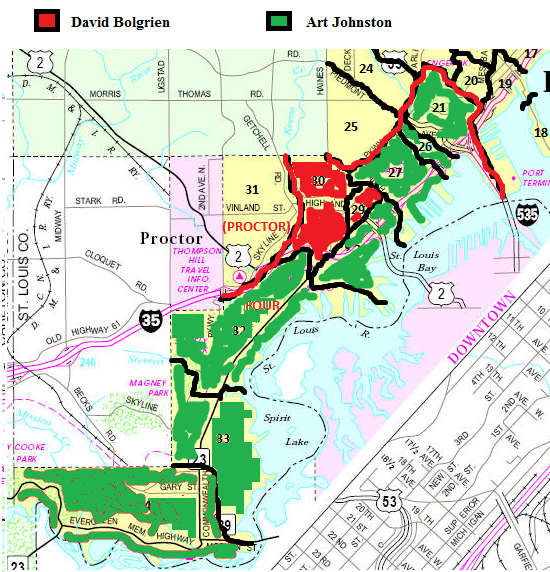
However, underneath all of the solid colors that appear on the election maps are a lot of details that are worth exploring. The somewhat unexpected results of three races jumped out at me: Zack Filipovich surpassing Barb Russ for first in the City Council At-Large race after finishing second in the primary, the passage of the second ISD 709 levy question, and Art Johnston’s re-election to the School Board.

All three of these results underscore the east-west divide in Duluth. That’s a delicate topic, as School Board Member-Elect Harry Welty learned with his “gangrene” comments, and obviously it generalizes, and there are plenty of people on both sides of the city who cut against the east-west stereotypes. Still, one trend clearly emerges in election results: the west side’s rejection of the east side liberal establishment.

It’s especially significant when you consider that people from the west side are not a demographic you’d normally associate with conservatism. It’s not a wealthy or suburban/rural region, and in state and national races, it’s still reliably Democratic. This is no bastion of the Tea Party or libertarianism, as shown by the passage of the first levy question in all but one precinct and Ryan Stauber’s inability to break through in many places. Still, the west side is not moving in lockstep with the Ness agenda, and it’s worth asking why.

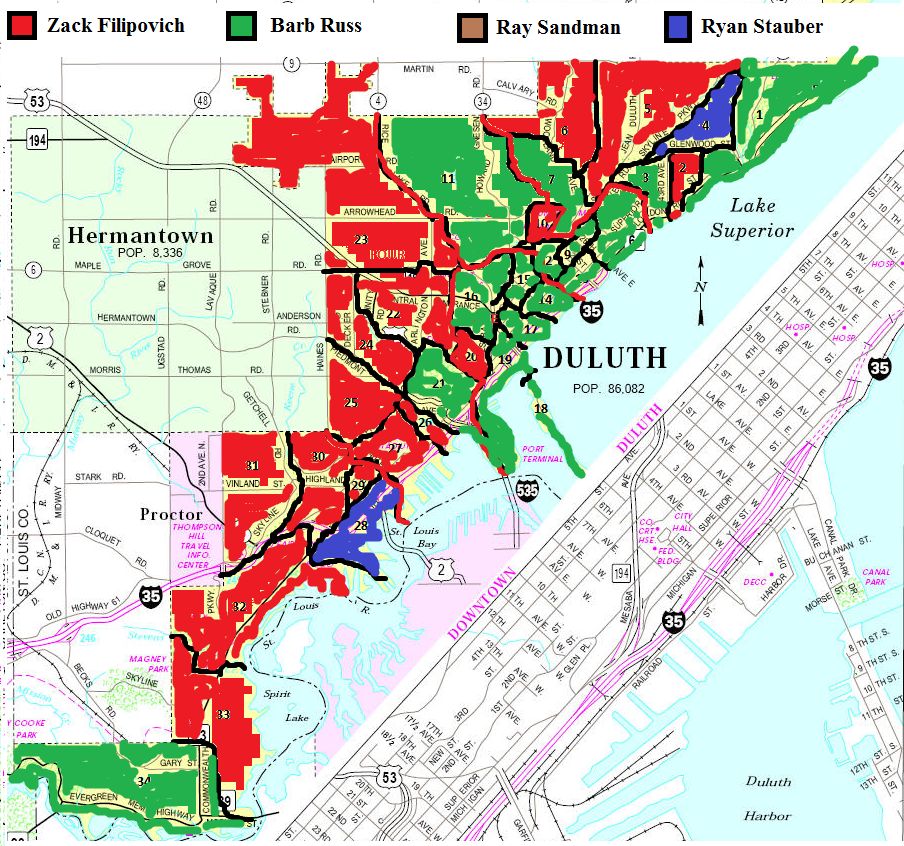
We’ll start with a look at the City Council At-Large race, in which I’ve mapped out the winners of each precinct using the wonders of Microsoft Paint:

City Council At-Large

Zack Filipovich, as you can see, had a very strong showing on the west side. As a recent college grad working in finance, Filipovich doesn’t really fit the blue-collar stereotypes one associates with the west side. Still, his campaign (whether by design or not) was certainly less explicitly liberal than Barb Russ’s, and since he’s young and fresh, he’s not really an establishment figure. Unlike Russ, he made a concerted push to get beyond the establishment, and campaigned out west. For that reason, I suspect he was able to generate a lot more support, especially in an election where voters could choose two candidates. Ryan Stauber was an easy first choice for Duluth’s more conservative voters, but I’d hazard to guess that Filipovich, who remained rather vague and upbeat in his campaign, was most likely to be their second choice. That coalition probably carried him to a lot of victories on the west side.

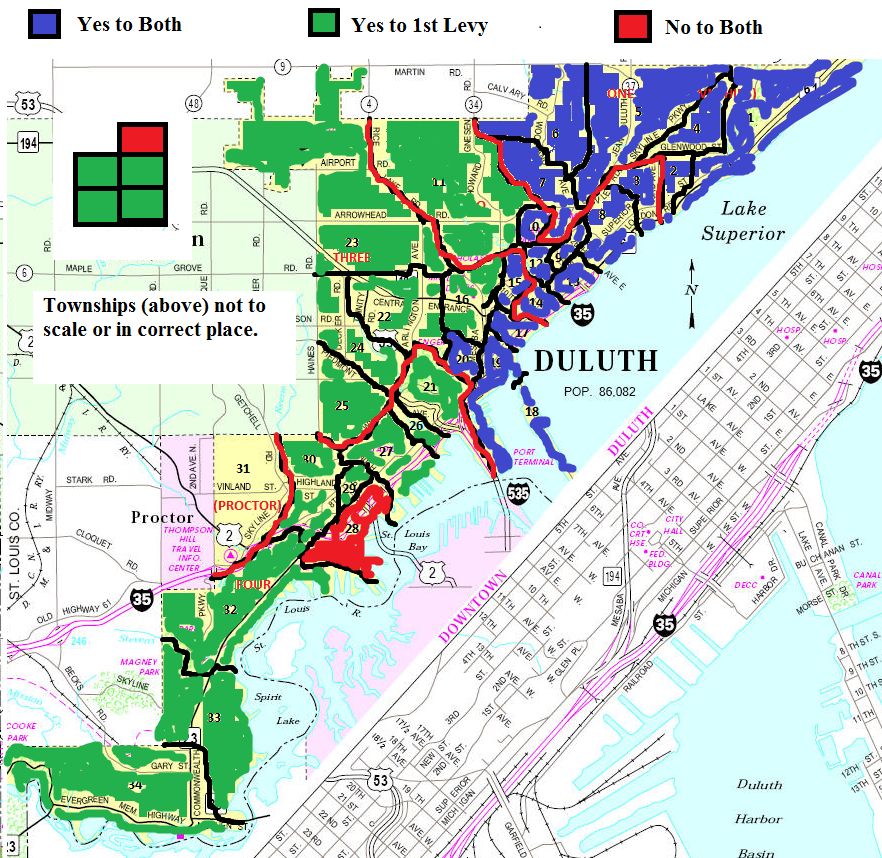
This anti-establishment-liberal pattern is even more distinct in other recent elections, with the west side being far less interested in sending more money to the city than the east side. In Ness’s first election, he won the east side and lost the west side to the more conservative Charlie Bell. Jay Fosle, the lone conservative on the Council, represents a far west district. Garry Krause, the recently-resigned conservative District Four councilor, was from the west side, and got a decent share of the vote despite having withdrawn from the race. If he’d stuck around, I suspect he would have won. If you want a map that really underscores this trend, though, take a look at the way the city voted on the school board levies:

School Board Levy Map

This really wasn’t a case of the city coming together to support the second levy. It was a case of the east side having just enough votes to drag the west side along with it.

While much of the rest of the city is exasperated by anti-Red Plan crusader Art Johnston, he was re-elected to his far west side district. In the West End area, there seemed to be a lot of passion over the school board race: Bolgrien’s base of support was right around Denfeld High, and Johnston had a bunch of signs in the areas just beyond the Bolgrien core. Heading east into Lincoln Park, however, there were hardly any yard signs. Even so, Lincoln Park broke for Johnston. It wasn’t a vicious rejection of Ness and his School Board allies, but it was a clear one.

School Board Dist. Four

I rarely agree with Art Johnston, but to his very real credit, he too has acknowledged these trends. He posed the question to the Board at a recent meeting, perhaps not realizing that his own presence on the Board is a product of these trends: why does it appear that west-siders do not share the east side’s emphasis on education, and willingness to open the pocketbook to support it? No one answered him, and he deserves an answer.

Part of it may be demographics. The school-aged population is much higher on the east side, so more people have a stake in the schools there. East side voters, content with the generally high test scores at their schools, see the value in supporting the District, while west side voters, seeing more mixed results, may not. (I have never understood the logic behind giving struggling schools less money, but plenty of people explain their votes that way.) Perhaps most importantly, the west side has more people living on fixed or lower-middle-class incomes who are nonetheless not living in poverty or qualifying for many government support programs. Because of that, they tend to be less willing or able to handle a tax increase.  That fact can explain the fiscally conservative bent one sees in the west side’s city councilors, too.

But while socioeconomics may explain a lot of the divide, they are not destiny. To that end, it’s important to understand why a number of Duluthians (no matter which neighborhood they live in) may not be completely thrilled with Don Ness’s Duluth. For that, I’d point readers toward my post from a few months ago on Duluth’s future. It’s a long and meandering post, so I’ll summarize one key part here.

Under Ness, Duluth has made a concerted effort to reinvent itself. It has also made itself a desirable place for young people to live, harnessing its natural beauty and developing a decent artistic and culinary scene. (Yay, good beer!) It has spent a lot of money making itself attractive, and to date, I think that move has been reasonably successful. With the decline in U.S. manufacturing, it was necessary to take that stand and create a new brand for the city, and while I have my quibbles here and there, I’m largely on board with Ness. I was also a staunch supporter of both levies, and I believe world-class public schools are essential to this whole project. However, former Councilor Krause raised an essential concern, and one I am not sure the Ness camp has properly addressed: is Duluth’s interest in shiny, new things coming at the expense of the mundane? Yes, it’s great to attract new people, but what about those who have been here for a long time, and are simply trying to get by?

No matter how many elections Ness and Friends may win, these questions will still exist. They need to be magnanimous in victory, and recognize that simply cruising along with a mandate still leaves some people on the outside looking in. No, they can’t satisfy everyone all of the time, but no one should be left behind because they never got a chance to be heard.

Speaking of being on the outside, the lack of racial diversity here is also worth mentioning: after this election, everyone on the School Board and City Council will be white. This isn’t terribly shocking in a city that is over 90 percent white, and there were two minority candidates this fall who simply did not run very impressive campaigns. Mary Cameron had a very long tenure on the School Board, proving that minority candidates certainly can do well in Duluth. Several of the white elected officials have long histories of work with minority groups. Even so, there is a trend in modern American liberalism in which people politely acknowledge minority interests while doing little to actually address them. I’ve talked up the east-west divide here, but downtown can’t be lost in the shuffle, either.

This all brings me back around to “boring” government. Yes, boring government is certainly better than people screaming at each other nonstop, but there is a danger here, too. This quote from Councilor-Elect Howie Hanson in the October 29 News-Tribune comparing himself to his predecessor brings it out clearly:

“I think Garry [Krause] was a little frustrated because he was in the minority on a lot of votes,” he said, noting that Krause frequently found himself at odds with Mayor Don Ness’ administration and much of the council.

“If we’re going to move Duluth forward, I think you need to set aside your personal agenda and petty politics and get everyone on the same page,” Hanson said.

This bothers me somewhat, and I do not think it is an accurate characterization of Krause’s work, even if I didn’t always agree with Krause. Good governance does not involve everyone being on the same page and rubber-stamping one another’s proposals. It needs constructive, perhaps even heated, arguments. To its immense credit, the City Council has managed that in recent years; the School Board, on the other hand, has not, as it went from being a rubber stamp machine during the Red Plan days to a fractious and ugly war zone during Art Johnston’s first term. With Welty and a possibly conciliatory Johnston on the School Board, I have some hope that it might finally come to a healthy balance. The new Council, with its new left-leaning supermajority, must make sure it doesn’t fall into one of those twin traps that bogged down ISD 709 in recent years.

Duluth’s politicians have the potential to do some great things in the next few years, and the future is there for the taking. We’ll see how they do.

A Sense of Place in the Modern World

So many trends in this day in age cut against loyalty to a place. Being committed to one spot on the map seems to be either a luxury or a harsh necessity.

Just think about it. Finding a well-paying job (or simply a job) often requires travel and frequent movement as one climbs the ladder in search of the best opportunity. Well-educated people often uproot themselves and cluster together in a handful of economic centers that have a lot of interesting high culture. People who come from less-than-ideal backgrounds can escape them, and for many, that is no small victory. Economists speak glowingly about “creative destruction”—that is, the need to tear down old stuff and replace it with new stuff to keep the engines of economic growth firing at full steam. The two political parties’ platforms only rarely give nods to local interests; Democrats emphasize universal rights above local loyalties and often use a distant federal government as their instrument of choice to promote it, while Republicans tend to venerate the frictionless free market above all else. Throw in the technological advances of the past few decades, and people have never been so free to move about without setting down deep roots where they are.

The march of modernity is all bad for a sense of place. Mobility has actually declined somewhat in recent years, though I’d guess that has more to do with economic forces than some newfound commitment to certain locations. The internet makes it easier to connect to interesting people without ever leaving places that might otherwise not be the most stimulating places. It is also becoming increasingly easier to do some jobs from home, and some communities that are just flat-out nice places to live will prove resilient because of that. The mayor of my hometown of Duluth, Don Ness, made that argument in this recent Atlantic piece—he’s admitted that he is the anonymous mayor there. It’s a sensible point, but while this is nice for a city like Duluth, it’s not of much use to many other places. Building communities and growing cultures takes time and commitment, and it’s hard to find the people and capital to build them.

All of this movement is often viewed as a positive thing (the American Way, even), and as the media and other big institutions that drive culture tend to be full of people who have made plenty of career leaps, voices that question it don’t get much coverage. When they do, it’s often negative—and not always without reason, as the excesses and eccentricities of opposition groups merit a fair amount of the mockery they incur. This isn’t to say that all the national media hates or ignores small towns or Middle America—they continue to be a fantastic source for stories of virtue and laments for middle-class Paradise Lost—but most of them seem to view it as a different land to be mused about from afar, its decay inevitable. The people who really argue for something different are on the margins: environmentalists and lefty localists, certain conservatives who are actually interested in conserving things (usually communities, churches, and stable social orders), and a handful of literary figures who transcend those categories, like Wallace Stegner and Wendell Berry.

People from very diverse backgrounds agree with bits of their argument, even if they might not ever cohere into a political movement. These people generally respect things like political rights and an open economy, but they don’t think that loyalty to such ideals should come at the expense of personal ties. They are skeptical of abstraction and a life consumed by endless thinking. Instead, they focus on the relationships with people immediately around them, and because interpersonal relationships are at the center of everything, constant movement doesn’t much appeal to them. Family and friends are important, so they keep everyone close and recognize their debts to both their ancestors and their children. As a result, they’re comparatively thrifty and careful about their economic choices. They aren’t necessarily Luddites, but technology isn’t their favorite thing on earth, and if possible, they’d often rather repair things with their own hands than haul in an expensive expert to do the work. A number ground their localism in shopping locally and caring for their neighborhoods, and a number rely on houses of worship to provide community. There’s nothing glorious about this way of life, but it is one of steadiness and deep contentment, and it provides the strongest cushions possible when tragedy strikes.

Of course, it can all go wrong, as it has many times over the years. The most egregious examples are racial, religious, or other such barriers imposed by small communities with strong tribal instincts. Communities can be stultifying, or just stale. It is very difficult for one individual to stand up to an entire community, and when everyone knows one another, grudges can be even more toxic than when the enemy is a bit more abstract. These troubles can always be overcome, but they also require careful attention, and mean people have to think beyond the most convenient aspects of community as well.

A more benign trend among localists is a tendency to tip toward escapism. This is what religious conservatives will call the “Benedict Option,” though it’s not hard to find secular or left-leaning equivalents: people with a shared sense of morality retreating into their communities to hide from or wait out the collapse of the fallen modern world around them. If you want to be one of those people, be my guest; as long as you’re not shooting at those who don’t join you, you have that freedom, and the global economy isn’t going to take a hit because fifty people retreat into a self-sustaining commune or a homeschooling cooperative. I respect that, and I think the rest of society stands to learn from methods used in alternative schools or from Zapatista “good government” practices or the Amish freedom from being eternally plugged in.

I’m just not going to join them.

Why not? With a few obvious exceptions, those idealized communities never really last; the best we can do is pick and choose a few things from them that are worth adopting. Humans will always dream, and unless one has been within the culture for generations, people will grow restless and head out to explore the world on their own terms. It’s no secret that I’m a loyalist to community, but I didn’t come to appreciate that without spending an awful lot of my childhood dreaming about being somewhere else. I still do. I still love to travel, and I keep up with international news and pop culture and major sports. That makes it an awful lot easier to find common ground with people who aren’t from one’s little tribe, and so long as one has faith in one’s lifestyle, it isn’t going to corrupt anyone in some terrible way. I have less fear of moral decay than many religious conservatives, or even a healthy number of bourgeois liberals; somehow, it seems like you can always find people saying we’re all going to hell, and yet somehow, human nature seems to survive intact. The cloisters are a lovely place for a weekend of reflection, but there’s a bit too much Athens in my Jerusalem for me to stay there, and the same is probably true for most people out there. I can’t run away from the world. Yes, there’s an awful lot wrong with it, but it’s the only one I have.

Staying in touch with the world beyond my little fishbowl also keeps me from falling too far into blind obsession. I’ve shared some very pointed words about school board levies and local politicians on this blog, and I’m glad I have; Duluth is small enough that I’ve actually been able to dialogue with some people about these things and now have a modest readership. I’m proud of that, and I want to keep building on it. But I also don’t want to sit here preaching to a choir that nods and smiles, and I need constant reminders that there are other things out there that make all of this seem trivial. This blog’s wanderings into hockey or Greek philosophy or global affairs may seem like random whims, but there’s a design here: I’m trying to keep myself from ever being too caught up in these delightfully petty political circles I’m floating around in. And if need be, if Duluth doesn’t work out in the long run, I’m ready to pull up and move somewhere else. Roots aren’t easy to grow, but as long as the soil is halfway decent, they have a chance in most places.

There is wisdom in seeing life as an ongoing pilgrimage or journey from one place to the next, but too often that strikes me as a defense mechanism; a regrettably necessary means of making peace with roots that have rotted away. Sure, there are some people who just have a lot of wanderlust, or their own roots are among perpetual wanderers. Like the old line says, not all who wander are lost. But plenty of them are, or may be fully aware that their wanderings stem from old burdens or an inability to properly go home. The Jews did an admirable job of surviving, even thriving, when they were wandering the desert or scattered across Europe, but they always yearned for Israel. And while that home may seem a fleeting one when held up against the sweep of history, for our equally fleeting time on earth, it can make all the difference in the world. If life is a journey, it’s a much happier one when we have a warm bed to come home to at the end of the day’s adventures.

What Is Duluth’s Future?

This is going to be a sprawling post, and I envision it as the start of a series on Duluth, Minnesota, my hometown, that builds on the fairly narrow focus of my posts on city council and school board meetings.  For those of you who have never been there, it is a city of 85,000 on the tip of Lake Superior, and the world’s largest freshwater port; and no, it is not a suburb of Minneapolis. (When I was in the college on the East Coast and told my classmates I was from Duluth, Minnesota, the inevitable next question was, “is that near Minneapolis?” They didn’t know how to respond when the answer was “no.” There were also the girls who once asked me if Minnesota was near Maine. And the one who didn’t believe that ice fishing was a real thing. But I digress.)

At any rate, a few days ago, the New York Times ran a piece by Robert Putnam, a Harvard scholar famous for his book Bowling Alone, which explores the decline of communal bonds in the United States. His work is some of the most fascinating stuff on modern American culture, though as with all scholarly work, there are intelligent critiques and rebuttals and endless back-and-forth nitpicking. While nuance is always necessary, I do worry about fraying social fabric and the increasing isolation in modern America, and perhaps more importantly, the pathologies that afflict an increasingly stratified society, from broken families to drug abuse to cycles of poverty. Without going straight into causes, solutions, and ultimate implications, it is clear there is a problem here. The ability of a city to cope with or adapt to these issues will likely determine its fate.

This particular article was more focused, however; it told the story of Port Clinton, Putnam’s Ohio hometown along the shores of Lake Erie. Like much of Middle America, Port Clinton has not fared particularly well economically in recent decades; its manufacturing base has collapsed, and though its lakeside location has kept some money in the town, it is now very divided, and not the foundation for the American Dream Putnam claims it was when he grew up there in the 1950s.

There is a shoutout to Duluth near the end of the piece, and the parallels are not hard to see. (The results of the Duluth surveys taken for Putnam’s project, while they do not mention many of the things discussed in the NYT piece, are here.) Duluth is much larger than Port Clinton, but for a while, it looked like it was going down the tubes when it lost its U.S. Steel mill and shed perhaps 30,000 residents toward the end of the 20th century. Like Port Clinton, Duluth has weathered the storm somewhat thanks to tourism dollars, and it has been fairly stable for two decades now. For all its troubles, Duluth really hasn’t fallen off the cliff in the way Putnam seems to think Port Clinton has.

If Duluth doesn’t fit so smoothly into the narrative of Midwestern industrial decline, we have to ask what sort of story we can tell about Duluth. In addition to the tourism dollars, I’d attribute Duluth’s resilience to two factors:

1. Due to its size, it remains a regional hub in a way that most small towns in America aren’t. Duluth may not have grown since it stopped shedding people in the early 90s, but it also isn’t shrinking, while most of the rest of the region is; its quasi-suburban areas, Hermantown and several unincorporated townships, have actually seen some growth. While Duluth may not have the opportunities Minneapolis does, it does have some allure when compared to small northern Minnesota towns. It has two 4-year universities, remains a busy transportation hub, and many regional services that cannot be outsourced to a metropolis or Malaysia (health care, certain government agencies, etc.) are based here.

2. Old money. At the start of the twentieth century, Duluth was a millionaires’ playground, and though not all of the grand old houses on the east side are in the best of shape these days, a chunk of the money is still here, doled out from trusts, foundations, and donations from heirs. For example, the revitalization along the waterfront likely would not have been possible without the efforts of the late pizza roll magnate Jeno Paulucci, whose restaurants anchor the Canal Park area. Putnam’s piece mentions the scholarships set up for many local students; Duluth has a bevy of such awards, and I received one that kept me debt-free through college.

(In a rebuttal to the Putnam piece, Front Porch Republic’s Jeffrey Polet points out that such scholarships may simply funnel graduates out of town, never to return. He may have a point; I am sure some of the recipients I graduated with, happily farmed out to elite colleges, will never be back. In my case, however, the strength of the Community Foundation and my sense of obligation to that history were among the many things that kept me grounded here.)

Duluth does very well in the indicators of social cohesion, which bodes well for the city, though some of Putnam’s later work shows that more homogenous communities tend to have much stronger social fabrics (a fact that so deeply troubled Putnam that he took years to release his data). Duluth, being 92% white and with strong northern European ties, obviously fits the bill. Moreover, it is a fairly segregated city (and not just in terms of race, though most minorities are concentrated in the city center). When explaining Duluth to outsiders, I’ve often described it as two separate cities: a combination college town/comfortable suburb on the east side, and a struggling rust belt city in the west. This is overly broad, of course, and perhaps an uncharitable portrait from a dyed-in-the-wool east-sider. The west side’s civic pride remains strong, and lower-income housing has been creeping eastward somewhat. But a simple look at the public high schools tells the story: three central and west Duluth high schools have folded into one since 1980, and East High remains much larger than that single western high school, Denfeld. (The East attendance area grew somewhat with the closure of Duluth Central a few years ago, but not drastically, and the school-aged population—a good indicator of how desirable an area is for families moving in—is much more dense on the east side.) Duluth East is the home of the “cake-eaters” of the north—it is the wealthy school that has long overshadowed Denfeld in academic and athletic prowess, even though Denfeld retains a very loyal following; perhaps even greater than East, since west-siders are far more likely to stay put while the East kids head off to supposedly greener pastures.

The divide is also made fairly clear by the quality of life and perceived political influence statistics in the Putnam study (see p. 49-54), though the west side does have some real strengths in those numbers. (This write-up also doesn’t mention where the dividing line is, which would be interesting to know.) This invites several questions:

-Duluth sprawls along 27 miles of lakeshore and riverfront, and there is a ridge along the length of the city that makes construction impractical in many places. How much does geography make Duluth’s divisions inevitable? The flip side of these divisions are some very strong local neighborhood identities, and I think these can be very good things. Are the divisions bad in and of themselves? Putnam certainly thinks so, and though I certainly understand that hyper-localism has its downsides, and can lead to discrimination, I’m not entirely convinced—in part for the reasons Polet touches on, though he doesn’t do a very thorough job in that post.

-What role do suburbs (ie. Hermantown) and new construction in Duluth Heights (away from the lakeshore and “over the hill”) play in Duluth’s development?

-Whither Superior? The Wisconsin city across the bridge is sometimes derided as Duluth’s armpit, but it still has a substantial a population and is an important part of the metro area. (And where else would we Duluthians go to buy our liquor on Sundays?) In the parts included in the Putnam study, it scores noticeably worse than Duluth in some respects. How does its fate affect Duluth’s?

-One effort to revitalize Duluth seems to evoke a hipster vibe. The attempt to attract “creative people” to revive the economy is mocked at times, but there is a certain logic here: in many cities (Manhattan, parts of Washington DC, San Francisco, and on and on), urban renewal (or gentrification, depending on how one looks at it) starts with artsy people moving into cheap housing, making the neighborhoods “interesting,” and in turn attracting wealthier wannabe urbanites who gradually displace the poorer people. Given Duluth’s universities, natural beauty, and decent arts scene for a city of its size, it seems to have potential for the hipster crowd. (Witness the dramatic rise in microbreweries and the expanding bike paths.) Mayor Don Ness, who is in many ways emblematic of this movement, certainly seems to be pushing it, as do several city councilors.

But this brings up some necessary questions: is this desirable development, and does the fact that it often just ignores or pushes poor and working-class people elsewhere trouble anyone? This model seems to work in major urban areas, but how well does it apply to a much smaller city? At first glance, a lot of this appeals to me—while I am probably a bit too clean-cut, conservative in temperament, and boring in my musical tastes to be a proper hipster, I enjoy culinary variety and good beer and a vibrant arts scene, and I’d much rather have more localized development than further urban sprawl. But I can still hear City Councilor Garry Krause’s words echoing in my mind: is our obsession with the new and interesting coming at the expense of the mundane, and the people who have called this city home for generations?

While Mayor Ness is a very popular and personable man who won re-election unopposed in 2011, in his initial election in 2007, he won the east side and lost the west side of the city. At the time of that election, I remember a high school teacher noting the unusual fact that Ness, by far the more liberal candidate, did better with the wealthier Duluthians, which seems to counter our normal political narratives. Looking at it from this perspective, it makes a lot more sense now.

-Duluth also includes many newcomers, and if certain critics are to be believed, it attracts a number of poorer people who look to take advantage of its relatively strong social safety nets. Councilor Jay Fosle had a complaint (not well-explained to the broader public) a few meetings ago about U-Haul rental patterns in Duluth; back in that 2007 mayoral election, Ness’s opponent, Charlie Bell, made some sort of remark about people from places like Chicago showing up and causing problems. Can someone give this critique some coherence or empirical backing, or is it just shoddy identity politics? And if it is true, what do we make of it?

This post is getting out of control, so I’ll cut myself off here. I’m throwing this open for discussion, in large part because I don’t know the answers. Urban planning interests me as a field, but I’ve never really pursued it because, eternal critic that I am, I have yet to latch on to any sort of coherent vision for how to revitalize a city. Duluth has considerable potential with its location, strong civic engagement, and unique culture; this city has a soul, and a lot of people probably don’t realize how unique that is. But where do we go from here?

Legality as Morality

A few weeks ago, while writing some less-than-kind words about local businessman Jim Carlson, I used the epithet that he “is the sort of man for whom legality defines morality.” I’ve used that line before in places other than this blog, and I think it deserves a deeper explanation.

At the time, Mr. Carlson was trying to justify his shop’s sales of synthetic marijuana, and claimed that the city of Duluth’s plan to regulate his product amounted to an admission that he hadn’t been doing anything wrong. It isn’t a totally implausible stance, at least to the extent that one considers the law the arbiter of whether something is right or not. Mr. Carlson also has some defenders who don’t necessarily like his product, but fear the city government is being too heavy-handed in its attack on the Last Place on Earth (LPOE); I respect that concern, and the wrongness of Mr. Carlson’s actions does not give his opponents free reign to bring him down by any means they choose.

However, far too often, people such as Mr. Carlson use the law as a shelter from the need to exercise any moral reckoning. If something is legal, the theory goes, then who is anyone to judge them? I suppose it is possible for him to uphold a libertarian form of morality that claims he simply sells what people demand, and that it’s up to them to reap the consequences. And, in a legal sense, this is true: we cannot rob the agency from the people who line up outside of his store to buy his incredibly harmful product. (This isn’t regular marijuana we’re talking about here: it involves countless chemical additives that can be as damaging as cocaine.)

Lost in that worldview, however, is any notion of interconnectivity. Synthetic drug use doesn’t just affect the users. It is a burden for the community on a number of levels, from increasing crime and the need for added police to public health issues to driving away the clientele of neighboring businesses. Drug abuse tears apart families, and it’s not uncommon to see people standing in line at the LPOE with toting children in strollers with them. (Childhood never really jells well with strict libertine arguments.) And with drug manufacturers doing everything in their power to stay ahead of the law by constantly changing the chemical compounds in their product, it is rather obvious that the motive here is the maintenance of legality at all costs. It is a cynical scheme whose only defense appears to be an attack on those who oppose them instead of an attempt to articulate why they do what they do.

Partisans will throw the blame for this loss of moral language in any number of directions. The left will attack the market, and the profit motive that pushes people to forget their morals in the pursuit of cash flow. (Mr. Carlson has made untold millions off his synthetic drugs.) The right will attack individual moral failings and, on a more intellectual plane, the overuse of the language of “rights” in political discourse. We see it around us every day: people religiously defend their right to bear arms, their right to free speech, their right to marry whomever they would like. Many of these rights are hard-won, and emerged out of historical cases of oppression that would seem to justify a legal reaction. Still, the possession of a right does not make it right to exercise it. Amidst our pushes for liberation, it seems that some people have lost track of any sense of prudence. (How often does one even hear words like “prudence” anymore?)

It isn’t surprising, really. Rights have the convenience of being black-or-white: either you have a right or you don’t, and it is spelled out in law. Prudence, on the other hand, requires near-constant discernment, and while other people can influence it, at the end of the day, that burden falls on each individual. Moral agency is a legitimate burden that can—and, really, should—be very difficult to manage. Thankfully, there are some guideposts to fall back on. Maybe this means a religious or communal or familial code; maybe this means a sort of liberal humanism whose precepts you don’t feel the need to question. If you don’t have one of those you feel comfortable with, maybe it means spending your waking hours trying to write through it all in fiction or on a blog when you should be out doing things with your life. (Guilty, your honor.) There’s no guarantee of easy answers, but one can find some measure of peace without too much pain.

This isn’t necessarily an argument against government action—in fact, the LPOE case is a perfect example of one in which a coherent response requires at least some measure of a response from an authority. Clearly, there are cases in which oppression is so overwhelming that it would be naïve to tell people to forget about the laws and get on with living virtuously, and there are many rights worth fighting for. It only becomes a problem when the rights become ends to themselves, instead of means to a broader end; unfortunately, this way of thinking has leached so deeply into contemporary American thought processes that it sometimes seems like people sacrifice their moral agency to the state. This is especially curious given the general wariness of state intervention in so many other spheres of life. Legalism, we might say, emerges from the bizarre civic religion of American freedom: in some circles, the mystique of the Constitution or some other interpretation of the nation’s founding principles seem to have replaced the exercise of moral inquiry.

Assuming legality defines morality isn’t the worst sin on earth. I’d rather live in a society where most people accept legal definitions of morality than one in which there is no morality at all. But forming one’s worldview with respect to what is legal is an impoverished view. On a fundamental level, no one’s moral reason for not doing something should be “because it’s illegal.” (I emphasize the word “moral” here because there are, obviously, practical reasons to do or not do things that have little to do with morality.) In many cases laws are based on perfectly rational precepts that practically no one would dispute, and it’s not worth expending much thought on them. But laws do not bear any moral weight in and of themselves; they simply convey the moral judgment of the governing body that produced them. They can be a starting point for moral thought, but never the end. That task lies with each of us, including Mr. Carlson.