In Which the Councilors Talk for a Very Long Time About Lots of Different Things: Duluth City Council Notes, 12/9/13

On Monday night, scores of Duluthians braved brutal roads to attend a three-hour marathon city council meeting. It was the largest crowd I’ve seen yet, even after the thirty or so high school kids—there on behalf of the Duluth delegation of Youth in Government, as one of their number explained as the sole citizen general speaker—cleared out after the first few issues. No one spoke in a public hearing on the budget, and CAO Montgomery was happy to announce that southbound I-35 would re-open this Wednesday, following extensive repairs. Councilor Larson also plugged two events rescheduled after last week’s snowstorm, a community development public hearing for today (Tuesday) and the Libations at the Library fundraiser this Wednesday at 6:30. (I’ll give that one a strong endorsement.)

Councilors pulled two items off the consent agenda, and Councilor Fosle was confused for confusing reasons over why a third item had been pulled, but once that was over with, it passed unanimously. Councilor Gardner’s pulled resolution concerned an agreement with a law firm for legal services in grievance arbitration with unions; she wanted to know where this money would go, as she’d heard on the news that some of it might go to a case involving a Duluth police officer recently acquitted on charges of brutality for this. (Warning: violent video.) Councilor Fosle took her concerns a step further and made it quite clear he wanted the officer removed, and somehow this became grounds for voting against the resolution. A citizen speaker came up (rather unusually) in the midst of this discussion to say that outside legal help would be a good idea in this case due to perceived conflicts of interest. This prompted CAO Montgomery to give some history on past outside legal help in arbitration cases, saying the city has moved to keep them internal in recent years, and only uses the outside law firm when it needs specific help. This satisfied everyone but Councilor Fosle, and it passed, 8-1.

Next up was a return to the debate over whether to use Community Investment Trust (CIT) funds to service street debts, a proposal that twice failed to reach the necessary 7-vote supermajority needed when Garry Krause was on the Council. He has since been replaced by Councilor Hanson, however, and he made his intentions clear right off the bat, breaking the silence of his first two Council meetings to introduce an amendment guaranteeing that any funds from a court settlement with the Fon Du Luth Casino would go back into the CIT. While technically a redundant amendment due to city charter stipulations, the Councilors liked its clarity, and, after some wrangling about the wording that Atty. Johnson settled, the amendment passed unanimously. The actual vote generated a little more debate, as Councilors Fosle and Stauber reiterated their opposition, with Councilor Stauber noting that the city’s bond rating has actually improved in recent months despite the measure sitting in traction. Councilor Gardner and CAO Montgomery had immediate rebuttals, saying the rating agencies had specifically noted this measure’s likely passage as a reason. Councilor Hartman pointed out that the CIT is designed to pay for streets and is nowhere near as liquid as the general fund, while Councilor Hanson talked about the amount of thought he had put into the issue before deciding to support it. The measure passed, 7-2.

The Council then moved on to a resolution exploring the feasibility of creating an ATV trail in Duluth. ATVs have been banned on city public land since 2004, but now a group of ATVers, with help from Councilor Fosle, is looking for a place to ride in town. There were six citizen speakers on the issue. Four were from the ATV community, and gave various reasons to support the measure; one was disabled and could not hike city trails well, another talked about efforts to train young people (whose illegal usage of ATVs was at the root of the initial ban) in responsible ATVing and new legislation that has gone into place, and several talked about the economic benefits of bringing in ATVs. A fifth speaker, a representative of the COGGS biking group, took no clear stance on the issue, but made it clear that he expected any ATV trail to go through rigorous assessments, and should not share an existing bike trail. The final speaker, Mr. Erik Viken of the Parks Board, asked for some clarification from Councilor Fosle, and said the ATVers should develop their own proposal rather than handing it to the Parks Board at this time, lest they place an undue burden on the Board.

Councilor Larson then introduced an amendment to focus the review to sites to the west of Cody Street. As Councilor Fosle explained, the likely site for the trail is the former DWP railroad line, which can certainly handle the impact of motorized vehicles; the amendment would allow the planners to focus on that specific area. Councilors Julsrud and Stauber expressed their opposition; both thought it neglected the rest of the city, while Councilor Julsrud added worries about the resolution’s vagueness and the burdens on the Parks Board when the city had already identified other priorities for parks. Councilor Krug declared herself open to being persuaded; Councilor Larson said focusing on the west side made sure the project would move forward, and Councilor Hanson pointed out that people will have to take ATVs to trailheads on trailers no matter where it is. The amendment passed, 7-2.

Discussion then moved on to the resolution proper, and Councilor Fosle insisted that these were merely baby steps. Councilor Stauber, hoping this would be a gateway to further ATV trail-building, announced his support as well. Despite reservations over ATVs, Councilors Hartman and Gardner said it was only fair that the city go ahead with the feasibility study; the “city has a mandate to represent everyone,” including ATV riders, Councilor Krug added. Speaking more pointedly than usual, CAO Montgomery said that if this really is a gateway to broader ATV usage in the city, environmental damage caused by illegally-ridden ATVs is very real, and that the trail is unlikely to change this fact. He said local ATV groups must rein rogue riders in, noting that snowmobile groups had successfully done so in the past, so it is possible. Councilor Julsrud reiterated her points about priorities, but was the lone ‘no’ vote, as the resolution passed, 8-1.

One of the ATV people spoke on the next issue as well, which asked the state to raise a speed limit on rural St. Louis River Road. Councilor Fosle took up the cause, and found supporters in Councilors Stauber and Gardner; given the road’s location and apparent usage, they thought the 30 MPH speed limit unusually low. CAO Montgomery did not recommend approval, however, saying that city engineers and police both had their reasons for the lower limit. The rest of the Council agreed, saying their process ought to be respected, and deferred to the experts. The resolution failed, 6-3; Councilor Fosle asked if roads could be annexed to neighboring communities, and got a ‘yes’ out of Atty. Johnson.

Six hardy speakers had waited out the discussions for the next Council issue, which was a proposal that restored the Heritage Preservation Commission’s (HPC) ability to bestow historic landmark status on local buildings. All six supported the ordinance; their most convincing speaker was Mr. Tony Dierckins of Zenith City Online, who told the Council not to be “afraid of landmark status.” He said the HPC was merely an advisory committee to the Planning Commission and the Council, which had final say, and that owners could always appeal. Ms. Caroline Sundquist added that threats of lawsuits were overblown, as HPCs’ authority to bestow historic status has been upheld time and time again in courts.

Councilor Gardner then expressed her support, saying the original removal was an error that had to be fixed. She worried about the city losing its status to certify historic sites, and pointed out several projects that had benefitted from landmark designation, such as Sacred Heart, Fitgers, and Tycoons. Councilors Larson and Hartman agreed, while Councilor Stauber, though joking that his age made him well-aware of the importance of old things, did not. He said the HPC’s loss of authority was “no accident,” and that the administration had known what it was doing in stripping away its powers. He thought the HPC had gone too far in the past; any property owner not wanting historic status foisted on their building would have to “go on the defensive” and hire lawyers. The HPC’s role, he concluded, should be limited to working with owners in a cooperative way to establish historic status.

Councilor Fosle asked CAO Montgomery if this was an accurate portrayal of the administration’s past stance, and he said it largely was. He added that the administration was okay with the changes, so long as the Council understood that these processes require care. While there are obvious benefits to historic status, he added that they can sometimes add costs and tie things up. (This suggestion had the pro-HPC people in the audience throwing up their hands in disbelief.) Councilor Julsrud counseled a pragmatic approach, saying the Council should support the HPC unless it starts throwing around designations in an undisciplined way, in which case its status could be again revoked. The ordinance passed, 7-2, with Councilors Stauber and Fosle in opposition. The remaining ordinances passed unanimously, despite Councilor Larson’s joking threat to filibuster one of them just to make the meeting drag on even longer; one of the ordinances in question adapted a historic church for use as a dance studio.

Despite a lengthy meeting with plenty of debate, the Council saved its biggest fireworks for the comment section at the end of the night. Councilor Gardner reminded the Councilors that anyone hoping to be Council President or Vice President in 2014 had to declare their candidacy by the end of the next meeting. Councilors Fosle and Larson promptly threw their hats in the ring for VP, while Councilor Krug said she would seek the presidency; Councilor Julsrud said she would wait until 2015, despite having had several people encourage her to go for it. Councilor Krug asked CAO Montgomery for an update on plans to annex part of Rice Lake Township; he assured her that they were merely in a conversation stage, and that the township will certainly vote on the measure if it moves forward. The measure would be nonbinding, though he said he had no interest in a hostile takeover.

Councilor Fosle made his opposition to the annexation immediately clear, saying he’d be at a Rice Lake town hall meeting the next night to “tell them the truth”: that Duluth is just trying to add population for government aid purposes, and that this would saddle them with all sorts of new fees and taxes. “There’s more going on here,” he said, not for the first time. This drew an upset reaction from CAO Montgomery, who said that it’s “not all conspiracies and black helicopters.” He insisted that the township’s residents would be consulted, and that their taxes would be lower in the end. He lived in a township, he said, and understood the emotions at play in the debate. Councilor Gardner likewise lashed out at Councilor Fosle, saying it was “not appropriate” for councilors to attend township meetings and try to influence an emotional discussion. She reminded Councilor Fosle that he is a representative of the city, and that he should not pretend otherwise by referring to the city government as “you guys,” thus excluding himself.

Councilor Krug apologized for bringing up the annexation debate, though she was nonetheless happy to see dialogue, while Councilor Julsrud offered cautious support for annexation, hoping rationality would prevail over emotion. Councilor Fosle got the last word, simpering that the Council’s reaction had already “let me know that I don’t stand a chance at being Vice President.” He insisted these were just the facts, not a conspiracy theory, and that CAO Montgomery and people like him moved to townships to escape the big government found in cities.

On that cheery and friendly note, the Council wrapped up its business. It’s hard to sum up such a busy night in a few short words, but it was largely a productive meeting, with many predictable sparring lines, and also a few mild surprise stances. Councilor Fosle’s busy night, I think, showed why he should not be in Council leadership, though I don’t necessarily say that as a condemnation: the man is an eternal insurgent, and is most effective when lobbing bombs from places where people don’t necessarily expect. I think it’s healthy to have that on the Council, but probably not in a leadership position, especially since he has few allies. The efficient Councilor Krug and consensus-building Councilor Larson are probably better-suited for leadership roles.

The final meeting of the year takes place next Monday, and will also be the final meeting for the outgoing Councilors Hartman and Stauber. I’ll wrap up the year and say a few words about them in next week’s write-up.
Paying the Mayor and Getting Locally Laid: Duluth City Council Notes, 11/25/13

It’s winter in Duluth now, with the Christmas City of the North Parade behind us and snow collecting on the streets late in the afternoon. Still, the atmosphere in the Council Chamber was warm on Monday night, and a modest crowd included a bunch of curious citizens, newly-elected Councilors, and the now-usual group of high school students on hand for class purposes. Councilor Fosle was absent, depriving the community of his creative critiques, but the Council had some quality debate anyway.

The meeting opened with a special public hearing on the tax increment financing (TIF) plan for the new Maurices tower, which the Council explored during its October 28 meeting. Only one person came forward to address the Council on the issue, but he was a man with clear experience in TIF affairs: St. Louis County Commissioner Keith Nelson, who represents the Highway 53 corridor from just beyond Hermantown north to Virginia and Eveleth. He lectured the Council over its plans to use TIF money to finance the project, complaining of how the governments have a habit of using obscure acronyms and names for tax increases. He complained that TIF property taxes affect not just Duluth, but the entire county, and that using it shows preferential treatment for certain projects. He also argued that a 25-year TIF was “excessive” and offered to work with the council on a ten-year abatement instead. After the meeting, Councilor Stauber commented on his speech, saying that he usually thought the city used TIF well and that the Maurices tower was probably good as it was, but that Commissioner Nelson’s concerns do deserve a spot at the table.

The Council then moved into official business. Councilor Larson reminded everyone of upcoming streets task force public meetings, including one tomorrow (Nov. 26) at Denfeld at 6:00 PM. Next, a resolution awarding grant money from the parks fund was pulled from the consent agenda because there were two citizen speakers on the topic. They both thanked the Council for its support of youth programs in the city and told happy stories of summers of sailing, fishing, gardening, paddle-boarding, and watching purple martins. Pleased by the upbeat update, the Council passed the funding unanimously, along with the rest of the consent agenda.

The main event of the evening was a debate over a plan to raise the salary of the mayor of Duluth. Councilor Gardner, clad in an intriguing plaid lacy thing, introduced the measure with some lengthy backstory. She said the mayor hasn’t had a raise since 2000, and shared some details of her extensive comparisons of mayoral salaries of Duluth to other cities in Minnesota. This is complicated somewhat by Duluth’s unusually strong mayor; in many Minnesota cities, the mayor is mostly a figurehead, whereas the CAO does most of the administrative work. Because of this, Councilor Gardner also looked at a number of cities in Wisconsin, and found that her proposed increase still kept the mayor’s salary on the low side. Finally, she announced plans for a new review committee of Councilors and involved citizens who would meet to determine the mayor’s salary in the future.

Councilor Larson then introduced an amendment to the proposal, which eliminated the original plan to back-pay the mayor the new salary for 2013, and instead started it on December 1. She emphasized that the raise was for the position, not the person who holds it; in her opinion, back-pay jeopardized this, and brought merit into the equation. CAO Montogmery said Mayor Ness was also uncomfortable with the back-pay, so the Council unanimously approved the amendment.

A number of Councilors spoke in favor of the resolution. Councilor Krug gave some history, noting that the Council had voted for increases fairly steadily in the 90s before abandoning the issue entirely after 2000, even though the city charter says it should be reviewing the pay scale regularly. Councilor Julsrud talked up the benefits of the city’s strong, responsive mayoralty and talked of the city’s responsibility to attract the best people possible, insisting pay had to be somewhat competitive with other city jobs. Councilors Gardner and Hartman broke out comparisons to cost-of-living adjustments and consumer indices to point out that the newly proposed salary would still have less purchasing power than the current figure had when first established in 2000; the increase simply looked large since the salary had been neglected for 14 years.

The dissenters were led by Councilor Stauber, even though he opened his remarks by saying he had “no delusions” that he would convince anyone. His first complaint was about the process; while he appreciated Councilor Gardner’s move to establish a new method, he wondered why this particular increase was being rushed through just six days after the proposal had come up, with little chance for public input. He pointed out that the Council has not had a raise since 1999, and said it doesn’t deserve one; they are public servants, not civil servants, and a 25 percent raise is “over-the-top.” He also had issues with the comparison process, noting that the mayor’s salary per citizen would be far higher than in other cities, and pointed out that Duluth does have a CAO to help run things. He made it clear he didn’t think much of Wisconsin, either. Councilors Hartman and Gardner pushed back against his point about Council pay, noting it is an entirely different process.

Before moving to a vote, President Boyle also shared his thoughts, and somewhat surprisingly broke from the Council’s liberal bloc. He called the process “rushed,” saying it needed a forum for more input, and suggested that past trends in pay increases weren’t of much use due to widespread salary stagnation after the recession. The resolution passed, 5-3, with the otherwise silent Councilor Hanson joining the dissenters.

While a number of ordinances were read for the first time—promising us a busy meeting next time around—there was only one other piece of business this week, a small land sale that went through unanimously. This brought the Council to the public comment section, in which the mystery of Councilor Gardner’s attire was solved, as she pulled back her intriguing plaid lacy thing to reveal a Locally Laid t-shirt. Locally Laid, I’m afraid, is not an escort service for localists, but instead a Wrenshall, MN poultry farm that is in the running to have its ad aired during the Super Bowl. (Councilor Hartman warned the public not to Google “locally laid” without mention of eggs, but when I did so immediately upon returning home, I only got the farm.) Locally Laid is in close competition with some company in Oakland, which has got itself tied up in litigation with the Beastie Boys over the song it used in its commercial. So, support artists’ copyright protections and give yourself an excuse to use a whole bunch of quality innuendos by voting LoLa here:

www.votelola.com

It involves making one click–no need to make an account or click through five screens. Just vote. The poll closes Dec. 1, and you can vote once a day.

UPDATE: Mayor Ness has decided to reject his salary increase. The DNT has more here.

Dog Parks and Lessons from the Past: Duluth City Council Notes, 11/12/13

What with the Veterans’ Day holiday, Duluth’s first post-election City Council meeting was pushed back to Tuesday this week. There was a decent crowd on hand, boosted by a brigade of high school students observing the meeting for class. CAO Montgomery was away, and Planning Director Keith Hamre filled his seat. It was also the first meeting for Mr. Howie Hanson, elected last week to fill the vacant Fourth District seat; this was a bit of a struggle for the woman who calls roll, but she sorted it out in the end. Councilor Hanson proceeded to say one word for the rest of the meeting.

With no general citizen speakers, the Council marched straight through the consent agenda and into the consideration of a bunch of bonds and capital equipment notes. There was no discussion here, and the measures passed by the predictable 7-2 margin, with fiscal conservative Councilors Fosle and Stauber opposing both. After that, it was on to the main event: discussion of a resolution identifying two Duluth parks, Lakeside’s Russell Square and Observation Park on Observation Hill, as sites for future dog parks.

Six citizen speakers came forward to speak on the issue; three in favor of the resolution, and three who had issues with one of the two sites. The first two, Mr. William Lynch and his wife, Denette, cheered the resolution. They noted that a dog fence was a cheap and simple project, and the heavy use of the Keene Creek dog park on the west side proved there was a demand. They said the two parks in question were underused and/or worn out, and insisted they would not cause any blight. A Lakeside resident “hated to be a not-in-my-backyard” person, but worried about parking and other animals in the park, saying she was a dog owner herself but did not think Russell Square was a good spot. Finally, noted boxer Zach Walters and another coach at his gym alongside Observation Park, Mr. Al Sands, spoke to the park’s value in its current state. They said they used the park and its jungle gym for classes and sports, and spoke of plans to create a program for returning veterans in need of an outlet; a dog fence, they argued, would limit their operations.

Councilor Hartman then took some time to explain the process, which he called “frustratingly slow,” and he pointed to the extensive vetting process undertaken by the Parks and Rec board. Councilor Larson added to his good vibes and emphasized that this was not a “point of no return” if later public input came out against the parks. She added that dogs are less of a safety hazard when given their own park than when roaming on trails (a fact to which this frequent Lester Park runner can attest—I’ve been nipped at several times). Councilor Gardner was rather snippy with Mr. Walters, accusing him of “taking over” the public park and suggesting this was not the proper venue for complaints; there was a process here, and he needed to attend the community meetings.

This brought Councilor Fosle to life, and he was in vintage Councilor Fosle Form as he meandered through a lengthy rebuttal. He noted that there was no money allocated for dog parks in the city’s capital improvement plan, and said Mr. Walters was indeed at the right meeting, wondering why a park neighbor had not been contacted about the process. He noted that these sorts of resolutions tend to generate momentum that is difficult to stop later on. He said he wouldn’t bring his own show dog to the park for fear of disease or attacks from other dogs. He worried about liability issues, wandered into a discussion of ATVs and the need to make parks useable for everyone, and floated the idea of using old hockey rink boards to set up dog pens.

Councilor Fosle found an unlikely ally in Councilor Julsrud, who asked Mr. Hamry if the resolution was redundant; he replied by saying this was a valid way of doing business, but admitted that, in his work on the Planning Commission, he preferred more of a “blank slate” approach. Councilor Julsrud agreed, saying the neighbors (and not the “dog park enthusiasts”) should have had more of an opportunity to engage the process. Councilor Hartman pushed back against Councilor Fosle’s legal concerns, asking Attorney Johnson if the city had been sued over dog bites at the Keene Creek park. No one had, though Councilor Fosle dragged out this rather silly point by pointing out that the park has been around longer than Atty. Johnson has. The resolution passed, 7-2, with Councilors Fosle and Julsrud in opposition; the city will go forward with the planning process now, though citizens will still have opportunities to voice support or objections at community meetings.

Next up was a resolution discharging the city of a loan made to a condo developer. Councilor Stauber, sad to have his premonitions proven correct, lectured the rest of the council on taking money out of the Community Investment Trust (CIT)—the city’s “nest egg” for street repairs—and using it for interest-free loans on projects that might not work out. He supported the measure, as “something is better than nothing,” but warned the Council that they hadn’t seen the end of such troubles. Councilor Fosle concurred and predicted the complete exhaustion of the CIT in seven years, while Councilor Larson thanked the Administration for making sure the recovered money would go back into the CIT. The resolution passed unanimously.

The Council then took up a $797,000 contract to repair a flood-damaged Chester Creek culvert running beneath the Duluth Armory, and Councilor Julsrud again made her displeasure heard. While she supported the resolution, saying the city would likely end up in court otherwise, she insisted that the group charged with restoring the currently condemned Armory get its act together. If they fail to save the building, the city will have wasted a ton of money, and had it been demolished by now, the culvert would have been left open to the air and thus been far cheaper to repair. Councilor Stauber thanked her for her words and gave everyone another history lesson, saying the Armory saga was “becoming a nightmare,” and that past Councils’ eagerness to support the arts group currently charged with saving the Armory—which it purchased with a $1 check that bounced—had cost it far better alternatives. Councilor Gardner pointed out that other things would be damaged if the culvert were not repaired, and everyone got on board to pass the resolution, 9-0.  

The last item on the agenda was a re-zoning of the old Central High School property, which had Councilor Fosle congratulating the school district for its renewed attempts to sell it. Here, Councilor Hanson finally got his one word in: “abstain.” The other Councilors all supported the ordinance, and it passed, 8-0. The closing comments featured mentions of several community meetings on such diverse topics as poverty (Gardner and Krug), crime in Lincoln Park (Krug), councilor appointment processes (Gardner), and ATV trails (Fosle); people hoping for free food at said meetings (Stauber); and gripes about parking at City Hall (Fosle).

The meeting had a transitional feel to it. Councilor Stauber in particular seemed keen to make a mark before he takes his leave, with his cautionary tales of good ideas gone awry when money is thrown around too freely. After the election, which resulted in a huge left-leaning majority on the Council, I suggested that the Council, whatever its ideological proclivities, had to make sure there was quality dialogue, and that no group of people was left out of the debate. Councilor Fosle achieved that with his usual stream-of-consciousness objections, but that was to be expected; in this meeting, I was most impressed by Councilor Julsrud, who was not afraid to ask sharp questions and demand results, no matter her stance on the issue at hand. From a good governance standpoint, this is what I want to hear out of elected representatives: crisp questions, a willingness to learn from the past, careful consideration of community input, and a concise articulation of why they’re voting the way they are. A good council has a healthy variety of styles and approaches, of course, but with ideological divides unlikely to hold up the Duluth City Council, its members must be careful to avoid the most immediate danger: groupthink. They did a decent job of that on Tuesday night, and must continue to do so going forward.

Don Ness’s Duluth and its Divisions: Election 2013 Analysis

I’ve written a lot about Duluth politics in recent months, with coverage of every city council and school board meeting, plus some coverage of yesterday’s election (results here). Lost in most of this political talk, however, was mayor Don Ness.

The lack of Ness coverage is, in part, his triumph. In this recent NPR interview, he said his goal was to make Duluth politics “boring” again. Six years into his tenure, he’s done that. He remains incredibly popular, and with good reason, considering the successes of the causes he’s supported. The economy has been fairly resilient despite a rough national economic climate. The city has won some major victories against noted antagonists, most notably Jim Carlson. Duluth has a bunch of new schools; despite some wobbly moments due to the way those schools were pushed through, they will be well-funded thanks to the passage of the two levies. Funding for libraries and parks has increased. The city even confronted its huge retiree debt burden and, while it probably hasn’t gone as far as conservatives want it to go, the Ness Administration has proven it isn’t beholden to special interest groups, and that it tries to avoid tax increases when at all possible. Don Ness is the dream mayor of the center-left, and if he is so inclined, he could easily make a strong run in a state or national race. (He even has the adorable children necessary for that sort of thing.) Ness’s warmth has rubbed off on people around him, as eight of the nine City Councilors now lean left. This city has been thoroughly renovated in the image of Don Ness.

However, underneath all of the solid colors that appear on the election maps are a lot of details that are worth exploring. The somewhat unexpected results of three races jumped out at me: Zack Filipovich surpassing Barb Russ for first in the City Council At-Large race after finishing second in the primary, the passage of the second ISD 709 levy question, and Art Johnston’s re-election to the School Board.

All three of these results underscore the east-west divide in Duluth. That’s a delicate topic, as School Board Member-Elect Harry Welty learned with his “gangrene” comments, and obviously it generalizes, and there are plenty of people on both sides of the city who cut against the east-west stereotypes. Still, one trend clearly emerges in election results: the west side’s rejection of the east side liberal establishment.

It’s especially significant when you consider that people from the west side are not a demographic you’d normally associate with conservatism. It’s not a wealthy or suburban/rural region, and in state and national races, it’s still reliably Democratic. This is no bastion of the Tea Party or libertarianism, as shown by the passage of the first levy question in all but one precinct and Ryan Stauber’s inability to break through in many places. Still, the west side is not moving in lockstep with the Ness agenda, and it’s worth asking why.

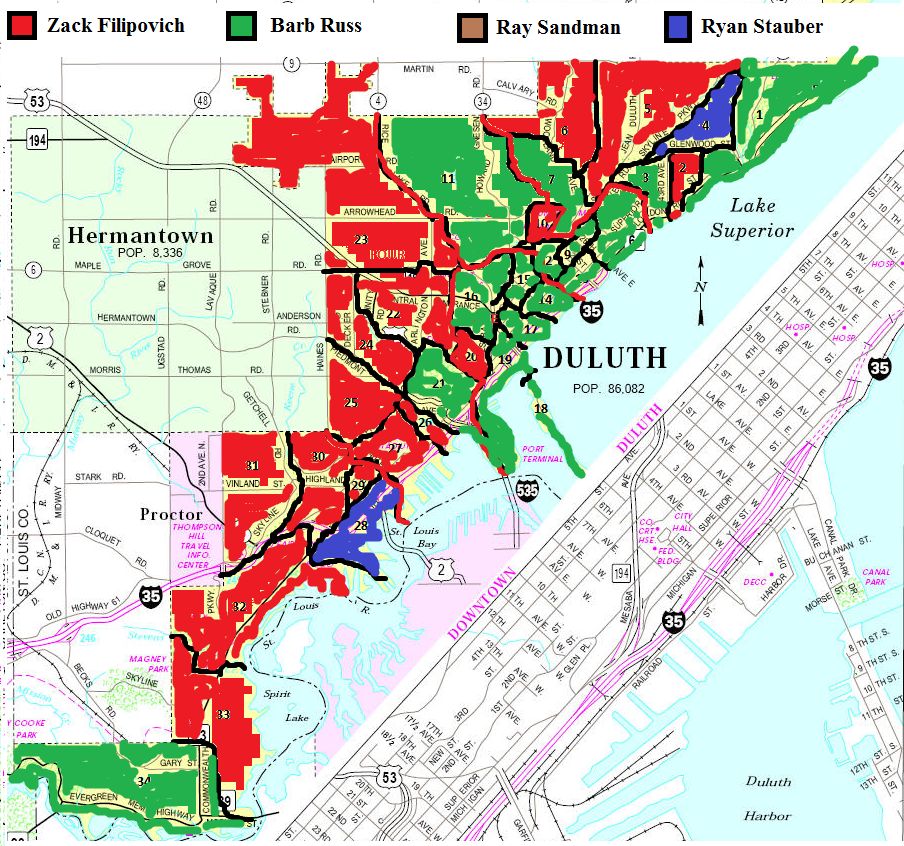
We’ll start with a look at the City Council At-Large race, in which I’ve mapped out the winners of each precinct using the wonders of Microsoft Paint:

City Council At-Large

Zack Filipovich, as you can see, had a very strong showing on the west side. As a recent college grad working in finance, Filipovich doesn’t really fit the blue-collar stereotypes one associates with the west side. Still, his campaign (whether by design or not) was certainly less explicitly liberal than Barb Russ’s, and since he’s young and fresh, he’s not really an establishment figure. Unlike Russ, he made a concerted push to get beyond the establishment, and campaigned out west. For that reason, I suspect he was able to generate a lot more support, especially in an election where voters could choose two candidates. Ryan Stauber was an easy first choice for Duluth’s more conservative voters, but I’d hazard to guess that Filipovich, who remained rather vague and upbeat in his campaign, was most likely to be their second choice. That coalition probably carried him to a lot of victories on the west side.

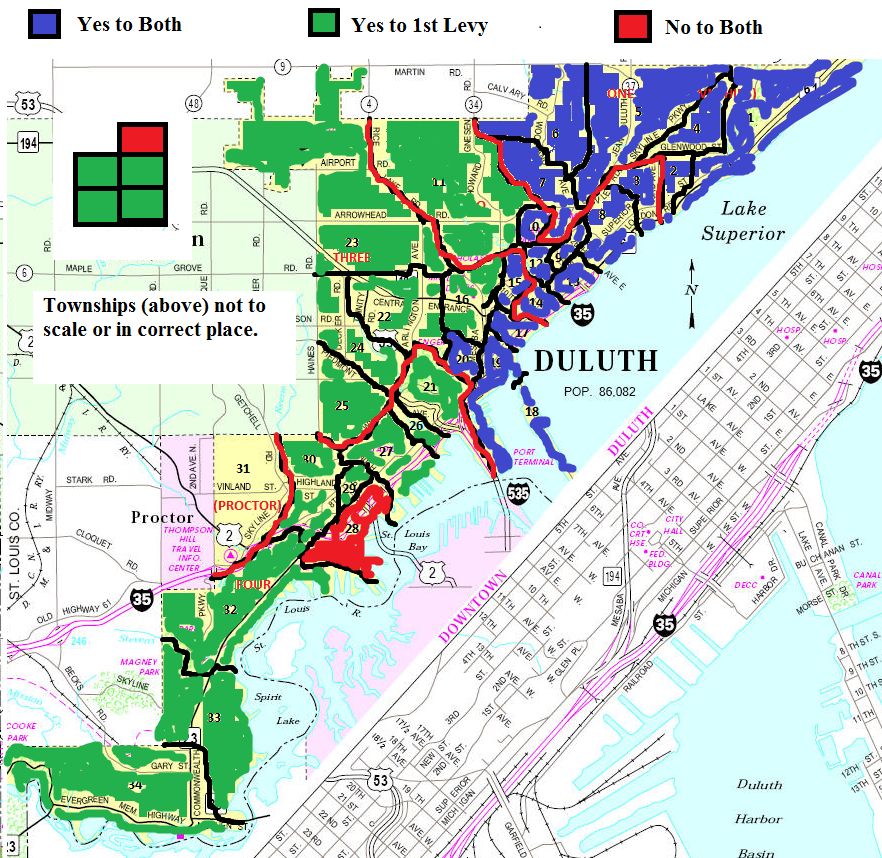
This anti-establishment-liberal pattern is even more distinct in other recent elections, with the west side being far less interested in sending more money to the city than the east side. In Ness’s first election, he won the east side and lost the west side to the more conservative Charlie Bell. Jay Fosle, the lone conservative on the Council, represents a far west district. Garry Krause, the recently-resigned conservative District Four councilor, was from the west side, and got a decent share of the vote despite having withdrawn from the race. If he’d stuck around, I suspect he would have won. If you want a map that really underscores this trend, though, take a look at the way the city voted on the school board levies:

School Board Levy Map

This really wasn’t a case of the city coming together to support the second levy. It was a case of the east side having just enough votes to drag the west side along with it.

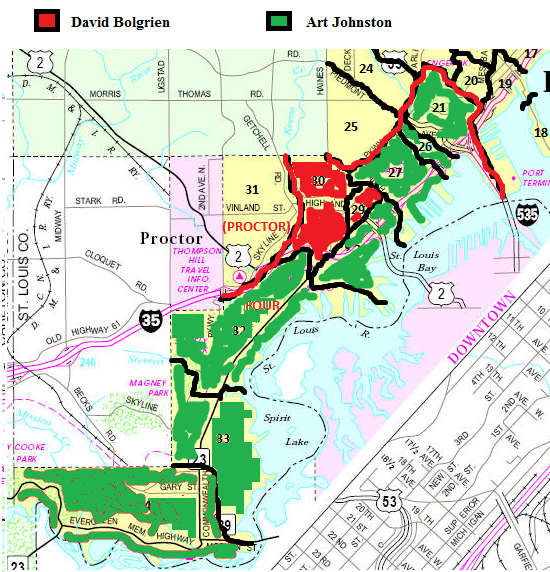
While much of the rest of the city is exasperated by anti-Red Plan crusader Art Johnston, he was re-elected to his far west side district. In the West End area, there seemed to be a lot of passion over the school board race: Bolgrien’s base of support was right around Denfeld High, and Johnston had a bunch of signs in the areas just beyond the Bolgrien core. Heading east into Lincoln Park, however, there were hardly any yard signs. Even so, Lincoln Park broke for Johnston. It wasn’t a vicious rejection of Ness and his School Board allies, but it was a clear one.

School Board Dist. Four

I rarely agree with Art Johnston, but to his very real credit, he too has acknowledged these trends. He posed the question to the Board at a recent meeting, perhaps not realizing that his own presence on the Board is a product of these trends: why does it appear that west-siders do not share the east side’s emphasis on education, and willingness to open the pocketbook to support it? No one answered him, and he deserves an answer.

Part of it may be demographics. The school-aged population is much higher on the east side, so more people have a stake in the schools there. East side voters, content with the generally high test scores at their schools, see the value in supporting the District, while west side voters, seeing more mixed results, may not. (I have never understood the logic behind giving struggling schools less money, but plenty of people explain their votes that way.) Perhaps most importantly, the west side has more people living on fixed or lower-middle-class incomes who are nonetheless not living in poverty or qualifying for many government support programs. Because of that, they tend to be less willing or able to handle a tax increase.  That fact can explain the fiscally conservative bent one sees in the west side’s city councilors, too.

But while socioeconomics may explain a lot of the divide, they are not destiny. To that end, it’s important to understand why a number of Duluthians (no matter which neighborhood they live in) may not be completely thrilled with Don Ness’s Duluth. For that, I’d point readers toward my post from a few months ago on Duluth’s future. It’s a long and meandering post, so I’ll summarize one key part here.

Under Ness, Duluth has made a concerted effort to reinvent itself. It has also made itself a desirable place for young people to live, harnessing its natural beauty and developing a decent artistic and culinary scene. (Yay, good beer!) It has spent a lot of money making itself attractive, and to date, I think that move has been reasonably successful. With the decline in U.S. manufacturing, it was necessary to take that stand and create a new brand for the city, and while I have my quibbles here and there, I’m largely on board with Ness. I was also a staunch supporter of both levies, and I believe world-class public schools are essential to this whole project. However, former Councilor Krause raised an essential concern, and one I am not sure the Ness camp has properly addressed: is Duluth’s interest in shiny, new things coming at the expense of the mundane? Yes, it’s great to attract new people, but what about those who have been here for a long time, and are simply trying to get by?

No matter how many elections Ness and Friends may win, these questions will still exist. They need to be magnanimous in victory, and recognize that simply cruising along with a mandate still leaves some people on the outside looking in. No, they can’t satisfy everyone all of the time, but no one should be left behind because they never got a chance to be heard.

Speaking of being on the outside, the lack of racial diversity here is also worth mentioning: after this election, everyone on the School Board and City Council will be white. This isn’t terribly shocking in a city that is over 90 percent white, and there were two minority candidates this fall who simply did not run very impressive campaigns. Mary Cameron had a very long tenure on the School Board, proving that minority candidates certainly can do well in Duluth. Several of the white elected officials have long histories of work with minority groups. Even so, there is a trend in modern American liberalism in which people politely acknowledge minority interests while doing little to actually address them. I’ve talked up the east-west divide here, but downtown can’t be lost in the shuffle, either.

This all brings me back around to “boring” government. Yes, boring government is certainly better than people screaming at each other nonstop, but there is a danger here, too. This quote from Councilor-Elect Howie Hanson in the October 29 News-Tribune comparing himself to his predecessor brings it out clearly:

“I think Garry [Krause] was a little frustrated because he was in the minority on a lot of votes,” he said, noting that Krause frequently found himself at odds with Mayor Don Ness’ administration and much of the council.

“If we’re going to move Duluth forward, I think you need to set aside your personal agenda and petty politics and get everyone on the same page,” Hanson said.

This bothers me somewhat, and I do not think it is an accurate characterization of Krause’s work, even if I didn’t always agree with Krause. Good governance does not involve everyone being on the same page and rubber-stamping one another’s proposals. It needs constructive, perhaps even heated, arguments. To its immense credit, the City Council has managed that in recent years; the School Board, on the other hand, has not, as it went from being a rubber stamp machine during the Red Plan days to a fractious and ugly war zone during Art Johnston’s first term. With Welty and a possibly conciliatory Johnston on the School Board, I have some hope that it might finally come to a healthy balance. The new Council, with its new left-leaning supermajority, must make sure it doesn’t fall into one of those twin traps that bogged down ISD 709 in recent years.

Duluth’s politicians have the potential to do some great things in the next few years, and the future is there for the taking. We’ll see how they do.

Duluth General Election Results and Comments, 2013

The results are in!

I’ll have a few more comments tomorrow once the city publishes district-by-district results and try to put everything in a broader context—complete with adventures in amateur map-making! I’ll also have more comments on the outgoing councilors and board members when their terms expire. For now, here are the results and their immediate implications.

Bolded candidates won. The numbers after the names are percentages of the vote, followed by the raw vote total.

City Council At-Large

Zack Filipovich 55.2 (9295)

Barb Russ 53.0 (8932)

Ryan Stauber 44.6 (7514)

Ray Sandman 14.2 (2398)

For a second straight election cycle, the DFL candidates march to a solid victory in the At-Large races. Stauber hung in there relatively well, but in the end was nine points behind the second of the two DFLers, a similar margin to his primary gap. The biggest surprise here was Filipovich leading the way: Russ had a large lead and a more obvious campaign presence after the primaries, and as Stauber is the only real conservative in the field and has some name recognition, I thought Filipovich might have a fight on his hands. Not so, as the recent UMD grad rolls into office.

City Council District Two

Patrick Boyle (I) 98.5 (2099)

As expected, the unopposed Councilor Boyle sails through, and also led the field in the District 2 County Commissioner primary. If elected to that position, the Council will appoint a replacement for the next two years.

City Council District Four

Howie Hanson 61.1 (1782)

Garry Krause 37.6 (1098) (withdrew from race)

37.6% is a fairly substantial vote total for a candidate who isn’t in the race, suggesting there were some misgivings with the otherwise unopposed Hanson, but he still heads into the Council after a stress-free campaign. My personal experiences with Howie have not been positive, but they were also in a very different context. I hope he proves a more skilled politician than he is a sportswriter, and I’ll give him a chance to prove he can be a good representative for this district, which could use some stability after running through an awful lot of councilors in the past few years. Due to the vacant seat, he’ll be seated at next Monday’s meeting.

City Council Big Picture: News flash—Duluth is a DFL town. With Stauber’s loss and Hanson replacing Krause, there is only one person on the Council now who really qualifies as a conservative in any sense of the word. Even in a liberal city, that’s quite the supermajority. I’ll have more on the dynamics of that sort of council tomorrow.

School Board At-Large

Annie Harala 56.9 (10648)

Harry Welty 39.3 (7342)

Nancy Nilsen 35.7 (6670)

Henry Banks 24.4 (4567)

No surprise in Harala’s big win, and as I suspected, Harry Welty’s uniqueness was enough to get him just past Nilsen. Welty comes into the Board following a somewhat ragged end to his campaign that included a weird ad and an awkward comment about gangrene in west side schools. As several letters to the Duluth News Tribune showed, a number of people do not trust this longtime Red Plan critic and former Board member. That said, I think he is a genuine person who simply has a habit of saying some tone-deaf things, and he probably deserves a fair amount of credit for getting otherwise skeptical people to vote for that second levy. If the other Board members approach him in good faith, he should be willing to work with them. Nilsen’s showing, which was decent but not good enough, shows Duluth’s continued mixed feelings about the Red Plan. Banks’s campaign had potential, but never did quite take off.

School Board District One

Rosie Loeffler-Kemp 56.1 (3220)

Joe Matthes 43.5 (2497)

After clearing 50% in the primary, it’s no surprise to see Loeffler-Kemp win, and her new seat is the culmination of 20 years of work in and around ISD 709. Matthes, meanwhile, ran a pretty strong campaign for a newcomer running against such a well-known figure. He seems to have a bright political future, and I hope he stays involved in ISD 709 affairs despite the loss.

School Board District Four

Art Johnston (I) 54.0 (1624)

David Bolgrien 45.7 (1374)

After a contentious race, Johnston emerges victorious and earns himself a second term. With the passage of the levies, his worry that the Board’s actions would cost it major public support were proven misplaced. To that end, it will be very interesting to see how he re-invents himself now that the Red Plan is fading into the rear view mirror. Will he take the passage of the levies as an opportunity to fix the various problems he sees in ISD 709 and attack them in concert with other Board members? Or does he think the voters were swindled by the Board, and does he continue to try to obstruct most everything it does? It’s his decision.

ISD 709 Levies

Question One: Yes 65.6 (12211); No 34.4 (6403)

Existing levy re-approved

Question Two: Yes 50.8 (9436); No 49.2 (9130)

New, additional levy implemented

It was a huge night for ISD 709’s bottom line, as voters approved not just the existing levy, but also the second one, for which I did not have high hopes. With more cash in hand and additional state aid on the way, the District should be able to pay off its debts and move to bring down class sizes. Education activists can’t just rest on this victory, though; they need to continue to work with the new school board to make sure the money is going to the right places.

ISD 709 Big Picture: It’s a bit of a split verdict here; while not unexpected given the lingering legacy of the Red Plan, it does have some interesting twists. Two of the Red Plan’s biggest critics are now on the Board, but their greatest fears have not come to pass, and they now have a decent amount of money they can use to attack the problems related (and unrelated) to the Red Plan. It will still require some important decisions, and with Johnston on the Board, things will never be boring. That said, this ISD 709 grad is feeling good about the direction of the District for the first time in a few years. While Duluthians are clearly demanding strong oversight of the Board, they also want to move forward, and the approval of the second levy shows a majority are willing to put the Red Plan behind them and do what they can to make Duluth public schools the best they can be. It’s a big win for Superintendent Bill Gronseth, whose gamble has paid off.

St. Louis County Commissioner 2nd District Primary

(2 advance to general election)

Patrick Boyle 34.4 (2389)

Jim Stauber 27.4 (1901)

Scott Keenan 26.9 (1868)

Cary Thompson-Gilbert 4.8 (333)

Boyle and Stauber, both sitting City Councilors, advance to the January 14 special election to fill the seat of the late Steve O’Neil. Boyle’s first place finish is no surprise; Stauber’s incredibly narrow win over Keenan, meanwhile, sets up a classic left-right showdown. Given the timing of the special election, there’s a healthy chance that turnout will have been better in the primary than in the actual election. That means that getting out the vote will be crucial for both candidates in January, as they look to build on their momentum. Stauber in particular will have to go to work if he wants to close the gap, as he doesn’t have a very large presence at the moment. Many Keenan supporters are up for grabs here; while Boyle would seem to be the favorite, his victory is not assured.

That’s it for now—check back for more tomorrow!

From Office Towers to the Horrors of Heroin: Duluth City Council Notes, 10/28/13

The Council Chamber teemed with life for its final session before the 2013 elections, with a large, chattering crowd on hand. Councilor Hartman was absent and “sick in bed,” according to President Boyle, leaving the Council with only seven members. Even so, they managed to pack a broad range of issues into a relatively short meeting.

The highlight of the night actually took place before the formal meeting, as Councilor Fosle made good on his promise to hold a Committee of the Whole meeting on heroin use in the Duluth area. Police Chief Gordon Ramsay was on hand to testify, and fielded questions on the spread of heroin, explaining the PD’s efforts to cut off supply lines from Chicago and Detroit and the troubles the city has with for-profit methadone clinics. Once the formal meeting started, six citizen speakers addressed the Council on heroin. They led off with a woman who gave a thorough overview of the drug in Duluth, telling of how addiction begins with people taking pain-killing drugs such as Oxycontin that are over-prescribed and often serve as a gateway. She attributed over 20 Duluth-area deaths over the past two years to heroin overdoses, and labeled it an “epidemic” that requires more education.

She was followed by two mothers of heroin addicts who shared jarring stories of their sons’ struggles. One said of her son that “she didn’t know who he is anymore,” detailing his addiction to painkillers starting at age 16 that led him to heroin and jail stints, theft, and no sober friends. She likened the experience to “watching my child drown, and there’s nothing we can do to change it.” The second explained the agony of being the mother of an addict, a life filled with nights of “tears and silent screams” given the lack of support networks, and the pain of having one’s child labeled as “scum.” The fourth speaker was a recovering addict who has been clean for three and a half years after roughly 15 years on heroin; she talked of how difficult it was to overcome the drug, and did her best to offer hope to the mothers who had come before her. A 22-year-old took the stand as the witness for her generation, which has been the worst-hit by heroin; she told of several family members and friends who have died in recent years. The final speaker emphasized the importance of prevention and treatment; while it is good to cut off drug suppliers such as Jim Carlson, he pointed out that removing the supplier does little to stem the demand.

After the meeting, Councilor Fosle thanked the speakers for their time, and invited the other Councilors to reflect on the stories and come back to him with their thoughts on what, if anything, the Council could do to fight the heroin epidemic. For a second straight meeting, he came across not as the rambling ideologue he occasionally seemed to be in the past, but as a powerful advocate for issues that might otherwise be missed. Councilor Krug suggested the Council hear more testimony from people working with addicts in schools, emergency rooms, and rehab centers to better grasp the issue. Councilor Gardner agreed, and said the root of the problem—prescription opiates—appeared clear. She hoped for further engagement with the medical community in the future.

The most involved piece of official Council business was an update on the construction of an office tower on the 400 block of West Superior Street by Mr. Chris Eng of the city’s Business Development office. He explained that the building, which stood 15 stories high in the initial plans, was now down to 10-12 stories. He detailed the funding sources for the project; $50 million of the $70 million project will be contributed by clothing designer Maurices, which will occupy much of the building, while the city will match an $8.5 million grant to cover most of the remainder. Councilor Fosle asked whether Maurices had a tenant lined up for its current location; a Maurices representative told him they had one for their main building, and were confident they could sell their other two locations over the next two years. Councilor Stauber grilled the project’s representatives on the finer details of the changes to their funding plans and received an assurance that the tower had letters of intent from several likely tenants for its retails spaces, though the tenants could not be disclosed at this point. Councilor Julsrud asked about the parking ramp, which has also shrunk in size now that the tower will not be as tall as first planned, and will not require bond money due to Maurices’ decision to front the payment.

The Council’s consent agenda passed unanimously. A measure that would have asked the state legislature to make it possible to remove withdrawn candidates from ballots was tabled, and the administration withdrew a plan to remodel a fire hall for further work. Councilor Stauber was the lone vote against the planned distribution of tourism tax revenue, though he didn’t explain why. Councilor Gardner introduced a City Code amendment to rename the American Indian Commission the “Indigenous Commission,” saying the new name was more inclusive. Councilor Fosle clarified that the term “indigenous” included numerous Asian and Pacific island groups, and the name change passed unanimously.

Next up was an ordinance funding a parking ramp at the Duluth International Airport. Councilors Julsrud and Fosle took care to emphasize the importance of the project, noting its minimal risk and its role in completing an important expansion for the airport, while President Boyle shared his personal horror stories of flying back into Duluth after a vacation to find his car plowed in and buried under half a foot of snow. The measure passed unanimously, as did two minor changes to permitted building types and sites. That wrapped up official Council business for the meeting.

In addition to her comments on heroin, Councilor Gardner used the final comment session to discuss recent controversy over efforts to remove homeless people sleeping in the “Graffiti Graveyard” beneath I-35 in downtown Duluth. She said she and President Boyle had recently attended a forum on poverty and learned that many people experiencing homelessness feel “less than legal” and fear doing things like coming before the Council to speak about their plight. She said she was looking at models used in Seattle and Providence, Rhode Island that might help empower these people to seek more help. Her comments wrapped up a brief but heavy meeting in which the Council did a thorough job of shining light on people who might otherwise slip through the cracks, yet still found time to push a pair of key economic development projects. Yet again, the Council proved an effective governing body, confronting issues that face a wide swath of Duluthians. We’ll see how well it can turn its talk into action, and how it evolves after next week’s election.

Duluth General Election Preview 2013

The Duluth general election is just over a week away. I’ve done a bit of driving around the city doing some completely unscientific counting of yard signs to see who appears to have an edge, but with local elections, it’s hard to get a really good feel on the situation without doing a lot of legwork. Turnout in the primary elections was low enough that things could still swing drastically on Tuesday the 5th.

Here is a Sample Ballot.

Polling Places and District Designations | Map

Here is a rundown on every race in the city; in this post, I try only to give neutral assessments on what each candidate’s election would mean for their respective bodies. Candidates are listed in the order of finish in the primary. Click their names to view their web pages, and if I missed a web page or if there’s a more detailed version than the Facebook pages I’ve linked to, let me know—I searched for everyone’s, but some didn’t generate results.

City Council At-Large

2 open seats

Barb Russ | Zack Filipovich | Ryan Stauber | Ray Sandman

Russ led the primary vote by a comfortable margin and has shown no signs of losing her momentum; she offers a crisply articulated version of Duluthian liberalism, and has a long history of community involvement. This likely sets up a showdown between Filipovich and Stauber for the second open seat; Filipovich had a stronger showing in the primary, but Stauber seems to have built some support since, and got himself a News-Tribune endorsement. Both are in their 20s, and their campaigns are a bit rough around the edges; Filipovich has a crisp image but is rather vague, while Stauber has more defined ideas but is rather scattershot in his presentation. While Filipovich appears more business-minded than your average liberal, this competition can easily be seen as a left-right competition; if Stauber loses, there will only be one Councilor who clearly qualifies as “fiscally conservative.” Sandman seems to have a decent base of support on the west side, but he also has a large gap to close, and his platform doesn’t really go beyond a vague call for living wage jobs.

City Council 2nd District

Patrick Boyle (Unopposed incumbent)

No excitement here, but Boyle is running for the Second District County Commissioner seat as well (see below).

City Council 4th District

Howie Hanson | The Ghost of Garry Krause

This race also appears to be a foregone conclusion, barring a massive protest vote from the residents of District Four in favor of the former Councilor Krause, whose name remains on the ballot despite his resignation in September. A Councilor Hanson would ostensibly tip the Council further left, though it’s hard to say much about him since he hasn’t had to run much of a campaign. If elected, Hanson would be seated immediately so as to fill the Council vacancy. All other people elected on Nov. 5 will be seated in January.

Edit from earlier version: I’ve updated the link above, which now leads to his Facebook page, instead of his blog.

School Board At-Large

2 open seats

Annie Harala | Harry Welty | Nancy Nilsen | Henry Banks

Harala was the top vote-getter in the primary by a decent margin, and has run a safe, positive, community-centered campaign since, earning plenty of endorsements. The wild card here is Welty; he leads the field in signage, has done a lot of legwork, and he’s also the only candidate who is attentive to the people still frustrated by the Red Plan, even though he supports the levies. I was going to say he’d run a textbook campaign until I saw his bizarre, paranoid ad in this past week’s Reader. (Judge it for yourself here–yes, this was a print advertisement.) This is what you get with Welty: doses of nuance and political acumen coupled with rambling attempts at honesty that, while well-intentioned, can be rather head-scratching, to say the least. His foil here is Nilsen, an unabashed Red Plan supporter who wants to finish the work from her first term on the Board. (I couldn’t find any web presence for her.) As with Sandman in the City Council race, Banks had a chance to give the Board some real diversity; his candidacy was slow to generate much momentum and remains on the vague side, but he does seem to have increased his presence in the past few weeks.

School Board 1st District

Rosie Loeffler-Kemp | Joe Matthes

Loeffler-Kemp cleared fifty percent in the primary, but Matthes has run a strong campaign since, with thorough answers at forums, a lot of door-knocking, and a News Tribune endorsement. Loeffler-Kemp has over twenty years of experience in school affairs, though, and that is quite the mountain to climb. Either way, this district has two of the stronger candidates out there, and the winner will have earned the position.

School Board 4th District

David Bolgrien | Art Johnston (incumbent)

Polarizing Board Member Johnston faces a serious challenge in this race; the third candidate in the very tight three-way primary has endorsed Bolgrien, a longtime education activist on the west side. Johnston has spent the last four years as a protest vote against anything Red Plan related, but now is attempting to walk the fine line of claiming he can be a voice of reason despite his burned bridges on the Board. Diverse voices are all well and good, but Johnston’s challenge is to prove he can offer something of substance and actually build a coalition on the Board to support his views. He is the only candidate in any School Board race who opposes the levies.

School Board Levies

“Yes” Vote Page

There are two ballot questions. The first renews an existing operating levy; its failure would lead to a budget shortfall, likely necessitating deep cuts and class sizes ranging up toward 50 students in a room. The second raises property taxes by approximately $4 per month on a $150,000 home. ISD 709’s stated purpose is to use this money to lower class sizes; if passed, Superintendent Bill Gronseth claims they will be lowered by 4-6 students across the board. Yard sign counts aren’t of much use here since there isn’t much of an organized “no” campaign; if forced to speculate I’d say the first question has decent odds of passing, while the second faces a bit more resistance.

The “yes” vote has built some momentum in recent weeks, with endorsements from the News Tribune, the Chamber of Commerce, and Mayor Don Ness; and also thanks to yeoman’s work by some of the School Board candidates in their door-knocking for their own campaigns. Several people related to the Tea Party and longtime School Board critics have mounted some public resistance, however. They claim taxes in Duluth are high enough as it is, and that the Board’s behavior during the Red Plan means it is untrustworthy, and may not direct money where it is most needed (into classrooms to fight the large class sizes). The “Vote Yes” crowd counters this claim by pointing out the small size of the tax increase and across-the-board support for smaller class sizes from all of the pro-levy Board candidates.

St. Louis County Commissioner 2nd District Primary

Patrick Boyle | Scott Keenan | Jim Stauber | Cary Thompson-Gilbert

Following the passing of Commissioner Steve O’Neil in July, residents of the east side of the Duluth will go to the polls to select the two candidates who will advance to the January 14 special election. The field for this seat is loaded, as all four bring plenty of experience to the table. Based on a lawn sign count and general knowledge of the east side’s proclivities, the two frontrunners appear to be Boyle and Keenan. Councilor Boyle is the O’Neil family’s desired successor and a liberal champion, while Keenan doesn’t really fit an ideological label, having shown streaks of fiscal conservatism and environmentalism during his two terms on the Council and during his tenure on many local boards. Outgoing City Councilor Jim Stauber is the most conservative voice in the field, though he isn’t exactly a confrontational one; if elected, four of the five members of the County Board would lean toward the right. He doesn’t have any noticeable lawn sign presence, though he does have plenty of name recognition, and with his son on the City Council ticket, the Staubers have the potential to have a big night. Thompson-Gilbert is the only candidate who hasn’t served on the City Council, though her husband (Greg Gilbert) has, and she has a solid résumé of community activism. Adam Jaros and Nik Patronas are both on the ballot, but have withdrawn their names; Jaros endorsed Boyle, while Patronas exited for health reasons.

That about sums it up. Get out and vote no matter who you support, and stay tuned for results and analysis after the election.

A New Counterweight: Duluth City Council Notes, 10/14/13

First off, I’ve gotten some very good responses from a number of people on my last post on charter schools. There will be a follow-up in the not-so-distant future. I appreciate the comments and welcome them from any perspective: please, make use of the comment boxes, or if you know me personally, get in touch through email or Facebook. I love the dialogue and I’m willing to answer to just about any sort of critique or question.

The Duluth City Council was in a rather festive mood as it kicked off its first meeting in three weeks. There was a warm energy in the council chamber at the start, and for good reason: as several Councilors noted, the city has won two major victories in recent weeks, with perpetual headache Jim Carlson convicted on 51 of 55 counts for his sales of synthetic drugs in federal court, and the city winning a substantial sum in a settlement with the Fon Du Luth Casino; while neither case is totally settled, things look good on both fronts for now.

The goodwill dissipated fairly quickly when Councilor Krug, who was absent at last week’s meeting, took the other Councilors to task for their inability to fill former Councilor Garry Krause’s vacant seat. (Details here, in last meeting’s write-up.) She wondered why, after Mr. Eckenberg announced his disinterest in filling the seat for only two meetings, they did not then appoint the other applicant to the seat, Mr. Radzak, whom they had all deemed qualified. She also opined that Atty. Johnson had erred; while he did correctly interpret the city charter, she said state statutes should have clarified the situation. Councilor Gardner agreed with her, and the two agreed to work to correct any future issues. Councilor Larson, with assist from Councilor Fosle and CAO Montgomery, updated the city on the efforts to re-route logging trucks off of Superior Street.

Councilor Krause’s seat came up again during the public comment session, as two citizens lashed out about the lack of representation for District Four. Former police lieutenant Peggy Johnson plugged the launch of the Duluth Police Foundation this Thursday at 5:00 at Clyde Iron. Mr. Rich Jaworski of the Duluth Children’s Museum and eight kids, most of middle school age, came forward to share the story of their radio conversation with astronauts aboard the International Space Station; the Councilors all melted into their sweetest smiles as the kids talked, and Councilor Julsrud snapped some pictures.

There were also two citizens who seemed rather confused over which political body they were speaking to. One man ranted about the luxurious expenses accrued by President Obama and IRS employees while the national debt grows, while our old friend Mr. Loren Martell shared some “facts” about the school board levies on this fall’s ballot. This is the City Council, not Congress or the School Board, people. But, hey, I guess they got themselves on TV.

After that, it was back to business. The consent agenda sailed through, 8-0, and a few resolutions were pulled back to administration. A resolution to appoint Mr.  James Williams as Director of Public Administration did draw some dissent from Councilor Fosle; while he was quick to say that he had no issues with Mr. Williams himself, he said the position was not necessary. He claimed it had been created a few years prior to give a former CAO a job, had an exorbitant salary, and just created more “top-heavy” bureaucracy. Councilor Gardner said she had been a bit skeptical as well, but had been reassured of the position’s value. Councilor Krug grumbled that the city should have made a stronger effort to retain the former occupant of the position, an African-American woman, and also complained of the lack of women in the Administration; CAO Montgomery countered both charges. The resolution passed with Councilor Fosle as the lone “no” vote.

Next up was a resolution authorizing the dumping of snow at a spot owned by the Economic Development Authority by the harbor, as has been done in recent years. Councilor Stauber announced his opposition, as he thought dumping snow filled with road salt next to a waterway was a bad idea; CAO Montgomery countered by saying the snowmelt at least filtered through the ground when dumped there, whereas it would go straight into the water as runoff if simply left where it was. Councilor Fosle also asked for updates on the search for a new spot to dump snow, and wondered why it all had to be put in one place. The resolution passed, 5-3, with Councilors Fosle, Gardner, and Stauber all opposed.

After Councilor Stauber shared a nice story about the Police Department’s bomb-sniffing dog, which had some grant money approved unanimously, the Council had another debate about the cross-city Duluth Traverse bike trail. Mr. Adam Sundberg of the biking group COGGS spoke in support of the measure, which accepted $2.4 million in grant money for the project. Councilors Larson and Julsrud affirmed their support and said this grant money offered a unique opportunity, while Councilor Stauber pressed CAO Montgomery on the $575,000 the city might have to pay in order to supplement grant money. CAO Montgomery explained that the city might not need to pay all of that money, and said it could be bonded or pulled from parks capital funds. Councilor Fosle echoed Councilor Stauber’s worries, saying “this whole trail thing is getting out of hand,” and wondered about future maintenance costs. He said the city already had bike trails, that the cross-city trail was not a practical commuting route, and wondered why bicycle trails were supported while things his constituents had told him they wanted, like ATV and snowmobile trails, were neglected. Rising to the occasion, he explained that he was simply trying to be the voice of people whom the other Councilors might not be hearing from. Councilor Hartman again tried to insist this was not a “trails versus streets” issue, while Councilors Krug and Gardner said the trail debate shouldn’t be seen as a zero-sum game between bikes and motorized recreation vehicles. The resolution passed, 6-2, with Councilors Fosle and Stauber in opposition.

Everything else on the agenda was either tabled or passed unanimously. In the closing comments, Councilor Julsrud brought forward a representative from the airport who will be lobbying for a new parking ramp in the coming meetings, and Councilor Stauber gave an update on school speed zones along city streets. A number of the Councilors said they were willing to work with Councilor Fosle on some sort of effort to satisfy snowmobilers and ATV riders.

This was an interesting meeting to watch, as the Council now lacks Garry Krause, who had been among its more active members. I’ve often described the Council as having a liberal-conservative split, but to the Council’s credit, the debates here often go beyond a simple left-versus-right war. While Councilor Krause was a well-spoken leader for the fiscally conservative minority who also was willing to compromise, I often sang his praises because he brought a different sort of opinion forward. I especially liked his characterization of himself as the defender of the “mundane and boring,” and his ability to raise some unique questions about the Administration’s new projects and march of “progress” helped make sure that the Council never fell victim to groupthink or narrow ideological divides.

With Krause now out of the picture, I wondered if anyone would fill that void; Councilor Gardner often does a good job of this from the liberal side, but I wondered if the more conservative members would be able to find their own counterweight. Councilor Stauber has a fairly similar temperament but is more soft-spoken and will retire in January, and I’ve had my doubts over Councilor Fosle. Councilor Fosle has never seemed very keen on compromise, and as I’ve noted numerous times, his criticisms can seem to come out of left field. More than once, I’ve had the impression that his sparring partners think he is just blathering so as to distract people from the issue at hand.

This time, however, there were real signs of maturation, and Councilor Fosle may yet emerge as a conscientious critic. Yes, his speeches still wander occasionally, and yes, some things he says come off as hyperbole. A few weeks ago, I called Councilor Fosle’s claim that the city should be worrying about heroin and ecstasy instead of e-cigarettes a “red herring.” After this past meeting, I’ll give him real credit: this wasn’t just some attempt to distract the debate. The last few minutes of the comments section were spent making plans to discuss the issues these drugs create in Duluth. Councilor Fosle is arranging for a number of community speakers at the next Council meeting, and described rises in the consumption of both drugs, often paid for by desperate people with food stamp EBT cards. He also suggested the Council educate itself on krokodil, a new drug which, if you haven’t heard of it, is absolutely frightening: as Councilor Fosle described in vivid terms, it is a cheap version of heroin that causes flesh to fall off, is often fatal, and is now on the rise. Councilor Fosle may frustrate at times, but he has a knack for picking up on things that other people don’t necessarily see, and talking to people who may not otherwise get a spot at the table. His concerns are genuine, and I’m curious to see how he evolves in future meetings. After a messy meeting last time around, the Council was back to looking like an effective, consensus-building body that also includes some diversity of opinion, and a quick glance at the other political bodies out there “operating” right now is a good reminder that we shouldn’t take this sort of thing for granted.

A Long and Awkward Good-Bye for Councilor Krause: Duluth City Council Notes, 9/23/13

It was an odd night at City Hall. The crowd was modest in size, there were no citizen speakers, and there were no grave disputes between the Councilors beyond the usual, civil back-and-forth. Yet somehow, it also wound up being the ugliest meeting I’ve seen since I started attending them. It was also the end of an era, so to speak, as Councilor Krause’s resignation was set to take effect after the meeting; indeed, his departure was at the root of the evening’s troubles. The Council’s bloc of fiscal conservatives has now shrunk from three to two, but the frustrations had nothing to do with Councilor Krause’s principled stands, nor the ideology of his successor. In fact, thanks to a heap of Council confusion, he has no successor.

President Boyle began the night by convening a special meeting to appoint Councilor Krause’s replacement, in which Councilor Krause was not allowed to participate. (Councilor Krug was also absent, leaving the Council with seven voting members for the special meeting.) President Boyle announced that the Council had interviewed two candidates, Mr. Zachary Radzak and Mr. Gary Eckenberg, found them both impressive, and invited the Councilors to share their opinions on each.

Councilor Stauber went first, but instead of endorsing one of the two candidates, he shared his serious concerns about the selection process. He was upset there had been no public hearing, that the process was being conducted via resolution (and hence technically open to a veto by Mayor Ness), and thought it was pointless to appoint someone only until the November 5 election. Councilor Gardner defended the process, saying it had worked for past vacancies (including two for Councilor Krause’s 4th District seat in the past four years), and while she agreed there was room for improvement, she said it would have to do for this particular situation. She then endorsed Mr. Eckenberg for the position, as he is a past member of the Council and would be able to hit the ground running.

Next, Councilor Fosle demanded an answer as to when the appointed Councilor’s term would end. City Attorney Gunnar Johnson replied that the Council would sit the person elected in November at the next Council meeting; it was his interpretation that past Councils had violated the City Charter in not doing so. Satisfied, Councilors Hartman, Julsrud, and Larson all told Mr. Radzak he was an impressive candidate, but expressed their support for Mr. Eckenberg.

At that point, Mr. Eckenberg came forward, held a whispered conversation with Atty. Johnson, and then took the stand before the Council. He said he had been under the impression that the person appointed to fill Councilor Krause’s seat would stay on the Council until January, when the Councilor elected to the seat in November would normally take office. A one-month appointment, he said, made zero sense, and would not allow him to do anything of substance. The 4th District could survive for a month without representation. He thus withdrew his name from consideration.

This rather understandably threw off the entire meeting, and Councilor Boyle brought forward yet another confusing point: Councilor Krause’s name will appear on the ballot in November, and if he were to win, the seat would then be his. If that were to happen, the Council would need to go through the re-appointment process yet again. Councilor Fosle asked if the resolution could be amended to allow Mr. Eckenberg to serve until January, but Atty. Johnson said it could not, as that would be a violation of the Charter.

For his part, Councilor Stauber was rather pleased with this development. He agreed that a one-month appointment did no good, and that the Council could simply appoint someone to fill the seat if Councilor Krause were to win. This irked Councilor Gardner, who said there was nothing “simple” about the whole process. She accused Councilor Stauber of selective interpretation of the Charter, which insists that vacancies on the Council must be filled in a timely manner. She implored Mr. Eckenberg to reconsider his position, but Mr. Eckenberg politely declined, saying he had been misled about what he was applying for.

An exasperated Councilor Julsrud apologized to Mr. Eckenberg, and suggested the Council pull the measure and follow Councilor Stauber’s suggestion. Councilor Hartman disagreed, admitting a one-month appointment made “no sense,” but that, due to the Charter, “sometimes we have to do things that make no sense.” The Council, however, chose to make sense. It pulled the resolution, 4-3, with Councilors Fosle, Julsrud, Stauber, and Boyle in support. Councilor Krause’s seat will thus remain open until after the November election.

With this sloppy affair mercifully over, the Council kicked off its actual meeting, in which CAO Montgomery began by presenting Councilor Krause with a plaque thanking him for his service. Councilor Krause in turn thanked him, the Council, the City Hall staff, and the city employees who are on the front lines of resolving city problems. The consent agenda then passed, 8-0. A resolution creating a pedestrian underpass under Haines Road passed, 6-2, with Councilors Fosle and Krause complaining about unnecessary expenditures.

The major topic of debate for the meeting proper was a plan to finance a phase of construction of the cross-city trail. This particular section, extending from Canal Park to 30th Avenue West, would cost $1.3 million, though a chunk of that sum would be paid by federal and DNR grants. Once again, there was some exhausting bureaucratic wrangling, as the ordinance authorizing the bonds to pay for the project and the resolution awarding the contract were in an illogical order on the meeting agenda. Once Atty. Johnson resolved the confusion, debate ensued.

To no one’s great surprise, the Council’s three fiscal conservatives shared their doubts about the plan. Councilor Krause called Duluth a “large city with many cities in it,” whatever other people might try to say, and that the residents of his district appeared not to value the trail as much as the still-shuttered community centers. (This phase of the project is primarily in Councilor Krause’s district.) He and Councilor Stauber questioned the wisdom of incurring more bonding debt when the city had already taken on more debt over the previous year; CAO Montgomery countered by saying the city had reduced its debt since 2007. Councilor Fosle went so far as to challenge the Council’s power to use bonding to fund trails, but both CAO Montgomery and Atty. Johnson refuted his point.

Councilor Hartman pushed CAO Montgomery for more details on the other funding sources, and he replied by saying that roughly 70% of the project would be paid for in grants. The project, he argued, was a good way to leverage the city’s money, as it turned $450,000 worth of money into $1.8 million in trails, whereas using that same $450,000 on streets would only result in $450,000 worth of street improvements. He also noted the value of trails as a tourist attraction, and Councilor Hartman added that commuters using the trail reduced wear and tear on the streets.

Councilor Krause said all of this leveraging was well and good, but in the end it still added to city long-term operating costs, and he therefore could not support it. Councilor Stauber repeated his dissatisfaction, and Councilors Fosle and Gardner both complained about the inadequate map they’d been given of the plans. Mapping issue aside, both measures related to the cross-city trail passed, 5-3; predictably, Councilors Krause, Stauber, and Fosle were the dissenters.

The Council wrapped up its business with the unanimous approval of a zoning reclassification, and a brief but contentious meeting came to an end. In the closing comments, Councilor Hartman pleaded that Atty. Johnson inform the Councilors of changes in interpretation of the City Charter before the meeting if at all possible, as the evening’s developments had left them in a “very awkward position,” and “didn’t look good.” Once again, his closing comments accurately summed up the mood of the meeting, in which dysfunction over Councilor Krause’s seat overwhelmed any substantive achievements later on. It was also an unfortunate end to Councilor Krause’s tenure on the Council; while I have to respect him greatly for his reasoned critiques and attempts to compromise, this entire process was not pretty, and the timing of his departure was poor, to say the least. The eight-member Council will now have to press on without him, and must clearly find a way to streamline its process for appointing replacement Councilors. Duluth deserves something far cleaner than what it got in this meeting.

Comments on Duluth Primary Election Results

Ah, the joys of local politics: I turned on the TV to watch for immediate candidate reactions and such on the late local news, but everything had been pushed back due to President Obama’s speech. Turns out the network executives think the possibility of the U.S. blowing up some other country is more important than the fate of unserviced bond debts on city street repairs. Their loss, I suppose.

My pre-election comments on the candidates: City Council | School Board

Complete results are available here. Turnout was a bit on the low side (by Duluth standards), even for a local primary in a non-mayoral election year. You can look at past Duluth election results here.

City Council At-Large (Top four advance; numbers are percentage of vote, followed by total number of votes)

Barb Russ 35.8 (3943)

Zack Filipovich 28.0 (3081)

Ryan Stauber 20.8 (2295)

Ray Sandman 10.7 (1175)

Ray Whitledge 4.8 (525)

It’s no surprise to see Russ roll here, and with Filipovich in a comfortable second, it was a good day for the Duluth DFL. Stauber, though in third by a wide margin over Sandman, has to close a fairly substantial gap over the next two months, and as I explained in my initial comments, his campaign needs a much more polished and convincing pitch. It’s no great shock, but Whitledge struggled to garner much support, and since he was already such a niche candidate, I doubt his small number of supporters will sway the general election much. Conservative Duluthians will almost certainly unite behind Stauber now, and it will be interesting to see how much momentum they can generate, and who—if anyone—his supporters will pick with their second vote. Sandman made the cut, but has little hope of doing much else aside from conceivably playing a spoiler role.

School Board At-Large (Top four advance)

Annie Harala 25.8 (3028)

Harry Welty 19.1 (2246)

Nancy Nilsen 17.7 (2073)

Henry Banks 16.4 (1926)

Loren Martell 10.9 (1283)

Joshua Bixby 10.1 (1190)

Harala’s strong showing has her on the inside track for a seat on the Board; the margin was small enough that she isn’t a completely sure bet, but I don’t really see two of the other four finalists passing her. After Harala, it gets interesting. Perhaps it’s name recognition; perhaps it’s the strength of personal ties in a local election, but I was a bit surprised to see such a large gap between the two former Members (Welty and Nielsen) and the two insurgents (Bixby and Martell). I’d hazard to guess it will come down to a race between Welty and Banks for the second seat. Given her ties to the Red Plan, I don’t think Nilsen has a very high ceiling, nor is she likely to gain many votes from the supporters of Bixby or Martell—though, granted, she has surprised me somewhat already by finishing ahead of Banks in the primary. Banks has the DFL machinery behind him, which could help boost his turnout substantially. Welty, on the other hand, is by far the most likely to pick up any disaffected Bixby or Martell voters who didn’t already vote for him. On a night when most of the Red Plan critics didn’t do especially well, Welty had a strong showing, suggesting that the voters of Duluth did a pretty good job parsing out the intelligent critics with strong education backgrounds (Welty) from those who didn’t quite meet those standards (Martell). I ranked Banks ahead of him in my preview post, but with the semi-critical voice I supported (Bixby) out of the race, I am going to give Harry a chance to convince me. Ridiculous as he can be at times, I do think his heart is in the right place, and the Board could use a critic who is not Johnston-esque.

I voted for Bixby, but I’m not terribly shocked by his last-place finish. He’s new to the Duluth political scene, his campaign didn’t have a very big presence, and while I appreciated his nuanced stances, I can understand how some voters might come away unsure of what he actually stood for. I hope he continues his involvement in Board affairs, despite the loss. Martell, meanwhile, has been whacked in both elections in which he has run. We’ll see if he continues his monthly crusades at the Board meetings.

District 1 (Top two advance)

Rosie Loeffler-Kemp 53.7 (1086)

Joe Matthes 26.0 (526)

Marcia Stromgren 20.3 (410)

As expected, it was smooth sailing for Loeffler-Kemp, who cleared the 50% mark in the primary and would probably have to get herself caught up in some sort of scandal to lose at this point. Considering the opposition, Matthes had a reasonably good showing, though his odds of moving beyond this point are low. I was most interested by Stromgren’s low total here; after all, she did garner 46 percent of the vote in the general election for this seat four years ago, albeit against an incumbent (Ann Wasson) whose hands were all over the Red Plan. As with Martell, I’d say the writing is on the wall for her future in School Board affairs. They raised their ruckus, but as cathartic as that may have been, their anger probably marginalized them in the eyes of voters who saw them as extremists. Once a person has that label, it’s difficult to shed it, and unlike Welty, neither one of them showed much in the way of political savvy.

District 4 (Top two advance)

David Bolgrien 37.6 (463)

Art Johnston (I) 33.4 (411)

Justin Perpich 28.9 (356)

The race I named the most interesting lived up to its billing, with roughly 50 votes between each of the candidates. Considering how polarizing Johnston is, the odds are that the Perpich supporters are more likely to jump on the Bolgrien bandwagon. If I were a betting man, I’d say that Johnston needed to win this primary by a reasonable margin to retain his seat, and is now in serious trouble. But as in the all the races here, it’s hard to know what increased voter turnout will do in the general election; has Johnston already hit his ceiling, or are there a lot of disaffected people on the west side who will come out of the woodwork to support him in the main event? There are a lot of votes potentially up for grabs amongst the Perpich people, and to win them over, Johnston would probably have to change his tone somewhat. I don’t think he has much interest in doing that, which means that School Board meetings could be a lot more boring come January. A lot more boring, and a lot more constructive.

***

Still, this is all idle speculation: the voters will decide things on November 5. We’ll see if there are any surprises in the meantime.

I had some ambitions of trying to tie the primary results to my “Duluth’s Future” post from a few weeks back, but I don’t think the results offer anything too conclusive, so I’ll wait until after the general election. There are some possible trends here, but nothing concrete. Stay tuned.