Give me a beach, a little pocket of beach, alive with a congenial crowd but far from where the cruise ship tours dump their loads. Give it a white sand apron, a few reefs off the shore, some swells further out to tempt the surfers. Give it a little open-air bar or two, a place to grab a beer as the smell of barbecued meat wafts down to the water. A couple trees to hang a hammock, a gentle breeze to sway it; let me melt into the beach, suspended in paradise.
I write these lines in a hammock on Hull Bay on the north shore of St. Thomas, in the United States Virgin Islands. The world intervenes to befoul an attempted cousins week here, but cousin Rob and I join Uncle Chuck and Aunt Monica for a few days at L’Esperance. I have been to St. Thomas seven times now, and my last time here, an extended stay, gave me some lay of the land. I am now a capable left side of the road driver, comfortable running the one stoplight all the locals ignore and no longer in a state of terror shooting up Flag Hill on a one-lane, two-way road with no guardrail between the rental car and a dramatic plunge. I know the ins and outs of some of the beaches, and I almost know where to find the dishes in the L’Esperance kitchen. These islands have become my most regular destination outside of my usual Upper Midwest haunts.
The Virgin Islands are predictable in their unpredictability. This time, here with the villa’s owners, I get a sense of just how much work it takes to keep up L’Esperance in a place where island languor seems so very real. Refrigeration is a struggle, repairmen do not show; the invasive plants slither inward. The power cuts, the solar panels and battery walls pressed into service. A venture to the grocery store takes on an air of intrigue: just what will be in stock today? But every glance at the view is a reminder of why we do it.
Paradise comes with a price, as all fine things must. A spin through the center of the island drives home how much the territory remains a colonial outpost, an outside world dropped on to hilltops and beaches and the rest put to its service. The locals are agreeable but operate on their own timetables, by their own values. The continentals who have settled here bear a sun-weathered satisfaction, resigned to their fates as things move slowly and break and occasionally get wiped off the map by a hurricane, but content with where they are. The siren song of tropical bliss echoes across the hillsides, audible often enough to sustain an eternal dream. That lotus-eating life would leave me restless on a longer stay, but over a week I find just the right level of contentment here.
Neighboring St. John remains a garden of beauty, a reason I would return here even if I did not have L’Esperance in my life. On our first full day on the islands together, Rob and I ferry over and do part of the hike that most mesmerized me four years ago: Leinster Bay, Windy Hill, and up over the sharp ridge on the Johnny Horn Trail down to stellar barbecue and a beer at Johnny Lime in Coral Bay. The sweat pours out on the return march over the ridge, and we take the plunge at Maho Bay to rinse it all away. We are waylaid by goat herds in both directions on our hike, including a dozen lounging at the start of the climb up from Leinster Bay and a leisurely family chewing its way along the lower reaches of the Johnny Horn on the return journey. New meaning for running on island time.
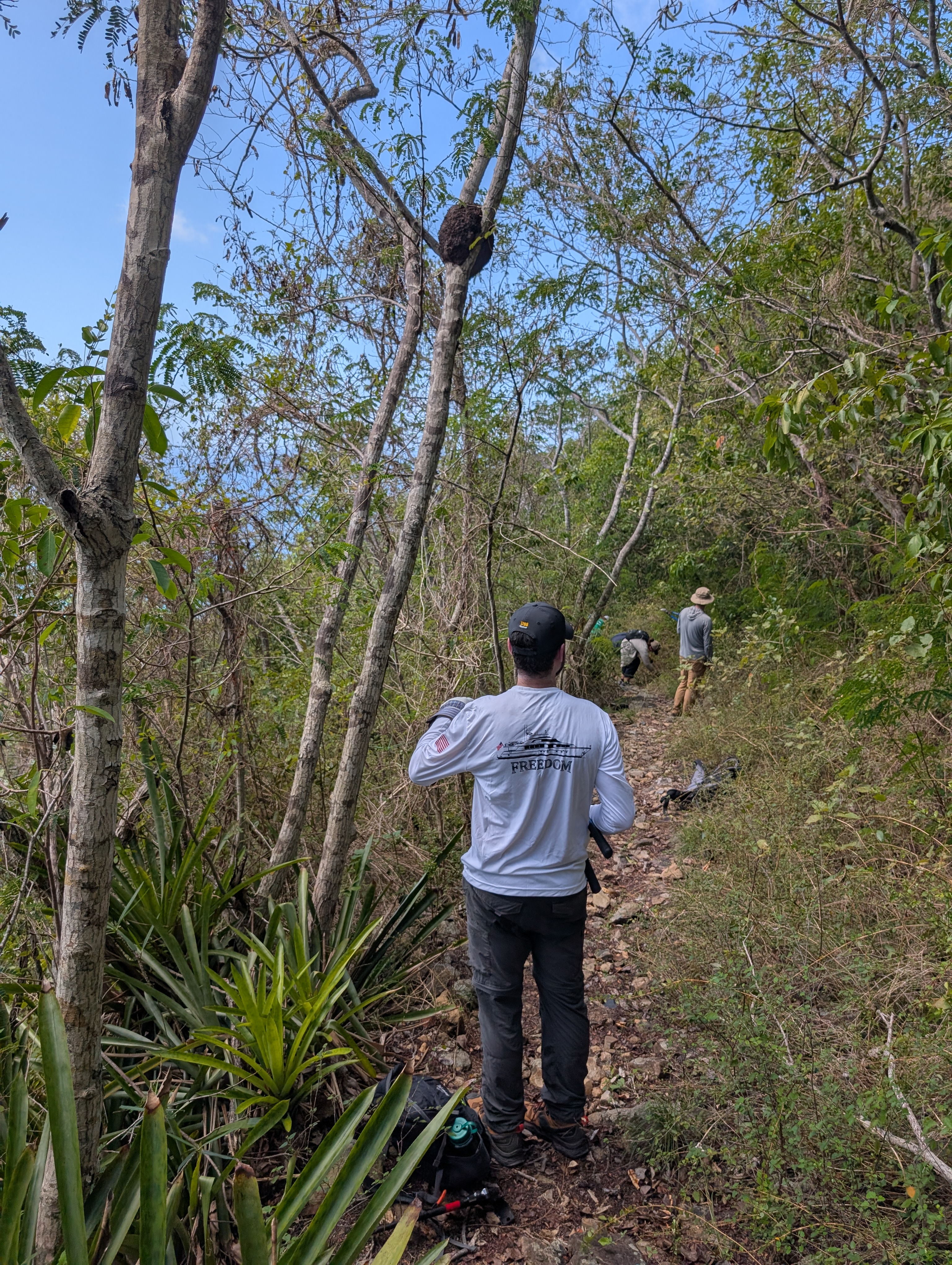
On a second visit to St. John we fill a 14-passenger van with people who think getting scratched up by catch-and-keep while sweating in the tropical sun is fun. Our crew has signed up to clear out the ever-advancing tropical brush on the Bourdeaux Mountain Trail, a path running from the island’s high point to the sea down the hotter, drier south side of the island. Frank, a sharp kid from Colorado and a volunteer coordinator with the Friends of the Virgin Islands National Park, appreciates the weirdness necessary to aspire to such action, and we hack away to free future hikers from encroaching thorns. Rob and I chat up some younger women who have traveled here together, spending a week in a camp at Cinnamon Bay to follow Frank’s commands. The talk fixates on adventures past and future and Rob notes our shared masochism, this pursuit of sweat and exertion to uncover new paths under the tropical sun.
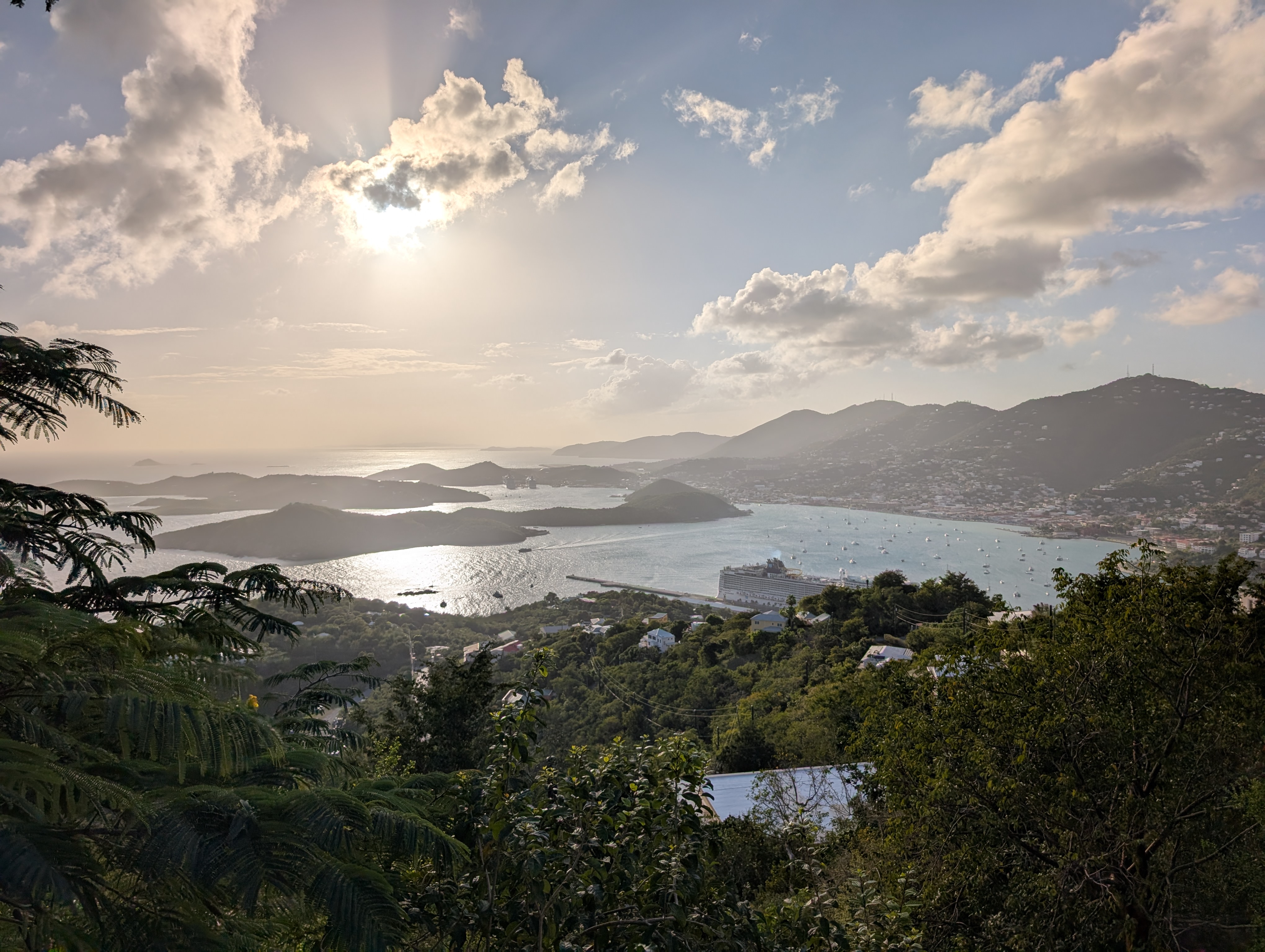
Trail work is my only labor during my time in the islands, and I otherwise succumb to island routines. I burn my skin, apply the aloe, rinse in the pool. The happy hour bell dings and we assemble in the great room for cocktails or wine as the sun plunges into the horizon beyond the Charlotte Amalie harbor. We alternate eating in and venturing out to some restaurants that deliver the goods: Mims, Oceana, Cuvee, with special credit to those who offer elevated cuisine and good wine in a place at the end of the supply chain. Conversation winds down and we turn to books or word games or a few rounds of Rummikub. Stay up late, sleep in a spell, use the exercise room or swim some laps to avoid total sloth. I get some time to think, to write out some stray lines, to ponder how best to meld passions and realities.
On my final full day I head to Hull Bay a second time. Through some great failing I have left my writing tablet back in Minnesota and so I am consigned to pen and paper, allow my thoughts to drift in slowly like the bay’s gently lapping waves. I return to past writings and mantras, write them anew, wonder if I can distill them into some sort of credo or code for moving through the world. I feel like I am circling a destination on a windy island road, sometimes driving on the wrong side but nevertheless getting closer, ever closer.
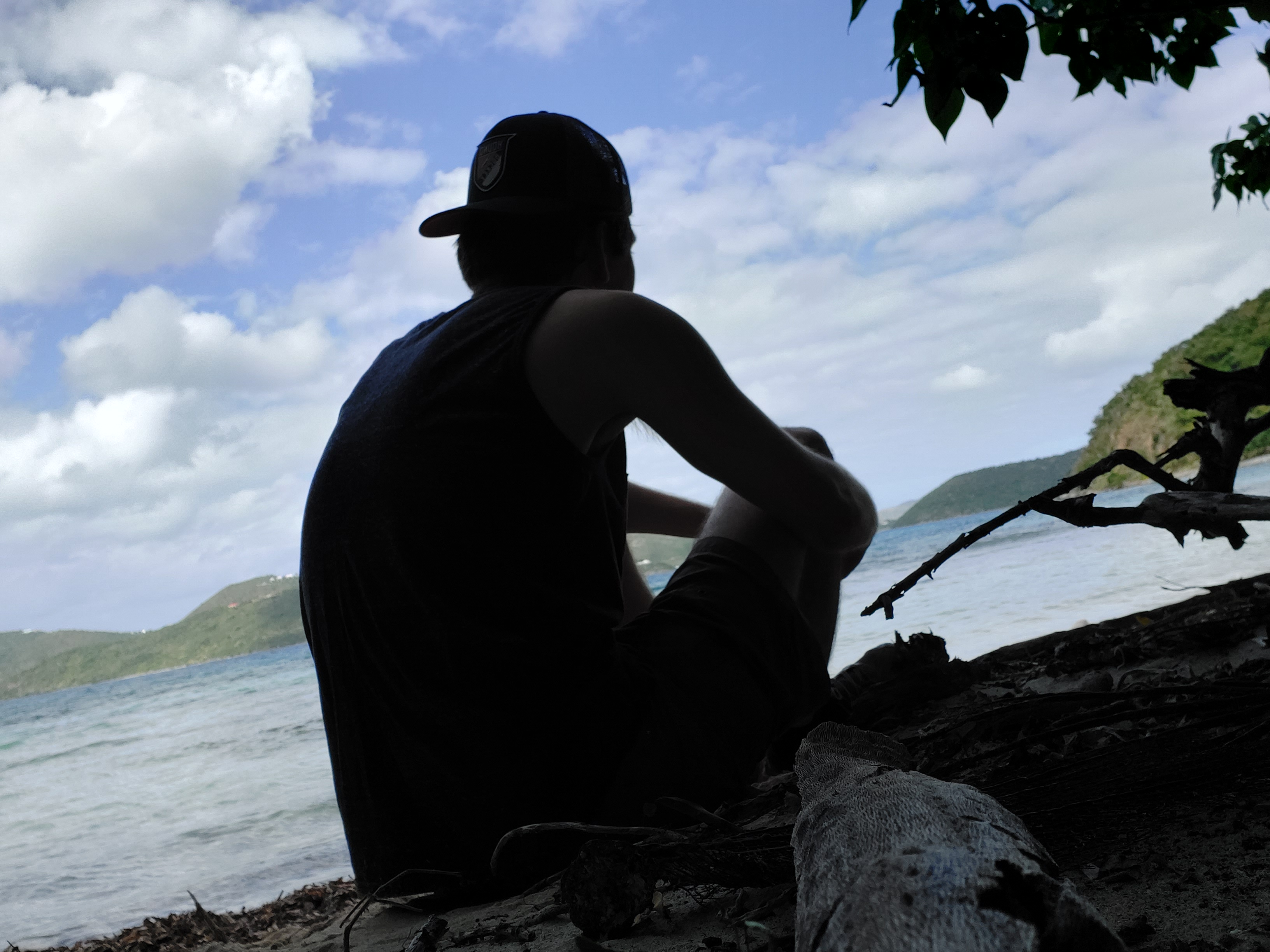
Over lunch at the bar, unenthused by the prospect of talk with my neighbors who have taken one-way tickets to Margaritaville, I find myself on the Wikipedia page for Isaiah Berlin’s hedgehog and fox analogy. I am of course a full-on fox, fascinated by many things and a skeptic of simple theories, content to hold a whole heap of complex thoughts within me and marvel at all of it, even the pickled retirees of Hull Bay. I can, through words, continue to pull things together. In due time. For now I finish my beer, pull my cap into place, tug off my shirt, appreciate the progress my gym time has coaxed out, and reassume my pose as a boy on a beach.
I’m not telling you to make the world better, because I don’t think that progress is necessarily part of the package. I’m just telling you to live in it. Not just to endure it, not just to suffer it, not just to pass through it, but to live in it. To look at it. To try to get the picture. To live recklessly. To take chances. To make your own work and take pride in it. To seize the moment. And if you ask me why you should bother to do that, I could tell you that the grave’s a fine and private place, but none I think do there embrace. Nor do they sing there, or write, or argue, or see the tidal bore on the Amazon, or touch their children. And that’s what there is to do and get it while you can and good luck at it.
-Joan Didion, Commencement Address at the University of California Riverside, 1975
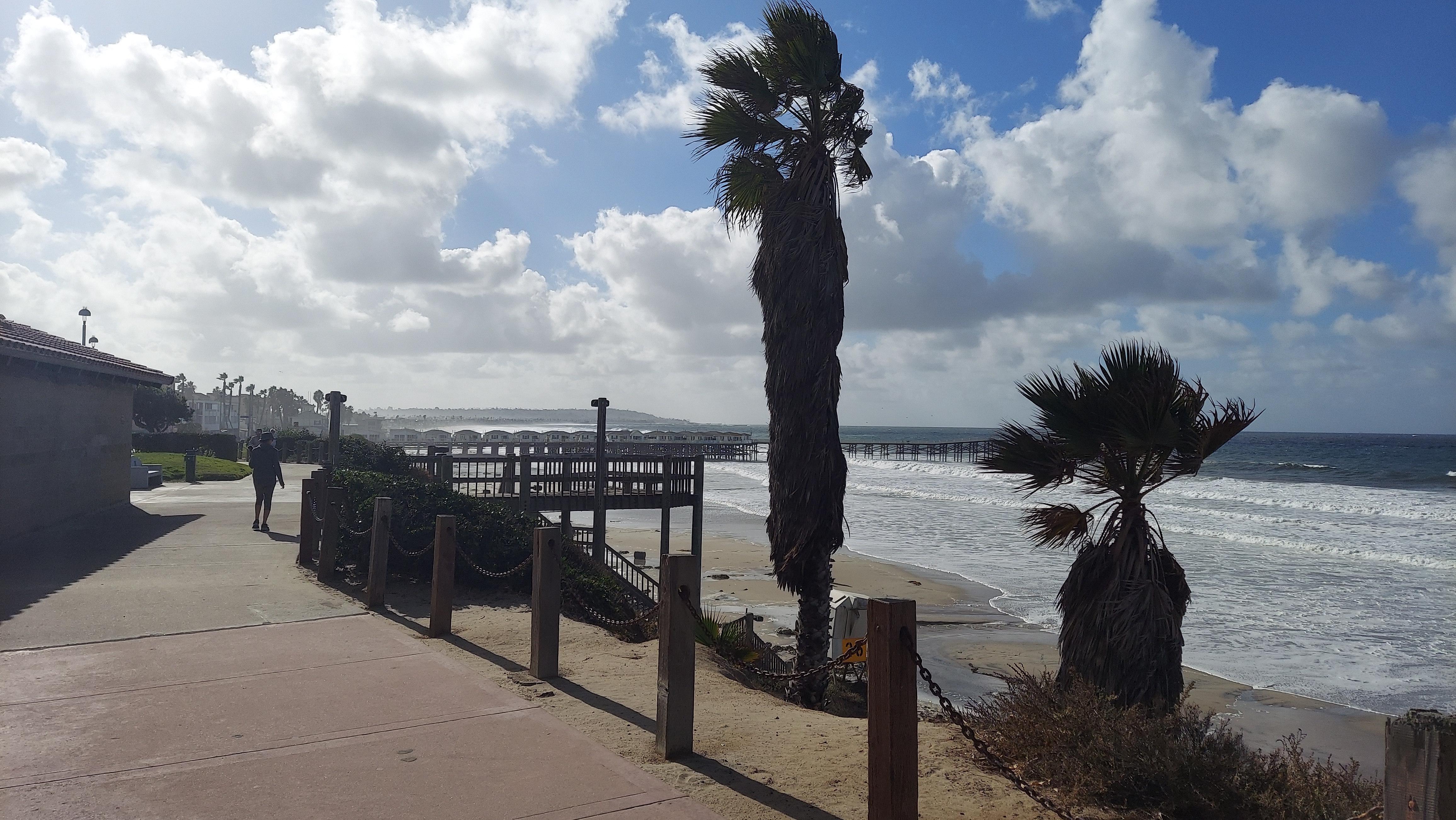
2024 approaches its close and I am aloft again, flitting this time to San Diego. I stay at the Diamond Head Inn at the head of Diamond Street in Pacific Beach, close enough for a sliver of an ocean view and to be lulled by the soothing crashes of giant waves through the night. I am not sure I prefer San Diego to some other haunts on the California coast that are becoming repeat destinations, but it is certainly the right place for this escape to cap a year of great escapes.
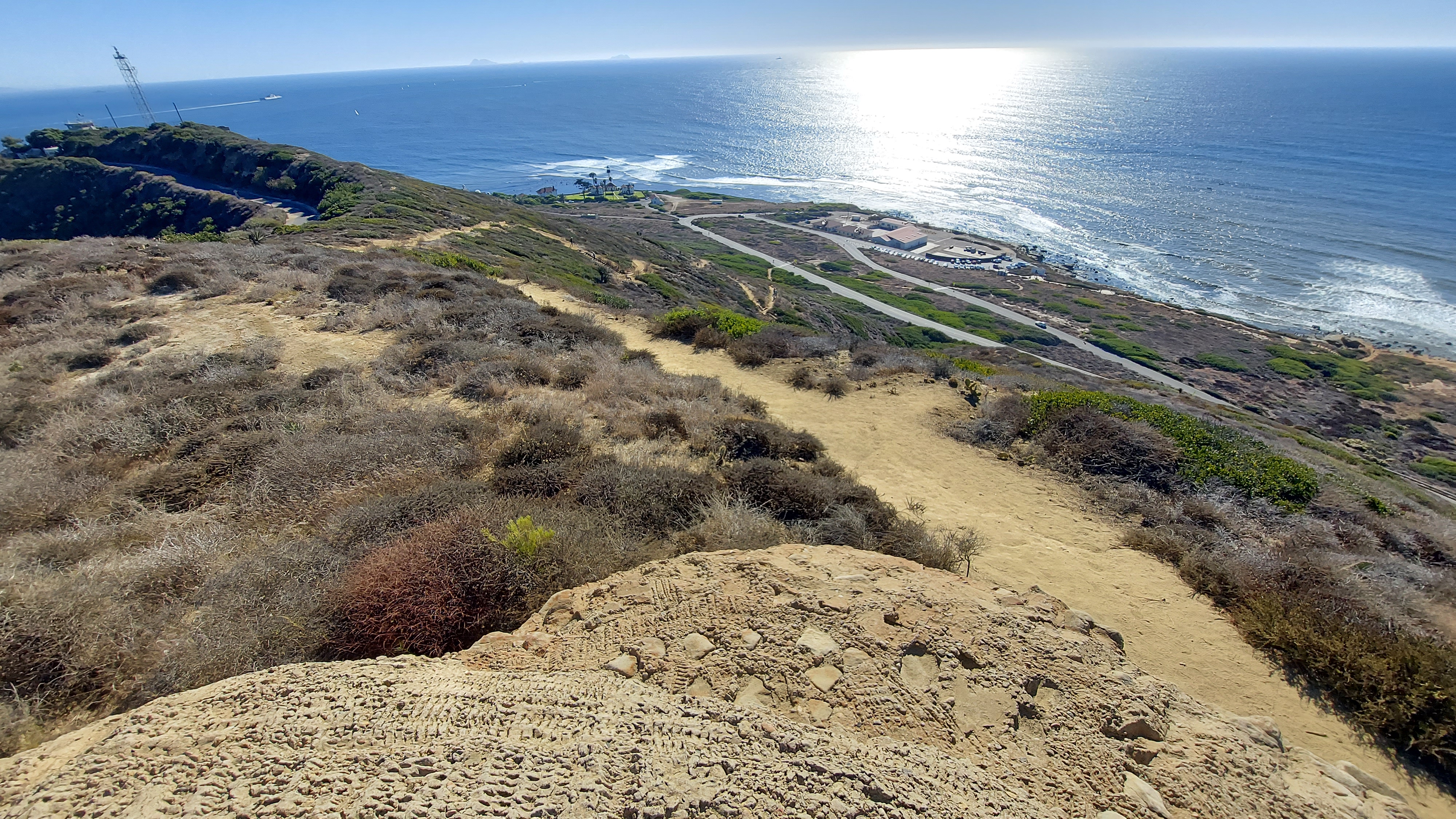
I run north through La Jolla, where the streets teem with the economy necessary to keep up the opulence of this headland: gardeners, renovation crews, cleaners, pest control. I run south along the length of Mission Beach, past miles of volleyball and beach bums and rows of vacation retreats, winding through the steady march of a three-day breast cancer walk whose path crosses mine on each of my days here. I grab a car for a day and venture down to the commanding views of Point Loma and up to spend a few hours with a college friend and his ever-expanding brood in Oceanside. But mostly I drift between the hotel and the beach and the clump of establishments along the Pacific Beach streets named for precious stones. Even with the Third Fleet looming in the harbor and Camp Pendleton to the north, San Diego feels removed from any great national dramas, a place where ambitions settle into yoga studios and waves and IPAs, a paradise now a bit overcrowded and at times a bit vapid but still holding to its beach life core.
A few people ask me if a beach escape was an election reaction, but it isn’t. Over the past few years I have found myself drifting out of political obsession and toward Joan Didion’s way of being in the world, not to forsake that realm but instead by finally internalizing the oft-neglected aspirations of my earlier self. My happiness is not ideological. I try not to let politics get me down, and through both an intentional effort and probably the simple passage out of youthful fervors and into my petite-bourgeois 30-something world, I am more or less there now. State and national affairs still matter to my moral universe, still matter to my job, but the privilege of not living in a state of anxiety over the world is, indeed, a privilege in the old-fashioned sense of the term, something one is lucky to have. To live in a place where anxiety does not drag one down, and where righteous anger does not consume one, is not in and of itself a defect.
This privilege allows me to seek to understand many ways of being while stripping away some preconceptions. It conveys a certain power: the ability to drink in experiences, to assume full presence in a particular moment, to say why not and just do things. To be always intrigued, ever nimble, always questioning, sometimes explicitly but also sometimes just in my mind so those around me can just be themselves. And it is not a realm of frivolity and luxury: the Olympian distance it can provide is the wellspring for reflection and insight that is hard to manage when wearing certain blinders.
Such distance can leave one in a lonely place, and it has taken time to embrace it as a real path when others are more clearly trodden. I can be a man in the arena, have perhaps even strengthened those skills considerably over the years, but I am not sure that doing so is the greatest use of my ability to come at stories from different angles, deep in the nuance. I am not by nature a fighter in the trenches, and I am drawn to realms upstream of politics, to places of culture and group dynamics and the deeper pulls of the human psyche. And I also now know that none of this is a binary choice, that I can step out for reflection but then dive back into messy human affairs in short order. (My stay in Pacific Beach also involved its share of time at beachfront bars, which are the definition of messy human affairs.)
My main method for my reflection has been writing. I gave up on a writing life after sweeping rejections from MFA programs over ten years ago, settling for sporadic posting on this blog instead of chasing any writing income. That failure has, on the whole, been a gigantic win for my mental health and financial security. But the itch has never died. The truth is that, if I have something resembling a vocation, it is not in anything terribly related to the job that earns me my income (though it is good work) but instead in being someone who has some useful things to say. I know that, in both triumph and crisis, I can sit down and come up with words that will both commemorate and help heal. People seem to like my stuff, if and when they find it.
I say I go San Diego to sit on a beach, but there is an ulterior motive: it is a retreat to begin compiling the episodic story collection on this blog into a manuscript, and I will be seeking professional feedback on it. This may seem like the ultimate Olympian turn, a retreat into fictional clouds at a time for engagement with reality. But this decade-in-the-making story is nothing but a response to questions about meaning in a fluid world, about coming of age, about masculinity and complicated family and coping with loss. I can think of no more urgent project for the skills I have.
I do not know what this story has to tell a broad audience; unlike everything else I write on here, the only feedback I’ve ever really gotten on it is from random people on the internet. But it is a story that is mine to tell, so I may as well tell it, take a chance on my attempt to get the picture and take pride in it. Progress may not necessarily be part of the package, but its possibility, whether sweeping or only in a few stray lives, is still a victory.
For the past three years or so I have been living somewhere in the long shadow of Joan Didion’s prose. I came to her in a search for meaning in this American reality we now inhabit, both for the troubles of 2020 and a jaded phase of toil through work life that is, thankfully, behind me. But I stayed because I fell in love with her sentences, her artistry, her skill with the English language, whether I cared about what she wrote about or not. Her detached cool became my ideal authorial voice.
Nowhere did Didion fix her gaze more than her native California, this daughter of a settler family and witness to the state’s change from frontier outpost to the dream state of the late twentieth century to something a bit more complicated as the dream started to run out. Because she was from an earlier era she was a keen critic of what her state became, from the postwar boom to the Summer of Love to the Reagans, always at a remove and rarely comfortable with the direction of things. Her lingering dread became part of her persona, but it was always counterbalanced by a certain glamor, the way a provincial aristocrat from a dying order learned to keep up appearances and move with her times instead of languishing into laments for the way things were. This is, I suppose, the inherent Californian in her, and a mindset I can only admire.
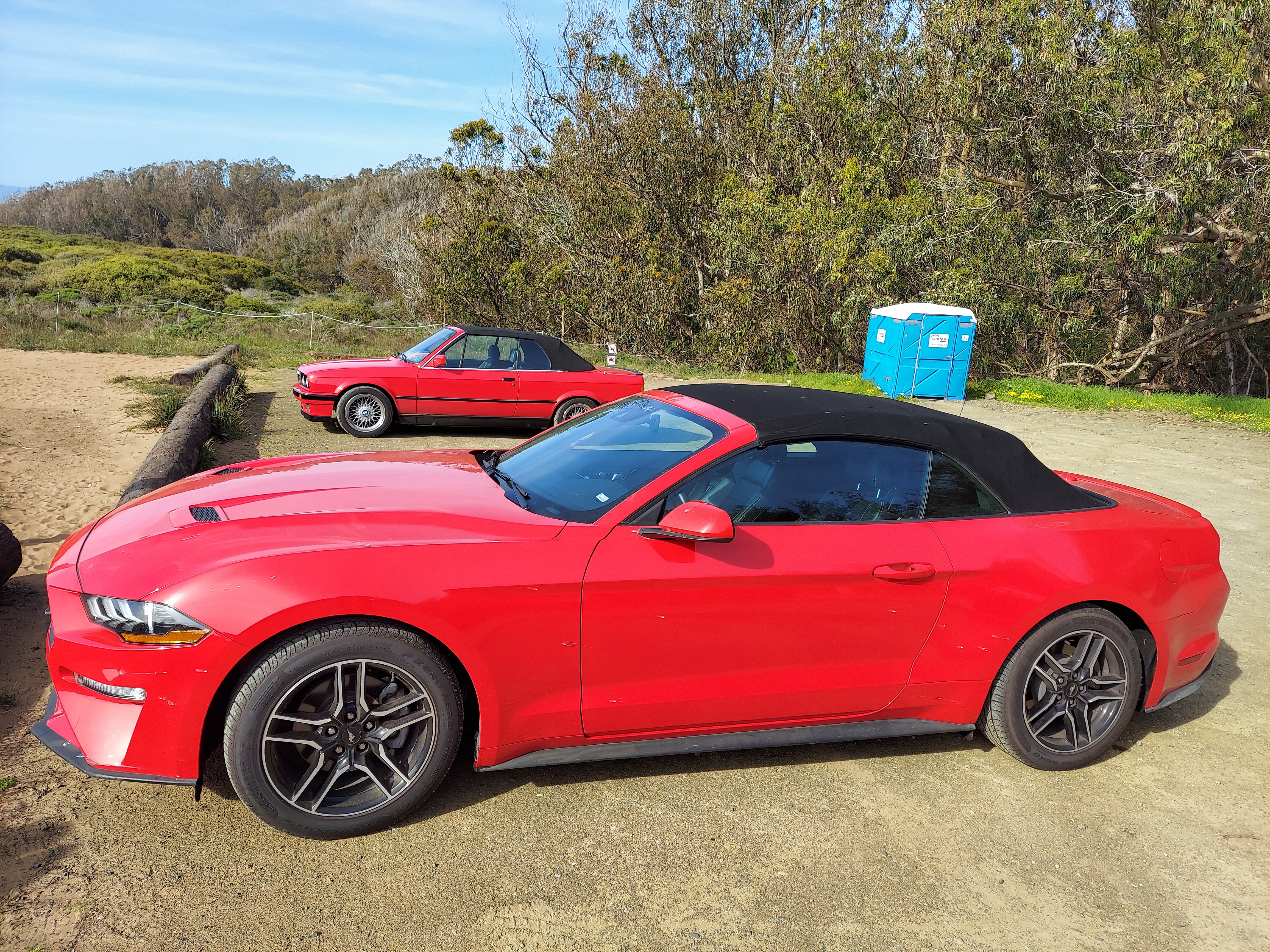
I head back to Joan Didion’s native land for my annual escape from Minnesota non-spring. While I have visited California several times before, I have enough ties here and enough things to see that it remains fresh. I land in San Francisco and immediately break south, pausing for an overnight south of San Jose before a long push down toward San Diego, from which I will work my way back up the coast over the course of a week. I escape Bay Area traffic swiftly and rise through the California coastal range, those ever greater undulations up from the sea. After a winter of great rain the golden land has been reborn as emerald hills, and I go in search of glimmers in a red Mustang convertible.
This trip is a break from some of my idle wanders across the American West in recent years: I spend no nights in tents, and while I’ve scheduled a few days of relative solitude, I go to both see some familiar faces and drink in the crowds. In certain ways it feels like an arrival, a trip for someone in a new phase of life free from some of the gnawing worries that gripped past trips and the start of a year of plentiful ventures outward. After the long push on day one, its pace is leisurely, with few concrete plans: I go to explore, to see where the road and my fellow travelers will take me.
The first day slog down I-5, however, is every bit as interminable as I feared it would be. The Central Valley is rich in its output, the California Aqueduct and the state’s water works a stunning feat for anyone into that sort of infrastructure (Didion is instructive on both topics), but at eighty miles per hour it mostly feels like Wyoming with some almond trees. Californians, I learn, are useless when confronted with roundabouts, and are even worse than overly polite Midwesterners at the zipper merge. I also learn that Tesla drivers are obligated to go twenty miles per hour faster than all other traffic, though as I sit behind the wheel of a vehicle that purrs when I accelerate, I rather understand the allure.
Mostly, though, Californians sit in traffic. Traffic chokes the Tejon Pass over the Tehachapi Mountains, the one real passage from northern to southern California. I sit in traffic here and then I sit in traffic above Chavez Ravine and I sit in more traffic down by Norwalk; I even sit in traffic in the Glendale In-N-Out Burger parking lot. To top it all off, the narrow strip between San Clemente and my destination in Oceanside, some twenty miles in distance, takes a full hour. At least it is a prettier to sit in traffic here than between sound barriers in Los Angeles, the sun sinking over the San Onofre beach and incongruous Camp Pendleton, a relic of an era when real estate dollars did not rule all on the coast. Southern California makes complete sense and zero sense: I get exactly why people would want to perch up on these subtropical hills on rolling estates, and exactly why the traffic is as shit as it is on these ten-lane ribbons that knit together innumerable valleys with no actual reason to form one coherent metro. The secret of the beauty is out, and the Joan Didions of the world are left to scrutinize the replacement of the ranches they knew with endless tract housing, elegiac but accepting that this is the world that now exists.
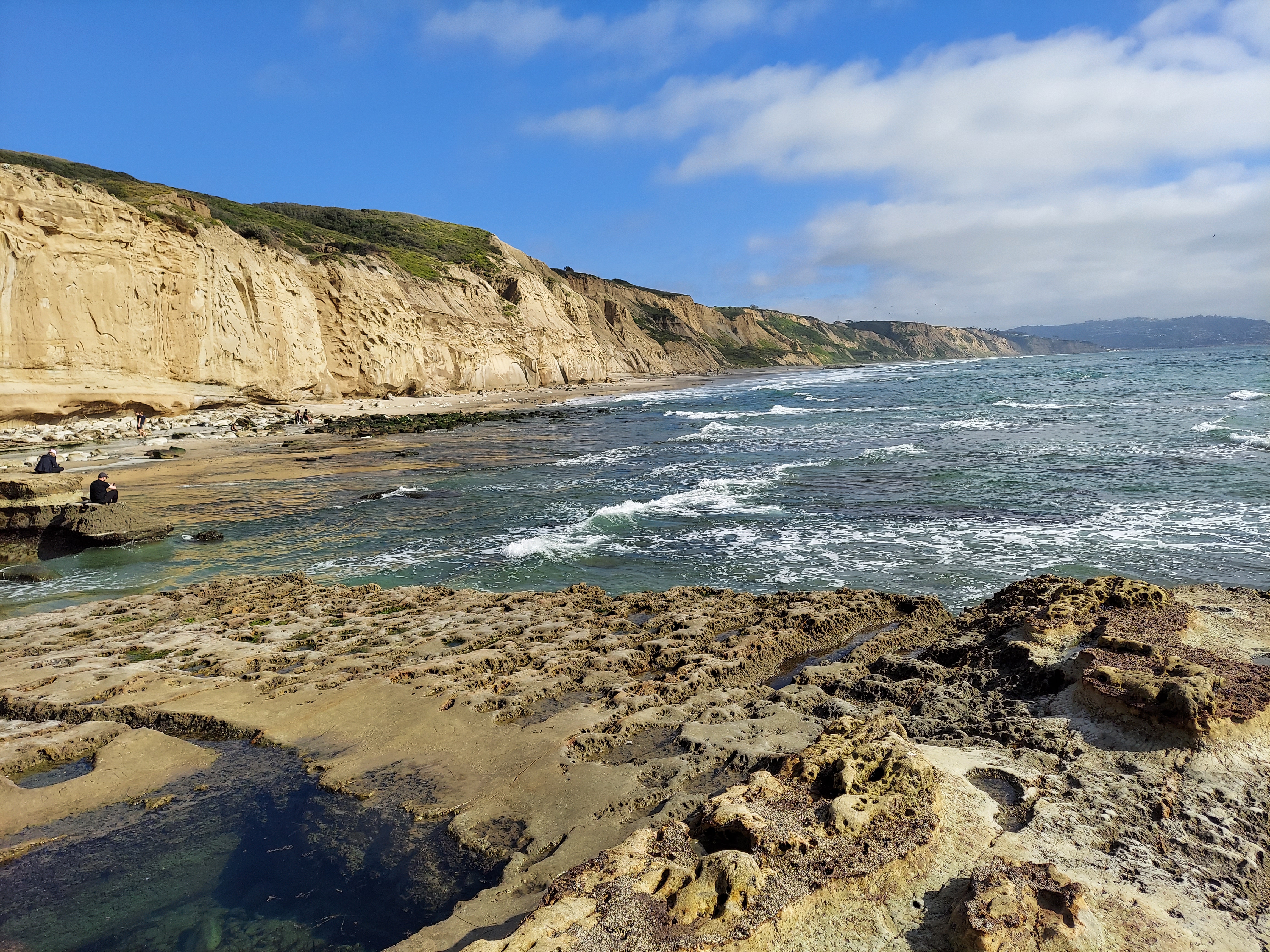
After I free myself from the freeway I pick way along the coast, where I will spend most of this week, its own little world with great variety among the beachfront towns. La Jolla glimmers with wealth on a hill, while Del Mar opens up to reveal Torrey Pines; Encintas and Leucadia are a blur of shopping, while I am too annoyed by a poorly signed road closure in Carlsbad to give it a fair shake. Oceanside seems more democratic than most towns on the coast, a healthy mix of people strolling its beach or fishing off its pier. To the north, San Clemente is the surfer stereotype on steroids, while Dana Point is a tryhard; Laguna Beach seems the platonic beach town, Newport Beach is a cut-and-paste Orange County suburb, and Huntington Beach is one giant timeshare. Malibu’s unrelenting development along the Coast Highway render its views mediocre, though a stop on one of its beaches brings a dazzling blur of sand and sea amid an unrelenting gale-force wind. Oxnard is a discordant slice of Central Valley agriculture transported to the coast, a fitting place to stop for gas and nothing else. There is something for everyone here, even if we can’t afford to live on it.
I land for two nights in Oceanside, where Georgetown friend Ben and his wife Etienne have doubled their brood since I last saw them in Sacramento four years ago. In a family with four kids under seven nothing happens quickly, ambitious plans swiftly reordered in the face of reality, and this new rhythm is an excellent corrective to my normal rigid scheduling and relentless travel pace. We bike to the beach and stroll up the pier, which is more than enough excitement for most of the kids, and do dinner at a brewery with ample space to turn them all loose. We sneak in life updates and insights between storytimes and toy deployment, and inevitably any building project with trainsets or connecting blocks or trimmed palm fronds turns into the adults wrapping it up while the kids have moved on to something else. The world looks different when one’s concerns are one’s kids’ schools, what they learn and how they learn it, how the world chooses to treat childhood. Any philosophical debate has immediate application, the inner world all-absorbing.
Greater San Diego, Ben observes, has a sort of opt-out culture, a great suburban city with no strong political identity anymore, having shed the old Orange County and military base conservatism that built up these areas south of LA. Here, one can enjoy the creature comforts of suburban homes and beach access and breweries while working from home to escape the miseries of the southern California commute. In my friends’ case an immediate family network is crucial to making it happen, the tight bonds of that inner world able to consume all. Without these anchors life here could trend toward anomie, but part of me admires the escape from the deeply political and the relentless progress-seeking, the choice instead to pursue the rhythms of the beach, a steady cycle of waves, bliss within reach.
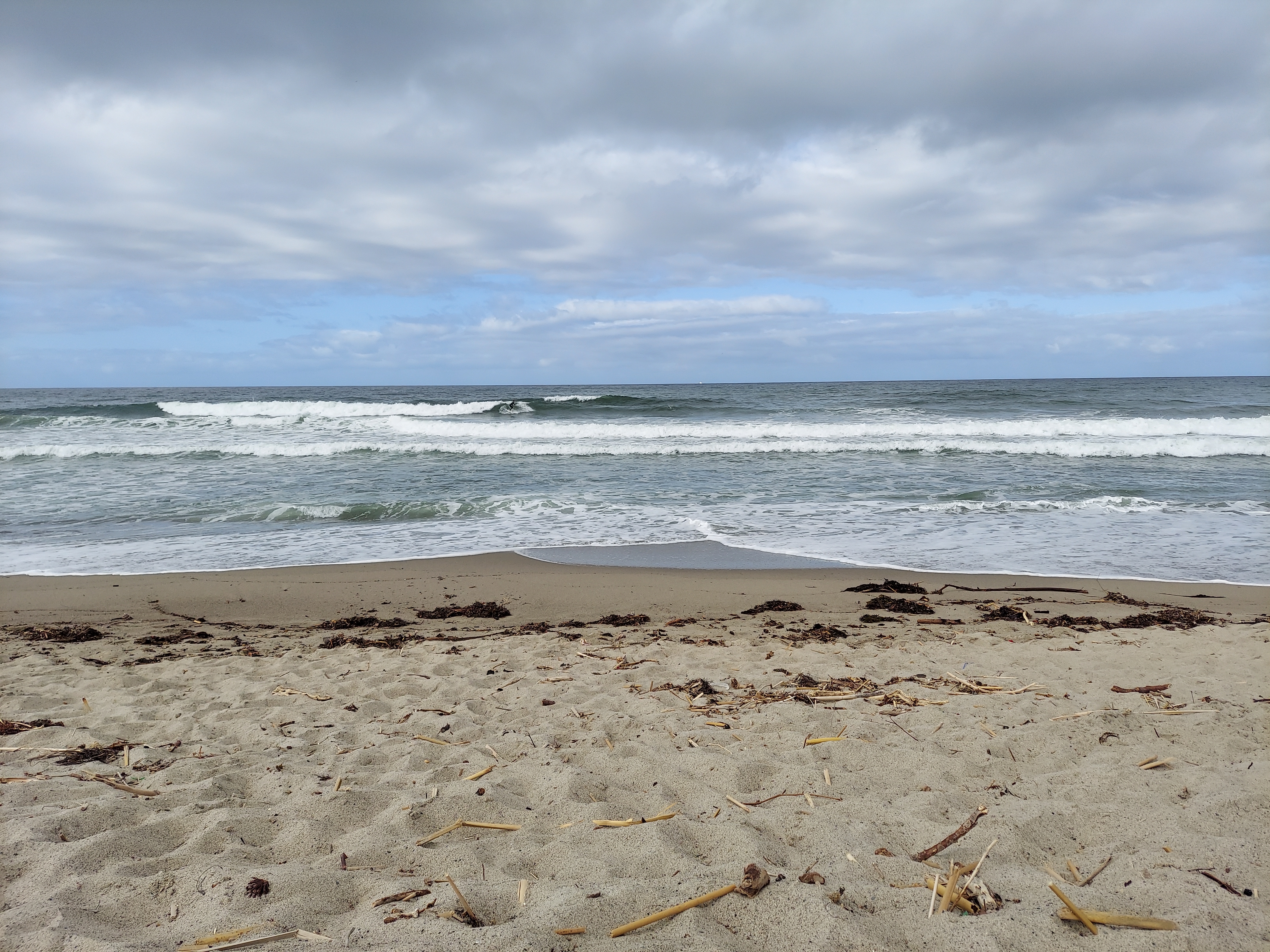
I start my road trip north from Oceanside at San Onofre State Beach, an iconic California surf spot. Two lonely men work the Trestles on this grey Monday morning, committed to the relentless slog outward but nailing ten-second rides down the Middles. I am mesmerized by this unrelenting quest, the pursuit of a glimmer of sublime. Without ever seeing it, I made this beach a place of deep reverie for a fictional character, and I marvel at how I thereby manufactured its significance to myself. Such is the authority of the author, possessed of a power to shape a world.
Part of me will always be a beach child, lured by the escape promised by the narratives here: freedom from all that overthinking I am prone to do, peace before the crashing surf, whether on Lake Superior rocks or St. John white sand beaches. The beach is its own little world with its own social codes, its outward displays that mean everything until they dissipate into the enormity of the sea and mean nothing. We find our wave here before the void, straddle it and accept our position between worlds. Somewhere here the myths of progress and eternal return collide, the inevitable march of time and the depth of memory that will always cycle back, resolving into a rare vitality. The moment lasts only an instant, but the right words can sustain it forever.
The pandemic may drain people away from the crowded shopping streets of Caribbean islands, but life prostrate on a towel has the same allure it always does. Here we are free to get sand all over ourselves and glug mouthfuls of saltwater, to sweat unnecessarily and court the inevitable sunburn. This is, of course, the point. During my two weeks on St. Thomas, I sample beaches both old and new to me in my ventures outward, plus add two days of hiking on neighboring St. John. Each venture ends with a seat in the sand or a swim in the sea, a beached state of bliss that kills worries nearly as well as the rum.
On one of my first free days on the island I head to the far west end of St. Thomas. Here, the arching island tumbles down to a gated community kind enough to allow the unwashed masses to sign in at the guard hut. From there, it’s a little over a mile by foot down the road past some obscenely large houses to the westernmost point on the island. Its name is the Mermaid’s Chair, and while I never quite figure out if I should be looking for seated mermaids on the spit of land that gets covered at high tide or beneath the lone palm tree on the little isle connected by the spit or on the rocks where waves crash beyond it, the place provides a serene respite. The sunset here is sublime, and the waves crash harder than anywhere else on St. Thomas. It’s not really a beach in the traditional sense, but I find some shade behind a rock and wade into a small inlet and along through the surf, alone here at the seeming end of the earth.
My second St. Thomas beach may not be a pristine beauty, but it has the best vibe of the ones I’ve sampled. Hull Bay on the island’s north shore sits somewhere between the solitude of a St. John beach and the built-up resort offerings. If the beachside bar hadn’t been sadly shut down, it would have taken me back to Puerto Escondido. When I arrive late morning, the only occupants seem to be locals. I chat with a commercial fisherman who is measuring out his kite and learn the basics of fishing these waters. Two men with metal detectors make their way up and down the beach, while a child associated with them digs a hole to Tibet in the sand. I join two middle-aged surf bums in incredulous gawking as a pristine-looking yacht tender plows straight into the beach so it can disgorge a few picnickers. Nonplussed, its pilot and an assistant work their way off the sand with some haphazard pushing and rocking, and in time head out on their merry way. “The year is only ten hours old and we have a contender for dumbass of the year,” says one of the surf bums.
Hull Bay has a reputation as a surfing beach, though only two people venture out while I’m there. The first is a teenage boy who looks every bit the surf star with a shock of sun-bleached curls, but after a few tentative steps into the breakers he settles for swimming out into the calmest part of the bay and riding his board back in on his chest before calling it quits. The second is a greying stand-up paddleboarder who stays out on the larger swells for at least two hours, bobbing away on the horizon. Score one for those of us advancing in age. The fisherman says I look like a surfer; in a different life, perhaps, I muse.
There isn’t much in the way of surfing on Magens Bay, the giant bite out of the north side of St. Thomas and its most famous beach. It’s a busy one, but large enough that people can strew themselves out along its length and splash around in the gentle turquoise waters. I traipse from one end to the other and admire the bodies on display, skimpy bikinis and pretty boy swag, plus some things that people would be better off putting away. It’s been too long since I last sampled humanity in this way. That night in bed, I feel the rocking sensation of the bay’s waves carrying me off to sleep.
Secret Harbor, which protects its secrets with about 40 speed bumps and a parking lot unnecessarily atop a hill nowhere near the beach, is an intimate stretch of sand, the sort that would be great with a group but leaves me feeling exposed when there alone. Snorkelers work their way out to its convenient reef, and the blasé servers at the seaside restaurant eventually get around to feeding me. I vaguely regret heading here on my final full day instead of ponying up for the ferry to neighboring St. John for a third time, but a little unfulfilled desire can’t hurt. I’ll be back for Maho Bay some other day.
A second stop that day, Smith Bay, restores me to my beach equilibrium. Sure, my newly developed beach snobbery leads me to conclude it’s nothing special. But there is plenty of shade, and both local and tourist families splash about in its waters and snorkel out to its buoys. Sailboats work their way back and forth into the bay, and I wrap up a book in peace and solitude. It’s a fitting final destination, though not this trip’s apex. On the drive back, I cast one last look of longing toward the island where dreams and reality blurred on this trip.
That place would be St. John, a sparsely populated isle half an hour to the east of St. Thomas by ferry. The city of Cruz Bay, its main gateway for ferry traffic from St. Thomas, is a couple of clusters of shops near the docks, and then a series of villas clinging to the hills up above it. Beyond that, the majority of the land is devoted to the Virgin Islands National Park, and after I escape the ferry traffic, I head straight for the hills.
St. John’s roads are even more painfully tortured than those of St. Thomas; I’m not sure whether to admire the engineers for their accomplishments or recommend them to the asylum. Being a driver on St. John deprives one of some marvelous scenery, since one’s eyes are always fixed on the next hairpin turn and leerily checking that tailgating garbage truck in the rear view mirror. Additional obstacles include a leisurely herd of goats, a monstrous feral pig, and some burros who look miffed when a car traveling the opposite direction gets too close. The pace of life on St. John is a world apart.
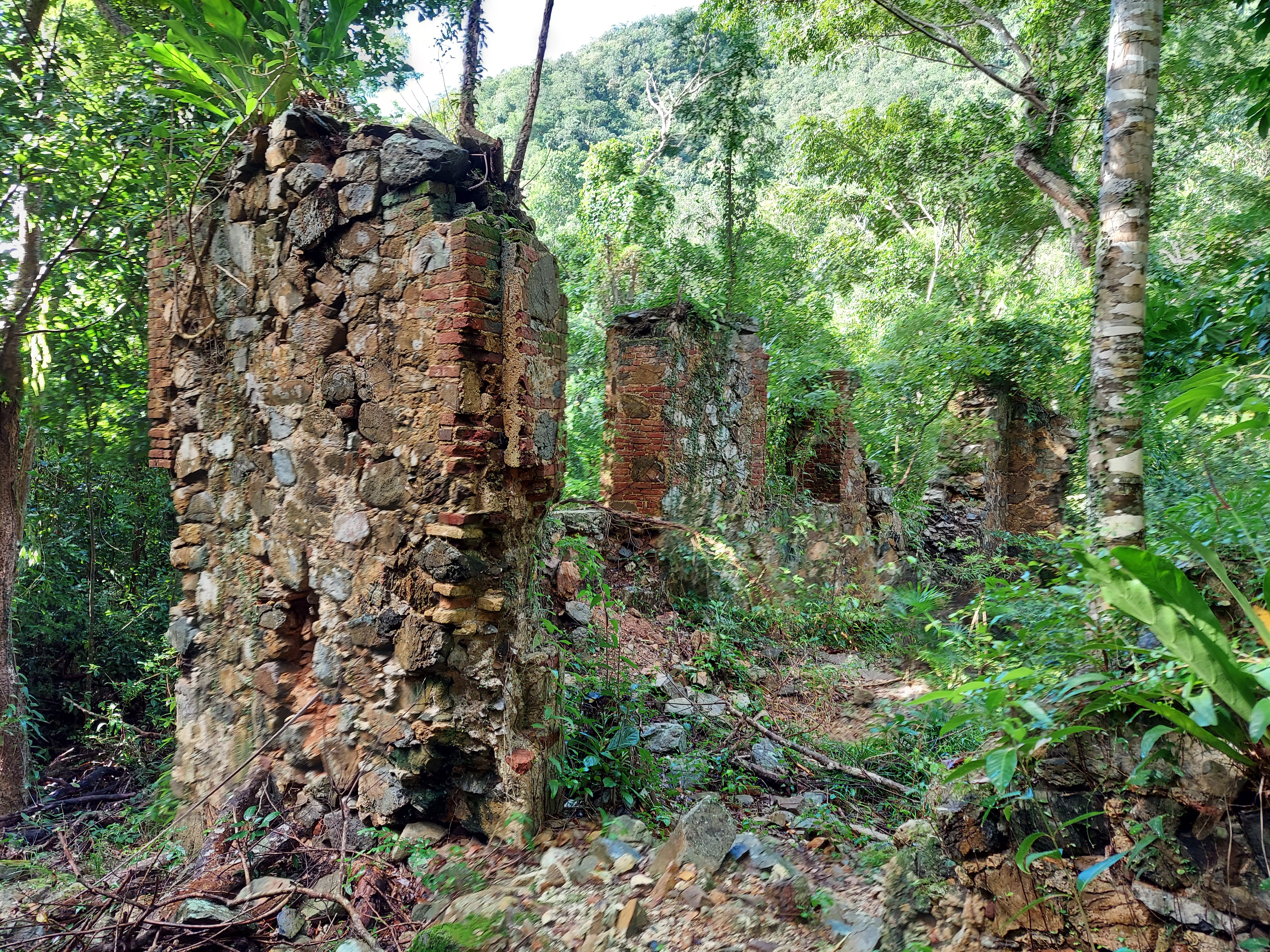
The Reef Bay Trail is one of the island’s best-known hikes, and it plunges some 900 feet from Centerline Road along the spine of the island to its namesake bay on the south shore. Ruins line the route: pull back the jungle on St. John and you find a less serene part of the Virgin Islands’ history than its pastel buildings and its cobblestone streets. Like most of the Caribbean, they were once a hub of the slave trade, and the ruins of its sprawling estates litter the landscape: a crumbling wall here, an old storehouse there, a cluster of old homes back in the thicket. Right before the Reef Bay beach is an old sugar factory, whose owners kept it going on steam power after abolition. And for truly deep roots, a side trail leads to a trickling waterfall and a pair of pools beneath some petroglyphs from the pre-Columbian Taino, who drew themselves a cartoon squid his crustacean friends. On the way back up I see how fast I can move in tropical heat, my sweatiness unnerving some not-particularly-fit hikers I meet near the top of the ridge.
On the far southeast end of St. John, a crowded trailhead leads down to the Salt Pond Beach, an idyllic, calm cove that hosts a small armada of snorkelers. I join a family who has sailed here from Georgia for a few false starts further down the beach as we seek out the Ram’s Head Trail, which climbs over to a rocky beach before ascending a bluff that juts out into the sea and gives 360-degree views. There’s little shade, and when I get back to Salt Pond Beach, I am content to lounge in the shade away from the water’s edge, a second sweaty journey of the day complete. Yes, I think, St. John is worth the hype.
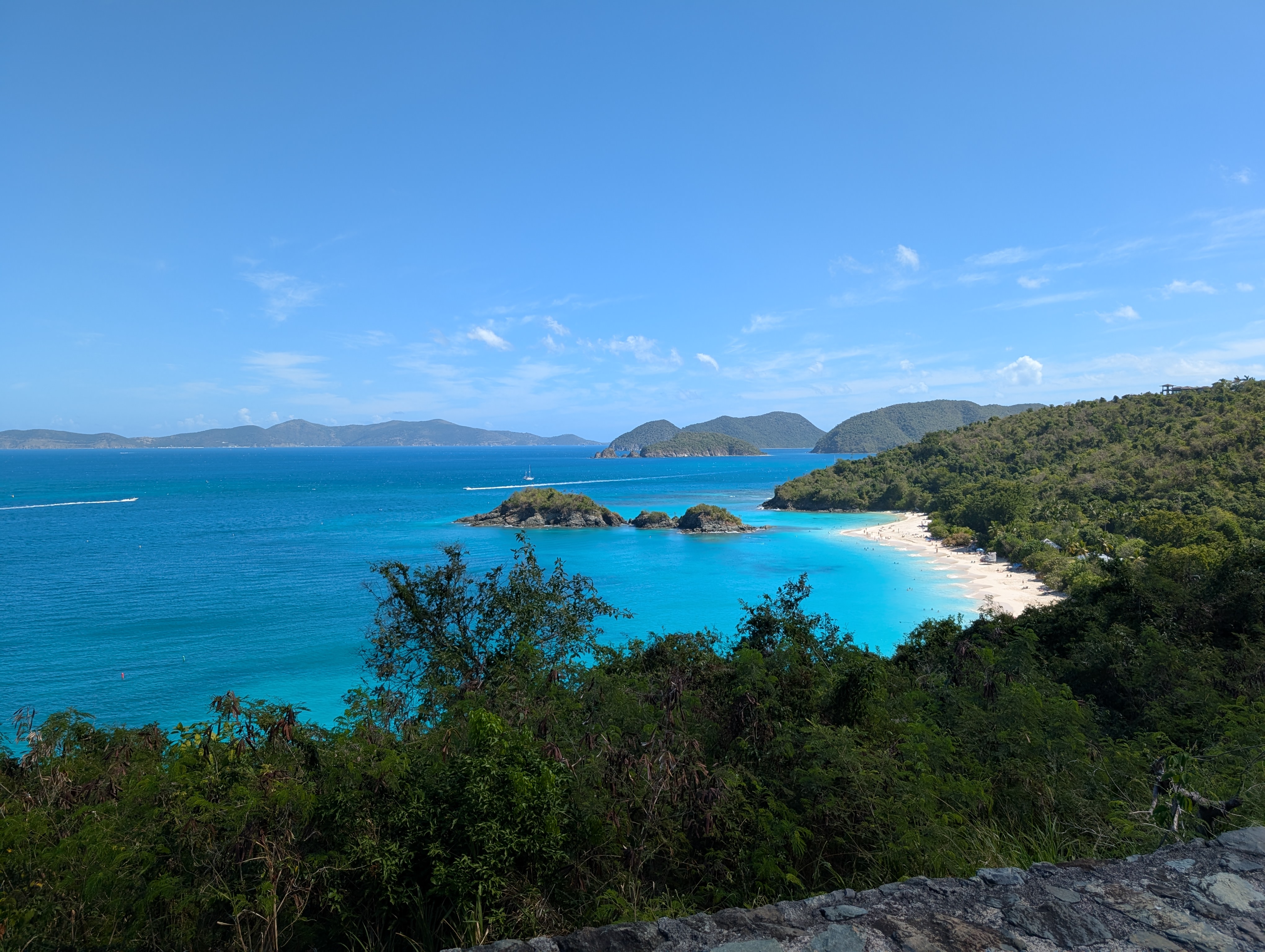
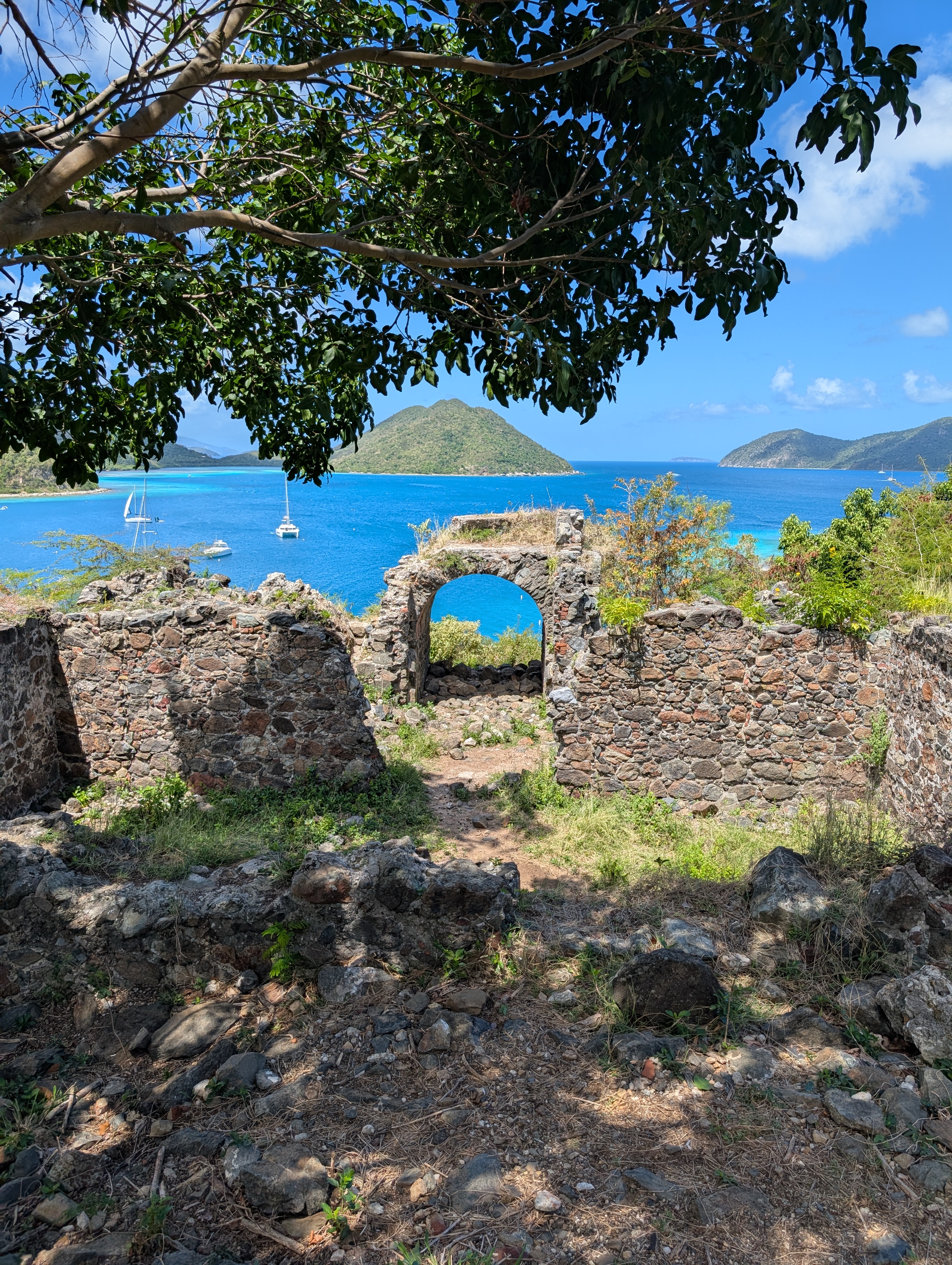
St. John’s greatest gems may be on its north shore, the white sand beaches of Hawksnest, Caneel Bay, Trunk Bay, Cinnamon Bay, and Maho Bay. The road here is stupidly pretty; the second-best North Shore on earth, I crack to friends back on another one now covered in snow. My birthday destination, however, is the end of the road at Annaberg, where the ruins of St. John’s largest plantation sit in repose over Leinster Bay. I follow a trail along the beach for a bit over a mile and briefly thrash around the ruins at the base of the hill where the trail turns away from the famed snorkeling spot of Waterlemon Bay. I first found this trail when volunteering with the Friends of the Virgin Islands National Park, on an outing for which we chopped out some of the brush along the trail and the ruins here; now, the jungle is encroaching again. Sufficiently scratched up by the undergrowth, I switch up to the ruined foundations of the Windy Hill House, the estate that once lorded over this whole expanse.
From there, I set out on a loop that takes me over the ridge from the north shore to the large southeastern bite out of St. John named Coral Bay. I follow the Brown Bay Trail further along the shore to another small beach a bit over a mile beyond. I have this one to myself, and tuck in beneath its encroaching undergrowth for a few minutes of shade. I only see one person on this entire trail, a relentless trail runner with whom I share a sweaty grin as we crest the hill with views both north and south. A few more ruins lie off the side near the end of the trail, which dumps me out on a road that runs along the East End peninsula. From there, it’s another mile along pavement through the hamlet of Zootenvaal, the easternmost reach of the United States.
I come to crossroads of Coral Bay, a collection of houses up on the hill and rundown shacks along the road, placid in the midday heat. I’d hoped to stop for a snack and to down some water next to its historic Moravian church, but the burros have occupied the spot beneath the one shady tree. Resigned, I turn and march 500 feet directly up a relentless grade; this is allegedly a road, but I’m not sure any vehicle could survive this thing. Naturally, the sun comes back out for its most intense burst of heat of the day while I’m slogging up. I crest the hill and saunter down the Johnny Horn Trail, which carries me back to the Windy Hill Great House.
I stop for lunch on a shaded set of steps on the ruins of the estate. The old house’s perch may be unbeatable: Leinster Bay and its sailboats to the left, Tortola of the British Virgin Islands across the Sir Francis Drake Passage to the right, shapely Great Thatch and quaint Little Thatch in front, and beyond it, Jost Van Dyke. The ruins are shrouded in pink flowers (which are, alas, an invasive Mexican creeper), its past lives as an overlord of slaves and a boarding house and a reform school now taken back by the wilds of St. John. A light rain pushes through, and I welcome the cleansing shower. I snack away, sip at a flask of rum, jot down a few notes, and attain something resembling nirvana.
At the bottom of the hill, I strip off my sweat-caked shirt and wade into the bay. I edge out gingerly, leery of urchins, and then strike out to a depth where I can float and tread water in peace. A few fish flit past my ankles, and I peer into the depths in this snorkeling haven as well as I can without goggles. A few motorboats come and go. The sun drifts in and out from behind the clouds. Hikers process up and down the beach in no real rush. I wonder just how long I can tread water, even though I know I must move on.
When a large family occupies the beach directly next to my bag, I decide it’s time to leave Leinster Bay behind. I do so with great reluctance. I stick with flip-flops for the beachfront stroll back to the car, where I change out of my sweaty hiking gear and take a brief spin through the Annaberg plantation. On a previous visit, it was packed, with docents and a little booth where a woman served juice from the plantation’s old kitchen; today, it is just me and a picnicking couple. Last time, I remember standing here, transfixed by a vista through the branches of a tree toward the sea; today, I find that spot again and internalize it as deeply as I can.
I make my way back into Cruz Bay. After a parking odyssey, I find the St. John Brewing Company’s tap room, which is tucked away on an upper level of the labyrinthine Mongoose Junction shopping area. The beer does the job, and I befriend Jim and Kate from Connecticut at the next table, the three of us reveling at the joys of dining in a restaurant and working remotely. How we’ve all missed this spontaneity, this liberation afforded by the most pristine of Virgins.
I take the ferry back at sunset. I’m at once hungry for more and fully satisfied: I could spend weeks on St. John, most likely, but I drank enough from its well on this trip to keep me going for years. How can I miss a place that provides a window unto eternity?











 A Patient Cycle