A Few December Duluth School Board Notes

I didn’t attend this week’s ISD 709 School Board meeting, but from what I’ve heard about it, any hopes for a more conciliatory Member Art Johnston went out the window. His antics this time around had Superintendent Gronseth apologizing to the District’s new accountants for his incivility. It was the usual song and dance, with Johnston berating people who did not give him the answers he wanted to hear, and in turn claiming to be the victim in this whole mess. The sun rises in the east, the taxman comes on April 15, and Johnston blathers on.

Other than that, it was, I understand, a fairly routine meeting. As expected, the Board voted to increase tax rates; the alternative being a plunge into bankruptcy, the decision was an easy one, and the District’s finances should rebound in the coming year thanks to new levy money and state aid, most likely sparing the need for a repeat next year. The sale of the vacant Duluth Central property would, of course, help immensely.

It was also the last meeting for three outgoing Board members, who will now enjoy Johnston-free third Tuesdays of the month. We’ll take a moment to recognize each of them.

Ann Wasson served District One for two and a half terms, surviving a narrow re-election battle against Marcia Stromgren in 2009 before electing not to run this time around. She joined the Board in the 2003 wave election that dumped opponents of Duluth East hockey coach Mike Randolph, and promptly voted to reinstate him. Later, she became best-known as one of the Red Plan’s more active champions, always trusting the district’s experts and lashing out at Art Johnston for challenging them. She chose her words carefully, and when did speak, she usually did so with force, though never with a whole lot of nuance. Her work on the Red Plan done, she now heads into retirement.

Mary Cameron, meanwhile, will go down as one of the longest-tenured Board members in city history, having served sixteen years as an at-large Member. While she too was a Red Plan supporter, her activity on the Board went much deeper than that, and she was not one to fight battles in public. As the lone African-American on the Board in a very white city, she focused on Duluth’s ugly achievement gap, and was instrumental in getting two minorities into the superintendent’s office. While usually supportive of the administration, she did break away from time to time, usually on human resources issues; she has extensive experience in the field, and was not afraid to call out poorly implemented decisions (as in the Randolph case) or demand second chances (as happened this past summer in the case of axed principal Leea Power).

The last outgoing Board member is Tom Kasper, who served a single term as an at-large, and was the Board Chair this past year. Kasper is an interesting figure, and one whose story sums up the dysfunction of the School Board over the past four years. As a neighbor of the new East High School, he was initially fairly critical of the Red Plan, and ran in 2009 as something of a centrist candidate; he was interested in alternative plans, but unlike some of his fellow anti-Red Planners, he kept a positive tone and actively sought new solutions. Voters rewarded him with easily highest vote total for any of the four at-large candidates in the 09 election, in a field that included two incumbents and a fourth strong candidate. However, once on he was on the Board and the Red Plan came to be inevitable, Kasper became a reliable vote for the administration. Though he showed a little more willingness to listen to Art Johnston than the others, his patience was clearly waning before long. I think that probably says more about Johnston than it does about Kasper, but his term shows just how difficult it can be to hold the center. As Chair, he faced the unenviable task of trying to keep the debates civil, and I do think he could have exercised a little more authority to shut down the rantings of both Johnston and his sparring partners, Members Wasson and Seliga-Punyko. I got the sense that he was very tired by the end of his term. Even so, I give him a lot of credit for the effort, and think he took the most practical course available.

As with the City Council, I’ll have a post previewing the 2014 Board before the next meeting. Blogging will likely be sparse over the coming week due to travel plans and holiday festivities. Merry Christmas, readers!

Don Ness’s Duluth and its Divisions: Election 2013 Analysis

I’ve written a lot about Duluth politics in recent months, with coverage of every city council and school board meeting, plus some coverage of yesterday’s election (results here). Lost in most of this political talk, however, was mayor Don Ness.

The lack of Ness coverage is, in part, his triumph. In this recent NPR interview, he said his goal was to make Duluth politics “boring” again. Six years into his tenure, he’s done that. He remains incredibly popular, and with good reason, considering the successes of the causes he’s supported. The economy has been fairly resilient despite a rough national economic climate. The city has won some major victories against noted antagonists, most notably Jim Carlson. Duluth has a bunch of new schools; despite some wobbly moments due to the way those schools were pushed through, they will be well-funded thanks to the passage of the two levies. Funding for libraries and parks has increased. The city even confronted its huge retiree debt burden and, while it probably hasn’t gone as far as conservatives want it to go, the Ness Administration has proven it isn’t beholden to special interest groups, and that it tries to avoid tax increases when at all possible. Don Ness is the dream mayor of the center-left, and if he is so inclined, he could easily make a strong run in a state or national race. (He even has the adorable children necessary for that sort of thing.) Ness’s warmth has rubbed off on people around him, as eight of the nine City Councilors now lean left. This city has been thoroughly renovated in the image of Don Ness.

However, underneath all of the solid colors that appear on the election maps are a lot of details that are worth exploring. The somewhat unexpected results of three races jumped out at me: Zack Filipovich surpassing Barb Russ for first in the City Council At-Large race after finishing second in the primary, the passage of the second ISD 709 levy question, and Art Johnston’s re-election to the School Board.

All three of these results underscore the east-west divide in Duluth. That’s a delicate topic, as School Board Member-Elect Harry Welty learned with his “gangrene” comments, and obviously it generalizes, and there are plenty of people on both sides of the city who cut against the east-west stereotypes. Still, one trend clearly emerges in election results: the west side’s rejection of the east side liberal establishment.

It’s especially significant when you consider that people from the west side are not a demographic you’d normally associate with conservatism. It’s not a wealthy or suburban/rural region, and in state and national races, it’s still reliably Democratic. This is no bastion of the Tea Party or libertarianism, as shown by the passage of the first levy question in all but one precinct and Ryan Stauber’s inability to break through in many places. Still, the west side is not moving in lockstep with the Ness agenda, and it’s worth asking why.

We’ll start with a look at the City Council At-Large race, in which I’ve mapped out the winners of each precinct using the wonders of Microsoft Paint:
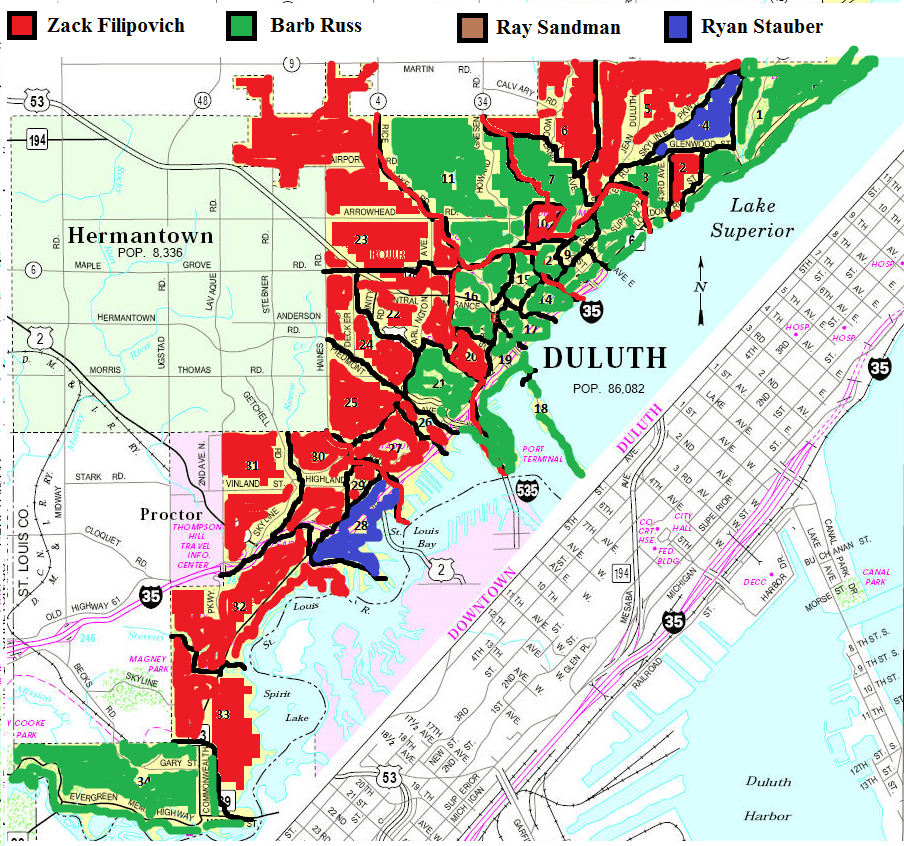
City Council At-Large

Zack Filipovich, as you can see, had a very strong showing on the west side. As a recent college grad working in finance, Filipovich doesn’t really fit the blue-collar stereotypes one associates with the west side. Still, his campaign (whether by design or not) was certainly less explicitly liberal than Barb Russ’s, and since he’s young and fresh, he’s not really an establishment figure. Unlike Russ, he made a concerted push to get beyond the establishment, and campaigned out west. For that reason, I suspect he was able to generate a lot more support, especially in an election where voters could choose two candidates. Ryan Stauber was an easy first choice for Duluth’s more conservative voters, but I’d hazard to guess that Filipovich, who remained rather vague and upbeat in his campaign, was most likely to be their second choice. That coalition probably carried him to a lot of victories on the west side.

This anti-establishment-liberal pattern is even more distinct in other recent elections, with the west side being far less interested in sending more money to the city than the east side. In Ness’s first election, he won the east side and lost the west side to the more conservative Charlie Bell. Jay Fosle, the lone conservative on the Council, represents a far west district. Garry Krause, the recently-resigned conservative District Four councilor, was from the west side, and got a decent share of the vote despite having withdrawn from the race. If he’d stuck around, I suspect he would have won. If you want a map that really underscores this trend, though, take a look at the way the city voted on the school board levies:
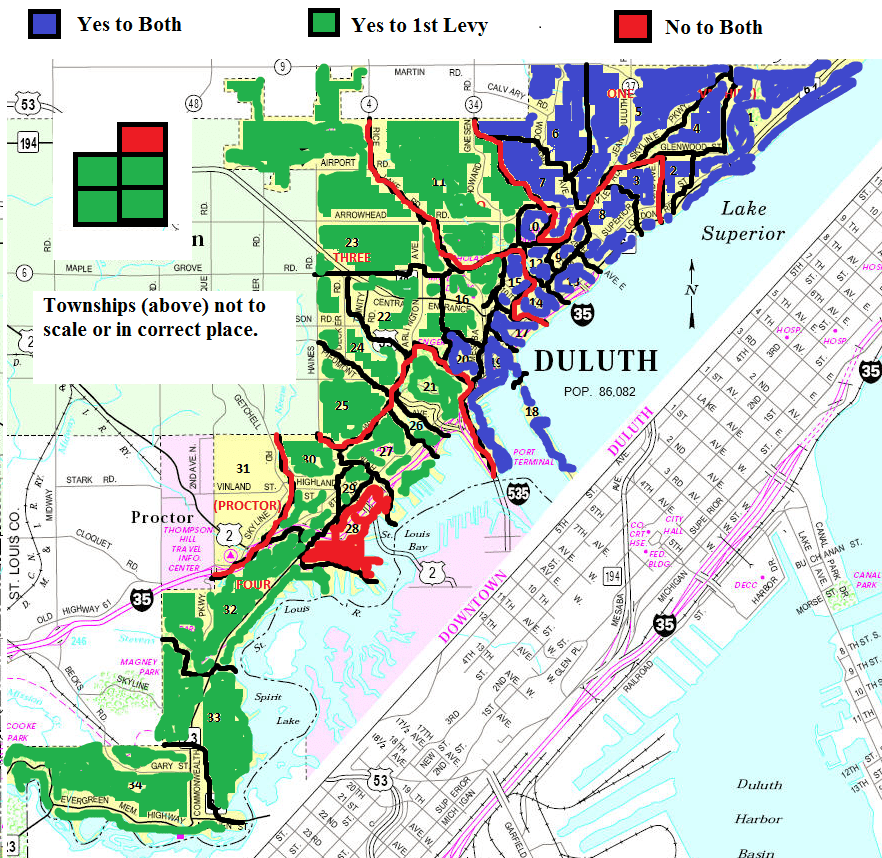
School Board Levy Map

This really wasn’t a case of the city coming together to support the second levy. It was a case of the east side having just enough votes to drag the west side along with it.

While much of the rest of the city is exasperated by anti-Red Plan crusader Art Johnston, he was re-elected to his far west side district. In the West End area, there seemed to be a lot of passion over the school board race: Bolgrien’s base of support was right around Denfeld High, and Johnston had a bunch of signs in the areas just beyond the Bolgrien core. Heading east into Lincoln Park, however, there were hardly any yard signs. Even so, Lincoln Park broke for Johnston. It wasn’t a vicious rejection of Ness and his School Board allies, but it was a clear one.
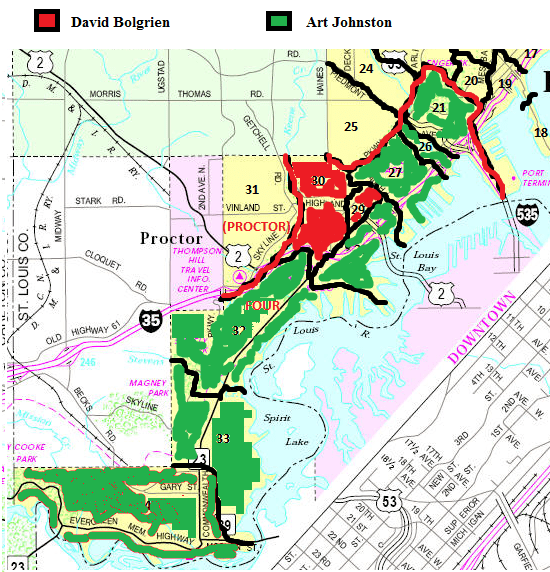
School Board Dist. Four

I rarely agree with Art Johnston, but to his very real credit, he too has acknowledged these trends. He posed the question to the Board at a recent meeting, perhaps not realizing that his own presence on the Board is a product of these trends: why does it appear that west-siders do not share the east side’s emphasis on education, and willingness to open the pocketbook to support it? No one answered him, and he deserves an answer.

Part of it may be demographics. The school-aged population is much higher on the east side, so more people have a stake in the schools there. East side voters, content with the generally high test scores at their schools, see the value in supporting the District, while west side voters, seeing more mixed results, may not. (I have never understood the logic behind giving struggling schools less money, but plenty of people explain their votes that way.) Perhaps most importantly, the west side has more people living on fixed or lower-middle-class incomes who are nonetheless not living in poverty or qualifying for many government support programs. Because of that, they tend to be less willing or able to handle a tax increase.  That fact can explain the fiscally conservative bent one sees in the west side’s city councilors, too.

But while socioeconomics may explain a lot of the divide, they are not destiny. To that end, it’s important to understand why a number of Duluthians (no matter which neighborhood they live in) may not be completely thrilled with Don Ness’s Duluth. For that, I’d point readers toward my post from a few months ago on Duluth’s future. It’s a long and meandering post, so I’ll summarize one key part here.

Under Ness, Duluth has made a concerted effort to reinvent itself. It has also made itself a desirable place for young people to live, harnessing its natural beauty and developing a decent artistic and culinary scene. (Yay, good beer!) It has spent a lot of money making itself attractive, and to date, I think that move has been reasonably successful. With the decline in U.S. manufacturing, it was necessary to take that stand and create a new brand for the city, and while I have my quibbles here and there, I’m largely on board with Ness. I was also a staunch supporter of both levies, and I believe world-class public schools are essential to this whole project. However, former Councilor Krause raised an essential concern, and one I am not sure the Ness camp has properly addressed: is Duluth’s interest in shiny, new things coming at the expense of the mundane? Yes, it’s great to attract new people, but what about those who have been here for a long time, and are simply trying to get by?

No matter how many elections Ness and Friends may win, these questions will still exist. They need to be magnanimous in victory, and recognize that simply cruising along with a mandate still leaves some people on the outside looking in. No, they can’t satisfy everyone all of the time, but no one should be left behind because they never got a chance to be heard.

Speaking of being on the outside, the lack of racial diversity here is also worth mentioning: after this election, everyone on the School Board and City Council will be white. This isn’t terribly shocking in a city that is over 90 percent white, and there were two minority candidates this fall who simply did not run very impressive campaigns. Mary Cameron had a very long tenure on the School Board, proving that minority candidates certainly can do well in Duluth. Several of the white elected officials have long histories of work with minority groups. Even so, there is a trend in modern American liberalism in which people politely acknowledge minority interests while doing little to actually address them. I’ve talked up the east-west divide here, but downtown can’t be lost in the shuffle, either.

This all brings me back around to “boring” government. Yes, boring government is certainly better than people screaming at each other nonstop, but there is a danger here, too. This quote from Councilor-Elect Howie Hanson in the October 29 News-Tribune comparing himself to his predecessor brings it out clearly:

“I think Garry [Krause] was a little frustrated because he was in the minority on a lot of votes,” he said, noting that Krause frequently found himself at odds with Mayor Don Ness’ administration and much of the council.

“If we’re going to move Duluth forward, I think you need to set aside your personal agenda and petty politics and get everyone on the same page,” Hanson said.

This bothers me somewhat, and I do not think it is an accurate characterization of Krause’s work, even if I didn’t always agree with Krause. Good governance does not involve everyone being on the same page and rubber-stamping one another’s proposals. It needs constructive, perhaps even heated, arguments. To its immense credit, the City Council has managed that in recent years; the School Board, on the other hand, has not, as it went from being a rubber stamp machine during the Red Plan days to a fractious and ugly war zone during Art Johnston’s first term. With Welty and a possibly conciliatory Johnston on the School Board, I have some hope that it might finally come to a healthy balance. The new Council, with its new left-leaning supermajority, must make sure it doesn’t fall into one of those twin traps that bogged down ISD 709 in recent years.

Duluth’s politicians have the potential to do some great things in the next few years, and the future is there for the taking. We’ll see how they do.
Duluth General Election Results and Comments, 2013

The results are in!

I’ll have a few more comments tomorrow once the city publishes district-by-district results and try to put everything in a broader context—complete with adventures in amateur map-making! I’ll also have more comments on the outgoing councilors and board members when their terms expire. For now, here are the results and their immediate implications.

Bolded candidates won. The numbers after the names are percentages of the vote, followed by the raw vote total.

City Council At-Large

Zack Filipovich 55.2 (9295)

Barb Russ 53.0 (8932)

Ryan Stauber 44.6 (7514)

Ray Sandman 14.2 (2398)

For a second straight election cycle, the DFL candidates march to a solid victory in the At-Large races. Stauber hung in there relatively well, but in the end was nine points behind the second of the two DFLers, a similar margin to his primary gap. The biggest surprise here was Filipovich leading the way: Russ had a large lead and a more obvious campaign presence after the primaries, and as Stauber is the only real conservative in the field and has some name recognition, I thought Filipovich might have a fight on his hands. Not so, as the recent UMD grad rolls into office.

City Council District Two

Patrick Boyle (I) 98.5 (2099)

As expected, the unopposed Councilor Boyle sails through, and also led the field in the District 2 County Commissioner primary. If elected to that position, the Council will appoint a replacement for the next two years.

City Council District Four

Howie Hanson 61.1 (1782)

Garry Krause 37.6 (1098) (withdrew from race)

37.6% is a fairly substantial vote total for a candidate who isn’t in the race, suggesting there were some misgivings with the otherwise unopposed Hanson, but he still heads into the Council after a stress-free campaign. My personal experiences with Howie have not been positive, but they were also in a very different context. I hope he proves a more skilled politician than he is a sportswriter, and I’ll give him a chance to prove he can be a good representative for this district, which could use some stability after running through an awful lot of councilors in the past few years. Due to the vacant seat, he’ll be seated at next Monday’s meeting.

City Council Big Picture: News flash—Duluth is a DFL town. With Stauber’s loss and Hanson replacing Krause, there is only one person on the Council now who really qualifies as a conservative in any sense of the word. Even in a liberal city, that’s quite the supermajority. I’ll have more on the dynamics of that sort of council tomorrow.

School Board At-Large

Annie Harala 56.9 (10648)

Harry Welty 39.3 (7342)

Nancy Nilsen 35.7 (6670)

Henry Banks 24.4 (4567)

No surprise in Harala’s big win, and as I suspected, Harry Welty’s uniqueness was enough to get him just past Nilsen. Welty comes into the Board following a somewhat ragged end to his campaign that included a weird ad and an awkward comment about gangrene in west side schools. As several letters to the Duluth News Tribune showed, a number of people do not trust this longtime Red Plan critic and former Board member. That said, I think he is a genuine person who simply has a habit of saying some tone-deaf things, and he probably deserves a fair amount of credit for getting otherwise skeptical people to vote for that second levy. If the other Board members approach him in good faith, he should be willing to work with them. Nilsen’s showing, which was decent but not good enough, shows Duluth’s continued mixed feelings about the Red Plan. Banks’s campaign had potential, but never did quite take off.

School Board District One

Rosie Loeffler-Kemp 56.1 (3220)

Joe Matthes 43.5 (2497)

After clearing 50% in the primary, it’s no surprise to see Loeffler-Kemp win, and her new seat is the culmination of 20 years of work in and around ISD 709. Matthes, meanwhile, ran a pretty strong campaign for a newcomer running against such a well-known figure. He seems to have a bright political future, and I hope he stays involved in ISD 709 affairs despite the loss.

School Board District Four

Art Johnston (I) 54.0 (1624)

David Bolgrien 45.7 (1374)

After a contentious race, Johnston emerges victorious and earns himself a second term. With the passage of the levies, his worry that the Board’s actions would cost it major public support were proven misplaced. To that end, it will be very interesting to see how he re-invents himself now that the Red Plan is fading into the rear view mirror. Will he take the passage of the levies as an opportunity to fix the various problems he sees in ISD 709 and attack them in concert with other Board members? Or does he think the voters were swindled by the Board, and does he continue to try to obstruct most everything it does? It’s his decision.

ISD 709 Levies

Question One: Yes 65.6 (12211); No 34.4 (6403)

Existing levy re-approved

Question Two: Yes 50.8 (9436); No 49.2 (9130)

New, additional levy implemented

It was a huge night for ISD 709’s bottom line, as voters approved not just the existing levy, but also the second one, for which I did not have high hopes. With more cash in hand and additional state aid on the way, the District should be able to pay off its debts and move to bring down class sizes. Education activists can’t just rest on this victory, though; they need to continue to work with the new school board to make sure the money is going to the right places.

ISD 709 Big Picture: It’s a bit of a split verdict here; while not unexpected given the lingering legacy of the Red Plan, it does have some interesting twists. Two of the Red Plan’s biggest critics are now on the Board, but their greatest fears have not come to pass, and they now have a decent amount of money they can use to attack the problems related (and unrelated) to the Red Plan. It will still require some important decisions, and with Johnston on the Board, things will never be boring. That said, this ISD 709 grad is feeling good about the direction of the District for the first time in a few years. While Duluthians are clearly demanding strong oversight of the Board, they also want to move forward, and the approval of the second levy shows a majority are willing to put the Red Plan behind them and do what they can to make Duluth public schools the best they can be. It’s a big win for Superintendent Bill Gronseth, whose gamble has paid off.

St. Louis County Commissioner 2nd District Primary

(2 advance to general election)

Patrick Boyle 34.4 (2389)

Jim Stauber 27.4 (1901)

Scott Keenan 26.9 (1868)

Cary Thompson-Gilbert 4.8 (333)

Boyle and Stauber, both sitting City Councilors, advance to the January 14 special election to fill the seat of the late Steve O’Neil. Boyle’s first place finish is no surprise; Stauber’s incredibly narrow win over Keenan, meanwhile, sets up a classic left-right showdown. Given the timing of the special election, there’s a healthy chance that turnout will have been better in the primary than in the actual election. That means that getting out the vote will be crucial for both candidates in January, as they look to build on their momentum. Stauber in particular will have to go to work if he wants to close the gap, as he doesn’t have a very large presence at the moment. Many Keenan supporters are up for grabs here; while Boyle would seem to be the favorite, his victory is not assured.

That’s it for now—check back for more tomorrow!

Duluth General Election Preview 2013

The Duluth general election is just over a week away. I’ve done a bit of driving around the city doing some completely unscientific counting of yard signs to see who appears to have an edge, but with local elections, it’s hard to get a really good feel on the situation without doing a lot of legwork. Turnout in the primary elections was low enough that things could still swing drastically on Tuesday the 5th.

Here is a Sample Ballot.

Polling Places and District Designations | Map

Here is a rundown on every race in the city; in this post, I try only to give neutral assessments on what each candidate’s election would mean for their respective bodies. Candidates are listed in the order of finish in the primary. Click their names to view their web pages, and if I missed a web page or if there’s a more detailed version than the Facebook pages I’ve linked to, let me know—I searched for everyone’s, but some didn’t generate results.

City Council At-Large

2 open seats

Barb Russ | Zack Filipovich | Ryan Stauber | Ray Sandman

Russ led the primary vote by a comfortable margin and has shown no signs of losing her momentum; she offers a crisply articulated version of Duluthian liberalism, and has a long history of community involvement. This likely sets up a showdown between Filipovich and Stauber for the second open seat; Filipovich had a stronger showing in the primary, but Stauber seems to have built some support since, and got himself a News-Tribune endorsement. Both are in their 20s, and their campaigns are a bit rough around the edges; Filipovich has a crisp image but is rather vague, while Stauber has more defined ideas but is rather scattershot in his presentation. While Filipovich appears more business-minded than your average liberal, this competition can easily be seen as a left-right competition; if Stauber loses, there will only be one Councilor who clearly qualifies as “fiscally conservative.” Sandman seems to have a decent base of support on the west side, but he also has a large gap to close, and his platform doesn’t really go beyond a vague call for living wage jobs.

City Council 2nd District

Patrick Boyle (Unopposed incumbent)

No excitement here, but Boyle is running for the Second District County Commissioner seat as well (see below).

City Council 4th District

Howie Hanson | The Ghost of Garry Krause

This race also appears to be a foregone conclusion, barring a massive protest vote from the residents of District Four in favor of the former Councilor Krause, whose name remains on the ballot despite his resignation in September. A Councilor Hanson would ostensibly tip the Council further left, though it’s hard to say much about him since he hasn’t had to run much of a campaign. If elected, Hanson would be seated immediately so as to fill the Council vacancy. All other people elected on Nov. 5 will be seated in January.

Edit from earlier version: I’ve updated the link above, which now leads to his Facebook page, instead of his blog.

School Board At-Large

2 open seats

Annie Harala | Harry Welty | Nancy Nilsen | Henry Banks

Harala was the top vote-getter in the primary by a decent margin, and has run a safe, positive, community-centered campaign since, earning plenty of endorsements. The wild card here is Welty; he leads the field in signage, has done a lot of legwork, and he’s also the only candidate who is attentive to the people still frustrated by the Red Plan, even though he supports the levies. I was going to say he’d run a textbook campaign until I saw his bizarre, paranoid ad in this past week’s Reader. (Judge it for yourself here–yes, this was a print advertisement.) This is what you get with Welty: doses of nuance and political acumen coupled with rambling attempts at honesty that, while well-intentioned, can be rather head-scratching, to say the least. His foil here is Nilsen, an unabashed Red Plan supporter who wants to finish the work from her first term on the Board. (I couldn’t find any web presence for her.) As with Sandman in the City Council race, Banks had a chance to give the Board some real diversity; his candidacy was slow to generate much momentum and remains on the vague side, but he does seem to have increased his presence in the past few weeks.

School Board 1st District

Rosie Loeffler-Kemp | Joe Matthes

Loeffler-Kemp cleared fifty percent in the primary, but Matthes has run a strong campaign since, with thorough answers at forums, a lot of door-knocking, and a News Tribune endorsement. Loeffler-Kemp has over twenty years of experience in school affairs, though, and that is quite the mountain to climb. Either way, this district has two of the stronger candidates out there, and the winner will have earned the position.

School Board 4th District

David Bolgrien | Art Johnston (incumbent)

Polarizing Board Member Johnston faces a serious challenge in this race; the third candidate in the very tight three-way primary has endorsed Bolgrien, a longtime education activist on the west side. Johnston has spent the last four years as a protest vote against anything Red Plan related, but now is attempting to walk the fine line of claiming he can be a voice of reason despite his burned bridges on the Board. Diverse voices are all well and good, but Johnston’s challenge is to prove he can offer something of substance and actually build a coalition on the Board to support his views. He is the only candidate in any School Board race who opposes the levies.

School Board Levies

“Yes” Vote Page

There are two ballot questions. The first renews an existing operating levy; its failure would lead to a budget shortfall, likely necessitating deep cuts and class sizes ranging up toward 50 students in a room. The second raises property taxes by approximately $4 per month on a $150,000 home. ISD 709’s stated purpose is to use this money to lower class sizes; if passed, Superintendent Bill Gronseth claims they will be lowered by 4-6 students across the board. Yard sign counts aren’t of much use here since there isn’t much of an organized “no” campaign; if forced to speculate I’d say the first question has decent odds of passing, while the second faces a bit more resistance.

The “yes” vote has built some momentum in recent weeks, with endorsements from the News Tribune, the Chamber of Commerce, and Mayor Don Ness; and also thanks to yeoman’s work by some of the School Board candidates in their door-knocking for their own campaigns. Several people related to the Tea Party and longtime School Board critics have mounted some public resistance, however. They claim taxes in Duluth are high enough as it is, and that the Board’s behavior during the Red Plan means it is untrustworthy, and may not direct money where it is most needed (into classrooms to fight the large class sizes). The “Vote Yes” crowd counters this claim by pointing out the small size of the tax increase and across-the-board support for smaller class sizes from all of the pro-levy Board candidates.

St. Louis County Commissioner 2nd District Primary

Patrick Boyle | Scott Keenan | Jim Stauber | Cary Thompson-Gilbert

Following the passing of Commissioner Steve O’Neil in July, residents of the east side of the Duluth will go to the polls to select the two candidates who will advance to the January 14 special election. The field for this seat is loaded, as all four bring plenty of experience to the table. Based on a lawn sign count and general knowledge of the east side’s proclivities, the two frontrunners appear to be Boyle and Keenan. Councilor Boyle is the O’Neil family’s desired successor and a liberal champion, while Keenan doesn’t really fit an ideological label, having shown streaks of fiscal conservatism and environmentalism during his two terms on the Council and during his tenure on many local boards. Outgoing City Councilor Jim Stauber is the most conservative voice in the field, though he isn’t exactly a confrontational one; if elected, four of the five members of the County Board would lean toward the right. He doesn’t have any noticeable lawn sign presence, though he does have plenty of name recognition, and with his son on the City Council ticket, the Staubers have the potential to have a big night. Thompson-Gilbert is the only candidate who hasn’t served on the City Council, though her husband (Greg Gilbert) has, and she has a solid résumé of community activism. Adam Jaros and Nik Patronas are both on the ballot, but have withdrawn their names; Jaros endorsed Boyle, while Patronas exited for health reasons.

That about sums it up. Get out and vote no matter who you support, and stay tuned for results and analysis after the election.

The Duluth School Board Levy: A Manifesto

Disclaimer: when I launched this blog, I used its first post to say it wasn’t my intent to make this thing a call to arms for any particular cause. Today, I’m going to violate that principle for a cause that is, I believe, worthwhile. I’m going to do what little I can do to get the voters of ISD 709 to pass the operating levy that will be on the ballot this November.

Two of the biggest levy proponents out there are ISD 709 Superintendent Bill Gronseth and at-large school board candidate Harry Welty. I don’t really know either of them personally, though I sometimes read Welty’s blog and had a mini-dialogue with him last week, and Gronseth was the assistant principal at my high school once upon a time. But while both men have the same goal and seem to respect one another on some level, they are coming from radically different places.

Gronseth’s PR campaign for the levy has been relentlessly positive. A gaudy handout touting all the successes of ISD 709 came out in a recent Duluth News Tribune, and if you read it, you’d think there wasn’t much of anything wrong with the District. At Board meetings, Gronseth will acknowledge challenges, but will quickly try to turn them into opportunities for improvement, insisting the District is on the right path. I don’t think this is some cynical spin operation: Gronseth genuinely believes he can help guide this District to a better place, and that sort of positive message can be a real asset to a District trying to move past a divisive era. His pitch attempts to show the voters of Duluth that the District is moving past the Red Plan rancor, and that voters can have confidence in its administrators to keep the momentum going.

Welty, on the other hand, sees a rather different picture when he looks at ISD 709. His blog collects plenty of horror stories of troubles that afflict the District: a paltry general fund, sagging graduation and enrollment rates, a glaring achievement gap, classes with over 40 students, and anarchic west side schools. His campaign theme is “honesty,” which for him involves acknowledging everything that is wrong with the District, and then confronting it head-on. Without the levy, he argues, it will be near-impossible to do so. There is no scenario in which “starving the beast” leads to more sensible financial policy, and should the levy fail, the task of trying to build a decent District will take a herculean effort.

Both of them are part right and part wrong. Gronseth is right to see some real positives: for all of the turmoil, the test scores and post-secondary success of kids from the east side schools remain strong, and the recent turnaround at Laura Macarthur Elementary proves that demography need not be destiny, and that west side schools can succeed with strong leadership and innovative teaching. Having seen some truly dysfunctional public schools during my time in Washington DC, I can assure Duluth that its schools still have a long way to fall before they’re a total train wreck. But at the same time, Welty’s worries can’t just be swept under the rug; his concerns don’t come from nowhere, and as I argued last week, a longtime critic like him might be able to reach out to voters who are otherwise jaded with the District.

There are drawbacks to each man’s approach. Gronseth’s shiny packaging could easily come across as untrustworthy spin tactics, especially for voters who think the District took them for a ride with the Red Plan.  His unqualified optimism can appear naïve, and perhaps ignorant of the unfortunate but very real divisions that have sprung up over the past few years. Welty’s use of the sinking ship metaphor runs some risk of making the whole thing sound like a lost cause, especially as he repeats stories of struggling classrooms and announces his sympathies for voters who won’t support the levy under any circumstances. Both Gronseth and Welty are on to something, but neither one quite paints a complete picture.

You know what I would love to see? These two men go door-knocking together in support of the levy. It’s a naïve wish, perhaps, but these two men really do need each other. It will be hard to put a positive spin on Gronseth’s stint as Superintendent if the levy fails, and Welty has said quite clearly that his job will be a miserable one if he’s on a Board that has to make deep cuts.

There are risks for each of them. Gronseth has to admit that not everything is quite right, and while he’s done a good job of inviting citizens to learn about the levy and made himself available to speak to groups, this is a rather self-selecting approach; he’d have to go out there and meet face-to-face with people who do not like what he stands for. Welty might alienate his old Let Duluth Vote base, which includes (though is necessarily not limited to) a bunch of people who hate the notion of working with the Board so recently after the Red Plan was rammed through.

Still, if we take both men at their word (and I do), the risks are worth the potential rewards. Gronseth could prove he believes in community engagement in the fullest sense of the term, not just inside a pro-education echo chamber. Welty would show just how much he believes the good of the schools transcends any past divisions, even if it comes at some risk for his political career.

It would have been a real coup for ISD 709 if Art Johnston would have been willing to join this sort of effort. I had my criticisms of Johnston before he came out against the levy, but they had more to do with style than substance: I think he is a legitimate representative of a portion of the community that is understandably upset with the Board, and there is something to be said for holding true to one’s convictions. In the moments when Board debate ranges away from Red Plan affairs, he has come across as a well-informed, thoughtful man who raises some real questions. His stint on the School Board had real potential, and for a moment at the August meeting, when he found it within himself to praise Gronseth for putting the levy to a vote and noted how significant it was that the two of them had found common ground, I thought he might yet fulfill that promise. He could have transcended the pettiness of some of his critics, and such an act of humility might have bought him some good will in the eyes of other Board members, leading him to perhaps actually pass a thing or two. He could have even upped his odds for re-election, as he would’ve had an answer to the biggest criticism thrown at him: that he is too intractable, too zealous in his pursuit of purity, too willing to alienate people who were willing to work with him if only he’d concede a tiny bit of ground. (And I’m not just talking about Gronseth here; I’m talking about people like Welty and Loren Martell, with whom he has plenty of views in common.) Alas, Johnston has allowed his distaste for some small tax increases to overpower any desire to work with others, even though (according to Tom Kasper) he once thought those taxes might be necessary evils in order to stabilize the district’s general fund. Looking at the likely composition of the next School Board, he is doomed to remain a voice in the wilderness, even if he is re-elected and the levy fails. He will have been proven correct, but is that really any consolation to a man who truly does care about the fate of the schools?

So, there is my plea to the individuals most able to sway voters to the ‘yes’ side of the levy, if they so choose. Let’s see some real leadership here. I’ll try to do my part. I’m going to write a letter to the News Tribune that will make my pitch for the levy the only way I know how, with a story of my love for the schools that gave me a world-class education, and my sincere wish that, should I someday raise a family here, my children can have as good a time in Duluth public schools as I did, if not a better one. I’m going to email this post to Gronseth and Welty, and even Johnston. (What do I have to lose?) I want to believe in Duluth’s future. Is anyone with me?

Onward and Upward with Art Johnston’s Scorched-Earth Campaign: Duluth School Board Notes, 9/24/13

The ISD 709 School Board gathered for its monthly meeting for an unusual 4:30 start on Tuesday. The time, apparently, was not agreeable for Member Seliga-Punyko, who was absent; Member Westholm was also MIA at roll call, but snuck in fifteen minutes after the meeting had started. Many candidates in the upcoming election were on hand, including several of those who had lost in the primaries.

As usual, Member Johnston held up the minutes, this time catching a misprint and complaining that his point of order at the previous meeting, in which he asked Chair Kasper to reprimand Member Seliga-Punyko for impugning him, was not in the minutes. Member Miernicki pressed him on this contention, wondering what exactly Member Johnston had found so impugning about her words and reading back Member Seliga-Punyko’s quote, which did not mention Member Johnston by name. Member Johnston dodged the question, simply insisting that his point of order had to be in the minutes. It was not entirely clear what Member Miernicki’s motive was, except perhaps to extract a concession that the reprimand was not warranted. (One can only imagine what sort of reprimand would have been necessary had Member Seliga-Punyko been in attendance at this month’s meeting, given Member Johnston’s subsequent actions.)

The Board then congratulated an East High School student for an award she’d won on a paper about the dangers of texting and driving. The sole community speaker was Mr. Dick Haney, who came before the Board for a second time to ask them to approve an easement for a bike trail across the property of the former Central High School. In his report to the Board, Superintendent Gronseth talked about the positives at the start of a new school year, particularly the opening of the new Congdon Park and Myers-Wilkins Elementaries; he was pleased to announce the District was now “out of the construction business,” and could focus directly on student achievement. He invited the public to learn more about the levy options on the ballot in the upcoming elections, and said he was happy to speak to any groups with questions. Chair Kasper thanked him, and Member Miernicki waxed about the sense of community he saw at the opening of the new schools.

By in large, the Education Committee report consisted only of test score reports and grant announcements. Member Johnston, however, took a moment to show what a constructive voice he could have been on this Board had he not chosen to chain his reputation to his scorched-earth campaign against the Red Plan. He singled out the test score disparities between East and Denfeld High Schools, and Ordean-East and Lincoln Park Middle Schools, wondering why gaps in scores ranged from 33 to 50 percent, and asking what could be done about it. He also congratulated Laura MacArthur Elementary for its drastic improvement, and Supt. Gronseth agreed, and congenially told Member Johnston that efforts to fight the east-west achievement gap were ongoing. It would be interesting to hear more about those efforts, which are a serious issue for Duluth schools; it’s a topic that deserves a real debate. Sadly, Member Johnston thinks that raising hell over things that have already happened is a better use of his time.

The Human Resources action items sailed past the Board, 6-0, but the Business Committee report was another issue. First, a few items were hauled out for discussion; Member Westholm had some questions on snow removal contracts answered to his satisfaction, and Member Johnston relayed some concerns from parents about the cubbies being installed at Congdon, which Facilities Management Director Kerry Leider attempted to answer. As usual, Member Johnston pulled out a few items for his support, and as usual, he tried to make a motion to not approve change orders on the Long Range Facilities Plan, which was not seconded.

Next, the District looked to certify the maximum funding levy, which sets an upward bound on the amount of money the District is able to levy for taxes at the December meeting. This is standard procedure for school boards, and is the action recommended by the state Board of Education. Member Johnston, however, decided this would be a good time to inform the public that passage of the first levy question on the ballot would result in a six percent tax increase for Duluth taxpayers. He grumbled that he’d been told the District was going to “hold the line,” and that it was “inappropriate” to now raise taxes.

Supt. Gronseth, sounding as upset as he ever has, said the only “inappropriate” thing here was Member Johnston’s “unfortunate” comments. The tax hike, he explained, had nothing to do with the levy on the ballot, but came about due to the District’s inability to sell old school properties. Rather than further draw down the much-diminished general fund, the District was looking to raise property taxes somewhat, and could make up for it by under-levying once the properties have been sold. He said Member Johnston was “trying to confuse the issue.” The Superintendent’s alarm was understandable; the obvious conclusion to be inferred Member Johnston’s sudden stand on taxes was “if you don’t want your taxes to go up, don’t support the levy,” which, as both men know, would have grave consequences for school funding. This is what Member Johnston wants, now that he has reversed his past stance and come out against the levy.

(If he were to read this post, Member Johnston would likely claim that he simply ‘said what he said,’ and was trying to be transparent, and nothing more. Such a claim would, of course, be hopelessly naïve of how public perception works. Member Johnston might then claim that he has no use for politicking, as he has from time to time, yet he also often acts as the ultimate politician, manipulating words so as to divorce the “truths” he claims to uphold from a broader context. And, as later events proved, his interest in transparency is highly selective.)

Predictably, Member Johnston fired back, claiming he was the only person “talking reality,” and that the levy’s passage would mean a tax increase. Business Services Director Bill Hansen answered that it was still in flux, and Chair Kasper grew peeved at Member Johnston, as he repeatedly tried to throw questions at Mr. Hansen without waiting for the Chair to recognize speakers. Supt. Gronseth reiterated the fact that the first question on the ballot levies the exact same amount of money as the existing levy, and said Member Johnston was making things even more confusing as he pressed on and brought bonds into the issue.

At this point, the long-silent Member Wasson exploded. She said the District employed finance specialists who knew what they were talking about, and said she had some things to get off her chest now that her time on the Board is coming to the end. “To muddy these waters is absolutely crazy,” she said, and was “no good” if “we are at all serious about our jobs as School Board members. I’m appalled.” She said she was sure a certain, unnamed member would “find a way to have the final say, as he always does,” but she “guaranteed” that Mr. Hansen and Supt. Gronseth “have the right answers.”

In response, a simpering Member Johnston played the victim card, accusing the rest of the Board of “lacking in positive energy” and that they were acting as if “putting on a light [indicating his desire to comment] is something negative.” (Curiously, he did not ask Chair Kasper to reprimand Member Wasson, even though her attack was far more scathing than Member Seliga-Punyko’s at the August meeting.) He then asked whether the money making up the gap left by the unsold schools would come from the general fund or tax certifications; Mr. Hansen, reminding the Board that things were still in flux, said he anticipated it would come from the tax certification, as had been obvious from the beginning. This response did not satisfy Member Johnston, and he would repeat his initial question three times over the next few minutes, each time receiving a slightly different wording in response from a patient Mr. Hansen. The agendas at play were clear enough: Member Johnston wanted a soundbite in which a District employee plainly said taxes would go up; the District representatives were unwilling to oblige him.

Chair Kasper, the closest thing Member Johnston has to a sympathetic ear on the Board, then called him out for confusing everyone, including himself. He said that, in their many discussions over the years, the two of them had often agreed that a tax increase was a sensible way to avoid diminishing the general fund further. Tellingly, Member Johnston did not deny the charge, but instead whined that he’d thought those discussions had been confidential, a claim Chair Kasper quickly dismissed. It is a curious stance for Member Johnston, considering he purports to support transparency in the Red Plan debate, and a revealing one: he has reached the point where he is so zealous in his fervor to make his point that he wants to sweep his past ideas on what might actually improve the district’s financial situation under the rug. A man who once supported higher taxes as the least bad option has been born again as a man who refuses to see them budge—not out of some great philosophical change, but because he feels so wronged by his colleagues who either supported, or are simply aware of the reality of, a plan that already happened. He has no alternative proposal, and knows he will not sway the Board. I am genuinely curious to know he thinks he is achieving for the good of the Duluth schools.

Finally, Member Miernicki managed to get a word in edgewise, and pointed out that many people had turned on their lights to say positive things. He said that Member Johnston was “dealing with conjecture,” and that the “ping-pong match” between him and Mr. Hansen wasn’t going anywhere. He called the question, a parliamentary procedure designed to end the debate; his motion to do so passed, 5-1, ending the absurd charade.

The levy certification also passed, 5-1, and the Board also passed a utility easement at East High. Poor Mr. Haney, who’d endured the entire circus, then finally learned the fate of his trail easement; it passed, 6-0, though Member Wasson added that the District was waiting on the City Council to pass some zoning changes. An exhausted Board thus wrapped up its business. In the closing comments, Student Member Thibault proved himself the sanest person in the room, as he lectured the entire Board for its “name-calling” and “whispering,” its “childish” and “unprofessional” outbursts, which “damage the District’s reputation and hurt the community.”

***

In case you didn’t notice, Harry Welty was kind enough to respectfully acknowledge my post about him, and a couple of subsequent posts on his blog referenced my points. This one seems particularly appropriate in the aftermath of this meeting. This post is already long, so I’m not going to try to continue the dialogue now, but I will do so later in the week.

Comments on Duluth Primary Election Results

Ah, the joys of local politics: I turned on the TV to watch for immediate candidate reactions and such on the late local news, but everything had been pushed back due to President Obama’s speech. Turns out the network executives think the possibility of the U.S. blowing up some other country is more important than the fate of unserviced bond debts on city street repairs. Their loss, I suppose.

My pre-election comments on the candidates: City Council | School Board

Complete results are available here. Turnout was a bit on the low side (by Duluth standards), even for a local primary in a non-mayoral election year. You can look at past Duluth election results here.

City Council At-Large (Top four advance; numbers are percentage of vote, followed by total number of votes)

Barb Russ 35.8 (3943)

Zack Filipovich 28.0 (3081)

Ryan Stauber 20.8 (2295)

Ray Sandman 10.7 (1175)

Ray Whitledge 4.8 (525)

It’s no surprise to see Russ roll here, and with Filipovich in a comfortable second, it was a good day for the Duluth DFL. Stauber, though in third by a wide margin over Sandman, has to close a fairly substantial gap over the next two months, and as I explained in my initial comments, his campaign needs a much more polished and convincing pitch. It’s no great shock, but Whitledge struggled to garner much support, and since he was already such a niche candidate, I doubt his small number of supporters will sway the general election much. Conservative Duluthians will almost certainly unite behind Stauber now, and it will be interesting to see how much momentum they can generate, and who—if anyone—his supporters will pick with their second vote. Sandman made the cut, but has little hope of doing much else aside from conceivably playing a spoiler role.

School Board At-Large (Top four advance)

Annie Harala 25.8 (3028)

Harry Welty 19.1 (2246)

Nancy Nilsen 17.7 (2073)

Henry Banks 16.4 (1926)

Loren Martell 10.9 (1283)

Joshua Bixby 10.1 (1190)

Harala’s strong showing has her on the inside track for a seat on the Board; the margin was small enough that she isn’t a completely sure bet, but I don’t really see two of the other four finalists passing her. After Harala, it gets interesting. Perhaps it’s name recognition; perhaps it’s the strength of personal ties in a local election, but I was a bit surprised to see such a large gap between the two former Members (Welty and Nielsen) and the two insurgents (Bixby and Martell). I’d hazard to guess it will come down to a race between Welty and Banks for the second seat. Given her ties to the Red Plan, I don’t think Nilsen has a very high ceiling, nor is she likely to gain many votes from the supporters of Bixby or Martell—though, granted, she has surprised me somewhat already by finishing ahead of Banks in the primary. Banks has the DFL machinery behind him, which could help boost his turnout substantially. Welty, on the other hand, is by far the most likely to pick up any disaffected Bixby or Martell voters who didn’t already vote for him. On a night when most of the Red Plan critics didn’t do especially well, Welty had a strong showing, suggesting that the voters of Duluth did a pretty good job parsing out the intelligent critics with strong education backgrounds (Welty) from those who didn’t quite meet those standards (Martell). I ranked Banks ahead of him in my preview post, but with the semi-critical voice I supported (Bixby) out of the race, I am going to give Harry a chance to convince me. Ridiculous as he can be at times, I do think his heart is in the right place, and the Board could use a critic who is not Johnston-esque.

I voted for Bixby, but I’m not terribly shocked by his last-place finish. He’s new to the Duluth political scene, his campaign didn’t have a very big presence, and while I appreciated his nuanced stances, I can understand how some voters might come away unsure of what he actually stood for. I hope he continues his involvement in Board affairs, despite the loss. Martell, meanwhile, has been whacked in both elections in which he has run. We’ll see if he continues his monthly crusades at the Board meetings.

District 1 (Top two advance)

Rosie Loeffler-Kemp 53.7 (1086)

Joe Matthes 26.0 (526)

Marcia Stromgren 20.3 (410)

As expected, it was smooth sailing for Loeffler-Kemp, who cleared the 50% mark in the primary and would probably have to get herself caught up in some sort of scandal to lose at this point. Considering the opposition, Matthes had a reasonably good showing, though his odds of moving beyond this point are low. I was most interested by Stromgren’s low total here; after all, she did garner 46 percent of the vote in the general election for this seat four years ago, albeit against an incumbent (Ann Wasson) whose hands were all over the Red Plan. As with Martell, I’d say the writing is on the wall for her future in School Board affairs. They raised their ruckus, but as cathartic as that may have been, their anger probably marginalized them in the eyes of voters who saw them as extremists. Once a person has that label, it’s difficult to shed it, and unlike Welty, neither one of them showed much in the way of political savvy.

District 4 (Top two advance)

David Bolgrien 37.6 (463)

Art Johnston (I) 33.4 (411)

Justin Perpich 28.9 (356)

The race I named the most interesting lived up to its billing, with roughly 50 votes between each of the candidates. Considering how polarizing Johnston is, the odds are that the Perpich supporters are more likely to jump on the Bolgrien bandwagon. If I were a betting man, I’d say that Johnston needed to win this primary by a reasonable margin to retain his seat, and is now in serious trouble. But as in the all the races here, it’s hard to know what increased voter turnout will do in the general election; has Johnston already hit his ceiling, or are there a lot of disaffected people on the west side who will come out of the woodwork to support him in the main event? There are a lot of votes potentially up for grabs amongst the Perpich people, and to win them over, Johnston would probably have to change his tone somewhat. I don’t think he has much interest in doing that, which means that School Board meetings could be a lot more boring come January. A lot more boring, and a lot more constructive.

***

Still, this is all idle speculation: the voters will decide things on November 5. We’ll see if there are any surprises in the meantime.

I had some ambitions of trying to tie the primary results to my “Duluth’s Future” post from a few weeks back, but I don’t think the results offer anything too conclusive, so I’ll wait until after the general election. There are some possible trends here, but nothing concrete. Stay tuned.

Duluth School Board Elections 2013: A Patient Primary Primer

Primary elections in Duluth take place this Tuesday. Here’s my take on the school board candidates (city council to follow tomorrow).

For my coverage of School Board meetings over the past few months, click here.

Figure out where to vote, and which races you’re voting for, here.| Pretty map

This is what your ballot will look like.

Now, some comments on the race and the candidates.

As anyone who follows Duluth politics knows, the School Board is riven by lingering controversy over its expensive Long Range Facilities Plan (the Red Plan), which got the city a bunch of shiny new schools and a bunch of very angry taxpayers who have voted against anything school-related ever since. Opponents of the Red Plan didn’t make much headway in School Board elections, however, leaving Member Art Johnston the sole critic on the current Board. As a result, he has waged a scorched-earth campaign over the past four years, doing everything he can to disrupt the final stages of the Red Plan (which was implemented nearly in full before his tenure began).

It is frustrating to watch Member Johnston’s antics, and I say this as someone who does not want to see the School Board be a rubber stamp machine. I want to see critics; people who will make very careful decisions with the paltry pot of money the Board has to work with, look for creative new solutions, and who will question the tendency of the Superintendent and the Board’s majority to move in lockstep. The problem is that most of the existing critics are so eccentric or embittered by the Red Plan rancor that they are hopelessly disruptive, and show few signs of being able to work with the rest of the Board. That makes for good theater, but it does not make for good governance.

Thankfully, after this election cycle, the Board could very easily have only one person left over from the whole Red Plan debate (Member Seliga-Punyko, who beat Loren Martell last election cycle). Everyone else who implemented it could be gone, as could the “interesting” cast of opponents…if Duluth can come through and vote against them all. This is the easiest path to long-term health for ISD 709. Love or hate the Red Plan, it happened, and Duluth has to decide what comes next, not repeat old debates.

At-Large

Current Members Mary Cameron and Tom Kasper have chosen not to seek re-election, freeing up two seats here. There are six candidates, two of whom will be weeded out in the primary. I list them here in a rough order of preference.

In the search for a new Board member who will question the status quo, Joshua Bixby may be the best bet. His campaign website is easily the most extensive out there, and includes Mr. Bixby trailing on about issues large and small. When addressing the Board as a citizen, he came across as articulate, insightful, and responsive to public opinion. He is a recent arrival to Duluth, meaning he wasn’t even here when the Red Plan debates started, and wants to move past that while also wrestling with the financial issues created by the Plan. I’m not sure I agree with him on everything, but I think his voice is a necessary one, and could be a very constructive addition to a Board that has been anything but constructive lately.

Annie Harala is another youngish newcomer to ISD 709 politics. Her campaign website isn’t all that detailed, though at least she has one, and it does get points for prettiness. I applaud her support of “community schools”—that is, schools that emphasize a holistic education and unite the school with the surrounding neighborhoods through a number of initiatives. She looks to be a safe choice.

Henry Banks, a man best known for his radio show “People of Color with Henry Banks,” has been involved in a number of community organizations over the years, though none of them focus explicitly on education. An African-American, Banks is certainly in tune with Duluth’s serious achievement gap issues, and with Member Cameron’s impending retirement, he is the only potential minority School Board member. Beyond that, though, he’s hard to pin down; he doesn’t have a website yet (Facebook page here), and there isn’t much substance detailed there.

Even though he is not a new figure, I actually have a decent amount of respect for Harry Welty. I think he tries to assess things fairly, even if he is sometimes wrong in said assessment; he is well-informed and, tendency for hyperbole aside, seems to be a genuine person who is capable of working well with others. Sure, he has a huge ego and a talent for grandstanding, but he can also appreciate nuance and can be self-deprecating at times, too. (His long-running website will tell you more than you ever wanted to know about his life and his stances on ISD 709 issues.) I’m not voting for him in the primary, but if you think a member of the old Let Duluth Vote crowd deserves a voice on the Board, though, Harry has the strongest credentials.

Nancy Nilsen, a Board member from 2006-2010 who helped push through the Red Plan, is one I’d throw out as old news. I really don’t care whether or not she was right, or how well-prepared she is due to her work on other matters. She was a part of that whole mess, and the District needs to move on.

Loren Martell is a regular member of the anti-Red Plan crowd. To his credit, he’s done his homework on district finances, and he’s managed to get an audit of the District; I’m curious to see the results. However, even if the audit vindicates his stance, that does not suddenly qualify him to make decisions over the futures of Duluth students. His speeches in front of the Board can be painful to listen to, and that has nothing to do with their content: he rambles, casts about charges, and generally fails to sound coherent. (At the first few meetings I attended, I chose not to mention his appearances before the Board in my write-ups because I honestly thought he was somewhat “slow,” and that picking on him would be in poor taste.) At any rate, he gives little indication that he knows anything about what a school board does beyond his stance on a facilities plan that has already happened. He sounds like Art Johnston 2.0, only without Art’s penchant for good quotes. Maybe he’s been goaded into anger and incoherence due to his frustrations with the Board; not having followed Board affairs closely during my four years out of Duluth (2008-2012), I don’t know. But that frustration is the exact reason I can’t endorse him: everyone touched by that bitter debate is tainted. It’s time to move on.

District 1

Rosie Loeffler-Kemp has, quite simply, devoted her life to education. She has served in just about every PTA or parent-advisory position imaginable, and as she lives in the neighborhood, I remember seeing her at just about every school function while growing up. As with all the candidates here, her platform is a bit vague, but she is a relentlessly positive person, and no one will doubt her work ethic. Judging by an informal lawn sign count, she’s the favorite here, and since I’ve supported a couple of younger, newish people in the at-large races, I’ll use my vote in my own district for someone who has a little more experience. One word of advice on the lawn signs, though: “informed” and “involved” are acceptable ways to describe a candidate, and in her case, very true. Describing oneself as “interested,” however, seems laughably self-evident. Is anyone running for the School Board really not “interested” in the position? (Facebook page here)

This district has two pretty strong candidates, though, and Joe Matthes is the other. He is a newcomer to Duluth politics, a 20-something with a couple of young kids. He is a union rep who has experience on the labor side of things, and to date he is the only candidate to leaflet my house (he lives down the block, though I don’t know him personally), and his literature hits all the right notes. (Facebook page here) I would have no qualms voting for him; it’s unfortunate he is in the same race as Loeffler-Kemp.

Marcia Stromgren is a member of the anti-Red Plan crew, and not even a terribly interesting one at that. She is good at complaining about things but offers little of substance, has no web presence, and her campaign signs appear to put emphasis on the “tax payer.” (Hopefully her efforts to save taxpayers money will not lead her to target English classes that might teach Duluth students that “taxpayer” is, in fact, one word.) On the flip side, her intriguing headgear would brighten up the Board meetings.

District 4

This is perhaps the juiciest race of the election cycle. As in District 1, it’s a three-way race pitting an anti-Red Plan name against two opponents, one a longtime schools activist, one a young newcomer.

This is perhaps the juiciest race of the election cycle. As in District 1, it’s a three-way race pitting an anti-Red Plan name against two opponents, one a longtime schools activist, one a young newcomer.

It’s hard to see many huge distinctions between the two challengers here. Justin Perpich is a recent Duluth arrival with a young child, while David Bolgrien is a longtime volunteer and PTA member. Both have a pretty similar emphasis in their campaigns, as they try to bring positive messaging back to District Four. Bolgrien appears a bit more antagonistic toward the incumbent, and he also endorsed Nancy Nilsen on his Facebook page (ostensibly because she is also a west-sider, though that gives some idea of his loyalties in the Red Plan debate). Because of that, I’d tip my support toward Perpich, who also has a website here that puts a little more substance behind his campaign. Still, I’d support either one against the incumbent.

These two men are, of course, taking on Art Johnston. Here is his website, “Truth in Duluth.”

I’ve probably made my opinion on Member Johnston abundantly clear in my posts on School Board meetings. My critique effectively boils down to the same one I made of Mr. Martell: just because he has a different opinion does not mean he is well-qualified to represent that opinion. His eternal disruption has yet to achieve anything of substance, and only reinforced the bunker mentality among the rest of the Board. It is time to move on.

I’ve said it many times, and I’ll say it again: it’s time to move on. On Tuesday, we’ll learn just how much Duluth agrees with that sentiment.

Gronseth’s Gambit: The School Board Will Let Duluth Vote (Meeting Notes, 8/20/13)

On Tuesday night, I joined a horde of wilting Duluthians in the Board Room. Historic Old Central High School has no air conditioning, and even though the temperature cleared ninety, the room was full of red-faced people. Many of the school board candidates and usual suspects were lurking around, and several hijacked my normal spot by setting up their own video cameras, forcing me to a sideline seat by the media. An MIA Member Cameron apparently fled to the beach, while Member Johnson celebrated the weather with a Hawaiian shirt, and the middle five people on the dais were color-coordinated in light blue shirts. The mood at the start seemed light, with Member Johnston sharing a joke with Superintendent Gronseth, but with a major debate about which levy options to send to voters on the table, the ending was certain to be different.

For once, Member Johnston did not have a beef with the previous meeting’s minutes, and the District moved on to celebrate the installations of educational gardens at a number of schools. After that, it was on to public comments, and the first four speakers were all candidates in the upcoming election. The first was the only real newcomer to Board affairs, at-large candidate Joshua Bixby, a middle-aged, well-polished man with salt-and-pepper hair who looked like he was fresh off a round at the country club. (Surprise! he lives in Congdon Park.) He asked the Board to support a voter-approved levy in order to restore trust, voiced his pleasure with the dialogue at a business committee meeting, and made the sensible suggestion that standing committee meetings be opened to the public, as Board members often have their minds made up by the general board meetings, rendering public comments nothing but a “moment of catharsis.”

Next up was Mr. Loren Martell, who sounded far more coherent than usual and celebrated the Superintendent’s recommendation that the levy appear on the ballot. He took a shot at Student Member Thibault, who was quoted in a recent News-Tribune article as saying the District should impose a levy without a vote, and grumbled about the civics lessons the Board must have taught him. Mr. Harry Welty came forward next, and in a display that can only be described as Harry Welty-ish, attempted to have a dialogue with Superintendent Gronseth involving head signals, was left confused by the Superintendent’s response, and trailed on in support of a vote on the levy. Ms. Marcia Stromgren rehashed her normal litany of complaints, and Mr. Tom Albright, a volunteer pushing for the passage of the levy, thanked the Board for its thoughtfulness.

The Board then breezed through Education and HR Committee business in record time. Sup. Gronseth gave a progress report on construction at Congdon and Myers-Wilkins Elementaries, and said he had shut down his office today after temperatures cleared ninety. Member Johnston, delivering the Education Committee report in Member Cameron’s absence, said the Committee had looked at pictures of blizzards during its meeting to try to keep cool.

When the Business Committee agenda came up, Member Johnston again broke several issues off from the rest of the agenda for separate discussion and vote. First came some funding for online programming for students who are homebound or at the alternative high school; he wanted to make sure the funding had been pre-allocated, which it had, though only as an estimate. Member Westholm pressed District staffers on the possible fuzziness of online education, and asked if there were models for the program; Assistant Sup. Crawford and Unity High School (the alternative school) Assistant Principal Adrian Norman responded by painting a picture of an interactive program tailored to fit each student’s needs that will be carefully watched in its pilot year. Satisfied, the Board approved the Virtual Schools contract and some AmeriCorps funding, 6-0. After that came the usual complaints by Member Johnston over change orders; he groused that they were voting on projects that had already been started or even completed. Member Seliga-Punyko insisted that the Board did indeed approve these projects in April, and asked if Member Johnston would have them tear up the sidewalks and playgrounds now. Member Johnston insisted that he was simply making a point that this “is not the way you do business,” and was the lone vote against the change orders.

After that, it was on to the main event of the evening: the levy plans. The School Board had three options to vote on:

1. A $300 levy imposed by the Board without a vote, which would also lock down $1.1 million in extra state aid.

2. An existing $212 state equity levy for larger districts, which could either be tabled indefinitely (effectively re-approving it), or rejected.

3. Two ballot questions in the November election, the first of which is a $600 levy that would match the current operating levy and also include (as part of the $600) the $212 equity levy, and the second of which would raise the levy another $200. The passage of the first leg would guarantee the $1.1 million in state funding, but its failure would cost Duluth the entire package, aside from the $212 equity fund (assuming it is not rejected).

The imposed levy was up first, and Member Seliga-Punyko took the stand to make a case that summed up her six years of work on the School Board. It was, effectively, an argument for representative democracy, and what she saw as the school board’s right to do whatever it thinks is best for the district, regardless of public opinion. She listed off a number of other bodies (some elected, some not) that can raise taxes without voter input, and asked why school boards are held to a different standard. “Why would you put the district in jeopardy?” she asked, shuddering at the thought of cutting $7 million in funding if the $600 levy were to fail at the ballot box. She envisioned a District in which all arts and athletics are gone, with 50-plus students in every classroom, and insisted that students came first; the issue was “not about the confidence of the voters, but being a responsible governing body.”

Student Member Thibault echoed Member Seliga-Punyko’s comments, while Member Miernicki respectfully disagreed. There was much confusion about the language of the resolution, freeing Chairman Kasper to deliver the line of the night: “we’re muddled in bureaucracy. Imagine that!” Sup. Gronseth told of his meeting with state legislators on Monday, which left him encouraged that lots of people are on the same page, and he said Duluth needs to move past its past issues and have hope and faith that the community will support it. (The words “hope” and “faith” were thrown around so often tonight that I wondered if I had perhaps accidentally wandered into an Obama rally.)

In a moment of rare agreement, Member Johnston thanked the Superintendent for his words, and offered his support for the ballot measure. He said that imposing the levy would jeopardize later motions and increases, and was responsible to students, taxpayers, and District staff over the long-term. He said it was “symbolic” that he and the Superintendent could agree on this. Chair Kasper agreed, admitting it was a big risk that he did not support lightly, but insisting that responsibility had to be given back to the taxpayers. The imposed levy failed, 5-1, with Member Seliga-Punyko the lone vote in favor.

The meeting degenerated from there, as the discussion over the equity levy swiftly became a mess; no one really knew what was going on. Members Johnston and Miernicki misinterpreted Sup. Gronseth’s intent, leading the Superintendent to hastily try to explain it all: the measure is not board-authorized, but state-authorized, and tabling it would accept the funds, not delay a decision. Member Johnston said that accepting this funding would “confuse” voters, make them think the Board was raising taxes, and “was a sure way not to get this money.” Member Seliga-Punyko lashed out, claiming this was “an excuse” to vote ‘no’ designed by people who are trying to bring down the levy,” “including a Board member.” Member Johnston asked that Chair Kasper reprimand her for impugning him, which he did. Member Seliga-Punyko also asked why this was even up for a vote, which Sup. Groseth answered by saying that it was the only way to have a debate about it. The normally quiet Member Wasson did her best to cut through the confusion and get the simple message: this is not a tax increase, and merely a stopgap to guarantee a few dollars if the levy does indeed fail at the ballot box. Over Member Johnston’s “begging,” the Board approved the equity levy, 5-1.

Angered, Member Johnston voiced his displeasure when the Board opened discussion on the 2-part ballot measure levy. He said the $212 equity levy “does nothing for us,” and thought the confusion of a two-part ballot question would only be “another nail in the coffin” for a measure that faces an uphill battle. He tried to peel off the second question so as not to “muddy the water,” but the rest of the Board voted against him. Member Wasson asked Business Services Director Bill Hansen if the explicit line “this is not a tax increase” could be put on the $600 levy, but was disappointed to hear a “no” in response. Member Johnston continued his parliamentary wrangling by announcing his support for the $600 levy despite the fact that he would abstain from the vote to put it on the ballot due to his opposition to the additional $200 question. After the meeting, Member Seliga-Punyko could be overheard doubting his good faith. The measure passed, 5-0.

Next up was a state-funded bond, and although the bond before the Board had nothing to do with the District’s credit rating, Member Johnston rolled out a series of quotes from Moody’s Analytics’ recent decision to downgrade the District to perhaps the lowest rating in the state. His point really was a good one: the bond downgrade is a real issue, and does indeed show that some of Member Johnston’s concerns over the years were well-founded. But when Sup. Gronseth reiterated that the District’s rating had nothing to do with the bond in question, Member Johnston yet again had to get in the last word. There is no such thing as a time and a place for Member Johnston: he must make his own righteousness clear at every turn, an act that is, frankly, the epitome of “muddying the water.” Nothing is made clearer by interjecting on every single point and going off on tangents, no matter how much they may prove him right; even though he usually adds the necessary caveats, discourses such as this one are not the mark of someone genuinely concerned about the District. They are the mark of a man trying to score political points for his platform so that he can tell people he was right. He claims to support the levy, but will claim vindication if it fails; he insists the public is well-informed about Board matters and will see through the confusion, but no one did more to advance the confusion than he did.

By the end of the meeting, the heat of the discussion and the room was driving everyone nuts. When Member Johnston belabored one particular point, a red-faced Member Miernicki threw his head skyward in exasperation. Chair Kasper twice announced there were no more lights lit and moved to a vote when other Members’ lights were quite obviously on; upon being shot down, Member Wasson shook her head and sighed as if to say “to hell with it.” Chair Kasper’s request that Member Johnston clarify a statement led to an obstinate “I said what I said” from Member Johnston. Member Seliga-Punyko’s mumblings were audible from my seat in the audience. Once the Board moved on to less contentious issues involving election judges and such, Member Miernicki began to second measures before they had been read in their entirety. Chair Kasper told the Board he has “four months and nine days” until his term is up, “not that he’s counting.”

In spite of the dysfunction, the winner of the meeting was Sup. Gronseth, who kept his composure as all of his proposals passed. We will have to wait until November to learn how real that victory is. He avoided the easy way out—Member Seliga-Punyko’s path—and has staked his legacy on the $600 levy. If it passes, the District is in decent shape, and he is the man who moved Duluth past the Red Plan rancor and into a new era in which things might actually get done. (The $200 extra levy is a cherry on top, and while I will support it, I don’t have a lot of faith in it.) If it fails, the losses will be catastrophic, and no one’s hands will be clean. Not Member Seliga-Punyko’s: even though she tried to avoid this path, her support of the Board’s past heavy-handed tactics will have come home to roost. Not Member Johnston’s: while he may try to say “I told you so,” his behavior has always prioritized his own purity over any sincere care over the direction of the District, and his endless parliamentary nitpicking did nothing but cloud matters further. And certainly not Sup. Gronseth’s, whose chumminess and leap of faith will appear naïve.

I’m on my knees in prayer already.

Art in the Schools: Duluth School Board Notes, 7/16/13

The Duluth School Board packed into the board room on Tuesday evening, joined by a modest but quiet crowd. With a heat wave sweeping Duluth (to the extent that any heat wave ever sweeps through Duluth), only Member Miernicki wore a suit and tie; Member Kasper apologized for the Board’s casual attire during a photo-op with a Duluth East student who had done well at the National History Day competition. One of the Student Members was absent, as was Superintendent Bill Gronseth, whose place on the dais was taken by Assistant Superintendent Ed Crawford. But Member Art Johnston was on hand, guaranteeing the audience a few fireworks as the night went on.

Once again, the fun began during the approval of the minutes from the previous meeting. Member Johnston complained his motion to offer a completely different budget was not in the minutes, which was a violation of district bylaws. This time around, the other members fired back. Member Seliga-Punyko said that, as had been explained to Member Johnston “several dozen times” over the past few years, a motion that does not receive a second simply dies, and does not need to be recorded. She cited Robert’s Rules of Order and the opinion of district legal counsel, and finished her salvo by noting that a Board member was wearing illegal campaign material.

Member Johnston, who had an “Art Johnston for School Board” shirt peeking out from beneath his Hawaiian shirt, invited Member Seliga-Punyko to call in the police to arrest him, as she had threatened to do several years earlier; it “would be exciting,” he told the crowd. He reiterated his point about the bylaws, to which Member Kasper attempted to reply by citing the opinion of Superintendent Gronseth, Business Services Director Bill Hansen, and legal counsel. Member Johnston huffed that these people were “not parliamentarians,” but voted to approve the minutes anyway.

During the time for public comments, Member Miernicki stepped down off the dais and addressed the Board as a community member in order to thank the late County Commissioner Steve O’Neil for his service to Duluth schools. O’Neil, who passed away on Monday after a battle with cancer, was a passionate community activist who had done tireless work to help Duluth students who lacked basic needs. Ms. Rosie Loeffler-Kemp, a candidate in the upcoming election, thanked the school board for its community input meetings on school planning issues, and Mr. Dick Haney, a former teacher and physical wellness advocate, urged the Board to approve a trail easement across the campus of the shuttered Duluth Central High School.

The first topic to invite much debate was the district’s Continuous Improvement Plan, a long-range vision to improve district-wide academic achievement, school safety, and efficiency. Member Seliga-Punyko emphasized the importance of elementary school specialists and the arts in the Plan, which led Member Kasper to crack that he was glad she supported “Art” in the schools, giving Member Johnston a good laugh. For his part, Member Johnston said he supported the plan, though he had three concerns: he wanted to know why the Plan was on the District website and in the media before it had been passed; he wanted to add goals to reverse enrollment declines; and he wanted a plan to restore the balance of the district’s depleted general fund. Member Miernicki answered the first point to Member Johnston’s satisfaction, arguing that media coverage and web presence was necessary to bring in the community input the District desired. Member Wasson echoed this theme and also pushed back on the enrollment goal, noting that most every school district in Minnesota is shedding students. In a cautionary note semi-subtly directed at Member Johnston, she also said that “negativity” around the Board would be a problem in implementing a plan they all agreed was necessary. Member Johnston earnestly explained that he was not being negative by voicing a few concerns, and the Plan passed unanimously.

During the Human Resources Committee’s resolutions, a motion came up to rescind the layoff of a single teacher. Member Johnston, rather understandably confused by the wording of the resolution, thought it was an effort to cut the position, and Member Kasper hurriedly tried to correct him. HR Director Tim Sworsky clarified the wording, and Member Johnston grumbled about its confusing nature before voting to support the re-hiring.

Next up was the Business Committee report, which included the easement to create a trail across the old Central property. While all were supportive of the idea (aside from some mild worry about wetlands from Member Johnston that he figured could be worked out), Member Wasson motioned to table the vote until they could have more feedback from Mr. Kerry Leider of Facilities Management. The Board Members then spent a while agreeing with each other in their wishes for clarifications on the unsold site’s zoning, and Mr. Leider said he believed their concerns would be met. Member Johnston had some concern that delays would hinder any construction on the project this year, though he also admitted he wasn’t sure any real progress this year was realistic anyway. The Board tabled the measure 6-0, with Member Johnston abstaining.

When it came time to approve the entire Business Committee Report, Member Johnston singled out a series of measures for separate votes, all of which he supported, leading them to pass unanimously. This left him free to vote against the remainder of the report, which included several change orders (which he had criticized at the June meeting), though he did not belabor his point this time around. His maneuvering allowed him to hold his line on facilities spending while also voting to support various fundraisers, investments, insurance policies, and a community collaborative project. The Members then wrapped up a meeting that, aside from the spat over the minutes at the start, appeared more constructive than the previous month’s, albeit with a less controversial agenda on their plate.

Tuesday was also the filing deadline for this fall’s School Board elections, which will feature a lot of familiar faces. While Members Cameron, Kasper, and Wasson are headed for retirement, former Members Nancy Nilsen and Harry Welty are throwing their names back into the fray for the two open at-large seats. Member Johnston will pursue re-election, though he faces two challengers in his western Duluth district. Two of Member Johnston’s most loyal lieutenants, Ms. Marcia Stromgren and Mr. Loren Martell (both surprisingly absent from Tuesday’s meeting), are back on the ballot after failed past runs. (Mr. Welty is also a member of the old anti-Red Plan crowd, though I consider him a more complex figure than single-issue candidates like Ms. Stromgren and Mr. Martell.) With the District’s operating levy also on the ballot, the election should prove an interesting referendum on the work of the past few Boards.