That is all.
But, what’s that you say? Hockey season starts tomorrow? In that case, all is well in the world.

That is all.
But, what’s that you say? Hockey season starts tomorrow? In that case, all is well in the world.
This blog is lapsing into self-improvement listicles, which should perhaps be a red flag, but ‘blog’ was on my schedule for tonight, so blog I shall. Here are eight suggestions for staying sane if, by chance, you ever find yourself taking a full load of graduate-level courses, running two student organizations, and working two jobs at once. It’s a common problem, right?
I’ll skip over the clichéd advice—get enough sleep, eat healthy, get some exercise—because that’s well-covered ground. Here are eight pieces of advice I’ll allow to flow forth from my fountain of infinite wisdom:
1. Master the art of filling a schedule and following it. We all schedule in different ways. Lots of my colleagues are Google Calendar adherents, with their phones spewing out eternal reminders of where they ought to be. Dinosaur that I am, I still use paper; it’s good to be able to scrawl new tasks or the odd reminder in the margins, and there’s something deeply satisfying about crossing things off the list. The medium doesn’t really matter; what matters is that every little task you need to do is documented so that your scattered mind doesn’t forget it. Check off tasks with gusto and move on to the next thing.
2. Clean out the email inbox right away. Nothing looms like unanswered messages and a sense that other people expect things from you. Not only does getting through them all tend to go faster than you’d think, it takes a load off. Not only that, you’ll find that responding promptly is actually a somewhat rare and valuable skill, and it’s one other people notice. They realize you have things together, or at least are good at projecting that illusion. There is nothing wrong with projecting illusions, so long as they are in the realm of sanity. Project it long enough and it might just become reality.
This doesn’t mean you have to check the damn thing every ten minutes. In fact, I’d highly recommend taking a minimum of a few hours away at times, especially on weekends. But when you do dive back in, plow through it relentlessly. Leave nothing for later—unless, of course, you’ve budgeted time for it on your schedule.
3. Never let work be the last thing you do before bed. No matter what deadline I face, no matter how late it is, I do something blissfully unrelated to school or career before the lights go out. It works wonders.
4. Multitask wisely. Don’t lie, you know you do it. You can’t cut yourself off completely. But if you are going to multitask, make sure it makes sense. If you’re watching TV, do work that requires less intellectual capacity, like spreadsheets or statistics or more inane writing tasks. If you’re drunk, write or work on the creative side of things. If you’re supposed to be reading or writing, distract yourself with other reading or writing, and preferably of a high caliber so that you’re reading good writing.
Enlightened procrastination is a valuable skill, and will serve you well in bar trivia. No, you won’t be as efficient, but you’re a human who has to remain sane, not a cog on an assembly line. If you finish a project two hours more slowly but also watched a football game during that time, chances are you’ll remember it much more fondly. Don’t beat yourself up over a slow pace; build in the breaks, accept them, and then get back to it.
5. Surround yourself with people who fuel your energy. I’ve found I’m particularly prone to channeling the mood of people around me, but everyone does this to some degree. Unless you’re ready to disrupt an organization (which can be good, but choose your battles wisely), you’ll adopt its general means of practice, to varying degrees and with varying levels of awareness. So, make sure the people around you are as committed as you are to getting things done; those who bring out the best in you, and drive you to do more. There are limits, of course, but that’s what #6 is for.
6. Know when to stop. There comes a time when no amount of agonizing will do any good. No one innately knows where this is. It’s a feel, and you have to find it for yourself, be able to recognize it, and enforce it with an iron fist. You are done. No, staring at it for another half hour won’t make it better. No, you will not die if you don’t get to that last reading, even if someone calls you out. You’re done, and you’ve done your best. Now go do something non-work related, and then go to bed.
7. Cycle in and out. Spend time with other people; spend time alone. Plan the future; go back to your roots. Think about the big picture, and lose yourself in the details. Again, surround yourself with people who complete you, and complement your skills. Take time for each of them, lest it seem like you’re spending too much time in one world and neglecting important parts of yourself. And yet…
8. Don’t aim for balance. Balance is lame. Work-life balance, social life balance…these terms all make you feel like a juggler who has to be doing ten things at once, and induce panic. That is exhausting, and leaves you further unbalanced. Instead, aim for excellence. Attack each piece with energy when the opportunities present themselves, and you’ll find the anxieties slip away. Stay hungry, even if you know you’ll never quite satisfy that appetite. It’s what keeps you going. Suddenly, you’re not overworked at all. You’re doing what you are driven to do, and feel weirdly good about yourself, even you should have lost your mind by objective standard. Who knows; maybe you have.
There you go, I solved all of your problems for you. Wasn’t that easy? I’ll start my motivational speaking tour as soon as I find time on my schedule.
Review: Show Me a Hero (SPOILER ALERT)
David Simon is among the last people I would turn to in search of a portrait of a hero, but the man behind The Wire undertakes that very task in his latest project, a mini-series that aspires to give us one. And yet, with some help from an incessant Springsteen soundtrack and some of The Wire’s old bit players, Simon transports us back to Yonkers, New York, in the 1980s, and makes us believe, if only for a little while. Show Me a Hero is Simon at his peak, all of his Wire themes boiled down into six quick hours as a city grapples with its own soul. In a novel burst that shows a different side of Simon, the city finds that soul.
The apparent hero is Nick Wasicsko, the kid mayor who becomes the unlikely force to push through a court-ordered public housing plan. The wealthy denizens of Yonkers’ east side want no part of these units, and the opportunistic Wasicsko plays to that fear to steal an election from a longtime incumbent. But Judge Leonard Sand orders the city’s desegregation full-stop, and Wasicsko quickly comes to see he is powerless to stop the construction. He becomes the reluctant champion of public housing. In just a few hours he endures riot-like council hearings and cantankerous councilors who’d rather go to jail for contempt than face reality, to say nothing of KKK graffiti and a pipe bomb. It takes courage to persevere here, or at the very least an unassailable sense of pride. Wasicsko may or may not have the former, but he certainly has the latter, and as such, heroism is his to claim.
It’s been said that it’s impossible to write a book or a television script that is both broad and deep; one must err on one side. Simon’s work always falls on the broad side. He gives us a rich tapestry of life in the Yonkers projects, and even if viewers only get to know bits of characters and can’t remember their names, they endure. This is politics at its most profound, the human relationships rising above any policy platform or high ideal. On occasion there are back room deals in gruff New York accents, but most of the time the drama plays out through frantic conversations in community centers or living rooms, and no one knows how they’re going to turn out. These people must find their way in the dark, act as if they have history on their side when no one really knows how it will all turn out. They show us the full range of human emotion as the world around them compels them to show us their best and worst sides.
Nick Wasicsko, in the end, is a fairly static figure, and only in the final two episodes do we come to see how sadly shallow he is. The goofy kid who jumped into politics at the beginning of the series has not matured one bit, and instead thinks his heroism has entitled him to glowing love. His steady decline is both glaring and painful, and while he may be a bit one-dimensional, the deep dive into that one dimension is all too real. Nick has fallen for the political game. Even in the narrow world of Yonkers intrigue, which reverts to the public works department totem pole once the housing war blows over, he is too far into the cave.
Those of us with the political bug likely know the power of this allure, and how easily pride can destroy someone with no other anchor for self-worth. When validation comes from votes or political favors, happiness is even more illusory than usual, and life becomes nothing but a series of battles, all life-affirming victories or soul-crushing defeats. Any cycle between the two is dead, and a when the breaking point comes, doom is not far off. For Wasiscko, this most likely comes on the day when he visits the projects he nursed to life and learns that no one cares who he is. Fitzgerald may have come up with the quote that gives the series its title—show me a hero, and I’ll write you a tragedy—but the Greeks were on to this a few millennia ago. Simon, presumably, knows this, and the tale follows the classic arc with exacting precision.
I’ve maintained for some time that there are no heroes; no one can stay on the pedestal for long. No, there are only heroic acts, and we can all aspire to them from time to time, when circumstances align—just as surely as we can sink into the darkness that consumed Nick. But even more heroic than Nick Wasiscko, perhaps, are people like Doreen Henderson and Mary Dorman, women with no claim on the political life before the housing situation thrusts it upon them. Both women find their voice over the course of the series, and in radically different ways: Doreen escapes the crack epidemic and organizes the new housing tenants into a cohesive community, while Mary, first spurred to rally against the housing plan in public debate, becomes its most committed advocate once she sees the human face of her new neighbors. There is no pretense here, no gamesmanship; only people coming examine their conscience and see the world with eyes wide open. Reality doesn’t always work this way, but it’s refreshing to see Simon show this side of the story in addition to the well-worked tragedy.
An aspiring planner can’t help but acknowledge the other star of the show: Oscar Newman, the architect, planner, and father of defensible space theory. His formula is shockingly simple: spread out public housing to reduce the effects of concentrated poverty, and eliminate common spaces that no one can care for. By giving residents ownership of their new townhomes and eliminating the public hallways or stairwells, the Yonkers projects give them the necessary stake in the protection of their territory. The feared blights never arrive, and the series leaves us with children playing in their new lawns, their wonder is the perfect foil to the staring, fearful white neighbors. Simon appears to have more faith in public housing scholarship than anyone I’ve ever met in the academy, and seems to believe a few smart planners can make things right. This is a more mature Simon than the one who went to (literally) absurd lengths to find any decency in the world in The Wire, and in a certain 2012 commencement address. Maybe the man is a softie after all.
The results are in! I offer my decidedly un-expert opinion on all of them below. Here are my previous comments on the field.
In each race, the top two candidates advance to the general election. I list percentages followed by actual vote total.
Mayor
Emily Larson 67.32 (5,456)
Chuck Horton 18.57 (1,505)
Howie Hanson 9.03 (732)
James Mattson 2.18 (177)
John Socha 1.37 (111)
John Howard Evans .63 (51)
Thomas Cooper .56 (45)
Robert Schieve .33 (27)
We’ll start with the most predictable of all the races, where Emily Larson steamrolled a field with a lot of bodies but very little in the way of actual competition. Anyone who might have been a remote threat to her stood aside, and for all the people involved, there has been very little in the way of genuine debate or serious alternative visions for the future of Duluth. Don Ness’s heir apparent should sail on to another victory in November.
Her opponent in the general election is Chuck Horton, whom I considered the most interesting of the bunch. He’s a bit scattershot and perhaps a little paranoid, but he speaks strongly on issues that others don’t, and is a fairly accurate spokesman for a small but significant slice of the Duluth electorate. Howie Hanson, the only other household name here, came in a distant third. Vague and sporadically directed bluster, it turns out, is not a solid campaign strategy. No one else had much of a prayer of making a name for himself.
City Council District 5
Jay Fosle (I) 56.08 (945)
Janet Kennedy 39.82 (671)
Allan Beaulier 2.61 (44)
Derrick Ellis 1.48 (25)
There are six Council seats up for grabs in the election this fall, but only one required a primary, and I’d suspect it’s also the only one with a realistic chance of shaking up the Council’s political composition. With tonight’s results, however, even that may be a long shot. Incumbent Jay Fosle, the often cantankerous west side conservative, put up a very solid primary showing. He has a well-honed feel for that populist vein that Horton nursed into a spot in the mayoral general election, and his district is in the part of the city most receptive to that message. He’s a very genuine representative of west side political sentiment, and is now in line for a third term. Janet Kennedy has the potential to be a strong opponent, but her campaign will need to pick up considerable ground to overcome a 16-point gap. The other two people in this primary put up negligible vote totals, so she can’t just poach their supporters; instead, she’ll have to turn out the vote and probably convince a few Fosle supporters. It will be an uphill battle.
School Board At-Large
Renee Van Nett 44.70 (3,351)
Alanna Oswald 32.51 (2,437)
Jim Unden 22.79 (1,708)
All three candidates for this open seat had respectable showings here, with Renee Van Nett, the candidate endorsed by the establishment, as the current frontrunner. Still, it’s not impossible to see a path to victory for Alanna Oswald, and if she can pick up the Unden votes and turn out more people in November, it could be a very tight race. This election, which I’ve discussed here, could well swing the composition of the school board.
School Board District 2
David Kirby 56.85 (1,044)
Charles Obije 25.90 (461)
Jane Hammerstrom Hoffman 15.45 (275)
Kirby, another establishment-endorsed candidate, doubled up the opposition in this district, and looks fairly safe to win a seat on the Board. This is the district in the city most likely to support public education at any cost, and was always going to be the most difficult of the three races for anyone outside of the Board majority’s consensus to make any headway. Objie now faces long odds here.
Big picture school board notes: I’d break down the six remaining candidates (including the two in District 3, Nora Sandstad and Loren Martell) into three categories. I see one, Martell, as a likely ally for the current minority of Harry Welty and Art Johnston. Two, Van Nett and Kirby, seem to have little interest in talking to Welty or Johnston and are thus likely allies for the current majority. Three—Sandstad, Oswald, and Obije—are trying to stake out the middle ground. If the primary results hold in the general election, the current majority will retain at least four seats, and we can expect more of the same, albeit with maybe a little less margin for error: the majority imposes its will while the minority makes a lot of angry noise. This strikes me as the most likely outcome, and not a terribly desirable one for anyone who wants to see any change in the tenor of the board.
Things get more interesting if either Obije or Oswald—more likely Oswald—can turn around the primary results. An Oswald win would give the minority a path to electoral victory, albeit far from a guaranteed one, and might force the board members into genuine debate and recognition that they can’t simply fall back on their past positions if they want to get anything done. Yes, there’s a risk that this could encourage yet more infighting, but given the track record of the past few years, I’d be willing to take that chance. On to November.
This will perhaps be the shortest post in this blog’s history, but busy grad students have to find creative ways to keep their blogs going. Here is a link to a piece I just published in the Humphrey Public Affairs Review.
Okay, that sounds a little more impressive than it is. I’m the managing editor of HPAR and get to decide what gets published and what doesn’t. I wrote a quick piece to serve as an example for a new type of submission we’ll be publishing this year, a series of 500-800 word op eds that will, hopefully, stimulate debate and help keep HPAR active year round, instead of just putting out issues heavy on academic articles every semester. The subject matter is hardly new to anyone who’s followed this blog for long, and mostly rehashes my summer reading. But if you’re feeling deprived of my writing, here’s a quick spurt of it. And don’t worry, Duluth primary election comments will be along later this week.
Tomorrow I start what will probably be my last year of formal education. Once I’m done, I’ll have spent 19 of the past 21 years in school, and there was never any doubt during that two-year gap that I’d be going back for something, somewhere. While I’m ready to get on with life and head into the full-time work world, it’s still the end of an era.
I’m the son of a professor and a librarian, so it’s probably no great surprise that I enjoy school. The environment I grew up in took school success so naturally I never really needed to be pushed to do well there. It’s always been home, a place where I am at ease, and I’m fiercely loyal to the schools I’ve attended, even if I am sometimes critical of them. Sure, I can see the flaws in everything, but I’ll still scowl at anything or anyone who might besmirch their reputations. They made me who I am. I spend some of my free time reading up on education, learning about other schools, and speculating idly on the pretentious books and philosophies I’ll subject my own children to someday. School is in my blood.
There’s something especially warm and familiar about the first few weeks in fall, when the weather is still warm and the grind has yet to start. It all seems fresh, a comforting cycle that will always be there for us. It is this renewed promise incarnate, passed from generation to generation, that gives life the edge it needs to push toward greatness, and at the same time allows us to descend into the recesses of our minds where we sort out who we are and what we stand for. I feed off that youthful energy, perhaps because I once worried I’d wasted it before finally discovering how to hold on to it.
From time to time, I’ve had people wonder why I don’t go into teaching or somewhere in the education world. I like being around high school and college-aged people, old enough to have learned a thing or two and pressed by a billion possibilities but still in possession of that youthful swagger. I enjoy passing along wisdom and making people think, and education (for now, anyway) offers stability in which one can rule over a little domain and do some good in the world, year after year. I’m confident that I could push kids to do at least a few impressive things, and a past fear of lecturing in front of people isn’t what it once was.
And yet there is no desire here. I could speculate why, with reasons ranging from my worries about the future of education to the world of campus politics to my ego. In the end, it’s probably a healthy separation: even for a voracious learner, it is important to remember that life is not like school. For too long, I labored under the delusion that all life was an exercise in getting an ‘A’ on everything. I was the poster child for a stifling quest to please, living as if some omniscient grader up in the sky was rating my every move on a 100-point scale. It’s not as if my parents or my schools forced this on me; my ambition did it all by itself. I had to be the best, and so I strove to be, whatever the cost. Later, disillusioned, it took me some time to realize that any fault didn’t lie with the ambition itself, but the way I’d directed it. It was easy to figure out what was wrong, but figuring out where to go next was an entirely different challenge.
But figure it out I did, to the extent that anyone can, and now it is time for one final year. It promises to be a packed one, with a normal course load, two jobs, two student organizations to run, my normal hockey duties, and this little blog to keep alive. It will be one last chance to enjoy the school calendar and run the gamut of on-campus events, and fix up the one or two remaining affairs I need to put in order before joining the adult world full-stop. More importantly, though, it’s a time to go all in with the people around me, the true foundation of any program, and I will have to tend to older ties as well. It will be a whirlwind, but these years of clear finality are always the most rewarding, the ones most likely to strengthen lifelong bonds and inspire deep thoughts. It’s a well I’ll return to time and again after this year, but never again will I be able to plumb its depths quite like this. Once more unto the breach, dear friends; once more.
What is beauty? Is it mere aesthetics, captured simply by wealthy people drifting about and enjoying all their lifestyle has to offer? Does art alone draw people toward higher purpose? Or is beauty representative of something else, something beyond the mundane world we see around us that gives it all a higher purpose? These are the questions that underlie Paolo Sorrentino’s film The Great Beauty (La grande belezza), the winner of the 2013 Academy Award for Best Foreign Film.
The Great Beauty is visually stunning from start to finish, without a wasted frame. The film is a love affair with a city, a dreamlike vision that sets Rome on a pedestal. The real Rome, visitors can attest, is impressive but not nearly as impeccable and clean. And yet it all works, and the flood of color toys with nostalgia, and even the critiques are those of one who knows it dearly. At one point, the protagonist notes that only tourists can see Rome with fresh eyes, something all to resonant for a kid who went to Rome once, but only for a day; one beautifully jam-packed day under a radiant July sun in which I was led about by an exceptionally attractive tour guide.
The film follows Jep Gambardella, a writer who wrote one great book forty years prior and has been resting on his laurels ever since. He lives in Dionysian opulence, stumbling from party to party dancing with beautiful people and rocking one superb suit after another. He arches his eyebrows at all the absurdity around him, at times even blasts the emptiness of his friends in Roman high society, but he is beholden to his life of excess, and resumes the revelry every night. He’s made himself the king of Rome, but as he ages, his throne seems increasingly lonely.
The Great Beauty is absolutely vicious in its takedown of Jep’s fellow travelers. In the most enjoyable scene, Jep makes short work of a vacuous performance artist, an all too accurate skewering of clueless contemporary art. He also unleashes a vicious takedown of the communist socialite whose “sacrifices” for her family are nothing more than self-serving lies: she is no better than any of these jaded souls partying the night away. At times these Roman elites are downright sad, as in the suicidal mania of Andrea and the young girl forced by her parents to smear paint about for the amusement of the crowd. And there’s the cardinal in line for the papacy, who prefers quoting his recipe book to scripture. Only the dwarf publisher, consigned to an absurd body, comes across as someone who has genuinely earned her high society stature.
By the end, though, a few figures start to poke out above the bitter takedowns. News of an old lover’s death starts to stir a few memories, and ever-dangerous nostalgia makes its move. Jep’s “friend” Romano, a hapless writer there mostly as an object of scorn, suddenly decides to leave Rome and head back to his anonymous hometown. For the first time, Jep’s reaction to an event goes beyond mild bemusement: suddenly, his world faces disruption. And then there is the matter of the Santa Maria, the Mother Teresa figure who comes to visit Rome at the end of the film. She, too, is a hyperbolic caricature, but her ascetic life is about the only one in the film that witnesses any greater beauty. At the end, she climbs a stair to an altar on her knees and looks up in pure wonder, and suddenly one starts to wonder if sleeping on cardboard and serving the Malian poor for 22 hours a day at age 104 is indeed the road to enlightenment.
Santa Maria stiffs Jep when he tries to interview her, instead settling for a night on his floor and some festivities with her flock of flamingoes before she asks the same damn question that everyone else asks him: why didn’t he write another book? Because he couldn’t find the great beauty, he replies, and Santa Maria orders him to remember his roots. Jep flashes back to a night on the beach with the girl who got away. She flashes her breasts at him, but what lingers is the tantalizing, mysterious look on her face. The wonder returns, Jep finds his beauty, and he can begin to write again.
The epiphany of beauty leaves one question unresolved: is Jep’s nostalgia for a cute girl on the same level as the crawling Santa Maria, the mere fact of wonder enough to give life meaning? Are all these Roman partiers saved if they can simply recall some moment of past beauty that gives them pause? Or is there still a moral order beyond this relativist ability to marvel? My vote, to no one’s surprise, is with the latter: those fleeting moments of great beauty are windows unto eternity, but they are not themselves eternity. Instead, they fuel the mind, and from there, the author must write his own story, remembering his roots and placing his narrative within the thousands of others that float past it down the streets of Rome or along the Tiber.
Sorrentino doesn’t show us whether or not Jep understands this, but at least he has some chance. It’s no coincidence that the hauntingly magnificent closing theme is named “Beatitude,” as it brings together the faith that has sustained Rome and opens the door to transcendence. It lilts down the Tiber and lingers for days beyond, and encapsulates the human core of Rome: at times tortured, burdened with the history of Western civilization in all its contradictions, but capable of stunning beauty, both in the facades it puts up and in the details deeper inside. Both the city and the man are along the road to truth, and while they may not get there, they at least have some notion of how to find their way.
Harry Welty is upset. This in itself is not really news, but this time around, it’s for a new reason. The candidate he favors in the at-large race for an open seat on the ISD 709 School Board, Alanna Oswald, was the subject of a withering dismissal in the Duluth News-Tribune’s primary election endorsements. Oswald’s involvement with the district “can leave voters concerned about adding another member to the School Board concerned with exploiting problems rather than solving them and with being divisive rather than cooperative.”
I always read Harry with a grain of salt, so I watched the video of Oswald’s interview with the DNT to see if it was an accurate assessment. If this is the editorial board’s idea of divisiveness, I shudder to think of what would happen if its members were ever to actually meet a divisive person. I wouldn’t say we agree on everything, but she seems like an eminently reasonable west side lifer with admirable commitment to achieving results in education. Her take on Art Johnston—guy with an obnoxious tone with whom she sometimes disagrees, yet sometimes has good ideas that the rest of the Board ignores because they come from Art Johnston—couldn’t be more accurate. It’s the least divisive, most balanced view you’ll hear about Johnston from anyone in the world of ISD 709 (in public, anyway).
Otherwise, she paints herself as an advocate for parents. I hang out with hockey parents, so I can understand being leery of empowering parents who might then start hounding teachers unreasonably, claiming they ‘bully’ their children for having standards or holding them accountable for failings that are much closer to home. However, I doubt Oswald has any of my favorite east side helicopter parents in mind when she talks about giving parents a voice. She’s talking about teaching parents who don’t know the landscape or the language of education the skills to become engaged in their children’s school lives. This should be something that everyone in this race agrees is worthwhile. Beyond that, we’re left with some real, but hardly confrontational, demands for accountability from the Board and administration. Reasonable debate has apparently become a sin.
With comments like the ones about Oswald, the DNT board will only perpetuate the ongoing travesty that is the ISD 709 Board: a group that mistakes imposed conformity for consensus, and fails to find nuance in the views of its political rivals. By tossing someone like Oswald under the bus, the editorial board gives Welty and Johnston all the ammunition they need to keep blasting away and rallying the base. That minority isn’t going away, and voters need to elect candidates who neither define themselves with or against that duo. Oswald isn’t necessarily perfectly neutral either—she obviously some ties to Welty—but if that was a concern for the editorial board, it should have probed a bit more to find out. Guilty until proven innocent, apparently. I fear Oswald’s loose ties to Welty, whose recent silly spat with DNT editorial editor Chuck Frederick probably left him in their doghouse, may cost her the election.
None of this is to cast any aspersions on the candidate the DNT did endorse, Renee Van Nett. Like Oswald, she’s a longtime community activist, and she has an extensive resume working with groups that often struggle in ISD 709. She says all of the right things about the Red Plan being in the past and wanting to move on from that mess. But achieving such neutrality in the current Board would be an incredible feat, and I have my doubts that someone with the clear endorsement of many sitting members of the majority will be able to pull it off.
Whether she likes it or not, Van Nett now has all the endorsements; she is now an appendage of the DFL-backed Duluth political machine. Duluth’s machine is a surreptitious one that doesn’t always know it is a machine, but it is one nonetheless, and it can be a vicious gatekeeper. And lest this sound like an anti-establishment screed, I’m not much of a radical; I can see myself playing the game and operating somewhere within some city’s political machinery someday. But at least I won’t have any illusions about it.
For now, however, it’s hard to believe that an insider can do anything to change the tenor of the ISD 709 Board, which is something that has to happen before anyone can implement any of the noble plans for rescuing the district’s enrollment that candidates of all stripes propose. I submitted my absentee ballot application today. In at least one race, I know who I’m voting for.
Minnesotans have plenty of reason to be nice. We’re not in a rush to scrap for spots on ladders for power, as happens out East; we have more space than they do, and lack their extremes and intensity, despite the political affinity. We’re not haunted by history as in the South, or left with much of a Rust Belt legacy like most of our Midwestern brethren. We’ll always be more interesting than the Plains, and do not suffer from whatever it is that afflicts Texans and turns them into Texans. Nor are we restless strivers still on the frontier, like those out West; we’ve tamed the whole state, and like it as it is under our stewardship. Just look at our rather racist flag, with its settler beating off some native to claim his fields. That mostly forgotten episode in the Dakota Wars aside, our history has never been at the center of the American narrative, which spares us a judging past, but we’ve been around long enough to have a cultural legacy that can stand on its own. Things are, simply, nice.
Unless, of course, you dare to find fault in our niceness. A Washington Post article poking fun at some of the nation’s more geographically “boring” counties got zero flak from the other states with a bunch near the bottom of the list, but Minnesotans trashed it en masse, leading to a mea culpa from the author. Perhaps the lack of attention leaves us with an inferiority complex; more likely, we’re just quirky outsiders unaccustomed to much national interest, and ready to defend our turf when someone suddenly tries to drag us in with the rest of the country. For all the champions of progressive politics this state produces, there’s still a deep conservatism at the core here: Minnesotans are proud of what they’ve built, and would rather not mess with it too much.
And we have good reason. We’ve got a white-collar metropolis that has weathered some of the worst trends in cities fairly well. We combine a pretty friendly business climate with a functional state government that, until recently, operated quite independently from the national parties. We have an educational system on par with the nations of Scandinavia. Sure, the winters are cold, but we know how to have fun with them, and they build character. Our summers are gorgeous, our autumns sublime. (Any Minnesotan knows that the one indefensibly crappy season here is spring, that grey void between the end of the State Hockey Tournament and Memorial Day.) We have work-life balance: you’re certainly allowed to enjoy your job, but it does not define who you are, as people who are consumed by their jobs are often not nice. We’re very conscious about the work we do, but at the end of the day, we’d rather be on the lake than anywhere else.
“The lake” defines Minnesota life, and is the place where Minnesotans always go, that one platonic ideal standing in for all 11,842 of them within the state’s boundaries. We have an incredible diversity in lakes, but whether one prefers Calhoun or Kekakabic, Minnetonka or Vermillion, every lake inspires a certain ideal. But the most Minnesotan of lands is the northern realm of the state, where lake life reigns supreme, and even the biggest lovers of the big city will make their way North at least once a summer. Even as its population stagnates and economic role dwindles, the Twin Cities are happy to appropriate the North as theirs. Its appeal reaches both suburbanites in search of space and solitude and crunchy urbanites who have adopted its fashion wholesale. (There were bearded men in flannel drinking PBRs in Bemidji decades before they came to Brooklyn.) The North forever draws Minnesotans back with its more gradual pace of life, inviting one to think both deeply or of nothing. Either way, it cleanses the palette from incessant work and family life. Sit back on the pier, crack open a beer, gaze out across those sunny dancing waters, and lose yourself.
For Minnesotans raised on the sonorous voice of the high priest of Minnesota Nice, Garrison Keillor, that sentiment is never far away. There’s a fair amount of self-hate among Minnesotans of the Lake Wobegon idyll, and not without reason. But even Keillor’s critics often unwittingly embrace the foundations of his weekly news from the edge of the prairie: the need to stop amid the noise of life and succumb to nostalgia, the allure of a carefree childhood of exploration; the freedom to look back from old age and say that one has stayed true to something passed down from generation to generation. Call it the Minnesotan Dream: we may not be able to offer you power or riches, but we can offer you a safe, reasonably priced, spacious house and weekends on a lake. Do you really need much more than that?
For a majority of Minnesotans, this holds true. Not many people leave, and most who come tend to stay. People marry young and settle down, and the people we shared those lake weekends with as children stay friends for life. The result is a dense network of people; even in the Twin Cities, it’s hard to escape into anonymity, and we all know someone who knows someone. (I’ve heard the Twin Cities job market described as “pervasive low-grade nepotism.”) We share enough that we all know how to work together and live together, even if we may not like each other all that much. Hence the famed dark side of Minnesota Nice, the tendency to put on a good face and pretend to like people when, in fact, we hate their guts. It can be tiringly catty and erupt in spurts of passive-aggressiveness, but it also lets everyone get their jobs done with typical Minnesotan efficiency.
Minnesotans expect anyone who comes here to adopt Minnesotan standards: you can share in our nice state so long as you play by our nice rules. It’s a very Scandinavian ethos, which is no surprise in America’s most Scandinavian corner, forever putting the common good ahead individual quirks. This is probably why Minnesota attracts few immigrants save a few strong ethnic enclaves for Somalis and Hmong, and those (especially the Somalis) tend to live in their own separate worlds. It’s also probably why our efforts to educate Minnesotan children who do not look like us tend to suck. Our history with our Native Americans is dark and ugly. It’s easy to claim the high ground when everyone shares a common language, but as in Scandinavia, changing demographics may complicate the tale of Minnesotan exceptionalism.
There’s also the matter of Jante Law, a Scandinavian sentiment akin to that in Appalachia or inner cities in which people heap shame upon those who seem to rise above their perceived stations. (This ambitious, non-Scandinavian kid from the North remembers the two reactions that his college of choice, Georgetown, inspired from a number of local adults: “oh, where’s that?” and “that’s so far away.” Minnesota Nice translation: “you are making a stupid and selfish choice, leaving behind everything you know to go off to some mysterious, no doubt un-Minnesotan ivory tower on the East Coast.”) Foraging one’s own path in Minnesota, unless it is through a literal forest, is not always the easiest thing.
But it can be done. Minnesota transplants must learn to love the lake, and those who leave must show that they still remember it. It need not be the center of life, but it must be a part of it, and so long as we tend the roots of the Minnesota mystique, one will always be welcome. One can even retain some of those quirks learned in the great void beyond, and perhaps even chase some form of excellence. The lake may seem small at times, but its depths can be profound, and sometimes, that respite is something we all need.
As I’ve mentioned in the previous two posts in this series, Mexico City’s constant crowds will force most anyone with means to venture out from time to time. I toured many of the smaller cities in central Mexico during my four months there, usually on long weekend or over the holiday weekends for the Mexican bicentennial and the 100th anniversary of the Mexican Revolution, both of which occurred during my stint there. None of my journeys were quite the road trip in Y tu mama también, though they all had at least one memorable moment.
With two exceptions, they were also all by bus. That may sound terrifying, but the Mexican bus system between major cities is one of the country’s more impressive feats. It’s at least as comfortable as its American counterpart, and sometimes more so; on some buses, a few extra pesos will earn one in-flight snacks and warm towels. Buses feed out of four Mexico City bus stations in each of the cardinal directions, all easily accessible by Metro and well-located for swift escapes. These buses, at least, are on time, clean, and populated by pleasant travel mates. The only real annoyances are the dubbed bad American movies inevitably playing on the TVs, and a few realities of Mexican highway life beyond the bus companies’ control, from ugly wrecks that clog traffic to understaffed tollbooths to animals wandering into the road.
I wrote about my Mexican bicentennial journey to Dolores Hidalgo, San Miguel de Allende, and Guanajuato some time ago, and it is hard to beat the sheer Mexican chaos of that long weekend. My only other trip to the north took me to Tequisquiapan, where my host family had a cozy vacation home in a gated community. Tequis was a lazy provincial town, though Day of the Dead festivities did drum up an anti-Halloween protest in its zócalo. The north is Mexico’s conservative heartland, and Gonzalo Junior bemoaned the incessant norteño music—Mexico’s answer to country—on the radio. On our full day there we ventured out early for breakfast in a sun-splashed village before a hike up the Peña de Bernal, a stone monolith, one of the largest of its kind. In the afternoon we made our way to a Mexican winery—not bad, for a nation new to the wine cultivation—and whiled away the evening with another game of cards.

The Peña de Bernal from the village below.
Dreary Toluca rules the first valley to the west of Mexico City, though the majestic Nevado de Toluca with its year-round snows towers over the city and bestows some sense of grandeur upon the crowded plain. (One of my previous trips to Mexico took me up toward the Nevado and into the mountains beyond, though that’s a story for another time.) Some of Mexico City’s most extreme sprawl has been outward into this neighboring valley, though there are some pockets of solitude up in the pine forests that separate the beast from Toluca. One day the host family and some of their friends took my roommate and I up to the Desierto de los Leones National Park, the site of an old monastery, and then moved on for some horseback riding in the rain before a delicious meal in a little hilltop diner.
Further west, Michoacán is a state of great beauty, of rich indigenous heritage, and of serious conflict in the Mexican drug war, the only place in my travels where such qualms ever surfaced. The flavor of the month cartel at the time was La Familia Michoacana, not long after replaced by the Caballeros Templarios (Knights Templar), both noted for their weirdly religious take on drug trafficking. They waver between rebellion and fractious alliances with the national cartels, building loyalty by pumping money into the small towns in the mountains of Michoacán. It was only in Mexico that I began to understand just how much geography—those towering hills and twisting mountains—can make it difficult for a state to assert any authority. La Familia grew bold during my time in Mexico, descended from the mountains, parked buses and trucks across the highways into the state capital of Morelia, and set them alight. Thankfully, my eclectic group from the university had no such obstacles.
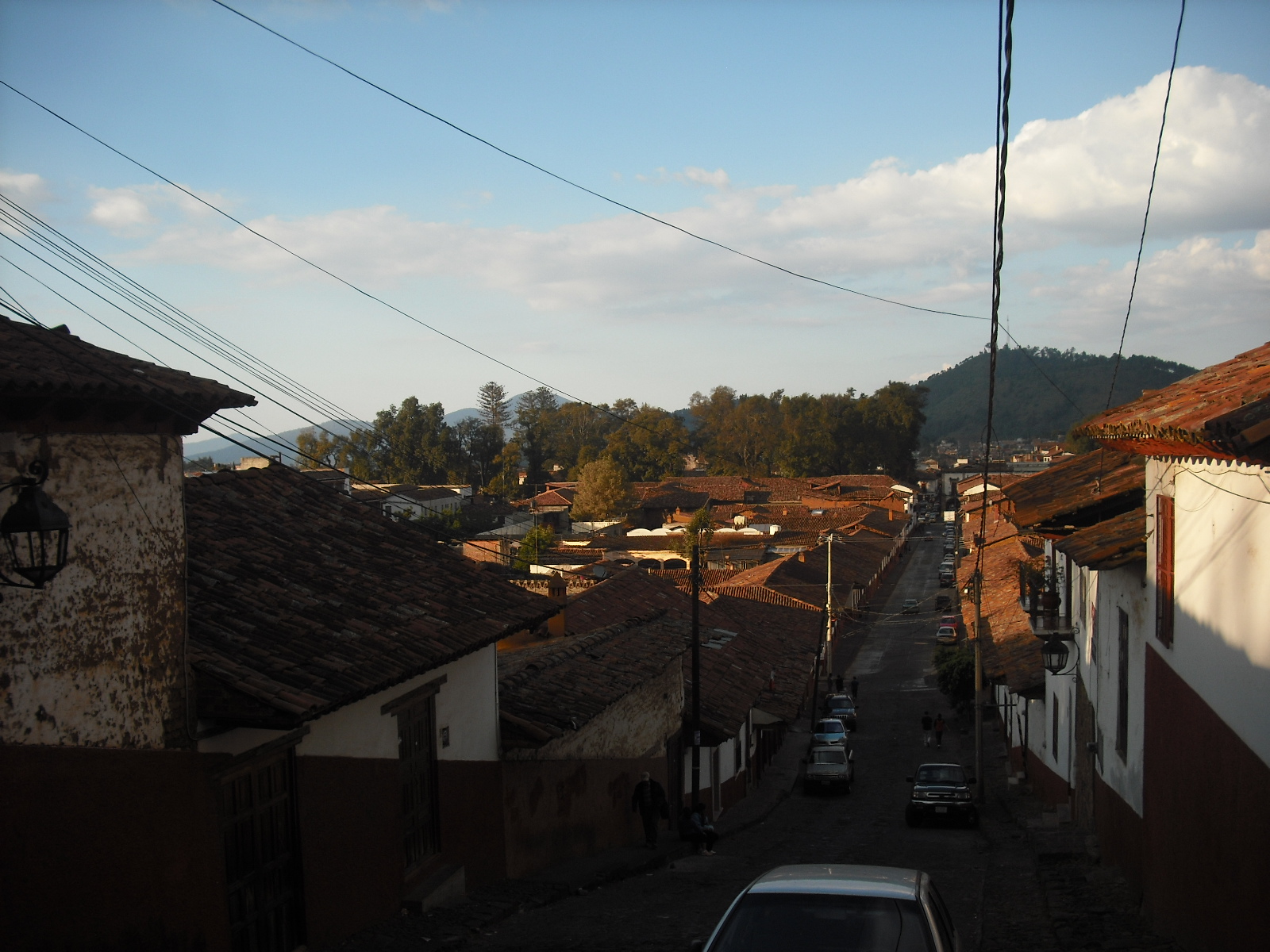
Streets of Pátzcuaro.
The first stop in Michoacán was Pátzcuaro, a small city on a lake whose utopian origins I’ve discussed before. The Pátzcuaro of 2010 was no utopia, but it was a beautiful place, the wind whispering down its mountain lanes and cooling its plazas. We arrived late at night and wandered the silent streets in search of a hostel, finally stumbling upon one with a few concrete blocks disguised as beds. Woken by roosters the next day, we hiked up a mountain to survey the scene, then descended to the lake, where a boat ferried us out to the island of Janitzio. It’s a famous Day of the Dead destination covered in terraces and quaint homes, though on this weekend it was a poster child for indigenous poverty: there were only a handful of tourists on the island, yet it featured row after row of shops, all selling identical, tacky products, and no business on the way. In spite of it all there was beauty there, a sight best witnessed from the lookout in the upraised fist of a giant statue José María Morelos on the island’s peak.
None of the outlying cities I visited can quite match the scale of Morelia, whose entire city center is a colonial jewel. Our first day there became an endless walking tour of intricate buildings, but there was something worth seeing around just about every corner. We visited on a hopping weekend; an international film festival featuring a few big names was in town, as was a superb bread festival, with championship breads arranged in shapes of trains and eagles and Mexican flags. We split our time there between two hostels; the first was the Tequila Sunset, whose name tells you all you need to know about it, and the second was a far swankier establishment owned by a man who had just come back from a few years in Bloomington, Minnesota. Naturally, we bonded, and the evening of wine and cheese on the rooftop swiftly degenerated when he invited in all his friends.

Par for the course on the streets of Morelia.
One trip south of Mexico City was to a place I’d been before. My dad, a Spanish professor, has been running study abroad trips to Cuernavaca since the early 2000s, and I went down to visit for a time during one of the early years. It had been years since I’d last seen Gerardo, the Canadian expat who runs the program, but it was a seamless slide back into life in the City of Eternal Spring. My first night involved a dinner on the zócalo with Gerardo, who seemed to know everyone in the square and the nearby artisans’ market; after some shopping, I settled into his home on the outskirts for some quiet contemplation.
The next day, joined by Gerardo’s wife and his friend Álvaro the Marxist Economist, we bought some beer and went for a drive up into the mountains for lunch at a trout farm, where we mused about Mexican politics and joked about Rubén Aguilar and loved life beneath the pines. Back in Cuernavaca that evening I made the acquaintance of a young Canadian who knew Gerardo, and he took me on a novelty journey to a spa he often visited with his Mexican girlfriend (now wife). I sat in a temazcal, an Aztec sweat lodge filled with pungent herbs, and sweated away my troubles before a good, hard massage. After that we ventured down into the Cuernavaca club scene, though the pictures of that night have, alas, “mysteriously” disappeared. But there was no time to linger in that realm, as Gerardo took me to breakfast the next day with a woman from an outlying village whose life had nothing in common with the leisure of the past few days.

Trout farm in the mountains above Cuernavaca.
Somewhat less placid than contemplative Cuernavaca was an arranged trip to Taxco by the university for all the study abroad students. This was also not a first time visit, though this jaunt proved a bit different than a day trip with the parents when I was twelve. On the way down the bus stopped at the Grutas de Cacahuamilpa, a large cave complex to the north of Taxco, and wandered through towering stalactites and stalagmites and other features I can’t possibly remember. Down its in depths was a spring pure enough that we could drink straight from it, the only water I’ve had that can rival the stuff that comes from Duluth taps.
Taxco is an old silver mining city, and one of the best-preserved colonial gems of Mexico. Even the major streets remain narrow cobblestone lanes, winding their way up the mountainside to which the city clings. Its centerpiece is the church of Santa Prisca, a stunning baroque icon on its zócalo with awfully translated English signs next to the Spanish ones. Thanks to a rainy season deluge, however, touring much of the city beyond the church and the silver markets proved a chore. We settled in a bar for a Mexican soccer humiliation at the hands of Ecuador, then skirted the raindrops on the way back to the hotel. (Two umbrellas were pressed into service as doors on our van taxi, as the real door was nowhere to be found.) The rain did little to dampen spirits, however, and the party raged on in hotel rooms for most of the night, culminating in a nighttime swim in the pool and an ill-advised journey back down into the city in search of tacos, which somehow managed to go off without a hitch. Most of the group suffered ill effects the following morning, though I was raring to go, ready to push through the mists of Taxco and on to the ruins at Xochicalco. I’d been here before too, and it was a good thing, because the rains drove us from the site far too soon.

Santa Prisca in the rain, Taxco
I never did get to Puebla, another regular stop on the central Mexico circuit, though I did pass through on a week-long journey into the country’s southeastern reaches. The first stop was Oaxaca, yet another city rich in history. We spent our first day at Monte Albán, a large Zapotec ruin atop a mesa-like mountain overlooking the city, but Oaxaca’s real wealth is in its living culture. The city is a culinary paradise, home to the riches moles and the purest mezcal and other delicacies, to say nothing of some good, crunchy chapulines. (Yeah, fried grasshoppers.) Southern Mexico retains its indigenous roots as well as anywhere in the nation, and that night the zócalo was the scene of a whirling pageant of dance. The next day our hostel gave us a wide-ranging bus trip around the area, with a visit to the Árbol de Tule—the fattest tree on earth!—and a Zapotec weaving operation. Next came Mitla, a ruin small in size but intricate in its Zapotec mosaic work, and then, a long, bouncing road up to the Hierve del Agua, a petrified waterfall. The tour ended at a mezcalería, where the Australian in our party won us a free bottle through feats of epic liver destruction.
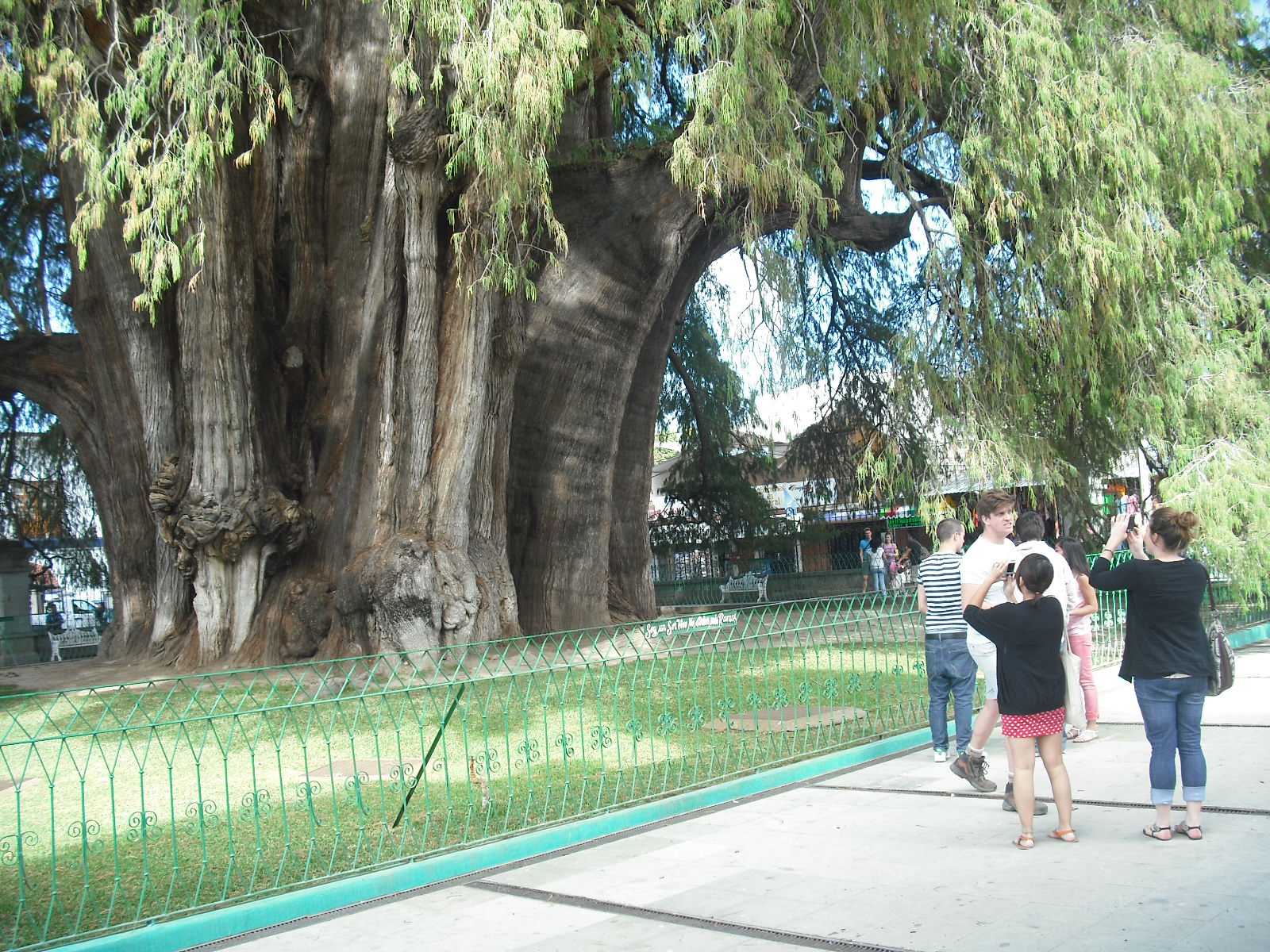
The fattest tree on earth, Oaxaca.
That night, I chaperoned us along on to another bus trip, this time to Puerto Escondido, the lone beach trip of my four months in Mexico. It involved normal Mexico beach activities, albeit in a sleepy town with just enough tourism to give it a hippyish edge. (One expat, when asked of her origins, told us she was from the stars, though she’d also spent some time in Cincinnati.) We found a couple of cabins far enough up the shore for some privacy, but close enough to walk into town along the beach. For once, I set my itinerary aside and devoted myself to blissful nothing: leisurely meals in seaside shacks, long nights of festivities on the beach, lazy scrawling in a notebook in a hammock before drifting into a nap and waking without a care in the world.

San Cristóbal de las Casas
The next bus took us up to San Cristóbal de las Casas in Chiapas, the farthest southeast and the poorest state in the Mexican union. I covered our Thanksgiving day trip to San Cristóbal and the Zapatista community in rebellion in a previous post, but it was a valuable stop, one that made me think long and hard about how to find my place in the modern world. The next day the bus schlepped us along to Palenque, stopping at a pair of waterfalls along winding mountain roads before coming to the great Mayan ruins in the jungle. Its sprawling palaces peek out of the greenery, and its architectural variety and detail surpass anything in the center of the country. After declining numerous offerings of mushrooms and one last long overnight bus trip, my last Mexican road trip came to an end.
* * *
These reminiscences on Mexico tend to be gushing tales of discovery and dalliance. That reflects reality, up to a point. But that isn’t the whole story, and I’d be remiss not to mention the other side. In a way, Mexico was liberation: I was wildly free to reinvent myself and surrounded by excess, in which I participated willingly. And yet I still had a vague sense that I was in this world, but certainly not of it. I both poured myself in the fun and remained a detached observer from on high, an exhausting effort that can be hard to articulate. More than once, returning to my Mexico City flat, I’d slump back in the elevator and run a hand through my hair, drained by the fullness of the life I lived, wondering what it all meant. For the first time since I’d started my aggressive writing two years prior, I had writer’s blocks: suddenly it didn’t come naturally, the world I’d built through those words no longer quite held together. In my relentlessness I was missing something; I didn’t always know what, and even when I did, I didn’t have the ambition to seize it. It took a trip abroad to see what was closest to home; a confrontation with different worlds to learn my place within the one I knew.

Lost in dreams in Puerto Escondido.
People often like to talk about finding their “true selves.” I find this deluded. We have no one true self; we are a wide array of forces and histories, all wrapped up in one body and one mind, trying to make sense of the whole mess. For me, Mexico is one of those parts, thrown in there with everything else.
What did Mexico give me? I can try to put it into words. There was a host family that showed me what family life ought to look like, and a friend or two who showed me the meaning of companionship. Those bonds endure. It showed me how to push outward, how to surrender parts of myself to others, even as I struggled with deeper truths. It showed me a country impossible to paint in black or white, a nation that swallows everything up and makes it all its own. It made me rethink my politics and my worldview, and gifted me with the man I quote more than anyone else. Above all, it turned me loose, however haltingly, and at the same time underscored how much more there is to life than mere freedom. Five years later, I await a chance to go back—but I carry it all with me, part of a living history, and those four months live on, forever renewing an old belief. Viva México, dador de la vida.
 A Patient Cycle