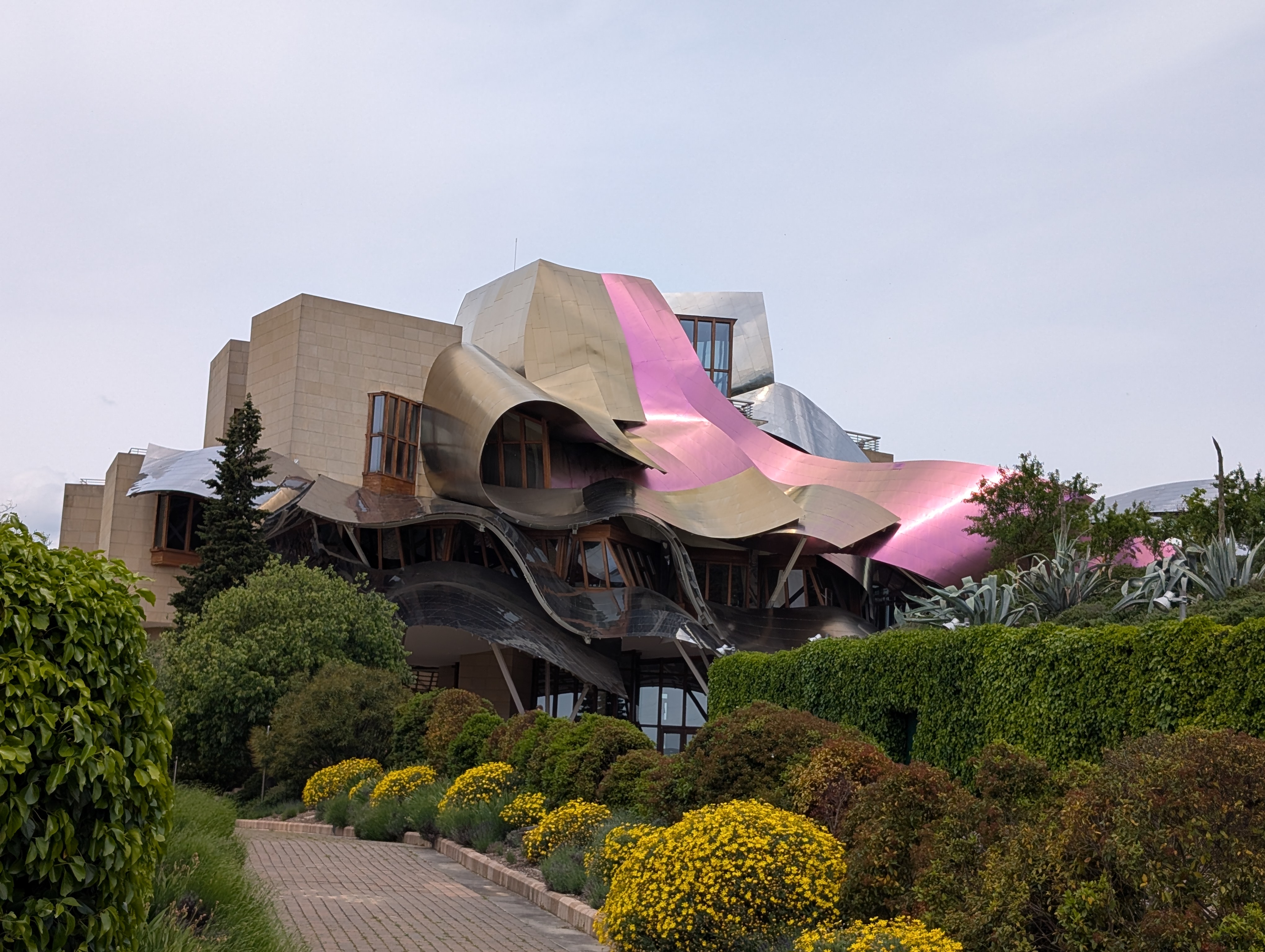
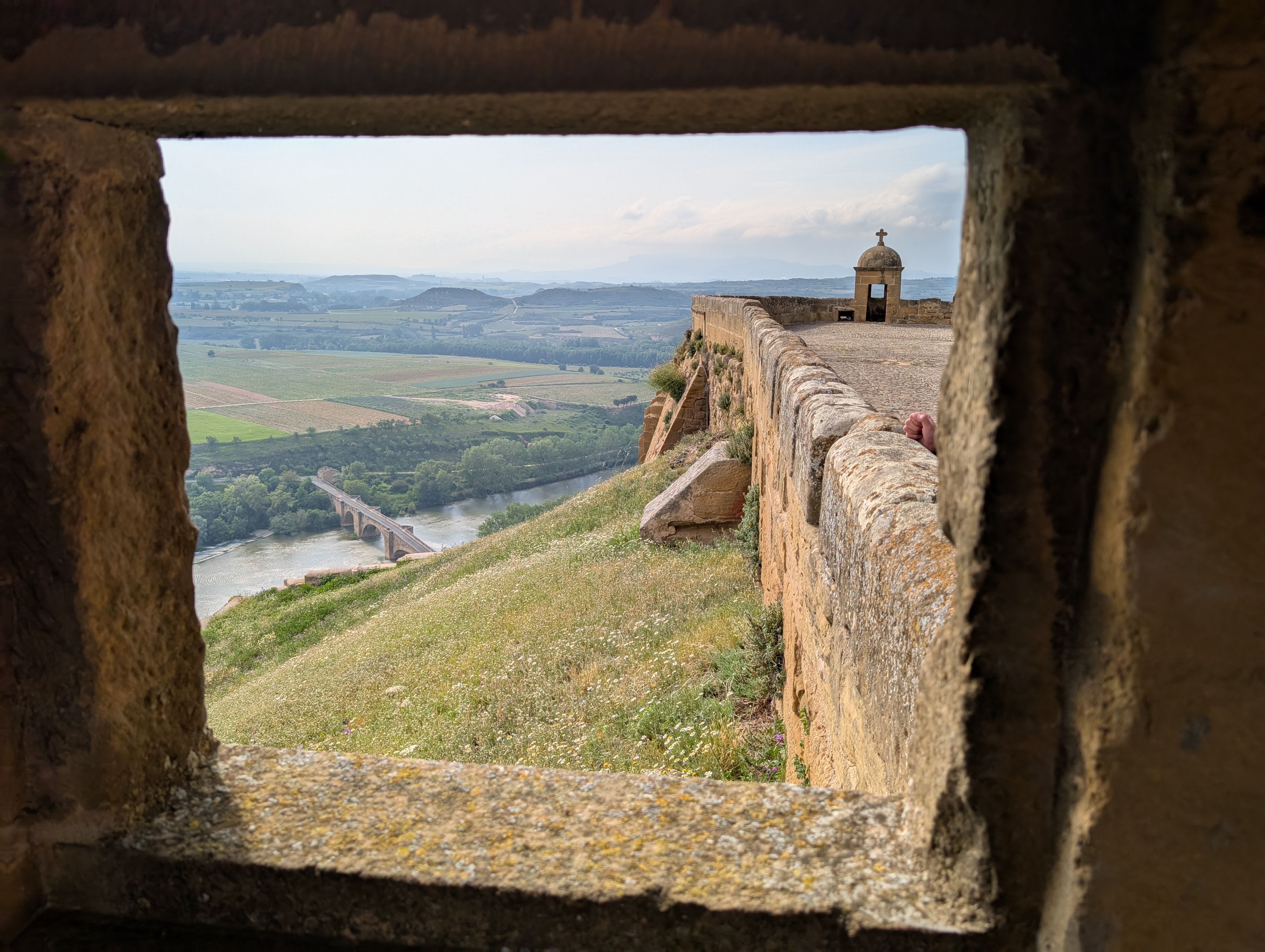
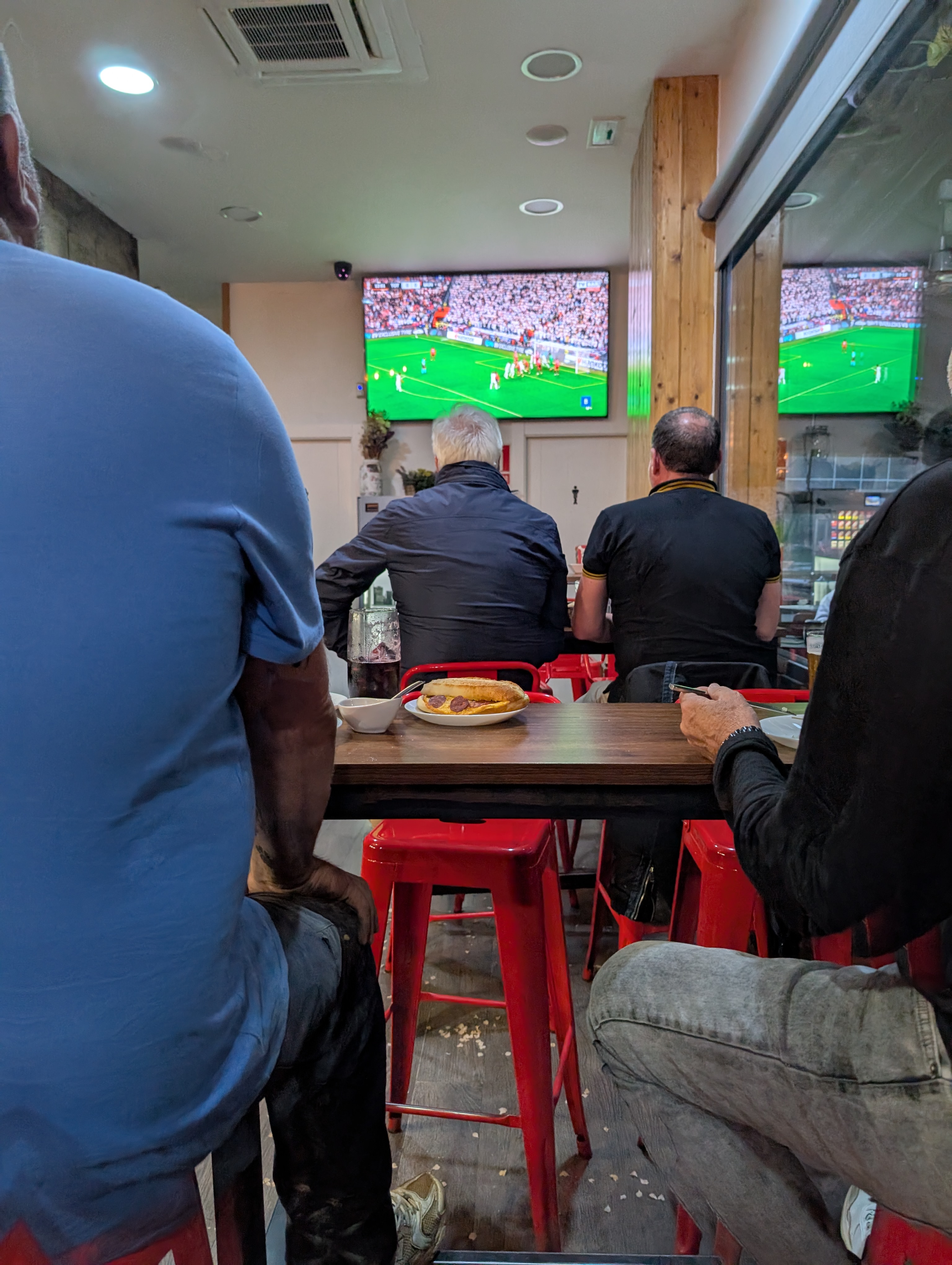
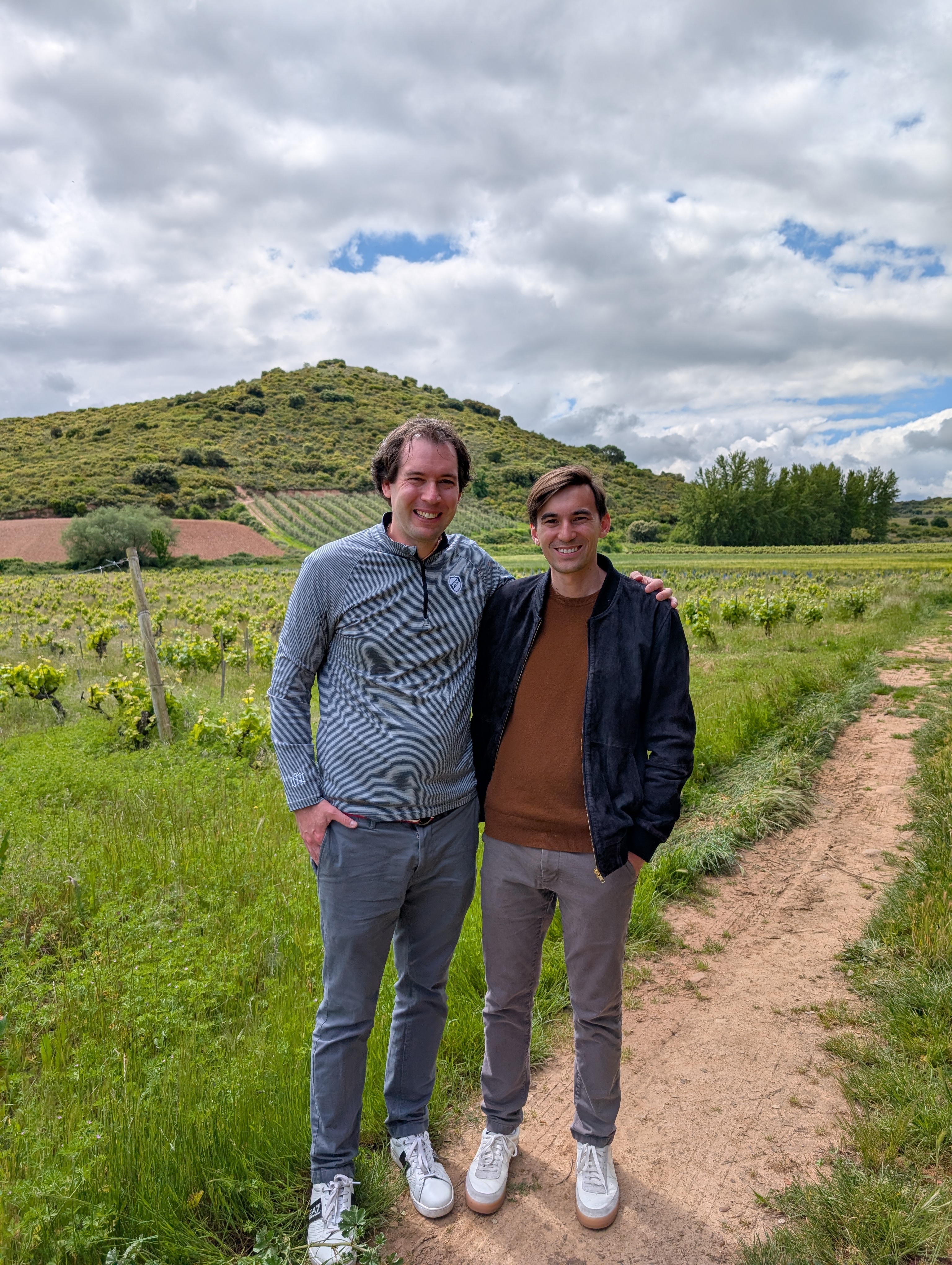
Spain 2025, Part II: Basque-ing in Finery

This is the second in a four-part series. Part One is here.

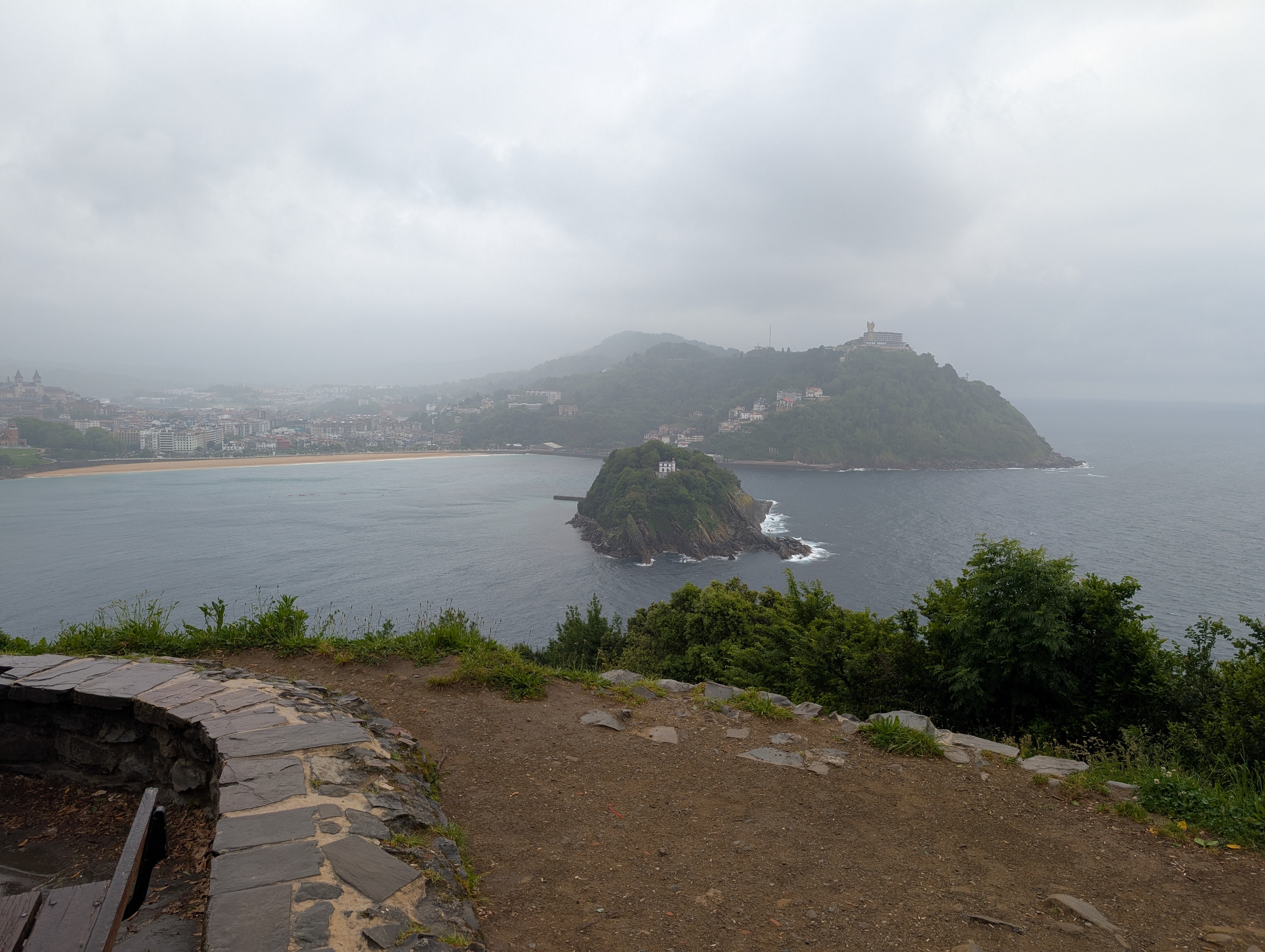
Northeast of Burgos the Spanish countryside grows more picturesque. My train cuts through passes in granite crags with old cities clinging to hillsides, all robed in fog on this wet day. The train slows for twists through thick trees and night swallows the scene quickly. A weird new language I cannot understand at all joins Spanish and English in the train’s announcements. I am approaching my destination: Basque Country, the Euskal Herria, the autonomous community on Spain’s northern coast and along the border with France, at the elbow of the Bay of Biscay. I’ve previously knocked out two of Spain’s regions with their own languages and complicated histories with Madrid (Galicia and Catalonia), but the Basques are in a league of their own, their mother tongue bearing no relation to later-arriving Romance languages and their separatism punctuated by violent militancy well into this century. In the far north they have carved out a state with immense national pride, Spanish flags almost universally replaced by the red, white, and green of the Basques. It is here that my friend Andrew and I have chosen to spend some time exploring in May.

Northern Spain is not the stereotype of dusty windmill-strewn plains nor of Moorish architecture nor an excess of loud British tourists chasing some cheap sun, though they are still around. It is a lush, wet land, its regions relatively small in area, cut off from much of the rest of Spain by a wall of mountains. The Moorish advances trickled out here, and the Reconquista began in places like Asturias and Cantabria and Northern Castilla y León. By Spanish standards the north is relatively affluent, the birthplace of several national banking giants and home to a respectable industrial base and such darlings of local control as the Mondragón Cooperative. And while there is good food everywhere in Spain, Basque Country is its peak.

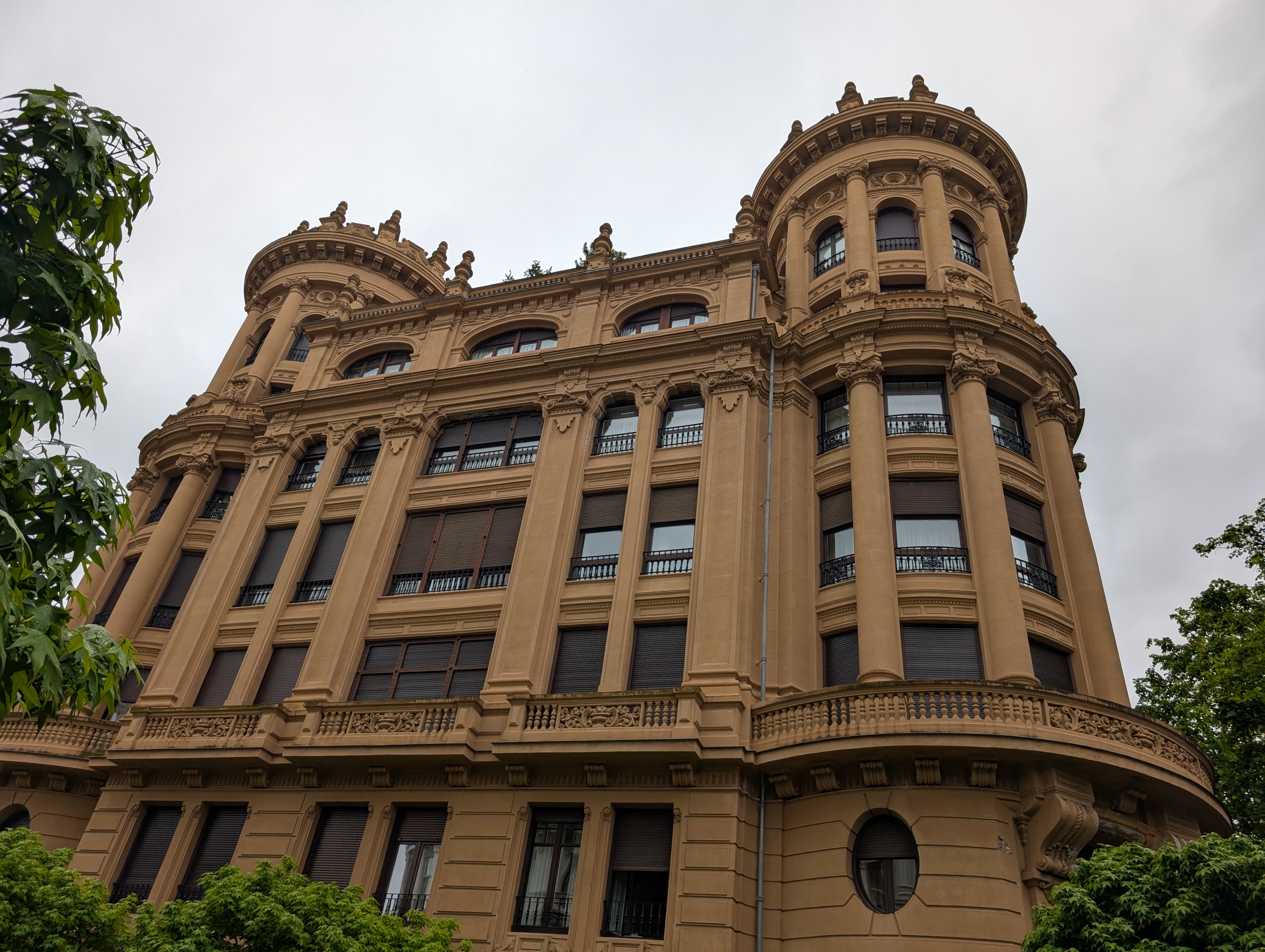
The Basque cultural capital is Bilbao, a metro of one million and in many respects an ideal type European city: tight winding historic old town, newer grand promenades, a famous museum, a fancy old train station, a gaudy new soccer stadium, apartment blocks in rings around the cool stuff, a few discordant office towers, and a river winding through the middle. Its twist is the national pride for a nation that spent long parts of history hidden away in these rugged hills along the sea, speaking their obscure tongue punctuated Xs and Ks and Zs and Ts. (Andrew and I are curious to see the point values in Basque Scrabble.) While Spanish remains the dominant tongue, Basque is present, from a dignified group of elderly diners at the nicest restaurant we visit to a flock of teenagers slurping Aperol spritzes on the patio where I grab a late-night snack upon my arrival. The rebellion against the crown continues, subtle but persistent.

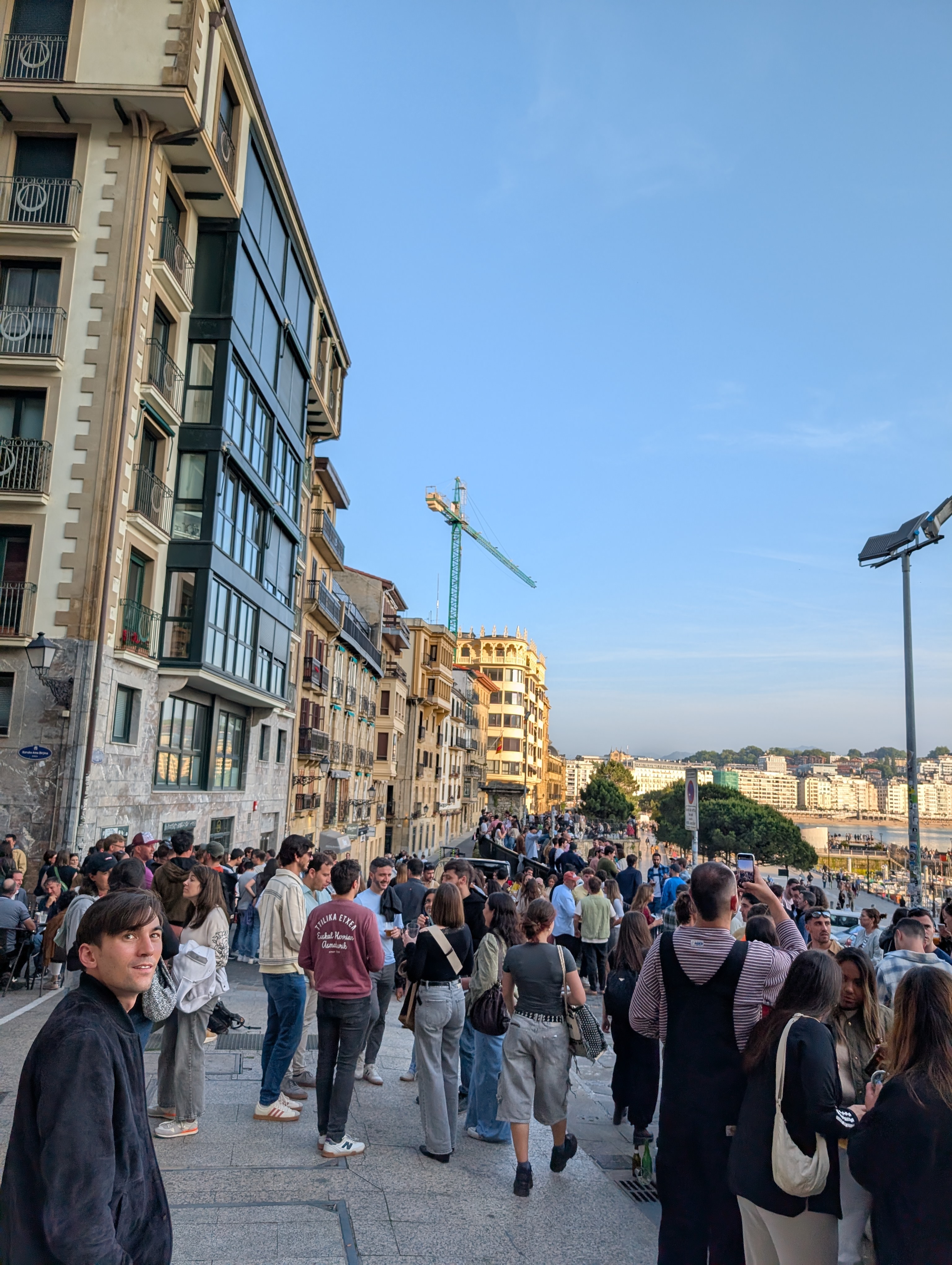
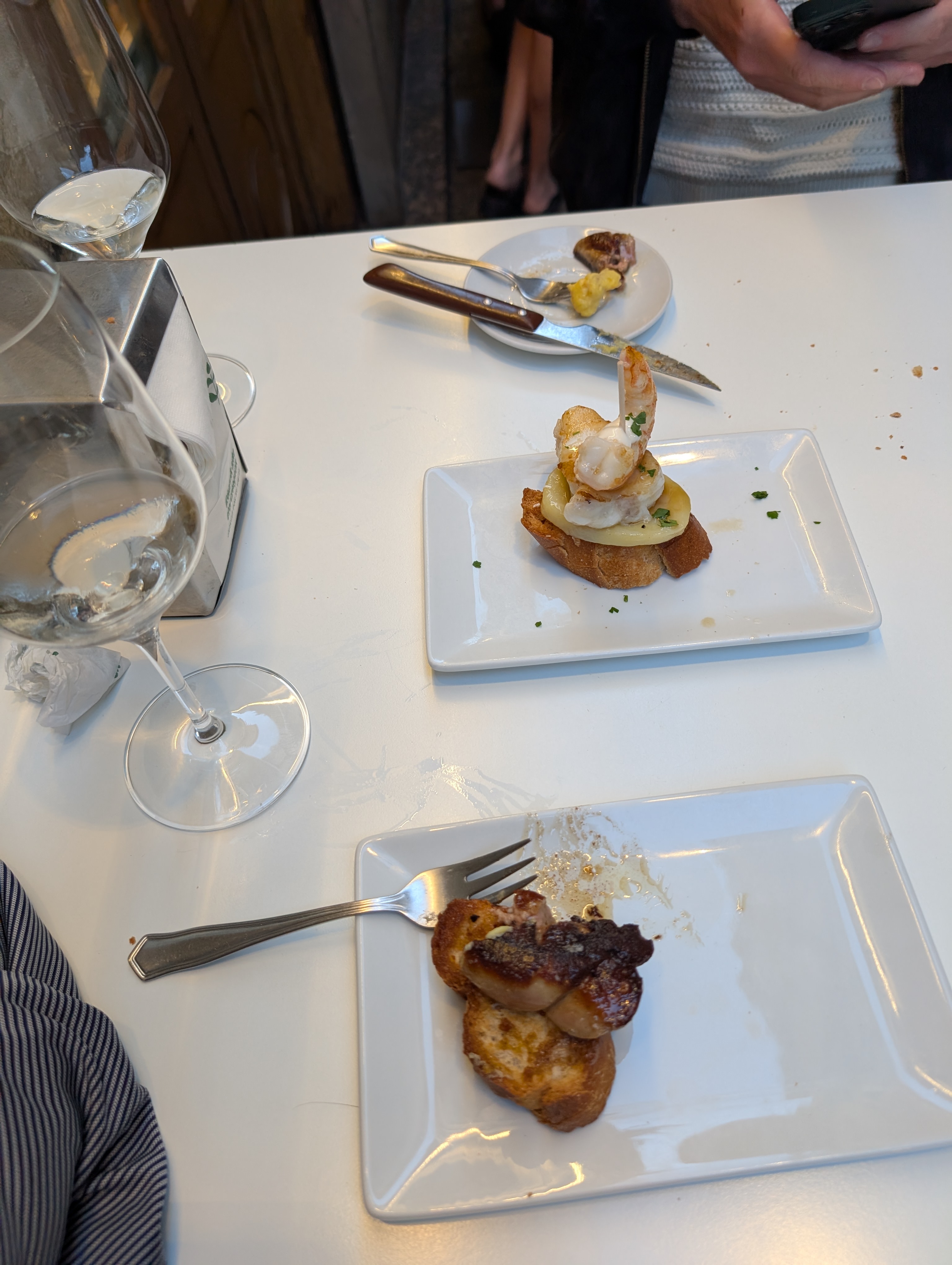
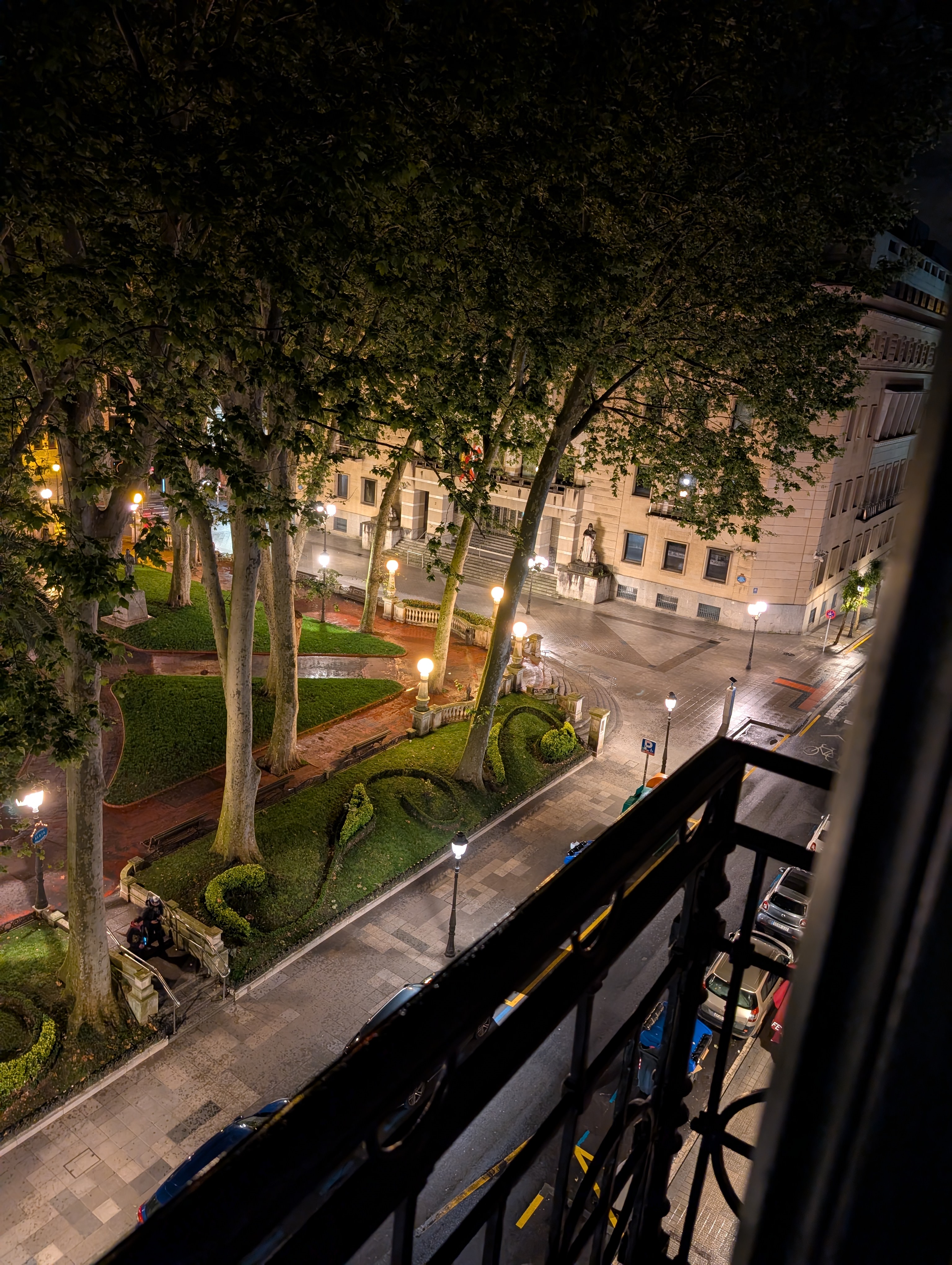
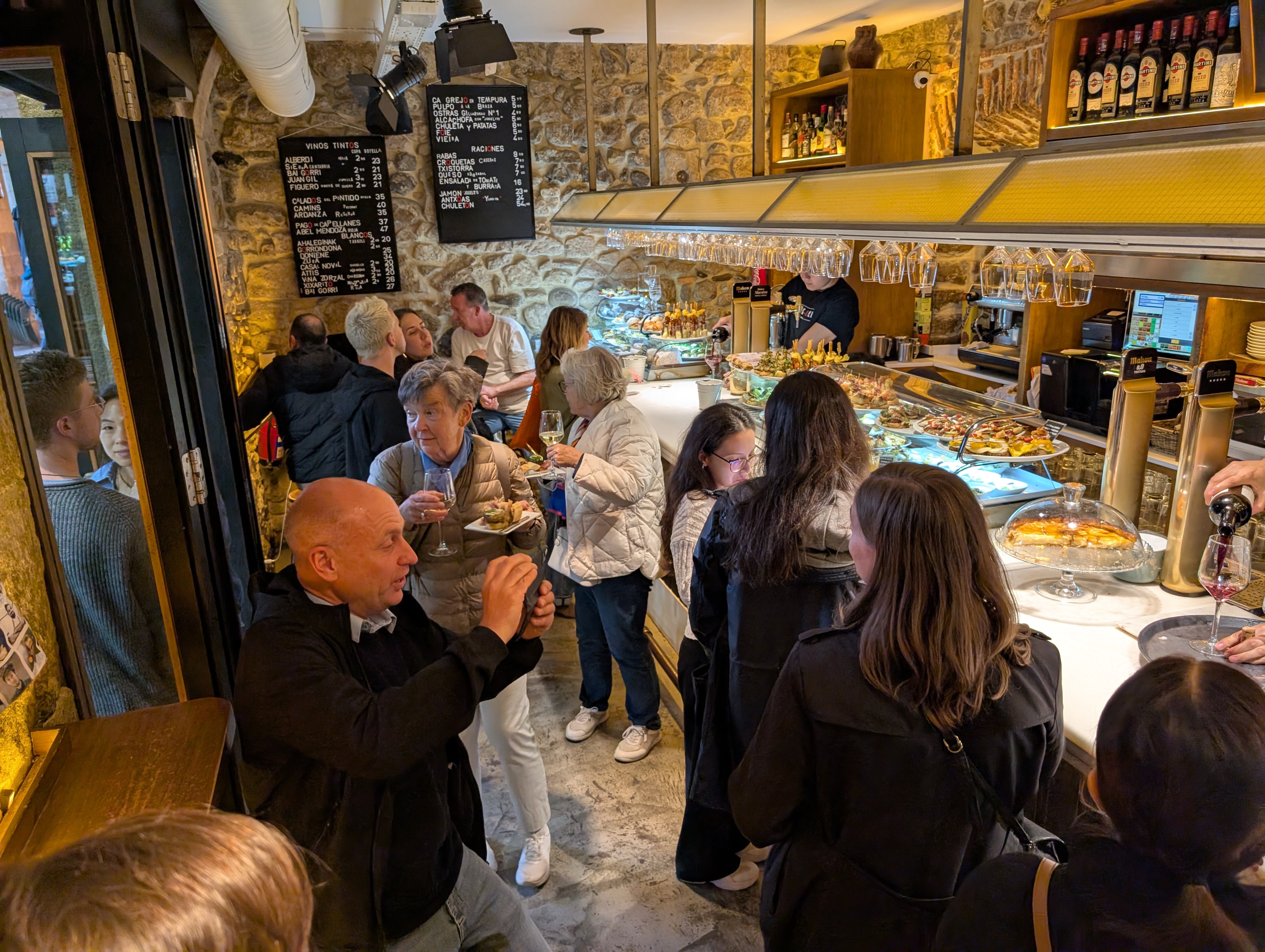
Our hotel sits on the Albiako Lorategiak, a placid square whose towering sycamores rise high above our fourth-floor balcony. Andrew misses a connection from Madrid to Bilbao (he spends his delay at the Prado, the poor soul), so I go back to my wandering routine on the grey, drippy sort of day that is common here in the Euskal Herria. I stroll the Gran Vía and meander the tight streets of the Casco Viejo, grab a pintxos (Basque tapas) lunch, ascend to a basilica on a hill. The city is in the preparation stages for a British onslaught, as Manchester United and Tottenham Hotspur will meet here in a week for the Europa League final; soccer balls dot the city, and a new wrap is going up on the sparkling San Mamés stadium. On the way down from the basilica I lose myself briefly in apartment block Spain, that dense, urban reality that is more representative of contemporary Spanish life than a tapas crawl on a historic street. In the US this sort of neighborhood would prompt some nervous looks from outsiders, but here it just feels like a normal Thursday afternoon. Kids pour out of a school, people reel in the laundry from beneath their umbrella-covered hanging spots out the window. The shops are a bit grittier but the fundamentals of Spanish urban life are unchanged.

When Andrew arrives, the pintxos tour begins in earnest. We nail our first two stops, octopus at Gure Toki and mussels with good wine at Taska Beltz. There is quality craft beer at La Ley Seca, a mediocre Mahou to end the night on a pedestrian street a block from the hotel. It continues the next day with breakfast at the Café Iruña with its stunning Moorish interior, lunch at the vast Erriberako market, more good beer at Bihotz, and a dinner at Casa Rufo that slowly builds: white asparagus from Navarra, a well-salted cod, a gaudy steak, and a divine Manchego cheesecake for dessert.

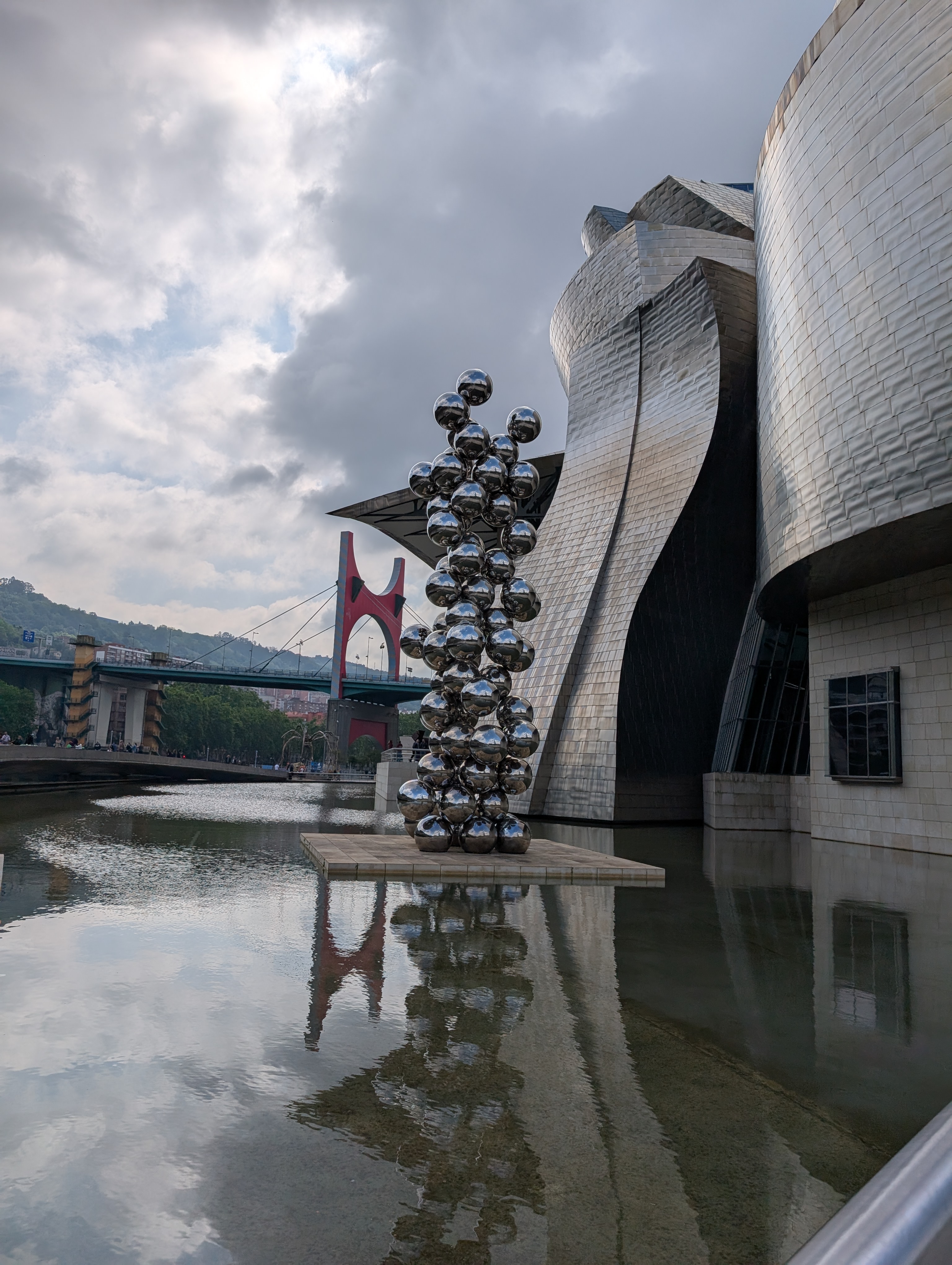
Bilbao’s great attraction is the Guggenheim Museum, the striking Frank Gehry-designed eruption of molten titanium lava flows that takes on to the shifting moods of Basque Country weather. The tour starts on the outside along the riverfront promenade, with Anish Kapoor’s giant pile of reflective balls and a giant spider (its effect somewhat reduced by the crews buffing it on the day we visit) and a towering flowery puppy by Jeff Koons. The titanium-clad exterior somehow turns to an airy glass interior, cavernous and at times vertiginous on its catwalks, able to hold ten thousand French schoolchildren with ease. Its three immersive exhibits are its best, and it wins me immediately with Richard Serra’s The Matter of Time, a series of giant pieces of iron that invite exploration as if they were a series of southwestern slot canyons. Next is Yayoi Kusama’s Infinity Mirrored Room, a trippy house of mirrors and flashing lights meant to invoke the artist’s hallucinations. Finally there is Refik Anadol’s in situ, a room covered in a nonstop flow of AI-generated images of Frank Gehry architecture and its influences that occasionally hallucinates and goes wrong. Beyond that there is a collection of modern art’s greatest hits: a Warhol, another Koons, some de Koonigs, none of which are my cup of tea but are welcome enough as a summation of a movement. (The one I do enjoy: Cy Twombly’s nine-part descent of Emperor Commodus into insanity.) An exhibit on the Brazilian painter Tarsila do Amaral also opens new worlds, a blend of modernism and Cubism and Brazilian color. The Guggenheim is a triumph of urban renewal, a peak many cities chase but achieved successfully by Basque leadership that saw the creation of monuments like this, not just another European micro-state, as the path forward.

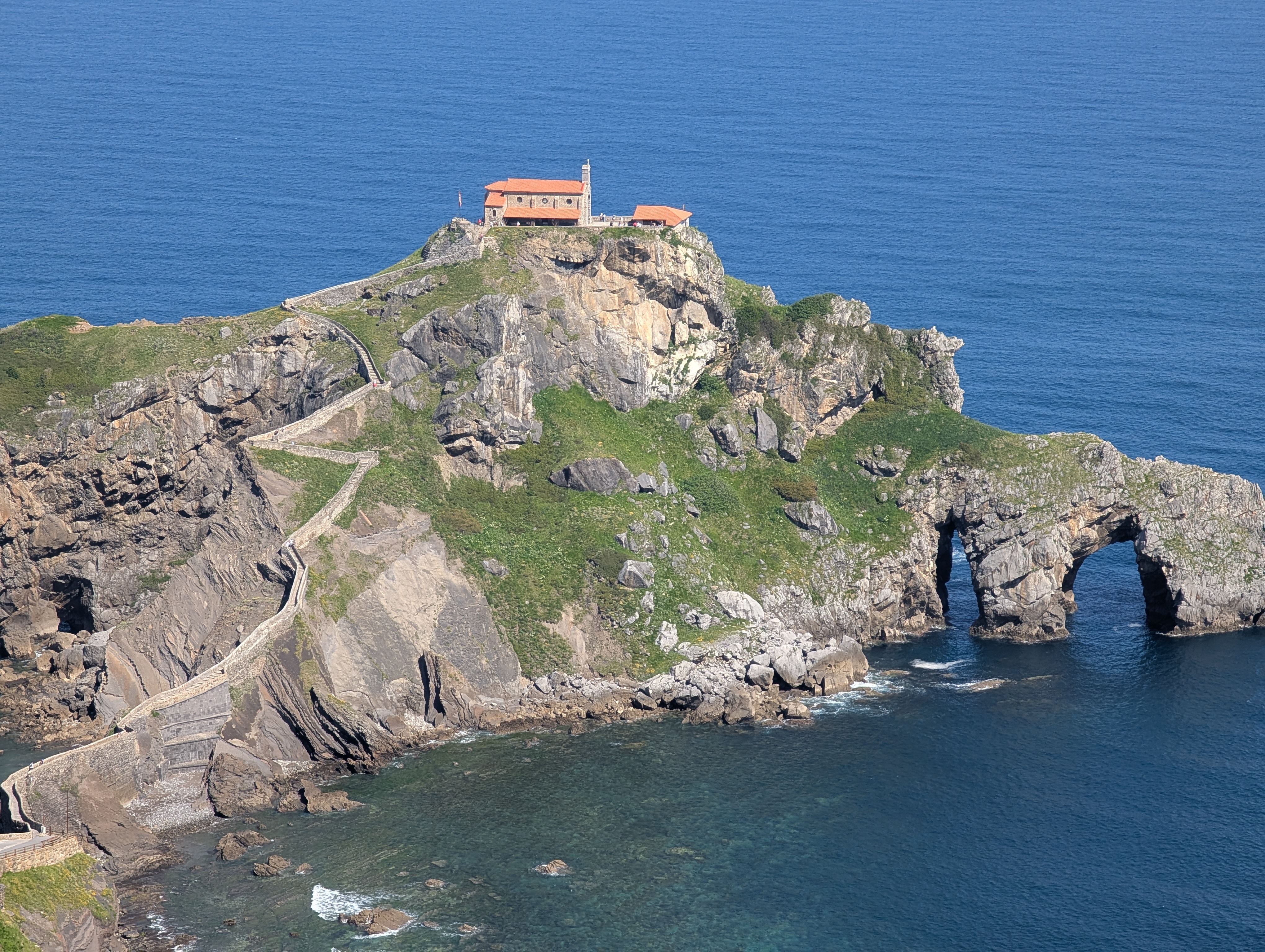
We rent a car for a day to drive the coast from Bilbao to San Sebastián, guided by a Siri whose command of Basque leaves something to be desired. The trip is just over an hour by freeway but over three and a half by our route, and while Siri takes us on a few rides, our road is well worth the time it takes. Our first stop is Gaztelugatxe, a medieval monastery and the site of Dragonstone in Game of Thrones, sitting alone atop a rocky isle just off a sloping cliff, its caves withholding any sign of fiery priestesses. We pass through little surfing towns like Bakio and Bermeo and Mundaka, and the coastline evokes Big Sur, complete with the road washouts requiring detours; this, I think, is what the California coast could have felt like several decades back, before history overtook California. It is stunning country, beautiful but not overpopulated, issuing a summons to stop and explore each small town, if one can possibly find any parking. Perhaps it is better that they do not build more.

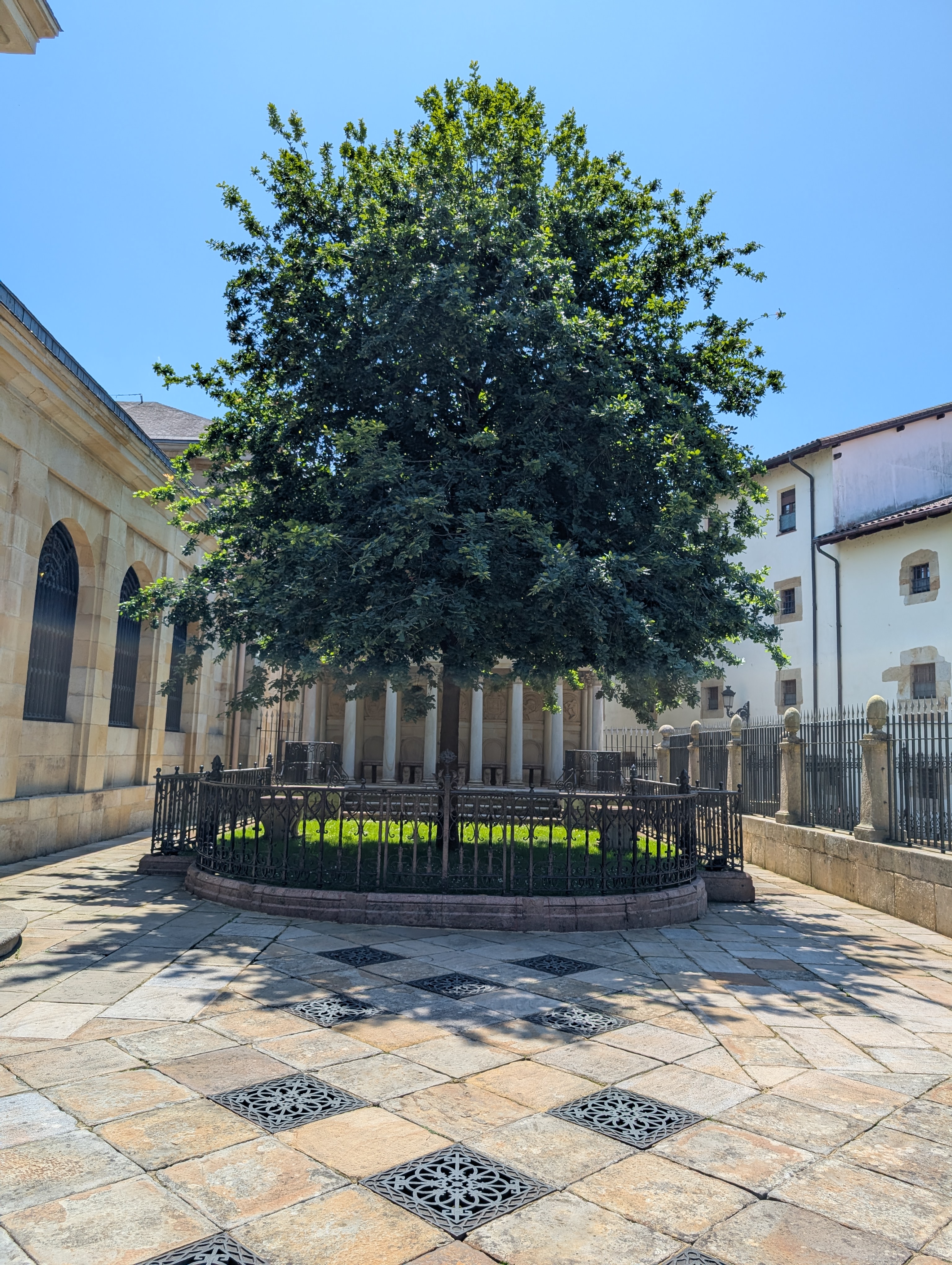
A quick turn inland takes us to Guernica, the spiritual center of the Basque Country, home to a meeting hall for their centuries-old republic (admired by John Adams as he studied forms of government for the United States) and the oak tree beneath which the province of Vizcaya still gathers to elect its ceremonial leader. This history is part of why Francisco Franco and his Nazi allies selected it in 1937 as a test run for the first carpet bombing of a town, though the oak tree (and the actual military targets, like an arms factory and a bridge) withstood the bombing while the city center went up in flames. Today, Guernica is a bustling, pleasant town with regular reminders of a dark past, and the Peace Museum gives eyewitness accounts of the devastation, ponders questions of what exactly peace means. As anyone with a memory of Guernica’s carnage passes out of time, I wonder how well a world increasingly interested in reviving great historical struggles will remember its lessons. We are left with some museums and one raw, great Picasso to help tell the tale of what that era’s escalations wrought.

After Guernica it is back to the coast, back to weaving roads through maritime pine and eucalyptus, my steering wheel hands and break pedal foot growing sore. Ondarroa makes me gawk. We stop off at a beach sliced up by Flysch, sharp cuts of sheer sedimentary rock near where tectonic plates met at some point in time. The beach here in Zumaia is populated entirely by locals, blissed out on the Basque coast. Next we curve over to Getaria, a fishing town on a narrow finger of a peninsula, though we have mistimed its fine food scene. Driving up a coast never grows old, I say to Andrew, and as we turn toward San Sebastián I understand why the Basques cherish their homeland so much.

Part 3 is here.

Spain 2025, Part I: History’s Greatest Urbanists

This is the first in a four-part series. Part 2 | Part 3 | Part 4

Being out in big surf is dreamlike. Terror and ecstasy ebb and flow around the edges of things, each threatening to overwhelm the dreamer. An unearthly beauty saturates an enormous arena of moving water, latent violence, too-real explosions, and sky. Scenes feel mythic even as they unfold. I always feel a ferocious ambivalence. I want to be nowhere else; I want to be anywhere else. I want to drift and gaze, drinking it in, except maximum vigilance, a hyperalertness to what the ocean is doing, cannot be relaxed. Big surf (the term is relative, of course—what I find life-threatening, the next hellman may find entirely manageable) is a force field that dwarfs you, and you survive your time there only by reading those forces carefully and well. But the ecstasy of actually riding big waves requires placing yourself right beside the terror of being buried by them: the filament separating the two states becomes diaphanous. Dumb luck weighs heavily, painfully. And when things go badly, as they inevitably do—when you’re caught inside a very large wave, or fail to make one—all your skill and strength and judgment mean nothing. Nobody maintains their dignity while getting rumbled by a big wave. The only thing you can hope to control at that point is the panic.

-William Finnegan, Barbarian Days (Against Dereliction)

On my recent trip to Spain I spent a little time mesmerized by the skilled surfers off Zurriola Beach in San Sebastián. Old friends and readers of my writing will know surfing can enrapture me, inspire words that go far beyond the exploits of a beach bum on a board. It is a feeling known to anyone who has ever given himself over to something beyond him.

The passage above, while less immediate in its death-daring fear, approximates the dream state I enter when exploring a European city on foot. I feel it all deeply, want to wander without a map, one with thousands of forces that flow of their own accord to weave together into the fabric of an urban life. Gifted thirty jetlagged hours in Madrid at the start of my trip, I pick out one museum for a visit, but I am mostly here to wander and explore.

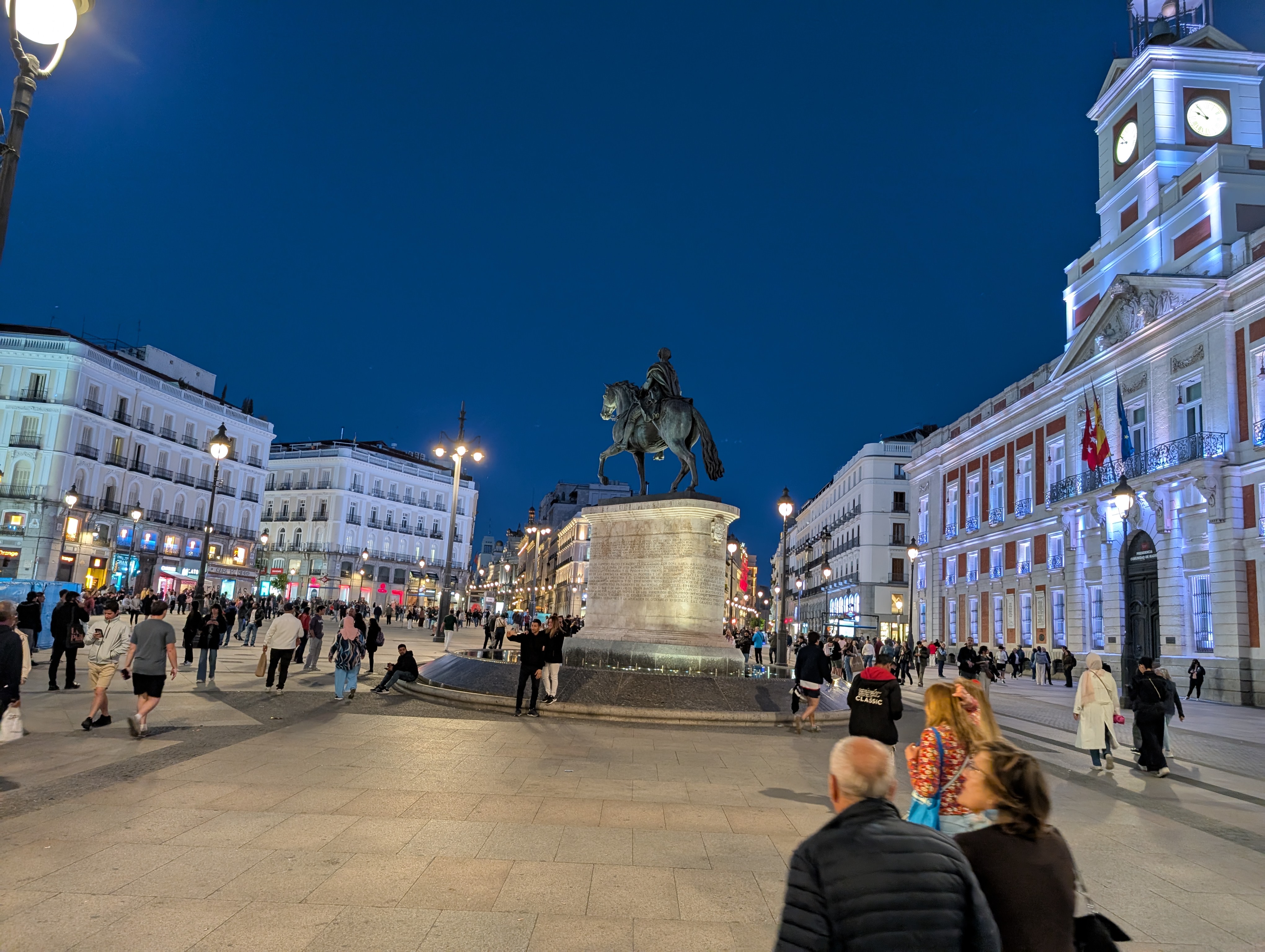
Madrid is a city of seven million people, and yet most of its great monuments are reachable by foot. The Plaza Mayor and the Puerta del Sol are the humming hearts of the city; down the Gran Vía and Calle Alcalá, luxury brands take up shop in ornate buildings, a pastiche of revival and art deco architecture. On the west end sit the monumental palace and cathedral, while a series of arches in traffic circles (puertas and glorietas in Spanish, far more melodious) ring the entrances to the city center. To the east and southeast are the great museums, the Prado and the Reina Sofia and the Thyssen-Bornemisza. Great green spaces bookend the Centro, the sprawling Parque del Buen Retiro to the east and the lush Campo del Moro below the palace to the west. Strewn between are neighborhoods of life and culture and history, La Latina and Letras and Chueca, plazas dotting them to open up the narrow streets and give people places to settle at tables for a drink or a bite. Fountains flow and statues stand guard and that central Spanish sun beats down on the scene.

And so I re-immerse myself in that Spanish urban rhythm. I revisit a good brewery here and a fun restaurant there from my previous visit. I pause to read sign boards and take unexpected turns when piqued, and I sit in some churches and gaze upward in awe. In the Plaza Mayor, a stage has been set up and trucks are unloading kegs for the celebration of the Feast of San Isidro, which I will miss by one day. In the Puerta del Sol, lit up for the night, I sit for a spell and feel the rush of freedom that comes at the start of a new great trip, enchanted by what the Madrileños have designed here.

The Spanish are, after all, history’s greatest urban planners. It is difficult to find any Spanish town, no matter how godforsaken, without a walkable grid at its core and a pleasing central square and a couple appropriately scaled monuments: a church, a government building, some statues or fountains. Small, specialized shops are everywhere, selling food and technology and books (so many bookstores!) and just about any basic need within an easy walk of home. They make ample use of arcades, a superb and underused design feature, especially in hot or wet climates. Their housing is dense but not overcrowded; the apartment blocks in the suburbs, while not aesthetically pleasing, provide ample housing and are well-connected into the city.

These characteristics are not uncommon across Europe, but Spanish innovations endure. Whatever else one may say about their colonial exploits in the Americas, the Spanish did very intentionally export their urban form over the better part of two continents, and those plazas and zocalos will live on from Buenos Aires to Santa Barbara long after anything Bob Moses built gets replaced and the high modernists get consigned to the museums where they belong. More recently, the Spanish have built a train system that is the envy of the Western world, high-speed AVEs flying about, full lines built for the cost it takes to lay three ties on the California High-Speed Rail project; in Barcelona, the subway arrival time boards count down to the second. When I recently heard a joking proposal that we fire all train planners in the United States and replace them with Spaniards, I found myself nodding in solemn approval.

Besides the timeless aesthetics, Spanish cities understand something about human nature. An innate curiosity to peek around a corner, slip down an alley, emerge into a square. A simultaneous desire for order and ornament, a stable foundation topped by some of the flair that makes life fun. Spaces where adults can sit at tables and talk while the youths gather in another corner and younger kids can just dart about, all free to intermix while also carving their own little spheres. Spaces for God and spaces for hedonism; spaces for government and dim alleys to escape it. Meals are a progressive feast, small plates to escape gluttony, a free bite with every drink. Spanish city centers are a pleasure to stroll through, a pleasure to linger in, the place everyone wants to hang out instead of alone in little boxes every night.

My visit to the Reina Sofía modern art museum confirms my belief in Spanish urban thinking. How, exactly, does an art museum reflect values in city planning? Well, in it, I find a healthy heap of the original versions of designs I remember from introductory urban planning texts, from Garden City drawings to Le Corbusier’s schemes, along with plans for Madrid and Barcelona that seek to update these great old cities with grids that can sustain modern living. In a museum with relatively few non-Spanish works, the curators have seen fit to collect some of the most iconic pieces in the history of the field, show how their country then took those ideals and adapted them to their own towns. For the Spanish, urban planning is an art, worthy of its own wing just down the hall from Guernica.

Like its more classically inclined compatriot, the Prado, the Reina Sofía largely leaves out anyone who is not either from the country or in some way tied up in its history or artistic movements. Picasso and Dalí take center stage, but here also are Joan Miró and Juan Gris and adjacent surrealists who made the art world churn in the early 20th century. The temporary exhibitions include the funky sound artist Laia Estruch, a reasonably well curated collection of art attempting to subvert narratives associated with Spain’s colonial history (here I am pleasantly surprised to find art and video from a Mexican Zapatista community I have visited), and a painter named Huguette Caland with no obvious tie to the country who does hold the attention, sitting at an intersection somewhere between Picasso and Georgia O’Keefe, with the occasional sprinkle from the Middle East.

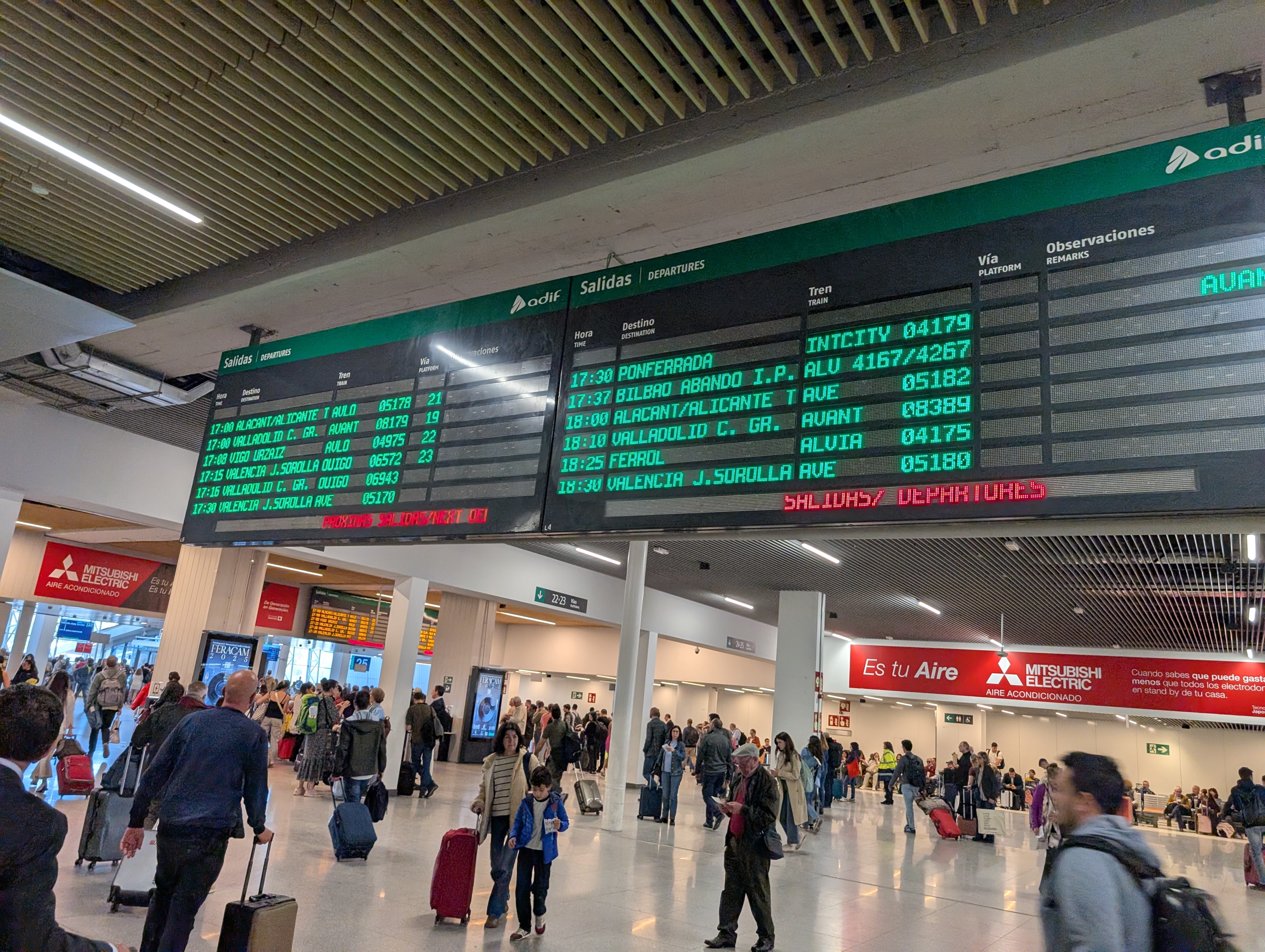
After my museum visit and a leisurely lunch on the Plaza Tirso de Molina a few blocks from my hotel, I head for Chamartín train station to get a taste of that great train system. It runs like clockwork, trains humming out every few minutes, and this isn’t even the busiest station in Madrid. The train I take rockets north, through tunnels under the Sierra Central and across the savannas of Castilla y León. The rain falls steadily on my train across the Spanish plain, through Segovia and Valladolid and Burgos and the smaller farming towns between them. The cities feature large industrial parks and larger apartment blocks, a somewhat bleak Spanish heartland.

When seen by train Spain feels like it is in a different stage of development, still suspended in an agricultural and industrial state instead of deep in the knowledge economy. In some ways this does not feel like a terrible tradeoff, with less job disruption and a healthier small business sector, with fewer basement-wage service jobs and a step of removal from the tech obsession and paranoia now gripping American culture. The only things that hurtle at maximum velocity here are the trains.

Still, it is a tradeoff: prior to the Great Recession, wealth in Western Europe’s leading economies (of which Spain is not really one) was basically on par with the United States. Now, American GDP growth has left Europe in the dust over recent years. Coming out of the recession, Angela Merkel’s Germany imposed bad austerity economics on the continent while the U.S. gave its economy some halting stimulus, and already higher energy prices have since been exacerbated by the war in Ukraine. Tech has been an engine of American growth, while Europe has maintained a skepticism of that whole push. Throw in a strong dollar and it’s easy for an American to feel relatively affluent in Europe: even with some exchange rate rebalancing amid a trade war, prices on most things still feel like a bargain, especially since Europe eschews the absurdity of tip inflation. Real estate in downtown Madrid is expensive, but under conventional American loan terms I could make a play at it with my current salary if I really wanted to. Doing the same in New York or Washington would be laughable.

There are still many reasons, some empirical and some subjective, to prefer European choices over the American growth-at-all-costs machine. But there are serious long-term implications for that widening income gap and what it will take to sustain those European welfare states. What the economy gains in preservation of the past, it can lose in any sense of dynamism; youth unemployment is an actual thing here. A loud soccer bro on his phone two rows behind me on the train, speaking in a Gen Z English punctuated by an appropriate number of fucks and bros, thinks his future is elsewhere. The question looms: how next will the Spaniards reinvent their cities and networks to meet the world they now live in?

Part 2 is here.

Maloney Sketches

I.

Red pines on a slope down to a rippling lake, a carpet of needles and fallen leaves, gentle hiss of the wind. Down at the dock a fisherman comes in, catch and release, cling to the moment while you can. Light glows out from the windows, loud laughs, clinking of glass. Cards dealt, happy hour announced, the Cubs or college football somewhere behind the scene. A venture up the winding drive to the field across the road, stars strewn across the sky. Now, ashes strewn here as well, here to join the few my mom and I scattered in our final visit before the place sold, guarded by a heart-shaped stone. The place is not ours now but it always will be, one final rest for some and now for others a reason for living, living to create that warm glow again and again.

II.

A sun-splashed morning in Irving Park. Sip the coffee or tea, come awake, run the streets or stroll the 606 or the lakefront, resplendent in the golden end of a false fall. At the end of each venture is a delectable meal, worth any slow crawl down big city grids or backup on the freeway. Back to the house. A satisfying creak to hardwood floors beneath feet, shelves filled with books and walls lined with Boteros and creepy doll heads, the vinyl crackling in the background. Baseball on the TV with Uncle Mike, chewing on the contradiction that is Chicago with Aunt Chris, tales of travels past and to come.

Return in winter and a fire crackles, cookie trays stocked and bottles up from the cellar. Halloween displays turned to Christmas lights, baseball replaced by the masochism that is the Chicago Bears. A dusting of snow, cold wind up grey blocks, a hot cider from Aunt Chris for the circuit of the neighborhood. Even in the bleakest season it sparkles, and this is the sort of place I want to make for myself someday, long a vague future that now starts to feel closer, within my reach.

III.

Thanksgiving in the suburbs. Adventure tales and political hot takes with Uncle Chuck, chatter over wine into the night with Aunt Monica. Carb-loading for the 5K, our runner ranks swelling as we jockey our way down the streets of Downers Grove. Temptation in the form of bacon and bloody marys, but once was enough for those mistakes mid-run. Fight across the finish line, collect the fellow runners, back to the house to see the splits from year to year. The chefs arrive, dinner down to an art; stand around, chip in where you can, inevitably end up in front of the kitchen implement they most need. More of us now gather here than anywhere. Dine, drink, lay about on a couch; perhaps euchre will break out. The late night crowd retreats to the basement but it is no longer a long party, just a gentle trickle until the lights go down.

The next night the rotunda at the Museum of Science and Industry is ours. A reception for Jim and Mo, fit for the couple, the groom in his element in the James Bond exhibits open for us to explore. Rob, Becca, and I scheme the next spring’s cousins weekend as we cruise down Lakeshore Drive, the towers of downtown lit up in that reassuring glow. We are all children of this city, even if we have never lived here.

IV.

Christmas on the South Side. The car takes a ding on the Dan Ryan but the precious cargo is safe, Quality Control can proceed as planned, Uncle Mike in command of his classroom as we sample this year’s lineup. Uncle John and Aunt Reen’s massive operation takes shape, trays of meat and jars of cookies, lights lining every meeting between wall and ceiling. A pause and then the burst: weave through the maze of humanity that pours in, a steady flow to capacity, some I’ve known since time immemorial and some rookies for this rite, and some faces I only see once a year but always reliably here. Stand in the wine room and you will be scolded but everyone will see you as they come by, great each, recommend a favorite or two. The dinner bell rings and Uncle John commands us to the tables. We toast to generations past as a new one runs around at our feet. Tony sits at the piano and Luke conducts the choir and the songbooks make their way around the house. Bibs and Merih master the Brandy Alexanders and the we rouse the whole neighborhood with “The Twelve Days of Christmas.”

The tenor of the night starts to shift. Big Steve holds court in the back room over port and stinky cheese, and now Frank takes requests on the guitar and Bibs is on vocals and the crowd slowly thins. Out come cigars and bourbon. For some this night will go deep but for me the car is here and I am headed back to Irving Park, into a wine-swaddled reverie, a ritual that is now the living embodiment of my own Christmas story.

V.

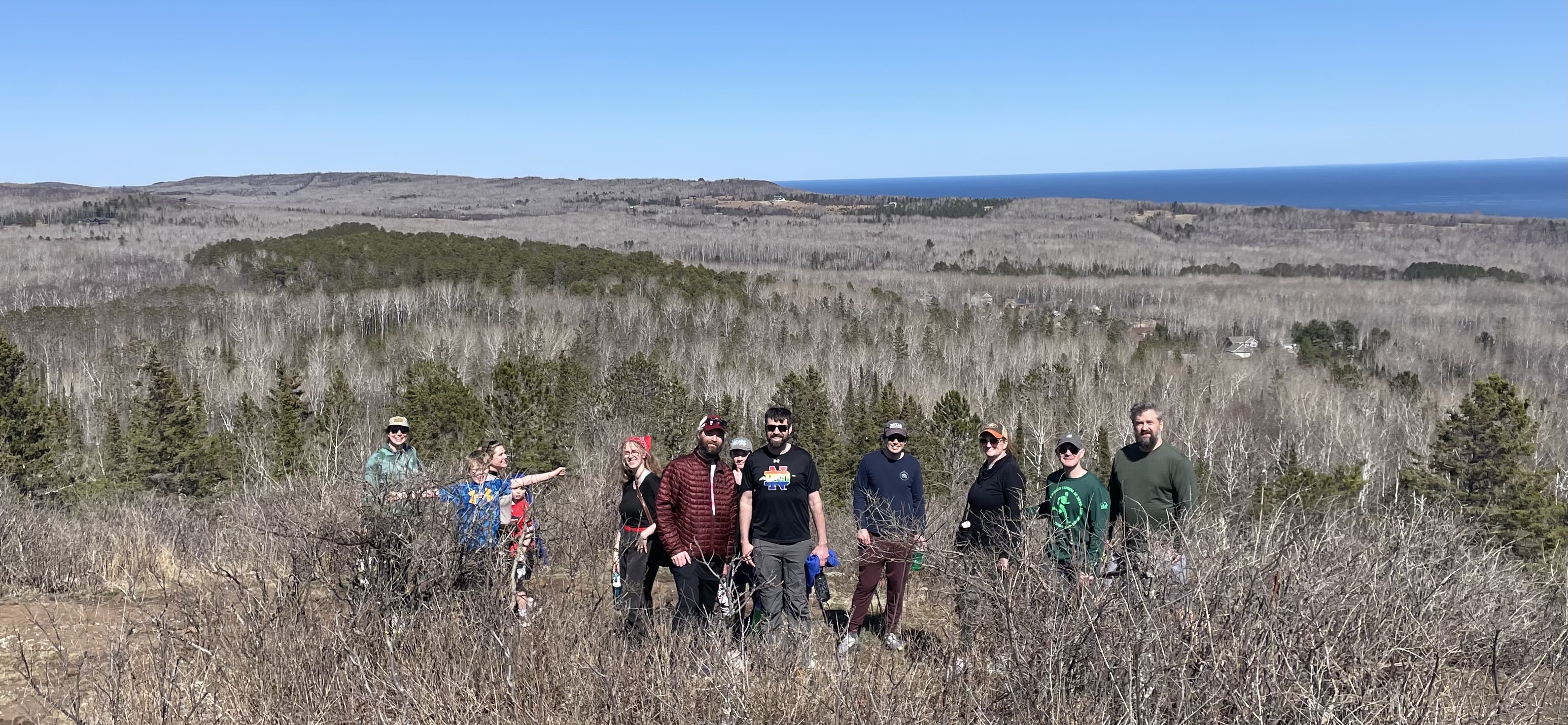
This time in Duluth. None of the 11 in my generation who descend this weekend have come as adults, to say nothing of their children. My worries about Duluth April fall away: of course the city shows out with a glorious weekend, casts its spell with sun-kissed ridgelines and whispers of green and the deep blue lake. We rent a labyrinthine Congdon beauty large enough to hold us, split among its little dollhouse rooms: a pack in the kitchen, always someone eating in the dining room, a few tucked into the lovers’ nook; John at the piano in the parlor as the next generation streaks through with lasers blaring. A crew slips down into the ravine where evergreens cling to red rock and Tischer Creek arcs its way down toward Superior below. Yes, this is what I have right outside my door, just one of many ribbons of beauty lain down this graceful ridge.

Finally I can return the favor to Rob, a night of bar-hopping and dips into a few of Duluth’s better gems, my pace turned up into that flow state where it reaches the performance zone of a distance athlete. A whole group bookstore invasion, a ridgetop stroll, some toodles about town and then a long drift into the night, musical roulette in the sunroom, a log on the fire and wine passed down the row and a ten-minute walk for me at one in the morning, a stop to gaze at stars as I head back home. Wake in the morning and Matt and Kathryn and Becca are in my living room, a little corner of quiet away from the din over on Hawthorne where we can spin a globe and tell of ventures outward, a new love and a renewed freedom, appreciation swelling at how much more these trips can mean when they come at the end of a long tunnel when they did not feel possible.

Each of us takes our turn, no one person ever central. Laura gets an education on Upper Midwest lingo while Molly and Katie are now fully part of the adult crew. David serves the wine and Paul runs the pizza operation and Megan blends worlds with an old friend two doors down. Liam takes a turn as the Zenith Bookstore social media star, Jack is in full sprint along Skyline at the end of the hike, Emma smashes the competition at the hook and ring game, and Luke, being raised right, can carry on a good conversation about baseball.

My dad, back in this picture for the first time in nearly two decades, joins us for an evening in Lakeside. We fill in the missing years, run through memories of our grandparents’ houses, weave our own corners of this great tapestry we share. Everything mixes here and the weekend unites two loves, my city and my sprawling family, dives into a past that was and steadily builds a certainty that we will keep this energy going year after year, pass it on into futures unknown. This thing we have built, it speaks to me, tells me of belonging on some deep, primal level beyond the reach of the rational mind. It is home.

Conversation in the Cathedral

I don’t think I have ever felt compelled to re-post a previous post on here, but right now, I am going to re-post the content of this one, which is in itself mostly just an extended quote from the 2010 acceptance speech for the Nobel Prize in literature. Farewell, Mario Vargas Llosa, one of the true giants of world literature, and one who inspired my own writing life immensely.

Literature is a false representation of life that nevertheless helps us to understand life better, to orient ourselves in the labyrinth where we are born, pass by, and die. It compensates for the reversals and frustrations real life inflicts on us, and because of it we can decipher, at least partially, the hieroglyphic that existence tends to be for the great majority of human beings, principally those of us who generate more doubts than certainties and confess our perplexity before subjects like transcendence, individual and collective destiny, the soul, the sense or senselessness of history, the to and fro of rational knowledge.

I have always been fascinated to imagine the uncertain circumstance in which our ancestors – still barely different from animals, the language that allowed them to communicate with one another just recently born – in caves, around fires, on nights seething with the menace of lightning bolts, thunder claps, and growling beasts, began to invent and tell stories. That was the crucial moment in our destiny, because in those circles of primitive beings held by the voice and fantasy of the storyteller, civilization began, the long passage that gradually would humanize us and lead us to invent the autonomous individual, then disengage him from the tribe, devise science, the arts, law, freedom, and to scrutinize the innermost recesses of nature, the human body, space, and travel to the stars. Those tales, fables, myths, legends that resounded for the first time like new music before listeners intimidated by the mysteries and perils of a world where everything was unknown and dangerous, must have been a cool bath, a quiet pool for those spirits always on the alert, for whom existing meant barely eating, taking shelter from the elements, killing, and fornicating. From the time they began to dream collectively, to share their dreams, instigated by storytellers, they ceased to be tied to the treadmill of survival, a vortex of brutalizing tasks, and their life became dream, pleasure, fantasy, and a revolutionary plan: to break out of confinement and change and improve, a struggle to appease the desires and ambitions that stirred imagined lives in them, and the curiosity to clear away the mysteries that filled their surroundings.

This never-interrupted process was enriched when writing was born and stories, in addition to being heard, could be read, achieving the permanence literature confers on them. That is why this must be repeated incessantly until new generations are convinced of it: fiction is more than an entertainment, more than an intellectual exercise that sharpens one’s sensibility and awakens a critical spirit. It is an absolute necessity so that civilization continues to exist, renewing and preserving in us the best of what is human. So that we do not retreat into the savagery of isolation and life is not reduced to the pragmatism of specialists who see things profoundly but ignore what surrounds, precedes, and continues those things. So that we do not move from having the machines we invent serve us to being their servants and slaves. And because a world without literature would be a world without desires or ideals or irreverence, a world of automatons deprived of what makes the human being really human: the capacity to move out of oneself and into another, into others, modeled with the clay of our dreams.

From the cave to the skyscraper, from the club to weapons of mass destruction, from the tautological life of the tribe to the era of globalization, the fictions of literature have multiplied human experiences, preventing us from succumbing to lethargy, self-absorption, resignation. Nothing has sown so much disquiet, so disturbed our imagination and our desires as the life of lies we add, thanks to literature, to the one we have, so we can be protagonists in the great adventures, the great passions real life will never give us. The lies of literature become truths through us, the readers transformed, infected with longings and, through the fault of fiction, permanently questioning a mediocre reality. Sorcery, when literature offers us the hope of having what we do not have, being what we are not, acceding to that impossible existence where like pagan gods we feel mortal and eternal at the same time, that introduces into our spirits non-conformity and rebellion, which are behind all the heroic deeds that have contributed to the reduction of violence in human relationships. Reducing violence, not ending it. Because ours will always be, fortunately, an unfinished story. That is why we have to continue dreaming, reading, and writing, the most effective way we have found to alleviate our mortal condition, to defeat the corrosion of time, and to transform the impossible into possibility.

Not bad inspiration for someone who has felt a surge of fictional inspiration in the past few weeks.

Virgins Revisited

Give me a beach, a little pocket of beach, alive with a congenial crowd but far from where the cruise ship tours dump their loads. Give it a white sand apron, a few reefs off the shore, some swells further out to tempt the surfers. Give it a little open-air bar or two, a place to grab a beer as the smell of barbecued meat wafts down to the water. A couple trees to hang a hammock, a gentle breeze to sway it; let me melt into the beach, suspended in paradise.

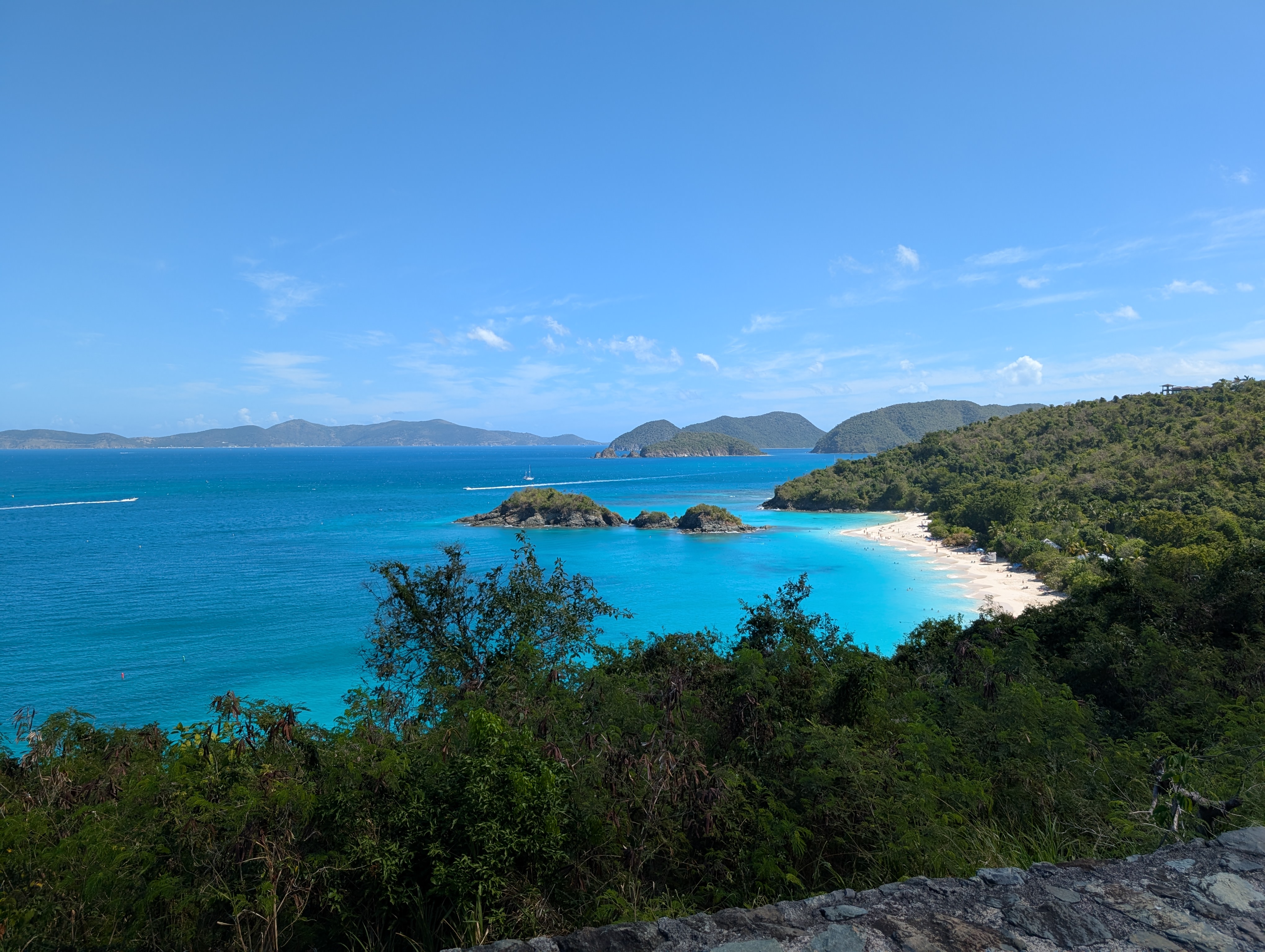
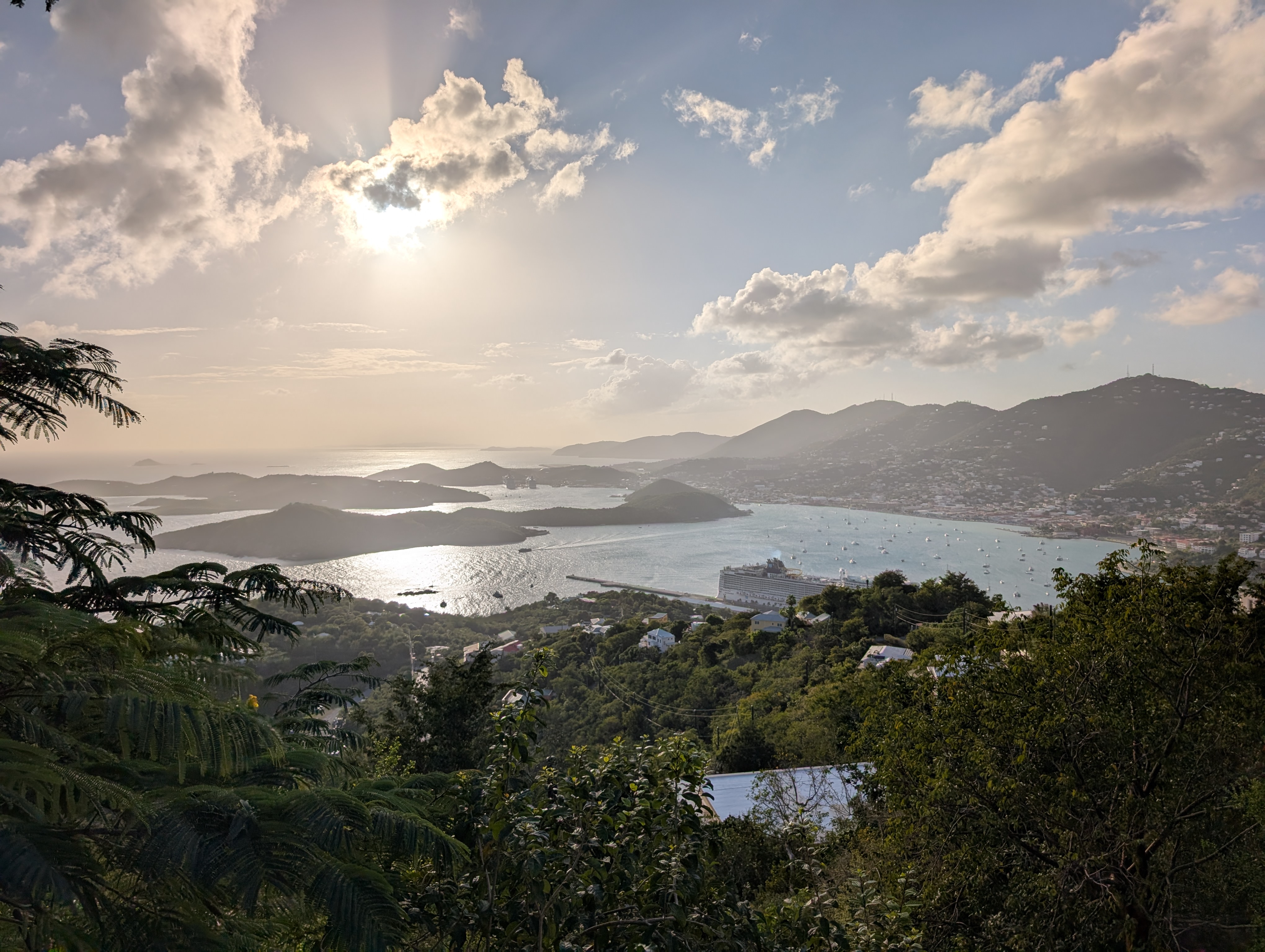
I write these lines in a hammock on Hull Bay on the north shore of St. Thomas, in the United States Virgin Islands. The world intervenes to befoul an attempted cousins week here, but cousin Rob and I join Uncle Chuck and Aunt Monica for a few days at L’Esperance. I have been to St. Thomas seven times now, and my last time here, an extended stay, gave me some lay of the land. I am now a capable left side of the road driver, comfortable running the one stoplight all the locals ignore and no longer in a state of terror shooting up Flag Hill on a one-lane, two-way road with no guardrail between the rental car and a dramatic plunge. I know the ins and outs of some of the beaches, and I almost know where to find the dishes in the L’Esperance kitchen. These islands have become my most regular destination outside of my usual Upper Midwest haunts.

The Virgin Islands are predictable in their unpredictability. This time, here with the villa’s owners, I get a sense of just how much work it takes to keep up L’Esperance in a place where island languor seems so very real. Refrigeration is a struggle, repairmen do not show; the invasive plants slither inward. The power cuts, the solar panels and battery walls pressed into service. A venture to the grocery store takes on an air of intrigue: just what will be in stock today? But every glance at the view is a reminder of why we do it.

Paradise comes with a price, as all fine things must. A spin through the center of the island drives home how much the territory remains a colonial outpost, an outside world dropped on to hilltops and beaches and the rest put to its service. The locals are agreeable but operate on their own timetables, by their own values. The continentals who have settled here bear a sun-weathered satisfaction, resigned to their fates as things move slowly and break and occasionally get wiped off the map by a hurricane, but content with where they are. The siren song of tropical bliss echoes across the hillsides, audible often enough to sustain an eternal dream. That lotus-eating life would leave me restless on a longer stay, but over a week I find just the right level of contentment here.

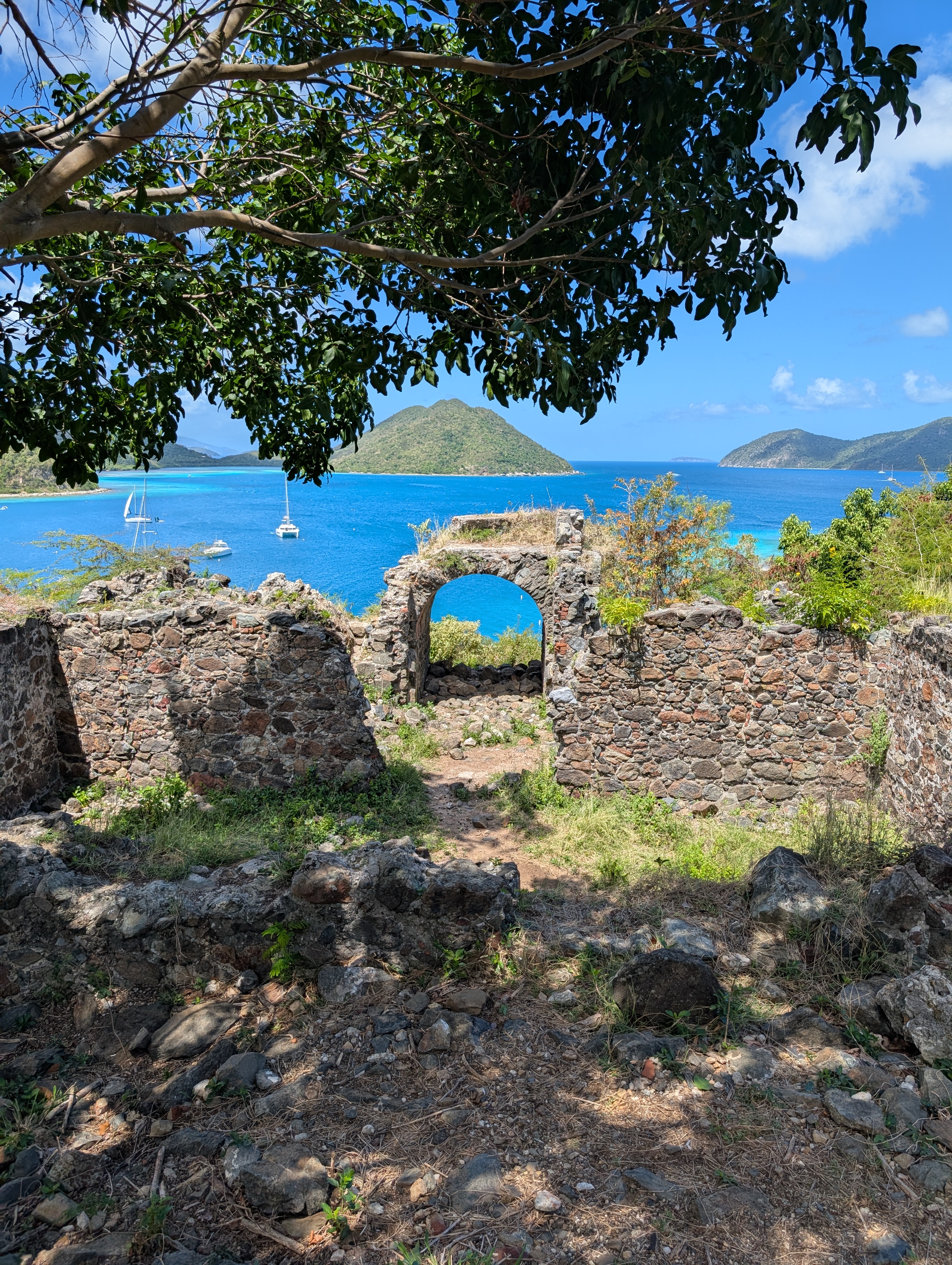
Neighboring St. John remains a garden of beauty, a reason I would return here even if I did not have L’Esperance in my life. On our first full day on the islands together, Rob and I ferry over and do part of the hike that most mesmerized me four years ago: Leinster Bay, Windy Hill, and up over the sharp ridge on the Johnny Horn Trail down to stellar barbecue and a beer at Johnny Lime in Coral Bay. The sweat pours out on the return march over the ridge, and we take the plunge at Maho Bay to rinse it all away. We are waylaid by goat herds in both directions on our hike, including a dozen lounging at the start of the climb up from Leinster Bay and a leisurely family chewing its way along the lower reaches of the Johnny Horn on the return journey. New meaning for running on island time.

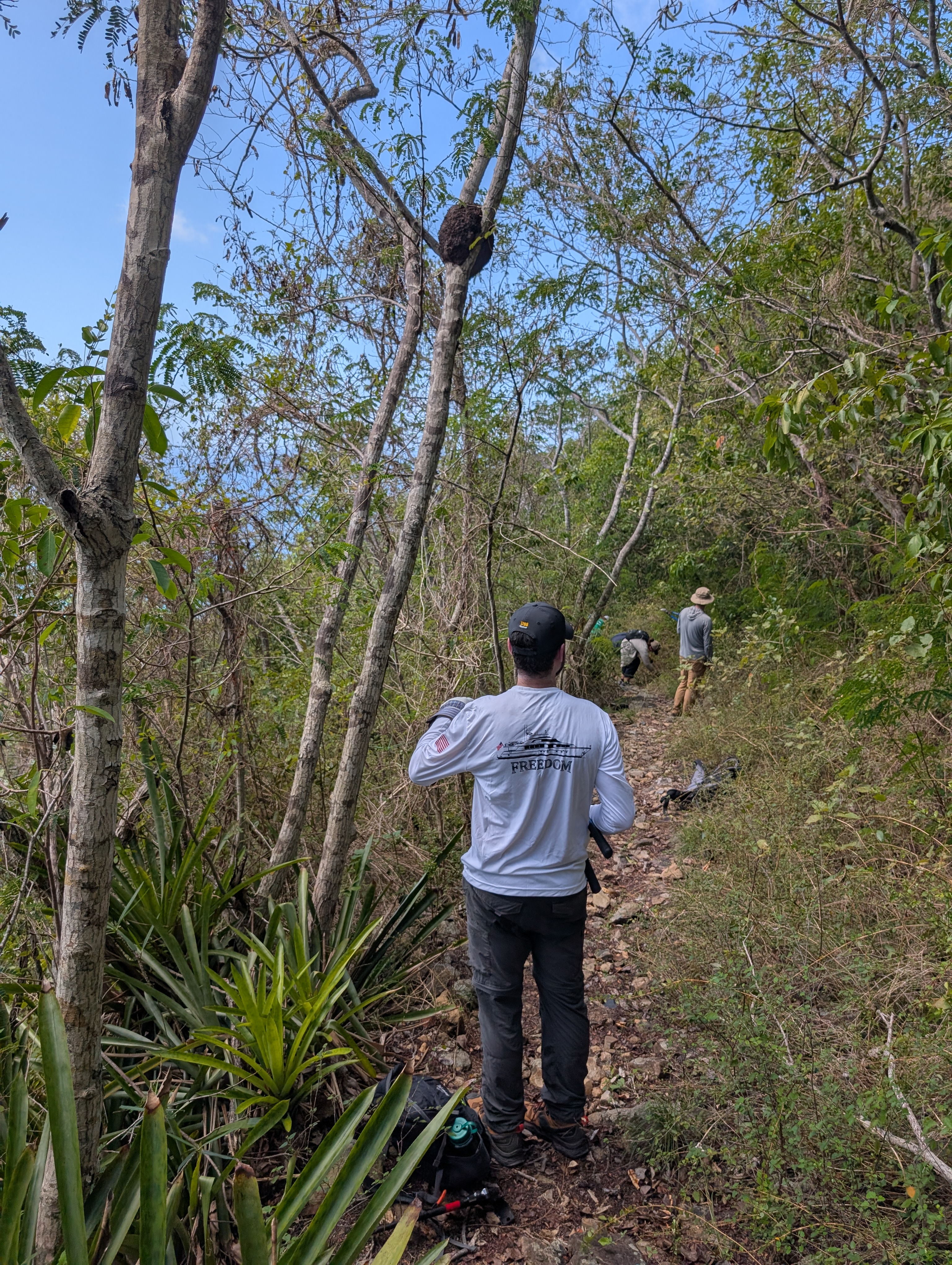
On a second visit to St. John we fill a 14-passenger van with people who think getting scratched up by catch-and-keep while sweating in the tropical sun is fun. Our crew has signed up to clear out the ever-advancing tropical brush on the Bourdeaux Mountain Trail, a path running from the island’s high point to the sea down the hotter, drier south side of the island. Frank, a sharp kid from Colorado and a volunteer coordinator with the Friends of the Virgin Islands National Park, appreciates the weirdness necessary to aspire to such action, and we hack away to free future hikers from encroaching thorns. Rob and I chat up some younger women who have traveled here together, spending a week in a camp at Cinnamon Bay to follow Frank’s commands. The talk fixates on adventures past and future and Rob notes our shared masochism, this pursuit of sweat and exertion to uncover new paths under the tropical sun.

Trail work is my only labor during my time in the islands, and I otherwise succumb to island routines. I burn my skin, apply the aloe, rinse in the pool. The happy hour bell dings and we assemble in the great room for cocktails or wine as the sun plunges into the horizon beyond the Charlotte Amalie harbor. We alternate eating in and venturing out to some restaurants that deliver the goods: Mims, Oceana, Cuvee, with special credit to those who offer elevated cuisine and good wine in a place at the end of the supply chain. Conversation winds down and we turn to books or word games or a few rounds of Rummikub. Stay up late, sleep in a spell, use the exercise room or swim some laps to avoid total sloth. I get some time to think, to write out some stray lines, to ponder how best to meld passions and realities.

On my final full day I head to Hull Bay a second time. Through some great failing I have left my writing tablet back in Minnesota and so I am consigned to pen and paper, allow my thoughts to drift in slowly like the bay’s gently lapping waves. I return to past writings and mantras, write them anew, wonder if I can distill them into some sort of credo or code for moving through the world. I feel like I am circling a destination on a windy island road, sometimes driving on the wrong side but nevertheless getting closer, ever closer.

Over lunch at the bar, unenthused by the prospect of talk with my neighbors who have taken one-way tickets to Margaritaville, I find myself on the Wikipedia page for Isaiah Berlin’s hedgehog and fox analogy. I am of course a full-on fox, fascinated by many things and a skeptic of simple theories, content to hold a whole heap of complex thoughts within me and marvel at all of it, even the pickled retirees of Hull Bay. I can, through words, continue to pull things together. In due time. For now I finish my beer, pull my cap into place, tug off my shirt, appreciate the progress my gym time has coaxed out, and reassume my pose as a boy on a beach.

After the Darkest Days

I don’t have a whole lot to say in memoriam of the Duluth East 2024-2025 season. It is hard to sugarcoat 4-23. I will give credit for effort, for gutting out a long season, for loyalty when kids could have jumped ship. They made it through, bloodied but honorable, and in a weird way this season ends with a less sour taste than 2021-2022, which came with some ugliness, or 2023-2024, when I thought the team was capable of more than it achieved.

Those four wins were worth something in the end. The victory over Andover was genuinely impressive, as the Huskies rounded more into form and are a mild favorite to win a section championship on Thursday. And if East could have won just one game this year, most people associated with the program would have chosen the one with Duluth Marshall. They pulled that one out with a solid effort from start to finish, a display of what their defense could be, and a diverse cast of forwards doing enough positive things to get the win. I do wish the program had made more effort to match the schedule to the talent level, but I understand why it wasn’t, and I hope for at least some adjustments next season.

This team also finished respectably. They fought back from three down to avoid infamy in a loss to Anoka, and after a painstaking start, they gave top-seeded Rock Ridge a decent run in the quarterfinals. No one will remember it as a moment of greatness, but there was no quit, and I enjoyed watching some of the younger kids come along. The line of Easton Ohrn, Mckennen Kramer, and Cole Licari was a fun little wrecking crew by season’s end, and players like Marccus Anttila and Fin Kuzmuk have some real skill that could be harnessed for good. There was real progress among the underclassman defensemen of Landon Pearce, Henrik Spenningsby, and Wally Lundell, and goaltender Nolan Nygaard did yeoman’s work as he endured barrage after barrage of shots. There are pieces to start climbing back out of this hole next season, and the long-term trajectory looks to be generally upward.

Just how far upward will depend on youth player retention. Duluth hockey does not have the numbers to split several ways and put out a serious contender, and when one looks at the Bantam rosters for this age group, a minority of the players going through ended up at Duluth East. Some went to Marshall, but Marshall itself then lost some players, and in the end the Toppers’ season, when weighted for a cupcake schedule, was not all that far off from East’s. While Marshall has the returning players to be better next season, they’re also approaching a situation where their numbers are scarily low, and this group of East youth players who became Toppers does not look like the start of some seismic shift in Duluth hockey.

Even mighty Hermantown, the dominant local power since East fell off at the end of the 2010s and now an occasional destination for skilled Hounds youth, is seeing some advantages recede, as Hibbing showed the world with a section-shaking win this past Saturday. Looking at youth scores, East is right there with the Hawks over the next few age groups, and with Hibbing surging and a drop-off in Grand Rapids looming after next season, the road to State may not be all that much easier in 7A than it is in 7AA. It is within East’s ability to step in and become the Duluth area power—and a 7AA front-line contender—again in the next few years. They just need the buy-in and the leadership to do it.

Those decisions are beyond my control, and I will be along for the ride wherever it leads. I will conclude by thanking our seniors: Caden Cole, Kyle Peterson, Timmy Balthazor, Christian Cochran, and Ryan Jensen. They stuck it out through a tough season, and they provided some good moments. They are part of the bridge on to whatever may come next for Duluth East hockey. May that era be a brighter one.

Organization

Over the past couple weeks, by popular request, I have been working on cataloguing posts on this blog more effectively than I have using tags over the years. Instead of going to a laundry list of posts, the links in the site menu now go to permanent pages with lists of past pieces that will allow you to link to things I have written in certain categories.

This is not an exhaustive effort. I have deemed a healthy chunk of my posts not particularly interesting to my future self, and I made no effort to categorize those ones. So, if you are passionate about random articles I have linked to or the scintillating drama of Duluth politics in 2013, you will still have to dig those ones up yourself.

Nonetheless, it was a fun exercise to go back into some past writing. For the most part I think my older posts hold up pretty well, though as with anyone who puts thousands of words out into the ether, there are bound to be a few bad takes here and there. In general I also think we owe our younger selves more grace than we normally give them, and I don’t feel the need to run from things that I might word differently now, or may no longer fully represent what I believe.

I am also not posting links to the fiction I’ve posted on here, in part because almost all of it is undergoing edits offline, and in part because it may just be going away from here entirely as I move toward doing something with it. If this stuff interests you, please reach out to me directly.

I am putting a link to this page on the “About” page, so an explanation of all of this is readily accessible. The categories I’ve chosen are as follows:

Reflections: The catch-all for my musings on life. It includes subcategories for writing-related announcements and the year-end reflections I have usually written.

People: Appreciations of and reflections on people in my life, including wedding celebrations and remembrances.

Journeys: Tales of travel far from home, in what has become some of my favorite essays to write and revisit, especially as major journeys become a bigger part of my life. Includes sections on two cities I where I have lived in the past but no longer do, Washington DC and Minneapolis.

Upper Midwest Adventures: Travel nearer to home for me, including outdoor adventures and road trips in Minnesota, Wisconsin, and northern Michigan.

Duluth: As you’d guess, commentary on the Minnesota city where I’ve spent most of my life, a source of both tribal loyalty and occasional rumination.

Hockey: My writing on hockey, including subcategories on Duluth East and more general pieces on high school hockey in Minnesota.

Politics: Scattered commentary on affairs both local and national.

Books, TV, and Film: Reviews and commentary on media I consume.

These may change over time, and I’ll make any necessary updates to this post.

Tending the Flame

For the past five Duluth East hockey seasons, I have sometimes felt like a chronicler of dramatic upheaval. From 2019-2022, there was plenty of theater, if often the wrong kind: a first losing season in decades, the craziness of the pandemic, the saga of an outgoing coach, some ugly headlines over fights. 2022-2023 saw a fleeting renaissance; 2023-2024 had elevated expectations after that run that never quite came together. There were storylines left and right, and I never suffered for things to write, even if I did not always enjoy writing them.

This season? Well, we endure. A 2-12 record speaks for itself. I could grumble about goalie rotations and fourth line shifts; there certainly have been some winnable games that slipped away, and a record of, say, 5-9 or 6-8 would be enough to be a legitimate top four seed contender in what passes for Section 7AA this season. But I am not here to criticize a lot. The team is trying, and its talent level doesn’t lie. They are young, trying to bring players along, making do with what is here.

It is hard not to ponder the decline with some bitterness. I could blame certain adults’ egos or wax philosophical about cultural and demographic drift. Some will blame the coaching change, but the start of the downturn preceded Mike Randolph’s ouster. Duluth Marshall pulled more above average kids from the youth ranks than it ever has for a variety of scattered reasons, though they too have now suffered defections that have left them only a marginal contender. Add in a few other departures or decisions simply to opt out and the sheer number of AA Duluth East youth players who are not on the Duluth East High School roster is the largest it’s ever been. While it isn’t realistic to expect perfect retention anymore, even marginal improvement would be worth a number of wins. A new dad friend points out we are moving through the youth group that never played Squirt A hockey, and when one watches head-down dangles out through the crease in one’s own zone even by some of the relatively skilled players, it’s not hard to jump to conclusions about missed lessons. When this team actually moves the puck, it has some life to it.

I confess I am watching less than I have in the past. Even in the stands there are many new faces, fewer buoyant pregame gatherings or shared road trips, more people isolated in their own worlds. But there are still flickers of what make this sport, and devotion to a program, so incredibly fun. A well-played contest with Andover, down but still dangerous, that ended in an overtime win brought back a little of that old feeling. They hung in there with Grand Rapids alright in the second meeting. There are some pieces among the younger players who can be a foundation of something; perhaps not a section champion next season, but at least a top four seed with a better record. When the energy builds, high school hockey can still build to something that no junior league or AAA program can ever muster.

But we are where we are now. Forget any scheme to pull a playoff upset, forget building a case for a certain seed in sections. One some level, forget winning too, though I don’t want it to devolve into participation trophy hockey, either. Build basic skills and try to get some momentum. Keep the seniors together, but start trying to build some chemistry among the younger players for the future. Work on conditioning, and pick an official starter in net. Uphold the honor, and find ways to improve relative to the competition.

I am reasonably optimistic there are brighter days ahead. The youth teams, collectively, appear to be on the upswing, and it sounds like retention should be somewhat better going forward. I have some lingering worries, but the fundamentals for hockey on the east side of Duluth still look decent; even better, perhaps, than they have been in the near past, with Hermantown’s edge on the local scene eroding somewhat. There is something here to be harnessed. Until then, I watch on, finding what I can in it, still in the thralls of a sport that pulls together glory days past and a promise of the future into the fleeting intensity of an adolescent present.

Onward and Upward

At the end of December I often write some words on what the past year has meant, or what I might be aspiring to in the coming year. But over the weekend, when asked about 2025 goals on a stroll down icy trails in Banning State Park, I struggled to articulate much other than to say I should keep doing what I have been doing. That, I suppose, is a good sign.

Two pieces I have written the past year on here explain my equanimity. The first was the 2023 year-end reflection on harbour minds. I continued that push outward even further this year, became a literal pilgrim and knocked out another continent, enjoyed living this way and the questions it posed. Over the past several years regular journeying has become a part of who I am, and that will continue into the foreseeable future. I am in many ways living as I mean to live, and generally making progress in the spaces where I am not. The 2023 post includes a lament about my lack of writing time, and while I was not dramatically better in 2024, I did carve out an escape to kick off a project. The second notable piece, on my San Diego retreat in November, both announced some writing ambitions and reflected a certain comfort with self that made that project possible. If I were to choose a Joan Didion essay that describes this shift (because of course I would), it would be “On Self-Respect.” To whit: “To have that sense of one’s intrinsic worth which constitutes self-respect is potentially to have everything: the ability to discriminate, to love and to remain indifferent.” People who have it “are willing to invest something of themselves; they may not play at all, but when they do play, they know the odds.”

I will have some things to post in the coming weeks. I’ve been noodling on one little piece for a bit now. I also feel some responsibility to comment on the state of Duluth East hockey at some point in the next month, though I am afraid that this year that task feels more like an obligatory tending of a flame until it can burn brighter again in the future. Other bursts of inspiration may come, as they sporadically do. But more than anything I want to focus on the project I set for myself in San Diego. The holiday season has predictably been a hard time to do any of that, and I need to be more intentional about slipping it in between hockey games and such. It is time to write a bit but mostly a time to edit, and then to look for brutal, honest feedback and likely deal with rejection, because that is how this game goes. But I am at a point where I can handle that now.

And so I hope I can get to work. Thanks for being a part of the journey.

Olympian Distances

I’m not telling you to make the world better, because I don’t think that progress is necessarily part of the package. I’m just telling you to live in it. Not just to endure it, not just to suffer it, not just to pass through it, but to live in it. To look at it. To try to get the picture. To live recklessly. To take chances. To make your own work and take pride in it. To seize the moment. And if you ask me why you should bother to do that, I could tell you that the grave’s a fine and private place, but none I think do there embrace. Nor do they sing there, or write, or argue, or see the tidal bore on the Amazon, or touch their children. And that’s what there is to do and get it while you can and good luck at it.

-Joan Didion, Commencement Address at the University of California Riverside, 1975

2024 approaches its close and I am aloft again, flitting this time to San Diego. I stay at the Diamond Head Inn at the head of Diamond Street in Pacific Beach, close enough for a sliver of an ocean view and to be lulled by the soothing crashes of giant waves through the night. I am not sure I prefer San Diego to some other haunts on the California coast that are becoming repeat destinations, but it is certainly the right place for this escape to cap a year of great escapes.

I run north through La Jolla, where the streets teem with the economy necessary to keep up the opulence of this headland: gardeners, renovation crews, cleaners, pest control. I run south along the length of Mission Beach, past miles of volleyball and beach bums and rows of vacation retreats, winding through the steady march of a three-day breast cancer walk whose path crosses mine on each of my days here. I grab a car for a day and venture down to the commanding views of Point Loma and up to spend a few hours with a college friend and his ever-expanding brood in Oceanside. But mostly I drift between the hotel and the beach and the clump of establishments along the Pacific Beach streets named for precious stones. Even with the Third Fleet looming in the harbor and Camp Pendleton to the north, San Diego feels removed from any great national dramas, a place where ambitions settle into yoga studios and waves and IPAs, a paradise now a bit overcrowded and at times a bit vapid but still holding to its beach life core.
A few people ask me if a beach escape was an election reaction, but it isn’t. Over the past few years I have found myself drifting out of political obsession and toward Joan Didion’s way of being in the world, not to forsake that realm but instead by finally internalizing the oft-neglected aspirations of my earlier self. My happiness is not ideological. I try not to let politics get me down, and through both an intentional effort and probably the simple passage out of youthful fervors and into my petite-bourgeois 30-something world, I am more or less there now. State and national affairs still matter to my moral universe, still matter to my job, but the privilege of not living in a state of anxiety over the world is, indeed, a privilege in the old-fashioned sense of the term, something one is lucky to have. To live in a place where anxiety does not drag one down, and where righteous anger does not consume one, is not in and of itself a defect.
This privilege allows me to seek to understand many ways of being while stripping away some preconceptions. It conveys a certain power: the ability to drink in experiences, to assume full presence in a particular moment, to say why not and just do things. To be always intrigued, ever nimble, always questioning, sometimes explicitly but also sometimes just in my mind so those around me can just be themselves. And it is not a realm of frivolity and luxury: the Olympian distance it can provide is the wellspring for reflection and insight that is hard to manage when wearing certain blinders.

Such distance can leave one in a lonely place, and it has taken time to embrace it as a real path when others are more clearly trodden. I can be a man in the arena, have perhaps even strengthened those skills considerably over the years, but I am not sure that doing so is the greatest use of my ability to come at stories from different angles, deep in the nuance. I am not by nature a fighter in the trenches, and I am drawn to realms upstream of politics, to places of culture and group dynamics and the deeper pulls of the human psyche. And I also now know that none of this is a binary choice, that I can step out for reflection but then dive back into messy human affairs in short order. (My stay in Pacific Beach also involved its share of time at beachfront bars, which are the definition of messy human affairs.)

My main method for my reflection has been writing. I gave up on a writing life after sweeping rejections from MFA programs over ten years ago, settling for sporadic posting on this blog instead of chasing any writing income. That failure has, on the whole, been a gigantic win for my mental health and financial security. But the itch has never died. The truth is that, if I have something resembling a vocation, it is not in anything terribly related to the job that earns me my income (though it is good work) but instead in being someone who has some useful things to say. I know that, in both triumph and crisis, I can sit down and come up with words that will both commemorate and help heal. People seem to like my stuff, if and when they find it.

I say I go San Diego to sit on a beach, but there is an ulterior motive: it is a retreat to begin compiling the episodic story collection on this blog into a manuscript, and I will be seeking professional feedback on it. This may seem like the ultimate Olympian turn, a retreat into fictional clouds at a time for engagement with reality. But this decade-in-the-making story is nothing but a response to questions about meaning in a fluid world, about coming of age, about masculinity and complicated family and coping with loss. I can think of no more urgent project for the skills I have.

I do not know what this story has to tell a broad audience; unlike everything else I write on here, the only feedback I’ve ever really gotten on it is from random people on the internet. But it is a story that is mine to tell, so I may as well tell it, take a chance on my attempt to get the picture and take pride in it. Progress may not necessarily be part of the package, but its possibility, whether sweeping or only in a few stray lives, is still a victory.