Olympian Distances

I’m not telling you to make the world better, because I don’t think that progress is necessarily part of the package. I’m just telling you to live in it. Not just to endure it, not just to suffer it, not just to pass through it, but to live in it. To look at it. To try to get the picture. To live recklessly. To take chances. To make your own work and take pride in it. To seize the moment. And if you ask me why you should bother to do that, I could tell you that the grave’s a fine and private place, but none I think do there embrace. Nor do they sing there, or write, or argue, or see the tidal bore on the Amazon, or touch their children. And that’s what there is to do and get it while you can and good luck at it.

-Joan Didion, Commencement Address at the University of California Riverside, 1975

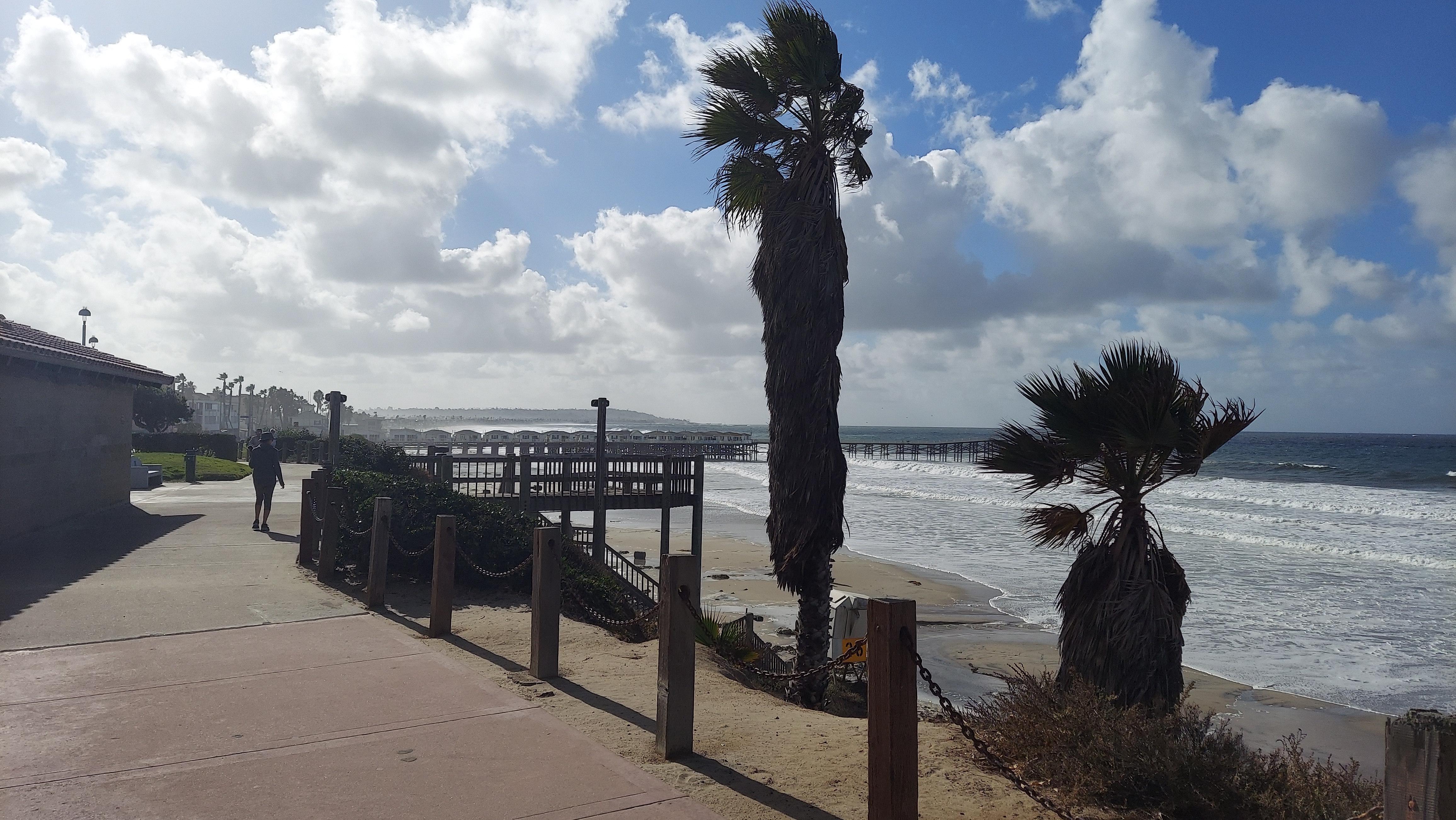
2024 approaches its close and I am aloft again, flitting this time to San Diego. I stay at the Diamond Head Inn at the head of Diamond Street in Pacific Beach, close enough for a sliver of an ocean view and to be lulled by the soothing crashes of giant waves through the night. I am not sure I prefer San Diego to some other haunts on the California coast that are becoming repeat destinations, but it is certainly the right place for this escape to cap a year of great escapes.

I run north through La Jolla, where the streets teem with the economy necessary to keep up the opulence of this headland: gardeners, renovation crews, cleaners, pest control. I run south along the length of Mission Beach, past miles of volleyball and beach bums and rows of vacation retreats, winding through the steady march of a three-day breast cancer walk whose path crosses mine on each of my days here. I grab a car for a day and venture down to the commanding views of Point Loma and up to spend a few hours with a college friend and his ever-expanding brood in Oceanside. But mostly I drift between the hotel and the beach and the clump of establishments along the Pacific Beach streets named for precious stones. Even with the Third Fleet looming in the harbor and Camp Pendleton to the north, San Diego feels removed from any great national dramas, a place where ambitions settle into yoga studios and waves and IPAs, a paradise now a bit overcrowded and at times a bit vapid but still holding to its beach life core.
A few people ask me if a beach escape was an election reaction, but it isn’t. Over the past few years I have found myself drifting out of political obsession and toward Joan Didion’s way of being in the world, not to forsake that realm but instead by finally internalizing the oft-neglected aspirations of my earlier self. My happiness is not ideological. I try not to let politics get me down, and through both an intentional effort and probably the simple passage out of youthful fervors and into my petite-bourgeois 30-something world, I am more or less there now. State and national affairs still matter to my moral universe, still matter to my job, but the privilege of not living in a state of anxiety over the world is, indeed, a privilege in the old-fashioned sense of the term, something one is lucky to have. To live in a place where anxiety does not drag one down, and where righteous anger does not consume one, is not in and of itself a defect.

This privilege allows me to seek to understand many ways of being while stripping away some preconceptions. It conveys a certain power: the ability to drink in experiences, to assume full presence in a particular moment, to say why not and just do things. To be always intrigued, ever nimble, always questioning, sometimes explicitly but also sometimes just in my mind so those around me can just be themselves. And it is not a realm of frivolity and luxury: the Olympian distance it can provide is the wellspring for reflection and insight that is hard to manage when wearing certain blinders.

Such distance can leave one in a lonely place, and it has taken time to embrace it as a real path when others are more clearly trodden. I can be a man in the arena, have perhaps even strengthened those skills considerably over the years, but I am not sure that doing so is the greatest use of my ability to come at stories from different angles, deep in the nuance. I am not by nature a fighter in the trenches, and I am drawn to realms upstream of politics, to places of culture and group dynamics and the deeper pulls of the human psyche. And I also now know that none of this is a binary choice, that I can step out for reflection but then dive back into messy human affairs in short order. (My stay in Pacific Beach also involved its share of time at beachfront bars, which are the definition of messy human affairs.)

My main method for my reflection has been writing. I gave up on a writing life after sweeping rejections from MFA programs over ten years ago, settling for sporadic posting on this blog instead of chasing any writing income. That failure has, on the whole, been a gigantic win for my mental health and financial security. But the itch has never died. The truth is that, if I have something resembling a vocation, it is not in anything terribly related to the job that earns me my income (though it is good work) but instead in being someone who has some useful things to say. I know that, in both triumph and crisis, I can sit down and come up with words that will both commemorate and help heal. People seem to like my stuff, if and when they find it.

I say I go San Diego to sit on a beach, but there is an ulterior motive: it is a retreat to begin compiling the episodic story collection on this blog into a manuscript, and I will be seeking professional feedback on it. This may seem like the ultimate Olympian turn, a retreat into fictional clouds at a time for engagement with reality. But this decade-in-the-making story is nothing but a response to questions about meaning in a fluid world, about coming of age, about masculinity and complicated family and coping with loss. I can think of no more urgent project for the skills I have.

I do not know what this story has to tell a broad audience; unlike everything else I write on here, the only feedback I’ve ever really gotten on it is from random people on the internet. But it is a story that is mine to tell, so I may as well tell it, take a chance on my attempt to get the picture and take pride in it. Progress may not necessarily be part of the package, but its possibility, whether sweeping or only in a few stray lives, is still a victory.

The Netting of Life

Sally Rooney is the closest thing there is to a star millennial novelist writing today. When I wrote about her Normal People a few years ago I focused on her chops as an author for my generation, one who talked to my own lived experience in prose that also reached beyond the present moment. Her latest work, Intermezzo, still does that. But while it contains the hallmarks of Rooney’s past novels, Intermezzo feels like a step into a new phase of writing life, exactly the sort of progression the dawning knowledge of her writing would imply.

Intermezzo tells of two Irish brothers living in Dublin. Peter is in his thirties, a lawyer driven to both public service and private drama, torn between a longtime love interest with some scars and a new fling with a college girl. Ivan is a chess prodigy just out of college, short on social graces and stumbling into something with an older woman. Their father has just passed, and neither is close with their mother, long divorced from the late dad.  These two heady young men are often stuck in their own brains and so we go on journeys with them, backward and forward as they dwell and process and then stumble through their complex interactions. Peter’s chapters have a staccato prose, the clipped thoughts of a culturally savvy lawyer firing through his thoughts, his debater’s instinct caked into his very being. Ivan, meanwhile, drifts on through, less precise but perhaps settling into a more stable inner peace.

Rooney is in her thirties now, and some of her characters have aged with her. While she still mines that fumbling twentysomething phase of life that birthed her writing career for more material, she has expanded her reach into another stage, that intermezzo somewhere between youth and middle age. Juxtaposing Peter and Ivan lets her show how the passage of time affects people. There is a tension here between youthful hope and older knowingness, between the buffeting forces of first loves and the steady attrition of passion that can plague later ones. The sex feels rawer, the intimacy more strained, the mental struggle more all-encompassing, not just a phase but a lifelong struggle to find a course.

There is an undercurrent of a radical existentialism beneath Rooney’s writing, one that I am coming to recognize as a fundamental faith that I share. She begins the novel with an epigraph from Wittgenstein, a founder of the whole line of thought. Her words also evoke Hannah Arendt, who saw in human relations the foundations of all achievement, and perhaps José Ortega y Gasset, who was explaining that we do not fall out of coconut trees long before the sentiment became political pop philosophy. While Rooney’s characters are smart people capable of holding court on such topics, that is not how she guides her stories forward.

Everything about Rooney’s prose drives home the existential stakes: the lack of extraneous detail, places defined but time left fluid. There are no acts of history or outside forces in a Rooney novel, few plot devices because there really isn’t all that much plot. She simply creates characters and has them collide with one another and that is all it takes for a great drama to ensue. In its spareness, Rooney’s writing makes the stakes clear: she has something to say about what we are all doing here, and how our interactions with flawed, scarred people will define both our triumphs and our failures. Consider this passage told from the lens of Ivan’s lover, Margaret, as they appear in public for the first time as a couple:

On the way back, they stop at an old country hotel in Knocknagarry. Margaret doesn’t think anyone will see them, it’s too unlikely, there’s no use being paranoid. And indeed, when they enter, the dining room is almost empty: a young family near the entrance, an elderly couple by the closed piano. Margaret and Ivan are shown to a small table, set with white linen, heavy silverware, a lighted wax candle. In her exhausted satisfaction after swimming, she smiles at him without speaking, and he smiles back. They order, the waitress brings their food, and they eat. When Margaret rests her arm on the tabletop, Ivan reaches over and touches the back of her hand lightly with his fingertips. No one else takes any notice, the staff, the elderly couple, the young family with their noisy children, and why should they. Margaret is reminded of the way she felt when she first met Ivan: as if life had slipped free of its netting. As if the netting itself had all along been an illusion, nothing real. An idea, which could not contain or describe the borderless all-enveloping reality of life. Now, in her satisfied exhaustion, with her hand resting on the white linen tablecloth, the touch of Ivan’s fingertips, the candle dripping a slow thread of wax down its side, the glossy closed lid of the piano, Margaret feels that she can perceive the miraculous beauty of life itself, lived only once and then gone forever, the bloom of a perfect and impermanent flower, never to be retrieved. This is life, the experience, this is all there has ever been. To force this moment into contact with her ordinary existence only seems to reveal how constricting, how misshapen her ideas of life have been before.

The scene is mesmerizing: the easy prose, the home evoked by this creaky old hotel on a bleak Irish day, the simple touches that give Margaret meaning to overpower every other earthly worry. Of course life is not this smooth, but the glimmers when it find this rhythm make everything else worth it. Later, Ivan and Margaret’s secret fling slips into the open:

They hang up. Margaret rises from the table, turns the lights on, fills the kettle. Rushing sound of the tap. Her reflection dim and bubbled in the dark window glass. Gradually these situations arise, she can see that now, just one step after another, and by the time a few weeks or months have passed, your life is no longer recognisable. You are lying to almost everyone you know. You have come to care too passionately, too fully and completely, for an unsuitable person. You can no longer visualise your own future: not only five years from now, but five months, even five weeks. Everything is in disarray. All this for one person, for the relation that exists between you. Your fidelity to the idea of that relation. In the light of that, you have come to hold too loosely too many other important things: the respect of your family, the admiration of your colleagues and acquaintances, even the understanding of your closest friends. Life, after all, has not slipped free of its netting. There is no such life, slipping free: life is itself the netting, holding people in places, making sense of things. It is not possible to tear away the constraints and simply carry on a senseless existence. People, other people, make it impossible. But without other people, there would be no life at all. Judgment, reproval, disappointment, conflict: these are the means by which people remain connected to one another. Because of Margaret’s friends, her former marriage, her family, colleagues, people in town, she is not entirely free to live the spontaneous life that she has imagined for herself. But because of Ivan, because of whatever there is between them, she is, on the other hand, not entirely free to return to her previous existence either. The demands of other people do not dissolve; they only multiply. More and more complex, more difficult. Which is another way, she thinks, of saying: more life, more and more of life.

Ivan and Margaret’s romance, while freighted with challenges, is the simple one. Peter’s mental descent as he negotiates his two live interests requires an even deeper reach and struggle that I could quote at length, but I will instead just encourage people to read the book. In Peter’s search, supplemented by Ivan’s parallel journey, we see deeper questions of what love can be, some tentative questions about faith, a path toward hope through deep anguish. That tale is not quite complete, but it is enough to go along for the journey through this intermezzo stage of life. It is also a hearty reminder that there are things novels can do that no other art form can. Keep weaving that netting, Sally Rooney, and showing us more and more of life.

Burdened by What Has Been

There is a certain reassurance in thundering about the tactical mistakes of a political party. There is vindication in picking out specific flaws, certain quotes that political junkies will laugh at years later. I could turn this post into a tirade about how Kamala Harris’s presidential campaign folded up after amassing decent levels of goodwill through its candidate’s ascension and through a debate with Donald Trump where she easily goaded him into being his worst self. I could grumble about its inability to message on the most pressing issues, and its reliance on old media and a sloppy use of its incredible fundraising haul. There is plenty of ammo.

But Harris’s opponent was a ridiculous figure who also ran a deeply bizarre race, with campaign rallies as performance art and masculinity elevated to a cartoonish extreme. Donald Trump did not win because he ran a brilliant operation, and Kamala Harris did not lose because she ran a terrible one: they ran as fairly predictable candidates in the world of 2024. In basically every functioning democracy, incumbent parties are suffering terribly, left and right. (Congrats on being the sole exception, Mexico.) This is a deeply disappointing explanation to anyone who wants to talk about voter agency and brilliant campaign work and the untold millions of dollars dumped into this race, but, well, we didn’t just fall out of a coconut tree.

That inability to appreciate the context, goofy campaign quotes aside, points to the fundamental struggle of the Democratic Party right now, one that goes deeper than any specific campaign issue. It is run by a bunch of people who have succeeded in the conventional terms of American life and are often blind to pathways outside of it. It is filled with managerial competence, able to get all the right language in a vacuum but blind to the animal forces beyond its narrowed scope. This professionally run machine knows how to cut loose some losing issues (such as basically everything Harris stood for in her ill-fated 2020 cycle campaign) and even candidates (post-debate Biden), but that cutting is almost always in retrospect, when the vague party blob realizes a message or messenger is a loser, instead of building a positive brand from the start. It leaves open the question is what they actually stand for, other than a few broadly popular ideas with everything else stripped away.

More fundamentally, it misses out on the energy of the Trump campaign, the outreach to people who aren’t true believers. It loses itself in policy details and substance-free vibes instead of a deeper attention to trends in American life: how people get their news, what unsettles them most deeply, what it takes to provide hope in a difficult place. On the deeper malaise plaguing American politics, the current Democratic Party has no answers. It had a chance to reach for some this cycle, in a competitive process to choose a successor to Biden, but after the exertion of forcing him aside, everyone just shrugged and jumped on the hype train for a Vice President saddled with his record.

As a Minnesotan I feel obligated to say a few words about Tim Walz, even if some of my state-mates may not love them. I think Walz is basically a replacement level Democratic politician, and his selection was the canary in the coal mine for a risk-averse, vibes-driven campaign. This is not to say he does not have genuine strengths; he can fill a room with charisma and speaks with the throwback down-to-earth style of a politician from a less toxic era. He didn’t do anything to materially cost Harris votes, and the margin of defeat is large enough that no Josh Shapiro fantasy could have swung it, either. But Walz ran as a liberal’s projection of what a moderate conservative voter might like, as if flannel and football could somehow cover for inflation and immigration. His selection was emblematic of the failure to grapple with deeper substance.

Democrats exist within the context they exist. They cannot just say we are not going back and then will it so. Donald Trump tells stories about this context, often kooky and sometimes profoundly harmful for some people, but they also sometimes hint at deeper truths about American life. He has concepts of plans that address these stories, ill-formed but recognizable in their general thrust to the median voter. Liberalism writ large, faced with a populist threat, has little in the way of the coherent story or the platform that is anything more than a laundry list.

I will end with questions, a soup of thoughts that get at this morass, shadows in Plato’s cave. Can economic statistics accurately capture a skyrocketing cost of living and a labor market that demands a lot of people? How does a superpower, its relative power waning but its absolute power still supreme, credibly manage its place in the world? What does it mean to be a young man today, especially a single one? For that matter, what does it mean to be a young woman? What endures in an era of social media ephemera? What gives people their faith in a collective future?

I remain generally optimistic about that American future. The US’s troubles, while real, are small relative to a sclerotic Europe and the demographic time bombs in an East Asia where no one has babies anymore. This country’s vastness, complexity, and dynamism render the red-versus-blue political obsession fairly small, when one cuts out the noise. But someone needs to weave a coherent thread to string through questions like these.