A History of Twin Cities Urbanism, As Told by High School Hockey

Want to know the socioeconomic health of a Minnesota town or city? Look no further than its high school hockey teams.

The comparisons are almost too easy to make. The first high school hockey Tourney was in 1945, so the evolution of Minnesota’s sports crown jewel tells the story of postwar American urbanism as well as any economic study. The history of the Tourney and its participants is the same as the history of local economies, from manufacturing collapse to suburban growth to rebirth along economically segregated lines. This is my attempt to tell that story.

Hockey is an expensive sport, and even though Minnesota keeps things relatively cheap with its community-based development model and plethora of municipal rinks, hockey success still tends to follow affluent areas. Wealthy areas with growing populations are typically the places to look for waves of hockey success. The exception to this rule has long been small northern towns—though even here things still more or less line up, with the Iron Range falling off from its early dominance along with the decline in mine employment while towns with more diverse economies (Grand Rapids, Bemidji) or an anchor industry (Polaris in Roseau, Marvin Windows in Warroad) remain relevant despite their size.

To study these trends more properly, I divided all high schools in the state into several categories: (1) Minneapolis and St. Paul public schools; (2) First-ring suburbs—that is, suburbs built in the first wave of suburban migration, from the 1940s-1960s; (3) Second-ring suburbs—suburbs that were built up from the 70s-90s; (4) the urban “periphery,” which includes suburbs/exurbs settled in the past 20 years and small towns in that area that have become part of the Metro as it expands; (5) Twin Cities private schools; (6) small Northern towns; (7) northern city schools—that is, schools that are part of small metro areas such as Duluth, Fargo-Moorhead, and Grand Forks; and (8) the rest of Greater Minnesota, which I realize is a very large catch-all category, but fits together for our purposes due to its relative lack of AA hockey success (with some exceptions) unless given its own weak section.

From there, I looked at the number of State Tournament entrants from each region by decades since the Tournament’s inception in 1945. I ignore the Class A Tournament/Tier II tournaments that began in 1992, as their teams are not necessarily reflective of the strengths of teams in each section relative to the state as a whole. In a perfect world I would have studied teams’ records and ratings over the years—as any sports fan knows, the best team doesn’t win every year, and sometimes a single dominant team can hide the successes of other good teams trapped behind them in their section—but that data just isn’t available for the early years. I’ll present a line graph of each region’s Tourney berths by decade, and then sprinkle in maps of the Twin Cities Metro area by decade.

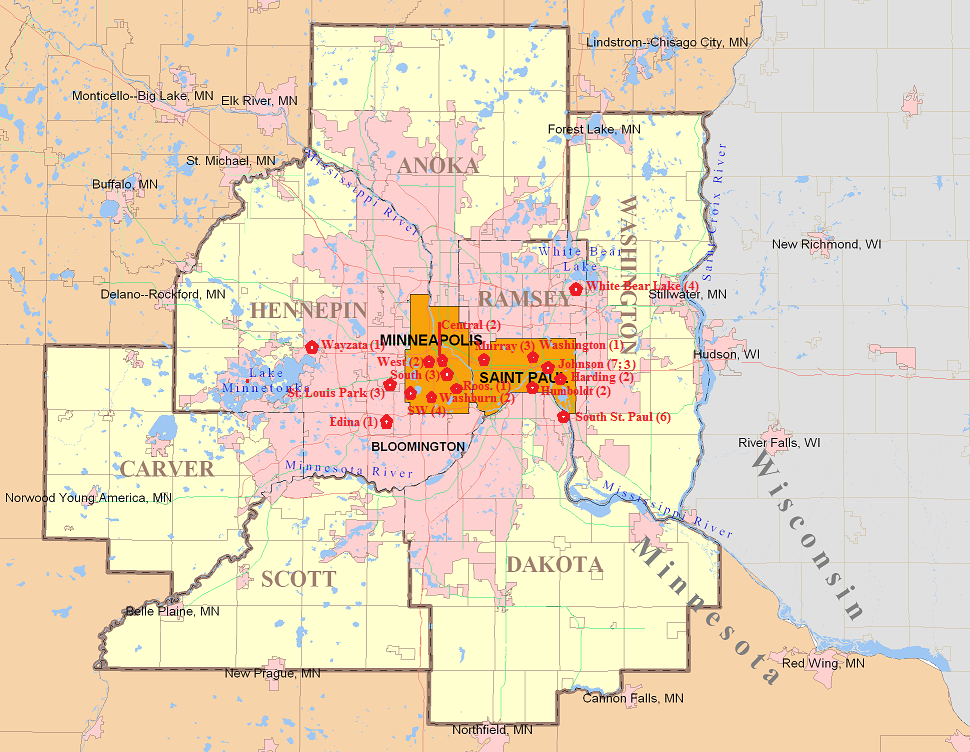
Tourney Apps by Category tc45-55

Metro Area State Tourney Entrants,1945-1955. Number indicates State Tournament berths; numbers after semicolons indicate State Championships. Click images for enlargements.

In 1950, most of the Minneapolis-St. Paul metro area population lived in the Twin Cities themselves, though there was a growing ring of suburbs such as Richfield, Bloomington, Edina, Roseville, and South St. Paul. Minneapolis’s population peaked in the 1950 Census, with 521,718 residents; St. Paul’s peaked a decade later, at 313,411. At the time, the cities’ hockey conferences were highly competitive; while St. Paul Johnston established itself as the Twin Cities’ preeminent public hockey school and the one Metro team that could go toe-to-toe with the powers of the North, there was relative parity beyond that, and things were always competitive.
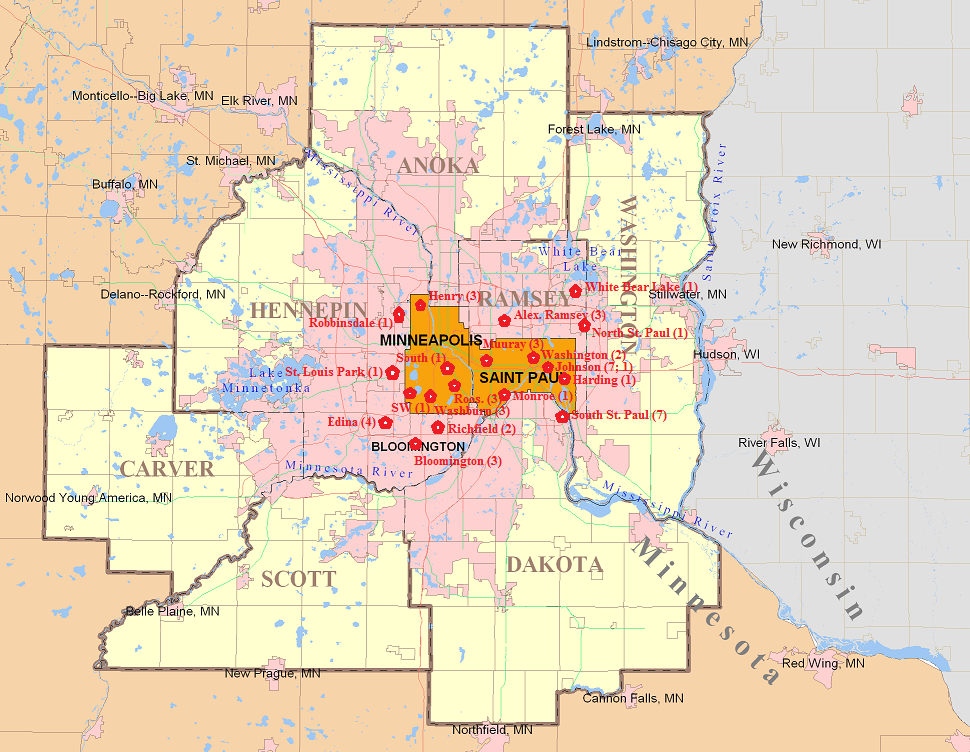
tc55-65

1956-1965

The second half of the twentieth century saw the gradual hollowing out of the inner city. Minneapolis lost 29.39% of its population between its peak year and 1990; St. Paul lost a more modest 13.14%, but the damage was real, and the hockey teams reflected it. By the 1970s, the Minneapolis section had largely devolved into a 2-team race between two of the most affluent schools, Southwest and Roosevelt; similarly, St. Paul was largely ruled by Johnson and Harding. But not even they were safe. Southwest won Minneapolis’s last big-school Tourney berth in 1980; Johnson managed to scrape together two berths in the 1990s, though they came out of weak sections and did nothing once they got to State. All of the Minneapolis public schools now co-op into one middling program; three St. Paul public high schools field hockey teams, with Johnson the only one coming even remotely close to some rare playoff success.
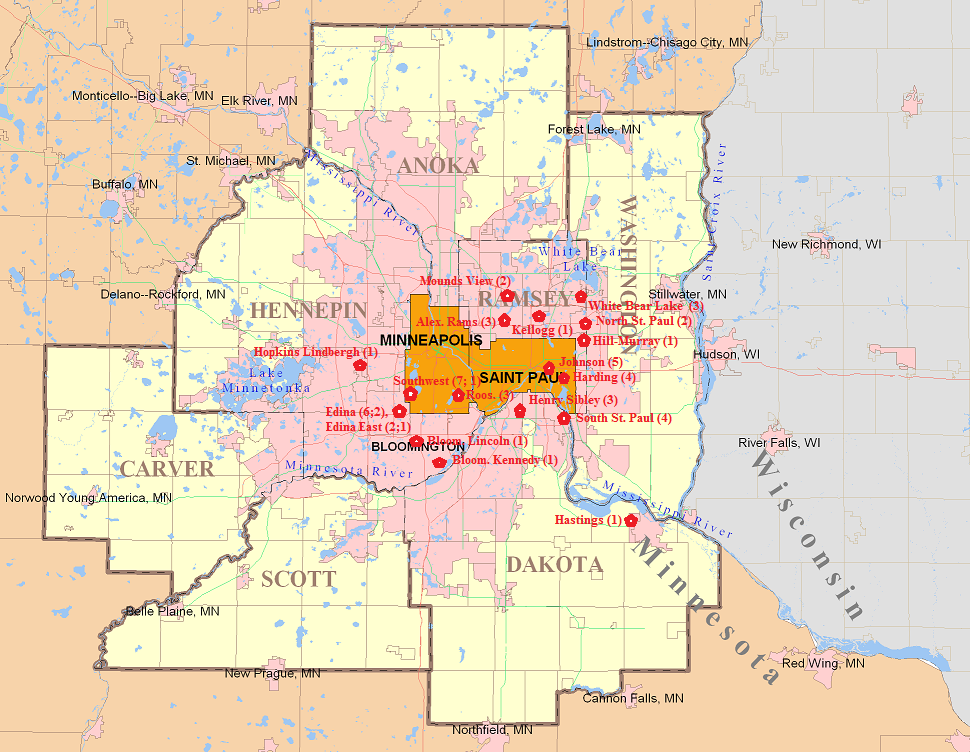
tc65-75

1966-1975

The first-ring suburbs were the early beneficiaries of the cities’ decline. Edina’s triumph in the famed 1969 title game, the one in which Warroad superstar Henry Boucha limped off hurt following an allegedly dirty hit, was the first title for a suburb, and ushered in an era of superb competition between the suburbs and the North. Alongside mighty Edina, South St. Paul established itself as a Tournament regular; Mounds View, Henry Sibley (of Mendota Heights), Irondale, and the Roseville and Bloomington schools all left their mark on the Tourney in the 70s and 80s.
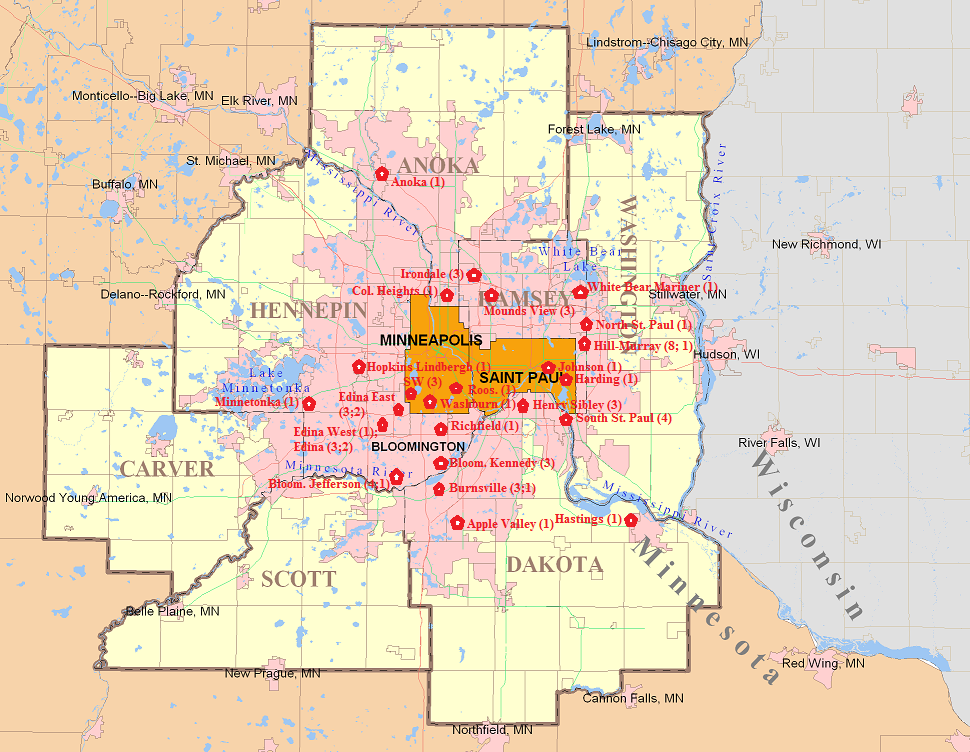
tc75-85

1976-1985

By the 1980s, however, things began to shift yet again. While Edina and the Bloomingtons often ruled the scene and the North had fallen off substantially, schools further afield in the Metro began to appear at State: Anoka, Apple Valley, and Minnetonka made multiple appearances, while Burnsville won back-to-back titles in the middle of the decade. That trend only accelerated into the 1990s, with Blaine and Eden Prairie joining the fun. There were even some berths for far-flung schools out on the Metro periphery, such as Hastings, Elk River, and Lakeville. Blue-collar South St. Paul, still one of the most decorated programs in state history, made its last Tourney in 1996 before dropping to Class A, where it has done little; Richfield, a title threat behind Darby Hendrickson in 1991, now struggles to field a team.
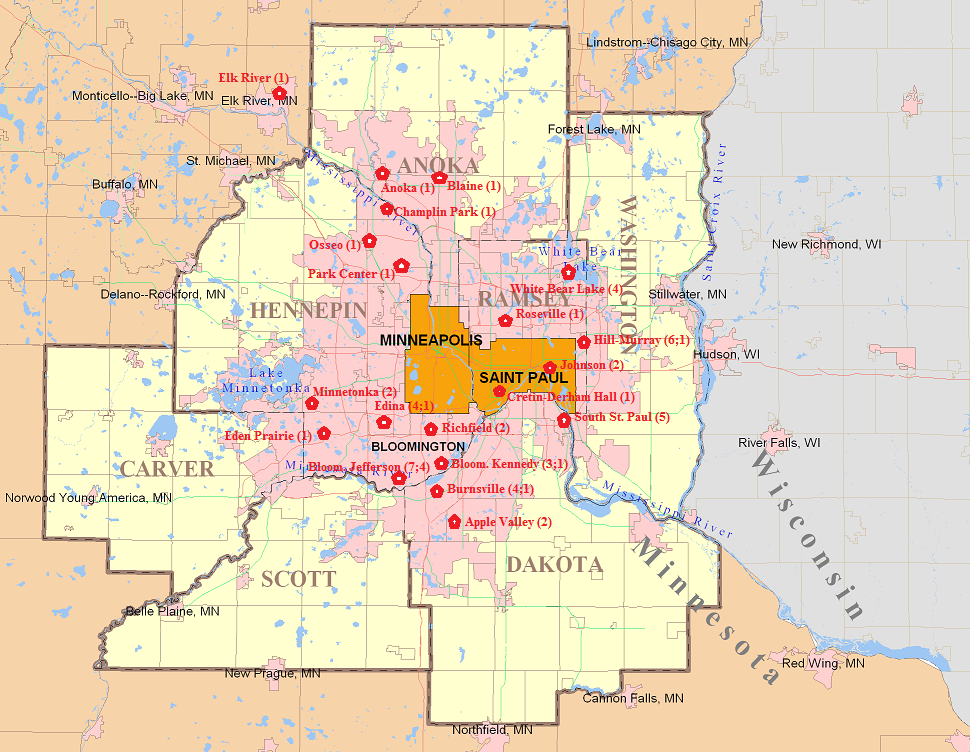
tc85-95

1986-1995

The decline of the first-ring suburbs becomes even more profound when one looks at which first-ring suburban schools have been doing all the winning over the past 25 years. 9 of the 13 berths from 96-05 came from Bloomington Jefferson and Edina, and all 9 from 06-15 belong to Edina. Edina is the exception that proves the rule here, the one first-ring suburb that has used its long-established prestige to maintain economic dominance and continue to attract young, fairly affluent families. In the late 1980s, blue-collar Bloomington Kennedy and Duluth Denfeld were every bit as good as, and often better than, their white-collar counterparts, Bloomington Jefferson and Duluth East. A decade later, Jefferson and East were the state’s premier powers, while Kennedy and Denfeld were struggling to stay relevant. Even the west side of Bloomington, home to Jefferson, has undergone some demographic change in recent years, though the Jaguars remain a relevant program despite the lack of State berths. America’s working class has been hollowed out, and its once-strong hockey teams have felt the strain.
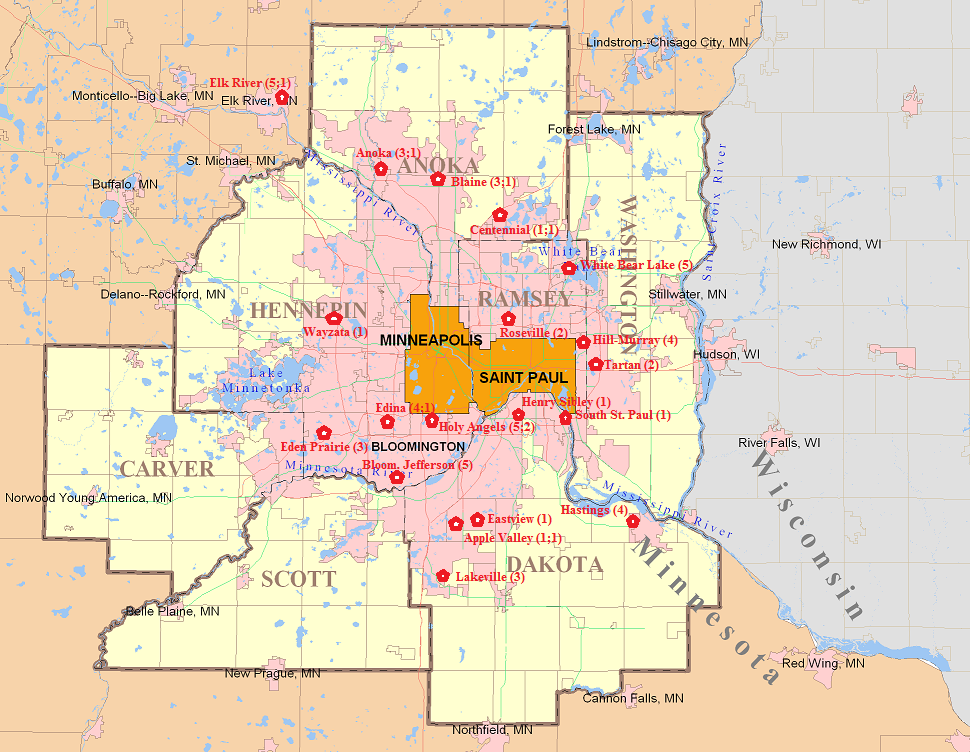
tc95-05

1996-2005

As populations in Minneapolis and St. Paul have started growing again for the first time in 60 years, there have been encouraging signs for the inner city teams; Minneapolis and St. Paul youth programs are climbing toward relevance, and St. Paul Highland Park brought its dead program back to life in 2010. But the most important trend over the past 25 years in these cities and in the first-ring suburbs is the rise of private schools, which tend to be where most of these youth kids wind up playing in high school. (Most, I suspect, have gone to private schools their entire lives.) This might seem to throw off the whole theory, but on the contrary, I’d argue that this only underscores the divisions in 21st-century American cities. While the 1992 two-class split and the story of Greg Trebil (a wildly successful Jefferson youth coach who took over the Academy of Holy Angels in 1996 and brought several top Jefferson youth players with him) may also play roles, the 1990s saw the sudden appearance of the privates (excepting Hill-Murray, which has always been good). This trend fits in with broader narratives of a self-sorting society. Inner cities, while growing, are increasingly divided, with the ultra-rich and the mostly-minority poor split into different neighborhoods, and only a small “middle” class (often involving young people who have yet to start families) serving as a buffer in between. Hockey parents with the means to do so bail on Minneapolis and St. Paul public schools, and often on schools in Richfield, St. Louis Park, or Brooklyn Park as well. There will be no hockey success for inner-city public schools until inner cities find some way to retain or grow their child-bearing middle class families.
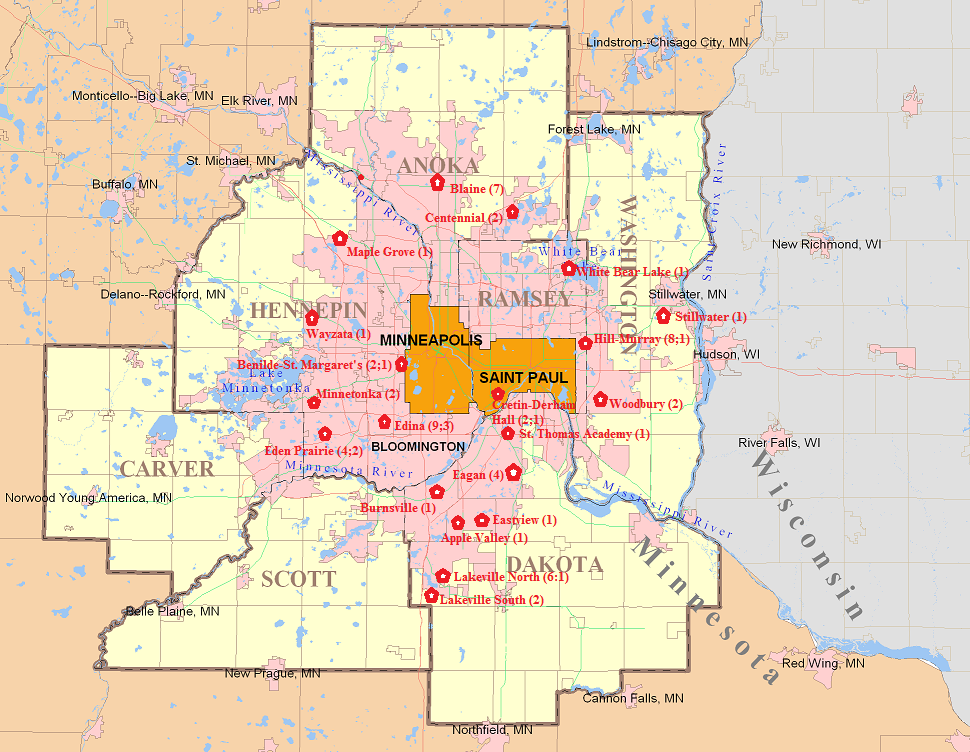
tc05-15

2006-2015

So, what might we predict for the future? The second-tier suburbs will peak at some point, with greater success in rising exurbs like Stillwater, Orono, Prior Lake, and St. Michael. Inertia and hockey culture will carry on in places like Edina, and perhaps in some other places whose leadership or natural amenities keep property values high. Communities that build a genuine sense of place, as Edina has, will prove more stable in the face of natural cycles of urban growth and decline. Places along lakes or rivers, from Elk River to Stillwater to Minnetonka, seem likely candidates.

Naturally, there are factors that have nothing to do with urbanism that affect who heads to the State Tourney. The manner in which the State High School League draws boundaries, to say nothing of great coaches or freak individual talents, all play a role. (How many more state berths would exurban Elk River have if it hadn’t been stuck in a section with Duluth East over the past decade?) Decisions to open and close schools or youth programs will leave their mark, and there’s some chance that the repopulation of inner cities might eventually manifest itself in some way. We’ll also have to see how private alternatives to community-based youth hockey progress, and how these might eat into the pools that high schools draw from. But the correlation is undeniable, and I don’t think any of the above trends will do anything to undermine this whole picture.

Statewide trends reveal a more straightforward numbers game, as power has shifted from smaller towns to larger metro areas. In most of the North, culture allows teams to stay relevant and even thrive with smaller numbers, so long as the economy is stable. Duluth operates as a microcosm of the Twin Cities, with “inner city” Duluth Central now closed and working-class Duluth Denfeld fighting to stay alive, while exurban Hermantown grows, private Duluth Marshall consciously moves to collect regional talent, and Duluth East looks to follow the Edina formula and ride the considerable power of past prestige to stay on top of the heap.

There is one last elephant in the room here that I haven’t mentioned: race. Due to its cultural origins in Canada and Scandinavia, hockey is an overwhelmingly white sport. And, as recently as half a century ago, Minnesota was an overwhelmingly white state. But that is changing, and hockey has been slow to follow. Minneapolis proper was 98% white in 1950, and is now 63% white; most first-ring suburbs are now following the same demographic shift. On that note, I’ll make a bold claim: whichever suburb, town, or neighborhood manages to get the most minorities on skates is going to be the model for the future of Minnesotan urbanism. It isn’t that hockey is some magical vehicle to social equity, but it does have considerable cultural cachet, and its adoption by new arrivals would imply genuine integration and social cohesion. If anything is going to resist the unending push outward and into greater self-segregation (or even the privatization of hockey training, a story for an entirely different post), it is to be found here, where there is still low-hanging fruit. Any high school that can get a group of talented minority athletes together on a successful hockey team is going to break down any number of barriers, and will almost certainly win the hearts of the state. Inertia can do the rest.

In the meantime, enjoy the continued rise of the urban periphery and the private schools, and the continued relevance of the old powers with enough economic vitality to keep their numbers going. For everyone else, take it as a challenge to buck the trends and prove that other, more subtle factors matter, too.

Farewell Duluth II: On Culture

Culture is a notoriously murky term, one that can be used to explain just about anything without actually proving causes or relationships or anything of the sort. Trying to define a culture is a frustrating exercise that throws a lot of unlike things into the hopper that then spits out a vague, abstract Thing that we claim has some substance. An awful lot of bad social analysis has used it to glorify or defame a group of people, and “cultural studies,” while potentially valuable, can also become repositories of mediocre thought and self-absorption.  At its most fundamental level, culture is a shared identity, which just goes to show how hard it is to pin down; no one person’s identity can be summed up by a few simple words, and it’s only going to get worse as we add more people. There is also a good chance that, even at a time where people are more and more likely to surround themselves with others who share their views, half the people on one’s block wouldn’t qualify as sharing one’s culture. There are a million different ways to measure it, and it’s tough to argue that one has any more intrinsic value than another.

Just because it is hard to capture something, however, does not mean that it is not real, or that it does not have considerable power. Duluth, Minnesota has a very distinct culture, one that makes it undeniably unique, and just about everyone from the city who ventures out and thinks about this knows it.

We can try to list some stuff that makes up the culture. There’s a hardiness and stoicism in the face of long winters, with a strong Scandinavian ethos to it. There’s a blue-collar legacy of a transportation hub near the Iron Range in there, and there’s also a strong element of Congdon Old Money and its resultant noblesse oblige. There’s an outdoorsy ethic, from biking and boating in summer to skiing and pond hockey in winter. There is relative racial homogeneity, the ruling DFL coalition, and an obsession with talking about the weather. There are neighborhoods and schools and businesses, all generators of their own sub-cultures; some predictable, some less so.

Culture, however, is never static, and Duluth has undergone a considerable shift over the past decade. It didn’t begin with mayor Don Ness—before him, there was Canal Park and the Munger Trail and a number of other efforts (of varying success) to get Duluth past its 1980s post-industrial mire. But Ness’s cool Duluth energy is part and parcel with the surge of renewal in recent years. In his own words, it plays to “authentic strengths” of this city, instead of trying to pretend we’re something we’re not. And so we have booms in biking and beer and indie music, plus the rise of urban farming and the industrial chic architecture used to revive derelict lots and crumbling old buildings. All the artsy quality of life stuff is moving in tandem with legitimate economic expansion, from the aviation sector to engineering to some good, old-fashioned manufacturing. Duluth has character, and a genuine sense of direction, too.

Another of Duluth’s strengths is its civic engagement, which has fueled the recent renewal. People love this city and want it to succeed, and will spend endless hours prepping for public meetings on school and park plans and so on. At the same time, though, some of its greatest outbursts are in opposition to new planning, and that’s definitely not always a bad thing. It is an erratic and often untamed force, as evidenced by the overzealous attempt underway to recall city councilor Sharla Gardner. Still, it’s a force that slows some of the more harebrained schemes and preserves some of the better aspects of local culture. At its best it’s simply a direct application of common sense, a counterbalance to the plans from on high that manages a strong voice without going into excess. It’s exemplar at the moment is Jay Fosle, the west side city councilor whose populist conservatism stands in sharp but (usually) respectful contrast to the left-leaning visionaries. As I wrote in my account of the first Council meeting I attended, he can waver between wise insights and serious head-scratchers with little warning. But Fosle is not there simply to say no; he is willing to work with people, and no one does a better job of effectively organizing citizens and bringing them forward to speak to the Council. The authenticity of the voices on both sides of Duluth’s political debates keeps things from falling into the stale platitudes of national politics, and that complexity is another source of life.

Still, as I’ve said many times—here in culture, here in politics, here in education—there’s an elephant in the room that threatens the whole project. This is, of course, the east-west divide. It’s always been there, of course. But the most obvious thrust of the current renewal, with its cultural enrichment and “creative class” cultivation, does not produce evenly spread results. If things just plug along as they are, it’s not hard to predict a split in which east side (and Hermantown) reap the benefits of a vibrant city, while the west side sinks into stagnation, a place without a future. Families with children are an excellent bellwether, and nothing is more haunting than this map of the city’s last school board levy. It’s also what makes Don Ness’s seeds of a vision for the west side so worth watching: if Duluth is going to transcend the common narratives of renewal by gentrification, this is where it will have to take place. It won’t be easy.

The plight of the debate around Duluth’s public schools is a sign of what can go wrong when the enlightened planners impose their vision while dodging public debate. Many of the critiques of that plan and its opaqueness had merit, even though I have little patience left with many of its foremost critics. Duluth’s echo chamber of education debate is a bizarre and unpleasant place, filled with catfights and resentment and overblown egos. Funnily enough, through it all, Duluth remains a pretty good place to raise some kids. It has enough big city stuff to be interesting and keep them engaged, has just enough variety to show them all walks of life, yet is small enough that they still get that much-hyped small-town feel. Every week, someone in the media laments the fact that kids don’t get to play freely anymore, but that’s not what I see when I look out my window. Children roaming and playing are one of the most obvious signs of communal health, and it was heartening to hear a recent visitor to the economic development agency where I intern gushing about all of the families she saw out and about on Duluth’s streets. A little part of me died when the Congdon hockey rinks got cleared out to make room for a parking lot.

This discussion of education and childrearing brings me back to the thrust of this post: the primacy of culture, from which everything else follows. Set things in motion early on, build a supportive environment, and your odds are as good as any, even if your background isn’t one of great wealth or education. Duluth does that well for most people, but as with anywhere, there are exceptions, and when they’re relatively few in number, the contrast can be glaring. There is still a substantial amount of poverty in Duluth, and while I’ll leave aside most of that debate about subcultures and pathologies and other things that bog people down, poverty and its associated ills often leave people incapable of participating fully in the broader culture and reaping its benefits.

To be sure, part of this problem comes from the culture itself. Aspects of culture can be both good and bad when it comes to business climate, and despite Duluth’s attentiveness to many of its ills, good intentions do not always beget good results; sometimes it can make things worse. Minority populations here (racial and otherwise) are so small that it’s hard for them to generate their own vibrant, self-sustaining cultures; they can either assimilate into the general culture, or be alone. It’s hard to know what can be done about this; if we did know, we’d have solved a lot of problems long ago. (Perhaps the most important point here is that these are not problems to be solved, but the stories of lives of real people to be unspooled into the fabric of a community.) Duluth has no shortage of well-intentioned people who want to overcome these troubles, and with the Clayton-Jackson-McGhie group and a vocal group of activists, there are real dialogues, though it’s not hard to ignore them, either. In time, demography will probably make these questions more relevant. One would hope that Duluth’s general tolerance will make this smoother than in other places, but it’s easy to claim tolerance when it’s rarely put to the test. Culture will always divide us, for good and ill.

In the eyes of some, the divisions coming out of culture are reasons for its dismissal. Better to cast away these things that tie us to imperfect places and people. An afterlife or some ideal form of human life takes precedent. Doing this, however, chokes off many of the greatest sources of earthly happiness. There are things I could do without in Duluth’s culture, but, in looking around the world, there is so much here that is worth preserving and enhancing. It has a strong sense of self, and now it also has a trajectory to match. It’s fighting the standard narratives of decline and measurements of success in cities, and these days, more often than not, it’s winning.

That makes Duluth unique, and explains why some people who aren’t native Duluthians find it hard to ever quite settle in here. But it works for Duluth, and it is, of course, never static. It goes along, guided by both inertia and a lot of hands that have claimed it as their own. It is a city with a soul, a sheer sense of being; a sense of motion through time, cyclical, coming and going, life and death flowing in and among one another. It has a rhythm, a pace, perhaps unique to each who walks its streets, yet felt like a beating heart, grounding one within it, leaving no doubt: a sense of place. It’s home.

Part 3 is here.

Saving the Seaway: Duluth City Council Notes, 3/10/14

The Duluth City Council had a fairly tame agenda on Monday night, and between hockey-caused exhaustion and a busy workday, I settled for following Monday night’s City Council meeting from home.

The opening comments were straightforward, and brushed on a handful of open Council issues. Councilor Julsrud plugged two upcoming meetings, one at 6:30 on March 20 at Good Shepard Lutheran Church in Lakeside to discuss soil testing and plans for a dog park in the neighborhood, and the other at 6:00 on March 27 at Hartley Nature Center over future plans for trails in Hartley Park. Councilor Gardner also gave a brief update on the move toward a charter amendment to resolve issues with council vacancy appointments, saying the committee charged with drafting the changes had some research to work with and would be meeting soon.

After some procedural wrangling and the pulling of several finance resolutions so as to allow more time for public notification, the Council moved into its only big agenda item of the evening, a $230,000 loan to the Housing Redevelopment Authority (HRA) to rescue the blighted Seaway Hotel in Lincoln Park. The Seaway has been condemned by the city in the past and faces serious structural issues, but continues to operate over 60 low-income housing units, and needs a new owner to realistically continue to operate. Three citizen speakers came forward to support the loan, saying the need was pressing, and that a revitalization could be a catalyst to help improve one of Duluth’s more depressed areas. They also stressed the inclusion of tenants in the meetings to decide the Seaway’s future.

Councilor Larson was the first Councilor to declare her support, noting the efficiency of the investment—about $3,000 per unit—and the potential costs of failure to act. Councilor Russ agreed and noted the diversity of groups involved in the effort, while Councilor Filipovich added an environmental angle to the discussion, saying refurbishment was better than demolition. Councilor Fosle, conceding he was likely the lone ‘no’ vote, expressed his doubts: the HRA has a budget of over $10 million, yet taxpayers are being left with the bill; the loan was “forgivable;” and other businesses in the region might not see any incentive to do anything, leaving then neighborhood unchanged. He was especially concerned about projections that had the project in the red for at least three years, perhaps forever, and insisted that it is “not the government’s job to buy dilapidated buildings. This is why people get mad at government.”

Councilor Hanson followed up on Councilor Fosle’s words, and asked CAO Montgomery if the loan really was “forgivable.” Montgomery did not quite answer the question, though he did point out that there was revenue to be made both from the building’s operations and in its eventual sale. He also conceded that there was a real chance the Seaway would operate in the red, but both he and Councilor Sipress insisted that the benefits of an improved Seaway would outweigh the costs. The whole plan was contingent on state grants, they explained, and the HRA is a catalyst for the process that makes an eventual payoff “more probable.”

Councilor Larson offered to talk to Councilor Hanson about the details later, but this didn’t quite quell his concerns, and he proposed an amendment to the resolution that would insist that the eventual liquidation of the building be done at a “fair market rate.” President Krug (via Atty. Johnson) and CAO Montgomery were quick to shoot this idea down, explaining that an amendment would force the plan back to the Development Authority. The Seaway “would have been sold long ago” if it were an “easy deal,” Montgomery explained, and the building would forever be problematic unless it got a “government kickstart.” He also wondered how they would define a “fair market rate,” and President Krug closed the comments by saying that the Seaway was a problem that needed a solution before anything else could be done to rehabilitate Lincoln Park.

Councilor Hanson voted for the resolution, and it passed 8-1, with Councilor Fosle as the lone dissenter. During the closing comments he explained himself further, and appeared to disagree with the narrative presented by some Councilors in which a refurbished Seaway would lift up the entire neighborhood. The “deep cancer” at play here, he said while citing his experience as a resident of and worker in Lincoln Park, is the presence of many “liquor establishments” along the block that blight the entire area. He demanded better management and responsiveness to crime in the neighborhood, and said it “will take more public investment” to turn things around; hence his frustration that the HRA was not picking up more of the tab, though this was a good “first surgical step.”

The only other discussion involved three ordinances amending the city code. Councilor Fosle made some cryptic comments at the start, saying someone had been “pushing an agenda” to make all of these changes, making a 1.5 inch-thick book’s worth of changes before abruptly leaving. He said one of the changes was not merely the “housekeeping” change it had been made out to be, and worried about unintended consequences. Agreeing that there was a lot of information to absorb in a short time, Councilors Gardner and Julsrud sought to explain the changes found in the most complex of the ordinances. The new language created more public meetings, and insisted that developers hold one for all residents within 350 feet, note the number of attendees, and respond to any concerns they might raise. It also allowed for more flexibility and freedom to issue special and interim use permits. This particular ordinance drew a ‘no’ vote from Councilor Fosle and passed 8-1; the other two passed unanimously. Its work complete, the Council wrapped up a relatively short meeting.

***

The most interesting theme to emerge in this meeting was the chicken-or-egg question relating to the Seaway and its place in Lincoln Park. Is the area around the Seaway in need of a facelift because of the effects of the Seaway, or is the Seaway an issue because its environs are the issue? Presumably the two are interrelated to some degree, but where is the best starting point for people trying to attack the problem? With the caveat that I don’t spend much time in Lincoln Park, I’ll say this: going after the blighted building at the heart of the neighborhood is probably more cost-effective than trying to make everything look pretty or cracking down on crime or shutting down bars. (Where there’s a demand, the supply will follow, in one way or another, and some of those other solutions can seem paternalistic, depending on how they’re implemented.) For the same reasons, though, it’s hard to see the changes to one building turning around an entire neighborhood.  This is, of course, why poverty is so entrenched; there are no simple causal arrows, and things cycle into one another through culture and politics and economics and the agency of individuals. The Seaway rescue is an attempt to throw a wrench in some of those cycles. We’ll soon learn if it is enough of one to create newer, healthier cycles for a neighborhood that could use some help.

What Is Duluth’s Future?

This is going to be a sprawling post, and I envision it as the start of a series on Duluth, Minnesota, my hometown, that builds on the fairly narrow focus of my posts on city council and school board meetings.  For those of you who have never been there, it is a city of 85,000 on the tip of Lake Superior, and the world’s largest freshwater port; and no, it is not a suburb of Minneapolis. (When I was in the college on the East Coast and told my classmates I was from Duluth, Minnesota, the inevitable next question was, “is that near Minneapolis?” They didn’t know how to respond when the answer was “no.” There were also the girls who once asked me if Minnesota was near Maine. And the one who didn’t believe that ice fishing was a real thing. But I digress.)

At any rate, a few days ago, the New York Times ran a piece by Robert Putnam, a Harvard scholar famous for his book Bowling Alone, which explores the decline of communal bonds in the United States. His work is some of the most fascinating stuff on modern American culture, though as with all scholarly work, there are intelligent critiques and rebuttals and endless back-and-forth nitpicking. While nuance is always necessary, I do worry about fraying social fabric and the increasing isolation in modern America, and perhaps more importantly, the pathologies that afflict an increasingly stratified society, from broken families to drug abuse to cycles of poverty. Without going straight into causes, solutions, and ultimate implications, it is clear there is a problem here. The ability of a city to cope with or adapt to these issues will likely determine its fate.

This particular article was more focused, however; it told the story of Port Clinton, Putnam’s Ohio hometown along the shores of Lake Erie. Like much of Middle America, Port Clinton has not fared particularly well economically in recent decades; its manufacturing base has collapsed, and though its lakeside location has kept some money in the town, it is now very divided, and not the foundation for the American Dream Putnam claims it was when he grew up there in the 1950s.

There is a shoutout to Duluth near the end of the piece, and the parallels are not hard to see. (The results of the Duluth surveys taken for Putnam’s project, while they do not mention many of the things discussed in the NYT piece, are here.) Duluth is much larger than Port Clinton, but for a while, it looked like it was going down the tubes when it lost its U.S. Steel mill and shed perhaps 30,000 residents toward the end of the 20th century. Like Port Clinton, Duluth has weathered the storm somewhat thanks to tourism dollars, and it has been fairly stable for two decades now. For all its troubles, Duluth really hasn’t fallen off the cliff in the way Putnam seems to think Port Clinton has.

If Duluth doesn’t fit so smoothly into the narrative of Midwestern industrial decline, we have to ask what sort of story we can tell about Duluth. In addition to the tourism dollars, I’d attribute Duluth’s resilience to two factors:

1. Due to its size, it remains a regional hub in a way that most small towns in America aren’t. Duluth may not have grown since it stopped shedding people in the early 90s, but it also isn’t shrinking, while most of the rest of the region is; its quasi-suburban areas, Hermantown and several unincorporated townships, have actually seen some growth. While Duluth may not have the opportunities Minneapolis does, it does have some allure when compared to small northern Minnesota towns. It has two 4-year universities, remains a busy transportation hub, and many regional services that cannot be outsourced to a metropolis or Malaysia (health care, certain government agencies, etc.) are based here.

2. Old money. At the start of the twentieth century, Duluth was a millionaires’ playground, and though not all of the grand old houses on the east side are in the best of shape these days, a chunk of the money is still here, doled out from trusts, foundations, and donations from heirs. For example, the revitalization along the waterfront likely would not have been possible without the efforts of the late pizza roll magnate Jeno Paulucci, whose restaurants anchor the Canal Park area. Putnam’s piece mentions the scholarships set up for many local students; Duluth has a bevy of such awards, and I received one that kept me debt-free through college.

(In a rebuttal to the Putnam piece, Front Porch Republic’s Jeffrey Polet points out that such scholarships may simply funnel graduates out of town, never to return. He may have a point; I am sure some of the recipients I graduated with, happily farmed out to elite colleges, will never be back. In my case, however, the strength of the Community Foundation and my sense of obligation to that history were among the many things that kept me grounded here.)

Duluth does very well in the indicators of social cohesion, which bodes well for the city, though some of Putnam’s later work shows that more homogenous communities tend to have much stronger social fabrics (a fact that so deeply troubled Putnam that he took years to release his data). Duluth, being 92% white and with strong northern European ties, obviously fits the bill. Moreover, it is a fairly segregated city (and not just in terms of race, though most minorities are concentrated in the city center). When explaining Duluth to outsiders, I’ve often described it as two separate cities: a combination college town/comfortable suburb on the east side, and a struggling rust belt city in the west. This is overly broad, of course, and perhaps an uncharitable portrait from a dyed-in-the-wool east-sider. The west side’s civic pride remains strong, and lower-income housing has been creeping eastward somewhat. But a simple look at the public high schools tells the story: three central and west Duluth high schools have folded into one since 1980, and East High remains much larger than that single western high school, Denfeld. (The East attendance area grew somewhat with the closure of Duluth Central a few years ago, but not drastically, and the school-aged population—a good indicator of how desirable an area is for families moving in—is much more dense on the east side.) Duluth East is the home of the “cake-eaters” of the north—it is the wealthy school that has long overshadowed Denfeld in academic and athletic prowess, even though Denfeld retains a very loyal following; perhaps even greater than East, since west-siders are far more likely to stay put while the East kids head off to supposedly greener pastures.

The divide is also made fairly clear by the quality of life and perceived political influence statistics in the Putnam study (see p. 49-54), though the west side does have some real strengths in those numbers. (This write-up also doesn’t mention where the dividing line is, which would be interesting to know.) This invites several questions:

-Duluth sprawls along 27 miles of lakeshore and riverfront, and there is a ridge along the length of the city that makes construction impractical in many places. How much does geography make Duluth’s divisions inevitable? The flip side of these divisions are some very strong local neighborhood identities, and I think these can be very good things. Are the divisions bad in and of themselves? Putnam certainly thinks so, and though I certainly understand that hyper-localism has its downsides, and can lead to discrimination, I’m not entirely convinced—in part for the reasons Polet touches on, though he doesn’t do a very thorough job in that post.

-What role do suburbs (ie. Hermantown) and new construction in Duluth Heights (away from the lakeshore and “over the hill”) play in Duluth’s development?

-Whither Superior? The Wisconsin city across the bridge is sometimes derided as Duluth’s armpit, but it still has a substantial a population and is an important part of the metro area. (And where else would we Duluthians go to buy our liquor on Sundays?) In the parts included in the Putnam study, it scores noticeably worse than Duluth in some respects. How does its fate affect Duluth’s?

-One effort to revitalize Duluth seems to evoke a hipster vibe. The attempt to attract “creative people” to revive the economy is mocked at times, but there is a certain logic here: in many cities (Manhattan, parts of Washington DC, San Francisco, and on and on), urban renewal (or gentrification, depending on how one looks at it) starts with artsy people moving into cheap housing, making the neighborhoods “interesting,” and in turn attracting wealthier wannabe urbanites who gradually displace the poorer people. Given Duluth’s universities, natural beauty, and decent arts scene for a city of its size, it seems to have potential for the hipster crowd. (Witness the dramatic rise in microbreweries and the expanding bike paths.) Mayor Don Ness, who is in many ways emblematic of this movement, certainly seems to be pushing it, as do several city councilors.

But this brings up some necessary questions: is this desirable development, and does the fact that it often just ignores or pushes poor and working-class people elsewhere trouble anyone? This model seems to work in major urban areas, but how well does it apply to a much smaller city? At first glance, a lot of this appeals to me—while I am probably a bit too clean-cut, conservative in temperament, and boring in my musical tastes to be a proper hipster, I enjoy culinary variety and good beer and a vibrant arts scene, and I’d much rather have more localized development than further urban sprawl. But I can still hear City Councilor Garry Krause’s words echoing in my mind: is our obsession with the new and interesting coming at the expense of the mundane, and the people who have called this city home for generations?

While Mayor Ness is a very popular and personable man who won re-election unopposed in 2011, in his initial election in 2007, he won the east side and lost the west side of the city. At the time of that election, I remember a high school teacher noting the unusual fact that Ness, by far the more liberal candidate, did better with the wealthier Duluthians, which seems to counter our normal political narratives. Looking at it from this perspective, it makes a lot more sense now.

-Duluth also includes many newcomers, and if certain critics are to be believed, it attracts a number of poorer people who look to take advantage of its relatively strong social safety nets. Councilor Jay Fosle had a complaint (not well-explained to the broader public) a few meetings ago about U-Haul rental patterns in Duluth; back in that 2007 mayoral election, Ness’s opponent, Charlie Bell, made some sort of remark about people from places like Chicago showing up and causing problems. Can someone give this critique some coherence or empirical backing, or is it just shoddy identity politics? And if it is true, what do we make of it?

This post is getting out of control, so I’ll cut myself off here. I’m throwing this open for discussion, in large part because I don’t know the answers. Urban planning interests me as a field, but I’ve never really pursued it because, eternal critic that I am, I have yet to latch on to any sort of coherent vision for how to revitalize a city. Duluth has considerable potential with its location, strong civic engagement, and unique culture; this city has a soul, and a lot of people probably don’t realize how unique that is. But where do we go from here?

The City of Duluth vs. Urban Blights: City Council Meeting Notes, 6/10/13

At various times on this blog, I’ve emphasized the importance of only worrying about the things one can control; that is, focusing on the most immediate issues around our lives rather than obsessing over what’s going on at the national or international level. Seeking to practice what I preach, I went to the Duluth City Council meeting last night. (I hasten to note here that care for the local need not necessarily involve formal political structures; it is simply one of many options, and a somewhat entertaining one in a city such as Duluth, which is large enough to have some “big city problems,” but small enough that there are few degrees of separation between anyone in town.) What follows is an account of the June 11, 2013 Duluth City Council Meeting.

The meeting took place in the council chamber on the third floor of city hall, a rectangular room with a spectacular view of the Duluth harbor that allows bored Councilors and writers to gaze out at the huge ships when they so choose. Attendance was limited primarily to citizens with immediate business before the council, though a local blogger who is running for the Council this fall was bouncing around the room and snapping pictures as if he already owned the place, and there were a handful of residents there to cheer the council on in its ongoing battle with a man named Jim Carlson. (I will refrain from making further comments about the blogger so as to keep my own blog from sinking to his level.)

The first item on the agenda revolved around Duluth’s biggest ongoing controversy, the sale of synthetic marijuana at a downtown head shop called the Last Place on Earth (LPOE). The city has been at war with Mr. Carlson, the shop’s owner, for years now, and the litany of complaints against LPOE grows ever longer. A representative from a local hospital described the situation as a “public health crisis,” and one councilor described the effects of the bath salts and other marijuana substitutes as “worse than cocaine.” Customers come from far and wide to purchase LPOE’s product, leading to loitering and vagrancy on the block in front of LPOE, an area of downtown that has otherwise been somewhat gentrified in recent years. The Chamber of Commerce has rallied behind the effort to thwart LPOE, citing serious losses for local businesses. Councilor Larson and Council President Boyle (who have experience in these matters) noted the added difficulties of getting marijuana substitute users back on their feet, and the widespread social consequences of drug use.

On Monday night, the Council took up a resolution that would regulate the sale of synthetic marijuana in the city of Duluth. Mr. Carlson came to share his thoughts, and took the stand rocking a green ensemble and a ragged grey beard one might expect to find on a Cuban revolutionary after several months fighting in the jungles. The image befits Mr. Carlson, a man who has pretensions of rebellion—he was on the ballot in several states in last year’s presidential election as the candidate of the Grassroots Party—but in the end seems to be in it only for himself, a man who believes that legality determines morality. Alas, Mr. Carlson lacked the charisma of a Castro or a Guevara, and limited his remarks to a few familiar points: he insisted this new measure constituted an endorsement of his business, and that the city would have to stop charging him for the extra police officers assigned to his block and return various seized assets.

The Councilors then took turns railing against Mr. Carlson and his business. Councilor Krug made it quite clear the measure was no endorsement of synthetic marijuana, but simply a stopgap bureaucratic measure to be used until state or federal law bans it. The intensity of the rhetoric varied; Councilor Fosle said his problem was with the product, not the business itself, and that he had only decided to support the measure after a National Geographic special he’d watched the night before said regulation was an effective tactic, while Councilor Julsrud said she would not rest until the business no longer exists. The lone vote against the measure came from Councilor Stauber, the longest-tenured Councilor and, as one of its more conservative members, a frequent voice in the wilderness. Councilor Stauber’s objection was, it seemed, a pertinent one: he worried that past efforts to control LPOE had simply increased Mr. Carlson’s celebrity, and that the measure might lead to even more litigation. A number of the councilors spoke past his objections as they piled on to Mr. Carlson, though Councilors Krause and Hartman argued the stakes of the problem were great enough to justify any ensuing legal battles, and Councilor Hartman said he doubted Mr. Carlson’s celebrity could grow any bigger than it already is. The measure passed, 8-1, and the Council moved on to other matters.

The second big issue on the agenda involved a pair of projects that seek to turn unused buildings into low-income housing that required Council support to qualify for grant funding. One, a repurposed Lincoln Park Middle School, was a shoo-in; the more controversial agenda item asked to council to elevate a second project at the site of the former Kozy Bar to equal status with the Lincoln Park project. The Kozy was a notorious Duluth establishment that perhaps once rivaled LPOE (just a block away) as the site most often visited by police in the city. It burned in a fire several years ago—a fire that was “quite honestly a relief,” according to Councilor Julsrud—and the shell of the Pastoret Terrace building it occupied, which was designed by a famed local architect, has been empty ever since.

Councilor Gardner, another longtime member and one of its most vigorous (and long-winded), read a letter from local historian Tony Dierckins that explained the need to save the Pastoret Terrace building, particularly since it might not be able to withstand another winter without some construction. Several Councilors noted the serious need for low income housing in Duluth, though Councilor Fosle had a rather murky counterargument to this claim involving U-Haul usage patterns.

However, as the debate unfolded, it became clear the Council had its doubts about the Pastoret Terrace project. Councilor Krause summed them up well, pointing to the very high density of the apartments coupled with poor ratio of resources (ie. food and support services) to institutions of vice in the area (LPOE, the Fon Du Luth Casino, a bar on the block) that might just lead to more of the same problems that led the Kozy to be Ground Zero for Duluth’s urban blight. Councilor Gardner countered that this is how downtown living is, and that there would be adequate support for residents who required it. The developer, a Mr. Conlan, reminded the council that these grants were not public money, asked where else “these people” were going to live if not downtown. Councilor Larson strongly objected to this language, while a representative of Mayor Don Ness’s administration offered similar sentiments, and suggested mixed-use housing would be more appropriate.

Several councilors also had serious issues with the owner of the property, Eric Ringsred, who, as Councilor Fosle reminded the chamber seven or eight times, once claimed the City Council (along with several other prominent Duluth institutions) was culpable for the suicide of Jim Grandishar, a business partner of Mr. Ringsred’s who once sought to convert a historic Duluth theater into a strip club. Councilor Fosle made it fairly clear he would not associate himself with anything involving Mr. Ringsred, despite Mr. Conlan’s best efforts to point out that his ownership stake and lack of any other involvement in the project did not render him much of an obstacle. (If Councilor Stauber is the Council’s voice in the wilderness, then Councilor Fosle is its loose cannon. A well-built man with a contemplative goatee, he displayed an incredible talent for oscillating between sharp insights and tone-deaf head-scratchers throughout the evening.)

In the end, the Council voted 6-3 against elevating the priority of the Pastoret Terrace project, with Councilors Gardner, Hartman, and Stauber providing the dissent. They then discussed the ultimate fate of the Pastoret Terrace project before ultimately deciding to table it. This vote also came down to a 6-3 margin, though Councilor Julsrud made her inner conflict quite clear; the ‘no’ votes came from Councilors Krause, Krug, and Fosle.

The only other item that inspired much debate was an amendment to a disbursement of some $80,000 in parks and rec grant funds proposed by Councilors Gardner and Krause, who suggested that money for informational kiosks along the lakefront Lakewalk path should come out of the tourism budget instead of park money. While the Councilors seemed to agree this was a sensible idea, Chief Administrative Officer Montgomery argued was more important to respect the existing vetting process, and Councilor Fosle, in one of his insightful moments, noted the danger of setting a precedent for the selective addition and subtraction of projects from omnibus funding measures. The amendment failed, 7-2.

The meeting concluded with a celebration of a new set of picnic tables in front of the library, a call to help set a new playground in Lester Park on Saturday, and plans for a City Council-School Board social at which the Councilors were told that their attendance had better be superior to that of the School Board members. And while the fate of a couple of blighted blocks in Downtown Duluth wasn’t all that much clearer, there were, at least, some signs of movement.