This is the first in a four-part series. Part 2 | Part 3 | Part 4
Being out in big surf is dreamlike. Terror and ecstasy ebb and flow around the edges of things, each threatening to overwhelm the dreamer. An unearthly beauty saturates an enormous arena of moving water, latent violence, too-real explosions, and sky. Scenes feel mythic even as they unfold. I always feel a ferocious ambivalence. I want to be nowhere else; I want to be anywhere else. I want to drift and gaze, drinking it in, except maximum vigilance, a hyperalertness to what the ocean is doing, cannot be relaxed. Big surf (the term is relative, of course—what I find life-threatening, the next hellman may find entirely manageable) is a force field that dwarfs you, and you survive your time there only by reading those forces carefully and well. But the ecstasy of actually riding big waves requires placing yourself right beside the terror of being buried by them: the filament separating the two states becomes diaphanous. Dumb luck weighs heavily, painfully. And when things go badly, as they inevitably do—when you’re caught inside a very large wave, or fail to make one—all your skill and strength and judgment mean nothing. Nobody maintains their dignity while getting rumbled by a big wave. The only thing you can hope to control at that point is the panic.
-William Finnegan, Barbarian Days (Against Dereliction)
On my recent trip to Spain I spent a little time mesmerized by the skilled surfers off Zurriola Beach in San Sebastián. Old friends and readers of my writing will know surfing can enrapture me, inspire words that go far beyond the exploits of a beach bum on a board. It is a feeling known to anyone who has ever given himself over to something beyond him.
The passage above, while less immediate in its death-daring fear, approximates the dream state I enter when exploring a European city on foot. I feel it all deeply, want to wander without a map, one with thousands of forces that flow of their own accord to weave together into the fabric of an urban life. Gifted thirty jetlagged hours in Madrid at the start of my trip, I pick out one museum for a visit, but I am mostly here to wander and explore.
Madrid is a city of seven million people, and yet most of its great monuments are reachable by foot. The Plaza Mayor and the Puerta del Sol are the humming hearts of the city; down the Gran Vía and Calle Alcalá, luxury brands take up shop in ornate buildings, a pastiche of revival and art deco architecture. On the west end sit the monumental palace and cathedral, while a series of arches in traffic circles (puertas and glorietas in Spanish, far more melodious) ring the entrances to the city center. To the east and southeast are the great museums, the Prado and the Reina Sofia and the Thyssen-Bornemisza. Great green spaces bookend the Centro, the sprawling Parque del Buen Retiro to the east and the lush Campo del Moro below the palace to the west. Strewn between are neighborhoods of life and culture and history, La Latina and Letras and Chueca, plazas dotting them to open up the narrow streets and give people places to settle at tables for a drink or a bite. Fountains flow and statues stand guard and that central Spanish sun beats down on the scene.

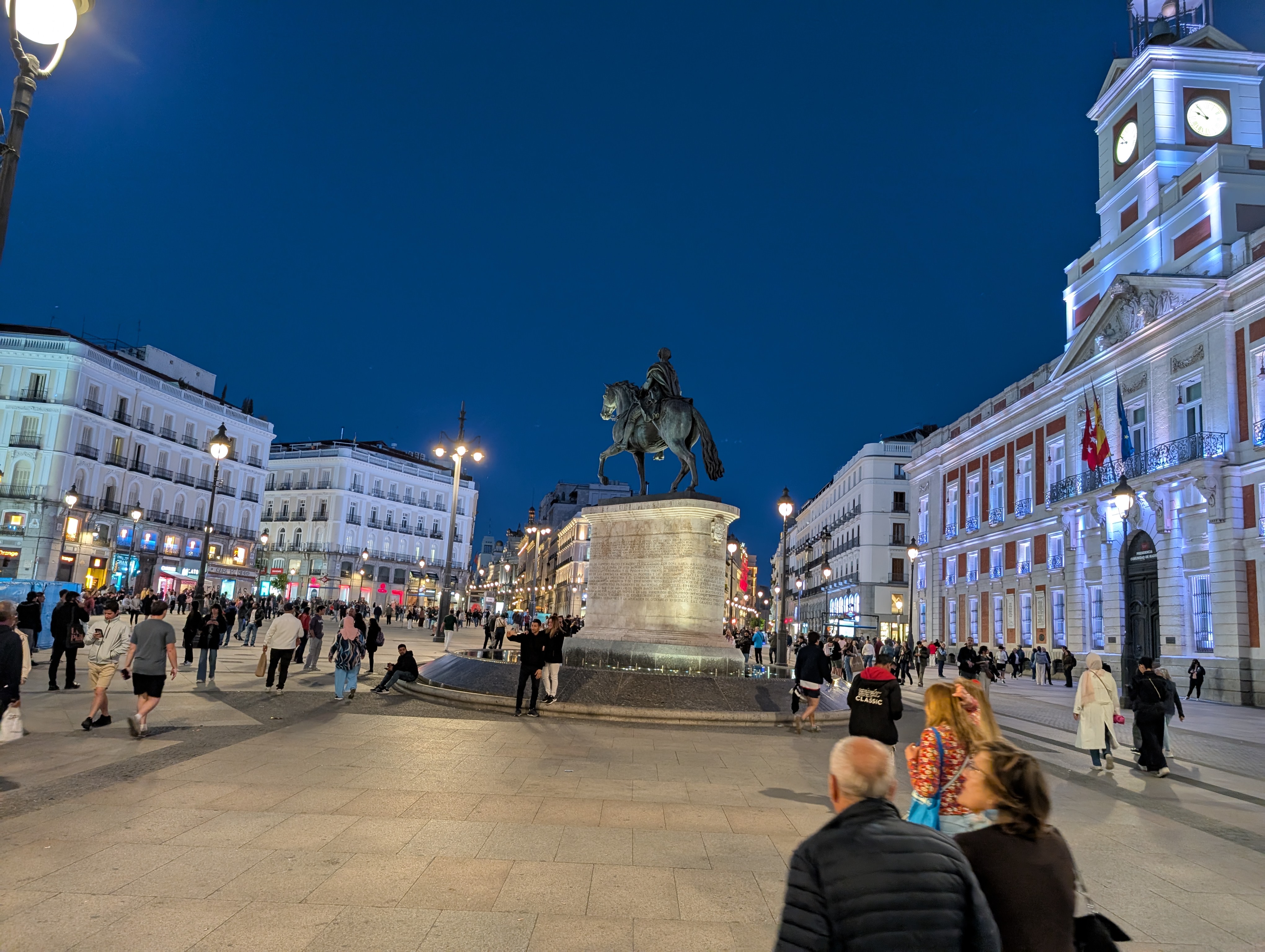


And so I re-immerse myself in that Spanish urban rhythm. I revisit a good brewery here and a fun restaurant there from my previous visit. I pause to read sign boards and take unexpected turns when piqued, and I sit in some churches and gaze upward in awe. In the Plaza Mayor, a stage has been set up and trucks are unloading kegs for the celebration of the Feast of San Isidro, which I will miss by one day. In the Puerta del Sol, lit up for the night, I sit for a spell and feel the rush of freedom that comes at the start of a new great trip, enchanted by what the Madrileños have designed here.
The Spanish are, after all, history’s greatest urban planners. It is difficult to find any Spanish town, no matter how godforsaken, without a walkable grid at its core and a pleasing central square and a couple appropriately scaled monuments: a church, a government building, some statues or fountains. Small, specialized shops are everywhere, selling food and technology and books (so many bookstores!) and just about any basic need within an easy walk of home. They make ample use of arcades, a superb and underused design feature, especially in hot or wet climates. Their housing is dense but not overcrowded; the apartment blocks in the suburbs, while not aesthetically pleasing, provide ample housing and are well-connected into the city.
These characteristics are not uncommon across Europe, but Spanish innovations endure. Whatever else one may say about their colonial exploits in the Americas, the Spanish did very intentionally export their urban form over the better part of two continents, and those plazas and zocalos will live on from Buenos Aires to Santa Barbara long after anything Bob Moses built gets replaced and the high modernists get consigned to the museums where they belong. More recently, the Spanish have built a train system that is the envy of the Western world, high-speed AVEs flying about, full lines built for the cost it takes to lay three ties on the California High-Speed Rail project; in Barcelona, the subway arrival time boards count down to the second. When I recently heard a joking proposal that we fire all train planners in the United States and replace them with Spaniards, I found myself nodding in solemn approval.
Besides the timeless aesthetics, Spanish cities understand something about human nature. An innate curiosity to peek around a corner, slip down an alley, emerge into a square. A simultaneous desire for order and ornament, a stable foundation topped by some of the flair that makes life fun. Spaces where adults can sit at tables and talk while the youths gather in another corner and younger kids can just dart about, all free to intermix while also carving their own little spheres. Spaces for God and spaces for hedonism; spaces for government and dim alleys to escape it. Meals are a progressive feast, small plates to escape gluttony, a free bite with every drink. Spanish city centers are a pleasure to stroll through, a pleasure to linger in, the place everyone wants to hang out instead of alone in little boxes every night.
My visit to the Reina Sofía modern art museum confirms my belief in Spanish urban thinking. How, exactly, does an art museum reflect values in city planning? Well, in it, I find a healthy heap of the original versions of designs I remember from introductory urban planning texts, from Garden City drawings to Le Corbusier’s schemes, along with plans for Madrid and Barcelona that seek to update these great old cities with grids that can sustain modern living. In a museum with relatively few non-Spanish works, the curators have seen fit to collect some of the most iconic pieces in the history of the field, show how their country then took those ideals and adapted them to their own towns. For the Spanish, urban planning is an art, worthy of its own wing just down the hall from Guernica.


Like its more classically inclined compatriot, the Prado, the Reina Sofía largely leaves out anyone who is not either from the country or in some way tied up in its history or artistic movements. Picasso and Dalí take center stage, but here also are Joan Miró and Juan Gris and adjacent surrealists who made the art world churn in the early 20th century. The temporary exhibitions include the funky sound artist Laia Estruch, a reasonably well curated collection of art attempting to subvert narratives associated with Spain’s colonial history (here I am pleasantly surprised to find art and video from a Mexican Zapatista community I have visited), and a painter named Huguette Caland with no obvious tie to the country who does hold the attention, sitting at an intersection somewhere between Picasso and Georgia O’Keefe, with the occasional sprinkle from the Middle East.
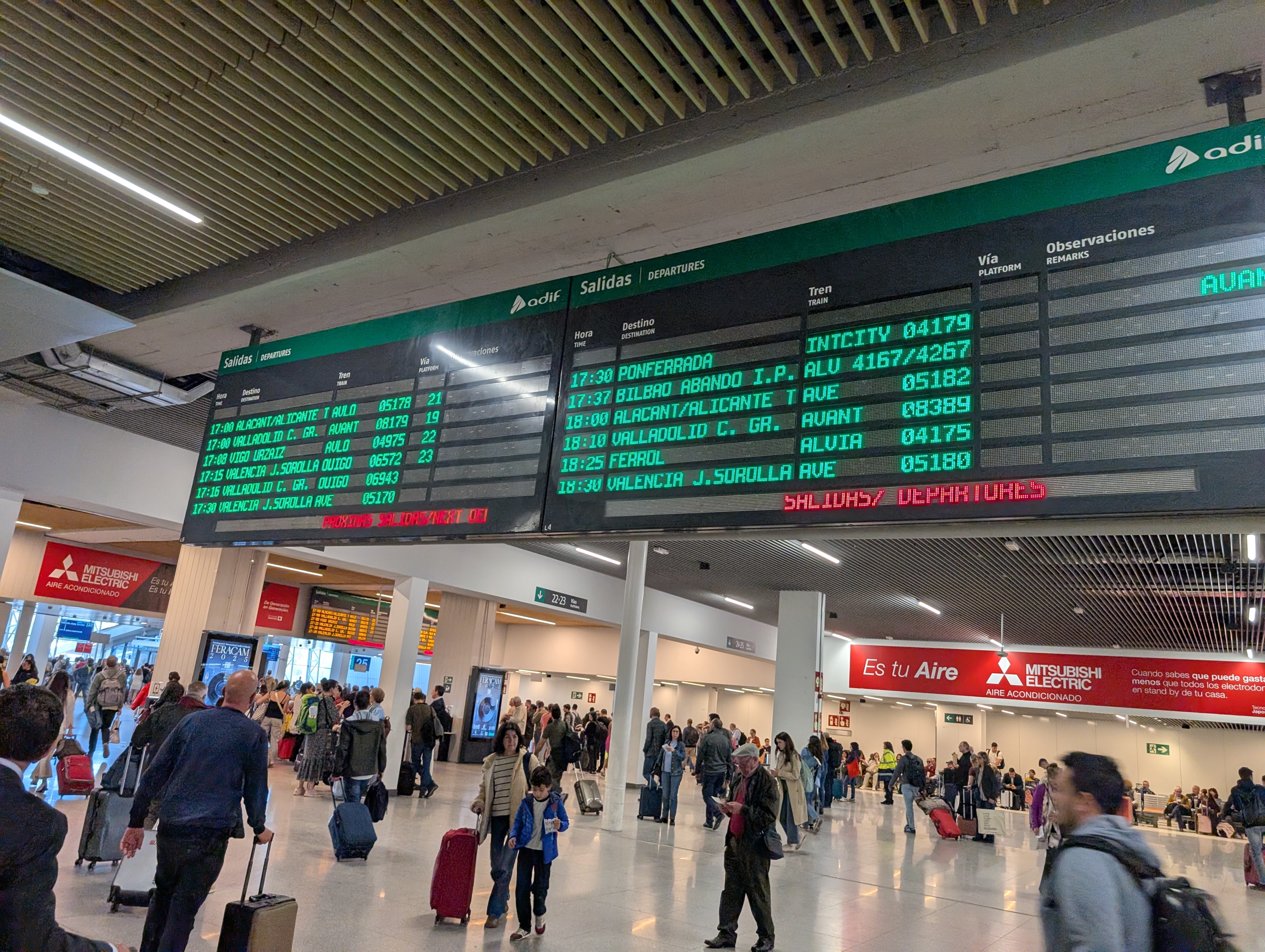
After my museum visit and a leisurely lunch on the Plaza Tirso de Molina a few blocks from my hotel, I head for Chamartín train station to get a taste of that great train system. It runs like clockwork, trains humming out every few minutes, and this isn’t even the busiest station in Madrid. The train I take rockets north, through tunnels under the Sierra Central and across the savannas of Castilla y León. The rain falls steadily on my train across the Spanish plain, through Segovia and Valladolid and Burgos and the smaller farming towns between them. The cities feature large industrial parks and larger apartment blocks, a somewhat bleak Spanish heartland.
When seen by train Spain feels like it is in a different stage of development, still suspended in an agricultural and industrial state instead of deep in the knowledge economy. In some ways this does not feel like a terrible tradeoff, with less job disruption and a healthier small business sector, with fewer basement-wage service jobs and a step of removal from the tech obsession and paranoia now gripping American culture. The only things that hurtle at maximum velocity here are the trains.
Still, it is a tradeoff: prior to the Great Recession, wealth in Western Europe’s leading economies (of which Spain is not really one) was basically on par with the United States. Now, American GDP growth has left Europe in the dust over recent years. Coming out of the recession, Angela Merkel’s Germany imposed bad austerity economics on the continent while the U.S. gave its economy some halting stimulus, and already higher energy prices have since been exacerbated by the war in Ukraine. Tech has been an engine of American growth, while Europe has maintained a skepticism of that whole push. Throw in a strong dollar and it’s easy for an American to feel relatively affluent in Europe: even with some exchange rate rebalancing amid a trade war, prices on most things still feel like a bargain, especially since Europe eschews the absurdity of tip inflation. Real estate in downtown Madrid is expensive, but under conventional American loan terms I could make a play at it with my current salary if I really wanted to. Doing the same in New York or Washington would be laughable.
There are still many reasons, some empirical and some subjective, to prefer European choices over the American growth-at-all-costs machine. But there are serious long-term implications for that widening income gap and what it will take to sustain those European welfare states. What the economy gains in preservation of the past, it can lose in any sense of dynamism; youth unemployment is an actual thing here. A loud soccer bro on his phone two rows behind me on the train, speaking in a Gen Z English punctuated by an appropriate number of fucks and bros, thinks his future is elsewhere. The question looms: how next will the Spaniards reinvent their cities and networks to meet the world they now live in?
 A Patient Cycle