Gateways and Arrivals

Arrival in Florida feels like one prolonged wait. Upon landing in Miami, my mom and I undertake an arduous trek to the rental cars. A four-hour drive means our entrance to the Keys comes in darkness, a journey across suburban strips and swamp and long, lonely bridges into the night. We are on a journey to celebrate my mother’s retirement, freed from city politics and social service provision after many long years at the Duluth Public Library. We’d planned a version of this trip in April 2020, but after the world intervened then, we are now free to do it well.

At the end of the bridges sits Key West, a land of tasteful bungalows and grand verandas, the whole island colored by a tropical languor, the stately repose of a retreat at the end of the road. Grey skies put it in a sense of slumber, a promise not quite fulfilled upon arrival. We are here midweek in the offseason, but the party goes on every night at Sloppy Joe’s and Captain Tony’s and a few dozen other tiki bars along its main drag. Duval Street is a Bourbon Street for middle aged white people, live guitars in every bar and beer and cocktails around every corner. A power boat race is in town this week, with souped up trucks to match; just about every man looks like he is here to fish. Here there is some risk of paradise as a commodity, a repeat soundtrack of Bob Marley and Jimmy Buffett, endless references to the drinking that will happen here. I am not here to fish. I am here to have a few drinks, but we are not exactly set on shutting down the bars, either. I am not really here to escape, but instead to take a pause that lets me write, be with the companion I’ve traveled with more than anyone.

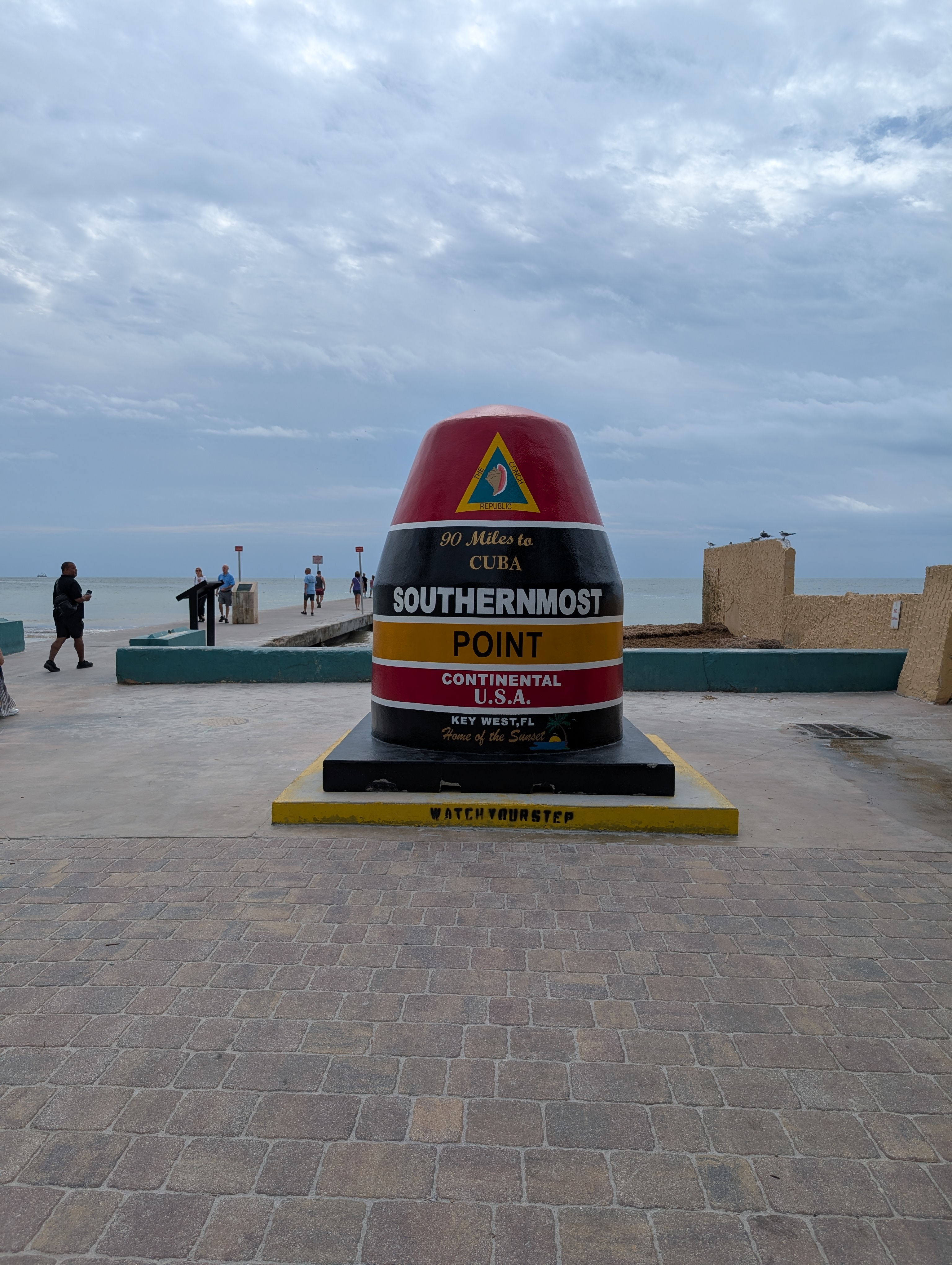
We take up rooms at the Eden House east of the city center. The rooms themselves are tight ground floor spaces, but I am of the camp that doesn’t much care about the interior of a hotel room beyond the basics: it is a launching point to go do other things. The Eden House’s pool deck has seating for all types, and a second story veranda is the hotel’s steal, one of those venues for Southern graciousness that is too often lost from later architecture. I sit out here and write three ways at once, this post and a possible follow-up and some musings on where my fiction goes from here. This town has punched above its weight as a retreat for writers for over a century, and I can only dream to catch a hint of that inspiration.

The Hemingway House is the highlight of Key West. The 61 cats prowl about and the writing studio sits in repose, books and typewriters and trophies from a life without limits, mementos of boxing and bullfights and fishing trips and safaris far afield. Here I find some of that awe, this time at that masculinity unleashed: the women and the parties for a warrior and a thinker, a man drawn to the questions of his time and the places where the action was, his pursuit straight up to the edge and then straight over it because what other way is there to live? Here the old man met the sea, fought it at times, churned out many of his greatest hits. He produced a legacy that smashes the underlying tragedy. The cost may or may not have been inevitable but it is a reality and it does just boost the mystique.

Ernest Hemingway’s crisp clarity defined modernity, his simple precision that can lead a 21st century reader to swoon about trout fishing in the hills above Pamplona or bring a pack of Two Hearted Ale to the mouth of the Two Hearted River in Michigan. (Yes, I have done this.) Joan Didion taught herself to write by copying down his sentences, and I have taught myself to write by toying with Joan Didion’s work. Of course from certain lenses Hemingway’s life can now be judged or even canceled; artistry with prose faces some headwinds in a flattened world of AI summaries and messages dumbed down to the lowest common denominator. Moreover the Hemingway mystique can swallow the human tale beneath, the depression coursing through his work turned into some tragic heroism that satisfies a certain narrative of tortured genius. As a writer whose instincts are not all that depressive I wonder if I’m missing some key ingredient that I would prefer to never have, but I decide I can make do with that tradeoff.

The cherished home of a long-departed author underscores the permanence of words. Sure, the novel may lack the cultural power it had in Papa’s prime. But fifty years from now no one will be watching TikToks made in 2025. They will still be reading Hemingway. Putting down words creates a record, both in print and in type, that the ephemeral world of live video does not. Of course there are some snippets that will last, but the power to both capture and interpret, provide witness and critical distance, will remain all the stronger.

It would be easy to look around at the denizens of Key West and draw a harsh divide: us few, proud people of words who stand athwart the vapid party, immune to the siren call of the anomie of endless swipes. On a certain level I do believe some version of this argument: that is the point of a conviction. But there can still be pathways in for anyone, and pulling up the drawbridge to hold on to a snooty high culture isn’t going to change it. I instead prefer to own it, sit on a beach reading or writing and make it look good, share the best snippets here and there. And for anyone looking for a way in, Hemingway’s deceptively simple prose and chasing of great adventures isn’t a bad place to start.

Slowly, Key West shows more as we scrape beneath the surface. We visit Judy Blume’s bookstore, wander in search of beers and a spot on the beach beneath a soft curtain of an Australian pine’s wispy needles. Truman’s summer White House is here, and the ferry to Dry Tortugas beckons for a future visit, perhaps when the campground facilities are not shuttered thanks to a government shutdown. We tour the Audubon House, never visited by its namesake but a keystone for the preservation of Key West’s grace, a spendy preservation movement that nonetheless keeps it a step removed from sinking into the tourist trap ensnaring much of the rest of the Keys. The Conch Republic puts in the effort to maintain its independence.

After three nights on Key West, we are on the move again. This, I think, is my style of travel: a meander up an island chain, flashes of both wilderness and city, parts unknown and the center of the action. As we drive up the Keys we stop at a state park for halfhearted snorkeling, a bit of beach time, a stroll up the old railroad bridge that first knitted the islands together. Later we pause at a roadside carnival show named Robbie’s, where we feed some tarpons and see some manatees and dodge the scavenging ibises and pelicans. From there we are off through the wet lowlands and back to Miami.

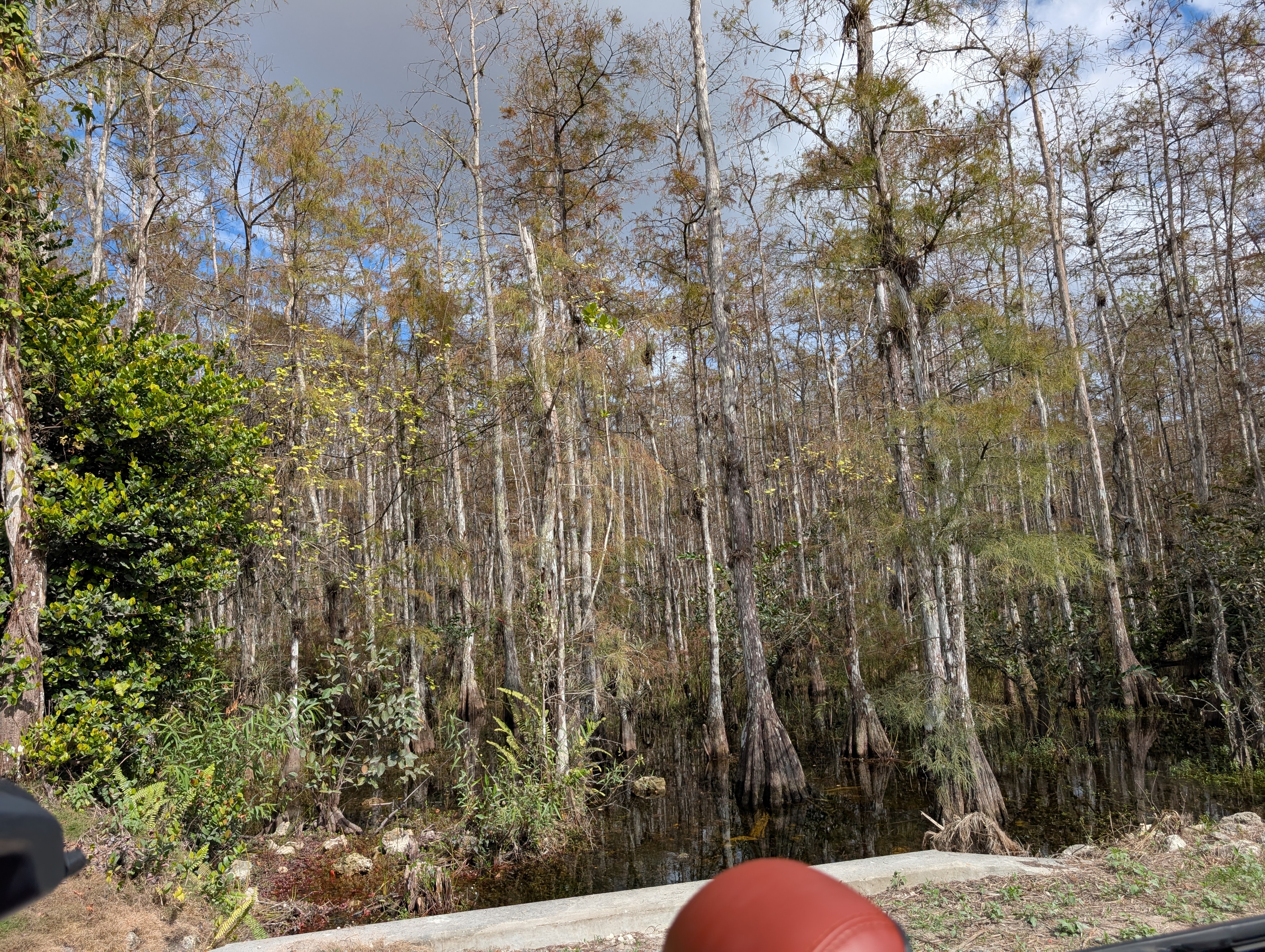
In Miami the skyline glows as warmly as many of the well-toned bodies, but for all the glaze it cannot quite hide how it is paving over a swamp. On our second to last day in Florida we immerse ourselves in that swamp and shoot up the Tamiami Trail, a 1920s causeway that colonized the interior of the Everglades. Even now, it is a wild place, the kind of locale an ambitious xenophobe would set up a migrant internment camp. (Sure enough, loud signs announce the presence of Alligator Alcatraz.) South Florida’s history is a series of battles against the rising waters, a desire to tame them and cut back that thick, oppressive brush to replace it with orderly rows of palm trees. This region’s boosters sought to roust the beasts who live in these swamps and the last people who hid away in these refuges, or at least tame them into a roadside attraction.

A circuit on the Big Cypress National Preserve’s loop road is a safari through a menagerie of birds, a few dozen alligators, and a slow roll through everything from dense watery forests to reedy cypress savannas to a tangled mass of endless scrub. It contains a wildness and a secrecy that the open West cannot match, the eyes only so much good in trying to explore it. Even a short hike on a nature trail leaves a little claustrophobia, a question of what might lie around the next bend, the mosquitoes rising up and some mysterious scat marking territory in the middle of the trail.

On the way out we visit the Miccosukee, a Native tribe that battled the U.S. government beside the Seminoles and later retreated deep into the swamp to retain some independence for as long as they could. Their roadside attraction of a village is sleepy today; the expected tour guide never appears. But the camp is well-tended, the museum behind carved alligator doors tells the story well enough, and a show demonstrating how to properly tame one of their rescue gators is a window into a different world.

Out of this landscape rises Miami, one of the nation’s largest metros. Miami’s story is an updated version of a very American story, a gateway city haphazardly absorbing immigrants. It has all of this country’s greatness and all its flaws: a rush of development, a hunger for freedom and parties and sexy bodies, out with the old and in with the new. It was famed for crime and coke in past generations but is now more of a place where people instead seek to properly model their bare chests or sports bras. With its borderland status comes tension as culture remains stubborn and ties to old countries complicate the politics. (Miami is one of the very few American cities that can still reliably elect Republicans to higher office, thanks largely to the particularities of the Cuban diaspora.) The beach gives it an allure that other Sun Belt cities cannot match; its closest analogue is LA, though it is more niche than LA, lacks its cultural power beyond the Hispanic community.

Within that community, though, Miami is everything. In my travels, I’ve learned that Latin Americans aspire to Miami as much as any American city. The heart of the allure is of course in economic opportunity, in political freedom, in glitz and glamor on the beach. But old ties are hard to break, and a visit to Little Havana is an object lesson: this neighborhood is home to a court in exile and a continuation of pure Cuba, of salsa rhythms and cigars and dominoes over cafecitos. Even with a collection of people branded with Royal Caribbean stickers strolling the streets, it feels alive, something carried forward and a place where a Hispanophile can feel very much at home.

Miami is a city of gleaming beachfront towers, but it is also home to graceful Art Deco neighborhoods from an earlier era, that great triumph of American architecture serving as the perfect backdrop for this modern-day white city. Beneath the gleaming façade, color explodes, and never more so than in Wynwood, where we spend two nights. Wynwood is gentrification central just north and west of downtown, the inevitable boxy apartment blocks and trendy restaurants crowding out the bedraggled old concrete single-story homes and empty lots. I linger on these grungy old homes, wonder what stories they have told over the decades, which immigrant lives may have launched from here. Even as Wynwood changes there is an easy drift between Spanish and English here, a dance between two worlds, and I wonder how well it will hold on to its art. Miami is strongest in the places where it keeps the tension alive.

This trip is a perfect escape to celebrate a retirement, to find some well-earned rest and adventure all at once and think about what might come next. For my part, I am not sure how high Florida is on my list for a return visit. It is a land of leisure, but not one of awe, and as a pursuer of awe this easy luxury will never quite be me. I am not drawn to resorts or creature comforts, the overly sanitized or scheduled trip. Vacations should be a little bit hard, and I don’t mind a little snow, I think as the season’s first snowflakes wander down on the drive north from Minneapolis.

On the beach on Key West I read “The Snows of Kilimanjaro.” This short story was the first Hemingway piece to capture my imagination, and like all good fiction, it tells us something that we do not know that we know. “Snows” is a writer’s lament for the things he has not yet written and may never write, a call to me to get to work. It is a confession of the fumbles with women drawn in by the Hemingway-style pursuit, with Harry in the tale pushing Helen in ways that both give her new meaning and wound her, Harry at once proud of her but still questioning the whole exercise. And it closes with a drift away from even the heaviest of earthly concerns on to greater heights, to beauty, to the white snows at the end of the line. There are so many worthy goals here, so much to unpack and to reach for. And with that, I write.

Exit Bruce Plante

Farewell, dear Bruce: one of high school hockey’s most colorful and recognizable coaches has decided to head for the exits. He led the Hermantown Hawks for 28 years over two stints as head coach, went to 13 Class A State Tournaments, won three titles, and produced an NHLer of a son along the way. Bruce, 68, goes out on top, having claimed his second consecutive title just a month ago.

When I first started attending State Tournament press conferences in 2012, Bruce immediately stole the show. He was passionate, he was insightful, and he was downright hilarious, with some memorable quip coming out of his mouth with every other line. What more could you ask for out of a coach? He did it all with his heart on his sleeve, and it wasn’t hard to see why his players loved him and usually managed to stay loose in big games. His feisty teams that hung with St. Thomas Academy teams drowning in D-I talent channeled their coach full-stop, and the sight of Bruce chasing the referees all over the ice after St. Thomas topped the Hawks on a questionable series of calls late in the 2013 title game will always be among my State Tournament favorites.

The News Tribune’s write-up tells some of the early details about Bruce that got lost in his later coaching success. It’s a superb redemption story, as a man coming out of a divorce and a drinking problem put it all together to become a community pillar, as recognizable a face as any in a town on the rise. His players were always approachable, respectful, and shared in more than a little of that infectious charm. Mike Randolph at Duluth East is probably the only other coach in the state who is deeply wrapped up both in the history and as the present-day face of his program as Plante was at Hermantown.

Bruce will go down as a program builder, a person who took a school that had been a hockey afterthought and turned it in to a power. It was a slow but steady process, as they first broke through with a second place run in the ‘98 Tourney, built their way into a Tourney regular, went through year after year of agony as runners-up, and then finally started claiming crowns at the end. He had some perks, to be sure: Hermantown runs right up against a busy commercial corridor in one of Minnesota’s larger cities, and (unlike that neighbor, Duluth) has ample tracts of undeveloped land for new single-family housing on large lots. As history has shown us, this is the exact formula for building a great program, and few have done it without such favorable conditions. (At about the time the announcement came, I happened to be driving around Hermantown for work purposes, and it was hard not to notice the amount of new home construction under way.) A variety of situations with neighboring school districts also helped the Hawks along. Still, it takes a committed leader to guide that process over many years, and Bruce was a steadying influence every step of the way.

Bruce won by inspiring confidence in his players and turning them loose. While he could at times be creative tactically, he never seemed to fancy himself a chess master, unlike some of his fellow longtime Duluth area coaches. Instead, he just lets his forwards fly and apply constant pressure. It’s fun hockey to play and watch, though perhaps worth noting that it is much easier to win with this style in Class A than in AA, and if there were a few playoff games that his Hawks probably should have won but didn’t, they came against big, tough defensive squads, as with the East Grand Forks team that knocked them off for a second straight year in 2015.

I can’t write this column without mentioning the controversy that plagued the Hawks in Bruce’s final years. After years of being the plucky upstart against Class A’s private powers, Hermantown suddenly became that power themselves. The Hawks’ advantages were obvious, and the program came to enjoy a combination of perks that no other Class A public school could claim. The 2017 Tourney, in which they frankly did not play anywhere near their potential throughout three games (two of them against vastly less skilled opponents) but still won it all anyway, seemed to underscore the tiredness of it all. While I’m not in the “Hermantown must move up!!!” camp—it’s their program to run as they see fit—I was a little disappointed that someone I’d come to like a lot seemed stuck in a rut of denial.

Hermantown will stay in A for at least two more years, though, and while they will still be a power, Bruce’s successor will start out with a slight down cycle in Hawk talent. This program has become big time, and the pressure will be on, both from inside and out of Hermantown. The position should attract some big names. For now, though, I suggest we take a moment to drop the class warfare and the pressure of the post and stop to honor Bruce, who was as rich a character as there was in high school hockey. Whether we know it or not, we’ll miss him.

Exit Alex Rodriguez

The most complicated of Yankees came to a more-or-less mutual agreement with his team last Sunday, and his career will come to an abrupt end when he plays his final game tonight. The writing was on the wall. Alex Rodriguez has been atrocious since the All-Star Break, seemingly spent as an offensive force. The Yankee front office has launched a long-overdue rebuilding operation in the past weeks, as they became sellers at the trade deadline for the first time in my lifetime. They purged a heap of long-term contracts, and Mark Teixeira, another aging star in an injury-riddled decline, also announced his retirement at the end of the season. Now, they are effectively paying the fading slugger to go away, giving him a cushy parachute with a job as an incredibly highly paid advisor.

It was, perhaps, the best way to save face. I’ve always had a nuanced take on A-Rod: I stood up for him when the New York media trashed his early playoff struggles in the Bronx, and said he deserved every boo he heard when the steroid suspension came down in 2013. And so I appreciate his efforts to redeem himself over the past two seasons and atone for the various mistakes of his youth. He came across as humbler; a changed man. Perhaps such an iconic player, just four home runs short of 700, deserved to pick his own time to go. But baseball is a business, and the Yankees are looking to the future. There was no point in wasting a bench spot on him when there are so many young guns to bring along and give a shot at the major league level. Nor is it any fun to watch a former great limp along as a shadow of his former self. It is time to move on.

A-Rod is a fitting face for the post-90s-dynasty Yankees: almost always good, but only able to meet the glare of absurd expectations on rare occasions. Tainted but talented, always hoping there was one good year left in an aging body. His arrival in 2004 marked the end of their run of six World Series berths in eight years, though the drop-off had more to do with the collapse of the pitching staff and the rise of the Red Sox than anything that A-Rod did. He wasn’t a total choke: he got his one ring in 2009, after a superb playoff performance. And after a steroid scandal in which he was nearly disowned by his team, he showed remarkable loyalty. For good and ill, he became the face of the franchise, and his departure, along with Teixeira’s retirement, severs the last remaining ties to those powerful offenses of the 00s. The revolution is at hand, and this Yankees fan is more encouraged about his franchise’s future than at any point this decade.

Once the hysteria fades away, A-Rod should still get some recognition for what he is: the greatest player of a generation. Like Barry Bonds, his predecessor to that title, he took his quest for greatness too far. But instead of rolling with the villain role as Bonds did, A-Rod was always tinkering, trying to make himself even better and manage a tarnished image. He shouldn’t have thought he needed drugs to make himself better, but he paid his dues, and will continue to do so when he doesn’t make it into the Hall of Fame. He had the versatility to switch positions mid-career as he sought out a winning team, and found some contrition in old age. His vanity and ego are part of the package, yes, but he’s hardly alone in such excesses among athletes. At the very least, he won back most Yankees fans, and will wind up with a respectable place in the team pantheon. Just about any judgment of him beyond that, whether scathing or appreciative, is defensible in its own way.

As a baseball fan, A-Rod’s retirement is also a generational marker. One of the final remaining icons of my childhood—and with it, the steroid era that corrupted baseball—is out the door. (It was heartening to see A-Rod’s exit coincide with a milestone for one of the most graceful, awe-inspiring, untainted stars of the past fifteen years: Ichiro’s 3,000th major league hit.) These aren’t my boyhood Yankees, and this is a new Major League Baseball in which the Yankees are sellers and rebuilders. Well, it worked out last time. Bring on the new era.

Exit Don Ness (Eventually, and For Now…)

Don Ness will not seek a third term as mayor of Duluth. This is old news by now, but, then, I’m not here to break news; I’m just here to comment on it. He spilled out his thoughts in a Facebook post yesterday, conceding that it’s time to move on. In usual Ness fashion it’s a bit long and earnest, but the sincerity is clear. It’s a bit silly to write a political obituary for a man who still has over a year in office, but there are a few things I want to say about the announcement.

At first blush, I do think he concedes too much to “critics,” which are relatively few and far between. Ness is possessed by a sincere desire to please everyone, and while he knows on a certain level that no one can do this, it still bothers when he encounters negativity. I don’t really blame him; I know that feeling well myself. He is so dead-certain that he is doing the right thing, and so honest in his attempts to reach out and do so, that failures to connect get to him some.

I’m also of two minds on one of his reasons for retirement, which is to “protect” his children from hearing negative things about him. It’s impossible to criticize the importance he places on his children, and I wouldn’t have raised this point if he’d just said he wanted to spend more time with them. But it is possible for love for one’s children to go so far as to be over-protective; sooner or later they will come to understand who their dad is and what he means to Duluth, and that he is not adored by all and may have a flaw or two. Ness tries hard to be a normal guy, and that’s obviously a big part of his appeal, but his rapid rise through the city’s political system will forever mark him as a bit different so long as he lives in Duluth. I don’t think he should shy away from that.

His concern may also over-inflate his role. I graduated from East with the kid of a prominent city councilor; no more than a handful of students had any idea her dad was a city councilor, and it wasn’t a big deal to those who did know. Ness is clearly the biggest local political personality, but in the grand scheme of things, being mayor of Duluth isn’t something that’s really going to stir up a bunch of schoolkids. I know this is all easy to say for someone who isn’t a parent yet, but I do believe pretty deeply in not sheltering kids from reality. I don’t think another term would have led to any serious damage.

Ness’s other explanation—his fear that city politics will calcify without some change—rings much more true. He’s right on in his belief that city government needs renewal with new ideas and new people. Twelve years would be an awful long time for one person (and his loyal followers) to take charge, especially now that their opposition is very insignificant. This is even more true in a city like Duluth, which has a strong mayor system. I wouldn’t have opposed a run for a third term, but I applaud anyone who has the foresight to know when to go—or, at the very least, take a break and recharge for a spell, perhaps until after the kids are out of the house. It’s always important to cycle back out.

Similarly, I’ll be Ness’s staunchest defender against the charge that he’s somehow shirking his responsibility by not running for higher office. The Star Tribune lamented the fact that he’s not showing much interest in heading down to St. Paul or Washington, suggesting it’s a sad sign of a toxic political culture. In part, yes. But it’s also a reflection of what made Ness such an effective mayor: he knows his limits, and the skills that make him such a dynamic force in Duluth might not apply so well elsewhere. It’s important to remember that he has never really left.

The world could also use more politicians like Ness; more people who dedicate their lives to one very small corner of the world that they love dearly, and shepherd it along. Local politics would be a sorry place if it were just a launching pad for higher-level positions, and when it comes to day-to-day effects on people’s lives, the local stuff is far more immediately relevant. It may lack the glamour, but it can be incredibly rewarding. Ness gets to see and live in the city he’s helped bring back from the post-industrial morass, and, barring an unexpected turn, a thankful city will likely show its appreciation for years to come. Even most of his critics (a category that occasionally includes me) seem to like him here. He’s left a legacy in a way no congressman or senator ever really could.

This doesn’t mean that all seekers of higher office are soulless strivers. Some people have priorities that transcend locality or are less tied to a sense of place; some people have that burning ambition, and can’t ever settle. With some important asterisks, it takes all types. Don Ness, for the most part, seems to know which type he is, and there is a lot to be said for that.

We’ll see what he can do in his final fifteen months in office, where he’ll head next, and whether he’ll ever get that itch again. (I’m guessing he will, though it might be a while.) In the meantime, let the succession intrigue begin!

A Curtain Call for Captain Clutch

Derek Jeter was my childhood hero, the first and greatest of my various sports man-crushes. I became a Yankee fan because of him. I’d go to bed cuddling a Jeter beanie baby bear, and I copied his stance in backyard baseball. I was crushed when I learned that lefties don’t play shortstop. (End the discrimination!) I admired his versatility, his prowess in every facet of the game, and in his life off the field, too. He may not be the greatest player ever, but he was certainly baseball’s most enduring champion in my lifetime, and his likes may never be seen again. He was the face of one of the most recognizable franchises in all of sport, enduring the brutality of New York scrutiny for twenty years, and in an era when many baseball stars were besmirched by the steroid scrutiny, he remained a pillar of decency.

Only in retrospect did I realize how much Derek helped form my ideal of what a man should be. Patient and respectful, words always carefully measured, yet consumed by a relentless drive toward greatness. Classy, and with an appreciation for finer things, though not overboard in flaunting it; just living it as it came, naturally, and with pride. A commitment to a clean and decent image, though not afraid to have a bit of fun, too. In hearing from the many fans of other teams who poured out their respect to Jeter this season, I felt a childish bit of possessiveness: Derek never meant to you what he meant to me. He was my idol in my fullest sense of the word, exactly the diversion a lost little eight-year-old needed, and while I grew older and deeper and stopped looking to sports for heroes, he never did anything to betray that trust.

At the heart of the Jeter mystique was his flair for the dramatic, something that made his 9th inning walk-off in his final Yankee Stadium game all too predictable. He had something others didn’t. Just reflect on that list of moments. There was his rookie season in 1996, when he always seemed to be the catalyst of every Yankee rally, most famously on that home run assisted by an 11-year-old; by 1999, he was one of the greatest offensive weapons in the game. His home run on the first pitch of Game 4 of the 2000 World Series snuffed out any momentum the Mets might have had after finally beating the Yankees, and that Subway Series left no doubt who was the king of New York. He’d built a dynasty, and was the face of the greatest run by a major sport franchise in 40 years. Perhaps his greatest moments came in 2001, when he made that sublime flip play in the ALDS against Oakland, a play whose ingenuity I never expect to see topped. His “Mr. November” home run that year won the 4th game of one of the greatest World Series ever played, an emotionally draining and ultimately crushing run in the shadow of 9/11.

That was hardly the end, though. Game 7 of the 2003 ALCS is synonymous with Aaron Boone, but the man who started it all was Jeter, who cranked a double with the Yankees down by three in the eighth to ignite the game-tying rally. While the team imploded against Boston in 2004, he was still fighting to the end, showing some rare extra emotion when swatting a key hit in Game 7. The Yankees’ fortunes dwindled over the rest of the decade, their fate tied to increasingly worse pitching and stars who had no measure of Jeterian class, but there was still room for one last spurt of brilliance in 2009, when he collected his fifth ring. Naturally, his 3,000th hit left the park; even when the injuries began to mount, it seemed like every return to action was punctuated by some little reminder of that flair.

Over the years the worship of Derek’s clutch performance became near universal, and the gushing at times went overboard; in turn, there arose a group of snarky critics who pointed out the flaws in his game—his lack of range, his inevitable gradual decline, and the emptiness of that vague, undefined ‘clutch’ adjective. No wonder that by the end it all became a bit tired, a perfunctory string of praise in which everything there was to say had already been said. It didn’t help that Mariano Rivera had gone through the same retirement rigmarole the year before Jeter, and that the team he captains, too, seemed a bit tired. Jeter leaves the Yankees in a state unworthy of his legacy, an iconic franchise sliding into mediocrity due to its failure to nurture that farm system that once produced Jeter and Rivera. The end of these farewell tours lifts a burden from the shoulders of this franchise, and frees them to take the first few steps into a very different era of baseball.

Losing was new and foreign to Jeter, and at times his steadiness in the face of it all seemed aloof and uncertain. Beneath the façade was a man with an unshakable belief in his own self, and unlike the serene Rivera, aging did not come naturally to him. His career paralleled the passing of the years that so many of us go through: invincible in his youth, living the dream and building that legacy before he had to come to terms with the steady march of time, the realization that he was no longer the man he once was. Time was the last and greatest enemy that not even Jeter’s mystique could conquer. But it couldn’t kill those memories, nor prevent another chapter in that fairy tale life from writing itself every now and then. As with Rivera’s stirring sendoff last year, tonight’s Yankee Stadium finale was a homage to all that is good in sports, one that can send us back into childhood without a hint of shame. Dream and reality blur, and whatever we call that state in between, it’s one of pure delight.

I’ve heard a few other Yankees fans say that Jeter’s retirement marks the end of their childhood. I’m not sure how my own story lines up with that, but it was hard not to feel another little twinge of age tonight. Tonight, when I got the goosebumps and, yes, the hints of tears when Bob Sheppard’s immortal voice echoed through Yankee Stadium for the last time ever: “Now batting for New York, numbah two, Derek. Jetah. Numbah two.”

A Hero in a Sport without Heroes: Farewell, Mariano Rivera

Image

I’ve been meaning to write a post on the impending retirement of Mariano Rivera ever since I started this blog. Much to the chagrin of my Minnesotan friends, I grew up a diehard Yankees fan, and my earliest baseball memories are of their late 1990s dynasty. Derek Jeter was, naturally, my childhood idol, and I still have a deep respect the Yankee captain; I’m sure I’ll write some glowing words when he retires, too. But as I grew older and more jaded, my pantheon of athletes whom I was willing to call a hero slowly shrank to include just one man. That man is Mariano Rivera.

Writing this post wasn’t easy, in large part because I’m not sure what I have to say that hasn’t already been said. Dave D’Alessandro wrote a masterful column about Rivera in 2011, and the god of all sportswriters, the 93-year-old Roger Angell, used Sunday’s game to remind the rest of us mere mortals of our places. I could trail on about his dominance, both across 19 regular seasons and 16 postseasons, or wax about that single pitch he used to it all, that untouchable cutter. There are the five World Series championships, the All-Star games, and the admirable sendoffs heaped upon him by his opponents over the course of this season’s long good-bye. (The Twins’ “chair of broken dreams,” made entirely of bats broken by Rivera’s cutter, was the best gift he got.) There are also those few moments when some emotion snuck out from behind his serene façade, like when he flopped over in exhausted ecstasy on the Yankee Stadium mound after three shutout innings in the 2003 ALCS against Boston, or his composure when the Red Sox finally got to him the next year. There is also his winning smile, his profound faith, his care for his Panamanian hometown, and his farewell tour in which he spent time with the unrecognized workers and fans at every park. D’Alessandro nails it: Rivera’s statistics are phenomenal, but he became the most universally adored ballplayer in an otherwise troubled era because of his character, his class, and his dignity.

Better writers who know Rivera far better than I do have told those stories superbly, so I’ll settle for simply sharing a memory. I’ve been to a ton of baseball games over the years, including a number of very memorable ones; many stars in their prime have had great days, and I’ve seen some extra-inning marathons and some brutal weather. I saw one of Roger Clemens’ tries at a 300th win in person, and any Yankees fan’s first trip to Yankee Stadium (the old one in particular, though the first visit to the new one was pretty cool, too) has to rank right up there among one’s favorite baseball moments.

But my most cherished memory is one that, on the surface, appears utterly mundane. It happened during my first ever Yankees game, a 2000 win against the Twins. The game itself was smooth sailing for the Yankees, and the paltry Metrodome crowd included more backers of the Bronx Bombers than loyalists to the hometown team. My seat, however, was not terribly far from the Yankee bullpen, and in the top of the ninth, the last ballplayer to ever wear number forty-two rose to his feet and began to warm up.

It was as if the entire game behind him had stopped. My ten-year-old self was absolutely mesmerized. While Rivera was great at the time, he was still a few years away from being as universally lauded as he is today. But even then, there was something different about him. His windup was swift and graceful, yet he unleashed the ball with so much power that it popped in the catcher’s glove in a way no other pitcher’s did. He was the platonic ideal of a ballplayer, and only a handful of other modern athletes can match that blend of dominance and aesthetic beauty embodied by the lanky Panamanian with a soothingly smooth name. Perhaps Lionel Messi, though he still has years to go before he is on Rivera’s level of consistency; perhaps Roger Federer in his prime, but he rose and then began to decline all while Rivera kept plugging away. He leaves the game at age 43, just as dominant as he was when he first settled into his setup role in 1996. It is never fun to watch a former great tail off and struggle some at the end of his career with some other team, as with Michael Jordan or Brett Favre; Rivera didn’t do that. He simply remained Mariano Rivera.

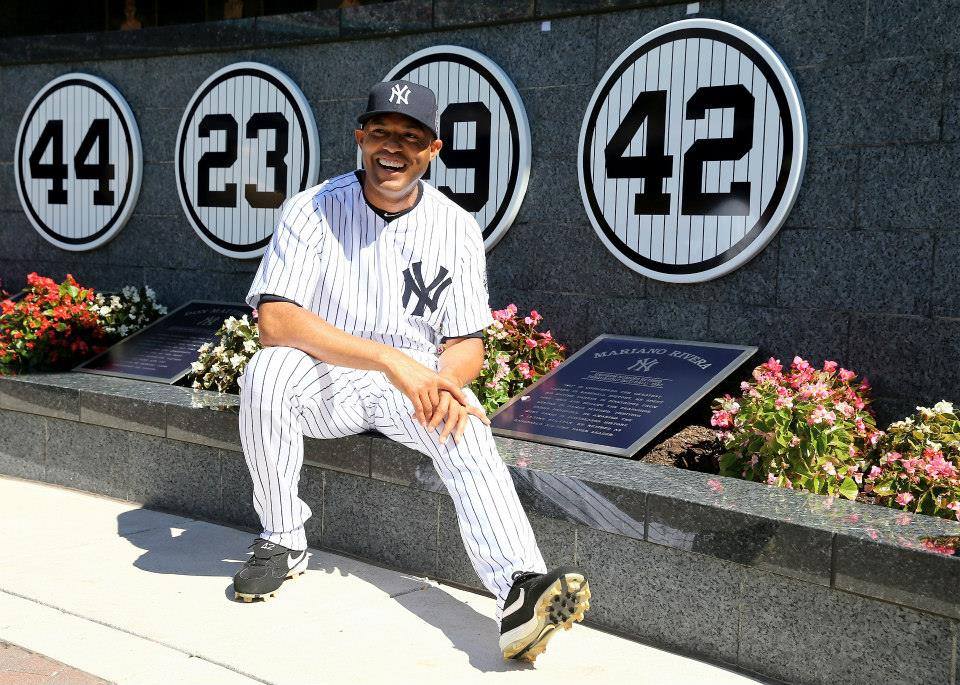
No one does ceremonies quite like the Yankees, and Rivera had his Lou Gehrig moment in front of the fans last Sunday in the Bronx. They trotted out all of the greats of the 1990s dynasty, deluged him in gifts, unveiled his Monument Park plaque, brought in Metallica to give a live rendition of “Enter Sandman,” and even Jackie Robinson’s family took the field to honor the man worthy of being the last to ever wear wearing Jackie’s number. It went for fifty minutes, yet Rivera’s surprise and gratitude never wavered. On the same day, Yankee great Andy Pettitte made his final home start in the Bronx, and he was almost an afterthought. Yet Pettitte wanted it that way, and in fact only announced his retirement because Rivera told him to; so great was his respect for Rivera that he didn’t want to steal a second of his time.

Gehrig called himself the “luckiest man on the face of the earth” to be showered with such praise, but with Mariano, one got the sense that there was never all that much luck involved. He is a reminder of everything that is good about sports; the sort of human being who deserves every ounce of recognition and fame he’s received, a poor Panamanian kid who used a silly game to make something of himself, and to inspire millions.

His mantra was a simple one.

I know where I come from. And when you always have in mind where you come from, the rest will be easy.

We’re going to miss you, Mariano.

Image


Photos from yankees.com.