Island Vignettes

I. Peregrinations

Climb aboard a plane. Shoot over a snow-dusted heartland, over the brain coral of the Appalachian hills and the long, aged spines of its mountains, over the Carolina coastal plain with its tidewater veins and then a long, sun-kissed expanse of ocean spackled by the shadows of clouds. I am off to St. Thomas again, hosted by Uncle Chuck and Aunt Monica at L’Esperance and joined by my mom and her partner and cousin David.
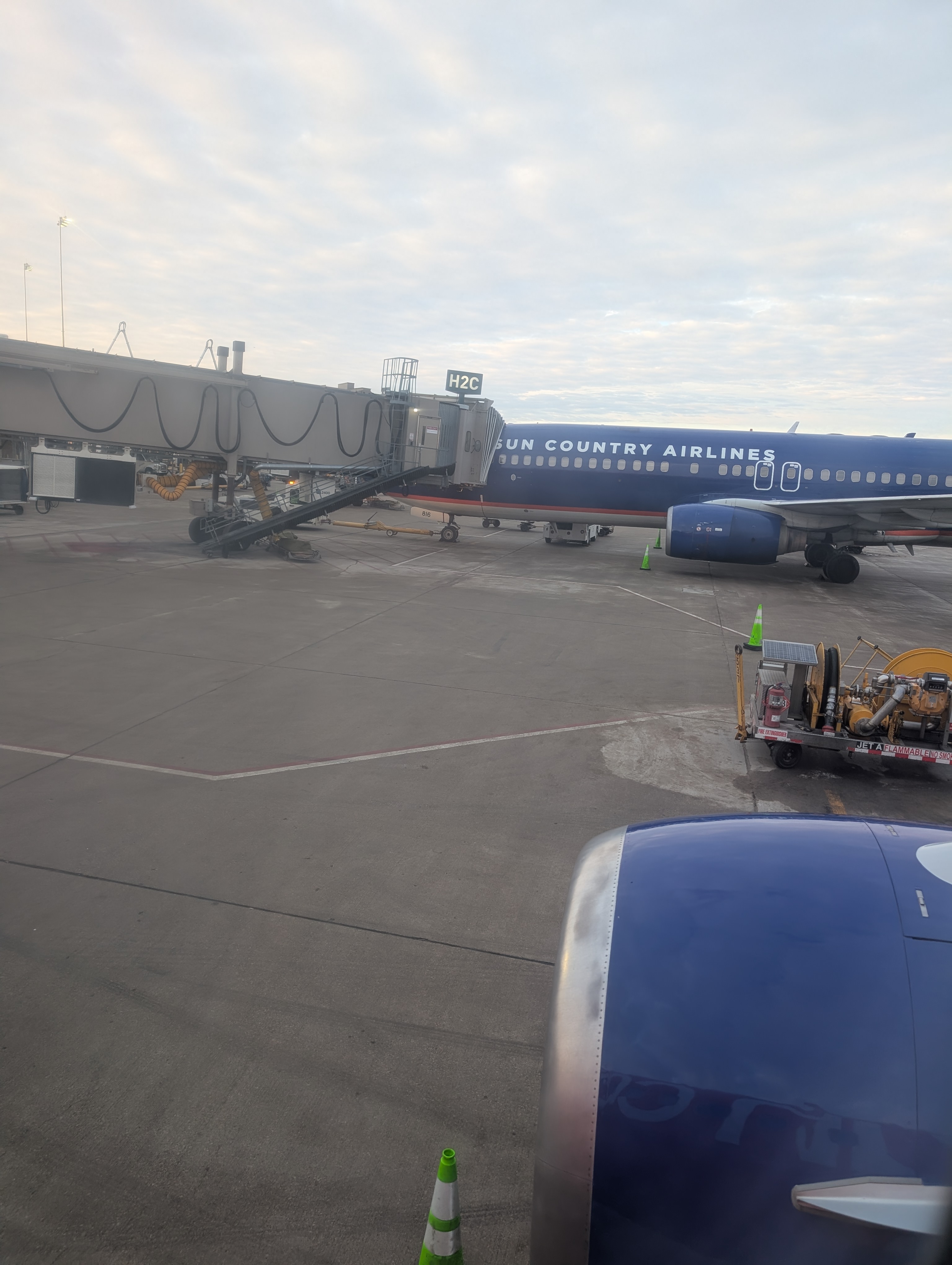
The actuarial tables of travel catch up with me again. Do it enough and things will go wrong, and this time, bad winds for landing cause a diversion to San Juan. Sun Country hotel vouchers are a fiasco and we wind up in a gated ground floor of a spare apartment in the city, a few blocks from a street shut off by police cars and a canine unit. It’s enough to sketch out most travelers.

A few ladies hold a casual party at the apartment next door, and it pulls at something deep within. I am eleven years old at a compound in Cuernavaca, Mexico, where a group of Minnesota college students study abroad and I am in the room next to the kitchen where I wake every morning to that same pitter-patter of Spanish chatter and laughter, those clattering dishes, those nourishing smells of baking food. Later, as a college student myself, I stumble down cobbled Mexican streets with an eclectic crew of kids from around the world, in search of a hostel and hear those same giggles, that same gentle teasing; later again they are reborn along the narrow lanes of an old Spanish city core. This easy soundtrack echoes through memory, puts me at peace. I am in good hands, perhaps only ever truly content as an object in motion.

II. Big Boats

From a perch at L’Esperance above the harbor, we watch the traffic come and go. Somewhere between one and five cruise ships visit Charlotte Amalie every day. They have grown in size over the years, disgorging ever more tourists, the islands left in a strange lurch of activity that settles down each evening. The long-term visitors go out for dinner and the locals party the night away. The carnivals of leisure cycle through, less the fresh joy of discovery in a European port of call and more of a drift through bars and shops that could, with some choice exceptions, be anywhere. Paradise, Incorporated.

On the Thursday of my week on St. Thomas, the USS Stockdale powers into port. This AEGIS destroyer has spent recent years guarding commerce on the Red Sea from Houthi rebels, though it recently joined the Caribbean buildup that accompanied the ouster of Venezuelan despot Nicolás Maduro. It sits in Crown Bay next to Royal Caribbean’s Independence of the Seas, dwarfed by the pleasure cruise craft. The twin faces of empire, a reminder of the force that makes possible the leisure on St. Thomas, and the reason the U.S. collected these islands from the Danish during World War I. That treaty forsook an American claim to Greenland, and while I cannot comment on the relative value of any rare earth metals, I will say the beaches that treaty brought beneath the stars and stripes are much better than the alternative down the road not taken.

III. Billionaires

Laurance Rockefeller purchased most of St. John, the third-largest of the Virgins, in 1952. He later donated nearly all of his holdings for the creation of Virgin Islands National Park, and he developed a hotel on Caneel Bay on land leased from the National Park Service. The Caneel Bay Resort was a world-class gem design to be one with the coastline, an eco-conscious masterpiece that shunned technology and rightly revolved on one of the most beautiful stretches of sand in the world.

Hurricane Irma demolished the resort in 2017. Ever since it has been trapped in development hell, swiftly swallowed by fast-growing trees and gnarled vines just like St. John’s old slave plantations before. Myriad questions from the NPS lease to cleanup from 60s-era building materials loom over its future.
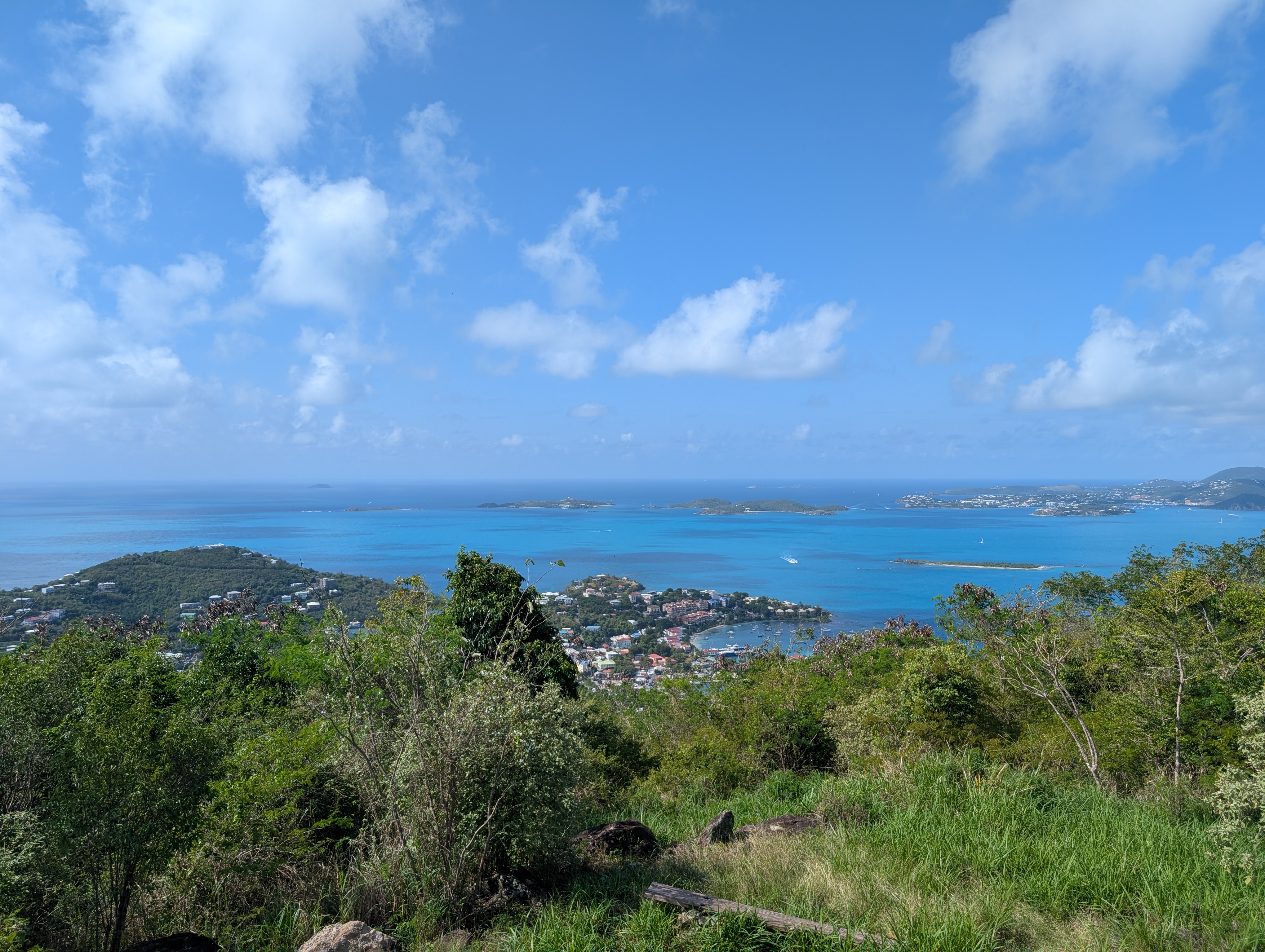
Jeffrey Epstein purchased Little St. James, an islet off Pillsbury Sound between St. Thomas and St. John, in 1998. For over 20 years it was the base of his most lurid operations, a steady procession of gilded elites and underage girls funneled through, his crimes an open secret among the islanders. In 2016, he added Great St. James to his collection.

Since Epstein’s death and disgrace, another billionaire, Stephen Deckoff, has purchased the islands from Epstein’s estate for $60 million. A proposed luxury hotel is trapped in development hell, unable to get off the ground despite its backer’s resources.

Some of the Virgin Islands’ billionaires aspire to preserve a natural and human heritage for posterity; some use its covers to hide the greatest depravities they can engineer. Others, like Deckoff, just try to profit from it, a money man doing what a money man does. But in the end, it seems the islands always win.

IV. Rituals

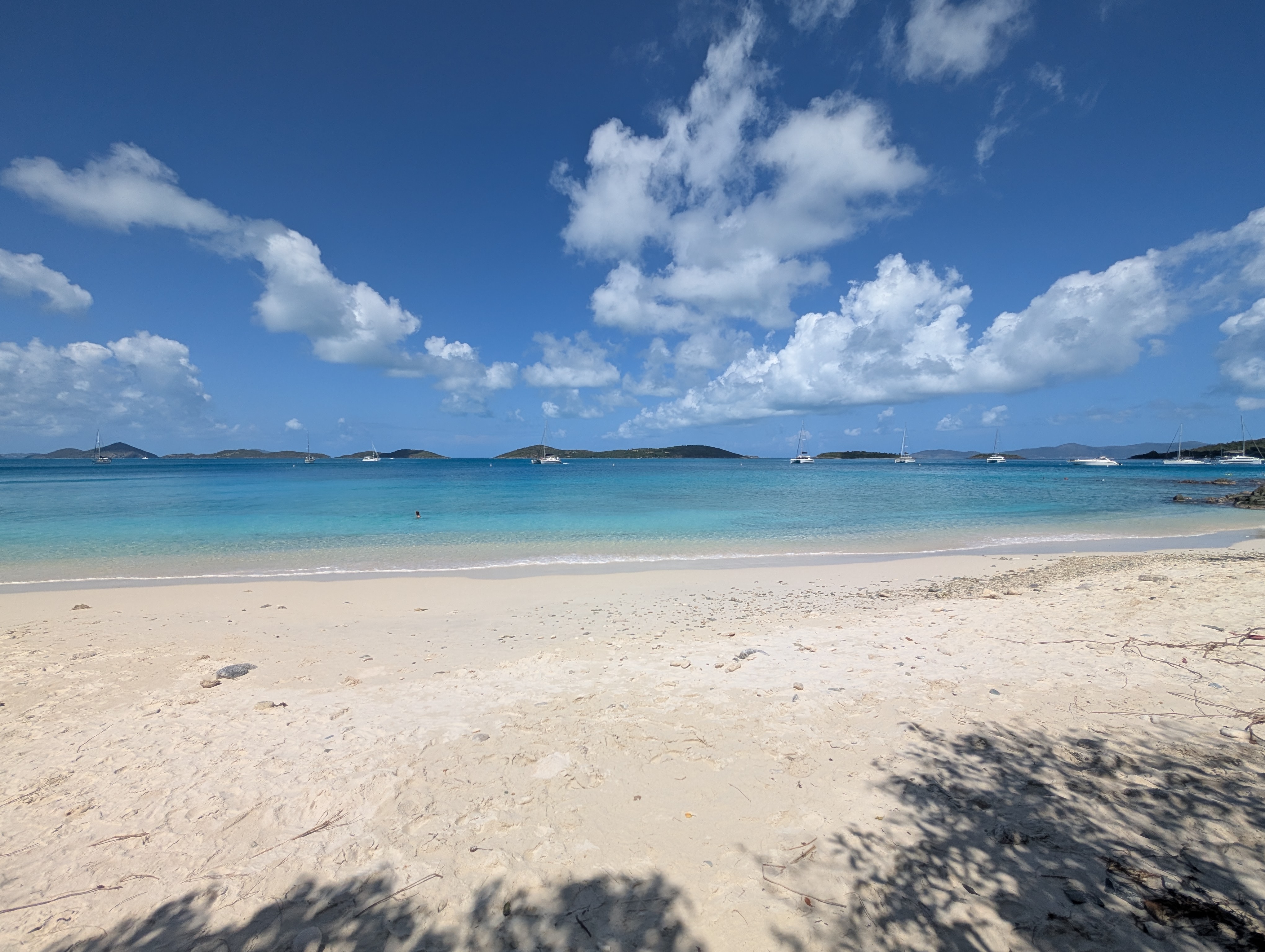
We enter the battle with the islands for a day of brush clearing on St. John, as we always do on Tuesdays here. Uncle Chuck is in his element with the Friends of the National Park, chatting botany and pointing out the monkey-no-climb he told fellow volunteers to spare several years back that has now shot up and become a healthy tree.

On this day we clear out the Reef Bay Great House, a sugar plantation relic now enveloped by a scourge known variously as coral vine and Mexican creeper. We hack back the jungle and restore some of its complex grandeur. Such as we can: a lintel along the portico now dangles in the breeze, its threat to pull down one side of the façade held only by a single strand of rebar. There is little chance of any stabilization from NPS, and a tragic fate for the Great House’s tragic legacy. But for now there is an easy satisfaction in passing on this privilege I enjoy, to cut out windows on to memory and beauty in a place where people come for joy and escape.

Later in the week, David and I return to St. John. We hike around Lind Point and up Caneel Hill, achieve commanding views of Cruz Bay and a descent to the ruins of Caneel and a splash into the ocean at Salomon Beach, a slice of white sand accessible only by trail or boat. Along the whole way the trail shows the fruits of the volunteer labor. A few cuts from catch-and-keep are a small price to pay, a little blood left to feed that lifeblood.
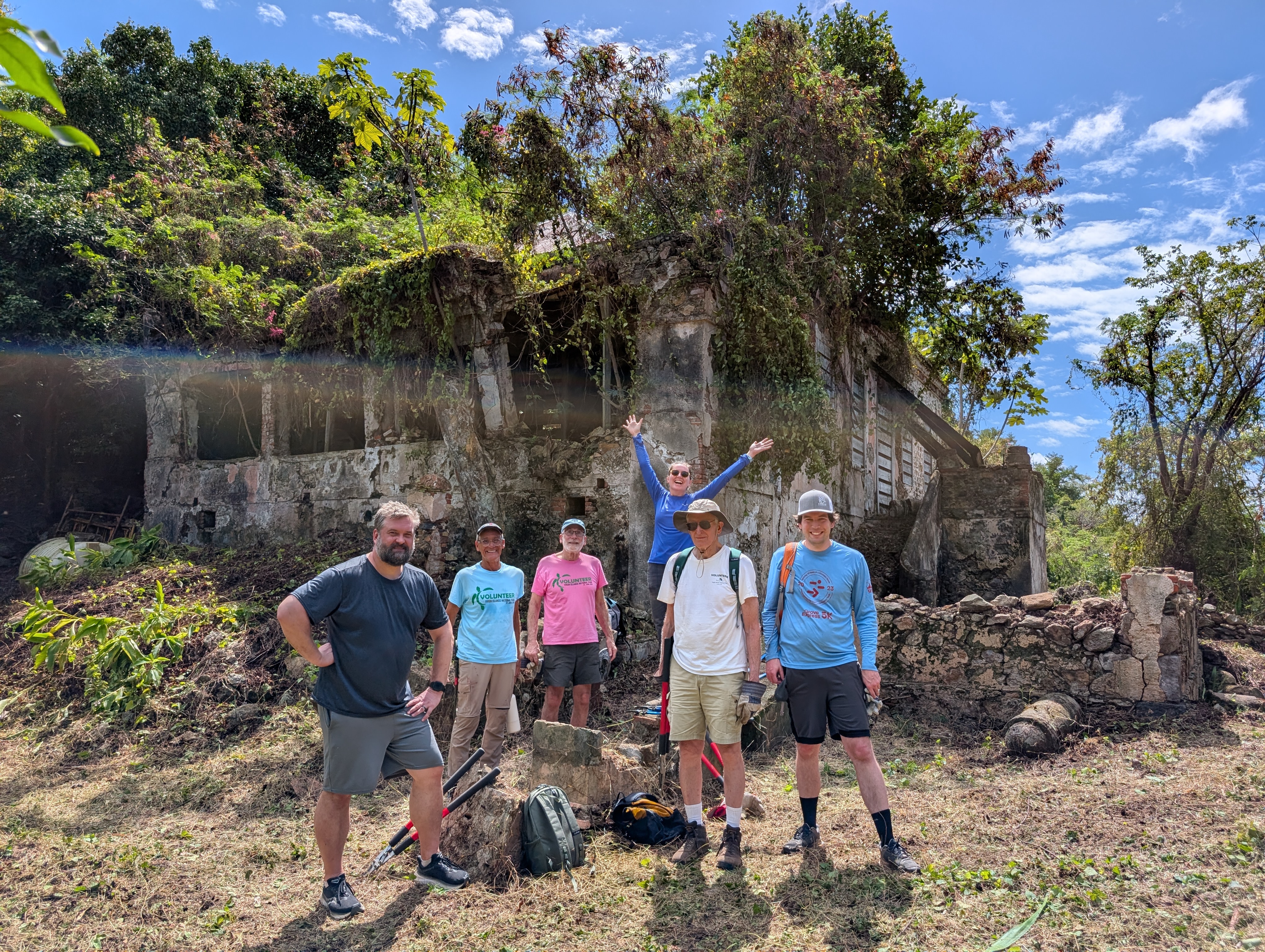
The other routines are less taxing: open up the villa, let in the breeze, wake to the sun’s long fingers creeping over the hill and in through the glass door to the balcony. Lay in sand and play in waves: Lindquist Bay, Hull Bay, a stroll down the streets of Charlotte Amalie. Make the circuit through the bars, order a Booty Call and get lei’d at Duffy’s, meet the same Minnesota waitress at two establishments, encounter the Islands’ finest purveyor of hose.

After long days on St. John we return to L’Esperance, where happy hour is a sacred rite. The sun plunges to the horizon and bathes Charlotte Amalie in a hazy sheen. The bell dings, the bottles pop open, ice tipped into glasses and drinks mixed. We set aside our books and our phones and hold forth: the day’s details, adventures past and future, the vagaries of island life. That happy hour bell is a call to drink, but it also breaks down that retreat into self, separates spaces for quiet and for community, both necessary in a well-rounded life. Pour me another, please, and again find that ease.

V. Inflection Points

My last time in the Virgin Islands my work life was in the process of blowing up as a regime change reoriented how things could be done. The previous time was deep in a pandemic. This time there are fewer lingering worries, easier roads to bliss.

It is thus to my great annoyance that I find myself facing writer’s block on the Hull Bay beach. I should be basking and letting my pen flow and yet the block nags, irks, makes one wonder if this is maybe too perfect or if I am just too easily knocked off my game. Things should flow naturally but they do not. I cannot absorb what the beach offers, assume that oneness that comes with the territory here. Distractions too easy, desires too fierce? Paralysis in the face of challenge? Nah. I just have to remember what the islands have already taught me.

I think back to my pandemic era escape here. I recognize now that it was a line in the canyon for me, a moment in which, when isolation anomie threatened to grind me down, I chose not to let it and instead struck outward. That journey put me on path toward being the world wanderer I long wanted to be, began infusing within me the self-assurance I always wished to have. In recent years I have looked at times for other lines in the canyon—a work life shift here, a memorable trip there; even that ultimate canyon line, a long-term relationship—and realized that all of those things, while attainable, are found somewhere along this rugged, sweaty, hunger-fueling hike on St. John. I embody the pursuit. Follow the path and the rest will come.
On that trip I read Khalil Gibran’s The Prophet. For reasons unclear to me I had previously thought I was not ready to read it. (These deep intuitions, I have learned, are things I should trust: even if they do not work out, I do not regret them, and they have delivered for me more than ever in the past year.) By that trip, I was indeed ready.

True it is I have climbed great hills and walked in remote places.

How could I have seen you save from a great height or great distance?

How can one be indeed near unless he be far?

At the end of The Prophet the poem’s namesake sails on from the city where he preached, on to the next adventure. I pick up a book on Byzantium and get ready for my next journey, too.

Reverie by Rail

I took my first Amtrak adventure when I was fourteen, a largely miserable affair that should have led me to swear off trains for all eternity. My mother and I went west to visit some family friends who had decided to give themselves a little culture shock by moving from Madison, Wisconsin to Ogden, Utah. We made a national tour out of it, from Minneapolis to Chicago to Salt Lake, and then on out to Sacramento and up the West Coast before heading back to Minnesota. It included obnoxious people, five near-sleepless nights, and a newfound hatred for freight trains. And yet, in spite of it all, it won a convert.

The first leg was a fairly quick jaunt from Minneapolis down to Chicago, though even that start was inauspicious, with the train rolling in a few hours late to the dismal station in St. Paul, one that has thankfully been put to rest since. The route follows the Mississippi and visits Wisconsin Dells, and there are docents on board to enlighten riders in the glass-encased observation car. It went smoothly enough, and after a night with relatives in Chicago, we were ready for the westward leg of our adventure.

The next day we set out on the California Zephyr, plowing across the prairie and readying for our first night on the rails. Unenthused by my seat, I tried to relax and sleep in the observation car, a window-filled car where one can stretch out across several chairs in a feeble imitation of a bed. That night is etched in my mind thanks to a loud teenage girl holding a deep, meaningful cell phone conversation with some distant friend. “Hello? What? Hello? What?” she bellowed for several hours on end, desperately seeking service as we wove across Iowa and Nebraska.

I woke the next morning in the gloom of eastern Colorado, a desolate stretch of factory farms and cattle ranches. There was a chance to get out and wander a bit in Denver, where the sun poured down through a high-ceilinged station. The train then began its steady meander into the Rockies, and before long, it snaked in and out of tunnels and clung to the side of the Colorado River gorge, us and I-70 and the moon-happy river rafters all flowing along. I ate the best peach I’ve ever had in Grand Junction, Colorado, and in time we were closing in on the State of Deseret. We spent a week in the Beehive State, climbing mountains east of Ogden and venturing down to do some August desert hikes in Capitol Reef National Park.

The adventure really got going on the way west from Salt Lake. We’d planned to meet some friends from the Bay Area in Sacramento when the train arrived in the early afternoon, but the freight train-induced delays began somewhere in the dusty wastes of Nevada. We sat on the tracks in the town of Sparks for eons, but that did little to prepare us for an endless wait atop the Donner Pass just across the California border. To be fair, it was a beautiful spot to get stuck, but as the delays mounted and the obnoxious guy further down the car got progressively more drunk, I began to find a little sympathy for the Donner Party and their decision to sink their teeth into the more useless members of their party.

We finally came to Sacramento just before midnight, over nine hours past the scheduled arrival time, and with just forty-five minutes to make our connection north to Portland. But no, it couldn’t be that easy: there had been a tunnel fire somewhere up the route, and the train wouldn’t be going through. My mother said some words I’d never heard her say before, and we were bundled on to a bus headed for Eugene, Oregon. It was a miserable ride made even more miserable by the need to stop in all the small towns along the Amtrak route north into Oregon, many of which are not along a convenient major highway. Still, it was a sight to awake from my fitful night’s sleep to Mount Shasta looming over us in the morning sunlight, and the coach rolled on through Klamath Falls and past Crater Lake through the endless forests, and once we finally got back on the train to Portland, I managed to catch a Yankees-Mariners game on a travel radio. (Remember those things?)

The last leg of the trip, on the Empire Builder back to St. Paul, was a blur; I have only vague memories of the Columbia River gorge, Glacier, and Havre, Montana. We mercifully slept through North Dakota before bringing our odyssey to an end. One would think I would have learned my lesson after that one. Yet as time passed the absurdity of the story became an object of laughs rather than misery, and when I was going to school in DC, an idea wormed its way into my head:  Amtrak is the perfect way to cart a lot of cargo across the country without a car or excessive airplane baggage fees, isn’t it?

That bright idea would take a little fine-tuning, as my freshman year roommate can attest. At the end of the year, I was somehow compelled to try to pack my entire life into two monstrously heavy boxes for the ride back to Minneapolis. The terrified taxi driver helped me get them out of the trunk, but the Union Station porters refused to even touch them, so I somehow managed to heft the two of them—well over two hundred pounds in total—on to a decidedly inadequate cart and get them to the counter, where a sympathetic ticket agent waited patiently through one of the less dignified moments of my life, full of sweat and panic and miserable pleas. My two large boxes, battered by their adventure from one end of Union Station to the other and hopelessly over the weight limit, were summarily broken down into ten Amtrak baggage boxes. I spent another unexpected night in DC and went out on the train the next day.

Years later, I’m still using those same Amtrak boxes to cart my junk around when I move. And once I got it down, the train ride between DC and Minneapolis became a delight. Amtrak’s schedulers wisely time sleep for the Indiana and Ohio bits of the trip. Head east, and one wakes to the mists of the Ohio River and the steel mills of Pittsburgh; head west, and the lights of the Steel City are the last thing one sees before nodding off. The Maryland-West Virginia leg is especially pretty as one heads west, snaking along the Potomac and through historic Harpers Ferry before coming to picturesque Cumberland, Maryland for sunset. The western route always dumped me in Chicago early in the morning, and sometimes I’d meet up with family or old friends during my layover; other times, I’d just wander the canyons between the skyscrapers, maybe foray down to Buckingham Fountain, and, in one memorable instance, pass out on a stone bench in a garden next to the Art Institute. One other memorable journey had me on an alternate route out east that wound through the hills of West Virginia, a frighteningly slow race between the train and Hurricane Irene to DC. My boxes and I all made it ahead of the storm, and my roommate had some hurricanes and dark-and-stormys waiting for me as we bunkered down at the start of my senior year.

Amtrak’s greatest romance comes in its people, who all come together in a place where time matters little. We’re all stuck together, we have nowhere to be, and talk flows freely. Yes, there’s the occasional clod, but they’re cause for commiseration for the rest of us, free to roll our eyes and laugh at the shrieking self-righteous homeschooler or the Mexicans who fail to understand that the coach is meant for sleeping after midnight. I paid the price for the dining car dinner once every trip, and it never disappointed. My best seatmates were a British couple on holiday in the U.S., and we talked for hours on matters great and small as we climbed into the Appalachians. There was also the personal trainer for former New York Giant and Philadelphia Eagle Steve Smith, who rearranged his medicine balls to let me into a seat and joined me in watching some old Duluth East hockey DVDs, marveling at the spectacle.

The observation car brings out even more conversation. I once sat with a Canadian guy on a month-long train journey with his son, and a couple traveling back along routes they’d visited as kids, with vague memories of the parks along the way. One lady shared her love for Jane Jacobs, and an eccentric grandmother gushed about some flower festival that I—the horror!—had never heard of. There are often Amish, using the lone long-distance form of travel available to them, always showing a delicate mix of reserve and curiosity when confronted by us moderns. I had a number of drinks bought for me—a debt I’ll have to pay forward someday—and whiled away many nights with people I’d never seen before and will never see again before settling in my seat, scrawling a few meditative lines in a notebook (interspersed with stream-of-consciousness curses directed at anyone in the car who wouldn’t shut up) before the train’s steady rumble lulled me to sleep. For days after each ride, I feel that gentle rocking when I settle in to bed at night.

It was only fitting that Georgetown’s senior ball took place at Union Station, giving us a chance to waltz about its grandiose halls, dressed in the opulent costumes its riders might have worn in a bygone era. Or maybe it was all just a dream after all? A few days later I was on the train home one last time, slamming beers with a jolly man from South Bend and penning one last reverie by rail. Amtrak has its share of ills, as recent crashes and funding crises show all too well. But its allure lingers, that escape from time into a shared journey past so many of this country’s marvels, and the timelessness should keep the dream going for years to come. Anyone else ready to climb aboard?

Why We Travel

As I mentioned a few weeks ago, my winter reading in Duluth often involves adventure stories set in places that are not currently buried in snow. As this winter has been a particularly harsh one, my impulse for vicarious travel has only grown stronger. And so the three works of non-fiction I’ve read over the past month (plus a work of fiction, though I’ll leave that out for now) take place nowhere near an iced-over Lake Superior.

The first book was The Lost City of Z by David Grann, and it’s the sort of book that made me think I was born a hundred years too late. It’s the story of a British explorer who fulfills many of my childhood fantasies in his explorations of the Amazon for the Royal Geographic Society. It was an era of glamour in mapping and exploration, with genteel Brits trotting about the globe to its empty spaces and painstakingly mapping them, risking life and limb to do ethnographies on previously uncontacted tribes. Nowadays, geographers sit fly over things in planes or around in front of computers, and we’re rather lacking in untouched earthly frontiers. Even as we read the words, it’s hard to process the fact that it isn’t one great big romantic adventure: the hero of the book, Colonel Percy H. Fawcett, became consumed by his search for the mythical city of Z, and vanished without a trace into the jungle. We all want to be adventurers, but we also want to be the ones who came back, and it would be nice if we got a book deal out of it, too.

Next, I read a book by the closest thing to a modern-day Fawcett out there: Shadow of the Silk Road, a mid-00s travelogue by Colin Thubron, a Brit who set out to trace the old trade route from China west to the shores of the Mediterranean. It is perhaps the best travel book I’ve ever read, beautifully crafted and overflowing with sharp insights about the people the author meets on his adventures through Central Asia. Like his predecessors, Thubron aims to see the world as it is, but for entirely different reasons: he has no aspersions of fame and riches, nor does he see himself as the vanguard of the civilized world, venturing into the backlands to establish contact and pave the way for future discovery (or perhaps colonization). While there are a few moments of self-examination, with Thubron speaking to an imagined Sythian trader trying to understand why he has undertaken his journey, his story takes a back seat to his exquisite observation skills.

And so his readers are given windows into the souls of the nations he visits. Central China, modernized in stunning fashion over the previous two decades, with questions emerging as to what comes next. The ethnic Uighur Chinese province of Xinjiang, its people clinging to a fading identity as waves of Han Chinese migrants pour in, with only a few outposts of culture left. The former Soviet Stans, populated by people without a history, their ethnicity invented by the Soviets and new national myths manufactured to hold it all together, uniting all on the surface but failing to pull at the nomadic core beneath. Afghanistan, crippled by war, thus rendered even more fractured and tribal. The Iranians, so fearful of Western smut yet disdainful of their authoritarian regime, the myths of the mullahs long dead. The Kurds, brashly proclaiming their identity at one moment, but beaten into submission when among their Turkish overlords. In the end, Thubron finally comes to the Mediterranean coast near Antioch, alone, and his return to the West is no homecoming: instead, the dark clouds remind him only of his restlessness, his reality as a wandering soul unable to find home in any single place. He can dabble in any place, visit old friends in China or Uzbekistan, share in a delightful night of vodka and yogurt in Kyrgyzstan, but he is still some other, forever the solitary soul on his lonely path.

The lonely path is a theme in my last book as well, A Walk in the Woods by Bill Bryson. Bryson’s infectious humor dominates every page, and as an out-of-shape recent returnee to the United States, he’s among the least likely hikers of the Appalachian Trail. Yet he endures long marches up and down mountains through brutal weather, mocking his fellow hikers and Americans in general with his delicious snark. He celebrates the environment preserved along the route, yet maintains a certain distance from the solitude of the Trail, and he captures the contradictory relationship so many wilderness adventurers have with their surroundings. I can relate completely. I go hiking or canoeing just about every summer, and the actual experience usually involves a lot of grumbling about why we’re abandoning our comfy beds to exert ourselves and do all these chores in the woods. I’ll admit it, I’m hardly an outdoorsman; my trips are rarely more than a long weekend, and I possess an unfortunate talent for staying awake all night for no good reason when sequestered in a tent. But yet, somehow, the trips are always a delight in retrospect, and memories of blissful afternoons in a hammock or staring at the stars through a tent screen always overpower those of the sleepless nights.

That’s how travel works. Every now and then, we have moments where we become truly aware of our surroundings—moments when we realize that This Is Water—but for the most part, our perceptions of things are either formed in anticipation or in memory, not in the moment. I’ve read that the process of planning a trip is often more pleasurable than the trip itself; it’s the idea of what is going to happen that captures our minds. After the trip is over, our memories pull out the most distinct moments and give them extra meaning. That’s what makes travel so powerful, for good or ill: it is so obviously a break from the monotony of daily life that it can’t help but be significant, especially for those of us whose minds are often racing into the future or lingering on the past.

There’s an underlying theme in all of these books: a sense of loss, a fear that these places are slowly being stripped of their novelty. Fawcett-esque adventurers would be laughable nowadays, and much of the Amazon he once explored is now open farmland. Thubron watches any number of people try to square their past with the march of modernity and development, whether in Chinese or Western form; most everyone thinks something is being lost, but the material gains are so great and often so necessary that no one is going to stop the process. Despite his love-hate relationship with the wilderness, Bryson fears its destruction at every turn, and is careful to educate his readers about environmental policy decisions on and around the Appalachian Trail. On the most basic level, they all fear the same thing: sameness. They worry that the world will lose some of those contours that interrupt an often numbing plain, a repetition of events that one cannot rise above—or sink below—in order to gain perspective.

That perspective is essential, and it’s why I’ll continue to go on journeys, either on my own or through the words of other people. Some journeys must be undertaken alone, and no two travel companions will come away from an adventure with the exact same conclusions. As the old cliché goes, life is a journey, and there is freedom and power to be found in taking up the mantel of the adventurer: one sets one’s own pace, keeps a record of the sights, and charts a course through the unknown.

It isn’t that easy, though. The best example of that might come from one of the most famous adventurers of all time, Don Quixote. The popular image of Don Quixote celebrates him as a knight errant, boldly going off and chasing the impossible dream. It’s admirable, to an extent. But at the end of the book, the protagonist comes home from his journey, and concedes that he never was the hero he claimed to be. We can only invent so much, and if travel becomes routine, then it too becomes a lie, a false reality from which we cannot see the contours. Life is not a progression from point A to point B; it is a cycle, in and out, forward and back, requiring both spontaneity in the moment and the cold remove of distance. This is why travel stories make such good books: they allow for plenty of both. But it can’t all be vicarious. We need to go live it too, if only for a little while. That little spark makes all the difference.