WRT V, Part 3: Of Sorrow and Triumph

This is the third in a three-part series. | Part 1 | Part 2

On the second to last day of my road trip, I cross South Dakota from southwest to northeast, almost entirely on back roads. I start in the Pine Ridge Reservation, which I expect to be jarring. It is.

The first markers of the new world I enter are the roadside markers reading “Think” and “Why Die?” While they are part of a statewide program to memorialize drunken and other reckless driving deaths, they are legion on Pine Ridge. Trailers begin to appear alongside the road, almost all in a state of decay, some fitfully patched up, others crumbling into these hard, rolling hills. In the town of Oglala, they just densify, each yard collecting broken down vehicles, mined for parts to keep one running. Drivers honk at the stray dogs who run in front of cars. A few men walk down lonely stretches of highway with no obvious aim.

The town of Pine Ridge stirs to life on this Sunday morning, a few kids ambling up streets and a group congregating outside a church. The reservation’s schools and health center at least look shiny and new, and the town now manages to offer some basic necessities in business and a few apparent research operations or other outposts from the outside. But it is still a tenuous borderland, still struggling to resist the entropy and despair that hang like a pall over Pine Ridge. There is one growing type of business that shows sign of new entrepreneurship: cannabis shops.

A few miles further east, I come to Wounded Knee. Here, in December 1890, over 140 Sioux camped beneath a white flag were slaughtered by the US cavalry. The massacre was the final blow in the Plains Wars and the end of an era, the frontier closed and reservation life made universal. Whispers of a mobilizing ghost dance spooked the Army, and after a single mystery shot, the guns above the creek blazed indiscriminately, killing Native men, women, and children, along with a number of US soldiers through friendly fire in the bloodbath below.

Today, a single sign by Wounded Knee Creek marks the site of the massacre, and a still-active cemetery atop a hill hosts the mass grave at its center. All is quiet when I pull up, but my arrival sparks some activity. An older man walks up the backside of the hill, introduces himself as the cemetery’s caretaker, and shares its history. His great grandmother, he says, is the one who showed another Sioux chief the blood coating the snow a few days later. He is reverent, adds some words in Lakota, though he also laughs easily as he talks of his grandchildren, for whom he needs to buy some Pampers.

Next, a younger man in a well-loved Seahawks jersey joins him. He adds some details on the 1973 occupation of this site by the American Indian Movement and subsequent standoff with federal forces. He had broken out of here to go live and work in Pipestone, Minnesota, but he is home to help restore water to his mother’s trailer down below the hill. He sells me a dreamcatcher. As I leave the site, two women with a young child arrive and begin setting up a table to peddle additional wares. For a variety of reasons I normally avoid giving handouts, but I leave Wounded Knee with a lighter wallet and no qualms about it.

Over these past two hours I have borne witness to an American moral disgrace. In some ways the tales of Native resistance and a delicate dance with an unbeatable government power take me back to the highlands of Chiapas in Mexico, right down to the vendors profiting off queasy, sympathetic tourists like me. But the affluence not far up the road seems to have particularly perverse effects on Pine Ridge, where residents can buy into one or two of the markers of modern American life but none of the rest, or are left with the detritus of a throwaway consumer culture and the accumulation of failing junk. I could haul in statistics on astronomical unemployment or obscene maternal mortality or life expectancies in line with the bleakest corners of sub-Saharan Africa, but my eyes are enough to capture the depths of the perdition here. Forget becoming great again: the US will be great when it can prove Pine Ridge is not a permanent state.

When I drove west in 2020, I struggled with questions about the state of the world, wrote moody fiction about a struggling soul who brushed up against the horrors of Pine Ridge. This time I drive freely, unburdened by what has been. I have borne witness, know I will find the words to capture this time on the edges of American life, a solo traveler drifting through and blending in with different worlds. I have a job in which I help chip away at the troubles in these lands, such as an outsider can. I am easing through, in control, pushing at edges and turning my eye my one great looming doubt, the place where my pursuit becomes tentative, comes up short.

As I go I listen to Hillbilly Elegy, now as good a time as any. The politics slip in here and there but the book is fundamentally an account of a broken boyhood, of one kid’s escape from a predetermined fate. JD Vance is the grandson of migrants (the irony drips through here), uncouth Appalachian Kentuckians who lit out for opportunity in an Ohio factory town, endured culture shock and their own demons but found ways, built lives. Two of their children lit upon upward trajectories, but Vance’s mother was the exception, the one who ran through men like tissues and lapsed into drugs. Young JD endures a constant rotation of father figures, jerked from place to place, unstable (despite some clear, precocious talents) until he finally lands in the place that has always been his most stable home: in with his Mamaw, the no-bullshit grandmother who sets a standard and holds him to it. She gifts him a world stripped of its ambiguities, clear in its expectations, no fleeting figures drifting through.

I feel stories like this deeply, am fascinated by how scars in youth can imprint themselves upon people. My own childhood was much happier than Vance’s, punctuated by a few acute jolts of pain instead of the near-constant anxious dread that probably made him the reflexive fighter that he is. Some scars linger, though, and he and I are not unaligned in some of our loose theories around the need for stable guides in a fluid world, of raising children to high standards, of the utmost importance of family life. How we have lived out that belief is very different.

I do not know if Vance has found the stability he craved with the choices he has made, will make no effort to judge his success or failure. But for my part there is no policy platform I would seek to impose on Pine Ridge to cure certain troubles of the soul, no rant about people whose views are different than mine. For me, before I ask what scenes like this demand that I do, I ask how I should be. In this case, the answer is to be a witness, to listen first, and then an attempt to uphold a faith in humanity through steady, daily work.

I have more pride than ever in the work I do because of some of the steps my office has taken over the past year to two to make good on some of these promises of greatness for people who deserve it. But the ties closest to home are still the ones that matter most. Trips like this one with an extended family are part of that work, bonds forged with people who are often not physically close but are some of my favorite humans. This whole year has been full of those journeys, and I cherish them all. And then there is my life in Duluth with my parents. Forget all the philosophical blather, forget the various expediencies: the foremost reason for my homing instinct in early adulthood was to live in joy with the two people who birthed me, even though our family unit is no longer. On that front, I have succeeded.

My project, however, is an incomplete one, and a gnawing void still looms as I dream of my own family life, my own investment in a future. What does it mean to want what I’ve been unable to find more than anything? It means I will pursue it with ever more vigor, with all the hunger, the joy, the panache, with everything I’ve articulated across all these journeys I take. I had thought this phase of life of outward journeys over the past few years may have been a distinct phase but now I understand it is in fact the project of a lifetime, an insatiable thirst for my world that will course through everything I do. I have built many of the necessary habits, slowly and fitfully over time. Whatever I might have believed before, I was never really ready. Now, I believe, I might be getting there. With that revelation I turn off the audiobook and coast into a Western sunset, my peace complete.
Europe 2023, Part IV: Our School of Athens

This is the final installment of a four-part series. Part I | Part II | Part III

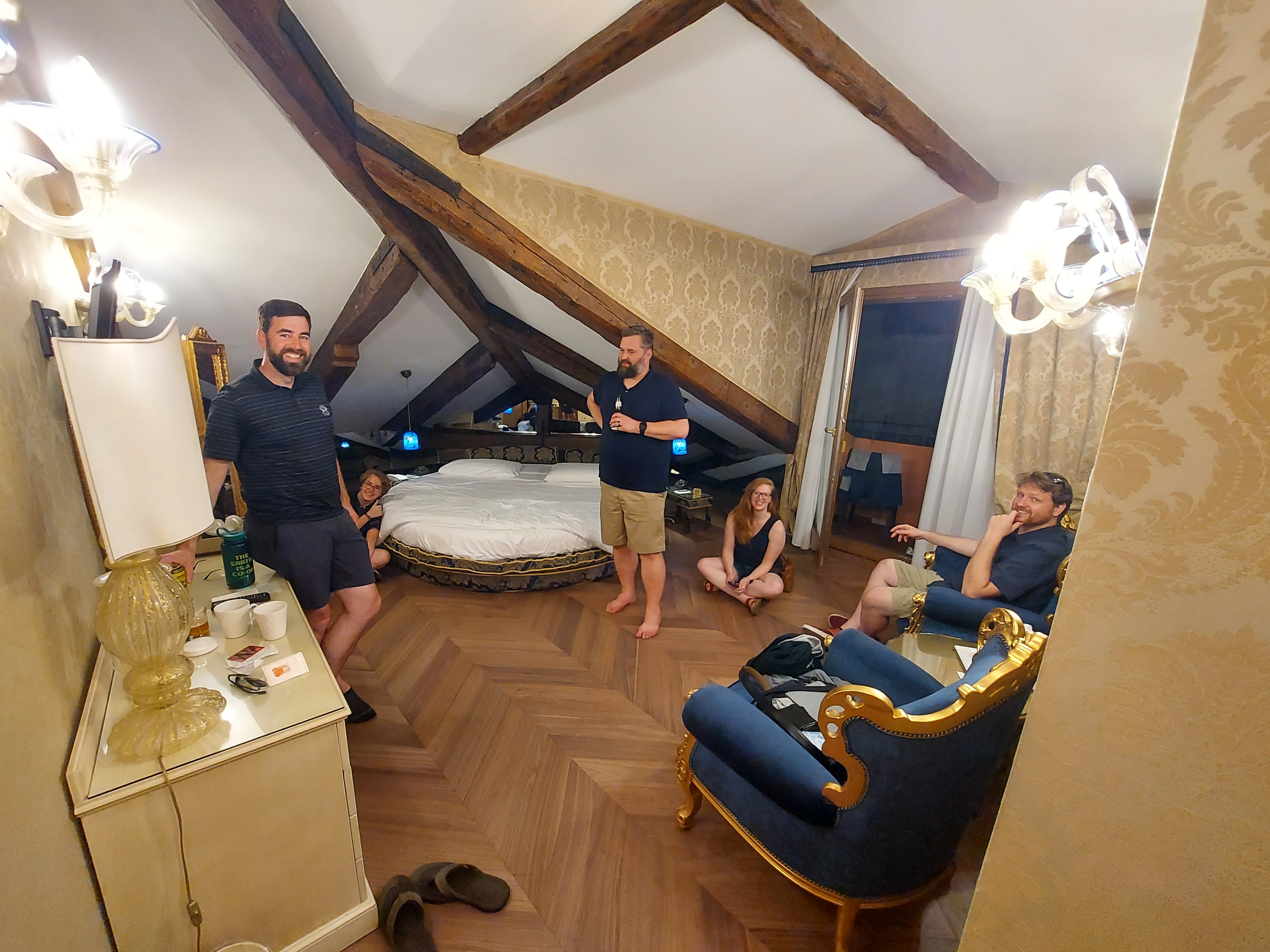
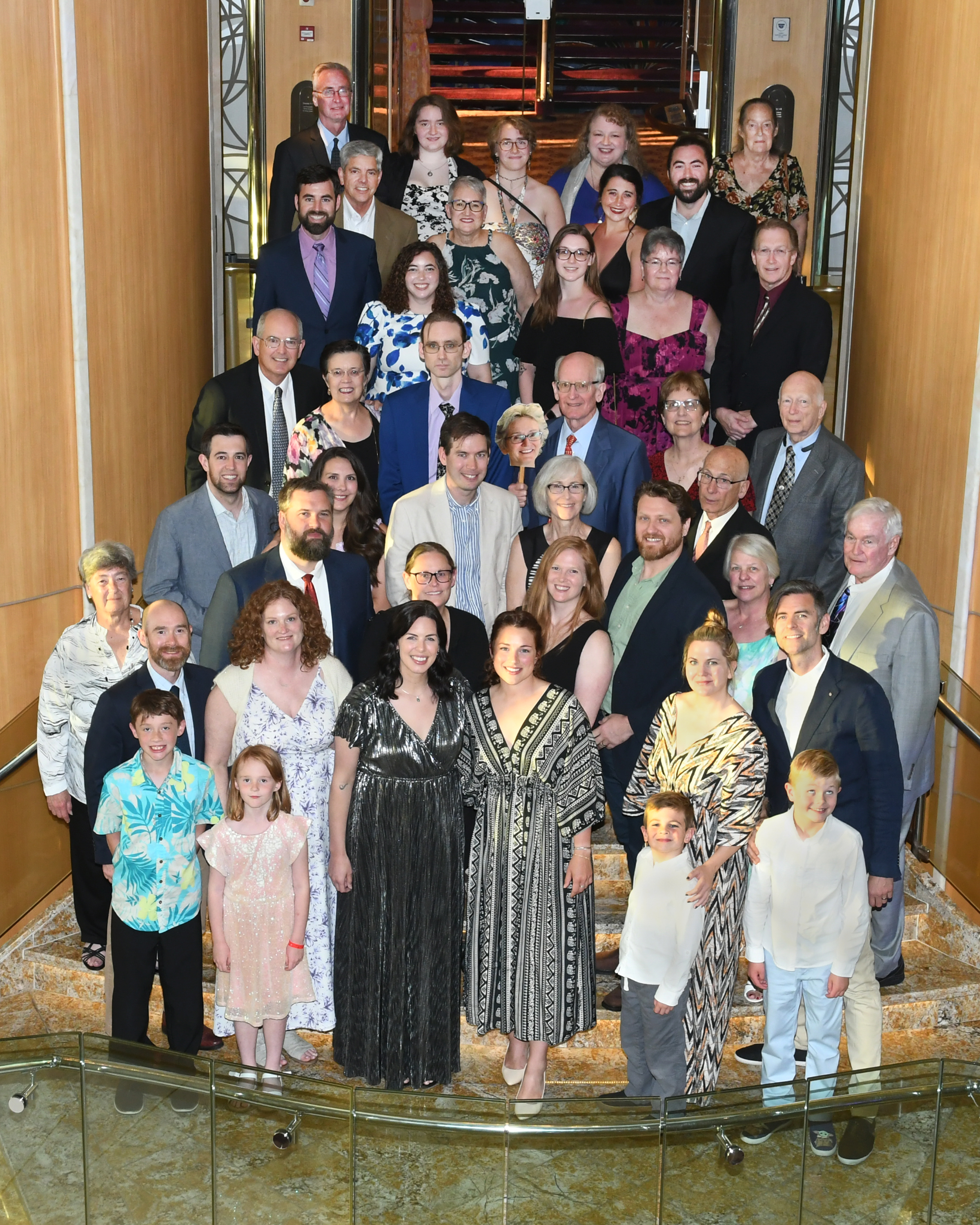
A 42-person family cruise is no enterprise for the faint of heart. My Uncle Chuck and Aunt Monica, the organizing forces behind this whole affair, give us a simultaneous window into a different world while traveling with the people we’ve known the longest. (Fate is cruel to even the best-laid plans: Monica’s broken hip just before our departure leaves her living vicariously, though pictures of Flat Monica heads on popsicle sticks crop up in every destination.) Most importantly, a cruise ship is a vehicle that will allow 42 people with disparate interests to all come together and share in the same thing. Of course we go our different ways: I see some people almost nonstop and only here and there. A cruise ship works for the people who aren’t physically able to do much other than be on the boat, and it works for people like me and my cousin Rob, for whom rest is an afterthought.

We did a version of this in 2004, beginning and ending in Barcelona, and I was fortunate to join a smaller group for a British Isles and Norwegian fjords excursion the following year. I hadn’t been to Europe since. Returning outside of peak awkward teenager phase brings considerable benefits—freedom to roam, legal booze, full choice in activities—though being turned loose on a giant boat is hardly an awful fate for a kid, especially one like me who could appreciate history and culture. Even so, my most enduring memories of that first trip include the discovery of the bidet, the phallic graffiti in Pompeii, a trash Royal Caribbean lasagna meal in Florence, and an exceptionally attractive Roman tour guide. I was fourteen; what can I say?

My attitude on cruising didn’t change appreciably in the intervening years. There are few agnostics on cruises, and telling someone about an impending cruise is likely to inspire envy or disdain. But, unless one has a David Foster Wallace level of misanthrope or gets warm tingly feelings at the phrase “organized group activity,” most people probably land somewhere in between. Cruise tourism is like tasting a beer flight; you may not get to immerse yourself in Rome, but you have enough of a flavor to know what you may want to come back for on some future trip. The first cruise showed me enough of Florence to know that any return visit would have to be for more than five hours, full stop, so it was easy to sub in Cinque Terre for the Livorno excursion this time around. As someone who now, improbably, has status with Royal Caribbean, I’ve learned how to bend these trips to my style.

Our vessel for the week is the Enchantment of the Seas, one of the oldest in the Royal Caribbean fleet, and its age shows around the edges: a few brown stains, the finest in 90s décor, a fraction of the absurd features on newer Royal ships. After an early Freudian slip, I take to calling it Endurance of the Seas. And while our fates are far from Ernest Shackleton’s, the whole two weeks do start to feel like a test of fortitude, not because of anything imposed from the outside but because I, aided and abetted by Rob, don’t want to waste one second of this trip: we are ready to go every morning, off on some lengthy excursion every day, seeking out the best food and drink every evening, and the last ones to retire every night. Cruising is, indeed, a feat of endurance.

Though the ship has over 2,500 passengers, it rarely feels crowded except when embarking or disembarking at a busy time It’s not hard to skip shows and gimmicks and choose “on your own” excursions, if you, like me, get relatively little out of comedy acts or following a tour guide with a Royal Caribbean popsicle stick down the streets of Taormina. We have sporadic pool parties in the solarium and play some shuffleboard; as always with this family, there is some euchre and Rummikub. But most nights we stage a takeover of the Viking Crown Lounge and cycle through conversations with one another, with people drifting off from there to bed or to their own activities, which for a few cousins and me means tasting the contraband beers we’ve smuggled aboard the ship. (No, Royal Caribbean, we’re not telling you our methods for getting around your systems to force us to buy your underwhelming drinks.)

The one organized group activity in which I am a regular and enthusiastic participant are the periodic trivia competitions held on board. Our family descends on three of them, and one of our teams wins every time. One afternoon, my team is in a three-way tie for first with two others, and we are instructed to send up one person for the tiebreaker; my team sends me up, and the other two counter with ten-year-olds. They are no slouches, and I don’t elbow them out of the way to answer first as I might have with some of my cousins, but I dispatch of them as politely as my blood-seeking trivia instincts will allow. I claim my Royal Caribbean highlighter prize and beat a hasty retreat to the bar.

The most grating part of the cruise is the extent to which the boat, despite already charging its passengers thousands of dollars, tries to take more and more of their money. The costs of the onboard internet and drinks package are laughable enough to make them easy to turn down, even as someone who remained pretty connected to the outside world and was hardly teetotaling on the trip. (That said, how can a boat with this many passengers serve only one craft beer, a lonely Terrapin fruity IPA that doesn’t even appear on the menu in half the bars where it’s served?) Plenty of people find ways to part with their money in the onboard shops and casinos. There is also the matter of communication, which is this constant dance among us between the glitchy Royal Caribbean app, other messaging apps, and texts for those of us whose cell phone plans work in Europe. T-Mobile, you are a quiet hero.

And then there is the often obsequious service. It is unclear if the fawning attention of the on-board attendants is coached by Royal Caribbean or a cultural characteristic of the Filipinos who dominate the crew or some combination thereof. It would not be hard to lapse into some sort of guilt about all these mostly brown people from scattered island nations waiting on a mostly white American passenger base, but I have of late found myself in revolt against the eternal calibration of morals in situations beyond my control, not to reject awareness of these divides but to find la vita serenissima in the situations we have been gifted. I am here, and giving the crew anything other than the respect they deserve would only make a hash of things. Let us save that anxiety for another day.

In a group of 42, the opportunities to connect with fellow passengers beyond the family are limited. The best gem comes the night after Cinque Terre, when seven of us join two other unsuspecting couples at the Chef’s Table, a five-course meal with wine pairings in a small dining room. As we stuff our faces we get to know Fran and Ed Dorn, a couple from Austin who were both on the faculty at the University of Texas, a Shakespearean actress and the dean of the Lyndon B. Johnson School of Public Affairs. That party goes deep into the night, and later, a few of us make it to the dance floor in the Viking Crown Lounge on Deck 12. Our fellow clubbers include a bunch of Spaniards demanding reggaeton and a clump of 18-to-20-year-olds who mostly stick to the areas by the bar as they revel in their newfound status. When the girl in the white dress vaults over a half-wall and pulls the boy in the “Please Drink Responsibly” t-shirt off down the hall, I drift off into some plaintive space of lamented lost youth that I never quite shake for the rest of the trip.

My catalog of small annoyances aside, a cruise ship offers a new perspective on may great cities, and even a few windows into great beauty. While the ports themselves are rarely scenic, I am of that obscure species that enjoys rolling through an industrial harbor to see the materials moving thorough and gawking at the massive container ships. At times there are stellar passages, never more so than on the day we set out through the Strait of Messina and pass the smoking volcano of Stromboli. The day at sea between Ravenna and Sicily gives a sense of how many other things share these waters with us, from ferries to oil rigs to ships in the night. After the Rome day the family gathers on the pool deck for certainly-not-contraband wine and watches a series of beastly cruise ships make their way out of port of Civitavecchia before we bring up the rear of the procession. As the Enchantment pulls out, the wind picks up and a lightning show kicks off out over the mainland. A near full moon lights up the night, and the sea begins to pitch. The late-night pizza run after what are of course legally brought on board beers brings a wobbliness unrelated to any beverages we consume. That night, the rocking ship soothes me into my deepest sleep in Europe.

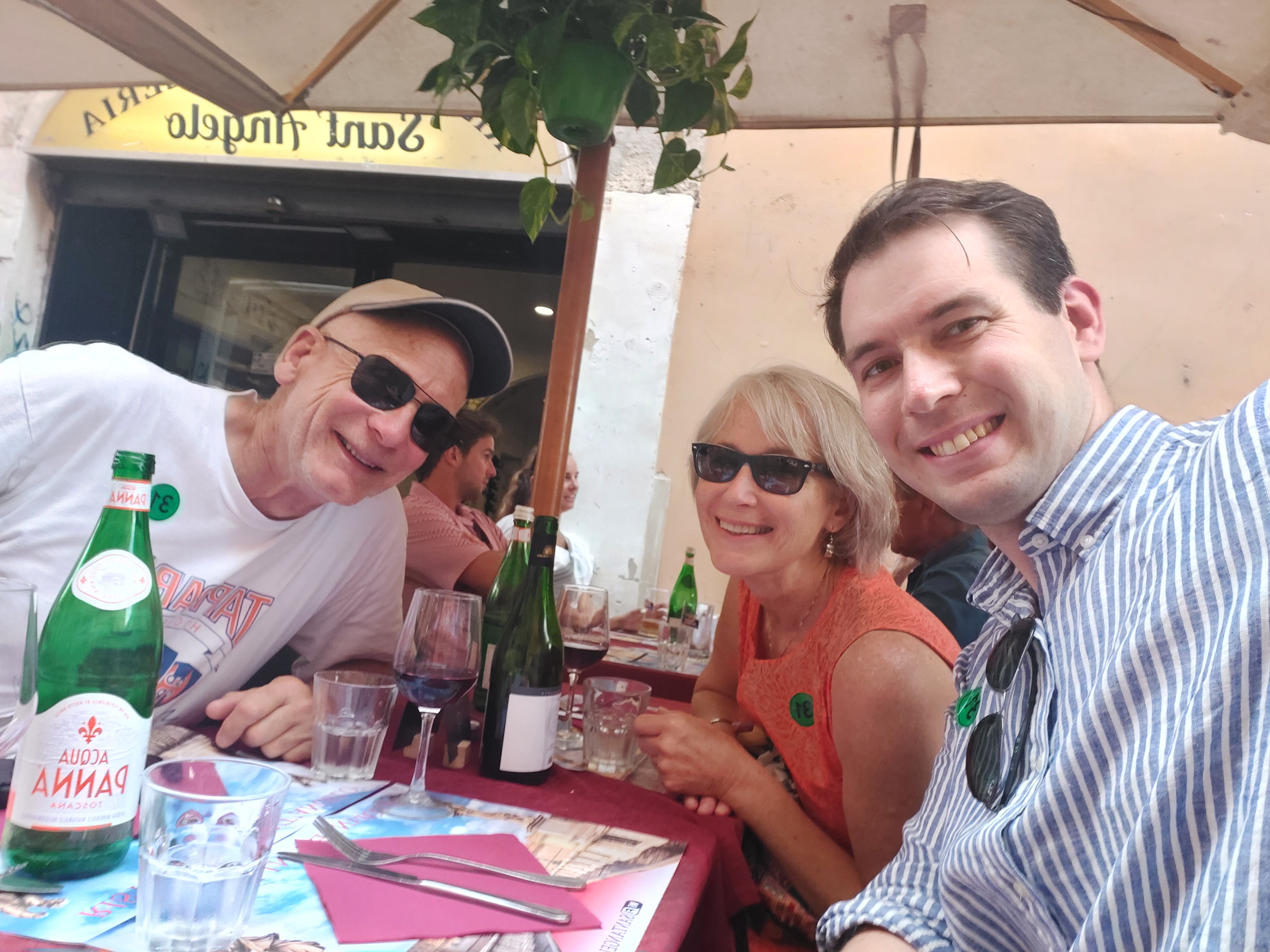
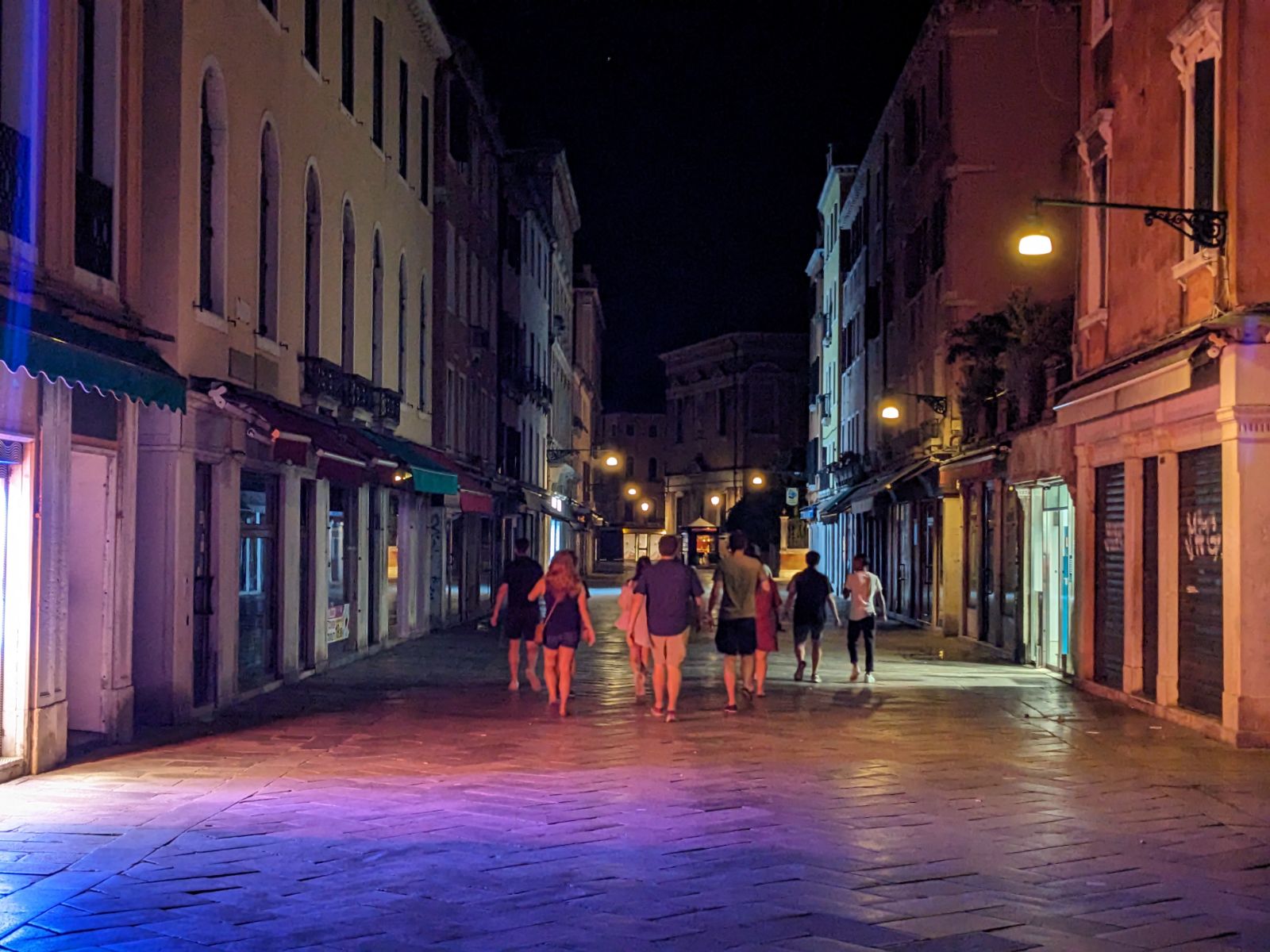
We know we are lucky to live this way. We toast to the lives we’ve lived, we toast to those who can’t be with us, for whatever reason; we toast to our hosts and to the achievements of some of our party and to our freedom to revel in this escape. Nineteen years ago, it was easy to take this sort of opportunity for granted. Now, with my grandparents and an aunt and an uncle and a couple of cousins out of the picture and some others who should be here prevented by life events, it’s not hard to recognize what a treasure this is. I will forever hold close that unique joy of strolling through a completely foreign city and seeing my relatives scattered here and there around the corners, chance encounters on the streets of Venice or Ravenna or Barcelona as we devour everything the world has to offer.

And eat it up we do. It is not uncommon for the discussion to roll until 2 AM on stateroom balconies or over pizza in the solarium. Perhaps we are debating Supreme Court cases and housing policy, or perhaps we are telling bits of our own complex stories; perhaps we are comparing tasting notes on our contraband beer, or simply noting the absurdities of cruise ship life. We are here in this moment, free to forget lost bags or loves or other regrets or anxieties, riding waves with ease.

First and foremost, a thank you to Monica and Chuck for treating us to this adventure, and to Jim, who patiently comes along for my Ravenna shopping excursion and carts things back. Steph and Kyle perfect the art of smuggling beer on board and are Rob and I’s most frequent partners in crime; David is also a regular at our beer tastings, with his wife Monica joining on a few of our shore excursions; Alex and Meghan seem to perfect the balance of deep dives in with us and retreats into their own time. Becca likewise stays close as a stabilizing force, aided in her effort by Amanda, while Molly, now 18, comes out to join the party regularly, and Katie dips in her toes here and there. Bibs and Haley liven up the full day in Venice and any dinner or evening where they join the festivities; now we just need to get your partners out for the fun. A thanks to John and Megan for hosting me in the Twin Cities the night before our departure, and for finding a good blend of good life and retreats. Paul and Laura, it was a pleasure to share some dinners and drinks and see the world through the eyes of your kids. The next generation makes its imprint: Luke is well on his way to being a trivia force, Emma was the queen of the Flat Monicas, and Jack and Liam kept me plenty entertained.

On the last night, Uncle John and I bask in repose with cigars on the windy pool deck, though we stub them out a bit early so he can be back with his co-conspirator at the center of the party, Aunt Reen. Aunt Marge probably won the award for enthusiasm for the whole cruise beforehand, and she and Uncle Steve live it up and foot the bill as we clean out her shipboard balance on the final night. Aunt Mary Beth is forever at the core of things, and along for an uphill trek to a wine tasting too. A thanks to Aunt Lucy and Uncle Bob for letting me be a sort of appendage to their family as I room with their son, and to their help with Aunt Trisha, who we are delighted to see make the trip. Props to Aunt Kristin (and Chris and friend Casey, joining us in Barcelona) for giving their girls a trip of a lifetime after graduation, and for finding ways for Uncle Joe to be a part of it. My Mom and Doug put up with Rob and I’s pace through Madrid, and my abandonment of them in Newark, with aplomb. We Maloneys get to know the McQuaid side a bit: Bill, Rose, Dan, Jan, Stephen, Amy. That adds to forty-two, but we also need to give a shout to Uncle Mike and Aunt Chris, who show us a marvelous time when they come along for the ride in Venice and Ravenna.

I had one goal as a tourist on this trip, and that goal was to see the School of Athens in person. The rest was all negotiable. And when I gaze up at Raphael’s masterpiece in that fleeting rush through the Vatican Museums, I can’t help but think of this sprawling family, always in debate or relating tales, gesticulating toward the clouds or at the things we know, a cacophony of voices where one or two may raise higher from time to time but where we need all of the voices to make it what it is. A reproduction of The School of Athens hangs above my mantelpiece because I live for this conversation, at times a central player and times a peripheral figure but always there for the dialogue until the last bit of sand has run out of the glass at the end of a very long night. That, Raphael shows us, is the essential core of the human condition, seeking and probing and finding community amid all our eccentricities, all our strong beliefs, all these jumbled ways of living that nonetheless stem from a common root. May the project never end.

And yes, I am keeping track of everyone who said they’d pay a visit to Duluth.

In That Sleep What Dreams May Come

I pour out the last glass from the bottle of wine we opened together last weekend. I head upstairs, where my guest bed is stripped, its sheets still drying from the wash; the towel he used still sits here. In a family picture on my wall, one smiling face looms out, that image forever freighted with a different meaning now. There is an empty space in my house, a sense of loss even though he was here for only a few short days. I am gutted, angry, filled with a fire to go forth and never waste another precious moment, to heal a broken world with whatever power I might have. And so I sit down to write.

My cousin Andy had the power to fill a room with his presence. He was magnetic, aglow with opinions, eager to share his latest objects of fascination. Like many of us Maloney cousins he was a Renaissance man: an electrical engineer, a voracious reader, a skilled chef, an eager skier, a card and pool shark, a determined sailor, and a devoted lover to his high school sweetheart, along with a host of other pursuits he would be sure to tell us about whether we were interested in them or not. He and I always shared a bond, even if we only saw each other a few times a year; though he was over four years my junior, he was precocious enough to keep pace from a young age. On an unstated level, we were the only living children of parents who knew loss, perhaps living out a sort of surrogacy for the younger brother I barely knew and the older one he never did.

Andy was voracious in his appetites, and so many of our times together are vivid: in the Northwoods by Minocqua, snorkeling off St. Thomas, on that family Mediterranean cruise we were set to relive this summer; teenage pillow talk when we were supposed to have been asleep, a bourbon-infused night after a Shakespeare festival in La Crosse, too many euchre marathons to count. One night, after I unwittingly enabled his tip into drunken excess, I suddenly saw the danger in the relentless course he charted. But I was myself enchanted by that push, wanted to ride along with it, even as I remained firmly bounded by an unshakable sense of limits. He was refreshingly open about the troubles he did eventually face, sought out the help he needed, was bounded by a loving network of support.

Some diseases, however, are too deep to cure, and Andy careened toward the edge in his final months. My journal entries on the four times I saw him in 2022 read like a steady progression. In February, when he descended on my house with a gaggle of friends for a ski weekend, it was a rollicking party, good food and happy stories and a few nightcaps for just the two of us, united in our thirst for those moments. “His company is so very easy to keep,” I wrote in a contented blur on one of those nights. A May backpacking adventure on the Superior Hiking Trail left me a bit put off by certain conversation topics and the regularity with which he self-medicated with THC, but he was a trooper through relentless rain and mud, not once complaining at this brutal slog that would have broken many other backcountry rookies. By Thanksgiving, I wrote with annoyance at the seeming evacuation of his social awareness; by Christmas, I was having asides with relatives, bluntly asking if he was okay. He was not.

Andy was supposed to come visit for New Year’s, but instead spent it in a hospital. He was bitter over the intervention, our lone conversation during that stretch a rant-filled call in which I could not get a word in edgewise. It was, however, necessary, his ultimate passing in no way invalidating the wisdom that something had to be done. I now recognize that he was by this point deeply sick, on a path to ruin in one form or another. I started to wonder if this story could ever have a happy ending, a cascading series of concerns that, alas, proved preparatory for the end result, a thought that is in no way comforting but did allow me to glide past the shock phase in the cycle of grief and begin the effort to heal.

He finally made that planned New Year’s trip in mid-February and spent his final weekend in my guest bedroom. It was a low-key affair, reading time and board games, me apologetic for being pulled six different directions by hockey and a ski race over those days. Of course all the what ifs flit through the mind. Was this a goodbye? No: he was going on with life, making reading lists and travel plans, and by then I knew his evasions well enough to be sure it was no act. Could I have said more, done more? No: I have enough faith in my instinct that he was not ready to talk, and this intuition has since been backed up by those who did try to broach the topic. But there was a visible void there, a missing spark of the old manic energy and rebellion, the fuel that drove him to the edge and sometimes over it. I chalked it up to medication and hoped he would, in time, find a better equilibrium. He did not have that time. His case was terminal.

This suicide is the closest and rawest to me in recent years, but it is far from alone: there have been far too many in my orbits, too many friends and relatives left in grief. It is hard not to look around for things to blame. There is something to a late modern anomie, a lack of meaning or sanctity in a cold-hearted and status-obsessed world; an uncle and I who had been just trying to watch a football game were subjected to snippets of this malaise amid a meandering December rant. There is a news environment that preys on fear and despair for profit, a doomsaying world in which Andy at least dabbled. There is the Covid-era exacerbation of isolation that has compounded so many of these trends and pushed too many over the brink. There are the guns, the sickly offshoots of an American fetish that draw headlines for mass carnage but more often than that prove deadly accessories that turn dark thoughts on bad days into irreversible fates. There is the lingering cloud of generational trauma, the specter of addiction, the accumulating weights that trouble people across all cultures and eras.

And still. So many of us live through the same general conditions and come out well enough, and I ask him the question on a ski the night I learn of his passing: fuck, man, why couldn’t you see some of what I see, feel some of what I feel that lets me take every crisis I face and crush it beneath a resolute certainty of purpose? I’m not sure if I will ever know that answer, and I am, true to form, at peace with my efforts with Andy. I have found counsel in the words of both friends near and thinkers afar, and I have, perhaps eerily well, scripted my ability to process the unthinkable in my words on here over the years. I wish I could impart that equanimity to his parents, to the love of his life he left behind, to everyone else in our sprawling clan, but their journeys are their own. May we all find what we need to persevere, in speech or in writing or in unsaid feelings, in embraces and little memorials that convey what words cannot.

I head upstairs and remake the bed. The towel goes in a laundry bin, the wine bottle into the recycling. The picture, of course, remains on the wall. The fondness over the good times we lived will never die; nor, I think, will a certain anger over his final choice. But the rant-laden phone call from the hospital in January did end with a sudden, tender “love you,” a jarring reminder that the incandescent soul was still there, clinging to something as it lost its war with a fatal disease. That is still Andy, here both to haunt and bring forth a smile, the eternal presence burning through us. Like Hamlet, we do not know what dreams may come in his sleep of death, but those of us who live on know he will endure in ours.

Gopher Ties

I’ve been out of graduate school for two years now, and a wedding of a former classmate this past weekend gave me a moment to look back on those two years of my life. My time at the University of Minnesota has misfortune of living in the shadow of a very different academic and institutional environment from my undergrad days—one that is hard to compare on many levels. But it was still a formative experience, and if readers of this blog know anything, they know I have a fondness for reflecting on formative experiences, so it’s time to give my time as a Gopher the same treatment I’ve given to my other alma maters.

I earned a master’s degree in Urban and Regional Planning from the University of Minnesota’s Humphrey School of Public Affairs. The fact that the U of M’s planning program is located in a policy school, and not an architecture school or somewhere else, is unique in and of itself. It gave planning a valuable social context that I think it deserves, as opposed to a more technical engineering-focused education. That said, the MURP program was also Humphrey’s red-headed stepchild; the dean would make good-natured but all-too-true jokes about how he didn’t know any of us. Our program was a forgotten little corner of a sprawling research university, and as a result many of us in it developed some chips on our shoulders. It could be a lonely world, but also one that built its own fierce tribe that stuck together through grad school and beyond.

Perhaps the biggest difference between my undergraduate life at Georgetown and Humphrey was the level of institutional support for students. While there are good and bad professors everywhere, the range of teaching quality at Humphrey was much wider than it was at Georgetown, where duds were few and far between. Some, including the current MURP program director, met a fantastic ideal of intellectual heft, ability to teach, and care for students. Others were so weak or so transparently more interested in their own careers than their students that it was hard not to check out in their presence, especially for those of us who preferred not to BS our way through things. I also had several unfortunate encounters with incompetent middle-level bureaucracy, from Humphrey human resources to the broader university’s health insurance system, which left a very sour taste in my final semester. The contrasts between the Georgetown financial aid office professional who went the extra mile to make sure I had everything I needed and the U of M’s automated and soulless systems, or between the Georgetown advisory dean who oversaw a five-person seminar for my major and one poor, overworked guy for the whole Humphrey, was striking. Funding for educational support staff is necessary at all levels, period: the difference in students’ mental health and career readiness is night and day.

The size of the U of M wasn’t all bad. I enjoyed the trappings of life at a Big Ten school; even though most of the major sports teams sucked during my time there, it made for excellent atmosphere on game days, and I will always feel a certain sense of home amid the frenetic energy of undergrads. The U of M is also so large that it’s hard for a single culture to dominate, as Georgetown’s East Coast preppiness sometimes could, and everyone could find their own little communities somewhere on campus. The urban campus gave access to an intriguing city, especially on the West Bank, where Humphrey sat a stone’s throw from the Somali-populated towers of Cedar-Riverside. We grad students mostly lived a bit further afield, clustering in neighborhoods that gave us access to plenty of good living beyond our schoolwork. In a phase of life where I had no pressing need to own a vehicle, it was a great place to be, and a large urban area is an excellent laboratory for aspiring planners.

Unlike Georgetown, which was caught up in a much larger mystique and set of life goals, I chose Humphrey for largely instrumental reasons. It is comparatively cheap, and its name and location provided access to networks and a ticket to a job in my field in the city where I wanted to be. It is reasonably well-regarded, though prestige means relatively little for a planning master’s program unless one is going on to a PhD. I find it somewhat ironic that this is the degree that gets me jobs when I think my undergraduate experience was more rigorous, more formative, and did more to prepare me to navigate through the adult world. But that, I suppose, is the world I live in. Higher education is a remarkably valuable thing, but not for the letters on the pieces of paper that students get at the end.

Even as a staunch defender of higher education, I could see how falsely this race to acquire credentials rang for so many of my peers, and had some sympathies when they rolled their eyes at the university system for leeching off of it. But if this was the price I had to pay, it was modest and reasonable, and more often than not was worth the cost. I was dismissive when classmates said they weren’t getting enough real world skills such as interpretation of zoning code, and nothing since then has altered that outlook. That’s not what grad school is for. Instead, it’s an immersive step outside the humdrum routine of working life, and a theater for students to negotiate crucial questions of what the actual outcome of their work will be. The debates we had in the MURP lab over beers at bars down the street or at Liquor Lyle’s set the table for everything that came after. Take it from Frank Bruni’s college admissions friend in this timely, excellent overview on how to get the most out of college: “The more you regard college as a credentialing exercise, the less likely you are to get the benefits.”

One of the real advantages of planning is the diversity of backgrounds of people who come into it, and for that matter in what they do coming out of it. A laundry list that includes architects, policy wonks, philosophers, map enthusiasts, and recovering bankers go in, some straight out of undergrad and some with varying degrees of working world experience. Developers, hardcore activists, academics, consultants, and traditional government employees all come out. We all tested each other, learned from each other, and became more complete people thanks to one another.

I made the decision to go to urban planning school at a point where my career ambitions were at a nadir, and am not sure if I would make the same choice today if not for the community that Humphrey built. We had good debates in classrooms, yes, but what Humphrey truly cultivated was a group of people with whom I can continue to make sure I’m doing what I want to do. The cozy MURP program gives its graduates a ready community of practice who, in the event that I have some sort of question on effective policy programs for particular issues or the value of adopting some technological tool, will give me an immediate, comprehensive response if I share it with my network. And for deeper dilemmas of where exactly we’re going with our work, they’re there, too.

This isn’t to say the network was without some frustrations. There was a general political groupthink to both the MURP program and the broader Humphrey, with only rare deviance. Within the MURP program itself, the lack of diversity was a frequent source of frustration for administration and students alike. And, as with any small group of people, it’s not hard to fall too deep into the weeds and lose track of other things, a fact of life that is mostly harmless but sometimes limiting. (During the wedding, I overheard one person declaiming loudly on bar graphs; over the course of the day, I had at least five people ask me if I’d heard of the latest incident of Minneapolis political outrage in which some low-grade elected official made a hash of trying to silence a bothersome hyper-local journalist.) Small communities will always have their internal little incidents that can disturb the peace. That’s life with other people.

In our best moments, my grad school cohort built exactly the sort of little community that we planners are supposed to uphold in the world. And now, out in that working world, we are spreading that seed. I struggle to define the emotion I feel upon seeing a rush of babies born to the married members of my class in the two years since graduation: it puts on hold a life so often driven by calculation and ambition, and I am left only with a sense of humility, a moment of rightness before the power of creation. While I don’t begrudge those who choose different arrangements (or are unable to choose it), child-rearing is central to my vision for a sustainable, healthy community: if we truly believe in leaving the world better than we found it, how can we not bring life into it ourselves? How can that not be the ultimate task, the ultimate test of our ability to stand up for what we claim to believe in? No matter where I may wander from here, that desire to live in community and contribute to it will be central, and I have my time at Humphrey to forever fuel it.

A Cyclical Christmas

I don’t really know what it means to be “home for Christmas.” I never am. Christmas is always part of a journey, one that usually involves a stint as an interloper in someone else’s holiday, or, lately, a sterile hotel. (I suppose it’s a step up from a manger in Roman-occupied Judea, but still.) Trying to make all these disparate threads make sense has become a sort of routine. But routine breeds comfort, familiarity, and no one really seems to mind my intrusions, wherever they may be. I’m always on the road this time of the year, and that is my tradition.

Lately, it hasn’t been just a journey to one place; it’s been a cycle between two different worlds. Just over 100 miles separate these two worlds, and the loose trappings of Christmas, somewhere within the Catholic tradition, are at the roots of both. Beyond that, it is a study in dualisms, twinned within me.

First, Chicago, its crush of humanity making Minneapolis seem quaint and tame. Here, a sprawling family unites en masse every year. It’s not without its skeletons, of course, and the march of time takes its toll. But the cycle goes on, the young carrying forward the best gifted to us by the old. Everyone comes together for a great Christmas festival, cramming the house full by the dozens, the well-earned merriment coming to fruition. We gorge ourselves, we down glass after glass of wine, and then we all settle around the piano and shamelessly belt out all the carols, loving every second. After the party, there’s some time to explore the city, see friends old and new, eat well and live well. A whirlwind caught up in the dream, my mission, if I can be so ambitious as to claim one: entwining the fabric of family with the fabric of a city, vibrant and full of life.

A brief train ride north, though, and the other side of the cycle. Here, things are quiet. No more frenetic energy, no more loud noise; just a couple of us with Grandma in that same old house, chancing the occasional word, little that hasn’t been said before. I read, I write, I dodge all the cats. Before long I’m out on a frigid trek down the country lanes of eastern Wisconsin, up and down the hills of the Kettle Moraine, out to the old stone church in St. Lawrence on Christmas Eve. That nostalgic pastoral scene so dear to my grandmother, if it ever truly existed, is fading away into the fog; the land slowly emptied or turned to exurban sprawl. I won’t have much reason to come back here after she moves on, though I know I will all the same.

It may not be my future, but it is an integral part of my past, and I must understand it, and pass it along, such as I can. On my run through the mists this year, I recalled the words of Fr. Thomas King, the late Georgetown Jesuit who, in his final Christmas Mass, gave the only homily that this unbaptized, intrigued-but-never-fully-inspired cultural Catholic has bothered to retain. In the midst of all the insanity of our lives, he preached, it is these escapes into the wilderness that bring us peace. It is that call inward that allows us to make ourselves whole again, bringing union with something far greater in that paradox we call faith. That thought in the wilderness has proven a great spark, and the most important thing I ever wrote, the foundations of the pieces that taught me who I was, spilled out in one of those dull hotel rooms not far off. Even here, I find myself, and through it, something much bigger than myself.

Roots are tangled, even for us white bread Midwesterners. Mine are a messy trinity with a handful of other currents feeding in: one part Chicago distinction, the American Dream made real; one part Wisconsin farm boy at the end of an era, trying to make sense of the past. One very large dose of Duluth at my core; perhaps small parts Mexico and, yes, part Washington as well. And yet it all holds together easily enough, all with its place. I suppose that’s where I’m at home, making those connections all one. The cycle goes on. A Merry Christmas to all.

Changes in Marriage and the Big Picture

Two Sundays ago, Ross Douthat, the New York Times’s resident conservative, wrote a column about the relationship between gay marriage and the general decline in what he calls “traditional” marriage. While later careful readings make show Douthat never explicitly draws a causal arrow between same-sex marriage and the decline in traditional marriage, he is certainly bringing attention to the possibility. No matter how tightly worded the column may be, its very focus on same-sex marriage was bound to generate a response.

After several critics took shots at the column, Douthat composed a three-part response on his blog. The blog posts were, in my opinion, far more effective than the original column, in part because of their composition: instead of seizing upon a hot-button issue and trying to cram it into a broader theory, they considered the theory and let the consequences of the theory—of which the same-sex marriage debate is one—flow from it naturally.

The second blog post traces the history of the decline of the “traditional” model of marriage, “which seeks to integrate sex, parenthood, economic cooperation, and emotional intimacy in a permanent union,” according to the National Marriage Project, with a “soul mate” model that puts one person’s love for another first and foremost. It shows how the latter model seems to have some serious consequences; while educated and wealthier classes tend to do just fine, working-class and less-educated Americans struggle to conform to the new model, leading to dramatic increases in divorce and childbirth out of wedlock, which tends to only exacerbate inequality in later generations. This is certainly a problem, and one that tends to unite both liberals and conservatives, even if their diagnoses of the causes and possible remedies vary wildly.

The third and final post is the strongest of them all, as it begins by mentioning everything that has pushed against the “traditional” model of marriage. There’s the state of the U.S. economy over the past forty years, which has made stable employment for younger people—particularly the white working class—much more difficult. There’s the impact of the feminist movement, and greater female participation in the work force. There’s contraception, there’s popular culture, and there are cultural norms that posit marriage as something one does once one is settled in life. Some people even trace it all back to the origins of modernity, and the early philosophers and revolutions responsible for aspects of the American project. As I mentioned in the post about the championship-winning goal, we can plausibly go back to the dawn of humanity finding events that affected later events that somehow lead up to the present day. The complexity of causes at play is nearly impossible to sort out, and Douthat recognizes this:

But I also think culture and economics, ideas and incentives, are all entangled at a deep level, working in cycles and feedback loops rather than in simple causal arrows — and thus it’s a mistake to treat changes in what people believe, and particularly the sweeping generational changes in how Americans conceptualize the links between sex and marriage and procreation, just as epiphenomena of economic pressure. (Emphasis mine)

Near the end of the second post, Douthat admits that same-sex marriage is not the driving force behind the decline in traditional marriage, but is rather a result of many forces. However, he also plausibly argues that the current push for same-sex marriage feeds back into the push toward the “soul mate” model, and that it would behoove society to step back for a moment and recognize that there might be more at stake here than just some ideal of love between two people. As just about all of us can attest, sometimes love can hurt, often in ways we never anticipated when we first fell in love. It is never as easy as it seems.

Of course, one could rationally argue that love between two people forever trumps those more complicated implications whose causes and effects are rather murky. This argument has considerable merit, in my opinion. There is always the question of what we can control, and with so many interplaying cultural and economic forces driving family instability in the 21st century United States, it seems silly to mount the defenses of traditional marriage strictly along the same-sex marriage front. Doing so cannot possibly stem the tide, and only invigorates a long-marginalized minority into greater action as they rally behind the simple, controllable, winning battle cry of love. I would also like to believe there is a way to reconcile an older, more stable vision of family life with such changes as same-sex unions. (I’m sure people have tried to do this, but I haven’t read or weighed them extensively yet.)

However, we can’t ignore the broader debates completely, and very few supporters of same-sex marriage seem to have grasped the magnitude of the movement their cause is wrapped up in. Douthat ends his series by saying “no one can predict the future,” and while I agree, it is fairly clear to me that history is marching in a certain direction: toward individual freedom, with little regard for societal implications. Same-sex marriage supporters (and opponents) often embrace some aspects of this push while scorning others, and few people seem to appreciate how tightly interrelated they all are. This, of course, is a very complicated subject that deserves its own post (if not a treatise), and I’ll have one along in the near future.