Europe 2023, Part IV: Our School of Athens

This is the final installment of a four-part series. Part I | Part II | Part III

A 42-person family cruise is no enterprise for the faint of heart. My Uncle Chuck and Aunt Monica, the organizing forces behind this whole affair, give us a simultaneous window into a different world while traveling with the people we’ve known the longest. (Fate is cruel to even the best-laid plans: Monica’s broken hip just before our departure leaves her living vicariously, though pictures of Flat Monica heads on popsicle sticks crop up in every destination.) Most importantly, a cruise ship is a vehicle that will allow 42 people with disparate interests to all come together and share in the same thing. Of course we go our different ways: I see some people almost nonstop and only here and there. A cruise ship works for the people who aren’t physically able to do much other than be on the boat, and it works for people like me and my cousin Rob, for whom rest is an afterthought.

We did a version of this in 2004, beginning and ending in Barcelona, and I was fortunate to join a smaller group for a British Isles and Norwegian fjords excursion the following year. I hadn’t been to Europe since. Returning outside of peak awkward teenager phase brings considerable benefits—freedom to roam, legal booze, full choice in activities—though being turned loose on a giant boat is hardly an awful fate for a kid, especially one like me who could appreciate history and culture. Even so, my most enduring memories of that first trip include the discovery of the bidet, the phallic graffiti in Pompeii, a trash Royal Caribbean lasagna meal in Florence, and an exceptionally attractive Roman tour guide. I was fourteen; what can I say?
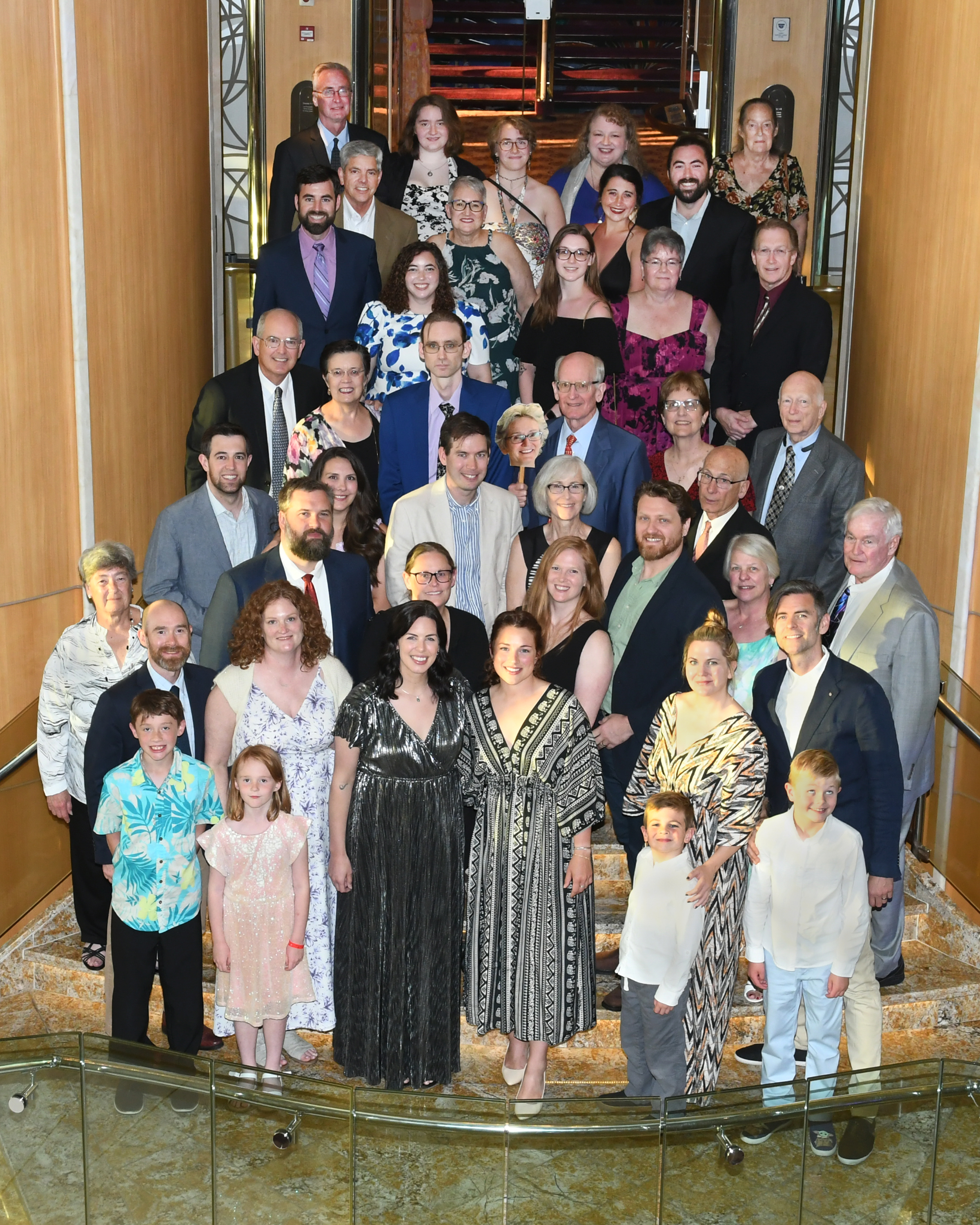
My attitude on cruising didn’t change appreciably in the intervening years. There are few agnostics on cruises, and telling someone about an impending cruise is likely to inspire envy or disdain. But, unless one has a David Foster Wallace level of misanthrope or gets warm tingly feelings at the phrase “organized group activity,” most people probably land somewhere in between. Cruise tourism is like tasting a beer flight; you may not get to immerse yourself in Rome, but you have enough of a flavor to know what you may want to come back for on some future trip. The first cruise showed me enough of Florence to know that any return visit would have to be for more than five hours, full stop, so it was easy to sub in Cinque Terre for the Livorno excursion this time around. As someone who now, improbably, has status with Royal Caribbean, I’ve learned how to bend these trips to my style.

Our vessel for the week is the Enchantment of the Seas, one of the oldest in the Royal Caribbean fleet, and its age shows around the edges: a few brown stains, the finest in 90s décor, a fraction of the absurd features on newer Royal ships. After an early Freudian slip, I take to calling it Endurance of the Seas. And while our fates are far from Ernest Shackleton’s, the whole two weeks do start to feel like a test of fortitude, not because of anything imposed from the outside but because I, aided and abetted by Rob, don’t want to waste one second of this trip: we are ready to go every morning, off on some lengthy excursion every day, seeking out the best food and drink every evening, and the last ones to retire every night. Cruising is, indeed, a feat of endurance.

Though the ship has over 2,500 passengers, it rarely feels crowded except when embarking or disembarking at a busy time It’s not hard to skip shows and gimmicks and choose “on your own” excursions, if you, like me, get relatively little out of comedy acts or following a tour guide with a Royal Caribbean popsicle stick down the streets of Taormina. We have sporadic pool parties in the solarium and play some shuffleboard; as always with this family, there is some euchre and Rummikub. But most nights we stage a takeover of the Viking Crown Lounge and cycle through conversations with one another, with people drifting off from there to bed or to their own activities, which for a few cousins and me means tasting the contraband beers we’ve smuggled aboard the ship. (No, Royal Caribbean, we’re not telling you our methods for getting around your systems to force us to buy your underwhelming drinks.)

The one organized group activity in which I am a regular and enthusiastic participant are the periodic trivia competitions held on board. Our family descends on three of them, and one of our teams wins every time. One afternoon, my team is in a three-way tie for first with two others, and we are instructed to send up one person for the tiebreaker; my team sends me up, and the other two counter with ten-year-olds. They are no slouches, and I don’t elbow them out of the way to answer first as I might have with some of my cousins, but I dispatch of them as politely as my blood-seeking trivia instincts will allow. I claim my Royal Caribbean highlighter prize and beat a hasty retreat to the bar.

The most grating part of the cruise is the extent to which the boat, despite already charging its passengers thousands of dollars, tries to take more and more of their money. The costs of the onboard internet and drinks package are laughable enough to make them easy to turn down, even as someone who remained pretty connected to the outside world and was hardly teetotaling on the trip. (That said, how can a boat with this many passengers serve only one craft beer, a lonely Terrapin fruity IPA that doesn’t even appear on the menu in half the bars where it’s served?) Plenty of people find ways to part with their money in the onboard shops and casinos. There is also the matter of communication, which is this constant dance among us between the glitchy Royal Caribbean app, other messaging apps, and texts for those of us whose cell phone plans work in Europe. T-Mobile, you are a quiet hero.

And then there is the often obsequious service. It is unclear if the fawning attention of the on-board attendants is coached by Royal Caribbean or a cultural characteristic of the Filipinos who dominate the crew or some combination thereof. It would not be hard to lapse into some sort of guilt about all these mostly brown people from scattered island nations waiting on a mostly white American passenger base, but I have of late found myself in revolt against the eternal calibration of morals in situations beyond my control, not to reject awareness of these divides but to find la vita serenissima in the situations we have been gifted. I am here, and giving the crew anything other than the respect they deserve would only make a hash of things. Let us save that anxiety for another day.

In a group of 42, the opportunities to connect with fellow passengers beyond the family are limited. The best gem comes the night after Cinque Terre, when seven of us join two other unsuspecting couples at the Chef’s Table, a five-course meal with wine pairings in a small dining room. As we stuff our faces we get to know Fran and Ed Dorn, a couple from Austin who were both on the faculty at the University of Texas, a Shakespearean actress and the dean of the Lyndon B. Johnson School of Public Affairs. That party goes deep into the night, and later, a few of us make it to the dance floor in the Viking Crown Lounge on Deck 12. Our fellow clubbers include a bunch of Spaniards demanding reggaeton and a clump of 18-to-20-year-olds who mostly stick to the areas by the bar as they revel in their newfound status. When the girl in the white dress vaults over a half-wall and pulls the boy in the “Please Drink Responsibly” t-shirt off down the hall, I drift off into some plaintive space of lamented lost youth that I never quite shake for the rest of the trip.
My catalog of small annoyances aside, a cruise ship offers a new perspective on may great cities, and even a few windows into great beauty. While the ports themselves are rarely scenic, I am of that obscure species that enjoys rolling through an industrial harbor to see the materials moving thorough and gawking at the massive container ships. At times there are stellar passages, never more so than on the day we set out through the Strait of Messina and pass the smoking volcano of Stromboli. The day at sea between Ravenna and Sicily gives a sense of how many other things share these waters with us, from ferries to oil rigs to ships in the night. After the Rome day the family gathers on the pool deck for certainly-not-contraband wine and watches a series of beastly cruise ships make their way out of port of Civitavecchia before we bring up the rear of the procession. As the Enchantment pulls out, the wind picks up and a lightning show kicks off out over the mainland. A near full moon lights up the night, and the sea begins to pitch. The late-night pizza run after what are of course legally brought on board beers brings a wobbliness unrelated to any beverages we consume. That night, the rocking ship soothes me into my deepest sleep in Europe.

We know we are lucky to live this way. We toast to the lives we’ve lived, we toast to those who can’t be with us, for whatever reason; we toast to our hosts and to the achievements of some of our party and to our freedom to revel in this escape. Nineteen years ago, it was easy to take this sort of opportunity for granted. Now, with my grandparents and an aunt and an uncle and a couple of cousins out of the picture and some others who should be here prevented by life events, it’s not hard to recognize what a treasure this is. I will forever hold close that unique joy of strolling through a completely foreign city and seeing my relatives scattered here and there around the corners, chance encounters on the streets of Venice or Ravenna or Barcelona as we devour everything the world has to offer.

And eat it up we do. It is not uncommon for the discussion to roll until 2 AM on stateroom balconies or over pizza in the solarium. Perhaps we are debating Supreme Court cases and housing policy, or perhaps we are telling bits of our own complex stories; perhaps we are comparing tasting notes on our contraband beer, or simply noting the absurdities of cruise ship life. We are here in this moment, free to forget lost bags or loves or other regrets or anxieties, riding waves with ease.
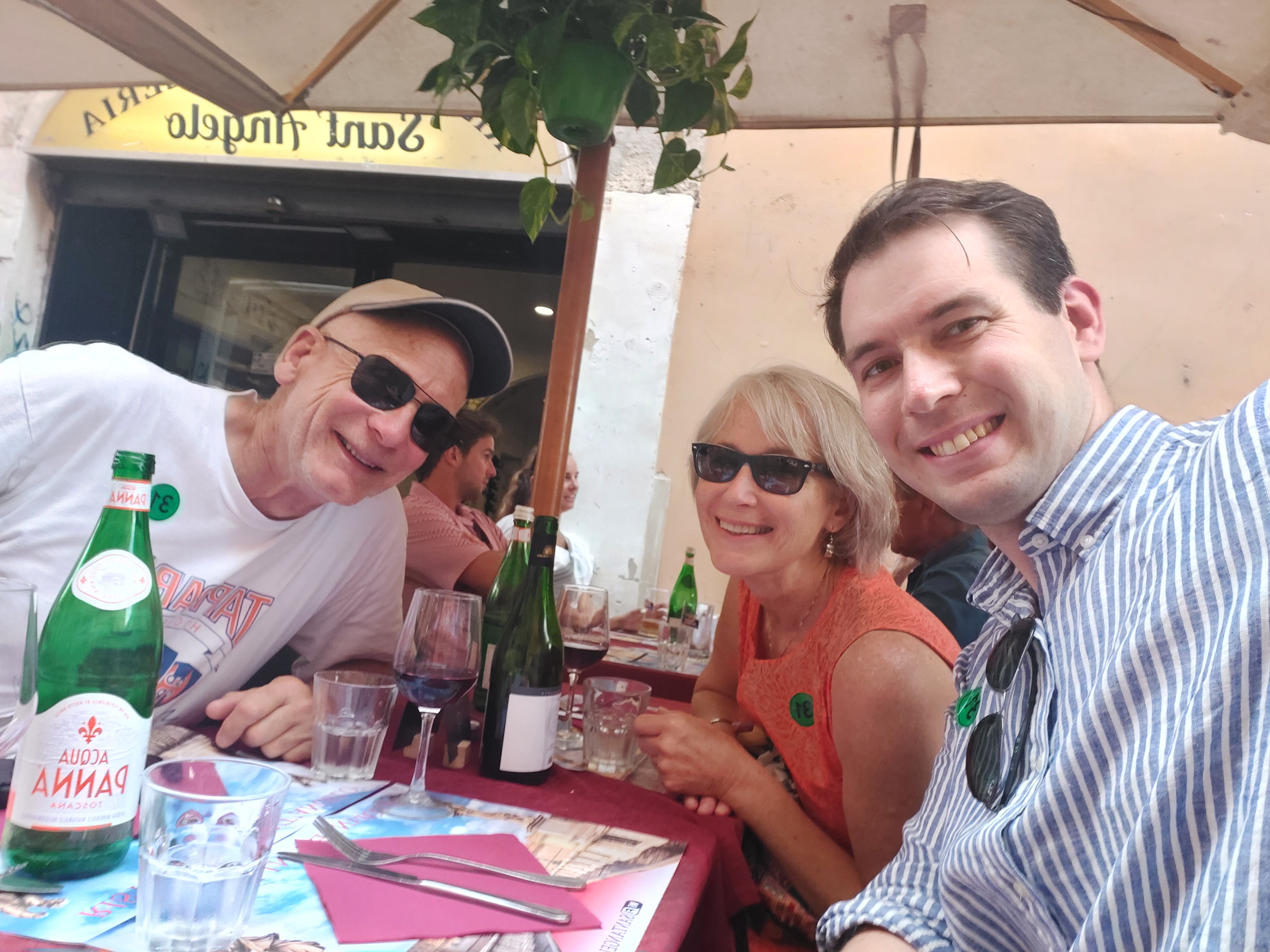
First and foremost, a thank you to Monica and Chuck for treating us to this adventure, and to Jim, who patiently comes along for my Ravenna shopping excursion and carts things back. Steph and Kyle perfect the art of smuggling beer on board and are Rob and I’s most frequent partners in crime; David is also a regular at our beer tastings, with his wife Monica joining on a few of our shore excursions; Alex and Meghan seem to perfect the balance of deep dives in with us and retreats into their own time. Becca likewise stays close as a stabilizing force, aided in her effort by Amanda, while Molly, now 18, comes out to join the party regularly, and Katie dips in her toes here and there. Bibs and Haley liven up the full day in Venice and any dinner or evening where they join the festivities; now we just need to get your partners out for the fun. A thanks to John and Megan for hosting me in the Twin Cities the night before our departure, and for finding a good blend of good life and retreats. Paul and Laura, it was a pleasure to share some dinners and drinks and see the world through the eyes of your kids. The next generation makes its imprint: Luke is well on his way to being a trivia force, Emma was the queen of the Flat Monicas, and Jack and Liam kept me plenty entertained.

On the last night, Uncle John and I bask in repose with cigars on the windy pool deck, though we stub them out a bit early so he can be back with his co-conspirator at the center of the party, Aunt Reen. Aunt Marge probably won the award for enthusiasm for the whole cruise beforehand, and she and Uncle Steve live it up and foot the bill as we clean out her shipboard balance on the final night. Aunt Mary Beth is forever at the core of things, and along for an uphill trek to a wine tasting too. A thanks to Aunt Lucy and Uncle Bob for letting me be a sort of appendage to their family as I room with their son, and to their help with Aunt Trisha, who we are delighted to see make the trip. Props to Aunt Kristin (and Chris and friend Casey, joining us in Barcelona) for giving their girls a trip of a lifetime after graduation, and for finding ways for Uncle Joe to be a part of it. My Mom and Doug put up with Rob and I’s pace through Madrid, and my abandonment of them in Newark, with aplomb. We Maloneys get to know the McQuaid side a bit: Bill, Rose, Dan, Jan, Stephen, Amy. That adds to forty-two, but we also need to give a shout to Uncle Mike and Aunt Chris, who show us a marvelous time when they come along for the ride in Venice and Ravenna.

I had one goal as a tourist on this trip, and that goal was to see the School of Athens in person. The rest was all negotiable. And when I gaze up at Raphael’s masterpiece in that fleeting rush through the Vatican Museums, I can’t help but think of this sprawling family, always in debate or relating tales, gesticulating toward the clouds or at the things we know, a cacophony of voices where one or two may raise higher from time to time but where we need all of the voices to make it what it is. A reproduction of The School of Athens hangs above my mantelpiece because I live for this conversation, at times a central player and times a peripheral figure but always there for the dialogue until the last bit of sand has run out of the glass at the end of a very long night. That, Raphael shows us, is the essential core of the human condition, seeking and probing and finding community amid all our eccentricities, all our strong beliefs, all these jumbled ways of living that nonetheless stem from a common root. May the project never end.
And yes, I am keeping track of everyone who said they’d pay a visit to Duluth.

Europe 2023, Part III: Out on a Peninsula

This is the third in a four-part series. Part I | Part II

After seven days at sea, the cruise ship disgorges my 41 family members and me in Barcelona. While our inevitable dispersal brings a magical week to a close, I am glad to be free from Royal Caribbean’s controls on my movements. A little more space, wandering back at our own pace, ready to explore two more cities that have set themselves up well for me to like them.

Barcelona is both the capital of the Mediterranean basin and the standard-bearer for modern Europe. Though there is some graffiti around town trashing tourists, it is certifiably alive in ways that museum pieces like Venice or straining old metropolises like Rome are not. It has reinvented itself dramatically over the centuries: Roman roots, a Gothic core, a grand City Beautiful charge from the 1800s embellished by Gaudí’s ornamental flair, and a cosmopolitan boom in recent decades that has it pulsing with young life, beaches and clubs plus art and architecture, enough Catalan ingenuity to keep it from becoming a stale playground for the wealthy alone. The buildings are stunning and quirky but functional, the trains run on schedules to the second, and the food and drink have little competition. The three Duluthians in our party stay across from the old cathedral on two pedestrian Gothic Quarter streets, a maze that loses none of its luster even after a week of meandering cities with similar appeal.

Barcelona is not without its warts. There are pickpockets afoot, and I have a bizarre interaction with a man who tries to scam me with a Metro ticket before I rather unwittingly turn the tables on him by only having five Euros in cash in my possession. The Catalan separatist struggle, while invisible on this visit, drives at the heart of the European tension between lofty universal ideals and local tribal pride. Even FC Barcelona, after reaching new heights in fútbol achievement a decade ago, now flounders in debt and corruption after overreaching as it tried to keep up with the Gulf and Russian oligarch money that has besmirched the sport across Europe. Barcelona is also a very raunchy place, which is not in and of itself a defect, but any edginess does rather wear off when one passes a tenth little shop selling t-shirts with the same trashy slogans in English. Some bits of culture are, alas, universal.

Grumbling aside, Barcelona is still a special place, the city a whole continent wants to think it can be. It also has some reminders of home, as I have a quick rendezvous with friends from Duluth who are also passing through and then visit Black Lab, a brewery owned by a Duluthian who makes some of the best beer we find in our wanderings. My cousin Steph and her husband Kyle lead me on a sampling of vermut at a quiet neighborhood bar north of the city center. A rooftop tapas dinner is the last 10-plus person family gathering on the trip, and the desserts, including the beet ice cream with a cake and the very cheesy cheesecake and the ice cream dish featuring a tray with several vats of the stuff with cones and toppings, are the winners. The next morning we make a circuit of Parc Guell, Gaudí’s experiment in a meandering pleasure ground where visitors have no real agenda other than to stroll its pathways and lose themselves in a mix of naturalism and neo-Gothic design. Tapas lunch comes a few blocks from the Sagrada Familia, the magnum opus of the architect who gave this city its flair, slow but steady progress evident in the 19 years since my last visit.

The group slowly disperses from Barcelona: many straight back to the States, some to linger here or nearby on the Balearic coast, a few back to Italy or off on lengthy tours. For my mom, her partner Doug, my cousin Rob, and me, it’s a ride on the AVE high-speed train across the Spanish plain to Madrid. The train hums with power as we shoot over the meseta at 300 kilometers per hour, through small towns with hilltop castles and churches, olives and grapes, and a lot of windmills that look unlike anything Don Quixote would have encountered in his wanderings here half a millennium ago. At times the landscape is so barren as to evoke, say, eastern Montana, but before long we are edging into Atocha station in one of Europe’s great former seats of imperial power.

Madrid will never quite match Barcelona’s underlying cool, but it is a delightful place. Even though the kings based here dominated most of a hemisphere for centuries, it lacks the consistent grandiose scale of a London or a Paris or even a Rome. The Palacio Real sits starkly alone on the edge of the city center, surrounded by gardens; the Plaza Mayor is one of Europe’s more cloistered central squares, with no 19th century grand avenues punched through its colonnades. The Parque del Retiro is sprawling, but its green cover likewise encloses a certain intimacy, and while there are other triumphant arches and plazas scattered about, they seem to blend with the city, opening up logically even when they may seem haphazard from a bird’s eye view. Quality urban form is, of course, one of Spain’s great triumphs and exports to its former colonies.

Spanish culture is, if not insular, decidedly peninsular. This will happen to a nation that mired itself in inquisitions and counter-reformations as liberalizing advances made their way across the rest of Europe, but the view from 2023 is one of a place distinctive in its flavor, a collection of fairly stable local cultures that share a political system out of Madrid but often little else. Modern Spain is much less unified than France or even Italy, the difference obvious enough even in simply visiting its two largest cities. Madrid and Barcelona feel like different countries, and then there are the Basques and the Galicians; our last dinner comes at an Asturian restaurant, a nod to the lush pocket of the northern coast where apples and cider reign supreme. And that’s all in the northern half of the country alone, skipping over the massive Moorish influence in sunbaked Andalucía.

We spend a chunk of our first full day in Madrid touring the Museo del Prado. The Prado, while massive, does not have the worldliness of the Met or the Louvre or the British Museum: here, Spanish masters like El Greco and Velázquez and Goya still reign, alongside some associated Venetians and a few Dutch masters who drifted through the Habsburg orbit. In the Prado, Spanish artists and imperial collectors gathered works of nobility and religious iconography, but little else. To tour the Prado is to view countless Assumptions and Immaculate Conceptions and Passions, alongside myriad temptations of saints and looming sin. And yet there is still incredible range on display, from the cluttered fever dreams of Hieronymus Bosch to the stark austerity of Velázquez’s Jesus on the cross, from the subtle mastery of Las Meñinas to the empathy in every Goya portrait. Another gallery stages El Greco next to Picasso, showing ties across generations between artists who, at first blush, have nothing in common. The Prado’s collection, more than any royal language academy or stuffy French defense of certain standards, is the epitome of a cultural patrimony.

Otherwise, most of our Madrid time is devoted to wandering, with stops in the Basilica de San Francisco, the cathedral, and in the Corte Inglés department store, where I buy a new suitcase. We find the statue of Cervantes in the Plaza de España and educate ourselves on the various Carloses, Felipes, and Alfonsos seated on horseback around the city. (I muse as to whether the Felipes could have prevented the decline of the Spanish Empire if they spent less time posing on horseback.) The streets of Madrid feel safer and better tended than Rome or Barcelona, though there is still an element of the absurd, with busking accordionists playing the same eight tunes or people dressed in giant panda or Mario costumes at nearly every attraction. (How they live in these things in 90-degree Spanish summer heat is beyond me.)

One could paint staid, imperial Madrid as a tired counterpoint to sexy Barcelona and its beachfront brethren, but when the sun goes down, Madrid shows out. The routine across three straight nights here is the same: after siesta, tapas and wine, with dinner extending through to midnight. Traveling with Rob means we have nonstop great food, and instead of sitting for dinner for hours as in Italy, here one can drift about for tapas, served almost immediately and savored slowly, a movable feast whose style I would gladly import across the pond. We continue our bold quest to find decent Mediterranean basin beer and have better luck here than anywhere else, including from a brewery named Oso whose bear-head-on-hops logo eerily resembles one in Duluth. My European culinary apogee comes at Juana la Loca, a tapas restaurant that was high on Rob’s list and turns out to be just one block from our Airbnb off the Plaza de Carros. The truffles, crab, and foie gras carry me away to a blissful place, and we walk off the meal with a stroll to a nightcap at a mezcal bar with the prettiest menu I’ve ever seen, with a detour for some people-watching at blocks-long line outside the one nightclub that apparently attracts every single Madrileño youth.

I am pleased to find my Spanish still perfectly functional once I kick off the rust, though plenty of Spaniards still open conversations with us in English, which I suppose is our blessing and curse as native speakers of tourism’s universal tongue. Still, there are moments of pride: at one dinner, Rob and I proudly order in Spanish before realizing there is an English menu if one scrolls further down; we sit between a loud British couple who demand the biggest beer available and a group of Indians who scandalize the waiter by asking for red pepper flakes. With competition like this, we are model tourists, blending smoothly into a country where I’ve scarcely spent a week.

Even model tourists must go home, however, and after three nights in Madrid, drained by rotating through my modestly sized Italian wardrobe and still anxious about my bag, I am ready for a return journey. If things go according to plan, I will be back on the Iberian Peninsula before long, ready to sample more of its diversity, more of its tapas, and more of its inviting streets before the siesta calls. I have no Spanish blood, but as the child of a Spanish professor and someone who studied in Madrid some 40 years ago, and this peninsula feels like a natural extension of my life.

Part Four is here.

Europe 2023, Part II: The Sea in the Middle of the Earth

This is part two in a four-part series. Part One is here.

Venice, Rome, Barcelona: these famed cities dominate this summer’s Mediterranean cruise. But many of the best days come in somewhat less famous towns, those cozy retreats that give these shores their glamour. Given the tight timelines afforded by any cruise tour, more than a few members of my large party conclude it is best to enjoy some quick samplings of beauty rather than deep immersions in the most renowned attractions, the vibes over the deep dives. We can, hopefully, return and immerse ourselves in the places that demand it when we don’t have a ship to catch. But for now, this is how we travel, and we are here to drink in the great beauty.

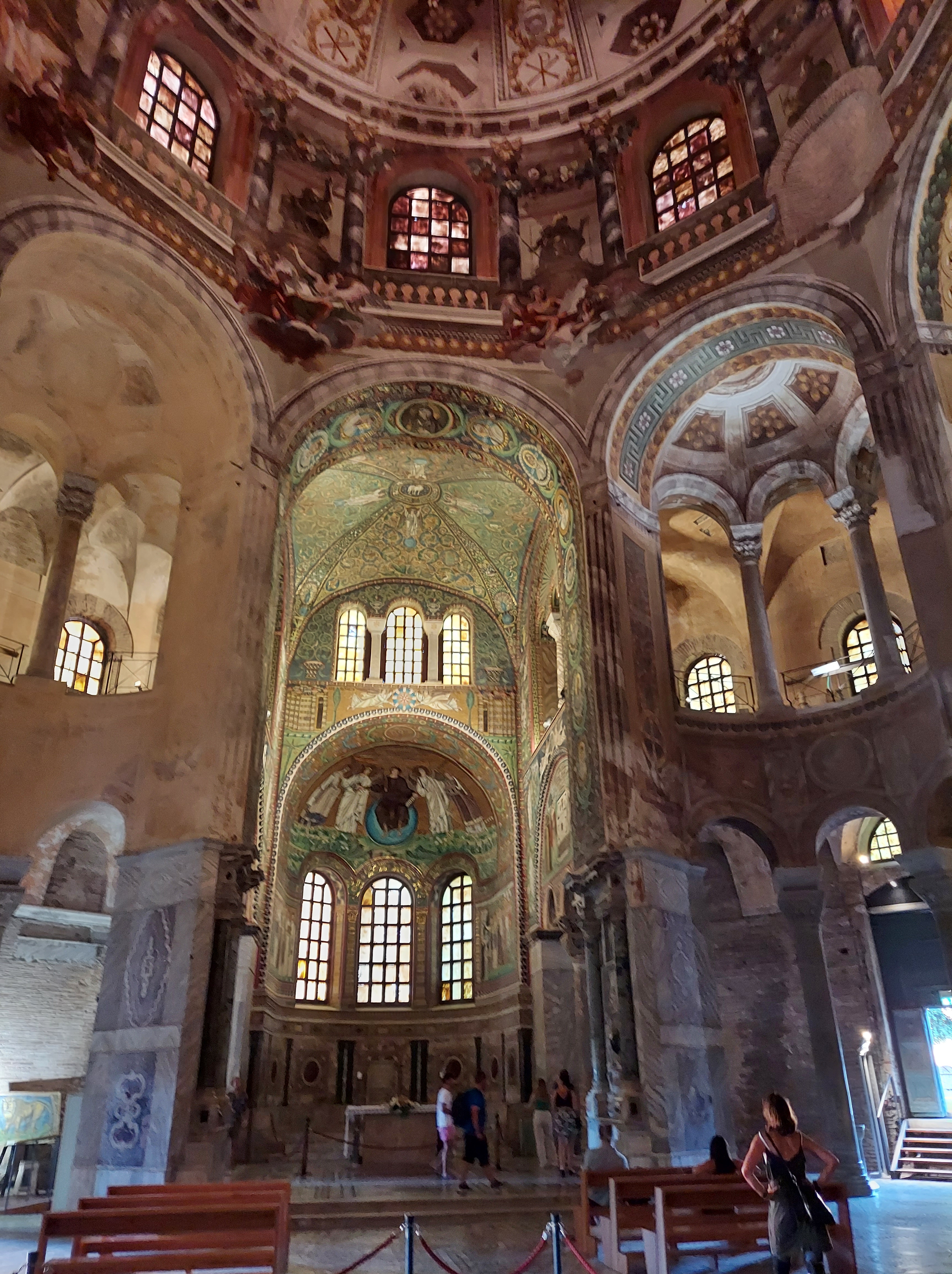
Venice has banned large cruise ships from its harbor, so our cruise starts from the port city of Ravenna two hours to the south. Ravenna has, quietly, slithered its way into world history: it was the Roman capital for a hot second after the sack of Rome, and it serves as the final resting place of Dante Alighieri. Most of all, though, it is known for its mosaics, and four of us make a circuit through the city on our first afternoon there, freed to move at our own pace through sparsely populated streets. We gaze at the art, stop by a café near Dante’s tomb, and pause beneath the cypresses at San Vitale, the cicadas droning in the midsummer heat. We gather ourselves at the Fargo Café, which serves non-Italian craft beer for reasons we will soon come to understand, and then cross paths with an aunt and uncle who aren’t cruising but are along for these first few stops. We endure an unfortunate tasting of Italian beer and then atone for this assault on our palettes with a dinner on a courtyard recommended by a local. The meal proves to be a four-hour affair, so it’s a good thing the cruise ship isn’t going anywhere tonight.

These long nights of food and drink are a staple of this venture, and one my extended family is delighted to inhabit. Moreover, for an American, Europe in 2023 is straight-up cheap. We repeatedly marvel at the cost it takes to feed a large group, all in a transparent price structure free from any pressure to tip. Somewhere in here there is a longer discourse on the relative merits of the high-stakes, higher-growth American economy versus its European counterparts, which are noticeably more sclerotic but nonetheless pay servers living wages and give people the leisure to enjoy nights like this. For a tourist drifting through, though, it’s not hard to eat up this lifestyle.

When I pull open the curtains on my sixth day in Europe, it’s clear I’m in a different land. The ship has nudged directly into the harbor of Messina, the city baked in a brown-gold tinge that blurs both its historic monuments and its newer apartment blocks. Messina clearly lacks Venetian wealth or even Ravenna’s calm, stately history. It does, however, command the strait between Calabria and Sicily, the only stop on this cruise where one can stroll two blocks off the boat and be in the middle of the city instead of some large working port. It is a gateway city, both to the Italian mainland across the whirlpool-filled strait and down the Sicilian coast.

The tour I’ve chosen for this day, Taormina by Land and Sea, is the best Royal Caribbean-organized shore excursion I take on this trip. A bus ride down the coast takes us just past Taormina to the quieter town of Giardini Naxos, the first Greek settlement in Sicily. The tour bus disgorges us into small boats with room for about ten passengers. Our guide, Pepe, takes us from Naxos along the coast, past beaches and grottos and exclusive hotels and villas clinging to rocky promontories over serene waters. He points out the spot where Naxos ends and Taormina begins (“to the left, beer five Euro. To the right, ten Euro”), explains the famous figures we may meet on these beaches (“football stars, movie stars, Pepe”) and acknowledges the most important house on the coast (his birthplace, of course). He pulls out a cooler of Messina beers, and when we look around, we realize our boat is the only one enjoying this perk. After cruising around a point we pause and jump into the cove for a swim, dodging jellyfish in the refreshing water before cannoli and prosecco back on Pepe’s craft. The man knows how to live.

From there the bus takes us up into Taormina, an ancient town fused to a ridge above the sea. This is paradise found: the touring crowds have descended en masse on its one cobblestone thoroughfare, and we hear thirty-six or thirty-seven times about how the city recently hosted a season of The White Lotus. To add to the fun, there is a film fest here this weekend. But the side streets are dead quiet, little stairways up to churches and tucked-away houses and a ruined Greek theater, with views down to the Ionian around every corner; lunch comes at a swordfish panini stand at a far end of the city. The Greeks knew what they were doing when they chose this bit of coast, a distant outpost that proved a Vietnam or Afghanistan for Athenian imperial ambitions.

Sicily’s blend of natural and human beauty sets a very high bar, but if anywhere can clear it, a few towns on the northwest coast of Italy may be the place. The bus ride from Livorno north to La Spezzia is an immersion in Tuscan and Ligurian countryside. The monuments in the Piazza dei Miracoli in Pisa rise up out of the morning haze in the distance, and the mountainous mines of Carrara marble loom below ghostly clouds. Hilltop fortress towns from the Middle Ages stand watch over the autostrade, and in the incredibly compact La Spezzia, the tour bus splits into two mini-buses that can handle the winding roads beyond. We are off to Cinque Terre.

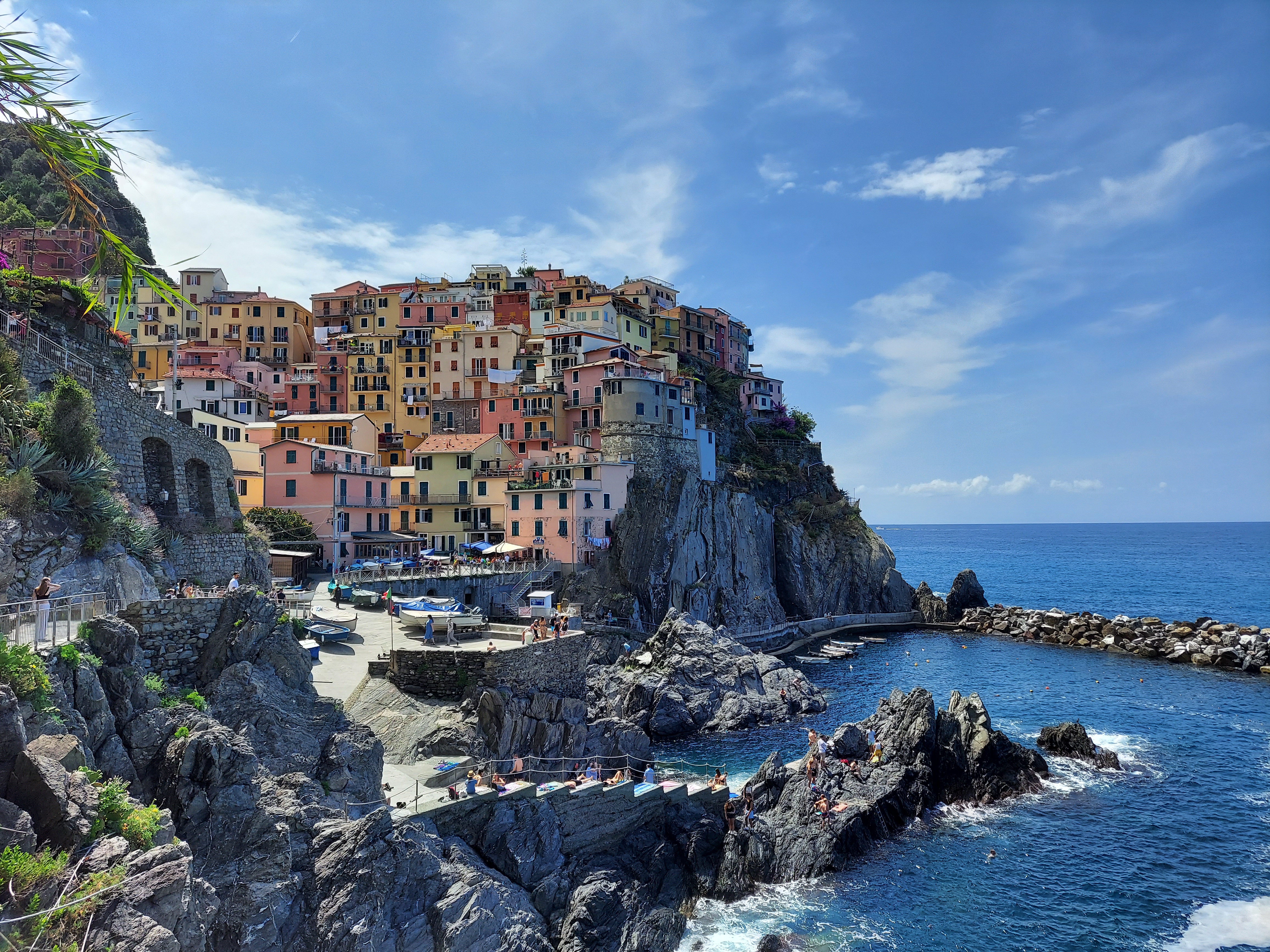
Cinque Terre is a collision of land and water, a Big Sur with 1,500 years of history and an added lushness, lemon trees and flowering shrubs and grapes clinging to terraces at the steepest pitch I’ve ever seen. The wine comes from those very terraces, the pesto from Ligurian basil and pine nuts, the world fresh and alive. In each town, a narrow main road plunges from the highway down to the sea, with inviting side stairs and alleys opening on all sides, a Venice on a slope instead of a lagoon.

A few hours on a small bus can only scratch the surface of a place that demands day, and we see only three of the five lands. Reggiomagiore has the steepest slope down to a small harbor, Manarola has a contender for the world’s best swimming hole and paths that wrap around the cliffs, and Monterosso ends in a beach. I leave Cinque Terre calling it the most Instagrammable place on earth, and it is indeed hard to choose the right selection of shots from these few days to blast out around the world. Venice’s urban form may be unmatched and there are a few places on earth where the natural beauty includes some wonders beyond those of the Italian coastline, but for a combination of the two, I can think of no more impressive place I’ve seen.

Like Venice, Cinque Terre runs the risk of becoming a place no one lives. Our guides tell us that few young people stay here now, loath to cultivate these precarious slopes when more lucrative work abounds. We learn we are fortunate to visit on a day where just one cruise ship passes through, so the crowds are light. But even so, the winding road above the five Ligurian jewels has a fraction of the traffic of an American scenic drive. There is a train down along the water, often in tunnels through sheer cliffs, and most alluringly, there is a trail up and down the terraces that leads from one end to the other. Perhaps more than anywhere else on this trip, the siren song of Cinque Terre summons me back.

Italy is a conundrum of a country. It is a bastion of high fashion, and its people, in my eyes, are among the most consistently beautiful on offer. It is the inheritor and steward of some of the world’s greatest history. But now it shows its age around the edges, worn and creaking, an aging beauty who’s had a few too many plastic surgeries and is still trying to live like it’s 25 instead of 75. It is now a potential European canary in the coal mine as the continent tries to find its way, its great projects stalled out and a revanchist Russia at the doorstep, left to cope with a series of crises: a fumbling economy, a migrant surge, unstable governments lurching toward extremes, near-catastrophic birth rates. But I suspect some of its intangible qualities may help keep it afloat: what a beauty it is, even compared to France, where we spend one brief day on this cruise.

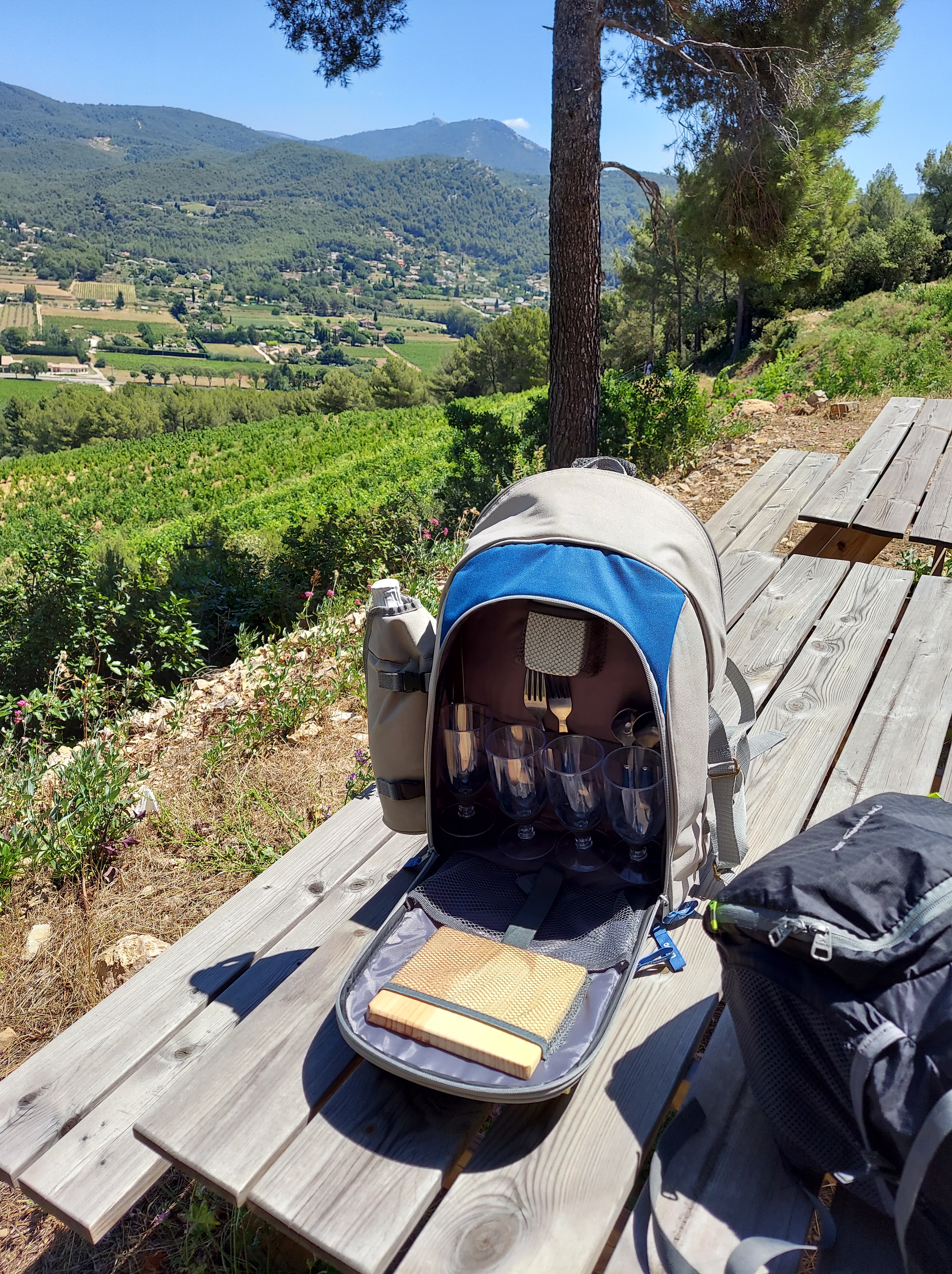
In Toulon, a port and naval base just southeast of Marseille, ten members of our party organize our own tour, which operates under the working title “Something Involving Karl and Wine.” After some momentary fumbling we acquire a motorcade of three cabs for a ride up through the dry Provencal coastal range to Domaine Fonts des Peres, a winery in the Bandol region. Here, the Mourvèdre grapes produce rosés at the bottom of the hill and the designated Bandol reds at the top. A vintner leads us through a tour and a tasting (including some of the best gin I’ve ever had, to go with the wine) before we are presented with picnic backpacks of quiches and focaccia and cheesecakes, and we select a few of the wines we like and stroll off for a leisurely picnic in the middle of the vineyard.

It seems fitting to complete our last shore excursion away from the clutches of the cruise ship, basking in Provencal sun, drinking in the wine and beauty with nine fellow travelers who are equally enamored with the whole enterprise. We’ve had our ups and downs, from travel annoyances to the grand sweep of this family history. But here, on the sea at the center of the world, gazing down at a vineyard and taking a sip of rosé, we have found that very heart of the good life. I suspect we shall return.

Part 3 is here.

Europe 2023, Part I: Rebirth

This is the first post in a four-part series.

A simple fact of travel is that things will go wrong, and one’s enjoyment of travel is directly tied to one’s ability to adapt when things go wrong. Alas, when forty-two members of an extended family travel to Europe for a Mediterranean cruise and some offshoot adventures, there are bound to be a few victims. On this venture, I am one of them. Parts of this trip feel like they are designed as a test of patience, and it starts on day one, when the Newark airport decides to keep my plane from Minneapolis, already late in departing Minnesota, sitting on the tarmac for 40 minutes before pulling up to a gate just long enough to miss the connection.

There is no indignity quite like airline indignity. A delayed arrival in Venice is the definition of a first world problem, and there is the bizarre shared ritual of ten despondent people who have never met throwing their bags down when the gate agent, possessed of a robotic soullessness, closes the door to the jet bridge and informs us it cannot reopen. Thankfully, a United representative manages to get me on a Swiss Air flight via Zurich that arrives in Venice only five hours later than planned. Not helping the airline’s cause is the Newark airport, a poorly connected, poorly signed cesspool where some light drizzle renders 80 percent of the flights on the board delayed or canceled. (This was not my first such experience in Newark.) As of this writing 23 days later, my checked bag is still there, its location known both to United and me, yet they are in no rush to return it: no matter how politely or angrily I address them, I can be safely assured anything they tell me about its progress toward me is a lie.

So of course, my first hour and a half in Europe are spent trying to locate my lost bag. Of course, when my number is called at the lost luggage counter, some Italian marches in front of me so he can carry on some pointless argument with the staff. Of course I get the woman with the employee-in-training badge, whose look of sheer defeat when she learns United had no record of my bag because it was switched to Swiss Air will be forever burned in my memory. And of course, the driver who takes me from the airport to the water taxi stand gets in an argument with the water taxi guy before he audibles and decides to just drive me across the causeway into Venice before securing a different water taxi. My arrival in la serenissima calls for a serenity prayer.

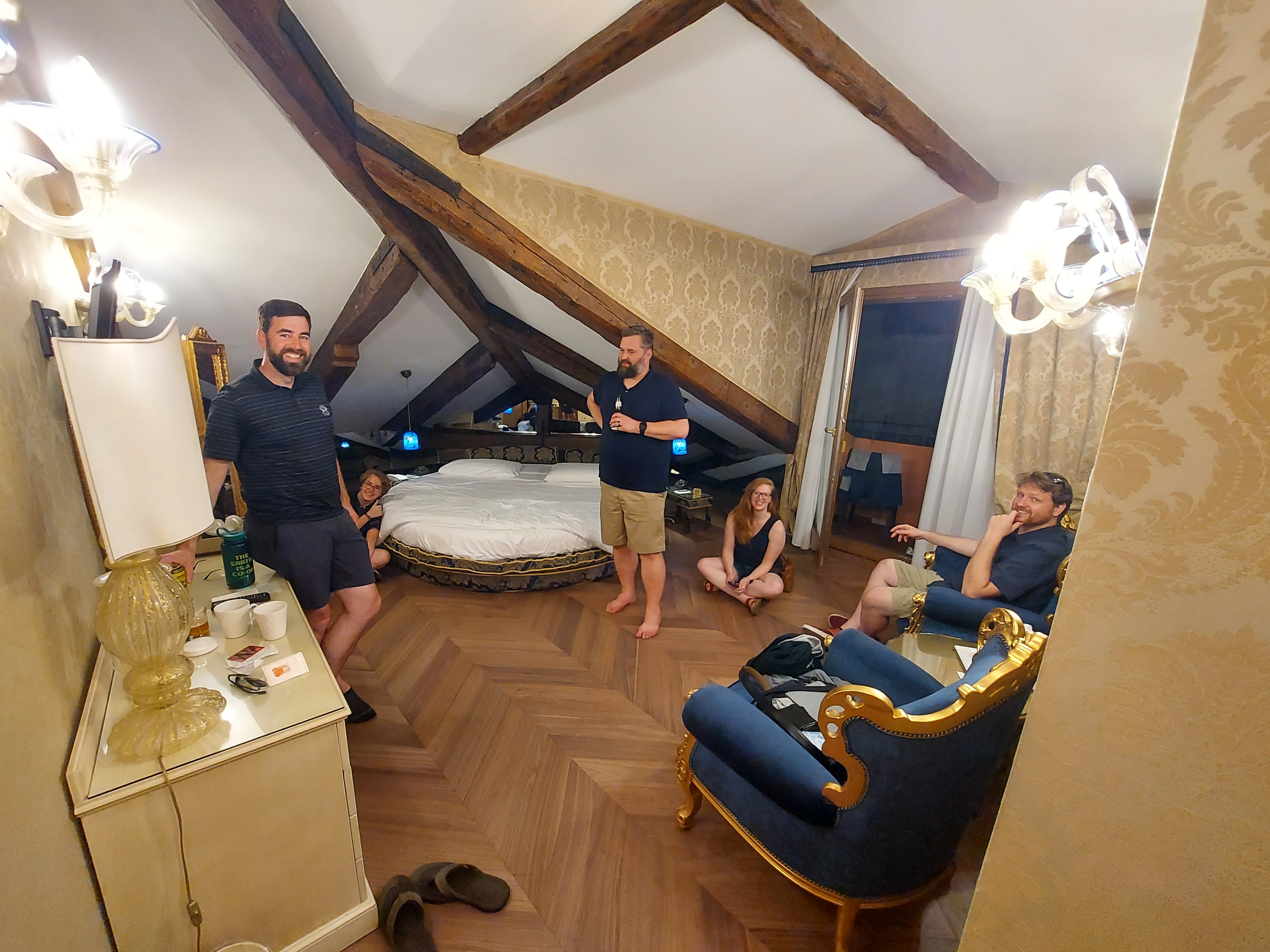
And then I see the hotel room I am sharing with my cousin, for which only a picture can suffice.

And yet, while mildly loopy after my travel ordeal over 30 sleepless hours, I am smitten by Venice. I get the taxi to myself up the Grand Canal and stand in the back, feeling vaguely James Bond-ish as it flies along. The hotel room is ridiculous enough to be a point of endless fun for our two nights in Venice, and the bed is in fact big enough to sleep two adult men with four feet between them. The room opens out onto a tiny balcony with a view of San Giorgio Maggiore, St. Mark’s Square is just a few minutes away, and tucked behind our waterfront base camp is a byzantine world of canals and alleys and invitations to wander.

After seeing other global tourist destination cities, I was expecting more garbage, more hawkers and homelessness, more general chaos. And yet here is Venice, reasonably clean, religiously tended, the nuisances kept to a minimum. Yes, the crowds do swamp St. Mark’s and the Rialto and the main pedestrian and gondola thoroughfares. But the attractions of this city are not confined to a small historic center like in so many of its peers, so it isn’t too hard to escape the crush. Across the Accademia Bridge, the Dorsoduro neighborhood offers up some rare greenery; a looping water bus trip takes a few of us to the narrow streets of the world’s first Jewish Ghetto before a chill lunch along a canal and a gradual stroll back. I do not have one bad meal here, octopus and lobster squid ink pasta and more classic Italian fare filling every menu. Every square foot of this city offers up something worth a second look.

There is no point in pretending otherwise: Venice is now a giant playground. But it is the best of playgrounds. If any city deserves to get preserved as a cultural treasure for the rest of humanity to explore, it is this one. Here the Roman world’s inheritance intertwines with the Byzantines and influences further to the east, the legacy of a great maritime republic that ruled half the Mediterranean through both trade and war. No city on earth has a built environment like Venice. Its streets and canals are an alluring maze, an invitation to lose oneself and reappear, serendipity with every step. I’m sure some Venetians would find such a take rather glib as they reflect on what has been lost in the slow museumification of their city. The slogan for rebuilding the Fenice opera house after it burned in 1996 was dov’era, com’era (as it was, where it was), but as John Berendt relates in The City of Falling Angels, the way it was had already made it subject to myriad rebuilds and renovations, a jumble of history with no clear point of return. Venice is a living monument, straining under pressures from both the sea and the crush of tourism, but it is worth saving and visiting because the life it brings out is like no other.

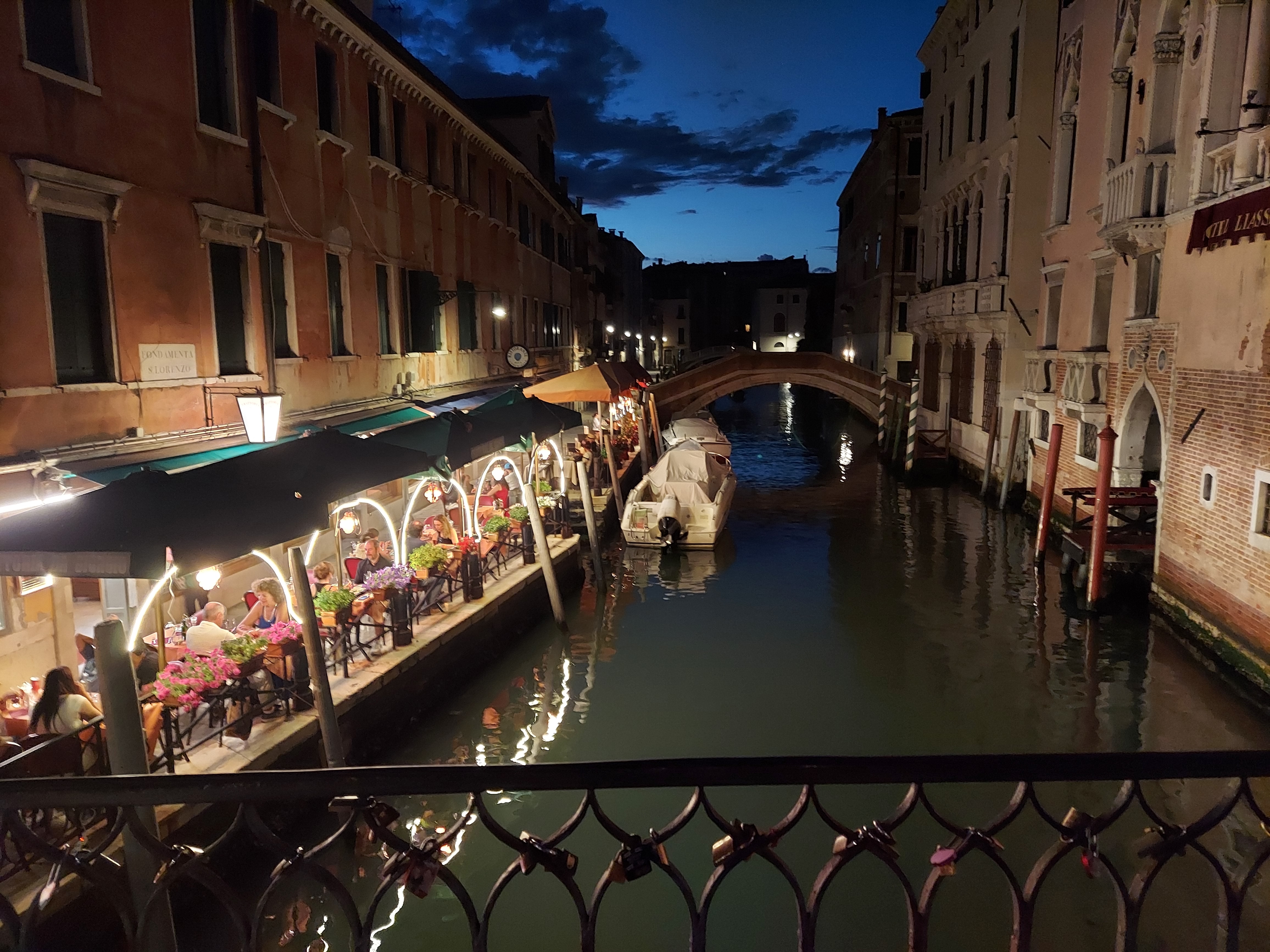
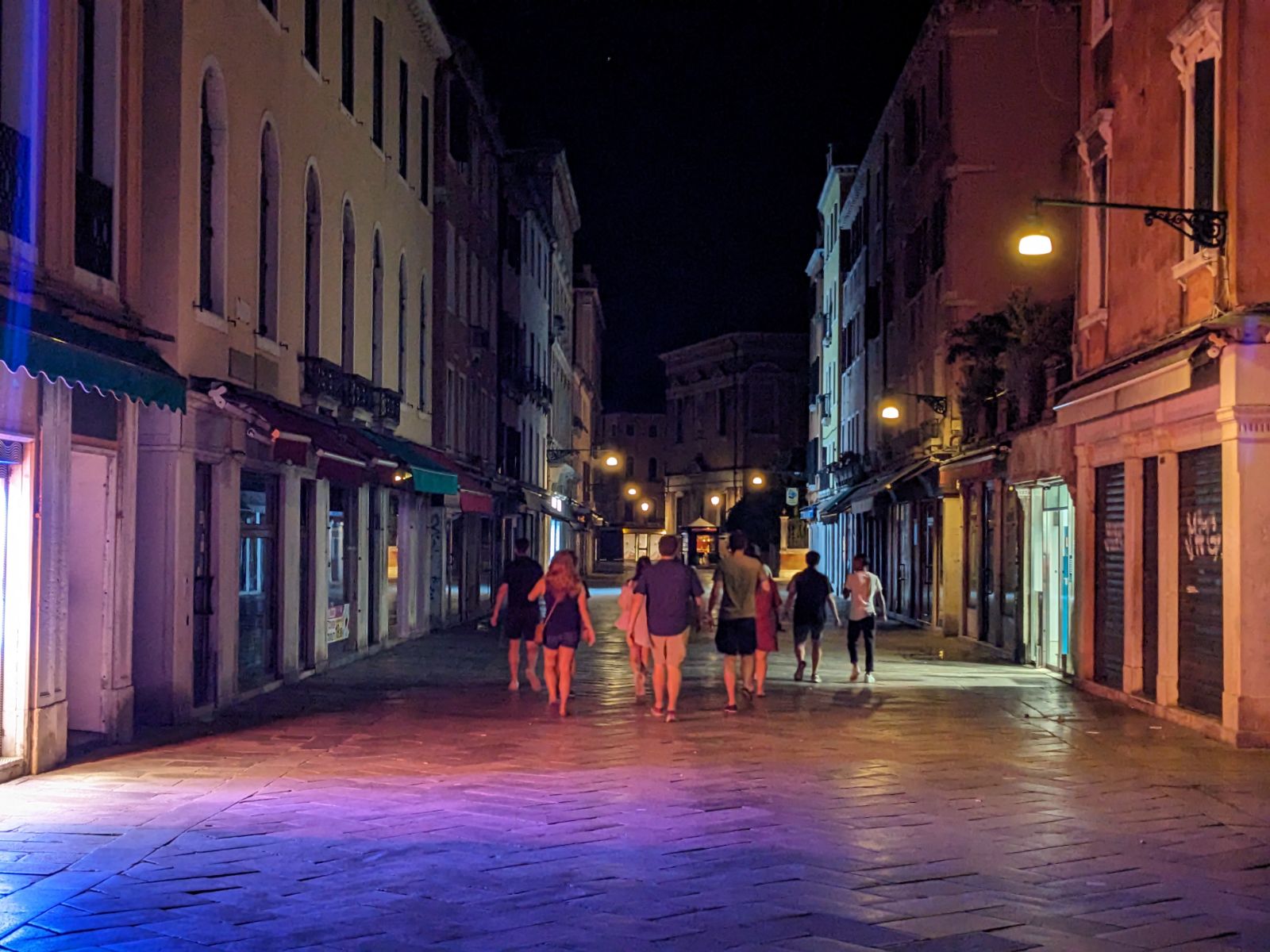
It is after dark that I most fall for Venice. On the first night, a group of my cousins and their spouses connects on the streets and we pick our way to St. Mark’s, the crowds unremarkable, the square aglow in the night. Later, we wind up sprawled on the flagstones along the waterfront, an array of mediocre European beers from a nearby kiosk on hand as we watch the nighttime water traffic, including a mock Venetian galley, cruise by. Several times we play a game where we identify a destination and then try to find our way without looking at maps, over a bridge and through a little arcade, past closed-up bars and lit-up ATMs, here a false turn down a dead end, there the sudden discovery of a church that in any other city would be a stunning monument but here is just some quaint afterthought tucked away on a backwater canal for our discovery and delight. When my fellow wanderers grow restless on a 2 AM retreat from Venice’s finest craft beer bar, I volunteer no details, even though I know the way. I could have wandered these streets until dawn.

I say I could have walked endlessly even though the only footwear in my possession is the same pair of boat shoes I’d worn on the plane, sometimes worn with the one increasingly gross pair of socks I have and at others occupied just by my bare feet as they slide around in a sweat-coated shoe. I am surrounded by beauty and feel disgusting. The next day, resigned to the fact that I will not reacquire my luggage before the ship cruise ship sets sail, I shop for a new wardrobe on Ravenna’s main streets. When life (or a terribly managed airline) takes your luggage, buy an Italian linen suit on their dime.

From there, the trip goes off without any major hitches. The only other real trying day is the one in Rome. Rome is big. Rome is hot. Rome is crowded. After the pleasant surprises of Venice, the Eternal City is frenetic, loud, stuffed with street vendors and pickpockets and garbage. In a city that peaked 2,000 years ago, the fraying seams are clear, and my party is in a state of collective exhaustion by the end.

For this day, I’ve booked myself a non-cruise tour through the Vatican Museums. (I did see the Colosseum, the Forum, the Spanish Steps, and the Trevi Fountain on a visit 19 years ago.) The pace through the collection is never leisurely: the whole time we are swept along through an unending stream of people, all baking in the midafternoon heat. The current tugs us from one gallery to the next, and at one point security diverts our flow through an Etruscan gallery to relieve the pressure on the Gallery of the Candelabra. The Sistine Chapel, the culmination of the tour, is awe-inspiring when one looks up; if one looks around, on the other hand, one gains the perspective of a herd of cattle shuffling through a pen toward slaughter while its Italian handlers around the edges demand silencio and scold the denser cows incapable of reading the ‘no photography’ signs. And yet there are marvels: the stunning Greek and Roman collections, the papal history, an unexpected modernist gallery, the sexy hall of maps, and my own pilgrimage destination on this trip: The School of Athens, Raphael’s great triumph, all philosophy and art distilled into one giant fresco. I am transfixed, and I wish I could linger.

I cannot linger, however, because we are on a cruise, and the boat must leave. We get just five hours to see Rome, controlled by tour guides even for this on-your-own venture. We still nearly lose one member of our party at the end, and my cousins who skipped the official tours and took the train instead also had their share of misadventures amid a few highlights. Between the time necessary to wait for my two-hour tour and the half hour it takes to actually get into the museum, the only other thing I really see outside of the Vatican is the Castel Sant’Angelo; I cross the Tiber only briefly, to meet with my mom and her partner Doug for a quick drink. For someone who reads a book titled Rome as a Guide to the Good Life on this trip (a recommendation by a reader and correspondent) and re-watched La Grande Bellezza (one of my favorite films of all time, in which Rome is a character unto itself) just before it, a day like this one can be something of a letdown.

To fixate on these troubles would miss the point. The message of Rome has never been of straightforward beauty (though it has it all over), but instead of staying power and reinvention, of finding panache amid ruin, or at the very least amid some unexpected chaos. No city can hold all of that complicated history in simultaneous tension as well as Rome, and I have a choice as to whether I fixate on the Sistine Chapel cattle pen or the wonder I find in The School of Athens. In the name of my Renaissance, I choose Raphael.

Part II is here.