Dissonance in a District Divided

On Saturday, the Duluth News Tribune’s Jana Hollingsworth wrote the paper’s best piece about ISD 709 in my memory. It was thorough, powerful, and on the depressing side. As usual, this is one of the few things that drives me up on to a soapbox. Here I go.

The article is primarily about the struggles of ISD 709’s music programs, which have taken a big hit in recent years. The number of music educators in the district has been halved since my graduation just six years ago, to say nothing of the private and small-group lessons that were already in decline. I wrote about this a little bit after the school board meeting two months ago (see the notes after the stars toward the end): a six-period middle school day makes for some ugly choices by students, and music is the natural victim. The suggestion in a letter by Superintendent Gronseth to parents that students don’t really need to study a foreign language in eighth grade, while true to the extent that it corrects a false rumor, would irk me if I were a parent. Shut up and eat your broccoli, kids!

What makes this article impressive, though, is that it digs a bit deeper, and acknowledges that elephant in the room that no one likes to talk about: Duluth’s east-west divide. Duluth is a split city; the new two high school set-up may make that distinction more obvious, but wasn’t any less real before the Red Plan. We have an east side that is home to the financial and intellectual elite of northeastern Minnesota, and while not everyone in the East attendance area is a cakeater, the ancillary benefits of wealth and stable neighborhoods can make all the difference in the world. The east side has the cultural capital to withstand budget crises and large class sizes, and its involved parents will fight hard to make sure the money keeps flowing into the coffers. Meanwhile, we have a west side that has a shrinking student population, more than double the number of kids on free and reduced lunch, and—perhaps most damagingly—a “far more transient” population. How can a District ever make real progress when kids are here one year and gone the next?

Sure, there are bureaucratic ways of getting around this, but it’s tough, given Duluth’s geography. Something like one half of the student-aged population now lives east of 21st Avenue. Elaborate line-drawing and busing schemes are an option, but as we reflect on the 60 years since Brown v. Board, we’ve learned that, however noble the intent, busing alone cannot correct the inequities in a city, and in general has simply proven another catalyst for white flight to the suburbs. Duluth’s dynamics in this regard are far less racial, but there’s no reason not to think that a number of those with the means to do so wouldn’t follow the incentives and create their own solutions if their children are forced into the “weaker” school in a search for equity. Like it or not, reality demands that Duluth confront the incentives that exist in the current system. No PR operation is going to change them. The solutions here are primarily in the realm of economics and urban planning, not school buses.

I’ve said this numerous times when talking about this divide, and I’ll stress it again here: the west side of Duluth is no ghetto. It has some quality neighborhoods and a strong sense of identity. It’s not beyond repair, and some people on the west side would take issue with the suggestion that it even needs repair. To the extent that it does, much of it is beyond the purview of a school district. It can’t give parents jobs or repair broken families or generate homeownership, and educational struggles will probably forever follow issues such as those. It makes no sense to force students district-wide into the same box and expect the same outcomes. Solutions must work with the reality on the ground.

ISD 709 has, quietly, acknowledged this. From the singular focus on math and reading at Laura Macarthur to the intensive programs at Lincoln Park detailed in this latest article, the District has put extra emphasis on basic skills. This is in many regards a practical decision, both in the need to raise test scores for funding purposes and in the need to have kids who can function at reasonable levels. Obviously, this isn’t without its trade-offs, sometimes potentially very negative ones. The most familiar is mentioned by Member Seliga-Punyko: things like music, athletics, and elective classes give kids reasons to be excited about school, and want to be there. If they don’t get this stuff early in their lives, is there any reason to expect they ever will?

There is another danger, here, though, something underscored even further by the recent elimination of Spanish 5 at Denfeld: there needs to be a track for the high-achieving kids on the west side to keep up with their peers on the east. The benefits are manifold: it sets a high bar that can give students a reason to strive in school. Those high-achieving students, many of them from stable families with deep roots in the area, are the glue that holds these schools together, and the foundation necessary for any broader scheme to rebuild that side of the city after thirty years of industrial decline. If options for those students get squeezed out, odds are they’re going to leave, and that only worsens the trickle-down effect. The west side’s test scores drop further, more resources get shipped out there to prop them up, and in time the east side starts to feel the strain, too, and suddenly we’re all going down the drain together. If that means devoting some extra resources to the west side to prop up certain options, as Clare Chopp suggests, then this kid who bleeds red and grey says “make it happen.”

This isn’t a big city. ISD 709 can’t just close low-performing schools left and right as in large urban districts, especially not in the wake of the Red Plan. (Though even that isn’t guaranteed to work; see this striking piece on school reform in Newark in last week’s New Yorker.) For all their differences, the east and west sides are intricately interconnected. It is not the job of school districts to make war on geography, and while they can be a source of social change—and probably should be, to the extent that they can—it’s delusional to think schools can do it alone, or even that they are the primary factor. Instead, the District has to work with what it has. There is only so much the schools can control, and I certainly have plenty of sympathy for the School Board members and principals as they make painful decisions on what must be cut. In the end, it all comes back to incentives: a few gentle pushes can make sure students have all of the opportunities they deserve.

To that end, here’s one idea: actively pressure kids to take tougher classes so that they can generate the numbers necessary to sustain them. Much too big of a deal is made out of the AP label in ISD 709. Just about anywhere else in the country, AP is a relative commonplace. If inner-city schools can cram a host of poorly-prepared students through the AP curriculum every year—as many do—Duluth most definitely can come up with a single class of AP World History students at Denfeld. Even a half-assed AP class that doesn’t quite teach to the test is better than a “regular” course (though it should, of course, aim for the top—push the kids, and who knows what might happen).

I understand that AP is not the be-all, end-all, and six years removed, I can see what a rat race the fight for a good high school résumé was. However, this is not something you lessen by lecturing from on high on what one needs to take to go to college, nor by lopping off options and saying “eh, you’ll turn out alright in the end.” AP is not for everyone, just as college is not for everyone, and there is no shame in finding stable employment in, say, a trade profession. (To ISD 709’s credit, its programs in this department are strong, and it should be commended for standing by them, despite this not doing much for those all-important test scores.) CITS covers most of what kids need for local colleges and can even ready kids for AP tests adequately with just some minor tweaks, and I’m naturally bit skeptical of blanket standards imposed by the College Board. Still, AP is the common language spoken at strong colleges across the country, and I would have been dead in the water at Georgetown without the skills I learned in the AP classes I had. I can’t speak for Denfeld, but when I was at East, I was impressed with the school’s ability to prepare students for a variety of paths, from elite colleges to the local ones to the trade professions. There was a healthy diversity there, and in my mind, that is more important than relentless pursuit of higher test scores.

The path to tougher classes could be further incentivized by weighting grades. That would give students added reason to challenge themselves, and also might break up some of the grade inflation that can happen in ISD 709. Fifteen people in my East graduating class had 4.0s, which is kind of ridiculous. Everyone gets a medal! Not that there weren’t plenty of very smart people in that group, but there were surely some different paths to those high GPAs, to say nothing of the hyper-competitiveness fostered by the fear that a single B could drop a person 15 spots in their class rank. It would be cute if we could get kids to take high-level courses simply for the love of learning, but a little push never hurts, and getting into the deeper stuff isn’t a bad way to hook people, so long as it’s well-taught.

All of this brings us back to music, and there really is only one solution to that conundrum: get that seventh period restored to the middle school day. I don’t want to hear anyone blaming the Red Plan, and I don’t want to hear anyone blaming state or federal mandates. There are plenty of things I dislike about both of them, but framing all of this District’s issues through them amounts to a whiny denial of responsibility in the here and now. We have to confront reality, not a world of wishful thinking in which things are not as they are. Whatever Supt. Gronseth might plead in a letter, there is no sustainable future for the music programs with a six-period day. I was impressed by his admission in the article that some of the things the District tries to save money “don’t work out so well.” That’s an essential review process, and there is no shame in that admission. We could use more of it in many fields, and no one is above it.

Of course, this is all easy for me to say; we’ll see what can feasibly be done. Tuesday’s Board meeting should be an interesting one: do the Members rehash the same old talking points and past wars, or do they confront the existing problems with both the seriousness and the humility necessary? Their actions over the first few months of this new term have given me some hope. As usual, I’ll be on hand to see if they hit the right notes.

Don Ness Goes West

I took a break from packing for the State Tourney to watch Duluth Mayor Don Ness’s State of the City address tonight. It was vintage Mayor Ness: upbeat, ambitious, and optimistic about Duluth’s future. Indeed, Ness has good reason to be optimistic; he began by listing off some of the city’s big wins over the past year, from record-low unemployment to the demise of the Last Place on Earth, and said the city is “showing signs of population growth that Duluth has not seen in sixty years.” It would be good to know more about that, but it’s an encouraging sign.

Next, it was on to a few broad challenges facing the city. One is the housing stock, which is already old and strained, and will need to grow if the city does indeed grow. Ness established a few goals and celebrated last month’s housing summit among community leaders, which was a decent start toward addressing a real issue. He also spent some time talking about income inequality, to which possible solutions included “engaging labor,” primarily in the building trades; granting equal access to communities of color; and making sure schools and colleges are teaching the skills students need. There isn’t really anything concrete in among these buzzwords, though there is only so much a local government can do on these fronts.

The bulk of the speech, though, focused on a vision for Duluth’s western end, and the St. Louis River corridor in particular. As Duluthians have learned over the past few days, the St. Louis River is the “world’s largest freshwater estuary,” and the string of neighborhoods dotting the riverbank—many of them separate enough from their neighbors to feel like their own small towns—do indeed have potential if the city “taps into its authentic strengths.” Ness noted the ongoing environmental restoration efforts along the river, and said they went hand-in-hand with economic development. He wrapped up the pitch with four legislative goals: the Spirit Mountain water project, further flood relief for the zoo and Irving Park, the re-implementation of a recently expired tourism tax, and housing incentives. He concluded by saying 2014 was the start of a “virtuous cycle” for the city, and said that “all we have to do is accelerate.”

The most striking thing about the Ness plan is its comprehensiveness. There are any number of ways a city like Duluth might try to improve its economy. It could try to follow the “creative class” theory and attract interesting people who will develop a rich cultural scene. It could focus on Duluth’s historic strengths, manufacturing and transportation, and try to create blue-collar jobs. Or it could embrace the post-industrial service economy and train most of its efforts on tourism, perhaps with some health care thrown in as well. In Ness’s Duluth, the choice is “all the above.” That’s an impressive commitment, and ultimately probably the right one, though the city does need to make sure it doesn’t spread itself too thin and wind up with a lot of some things but no critical mass in anything.

It’s also an incredibly ambitious plan on many levels. First off, Ness does deserve credit for going out there and pitching such a big plan; as I’ve observed before, the west side is not his political base. He doesn’t need to do this. Aside from flood reconstruction and city-wide projects like the expansion of trails, it’s hard to think of any development large development projects on the west side in recent years; most of the attention has been focused downtown, up in the Duluth Heights area, and in a few pockets on the east side such as the BlueStone Lofts. This is a leap into new territory; one he truly believes is the next step in bringing this city toward whatever destiny it has in mind.

It also makes complete sense intuitively. As someone who’s spent some time wandering the western neighborhoods, I agree there is clear untapped potential: natural beauty, empty space left over by dying industry, tight-knit neighborhoods, and a somewhat tired feel that could use some updating. Further neglect will only deepen divides between east and west, and it’s important to act while the west side’s civic pride remains strong.

With great opportunity, however, comes the great possibility of screwing things up. There will be competing visions going forward, and the people who don’t get what they want will have to be placated somehow. Economic and environmental incentives may align for now, but there’s no guarantee that will last. The end result isn’t going to look like the west side of forty years ago, even if there is a decent manufacturing base out there. Community input is essential; this can’t just be something the (mostly east side-based) city administration imposes on the west side. Ness’s nod toward “authentic strengths” is a step in this direction, but people have different perceptions of authenticity, and for many, it involves keeping things the way they are. This is going to cost money—probably a lot of money—and if people don’t jump on the incentives the Administration thinks they will jump on, it will be a financial sinkhole.

On that front, the biggest battle is probably going to be one of perception. For many who don’t live out that way, there’s no real animus the west side; people just don’t feel the need to go there. It used to be big manufacturing area, but not anymore, except for that smelly paper mill; it seems long and spread out and no one can remember the neighborhoods; the schools’ test scores and such are lower than the east side or Hermantown. It’s just there, without any real draws aside from a few trails and a small-city zoo. It has to fight the perception that it’s a part of the city that history has left behind.

That’s a very unfair generalization, of course; there are plenty of bright spots out west, and plenty of people who are fighting for it. (The late Charlie Bell immediately jumps to mind.) There are also plenty of residents who don’t care at all about grandiose things like arcs of history, and simply want to get on with their lives; that could be good or bad for the redevelopment plans, depending on how they’re presented. The point here is that perception moves slowly. It isn’t going to shift with more trails or a co-op or a niche manufacturer. It’s a long process, one that will long outlive the Ness Administration. It can work (witness Canal Park), but it’s no guarantee.

I could blather on for a spell with more questions (for example, why does the credits music sound like it’s from India?), but I’ll stop myself. I don’t have a definitive take on Ness’s vision for the west side, perhaps because I can swim in both seas. My inner developer loves it all, and wants to start drawing up plans on a map while dreaming of the future. Another part of my brain orders me not to be so presumptuous as to say I know what should be done with the side of the city I don’t know well, that history should take its course. Duluth needed a Ness at this point in its history to get it to think past the post-industrial mire it’s been in for my entire life; it will also need its critics acting in good faith, though, or else it will end up with another half-baked, expensive mess that creates more problems than it solves. The vision must remain comprehensive at all steps, and not just pay lip service to certain areas.

I hope Ness is right; I hope this is the start of a new virtuous cycle for Duluth. I also hope it is a patient one. There’s a lot of work to done before we go barreling ahead, but if we do it right, it might just work out in the end.

Don Ness’s Duluth and its Divisions: Election 2013 Analysis

I’ve written a lot about Duluth politics in recent months, with coverage of every city council and school board meeting, plus some coverage of yesterday’s election (results here). Lost in most of this political talk, however, was mayor Don Ness.

The lack of Ness coverage is, in part, his triumph. In this recent NPR interview, he said his goal was to make Duluth politics “boring” again. Six years into his tenure, he’s done that. He remains incredibly popular, and with good reason, considering the successes of the causes he’s supported. The economy has been fairly resilient despite a rough national economic climate. The city has won some major victories against noted antagonists, most notably Jim Carlson. Duluth has a bunch of new schools; despite some wobbly moments due to the way those schools were pushed through, they will be well-funded thanks to the passage of the two levies. Funding for libraries and parks has increased. The city even confronted its huge retiree debt burden and, while it probably hasn’t gone as far as conservatives want it to go, the Ness Administration has proven it isn’t beholden to special interest groups, and that it tries to avoid tax increases when at all possible. Don Ness is the dream mayor of the center-left, and if he is so inclined, he could easily make a strong run in a state or national race. (He even has the adorable children necessary for that sort of thing.) Ness’s warmth has rubbed off on people around him, as eight of the nine City Councilors now lean left. This city has been thoroughly renovated in the image of Don Ness.

However, underneath all of the solid colors that appear on the election maps are a lot of details that are worth exploring. The somewhat unexpected results of three races jumped out at me: Zack Filipovich surpassing Barb Russ for first in the City Council At-Large race after finishing second in the primary, the passage of the second ISD 709 levy question, and Art Johnston’s re-election to the School Board.

All three of these results underscore the east-west divide in Duluth. That’s a delicate topic, as School Board Member-Elect Harry Welty learned with his “gangrene” comments, and obviously it generalizes, and there are plenty of people on both sides of the city who cut against the east-west stereotypes. Still, one trend clearly emerges in election results: the west side’s rejection of the east side liberal establishment.

It’s especially significant when you consider that people from the west side are not a demographic you’d normally associate with conservatism. It’s not a wealthy or suburban/rural region, and in state and national races, it’s still reliably Democratic. This is no bastion of the Tea Party or libertarianism, as shown by the passage of the first levy question in all but one precinct and Ryan Stauber’s inability to break through in many places. Still, the west side is not moving in lockstep with the Ness agenda, and it’s worth asking why.

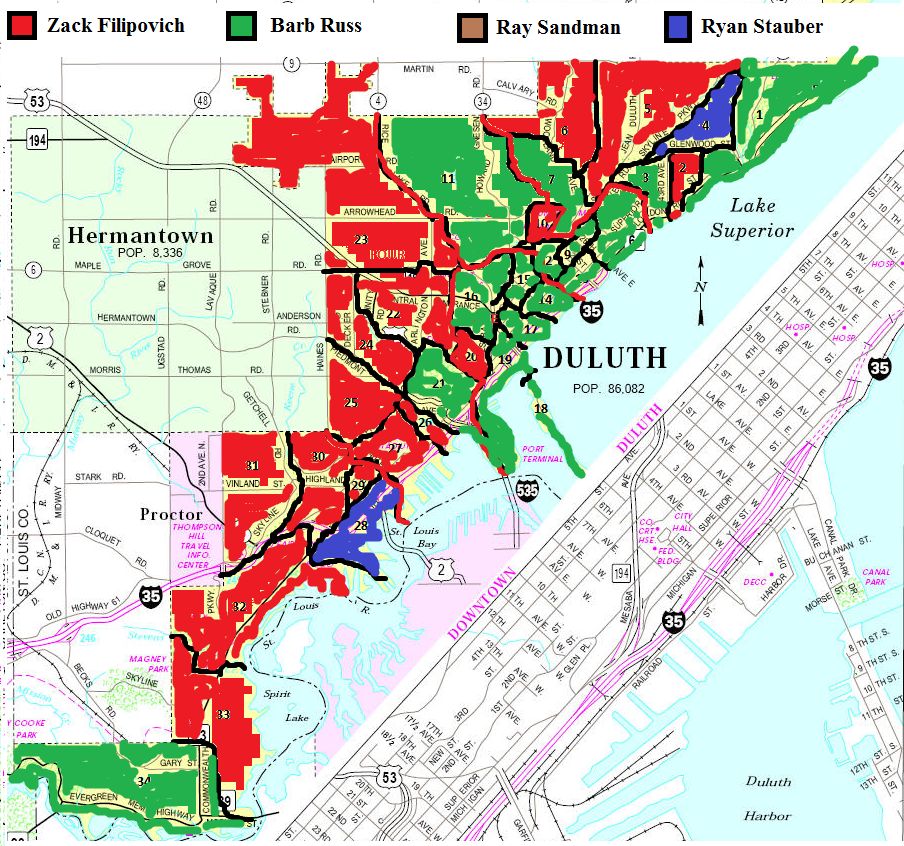
We’ll start with a look at the City Council At-Large race, in which I’ve mapped out the winners of each precinct using the wonders of Microsoft Paint:

City Council At-Large

Zack Filipovich, as you can see, had a very strong showing on the west side. As a recent college grad working in finance, Filipovich doesn’t really fit the blue-collar stereotypes one associates with the west side. Still, his campaign (whether by design or not) was certainly less explicitly liberal than Barb Russ’s, and since he’s young and fresh, he’s not really an establishment figure. Unlike Russ, he made a concerted push to get beyond the establishment, and campaigned out west. For that reason, I suspect he was able to generate a lot more support, especially in an election where voters could choose two candidates. Ryan Stauber was an easy first choice for Duluth’s more conservative voters, but I’d hazard to guess that Filipovich, who remained rather vague and upbeat in his campaign, was most likely to be their second choice. That coalition probably carried him to a lot of victories on the west side.

This anti-establishment-liberal pattern is even more distinct in other recent elections, with the west side being far less interested in sending more money to the city than the east side. In Ness’s first election, he won the east side and lost the west side to the more conservative Charlie Bell. Jay Fosle, the lone conservative on the Council, represents a far west district. Garry Krause, the recently-resigned conservative District Four councilor, was from the west side, and got a decent share of the vote despite having withdrawn from the race. If he’d stuck around, I suspect he would have won. If you want a map that really underscores this trend, though, take a look at the way the city voted on the school board levies:

School Board Levy Map

This really wasn’t a case of the city coming together to support the second levy. It was a case of the east side having just enough votes to drag the west side along with it.

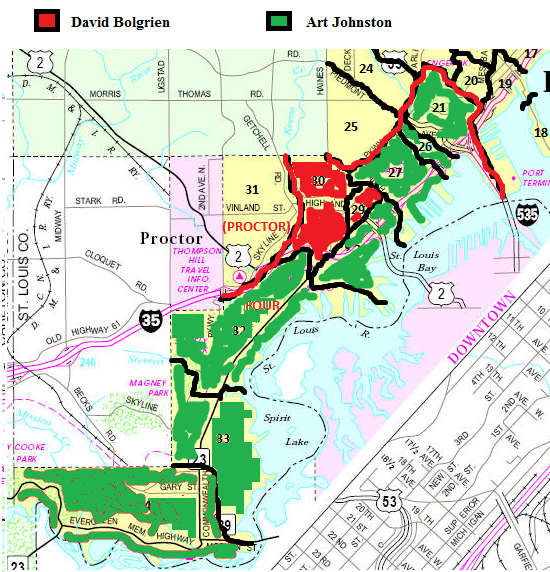
While much of the rest of the city is exasperated by anti-Red Plan crusader Art Johnston, he was re-elected to his far west side district. In the West End area, there seemed to be a lot of passion over the school board race: Bolgrien’s base of support was right around Denfeld High, and Johnston had a bunch of signs in the areas just beyond the Bolgrien core. Heading east into Lincoln Park, however, there were hardly any yard signs. Even so, Lincoln Park broke for Johnston. It wasn’t a vicious rejection of Ness and his School Board allies, but it was a clear one.

School Board Dist. Four

I rarely agree with Art Johnston, but to his very real credit, he too has acknowledged these trends. He posed the question to the Board at a recent meeting, perhaps not realizing that his own presence on the Board is a product of these trends: why does it appear that west-siders do not share the east side’s emphasis on education, and willingness to open the pocketbook to support it? No one answered him, and he deserves an answer.

Part of it may be demographics. The school-aged population is much higher on the east side, so more people have a stake in the schools there. East side voters, content with the generally high test scores at their schools, see the value in supporting the District, while west side voters, seeing more mixed results, may not. (I have never understood the logic behind giving struggling schools less money, but plenty of people explain their votes that way.) Perhaps most importantly, the west side has more people living on fixed or lower-middle-class incomes who are nonetheless not living in poverty or qualifying for many government support programs. Because of that, they tend to be less willing or able to handle a tax increase.  That fact can explain the fiscally conservative bent one sees in the west side’s city councilors, too.

But while socioeconomics may explain a lot of the divide, they are not destiny. To that end, it’s important to understand why a number of Duluthians (no matter which neighborhood they live in) may not be completely thrilled with Don Ness’s Duluth. For that, I’d point readers toward my post from a few months ago on Duluth’s future. It’s a long and meandering post, so I’ll summarize one key part here.

Under Ness, Duluth has made a concerted effort to reinvent itself. It has also made itself a desirable place for young people to live, harnessing its natural beauty and developing a decent artistic and culinary scene. (Yay, good beer!) It has spent a lot of money making itself attractive, and to date, I think that move has been reasonably successful. With the decline in U.S. manufacturing, it was necessary to take that stand and create a new brand for the city, and while I have my quibbles here and there, I’m largely on board with Ness. I was also a staunch supporter of both levies, and I believe world-class public schools are essential to this whole project. However, former Councilor Krause raised an essential concern, and one I am not sure the Ness camp has properly addressed: is Duluth’s interest in shiny, new things coming at the expense of the mundane? Yes, it’s great to attract new people, but what about those who have been here for a long time, and are simply trying to get by?

No matter how many elections Ness and Friends may win, these questions will still exist. They need to be magnanimous in victory, and recognize that simply cruising along with a mandate still leaves some people on the outside looking in. No, they can’t satisfy everyone all of the time, but no one should be left behind because they never got a chance to be heard.

Speaking of being on the outside, the lack of racial diversity here is also worth mentioning: after this election, everyone on the School Board and City Council will be white. This isn’t terribly shocking in a city that is over 90 percent white, and there were two minority candidates this fall who simply did not run very impressive campaigns. Mary Cameron had a very long tenure on the School Board, proving that minority candidates certainly can do well in Duluth. Several of the white elected officials have long histories of work with minority groups. Even so, there is a trend in modern American liberalism in which people politely acknowledge minority interests while doing little to actually address them. I’ve talked up the east-west divide here, but downtown can’t be lost in the shuffle, either.

This all brings me back around to “boring” government. Yes, boring government is certainly better than people screaming at each other nonstop, but there is a danger here, too. This quote from Councilor-Elect Howie Hanson in the October 29 News-Tribune comparing himself to his predecessor brings it out clearly:

“I think Garry [Krause] was a little frustrated because he was in the minority on a lot of votes,” he said, noting that Krause frequently found himself at odds with Mayor Don Ness’ administration and much of the council.

“If we’re going to move Duluth forward, I think you need to set aside your personal agenda and petty politics and get everyone on the same page,” Hanson said.

This bothers me somewhat, and I do not think it is an accurate characterization of Krause’s work, even if I didn’t always agree with Krause. Good governance does not involve everyone being on the same page and rubber-stamping one another’s proposals. It needs constructive, perhaps even heated, arguments. To its immense credit, the City Council has managed that in recent years; the School Board, on the other hand, has not, as it went from being a rubber stamp machine during the Red Plan days to a fractious and ugly war zone during Art Johnston’s first term. With Welty and a possibly conciliatory Johnston on the School Board, I have some hope that it might finally come to a healthy balance. The new Council, with its new left-leaning supermajority, must make sure it doesn’t fall into one of those twin traps that bogged down ISD 709 in recent years.

Duluth’s politicians have the potential to do some great things in the next few years, and the future is there for the taking. We’ll see how they do.