Data on the State of Affairs: Duluth and the Iron Range

My new job has me hanging out with Census data some, and this spins nicely into a blog post that builds on some of my past studies of the Duluth area. Last time, I focused just on Duluth and outlying areas in St. Louis County. This time, I’ve expanded it beyond Duluth for a few reasons. One, there are parts of the Duluth ecosystem—most obviously Superior and Douglas County, Wisconsin, but also large parts of Carlton County and even bits of Lake County. The U.S. Census does publish statistics for metropolitan areas (MSAs), which they determine by county. However, when one of the counties in question is the size of Connecticut, as St. Louis County is, that’s going to wreck the data. As far as the Census is concerned, a cabin on Lake Kabetogama is in the Duluth Metro, and the area’s population lands around 280,000. For our purposes, I chop out everyone from the Iron Range on north, while also subtracting outlying bits of Carlton and Douglas Counties and adding Two Harbors, which the Census does not count as within the area. I was also curious about the Iron Range, a big region that I now work with on a near-daily basis, so I decided to pull its data, too. The end result: I have numbers on St. Louis, Douglas, Carlton, Lake, and Itasca Counties, and subdivide those five into regions so that we can draw some conclusions about different areas.

I subdivide the cities and regions in ways that try to explain a few things about them. To clarify this first table, “Outlying Towns” refers to communities like Cloquet, Proctor, and Two Harbors, which can stand alone as identifiable towns, but are within the Duluth commute shed. There are some differences between them, but they share a general trajectory. A separate, very large category is the wide swath of semi-rural area around Duluth and Superior, from townships to the north and south to Esko and Midway to the west. I include Hermantown and Rice Lake here because, unlike the cities in the previous category, they lack the defined town centers and history of planned development, and have indisputably arisen as outgrowths of the Duluth metro.

I divide the Range into four portions: Grand Rapids and its surrounding rural areas, the West Range (basically, from Coleraine to Chisholm), Central Range (Quad Cities and surrounding townships), and East Range (beginning with Biwabik and ranging all the way up to Ely). Apologies if anyone is offended by these groupings, deal with it; census tract names are also my own. Anything that doesn’t nest comfortably into any of the above categories gets lumped into the “Rural Areas” group, which I’m not going to devote a lot of attention to here: basically, they are shrinking, much older, and generally somewhat wealthier, probably due in part to the elevated age. Here are population, household income, and age statistics by region:

2014popincage

First off, for all the moaning about the struggles of northeast Minnesota in the current economy, the region modestly outperforms the nation in a lot of areas. Population growth may be lower, but income growth is higher, and household median income hovers above the national average. Some of this may be due in part to an older population; old people just generally make more money. But on the whole, I think these numbers are more of a reason for optimism about the area, at least when painting with the broadest strokes.

Also, to combat another common narrative, greater Duluth is not shrinking, nor flat in population growth. Since 1990, when the economy and population basically bottomed out, the region has had steady, modest growth, all driven by the outlying areas. Sure, it’s slower than national growth, but it’s real. The populations of Duluth and Superior have been remarkably stable over that 24-year stretch.
1990comparison

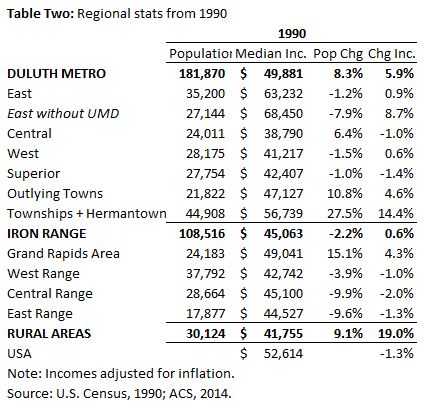
It’s not happy for everyone, though, and as Table Two shows, there is certainly evidence of divergence. Duluth, predictably, dominates both the top and the bottom of the income list, with pockets of great wealth and realms of substantial poverty. Those areas haven’t changed much since 1990—in fact, I was a bit surprised to see so little movement near the top, given the growth of the exurban areas—but the rich do seem to be getting richer while the poor get poorer. (See the table at the end for a breakdown by census tract.) This is less extreme on the Range, but it is noticeable in places, especially around Grand Rapids. It’s worth noting that the “Grand Rapids – South” tract split in two over this time period; I kept it together for consistency’s sake, but the southern, more rural part followed the trajectory of the wealthier areas around Pokegama Lake, while the more central parts slumped a bit.

The influence of Duluth’s colleges is also unavoidable. I split out East Duluth stats with and without UMD to show what an effect they have on incomes in that part of the city, while at the same time boosting an otherwise shrinking population, especially on the far west end of the area. Student housing has spread further afield, and the Census has also made more of a commitment to counting students where they live instead of counting them as living with their parents. (For my part, I’m not a fan of this decision, as I think it distorts things and gives an inaccurate account of the economic standing of students’ situations and of the area they live in, but no one asked me.) This leads university campuses to look like poverty-stricken wastelands; just check out the University of Minnesota campus sometime. Given the number of students, the income measured in a neighborhood like Lower Chester in Duluth is actually pretty substantial, even though it appears below average.

The Range, again predictably, is older and poorer than the Duluth area, and parts of it do worse than the national average. Grand Rapids—whose labeling as “Iron Range” is always a source of controversy anyway—also really carries the region economically. And while the East Range as a whole struggles, it could easily be split between the Ely and Lake Vermilion areas (which are growing in income, though still not rich, and fairly old) and East Range towns like Hoyt Lakes, Aurora, and Biwabik. These are among the worst-hit areas over this 24-year stretch, with the 2001 closure of LTV Steel in Hoyt Lakes looming large. Basically, the areas that have emerged as vacationlands are doing better than the more mining-dependent regions, and this is probably only even more true following the steel price downturn of the past two years.

It’s true that hospitality jobs don’t pay a ton. Ely and Tower aren’t getting rich off their recent tourism growth. But diversification does allow them to do somewhat better than their neighbors, and have something to fall back on in difficult mining times. The advantages are real, and are even more real around Grand Rapids, which benefits from being somewhat closer to the Twin Cities and on a couple of major highways.

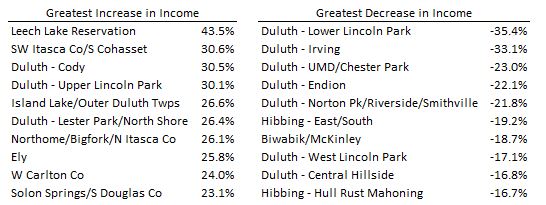
Now, we’ll boil it all down to census tracts, which usually have 2,000-6,000 people and are roughly aligned with neighborhoods and towns.
ChgsinIncome.JPG

The tract with the greatest income growth was a surprise to me: Leech Lake Reservation west of Grand Rapids in Itasca County. The other reservation tract, Fond du Lac, also did quite well for itself. Granted, these native communities are both coming from very low starting points, but it’s worth acknowledging that success, and taking a broader look at outcomes across the board in these areas. The other big gainers are mostly exurban lake country and a handful of Duluth neighborhoods that have seen some growth on the fringes plus, I suspect, some turnover as an older generation fades and gets replaced by a younger, upwardly mobile one. The biggest drops are in UMD tracts, a few of Duluth’s poorest areas, and in mining communities.

youngestoldest

The age table reinforces the effects of the colleges. I’m over the median age in my own Endion neighborhood, proving once again that I am an evil gentrifier who is ruining the neighborhood. The oldest tracts, excepting the two central Duluth areas with large retirement complexes, are all very rural, and the top of the list stays very rural beyond the top ten, too. Central Duluth also trends young, and this is worth watching: are the people here upwardly mobile, and will they move up in time, and perhaps move east or west? Or is this another generation of entrenched poverty?

Answers to a lot of these questions will have to wait, but our friends at the Census can give us some clues. I’ll continue this series at some point, too. As an appendix, I here add the table with income stats on all 98 census tracts in the five counties I looked at:

AllTractsDLH.png

Utopia III

If the instinct toward perfection is an essential piece of human nature, it’s hidden itself pretty well this year. This presidential election cycle alone is enough to paint a dark picture, and that’s not even touching the rest of the world. Even the supposedly hopeful candidate in the Democratic primary spent most of his time calling for a sort of class war. The road to revolution isn’t always bright or happy.

Given this climate, one could forgive people for yearning for utopia anew. A piece in the most recent New Yorker explores some favorable books that favor the concept before landing in my preferred territory of skepticism of grand ideas and defense of gradually moving the chains. There need not be an ideal vision; merely a general direction, and confidence in the steps taken in that direction.

For me, this is a fitting time to reflect on that dream of perfection. The past month and a half has been pretty good to me, basically aligning with my hopes. I’ve gone home again. I have a secure job that I like, and that aligns with both my interests and my general sense of what I want to do with my life. I’m not going to be rich anytime soon, but I’m certainly living comfortably for someone my age. I’m back among some of my favorite people, ready to live a life in the same place as them, and work with them to build whatever comes next. I live in a big old house that nails the details for what I look for in a home. For years so much of this seemed so far away, and now, all of the sudden, it’s all here.

It’s a good time to be back. Autumn in Duluth is one of its more spectacular seasons, as these waning golden days invite us out to marvel in the tapestries lain across the landscape. I hike or run the rugged ridges of the countless parks, wreathed in orange and red and gold and orange. I savor the warmer evenings, sit out on my new front porch with a glass of wine and read some. My book choice for the weekend revisits an old favorite: Amartya Sen, an anti-utopian economist nonetheless filled with hope for gradual movement toward justice. The football field at East is packed when I go by on Friday nights, I watch Verne Lundquist (born in Duluth!) call SEC games on Saturday for one final year, all adding to a sense of timelessness. Well, I suppose some things change: the Yankees are sitting at home in October, and the Cubs of all teams are favored. No matter: there’s a haze of rightness about it all.

I’m not resting on my laurels. I’m too restless to do that, and while I can ground myself for stretches, there’s always another cycle outward. No need for congratulations, either: this is only the beginning, and there’s lots of work to do. Things are moving. Not toward utopia, and toward a state that’s slightly better than where we were before. Now that I’m settled in, it’s time to see what we can do to fight the cynical instinct: not to reach back up to utopia, but simply to reach out with the utmost effort, enough that we can come home content at the end of the day. Onward.

50 Things I’ve Missed About Duluth

I’ve been back here a week now. Here are 50 distinctly Duluth things I have enjoyed since then, or plan to enjoy in the not-so-distant future.

  1. Ridiculously perfect summer weather.
  2. Topography. In Minneapolis, I would go out of my way to find hills when running because it was so damn flat.
  3. Marvelously cheap real estate.
  4. Rush “hours” in which the traffic doesn’t actually get any slower.
  5. Not really caring about leaving ground floor windows or doors open or unlocked.
  6. Bike/running paths that do not require constantly trying to dodge other people on said path.
  7. That slightly wild edge to the green spaces. Which are everywhere.
  8. Walking across the lift bridge, which is inevitably cold even when it is warm everywhere else.
  9. Lake views. Everywhere.
  10. A really big, sandy beach.
  11. Lots of craft beer with no hint of pretension.
  12. 75-cent bus fare.
  13. Silence as I sleep.
  14. Duluth Grill lunches.
  15. Pacing the concourse at the Heritage Center.
  16. Easy day trips to the North Shore, the Boundary Waters, or just the middle of nowhere in the woods.
  17. The India Palace buffet.
  18. The Thirsty Pagan. (Okay, I guess that’s Superior. But for as much fun as we Duluthians poke at Superior, it does have some very good food options, and I’m kinda curious to explore its bar scene in all its glory.)
  19. Being entertained by tourists in Canal Park.
  20. Having Duluth to ourselves again after all the tourists leave.
  21. Grandma’s Sports Garden…eh, maybe not, I’m not 22 anymore.
  22. Knowing the politicians who represent me. (Or, at least, being able to get to know them with relative ease.)
  23. Not having Comcast in my life.
  24. Basically any establishment on East Superior Street between Tycoons and Sir Ben’s.
  25. Seeing stars at night.
  26. Boat horns.
  27. Neighborhood hockey rinks.
  28. Parties in Bayfront.
  29. A breeze off the lake. Well, sometimes.
  30. The tap water.
  31. The Breeze Inn.
  32. Ice cream after a walk on the Lakewalk.
  33. Refurbished turn-of-the-century downtown buildings.
  34. Getting bridged.
  35. Ski trails everywhere.
  36. Congdon homes.
  37. The Duluth arts community.
  38. Enger Park.
  39. The Red Herring.
  40. Amsoil Arena.
  41. The St. Louis River.
  42. That Christmas parade we have in mid-November.
  43. Smelt.
  44. Huskies games.
  45. Sidewalk Days.
  46. The Rose Garden.
  47. Cruising down Skyline Parkway.
  48. Vikre.
  49. Greyhounds.
  50. Late nights on the lakeshore, or on the ridge up above.

Farewell, Minneapolis

I’m settling back into life in Duluth right now, temporarily back in my childhood bedroom as I find my own place and make some other purchases to prepare me for working life. Before I completely turn the page, though, I’ll say a fond farewell to Minneapolis, my home for the past two years. I only ever expected it to be a short stay; a stint that would simply prepare me for an eventual return to Duluth. I didn’t invest myself too deeply in its politics or inner workings, and kept my attention fixed to the north. One can only handle so many political sagas at a time, though I was there for long enough that I certainly know the lay of the land now. Things went according to plan, so this post won’t approximate my “Farewell Duluth” saga from August 2014. But I did fall for much of Minneapolis in my time here, and I will miss parts of it.

For starters, my apartment and neighborhood were ideal for my situation. I lived in a spacious apartment in an old red brick building with hardwood floors, though the building’s greatest feature was Frances, the elderly, vivacious building manager who kept us all in line. My friend in the apartment’s other bedroom, a fellow Georgetown grad, provided a necessary sounding board, as two people who had their critiques of the Minneapolis mystique could vent freely while pursuing our goals, divergent as they were, with typical Hoya ambition. Lowry Hill East, despite its hopelessly dysfunctional neighborhood board and historic renovation slush fund, gave excellent access to the whole city. It was right between Uptown and Downtown, both a short ride or a long walk away, and express buses to the U took me there in less than ten minutes. A short run was all I needed to reach many of my favorite parts of the city: the lakes, the sculpture garden (RIP), and my favorite refuge here, Theodore Wirth Park. And, next door, Liquor Lyle’s, that magical den where you can find a little something of everything.

I saw nearly every corner of the city in my time here. Downtown, where I worked for a year, threading the skyway hive and watching as the beast of a new Vikings stadium arose day by day. The North Loop, its warehouses all freshly renovated, home to happy hours and Twins games. Northeast, with its ever-expanding network of breweries and dive bars that put Lyle’s to shame. St. Paul, which I frequented on bike rides up Summit Avenue to a winnable trivia, and of course that southwest corner of downtown, which I’ll continue to visit every March. Lowry Hill, Linden Hills, Bryn Mawr, and the Chain of Lakes, where I sized up grand old houses and dreamed of the future. North, site of many a run, and subsequent reflection on race and poverty in this otherwise gleaming city. Quirky, crunchy Seward; the looming towers of Cedar-Riverside. The riverfront, always a convenient escape, whether down along the southern bluffs or from a bar on St. Anthony Main with that incomparable view. All those hockey rinks out in the suburbs that became frequent haunts in the winter months. I could trail on.

The University of Minnesota campus isn’t an aesthetic masterpiece; that’s especially true on the droll modernist West Bank, where I spent most of my days. I enjoyed being part of a power conference school (albeit one that doesn’t win much in the big sports), with all the attendant atmosphere and that infectious buzz of spirit. Comparing it to Georgetown naturally dooms it: they serve different purposes, and of course a large, sprawling research school is going to spawn a few more weak instructors and a bureaucracy that often left me in disgust. Thankfully, they were outshone by handful of committed leaders, and their numbers seemed to grow in my time as a Gopher.

What the U may have lacked in institutional efficiency, however, it made up for in the community it built in my graduate program. My fellow students of cities will stay friends for a very long time, and saying goodbye wasn’t easy. Our social calendar was nearly nonstop, and I’m sure I’ll be watching it forlornly from a distance for a while. I spent so much of my time in this city on the couch in the MURP Lab, where I rarely ever got anything done, but rarely regretted the detour. It was the prefect venue for coming into one’s own.

This is, of course, a brief goodbye. There will be many return visits for nights with old friends, for trips to suburban ice rinks and Orchestra Hall and Target Field. I’m excited to show off my hometown and my new life to many of them, and am ready to open up a mini boarding house for any Minneapolitans in need of an escape northward. Wherever I end up living, there will be plenty of space for guests. (After miserable DC and inflating Minneapolis, Duluth real estate is dreamy.) Thanks for serving me well, Minneapolis, and I expect you’ll always be a pleasant home away from home.

A few housekeeping notes: blogging may be a bit sparse as I settle in to a new job and home. Since I try to maintain a pretty strict work-blog separation—in over three years at this, you’ll never find more than a passing mention of any of my jobs—I also might not resume my Duluth politics coverage on the same level I was at a couple of years ago. Now that I have a job that can have some effect on these affairs, I’ll aim to avoid any perceived conflicts of interest. But I certainly won’t cut myself off entirely, either, and I expect to have some openings for comment now when I’m back in the thick of this cozy political world, where there’s little space to hide. On the hockey side of the ledger, I’m naturally excited to be back in my alma mater’s backyard, and also look forward to touring a number of northern Minnesota rinks this winter. Rest assured that I’ll make a few well-timed weekend visits to the metro, and the podcast should be able to go on with me as a call-in correspondent. If anything, our network is just expanding, and the future looks bright on many fronts. Stay tuned.

Going Home

Like any good PR person, I had two blog posts written for today, a victory speech and a concession address. This, I’m pleased to announce, is the former. After a long, sometimes dismal summer in which pickiness over potential jobs led to a lot of painful waiting, my patience has paid off. I’m going home, back to Duluth to work a job whose description might as well have wandered out of a dream of mine from two years ago when I started my grad school odyssey. I’ll be working for a consultant on business and community development across northeast Minnesota and northwest Wisconsin. I try to be skeptical of things like destiny, but I’m still prone to strong hunches, and if there ever were such a tale of fate in my life, this was it.

It’s a move 20 years in the making: this very week in 1996, I first came to Duluth in a moving van. The story twists through long formative years and an unexpected two-year return, and culminates in one of the best interviews I’ve ever done, easy because it was so genuinely sincere. It took no act, no conscious airs, to convey how badly I wanted this, and how much I believed in my ability to do it, despite my relative inexperience. I don’t consider myself a great actor, but as a kid well-versed in Minnesota Nice and East Coast gentility and a natural introversion, deep expression can be rare. Here, it all came gushing forth.

I’ve had a number of guides in this trip back; some may be aware of their roles, others less so. First off, there are my parents, ever my supports, even if I’ve never properly expressed my gratitude to them. I think back to some of my Georgetown professors; one who opened my eyes to the full array of options before me, and one who told a moody senior who was scared to go home that, indeed, “Duluth needs people like you.” (I’m not sure if it does, but I’m glad to be of service to it.) There’s my grad school friend P., who, over beers at Acadia, made the comment that “I’m not sure that Minneapolis needs me,” a sentiment I wholeheartedly agreed with: while the Twin Cities need work, I think they are in good hands, and I’m in a position to make more of an impact back home, where I have easier access to levers that can make a difference, and which I still know far more intimately than anywhere on earth. If I have any ideals on how to perform public service, they come through rooting oneself in a community and understanding it from the bottom up, and I now get to do that. I have plenty of other friends to thank for their encouragement along the way, with special credit to a handful of old Duluth colleagues who went to bat for me over the past two weeks.

It is strange, I think, to be wedded to a city in the way I am to Duluth. Sure, I’ve built some contingencies, and try not to idolize earthly things, but the nagging call was always there. It flies in the face of some other forces in my life, and I try to view my attachment to a place with clear-eyed dispassion. I’m leaving behind a tight-knit network of good friends in Minneapolis, and I will miss them. A lot. (For those of you reading this, I’ll be down often, and you are all required to visit. Seriously.) Any good-bye, no matter how brief, makes me lament lost chances to go deeper with people I know in a place. I’m not sure what Duluth will be like for a 26-year-old single kid who is now out of excuses for tarrying and ready to find someone to share in, and make her own contributions to, a vision for the future. Beyond that, I’m going to need to find some partners in crime in a small city where it’s hard to keep secrets or stay in the shadows. And, of course, I will have to reacquaint myself with blankets of fog, vicious winds, driving on snow-covered hills, and the unspeakably gross time of year in Duluth that in other places is called “spring.”

I now have an adult life to put in order, and will face my share of challenges in doing so. On the one hand, my path appears routine: kid goes away for college, goes home, accepts solid job, settles down. On the other hand, it’s a bit countercultural for someone who had a ticket to some exotic position in Washington DC or some other major city, but chose not to board that train. Whatever it was that led me down this road, it has always felt natural, and I’m content with that much. There’s a lot of work to do, too. Duluth and some pockets of northeastern Minnesota are doing better now than they have been for most of my life, but that’s not true of the whole region that my work will now cover, and even the successes to date are only a basic foundation. It’s an exciting time to head back and begin anew on an effort to support a regional economy and the people who are its heart and soul.

To everyone who’s been a part of this journey, thank you: you’ve all fed in, often in ways you may not know. I’ve been blessed, and am more than ready to set out on the next journey, on to new heights. Let the work begin.

Duluth’s Divisions, Revisited: 2015 Election Analysis

After a minor delay, here’s a dip into the details of the latest election. As you may notice, my map-making skills have come a long way since I last did this.

Oswald

School Board At-Large race, Alanna Oswald vs. Renee Van Nett (Shown in terms of Oswald’s vote share)

We’ll start with the closest race of the night, the battle between Alanna Oswald and Renee Van Nett for the at-large school board seat. Van Nett’s campaign had a more explicit emphasis on racial equity—even if it was a bit vague on how that was supposed to look in practice—which probably explains her success in the city’s most liberal districts on the east side and in the center of the city. She also may have benefitted from sharing a ticket with the popular David Kirby in District Two in the center-east part of the city. Oswald, meanwhile, focused more directly on east-west equity, which helped her carry the west side. Oswald’s more critical history of the administration and endorsements from the likes of Harry Welty also likely helped her out west, where skepticism of the administration is higher. Still, she was much more than an anti-establishment protest candidate, as evidenced by her success in places like Lakeside and the areas over the hill. She was a nuanced candidate who ran a strong campaign, and gave Duluth a rare upset of a DFL-endorsed candidate in a city-wide race.

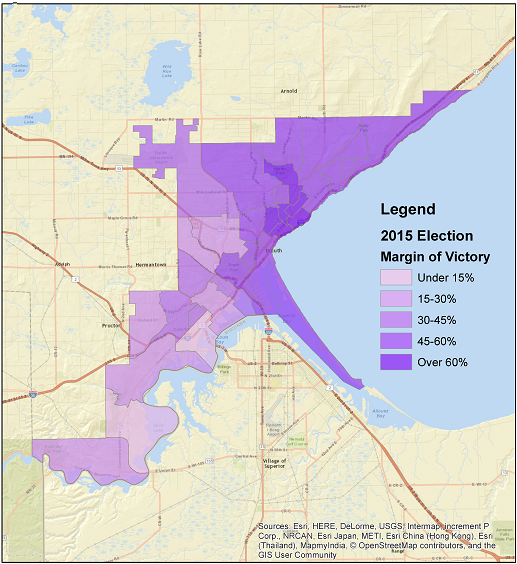
2015 Duluth Mayoral Race, shown as Emily Larson's margin of victory over Chuck Horton

2015 Duluth Mayoral Race, shown as Emily Larson’s margin of victory over Chuck Horton

The main event of the evening doesn’t look all that thrilling; Emily Larson won every precinct in the city in the mayoral race. Still, the margin wasn’t consistent, and reveals the old east-west divide that has punctuated most two-horse races in this city for at least the past decade, if not longer. (Someone with a longer historical memory than a 25-year-old will have to weigh in on the older details.) These results suggest the east side is again driving the agenda, while the west comes along for the ride with varying levels of agreement.

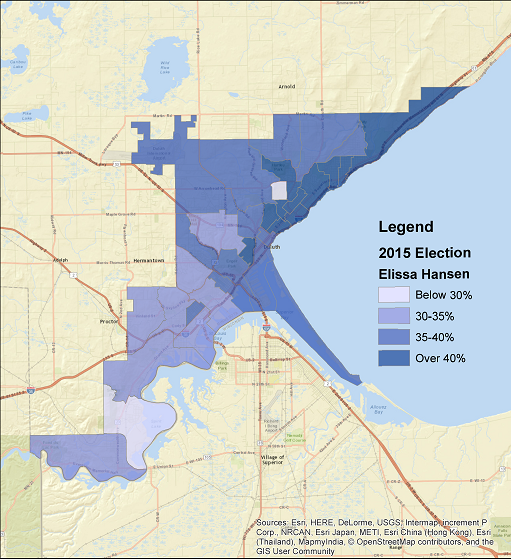
Elissa Hansen's performance, 2015 city council at-large election.

Elissa Hansen’s performance, 2015 city council at-large election.

Noah Hobbs' vote share, 2015 city council at large election.

Noah Hobbs’ performance, 2015 city council at large election.

In the city council at-large race, Elissa Hansen won all but four precincts, though her margins again tend to map on to the east-west divide. Like Larson, she is a poster child for continuing the Ness governing vision with her optimism, youth, and emphasis on inclusion. She lost three precincts to Noah Hobbs, and the two tied in the fourth. All four were pretty predictable: Hobbs, a recent UMD grad, carried the precinct on the UMD campus, and did the rest of his damage on the west side. Hobbs is a died-in-the-wool west-sider, so this only makes sense. (It wasn’t an accident that those lawn signs had Denfeld colors.) This is a second straight election that a younger person has eclipsed the establishment favorite on the west side, but I wouldn’t read anything too deep into this. Zack Filipovich simply had a stronger ground game than Barb Russ on the west side, and Hobbs’ ties carried the day on Tuesday.

Jim Booth's performance, 2015 city council at-large election

Jim Booth’s performance, 2015 city council at-large election

Jim Booth, a Duluth Heights resident, did best up in that region. As the relative conservative in this race, I thought he might do somewhat better on the west side, and while his percentages were somewhat higher, he still ran behind Hobbs nearly everywhere. An explicit west side focus outweighs any ideological loyalty. Anyone who seeks to speak specifically for that side of the city will do well.

Sticking with the west side theme, these trends become more acute with if we hone in on the Fifth District race. Here, Jay Fosle beat Janet Kennedy by a fairly comfortable margin. Still, the district has two clear halves: in the Denfeld and Oneota areas, Kennedy kept things very competitive; she was within 21 votes in the four easternmost precincts in the district. However, she got whipped in the far west precincts, particularly in Fond-du-Lac, Gary-New Duluth, and Morgan Park. This is Fosle’s home base, so it’s not stunning, and across the board, these very far west areas were some of the strongest areas for the more conservative candidates in the field. To the extent that the west side now has an anti-establishment reputation, it is rooted in the very far west.

2015 5th District city council race, Jay Fosle vs. Janet Kennedy, shown in terms of Fosle's vote share

2015 5th District city council race, Jay Fosle vs. Janet Kennedy, shown in terms of Fosle’s vote share

This may be a long-running trend, and the precincts in question are a small enough sample that personal ties for someone like Fosle can make a big difference. Still, this gap endures despite a very intentional effort by the Ness administration to launch a redevelopment effort in this particular corridor over the past two years. That’s significant, and shows that the west side, even if they like the leader of the River Corridor Coalition as a city councilor, still isn’t entirely on board. Once again, the west side wants to talk about west side issues, not the broader liberal ideas one tends to hear from the establishment candidates.

At the risk of conflating a mild political divide and a much deeper discussion, the west side’s demographics hew to a recent attention-grabbing study on the plight of working-class white men. This group feels increasing alienation from the people in power, and whether this involves suicide or more insidious forms such as heavy drinking or drug use—a concern that Fosle, to his great credit, was waving in the face of the Council several years ago—they are dying at a faster rate than before. It’s certainly not hard to see how this affects politics. (See Trump, Donald.) These are somewhat more existential questions on the fate of the American Dream, some of which I’ve explored before, and that theoretical discussion needs to continue. In the meantime, though, cleaning up that steel mill site and other post-industrial dreck, building some new housing on the site of a shuttered school, and bringing some jobs back to the west side will have to do.

In the big picture, however, Fosle’s constituents have themselves a protest vote. Don Ness was not running for office on Tuesday, but he loomed large over the whole race, and his ethos reigns supreme. The city’s government is younger, and solidly on the left side of the political spectrum. Ness’s legacy will last long beyond his eight years in office, and while it will be many years before we can cast final judgment, there’s certainly more cause for optimism now than there was eight years ago. For most Duluthians, the trajectory forward was so obvious that it wasn’t really up for debate in this election cycle.

Still, there is nuance here. Duluth rejected the vogue electoral system because it didn’t get caught up in the latest flashy trend with no actual evidence backing it, and that is a win. A mild upset in the school board at-large race shows some discontent with the direction of the school district, and a refusal to impose a single vision upon it without debate. There is room in the tent for east side liberals and west-side loyalists; for total believers in the Ness vision and a loyal opposition. The more open the process, the greater the odds that a portion of the city won’t get left behind. We’ll see what Emily Larson and friends do with that new mandate.

See two more maps in a follow-up here.

A Patient Cyclist

Fall is kicking in to gear in Minnesota, which means that it will soon be time for those of us who are not ambitious winter bicyclists to stash our steeds away for a few months. For reasons that now elude me, I was never a big biker as a kid; the bike helmet strapped to my bag is a new addition, and given the choice, I’d rather just walk everywhere. But my graduate program contractually obligates me to begin something akin to a Tour de France training regimen, and so I have begun my education.

As Adam Gopnik writes in a recent urban planning omnibus New Yorker piece (alas, it’s behind the paywall), cycling rose to prominence in the 1890s not because it was cheap or necessarily fun, but because it was the fastest way to get around at the time. This became true for me this summer, as construction fouled up traffic between Uptown and Downtown Minneapolis. I took a certain glee in whizzing past the people trapped in their cars along Hennepin Avenue every morning, and Minneapolis’s generally excellent bike infrastructure made the decision to abandon the bus an easy one. When safe lanes are in place, the cyclists will follow.

As the summer went along, though, I began to take a few trips beyond the route of my daily commute. My Tours de Minneapolis never did quite enough to make my runner’s knees totally happy on a bike, but there’s something deeply satisfying in coasting through Theodore Wirth Park or pushing the pace past laboring cyclists on the few inclines this city has to offer. I would around the lakes, cruised along the river, and even made my way over to St. Paul from time to time. A bike camping trip out to the crimson trees of Maple Grove this past weekend seemed the ideal way to cap my first summer as a regular biker. It’s a pleasurable way to cruise about a city, with every corner suddenly at one’s disposal; nimble and versatile, both leisurely and a decent workout, depending on one’s desires.

Defenders of the bicycle are locked in a long-running, low grade war against their great antagonist, the automobile, and no self-conscious cyclist can pedal away from the debate. A lot of drivers are supremely ignorant of cyclists, and I’ve witnessed more than a few cyclists returning the favor by weaving recklessly in and among cars. If this is how rule-conscious, respectful Minnesotans handle things, I can’t imagine the battles elsewhere. As a runner, I’ve also endured countless cyclists who either give no indication of their presence or like to think they own the entirety of a shared path. Such is the grey zone of cycling etiquette, and the frequent imbalance between the letter of the law and what proves good practice on city streets.

In the end, people remain people, often inclined to vent their disgust at other anonymous individuals hurrying off to wherever it is they need to go; sometimes they simply have larger machines with which to express their pathologies. My code on the roads ignores rigid rules and settles for basic common sense. Cyclists need not come to a halt at every stop sign and red stoplight if there is no traffic in sight; a simple yield will do. For pedestrians’ sake, bicyclists should stick to streets when possible, but it is no sin to escape to the sidewalk on particularly dangerous streets. Signaling turns is the polite, and safe, thing to do. Please, cyclists, announce your presence (without sounding passive-aggressive, as if your presence should be self-evident) when approaching pedestrians who appear oblivious or might risk wandering into one’s path. And drivers, open your eyes: you do not have a monopoly on the use of our streets, and never will.

As long as I’m on the topic, I’d be remiss not to add a few stray words on Duluth’s bike controversy this summer. Even though I think the Michigan Street compromise was the most practical option—and for the skeptics of it, I always took Michigan Street both ways on the handful of occasions that I bicycle commuted from my childhood home out east to jobs on the west side of Downtown—I couldn’t help be a bit sad to see the Superior Street push fail. I understand the practical limitations, but it otherwise seems like Duluth is going all in on the bicycle mecca development plan, and the lack of any accommodation for them on the city’s signature street is a glaring miss. (Suggestion for making the Michigan Street corridor work: get a ramp from Lake Place down to the street. Lugging a bike up and down those stairs isn’t ideal.) As long as the network continues to grow and people can learn what a cheap, fast, and valuable form of transport bikes can be, the end result will be a happy one.

Duluth Primary Election Results, 2015

The results are in! I offer my decidedly un-expert opinion on all of them below. Here are my previous comments on the field.

In each race, the top two candidates advance to the general election. I list percentages followed by actual vote total.

Mayor

Emily Larson 67.32 (5,456)

Chuck Horton 18.57 (1,505)

Howie Hanson 9.03 (732)

James Mattson 2.18 (177)

John Socha 1.37 (111)

John Howard Evans .63 (51)

Thomas Cooper .56 (45)

Robert Schieve .33 (27)

We’ll start with the most predictable of all the races, where Emily Larson steamrolled a field with a lot of bodies but very little in the way of actual competition. Anyone who might have been a remote threat to her stood aside, and for all the people involved, there has been very little in the way of genuine debate or serious alternative visions for the future of Duluth. Don Ness’s heir apparent should sail on to another victory in November.

Her opponent in the general election is Chuck Horton, whom I considered the most interesting of the bunch. He’s a bit scattershot and perhaps a little paranoid, but he speaks strongly on issues that others don’t, and is a fairly accurate spokesman for a small but significant slice of the Duluth electorate. Howie Hanson, the only other household name here, came in a distant third. Vague and sporadically directed bluster, it turns out, is not a solid campaign strategy. No one else had much of a prayer of making a name for himself.

City Council District 5

Jay Fosle (I) 56.08 (945)

Janet Kennedy 39.82 (671)

Allan Beaulier 2.61 (44)

Derrick Ellis 1.48 (25)

There are six Council seats up for grabs in the election this fall, but only one required a primary, and I’d suspect it’s also the only one with a realistic chance of shaking up the Council’s political composition. With tonight’s results, however, even that may be a long shot. Incumbent Jay Fosle, the often cantankerous west side conservative, put up a very solid primary showing. He has a well-honed feel for that populist vein that Horton nursed into a spot in the mayoral general election, and his district is in the part of the city most receptive to that message. He’s a very genuine representative of west side political sentiment, and is now in line for a third term. Janet Kennedy has the potential to be a strong opponent, but her campaign will need to pick up considerable ground to overcome a 16-point gap. The other two people in this primary put up negligible vote totals, so she can’t just poach their supporters; instead, she’ll have to turn out the vote and probably convince a few Fosle supporters. It will be an uphill battle.

School Board At-Large

Renee Van Nett 44.70 (3,351)

Alanna Oswald 32.51 (2,437)

Jim Unden 22.79 (1,708)

All three candidates for this open seat had respectable showings here, with Renee Van Nett, the candidate endorsed by the establishment, as the current frontrunner. Still, it’s not impossible to see a path to victory for Alanna Oswald, and if she can pick up the Unden votes and turn out more people in November, it could be a very tight race. This election, which I’ve discussed here, could well swing the composition of the school board.

School Board District 2

David Kirby 56.85 (1,044)

Charles Obije 25.90 (461)

Jane Hammerstrom Hoffman 15.45 (275)

Kirby, another establishment-endorsed candidate, doubled up the opposition in this district, and looks fairly safe to win a seat on the Board. This is the district in the city most likely to support public education at any cost, and was always going to be the most difficult of the three races for anyone outside of the Board majority’s consensus to make any headway. Objie now faces long odds here.

Big picture school board notes: I’d break down the six remaining candidates (including the two in District 3, Nora Sandstad and Loren Martell) into three categories. I see one, Martell, as a likely ally for the current minority of Harry Welty and Art Johnston. Two, Van Nett and Kirby, seem to have little interest in talking to Welty or Johnston and are thus likely allies for the current majority. Three—Sandstad, Oswald, and Obije—are trying to stake out the middle ground. If the primary results hold in the general election, the current majority will retain at least four seats, and we can expect more of the same, albeit with maybe a little less margin for error: the majority imposes its will while the minority makes a lot of angry noise. This strikes me as the most likely outcome, and not a terribly desirable one for anyone who wants to see any change in the tenor of the board.

Things get more interesting if either Obije or Oswald—more likely Oswald—can turn around the primary results. An Oswald win would give the minority a path to electoral victory, albeit far from a guaranteed one, and might force the board members into genuine debate and recognition that they can’t simply fall back on their past positions if they want to get anything done. Yes, there’s a risk that this could encourage yet more infighting, but given the track record of the past few years, I’d be willing to take that chance. On to November.

Duluth Election Filing Deadline Notes, 2015

Hey, Duluth! It’s been a while. I see your filing deadline for this fall’s municipal elections has come and gone, so it’s time to see who’s looking to shape the city for the next four years.

Mayor

We’ll start at the top, which also looks to be the most predictable of all the races so far. Emily Larson has all the inevitability of Hillary Clinton and none of the baggage that makes Clinton unlikable, and it would be a shock not to see her as the next mayor of Duluth. One by one, the people who could have given Don Ness’s heir apparent a run declared their intent to stay out of the race, and the unfailingly positive Larson hasn’t missed a beat.

She does have seven opponents, though, and the field will need to be winnowed down in a September primary. The most intriguing is probably Chuck Horton, the boxing gym owner; agree or disagree with his nonpartisan populism, he has a very distinct take, and some articulate thoughts flowing on his website. The scourge of drugs seems to be the theme of his campaign, while Thomas Cooper also looks to be draw attention toward a clear cause, the plight of disabled Duluthians. John Socha, who ran in 2007 and aims to continue Ness’ policies, is also in the race. John Howard Evans, Robert Schieve, and James Mattson need to tell us a bit more about themselves. Last, there’s Howie Hanson, the Fourth District Councilor who has yo-yoed in and out of the race over the past year. Howie has kept a fairly low profile since re-entering the race, and his positions remain fairly cloudy. Still, he has enough name recognition that he might sneak through into the general election.

The real question in this race is whether someone can offer a genuine policy alternative that might convince others that Larson isn’t the only realistic option. I don’t see it happening, but one never knows. The good news is that the large field indicates some good civic life in Duluth, and even if they don’t win, some of the other candidates might shed some much-needed light on certain issues.

City Council

It’s a busy election year for the Council, with six of the nine seats up for grabs, including four of the five seats based on geographic districts. One of those, however, is not really a race: Second District Councilor Joel Sipress is unopposed, and will win himself a full four-year term after his two-year appointment to a vacancy. In the early going, it’s hard to separate many of the candidates; most say nice things about the Ness Administration, and suggest mild tweaks here and there. It goes to show how powerful Duluth’s political consensus has become

Two other races involve two candidates, meaning there’s no need for a primary. Gary Anderson will clash with former weatherman Karl Spring in the First District in a race to replace Jennifer Julsrud, whose retirement after one term took me by surprise. Spring has a recognizable name, but my only knowledge of his politics is a recollection of a global warming-denying rant a few years back; Anderson, meanwhile, appears the more likely heir to Julsrud’s left-leaning mantel. In the Third District, Em Westerlund and Barri Love will go at it to replace longtime Councilor Sharla Gardner. Both appear pretty progressive, and will have to differentiate themselves somehow in the coming months.

The most interesting race might be in the Fifth District, where two-term Councilor Jay Fosle faces three opponents in his re-election bid. Fosle has become a Council institution with his populist defenses of fiscal conservatism and some groups who normally don’t get much attention, but he’s also the most obvious target for the Duluth DFL. The DFL-endorsed candidate is Janet Kennedy, who is upbeat and has long been active in the community. It’s hard to find much on other two candidates, Allan Beaulier and Derrick Ellis; assuming it comes down to Fosle and Kennedy, it could be a compelling race.

The at-large field has four candidates fighting for two spots, so there won’t be a primary here. Elissa Hansen—disclaimer: briefly, a former colleague of mine—is an upbeat younger person who follows in the Ness-Larson mold, will likely ride to a spot on the Council. Two of the others are recognizable names. Jim Booth, a losing candidate for the County Board in the past, is the most conservative option of the four; Kriss Osbakken, meanwhile, ran on the Green Party ticket for House seat 7A last fall. The wild card here is Noah Hobbs, a young west-sider who’s very active in the community. One might say he’s looking to ride the Zack Filipovich formula of relentless campaigning energy to the Council.

School Board

Three of the ISD 709 seats are on the ballot this fall, and here, there is actually a race for control of the agenda. Three members of the five-person majority bloc that has called all the shots and tried to remove Art Johnston this past year are retiring, and the longtime minority senses an opportunity for a changing of the guard. Jane Hammerstrom Hoffman, David Kirby, and Charles Obije will require the only ISD 709 race primary to whittle the field down to two.

They’re probably least likely to make any inroads with the Second District seat currently held by Judy Seliga-Punyko. This district represents the wealthiest parts of Duluth, and the people most likely to shell out whatever funds necessary to give their kids a good education.

A real race to watch will take place in the Third District, where Nora Sandstad squares off against longtime Board critic Loren Martell. I’ve picked on Martell on here before, but of late he’s been increasingly coherent. Many of his concerns are genuine. The question is whether he can present himself as a visible champion of his cause, and shake off some of the baggage of his past involvement, which, right or wrong, is very real. Samstad, meanwhile, seems to be digging deep in her early investigations and asking all the right questions without taking sides yet. As a west side resident with young kids, she knows what’s at stake here.

The at-large race, meanwhile, involves some relative unknowns. Jim Unden, Renee Van Nett, and Alanna Oswald all have kids in west side schools, and have deep roots here. (This is Unden’s second run; his first was a mere 36 years ago.) Like Samstad, they seem frustrated with the pettiness of the current Board, know the problems the city faces, and are (for now, at least) trying to hold the high ground, with Oswald being the most pointed of the three so far. We’ll see how they distinguish themselves down the stretch, and will also require a primary.

The new board will include two more west-siders frustrated with the status quo, which could shake things up. Excepting Martell, however, it’s unclear if any of them would become immediate allies of Johnston and Harry Welty. They certainly should do a better job of listening to them than the current Board, but they would do well to stay above that squabble for as long as is humanly possible. It’s definitely time for an overhaul, but if it just turns into a fight for retribution or I-told-you-so or cleared names, who does that help? Not the students, that’s for sure.

Hey Kids, Instant Runoff Voting Is Back!

File this one under “oh no, not this again.” A year after the Duluth City Council made a hash of using instant runoff voting (IRV; also known as ranked choice voting, or RCV) and subsequently voted down a move to put it on the ballot in a laughably over-the-top hearing, a group of committed citizens have gathered enough signatures to get it on the ballot. With just 50 percent of the vote, it will come to pass in Duluth.

I’m not being very subtle here, but my reaction is informed by serious investigation, not just a gut reaction to Duluth’s stumbles with a system that works without all the drama in other places. I came into the 2014 debates neutral, but subsequently got an education from some UMD professors in the realities of IRV in practice. To date, IRV’s supporters have deployed a bunch of canards about “inclusion” and “diversity” and “democracy” and give some anecdotal evidence about its success. The evidence in support of IRV ends there. The cold, hard data reveals a system that only ends up entrenching two-party rule and leads to occasional costly debacles. Cities then wind up making incessant tweaks to their system or abandon the experiment altogether. There’s never any attempt to respond to the more nuanced critiques either, except perhaps with some character assassination. The cool kids in Minneapolis have lapped this up, so Duluth must now jump on the bandwagon, and if we fail, we are a retrogressive city that obviously doesn’t care about representation. Spare me.

IRV, if it comes to pass, probably won’t be a disaster. It just won’t change much, either. It is a waste of time and energy for activists who should direct their time and money to much greater issues afflicting Duluth and the country at large. Trying to fix American democracy with IRV is like trying to fix a sinking ocean liner with some duct tape. Look at the bigger picture.

That’s all for now; I’ll check back in as we approach the primaries and the general election, once we get a better idea of who a lot of these people are.

The Story of Duluth in Data, Part II: Tables and Methodology Notes

(Link to the original post)

Tables

The following tables show the top and bottom ten census tracts in various categories using 2010 boundaries. Here again is the link to those boundaries.

I. Change in Population, 1970-2010

DuluthPopChg

Click to enlarge all images. Colors denote region according to map in Part I.

Unsurprisingly, the big gainers are almost all on the edges of the city or beyond, and the losers are in the center or on the near west side of the city, save the unique East End tract.

II. Change in Poverty Rate, 1970-2010

DuluthChgPov

The tracts that lost poverty over time are all over the map, but again excepting East End, they all enjoyed new development over the 40-year span, and some of them had a lot. It’s not surprising to see many of the biggest gainers in the center, but it is notable how poverty has leeched west out of Lower Lincoln Park (which was a high-poverty area to begin with) into its once less poor neighbors. Morgan Park and Chester Park are next to each other on the list, but their reasons for decline—loss of a steel mill versus the arrival of college students—could hardly be more different.

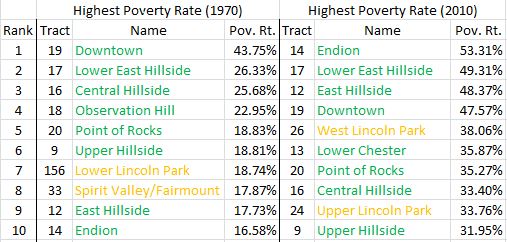
III. Highest Poverty, 1970 and 2010

DuluthHiPov

Most of these stay the same over time and are predictable, but the real eye-opener is just how much poverty has increased in these tracts over time. The poor have very clearly gotten poorer relative to everyone else, and much more concentrated.

IV. Lowest Poverty, 1970 and 2010

DuluthLowPov

A couple of west side middle-class tracts drop off the list here, and are replaced by exurban areas. No surprises on the 2010 list, save maybe Lakeside landing at the very top.

V. Changes in Per Capita Income, 1970-2010

DuluthChgPCI

The exurbs had the farthest to climb, so it makes sense that they dominate the growth list. Most of the east side settles in just below them, all ahead of the national average. With a sample size of 38 tracts, it’s incredible to note that nearly a third of them had little or negative income growth over the 40-year period, despite the national average rising 50% over this time.

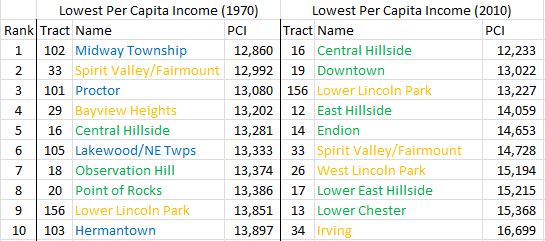
VI. Lowest Per Capita Income, 1970 and 2010

DuluthLowPCI

It’s interesting to note how many tracts are both low income and low poverty in 1970, particularly in the exurbs. Such tracts just don’t exist in 2010, with the low-income list coming to increasingly resemble the high poverty list. The closest thing to an exception is Bayview Heights, followed by the better-off west side tracts.

VII. Highest Per Capita Income, 1970 and 2010

DuluthHiPCI

No surprise to see the east side dominate the 1970 list, though a few rising exurbs and Park Point edge a few of those tracts down the list over time. Other than the growth in the college population in Hunters Park/Morley Heights, this really isn’t due to east side decline; just as there are more poor tracts in 2010, there are more comparatively rich ones as well. The city has stratified, as the much larger bands on the income map legend in the previous post show. The gap between the lower middle and the upper middle has grown significantly.

Methodology Notes

All of the data here comes from the U.S. census; 2000 and 2010 data is readily available online, and anything earlier comes from the University of Minnesota’s archives. Census tracts change somewhat over time, which is why a handful of west side tracts, which were once subdivided into several tracts, now have such large numbers. The census also reclassified UMD at some point, eliminating tract 8 and creating tract 157. The 1970 also overall figures include people residing on ships based out of Duluth, who are assigned to sub-tracts of the existing tracts. I threw them out of the comparison tables, though.

I focused on population and financial data because these are probably the easiest way to show general rise and decline. I use the federal government’s definition of the poverty line in each year. All income figures have been adjusted for inflation, in terms of 2010 dollars, using the Bureau of Labor Statistics’ Consumer Price Index Calculator. Analyses of job location, housing values, race, and various environmental factors could also prove fruitful in creating a more complete picture.

I made the maps with ArcGIS, census tract shapefiles available from the state, and the census data.

One could easily nitpick over some of my regional choices, and I wouldn’t disagree about many of them. For example, I waffled over where to put Tract 4 (Kenwood); it’s centrally located, but its 1970 demographics have more in common with east side neighborhoods than those in the center, and it’s also over the hill, and has seen considerable growth. Because of that growth, I ultimately put it in with the exurbs, though I could see arguments for other places. Tract 10 (Chester Park) also awkwardly straddles a few different areas, but since a little more of its population looks to be toward the east side, I put it there instead of in the center. One will also note that boundary with Hermantown and a township or two don’t line up with census tracts, so it’s impossible to get city-level data using the tract method. (That could be easily fixed by using census-designated places, but that would rob us of the ability to make comparisons among neighborhoods.) As mentioned in the main post, Bayview Heights’ placement is also debatable.

I threw out Census Tract 157 (UMD) from the tables above, as the census seems to count students differently over time, so the numbers lurch all over the place. Its numbers remain in use for area-wide analyses, though. There are cases for doing the same with Tract 10 (Chester Park), Tract 4 (Kenwood), and perhaps even places like Tract 5 (Hunters Park/Morley Heights), Tract 14 (Endion), and Tract 13 (Lower Chester). The effects of the colleges are seemingly so large that, if I were to do this again, I might make those neighborhoods their own area separate from all the others. Duluth is part college town, and those colleges dramatically shape the urban fabric.

Don’t hesitate to comment if you have any questions. I’m happy to do follow-ups, time and data-permitting.