Return to Adams Lake

I. The Struggle Itself

On a clifftop campsite above Malberg Lake in the Boundary Waters Canoe Area Wilderness of northern Minnesota, the western painted turtles have staked out their maternity ward. They climb some twenty-plus feet along a slope of loose dirt and rounded rock to dig holes and lay their eggs. They plod up slowly, their stubby limbs seemingly inadequate to the task. Their eyesight doesn’t appear much help either, as they fumble over the same stretches of rock and take brainless routes along the site. The holes they dig are all on the same small stretches of dirt in the center of a campsite that gets decent use, which doesn’t seem like a good way to keep one’s offspring from disruption. Humans in the campsite draw their wary eye; get too close and they will hustle into the underbrush as quickly as a turtle can. But they persist. Duty complete, they then poke about in an equally agonizing search for a descent, shuffling partway down the cliff before usually then falling five feet or so, at which point they find their legs again and drop back into the narrow arm of lake at the base of the camp.

The whole operation seems questionable at best. But can this many turtles all be wrong? My dad witnessed the same ritual at this site years ago, with several making their march upward each night. Something must be working. The Sisyphean turtles of Malberg Lake continue to roll on up the hill, fulfill their need to seed a new generation, and head back down, mission accomplished. We must imagine the turtles happy.

II. The Return

My dad and I have had Adams Lake on our minds for a few years now. We paddled through it on a day trip when base camped south of here on Malberg in 2021; we knew we needed to return. An overambitious attempt to reach it from a different direction last fall came up well short. This summer, we make it.

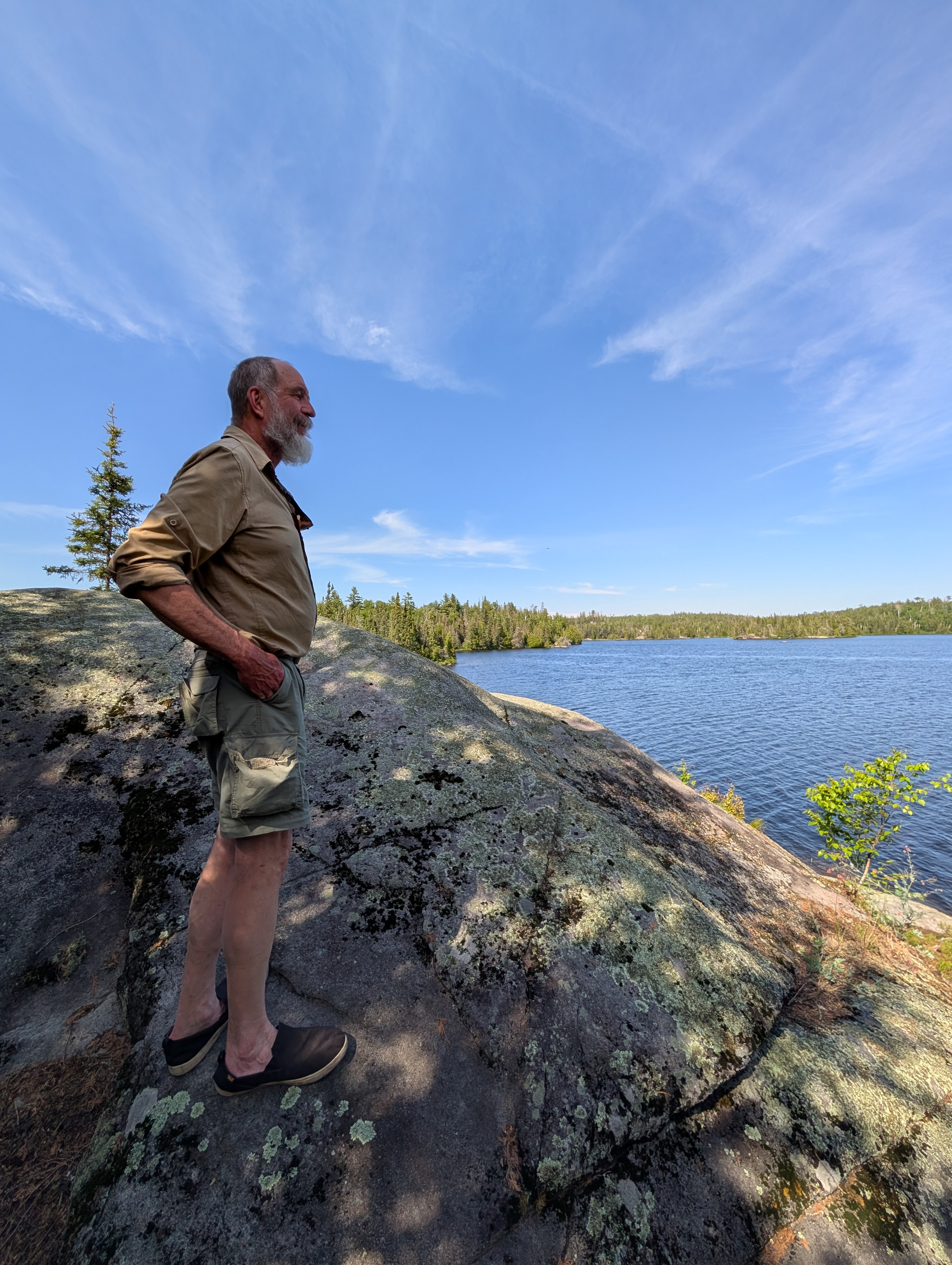
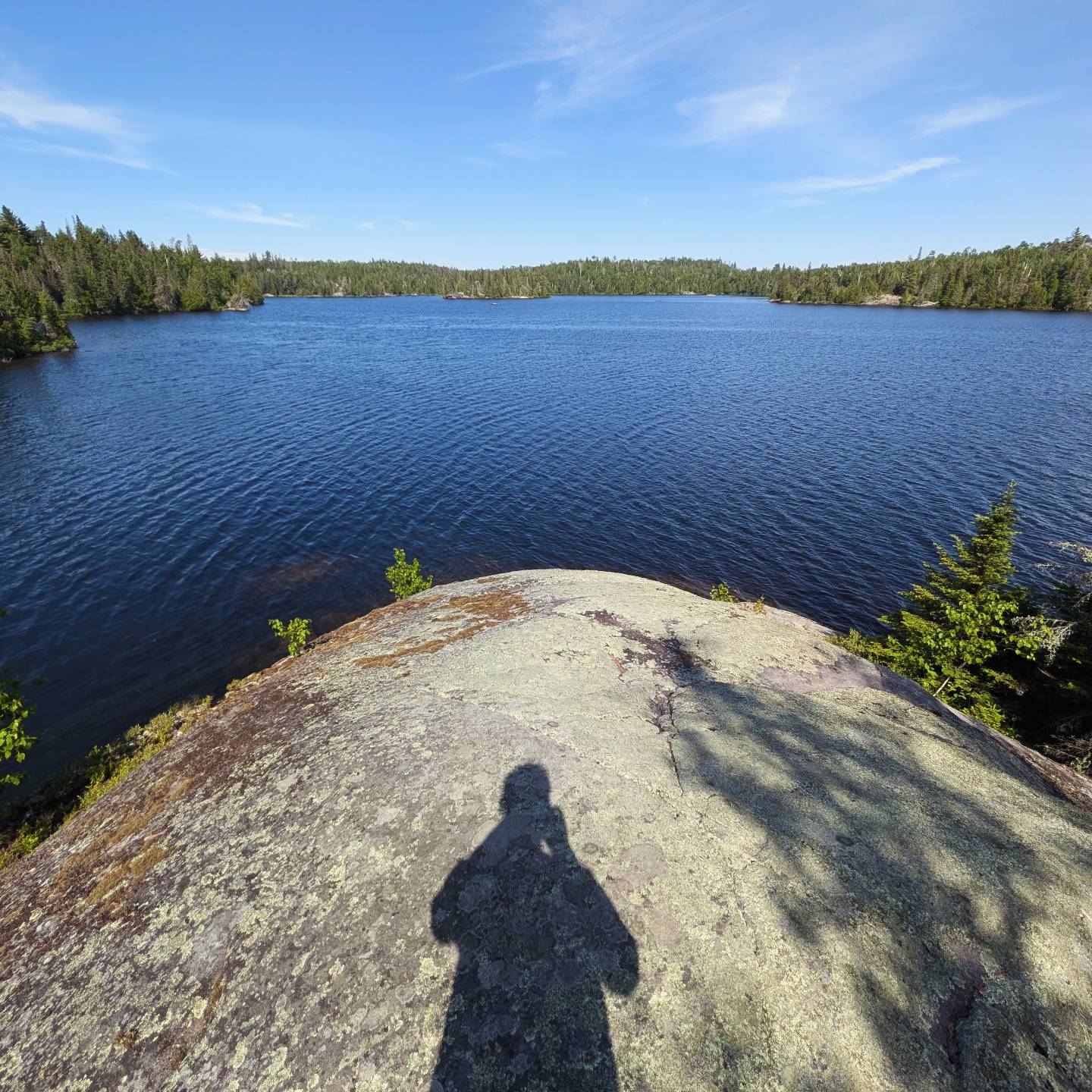
We spend two nights on a small island at the heart of Adams. This site is everything a BWCA camp should be: a cozy kitchen surrounded by cedars, giant sitting rocks with wide-open views, ample space for tents and hammocks, the right balance of shade and sun, tucked-away corners and views out to the lake beyond. Nothing notable occurs during our time here, no weather events or camp surprises or turtle invasion. We do a short day paddle, scope out the other sites, go in search of the portage on to even more remote Boulder Lake and encounter only an uninterrupted stretch of swamp. The cliff-lined northwest arm toward Smite Lake is beautiful in repose; it’s a shame the campsites back here have nothing on our island. In the days after our return from the wilderness, those 40 hours on Adams feel like something out of a half-remembered dream, a state at remove from all the rest.
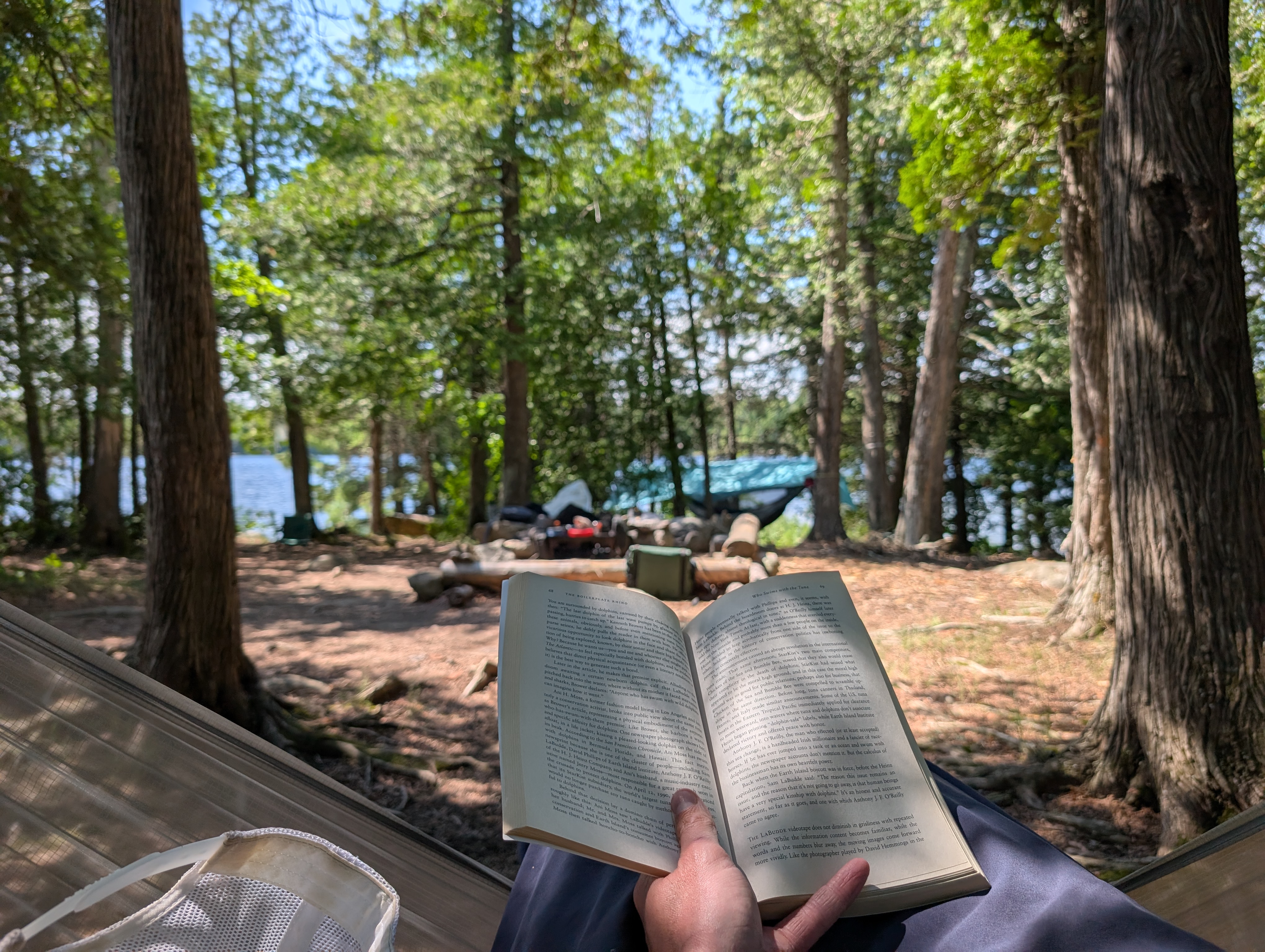
The whole world outside fades away. Time becomes irrelevant. On Adams there are no notifications save whatever signs the clouds hold for the weather, our only memorable company some heckling angry birds. Two canoes glimpsed in the distance inspire speculation not unlike Robinson Crusoe’s when he encountered one human footprint. We see no one else on the lake.

Everyone should feel this release from time to time. It is a gift to drift, to see so much of import fall away. Hunger grows; what time is it? It doesn’t really matter, you decide if it’s time for a meal. It gets a bit cool, rocking in a hammock in the breeze: what temperature is it? It doesn’t really matter, adapt as you see fit. End the slavery to the external signals and live as you choose, if only for a little while. Read, write, just zone out: follow your compunction, attain your own state.

III. Wilderness Companions

The loon is the icon of northern Minnesota lakes, but on this trip they are shy and reclusive, offering only occasional haunting calls from a distance. The kings of this stretch of the BWCA are instead the white-throated sparrows trading their call-and-response songs, the east coast classicists with their rising two-note cadences and the west coast cool kids with their descending three-note reply. Ducks shoot up the arm of Malberg Lake with their metronomic quacks. Swans cruise regally, their cygnet charges kept behind them, their necks bobbing at the sight of an intruding canoe. A discordant honk comes out when they open their beaks. The geese are also escorting their young, hiding them away. Bald eagles soar past, sometimes escorted by grumpy tiny birds. On one swampy, beaver dam-bedeviled stretch of the Kawishiwi River, red-winged blackbirds rule the roost. On the island on Adams, dark birds hidden in the trees squawk in anger every time someone ventures back to the latrine. The BWCA is known for its larger fauna: bears raiding food supplies, moose lurking in marshes, perhaps a distant howling wolf. But the feathered inhabitants are the ones whose imprint is most felt.

There are two others who rise to the top. The first is especially irksome on routes that feature rivers: the ever-industrious beavers. They build dams here and there, forcing awkward rammings or pullovers, and in some cases outright portages. From the site on Malberg we watch nature’s engineers swim back and forth, off to frustrate some future canoers. On a landscape with a light human touch, the beavers remake things more than anyone.

The second, of course, is the mosquito. The winged terrors of watery wilderness everywhere make nightfall in the BWCA a ticking time bomb. At some point after the sun sinks, they emerge. As I settle into my tent, over one hundred may be buzzing between its mesh and the rain fly. Next time, I muse, I should keep a tally on my total mosquito slaughter, though the count quickly blurs. Even in a paradise, blood gets sucked.

IV. Return from Return

The journey toward Adams, even a few days on, has faded into a gentle blur. The return trip is somewhat more eventful. Unshackled from the clock, we rise by the sun and complete a day’s journey at an absurdly early hour. Happily, the beaver pond that had made one portage a miserable slog five years ago has drained. We stop at the same site on Malberg again, watch another turtle at work. Some rumbles of thunder drive us to take shelter on a stretch of shoreline on Lake Polly. Our journey is slowed, but the threatened cloudburst does not come, and I am strangely pleased by this opportunity to disappear into a patch of virgin forest covered in cushions of moss so thick that I think I could curl up and fall asleep here. Any harbor in a storm, but sometimes those least expected harbors are most accommodating.
Further south, after deeming several campsites mediocre for hanging the tarp we anticipate will be necessary and one uninhabitable under the pain of death on account of a biblical plague of mosquitoes, we set up on Kawishiwi Lake. The lake takes on a tinge of eerie liquid gold, the monster clouds open up, and a deluge pours forth. We spend two hours under the aforementioned tarp, but the blasting southward wind that carries on well into the night is perhaps more worrying, testing the limits of a sleeping hammock and making us wonder just how the return journey to the landing could go if it doesn’t settle down. It only does so late at night, after another cloudburst and amid rising heat. But the next morning dawns still and comfortable, and it is an easy weave through the islands of Kawishiwi back to the landing before the heat of day rises.

V. Eternal Return

Are ventures like these an escape? In part, but I am not an escapist; if that were the goal, a bottle or a bong would provide a much easier course than muddy and mosquito-filled portages. Are they mental resets? Yes, certainly, but our reasons for entering the wilderness are not merely instrumental.

Instead, they provide immersion. Everything is tangible, real, embodied and felt directly rather than in transmitted vibes. One might argue this is a reveal of human nature, humans in nature released from external pressures, beings-in-the-world. We could take this to an existential level, if we please: Heidegger called this Dasein, an authentic embodiment of a life force, consciousness of one’s own self within the world and standing athwart the unthinking drift of the self into something imposed from vague outside forces.
One of the more heartening things I’ve read recently is how easily, when deprived of their phones, kids slip back into the streams in which homo sapiens has swum for most of its existence. On day one I glance through a few old pictures, the compulsive phone swipe inescapable. But by day two, I am forgetting where I have left my phone. There are no ephemeral emails, no doomscrolling through distant news, no pictures against which to compare. This just are as they are. It’s not that I forget the outside; I wonder what friends and family are doing, what’s happening in the World Cup or baseball, and as with any boy a few lusts will flit in and out. But that all can wait for its proper time and place.

I’ve never been accused of being a free spirit, nor do I want to be a hermit. But I do want to be around people who fight some version of the same fight, who immerse themselves fully and know the liberation that comes from an escape from linear time and dabble on the edges of that mythical age, what Mircea Eliade called the eternal return. The call to wilderness comes, perhaps now more urgent than ever. Dip your feet in and remember that world of your youth, when the immediate was everything. So it can be again, if you wish it.

More than Civility

Duluth was in the national news again this past week, and this time in a much more flattering piece than the dreck that appeared in Rolling Stone last month. This time, Gerald Seib at the Wall Street Journal lauds the Civility Project, an effort to establish norms for polite public discourse that he claims has made Duluth politics a bit more pleasant. (I’m linking to a Tweet that has the link because that is the WSJ’s bizarre method of allowing people around their paywall.)

It’s not quite that easy. It’s true that, for much of the past decade, Duluth city-level politics did coalesce around a broad, quiet, and largely civil consensus. I think that probably had more to do with the good vibes of the Don Ness era and his unique talent for making politics boring than the norms listed on a poster, but they certainly didn’t hurt. While still largely following in that same vein, it’s not hard to sense a few more cracks  in the Duluth consensus these days as both regional and national political forces have activated more people to express strong opinions.

It’s also not a universal experience. Critics of the school board will argue that the norms of civility have been used as a bludgeon to silence opposition, as honest and well-meant critiques are called uncivil; that point has had real merit at times over the years. Duluth also is a relatively homogeneous city, and there is pretty good evidence from social science that this makes political debate much easier given the shared culture; I’m not sure how applicable its lessons can be to a nation more starkly riven by questions of racial and cultural identity. (This is not to downplay the divides that do exist in Duluth, but more of an empirical observation on their centrality to day-to-day discourse.) It’s easy to look good when a large majority of people share a common culture agree on many things.

Even with those caveats, the Rules of Civility seem almost quaint now, as if they were a throwback to a more innocent era. Still, they exert a certain power. I would like to think that a bunch of well-meaning people can get together at the local level and build a healthier culture by bringing people together to talk in rational ways. There are, and likely always will be, scenarios where that can happen, and when they happen, that is only a good thing.

One of the more fascinating aspects of our current political moment, however, is how it has made cynics of us all. I try to be wary of narratives that pretend as if the loss of civility or decency is something recent. (Remember: if you want to understand a person’s worldview, figure out what the world looked like when that person was 20, or some comparable early formative age. It’s easy to imagine the decline and fall of political discourse is a new thing, when instead it just stems from the point at which the people in question gained a new level of political or social consciousness.) But I do think there is something particular about the milieu from which those norms of civility emerged from, one that has left us behind for something more complicated.

The Rules of Civility emerged in a time and a place when it seemed like a broadly liberal consensus was destiny. They are the guiding principles of a culture confident that it can bring people together under a common cause and include everyone in the push toward a better tomorrow. They are the rules of a world ruled by a meritocracy, where careful arguments win out and rewards flow to the people who have earned them through reason in the public square. This culture has always had some place in American political culture, but it reached its zenith after the fall of the Berlin Wall, when this worldview came to seem completely triumphant. There is still no clear alternative, but it has undergone a steady erosion amid endless low-grade war, the late 00s financial crisis, and now a wave of political backlash to the whole notion.

As a child of the 90s, I was a product of this largely unquestioned culture. I thrived in its environment, climbed the ladder of test scores and college admissions exactly as I was supposed to. It was a source of anxiety at times, yes, but on the whole I rather enjoyed it. The path was clear, as were the rewards, and I grew up in a community where playing by those very civil rules earned respect. No one ever really questioned whether or not I’d earned what I got, and those of us caught up within it learned not to question the rules of the game.

Now, however, the critiques of the system have emerged in force. The first is the internal one, common among liberals: the idea is right, but in practice our meritocracy has been far too exclusionary. Many people of color (and a chunk of mostly rural white people, for that matter) face such large systemic barriers that they cannot break through; women thrive in certain areas of the ladder but often hit glass ceilings when it comes to leadership positions. The answer, then, is to level playing fields, perhaps through affirmative action if need be, and ensure that social mobility becomes a possibility. If we all just follow the code of civility to its fullest extent, we’ll get there in the end.

A second critique attacks whole logic that the meritocratic winners who have been groomed to rule actually deserve to do so. The best and brightest who went to Wall Street ran the economy into the ground in the late 00s, and even the scholars and pundits who saw warning signs have been unable to devise a humane economy that gives the losers of the macroeconomic shifts of the past decade any level of dignity. The foreign policy consensus bungled its Middle Eastern adventures that decade, leaving thousands dead and no discernable achievement of non-military goals. Over in Europe, the European Union, instead of being some enlightened post-nation-state government, is instead a creaking and unaccountable machine with an egregious mismatch of fiscal and monetary policy that should have been obvious to anyone who’d taken Econ 101, but somehow got pushed through anyway.

While in college at the tail end of this era of good feelings, I read and listened to a lot of triumphal bloviating about the march of democracy and rights and so on that in retrospect seems wishful, if not naïve. And yet there has been little to no reckoning for these failures, and critiques of the elite consensus have often been left outside the bounds of serious political debate. Anyone who suggests otherwise is uncivil. Why should we trust the people who gave us all of these things, or the institutions that produced them, if they can’t get anything right? Our supposedly meritorious ruling class has much to answer for, and precious few of its members have attempted anything resembling an examination of conscience for their failures. Instead, they just drift into cushy lobbying jobs when they get voted out of office. The swamp, according to this take, is very, very real.

Both of these critiques capture some of the truth, but are inadequate on their own. The liberal critique is dead accurate, but fails to step out of the cave and consider whether this way of doing things is the best we can do. The new critique, which can come from either the left or the Trumpist right, raises that issue, but largely fails to present an alternative that doesn’t sound hopelessly idealistic or retrograde. Simply suggesting an alternative seems ridiculous: how does it make sense to run anything without a civil debate of the merits, or without the most qualified people? They may not know everything, or their expertise may come in unconventional ways, but there has to be a way to agree to a basis and sort and choose from there. We’re still a long way from mob rule or authoritarian whim becoming the law of the land.

Civility is great, but trying to cure the nation’s ills with a civility project goes nowhere near to the source of the malaise. Civil discourse can also only emerge at any scale from a common culture that agrees on at least some basic foundation of how to order a society. Without some underlying vision we are left only with critique for critique’s sake, an endless argument that aspires to nothing more than disruption, to use that useless, canned Silicon Valley word that dresses up chaos in the garb of progress.

On a national level, it’s easy to despair about the possibility of the common cause from which a civil governing consensus can emerge. Perhaps, then, the answer must be local. If Duluth’s history over the past ten-plus years is a model of anything, as I’ve argued (with much nuance) that it can be, it starts first with a common vision, and a common narrative that acknowledges but then breaks from a past. Civility is as much a product of such a vision as it is a precondition of it, moving in virtuous feedback loops as eclectic groups come together to advance some common goal. Building and sustaining such cultures won’t be easy; they all have flaws and require serious interrogation at every step, and even with the best of intentions, they will struggle to accommodate everyone in a community of any size.

We live in a world in which the underlying truths that sustain nations and foundations of faith have crumbled. In many, if not all, cases, there is good reason for the critiques. But the project of this century won’t come through continued disruption of already tattered truths, or context-free attempts to make politics nice again. It will come from a concerted effort to build a common future in spite of the myriad obstacles before us. We must imagine Sisyphus happy.

Confronting Baltimore: David Simon at Georgetown, 2012

Baltimore is in the news this week, and any mention of Baltimore seems to make anyone in my very narrow circle make excited references to The Wire, that pinnacle of twenty-first century television. The Wire, in turn, makes me think of David Simon, the producer and brains behind the whole operation. Three years ago, on a sunny morning in Washington D.C., he gave the Georgetown College Class of 2012 commencement address. It will surprise no one who knows his work that it was a thoroughly depressing speech. Here is the text, coming from his blog named (you can’t make this stuff up) “The Audacity of Despair”:

http://davidsimon.com/commencement-address-georgetown-university/

Alright, that’s misreading Simon’s words. He’s making a deeply existentialist appeal, one that calls on people to continue the good fight in spite of the impossibility. He builds a case for national unity in the face of apparent divergence, and the events in Baltimore only underscore that concern. His diagnosis of Baltimore’s miseries in The Wire proved all too prescient, and it may indeed take a dose of Camus for anyone who has confronted this disorder to believe in any chance of improvement.

Unfortunately, Simon isn’t reading Camus quite right. Camus doesn’t confront the question of suicide because he thinks political change is impossible; he confronts it because he knows that all knowledge is impossible, and because there is always another way to look at things, no single political platform will do. There is no answer, and the world is incoherent. This, and not the possibility or impossibility of progress, is what leads Camus to call life absurd, and to suggest we soldier ahead along the one path that offers dignity, imagining Sisyphus as happy.

Very well; onward we go. Simon certainly offers a worldview; a plan of attack of sorts. He offers one lens that purports to make sense of it all. It uses nihilism, the cheapest of philosophical absolutes, as an attempt to come off as a world-wise sage. Who knows where we’re supposed to reconcile that nihilism with the genuine care for humanity that comes out of his lens. It’s a Western liberal lens concerned primarily with the rights of one’s countrymen. It sees humans in isolation, unequal, struggling for these abstractions we call rights. The policy prescription is liberal boilerplate. Halting steps might be realistic, though the end goal, as Simon readily admits, is impossible.

Yes, impossibility can inspire; I begrudge no one for chasing it. We talk a good game, say we can achieve it, and some people out there really do. But it sets an absurdly high bar, and it’s no wonder the platform faces such long odds. Many people spend most of their lives without daring to contemplate that shadow of doubt, focused relentlessly on what is before them, for good or ill. Many who do recognize it fold before it, unwilling to make Simon’s “absurd” leap. A belief of impossibility, after all, is what drives a teenager in Baltimore to throw a rock through a window. If the call to service requires either naïveté or this high a level of philosophical belief, perhaps the lens shouldn’t be our primary entry to the situation.

This doesn’t mean one who wants to “fix” Baltimore can’t have many of the same end goals or employ some of the same analytical tools as Simon; it’s just that one has to understand their place. They are means to approximate reality, not reality itself. No one lens, nor even any number of lenses deployed at once, can see that. Modern liberalism likes to think it can, and while it may come closer than many others, it still fails. Take it away, Octavio Paz:

Today a universal relativism reigns triumphant. The term is contradictory: no relativism can be universal without losing its relativity. We live in a logical and moral contradiction. Relativism has given us many good things, and the best of these is tolerance, the recognition of the other. Although I have no nostalgia for the old religious and philosophical absolutes, I’m aware that relativism–apart from its intrinsic philosophical weakness–is an attenuated form and in certain ways hypocritical of nihilism. Our nihilism is surreptitious and is coated in a false universal benevolence. It’s a nihilism that doesn’t dare say what it is. I prefer cynics, I prefer Diogenes in his barrel. A relativist society doesn’t admit what it is: a society poisoned by the lie, a slow but certain venom. The remedy, perhaps, requires a return to classical thinkers.

There is an alternative. An alternative that avoids the knee-jerk turn to the failed dreams of a narrow worldview. One that dispenses with the grand sociological theory and anger at systems, and turns attention to the immediate. One that sees history not as a blind arc from darkness to light, but caught up in a tumult of connections and feedback loops. Full understanding is impossible, but we can approximate it, and that calls for the full arsenal of perspectives we can imagine, and the humility to never claim complete knowledge. When we admit our own limitations, wonder at the void we do not know can return, and suddenly everything is a bit less bleak, a bit less doomed to failure. It is a happier, healthier place to reside.

It was at Georgetown that I came to see that different lens for what it was, and, haltingly, embrace it, though I have some fear the latest curriculum decision there will only push Georgetown further toward the vogue lens. The rush to see everything through the lens of “diversity,” I fear, will neglect any attention to a moral language that underlies the most basic human relationships, the ones that go deeper than identity-driven labels and thought constructs and settle on reality. People will settle on the established battle lines and war away, without stopping to take a closer look. Camus, for one, never lost sight of this: when while the rest of the French intelligentsia embraced the anti-colonial revolt in Algeria, Camus, an Algerian of French origin, saw more nuance. “People are now planting bombs in the tramways of Algiers. My mother might be on one of those tramways. If that is justice, then I prefer my mother.” He was able to strip away all the rhetoric of the age and see the human drama beneath, entranced by the little details that no one has time for.

To his credit, I think David Simon realizes this on some level. His analysis of the state of the Baltimore Police Department, right or wrong, shows keen insight. Beneath all the sociological sharpness of this and The Wire, though, are a lot of paper-thin characters. Simon’s attempt to study deeper human workings just aren’t there. But that, I suppose, would require an audacity far greater than cheap despair.