Mexico City, Revisited: Exploring the Giant

My last post tells the clichéd study abroad story: fun host family, mediocre foreign university, basic navigation of a different culture. I would like to think that my time in Mexico, however, goes beyond the most basic of study abroad tropes, and it owes that difference to the city I lived in. Mexico City is so gigantic that no one can dream of making their way through it in four months, though I managed to visit practically all of them on the day a pair of old high school Spanish teachers swung through the city on a visit. No East grad’s journey through Mexico is complete without a day on the canals of Xochimilco with Mrs. Bergum and Mrs. Melchert.

My university, the Ibero, gave its exchange students an easy way in via a Friday “class” that took us to sites around the city. The first trip with tour group took us straight into the city center, where a kindly but long-winded gringa used a bevy of props to lead us through some of the city’s more famous attractions. She knew her stuff, and we followed her across the great plaza known as the Zócalo—every Mexican city has one—and into the Metropolitan Cathedral and finally to the ruins of the Templo Mayor, the centerpiece of the old Aztec capital, rediscovered only during excavations by the national electrical company in the 1970s. But as we meandered through the site museum and the guide droned on and no promise of lunch came forth, a friend and I bailed. With a few quick steps out a side door, we left behind the self-conscious curation of Mexican history and entered the Mexico of today, a cobblestone street lined by small shops and teeming with the seamless ballet of urban life, as the shoppers stop and start and flow along down the avenue. We disappeared into a taquería, came out with some streetside delicacies, and, two days later, came down with diarrhea.

Leaving aside long nights on the toilet, the journey down the side street kicked off my many unguided wanderings of the city, and the Zócalo was a natural place to revisit. The Zócalo is the heart of Mexico, the center of the great imperial city that rose to glory under the Aztecs and became the seat of Spanish power in the northern hemisphere. At its center, a massive Mexican flag, the eagle on the cactus lilting in the breeze. The government, the church, and those Aztec ruins all spectate from the sides, but this is a living plaza, always the center of the action. Often a protest, sometimes a concert or a party, though never more novel than during my final visit in early December: a skating rink! This Minnesota boy could have watched for hours in delight. The rink featured at least a hundred uniformed attendants, all there to help out the poor Mexicans as they shuffled about the rink, clinging to the walls in desperation. Further along the intrepid city government had devised a mini snowman-building station, and an artificial sledding hill made an appearance as well.

Mexicans on Ice!

Mexicans on Ice!

The rink was one of the more lavish flourishes of mayor Marcelo Ebrard’s urban vision. Ever since it gained home rule in 1997, the Federal District has stayed firmly in the hands of the Party of the Democratic Revolution (PRD), a left-leaning party that has been decimated in the rest of the country thanks to the egotistical handiwork of Ebrard’s predecessor to the top spot in the Federal District, Andrés Manuel López Obrador. To be fair, López Obrador’s administration helped push Mexico City’s urbanism toward the vanguard, and under PRD rule, the city has had a renaissance of cultural life and chic vigor. A large urban elite allows for a center-left party to flourish, and even if it’s not on the cutting edge of the war on poverty, it runs a fairly clean and efficient ship, which is no small miracle south of the border. But Ebrard lost out to the more ruthless López Obrador in the 2012 succession battle, and the PRD split into two, its moderate core left only in Mexico City. The result: a city whose governing vision has more in line with New York or San Francisco than it does with the villages just beyond the Valley of Mexico.

If the Zócalo is the heart of Mexico, then the Alameda, some six blocks to the west, is its soul. Or so I thought when I first laid eyes on the great Diego Rivera mural back when I was in high school, the one that showed the whole of Mexican history promenading down its leafy walks on a lazy Sunday afternoon. On one of my first Sundays in Mexico City I walked from my place in Polanco up Paseo de la Reforma to the mural. I sat before it for a while before venturing into the square itself. The Alameda of 2010 had no great politicians or artists striding up its walks, but there was a complete cross-section of the country: the wealthy on parade, young lovers in the bushes, beggars, the inescapable rows of vendors, protesting leftists, break-dancers, and every possible shade in between. And on a bench in the middle of it all, a dreamy American kid, enmeshed in that urban fabric and in love with it.

A dreamy Sunday.

A dreamy Sunday.

The rest of the center city has chaotic but ordered streets, and is well-serviced by the packed but slick, highly subsidized, rubber-tired subway system. The urban grid conforms to the Spanish colonial Laws of the Indies, with churches and government centers grouped around plazas of varying importance. There’s a bike share system, a number of pedestrian streets, and little monuments or plaques at every turn. The architecture impresses, from a gilded post office to the Casa de los Azulejos, the original home of the Sanborns owls that now roost about the city on the department store’s logo; from the grandiose Palace of Fine Arts to the iconic Torre Latinoamericana, long the city’s tallest building. To the North is Plaza Garibaldi, perfect for one’s mariachi rental needs, and unrepentant debauchery once the sun goes down.

Paseo de la Reforma is the artery that feeds the body of the beast, a grand avenue that belongs on a short list with the Champs-Elysees, the Rajpath, Broadway, and Las Ramblas. Every major intersection brings a traffic circle and a monument, the statues ranging from Columbus to Aztec emperors to Roman goddesses to the city’s most famous icon, the Angel of Independence. It’s wide enough to handle hordes of both cars and pedestrians, and on Sunday, the whole thing shuts down for bicycles. The neighborhoods along it to the west of the center are the trendy and artsy core: Roma Norte, the gay-friendly Zona Rosa (under Ebrard, Mexico City legalized gay marriage in 2009), and La Condesa, the D.F.’s answer to Williamsburg. The streets in each neighborhood have themes, with national heroes and dates in the city center, European cities in Roma, and Mexican states in La Condesa. La Condesa is at once the most happening and perhaps the least Mexican place in the city, a cosmopolitan neighborhood filled with fusion restaurants and clubs for travelers from afar. It was a popular home for the European students at the Ibero, and I spent many nights in its apartments and parks, dining or heading for the Pata Negra, the club where all twenty-somethings’ paths seem to cross while in Mexico.
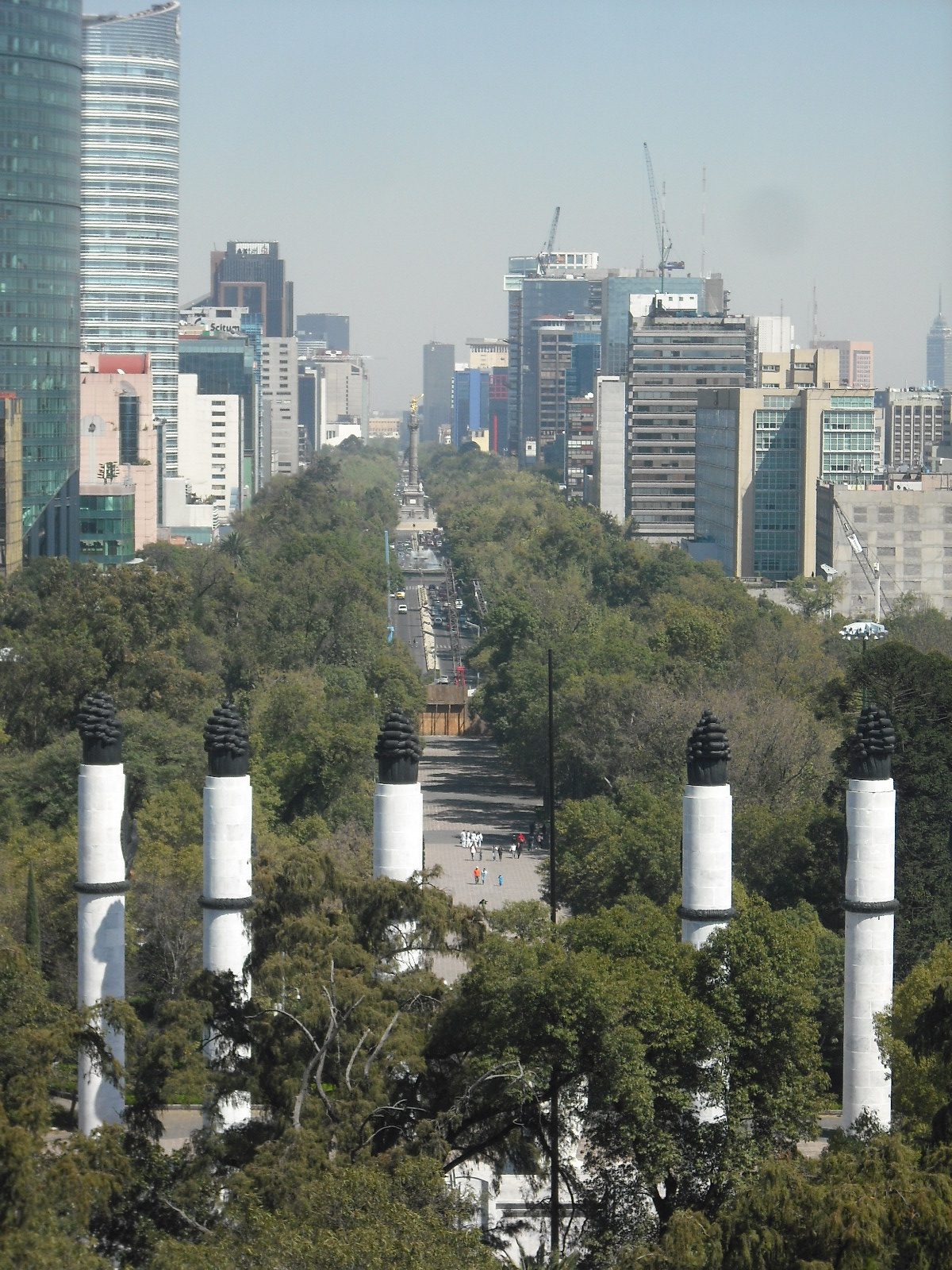
View up Reforma from Chapultepec Castle.

View up Reforma from Chapultepec Castle.

West of La Condesa sprawls Chapultepec Park, a giant green space that makes Central Park look quaint. It hosts many of the city’s great museums and monuments, from modern art to anthropology to Chapultepec Castle atop the hill. Below Chapultepec is the monument to the Niños Heroes, six boys who wrapped themselves in Mexican flags and threw themselves from the ramparts rather than risk capture when the American army sacked the palace in the 1840s. Los Pinos, home to the Mexican president, is here as well, but so are the unavoidable vendors, brackish lakes, and price-gouging toilets. There is no such thing as a free leak in Mexico.

North of Chapultepec and Reforma, beyond the Parque Líbano, lies my old haunting grounds. Polanco is densely urban, filled with apartment towers and shopping streets, though it’s statelier than La Condesa, and the streets are so robed in trees that it seems sheltered from the oppressive crowds downtown. The streets here, all named for great philosophers or writers, make one want to stroll to a café and discuss some great work with other learned people. I meandered its placid streets whenever I needed to get out of the apartment and breathe, stopping for an ice cream or touring the Tianguis market on Fridays, perhaps flagging down the tamale bicycle. At its heart is the Parque Lincoln, a quaint monument to the American president, who gazes across the street at Martin Luther King. A few blocks north is Presidente Masaryk, Mexico’s swankiest shopping street; a few blocks south, the Campos Elíseos: Champs-Elysees, Elysian Fields, one of those streets that just basks in presumption, playing host to embassies and luxury hotels.
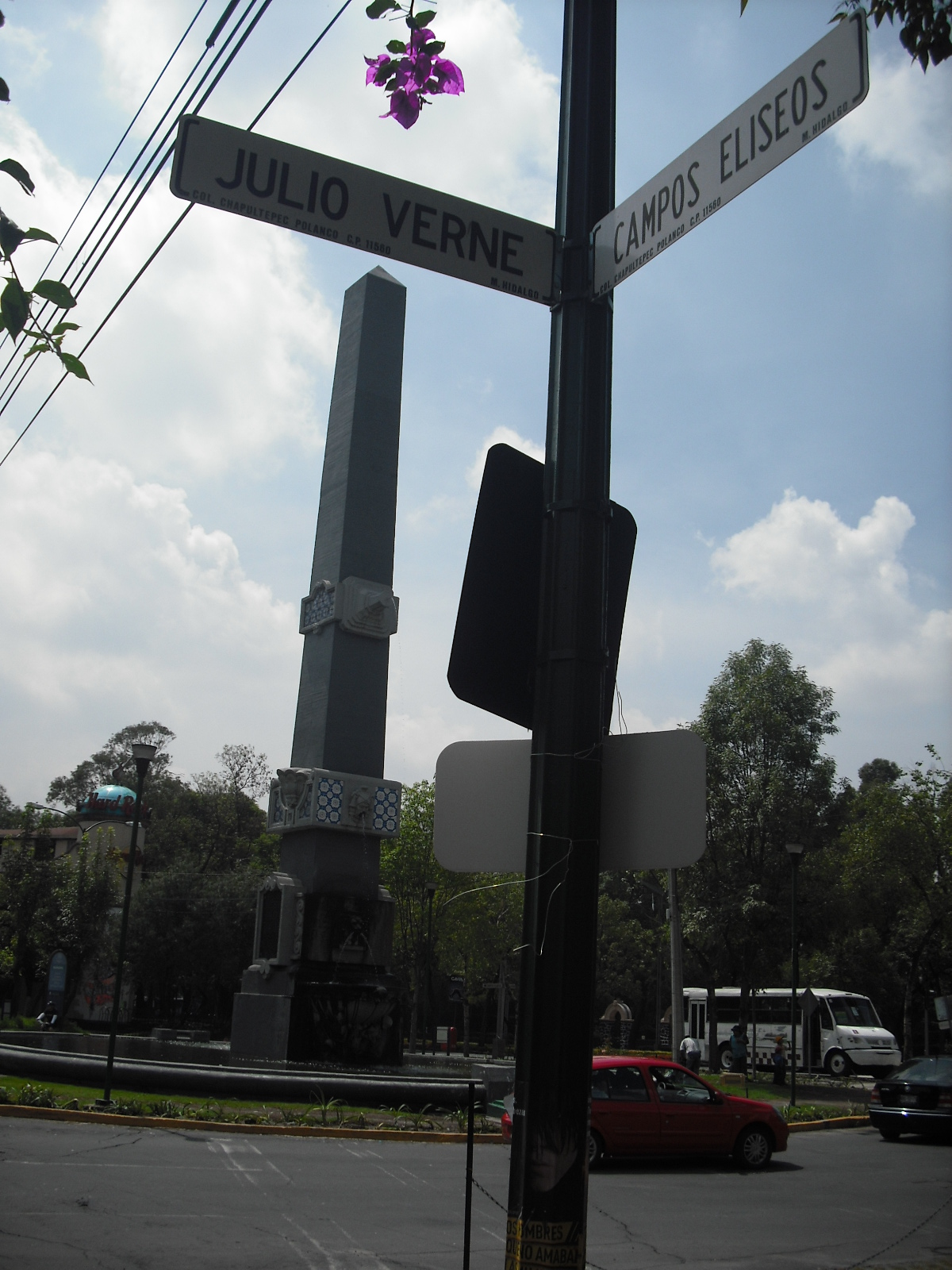
Street corner in Polanco.

Street corner in Polanco.

Further up the hill the men of letters give way to mountains, and the lanes loop around walls that guard the estates of Lomas de Chapultepec. I myself lived right on the line between Lomas and Polanco, on Monte Elbruz, a short wedge between two highways that still managed to fill the obligatory quota of 7-Elevens and Starbucks on a Mexico City block. My tower overlooked the Periférico, the ring highway that loops about the center of the city. At night I’d gaze down from the picture windows as the traffic weaved along the canyon below, threading its way through a small regiment of financial and corporate towers. The cool mountain air poured in through the slits beneath the windows, breathing life back into the giant’s lungs.

To the north, a pyramid, a church, and the State Department share a square. It’s the Plaza de las Tres Culturas, still better known as Tlatelolco. This was once a booming native market town, but now this name recalls a different memory, the moment that ripped the mask off the PRI regime. In 1968, the government gunned down scores of student protesters here. The regime ruled ably for forty years, overseeing an economic miracle that pulled Mexico to the brink of the first world. The 1968 Olympics were supposed to prove that greatness, and celebrate the “perfect dictatorship,” the system that seamlessly transferred power from one party boss to another, all the disparate factions of Mexican society united within one machine. Instead, they kicked off a national nightmare.

The next thirty years saw a slow but steady decline. The party couldn’t buy off the far left the way it could with other groups, and its patronage machine went from competence tinged by low-grade corruption to a downright bloated bureaucratic cesspool. The nation’s fortunes rose and fell with oil prices and presidential terms, and after a stolen election in 1988, the PRI was in crisis. It held on for another twelve years, enough time to oversee the lurching implementation of NAFTA and a privatization scheme that simply put state agencies into the hands of wealthy cronies rather than fostering genuine competition. To the credit of President Ernest Zedillo, he was willing to hand off power when the PAN won the 2000 election. The PRI returned to the presidency in 2012, but it is a shell of its former self, with the El Chapo jailbreak showing the bankruptcy of Enrique Peña Nieto’s pretty PR machine. The ghosts of Tlatelolco have come home to roost.

Further north Reforma splits in two, and the Calzada de Guadalupe and the Calzada de los Misterios lead the way up to the Basilica of Guadalupe. The current basilica is an unfortunate modernist thing, but all the beautiful old churches and chapels on the hill at Tepeyac are still there, and one can still mount it for a view of what a sixteenth century miracle has wrought. The shrine marks the site where the Virgin Mary revealed herself to Juan Diego, and the image seared on his tilma became the foundation of a nation. Mexico is a fractured place, filled with hundreds of indigenous tribes and regional cultures, and riven by stark mountain ranges. Many of its Catholics practice something that my Polish and Irish grandparents could never recognize as their own.

Juan Diego's tilma with some not-so-subtle symbolism below.

Juan Diego’s tilma with some not-so-subtle symbolism below.

But the Virgin courses through all Mexican life, and the flag hanging around the framed tilma drives the point home. While the southern Latin American countries killed their natives and the Andean and Central American ones still live in serious racial tension, Mexico approximates a blended nation. Reality still shows stark divides, but ever since its great revolution in the 1910s, Mexico’s official narrative has aspired to a blended mestizo identity, the raza cósmica that takes pride in both its indigenous roots and its Spanish inheritance. The PRI, for all its failures, built a country around that vision. It is no small victory, and while some racial divides endure, the rest of the world has something to learn from Mexico.

In the far north lie the ruins of Teotihuacan. The name means ‘City of the Gods’ in Nahuatl; the story claims that the Aztecs, still in their exodus phase and wandering the Valley, stumbled through its ruins and figured that no man could have built them. Sitting atop the Pyramid of the Sun today, it’s not hard to see why: its base rivals the Great Pyramid in Egypt. But if the Aztecs aspired to godlike status, they found it soon enough. They found that sign they’d awaited, the eagle perched on a cactus, and build a city to rival Teotihuacan in the center of Lake Texcoco. Tenochtitlan stunned its Spanish conquerors with its size, beauty, and cleanliness, though that did nothing to stop them from slaughtering the lot of them and filing in the lake.

Pyramid of the Sun, Teotihuacan

Pyramid of the Sun, Teotihuacan

Today, the only living remnant of the Aztec imperial city is on the far south end, in Xochimilco. These canal-filled gardens sum up Mexico simply: a historical artifact kept alive by a raucous party on boats, with vendors paddling along the rented trajineras peddling food and flowers and booze. The traffic is just as hectic as the Mexico City streets, the oarsmen worryingly young, yet no amount of social scrutiny can dim the festive atmosphere. Here Mrs. Melchert showed incredible poise under pressure, earning applause from the Mexicans as she maintained her balance after our trajinera got rammed just as she was leaning out to take a picture.

The south side of Mexico City has more wealth than the north, and it is here that one finds the sprawling campus of the national university (UNAM), home to over 250,000 students; the giant Estadio Azteca is here as well. A little ways further north are two charmingly gentrified neighborhoods with cobbled houses and colorful streets and histories as well. San Ángel features a flower market, a Diego Rivera studio, and a monument to some Irish-American U.S. soldiers who turned on their new county and joined the Mexicans during the U.S. invasion. They all got slaughtered, but they still remember them in San Ángel, and I happened to visit on the day of a remembrance parade that included the Irish ambassador. Better known is Coyoacán, Mexico City’s Greenwich Village of yore, home to the famous blue Frida Kahlo house, where one can learn of all her eccentricities. Just up the street sits the Trotsky museum, where budding little Marxists shepherd the tourists about the bullet-riddled rooms of the exiled revolutionary’s final home. The bullets from Stalin’s henchmen all missed their marks, but later, an ice axe did not.

Not wanting to cause my host family or the university and undue ulcers, however small the real worry, I never ventured on foot into the far eastern reaches of Mexico City. As the city climbs up out of the valley, there in the shadow of the twin volcanoes of Popocatépetl and Ixtaccíhuatl, the city degenerates into row upon row of concrete housing. The largest slum in the world is here, beyond the D.F.’s border with the State of Mexico, and there’s a ring of badly built homes creeping its way up the mountains on all sides of the city. They’ve come here in search of something more than subsistence farming, the countryside drained of peasants by a growing economy. It is a zone of misery, though Mexico has nothing on the poorest of the poor; in fact, thanks to a growing economy, there are now more Mexicans heading back south across the border with the U.S. The American immigration crisis these days comes from Central Americans, who endure a hellish journey across Mexico to the border. This journey usually avoids the insanity of the capital and instead works its way up the Atlantic coast.

Mexico City faces many issues, perhaps the most worrying being its need to suck up water from all across the country, but otherwise, its problems have solutions. Yes, the mountains that ring the city hold in the smog, though it’s not as bad as it used to be; methods to clean up the sky lurch along. My lungs had no trouble adjusting to the Mexico City air during my workouts, as many past travelers had suffered. The soft former bed of Lake Texcoco, filled in by the Spaniards, causes some structural problems, and leaves the city vulnerable to earthquakes. But the government can and does take steps to stabilize these things, and it’s hard to foresee a catastrophe. The once-worrying taxi system has been cleaned up some. And the drug violence that plagues some parts of Mexico doesn’t really appear in the Federal District: it is just too large and sprawling, and the state has too big of a presence, for any of the cartels to move beyond the run-of-the-mill crime operations found in any big city. At the time I traveled, Washington D.C.’s murder rate was over three times the D.F.’s. I can’t recall a single crime, even minor theft, befalling one of my fellow foreign students—and we weren’t always the most self-aware or cautious bunch.

In a way, my complaints about the traffic how easily it is to lead a comfortable life: the most serious inconvenience of D.F. life is a mundane problem that’s not much better in, say, Los Angeles. Large parts of Mexico City are placid if not downright lovely, which both makes life easier and makes one understand why the Mexican upper classes aren’t terribly bothered with the slums to the east. Their productive, comfortable lives can coexist with the extreme poverty around the city. Seen from the ground, the contradictions that form this city are easier to understand, its vast scale easily gathering it all in. No city did more to drive my fascination with the systems of urban life, and its allure will long endure, no doubt pulling me back before long. For good or ill, Mexico City is without equal.
Next time: Provincial towns and cities of Mexico.

Mexico City, Revisited: The Road to the Ibero

Five years ago today, I arrived in Mexico City for the start of a four-month sojourn south of the border. I was twenty years old, both open to the world and anxious about stepping out of line; a Georgetown international affairs student with strong convictions who was nonetheless feeling more than a little adrift in his studies. And so I headed south for a semester abroad, on a quest for meaning in one of the world’s most difficult cities to comprehend.

I landed in Mexico City in a daze that afternoon, frustrated by wrong immigration forms before a search through the throngs behind the gate for a sign with my name on it. This was my third time in the Valley of Mexico, though the first two visits had been mere snippets to tease me, invite me back for more. This time I’d spend a full semester in the belly of the beast, and put my presumptions of cultural competence and world-wise traveling to the test.

I arrived with a backpack of personal effects and two suitcases filled with a wardrobe heavy on sports apparel that simply screamed “American”—though when one is over six feet tall and white as snow, there’s no disguising it anyway. (For the most part, that is; a handful of people, furnished only with my name, assumed I was German.) This unabashed embrace of my homeland seemed to unsettle my eternally deferential roommate, another American who, in the rare moments we actually talked, sought the experience of an ideal Mexico.

002

Gazing wistfully out my apartment window…

Anti-American attitudes in Mexico, in my experience, were limited to a theoretical corner of the academy. I never suffered anything more than a light ribbing as a guero, and I couldn’t count the number of times a Yankees cap struck up a baseball conversation. There’s no purity in the post-NAFTA world, and yes, something may be lost in the mix. But the whole experience seemed to reinforce a couple of Octavio Paz aphorisms: first, that local culture will always divide us, even in a globalized era; and second, that the visitor ought to integrate, not assimilate. We must settle for dialogue, playing off one another’s quirks and learning to make do. There is no eternal essence of what Mexico is; it’s a living history, always in motion, evolving into some new blend of the stories its people create. I have no Mexican blood in me, but Latin America is an inescapable part of my family history, both for my father and now for me. This trip sought to cement that curious root, and blend it in with all of my other histories into something that aspired to coherence.

*          *          *

I wasn’t without guides: I lived with a two host parents in a cozy ninth floor flat they shared with their adult daughter; an older son lived nearby, and swung by nearly every day. They were veterans of hosting foreign students, there to both provide sanctuary from the insanity and turn us loose to explore as much as we could. I also had the silent roommate, whose aloofness was one of the disappointments to the program. I recognized more of myself in him than I cared to admit, but my exuberant push outward had no place in his Mexican journey. What could have been a brotherhood stayed stagnant; though they hid it well, the perplexed host parents worried over his quirks, wondering what they could do to draw him out.

For my part, I had little trouble sliding in with the Meléndez family. The small-world coincidences made it easy: a good family friend of theirs had married a man from Kewaskum, Wisconsin, not far from where my father grew up. They’d gone to visit at some point, and a Green Bay Packers bumper sticker adorned the doorway into my bathroom. (Another cultural blend: the family loved American football, and the children would often bet on games. The daughter, Gina, always won.) Not only that, Gina had spent some time in Lombard, Illinois, where my mother’s family lived for many years. Her knowledge of English was especially handy on one of my first days in Mexico, when the shower drain clogged up and my normally reliable Spanish degenerated into a lot of frantic gestures and repeated cries of “ducha!”

My host father, Gonzalo, was a retired army dentist. He had the patient, relaxed air and easy smile of a man who’d found his home in the world, and always toyed with his wife and giggled over the world’s absurdities. His jefa, Lupita, cooked up a storm and doted as all host mothers must, doing her best to put some meat on my bones. I never got the full story, but it seemed they came from some money, once inhabiting a house near that of billionaire Carlos Slim before they downsized to the well-heeled flat. The children were both graduates of the Universidad Iberoamericana, my study abroad destination, with Gonzalo Junior now working in IT—free support for the cranky old laptop I had at the time—while Gina developed powdered food products.  It was an easy family to join. In the evenings we’d relax with telenovelas or a football (or fútbol) game, though every now and then they’d invite over some friends for rousing games of dominoes. We’d sip away at our tequilas and have a grand old time, hearing all the gossip there was to hear.

Gonzalo, Gonzalo, and Lupita

Gonzalo, Gonzalo, and Lupita

Tequila gets a bad rap in the U.S. thanks to the tastes of drunk college kids, but the real stuff is a delicacy, unbesmirched by the additives that produce the famous tequila hangover. Proper tequila comes from blue agave in Jalisco; anything other liquor from an agave falls under the blanket term mezcal. Mezcal often takes the form of Mexican moonshine—hence the famous worm, used to mop up its impurities—but true mezcal is a nectar of the gods. Only recently had it really found its way north out of the mountains of Oaxaca and into Mexico City, but the rich smokiness and the delightful lack of headaches made it one of my finest discoveries.

*          *          *

I could have used a bit of that mezcal before the daily bus commute, but by the end they proved an excellent education in willpower. Indeed, there was no greater test of my readiness for Mexico than my daily commute from my apartment to my university on the western fringe of the city. Morning rush hour on Paseo de la Reforma is a daily exercise in gymnastics and human contortion: just how many people can we stuff into this bus? One or two might go by my stop before I’d finally find one with space to clamber aboard. I’d wedge myself in through the back door of the bus, pausing only to make sure that all of my appendages made it also. By the end I’d become a ruthless transit rider, knifing my way in and towering a head above all the Mexicans, making sure I had some space to breathe in the rush hour fumes.

My daily chariot was one of the finer specimens on the Mexico City streets, a lurid orange and green machine that had seats for about twenty and standing room for a good seventy, depending how well we all got in touch with our inner sardine. The bus rides never were very chatty, though it was always a serendipitous day when I got on a bus with the guitar player. There were millions of people in the city, but it was always the same damn guy. His songs were uplifting, poppy dreck that I’d have hated if they were in English, but they unfailingly brightened my mornings. His presence was well-worth the eventual generous tip.

A surprisingly tame Anillo Periférico near my apartment.

A surprisingly tame Anillo Periférico near my apartment.

Two days a week I had a class that began at seven o’clock. Never a morning person, these rides were a daily struggle, but they beat the traffic, and there were small delights here, too: as I got off the bus along the highway in Santa Fe, high above the smog and out on the outskirts, the stars were far brighter than they are in the environs of any American city. I would have stopped to admire them, if doing so hadn’t invited death during the crossing of the highway that separated the bus stop from the gates of the Universidad Iberoamericana.

*          *          *

The early morning bus trips were worth it for the man who held court for two hours in a chilly Ibero classroom. Rubén Aguilar Valenzuela’s modest résumé boasted stints as a Jesuit priest, a leftist revolutionary in El Salvador, and the chief spokesman for Vicente Fox, the right-leaning Mexican president whose 2000 election broke 70 years of rule by the “perfect dictatorship” of the Institutional Revolutionary Party (PRI). Fox was a dynamic campaigner but a bumbling President, and Aguilar is now immortalized in Mexicans’ minds for his oft-repeated phrase, “Lo que el presidente quiso decir” (what the President really meant to say…). But he stuck it out, even though he shared neither his President’s ideology nor his foot-in-mouth disease, because he believed in the democratic transition, and its success transcended such petty wars. He believed what he preached, and devoted his mornings to lecturing college kids with a fairly radical message: the answer to Mexico’s plight came not from expecting the free market to rule all nor belief in the power of the government to rectify things, but in a stronger civil society.

Aguilar found a curious home in the National Action Party (PAN), and no doubt it cost him some allies. The right-leaning party might not have matched his social agenda, but in the early 2000s its free market ideology helped it avoid the machine politics that plagued its rivals, the PRI and the leftist PRD. Its image was about as pure as possible in Mexican politics. By 2010, however, things had begun to sour. President Felipe Calderón’s militarized drug war drew Aguilar’s ire; he called the army’s involvement a farce, and pushed for legalized drugs. Instead, Calderón doubled down, and his party crumbled. Frustrated by the failure of the right, a fractured left, and a tide of PRI revanchism, Aguilar settled for lecturing to the next generation of his nation’s leaders, along with one sleepy American kid whom he’d quiz about Mexican baseball players in the MLB.

*          *          *

The Iberoamericana is a gated maze of long, airy brick buildings—puro ladrillo, in the words of Gonzalo Junior—and a replacement campus thrown up after the 1986 earthquake demolished the old campus location. It has a longstanding relationship with Georgetown, though American students were few in number; just two of us formed the entire Hoya contingent. The two of us were inseparable during that trip, and that friendship endures. Joining us in the exchange student melting pot were a boatload of French and Germans, a few Brits, and scattered Latin Americans, along with some Mexicans on loan from universities outside the Federal District. The head of the program was a Texas dame who used her spurs to shred Mexican bureaucracy at will, though she retired abruptly mid-semester, leaving a quietly efficient German in her place.

The Ibero owes its ties to Georgetown to its Jesuit identity, though I never saw a priest on campus, nor did I ever find the well-hidden chapel. No, the Ibero is a finishing school for the Mexican elite, a place where one goes to be seen. Most spent the entire day at school to avoid the traffic; groups spent much of their days sprawled out in chairs at one of the on-campus restaurants, these rare open, semi-public spaces free from vendors or the noise of urban life. Everyone sat about chatting and watching European soccer matches, taking slow lunches, perhaps venturing up to the gym to work on some muscles to show off for the ladies of the Ibero. Class start and end times were suggestions, though everyone got there in the end, and readings came not from books, but from copy machines in the bowels of the library.

The library was a highlight of the otherwise unremarkable Ibero campus, particularly for the novelty of two of the floors in its tower. These floors, you see, were designed principally for napping. After my morning class I’d pull two of the IKEA chair contraptions together and slump into oblivion, joining the herd of dozing students. In a daze a while later, I’d edge the curtain open a little and read something for class, or perhaps the New Yorker or its Mexican counterpart, Nexos. My Georgetown buddy and I probably drove the rest of the exchange crew nuts with our frequent lapses into intellectual digression, but we were never far from the center of the party, either. Oh, how we lived.

Ibero gate, with the library tower behind.

There was still some intellectual life at the Ibero, spurred along by the most talented of the students and professors. In addition to Rubén Aguilar, I enjoyed the presence Ivonne Acuña Murillo, a sociologist, who pushed us through a heap of theorists, some of whom still crop up in my writing. (“Order and progress!”) But there was an unfortunate trend, particularly among the graduates of UNAM, the monstrous national university, to resort to a clichéd, vulgar Marxism. (There was some delicious irony when one of them assigned us an Octavio Paz reading that trashed such people and failed to recognize himself in it.) They also just weren’t very good teachers, and were stuck at the Ibero trying to communicate their desire to save humanity to a bunch of bored rich kids. But oh, did one of them try, and ever so earnestly, flailing as the students tormented him and hauling me up to the front of the room to recount all of the U.S.’s transgressions in Latin America.

Another gem was the art professor, an American expatriate whose name now eludes me. I wasn’t in the class, but this delightful old crone had a fondness for Minnesota accents, and thus invited me to join on a few of their field trips. She’d wander along the gallery, cigarette dangling from her mouth as she dismissed some intricate work with a single droll adjective; any work by Diego Rivera would elicit a muttered “fat man” before moving on. But her knowledge was boundless, and at times it would pour forth on some obscure piece no one else would notice. She also had connections, and made sure all us Americans voted via a federal write-in ballot before inviting us to a penthouse party of expatriates on the evening of the 2010 elections. One of my more formative moments owes her an assist.

*          *          *

Trips home were inevitably even more congested than the rides up the mountain, and during the first two months tended to coincide with the daily storm brought on by the rainy season. This added to the fun, with torrents of water overwhelming the drains and making for precarious leaps in to the bus. The stop outside the Ibero was even more chaotic than my starting point in Polanco, with a steady stream of peseros lurching past, often with kids ordering us to board if we wanted to go to Tacubaya, as if the destination painted on the windshield wasn’t enough. More than once, a fellow exchange student coaxed me away from the stop to the neighboring bar, the inexplicably tagged The Big Yellow.

The constant traffic takes a toll on anyone, and harrowing incidents along the road were commonplace. A crash involving an orange truck scattered citrus all down Reforma, with stains visible for weeks afterward; another day, I witnessed the aftermath of an accident that probably ended the life of a roadside vendor. On one of the dark early mornings, the bus hit something very large; the driver got out, inspected, then kept us going on our way, nonplussed. During one rush hour the bus sideswiped a car, leading to a bickering match between the two drivers while traffic crawled on about us and half the passengers dismounted and hiked up the freeway to the next stop. It became all too clear why Mexicans with means all take weekends away from it all, and my family, with a place in superbly named Tequisquiapan, was no exception.

The smaller cities in Mexico’s colonial heartland can stand on their own as destinations, and proved fascinating cycles outward. This was especially true for someone who is both highly social and introverted, in need of both unbridled life and retreats into that other great Mexican theme, solitude. But make no mistake: they were only temporary respites. The aim of the trip was to sink as deeply as I could into the wonders, and the insanity, of Mexico City.

Next time: Touring the city.

A Midsummer Night’s Hockey Notes

We’re over halfway through the long, dark tunnel of summer without high school hockey, and there have even been some summer tournaments in recent weeks to give a faint glimmer of what’s to come. Still, there’s been no shortage of news of late, so it’s worth rounding some of it up here.

Coaches Come and Go

It hasn’t been a quiet summer on the coaching carousel. Two longtime coaches with 13 State Tournaments between them, Russ Welch at Hastings and Erik Setterholm at New Ulm, made their way to the exits. Welch’s nephew Adam takes over along the Mississippi, while the kings of 3A have gone with Ryan Neuman. Aaron Weber, long a polarizing figure at Lakeville South, gives way to newcomer A.J. Bucchino. Some familiar names came in to help teams return to glory or seek it for the first time: Grant Clafton at Greenway, Billy Hengen at Providence Academy, and Mark Parrish at Orono. (Maybe a big name here will placate the Orono parents in a way their last thirty-seven coaches failed to do.)

Scott Brokaw, an active figure in the offseason training world, moves from Providence Academy to Mounds View. In the theater of the bizarre, Matt Funk takes over at the head of rising St. Paul Academy after Bill Owens got the can in the middle of the playoffs, while Scott Steffen takes the place of Tom Benson, who was rewarded for taking Spring Lake Park to its first Tourney with a pink slip. St. Cloud Cathedral, a regular Class A contender, has a vacancy after Erik Johnson’s retirement. As I covered in an earlier post, John Rothstein left Grand Rapids, and well-regarded bantam coach Trent Klatt has taken the reins.

Exit Tyler Palmiscno

The biggest, and perhaps most unexpected, retirement came from Tyler Palmiscno, the coach of two-time defending Class A champion East Grand Forks. It was a prolific 7-year career for Palmiscno; he came along at the right time, as the Green Wave surged in talent and peaked in his three final years. But his growth over that time was very visible to anyone watching. They went in to the 2013 Tourney raw and survived a Rochester Lourdes comeback in the first round, and after skating fairly evenly with dynastic St. Thomas Academy early in their semifinal, a train wreck ensued. It was 11-0 by the time the carnage was over, and the Green Wave lost the third place game to Breck. Their coach struggled to find words to describe what had happened.

The Green Wave rolled back in with added power in 2014, and this time around, there were no Cadets in the way. A visibly more composed Palmiscno projected a low-key determination as his team marched to a clearly deserved title. And then, in 2015, they came into the Tourney with a team that clearly wasn’t the most talented, but was the most complete team. This is my style of hockey: they weren’t the perfect team, but they knew their strengths and weren’t afraid to flaunt them. Their performance against Mahtomedi was a message to Hermantown, and the rest of the state: the Hawks weren’t in some league of their own. “We wanted to turn it into a man’s game,” Palmiscno told the press after the win. The Green Wave had the swagger of champions, took the game to Hermantown, and had the composure to respond like coolly when things did fall apart in the final minute of the third period.

For now, it sounds like Palmiscno is content with his work and on to other things in life; one hopes there is no more to this story, and that his departure isn’t a rude shock to his program. And if I’m sad to see Palmiscno go, I can’t help but relish the possibility that Scott Oliver will climb back into the saddle. Oliver has a state championship ring from his days at the helm at Roseau, and these Green Wave teams bore his unmistakable mark. The talent pool is thinner than the past few years, but they still have a couple of top-end players, and should be right there with Thief River Falls in the hunt for an 8A title. If they can make it back to St. Paul, they know what to do once they’re there.

Elite League Rosters

The fall Elite League rosters came out last week. As usual, there’s room for some wrangling, especially when it comes to the younger players selected. Unlike some, I’m not one to deny underclassmen roster spots if they’re legitimately good enough to hang with the seniors, but one does hope that no seniors are being left without places to pay because they’ve been cut. Of more concern is the tendency of a handful of teams to dominate the list, and the fact that large portions of the state seem to get shut out; like it or not, this will lead to cries of nepotism.

The biggest surprise is Stillwater’s six players in the league, a figure that ties them for the most in the state. None of these Ponies are can’t-miss studs (pun intended), but it’s worth remembering that their bantam team was one of the two or three best in the state two years ago. There’s no reason that city can’t develop a front-line program, and it may finally be happening.

The others with six are Benilde, always near the top of this list no matter how the team does, and Hermantown, peaking in upper-class talent and a northern team. Team North draws from the smallest pool of players—it’s basically 7A and the four northern 7AA teams, plus the East Grand Forks kids who can’t play for Scott Oliver—so team numbers at the top schools will look inflated. It is here that the choosing of younger players can be most extreme: three of Grand Rapids’ five invitees were bantams last year. (Duluth East is an exception to that trend; all five Hounds are seniors, and I can’t remember a sophomore Hound participant despite some worthy contenders over the years.) When the number of schools is smaller (and alternatives more limited, thanks to geography), there are going to be some more odd figures—even though North has no trouble fielding a competitive team.

The Metro and southern part of the state, meanwhile, has six and a half AA sections and (ostensibly) four Class A sections feeding in to four teams. Given that tight competition, there’s going to be some extra scrutiny on the handful of younger kids who make it, and the lack of variety among the teams represented. I don’t watch the tryouts so I won’t judge if anyone else should be there, but the Elite League could do itself some favors by pulling out some of the people with the most blatant ties to high school programs.

As always, some of the omissions are the most striking, as they clue us into who is playing in the USHL during the fall. Whether they’ll stay there over the course of the season may be another story. No matter what, though, it looks like there will be significantly fewer early departures this season than in recent years. I’ll wait to judge that until we know if it’s a trend or a one-year blip, but it’s worth noting.

Pre-Pre-Preseason Ranking Talk

It’s never too early to get this going, is it?

A vague consensus seems to be forming around Eden Prairie as the top team in AA. Michael Graham (assuming he returns) and Casey Mittelstadt alone are enough to make them a factor, and with the program’s considerable depth, they’ll be well-supported. Add in the past success of Lee Smith’s Eagles when blessed with teams that clearly lead the way in raw talent, they’re the cautious favorites.

Still, this promises to be one of the more open years. Defending state champ Lakeville North returns a fair amount of firepower, but has to replace its heart and soul, that dominant blue line. They’ll be the favorite in 1AA, but it’s hardly the cakewalk it was the past two years. Speaking of cake, Edina is still Edina, but has to replace far more than usual; St. Thomas Academy is also in reload mode. Wayzata or Benilde-St. Margaret’s, if either one can fix long-running and obvious shortcomings at one end of the rink, could dethrone Edina in a retooled 6AA. In 2AA, Minnetonka pushed Eden Prairie to the brink last season, and Prior Lake’s steady rise could continue, too. I have some issues with the new sections, including the indefensible imbalances the MSHSL has left in the number of teams across sections and a couple of weird placements, but I do think the new 2AA and 6AA are more equitable than they were in the past.

Realignment has also given the Cadets the only serious threat to their primacy in a weak 3AA in the form of Bloomington Jefferson; the baby blue, freed of a road to State through Edina, may be relevant again now. Aforementioned Stillwater, and perhaps White Bear Lake, will give Hill-Murray a run in 4AA. 5AA, while lacking an elite team, should be competitive among the familiar faces, and Centennial’s future looks very bright. Up north, Grand Rapids, Duluth East, and Bemidji all return substantial chunks of teams that showed that they—at their best, at least—could hang with the state’s top squads. The well-balanced Hounds need to prove last year’s run wasn’t just a fluke, while the future is now for the Thunderhawks and the Lumberjacks. Both will have their deepest and most experienced teams in quite some time.

In Class A Hermantown remains the perpetual favorite; with a weaker bantam class feeding in they may not be as deep as this past year, but the front-end talent is all right there, and Wyatt Aamodt may be the best player in the class. Hibbing may be good enough to give them a decent run in 7A, but anything less than another title game appearance would be a disappointment in Hermantown. In the Metro, defending section champs Mahtomedi and Breck return good cores, though should have good competition. With their defending champions realigned, 1A and 5A are wide open, while Luverne will try to atone for last year’s slip-up in sections in 3A. The usual suspects will duke it out in 8A.

For my money, though, the best story in Class A this coming year will be St. Cloud Apollo. The Eagles, semifinalists a year ago, return a lot of talent, including three elite-leaguers. They should be the favorites in a competitive 6A. Their program is also fighting for its life. The youth players in St. Cloud aren’t being distributed equally, and Apollo could face a legitimate, unexpected numbers crisis as early as the 2016-2017 season. One hopes they get some exposure and the resources necessary to keep a good thing going on the west side of St. Cloud.

Hockey Day in Duluth

In an announcement sure to delight any Duluthian, Hockey Day in Minnesota will take place in Duluth this year, with a pair of high school games in Bayfront Park on February 6. Denfeld will play Eveleth-Gilbert in the early game before East takes on Lakeville North in a rematch of the AA state championship. The first game, if not as crisp as the one likely to follow, should be a competitive one for a pair of 7A teams with some good history to their names. The East-North game, meanwhile, could well be a top ten clash. No matter what happens, it probably can’t be worse than East’s last Hockey Day appearance, and it will be hard to beat the site. Let’s start the countdown.

Duluth Election Filing Deadline Notes, 2015

Hey, Duluth! It’s been a while. I see your filing deadline for this fall’s municipal elections has come and gone, so it’s time to see who’s looking to shape the city for the next four years.

Mayor

We’ll start at the top, which also looks to be the most predictable of all the races so far. Emily Larson has all the inevitability of Hillary Clinton and none of the baggage that makes Clinton unlikable, and it would be a shock not to see her as the next mayor of Duluth. One by one, the people who could have given Don Ness’s heir apparent a run declared their intent to stay out of the race, and the unfailingly positive Larson hasn’t missed a beat.

She does have seven opponents, though, and the field will need to be winnowed down in a September primary. The most intriguing is probably Chuck Horton, the boxing gym owner; agree or disagree with his nonpartisan populism, he has a very distinct take, and some articulate thoughts flowing on his website. The scourge of drugs seems to be the theme of his campaign, while Thomas Cooper also looks to be draw attention toward a clear cause, the plight of disabled Duluthians. John Socha, who ran in 2007 and aims to continue Ness’ policies, is also in the race. John Howard Evans, Robert Schieve, and James Mattson need to tell us a bit more about themselves. Last, there’s Howie Hanson, the Fourth District Councilor who has yo-yoed in and out of the race over the past year. Howie has kept a fairly low profile since re-entering the race, and his positions remain fairly cloudy. Still, he has enough name recognition that he might sneak through into the general election.

The real question in this race is whether someone can offer a genuine policy alternative that might convince others that Larson isn’t the only realistic option. I don’t see it happening, but one never knows. The good news is that the large field indicates some good civic life in Duluth, and even if they don’t win, some of the other candidates might shed some much-needed light on certain issues.

City Council

It’s a busy election year for the Council, with six of the nine seats up for grabs, including four of the five seats based on geographic districts. One of those, however, is not really a race: Second District Councilor Joel Sipress is unopposed, and will win himself a full four-year term after his two-year appointment to a vacancy. In the early going, it’s hard to separate many of the candidates; most say nice things about the Ness Administration, and suggest mild tweaks here and there. It goes to show how powerful Duluth’s political consensus has become

Two other races involve two candidates, meaning there’s no need for a primary. Gary Anderson will clash with former weatherman Karl Spring in the First District in a race to replace Jennifer Julsrud, whose retirement after one term took me by surprise. Spring has a recognizable name, but my only knowledge of his politics is a recollection of a global warming-denying rant a few years back; Anderson, meanwhile, appears the more likely heir to Julsrud’s left-leaning mantel. In the Third District, Em Westerlund and Barri Love will go at it to replace longtime Councilor Sharla Gardner. Both appear pretty progressive, and will have to differentiate themselves somehow in the coming months.

The most interesting race might be in the Fifth District, where two-term Councilor Jay Fosle faces three opponents in his re-election bid. Fosle has become a Council institution with his populist defenses of fiscal conservatism and some groups who normally don’t get much attention, but he’s also the most obvious target for the Duluth DFL. The DFL-endorsed candidate is Janet Kennedy, who is upbeat and has long been active in the community. It’s hard to find much on other two candidates, Allan Beaulier and Derrick Ellis; assuming it comes down to Fosle and Kennedy, it could be a compelling race.

The at-large field has four candidates fighting for two spots, so there won’t be a primary here. Elissa Hansen—disclaimer: briefly, a former colleague of mine—is an upbeat younger person who follows in the Ness-Larson mold, will likely ride to a spot on the Council. Two of the others are recognizable names. Jim Booth, a losing candidate for the County Board in the past, is the most conservative option of the four; Kriss Osbakken, meanwhile, ran on the Green Party ticket for House seat 7A last fall. The wild card here is Noah Hobbs, a young west-sider who’s very active in the community. One might say he’s looking to ride the Zack Filipovich formula of relentless campaigning energy to the Council.

School Board

Three of the ISD 709 seats are on the ballot this fall, and here, there is actually a race for control of the agenda. Three members of the five-person majority bloc that has called all the shots and tried to remove Art Johnston this past year are retiring, and the longtime minority senses an opportunity for a changing of the guard. Jane Hammerstrom Hoffman, David Kirby, and Charles Obije will require the only ISD 709 race primary to whittle the field down to two.

They’re probably least likely to make any inroads with the Second District seat currently held by Judy Seliga-Punyko. This district represents the wealthiest parts of Duluth, and the people most likely to shell out whatever funds necessary to give their kids a good education.

A real race to watch will take place in the Third District, where Nora Sandstad squares off against longtime Board critic Loren Martell. I’ve picked on Martell on here before, but of late he’s been increasingly coherent. Many of his concerns are genuine. The question is whether he can present himself as a visible champion of his cause, and shake off some of the baggage of his past involvement, which, right or wrong, is very real. Samstad, meanwhile, seems to be digging deep in her early investigations and asking all the right questions without taking sides yet. As a west side resident with young kids, she knows what’s at stake here.

The at-large race, meanwhile, involves some relative unknowns. Jim Unden, Renee Van Nett, and Alanna Oswald all have kids in west side schools, and have deep roots here. (This is Unden’s second run; his first was a mere 36 years ago.) Like Samstad, they seem frustrated with the pettiness of the current Board, know the problems the city faces, and are (for now, at least) trying to hold the high ground, with Oswald being the most pointed of the three so far. We’ll see how they distinguish themselves down the stretch, and will also require a primary.

The new board will include two more west-siders frustrated with the status quo, which could shake things up. Excepting Martell, however, it’s unclear if any of them would become immediate allies of Johnston and Harry Welty. They certainly should do a better job of listening to them than the current Board, but they would do well to stay above that squabble for as long as is humanly possible. It’s definitely time for an overhaul, but if it just turns into a fight for retribution or I-told-you-so or cleared names, who does that help? Not the students, that’s for sure.

Hey Kids, Instant Runoff Voting Is Back!

File this one under “oh no, not this again.” A year after the Duluth City Council made a hash of using instant runoff voting (IRV; also known as ranked choice voting, or RCV) and subsequently voted down a move to put it on the ballot in a laughably over-the-top hearing, a group of committed citizens have gathered enough signatures to get it on the ballot. With just 50 percent of the vote, it will come to pass in Duluth.

I’m not being very subtle here, but my reaction is informed by serious investigation, not just a gut reaction to Duluth’s stumbles with a system that works without all the drama in other places. I came into the 2014 debates neutral, but subsequently got an education from some UMD professors in the realities of IRV in practice. To date, IRV’s supporters have deployed a bunch of canards about “inclusion” and “diversity” and “democracy” and give some anecdotal evidence about its success. The evidence in support of IRV ends there. The cold, hard data reveals a system that only ends up entrenching two-party rule and leads to occasional costly debacles. Cities then wind up making incessant tweaks to their system or abandon the experiment altogether. There’s never any attempt to respond to the more nuanced critiques either, except perhaps with some character assassination. The cool kids in Minneapolis have lapped this up, so Duluth must now jump on the bandwagon, and if we fail, we are a retrogressive city that obviously doesn’t care about representation. Spare me.

IRV, if it comes to pass, probably won’t be a disaster. It just won’t change much, either. It is a waste of time and energy for activists who should direct their time and money to much greater issues afflicting Duluth and the country at large. Trying to fix American democracy with IRV is like trying to fix a sinking ocean liner with some duct tape. Look at the bigger picture.

That’s all for now; I’ll check back in as we approach the primaries and the general election, once we get a better idea of who a lot of these people are.

American Dream, American Reality

What to do with the American Dream? On the Fourth of July I busted out the red, white, and blue attire, not out of irony, nor to follow a herd of over-the-top ‘Murica bravado that seems to think wearing certain clothing is a sign of patriotic superiority. No, it was an honest statement of belief: for everything this country gets wrong, it’s an exceptional place to be.

As I’ve written before, I’m both deeply committed to the Dream and an unapologetic critic of what it tries to do. My loyalty is conservative in nature: I’m unable to come up with any more plausible ordering principle for a society short of a fanciful revolution, and we all know how that worked out for those who tried it in the 20th century. It has withstood the demise of most competing ideologies, and it helps unite a giant, disparate nation. It taps into some fundamental aspect of the human psyche, and even when the revolts are abortive, its spirit can be found from Havel to Bolívar, from Tiananmen to Tahrir.

In a Mexican park back in 2010, I released myself from any obligation to a sense of political destiny. Ever since, I’ve oscillated between rallying cries for the Dream and building a bunker to guard myself against its impending doom. I wonder if and when its real weaknesses will come out into the open and doom the project, and what will happen in the aftermath. The question of our times is whether this abstract dream is enough to keep a nation united and strong. It’s supple enough to deal with changes over time, but runs a risk of vagueness and hypocrisy, should the Dream ever sour. It’s both human destiny and a sure disaster, a center broad enough that can unite the spectrum behind a governing vision or send it all into chaos as it narrows political reality into a stultifying elite class.

These questions became real during my final two years at Georgetown, a surefire incubator of the American elite. It’s not quite Harvard Law, and there are plenty of Hoyas who take roads less traveled, but let there be no doubt: most of its graduates end up on top of the heap, either in politics or business or in institutions that shape culture, from academia to the media. The trouble is that so few people who come out of these places recognize their status, or stop their relentless pursuit of dreams to meditate on what it means to be an elite. Sure, there are efforts to tell people to “check your privilege,” but these are often too wrapped up in a left-wing agenda to say much to most of the people involved. Many who are have worked (or been spoon-fed) their way up never really recognize how far they’ve come; others, born into the upper middle class comfort of those who rose up in a previous generation, don’t see it for what it is. It just seems natural, and with a dominant culture that emphasizes a comfortable suburban home as the peak of Americana, they don’t realize how out of step their experience is with the national mainstream.

This isn’t to say most of these people take their comfort for granted. Thanks to an uncertain economic climate, they’re understandably fixated on keeping what they’ve got. The upper middle class will defend its status with every weapon at its disposal. (Witness the looming war over enforcement of the Fair Housing Act in the wake of a recent Supreme Court decision.) In fact, they’ll win these wars because they mostly don’t see themselves as an entitled upper class, born to rule; they just see themselves as normal people defending what they’ve earned. And who could blame them? When liberal ideals collide with realities family life, the ideals usually wind up dead.

The superstructure of American politics reflects an underlying post-World War II cultural unity, where a consistent majority conforms to a few cultural touchstones that define what it means to be an American Dreamer. The U.S.’s two-party system, built on this consensus, all but guarantees governance by a meritocratic party of the center. For all the foaming mouths, and some noble exceptions aside, the leaders of the Democratic and Republican parties have much more in common with each other than they do with the bases for whom they claim to go to war. On the whole the arc trends leftward, given the cultural power of the media to shift the debate, but the Republican Party’s donor class is all on board, and we have it to thank for the likes of Mitt Romney and John McCain. The unity is clearly political, but even more significantly, it’s cultural. Any vocal opposition comes from libertines and libertarians who may be a bit radical for the center as a whole, but speak the same language and tend to be the vanguard for what may come. As guardians of rights and freedoms, they speak to that Dreamy consensus behind it all.

These powerful Dreams emote freely, play off simple passions and make the most basic ones the foundation of a culture. In a way, this is impressively universal: who doesn’t want to be free? But if the only thing we stand for is some vague cry to freedom with few details beyond, it runs the risk of playing to the lowest common denominator, and of course the cheap buck. Confronted with big questions about why we’re here, we shrug our shoulders and mumble a few platitudes about freedom, the arc of history, and gut instincts for what is right and what is wrong.

The result is a mass culture that reflects the vague morality. I certainly don’t pine for some past age of unquestioned moral absolutes, but most people don’t realize how much agency they now need to carve out a coherent narrative for themselves. Many abdicate on this responsibility, and it’s more than a little amusing how basically everyone, no matter their politics, winds up complaining about the ills of popular culture while sucking it all up anyway. It’s a natural outgrowth of the political, social, and economic world we inhabit, and with such a monolithic underlying morality, it’s a chore to pick good and bad things out of it without blowing up the whole enterprise.

And so people throw up ad hoc, incoherent barriers for themselves and their children, from sex to tolerance of violence to where we do our shopping to the groups of people we commune with. For many this is not a reflective process; one just puts up personal barriers based on family tradition and a few life lessons. Others (here I include my own childhood) play around the fringes, consciously sheltered from mass culture to varying degrees. Those who have a solid counterculture (usually of a religious nature) to fall back on can stay there, but most people, lacking such anchors, will drift back into the center of the stream at varying paces, and with varying qualms. We’re all sellouts, but considering an alternative would be far too radical, far too disruptive of this comfort in which we’ve ensconced ourselves.

Same as it ever was? Perhaps; it’s only right that we have to negotiate many of these things for ourselves, learning as we go. It can be an edifying, educational process. But economic and social trends seem to suggest that the wealthy and well-educated are much better at this than those who are not, and this only leads to increasing divides and discomfort over the proposed paternalistic solutions. There’s also something particular about this modern age, with blurred lines between public and private life and the intrusion of technology into most every facet, that makes healthy separation from the dominant culture that much more difficult.

This reality eats at many talented and thoughtful people, forced to negotiate the schizophrenic relationship between mainstream culture and our ambitions. We want to do great things, but to do so, one has to play on the mainstream playing field—a realm that immediately imposes conformity and chokes off the most daring dreams. Abandon that center and you’re a fringe figure who can only speak for one little area, a provincial afterthought who will generate little more than a cult following. And for all your efforts to convince yourself that you’re not running away, that you’re cultivating something worth keeping here in your own little corner of the world, the center may still come knocking and swallow you up.

It’s an old critique of democracy, one that resonates from Aristotle to Tocqueville to Nietzsche, and it holds up because it works. Democracy requires room for minority rights and clean avenues from the bottom to the top, or else it will calcify into a tyrannical majority, perhaps even totalitarian in its reach. Bread and circuses may amuse the masses for a while, but there’s no escaping the hunger at the heart of human nature that will push people to hunt for something more. Unless we medicate it away with enough drugs, I suppose.

And so we are left with an achingly slow fin de siècle. The continued suburban sort broke down the illusion of a solid white middle class that was the core of the postwar consensus, and an increasingly diverse nation has growing numbers who, quite understandably, find fault in that old ideal. For now, at least, we lack the existential threats that inspired past spurts of national pride; sure, al-Qaeda and its ilk make for a decent foil, but they’re no Nazis or Soviets, and we can go about our business most days without worrying too much about them. American wars, when not fought by drone, are now fought by a professional class of (largely low-to-middle-income) kids who do our unfathomable dirty work and let us sleep at night without a second thought. Atomism triumphs, with everyone retreating to their own little like-minded communities and getting their news only from those who agree. Kiss goodbye any overarching ideals, any inspired movements beyond whatever is fashionable for the pro-liberty vanguard. We are all ants within the leviathan.

It’s a paradox: even as the mass culture swallows all, people find it harder and harder to bridge their gaps. The early field for the presidency in 2016 is a sign of this exhaustion. The frontrunners, two scions of political dynasties, are relics of an old era. Even if they succeed in the short run—if Hillary Clinton gives new meat to a liberal agenda that has lost its fight outside of the courts, or Jeb Bush re-unites the two wings of his party that strain against one another in the image of Ronald Reagan—they are the end of the road. We’re so out of ideas that the most “fresh” voices on either side include an old guard socialist and a real estate mogul who has cast aside the dog whistle for the bullhorn. It’s hard not to argue that they’re the politicians we deserve.

And yet we’ve been here before. “Every time they’ve confronted a great crisis, the United States has examined its conscience. The whole world whacks at it, even at its head…then they change,” writes Octavio Paz. The American meritocracy, for all its imperfections, on the whole fosters steady, healthy cycles of turnover in the ruling class. So long as it continues to function at a reasonable level and people believe it works, there’s no reason to expect a sudden crash.

Maybe I’ll shrug and join the machine, follow this nation toward its destiny, whatever that is. Maybe I’ll deem it all doomed and look to carve out my own, distinct version of the Benedict Option where I can live in peace with those who matter as everything crumbles around me. Most likely I’ll settle for the nuanced view and muddle through, at times working with the Dream, at times pulling back. It’s all a cycle, after all, and no one knows what the endgame will look like. We may not know where we’re going, but we can have some idea how to go about that journey, and we know why we must. Those two little facts make all the difference.

Wild Development Camp Notes, 2015

This past Saturday, in front of 3,500 souls all too pleased to spend a summer afternoon in a frozen arena, a collection of Minnesota Wild prospects showcased their skills in a scrimmage at the Xcel Energy Center. It was a first look at the Wild’s 2015 draft picks, a chance to revisit a few other prospects who’ve been in the system for a few years, and an opportunity for a handful of unsigned invitees to make a splash. Most were born between 1993 and 1997, though there were a handful of elder statesmen. The game featured two running-time 30-minute halves and an eight minute 3-on-3 overtime with stops; Team Green defeated Team White 6-3 with an empty-netter near the end of regulation, an accurate reflection of the chances throughout.

The most NHL-ready player there—perhaps unsurprisingly, seeing as he’s just signed a serious NHL contract—was Mike Reilly, who, as usual, ruled the ice with his offensive rushes. He added a crushing hit on Joel Eriksson Ek, and should have every opportunity to make the opening day roster. Barring any trades, his addition will only accentuate the Wild’s offensive-minded D corps, but in the hands of a good coach and the right scheme, that need not be a weakness.

This was the first real viewing of Eriksson Ek for Minnesotans, and he didn’t disappoint. His size and lack of physical presence were issues, but no one was more artful than the 2015 first round pick. He paired up especially well with Jordan Greenway, the NTDP product whom the Wild took in the second round. Greenway (alas, no ties to Coleraine there) was a physical force, good in tight space and on the cycle, and he and Eriksson Ek had natural chemistry. There may be a future between those two. The third member of their line, Zack Mitchell, didn’t rule play quite as much, but got the first goal of the game when he tapped in an Eriksson Ek pass, and added a snipe in the 3-on-3 overtime. The 2014 draft pick had a solid year with the Iowa Wild, though lacks the ceiling of many of the others on the ice Saturday.

One of the more intriguing players on hand was Louie Nanne, the ex-Edina Hornet burdened with a name that led to some (justified, though sometimes overboard) cries of nepotism when he was drafted in 2012. Nanne smartly chose a road less traveled, and he didn’t look out of place in the prospects game, with his smooth skating his finest asset. Still, his puck control still left something to be desired, and his penalty shot try was a dud. While he’s a clear D-I player, I’d still be stunned to see him get anywhere near the NHL.

Keeping with the theme of wandering Edina products, Jack Walker was among the standouts on the day. His wheels were among the finest, and he flew all over the place, though he couldn’t convert on a breakaway. He was the smallest player on the ice at 5’9” 170, but is no defensive liability, and he has a future somewhere. At eighteen, he still has some time to beef up, too.

Still, WHL leaps are hardly a golden bullet. Jared Bethune, the prodigal former Warroad Warrior and ex-UMD commit, was the one undrafted 1997 birth year, and it showed. Hunter Warner was also fairly anonymous, showing none of that physical prowess that made him a star at Eden Prairie.

Avery Peterson, the pride of Grand Rapids, slid smoothly into Team White’s offensive attack, joining Reilly on a slick passing play with Sam Warning to set up the first of his team’s two regulation goals. If anything, Peterson was too unselfish, a rare crime in this game. Warning, meanwhile, displayed that trademark speed and aggression that made him a staple at the University of Minnesota. With some consistency, he could still have a future at a high level.

Jack Sadek, last seen in this arena lifting a state championship trophy, was the only played coming straight from high school, but he had zero trouble making the leap. He was composed in his own end, leading those silky breakouts that made him a star at Lakeville North, and after he got knocked to the ice early in the scrimmage, he popped right back up and returned the favor. If he can add that physical side to his game, he’ll be a steal as a 7th-round pick for the Wild.

Sadek was one of several defensemen with Minnesota ties who had fine showings. Carson Soucy, the two-way UMD blueliner, was a consistent force, showing aplomb for jumping into the play while staying strong in his own end. Zach Palmquist was another player with a vintage effort, composed and steady. Rogers native Logan Nelson, who went the WHL route and is now in the ECHL, showed good patience and got down to block a few shots.

Rounding out those with Minnesota ties on the rink, Gopher Robin Hoglund brought the physical goods and created a few chances. Mario Lucia was quiet for parts of the game but also had some dominant shifts, singlehandedly bringing the pressure as he forced his way through the Green defense.

Alex Tuch, the 2014 first-rounder and current Boston College Golden Eagle, dangled about the rink at times, and found the back of the net in a breakaway on the 3-on-3. Another standout was Ryan Graham, an undrafted Canadian playing in the WHL. Graham was a one-wrecking crew on the forecheck and worked as hard as anyone on the ice. Another WHL invitee, Carter Rigby, did a good job of carrying his line, showing good control in tight space. Michael Vecchione, a name some Gopher fans may remember from the 2014 national championship game against Union, likewise used some flashes of strength to showcase his skills for the Wild brass. The various Swedish defensemen named Gustav (Oloffson and Bouramman) both jumped into play, at times doing a bit too much, though.

A few other players made their way on to my notepad with occasional flashes, but this limited viewing is short enough that I’ll avoid further sweeping judgment. Without much context from other teams’ camps, it’s also hard to measure where all these Wild stack up. They’ll do it again Tuesday night (6:30 start; free admission to the X), so if you need some ice in your July, head on down. Otherwise, we’ll check in with these kids in fall to see where they’re playing, and who’s a threat to crack the lineup in the future.

Active Former Hounds, 2015

In what is now becoming a regular feature, here’s my annual checkup on Duluth East alumni and former players who played hockey somewhere beyond high school over the past year. (Here’s last year’s list.) Asterisks denote players who left East before their senior year.

Nick Angell (’98 D) The star of the 1998 state champion Hounds is still going strong at age 35, playing in Sweden’s second division. He’s obviously still got it, as he tied for second in team points for league champion Vasteras IK. After his stint with the Gophers that culminated in a national championship, he played at least one year in the U.S.; there’s a gap in his HockeyDB record after that, but he’s spent at least ten years in Europe, including a stint in the Russian KHL.

Zack Fitzgerald (’04 D)* After a long career as an AHL enforcer, Fitzgerald took his talents across the pond and filled a similar role for the Braehead Clan, a Scottish team in the British Elite League. He collected an absurd 344 penalty minutes in 52 games, and put a few more points on the board than he had in most of his professional seasons. Who knows if this was the plan when he left Duluth for the WHL after his freshman year in 2001, but he’s now 30 and still playing professional hockey, so he’s made a career for himself.

Cade Fairchild (’07 D)* Like Fitzgerald, this former east end youth star and momentary NHLer went overseas this past season after failing to quite catch on in the big leagues. He landed in the KHL, where he played for something named Novokuznetsk Metallurg and was fairly productive, leading the defensive corps of a bad team with 28 points in 53 games. He joins the long tradition of Duluthians traveling across Europe to pursue a professional hockey dream, and we’ll see where he wanders in the coming years.

Keegan Flaherty (’08 F)* Flaherty stayed true to form in his second season with Pensacola of the Southern Professional Hockey League, grinding out a modest point total. The former Minnesota-Duluth assistant captain played two years in the USHL before his stint with the Bulldogs.

Alex McLean (’09 D) The defensive defenseman rounded out his career at Ohio State as a regular fixture in the lineup. He was never a big scorer, but held up fairly well on a bad team. We’ll see if he looks to play on after college or heads out into the real world.

Julius Tamasy (’09 F) Tamasy, a transfer to the Hounds from Brainerd his senior year, had another reasonably productive year with D-III Nazareth College in New York. He’ll be a senior there this coming season.

Derek Forbort (’10 D)* After a bit of a wait the former first-round draft pick got called up to the NHL this season, but he never saw the ice with the Kings, so his official debut still awaits. He did have a strong season with the AHL’s Manchester Monarchs, and got to lift the Calder Cup at season’s end. He’s proven about everything he needs to prove in the AHL, and with some potential openings on the Kings’ blue line next season, there’s a pretty good chance he’ll finally get the call.

Andy Welinski (’11 D)* Welinski had another strong season with UMD, piling up a career-high 9 goals and clearly taking on the leadership role on the Bulldog back end. The third-round pick had the option to go pro, but chose to return to Duluth for his senior year, where he’ll be the team captain. With him back in the fold, UMD could be a serious force this coming year.

Phil Johnson (’11 F) The power forward rounded out a very solid D-III career with St. John’s, finishing second on the team in points. He piled up 62 points across four seasons with the Johnnies.

Hunter Bergerson (’11 D) In his junior season at D-III St. Scholastica, Bergerson scored his first collegiate goal and finished with three points in somewhat limited playing time.

Dom Toninato (’12 F) Toninato had a breakout season as a sophomore at UMD, leading the team in goals and finishing second in points despite missing a few weeks due to injury. He’s grown into his large frame, has become a serious presence in front of the net, and centered UMD’s top line. His post-college stock is on the rise but he still has some development to do, so he’ll be back for his junior year.

Jake Randolph (’12 F) Randolph had a big freshman year with Nebraska-Omaha, finishing third on the team in points and scoring the game-winning goal that sent the Mavericks to their first ever Frozen Four. In typical Randolph fashion, his first year at a higher level saw him put up a defenseman’s stat line with five goals and 21 assists. If he stays true to form, expect the goals to start coming next season.

Trevor Olson (’12 F) Olson’s had an unlucky run over the past couple of years. After injuries slowed him in his senior year at East and in his second year of juniors, a bout of mono knocked him out for a spell during his freshman year at North Dakota. He struggled to get into the lineup after that, and was a healthy scratch through their run to the Frozen Four. Still, Olson drew praise in limited playing time on a deep team, and he’ll have an opportunity to jump back in and remind everyone of his serious talent next season.

Nate Repensky (’12 D) Repensky had a very strong freshman season at Yale, whom he helped guide to the NCAA tournament. He also scored a goal in their first round loss. This monster Class of 2012 has lived up to the hype and more in their post-high school careers to date.

Meirs Moore (’13 D) After an up-and-down post-high school debut in the USHL, Moore moved on to Victoria of the BCHL and plied his trade in Canada. He put up big offensive numbers and led the team’s defensemen in points, as is his wont. He’s set to make his D-I debut with Rensselaer Polytechnic Institute (RPI) this coming fall.

Conner Valesano (’13 F)* Valesano’s career took a bit of a twist in his third season in the USHL, as his point totals plummeted and his penalty minutes shot up. It’s an unexpected evolution for the small forward whose offensive skills had made him a D-I prospect at East, and who had a pretty productive season the year before. He still has another year of USHL eligibility to catch on somewhere else.

Alex Toscano (’13 F) Toscano also piled up the penalty minutes in his second season of juniors, though this was a much more predictable shift, as the big forward also managed modest offensive numbers for the NAHL champion Minnesota Wilderness.

Jack Forbort (’13 F) The second of three East alumni on the Minnesota Wilderness, Forbort had a second modestly productive NAHL campaign.

Andrew Kerr (’13 D) Kerr made a smooth jump from the NAHL to the USHL, where he was a steady, solid defenseman for Dubuque. To no one’s surprise, he also led the team in penalty minutes. He has a year of junior eligibility left, and will most likely be back in Dubuque. His size has always been a limitation, but his physical skills have been enough to generate at least some D-I interest.

Hogan Davidson (’13 F) The grinding, hard-nosed Davidson had a second straight season of respectable production in the NAHL, where he played for the Texas-based Lone Star Brahmas. As with many of these Class of ‘13 players in juniors, he’ll have a choice on his hands over his next step this offseason.

Phil Beaulieu (’14 D) The artful Beaulieu had zero trouble making the leap to the USHL, where he led all Waterloo defensemen in points. He’s on track to join his old friend Jake Randolph at Nebraska-Omaha this fall.

Alex Trapp (’14 D) Trapp also had a strong junior league debut, and was a fixture in the lineup for the Wilderness in the NAHL. He also landed the Academic Achievement Award for the NAHL’s Midwest Division.

Players dropping from the list this past season:

Nick Anderson (’97 F) Anderson hung up the skates after a long professional career. Not a star at East, the forward paid his dues in three years of junior hockey before a 5-year span at UMD, and then spent three years with Las Vegas of the ECHL before heading to Europe for six seasons. His final stop was with the Nottingham Panthers in the UK.

Josh ‘Podge’ Turnbull (’07 F)* The Hayward, Wisconsin native and former Badger appears to have ended his three-year professional career. He played with Flaherty, whose family billeted him during his two years in Duluth, in Pensacola in 13-14.

Max Tardy (’09 F) Tardy’s career ended after his four years at UMD. He never became the prolific college scorer some thought he might be out of high school, but he won’t be forgotten either, thanks to his goal in the 2011 national championship game. That sophomore season was his most productive in college, but he had sporadic playing time thereafter and never became a fixture in the lineup.

Jake Williams (’09 D) The small defenseman had three decent years at D-I American International University, but doesn’t appear to have played his senior year unless he was hurt or something. If he really is done, he’s the first of the four D-I d-men from the 2009 Hounds to hang up the skates.

Nolan Meyer (’11 F)* Meyer, best remembered as a Hound for his senior year transfer to Cloquet, didn’t play this season after getting into a handful of games over the previous two years for D-III Augsburg.

Paige Skoog (’12 G) Skoog spent two seasons in the NAHL, but the former Forest Lake and part-time Hounds goalie didn’t catch on anywhere afterward.

Dylan Parker (’13 G) The kid who started ahead of Skoog in 2012 and backstopped the 2013 3rd place campaign is done as well after a brief stint in the NA3HL. He was one of the more touted goalies to come out of East in recent years, but even while at East, he never quite found the consistency necessary to put together a long post-high school career.

Ryan Lundgren (’13 F) Lundgren never played a game after high school, but I put him on the list last season in case he decided to make a comeback after a serious injury in NAHL training camp. Instead, the 2013 Herb Brooks Award winner chose to move on with life. While this post applauds a bunch of young men who are out chasing hockey dreams, sometimes wisdom comes in knowing when to take the next step into reality.

Also of note: while college club hockey wouldn’t normally qualify one for this list, Matt Cooper (’09 G) has made a legitimate name for himself at Iowa State. A dominant club hockey goalie, Cooper twice went to Europe for the Winter World University Games, including this year’s games in Granada, Spain. He was the starter at East for the better part of two years, and while he’d probably like a couple of his playoff games back, he put up some gaudy numbers while he was a Hound.

The Story of Duluth in Data, Part II: Tables and Methodology Notes

(Link to the original post)

Tables

The following tables show the top and bottom ten census tracts in various categories using 2010 boundaries. Here again is the link to those boundaries.

I. Change in Population, 1970-2010

DuluthPopChg

Click to enlarge all images. Colors denote region according to map in Part I.

Unsurprisingly, the big gainers are almost all on the edges of the city or beyond, and the losers are in the center or on the near west side of the city, save the unique East End tract.

II. Change in Poverty Rate, 1970-2010

DuluthChgPov

The tracts that lost poverty over time are all over the map, but again excepting East End, they all enjoyed new development over the 40-year span, and some of them had a lot. It’s not surprising to see many of the biggest gainers in the center, but it is notable how poverty has leeched west out of Lower Lincoln Park (which was a high-poverty area to begin with) into its once less poor neighbors. Morgan Park and Chester Park are next to each other on the list, but their reasons for decline—loss of a steel mill versus the arrival of college students—could hardly be more different.

III. Highest Poverty, 1970 and 2010

DuluthHiPov

Most of these stay the same over time and are predictable, but the real eye-opener is just how much poverty has increased in these tracts over time. The poor have very clearly gotten poorer relative to everyone else, and much more concentrated.

IV. Lowest Poverty, 1970 and 2010

DuluthLowPov

A couple of west side middle-class tracts drop off the list here, and are replaced by exurban areas. No surprises on the 2010 list, save maybe Lakeside landing at the very top.

V. Changes in Per Capita Income, 1970-2010

DuluthChgPCI

The exurbs had the farthest to climb, so it makes sense that they dominate the growth list. Most of the east side settles in just below them, all ahead of the national average. With a sample size of 38 tracts, it’s incredible to note that nearly a third of them had little or negative income growth over the 40-year period, despite the national average rising 50% over this time.

VI. Lowest Per Capita Income, 1970 and 2010

DuluthLowPCI

It’s interesting to note how many tracts are both low income and low poverty in 1970, particularly in the exurbs. Such tracts just don’t exist in 2010, with the low-income list coming to increasingly resemble the high poverty list. The closest thing to an exception is Bayview Heights, followed by the better-off west side tracts.

VII. Highest Per Capita Income, 1970 and 2010

DuluthHiPCI

No surprise to see the east side dominate the 1970 list, though a few rising exurbs and Park Point edge a few of those tracts down the list over time. Other than the growth in the college population in Hunters Park/Morley Heights, this really isn’t due to east side decline; just as there are more poor tracts in 2010, there are more comparatively rich ones as well. The city has stratified, as the much larger bands on the income map legend in the previous post show. The gap between the lower middle and the upper middle has grown significantly.

Methodology Notes

All of the data here comes from the U.S. census; 2000 and 2010 data is readily available online, and anything earlier comes from the University of Minnesota’s archives. Census tracts change somewhat over time, which is why a handful of west side tracts, which were once subdivided into several tracts, now have such large numbers. The census also reclassified UMD at some point, eliminating tract 8 and creating tract 157. The 1970 also overall figures include people residing on ships based out of Duluth, who are assigned to sub-tracts of the existing tracts. I threw them out of the comparison tables, though.

I focused on population and financial data because these are probably the easiest way to show general rise and decline. I use the federal government’s definition of the poverty line in each year. All income figures have been adjusted for inflation, in terms of 2010 dollars, using the Bureau of Labor Statistics’ Consumer Price Index Calculator. Analyses of job location, housing values, race, and various environmental factors could also prove fruitful in creating a more complete picture.

I made the maps with ArcGIS, census tract shapefiles available from the state, and the census data.

One could easily nitpick over some of my regional choices, and I wouldn’t disagree about many of them. For example, I waffled over where to put Tract 4 (Kenwood); it’s centrally located, but its 1970 demographics have more in common with east side neighborhoods than those in the center, and it’s also over the hill, and has seen considerable growth. Because of that growth, I ultimately put it in with the exurbs, though I could see arguments for other places. Tract 10 (Chester Park) also awkwardly straddles a few different areas, but since a little more of its population looks to be toward the east side, I put it there instead of in the center. One will also note that boundary with Hermantown and a township or two don’t line up with census tracts, so it’s impossible to get city-level data using the tract method. (That could be easily fixed by using census-designated places, but that would rob us of the ability to make comparisons among neighborhoods.) As mentioned in the main post, Bayview Heights’ placement is also debatable.

I threw out Census Tract 157 (UMD) from the tables above, as the census seems to count students differently over time, so the numbers lurch all over the place. Its numbers remain in use for area-wide analyses, though. There are cases for doing the same with Tract 10 (Chester Park), Tract 4 (Kenwood), and perhaps even places like Tract 5 (Hunters Park/Morley Heights), Tract 14 (Endion), and Tract 13 (Lower Chester). The effects of the colleges are seemingly so large that, if I were to do this again, I might make those neighborhoods their own area separate from all the others. Duluth is part college town, and those colleges dramatically shape the urban fabric.

Don’t hesitate to comment if you have any questions. I’m happy to do follow-ups, time and data-permitting.

The Story of Duluth in Data, 1970-2010

How do we tell the story of a city? The most compelling way probably involves walking across it, listening to stories and using one’s eyes, letting the stories tell themselves. I’ve done that for Duluth before, and historians more learned (and aged) than I am could do a much better job of reaching back into history to create something far better than a simple blog post. No one can really claim expertise without truly getting lost in the woods—in Duluth’s case, quite literally.

And then there’s data. It has its limits. It’s been overhyped in an era when reams of it are available with a few easy clicks. Too often, it’s taken as destiny, its sweeping trends that elide the human dramas playing out every day, across the years and in ever little corner apartment or dead-end street on the hill. But it also takes all of those stories and boils them down into something we can see clearly, and allows us to better understand the broader forces that catalyze events in those lives. It lets us fly above the woods for a bit and see it all before coming back down to earth.

This post uses U.S. census data since to tell the story of Duluth since 1970. I use tract-level data, which usually lines up roughly with neighborhood boundaries. The official map for 2010 is here. I also include the suburbs and outlying townships in St. Louis County; these are an essential part of Duluth’s urban evolution, and using longstanding city boundaries makes for an unhelpful cut-off for a dynamic process. (Someday, I might throw Superior and eastern Carlton County into the hopper, but this will do for now.) I won’t bore casual readers with the methodology notes, but if you want to know how I made these categories, there’s a section on this in the follow-up to this post, which also includes a bunch of supplemental tables.

Actual billboard from Duluth, 1980s. Duluth News Tribune.

Actual billboard from Duluth, 1980s. Duluth News Tribune.

This forty-year span was not kind to Duluth. The area of study clocked in 121,398 residents in 1970; just 20 years later, it was down to 108,024. Poverty climbed across the board. This is also only a snapshot: the decline really begins in 1960, which was the high-water mark for the city’s population. Most of the second half of the 20th century was a depressing downhill slide, and stagnation followed before things began to tick upward again. To dig into the details, however, I’ve divided the city into four separate areas that tell different stories about the city and its changes: the east side, the center city, the west side, and the exurban areas. Each one reveals something different afoot in Duluth’s neighborhoods.

DuluthRegions

Click any image to enlarge it.

After rock-bottom around 1990, though, things start to change. There’s stagnation in some places and resiliency in others; growing gaps in some areas, and dramatic rises elsewhere. Sure, the city’s population has barely budged, and the neighborhood descriptions a mid-90s real estate map I recently discovered—something a map-obsessed kid kept from his parents’ move to Duluth when he was in first grade—could have been written yesterday, and I doubt anyone would know the difference. Yet there are subtle changes here and there, and one has to look beyond the city limits to understand things, too.

A couple of quick notes before we tour Duluth: I’ve tried to name the neighborhoods as they line up with census tracts, but I had to get creative in a few places. Apologies for any grave sins on that front, and check out the map linked to above to see actual boundaries. I’ll also add the necessary warning for all 2010 census data: most of it was collected in 2009, in the depths of the Great Recession, and it therefore tends to make things look a bit worse financially than overall trends would suggest.

East Side Steadiness

Like all of Duluth proper, the east side lost population over the 40 years, but the rate was much slower than in the rest of the city. Population loss is no great surprise in built-up neighborhoods, especially as family sizes decrease. The poverty rate has also held pretty steady, and the few changes have more to do with college students moving in than economic decline. With occasional variation in the difference, incomes stay ahead of the national average. The old streetcar suburbs of Lakeside/Lester Park and Woodland are steady bastions of middle-to-upper-middle-class comfort—I was surprised to see “Lakeside” (roughly 40th to 50th Avenues East) was the lowest-poverty tract in the city. Congdon, meanwhile, remains Duluth’s realm of highly concentrated affluence; if it were its own municipality, it would rank 13th in the state in per capita income, right behind some of the small, opulent enclaves along Lake Minnetonka. One of the more interesting tracts is East End, the area below 4th Street between 20th and 26th Avenues East, which lost a lot of population, but also saw a decrease in poverty and had distinct rise in per capita income. Many of the people who remain are in its grand old houses, and the longstanding Congdon area prestige has withstood Duluth’s post-industrial phase.

CongdonsGonnaCongdon

Congdon, summarized in one image.

There were noticeable increases in poverty in Hunters Park/Morley Heights and especially Chester Park, though I’d hazard to guess that most of these are the product of growing numbers of college rentals in these areas. I included UMD proper in the east zone, so the school’s growth may help hide some population loss on the east side, though the wider impact of off-campus housing has clearly changed neighborhood dynamics in that area. And while the colleges may cause some decline in the neighborhoods that immediately border them, they more than make up for this by providing very stable, well-paying jobs, both for their employees and their graduates. Time will tell if new apartment developments in the area will stem the tide of converting single-family homes into rentals.

DuluthChgPop

The east side may no longer be the home of many captains of industry, but it has become the home of white-collar professionals, from teachers to doctors for the growing hospitals to the financial and government workers who run the city. Its income may flatline somewhat; there’s not a whole lot of space for development left, and barring aggressive redevelopment—of which there has been some—home values tend to decline with age. But the key anchors are all still there, most indicators are healthy, and there is little reason to expect any changes to this anytime soon. East will remain east.

The Center Collapses

Central Duluth has been slowly hollowed out over the past forty years. It was at the bottom to begin with, but its poverty rate makes for a perfect scissors graph (to borrow a phrase from Robert Putnam), in which the plight of the poor gets steadily worse while the rich hold steady or do better. Duluth is often defined by its east-west gap, but its most glaring divide lies somewhere in the high teen Avenues East. The census tract with the highest poverty rate (Endion) borders the one with per capita income levels that would put it in the company of Edina and Minnetonka on a statewide list (East End).

DuluthPovByArea

A chunk of the Endion, East Hillside, and Lower Chester poverty is probably college-related, but those poverty rates glide easily into the neighborhoods in the center of the city, which are undeniably Duluth’s poorest. There’s really no way to spin the statistics for all of these neighborhoods in the center of the city; most were fairly poor in 1970, and are now very poor and continuing to shed population. The one obvious exception is Park Point, whose beachfront lots have only grown more attractive to developers; Observation Hill has also rebounded enough to escape the “lowest” lists, most likely thanks to those fancier houses up near the ridgeline. One other eye-popping statistic, Downtown’s increase in population, dates to the first decade of the study, meaning the likely cause was the construction of high-rises like the Gateway and Lenox towers. It’s been mostly flat ever since.

DuluthPov

A tour of the Hillside today will reveal a few changes, from a few new apartments and urban gardens to some serious reclamation efforts of historic buildings, both by the city (as on downtown East Superior Street) and by intrepid owners. I don’t think it’s coincidental that some of Duluth’s most committed public servants, including current mayor Don Ness and his likely successor, Emily Larson, are Hillsiders: these people see several different paths for Duluth around them every day, and are committed to making things right. Things seem to be moving in the center now, with some new low-income housing that will do nothing to disperse poverty, but should at least improve living conditions. Downtowns around the United States are largely on the rebound, and Duluth may someday follow suit. Still, it won’t happen overnight.

The West Side: Post-Industrial Variety

There are a lot of things going on in the data out west, and it’s hard to find an overarching story. The most basic rule to the west side is that wealth gathers on top of the hill: Piedmont ranks right up there with the middle-class east side neighborhoods in 1970 and isn’t far behind in 2010, Cody and the area just above Denfeld does alright for itself, and Bayview Heights saw considerable new development, flipping from the high-poverty list in 1970 to the low-poverty list in 2010. (There’s a decent case for lumping Bayview in with the exurbs, given its greater proximity to Proctor than any part of Duluth.) Lincoln Park mostly behaves like the center of the city, though its poverty has crept outward over time. Denfeld/Oneota, Spirit Valley, Irving, and Morgan Park are on the lower end of things, though not on the level of the center city. Smithville/Riverside/Norton Park, able to reap the benefits of the riverfront without any industry in the area, is somewhat better off, while Gary New Duluth/Fon-du-Lac has grown some, too. The city’s west side redevelopment plan calls for taking advantage of the river, but the neighborhoods with good river access are already doing relatively well compared to the rest of the west side. (I’m not saying there’s an easy policy solution to that, but it’s worth noting.)

DuluthIPC

The most telling west side statistics may come in a comparison of poverty rates across time. In 1970, poverty was pretty evenly distributed on the east and west sides; two of the four lowest-poverty tracts were out west, and with a couple of exceptions, they are low across the board. The west side wasn’t rich in 1970, but most everyone had access to decent-paying jobs and could stay out of poverty. In 2010, the script has flipped: only a handful of holdouts still have those low poverty rates. While not as extreme as the center, the gaps persist and grow.

DuluthPCIByArea

Things came apart with the collapse of the manufacturing base in the 1970s and 1980s. A comparison of per capita incomes over time shows fairly steady lines for most of the regions (and the nation as a whole), but the west side takes a sudden detour downhill in the 70s and especially the 80s, the decade in which the U.S. Steel mill in Morgan Park shut down. The west side has bounced back some since, but on the whole, it subtle scissors graphs show a trajectory closer to that of the poverty-stricken center than the steady east or the rising exurbs. This is the demise of blue-collar America in one simple graph.

The Rise of the Hinterlands

A glance at Duluth’s population stats would suggest the city has had flat growth for a long time now, but in reality, the region has been growing since the population bottomed out in 1990. Some growth has happened in areas up “Over the Hill,” but most of the growth has happened beyond the city limits, in a number of townships and Duluth’s two incorporated neighbors, Hermantown and Proctor. Excepting central Proctor and the part of Hermantown that bleeds into Miller Hill Mall, these areas are very sparsely populated; this is why I’ve called them “exurbs” rather than “suburbs.”

DuluthPopByArea

In 1970, these exurban areas had low poverty rates, but also low income rates; they were mostly basic rural areas where not much was happening. That means they’ve had plenty of room to go up, and have indeed dominated the lists of greatest ‘climbers’ ever since, both in population and income. Proctor and Midway Township have had modest population losses since 1970, and Rice Lake Township, which was already somewhat built up, has only grown slightly. Otherwise, these areas have all grown by 20 percent or more, and this growth has been accompanied by concurrent gains in wealth. (The only exception to that is the sprawling Kenwood census tract, which has the college population to contend with.) Especially impressive is the strong rise in income between 2000 and 2010, despite the effects of the recession. (The Duluth area as a whole actually held up quite well through the recession, as the center and west declined less than the national average and the east stayed even.) While only a few of them have cracked the “highest income per capita” list, they are on the way up, and poverty remains universally low. Duluth’s middle class, so hollowed out by the industrial decline, has been able to rebound somewhat in the exurbs, where land is cheap and taxes tend to be lower.

So long as the regional economy grows, this trend should carry on. There’s still plenty of space out there, with the caveat that much of its allure stems from its rural character, and that could change as it gets built up. Poverty has made its move toward the inner suburbs in many larger cities, so it will be interesting to see if Duluth follows suit at all; Duluth doesn’t really have inner-ring suburbs, as it had stopped growing at the time most of those arose nationally. That may actually wind up being an asset, as neighborhoods with uniform housing stocks all decay at the same rate, and many Duluth neighborhoods (probably by accident) do a decent job of avoiding that. And while the exurbs have nearly closed the gap in income with the east side, I also suspect that may level off at some point; it’s not as if Duluth has a booming class of nouveau riche, and the pace of development isn’t enough to justify an explosion of McMansions that could topple Congdon from the top of the income list anytime soon.

ShutUpProctor

Thanks a lot, Proctor.

Duluth coexists awkwardly with its exurbs. Township members have forcefully rebuffed occasional attempts to annex territory, and the city has been largely inelastic over the past century. Predictably, township residents have little interest in paying taxes to prop up Duluth’s underclass, and predictably, Duluth points out how much these townships enjoy jobs, shopping, and cultural opportunities without paying to support them. It’s an endless cycle that has been played out in countless cities, though the state of the squabble is usually a good indicator of the economic health of the metro area. When the area is growing, everyone does better, and growth in one area need not come at the expense of another; when things are more stagnant, one’s neighbors become the easy targets for blame. During the worst of the downturn in the 1980s, the exurban areas lost population, just like the rest of the city. Exurban growth is now reality, but stands to gain even more if the more downtrodden parts of Duluth can get back on their feet. It is not a zero-sum game.

Conclusions

Not much here is wildly surprising to anyone who’s paid attention to these things around Duluth, but the numbers and trends throw things into sharp relief. It also fits pretty cleanly with the dominant narrative of American cities since 1970: widening gaps, the isolation of the super-wealthy, the hollowing out of the center, the loss of blue-collar jobs, the rise of the exurbs, and a new creative class. Duluth fits the general mold and that is unlikely to change, though it will be interesting to see if some of the Don Ness Era innovations can push Duluth to the vanguard of the changes instead of trailing along behind the rest of the country. The City of Eternal Air Conditioning is beyond the point where it can just ape the narrative of other mid-sized cities on the Great Lakes. It has to write its own.

See Part II (Tables and Methodology) here.

Game of Groans

SPOILER ALERT I just completed a five-season Game of Thrones binge, a swift tour through Westeros that finally allowed me to reclaim some bougie pop culture cred (as if I’d ever aspired to a lot of it in the first place). I was late to the party because this is not really my favorite genre; I am not terribly compelled by armies of frozen zombie men (I’m a Minnesotan, I see enough of those already), smoky assassins that conveniently take out contenders for the throne, or franken-knights. But I’d heard enough praise to suggest it was more than some run-of-the-mill fantasy dreck, and while I wouldn’t call it a masterwork, it delivers more often than not.

Game of Thrones also generates its share of negative press for its gratuitous sex and gore, most of it justified. I’m hardly the morality police on this front, but it is so incessant that it quickly becomes banal. At a certain point, it stops making Joffrey or Ramsay Bolton seem more evil and just turns them into cartoonish villains, simplifying an otherwise complex drama. And does the show really aim to deaden the very idea of intimacy in its relentless sexposition, to suggest that love is the first victim of this Hobbesian world? Or is this just Fifty Shades of Grey for the fantasy crowd? The strength of many female characters also seems to belie their treatment as walking vaginas by the other half of Westerosi society. This all makes for an interesting statement on the state of American sexual voyeurism, but we’ll save that debate for another day. In the end, it leaves one oddly ambivalent: are we sure these people would really be worse off if they were all gored by the White Walkers?

Still, beneath the tiresome HBO trope is some serious human drama, as the show finds great strength in ambiguity. The characters are complex, and their motives believable. Here, I must admit that my favorite characters are not the Starks, the ostensible heroes of the series, but instead the Lannisters. Lena Headey was not always my favorite actress in the series, but she stole the show in season five, as the show traced Cersei’s arc of Greek tragedy. She wins nearly every battle she fights, but is slowly losing the war, failing the only three people who matter to her: her children. The first, a spoiled sadist, is dead, and her moves to protect the other two backfire: she sends Myrcella away before realizing the danger she faces in Dorne (ugh, Dorne), and Tommen is much too young, sweet, and innocent to rule over anyone besides Ser Pounce or claim any glory beyond his exploits under the covers with Margaery. Cersei’s walk of shame through the streets of King’s Landing was superbly executed, and she is a brilliant mess of a person; at once haughty and haunted, a careful schemer and a sorry pawn.

Cersei is hardly alone in excellent Lannister story arcs. Peter Dinklage’s slick performance has made Tyrion the star from the start as everyone’s favorite cynical and sharp-tongued dwarf. But I also fell for Tywin, the patriarch, so clearly the father of his three children. In his own way he is as duty-bound as Ned Stark, though he is much more utilitarian than his northern rival, and suffers no illusions beyond the ones beneath his very nose. While the show makes short work of its idealists, the realists aren’t much better off in the long run. The Lannisters’ undoing is not their cruelty or elitism, but instead their humanity: they see only what they want to see in their children and (in Tyrion’s case) their lovers. Even the coldest schemers have their sacred cows, and they all bring them down in the end.

If it weren’t clear that the political drama is the true fulcrum of Game of Thrones, the show offers obvious reminders, usually in lofty throne room speeches between Petyr Baelish, Varys, and various witty interlocutors. These scheming councilmembers and aides are master manipulators, and a potential Baelish-Varys showdown in the final fight for the throne would be one to relish. Baelish, so Machiavellian that he makes the Lannisters look like happy little Hodors, might be the most formidable character of them all; maybe I’m in the minority here, but I don’t think Tommy Carcetti—err, Aiden Gillen—quite inspires much confidence. Maybe that’s why it’s hard to see an endgame in his lonely maneuvers.

Varys, meanwhile, has chosen the devil he does not know in Daenerys Targaryen, and with Tyrion in tow, perhaps he figures they can cover for her lack of governing skills. Conleth Hill and Dinklage radiate chemistry whenever they’re on screen together, and I’d be perfectly content to see them running the show in the end. I’m also a sucker for the journey of their new ally Jorah Mormont, the world-weary Lawrence of Essos given sudden religious purpose by his obsession with the woman he cannot have. While Daenerys’ claim to the throne still has its share of holes beyond the ability to birth dragons and some badass liberations, the cadre forming around her is enough bring me on board ahead of all the other pretenders. Now if we can just sign up Diana Rigg’s Oleanna Tyrell for the Targaryen restoration, I’m all in. Daenerys’ victories tend to be the show’s most dramatic pieces, though it’s hard to know if this reveals the true heroine, or if this is just Game of Thrones messing with us again. They’ve gotten into our heads.

The Starks, on the other hand, have always seemed out of their element in a world with all the schemers of King’s Landing. It helped that I knew to expect unexpected deaths when I started in, but Ned’s early demise was telegraphed all too clearly by his naïve nobility. The Robb character never developed enough for my liking, and Jon Snow, for all his screen time, mostly oozes toward becoming the father’s son we always thought he would be. Maisie Williams is superb as Arya in her haunted journey, and I appreciate the moral ambiguity of her story as she slowly turns herself into a vengeful killing machine, but that arc still feels a bit tangential to the central drama. Of all the deaths so far, the one that most disappointed me was Catelyn’s: at least she had some idea of how to play the game, albeit imperfectly, and for it became the most complex and interesting Stark. Sansa offers some hope on this front as well, presuming she has not joined up in the family tradition of shattering limbs upon falling from high places in Winterfell. (Otherwise, I’m afraid Hodor is going to need a bigger cart next season.)

Even if Jon Snow is a bit of a bore, his death would be irksome given how much we’ve invested in The Wall, and I immediately suspected it wasn’t permanent. There are too many loose ends in that storyline, and Melisandre, who has witnessed a man return from the dead and is clearly playing a longer game than the one Stannis offered, is still lurking about Castle Black. Melisandre has mostly annoyed me to date, but she now has a tantalizing role to play. Her mercy for Davos, the one redeeming character in the Stannis arc, still needs an explanation, too. So far, the different deities of Westeros have managed to coexist, but sooner or later things will come to a head, and the war among faiths and reason remains one of the more compelling plot lines left. One hopes there is no godly deus ex machina that will save the whole continent (don’t ruin it for us, Stark children), but I appreciate how the various faiths and magical acts are real enough in their power to seem plausible, while all incapable of capturing a total truth.

Beyond that, there are still a lot of choices left for the relative free agents of the story. Breanne of Tarth is clearly going to swing someone’s fate before she’s done, and she’s due for a reunion with Jaime Lannister at some point, too. Jaime has some big decisions to make now that he’s failed on his mission for Cersei; I’ve always gotten the sense that Jaime’s story should be a good one, but hasn’t quite been fleshed out well enough on screen. Gendry, who is by rights the heir to the Baratheon claim to the throne, is still rowing somewhere out in the east. Kevan Lannister has lived up to his brother’s standard in his occasional screen time, and I hope for more of him. (Is there any chance that Lancel’s conversion to fanaticism is just part of a tricky power play by that branch of the Lannister clan?)  I also want more Tyrells, who from most any objective standpoint are the most qualified noble family to do any ruling in Westeros. Someone get Margaery out of that damn jail cell and let her do her thing. I guess the Iron Islanders still exist out there somewhere, too.

I’m prepared to be disappointed by the rest of Game of Thrones. I fear long battles against the zombie snowmen and Franken-Mountain, and more inane Ramsay Bolton torture. I expect more Dorne; well, at least the set for the Water Garden is pretty. I pray Arya and Bran’s adventures with otherworldly powers don’t stumble away from that tricky balance of faith I praised earlier. There’s even the terrifying possibility that Stannis isn’t dead, since the cameras cut away before Breanne brought down her sword. The sexposition will, no doubt, trail on.

And yet I’m still hooked. I suppose that makes George R.R. Martin a greater schemer than all of his characters, the true winner of the Game of Thrones. He’s a world-builder of epic proportion, and he’s done a brilliant job of turning to real European history to enliven a genre that too often apes its handful of genuine talents. It makes for a bizarre fusion of fantasy and hardcore realism, which may be why the sexual aspect has proven so troublesome and gives birth to arguments about its seeming “realism.” (Sex is hard enough to depict in a sincere, fresh way in the present.) The waters are sufficiently muddy that nothing is easy to predict, and it’s transcended genre and become a fairly intelligent cultural touchstone in an age when such touchstones too often appeal to the lowest common denominator. I want to see if this show can pull it off, though even if the end result proves wanting, the reaction to the train wreck should be amusing enough to make it worth it.