In That Sleep What Dreams May Come

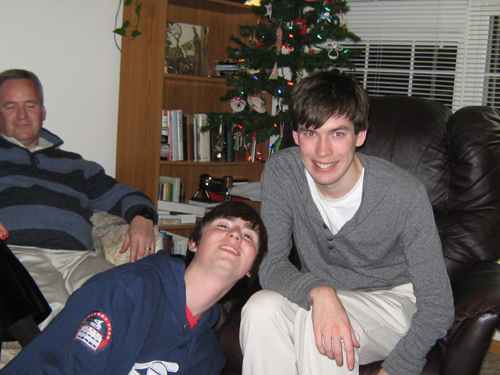
I pour out the last glass from the bottle of wine we opened together last weekend. I head upstairs, where my guest bed is stripped, its sheets still drying from the wash; the towel he used still sits here. In a family picture on my wall, one smiling face looms out, that image forever freighted with a different meaning now. There is an empty space in my house, a sense of loss even though he was here for only a few short days. I am gutted, angry, filled with a fire to go forth and never waste another precious moment, to heal a broken world with whatever power I might have. And so I sit down to write.

My cousin Andy had the power to fill a room with his presence. He was magnetic, aglow with opinions, eager to share his latest objects of fascination. Like many of us Maloney cousins he was a Renaissance man: an electrical engineer, a voracious reader, a skilled chef, an eager skier, a card and pool shark, a determined sailor, and a devoted lover to his high school sweetheart, along with a host of other pursuits he would be sure to tell us about whether we were interested in them or not. He and I always shared a bond, even if we only saw each other a few times a year; though he was over four years my junior, he was precocious enough to keep pace from a young age. On an unstated level, we were the only living children of parents who knew loss, perhaps living out a sort of surrogacy for the younger brother I barely knew and the older one he never did.

Andy was voracious in his appetites, and so many of our times together are vivid: in the Northwoods by Minocqua, snorkeling off St. Thomas, on that family Mediterranean cruise we were set to relive this summer; teenage pillow talk when we were supposed to have been asleep, a bourbon-infused night after a Shakespeare festival in La Crosse, too many euchre marathons to count. One night, after I unwittingly enabled his tip into drunken excess, I suddenly saw the danger in the relentless course he charted. But I was myself enchanted by that push, wanted to ride along with it, even as I remained firmly bounded by an unshakable sense of limits. He was refreshingly open about the troubles he did eventually face, sought out the help he needed, was bounded by a loving network of support.

Some diseases, however, are too deep to cure, and Andy careened toward the edge in his final months. My journal entries on the four times I saw him in 2022 read like a steady progression. In February, when he descended on my house with a gaggle of friends for a ski weekend, it was a rollicking party, good food and happy stories and a few nightcaps for just the two of us, united in our thirst for those moments. “His company is so very easy to keep,” I wrote in a contented blur on one of those nights. A May backpacking adventure on the Superior Hiking Trail left me a bit put off by certain conversation topics and the regularity with which he self-medicated with THC, but he was a trooper through relentless rain and mud, not once complaining at this brutal slog that would have broken many other backcountry rookies. By Thanksgiving, I wrote with annoyance at the seeming evacuation of his social awareness; by Christmas, I was having asides with relatives, bluntly asking if he was okay. He was not.

Andy was supposed to come visit for New Year’s, but instead spent it in a hospital. He was bitter over the intervention, our lone conversation during that stretch a rant-filled call in which I could not get a word in edgewise. It was, however, necessary, his ultimate passing in no way invalidating the wisdom that something had to be done. I now recognize that he was by this point deeply sick, on a path to ruin in one form or another. I started to wonder if this story could ever have a happy ending, a cascading series of concerns that, alas, proved preparatory for the end result, a thought that is in no way comforting but did allow me to glide past the shock phase in the cycle of grief and begin the effort to heal.

He finally made that planned New Year’s trip in mid-February and spent his final weekend in my guest bedroom. It was a low-key affair, reading time and board games, me apologetic for being pulled six different directions by hockey and a ski race over those days. Of course all the what ifs flit through the mind. Was this a goodbye? No: he was going on with life, making reading lists and travel plans, and by then I knew his evasions well enough to be sure it was no act. Could I have said more, done more? No: I have enough faith in my instinct that he was not ready to talk, and this intuition has since been backed up by those who did try to broach the topic. But there was a visible void there, a missing spark of the old manic energy and rebellion, the fuel that drove him to the edge and sometimes over it. I chalked it up to medication and hoped he would, in time, find a better equilibrium. He did not have that time. His case was terminal.

This suicide is the closest and rawest to me in recent years, but it is far from alone: there have been far too many in my orbits, too many friends and relatives left in grief. It is hard not to look around for things to blame. There is something to a late modern anomie, a lack of meaning or sanctity in a cold-hearted and status-obsessed world; an uncle and I who had been just trying to watch a football game were subjected to snippets of this malaise amid a meandering December rant. There is a news environment that preys on fear and despair for profit, a doomsaying world in which Andy at least dabbled. There is the Covid-era exacerbation of isolation that has compounded so many of these trends and pushed too many over the brink. There are the guns, the sickly offshoots of an American fetish that draw headlines for mass carnage but more often than that prove deadly accessories that turn dark thoughts on bad days into irreversible fates. There is the lingering cloud of generational trauma, the specter of addiction, the accumulating weights that trouble people across all cultures and eras.

And still. So many of us live through the same general conditions and come out well enough, and I ask him the question on a ski the night I learn of his passing: fuck, man, why couldn’t you see some of what I see, feel some of what I feel that lets me take every crisis I face and crush it beneath a resolute certainty of purpose? I’m not sure if I will ever know that answer, and I am, true to form, at peace with my efforts with Andy. I have found counsel in the words of both friends near and thinkers afar, and I have, perhaps eerily well, scripted my ability to process the unthinkable in my words on here over the years. I wish I could impart that equanimity to his parents, to the love of his life he left behind, to everyone else in our sprawling clan, but their journeys are their own. May we all find what we need to persevere, in speech or in writing or in unsaid feelings, in embraces and little memorials that convey what words cannot.

I head upstairs and remake the bed. The towel goes in a laundry bin, the wine bottle into the recycling. The picture, of course, remains on the wall. The fondness over the good times we lived will never die; nor, I think, will a certain anger over his final choice. But the rant-laden phone call from the hospital in January did end with a sudden, tender “love you,” a jarring reminder that the incandescent soul was still there, clinging to something as it lost its war with a fatal disease. That is still Andy, here both to haunt and bring forth a smile, the eternal presence burning through us. Like Hamlet, we do not know what dreams may come in his sleep of death, but those of us who live on know he will endure in ours.

Racing Hounds

For the better part of three decades, Duluth East hockey had a particular brand. Aside from the occasional exploits of a Dave Spehar or a Garrett Worth, there were certain things one could always expect out of those black jerseys. A tough, gritty style. A firm defense. A willingness to wear down the opposition, to outhit them and grind them up with an intense forecheck and a suffocating neutral zone. There were wrinkles here and there to adapt to the talent at hand, some of which yielded great results, but even in relative down years, people in the stands knew exactly what to expect.

In 2023, Duluth East hockey bears little resemblance to that age. Gone are the clogged neutral zones, the yells for the second forechecker to beat a hasty retreat back to the blue line. Even the black jerseys are gone. (Sorry, Coach, I’m going to struggle with that one for a while.) This team is a group of racing Hounds, flying up and down the ice, and behind a surging top unit and a Mr. Hockey finalist-type season out of Cole Christian, East is 13-1-1 in its last fifteen, back among the serious contenders in Minnesota.

No team ever wins anything in early February, but these Hounds have already made real progress. The air has fully cleared from the misery of the past few seasons, and the hockey is just straight-up fun to watch. Anyone who wandered away from East hockey after the past few seasons and has not yet come back is missing out. The Hounds bury lower-tier opponents with regularity, and even if they have an off period or two, they have the firepower to come roaring back. The offensive output has been like clockwork, never really slumping, even if they do get caught deep and sometimes bleed a few too many goals for comfort. The signs of potential were there in a 3-5 start; frankly, they were there at times last season too, albeit buried beneath a lack of discipline and long periods of slop. This team has always had talent at every position, and the pieces were there, just waiting to be unleashed. In his second year as head coach, Steve Pitoscia has engineered a reversal.

In mid-December I posed a few scenarios on how East, then 1-4, might rise out of the realm of moral victories and start logging real ones. One of these involved the stars putting the team on their backs, and that has most certainly happened. Christian’s heroics (58 points in 23 games) have led the way here, but Thomas Gunderson has developed some good chemistry with his linemates over the course of the season, while Wyatt Peterson does some of the dirty work that frees up Christian and Gunderson to fly. They may not have the sheer high-end potency of Worth-Donovan-Mageau or Randolph-Toninato-Olson, but they are carving out a space among the great Greyhound lines, with few able to keep up such a ferocious pace. On the back end, Grant Winkler has become a dominant force, and Henry Murray has also grown into a reassuring presence. The East top unit can now stack up with just about anyone’s.

There has been growth in other areas too, with players like sophomore Caden Cole making his way into double-digit goals and Makoto Sudoh throwing his weight around, along with some respectable lower line work and a stable second defensive pair. In December I also said the team needed to prove it could win a big, close game, and it has started doing that down the stretch, holding off pushes from Centennial and Cloquet and, most recently, mounting a stirring comeback against Champlin Park in a game in which they’d looked dead to rites for a spell. These Hounds continue to check box after box, finding ways to win and bringing the Heritage Center back to life.

It all started with a win over Andover in December. These Huskies are not the Huskies who won the state title a season ago; gone are the leaders of a stout defense, the Brimsek-contending goalie. But their top line remains otherworldly, and the program is gushing with talent that should allow it to fill holes with relative ease. But when the Hounds took it to them in a 5-1 home win, it was clear the gap in 7AA was not what most of us thought it might be. When East followed that up with a 6-0 win over Grand Rapids on Friday Night Ice, the Hounds were off to the races. Their only loss since came at the hands of top-ranked Minnetonka.

Andover, after a choppy start to season, has joined the Hounds in finding an offensive groove. The Hounds and Huskies are clearly the class of 7AA, as Grand Rapids has flatlined some; the Halloween Machine’s early defensive prowess has not always held up under relentless pressure, their offense too hit-or-miss to sustain a top 20 status. Still, the Thunderhawks remain ominous, capable of finding the formula to shut down a semifinal opponent. A feisty Cloquet team, meanwhile, has scored a few respectable wins, and will look to leave a mark in its final season in AA. The section is far from the state’s deepest, but it provides some intrigue, and if it does come down to East and Andover on a Thursday night at Amsoil, it will be another great heavyweight fight.

This team isn’t a finished product yet. Goaltender Kole Kronstedt would no doubt appreciate fewer odd-man rushes coming his way, and a few fewer stretches where they lapse into chasing teams around their own zone. The top line plays a lot, and long shifts always unsettle me. A rigidly structured opponent can leave them struggling for answers, though other than Minnetonka, not one of them has managed to keep East down for three periods since early December. Regular season winning streaks mean nothing in late February or early March, when teams truly leave their legacies. But belief is a dangerous thing, and after three seasons in the hockey wilderness, these Hounds have restored it on the east side of Duluth.

Making it Count

On a night in late March I mummified myself in every garment I had. Ice pellets pelted my tent, whose central pole was held up only by an elaborate pile of rocks nervously heaped along its base. I was miles from the nearest human, and a cruel wind ripped across the exposed ridgetop where I’d made my home. My sleeping bag liner was in the trunk of a car some twelve miles off, and any extra water would have to come from melted snow. I was exhilarated, never more alive and yet still able to settle into some just-warm-enough restfulness that would carry me through the night. At dawn, a glittering golden light burst over the mountains of southern Utah. I had reached Zion.

That night, and the reflections that built upon it over the remainder of that trip, have often been on my mind since. It was the culmination of a journey, or so I believed, that began in pandemic grit and then burst outward on a series of great adventures in 2021, from St. John to Montana, from New York to Tucson and various stops in between. My return to Zion was to be a final step up a Grand Staircase, a surge into a new layer of time in my life, to borrow my metaphor at the time. No more need for ventures like this, I proclaimed: I’d done what I’d set out to do, and now I could go all in back home, building the life I imagined.

On the surface, the next nine months went well enough. Yes, my work life was at times all-consuming and stressful, but I learned and I grew and I knew where I was going with it. I still went on some worthwhile ventures, from a college reunion to the peaks of Colorado. Perhaps most gratifyingly, out of loss, I found new pride in one half of my family history, and the joy with the other half continues. My Duluth networks, from politics to hockey and beyond, grew deeper, richer. And yet if you were to ask me how I was doing at nearly any point during this stretch, I would have almost never responded with joy or even self-satisfaction. I was drained, yearning for things I did not have, turning a Joan Didion quote from “Goodbye to All That” over and over in my mind: “It was in that year, my twenty-eighth, when I was discovering that not all of the promises would be kept, that some things are in fact irrevocable and that it had counted after all, every evasion and procrastination, every mistake, all of it.”

Perhaps I was lapsing into melodrama. My audiobook choice for my most recent drives across northeast Minnesota might provide some evidence here: Finding Everett Ruess details the story of a 1930s-era Into the Wild figure, a teenage boy who completed epic traverses of the American Southwest before he disappeared into the Escalante canyon country, never to be seen again. I have in me some of that romantic, wandering soul on some solitary transcendent quest, and while I count myself fortunate to be free of Ruess’s melancholy and any yearning for eternal escape, I can identify with those impulses to place oneself amid a grand narrative of destiny, driven by powerful feeling.

To make sense of that narrative I have tended to lean on classics and a web of metaphor. My loose outlook on the world, and perhaps my staid reserve that keeps me from any emotional overdrive, comes from Aristotle, who observed the world as it was and understood what was good in it in light of that reality. But a duality has always hovered, and it was no coincidence that, upon my decent from that ridge in Zion, I quoted Plato’s Symposium on true beauty, a true form of unsustainable yet ever-alluring perfection. I leaned deeper into that pursuit this year, as did several people around me, often with mixed results. I cannot regret it: paths were there to take, and we must nurture both Athens and Jerusalem, reason and faith twinned, and find them both. Living in the shadow of a modern-day Roman empire this can at times be hard to do, and it is in fiction (all tagged ‘Rome’ on this blog), that I have tried to sort it out. And as I do so I feel compelled to extend my metaphor: at the end of a murky middle age, it is now time for a Renaissance.

My artistic output this year has been less than I hoped for, a common writer’s lament. This blog has far fewer posts than in any year since its launch, and my fiction on the side is stillborn. And yet I am almost universally happy with what I did put out, a rare feat indeed, and am lately enjoying the mere act of writing as much as I ever have. I’ve supplemented this progress with a new toy: this post was written almost entirely on a reMarkable, a writing-only, paper-like tablet that has already proven an ally in a quest for focus. When there is focus I can write, and when I can write I can shape my fate, and from there I can thrive.

Nine months after Zion, as an even more vicious storm battered my home in Duluth, I was just as solitary, burrowing into my blankets with equal purpose, and rather less excited about the looming shoveling than I had been about the hike down out of the clouds. But the triumph of that night hovered in my mind, a warm glow that carried me to sleep as the wind howled around me and toppled a neighbor’s tree. Zion, it seemed, had not marked a firm layer in time—that will yet come—but it was very much a moment that did count, and I was proud it had.

So, as I begin my thirty-third year, I will look for more moments that count. Many of the old excuses no longer hold, and the opportunities to flourish through a Renaissance are all right there, perhaps as literally as can be, with Venice and Rome and Florence all on the calendar for this coming summer. As I complete another pause before tacking all my Duluth winter activities I find myself liberated from chic doomsaying, filed with gratitude, and ready to live more fully than ever.

Rich as an Argentine

Destiny is a dangerous phrase in sports. Many suspect they know it when they see it, most of them blinkered partisans who believe in what they know. It’s impossible to capture fully, scorned not without good reason by the quants who have distilled so many sports down to the barest essentials that can separate wins from losses. To call a squad a team of destiny is to make an irrational leap, to claim to see something others cannot, likely in athletes one has never met, seen only on a TV screen from half a world away. It is perhaps even more ludicrous for someone who is only a passing fan of a sport; someone who’s followed on and off over the years and has down the names of the main protagonists, but has no claim to deep expertise.

As this World Cup went on, however, it became clear that Argentina was one of those teams. It didn’t guarantee they would win the thing, but it did mean they would be there at the pivotal moment, would rise to the occasion, would push to the brink in ways others could never will themselves because they just felt it in their bones. It simply meant more in Argentina. They have known they have a window for a championship ever since Lionel Messi began showing the world what a different level of skill meant, and as the five-foot-seven magician from Rosario turned thirty-five, knew this would be his last chance. Their fans, after 36 long years of waiting, overflowed with raw emotion. Argentine tears flowed out at every goal (insert Evita joke here), and as they fought past the resilient Dutch in the quarterfinals, triumph felt more like relief, like completion of a solemn mission, than the mere victory enjoyed by other nations.

By that point, I was fully on board the bandwagon for the ride, using unspent work personal time to catch their remaining matches. After the sky blue and white carved up Croatia in the semifinals, they earned a clash for the ages against France. The final was about the juiciest imaginable: perhaps the greatest of all time against the golden child of the next generation, two otherworldly talents trading blows on the world’s most dramatic stage, the defending champions against the fútbol-bleeding nation determined to send out a sporting deity on top. It somehow outdid all the hype.

Messi had the supporting cast in his quest; the Argentines, unless defending a late lead, were the most cohesive unit of this tournament almost all the way through. The work rate in the midfield, from Alexis Mac Allister to Rodrigo de Paul to Enzo Fernández, took apart their vaunted French counterparts. On the sideline, the other Lionel, the little-heralded Lionel Scaloni, pressed all the right buttons as he molded his squad, boldly putting a few stars on the bench in favor of the right supporting cast for Messi’s skills. His master stroke: starting the wily veteran Ángel di María, who had the half of his life in the final, as he drew the penalty converted by Messi for Argentina’s first goal and finishing off a majestic passing sequence on their second. The Argentines were in complete control against the world’s deepest footballing machine, and in normal times, this would have been enough for a coronation.

Destiny, however, demands drama. No podía ser de otra manera sino sin sufrir, sobbed Andrés Cantor to his Spanish language audience at the end of the night: they had to suffer, there couldn’t be any other way. The source of that drama, aside from suddenly ragged defending: Kylian Mbappé, the French virtuoso who drifted through most of the game who needed just 93 seconds to knot the score. His vicious strike on the second goal hushed the singing Argentines for the first time all tournament; soccer, perhaps, was ready to pass the torch to a new superstar. But after that it was sheer, magical chaos, the teams powering up and down the pitch trading chances at reckless abandon, substitutions one-upping another, a net-crashing Messi seemingly winning it all before Mbappé snatched it back again in the dying minutes of extra time. So often in soccer penalty shootouts seem unspeakably lame, a way of euthanizing a game that has long since run out of energy, but it felt like the only sane conclusion here. One by one, the Argentines came forward and clinically finished their penalties, while their keeper, Emiliano Martínez, rose to the challenge once again.

When Gonzalo Montiel sealed the Cup with the final penalty, Argentina went into a catharsis to end all catharsis, a pure release, from the pitch to the broadcast booth and everywhere beyond. Montiel ran around cluelessly before his teammates swarmed him, di María bawled for the third or fourth time in the span of two hours, and Messi raised his hands to accept the worship of the masses and channel it through him. On the other side, abject shock, with dazed stares of exhaustion and Emmanuel Macron down on the pitch to console Mbappé. (I here picture Donald Trump coming down to the pitch to inform a United States team in a similar spot that they are all losers, or Joe Biden forgetting who all these people are anyway.) Who needs great conquests or wealth when a two-hour game can provide the apogee of human emotion?

The next night I found myself ignoring Monday Night Football to pour myself a Mendoza Malbec and watch footage from Buenos Aires: a drone sweeping over the Avenida 9 de Julio, the view from a lonely cyclist peddling up a deserted street as the city suddenly explodes, relentless song and dance, a few insane souls scaling the obelisk in the Plaza de la República. Then came the scenes from the victory parade, which had to be abandoned and completed by helicopter to get around the crowds. Oh, to someday be able to party like an Argentine.

And then it occurred to me: a few months ago, I’d been offered a spot on a trip that would have begun in Argentina in late December. I declined: a bit too much money, a bit too complicated logistically. I looked back at the old string of emails and, sure enough, if I’d accepted, I would have been in Buenos Aires on the day of the final. FOMO, you have consumed me.

Life goes on, though, and rewards in Christmas parties and holiday retreats and good hockey. And before long there will be new windows into that full range emotion, life to the fullest, joie de vivre in the face of everything. May the bursts never stop coming.

Beyond Moral Victories

If you had told me ten or even five years ago that I might be relatively pleased with a 1-4 start out of a Duluth East boys’ hockey team, I would have run away in terror. I also would have dreaded to know what happened in the interim, and my darkest guesses would probably resemble something like what East has gone through these past three years. It has been a long, unpleasant tunnel, but suddenly, despite losses, the team looks like it could do some good things. “Duluth East hockey is fun again!” I exclaimed out of the blue midway through a competitive showing against Wayzata this past Saturday.

I don’t want to oversell this start. 1-4 is still 1-4. White Bear Lake and St. Thomas Academy, and even Wayzata, are all plenty beatable, and a top fifteen team probably would have pulled out one of those. The Hounds have lost to an offensively challenged Grand Rapids team, a seventh straight defeat against a section rival they once owned, and will likely have to solve that tight Thunderhawk defense and goaltending to go anywhere in 7AA. And that, of course, is before the get to the elephant in the section, an increasingly dynastic Andover program that returns its top line from a state championship a season ago.

And yet there is promise. The Hounds play at a lively pace with good tempo, and have proven they can skate with three teams that are in the top ten or at least around it. The top line of Cole Christian, Thomas Gunderson, and Noah Teng has shown some quality flashes against good teams, and if it builds its chemistry, it could round into one of the better units in the state. Wyatt Peterson and his sophomore sidekicks, Ian Christian and Caden Cole, could give them some scoring depth, which has been in short supply in recent years. A grinding third line, if it sticks to its game, could play a vital role. A defense with four three-year-plus players—Grant Winkler, Henry Murray, Grady Downs, and Aidan Spenningsby—is a real strength. Newcomer Kole Kronstedt looks smooth in goal, safely filling what looked to be a void. The schedule has a bunch of winnable games coming up that could let them find some confidence, along with a few state powers sprinkled in as measuring sticks.

This team has no glaring flaws, and the ones that do exist seem fixable. Discipline, their bete noire a season ago, still simmers beneath the surface as a challenge that requires management, exemplified both in the occasional parade to the box and just in the occasional ill-advised pinch out of a defense that otherwise looks relatively good. The offense must also find ways to turn shots into goals, to break down rigid defenses and finish the golden opportunities that do appear before them. Cleaning up those two challenges will leave the Hounds competitive on any given night.

Sometimes not having glaring flaws, however, makes it hard to find the pick out the opportunities that could move a team from the realm of the merely good to the great. The talent is not on Andover levels, nor does the depth match the West Metro powerhouses. Perhaps the senior stars, like Cole Christian and Grant Winkler, can put this team on their backs; perhaps breakthroughs by some of the younger talent can move them toward a reliably dangerous offense. Perhaps the veteran defensemen can lock down in front of strong goaltending to create a real fortress around the net. Perhaps the special teams, brutal a season ago and modestly better through five games but still with plenty of room for growth, can become the source of strength they have so often been in Duluth East history. Some combination of these things will need to fall into place to put together a strong season; to have a shot at Andover, they will need all of them, and maybe more.

Beyond any individual performances or newly discovered discipline, though, I sense that this team needs to learn how to win. Duluth East playoff success is a childhood memory for this group: only Grant Winkler, as an injured eighth grader, has been on an East team that won a section quarterfinal. These players have never beaten Andover or Grand Rapids, or even Forest Lake, in high school. Without being in the locker room, I don’t know if that self-confidence can come from cranking up the stakes and pushing the team to the brink, as was the method under the old regime, or if they can drain away all the pressure that comes with high-stakes high school hockey and just go out there, be loose, and have fun. The answer may vary for different players, or in different moments. But unlocking that formula will be the key for second year coach Steve Pitoscia and a program looking to regain its stature after a few years in the wilderness.

There are enough pieces, enough opportunities, for this team to stop winning moral victories and turn them into actual victories. It all starts this Tuesday in Forest Lake, the place where the last East dynasty ended, and where perhaps some sort of return to high school hockey contention can begin.

In Memoriam: Nick Bachhuber

News of a death from one’s high school class trickles in slowly; first from one stray friend and then another, none of us his intimates and all with our own sources, and then confirmed through a dive into the social media world where it sits alongside random minutiae in other lives temporarily untroubled by sudden loss. It is a jarring experience, one in which I trade some laments and feel momentarily helpless and then do what I always do, which is start to write a few things to make sense of it, and in this case choose to share them in the off chance that they help a few others find that sense, too.

It has been years since I last saw Nick Bachhuber, but he lingers in my mind’s eye as a truly genuine human, a piece of praise I do not dole out lightly. He was beloved by his classmates, outwardly easygoing and willing to connect with anyone, curious and thoughtful in all he did. Nick lost his dad while we were in high school, an absence that haunted him. (We children who knew tragedy could see it in one another.) Out of that, I think, came a depth of character that emerges through adversity, a layer of thought that can provide an added well of richness to strengthen certain interactions. With that he set off for college in Chicago, for Teach for America in Detroit, for a series of steps outward and eventually into a life with a wife and a son and a second on the way before it all came to a sudden halt. He packed so much in to so little time, a raw intensity of experience channeled through him and into his works.

Nick is not the first of my high school classmates to pass, but losing that vivacity and richness of soul is a particular hit. That feeling is underscored as I find myself more and more enmeshed in my hometown, where I watch as some other kids at the same high school form those same ties my classmates and I once did. I am now left to wonder how the march of time will flow through their friend groups, which once fond memories will take on an elegiac tint too soon. Nick’s loss now can only be a reminder of how much every passing moment counts and how long these connections last, even when they stem from experiences long ago in a world half remembered, their peaks and valleys smoothed into a few clean, defining moments. Perhaps our minds know what they are doing, picking out the highlights and giving them back to us as fondness for what was and fuel for what can yet become.

Nick’s coronation as Mr. East, 2008.

A memorial fund is available here.

Nick’s high school story was somewhere in my mind, among other influences, when I penned this short piece of fiction a few years ago.

Rest in peace, man, and know we are all still here for you.

On Loyalty

This political season has led me to reflect on my moment of political de-awakening in 2010, back on that Mexican night when I stood before a statue of Abraham Lincoln and freed myself from overreaction to election results. I swore that I would never let politics define my fundamental happiness: family my immediate network, my community, would come first. While there have been bumps, particularly amid Covid isolation, I have managed that, through a volcanic Trump era and some peaks and valleys closer to home. Despite a lifetime of fascination with this world, I have simultaneously held it at a certain remove, forever intrigued and even active but never quite attaining full immersion.

This tension begs the question of why I still spend a fair amount of time hovering around the political arena. I certainly have some opinions on things, and would like to see my milieu move in certain ways. But more than that it is a way to meet people who believe in action, who believe in the betterment of their worlds and who recognize they have a role to play in it. Some of the people who are most full of life that I have ever met are politicians, at their best when they channel others around them and use their wit and charisma to achieve results against long odds. They enter some of the most brutal, unsparing competitions a person can find: failure is public, they place targets on themselves, and their choices affect not just their own selves or circles but stray random individuals who may have nothing to do with them. The winners in politics get to touch the levers of power, and power requires great care. Few situations say more about people than how they react when so exposed.

Hanging around politics is a social activity, and the people who are attracted to politics are always looking for something. The best of these are the committed, hardworking volunteers; the people who are scrapping their way up out of committed belief or who have free time to give to things they believe in. But one will also find a few awkward hangers-on who cling to campaigns in cringey forms. There are the attention hounds, those who are more interested in the image of appearing useful than actually doing so, and the grudge-holders who get caught up in the inane drama within these small circles. And there are the climbers, who will work hard for those who can give them something in return but offer little when they suddenly do not. Some of these political animals are using electioneering to fill an inner void, a turn to a flawed, earthly pursuit for meaning against which my 20-year-old self instinctively rebelled; others are merely the thin and vain who would never even recognize a void that swallowed them whole. Too many others are true believers who get caught up in the machine, float into a place that combines some of those two strains, and wind up in too far deep before they have a chance to realize how adrift they are.

Now, twelve years removed from that visit to Lincoln, I find my political self not loyal to a party or even so much to a real set of policies (though I have my preferences), but to certain people. To the people who engage in politics because they think they can do some good in the world, who see opportunities in front of them and leap in despite some trepidations, rather than those who barrel ahead because they’ve convinced themselves that this is who they are and what they must be. To people who are excited by what they can do in office, not the mere act of running. To the people who display loyalty, to people who recognize that loyalty is a two-way street, and to the people who cultivate it in turn. To the people whose loyalties remain true through victory and defeat. To the people who stay loyal even if my own reality takes me in a direction that limits my chances for direct engagement, as this year’s has.

That loyalty is ever so important because politics can consume people, even those who start out with the best of intentions. In a world where the end goal is always in the eye of the beholder, the ground on which people stand shifts faster than anyone could expect. The outcomes of political work are all filtered through public opinion, significantly murkier than the clean profit motive in running a business or the carefully honed mission statement of a well-run nonprofit. Politicians have to sell not a product with a discrete use but themselves in their flawed human forms, imperfect vessels to funnel into positions with narrow paths to achieving outcomes. Money can help, but it alone cannot buy success, nor can one ever have enough. Many politically active people are plagued with an eternal craving for more that even the greatest policy achievements will not satisfy. It is the ultimate Sisyphean goal, the promised eternal renewal of human affairs.

And so, instead of a series of hot takes on the political trends in northeast Minnesota or a rumination on national polls, this year I choose simply to offer my thanks. There are some wonderful people in my network, and after a year that pushed many of them to the brink, may we continue to pursue greatness with the levers we have in our hands. Our moments are here for us to seize them, and as long as we have these ties, we will survive, no matter the outcome.

In retrospect, I may have made a mistake twelve years ago, when I said community, not politics, would be that source of happiness. Politics might just have been the conduit to find a community, and those ties go far deeper than the results of one stray election. The pursuit can reap rewards we never could have imagined.

Out of Arcadia

It is easy enough to say that we will remember people who have left this world, but an altogether greater challenge to say what exactly that will mean in practice. Over time, the mental images of those who have left us acquire a sepia tone and fade into nostalgia. Pictures and words may carry forward the more poignant snapshots, but another’s presence in the moment is not something any of us can replicate. This is the way of the world, not cause for sadness but a reality that requires adaptation. How, exactly, do we sustain memory?

In my home office, a quest for a passable Zoom background became, unwittingly, a shrine of sorts that gets at the answer.

Pictures of my paternal grandparents sit beneath Poussin’s Et in Arcadia Ego, a depiction of Arcadian shepherds discovering a tomb, a realization that even in Arcadia, a fertile paradise of myth, death looms. My earliest memories of Alfred and Mary Ann Schuettler are a rural Wisconsin idyll: a venture across a corn field to a collection of bee boxes, hide-and-seek through their tangled gardens, throwing a baseball around with Grandpa in the back yard, decking the house for Christmas. All of the trappings of childhood simplicity and happiness, it seemed, could be found tucked away on Division Road.

Time and growing knowledge undid those images, and while aging shatters many youthful illusions, in few other places was the fall as obvious. Like the shepherds in Arcadia, I discovered death and human suffering, and knew there was no going back to the idle play that preceded it. I saw how escaping that world had allowed my dad to thrive. My grandparents aged, lost their faculties, and passed on. An uncle was there to care for them, but battled his own demons. The cats proliferated. The vegetation swallowed the home, the smell grew worse, the conversation more stilted. There was no going back, and it became some emblem of a fallen world.

To be cast from this garden is among the most fundamental facts of human life. It will take different forms for everyone, but come it will, even if some may never acknowledge it. When faced with this reality, the reactionary mind rejects the garden as a lie; the mature mind looks back on the garden and sees in it things that are worth perpetuating, even as it knows its impossibility as a permanent state.

It took me years to come to this place. I am leery of the word closure because it implies an ending that may not fully be, but this past weekend, on a venture to spread the ashes of my grandparents, I completed a project over a decade in the making. Distant relatives came out of the woodwork to pay their respects. An eight-foot family tree came forth, and stories about everyone on it followed. A drive past the family farm where it all started seared its way into my mind: the house burned years ago, but something of mine remains out on County LL north of Port Washington. Pictures revealed a time before the thickets swallowed up the world of the people who had planted them, a time when its flowers and gardens were meticulously tended and put on stunning display. We flipped through hundreds of old photos and sipped booze out of the Elvis figurines that secretly contained bourbon all along. My grandparents’ story followed the full cycle, from some prelapsarian myth deep into purgatory, but now it can rise again not up into the clouds but instead into that rich Wisconsin earth where it belongs.

My maternal grandparents sit beneath Don Quixote. This piece came directly from them amid late life downsizing; I remember its old resting place above an entertainment stand in the house on Edgewood in Lombard, Illinois. (The stand was dominated by a radio, a fact that now would seem to suggest it was a relic of the Ming Dynasty.) From that pair of 1940s University of Chicago lovers I needed little in the way symbolism: the dynasty they founded and the lives they lived have stood on their own. But the words in which they immersed us all provide guides, too.

When, in my senior year of college, I took a full-semester course on Don Quixote, my professor, the formidable Barbara Mujica, repeatedly noted the cyclical nature of the novel. The common image of the knight errant as a symbol of freedom is only half his story. Don Quixote ventures out and then returns home, eternally searching, trying to recover the world of the chivalric novels he devoured, a performative seeker of an impossible dream. His journey shows not only what he strives for, but what he is missing, rising in pursuit of glory and falling into madness all at once.

The final chapters in Don Quixote are not a paean to the hero’s quests, but instead a lesson in how to die. Cervantes gives his readers some ideas on how to prepare for that unshakable fact: surround ourselves with a dense network, appreciate that our journeys are complete, free to cast aside any final illusions and go forth not as Don Quixote, but as Alonso Quixano the Good. With him, literature left behind the trifling Arcadian novels that preceded Don Quixote and discovered modernity, a mandate to pursue truth and move through time in a linear march.

That march of modernity loomed heavily over the past two years, a reality that includes both progress and inescapable loss. Fortunately, a few people have ruminated on this reality, and some of the best of them were my grandparents’ contemporaries or immediate forerunners: creative minds in the aftermath of calamity who dared envision a new world while still retaining some wisdom of the past. The names here will be of no surprise to people who know my reading habits: Wallace Stegner and Joan Didion, children of pushes to the frontier who appraised what their worlds had wrought with a keen skepticism, or Hannah Arendt and Octavio Paz, who harshly judged the machinations of modernity while still knowing that it formed the basis of the world in which they lived. Sometime in the middle of the twentieth century Don Quixote’s quest came full circle, and a few wise minds of that era stopped to gaze back on that Arcadian garden even as the world hurtled ahead. Too often now we have lost the ability to recognize it for what it is.

A generation is gone to me now, but I am at peace with it. Grandparents often have the freedom to bestow unconditional love, to spoil their grandchildren and never have to deal with the consequences of misbehavior or the grating tension that so often arises between parents and children who share the same home day after day; to create a world in which children can be knights errant on their own little quests. And yet they are in some ways inaccessible, will never be a peer in the way a parent can be once a child reaches some modicum of a stable adulthood. Several boomers in my life, now past the age when high school or college-aged kids could be considered peers of their own children, have noted how they have lost touch with the youth, can no longer relate in a way they once could. Two generations of separation in a world whose technological and cultural markers change at breakneck speed leave a gulf that can be bridged but never quite pulled back together.

There are ways to strengthen these bridges, to build ties across generations, and I will certainly submit that our world needs more for them. But there is forever a gap of space and time. That separation gives us a sense of our own time, tells us who we are. We do not have forever. Moments of influence are thrust upon us, and we can take different roles at different stages, finding the contributions most relevant to our specific moments. The passage of a generation teaches us something about these stages, and it may fuel our urgency to play our own parts, to preserve the best of it and pass it on.

With my grandparents’ ashes scattered, my dad and I head home in the company of six boxes of photos, which we will sift through in the coming weeks and months. But I also head home with a story about what my grandparents meant, the world they came from and what they can unwittingly teach. They have settled into that earth now, and from them another Arcadia can start to grow.

The Twilight of the Official Myth

The passing of Elizabeth II, by the Grace of God Queen of this Realm and of Her Other Realms and Territories, Head of the Commonwealth, Defender of the Faith, has little bearing on my life. To my knowledge, I have no British ancestry. I have spent all of five days of my life on British soil, and have not set foot in one of the various Realms or Territories since a lunch at a Canadian golf course a decade ago. For that matter, I live into a country that came into being by throwing off the yoke of British rule. Like most Americans, I could content myself with reading a news story or two about the passing of the crown and move on.

And yet I confess a fascination with the late monarch. My weekend devolved into long Wikipedia dives down the lineages of royal families and their estates, a quixotic quest to understand the arcane layers of royal titles and role. Elizabeth II earned respect, even among anti-monarchists, for her longevity and ability to project a stable, dutiful image even as Britain convulsed its way through the dissolution of its empire, 15 prime ministers, the lurches of the Cold War, Margaret Thatcher and Tony Blair, and, finally, Brexit. But she represented more than just good health in the age of modern medicine and her meticulous decorum: she was the living symbol of what it meant to be a Briton, the whole churn of history and greatness and oppression and everything else that comes with being an obscure island off the coast of Europe that has shaped world history as much as any other place.

Such symbols are in decline. One of the former Commonwealth countries, Barbados, took its own path to Brexit in 2021; now a republic, it no longer recognizes the British royals. Others will likely follow, and while the outpouring of British mourning has no parallel in American life, even in Britain there appears to be a generational gap in real appreciation. For that matter, republicanism, the cause for which millions died over the course of two and a half centuries in a revolt against the power of monarchs, faces its own crises amid charges of aloof elites and out-of-touch representation, or perhaps a descent into dithering dysfunction that fails to get anything done. Politics devolves into rage or apathy, neither of which has much time for unifying symbols. To hold one’s nation-state in great esteem comes off as a special brand of naïveté, perhaps noble in the case of some members of the armed forces but also quaintly antiquated in a world that is supposedly beyond borders.

The nation-state is far from the only realm where unifying mythologies of the modern era are falling away. To be religious in the educated or fashionable circles of society is now passé, a stodgy formality akin to a fondness for corsets or three-piece suits, and that once-universal language of Biblical references that litters midcentury popular culture now draws blank stares from younger generations. The great media brands of the postwar era are being eaten alive by the cacophonous inanities of social media, the only exceptions being niche interests like the Wall Street Journal or companies that have become one with the beast and turned themselves into full-on lifestyle brands like the New York Times and, in different ways, Fox News. The only national arbiters of culture seem to come through momentary fads, a quick TikTok craze that comes and goes in a blink, the most notable of which we may recall in twenty or thirty years, but disconnected from many broader statements about our times.

The rational mind likes to think this death of myth is a victory: we are dispatching of fictions and living in reality. Leaving the merits of this worldview aside, the evidence that this mindset is actually taking power is wanting. Religiosity finds fascinating new outlets, some of them much less worthy of respect than an omnipotent deity. A dating app now sends me weekly astrology advice; I swipe left in disgust, though apparently there is a market for this. The middlebrow epic film on themes of historical resonance may be in decline, but the myths of Middle Earth and Hogwarts and Westeros and A Galaxy Far, Far Away keep cycling back in a meta-myth that would no doubt chagrin Joseph Campbell. Financially, these reboots pale next to the searches for superhero figures to save us from an ever-grittier perdition of the supposed real world, a childhood wish extended in a none-too-subtle quest for redemption. Vladimir Putin channels a certain czarist revanchism in his Ukrainian adventure; lesser actors on the world stage, from Recep Tayyip Erdogan to Narendra Modi, likewise gesture toward an imperial power they would surely like to wield.

Putin’s floundering offensive, however, is just one of many markers that suggests old myths, once dented, cannot simply revive themselves with a few well-directed artillery rounds. (I will spare this post any discussion of Make America Great Again or a resurgent socialism.) The absurdity of social media as a news source speaks for itself, and meditation for its own sake is hollow solace when darkness comes. Rock consigned classical music to a niche realm of high cultural appreciation, but now seems to be drifting that way itself as its Boomer progenitors age out of the limelight. The humanities revolted against the white maleness of Western Civilization and have wound up not as newly empowered multicultural wealth of knowledge but instead stumbled into the wilderness. Humanities majors have gone into precipitous decline, with a few loud voices sucking up the oxygen for the culture wars while more and more students spend less and less time in any well-structured place where they can figure out what this whole life thing is for. Heavy is the head that wears the crown.

There is nothing particular to the death of Queen Elizabeth, or to the uncertain future of the British Empire, that fills me with sadness. And yet, as I look to a world where more and more people around me seem at a loss for things to ground them in a liquid world, ever more consumed by paralyzing anxieties or resignation in the face of it all, I cannot help but feel a slight tug of emotion when William Blake’s lyrics to “Jerusalem” ring out at Westminster Abbey next week. The Queen, for all her monarchy’s flaws, was a stable part of the world we had, and her passing leaves a void. In some ways it may be a welcome void, but it is a void nonetheless. And any project that does not seek to fill the void with something as compelling, whether national or cultural or educational or personal, will see it filled by something else.

The Two Mountains

I use mountain metaphors with a regularity that long ago gave up any pretense of originality. Such allusions come naturally to a hiker, a striver, someone who values both the art of finding the route and exploits of physical skill, to the point that they become rote. They leech through my travel writing, my fiction, and my political advice. “We have other mountains to climb,” I tell a friend who, like me, has suffered a setback in what I have started to call a summer of disappointment. It has been a summer of deferred dreams and stalled-out ambitions, though any frustration is only the product of the lofty heights we have sought for ourselves. The pursuit alone is part of the allure, though after a view from higher up, the same old woods may not feel quite as satisfying.

My annual hiking trip with my uncle Bob, cousin Rob, and friends Amy and Ed takes me to the highest reaches of Colorado. It orbits around Leadville, the only settlement of over 1,000 people at an elevation over 10,000 feet in the United States, and to call Leadville colorful would only start to tell the story. An early silver rush turned it into the second-largest city in Colorado for a spell; even today, a healthy chunk of the world’s molybdenum comes out of the nearby Climax Molybdenum Mine. On the way up, this northern Minnesotan explains tailings basins to his fellow travelers and geeks out on this operation. Large parts of the town look rough, trailers and bedraggled bungalows along some streets that are practically sand, but at its core is some boom era architecture with lively hues, and an outbreak of new construction has created a ski town-style tumor on its northern edge. “Keep Leadville Shitty,” exhorts a local bumper sticker, a window into the battle for its soul now under way.

I am swiftly smitten by this city on an eternal frontier. Our arrival coincides with the closing stages of the Leadville Pack Burro race, the second leg of the pack burro racing triple crown and one of its most daunting courses. It is a magical spectacle. Every five minutes, the town police car circles back through to guide in another exhausted and sweaty human tugging on the rope of a burro, which may or may not have any interest in cooperating with the exercise. Onlookers cheer as the burros amble to the finish line by the booth from the Western Pack Burro Ass-ociation. One collapses into a chair next to us, his fifth 22-mile race complete, spent from the effort of coaxing his mighty steed across the line. The closed-down main street through Leadville hosts grand old architecture, placid burros willing to be petted, and t-shirts spanning the full gamut of ass puns. A week later, on our way out of the wilderness, cyclists for the Leadville 100 have replaced the burros, another reinvigoration for a small, rural town finding its late modern footing.

Our hike covers two segments of the Colorado Trail, a 485-mile path from Denver to Durango that takes its travelers through some of the nation’s most dramatic high country. We begin at the Tennessee Pass between Leadville and Vail and work our way south to a trailhead between Mount Massive and Mount Elbert, the state’s two highest peaks. Our campsites place us at the high-altitude Porcupine Lakes, an alpine meadow beyond Turquoise Lake, and among the wooded roots of Massive. With a tree line at 12,000 feet, the views from this part of the CT are not as stunning as last year’s jaunt on the Beaten Path, but the lodgepole pines provide pleasant hiking cover, and it takes little time for this group to settle into the rhythms of wilderness release.

As trails go, the CT itself is relatively benign. It is wide and well-maintained, sometimes with the feel of a hiking superhighway. On this stretch there is plenty of water, and resupply opportunities are abundant in nearby towns. There are just two great challenges to hiking the CT. The first is elevation, and with the entire hike happening above 10,000 feet, five flatlanders take some time in adjusting to the thin mountain air. Our first day is mercifully easy, but even then sleep comes terribly, and day two beats up the entire party, with me feeling about as gassed as I ever have on a trail after a far-from-awful 400-foot climb midway through the day and fellow hikers collapsing in a grove at the bottom of the following 1,500-foot descent, all before the subsequent 1,000-foot march up to the alpine meadow where we make camp. A constant sense of dehydration looms over the trip, occasional lost appetites and bad sleep turning a routine hiking distance into a genuine chore.

The second looming threat throughout the week is the weather. Colorado has a short hiking season, and even now in midsummer, there is a chance that thunderstorms may roll in off the mountains every day. Early starts are necessary, lest the oncoming storms bear down while on some exposed stretch of trail. Our luck holds on the first three days, and though dime-sized hail does rain down on us high above the tree line on Mount Massive and lightning strikes behind the hulking peak, we make it back to camp without any ill effects and ride out the remainder of the lone storm to hit us. The wettest I got on the trip was on a hike from a restaurant to the hotel in Denver.

Mount Massive is the third-highest American peak outside of Alaska, standing shorter only than Mount Whitney and its immediate neighbor to the south, Mount Elbert. It also lives up to its name: while it may be 12 feet shorter than Elbert, it is far bulkier, a sprawling behemoth of false summits and lengthy approaches feeding up to one great ridge atop it all. We make camp for two nights at Willow Creek, which sits at 11,000 feet and cuts off six miles of the round-trip ascent from the nearest parking lot. The climb starts through the region’s characteristic pine forests, but in time the trees thin out into scrubby willows and then into rocky slopes studded with grasses and mosses. This stretch above the tree line is the longest part of the ascent, a steady march up and up through steadily choppier terrain. A saddle between South Massive and the main peak gives a stunning view down to mountain lakes and smaller mountains below, and a clamber takes the hiker up a ridge to a false summit and then on to the twin logs marking the point 14,427 feet above sea level.

Our group plods at a determined, if hardly speedy, pace. On the way down, we are promptly waylaid by a mountain goat, who takes his sweet time in vacating the path. Twenty feet onward, we encounter mama goat and baby. Baby plops down in the middle of the trail for a spell, and mama takes a leak on the path to further get the point across. By the time they finally move, the clouds are beginning to gather, and the goats provide further entertainment through a lunch stop back at the saddle. The Massive menagerie continues as we head down from there, as ptarmigans stroll past and a crew of marmots, some of them appearing rather obese, trundle about the slopes.

The human zoo on display on this trip, somehow, exceeds the variety of the wildlife. At the parking lot at the start, we get our picture taken by a British cyclist who began in Denver and is now working his way down to Mexico, an adventure that he expects will take him until March of next year. (Excepting the wilderness bits, which include the two segments we hike, the Colorado Trail welcomes cyclists.) When we roll into our camp for our first day, we come across two Missouri Mennonite newlyweds in traditional garb and their salt of the earth cowboy guide, riding horses up and down peaks for their honeymoon. One could mistake the image of the three of them for one taken in 1872. On that first night, we share the site with the Gu Girls, three through-hiking young women who have formed a trail family; on a resupply run in Leadville earlier that day, they chased down a truck distributing Gu, the energy gel for distance athletes, and they share some of their rather large haul with us. It all tastes awful.

We pass twenty Outward Bound kids for whom a 3-mile trek is torture, and later meet a teenage girl councilor for another group of OB boys who decides the route up Mount Massive, which she has just casually summitted in no time flat, will not do for them. A University of Florida biologist acclimates herself to hiking at elevation before she heads to Argentina, where she will work to preserve endangered chinchillas high in the Andes. We pick her brain on the diets of local rodents. Inevitably, we encounter a man wearing a shirt from the Bonfield Express, a now-defunct Thanksgiving 5K in Downers Grove, Illinois that Bob, Rob, and I often ran; this is the second straight year of a Bonfield moment of recognition a thousand miles from suburban Chicago, and we sing the praises of its shirts for hiking. Another Mt. Massive day hiker has just bagged his 27th fourteener this year, while the two guys who summit just behind us crack beers together at the summit. No one, however, can top Nora, the 19-month-old through hiker. Her parents are carrying this intrepid traveler clear from Denver to Durango, each with 42-pound packs (Nora weight included), and report she is in good cheer after the first 185 miles.

The trip begins and ends in Denver, a city that inspires mixed feelings. The airport, a monument to 90s sprawl, is a contender for worst in the country, though Blucifer and the lizard people lair do liven things up. Its rapid growth is apparent everywhere, and at least the dense housing is going up in droves, albeit often in far-flung tracts of identical boxes. There is a charming district of craftsman bungalows south of downtown, and grand institutions like the capitol, Union Station, and a lush botanical garden give some status to the capital of the Mountain West. The food scene, with Rob as our guide through it, is solid, and of course I cannot complain about the beer. The American future on display in Denver is more comforting than that of other western American cities, freed from California world-saving hypocrisy or Vegas alternate reality or Phoenix total defiance of nature, but it remains choked by dust and ozone warnings and unattainable real estate, the sort of qualified success story that defines the nation’s epochal lurch. It’s a fun place to visit, but it isn’t home.

Shortly before this trip, I polished off David Brooks’ The Second Mountain, the columnist’s midlife crisis book in which he distinguishes between the mountain of earthly success and the mountain of moral formation that people can pursue in life. In my tension-obsessed way, I have made efforts to climb both peaks in the first third of my life, striving both for a home life worthy of an American Dream and a well-ordered life where I believe in what I do. At thirty-two, I find myself frustrated with my progress on both, in many ways proud of my progress but still clearly still gazing up at a false summit. I decide it is somehow fitting that my venture left the conquest of a second peak such as Mount Elbert for some future journey. We do, indeed, have other mountains to climb. But we are on a well-maintained path, and we have fellow hikers to go with us.