JFK, 50 Years Later

Fifty years. I haven’t been alive for half that time, yet I can’t escape the shadow of John F. Kennedy’s assassination. A macabre spectacle that still rivets, judging by the number of books and TV specials that have come pouring out in the run-up to today’s anniversary. His celebrity and his promise still captivate millions, to say nothing of the mysteries surrounding his death and the conspiracy theories that cannot themselves die, no matter how many government commissions try to shoot them down. There is just enough question, just enough suspicion, that even hardened skeptics can be forgiven a moment of doubt. (A teacher at my high school enjoyed telling us of how he’d once taught a year-long course on the Kennedy assassination. I have no doubt he had enough material to fill that year.)

It is never hard to eulogize a charismatic man. His family’s legacy has made him a hero of the American left, one who asked us to commit ourselves to the betterment of our country. He was a war hero, promised us a man on the moon, a more democratic world, and managed to cut taxes and reach out to marginalized groups at the same time. A few on the right have even tried to appropriate him due to his stance on communism. (Indeed, a Marxist Mexican professor of mine once dismissed Kennedy as “very, very conservative” because of the Bay of Pigs…) JFK still resonates because he was everything we like to imagine this country is: youthful, vigorous, full of hope and optimism while firm in the face of crises. Not that he was without his failings, but they were of the forgivable sort, born of well-intentioned ambition and a love of life.

Kennedy’s legacy is linked to the dream—and, in all likelihood, a delusion—that a longer life might have altered the course of the next two decades. Maybe he could have kept the U.S. out of Vietnam, perhaps been able to guide the nation through the Civil Rights Movement and the other changes of the 1960s without the violence and unrest that burdens their legacies. It is all too easy to use his death as the turning point that separates the booming post-war era from the tumult of the late 60s and the 70s. As 9/11 is for me, so 11/22 is for my parents: the day when all our illusions of a well-ordered world dropped dead. A fall from grace exacerbated by his youth, his glamour, and his family’s march toward royal status. Once again, as this superb New Yorker piece shows, we have a Greek tragedy on our hands.

In realms filled with love and wishful thinking, the cynics will emerge as well. Some paint JFK as the George W. Bush of his day, desperately trying to re-make the world in America’s image. They note his botched invasion of Cuba, the brinksmanship of the missile crisis, his elaborate aid programs in Latin America that were followed by a bunch of coups, and a refusal to look “soft” on Vietnam: American foreign policy at its worst, the hell-bound road of enlightened intentions. They point out his failing health and his sexual exploits as counterpoints to the slick image we tend to remember. (In Georgetown, one can go on a walking tour to visit all of the houses of his mistresses.) They label him a mediocre president, now exalted only because he was made a martyr by a mad commie with a gun. (Yes, yes, and maybe the Mob and the CIA and LBJ…)

From a distance, both stances appear wanting: Kennedy’s grade as commander-in-chief remains incomplete, cut short before anyone could have truly known. (Pick just about any prominent president and try to imagine what their legacy would have looked like if cut off after just two and a half years.) We’re bothered by that doubt, that uncertainty, that what-could-have-been. We like crisp endings to stories, the heroes and villains made clear. JFK did not leave us with a definitive answer, and we’re left fighting over the scraps.

The JFK remembrances come in the same week of the 150th anniversary of the Gettysburg Address, one of the few moments more important in American mythology. A speech by another president whose life was cut too short, though his legacy is a bit more secure. Most every president invokes American ideals; some live up to them, while with others, it’s empty talk. They emphasize a project, a plan for a nation that rises above all others because of what it allows its people to be. Whatever JFK would have become, he never got there, and it galls us to no end.

The sober part of my mind tells me that Kennedy’s allure is all wishful thinking; that our fascination with his unfulfilled promise and his troubling death lingers over something that should have been buried long ago. But burying the past comes with the danger of forgetting its lessons; lessons that we should be able to assess without too much pain, fifty years after the fact. And while the debates over the political lessons may never end, there is something else that should not be lost: the emotion. The rawness of the moment, the shock of death, the eternal struggle to make sense of what has transpired. That we cannot forget. As Roger Angell wrote in the aftermath of 9/11:

Now we’re all the same age together. None of us is young this week, and, with death and calamity just down the street, few of us vicarious any longer.

While that moment will fade in time, in turn overrun by the next great tragedy or shock, it lingers as one of those moments that made us react viscerally—and, hopefully, search our souls before thinking of the best way forward. This is what it means to belong to a nation, however much or little we may like what it stands for. We hope these moments are rare, but when they do come, it’s worth asking not what our country can do for us, but what we can do for our country. A nation is its history, but that history lives on, and can be bent in any number of ways. Our choice, then, comes in how we respond to tragedies that take people from us before their time. Whether it’s the loss of a president or someone a bit closer to home, that time will come, and those choices can be the ones that define lives.

“Gravity” and “To the Wonder”: Sincerity and Cinematic Beauty

I’m no film critic, but I have seen two films over the past week that are worth some reflection: Alfonso Cuarón’s Gravity and Terrence Malick’s To the Wonder. The unifying theme here is a Mexican man named Emmanuel Lubezki, the cinematographer, who frequently collaborates with both Cuarón and Malick.

To be clear, I’m not at all a cinematography connoisseur; I simply saw some scenes in Gravity that reminded me of Malick’s The Tree of Life, and was pleasantly surprised to learn the same guy was behind both of them. This gave me a good excuse to go watch Malick’s latest film. Warning: spoilers galore, though I’d add the caveat that if you’re fixated on the plot of either of these films, you’re probably missing the point.

Gravity, perhaps the most hyped film of 2013, tells the story of Ryan Stone (Sandra Bullock), a rookie astronaut who must fight for her life after things go wrong in orbit, though she has some help from veteran space explorer Matt Kowalski (George Clooney). Though it takes place in space, it’s hardly typical science fiction; aside from a few liberties with actual physics, it is entirely plausible, and could easily happen to a space explorer in 2013. Of course, more fantastical science fiction can offer compelling human drama, but by stripping away the alien races and souped-up technology and specialized terminology, the human drama comes to the forefront.

Still, Gravity is not a film one could accuse of having too much plot. There is only the slightest of backstory for both astronauts, and the action begins so early in the film that there’s not much time to get to know them. Kowalski in particular is hard to separate from Clooney, and while Clooney himself is a delightful enough personality to be reasonably compelling, he is not a deep character. That leaves us with Stone, and her story also runs the danger of being rather hackneyed: a broken woman, emotionally spent after the death of her child, is jarred back into life by a debonair man and a brush with death. Bullock does a good job of presenting the emotion of that journey. Her tears drifting off through space are real (if, sadly, not scientifically accurate), and the scene in which Kowalski “returns” and gives her reason to live, while threatening to head down the road toward mawkishness, is no doubt sincere. These moments resonate because we really do have moments like that in life, and just because something’s been done before (as most any plot has by now) doesn’t mean it can’t be meaningful.

Symbolically, the film is a masterwork, and on this front, it does take the full film to unfold. Cuarón and Lubezki have created a film of stunning beauty that is far more than CGI flashiness. From the umbilical cord tethers to Stone drifting about in the space station in a fetal position to her exiting the womb and heading out into the vast nothing beyond, it is a story of rebirth, and the creation of life from nothing. The film has an element of terror to it, a terror perhaps worse than anything that can be brought on by a villain or some sort of earthly destruction: sheer, endless emptiness. If Stone lets go, she is doomed to die adrift, alone, desperately sucking for her rapidly-diminishing oxygen, her mind running wild with fright. While a bunch of chunks of debris may set events in motion, Stone is a sort of Robinson Crusoe in space, and her most bitter enemy is not time or broken satellites, but her own wavering will. After the death of her daughter, she is lost in space in every sense of the phrase, with only some vague radio chatter in the background to numb her into a monotonous routine. She is drawn back to earth by Kowalski’s charm, both in the lightness of his humor and the gravity of his exhortations: she must find a way. The final scene, back on Earth and resplendent in color, with Stone emerging from the sea and feeling the sand in her fingers and rising up to take her first few stumbling steps, is reminiscent of Malick at his best.

To the Wonder is not Malick at his best; in fact, the film was widely panned, and it is not hard to imagine how its airy beauty and whispered religious musings could turn off a lot of people. (Roger Ebert, on the other hand, gave it a boost in the last review he ever penned.) Like Gravity, it is an exhausting picture, with so much in each frame that one can easily forget to read the subtitles as one tries to drink in all the details and figure out all the symbols and keep up with whatever it is that Javier Bardem is muttering in the background. The film stars Ben Affleck as an American who meets Olga Kurylenko in Paris and lures her back to Oklahoma, where their relationship goes through an endless number of trials and tribulations. (I assume the characters have names, but they’re never mentioned in the film, so I’m just going with the actors’ names here.) Unlike the sustained intensity of Cuarón’s film, Malick’s is an endless cycle of ups and downs, brilliant light juxtaposed against somber greys, all beautiful and, in a certain sense, more draining than Ryan Stone’s space flight. The accelerating pace in Gravity is constant, eventually numbing the viewer somewhat, while the peaks and valleys in To the Wonder can take fully invested viewers and lift them up into that wondrous state before crashing back down to earth. As surreal as it seems, its emotional swings really do capture the daily flow of human life.

The dynamic between the two leads is fairly similar in both films. As with Bullock’s Stone, Kurylenko’s character is a bit damaged, and rather flighty; she is juxtaposed against the stolid Affleck, and although he does show some maturation and has flashes of anger and disappointment, the male lead is once again without a past and lacks the emotional range of his partner. Lost daughters are once again a theme: Kurylenko has a ten-year-old who at first comes with her to Oklahoma, but struggles to fit in and goes back to France to live with her father; Rachel McAdams, Affleck’s rebound after Kurylenko leaves him, lost her only child. The firm man and the emotional woman once again run the risk of cliché, but there can be truth in clichés, and viewers’ willingness to accept their sincerity will likely define their reactions.

The redeeming feature of To the Wonder is Bardem, who shows off his incredible range in playing the doubting priest in the Oklahoma parish. He gives the film a backbone, guiding us through the rises and falls in the love story, his own troubled relationship with God following a similar course. If the fear of loneliness motivates the terror of Gravity, the fear of commitment and the burdens of love drive To the Wonder; while Gravity ends with Stone rising up on to a beach and marveling at the beauty of creation, To the Wonder starts on one, a rather somber beach beneath the gothic church of Mont Saint-Michel, where Affleck and Kurylenko’s love is immune to the grey day around them. “Love is a duty,” Father Bardem reminds us, soldiering through parish politics and his visits to the poor and suffering, wondering where God is in all of this madness. To the Wonder struggles somewhat because it has taken such a massive theme—love—and tried to pack it into a two-hour feature, and while Malick and Lubezki fit an awful lot of stuff into those two hours, it’s hard to do it justice.

Despite the very conventional trappings of To the Wonder (love story in Paris, archetypal characters, life in suburbia with amber waves of grain), it is highbrow in a way that Gravity isn’t, and also has a radical edge. The reason for this is religious: Malick is, of course, an explicitly Christian filmmaker, and that makes him a bit of an odd duck in the modern film industry. He’s not here to proselytize or show off the wonders of faith, either; instead, much as in The Tree of Life—a meditation on the Book of Job—the emphasis is on the meaninglessness of it all, and on faith as consolation in the face of tragedy. It’s also intellectually robust, which explains why the film was lost on many people. And even some of the people who did understand what was going on might not have liked it if they were annoyed by the religious themes or frustrated with the vagueness of it all. Even so, Malick is the epitome of David Foster Wallace’s “new literary rebel” (see the last paragraph for the summary).

Gravity, as gripping as it can be, isn’t going to rock any planets. Its themes are far more universal (gah, so many puns): the rebirth-of-meaning arc is something you can find in just about any culture. This is great for happy liberal themes in which we all just get along, and also great for selling movies to as many people as possible. However, it also runs the risk of being glib, or being artsy for its own sake but not aspiring to much else. There is a trade-off here that many artists have to make: go deep and risk losing people (Malick), or stay away from those more troubling questions and let the prettiness stand alone (Cuarón). My own instincts, being somewhat on the snobbish side, tip toward Malick—even though I don’t entirely share his worldview.

This isn’t to condemn Gravity. It deserves all of the plaudits it’s received for its beauty, and it reminds us of how visual innovation in film is far from over. Demanding intellectual rigor out of all art can quickly grow tiresome, especially when that annoying life thing makes one do things other than be a critic. It may not really challenge anyone, but if one knows how to ask the right questions, middlebrow film is good enough to raise plenty of issues that demand further explanation. And given the confines of the two-hour feature film, there’s a good argument for relying on television instead of the silver screen for true depth. (Want a sincere, near-avant-garde look at modern American life, with much more profound characters and fewer religious trappings? Watch Friday Night Lights.) When it comes to visual power, though, the cinematography of a man like Lubezki offers so much that a film can stand on its own as a superb work of art. Whether that is enough for you, or if you want art to demand something more…well, that’s up to you, and there’s wisdom in both answers.

Washing out the Lice and Beginning Anew: Duluth School Board Notes, 11/19/13

(After the election earlier this month, why shouldn’t my title be an analogy worthy of Harry Welty?)

The lame duck ISD 709 School Board gathered for its second-to-last meeting on Tuesday night at Historic Old Central High School, and the mood was as festive as it’s ever been. The Duluth East Sterling Strings, now under the direction of the excellent Ms. Elaine Bradley, were on hand to serenade the Board members, and those in attendance were free to enjoy some watery orange punch throughout the evening. The three Members-Elect who will be seated in January—Annie Harala, Rosie Loeffler-Kemp, and Harry Welty—sat in a row in front of me, chatting freely. Member Seliga-Punyko was absent for a third consecutive meeting(!?), and one of the two student members was also gone.

The atmosphere in the room couldn’t have been any different from what it was like just three months ago, when the Board voted to approve a pair of levy questions for the November ballot. Ms. Marcia Stromgren and her video camera were nowhere to be seen, nor did Mr. Loren Martell make his way to the podium; in fact, there weren’t any citizen speakers at all. During the community recognition portion of the meeting, Assistant Superintendent Ed Crawford congratulated Stand Up For Kids for coordinating the passage of the two levies, and there was much applause. With Thanksgiving just around the corner, Supt. Gronseth said how thankful he was that Duluth had passed the levies; he also thanked everyone who was involved in their passage, and previewed some of the plans to reduce class sizes and update curriculum with the new money.

The only real issue of substance came up during the Education Committee report, and revolved around a planned revision of the District’s head lice policy. A committee of teachers and community members, frustrated with aspects of the current policy, had come together over the previous week, and handed out draft copies of their revisions. The new policy lays out clear procedures for dealing with lice, emphasizes the goal of keeping students in the classroom, and aims to de-stigmatize lice as a sign of poor hygiene or cleanliness. (They’re not.) It reminds parents that it is their responsibility to check their children for lice with the catchy slogan, “once a week…take a peek!”

The Board members were all quite pleased with their work, and impressed at how quickly it came together. From what I could gather from Member Johnston’s near-inaudible mumblings, most of the concerns he’d had e-mailed to him had been addressed. Members Miernicki and Kasper echoed his satisfaction, as did Supt. Gronseth, who added that there will be some minor edits in definitions and formatting. The Members also acknowledged the other health-related issue to come up in recent weeks—the disclosure that as many as one-third of ISD 709 middle-schoolers may not be up-to-date on their immunizations—and promised a formal policy discussion in the coming weeks.

My summary of the remainder of the meeting could have been written in advance. There were the weekly issues with trying to get people’s microphones to work, and some resolutions were mis-numbered in the agenda. The Human Resources Committee report breezed through without any issues, and the Business Committee report involved the expected objections from Member Johnston. As usual, he expressed his concerns about long-term enrollment numbers and voted against the committee report because he thought several change orders to the last few Red Plan projects were being “improperly administered.” He kept his critiques very concise, though, and the Board wrapped up its business in short order. Once it was over, the Members and Members-Elect milled about for a while, chatting with the lice committee people (there’s no way to make that sound sexy, is there?) and one another, with even Member Johnston kindly agreeing to meet some of his future colleagues.

Compared to many recent meetings, this one was an absolute delight to sit through, and I’m happy to give the Board credit here. The passage of the levies lifted everyone’s spirits, and the lice committee people were very pleased with how quickly and thoroughly the Board had taken up their concerns. For the first time ever, I’m going to break out the “good governance” tag for a Board meeting. There’s good reason for optimism with the Board going forward.

Still, I’d be remiss if I didn’t repeat my warning to the City Council: it can be dangerous to rubber-stamp everything without some debate. In many cases here I’m not even asking for that, but rather a simple clarification: for example, why is the Board “rededicating” several streets on the west side to the City? I doubt there are any real concerns about this, but I also doubt that anyone watching has any idea what this means. On a related note, could someone perhaps briefly summarize the “updates” the district receives from various people during the Education Committee meetings? Some of them do sound genuinely interesting to people who care about the district, or education in general. It never hurts to explain the thought process.

To that end, I’m considering attending the committee meetings next month; it seems like this is where a lot of the lice discussion took place, and if immunization and taxation issues are going to come up at the December meeting, it would be nice to get a more thorough briefing. Okay, I also have an ulterior motive: the East hockey team has a home game the night of the next full Board meeting, so I may need to attend the earlier session to get my fill of ISD 709 affairs. But even though I’m afraid that I do find hockey a more entertaining spectator sport than school board meetings, I’ll keep up on ISD 709 issues, and the blogging will go on. Stay tuned.

Where My Demons Hide

“If my devils are to leave me, I am afraid my angels will take flight as well.”

—Rilke

During my series on Dead Greek People, I tried to avoid using Greek words or an overload of philosophical jargon. That’s usually a good way to get people to ignore what you’re saying. There is one word, however, that I think deserves a little exploration. That word is eudaimonia.

This is Aristotle’s word for…something good. No one has ever really found a satisfactory translation. It means “happiness” or “welfare” or “human flourishing,” or something along those lines. It’s hard to know exactly what it is, but it sure sounds like something that would be nice to have, though. It makes sense that Aristotle would make this thing the end goal of all human life; the state to which we all aspire.

But let’s take an even closer look at the word. Take a look at the word sandwiched in between the two vowels on either end of it. Daimon. That’s right: demon. At the center of Aristotle’s good life, one finds demons.

To be sure, these aren’t demons the sort of demons we normally hear about today, with the possible exception of the “daemons” in Phillip Pullman’s His Dark Materials. They’re not horned creatures running around causing mischief, and they aren’t necessarily evil. A better translation of “daimonic” into modern English would be “spiritedness,” or something like that.

Still, the daimon is dangerous. There’s no room for apathy in it. It has the power to take over people and consume them. It is an urge that rebels against any form of submission, and seeks to assert and perpetuate itself at every turn.

Our old friends Socrates and Plato and Aristotle saw the dangers in that drive, but they never advocated its repression. Plato called it a form of “divine madness,” a natural force that went beyond good and evil that was at the center of each person’s individuality—both the good and the bad.

To frame these daimons in modern terms, we turn not to a Dead Greek Person, but to a Dead American Person who knew a lot about them. His name is Rollo May, and he has the rather grandiose title of “existential psychoanalyst.”

May’s seminal work is entitled Love and Will, and it is one of the more compelling attempts ever made to make sense of the malaises of modernity. Rather than pretending these drives don’t exist or trying to cover them up, he advocates confronting them head-on, and trying to live in accordance with them. This isn’t easy, of course, and requires a lot of support. But they can be harnessed, and that is exactly what May calls for. And while there are probably many demons, named and unnamed, May focuses on one: Eros.

Eros, mind you, is not straight-up eroticism—though it can certainly entail it. It’s a bit more complicated. It’s a force that pulls people outward, animates them, keeps them dreaming and aspiring for more. In the ancient Greek myths, Eros was the child of Ares and Aphrodite, both warlike and beautiful, but willing to assert itself. Erotic love can consume people, but it’s also a force that makes life worth living, its risks always worth taking.

Since incredibly good sex doesn’t come around every day, it can be tough to find outlets for one’s Eros. May looks to art as an obvious means; he also says that writing “comes from maladjustment to life,” and while this raises some awkward questions for those of us who like to write, I think there’s something to that. Some of us just cannot stop thinking and always have to sit about trying to understand things, often getting lost in the mire. If you’re not one of those people, I envy you, though at the same time, I can’t imagine things being any other way. May doesn’t mention this, but I would argue that sports and physical activity can also be a very good channel for that inner spiritedness. They allow for controlled aggression and set off all sorts of hormones that satisfy some of the more primal human urges without causing great harm to other people.

Whichever form it takes, the important thing is that Eros not be repressed. This, May insists, only causes lots of problems later on, as the demon comes to control people, exploding in sudden, ugly fits. The opposite of love, he writes in his most famous line, is not hate: it is apathy. People who suppress their urges do not learn how to harness their will, and are in turn compulsive and neurotic, perhaps even to the point of self-destruction.

On this blog, I’ve made a big deal out of detachment. There is, however, a danger of detachment drifting over into apathy. The key, then, is in placing that detachment into the service of Eros. I stay detached not because I don’t care—quite the contrary. It’s very important to me that I get things right, and I think every possibility has to be explored to get there. That, I suppose, is how the patient cycle is supposed to work.

Image of Rollo May from http://www.listal.com/viewimage/3006433h.

Preseason Hockey Ranking Nuts and Bolts

My preseason Class AA Minnesota high school hockey rankings are out. For curious readers out there, here’s some background on how I go about this process.

I start out by taking most possible contenders and making lists of their players and their regular season point totals from last season, crossing out those who are gone, and adding any other useful information we might have on them (grade, position, special notes like making the Elite League). For example, here’s the list for top-ranked Wayzata:

Freytag 32 Jr F EL
Sorensen 24 Sr F EL
Zimmer 23 So F EL
Olson 19 Sr F
Haller 16
Machut 15 Sr F
Wahl 14
Hemenway 12 Sr D
Heising 10 Sr F
Batra 9
Olson 9
Lindstrand 8 Sr D EL
Stevens 6 Jr D EL
Zitzlsperger 6
Goalie:
Dingmann
Ahrens Jr EL

I cut the list off without including every player because, below a certain point, point totals are easily replaced by a fill-in, especially in deeper programs. That cut-off point varies by team based on the schedule they play, and I’m also more lenient in including low-scoring defensemen, for obvious reasons. Sure, a few of those 3-point players might break out and suddenly have huge years, but guessing which ones can be near-impossible. I also only list goalies who have played a substantial number of games.

With Wayzata, this method gives us six returning forwards, three returning defensemen, and one goalie. That’s among the better totals you’ll see for any team at each position:

Top 20 teams with 6+ returning forwards: Burnsville, Hill-Murray, Blaine, Wayzata, Benilde, Elk River, Roseau

Top 20 teams with 3+ returning defensemen: Eastview, Hill-Murray, Blaine, Wayzata, Benilde, Holy Family

Four teams make both cuts: Hill, Blaine, Wayzata, and Benilde. Of those four, two return goalies: Blaine and Wayzata. That’s a simplistic look, of course; I have to look at the individual players who are coming back and make some judgment on how good they are. But based on that alone, I have a decent idea of who’s going to be near the top of the rankings.

From there, I can weigh the strengths of teams against other teams in the same general tier. Hill has more front-end forward talent than Wayzata, but Wayzata’s defense is better and their goalie situation is more settled, while depth is a wash. The Trojans therefore pull ahead of the Pioneers. Blaine, on the other hand, despite being relatively good in every category, doesn’t jump to the top of the list anywhere. That’s why they settle toward the back of the top group.

I trust people can see the shortcomings here: it can overvalue points somewhat, and it’s not much use in figuring out who can fill all the holes in the lineup. For that, I turn to youth program rankings for help. This gives me an idea of how deep each team is, and how much they can expect JV or bantam players as they try to fill their holes. Again, it has that has its disadvantages: it’s useless for private schools (or publics without their own feeders), not all players go to the same high school program, and players develop at different rates. It’s of some use, though, and here are Bantam rankings (among programs feeding AA public high schools) for the sophomore, junior, and senior classes for the 7AA contenders:

Elk River 5-16-4
Duluth East14-15-12
Grand Rapids 43-26-5
Forest Lake 32-X-33
Andover 12-11-26
Cloquet 26-28-X

Teams with Xs were out of the top 45; I didn’t bother going any further than that.

Knowing that, we can then start to add asterisks. Cloquet lost a bunch of players in last season’s exodus, East had some players go to Marshall, and Elk River and Andover have also had players leave early. On the other side of the coin, two big-time players in this section—Grand Rapids’ Avery Peterson and East’s Phil Beaulieu—played varsity as freshmen, and are therefore not included in those numbers. I’ve also been at this long enough now that I can see certain trends. Forest Lake, for example, tends to exceed the expectations you’d have for them, based on those youth teams; Andover, on the other hand, often does not.

One last step I added last year was making a note of incoming players who are probably capable of jumping right in and contributing. I usually find these names off of the High Performance national camp teams (mostly the 15s), along with a handful of others who stand out (say, in the Elite Development League). Going back to Wayzata, that adds three players to our Trojan roster: Paterson (F), Senden (F), and Sorensen (D). Even if these players don’t play right away, that means there’s someone in the program who’s good enough to be taking their place. With three promising young players, Wayzata once again comes out looking good; only Edina, with five, has more.

Including those three players, the Trojans now have 8 forwards and 4 defensemen accounted for; those totals are both the most, or tied for the most, of any team out there. Add in their incredible depth (youth teams ranked in the top two each of the past three years), and they’re a pretty clear preseason #1. They’re not a runaway #1 like, say, Duluth East two years ago, or Edina in 2009: some of their top players are still on the young side, and haven’t put up big numbers in high school yet. Still, they’re a safe bet for now, and using this method, I get a decent look at the preseason top 25.

As I’ve explained in past arguments on the forum, this isn’t a formula, and I don’t ever want it to be. These are subjective rankings, and while that comes with obvious biases that computers don’t have, it also frees me to make certain judgment calls, and factor in less tangible things like coaching and history. I just aim to be as objective as I can, add those subjective tweaks that can correct for some of the head-scratchers that sometimes come up in computer models, and hopefully add some substantive comments that help tell a story for each team. I hope you’ll follow along as those stories unfold.

Dog Parks and Lessons from the Past: Duluth City Council Notes, 11/12/13

What with the Veterans’ Day holiday, Duluth’s first post-election City Council meeting was pushed back to Tuesday this week. There was a decent crowd on hand, boosted by a brigade of high school students observing the meeting for class. CAO Montgomery was away, and Planning Director Keith Hamre filled his seat. It was also the first meeting for Mr. Howie Hanson, elected last week to fill the vacant Fourth District seat; this was a bit of a struggle for the woman who calls roll, but she sorted it out in the end. Councilor Hanson proceeded to say one word for the rest of the meeting.

With no general citizen speakers, the Council marched straight through the consent agenda and into the consideration of a bunch of bonds and capital equipment notes. There was no discussion here, and the measures passed by the predictable 7-2 margin, with fiscal conservative Councilors Fosle and Stauber opposing both. After that, it was on to the main event: discussion of a resolution identifying two Duluth parks, Lakeside’s Russell Square and Observation Park on Observation Hill, as sites for future dog parks.

Six citizen speakers came forward to speak on the issue; three in favor of the resolution, and three who had issues with one of the two sites. The first two, Mr. William Lynch and his wife, Denette, cheered the resolution. They noted that a dog fence was a cheap and simple project, and the heavy use of the Keene Creek dog park on the west side proved there was a demand. They said the two parks in question were underused and/or worn out, and insisted they would not cause any blight. A Lakeside resident “hated to be a not-in-my-backyard” person, but worried about parking and other animals in the park, saying she was a dog owner herself but did not think Russell Square was a good spot. Finally, noted boxer Zach Walters and another coach at his gym alongside Observation Park, Mr. Al Sands, spoke to the park’s value in its current state. They said they used the park and its jungle gym for classes and sports, and spoke of plans to create a program for returning veterans in need of an outlet; a dog fence, they argued, would limit their operations.

Councilor Hartman then took some time to explain the process, which he called “frustratingly slow,” and he pointed to the extensive vetting process undertaken by the Parks and Rec board. Councilor Larson added to his good vibes and emphasized that this was not a “point of no return” if later public input came out against the parks. She added that dogs are less of a safety hazard when given their own park than when roaming on trails (a fact to which this frequent Lester Park runner can attest—I’ve been nipped at several times). Councilor Gardner was rather snippy with Mr. Walters, accusing him of “taking over” the public park and suggesting this was not the proper venue for complaints; there was a process here, and he needed to attend the community meetings.

This brought Councilor Fosle to life, and he was in vintage Councilor Fosle Form as he meandered through a lengthy rebuttal. He noted that there was no money allocated for dog parks in the city’s capital improvement plan, and said Mr. Walters was indeed at the right meeting, wondering why a park neighbor had not been contacted about the process. He noted that these sorts of resolutions tend to generate momentum that is difficult to stop later on. He said he wouldn’t bring his own show dog to the park for fear of disease or attacks from other dogs. He worried about liability issues, wandered into a discussion of ATVs and the need to make parks useable for everyone, and floated the idea of using old hockey rink boards to set up dog pens.

Councilor Fosle found an unlikely ally in Councilor Julsrud, who asked Mr. Hamry if the resolution was redundant; he replied by saying this was a valid way of doing business, but admitted that, in his work on the Planning Commission, he preferred more of a “blank slate” approach. Councilor Julsrud agreed, saying the neighbors (and not the “dog park enthusiasts”) should have had more of an opportunity to engage the process. Councilor Hartman pushed back against Councilor Fosle’s legal concerns, asking Attorney Johnson if the city had been sued over dog bites at the Keene Creek park. No one had, though Councilor Fosle dragged out this rather silly point by pointing out that the park has been around longer than Atty. Johnson has. The resolution passed, 7-2, with Councilors Fosle and Julsrud in opposition; the city will go forward with the planning process now, though citizens will still have opportunities to voice support or objections at community meetings.

Next up was a resolution discharging the city of a loan made to a condo developer. Councilor Stauber, sad to have his premonitions proven correct, lectured the rest of the council on taking money out of the Community Investment Trust (CIT)—the city’s “nest egg” for street repairs—and using it for interest-free loans on projects that might not work out. He supported the measure, as “something is better than nothing,” but warned the Council that they hadn’t seen the end of such troubles. Councilor Fosle concurred and predicted the complete exhaustion of the CIT in seven years, while Councilor Larson thanked the Administration for making sure the recovered money would go back into the CIT. The resolution passed unanimously.

The Council then took up a $797,000 contract to repair a flood-damaged Chester Creek culvert running beneath the Duluth Armory, and Councilor Julsrud again made her displeasure heard. While she supported the resolution, saying the city would likely end up in court otherwise, she insisted that the group charged with restoring the currently condemned Armory get its act together. If they fail to save the building, the city will have wasted a ton of money, and had it been demolished by now, the culvert would have been left open to the air and thus been far cheaper to repair. Councilor Stauber thanked her for her words and gave everyone another history lesson, saying the Armory saga was “becoming a nightmare,” and that past Councils’ eagerness to support the arts group currently charged with saving the Armory—which it purchased with a $1 check that bounced—had cost it far better alternatives. Councilor Gardner pointed out that other things would be damaged if the culvert were not repaired, and everyone got on board to pass the resolution, 9-0.  

The last item on the agenda was a re-zoning of the old Central High School property, which had Councilor Fosle congratulating the school district for its renewed attempts to sell it. Here, Councilor Hanson finally got his one word in: “abstain.” The other Councilors all supported the ordinance, and it passed, 8-0. The closing comments featured mentions of several community meetings on such diverse topics as poverty (Gardner and Krug), crime in Lincoln Park (Krug), councilor appointment processes (Gardner), and ATV trails (Fosle); people hoping for free food at said meetings (Stauber); and gripes about parking at City Hall (Fosle).

The meeting had a transitional feel to it. Councilor Stauber in particular seemed keen to make a mark before he takes his leave, with his cautionary tales of good ideas gone awry when money is thrown around too freely. After the election, which resulted in a huge left-leaning majority on the Council, I suggested that the Council, whatever its ideological proclivities, had to make sure there was quality dialogue, and that no group of people was left out of the debate. Councilor Fosle achieved that with his usual stream-of-consciousness objections, but that was to be expected; in this meeting, I was most impressed by Councilor Julsrud, who was not afraid to ask sharp questions and demand results, no matter her stance on the issue at hand. From a good governance standpoint, this is what I want to hear out of elected representatives: crisp questions, a willingness to learn from the past, careful consideration of community input, and a concise articulation of why they’re voting the way they are. A good council has a healthy variety of styles and approaches, of course, but with ideological divides unlikely to hold up the Duluth City Council, its members must be careful to avoid the most immediate danger: groupthink. They did a decent job of that on Tuesday night, and must continue to do so going forward.

Housekeeping Notes: Election Wrap-Up and Dropping the Puck

First off, this site had a nice little spike in interest around Duluth’s recent municipal elections. Between that and the already strong interest generated by some of my hockey stuff, I’ve decided it was worthwhile to fork over the $18 to WordPress and buy the domain name. This blog is now apatientcycle.com, though if you still have the old web address cached in your browser, it should still link here. Thanks for the support!

Also, a note on my post-election analysis: I’m sure there are plenty of other conclusions or interpretations of the trends I found, or of other trends I didn’t comment upon there. It’s meant to be the start of a conversation, not the end. The goal here is dialogue. I don’t have all the answers. No one does. It takes a group effort to find some.

To that end, I’m interested in hearing some responses, and I’m also happy to post any sort of reply I get—questions, comments, criticisms, scathing rebuttals—and anonymously, if you’re more comfortable with that. I invite you to email me at karl.schuettler@gmail.com or get in touch with me in any other way you know how. My coverage of local politics will continue as time allows, and I do want to write more broad posts like that analysis one, too. I heard a few good points at a post-election wrap-up forum over the weekend, and I might try to expand on them, among other things.

Shifting gears: Minnesota high schools begin hockey practice this week, which means there will be more hockey coverage on this blog over the next few months. My preseason Class AA rankings, which have become something of a fixture over on the USHSHO forums, will debut over there on Wednesday, and will appear every Sunday of the regular season starting December 1.

You can find my hockey stuff in other places, too. MN Hockey Hub appears to still be selling copies of its annual preview book: it isn’t cheap, but it is incredibly thorough, and yours truly has an article in it. They had me do a feature on Duluth East, which included a much more succinct version of the history series that appeared on this blog over the summer, a preview of the upcoming season, and bits from a very long interview I did with Mike Randolph back in August. (I might try to get more of that online at some point—whatever you think of the man, it’s fascinating.) The rankings will probably be appearing on mnhockeyprospects.com once again also, and I’ve had other people talk to me about possible writing opportunities. No matter what, I will continue to put some stuff on this blog—most likely more Duluth East-related stuff, and perhaps essay-length responses to some of the more compelling topics that come up on our forum. (I already have a post on the work behind my preseason rankings queued up.) Stay tuned for details on that front.

To help keep people track of these things, and to be more actively engaged, I’ve also succumbed and decided to launch a Twitter account. You can find it here: https://twitter.com/KarlEastHockey

Since I know many of the hockey fans here have little interest in the political and cultural stuff I post on this eclectic blog (and vice versa), I’m going to limit that Twitter feed to hockey. I don’t have any immediate plans to create a separate handle for everything else, but if you think I should, let me know.

As always, thanks for reading.  

Dead Greek People V: Living in the Shadow of Empire

I kicked off this detour into Dead Greek People after attending a Peace and Justice Series talk at the College of St. Scholastica, so it’s only fitting that I wrap it up (for now, anyway) after another talk. Last night, Duluth was treated to Andrew Bacevich, a scholar noted for his attacks on “American exceptionalism” and U.S. military policy in recent decades. He trashed U.S. military strategy from Vietnam to Iraq, and quoted Jimmy Carter’s 1979 “malaise” speech with approval—the one in which Carter committed political suicide by telling Americans to stop using so much energy and be less materialistic and instead turn down their heat.

So Bacevich must be a flaming lefty, right? Well, no: he self-identifies as a conservative. (To understand why, I highly recommend this article.) Obviously, he isn’t the sort of conservative who would’ve been very popular among other self-identified conservatives in the Bush Administration, and one could argue that, if “conservatism” is something both Bacevich and Ayn Rand lovers would claim, the word has been stripped of all meaning. To get away from this confusing word, we might say that Bacevich’s platform has a whiff of Aristotle about it. (Indeed, he’s a Catholic, and a lot of intellectual Catholics are closet Aristotelians, thanks to the work of Thomas Aquinas.)

The problem is that it’s well-near impossible to apply Aristotle to a modern country, because his ideas—on the definition of freedom, on citizenship, on economics, on the importance of virtue—just don’t compute for most of us moderns. Just look at the comments from the readers on the Bacevich article, some of which are quite intelligent: some people try to cram contemporary politicians into his worldview; some are inclined to agree with some or even most of his ideas, but have one or two disputes that make them skeptical; and some are all on board but have no hope for actually seeing these ideas come to fruition in modern American politics. It is something foreign; something weird. To understand this, and to find the way out of the problem, let’s go back to Athens.

When we last left our Dead Greek People, things weren’t looking terribly good for Athens. The Spartans had won the Peloponnesian War around 400 B.C., leaving Athens seriously weakened. Sparta was the leading power for the next few decades, though Thebes eventually knocked them off, and after that no one really ran the place. Even so, Athens thrived despite its lack of military power. Plato and Aristotle founded their schools, the democracy largely remained intact, and Athens was still the cultural capital of the world.

By the 330s B.C., all this intrigue among Greek city-states wouldn’t matter all that much, either. Alexander the Great came down from Macedon, gathered all his Greek brethren, and set off on a campaign across Asia. The age of city-states was over, and the age of empires had begun. But even when Alexander’s empire fragmented after his death, the Greek influence endured. Athenian thought caught on from far western Europe to India, most importantly in Alexandria, Egypt, where they built a pretty big library to preserve all those ideas. When Europe fell into the Dark Ages after the Romans collapsed, Africa and the Middle East picked up the burden, and Greek philosophy was eventually re-introduced into Europe by conquering Muslims. If it weren’t for Alexander’s imperial ambitions, we probably wouldn’t know the first thing about Plato or Aristotle today.

Even if Alexander was good for the preservation of Greek thought in the long run, he was rather a problem at the time. Up until that point, political philosophy hadn’t thought much about empires, quite rationally pointing out that they were far too big to control. Some of the Tragedies, and historians like Thucydides, made this all too clear. Plato’s Republic imagines the perfect city, not the perfect empire; similarly, Aristotle’s political philosophy takes the community as its base unit, and his entire understanding of human nature comes out of human interaction within those communities. Neither are of much use in explaining life under the new imperial order; what’s worse, Aristotle actively helped bring about the demise of the old world by teaching and encouraging Alexander, and realized his mistake a bit too late. (There are claims that he became involved in a plot to kill Alexander so as to end the madness, though they are unsubstantiated.)

Aristotle

Aristotle teaches Alexander

Massive land empires, you see, are far too large to function as happy little communities in which everyone plays a role. They’re run by powerful people in some distant capital, and while it might be possible to work one’s way into power, the odds aren’t very good. A few groups within the empire will likely take up arms or use other means to protect their more particular identities, but this can be exhausting, and might incur the wrath of the imperial armed forces. Instead, most people become resigned to the fact that they lived in a system beyond their control, and try to carve out the happiest existence they can manage. This brings us to our last Dead Greek Person, Epicurus, who came of age just as Alexander died.

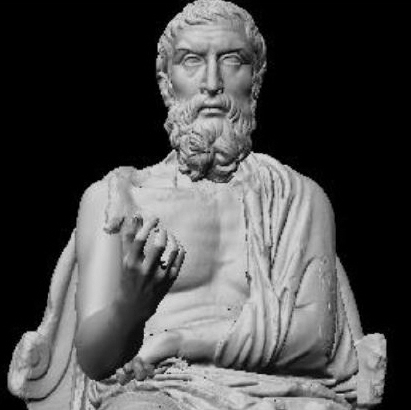
Epicurus, jaded by the political strife all about him, had a very different approach to political philosophy than his Greek predecessors. He had no vision of the ideal state like Plato, nor did he put much stock in an active citizenry living in community, as Aristotle might. He simply counseled that his followers retreat from those grandiose and often toxic affairs, and said the only things that mattered were individuals’ abilities to avoid pain and anxiety. He didn’t have much use for the gods, though if they made people feel better about themselves, good for them. He is technically a hedonist, but he took a very long view of what involves “pleasure,” and therefore wouldn’t counsel people to follow any old desire just because it made them feel good; they had to find pleasure in things they wouldn’t come to regret later on. Epicurus cautioned against falling too far in love: after all, that can cause a lot of pain. He didn’t let gender or class restrict who he welcomed into his school, which he named The Garden.

Epicurus’s ideas have been incredibly durable. His suggestion that people seek happy lives outside the political sphere would prove highly useful for many subjects of the Alexandrine and Roman Empires, and also in many of the feudal and imperial states that came afterward. John Locke, who was probably the most important philosopher for the founders of the United States, thought quite highly of him. His notions of maximizing pleasure and minimizing pain were taken up by utilitarians centuries later, and might be seen as the foundation of modern economic theory. One could easily argue that most people are, and perhaps always have been, far more Epicurean than anything else: they care far more about the things that make them feel good or bad than any grandiose political affairs, and they only get whipped up into a political frenzy when someone or something threatens their comfort.

The obvious problem here is that it can be very hard to know how much pleasure or pain certain actions will cause in the long run. Even more problematic, in my opinion, is Epicureanism’s rather dismissive take on human ambition. There is a danger of it wandering over into Stoicism, which again can be a practical approach in some situations, but tries to suppress those ambitious and aspirational urges and make them go away. It can lend itself to defeatism even more than Aristotle’s acceptance of the world as it is, and when people encounter obstacles, it often tells them to simply desire less. It’s practical advice in many ways, but if it’s too puritan, it won’t work for long. Repressed urges tend to erupt in time, often in ugly ways, and shunting those impulses aside and making them taboo doesn’t quite work. They need healthy outlets. This was Aristotle’s approach: acknowledging those animal drives, and channeling them into something good. He was right to see human interaction as some form of politics, even if many people don’t like that fact.

Epicurus’s value, then, isn’t as a guide toward some utopia where we all forget about politics and live happy little lives. Instead, he grounds us, and reminds us that any ambitions we might have beyond tending our own little gardens have to remember where we all come from. Epicurus was no rebel; he simply had a much better grasp of reality than many of his politically-obsessed contemporaries. This is why Bacevich’s ideas don’t jive with our idea of modern politics: despite claiming to be prudent, they’re not something that we can bring about by electing one or two good leaders.

To his credit, Bacevich acknowledged this in his talk. He had a rather pessimistic view of modern politics, and quite rightly suggested that we tone down our expectations for it, and be glad that one or two individuals can’t change it too easily. Instead of building the ideal city or state from the top down, via a national party or some effort to change Washington, it has to start from the bottom up. (Just ask Jimmy Carter.) If we want a world that believes in a human scale instead of being forced to make do with the empires (literal or figurative) we’re stuck with, we need to start at home, and live it in our daily lives. Instead of focusing on the vagaries of politics beyond our reach, we need to change the things we have the ability to change, and closely guard things we think ought to be preserved. For all their differences, that is the enduring lesson of all the Dead Greek People: that human life is grounded in community, and everything else must follow from there. With that as our starting point, we need not be so pessimistic. In that realm, we really can make a difference.

Here’s a related post on Aristotle’s demons to round out this series.

Picture of Alexander and Aristotle from http://www.heritage-history.com/www/heritage.php?Dir=characters&FileName=aristotle.php. Picture of Epicurus from http://newepicurean.com/wp-content/uploads/2011/01/Epicurus-sculpture-crop.jpg

Don Ness’s Duluth and its Divisions: Election 2013 Analysis

I’ve written a lot about Duluth politics in recent months, with coverage of every city council and school board meeting, plus some coverage of yesterday’s election (results here). Lost in most of this political talk, however, was mayor Don Ness.

The lack of Ness coverage is, in part, his triumph. In this recent NPR interview, he said his goal was to make Duluth politics “boring” again. Six years into his tenure, he’s done that. He remains incredibly popular, and with good reason, considering the successes of the causes he’s supported. The economy has been fairly resilient despite a rough national economic climate. The city has won some major victories against noted antagonists, most notably Jim Carlson. Duluth has a bunch of new schools; despite some wobbly moments due to the way those schools were pushed through, they will be well-funded thanks to the passage of the two levies. Funding for libraries and parks has increased. The city even confronted its huge retiree debt burden and, while it probably hasn’t gone as far as conservatives want it to go, the Ness Administration has proven it isn’t beholden to special interest groups, and that it tries to avoid tax increases when at all possible. Don Ness is the dream mayor of the center-left, and if he is so inclined, he could easily make a strong run in a state or national race. (He even has the adorable children necessary for that sort of thing.) Ness’s warmth has rubbed off on people around him, as eight of the nine City Councilors now lean left. This city has been thoroughly renovated in the image of Don Ness.

However, underneath all of the solid colors that appear on the election maps are a lot of details that are worth exploring. The somewhat unexpected results of three races jumped out at me: Zack Filipovich surpassing Barb Russ for first in the City Council At-Large race after finishing second in the primary, the passage of the second ISD 709 levy question, and Art Johnston’s re-election to the School Board.

All three of these results underscore the east-west divide in Duluth. That’s a delicate topic, as School Board Member-Elect Harry Welty learned with his “gangrene” comments, and obviously it generalizes, and there are plenty of people on both sides of the city who cut against the east-west stereotypes. Still, one trend clearly emerges in election results: the west side’s rejection of the east side liberal establishment.

It’s especially significant when you consider that people from the west side are not a demographic you’d normally associate with conservatism. It’s not a wealthy or suburban/rural region, and in state and national races, it’s still reliably Democratic. This is no bastion of the Tea Party or libertarianism, as shown by the passage of the first levy question in all but one precinct and Ryan Stauber’s inability to break through in many places. Still, the west side is not moving in lockstep with the Ness agenda, and it’s worth asking why.

We’ll start with a look at the City Council At-Large race, in which I’ve mapped out the winners of each precinct using the wonders of Microsoft Paint:

City Council At-Large

Zack Filipovich, as you can see, had a very strong showing on the west side. As a recent college grad working in finance, Filipovich doesn’t really fit the blue-collar stereotypes one associates with the west side. Still, his campaign (whether by design or not) was certainly less explicitly liberal than Barb Russ’s, and since he’s young and fresh, he’s not really an establishment figure. Unlike Russ, he made a concerted push to get beyond the establishment, and campaigned out west. For that reason, I suspect he was able to generate a lot more support, especially in an election where voters could choose two candidates. Ryan Stauber was an easy first choice for Duluth’s more conservative voters, but I’d hazard to guess that Filipovich, who remained rather vague and upbeat in his campaign, was most likely to be their second choice. That coalition probably carried him to a lot of victories on the west side.

This anti-establishment-liberal pattern is even more distinct in other recent elections, with the west side being far less interested in sending more money to the city than the east side. In Ness’s first election, he won the east side and lost the west side to the more conservative Charlie Bell. Jay Fosle, the lone conservative on the Council, represents a far west district. Garry Krause, the recently-resigned conservative District Four councilor, was from the west side, and got a decent share of the vote despite having withdrawn from the race. If he’d stuck around, I suspect he would have won. If you want a map that really underscores this trend, though, take a look at the way the city voted on the school board levies:

School Board Levy Map

This really wasn’t a case of the city coming together to support the second levy. It was a case of the east side having just enough votes to drag the west side along with it.

While much of the rest of the city is exasperated by anti-Red Plan crusader Art Johnston, he was re-elected to his far west side district. In the West End area, there seemed to be a lot of passion over the school board race: Bolgrien’s base of support was right around Denfeld High, and Johnston had a bunch of signs in the areas just beyond the Bolgrien core. Heading east into Lincoln Park, however, there were hardly any yard signs. Even so, Lincoln Park broke for Johnston. It wasn’t a vicious rejection of Ness and his School Board allies, but it was a clear one.

School Board Dist. Four

I rarely agree with Art Johnston, but to his very real credit, he too has acknowledged these trends. He posed the question to the Board at a recent meeting, perhaps not realizing that his own presence on the Board is a product of these trends: why does it appear that west-siders do not share the east side’s emphasis on education, and willingness to open the pocketbook to support it? No one answered him, and he deserves an answer.

Part of it may be demographics. The school-aged population is much higher on the east side, so more people have a stake in the schools there. East side voters, content with the generally high test scores at their schools, see the value in supporting the District, while west side voters, seeing more mixed results, may not. (I have never understood the logic behind giving struggling schools less money, but plenty of people explain their votes that way.) Perhaps most importantly, the west side has more people living on fixed or lower-middle-class incomes who are nonetheless not living in poverty or qualifying for many government support programs. Because of that, they tend to be less willing or able to handle a tax increase.  That fact can explain the fiscally conservative bent one sees in the west side’s city councilors, too.

But while socioeconomics may explain a lot of the divide, they are not destiny. To that end, it’s important to understand why a number of Duluthians (no matter which neighborhood they live in) may not be completely thrilled with Don Ness’s Duluth. For that, I’d point readers toward my post from a few months ago on Duluth’s future. It’s a long and meandering post, so I’ll summarize one key part here.

Under Ness, Duluth has made a concerted effort to reinvent itself. It has also made itself a desirable place for young people to live, harnessing its natural beauty and developing a decent artistic and culinary scene. (Yay, good beer!) It has spent a lot of money making itself attractive, and to date, I think that move has been reasonably successful. With the decline in U.S. manufacturing, it was necessary to take that stand and create a new brand for the city, and while I have my quibbles here and there, I’m largely on board with Ness. I was also a staunch supporter of both levies, and I believe world-class public schools are essential to this whole project. However, former Councilor Krause raised an essential concern, and one I am not sure the Ness camp has properly addressed: is Duluth’s interest in shiny, new things coming at the expense of the mundane? Yes, it’s great to attract new people, but what about those who have been here for a long time, and are simply trying to get by?

No matter how many elections Ness and Friends may win, these questions will still exist. They need to be magnanimous in victory, and recognize that simply cruising along with a mandate still leaves some people on the outside looking in. No, they can’t satisfy everyone all of the time, but no one should be left behind because they never got a chance to be heard.

Speaking of being on the outside, the lack of racial diversity here is also worth mentioning: after this election, everyone on the School Board and City Council will be white. This isn’t terribly shocking in a city that is over 90 percent white, and there were two minority candidates this fall who simply did not run very impressive campaigns. Mary Cameron had a very long tenure on the School Board, proving that minority candidates certainly can do well in Duluth. Several of the white elected officials have long histories of work with minority groups. Even so, there is a trend in modern American liberalism in which people politely acknowledge minority interests while doing little to actually address them. I’ve talked up the east-west divide here, but downtown can’t be lost in the shuffle, either.

This all brings me back around to “boring” government. Yes, boring government is certainly better than people screaming at each other nonstop, but there is a danger here, too. This quote from Councilor-Elect Howie Hanson in the October 29 News-Tribune comparing himself to his predecessor brings it out clearly:

“I think Garry [Krause] was a little frustrated because he was in the minority on a lot of votes,” he said, noting that Krause frequently found himself at odds with Mayor Don Ness’ administration and much of the council.

“If we’re going to move Duluth forward, I think you need to set aside your personal agenda and petty politics and get everyone on the same page,” Hanson said.

This bothers me somewhat, and I do not think it is an accurate characterization of Krause’s work, even if I didn’t always agree with Krause. Good governance does not involve everyone being on the same page and rubber-stamping one another’s proposals. It needs constructive, perhaps even heated, arguments. To its immense credit, the City Council has managed that in recent years; the School Board, on the other hand, has not, as it went from being a rubber stamp machine during the Red Plan days to a fractious and ugly war zone during Art Johnston’s first term. With Welty and a possibly conciliatory Johnston on the School Board, I have some hope that it might finally come to a healthy balance. The new Council, with its new left-leaning supermajority, must make sure it doesn’t fall into one of those twin traps that bogged down ISD 709 in recent years.

Duluth’s politicians have the potential to do some great things in the next few years, and the future is there for the taking. We’ll see how they do.

Duluth General Election Results and Comments, 2013

The results are in!

I’ll have a few more comments tomorrow once the city publishes district-by-district results and try to put everything in a broader context—complete with adventures in amateur map-making! I’ll also have more comments on the outgoing councilors and board members when their terms expire. For now, here are the results and their immediate implications.

Bolded candidates won. The numbers after the names are percentages of the vote, followed by the raw vote total.

City Council At-Large

Zack Filipovich 55.2 (9295)

Barb Russ 53.0 (8932)

Ryan Stauber 44.6 (7514)

Ray Sandman 14.2 (2398)

For a second straight election cycle, the DFL candidates march to a solid victory in the At-Large races. Stauber hung in there relatively well, but in the end was nine points behind the second of the two DFLers, a similar margin to his primary gap. The biggest surprise here was Filipovich leading the way: Russ had a large lead and a more obvious campaign presence after the primaries, and as Stauber is the only real conservative in the field and has some name recognition, I thought Filipovich might have a fight on his hands. Not so, as the recent UMD grad rolls into office.

City Council District Two

Patrick Boyle (I) 98.5 (2099)

As expected, the unopposed Councilor Boyle sails through, and also led the field in the District 2 County Commissioner primary. If elected to that position, the Council will appoint a replacement for the next two years.

City Council District Four

Howie Hanson 61.1 (1782)

Garry Krause 37.6 (1098) (withdrew from race)

37.6% is a fairly substantial vote total for a candidate who isn’t in the race, suggesting there were some misgivings with the otherwise unopposed Hanson, but he still heads into the Council after a stress-free campaign. My personal experiences with Howie have not been positive, but they were also in a very different context. I hope he proves a more skilled politician than he is a sportswriter, and I’ll give him a chance to prove he can be a good representative for this district, which could use some stability after running through an awful lot of councilors in the past few years. Due to the vacant seat, he’ll be seated at next Monday’s meeting.

City Council Big Picture: News flash—Duluth is a DFL town. With Stauber’s loss and Hanson replacing Krause, there is only one person on the Council now who really qualifies as a conservative in any sense of the word. Even in a liberal city, that’s quite the supermajority. I’ll have more on the dynamics of that sort of council tomorrow.

School Board At-Large

Annie Harala 56.9 (10648)

Harry Welty 39.3 (7342)

Nancy Nilsen 35.7 (6670)

Henry Banks 24.4 (4567)

No surprise in Harala’s big win, and as I suspected, Harry Welty’s uniqueness was enough to get him just past Nilsen. Welty comes into the Board following a somewhat ragged end to his campaign that included a weird ad and an awkward comment about gangrene in west side schools. As several letters to the Duluth News Tribune showed, a number of people do not trust this longtime Red Plan critic and former Board member. That said, I think he is a genuine person who simply has a habit of saying some tone-deaf things, and he probably deserves a fair amount of credit for getting otherwise skeptical people to vote for that second levy. If the other Board members approach him in good faith, he should be willing to work with them. Nilsen’s showing, which was decent but not good enough, shows Duluth’s continued mixed feelings about the Red Plan. Banks’s campaign had potential, but never did quite take off.

School Board District One

Rosie Loeffler-Kemp 56.1 (3220)

Joe Matthes 43.5 (2497)

After clearing 50% in the primary, it’s no surprise to see Loeffler-Kemp win, and her new seat is the culmination of 20 years of work in and around ISD 709. Matthes, meanwhile, ran a pretty strong campaign for a newcomer running against such a well-known figure. He seems to have a bright political future, and I hope he stays involved in ISD 709 affairs despite the loss.

School Board District Four

Art Johnston (I) 54.0 (1624)

David Bolgrien 45.7 (1374)

After a contentious race, Johnston emerges victorious and earns himself a second term. With the passage of the levies, his worry that the Board’s actions would cost it major public support were proven misplaced. To that end, it will be very interesting to see how he re-invents himself now that the Red Plan is fading into the rear view mirror. Will he take the passage of the levies as an opportunity to fix the various problems he sees in ISD 709 and attack them in concert with other Board members? Or does he think the voters were swindled by the Board, and does he continue to try to obstruct most everything it does? It’s his decision.

ISD 709 Levies

Question One: Yes 65.6 (12211); No 34.4 (6403)

Existing levy re-approved

Question Two: Yes 50.8 (9436); No 49.2 (9130)

New, additional levy implemented

It was a huge night for ISD 709’s bottom line, as voters approved not just the existing levy, but also the second one, for which I did not have high hopes. With more cash in hand and additional state aid on the way, the District should be able to pay off its debts and move to bring down class sizes. Education activists can’t just rest on this victory, though; they need to continue to work with the new school board to make sure the money is going to the right places.

ISD 709 Big Picture: It’s a bit of a split verdict here; while not unexpected given the lingering legacy of the Red Plan, it does have some interesting twists. Two of the Red Plan’s biggest critics are now on the Board, but their greatest fears have not come to pass, and they now have a decent amount of money they can use to attack the problems related (and unrelated) to the Red Plan. It will still require some important decisions, and with Johnston on the Board, things will never be boring. That said, this ISD 709 grad is feeling good about the direction of the District for the first time in a few years. While Duluthians are clearly demanding strong oversight of the Board, they also want to move forward, and the approval of the second levy shows a majority are willing to put the Red Plan behind them and do what they can to make Duluth public schools the best they can be. It’s a big win for Superintendent Bill Gronseth, whose gamble has paid off.

St. Louis County Commissioner 2nd District Primary

(2 advance to general election)

Patrick Boyle 34.4 (2389)

Jim Stauber 27.4 (1901)

Scott Keenan 26.9 (1868)

Cary Thompson-Gilbert 4.8 (333)

Boyle and Stauber, both sitting City Councilors, advance to the January 14 special election to fill the seat of the late Steve O’Neil. Boyle’s first place finish is no surprise; Stauber’s incredibly narrow win over Keenan, meanwhile, sets up a classic left-right showdown. Given the timing of the special election, there’s a healthy chance that turnout will have been better in the primary than in the actual election. That means that getting out the vote will be crucial for both candidates in January, as they look to build on their momentum. Stauber in particular will have to go to work if he wants to close the gap, as he doesn’t have a very large presence at the moment. Many Keenan supporters are up for grabs here; while Boyle would seem to be the favorite, his victory is not assured.

That’s it for now—check back for more tomorrow!