Planning Duluth: Let’s Talk About Housing

As Things happen in national politics, Duluth marches along with…community engagement sessions for its comprehensive plan! I attended a meeting for my council district last week that allowed me to draw things on maps and be a good, engaged citizen. At this event, I received a list of planning-related research questions, which it shared at a community event I attended last week, divided by topics. Today, I’ll offer up my semi-solicited opinion on the housing-related questions.

What three qualities make your neighborhood a great place to live?

I live in Endion. Its perks are its big, cool old houses; easy access to downtown and multiple east side business districts; and an eclectic mix of people, from college students to old money to lower-income people.

I will also answer for Lakeside, where I’ve spent a majority of my life. It’s a reasonably affordable yet very pleasant place to raise a family; it has great neighborhood schools; it has easy access to big parks.

What three aspects of your neighborhood would you like to see changed?

Endion: Better maintenance of some rental properties; lack of a defined neighborhood center, or real sense of neighborhood at all. The third thing isn’t necessarily something I’d like to see changed, but at least investigated: how necessary are these one-way numbered streets? I certainly appreciate them when I drive to work, but they slice through the neighborhood and make it less pedestrian- and child-friendly. I’m not convinced we need two one-way streets (First and Third) going the same direction.

Lakeside: Some renewal in the old business district; something happening with the old Rockridge property, so long as it preserves access to the Hawk Ridge trail; continued gradual, planned growth on the edges and redevelopment of vacant/declining properties to meet market demand in a desirable neighborhood.

What does a healthy neighborhood look like?

A variety in age of housing stock. Easily accessible local businesses that provide most basic necessities, and connections to jobs. Thriving schools, and children playing freely. Outdoor hockey rinks. (Okay, I guess we can allow other sports in the neighborhood parks, too.) In Duluth: access to a more wild park space. Few to no highways or high-speed roads carving through the neighborhood. All those pretty things.

What types of housing are missing from Duluth?

The same type that’s missing from a lot of places: a middle tier that rises above student or-low income housing, but isn’t on the top end like some of the (very welcome) new apartments coming on line on the east side. Mid-tier homes for new families. Homes that are accessible for aging people looking to scale down some.

Are you satisfied with the quality and quantity of housing that is affordable to you?

As someone who just went through an apartment search, I found myself a gem, and after living in larger cities, Duluth is remarkably affordable. That said, I was looking for a while before I landed the unit I got. There’s a lot of older housing here that just isn’t in great shape, but could be phenomenal if it were patched up. It’s all right there in front of us if we invest in it. The top end was also thin for a while, though that is changing.

What kind of housing should be planned for individuals and families moving here?

Housing that does not rely on the passive voice in its planning process. Also, I’m not sure why people moving here should have different types of housing than those who are here already. Am I missing something in this question?

How should people who need assistance with daily living tasks be provided with housing?

With housing that makes it easier to do the tasks they need assistance with, presumably. But, yes, it is important to keep this consideration on the table.

How should parking needs of residential uses be accommodated in neighborhoods?

Woo, heavy planner-speak in this one. If there was any question about it, I support alternate side parking; it’s just so much better for snow removal. I think this question is also getting at the city’s recent rediscovery of its limits on parking on lawns and “improvised” driveways, which is an issue in college areas. The city’s approach to date appears sensible: give people a year to adjust, but then, yes, enforce it to clean up those rental properties with yards that have become mini parking lots. Densifying the campuses so that not every student needs a car would be a win, too. As someone who went to an undergraduate university where practically no one drove, I can assure people that it’s actually a great arrangement for all involved. Also, if the city is ever in a position to develop new subdivisions with alleys, do it: this gets cars off the street and also opens up more street parking, since there isn’t a driveway every 20 feet.

Do neighborhoods need assistance in managing small conflicts like noise, trash, parking, and snow removal?

I will say this: for a city that has such pronounced and recognizable neighborhoods, Duluth has surprisingly little in the way of organized, visible neighborhood organizations. The neighborhood level could be a great place to achieve greater responsiveness on the issues listed above.

But, I urge caution here: it’s very easy to do this badly. I spent the past two years living in a Minneapolis neighborhood with a batshit crazy neighborhood board that should not have been allowed anywhere near the purse strings it had. Neighborhood boards also have a tendency to not be very representative; that is, they’re run by old people with free time. Renters and low-income people are often shut out. The well-attended council district session last week wasn’t a bad example; my council district includes both college campuses, but I was probably the youngest person there, and there were a lot of unpleasant things said about college students. I was offended before remembering that I’m not a student anymore.

I don’t mean to dismiss those concerns. Noise is an issue, and as I’ve written before, it would be great if more students could live near the college campuses instead of mixing in with neighbors who don’t like to have people puking on their lawns at 2 AM. Perhaps there is a role for city action on these fronts, but it must walk a fine line between making sure everyone is actually represented and overbearing big-city government.

Should there be more incentives to improve existing housing rather than new construction or vice versa?

Whatever the city’s stance is on new construction, yes, there should be more incentives to improve existing housing. This city has a large housing stock, and a lot of homes that could be very nice with a little loving. On the new construction front, there is plenty of room for infill in this city too, and demolition and reconstruction on lots with blighted properties. Duluth has done a good job this sort of redevelopment for tourism, so there’s no reason it can’t expand into housing, as long as there’s some money to help it along. (Big if, I know.)

Are you concerned about the resiliency of your neighborhood to withstand a natural disaster?

Not especially; I’m no expert here, but I don’t see any immediately obvious things that Duluth can do to shore up its neighborhoods against disasters other than generally making sure infrastructure is protected from 2012-style flooding. However, this question does give me a chance express my annoyance at the use of the word “resiliency.” While technically a word, it is an obnoxious piece of planning jargon and adds an unnecessary syllable. Do not use it. Thank you. Grammar police out.

How and where should/could we densify the community, particularly if we want more convenient locations for mixed uses?

Well, I’ve already mentioned the UMD area, where we’ve seen considerable success in this already, and there’s plenty of room for more. But lots of the old neighborhood downtowns, from Woodland to Lincoln Park to Spirit Valley, have potential here. Near East Fourth Street, and downtown beyond the already-dense core, also seem like obvious targets. London Road, too; I’m also looking forward to the project at Arlington and Central Entrance in Duluth Heights. These efforts to fix up lousy strip malls that have been outstripped by development elsewhere are excellent developments. There are lots and lots of opportunities here.

Should we consider a “no build” (or urban growth) boundary to limit infrastructure extensions and preserve open space on the periphery of the city?

In principle, nice idea. In practice, it would be a disaster.

Urban growth boundaries are a sexy urban planning idea best known for their implementation in Portland. There, it basically does what it intends to do. It limits the outward growth of the city and forces more density, though there is evidence that such limits on growth inflate housing prices.

Leaving that debate aside, however, there is one huge difference: Portland has a governing body, Metro, that oversees the entire metropolitan area, not just the city proper. Its regulations work because a developer who’s limited in Portland can’t just pack up and move a project to Gresham or Clackamas. If Duluth imposed this, it would have no such luck unless the suburbs and townships (in two states!) played along, which would take some colossal legislative work. Not only would it deprive the city of potential development and subsequent tax base growth, it would actually make the environmental situation worse: market-rate developments would be even further out, leading to even longer commutes and infrastructure extensions. Let’s devote our attention elsewhere.

That’s it for now, but stay tuned…

The Lonely Resistance of Rick Nolan

On paper, Rick Nolan’s congressional career should have ended on Tuesday night. The incumbent Democratic congressman in Minnesota’s 8th district has always been on political thin ice in a district on the edge. Hillary Clinton got destroyed in this sprawling, 17-county rural district: four years after Obama carried it 51-46, it went for Trump by 16 points. While local candidates proved more resilient, Trump clearly had down-ballot effects in the state legislature and other Minnesota congressional races, with attrition from the DFL across the board. Democrats lost some ground on the western side of Minnesota 8, particularly around Grand Rapids. Nolan beat his opponent, Stewart Mills, by a razor-thin margin in 2014. He didn’t have much ground to give in this year’s rematch.

Little about Nolan’s biography suggests he should have won, either. He’s not some rural, conservative Democrat like, say, Joe Manchin of West Virginia: on most issues he’s basically a standard-issue liberal, and is even further to the left than his longtime Democratic predecessor Jim Oberstar, who was ousted in the 2010 Tea Party wave, on issues like abortion. He’s 72, and as a visting friend noted, his yard sign design looks like it’s straight out of his first congressional campaign in in 1972. He’s no social media darling of the youth a la Bernie Sanders. He’s had a few private sector jobs, but for the most part he’s spent his adult life as a politician and general policy wonk, an endangered species in 2016. He grew up in Brainerd, which is one of the most conservative parts of the district, and his first stint in Congress took place when Brainerd was in a different district; his political roots are not deep in the vast majority of Minnesota 8. His motto, “Minnesota Tough,” belies a thin, aging frame and a nasally voice.

Nolan’s opponent, Stewart Mills, was formidable. He polished himself up from his losing run two years ago, both in terms of his looks (goodbye, weird long hair) and campaign operation. His conservative bona fides were never in question, he never shied away from Trump’s coattails, and the demographics of the district were in his favor. The heir to the Fleet Farm fortune, he could self-finance a lot of his campaign. While Nolan had plenty of outside money pouring in, Mills outspent him by a 3-2 margin in what wound up being the most expensive congressional race in the entire country. By the end, a resident of Minnesota 8 couldn’t go through a single commercial break during a football game without seeing an ad bashing Nolan, funded either by the Mills campaign or a Super PAC.

The indicators aren’t all bad for a Democrat in Minnesota 8: it has a larger city in Duluth that is consistently and solidly Democratic, labor still has power on the Iron Range, and some rural areas like the North Shore of Lake Superior maintain a decidedly crunchy, liberal vibe. The lack of a Green Party candidate this time around probably also helped him. (Though only somewhat: I’m guessing that a number of the die-hard Greens in Duluth sat this one out, given Nolan’s support of mining.) There are very few people of color in Minnesota 8, and turnout drop-offs here hurt Clinton nationally, though Nolan still outpaced Clinton in the part of Duluth that does have a somewhat sizable non-white population. But in a sweeping wave election, it shouldn’t have taken much to oust Rick Nolan.

Yet Nolan persevered. He did it the old fashioned way: with barnstorming tours, patient conversations, and by building trust. I saw his blue bus rumbling around Duluth a number of times, and its frequent presence took me back to a certain Minnesota senator’s green bus we used to see in these parts, another man who, on paper, seemed too liberal to ever win in the region. Mills, on the other hand, copied Clinton in its narrow guardedness, and refusal to let him see the media or encounter people who might disagree with him. Mills’ ads were of the vicious variety we’ve come to expect in a bloody campaign (Nolan brings Syrian terrorists to Minnesota! Nolan votes against veterans’ care!), looking to tar Nolan as a weak liberal. Mills even doubled down on the Syrian refugee angle, so if some latent fear of brown people was the main motivator for the sea change in the presidential race, one would assume this would continue down ballot. (Hint: it wasn’t.) Nolan’s most frequently run ads, on the other hand, involved him sitting and talking with groups of people or behind the wheel of his car, simply talking to the camera. Aside from making one want to yell at Nolan to keep his eyes on the road, these ads did muster a certain genuine quality that Mills’ never quite did.

Nolan’s record was the most important part of his win: he’s very good at getting things done for the people that Hillary Clinton’s Democrats too often left behind. His vote against veterans’ care was, in fact, a protest vote against the lack of resources, and he was able to communicate this. He was a crucial figure in the re-imposition of U.S. steel tariffs, which helped bring about a partial economic recovery from last year’s dire straits on the Iron Range. He pushed through policy changes that streamlined logging industry logistics. One key policy difference separated him from doctrinaire Democrats: unlike many Twin Cities and even Duluth liberals, Nolan supports expanded mining operations. He is careful to emphasize a more responsible version of that mining support than Mills’ unequivocal stance, but there was no underlying doubt, no awkward statement about coal country like Clinton had. While this lost him some support on the left fringe, his firm support for mining kept him from losing ground on the Iron Range.

This isn’t to suggest the Nolan campaign was a loving tea party. It, too, had heaps of money, and returned fire without abandon. Black signs appeared all over the Range in recent weeks that drove a stake into Mills: “Stewart Mills III Supports Chinese Steel.” (The inclusion of the ‘III’, which he also did in his attack ads, was a subtle but clever dig at Mills’ inherited wealth, and almost certainly played well on the Range.) It had its vicious negativity, but the negativity was very carefully targeted, and Nolan knew his audience in the land where the American steel supply chain starts. Instead of blasting his opponent as a standard-issue member of the opposite party, Nolan nailed Mills specifically on issues that played to the voters he needed; the ones most vulnerable to flipping. Outside of the very red extremities of the district where Clinton had basically zero support, nowhere did he run up his margin on Mills versus Clinton’s margin against Trump more than on the Range.

stewie

Perhaps the dirtiest thing one can say about another man on Minnesota’s Iron Range.

Part of Nolan’s success was strong turnout in the Duluth area, where he improved slightly on his 2014 performance, even in the outlying townships that trend further to the right. But even in a random sampling of Duluth-area precincts, Nolan only ran somewhat ahead of Clinton. On the Range, however, his margins from two years ago all held up, even as Trump made major gains. Part of this is a reflection on Hillary Clinton, a singularly terrible candidate for rural Minnesota 8, but Nolan’s resistance outperformed everyone. He made gains in the four bluest counties in the district—Carlton, St. Louis, Lake, Cook—which combine for 40 percent of its population, and were enough to withstand further erosion in the rest. He turned out his base, and the people he’d built a relationship with over time. This is where Nolan fundamentally bucked the trend.

Time will tell if Rick Nolan is a model for Democratic resurgence, or simply the last roar of a fading dynasty. If the Democratic Party doesn’t reform itself, this hold in Minnesota 8 may prove short-lived. Nolan’s age may become a factor before long, too. Republican gains across the district, and the general improvement in the caliber of GOP candidates, are a good thing for democracy, lest places like the Range calcify into one-party rule where politicians aren’t held accountable. But the Democrats still have a lot to work with here, and a reasonably deep bench. Erik Simonson and Jason Metsa offer a new generation of the old labor leadership, while popular figures like Don Ness and Carly Melin, still quite young, could someday re-enter the arena. Duluth city government is brimming with young DFLers who could someday be in a position to win, so long as they can maintain an appeal to the whole MN-8 electorate. The DFL has cultivated a fresh, new generation of politicians in the region, which is a lot more than can be said of the national party in some places.

If the Democratic Party brass has any brains, it will look to people like Rick Nolan to learn how to rebuild from its 2016 defeats. The answer doesn’t come through a full-scale ideological move, or reliance on a demographic shift that may or may not materialize at the ballot box. It comes by abandoning any hint of condescension, or lectures on how failure to support the right candidate is in some way a moral failing. Instead, it lasers in on the most important issues to voters and backs them up with action. It involves a willingness to fight, sometimes even to fight dirty, but only in select battles that the candidate can be sure to win. It means getting out into communities, because the basis of all campaigns remains fundamentally local. Rick Nolan isn’t perfect, but he understands the landscape, and because of that, he’s lived to fight another day.

A Dream Sours

Whither the Democratic Party, after Tuesday’s stunning defeat? There will be time enough to contemplate how our new Republican majority goes forward, but for now, it’s time for an autopsy on the demise of a Democratic era, and the collapse of an Electoral College Maginot Line.

This begins by looking back on the past two elections. It’s time we recognize that Barack Obama was not at the head of a tide, or at least not one for the immediate future. He was exceptional. He ran on an agenda that did not have broad popular support, but swept to power twice on the force of sheer charisma, integrity, and ability to inspire optimism in spite of it all. The repeated decimation of Democrats down ballot across the country shows how quickly this wore thin. The wins at the presidential level masked some serious shortcomings in state and local races, and are an embarrassment for a party that had reason to think it was on the rise.

Obama’s presidency will thus go down as a paradox: a popular man whose legacy will likely not outlive him, unless President Trump truly surprises us. The economy performed steadily under conventional measures during the Obama years, but nothing reversed the widening gaps that preceded him. His signature piece of legislation, the Affordable Care Act, helped cover more people but has been fraught with issues throughout, and probably won’t resemble the original after a few months. His foreign policy was better than that of his predecessor and of the alternatives to him in 2008, but never quite amounted to a coherent doctrine. Everywhere else, he faced resistance and gridlock; he responded with executive orders, effective in the short term but setting a dangerous precedent for successors to roll them back and more. There were some momentous shifts on social issues, though future Supreme Courts may have some word on how permanent those are. The real question, I suppose, will be whether the Democrats can harness the electoral machinery he put into place and reuse it in the future, or if it will languish. Otherwise, Obama is just the bookend to an era of rising and falling global liberalism, a Washington Consensus that arose out of post-Cold War confidence and now heads into the great unknown.

It was bound to end, as all movements must; the question was how, or when. Even if Hillary Clinton had won, she probably was the end of the line; the Democrats just didn’t have a new generation ready to carry it forward, and its limitations were becoming obvious. It could have evolved, if there were an effective leader to bridge the gap, but there wasn’t. Instead, the Democrats had a candidate of the status quo, and when she crashed, so did the whole enterprise.

Our old friend Mitt Romney has been on my mind lately. In fact, I think there are a lot of parallels between the Clinton and Romney campaigns: blandness, occasional tone-deaf statements, inability to broadcast much of an agenda other than opposition to the other guy, reliance on sheer institutional inertia, certainty of ultimate victory. The unexpected polling error in both Obama and Trump’s favors are not coincidental; it’s just that one more clearly swung the election. Candidates who fail to be fresh will always underachieve, even if they don’t make any unforced errors.

I won’t wade into the discussion over the magnitude of Clinton’s email- and foundation-related sins, but the existence of these issues is a fundamental problem when the theme of one’s campaign is competence and reliability. When a candidate gives mixed messages on the thing she’s supposed to be good at, it’s a bad sign. I’d also add that, whether there were fires or not, there has always been an awful lot of smoke around the Clintons. Yes, Republicans have drummed a lot of this up, but eight years of the same efforts exposed practically nothing on Barack Obama. Clinton was a flawed candidate, and flawed in the worst possible way for the pitch she was trying to make. Her time would have been 2004 or 2008. By 2016, it was too late.

In retrospect, I do think Bernie Sanders probably had better odds than a lot of people gave him credit for, though not as good as his supporters would have liked to believe. He certainly would have played better among the rural white people around the city I live in. But gains in one place could lead to losses elsewhere. Clinton wrecked Sanders among people of color, and Clinton herself failed to generate the needed turnout from people of color. Maybe Sanders wins back some of those Midwestern states, but Nevada, Colorado, and Virginia might all flip the other way. Do the math, and it’s still a toss-up. That particular “what if” is a murky one, and the moment is past. The Democrat most capable of building a big tent was Joe Biden, and that ship has also sailed.

A lot will be said on the left about racism or bigotry, and its apparent triumph. But any discussion of racism has to get past that loaded word and look at the details. Two hundred counties that broke for a black man four years ago went to Trump. This wasn’t a rush of people suddenly discovering hate in their hearts. Instead, you have a lot of people for whom the battle with racism was not their primary reason for going to the polls. Many of these people probably have no real desire to discriminate, but live in places where racial issues aren’t really present in day-to-day life, and are far more motivated by other factors. And when a candidate gives voice to their dearer causes, it’s not hard to dismiss some warts; once that dismissal of warts is normalized, further revelations aren’t going to upend the process. Sure, Trump would take a hit in the tracking polls when he went after someone based on their ethnicity or gender, but before long, the dynamics of the two-horse race would have him trending back upward, as the latest spurt of outrage faded from memory and the persistence of day-to-day life on the ground rose up again.

It’s also worth asking some questions about the wide range of things that fall under that blanket label of “racism.” The working definition on the left considers both a card-carrying member of the KKK and a person who questions protest tactics when Black Lives Matter occupies the freeway and fouls up a commute as exhibiting racist tendencies. Deplorable as one may find all of these attitudes and the many shades in between, it’s counterproductive to treat these phenomena the same way, and slap the same label on the full range of people who hold them. Much as “47 percent” doomed Mitt Romney, the “basket of deplorables” comment left a lot of wavering people fundamentally alienated. Once again, Clinton was supposed to be the uniter, the candidate of “stronger together.” This made her failures to live up to that ideal considerably more impactful than those of Donald Trump, who made no such claim (or, at least, not one anyone took seriously). The candidate of unity failed to display it, and the other guy spoke to voters on a levels they actually cared about. If the Democrats continue to paint with the broad brush of racism instead of interrogating different cases carefully, they will continue to appear condescending, and will continue to lose.

These racial lines have an added drawback for Democrats: most people of color are tightly packed into cities, and as we’ve seen, this limits their odds of winning majorities in the House and of winning the Electoral College despite taking the popular vote. The Democrats, the supposed party of tolerance, are extremely likely to live just among themselves, and it hurts them. Sure, it would be nice to eliminate some of those structural issues that give rural voters added influence, but this is the system we have, and it’s not going to change without getting a hand on the wheel in the first place.

The hubris of so many Democratic operatives, the belief that a more diverse nation would create a firewall and a longer-term majority, might yet come to pass. But as I explained in my initial reaction, the rise in white identity on the right is the natural outflow of identity politics on the left, however justified it may or may not be. This is why identity politics is ugly and dangerous, and it is a major reason why so many struggling states around the globe lapse into ethnic groups squabbling over government. There can be no functioning state without a nation, and that nation needs to approximate some sort of broad identity, even while allowing for nuance within it. Sure, the Democrats may be on track to pick up Arizona and Georgia and maybe even Texas over the next decade. But if they don’t change course somewhat, and rely on demography alone while failing to reach out to large demographics, things will continue to flip. Minnesota—yes, Minnesota—will be the next state to go red, along with the rural northeast, and more will follow.

I heard from a reliable source that Obama wanted to go spend time in Appalachia, but that his advisers told him it wasn’t worth the time. If true, it may prove a fatal error.

I’ve come back to Obama a lot in this post, in part because he is very much my president. The first bubble I ever filled on a ballot was for him, and even as I’ve drifted away from doctrinaire liberalism into something a lot more complicated, I don’t regret either of my votes for him. I was in Washington, D.C. the night he won, and that night might be the most momentous bit of history I ever live. Temperamentally, I relate to the man: cautious and intellectual, prone to elevated rhetoric and a desire for communal action, while perhaps suffering from a certain aloofness and detachment at times. He had genuine empathy for the America that was left behind, but forces beyond his control—forces beyond anyone’s control—largely rendered him powerless to change things. George Packer put it presciently, back in 2010, as the Tea Party arose to face Obama and the failures of Middle East nation-building and the end-of-history Pax Americana became evident:

The noble mission to make the world safe for democracy ended inconclusively, and its aftermath has curdled into an atmosphere more like that of the Palmer raids and the second coming of the Klan. This is why Obama seems less and less able to speak to and for our times. He’s the voice of reason incarnate, and maybe he’s too sane to be heard in either Jalalabad or Georgia. An epigraph for our times appears in Jonathan Franzen’s new novel “Freedom”: “The personality susceptible to the dream of limitless freedom is a personality also prone, should the dream ever sour, to misanthropy and rage.”

The dream has soured, and it has done so on both sides of the aisle. Fortunately, we have ways to pick up the pieces.

A New World Order

Well, that just happened. (This was written on election night, but I’ve held off on posting it until this morning to confirm some final results.)

Duluth Area Elections

First, let’s get the local stuff out of the way. In the one competitive Duluth area race: Beth Olson pushed past Jay Fosle for a seat on the St. Louis County board. It was competitive, but clear, as her 57 percent margin carries the day. This shifts the county board somewhat leftward, and keeps the city council as is. Everything in Duluth was predictable, with only minor nuance relative to some of those details I outlined in my pre-election post. A strong Republican state senate candidate only loses by 30 percent of the vote, instead of by the 40 percent margin suffered by the two house candidates.

The Range upset(s) I predicted happened: Republican Sandy Layman, head of the IRRRB under the Tim Pawlenty administration, knocked off Tom Anzelc in the 5B house seat in Itasca County, and Justin Eichorn took down Tom Saxhaug in the 5th state senate district. Layman and Eichorn are business class candidates, not Trumpistas, so this wasn’t them riding the President-elect’s coattails so much as the natural culmination of the once-blue western fringes of the Range becoming more red. Elsewhere on the Range, however, it’s remarkable how much ticket-splitting happened: the other Democrats at the local level won pretty comfortably, and Rick Nolan proved resilient, even as Trump performed well. Without looking at all the precinct results, it appears Trump won the Range, while Stewart Mills lost it.

On a night in which Democrats got wrecked across the country, Rick Nolan stands out as a rare point of resistance, if not the most impressive Democratic win of the night in the entire country. It wasn’t easy, but the veteran Democratic congressman scraped out a second straight win over Mills. This, I think, is a triumph for old-fashioned retail politics, and for careful focus on some of the more immediate concerns in the district. Specificity triumphed over a generic conservative message, even in a district that one might expect to break conservative. The rest of the Democratic Party—and plenty of Republicans, for that matter—have something to learn from Rick Nolan.

The Presidential Election

The world is a fascinating place, isn’t it?

I was critical of Trump, but if you read between the lines here, you’ll see a weird ambivalence on the issues, and general skepticism for the level of apocalyptic fears of many over a Trump presidency. I recognize that this is easy for me to say as a straight white dude who’s fared pretty well in the lotteries of genetics and upbringing. I still think this neophyte is going to get rolled in some arenas of politics, and many of his supporters are in for some nasty shocks. The empowerment of extremist elements bears watching, and if Trump goes through on some of the more extreme policy proposals that further divide people by race or ethnicity and so on, I’ll join the resistance. But there’s more here than meets the eye, and anyone who thinks this result is the product of simple bigotry or sexism needs to get out an awful lot more. This election was a fundamental failure of elite opinion and elite consensus. It was a failure to understand the plight of rural America, middle-income whites, and Christian Americans, and years of dismissiveness coming home to roost. My region of Minnesota, which largely stuck with its reliable Democratic stewards at lower levels but saw Trump make some serious gains, is obvious proof of this.

This defeat should cause some soul-searching on the left. If nothing else, it should discount the absurd nonsense that claims history has sides, or that it bends in a particular direction. No: it only has any direction we give it as active agents. Left-leaning millennials can be forgiven for making blithe assumptions about some steady march of progress, given the course of events in their lifetimes. But we now must adjust to a reality in which we actually have to understand and talk to people who disagree with us. Demography as destiny? Maybe, but gains in one place can cause equal and opposite reactions in others, and these things always revert toward the mean. If we reduce these things to interest groups and focus on riding certain ones instead of building a broader coalition—as the left has, unquestionably—it will rebound in other places. A failure to understand this give-and-take is the fundamental failure of the Democratic Party and the fundamental failure of the current progressive movement, and if you don’t understand what I’m talking about, you live in that bubble.

The Third Way Democratic Party, the movement that was born with Bill Clinton, dies with his wife. (Worth noting: Election Day was the 27th anniversary of the fall of the Berlin Wall.) It had a good run. Its two presidencies oversaw general economic growth, the steady march of a left-leaning social agenda, and persistent and haphazard efforts to reform healthcare. (These incomplete, limping efforts may ultimately have proven its downfall.) But by 2016, it was clear how tired they all seemed, and how thin the bench of plausible candidates was; everyone felt like holdovers from the past two administrations. It was a curious place for the party that was supposed to represent the Coalition of the Ascendant, of groups that are growing in size and influence. Its inability to contend with rising inequalities and splits between a globally connected class and the rest all came home to roost.

The party is now in the wilderness, and it will be curious to see who rallies to take control of it in the coming years. If there is a winner waiting in the ruins, it’s not a holdover from the previous administrations, nor a septuagenarian socialist from Vermont. It is someone who can command a muscular, optimistic call for a multicultural America, not a reactionary defense of interest groups. The Democratic Party is utterly adrift; its outgoing president, despite his considerable popularity—it’s amazing what a little integrity will do—will likely see much of his agenda rolled back.

As for the Republicans, well, they have the keys, and they will soon control all three branches of government. Good luck to them: their coalition will be fractious, and there’s no Hillary Clinton or Barack Obama to blame now. It’s their ship to steer. I won’t even begin to predict where President Trump and his merry band of Republicans in Congress will guide the country. This president is going to be quite malleable in areas, and there are opportunities here for a lot of people.  We’ve known all along that the policy prescriptions are fluid, only time will tell where he ends up landing on so many issues, and I expect wild fluctuations.

Still, we can conclude a few things here. “Change,” whether peddled by an Obama or a Trump, is a winner. Money edges mean less than we thought they did (which I guess is good?), and relying on ground games and carefully refined data operations is less important than genuine enthusiasm. As with Nolan’s win, this is oddly heartening for the basic practice of democracy, whatever you may think of the vehicle. J.D. Vance and his ilk are on to something, and we need to listen to them. The Democrats, who lost ground among people of color, cannot take them for granted. Polling practices were deeply flawed, and in a way consistent with Brexit and a number of other recent votes. No one knows what will happen next.

The circles in which I run trend quite liberal, and I’m seeing a lot of despondency now. Again, maybe I’m privileged and crotchety, and maybe the wine bottle is talking, but I don’t feel that way. I was aware enough as a kid to recognize that a lot of this language is awfully similar to what came out in 2000 and 2004, and for all the absurd rhetoric in this campaign, actions, not rhetoric, are what decide policy. This drama is only beginning, and our whacky President-elect rarely conforms to expectations. I’m too uncertain about what the future holds to have a strong reaction.

This result isn’t a cause for lamentations. No, this election is a rallying cry. It is a call to re-commit myself to everything I truly believe in: that localism trumps slavish following of national politics, and that we can build safe havens closer to home that can withstand the buffeting of broader trends. God only knows which direction national politics will lurch now, and it will go as it goes. It affects us, and we should still care, but it pales in comparison to what we can do at home. That, and not some distant presidential candidate, will Make America Great Again.

Duluth Area Election Preview, 2016

The tragicomedy also known as the 2016 presidential race is about to come to a merciful close (well…maybe, depending how rigged the loser thinks the election is), and I’ve said all I have to say on that mess. To the local races we go. In the Duluth area, there is perhaps a little more intrigue than usual in an even election year: we’ve become used to a competitive race for the region’s U.S. House seat by now, and there are a handful of local races that could shake things up some.

The Eighth District congressional race should be a barnburner. Incumbent Rick Nolan isn’t an Iron Ranger, but he is an old guard candidate who typifies the DFL coalition that has held sway over its politics for so long. He is a liberal Democrat who is generally pro-mining; that’s a bit of a dying breed in the DFL, which is increasingly dominated by conservationist urbanites instead of the rural farmers and laborers acknowledged in its name. It’s a sign of his crossover appeal that both the unions and Lourenco Goncalves—the colorful CEO of Cliffs, the mining company that has come out of this latest ore price crisis looking the strongest, and is plotting a takeover of the stillborn Essar project in Nashwauk—have both come out in his favor. But Nolan’s patient folksiness my not jive with the political climate of the moment, and he’s faced a relentless stream of attacks in a true swing district. Stewart Mills has polished up his operation this time around in more ways than one.

The most relevant factor in the Duluth region for the national and congressional races is turnout in the city of Duluth itself. Duluth is a bigtime DFL town, and much of that DFL leans pretty far left; Bernie Sanders carried the day here in the primaries. Hillary Clinton probably doesn’t need a big Duluth turnout to win Minnesota, and wouldn’t be affected if any disaffected leftists stay home or vote third party. In the Minnesota Eighth Congressional District, however, it could make or break the race. In a year when turnout is likely to be down for a presidential year, Rick Nolan needs Duluthians to go to the polls.

At the same time, I’m curious to see Donald Trump’s margins in the Minnesota Eighth Congressional District, particularly on the Range. We all know the Range is a traditional DFL bastion, and that probably won’t switch overnight. But the region’s demographics—largely white, relatively few people with bachelor’s degrees, mining-dependent, economically wobbly—are the poster child for an area where the Trump Era Republicans are supposed to make gains. Does that hold true, or do Rangers buck the trend? While I haven’t followed most Range races closely enough to say too much, I was amused to see a local candidate with a bunch of “Make the Range Great Again!” signs on the East Range on a recent road trip. Aaron Brown will be my source of information on that region.

Much like the Range, the west side of Duluth bears watching, too, and not only for how it breaks in national races. The Third District St. Louis County Commissioner’s race appears heated, and could be one of the more exciting local races in recent memory. This is a competition for the seat currently held by Chris Dahlberg, who very nearly became the Republicans’ gubernatorial candidate in 2014. Jay Fosle, a three-term veteran of the city council, squares off against children’s advocate Beth Olson. At the city level Fosle largely serves as a protest vote, at times frustrated but also at times insightful. A Fosle win would solidify the west side’s reputation as having a more conservative streak than East Duluth, at least in a relative, local sense. On the more politically diverse county board, he’d also have a serious chance to enact policy. An Olson win, on the other hand, would show the limits of Fosle’s appeal and move the board somewhat leftward.

A Fosle win would also force the city council to appoint a replacement, which could lead to all sorts of drama.  As we’ve seen in recent years, appointing replacement councilors is not among the strong suits of an otherwise functional, responsive body of government. Replacing Fosle would bring with it an ideological dimension not present the last time we went through this, as a council with seven Democrats and one Howie Hanson would have to find someone to fill the shoes of a man who, while idiosyncratic, has basically become the voice of the right in Duluth-area government.

Sticking with St. Louis County board races, the other two should be easy re-elections for incumbents. In the towns and townships surrounding Duluth, Pete Stauber will beat some guy whose campaign is built around a personal gripe with the board. On the east side of Duluth, Patrick Boyle should cruise; his opponent is Linda Ross Sellner, a familiar face from my days watching city council meetings. The longtime local activist has said she’s basically just running to bring attention to climate change issues.

Democrats will likely coast in most Northland state legislature elections. In several of the Duluth-area races, however, the Republicans have gone with candidates who buck the typical party mold in search of a win, which is worth noting. Dylan Raddant, 20-something transgender person, doesn’t fit anyone’s idea of a stereotypical Republican, but is right there on the ballot, and his policy stances are indeed largely in line with the GOP. A near-nonexistent campaign infrastructure, however, will lead to the predictable lopsided loss to incumbent Jennifer Schultz, a UMD economist.

Republican state senate candidate Donna Bergstrom, meanwhile, has a much more visible campaign. She too is idiosyncratic, as a part Native American who is running a positive, centrist campaign based around public service, education reform, and cleaning up bureaucratic red tape.  She also sounds the more typical (if rather vague) notes about fiscal conservatism, and I don’t know if she has a realistic chance in a low-information local race where so many people vote the party ticket. Her opponent, Erik Simonson, is a powerful old-school DFL figure, with two terms of experience in the state House and heavy union support. But if any Republican has a chance in a Duluth-wide election, it’s probably someone like Bergstrom.

Fiscal conservatism appears to be the defining issue for the folksy Tim Brandon in the race for house district 3A, which covers bits of Duluth Heights and the communities and townships surrounding the city. If campaign signs mean anything (and it’s hard to say if they do) he’ll probably do better than Republicans usually have in this district, but he takes on 40-year incumbent Mary Murphy, who’s reliably brought home the bacon to the region and who has signs that politely ask voters for their support. A committed listener, Murphy feels like a figure from a different era of politics, and I don’t mean that in a negative way. The West Duluth 7B House seat being vacated by Erik Simonson will likely go to DFLer Liz Olson; her opponent, Cody Barringer, offers standard conservatism in his limited campaign presence.

Among those nonpartisan down-ballot races where most voters’ eyes tend to glaze over, there’s only one that has more than one candidate: the race for a Minnesota Supreme Court seat. Here, Natalie Hudson, whose campaign centers around integrity instead of issues, faces off against Michelle MacDonald, who takes more explicitly conservative stands.

Across the bridge in Superior, where different state laws leave local officials with far fewer tools for local economic development than they do in Minnesota, the city is trying to push through an initiative that would raise funds for downtown development. The only other race of any great interest is Wisconsin’s Senate race, where the conscientious liberal Russ Feingold seems likely to reclaim his old seat from Ron Johnson. The Seventh District congressional race is likely safe for Republican Sean Duffy, and there isn’t much else of note on the ballot.

Predictions, because why not: Clinton wins Minnesota and Wisconsin by five or six percent and the election by a margin somewhat smaller than Obama’s in 2012; Nolan ekes out another narrow re-election; DFLers sweep the Duluth area, but there’s at least one Republican surprise somewhere on the Iron Range. For all the talk about everyone’s frustration with American politics, it will be a good night for the status quo. I’m not sure that’s a good thing for the country, but I’m less sure the alternatives are any better.

The more interesting questions revolve around what comes next. Does Trump press his “rigged” election case, and what ensues from that, or does he get bored and go home? Do Republicans allow Hillary Clinton to govern? Do the Democrats, who also regain the U.S. Senate and pick up seats in the House, try to push their advantage with a leftward agenda, or does Clinton still have some room to tack to the center, where she’d probably rather be? How does the Republican Party evolve: is there a case for a less crude version of a protectionist, immigration-reducing, religiously conservative platform that comes along and carries it to victory in two or four years, or does it pretend Trump never happened?

Right or wrong, I’ll be along with some analysis after Tuesday.

Chicago, Triumphant

On a handful of occasions in my life, sports have caused me to shed a few tears. Twice they were the result of jarring defeats for a kid, as the 2001 World Series and the 2008 section 7AA hockey semifinals left me crushed. Twice they came when childhood heroes rode off into retirement. Twice, there have been tears of pride and joy: in the waning moments of a AA state semifinal in 2015, and, now, after the final out of the 2016 World Series.

2016-11-02-13-51-49

Karl and Mom in the Duluth Rose Garden, now sitting on my desk at work.

I come from a family of Cubs fans, but, contrarian child that I was, I instead adopted the Yankees as a kid. The Cubs, however, still settled in at number two. The wins were sporadic in those early days, but the North Siders always managed to entertain. Whenever I joined my uncles at Wrigley Field, we were treated to absurd games: a 100-degree, four-hour war with the Mets in the Sammy Sosa years, a Roger Clemens loss in pursuit of his 300th win, a laughable marathon against Atlanta in which the Cubs rallied from four down in the 9th only to lose when a ball bounced off of Aramis Ramirez’s head in the 13th inning. Win or lose, those days at Wrigley always showed how baseball should be: long, lazy afternoons basking in the sun, the Bleacher Bums cursing up a storm throughout. It was always a delight.

In a year in which baseball often took back seat to other things, I only casually followed the Cubs’ 103-win regular season and the first round of the playoffs. But by the end of the NLCS I was fully on board the bandwagon, keeping score like I was a kid watching the Yankees’ 90s dynasty again. My mom showed more emotion over sports than I’d ever seen when they finally clinched the pennant against the Dodgers, and lately I’ve been glued, growing gradually more and more sleep-deprived and invested.

What a World Series it was: intense drama, back-and-forth games, and a weird aversion to giving starting pitchers any slack anytime beyond the third inning. Sure, there were too many pitching changes and long games, but there were also plenty of brilliant moves by the managers, and it felt only natural that it came down to a thriller of a seventh game. When a bear wandered down into the middle of downtown Duluth today and climbed a tree, it was hard not to think of it as an omen. The extra inning rain delay in Game Seven only added another dose of mystique, as the heavens made it clear they’d leave their mark on this one. All it takes is a silly sport to turn all us skeptics into true believers.

This batch of Lovable Losers proved to be thoroughly lovable winners. Even if he had me muttering things with his pitching choices in Games Six and Seven, Joe Maddon set the tone here, and made sure he had a group that could handle the moment. There was David Ross, riding off into retirement with a home run; Dexter Fowler, who just sounds like he was born to be a leadoff man. The double play combination of Addison Russell and Javier Baez, overflowing with promise and flair. I forgive Jon Lester and John Lackey for being Red Sox, admire the ace Jake Arrieta, and feel for Kyle Hendricks, pulled too soon, the quiet hero of the Cubs’ postseason. There was even some cosmic justice in the Game Seven implosion, as Aroldis Chapman, the most questionable of Cubs, blew the save and gave an entire city ulcers. But Kyle Schwarber lumbered back from injury to start the tenth inning rally, and Ben Zobrist was on hand to play the consummate hero. A few more pitching changes, and we were finally ready to end 108 years of pain. The final out, Kris Bryant to Anthony Rizzo, the powerful combination at the heart of the lineup combining to take a franchise where so many before them could not. Eight different players scored in the clincher, while seven drove in runs, a total team effort. They all earned it, scraping past an opponent that gave it their all.

As Wrigleyville parties into the night and “Go Cubs Go” echoes around the world, my mind drifts to all of that Field of Dreams mush about how baseball reminds us of all that once was good, and could be again. It’s timeless, and much as I love my Yankees’ history and lore, the 2016 Series has far more powerful generational ties. As I settle in to bed in world in which the Cubs are World Series champions, my thoughts are with my grandparents, in their late 80s and lifelong Cubs fans, who get to experience this for the first time in their lives. Congratulations to all the Cubs fans in the Maloney clan, and thanks for teaching me to enjoy this beautiful game. In 2016, you leave all of the rest of us musing “maybe next year,” and get to enjoy a trophy more deserved than any other in professional sports. Hey Chicago, what do you say? The Cubs, at long last, won it all today.

Data on the State of Affairs: Duluth and the Iron Range

My new job has me hanging out with Census data some, and this spins nicely into a blog post that builds on some of my past studies of the Duluth area. Last time, I focused just on Duluth and outlying areas in St. Louis County. This time, I’ve expanded it beyond Duluth for a few reasons. One, there are parts of the Duluth ecosystem—most obviously Superior and Douglas County, Wisconsin, but also large parts of Carlton County and even bits of Lake County. The U.S. Census does publish statistics for metropolitan areas (MSAs), which they determine by county. However, when one of the counties in question is the size of Connecticut, as St. Louis County is, that’s going to wreck the data. As far as the Census is concerned, a cabin on Lake Kabetogama is in the Duluth Metro, and the area’s population lands around 280,000. For our purposes, I chop out everyone from the Iron Range on north, while also subtracting outlying bits of Carlton and Douglas Counties and adding Two Harbors, which the Census does not count as within the area. I was also curious about the Iron Range, a big region that I now work with on a near-daily basis, so I decided to pull its data, too. The end result: I have numbers on St. Louis, Douglas, Carlton, Lake, and Itasca Counties, and subdivide those five into regions so that we can draw some conclusions about different areas.

I subdivide the cities and regions in ways that try to explain a few things about them. To clarify this first table, “Outlying Towns” refers to communities like Cloquet, Proctor, and Two Harbors, which can stand alone as identifiable towns, but are within the Duluth commute shed. There are some differences between them, but they share a general trajectory. A separate, very large category is the wide swath of semi-rural area around Duluth and Superior, from townships to the north and south to Esko and Midway to the west. I include Hermantown and Rice Lake here because, unlike the cities in the previous category, they lack the defined town centers and history of planned development, and have indisputably arisen as outgrowths of the Duluth metro.

I divide the Range into four portions: Grand Rapids and its surrounding rural areas, the West Range (basically, from Coleraine to Chisholm), Central Range (Quad Cities and surrounding townships), and East Range (beginning with Biwabik and ranging all the way up to Ely). Apologies if anyone is offended by these groupings, deal with it; census tract names are also my own. Anything that doesn’t nest comfortably into any of the above categories gets lumped into the “Rural Areas” group, which I’m not going to devote a lot of attention to here: basically, they are shrinking, much older, and generally somewhat wealthier, probably due in part to the elevated age. Here are population, household income, and age statistics by region:

2014popincage

First off, for all the moaning about the struggles of northeast Minnesota in the current economy, the region modestly outperforms the nation in a lot of areas. Population growth may be lower, but income growth is higher, and household median income hovers above the national average. Some of this may be due in part to an older population; old people just generally make more money. But on the whole, I think these numbers are more of a reason for optimism about the area, at least when painting with the broadest strokes.

Also, to combat another common narrative, greater Duluth is not shrinking, nor flat in population growth. Since 1990, when the economy and population basically bottomed out, the region has had steady, modest growth, all driven by the outlying areas. Sure, it’s slower than national growth, but it’s real. The populations of Duluth and Superior have been remarkably stable over that 24-year stretch.

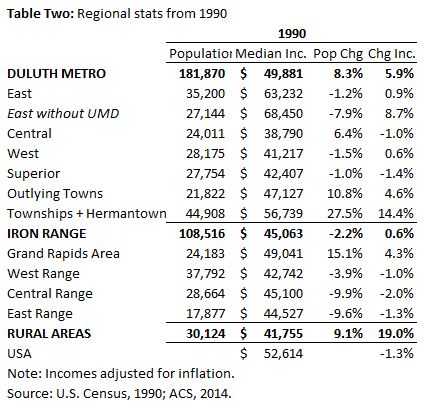
1990comparison

It’s not happy for everyone, though, and as Table Two shows, there is certainly evidence of divergence. Duluth, predictably, dominates both the top and the bottom of the income list, with pockets of great wealth and realms of substantial poverty. Those areas haven’t changed much since 1990—in fact, I was a bit surprised to see so little movement near the top, given the growth of the exurban areas—but the rich do seem to be getting richer while the poor get poorer. (See the table at the end for a breakdown by census tract.) This is less extreme on the Range, but it is noticeable in places, especially around Grand Rapids. It’s worth noting that the “Grand Rapids – South” tract split in two over this time period; I kept it together for consistency’s sake, but the southern, more rural part followed the trajectory of the wealthier areas around Pokegama Lake, while the more central parts slumped a bit.

The influence of Duluth’s colleges is also unavoidable. I split out East Duluth stats with and without UMD to show what an effect they have on incomes in that part of the city, while at the same time boosting an otherwise shrinking population, especially on the far west end of the area. Student housing has spread further afield, and the Census has also made more of a commitment to counting students where they live instead of counting them as living with their parents. (For my part, I’m not a fan of this decision, as I think it distorts things and gives an inaccurate account of the economic standing of students’ situations and of the area they live in, but no one asked me.) This leads university campuses to look like poverty-stricken wastelands; just check out the University of Minnesota campus sometime. Given the number of students, the income measured in a neighborhood like Lower Chester in Duluth is actually pretty substantial, even though it appears below average.

The Range, again predictably, is older and poorer than the Duluth area, and parts of it do worse than the national average. Grand Rapids—whose labeling as “Iron Range” is always a source of controversy anyway—also really carries the region economically. And while the East Range as a whole struggles, it could easily be split between the Ely and Lake Vermilion areas (which are growing in income, though still not rich, and fairly old) and East Range towns like Hoyt Lakes, Aurora, and Biwabik. These are among the worst-hit areas over this 24-year stretch, with the 2001 closure of LTV Steel in Hoyt Lakes looming large. Basically, the areas that have emerged as vacationlands are doing better than the more mining-dependent regions, and this is probably only even more true following the steel price downturn of the past two years.

It’s true that hospitality jobs don’t pay a ton. Ely and Tower aren’t getting rich off their recent tourism growth. But diversification does allow them to do somewhat better than their neighbors, and have something to fall back on in difficult mining times. The advantages are real, and are even more real around Grand Rapids, which benefits from being somewhat closer to the Twin Cities and on a couple of major highways.

Now, we’ll boil it all down to census tracts, which usually have 2,000-6,000 people and are roughly aligned with neighborhoods and towns.

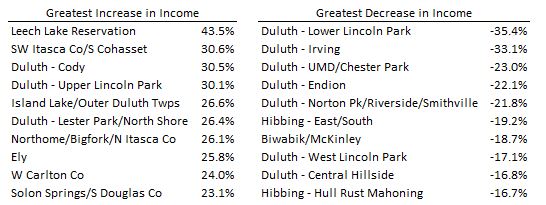
ChgsinIncome.JPG

The tract with the greatest income growth was a surprise to me: Leech Lake Reservation west of Grand Rapids in Itasca County. The other reservation tract, Fond du Lac, also did quite well for itself. Granted, these native communities are both coming from very low starting points, but it’s worth acknowledging that success, and taking a broader look at outcomes across the board in these areas. The other big gainers are mostly exurban lake country and a handful of Duluth neighborhoods that have seen some growth on the fringes plus, I suspect, some turnover as an older generation fades and gets replaced by a younger, upwardly mobile one. The biggest drops are in UMD tracts, a few of Duluth’s poorest areas, and in mining communities.

youngestoldest

The age table reinforces the effects of the colleges. I’m over the median age in my own Endion neighborhood, proving once again that I am an evil gentrifier who is ruining the neighborhood. The oldest tracts, excepting the two central Duluth areas with large retirement complexes, are all very rural, and the top of the list stays very rural beyond the top ten, too. Central Duluth also trends young, and this is worth watching: are the people here upwardly mobile, and will they move up in time, and perhaps move east or west? Or is this another generation of entrenched poverty?

Answers to a lot of these questions will have to wait, but our friends at the Census can give us some clues. I’ll continue this series at some point, too. As an appendix, I here add the table with income stats on all 98 census tracts in the five counties I looked at:

AllTractsDLH.png

Slouching Toward Bethlehem

As usual, I try to avoid national politics on here; as usual, I can’t resist inserting myself. This cycle has drawn everyone in for more carnage, much in the way we fixate on train wrecks. I’m not much of an idealist, have no qualms for voting for the lesser of two evils; at the same time, I tend to believe apocalyptic thinking of any stripe is overstated, and am more inclined to laugh off ludicrous claims than to fear for the future of the country. But as I’ve let show, this is an instance in which I think the choice is a clear one. Donald Trump must lose.

I’m not opposed to Donald Trump because I think he’ll cause great calamity. The risks might be somewhat higher, but he’s strongly constrained by the inertia of a powerful state. Nor do I fear the content of his provocative language: I’ve never taken the “build the wall” rhetoric seriously, and ultimately, I don’t think minority groups will see their fates be much different under Trump than they would have been under a standard-issue Republican. I’m less afraid of him doubling down on some of his claims than of him getting bored and losing interest in the whole charade.

Frankly, I struggle to see how anyone who’s tracked his behavior over the course of this cycle can have any confidence that he will actually do any of the things he says. While thankful, I also struggle to resist rolling my eyes at anyone who jumped off the bandwagon recently, as if he didn’t exhibit the same patterns of volcanic behavior all along. I see a President Trump as a bumbling clown, nutty but at least capable of reading off a teleprompter from time to time, all at the behest of his handlers, who step in to do damage control when he devolves into another tweetstorm against someone who’s offended him. (How is it that people who claim to oppose political correctness are so often the most thin-skinned?) To date I have little faith in the handlers’ ability to do that, but it’s not totally implausible to imagine Trump as a blustering figurehead and spinmaster-in-chief while a cadre around him implements its policies of choice, thereby avoiding a train wreck. Whatever you think of said policies, this leaves us right back where we started, with a group of political insider technocrats Making America Great Again. So much for the revolution.

Funnily enough, there are things about Trump’s policies (such as they are) that intrigue me. Foreign policy motivates me more than most voters, and I have deep reservations about Hillary Clinton’s foreign policy, which has been pretty reliably wrong over the past 15 years. On diplomacy, I prefer the calculating deal-makers to the liberal hawks, and while I have deep concerns about Vladimir Putin, he’s also a necessary partner in the Middle East and in other spheres, and handling him requires a bit more nuance than displayed in some Democratic Party circles recently. (How strange the world now seems: the Democrats are the hard-liners on Russian autocrats, while the Republicans are cozy with them.) While my takes on trade and economics are nuanced, I appreciate that Trump has prompted some good reflections on the state of the white working class, and an opportunity to have genuine debate about our blind assumptions about the Washington Consensus that have dominated both parties since the end of the Cold War. (I suppose Bernie Sanders gets an assist here, too.) A more polished version of Trump would have at least piqued my interest.

These are just a few of the policy areas where Trump sheds some light before going ten feet overboard. Arguments that immigrants hurt native-born Americans’ economic prospects are basically bunk, and I am glad to see many of the barriers to LGBTQ equality come down. But I’m also capable of putting myself in the shoes of people watching their world change so rapidly and feeling some sympathy. The immigration system does need careful management instead of wishful idealism, and people do need to be vetted some; religious conservatives have a right to worship as they choose, and raise their children in the ways they see fit. I don’t see the Clinton campaign acknowledging this reality. Her campaign makes occasional overtures toward a big-tent coalition, particularly during the Democratic National Convention, but so often appears motivated by a bunker mentality brought on by its candidate’s baggage. It fails to inspire, and the strategy seems to involve checking off boxes with all the interest groups it needs to keep happy.

My objections to Trump have much more to do with the way he has shifted the window for political debate in the United States. Or, rather, the way he’s shattered the window altogether. To be fair, Trump didn’t start this. Most popular media and cable news has been superficial garbage for a long time, and we can blame some of the toxicity on both a Republican Party that has subtly played off racial divisions since Nixon and a Democratic Party that has increasingly come to resemble a scattershot coalition of identity-based interest groups all trying to make a narrow claim at the table. But Trump has accelerated this, and brought it into the open with no apologies. Elements  of the left have sunk to his level, and political discourse, never pleasant, has degraded into self-reinforcing horror show. No figure is more responsible for this than Donald Trump.

We have the politics we deserve, and we can’t say the Greeks didn’t warn us. These are the timeless dangers of democracy, though I hastily add that I still find it the worst choice except for all the others. (I can see the Trump tweet now: “Korrupt Karl hates democracy. Sad!”) These are the consequences of dumbed-down celebrity politics, with messaging aimed at the lowest common denominator. It’s a reduction of elections to a binary choice in which it is somehow our patriotic duty to choose, red team versus blue team, more about winning and losing elections than the tricky work of governance. It needs some inherent dignity to avoid collapsing into an entertainment complex. Trump exemplifies politics as the reality TV show, and his continued presence on the political stage would only set off a downward spiral of degradation. I don’t predict the imminent collapse of American democracy, but each spin down the toilet increases the odds that it won’t quite be the same afterwards.

Trumpism, to the extent that it exists, taps into a Nietzschean energy: the world, instead of three interlocking circles that explain everything, is reduced to winners and losers, with sharp lines between them. Its most fertile intellectual ground is in the dark corners of the internet, where young men, probably around my age, assume ridiculous Latin pseudonyms and peddle their profound ressentiment of those who oppose them. (Oh, the Nietzschean irony.) Trump’s election wouldn’t bring them to power, nor would his defeat silence them. But the whole Trump phenomenon runs the risk of normalizing them, of empowering this narrative of fire and brimstone, of tribe and ideology over common American future.

In a way, I’m sympathetic. I get that urge to rise up in a crusade for greatness through politics. It’s what drove my eighteen-year-old self to Washington. I understand that longing to smash the day-to-day drudgery we inhabit and unleashed a repressed inner soul in all its erotic glory. It’s hard to beat that rush, and that side of human nature never will—and never should—go away. But channeling it in ways that trump up a mediocre establishment as an existential threat endangers American exceptionalism in the best sense of the phrase, this belief in a national project that won’t ever die. Lord knows this project has had its dark patches through history, but through it all, we are all awfully lucky to be here in this day in age. It’s cute to think we’re standing on some precipice of looming demise, and probably empowering to pretend one man can change it, but, alas, real heroism for the vast majority of us probably involves something both much closer to home and much more radical than checking a box on a Tuesday in November.

Some argue it’s a good thing that certain political currents, long suppressed, are now out in the open. I’m skeptical. One often hears Trump supporters say they’re glad he tells it like it is. I hate this phrase as much as I did when I first heard a public figure in Duluth utter it some years ago.  A layer of civilization is necessary for governance within political systems—especially the American one, with all its checks and balances—and there’s a need for consensus instead of silos of self-affirming certainty about what one already believes. No one has a monopoly on truth. Our elites have failed us many times, certainly, but we are blind to how far we have to fall. It’s more than a little disconcerting to witness the sort of political awakening one expects out of dispossessed young men in the Middle East coming out of a middle-aged couple in Youngstown.

And so I turn to Hillary Clinton: embattled, dogged by scandal, uninspiringly wonkish, too far to the left to sweep to a broad mandate, but too ensconced in her establishment cadre to inspire the energy to advance a more progressive agenda. She promises four more years of technocratic plodding, vicious right-wing opposition to anything she proposes, and shady, sheltered practices that, whether justified or not, will continue to court media attention. This only drags Washington further into the muck, perhaps ups the odds of a stronger counter-reaction in two or four years.

I reassure myself in a few ways. One, whatever Clinton’s flaws, they are predictable, and nothing in her political history suggests she will do anything unexpected or drastic. Give me a mediocre status quo over the revolution any day. Two, while she certainly won’t devolve power from Washington, she has neither the charisma nor the political capital to centralize it much more either, and at least pays lip service to bringing everyone to the table instead of saying “I alone can fix it.” Three, while the Republican Party has a very complicated reckoning to come, there is at least some hope that the coming dust-up allows the party to salvage itself in a way that it never could with a floundering President Trump at the top. In the long run, his defeat may do more good for the more sanely-grounded elements of his cause, since they’ll be part of the national conversation, but not tied to an absurd, distracting figure.

I sometimes say my time in Washington jaded me, but I think a more accurate summation my takeaway from four years there was a revelation over the smallness of it all: how much life could go on without worrying about it, and how much the people in charge are stumbling in the dark and guessing, just as we all are. This doesn’t mean that some political rookie can roll in and shake it up, though. It also takes experience, and knowledge of how to play the game to at least move policy, which does still matter enough that we can’t laugh the whole thing off. Only in reality TV shows do Trump-like figures march in and prove effective.

The Yeats poem that gives this post its title, oft-quoted this election cycle among intellectuals lamenting our political fate, claims the best lack conviction. Maybe, instead, the best know that obsessive conviction is misplaced. For my part, it’s time to stop reading FiveThirtyEight, make peace with the Clinton slouch, and get back to work here at home.

A Hawkish Outlook

Just a couple of years ago, the Hermantown Hawks were the darlings of the Class A Tournament, the last public school bastion of defense against the march of Twin Cities private school machines. How quickly the tables turn: the longest-running and incessant debate on the hockey forum this offseason has been about Hermantown’s dominance over Class A, and the competitive imbalance it creates. As with St. Thomas Academy before them, the Hawks’ consistent ability to pump out elite teams has prompted frustrated reactions from those who are stuck going up against them and lose, year after year: shouldn’t this high-powered team move up to AA?

As long as they kept losing state championship games, as they did for six consecutive seasons, they had an easy counterargument: for all their success, the Hawks clearly weren’t on the level of a St. Thomas or a Breck. But on the seventh year of consecutive title game appearances, God rested in his torment of Hermantown, and the Duluth suburb took home its second state title in ten years. With a loaded team coming back this coming season, anything less than a convincing repeat would be stunning. The Hawks are the undisputed superpower of Class A, and no one is even close.

I’ve been mostly agnostic in the A vs. AA debate, as I have no strong Class A loyalties. I respect teams’ rights to run their own programs as they see fit, and prefer not to throw stones when my own team makes scheduling decisions based on what it believes is right for its situation. Any complaints that spurted out of my Twitter feed were from an aesthetic standpoint; I want to watch competitive hockey at Class A State, not giant blowouts, and grew bored with some of the Hawks’ men-versus-boys contests last season. Sure, I think it’s fun when historic Range teams head to State, and as a northern boy, I’d appreciate another northern squad in 7AA so as to boot Elk River to a different section and carry the regional torch at State if they earn it. But this was not among the things keeping me up at night or making me mutter under my breath.

Hermantown defenders are right to make a few points. The school is playing where it was assigned, and its enrollment is nowhere near the AA cutoff. Nor are most of Hermantown’s advantages the product of an evil recruiting scheme, even if there may be isolated incidents here or there. (I’m not close enough to say whether those rumors have any teeth.) The school boundaries around Hermantown do lend themselves to open enrollment. Townships to the west and northwest of are in the Proctor school district, despite being closer to Hermantown and not touching Proctor. (Numbers from these townships help keep Proctor a decent-sized school for an otherwise tiny community.) The closure of Duluth Central also pushed a decent number of Duluth Heights residents to open enroll across the border, as Hermantown was both convenient, and higher-performing than those students’ new West Duluth schools. (Of course, it’s worth asking how much of this has to do with anything unique to Hermantown, and how much of it is just demographic inertia.)

That said, Hermantown does have its share of advantages that most small hockey programs in the state do not enjoy. It is an exurban community in a respectably-sized metropolitan area of about 200,000. That’s not huge, but it’s substantial, especially when accounting for the wealth of local hockey history and the presence of a prominent D-I program, many of whose graduates stick around. It’s growing, and adding young families. It’s not the wealthiest part of the Duluth area, but it’s certainly toward the upper end. Its basic urban design—large, sprawling wooded lots—does not lend itself to much density of lower-income residents, even if it also limits its economic and population growth potential. If we remember our lessons about urbanism and high school hockey, that tends to be good for hockey success, at least in the short run while the community is still growing.

The small size of the Duluth metro area also magnifies the Hawks’ position. The closest comparison to Hermantown in the Twin Cities is probably something like Delano, which is starting to surge toward hockey relevance. Delano, however, doesn’t have neighbors who aren’t also affluent and growing; no one is open enrolling there to flee the shuttering or struggling schools of Plymouth or Minnetonka, or to dodge bizarre borders with other Wright County towns. In an area that can only support a handful of options, just a handful of player moves can throw things out of whack. Unlike some Twin Cities schools that may lose a bunch of players to open enrollment or private schools, places like Proctor or Denfeld aren’t losing players all over the place; there are only two or three places that stand to benefit, and those places are likely in the same section. Duluth’s smallness and the extent to which everyone knows each other make it obvious who the winners and losers of player movement are, and make the scapegoats easy to identify. (We Duluth East fans know a thing or two about this.)

The advantages that some schools have over each other are blurry, and there are gradations of advantage and disadvantage all over Class A. East Grand Forks also benefits from a decent-sized metro and a convenient D-I school; Mahtomedi lurks just under the cutoff bar for AA and thereby builds some of the deeper A teams out there. Even small, relatively isolated towns aren’t all cookie-cutter; Luverne has surged to relevance in recent years, while nearby Worthington is at the bottom of the barrel, largely due to an immigrant-heavy population with no knowledge of hockey that has been drawn to its meat packing plant. The fans of the true small towns in Section 1A could probably gripe about how it’s been dominated by schools in larger towns (Rochester Lourdes, the Mankatos), or towns on the growing exurban fringe (New Prague). It’s worth remembering that even St. Thomas Academy was a Class A doormat at one time, and that it took years for Greg and Tom Vannelli to turn it into a consistent contender. These different levels of advantage are reality, and any assessment of a team can’t be a snapshot at one point in time, but needs to understand its long-term record and accomplishments to date.

Hermantown is clearly pretty far along on this spectrum of success now, and that’s to their credit. I don’t think any team should ever be forced to opt up, and any pressure to do so should only come after a long period of dominance. I want to see good teams and players in Class A, and more than one or two new opt-ups due to Class A success in a decade would quickly drain the field. That said, when a program is consistently putting other top five teams in its class in running time, it’s a clear sign of a mismatch, and the point at which even diehard supporters should see a case for a move.

There’s no doubt Hermantown could compete in AA, and rumors suggest the program may make the leap after this coming season. The move may come a year too late: this year’s squad, with a pair of potential Mr. Hockey candidates and depth across the board, could have easily contended for a AA title. While people might be able to cherry-pick a regular season result or two to claim they’re better than a bunch of AA Tourney entrants, we’ll never really know how good they are. (The AA playoff gauntlet is an entirely different animal from what the Hawks now face; just ask STA about its first three years in AA.) Beyond this year, Hermantown looks good, but perhaps not as good as last year and this year, and will face the 7AA minefield. If they do make that move, I’ll welcome them in and look forward to the battles; if they don’t, I’ll be disappointed, but life will go on. Much as I’d love to see some success out of Range teams, they face their share of internal obstacles in the search for a return to glory.

The whole debate relates back to a deeper question: what’s the whole purpose of the two-class tournament? The generic State High School League response will tell you that it gives more players a chance to play at State. That’s true, but from a hockey development standpoint, its true benefit is in giving more players a chance to aim for State: to grow hockey in areas that haven’t traditionally seen success, and to revive it in areas where it might otherwise have faded or died. Hermantown is as obvious a success story as any in 25 years of two-class hockey; it went from an afterthought to an unstoppable force, and probably wouldn’t have done so without being able to take the baby steps allowed by Class A. The Hawks have succeeded. Now we’ll see if they’ll let someone follow in their footsteps.

Utopia III

If the instinct toward perfection is an essential piece of human nature, it’s hidden itself pretty well this year. This presidential election cycle alone is enough to paint a dark picture, and that’s not even touching the rest of the world. Even the supposedly hopeful candidate in the Democratic primary spent most of his time calling for a sort of class war. The road to revolution isn’t always bright or happy.

Given this climate, one could forgive people for yearning for utopia anew. A piece in the most recent New Yorker explores some favorable books that favor the concept before landing in my preferred territory of skepticism of grand ideas and defense of gradually moving the chains. There need not be an ideal vision; merely a general direction, and confidence in the steps taken in that direction.

For me, this is a fitting time to reflect on that dream of perfection. The past month and a half has been pretty good to me, basically aligning with my hopes. I’ve gone home again. I have a secure job that I like, and that aligns with both my interests and my general sense of what I want to do with my life. I’m not going to be rich anytime soon, but I’m certainly living comfortably for someone my age. I’m back among some of my favorite people, ready to live a life in the same place as them, and work with them to build whatever comes next. I live in a big old house that nails the details for what I look for in a home. For years so much of this seemed so far away, and now, all of the sudden, it’s all here.

It’s a good time to be back. Autumn in Duluth is one of its more spectacular seasons, as these waning golden days invite us out to marvel in the tapestries lain across the landscape. I hike or run the rugged ridges of the countless parks, wreathed in orange and red and gold and orange. I savor the warmer evenings, sit out on my new front porch with a glass of wine and read some. My book choice for the weekend revisits an old favorite: Amartya Sen, an anti-utopian economist nonetheless filled with hope for gradual movement toward justice. The football field at East is packed when I go by on Friday nights, I watch Verne Lundquist (born in Duluth!) call SEC games on Saturday for one final year, all adding to a sense of timelessness. Well, I suppose some things change: the Yankees are sitting at home in October, and the Cubs of all teams are favored. No matter: there’s a haze of rightness about it all.

I’m not resting on my laurels. I’m too restless to do that, and while I can ground myself for stretches, there’s always another cycle outward. No need for congratulations, either: this is only the beginning, and there’s lots of work to do. Things are moving. Not toward utopia, and toward a state that’s slightly better than where we were before. Now that I’m settled in, it’s time to see what we can do to fight the cynical instinct: not to reach back up to utopia, but simply to reach out with the utmost effort, enough that we can come home content at the end of the day. Onward.