This is the second in a four-part series. Part One is here.
Northeast of Burgos the Spanish countryside grows more picturesque. My train cuts through passes in granite crags with old cities clinging to hillsides, all robed in fog on this wet day. The train slows for twists through thick trees and night swallows the scene quickly. A weird new language I cannot understand at all joins Spanish and English in the train’s announcements. I am approaching my destination: Basque Country, the Euskal Herria, the autonomous community on Spain’s northern coast and along the border with France, at the elbow of the Bay of Biscay. I’ve previously knocked out two of Spain’s regions with their own languages and complicated histories with Madrid (Galicia and Catalonia), but the Basques are in a league of their own, their mother tongue bearing no relation to later-arriving Romance languages and their separatism punctuated by violent militancy well into this century. In the far north they have carved out a state with immense national pride, Spanish flags almost universally replaced by the red, white, and green of the Basques. It is here that my friend Andrew and I have chosen to spend some time exploring in May.
Northern Spain is not the stereotype of dusty windmill-strewn plains nor of Moorish architecture nor an excess of loud British tourists chasing some cheap sun, though they are still around. It is a lush, wet land, its regions relatively small in area, cut off from much of the rest of Spain by a wall of mountains. The Moorish advances trickled out here, and the Reconquista began in places like Asturias and Cantabria and Northern Castilla y León. By Spanish standards the north is relatively affluent, the birthplace of several national banking giants and home to a respectable industrial base and such darlings of local control as the Mondragón Cooperative. And while there is good food everywhere in Spain, Basque Country is its peak.
The Basque cultural capital is Bilbao, a metro of one million and in many respects an ideal type European city: tight winding historic old town, newer grand promenades, a famous museum, a fancy old train station, a gaudy new soccer stadium, apartment blocks in rings around the cool stuff, a few discordant office towers, and a river winding through the middle. Its twist is the national pride for a nation that spent long parts of history hidden away in these rugged hills along the sea, speaking their obscure tongue punctuated Xs and Ks and Zs and Ts. (Andrew and I are curious to see the point values in Basque Scrabble.) While Spanish remains the dominant tongue, Basque is present, from a dignified group of elderly diners at the nicest restaurant we visit to a flock of teenagers slurping Aperol spritzes on the patio where I grab a late-night snack upon my arrival. The rebellion against the crown continues, subtle but persistent.
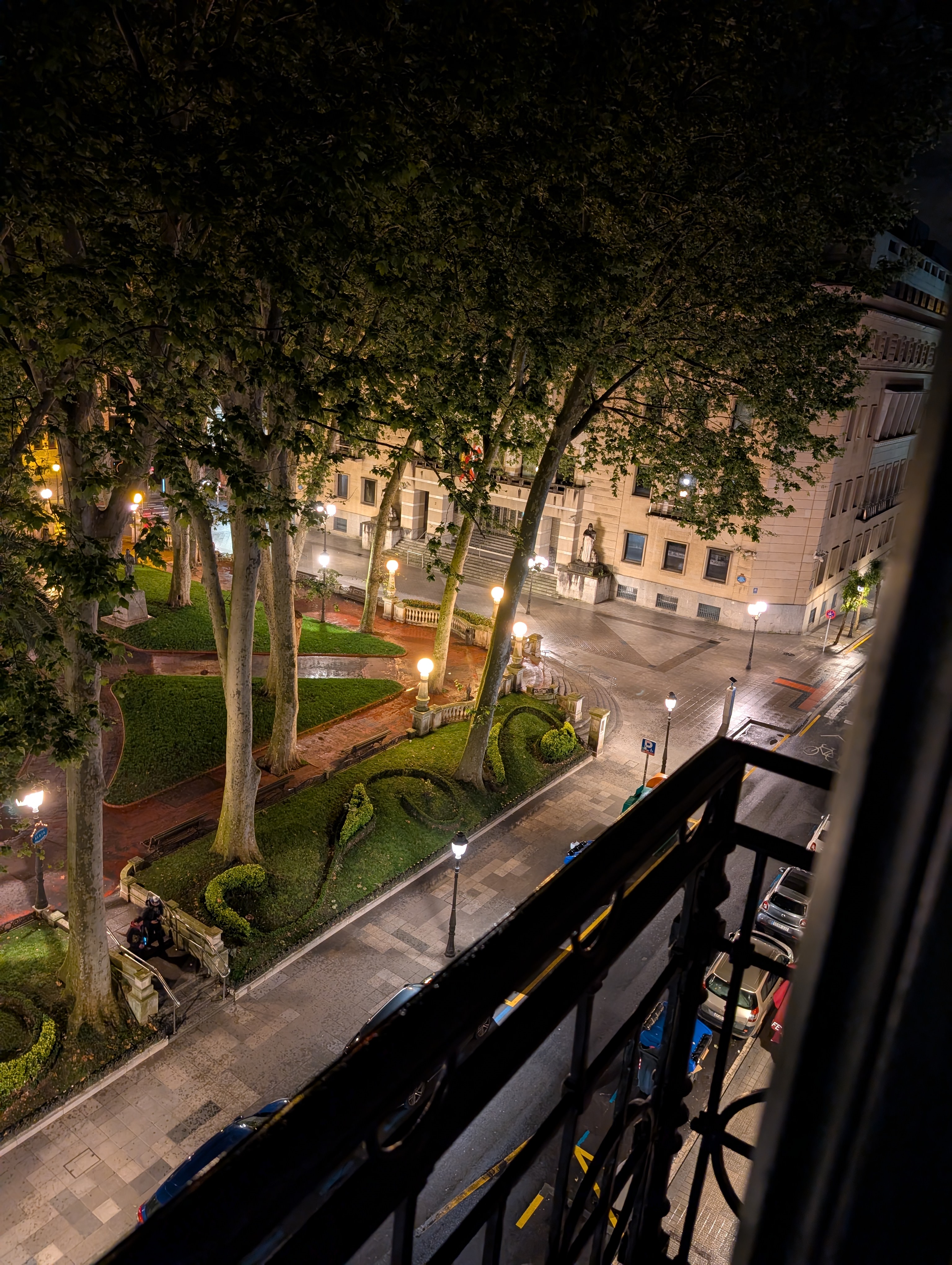
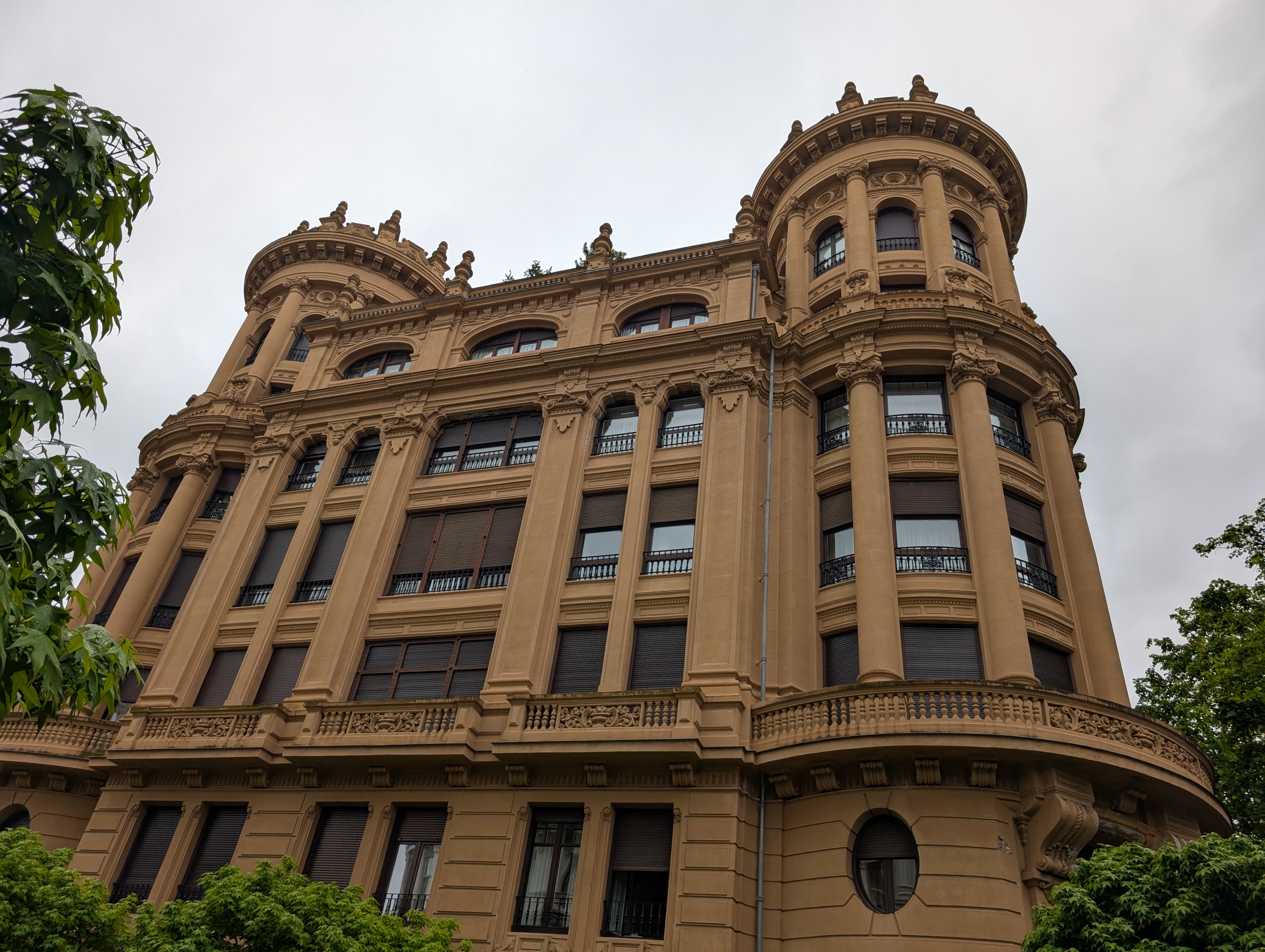


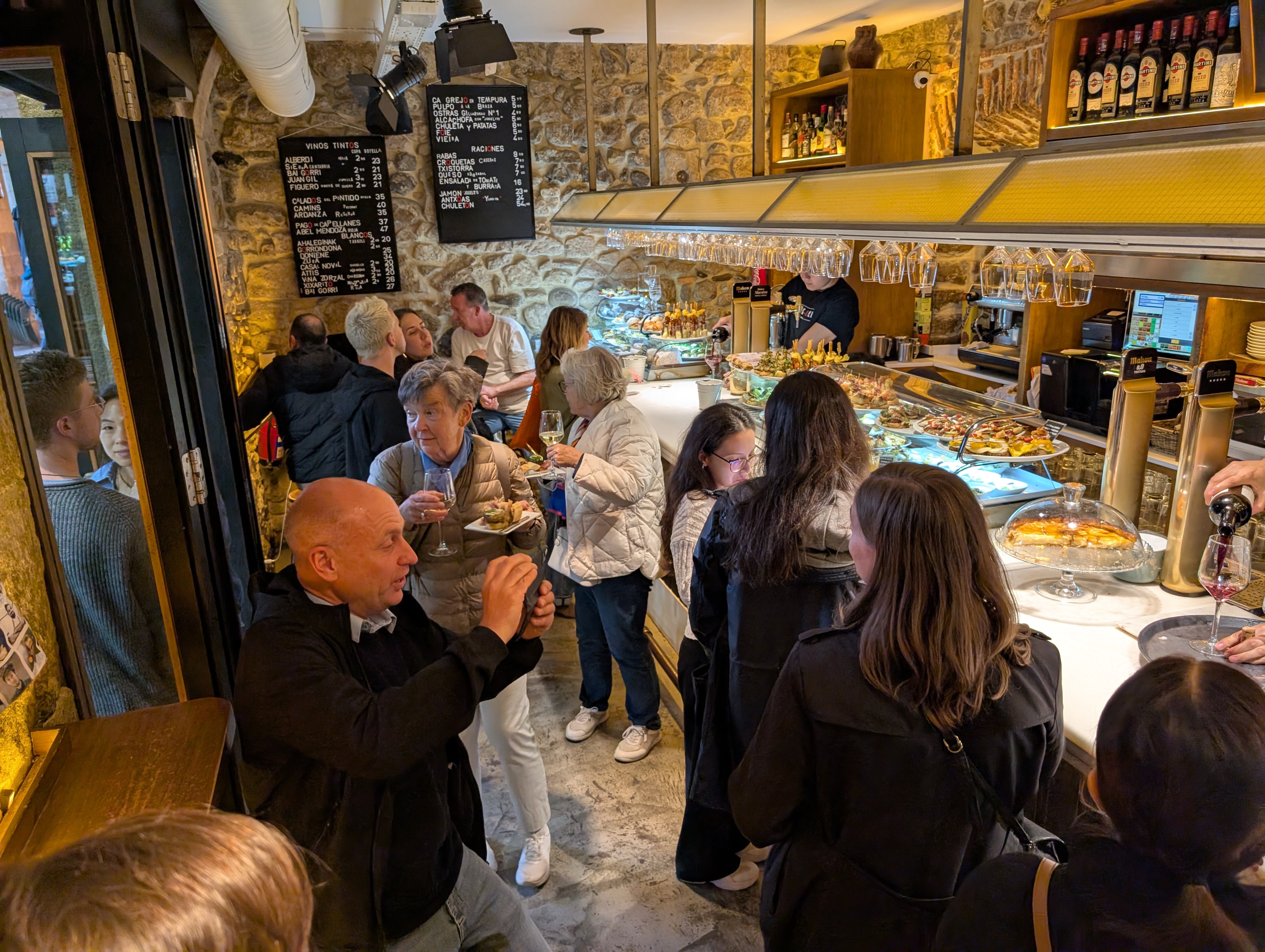
Our hotel sits on the Albiako Lorategiak, a placid square whose towering sycamores rise high above our fourth-floor balcony. Andrew misses a connection from Madrid to Bilbao (he spends his delay at the Prado, the poor soul), so I go back to my wandering routine on the grey, drippy sort of day that is common here in the Euskal Herria. I stroll the Gran Vía and meander the tight streets of the Casco Viejo, grab a pintxos (Basque tapas) lunch, ascend to a basilica on a hill. The city is in the preparation stages for a British onslaught, as Manchester United and Tottenham Hotspur will meet here in a week for the Europa League final; soccer balls dot the city, and a new wrap is going up on the sparkling San Mamés stadium. On the way down from the basilica I lose myself briefly in apartment block Spain, that dense, urban reality that is more representative of contemporary Spanish life than a tapas crawl on a historic street. In the US this sort of neighborhood would prompt some nervous looks from outsiders, but here it just feels like a normal Thursday afternoon. Kids pour out of a school, people reel in the laundry from beneath their umbrella-covered hanging spots out the window. The shops are a bit grittier but the fundamentals of Spanish urban life are unchanged.
When Andrew arrives, the pintxos tour begins in earnest. We nail our first two stops, octopus at Gure Toki and mussels with good wine at Taska Beltz. There is quality craft beer at La Ley Seca, a mediocre Mahou to end the night on a pedestrian street a block from the hotel. It continues the next day with breakfast at the Café Iruña with its stunning Moorish interior, lunch at the vast Erriberako market, more good beer at Bihotz, and a dinner at Casa Rufo that slowly builds: white asparagus from Navarra, a well-salted cod, a gaudy steak, and a divine Manchego cheesecake for dessert.
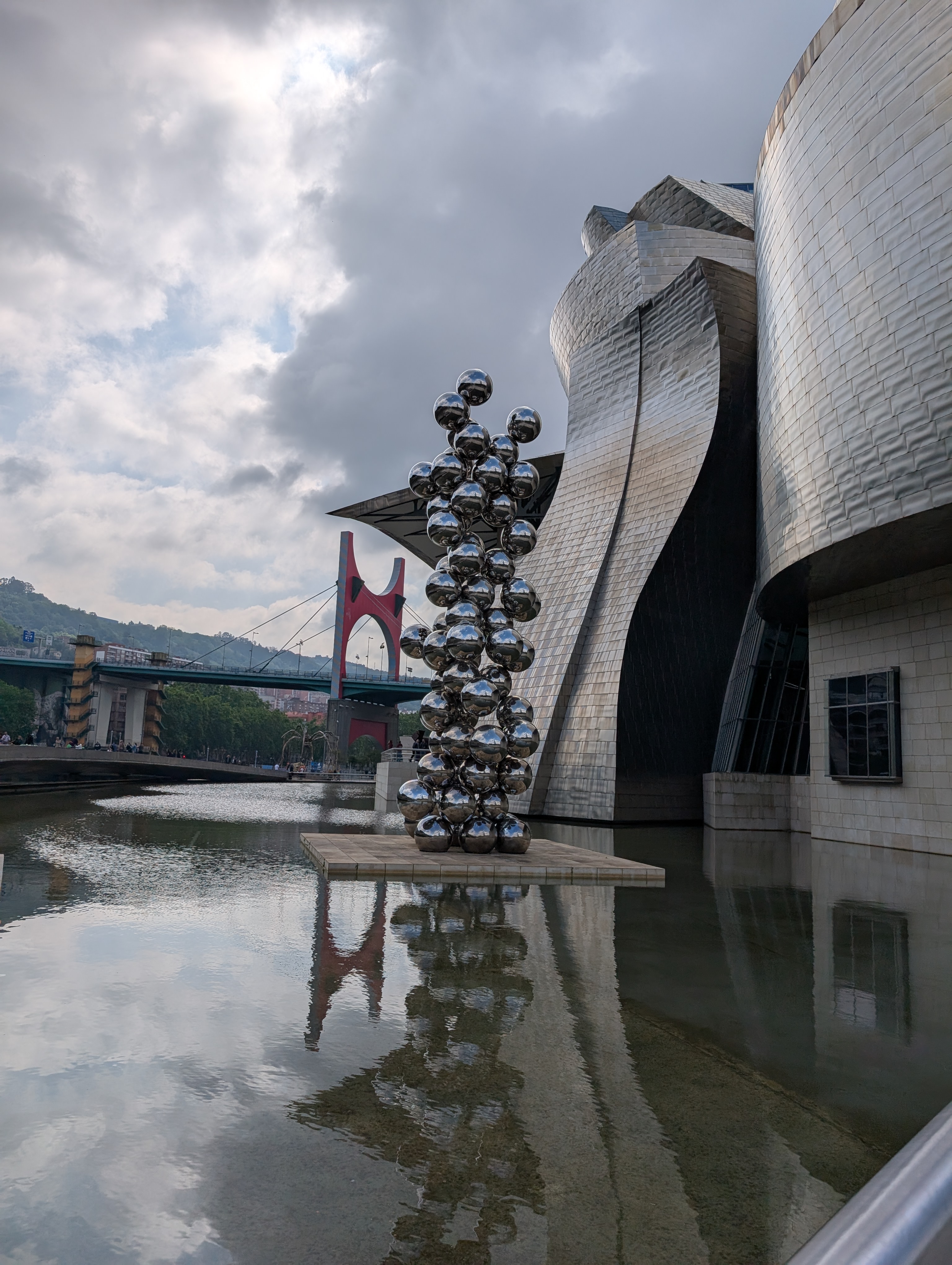
Bilbao’s great attraction is the Guggenheim Museum, the striking Frank Gehry-designed eruption of molten titanium lava flows that takes on to the shifting moods of Basque Country weather. The tour starts on the outside along the riverfront promenade, with Anish Kapoor’s giant pile of reflective balls and a giant spider (its effect somewhat reduced by the crews buffing it on the day we visit) and a towering flowery puppy by Jeff Koons. The titanium-clad exterior somehow turns to an airy glass interior, cavernous and at times vertiginous on its catwalks, able to hold ten thousand French schoolchildren with ease. Its three immersive exhibits are its best, and it wins me immediately with Richard Serra’s The Matter of Time, a series of giant pieces of iron that invite exploration as if they were a series of southwestern slot canyons. Next is Yayoi Kusama’s Infinity Mirrored Room, a trippy house of mirrors and flashing lights meant to invoke the artist’s hallucinations. Finally there is Refik Anadol’s in situ, a room covered in a nonstop flow of AI-generated images of Frank Gehry architecture and its influences that occasionally hallucinates and goes wrong. Beyond that there is a collection of modern art’s greatest hits: a Warhol, another Koons, some de Koonigs, none of which are my cup of tea but are welcome enough as a summation of a movement. (The one I do enjoy: Cy Twombly’s nine-part descent of Emperor Commodus into insanity.) An exhibit on the Brazilian painter Tarsila do Amaral also opens new worlds, a blend of modernism and Cubism and Brazilian color. The Guggenheim is a triumph of urban renewal, a peak many cities chase but achieved successfully by Basque leadership that saw the creation of monuments like this, not just another European micro-state, as the path forward.


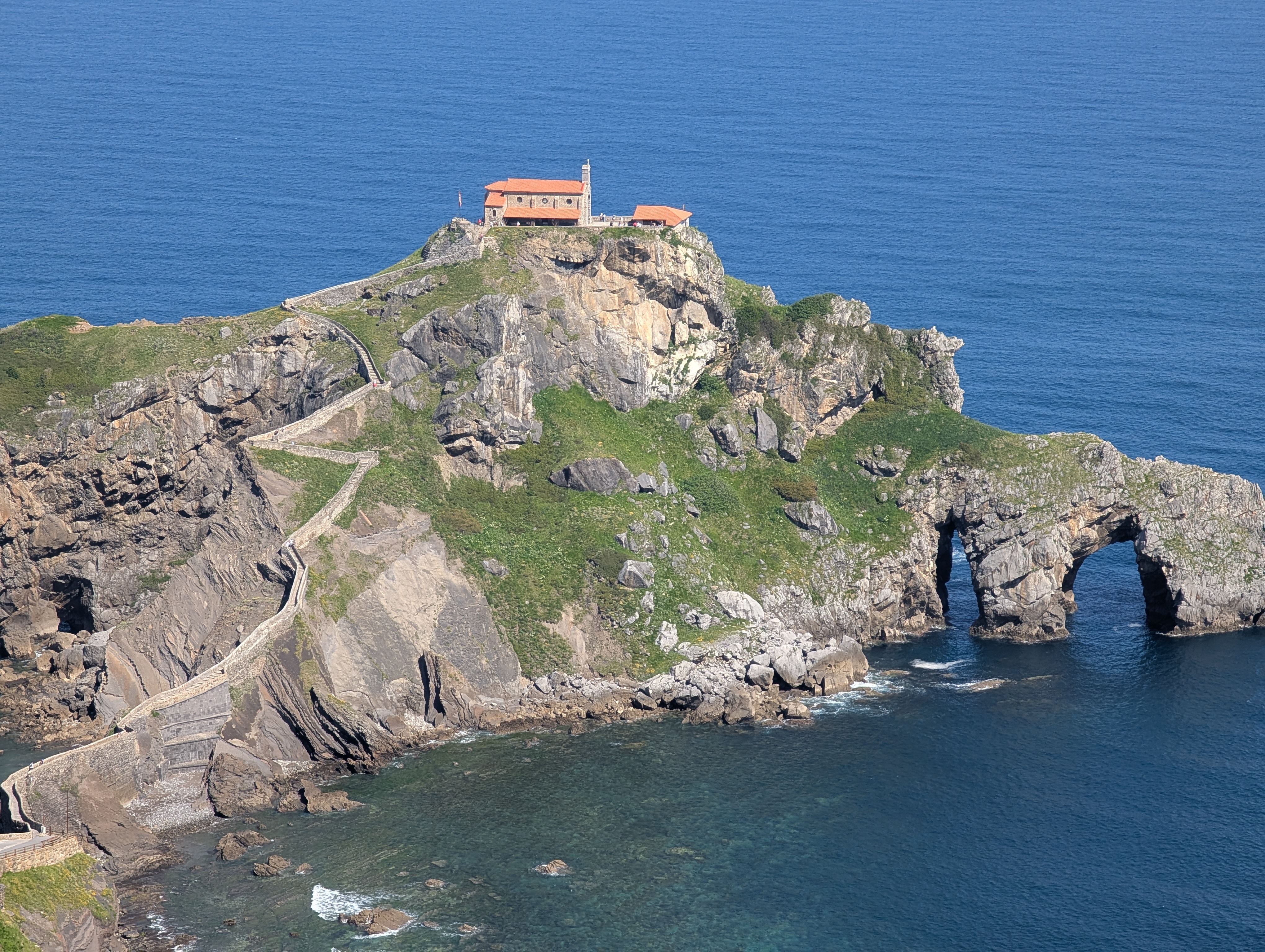
We rent a car for a day to drive the coast from Bilbao to San Sebastián, guided by a Siri whose command of Basque leaves something to be desired. The trip is just over an hour by freeway but over three and a half by our route, and while Siri takes us on a few rides, our road is well worth the time it takes. Our first stop is Gaztelugatxe, a medieval monastery and the site of Dragonstone in Game of Thrones, sitting alone atop a rocky isle just off a sloping cliff, its caves withholding any sign of fiery priestesses. We pass through little surfing towns like Bakio and Bermeo and Mundaka, and the coastline evokes Big Sur, complete with the road washouts requiring detours; this, I think, is what the California coast could have felt like several decades back, before history overtook California. It is stunning country, beautiful but not overpopulated, issuing a summons to stop and explore each small town, if one can possibly find any parking. Perhaps it is better that they do not build more.

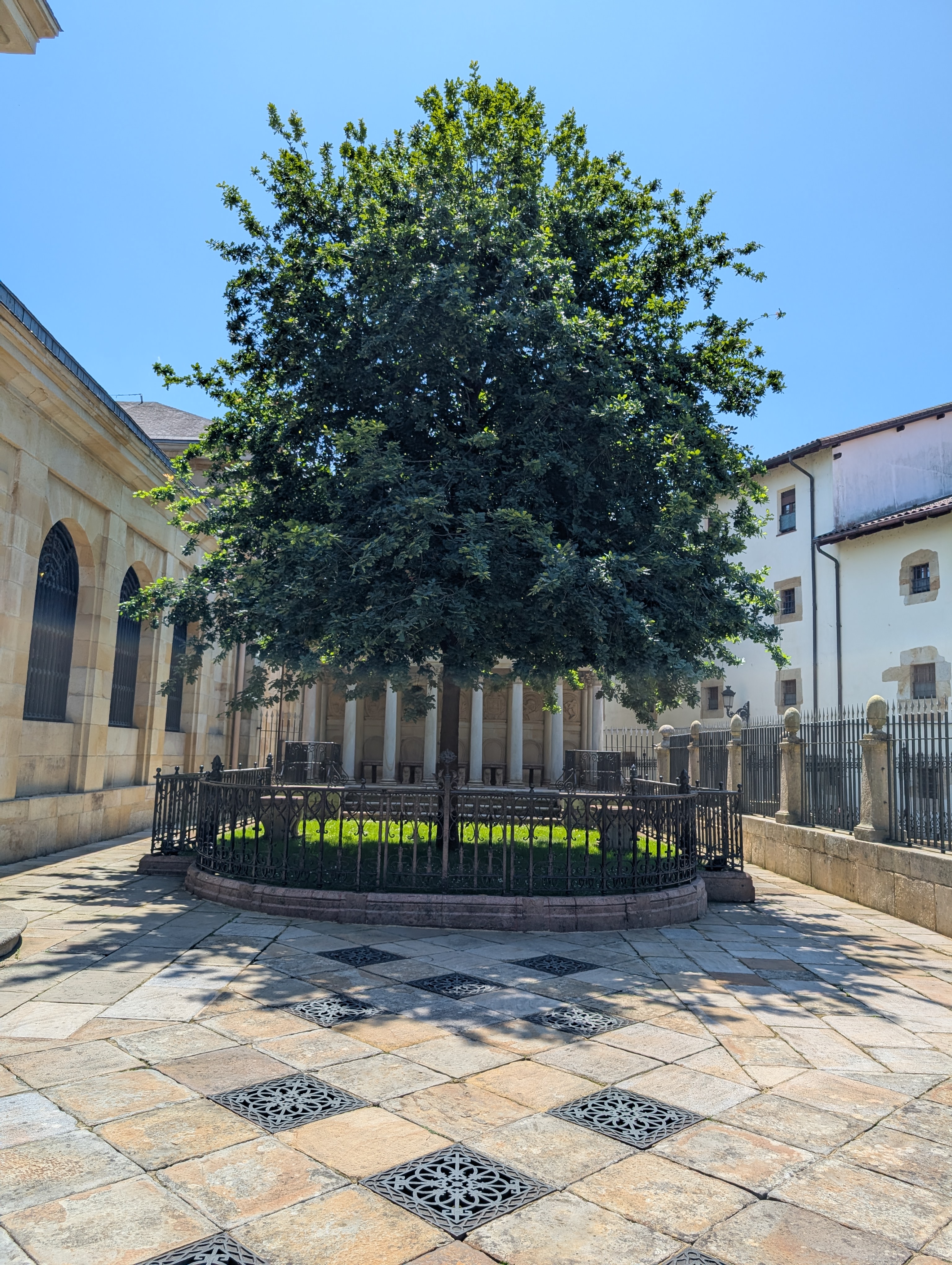

A quick turn inland takes us to Guernica, the spiritual center of the Basque Country, home to a meeting hall for their centuries-old republic (admired by John Adams as he studied forms of government for the United States) and the oak tree beneath which the province of Vizcaya still gathers to elect its ceremonial leader. This history is part of why Francisco Franco and his Nazi allies selected it in 1937 as a test run for the first carpet bombing of a town, though the oak tree (and the actual military targets, like an arms factory and a bridge) withstood the bombing while the city center went up in flames. Today, Guernica is a bustling, pleasant town with regular reminders of a dark past, and the Peace Museum gives eyewitness accounts of the devastation, ponders questions of what exactly peace means. As anyone with a memory of Guernica’s carnage passes out of time, I wonder how well a world increasingly interested in reviving great historical struggles will remember its lessons. We are left with some museums and one raw, great Picasso to help tell the tale of what that era’s escalations wrought.
After Guernica it is back to the coast, back to weaving roads through maritime pine and eucalyptus, my steering wheel hands and break pedal foot growing sore. Ondarroa makes me gawk. We stop off at a beach sliced up by Flysch, sharp cuts of sheer sedimentary rock near where tectonic plates met at some point in time. The beach here in Zumaia is populated entirely by locals, blissed out on the Basque coast. Next we curve over to Getaria, a fishing town on a narrow finger of a peninsula, though we have mistimed its fine food scene. Driving up a coast never grows old, I say to Andrew, and as we turn toward San Sebastián I understand why the Basques cherish their homeland so much.
 A Patient Cycle
