This is part two in a four-part series. Part one is here.
My adventure to the Southern Cone begins, as half my trips anywhere these days seem to do, with travel issues. Ten minutes before I leave my door, Delta informs me the flight from Atlanta to Buenos Aires will depart nine hours later than planned. While they feed me, put me up in a decent Atlanta hotel, gift me some miles, and are night and day better than United was to me through comparable past incidents, I am still left lamenting lost time that I can never make up.
I confess that I am spoiled. Any regular flyer knows the absurdity of travel scheduling, the absurdity of our expectations, and the ability to schedule things out so meticulously can crimp the traveler’s mind. On our recent Camino, my dad reflected on his post-college backpack tour of South America in 1981, when there was no way to plan much of anything and he went with just one heaping guidebook to carry him through the whole continent. He would just take a bus to some city, wander until he found adequate lodging, and then stay there, and he came away from all of it just fine. As a millennial I got the slightest snippet of this unplanned life, most notably during my college semester in Mexico, which was just before functional smartphones for trips abroad were a thing. Now, such spontaneity feels like a borderline irresponsible relic, or at best a quaint dream of a different era.
This line of thinking trips an old hunger. On the plane, I break my usual rule about not connecting to the internet (the irony does not escape me) to wistfully reread Roger Cohen’s “Ways to Be Free,” the op ed column that has stuck with me more than any I’ve ever read.
It resonates so fully because the desire it expresses is deep in my bones. I can see my dad in Cohen’s van trip. William Finnegan’s writing on surfing triggered an artistic flourish from me, a fictional project that set re-oriented my trajectory some. I too asked the question Cohen’s son did, without ever quite settling on an answer. The appetite for freedom is inescapable.
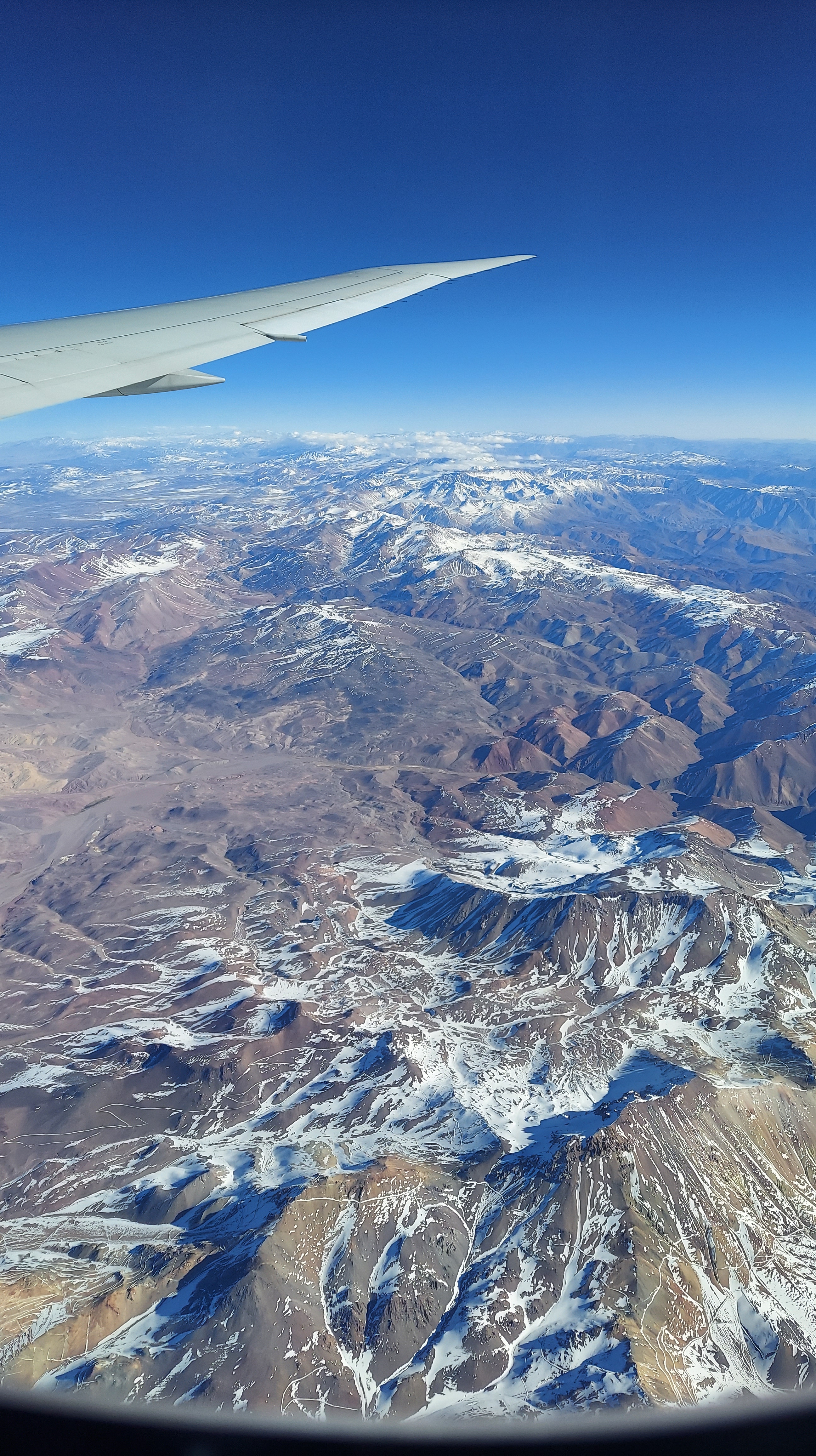
I was not in a position to take some grand adventure right after college (or at least I didn’t think I was), but I am now in a position to make up for some lost time. Any annoyance at the delay is forgotten as I drink in the rare experience of a full international flight in the daytime. I love this: over the ten-hour flight I can gaze out my tiny window at the Florida Keys, Cuba, the Panama Canal, the Andes over Ecuador and then Peru and then Chile before sweeping over the pampas and into the sprawl of Buenos Aires. This god’s eye view opens up the possibility of the world, shows how many more places there are to explore.
The contours of the earth always have fascinated me. From the youngest age I was enraptured by atlases and globes, tracing routes across nations I did not know and may never know. I recall some kid on the school bus early on—this must have been first grade, the only year of elementary school I took a bus—asking why I always stared out the window. Because I want to explore every inch of it, I probably would have said if I had the maturity to do so. Now, blessed with some modicum of disposable income, I dispose of it by visiting some of those places. Even with the travel delay, this feels right, some sort of trip I am meant to take.
An odd feature of my mini sabbatical: between my dad’s retirement trip and three weddings, all this travel is because of someone else. Of course I am pleased to go to all these places with all these people, and I had some input in crafting some of the itineraries. But I have just one snippet that is truly my own, for more than a few stray hours: my two-night detour to Uruguay.
The journey from Buenos Aires to Montevideo, the Uruguayan capital, takes just over two and half hours by a ferry named Francisco, which bills itself as the world’s fastest catamaran. It cruises smoothly across the Rio de la Plata, the views rather unfortunately blinded by bright string lights all around the windows. The travel delay has cost me my night in Montevideo, and from cab and bus windows it feels a bit tired, the changing fall leaves adding to the general sense of a drift into lost time. From Montevideo it is a two-hour bus ride on to Punta del Este, where I have decided to hole up before I return to Buenos Aires for the wedding.
Uruguay is a remarkable little country wedged between Argentina and Brazil. On the surface it resembles Argentina immensely, with its loves for beef and maté and wine and soccer; like its neighbor, its population is dominated by Spanish and Italian immigrants from around the turn of the 20th century. Its early history was tied up in wars involving its larger neighbors, whose residents still descend on its beaches en masse in peak seasons. But here is little Uruguay, tame as its neighbors overflow in excess, as boring in its politics as its neighbors are bombastic, comparatively affluent and low in crime. It is, perhaps, the most chill country on earth.

Uruguay earns this status not by exuding the painfully orchestrated cool of California or that “what, me worry” style of, say, a Caribbean island where people just expect things not to work. Uruguayans just seem to ease their way through life, living out small dramas, refilling their matés from the thermoses they carry around all day, and channeling any aggression on to the soccer pitch, where they might just bite you to get what they need. Uruguay is not rich, but it does not pretend to be. It works with what it has, and its infrastructure and institutions are the class of Latin America.
Riding out from Montevideo, the suburbs bustle with healthy life and don’t feel too far off from the parts of Portugal or Galicia I toured a few weeks earlier. In the countryside there is some poverty, but it feels stable, like these tiny cobbled-together homes have some staying power the shacks of a slum or dusty Mexican outpost do not, rooted into this pampa sand instead of living each day on the edge. The landscape starts out as plain grassland; cows and horses graze about. A few humpback mounts rise in the distance and grow thicker as I head east, and occasional forests offer pleasant mixes of pines and palms and the great ombú trees of the region. And then, finally, my bus rolls over a hill and reveals South America’s foremost beach resort.
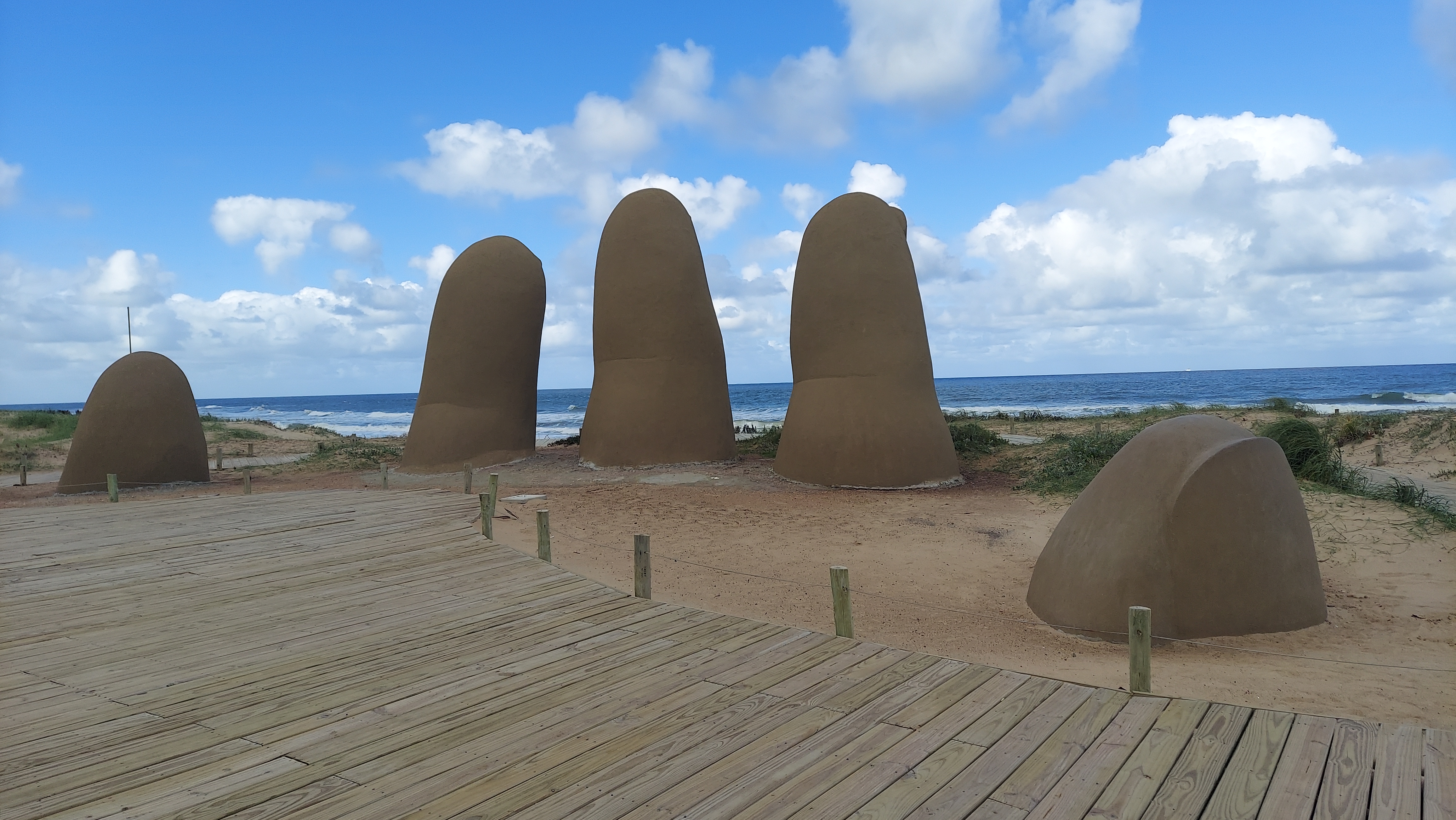
Punta del Este juts out on a snippet of sand where Uruguay’s southern and eastern coasts meet. Its center is more Miami Beach than modest Latin American resort, with clusters of towers and other prime real estate, while further out it drifts into graceful modernist homes settled beneath the pines. As this is fall in South America, it is now the offseason; the towers are mostly quiet, and the trendier clubs are closed up until the next major vacation. I putter around the peninsula and take a minute to appraise the iconic mano of Punta del Este, the hand that rises from the sand. Punta’s style is modern but tasteful, built to drink in the full surroundings, to provoke a few creative thoughts without disrupting the beachfront cool.
Some stray raindrops convince me it’s time to cab up to La Barra, a small beach town across an undulating bridge from Punta’s towers. It is still built up, still very much a destination, but has more of a town feel than Punta itself. I settle into a private room in an otherwise fairly dead, quirky hostel a block off an inlet, an easy walk from everything I will need for my stay in Uruguay. It all feels very assured.
I stroll along the beach at sunset. It is quiet, just a few stray couples and dog-walkers, and a lone surfer who puts in the brutal work out through fierce waves for one long, brilliant ride in. The sun disappears into glowing clouds and a full moon rises up through the marine layer, a resplendent yellow orb shrouded from time to time in a drifting oceanic haze. Everyone on the beach stops to watch. Later, I eat a chivito dinner at a casual restaurant named Chill Out and chat up the kid at the bar, an easygoing townie with a dream of an escape to Miami.
On day two, I fall deeper into Punta’s trance. It is grey, on the chilly side, but the surfers are out in force. Sixty or seventy of them ride off Playa los Cangrejos, and scattered others take on additional stray points along the unending beach. I amble my way to Manantiales a few miles up the shore just to drink it in. Sitting and watching the crashing waves appears a perfectly acceptable pastime in these parts. My guidebook calls Playa Bikini a “flesh cauldron” in the high season, but for now it is placid in response beneath a colorful row of those large-widowed modernist homes, all nestled beneath shapely pines and ombús. It is hard to square the Punta I see with the ubiquitous cranes putting up more towers, and hard to remember over lunch in a swanky beachfront joint that this is not in fact a rich country. I eat the seafood of the day, drink fernet, and the waiter provides a heavy blanket so I can get cozy in my seat. Rain arrives while I dine, and while I wait out the worst of it, the walk back is damp. Time for a siesta.

I dine at El Papu, a bohemian chic spot up the road, stone floors and the ubiquitous floor-to-ceiling glass, all lit by candle. They serve local craft beer; the eggplant parmesan is the best I’ve ever eaten, tender as can be, drizzled in a green salsa with nuts. A bassist and a keyboarder settle in to serenade us with jazzy tunes, all improvised, the bassist working wonders in the higher registers. The other patrons are local hipsters and surfers, at ease among one another, an easy night taking shape. The vibe has met the moment.
In Uruguay I am free to pursue a radical freedom, to re-create myself in a country where not a soul knows me as I am. It is an opportunity at once both tantalizing and impossible. I could expand on certain tales from my stay here, perhaps, but some things are best left unwritten. And sometimes fiction, in the words of Walker Percy, tells us what we know that we do not know that we know. After Uruguay, I know what possibilities exist, but I also know the extent of my reach. I can head home a wiser man.
 A Patient Cycle