Symposium

I started 2021 with a midnight splash into a pool, a dive both literal and metaphorical: after the caged life of 2020, 2021 would be a year where I jumped in. I am not ready to pass final judgment on that goal, as certain limitations have not exactly disappeared, but in one way this year has matched the hype. I traveled more than I ever have, a steady stream of escapes from daily toil, and this past weekend, a final excursion outside of holiday family time took me to Tucson, Arizona, a new place with a lot of very familiar people.

I liked Tucson. I found it somewhat less sprawl-happy than its larger northern neighbor, Phoenix. The Presidio neighborhood, where I made my home for two days, had a dash of Spanish colonial charm, its homes quaint and bright and the landscapes one with the desert around it. I visited the weekend of the University of Arizona homecoming, which brings its large campus to life. Tucson’s food scene is good enough to earn a UNESCO designation, and the intensity of the Mexican influence gives it a genuine sense of a borderland, a mash-up that brings together the poverty and migration and logistical challenges with the immigrant grit and rich cultural creation and re-creation that takes place when two worlds collide.

My summons to Tucson came for my college friend Mike’s wedding with Lizette, a union of Irish- and Mexican-Americans that underscored this syncretism at every step. Mariachis in the cathedral, Irish dancers at the reception, and a couple of Georgetown Jesuits to tie the ribbon; a bagpiper to herd us to dinner and a Mexican ballad crooner at the post-boda party the following day. Now that I have seen his city I sense that I know Mike a bit better, and know why he helped found Georgetown’s Kino Border Initiative alternative spring break program that continues to run today. No matter how far he ventures he is a child of his hometown, a sentiment I know all too well.

I will here embarrass Mike by calling him one of the most impressive humans I know. I dole out such praise not only for his considerable worldly achievements from his presidency of the Georgetown student association to his Cambridge fellowship to his burgeoning education career, but also for his capacity for introspection and his ability to change his life for the better. We have both come a long way since we were two eager kids stumbling around Mexico City together for a semester, each restlessly seeking out callings that reflect who we have become every step of the way. For him, this weekend was a moment of triumph, a rush that ties those disparate threads of life into one, and while my own such moment remains somewhere further out beyond those cactus-studded hills, seeing another achieve it only fuels me.

Recently I’ve been reflecting on my objects of love, most notably the city that my time at Georgetown led me to conclude was the place I should be. After Duluth, however, comes that institution. An inordinate number of my formative moments came between the ages of eighteen and twenty-two. Georgetown was the apotheosis of my childhood striving, though its central role has never been an unambiguously positive one. Not long out of undergrad I penned a somewhat cynical account of my time there, and I when I read critical takes here and there on institutions like Georgetown, I find my share of truth. I have struggled, sometimes mightily, to weigh my place amid and against everything that Georgetown represents.

But anytime I am back on its campus or among its people, it is an object of ever-growing love. This Tucson weekend, spent primarily among friends I liked in college but have not kept up with religiously since graduation, was a liberation of sorts. In short order any anxieties over class or money or my strange post-graduation path melted into nothing. My story remains a curiosity to this audience, but it earns respect, and as we roll into our thirties, we are collectively easing into our own skin and into healthier relationships with the meritocratic pressure-cooker we have all inhabited to greater or lesser degrees. We all still share a hunger for knowledge and a thirst for rich lives, this belief that we really can have it all. It was also refreshing to be back in circles where not every 31-year-old is married, perhaps with a kid or two, that status a source of growing annoyance but not unnatural. These are in so many ways my people, and as I kill time in the plaza of the Tucson Presidio the morning after the wedding, I appreciate once again that I am who am, formed by my own peculiar jumble of circumstances just as Mike has been formed by Tucson, a new pride stirring within me.

Each morning since my return, I’ve begun my days with a brief reading from Plato’s Symposium, a search inspired by a speech from a member of Lizette’s bridal party. Perhaps Socrates and friends can be guides to my own loves; perhaps Tucson is only another meander on this strange path I tread. But with each dive I grow a bit more comfortable in the water, a bit more content to ride the waves, whether they come in a Caribbean pool or a November gale on the greatest of lakes. And between each one, may I continue to have symposia with Hoyas, my fellow travelers for life.
Halfhearted Election Reflection 2021

Duluth had some municipal elections this week, and while I mostly lurked in the shadows this cycle, I feel compelled to offer up my usual closing thoughts. When compared to the national-level barometers in some sates and weighty ballot measures down south in Minneapolis, Duluth seemed decidedly sleepy this cycle. The two school board races for three open seats were predictable from the moment the filing deadline passed, with the only opposition to the labor/DFL bloc coming from two very familiar faces. Against that backdrop Loren Martell actually had a passable performance, pulling in over 4,000 votes, but the race was never really in doubt.

The District Two council race was a bloodbath. Mike Mayou, who fell short in the at-large race two years ago, had little trouble cleaning up against a fairly invisible campaign from Dave Zbaracki. Mayou won big everywhere, and now assumes the mantel of the retiring Joel Sipress, who has been the voice of the council’s leftward wing for the better part of a decade.

In District Four, on the other hand, things got a bit more interesting, as incumbent Renee Van Nett scraped out a win against Howie Hanson, whom she had herself unseated four years ago. Hanson’s campaign was consistent in its messaging, if nothing else, seeking to paint Van Nett as a tax-raising rubber-stamper of mayor Emily Larson’s agenda. This is an odd characterization of Van Nett, who is one of the more heterodox and interesting people in local politics, but Howie is, well, Howie, and his message had some resonance in the city’s most conservative district. (Remember when the guy first ran some years ago as a lockstep ally of Don Ness?) As was the case four years ago, Hanson carried the day in the Piedmont and Duluth Heights precincts, while Van Nett ran away with the three in Lincoln Park, which gave her enough of a margin.

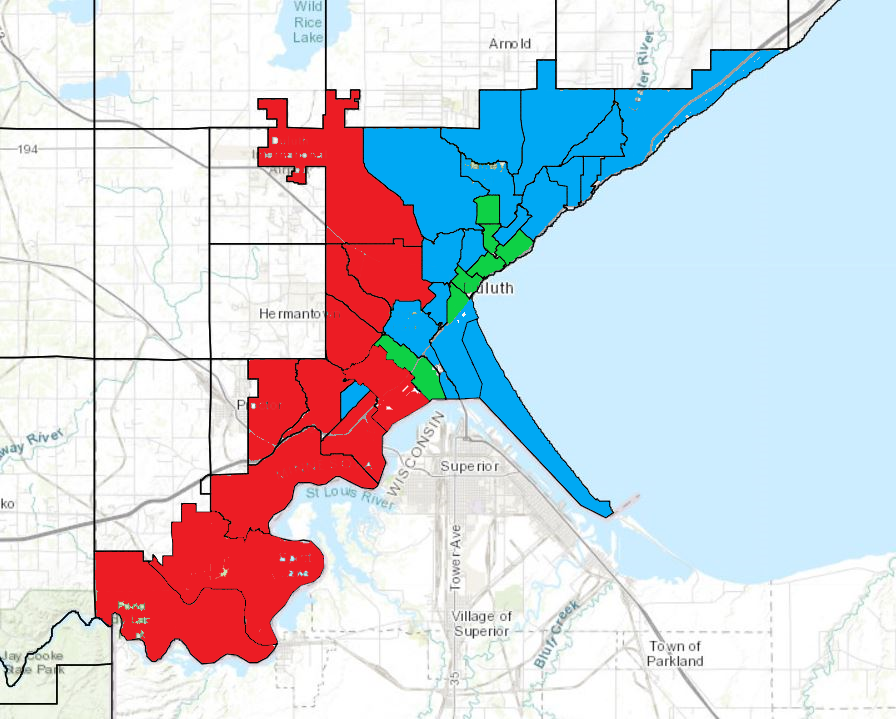
The most interesting race (and the only one worthy of mapping) was the competition for the two open at-large seats, which became a three-way race when one of the people who advanced from the primary, Tim Meyer, withdrew from the race. (He still got over 1,000 votes. Not a bad showing, really.) Here, things broke as one might expect in a three-way race: the center-left figure nearest the center of Duluth politics, Terese Tomanek, coasted to victory. Like many winning coalitions in citywide politics, the east side was her base of support. Azrin Awal, meanwhile, was fueled by a strong personal story and DFL institutional power in a DFL city. She ran comfortably into the second seat despite winning only a handful of precincts around UMD and on the lower East Hillside, in neighborhoods often dominated by younger voters. Further to the right, Joe Macor seemed to try to run with the Derek Medved playbook, but he is not the singular figure Medved was two years ago when he ran up unprecedented margins in west side precincts. He still won much of the west side, but finished in a firm third place, and is now 0-for-2 in local elections. We’ll see if the Duluth right finds a new standard-bearer after this inability to break through.

2021 at-large race. Blue: Terese Tomanek; Red: Joe Macor; Green: Azrin Awal

This map is, somehow, nearly a carbon copy of the one from two years ago. Tomanek won pretty much every precinct that Arik Forsman won in 2019, plus the two that Noah Hobbs carried. All of the seats that Awal won were won by Mayou in his losing campaign two years ago. And Macor’s map pretty much maps on to Medved’s. The exceptions: Tomanek won two additional precincts, including 29 in the Denfeld area (won by Medved in 2019) and 15 on the upper hillside (won by Mayou), while Macor won one (23 in the upper Heights) that Forsman won in 2021. But yet, despite basically the same map, the actual results are very different, with the rightward-leaning figure dropping from first to a somewhat distant third, the center-left figure rising from second to first, and the leftward figure going from fourth to second. It goes to show what a unicorn Medved was, and also how a race with only two left-ish candidates (instead of the three in 2019) is pretty much a foregone conclusion.

Functionally, I’m not sure this changes things dramatically. Replacing the retiring Zack Filopovich with Awal does move things leftward; her successful and money-flush campaign showed how the DFL has gravitated that way, which is a statewide and national trend, and will certainly be a factor in coming elections. On the flip side, the firmly progressive bloc of the council no longer has Sipress as its commanding presence, and it will be interesting to see how the newcomers, Mayou and Awal, position themselves vis-a-vis figures like Mayor Larson or even councilor Janet Kennedy, who are no one’s real idea of moderates but also not exactly in lockstep with progressive movement politics, either. The center of the council is blurrier than it has been in recent years, which opens up some interesting potential arrangements and makes being able to whip the votes a valuable skill. The mayor herself also has a looming decision on a run at a potential third term, and we also await the results of a redistricting process, which is unlikely to bring major change but could alter some things at the margins. There will be no shortage of intrigue in the coming years.