Onward and Upward

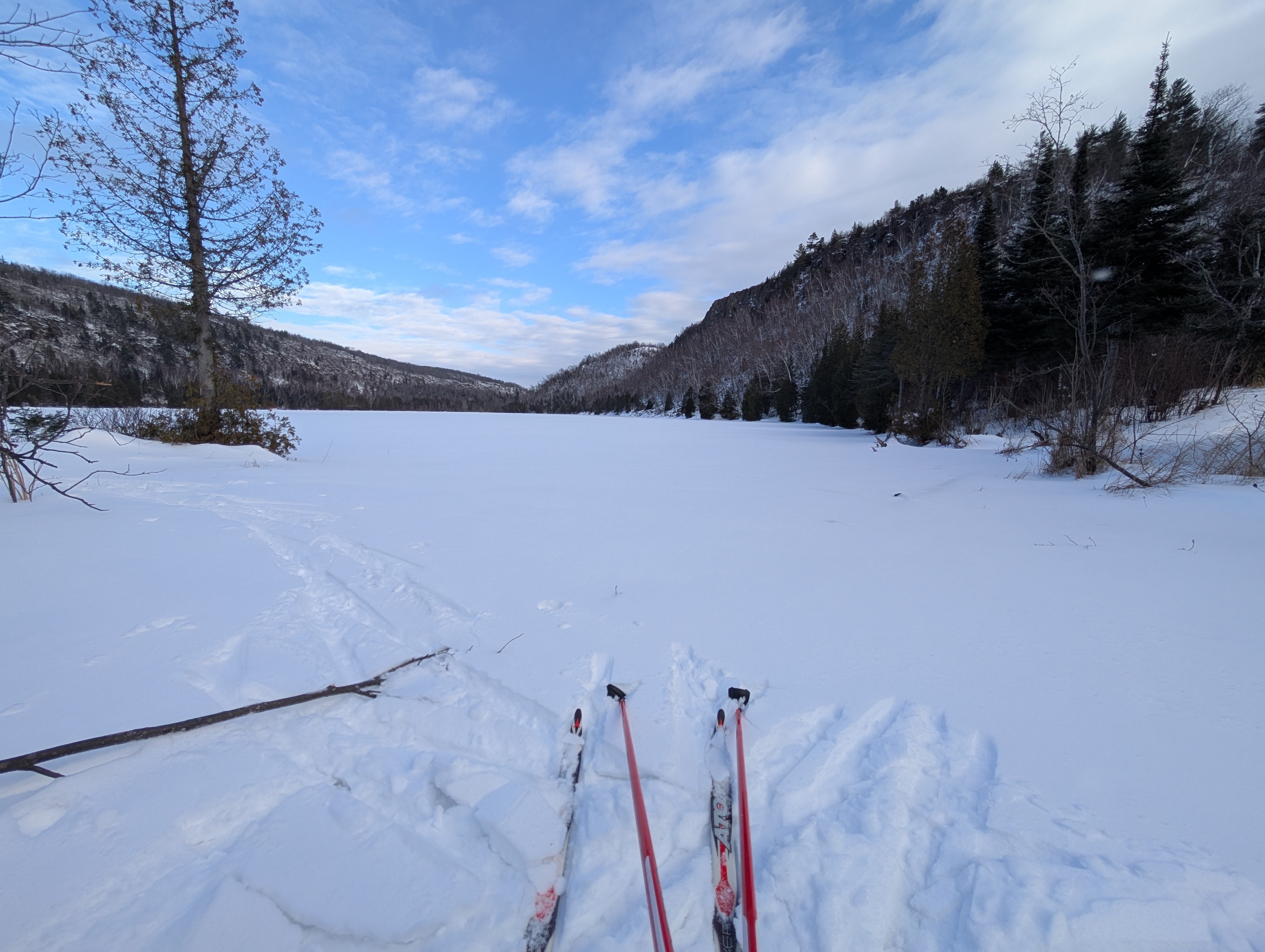
At the end of December I often write some words on what the past year has meant, or what I might be aspiring to in the coming year. But over the weekend, when asked about 2025 goals on a stroll down icy trails in Banning State Park, I struggled to articulate much other than to say I should keep doing what I have been doing. That, I suppose, is a good sign.

Two pieces I have written the past year on here explain my equanimity. The first was the 2023 year-end reflection on harbour minds. I continued that push outward even further this year, became a literal pilgrim and knocked out another continent, enjoyed living this way and the questions it posed. Over the past several years regular journeying has become a part of who I am, and that will continue into the foreseeable future. I am in many ways living as I mean to live, and generally making progress in the spaces where I am not. The 2023 post includes a lament about my lack of writing time, and while I was not dramatically better in 2024, I did carve out an escape to kick off a project. The second notable piece, on my San Diego retreat in November, both announced some writing ambitions and reflected a certain comfort with self that made that project possible. If I were to choose a Joan Didion essay that describes this shift (because of course I would), it would be “On Self-Respect.” To whit: “To have that sense of one’s intrinsic worth which constitutes self-respect is potentially to have everything: the ability to discriminate, to love and to remain indifferent.” People who have it “are willing to invest something of themselves; they may not play at all, but when they do play, they know the odds.”

I will have some things to post in the coming weeks. I’ve been noodling on one little piece for a bit now. I also feel some responsibility to comment on the state of Duluth East hockey at some point in the next month, though I am afraid that this year that task feels more like an obligatory tending of a flame until it can burn brighter again in the future. Other bursts of inspiration may come, as they sporadically do. But more than anything I want to focus on the project I set for myself in San Diego. The holiday season has predictably been a hard time to do any of that, and I need to be more intentional about slipping it in between hockey games and such. It is time to write a bit but mostly a time to edit, and then to look for brutal, honest feedback and likely deal with rejection, because that is how this game goes. But I am at a point where I can handle that now.

And so I hope I can get to work. Thanks for being a part of the journey.

The Harbour Mind

The rush from Thanksgiving to Christmas has been its usual series of frenetic weeks, twice to Chicago and once to DC and twice consumed by hockey. It is only Christmas weekend that I finally have time to pause, a reversion to a few days of quiet family time and remote work, a peaceful time only once I look past this embarrassing excuse for a Duluth winter and shrug off the unwelcome reminder of Covid pandemic solitude in the work week that follows. Most people are off but I plug away, either in an empty office or an empty house, no ski trails to escape to, just driving rain outside, achieving in bursts before lapsing into boredom. This inaction suits me less and less as I age.

I manage to finish the one book I set out to read over this month, Adam Nicholson’s How to Be: Life Lessons from the Early Greeks. It traces the emergence of philosophy with the emergence of the trading city-states of ancient Greece, from the god-determined fates of the heroes of the Iliad through Odysseus’ radical agency, from the first interrogations of existence in Miletus to the sense of self emerging in Sappho and her contemporaries in the Aegean basin. Symposiums take place; leisure and thought intertwine. Life emerges as a fire in Heraclitus, an eternal soul in Pythagoras and the Orphic cult, a single reality in Parmenides before Empedocles unites it all, these final thinkers acting as forerunners to Plato and Aristotle, the foundations for basically all Western thought since.

How to Be is more than just pop philosophy, though: it weaves in a journey to the cities that formed these early thinkers. Nicholson wanders these acropolises atop harbors, the temples built to gods who match the questions of their particular age: Athena as city-states form, Demeter as they grow to flourish, Aphrodite as questions of love grow more profound, Persephone as thinkers dig deeper into the meaning of eternity. He parses the relics they have left behind to show how these communities were interconnected with their neighbors, how ideas born on the Aegean coast of Turkey interacted with Ionian Ithaca or colonial Sicily and beyond. All of this flourishing thought, he contends, is the result of a “harbour mind,” a life of commerce and exploration and incipient leisure that was fundamental to making the Greeks the thinkers they were.

These past two years have been a time of deep harbour mind, with many mundane days at sea broken by arrivals in thrilling ports. In 2023 I found literal harbors on a trip up the California coast and an unforgettable family venture to the Mediterranean, and metaphorical ones in treks near and far and as I pushed my body further and relished the results. I also found harbors in times of grief, this sense never more immediate than this past February, and though that scar is still raw it is also a reminder of just what kind of a harbor I can build, both for myself and for other people. It is a strange feeling, to be supremely self-assured in grief; one that requires delicate words to avoid sounding callous. But as I sat through my cousin’s funeral I found myself not burdened by agony but instead consumed by a fire I’d known was there but only rarely let out. It was a fire I tended numerous times in the following months, through late-night euchre vigils and over beers at hockey games, on a wind-blasted deck on a rocking cruise ship and on the slopes of Cloud Peak, on the dance floor at weddings until the last song played and all my muscles ached, only then believing my work was done. These are the moments I feel most myself.

In between the surges I do not lead a bad existence, and I have no trouble listing off the ways in which life has improved in the span since I started this burst outward with a venture to the Virgin Islands deep in the pandemic. But the mundane everydayness gnaws at me, and while it has its small triumphs and defeats, it never brings major change. When I do have events worthy of words they are among the best I’ve ever written, but the act itself does not come often enough, and too often I go to bed without even consulting my writing, plagued by a nagging annoyance that I am not using my greatest gift to its fullest extent. For too long I have been too frozen in routines to unleash it, too frozen by convention or belief in how I had to be, lip service alone to the pursuit I preach.

I will always owe a deep debt to the Greeks. They have framed my life over the past decade-plus now, a necessary port on a stormy sea, and I will never forget that debt, will someday go to pay homage at the sites Nicholson visits, when the time is right. (The time is not yet right. I will know when it is.) The Greeks’ basic insights still form the channel in which I sail. But this holiday season, I find myself drawn to the burning paradoxes of Heraclitus and the love inherent in Empedocles, fueled by that radical turn, and reach once again for Hannah Arendt’s verdict on Greek thought at the end of her chapter on Action in The Human Condition, something I saw in a snippet atop Zion last spring but did not fully process:

The miracle that saves the world, the realm of human affairs, from its normal, “natural” ruin is ultimately the fact of natality, in which the faculty of action is ontologically rooted. It is, in other words, the birth of new men and the new beginning, the action they are capable of by virtue of being born. Only the full experience of this capacity can bestow upon human affairs faith and hope, those two essential characteristics of human existence which Greek antiquity ignored all together, discounting the keeping of faith as a very uncommon and not too important virtue and counting hope among the evils of illusion in Pandora’s box. It is this faith in and hope for the world that found perhaps its most glorious and most succinct expression in the few words with which the Gospels announced their “glad tidings”: “A child has been born unto us.”

If human action is founded on reason and faith, on Athens and Jerusalem, it is time to grapple with Jerusalem again. This is hardly some announcement of bold conversion or spiritual quest; it is merely an acknowledgment of another journey that awaits. In my year-end post last year I said I craved a Renaissance, and while a Renaissance means a rebirth of the Classical it is still rooted profoundly in a faith. In its most obvious form this will come as a pilgrimage, a concept I will grapple with as I head for Santiago de Compostela this April, to say nothing of a subsequent adventure to southern latitudes. The opportunity to rethink things is before me.

I look ahead to the deeper truth-seeking afforded by this sabbatical of sorts in spring, but the true process must begin now, the harbour mind unleashed. It is time to set sail, whether on steely Superior or on the South Atlantic, and find faith in daily routines yet again. Maybe this will lead me to change my life in more significant ways than I have in recent years; maybe it will instead be a stripping away of false desires and a focus on a simpler core that is already right in front of me. But I am ready for a journey once again.

Making it Count

On a night in late March I mummified myself in every garment I had. Ice pellets pelted my tent, whose central pole was held up only by an elaborate pile of rocks nervously heaped along its base. I was miles from the nearest human, and a cruel wind ripped across the exposed ridgetop where I’d made my home. My sleeping bag liner was in the trunk of a car some twelve miles off, and any extra water would have to come from melted snow. I was exhilarated, never more alive and yet still able to settle into some just-warm-enough restfulness that would carry me through the night. At dawn, a glittering golden light burst over the mountains of southern Utah. I had reached Zion.

That night, and the reflections that built upon it over the remainder of that trip, have often been on my mind since. It was the culmination of a journey, or so I believed, that began in pandemic grit and then burst outward on a series of great adventures in 2021, from St. John to Montana, from New York to Tucson and various stops in between. My return to Zion was to be a final step up a Grand Staircase, a surge into a new layer of time in my life, to borrow my metaphor at the time. No more need for ventures like this, I proclaimed: I’d done what I’d set out to do, and now I could go all in back home, building the life I imagined.

On the surface, the next nine months went well enough. Yes, my work life was at times all-consuming and stressful, but I learned and I grew and I knew where I was going with it. I still went on some worthwhile ventures, from a college reunion to the peaks of Colorado. Perhaps most gratifyingly, out of loss, I found new pride in one half of my family history, and the joy with the other half continues. My Duluth networks, from politics to hockey and beyond, grew deeper, richer. And yet if you were to ask me how I was doing at nearly any point during this stretch, I would have almost never responded with joy or even self-satisfaction. I was drained, yearning for things I did not have, turning a Joan Didion quote from “Goodbye to All That” over and over in my mind: “It was in that year, my twenty-eighth, when I was discovering that not all of the promises would be kept, that some things are in fact irrevocable and that it had counted after all, every evasion and procrastination, every mistake, all of it.”

Perhaps I was lapsing into melodrama. My audiobook choice for my most recent drives across northeast Minnesota might provide some evidence here: Finding Everett Ruess details the story of a 1930s-era Into the Wild figure, a teenage boy who completed epic traverses of the American Southwest before he disappeared into the Escalante canyon country, never to be seen again. I have in me some of that romantic, wandering soul on some solitary transcendent quest, and while I count myself fortunate to be free of Ruess’s melancholy and any yearning for eternal escape, I can identify with those impulses to place oneself amid a grand narrative of destiny, driven by powerful feeling.

To make sense of that narrative I have tended to lean on classics and a web of metaphor. My loose outlook on the world, and perhaps my staid reserve that keeps me from any emotional overdrive, comes from Aristotle, who observed the world as it was and understood what was good in it in light of that reality. But a duality has always hovered, and it was no coincidence that, upon my decent from that ridge in Zion, I quoted Plato’s Symposium on true beauty, a true form of unsustainable yet ever-alluring perfection. I leaned deeper into that pursuit this year, as did several people around me, often with mixed results. I cannot regret it: paths were there to take, and we must nurture both Athens and Jerusalem, reason and faith twinned, and find them both. Living in the shadow of a modern-day Roman empire this can at times be hard to do, and it is in fiction (all tagged ‘Rome’ on this blog), that I have tried to sort it out. And as I do so I feel compelled to extend my metaphor: at the end of a murky middle age, it is now time for a Renaissance.

My artistic output this year has been less than I hoped for, a common writer’s lament. This blog has far fewer posts than in any year since its launch, and my fiction on the side is stillborn. And yet I am almost universally happy with what I did put out, a rare feat indeed, and am lately enjoying the mere act of writing as much as I ever have. I’ve supplemented this progress with a new toy: this post was written almost entirely on a reMarkable, a writing-only, paper-like tablet that has already proven an ally in a quest for focus. When there is focus I can write, and when I can write I can shape my fate, and from there I can thrive.

Nine months after Zion, as an even more vicious storm battered my home in Duluth, I was just as solitary, burrowing into my blankets with equal purpose, and rather less excited about the looming shoveling than I had been about the hike down out of the clouds. But the triumph of that night hovered in my mind, a warm glow that carried me to sleep as the wind howled around me and toppled a neighbor’s tree. Zion, it seemed, had not marked a firm layer in time—that will yet come—but it was very much a moment that did count, and I was proud it had.

So, as I begin my thirty-third year, I will look for more moments that count. Many of the old excuses no longer hold, and the opportunities to flourish through a Renaissance are all right there, perhaps as literally as can be, with Venice and Rome and Florence all on the calendar for this coming summer. As I complete another pause before tacking all my Duluth winter activities I find myself liberated from chic doomsaying, filed with gratitude, and ready to live more fully than ever.