The trope of the Midwestern kid heading to an East Coast seat of power has typically been one of innocence lost, of bright-eyed illusions dimmed by closed networks and sordid affairs. This story, saddled on succeeding generations of Midwestern boys heading east by F. Scott Fitzgerald, has a certain glamour. It is flattering to imagine oneself the wounded noble soul in a greater story, and wounded noble souls do not usually realize they are doing themselves no good until a few years have drifted by in aimless emoting.
One who has navigated this road with remarkable aplomb, however, is my Georgetown roommate Trent, whose wedding I attended in New Orleans this past weekend. Trent and I first came together in New South 205 as freshmen at Georgetown, two rare Hoyas who did not hail from large metropolitan areas and in the thralls of what Washington had to offer them. We were avid pursuers of the DC political scene and Hoya basketball loyalists, and while our social circles ebbed and flowed as he dove deeper into campus communities from the start than I did, we remained an ideal pairing, drama-free and easygoing. We lived together for all four years of our undergrad experience, New South to Copley to 3731 R Street, though we were abroad in Mexico in opposite semesters of our junior years. By senior year our house, with Phil and Tim added to the mix, crystallized into a cohesive unit.
The journeys since have been long. Trent left DC after graduation, first to teach in Houston and then on to NOLA, where his new wife, Kelly, attended medical school at Tulane. No doubt there have been moments of trouble and deep frustration, especially in those Teach for America years, a crucible that formed many of my Georgetown friends. But for no one did it show outwardly less than for Trent. In the hours before he tied the knot, a group of us sat in his hotel suite and shared stories of Midwest childhoods and Georgetown escapades and teaching travails, and there was no trouble believing these tales all wove their way through the same guy who sat before us. At the core, nothing has changed a bit.

Trent retains a slight Ohio twang, even as he travels higher in professional circles and eyes an impending return to DC. He is relentlessly competent and organized but stays preternaturally upbeat, his work rate nonstop but still grounded in the people around him, whatever their station. It was no secret where those lines about social justice in the prayer of the faithful during the ceremony came from, and he has the art of making such lines feel heartfelt. He has perfected the blend of roots and ambition that has always been my ideal, and he has the magnetic personality to make it all work. And in the meantime, he will have a lot of fun.
I will save a longer discourse on New Orleans for a second visit in May, but this venture was a dive into Trent’s life in the city. And, of course, no trip to the Crescent City can be complete without eating up the rich local culture and the nonstop revelry that make it unlike any other American city. Friday night takes us to the Mid City Yacht Club, a local joint with no pretentions of hosting people who enjoy yachting, tucked in among classic NOLA houses and across from a well-lit ballfield in the neighborhood where Trent and Kelly live. I’d assumed the name was ironic.
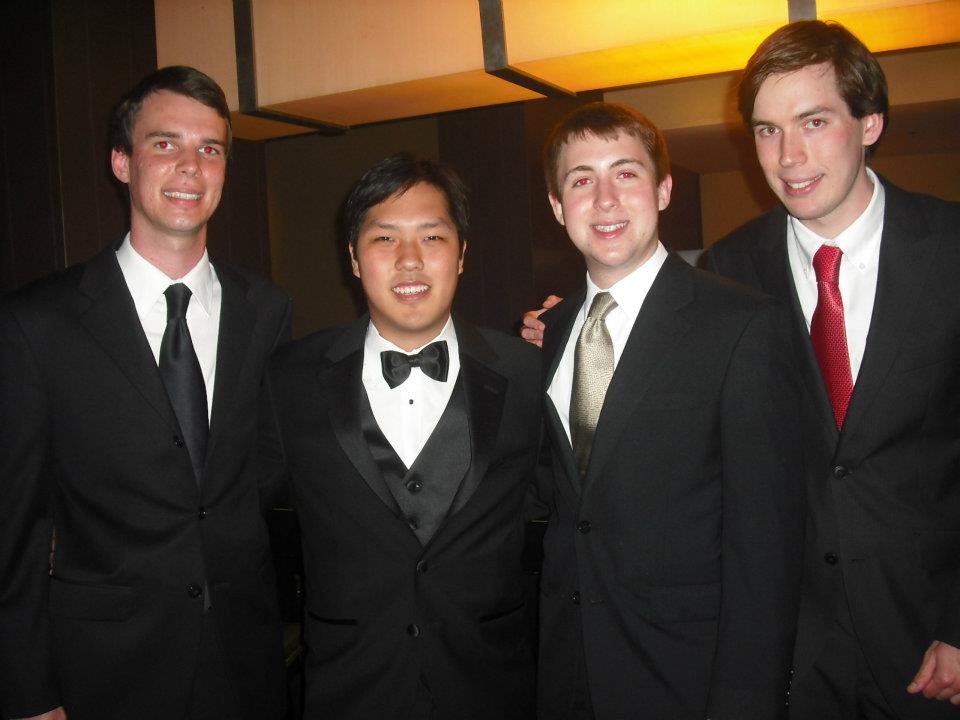
The rookie Jesuit presiding over the ceremony, however, tells us the truth: during Katrina this little bar, flooded along with the rest of the neighborhood, acquired the moniker in jest, and a few friends nursed it back, rebuilding it from the detritus of the hurricane. In the homily, the mention of the Yacht Club was a metaphor for love and commitment, but it was also a simple summation of Trent: there for the party often enough to be a regular, but using that tie to make a deeper connection and lift up a story of triumph and rebirth. Trent brings together great people, two new friends and I observe as we stroll up Canal Street toward the church with our roadie martinis in plastic cups.
Since this is a Hoya wedding, the ceremony takes place in a Jesuit church tucked just west of the French Quarter, its grandeur shadowed by the towers around it but resplendent in the Company of Jesus’ quest for the Greater Glory of God on the inside. It is as snappy a Catholic ceremony as one will hear, with no communion to separate out the devout from the apostates, and in time we bus over to the Ogden Museum of Southern Art for the reception. Beneath a cavernous ceiling we mill around and eat a steady stream of hors d’oeuvres, with no formal dining time or seating chart and only the briefest of wedding speeches. The party must go on—unless one goes on the bathroom odyssey, down a staircase and through a gallery and up an elevator past some distracting sensory art.

The DJ lords over the hall at one end, and while the dance floor takes some time to warm up, it eventually explodes with light and flashy light sticks for everyone, and we after we have all swayed in a circle as the lights come up the brass band marches in and the second line begins. We parade down the streets of NOLA, Trent and Kelly waving parasols in front of the procession, the band right behind and the rest of us in tow, waving towels and dancing along, the less mobile of our number rolling along in rickshaws. We are the attraction, filmed by passersby and watched from those classic wrought iron balconies above, and in time we get one of our own atop a bar near the hotels. The good times do indeed roll, onward late into a cool New Orleans night, though a dream of brunch looms in the morning. Even if New Orleans is not in Trent and Kelly’s longer-term plans, it is the ideal city for a group of friends to come together, dispense with the dithering, and commit to making the most of a moment.
On a personal note, Trent’s wedding is an appetizer for what I am calling my sabbatical, a stretch in which I will be away from Duluth for five of six weeks. This stretch starts and ends in New Orleans, with Europe and South America sandwiched in between. It seems right to start it with the people with whom I set out into the adult world, though they will reappear in it on an estancia outside Buenos Aires. If I am going to take a radical break from my day-to-day routines, who better to be with than the people who most revel in this life?
 A Patient Cycle