A Landscape of Yearning

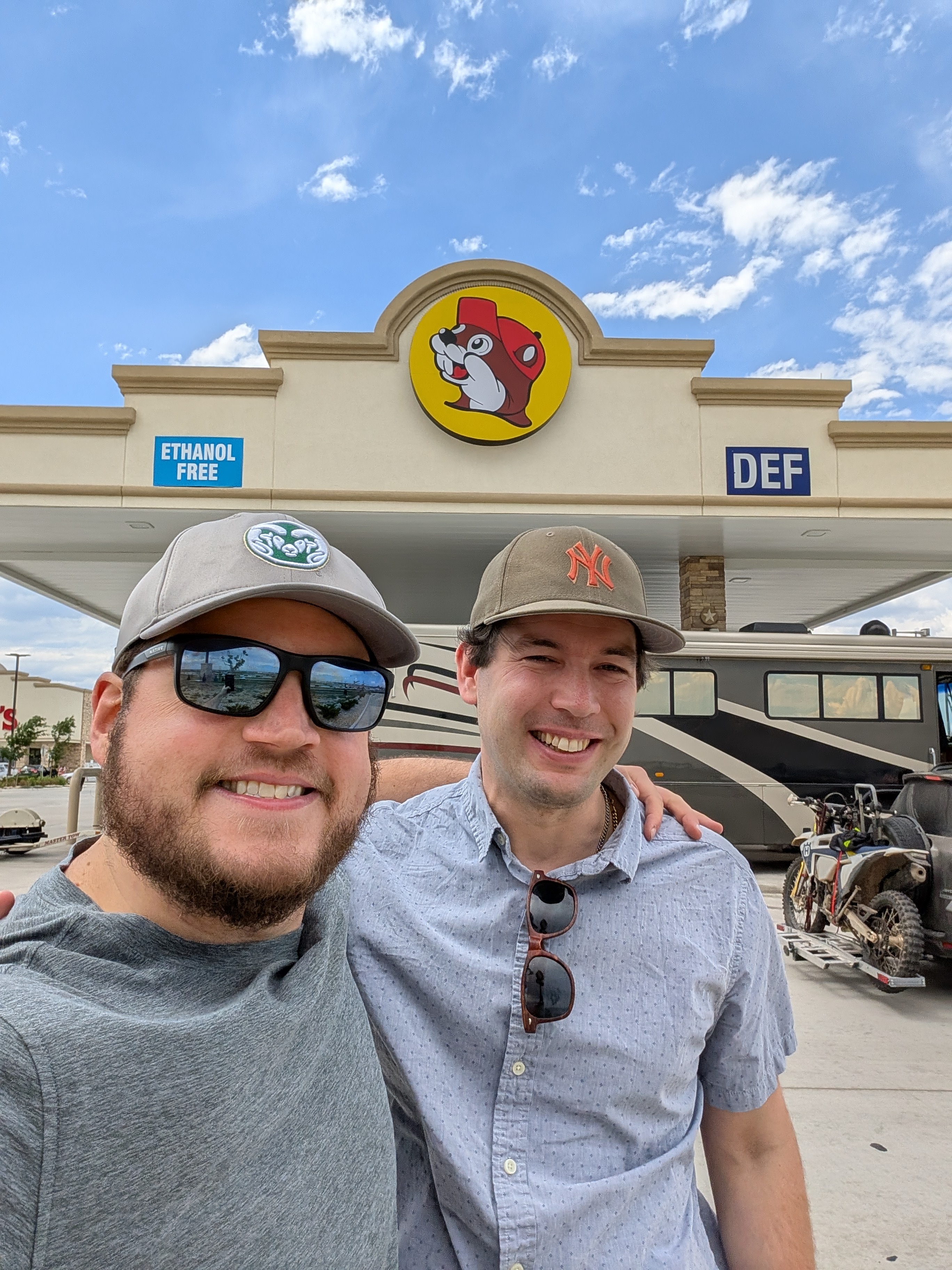
Last year I wrote that I go west for new beginnings, but this year’s trip starts with a blast from the past. I start my annual venture with a diversion away from my hiking crew’s rendezvous point in Denver and head to Fort Collins, Colorado. This Front Range college town exceeds all expectation with its verdant core, a green grid with a pedestrian mall and college bars and teeming life. A good guide helps, of course: in this case it is Joe, one of my oldest friends, a connection sustained since second grade. He gives me and a few of his friends a behind-the-scenes private tour of New Belgium, a leisurely three-hour affair that goes deeper than any other brewery visit I’ve done. The night carries on from there into the morning, dinner and drinks and debate and a blending of worlds would never have otherwise mixed. And yet it is as if we have not missed any time, our interests evolving on parallel tracks into the political world and urban planning and good beer too. This is a deep cut at a time of deep feeling, one in which words do not always come easily to me as feelings surge and demand examination, but a certainty in the paths I trod only grows.

As kids, Joe and I bonded over the Civilization computer game franchise, a fond memory for several people in our Fort Collins dinner party. That game had a certain influence on my way of being: a desire to build worlds, to advance a society toward greater glory, and perhaps to leave the Babylonians in smoldering ruins. But the game has to stop here and there, and it is time for my annual escape from civilization with my usual backpacking crew, a ritual renewed.
The venture gets off to an inauspicious start. Ed, a stalwart member of our party, injures himself on the drive west and has to abandon the trip. Our planned acclimation day-hike at the Black Canyon of the Gunnison goes up in flames as a wildfire shuts down that national park. We plan to start our official hike on the Bear Creek Trail just south of Ouray, but trail maintenance has closed that, too. As we pull up to the Middle Fork trailhead instead, signage warns us that several hikers have been attacked by sheepdogs, including one party just nine days before we set out. But the show must go on. Amy, Bob, Rob, and I head for the Uncompahgre Wilderness in the San Juan Mountains, an escape even many Coloradans do not know. This, I say, is kind of the point.

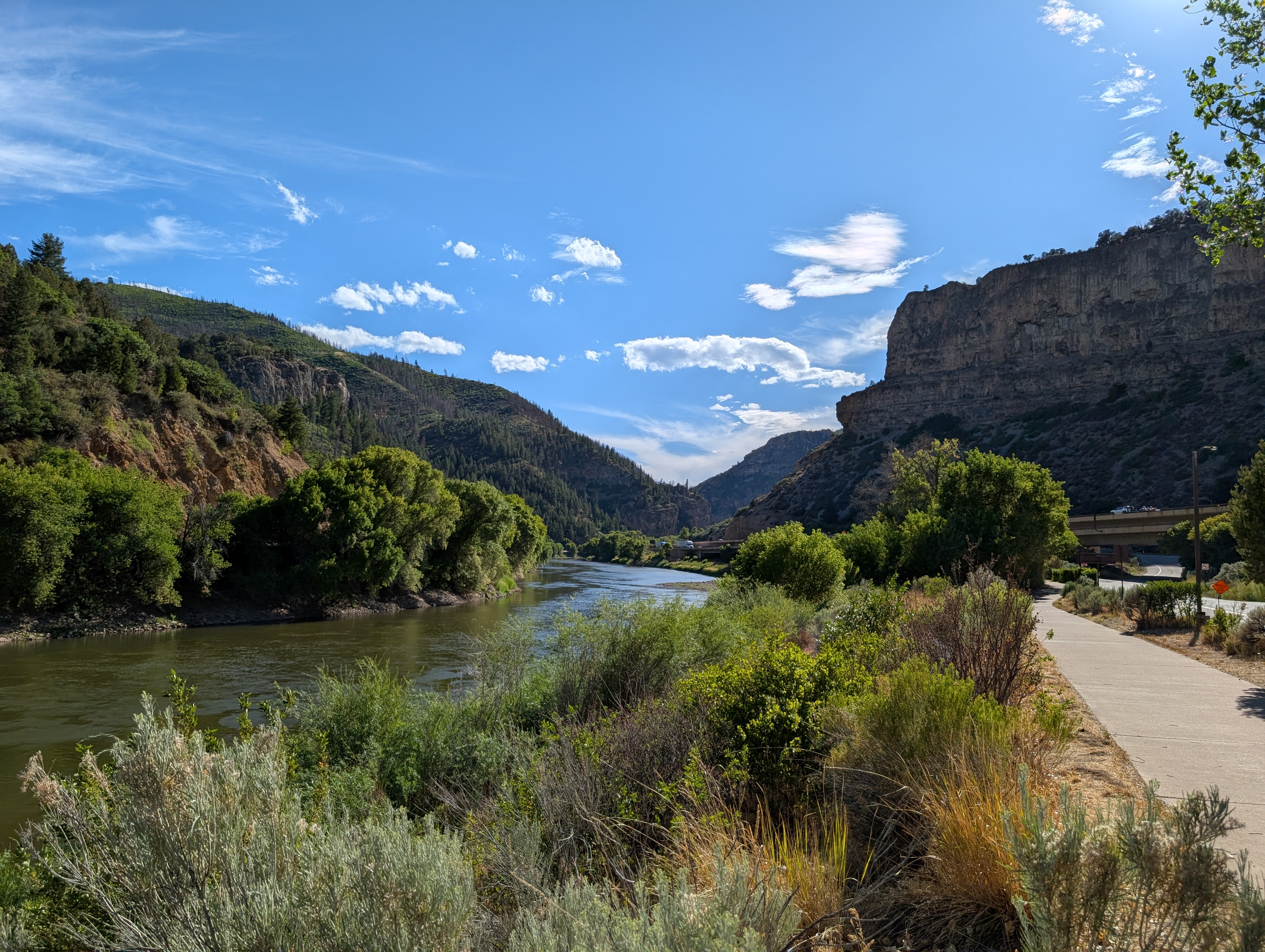
West of Denver, I-70 is the scenic showpiece of the interstate highway system. I have memories etched in amber of an Amtrak venture down this corridor at age fourteen: gazing out the observation car through Glenwood Canyon, the divinity of a Palisade peach. Somewhere on these stretches, beyond the Front Range traffic and the most extreme grades at Loveland and Vail Passes, I find my western release. We cruise down an austere river valley where dusty towns watch the world fly by, a simultaneous invitation offered and challenge posed by a landscape of yearning. It calls forth, speaks of more to find. Its treasures draws in seekers, from 19th century gold to today’s powdery slopes, from conquest of fourteeners to backcountry solitude. The Western Slope is far from the cradle of familiar northern Minnesota woods, not a safe harbor but land that won’t ever quite be so well charted and is all the better for it.

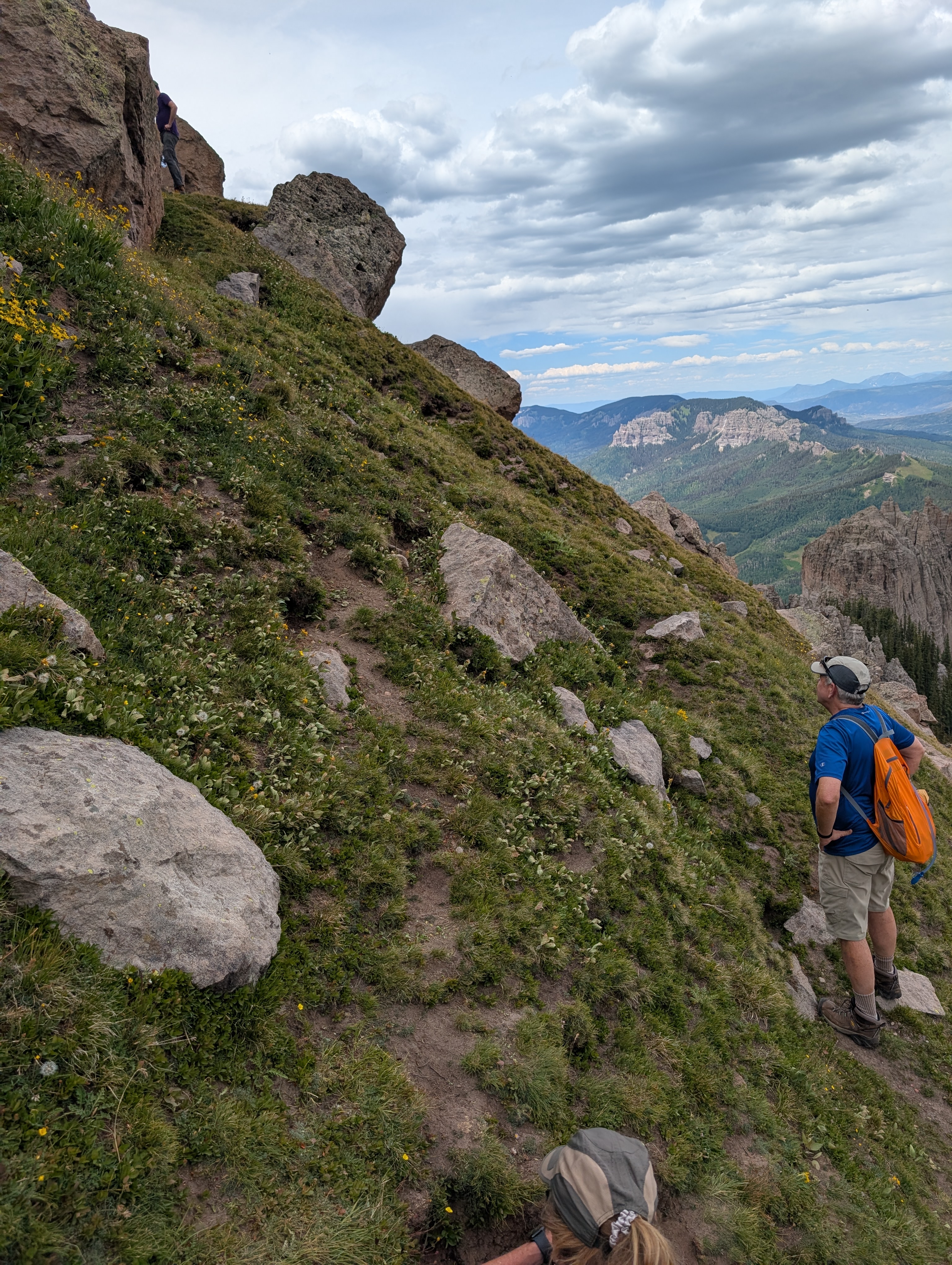
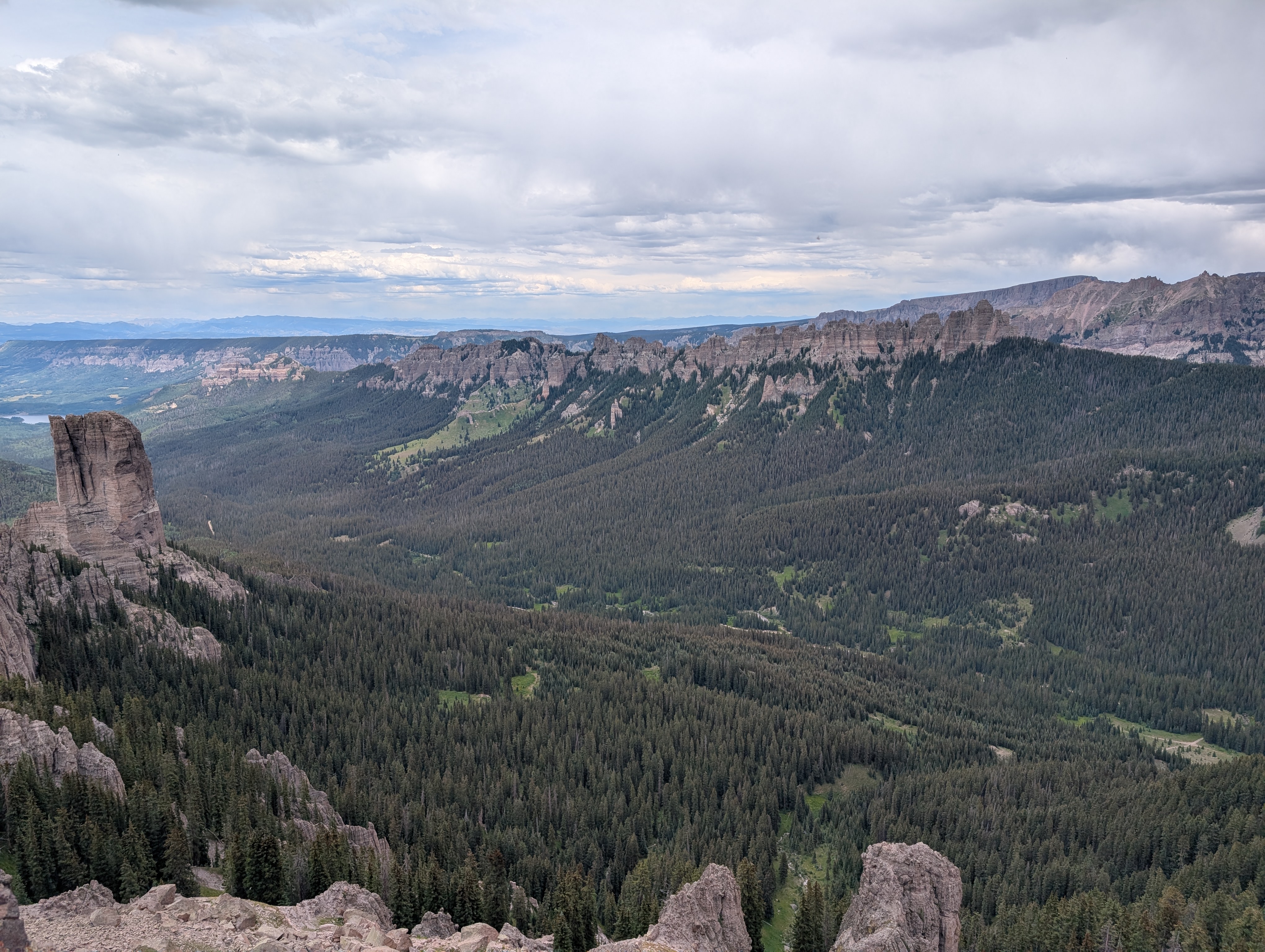
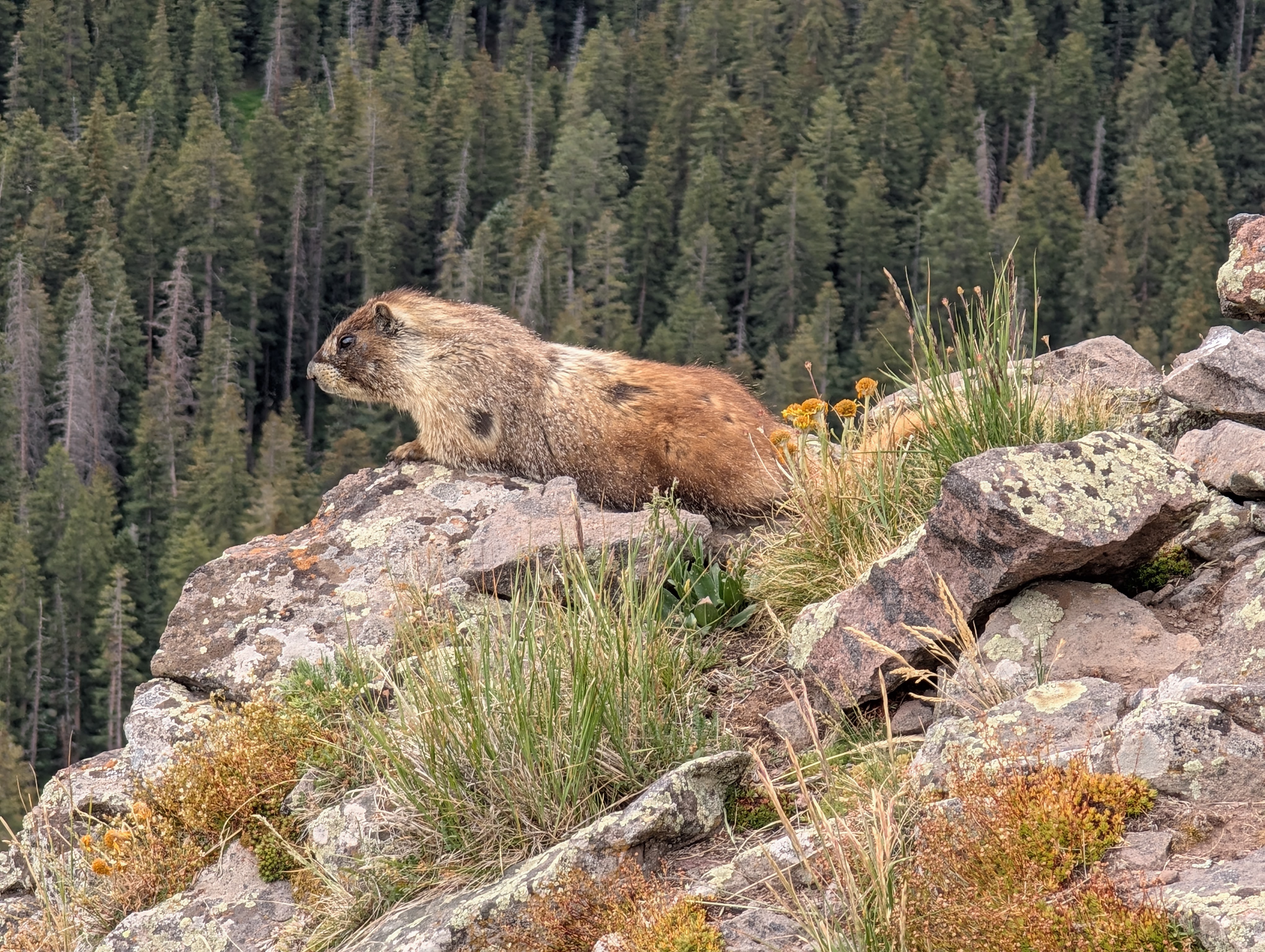
The alpenglow over the Uncompahgre beckons as we swing south from Grand Junction for a night in Montrose. We summit Courthouse Peak for a warmup hike and scramble, gaze down on the field where John Wayne finished off some bad guys in the original True Grit, and enjoy the company of a fat marmot on top. We spend the next night in Ouray, a vein of gold tucked between red cliffs along the Uncompahgre River, its sloping Main Street in classic Colorado style leading up toward the Million Dollar Highway to Silverton. Here we enjoy one of our best pre-trail meals ever at Brickhouse 737, though my pasta with rabbit cannot compete with the eight-year-old at the next table who orders the hibachi smores and roasts his marshmallows over a small flame. We pack in record time in a cozy motel beside the rushing river, breathing easier after a few days at elevation. It’s time to enter the wilderness.
Oftentimes on these trips the first day is a plod to get to nicer things, but in the Uncompahgre, the beauty is immediate. The valley of the Middle Fork of the Cimmaron River, one of three long tines cutting into the northern side of the wilderness, is just wide enough to show its ramparts, a jumble of jagged peaks reaching skyward. We camp the first night atop a meeting of rushing streams, with views up the bowl to the south and down the Fork to the north. The sun bathes the valley in gold as it sets, and a faint crescent moon gives the night a touch of light. All is quiet, and I am where I want to be.

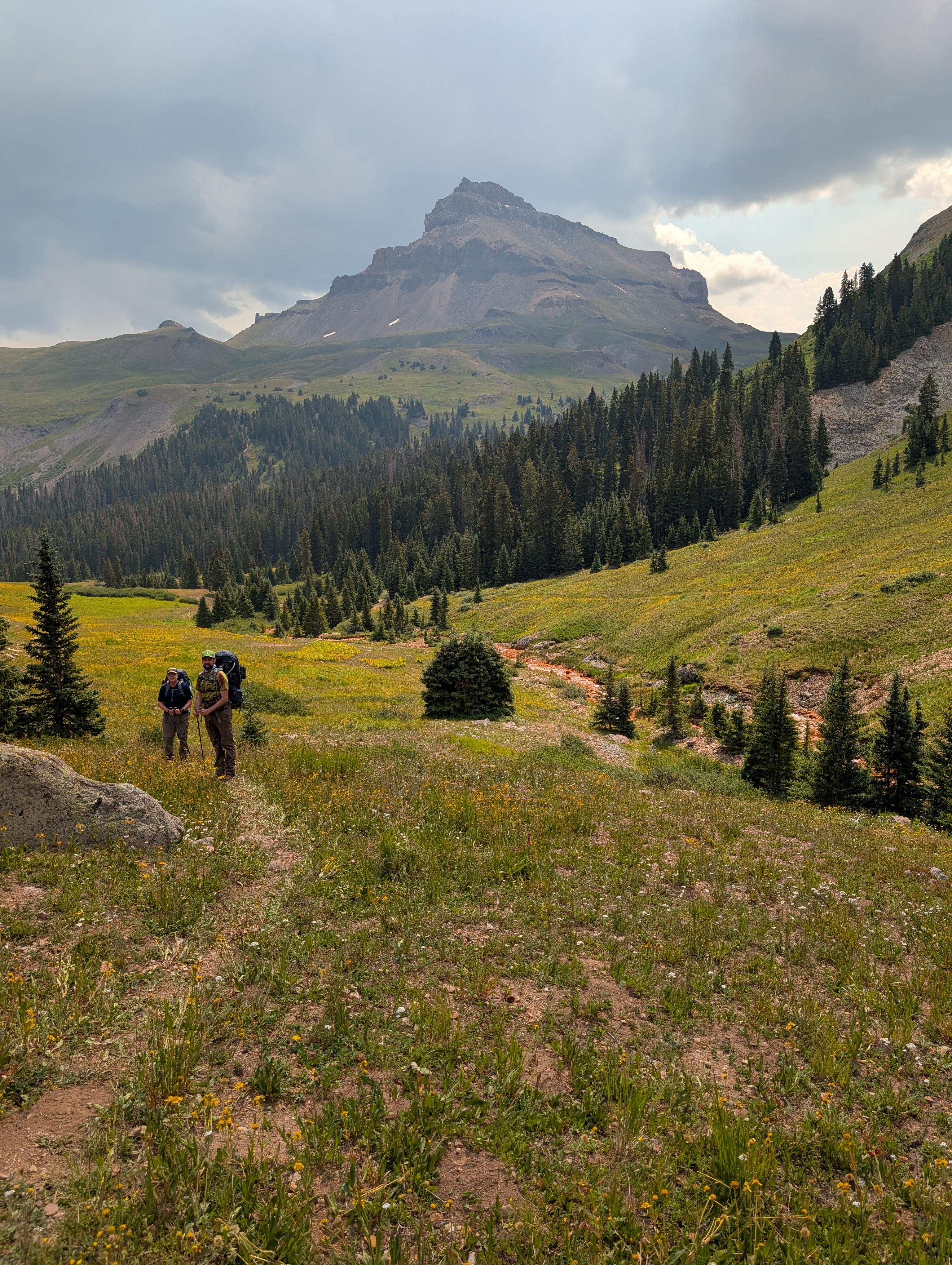
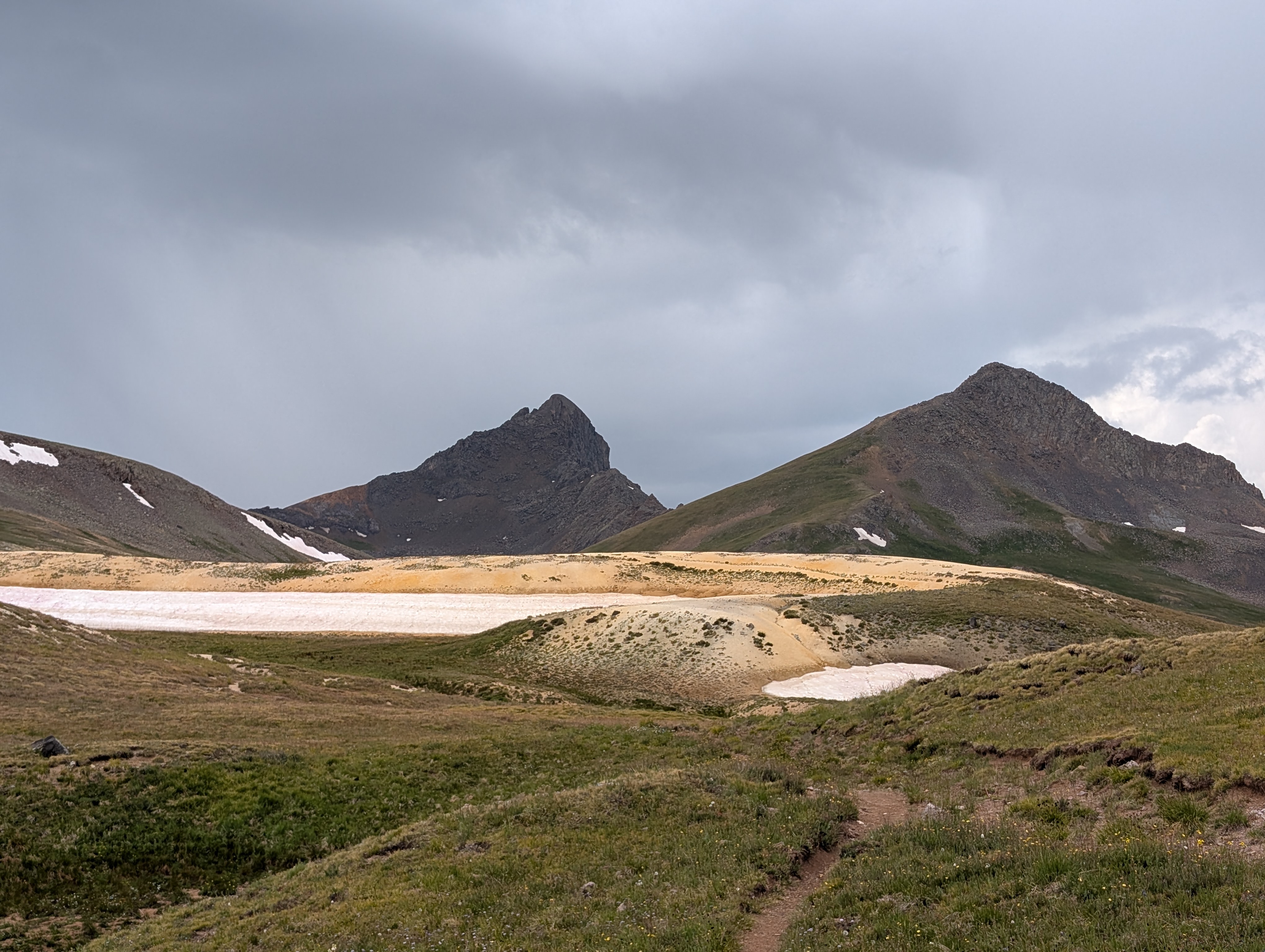
On day two we immediately climb 1,000 feet to a pass between the Middle and East Fork drainages. After we rise above the trees we are in an upward sloping glade of yellow flowers, and after a steady push we come over a pass that reveals the three greatest peaks at the heart of this wilderness: the striking Wetterhorn; the Matterhorn, reminiscent of its namesake Alp; and, to the east, a broad beast greater than all of them, Uncompahgre Peak. With eyes still turned upward at the giants around us we descend from the pass, ford an orange-tinted creek, and scramble up a lightly maintained shortcut trail to an eventual camp by some falls on the East Fork at the root of Uncompahgre. We are settled into camp before the afternoon storm rolls through.

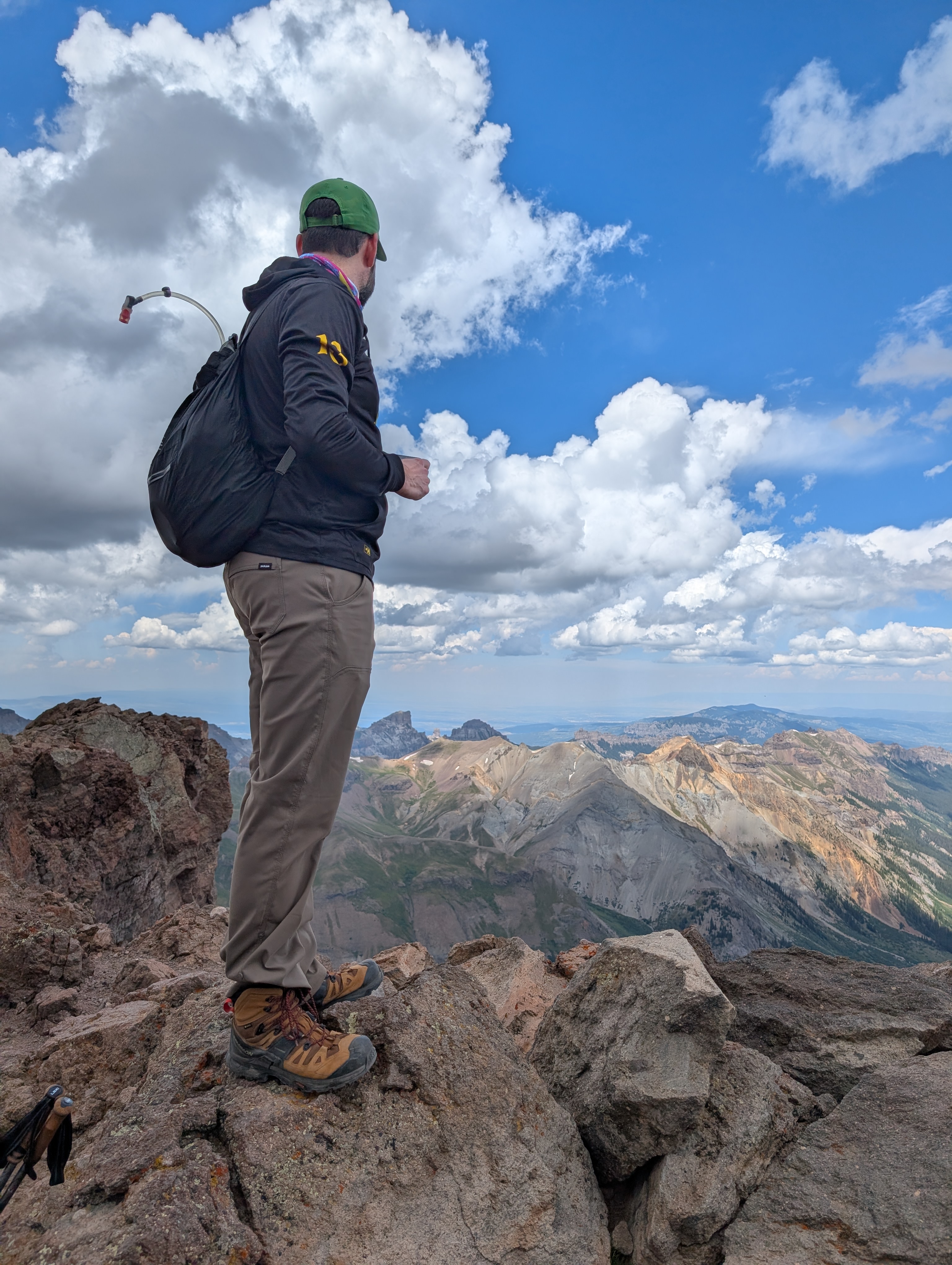
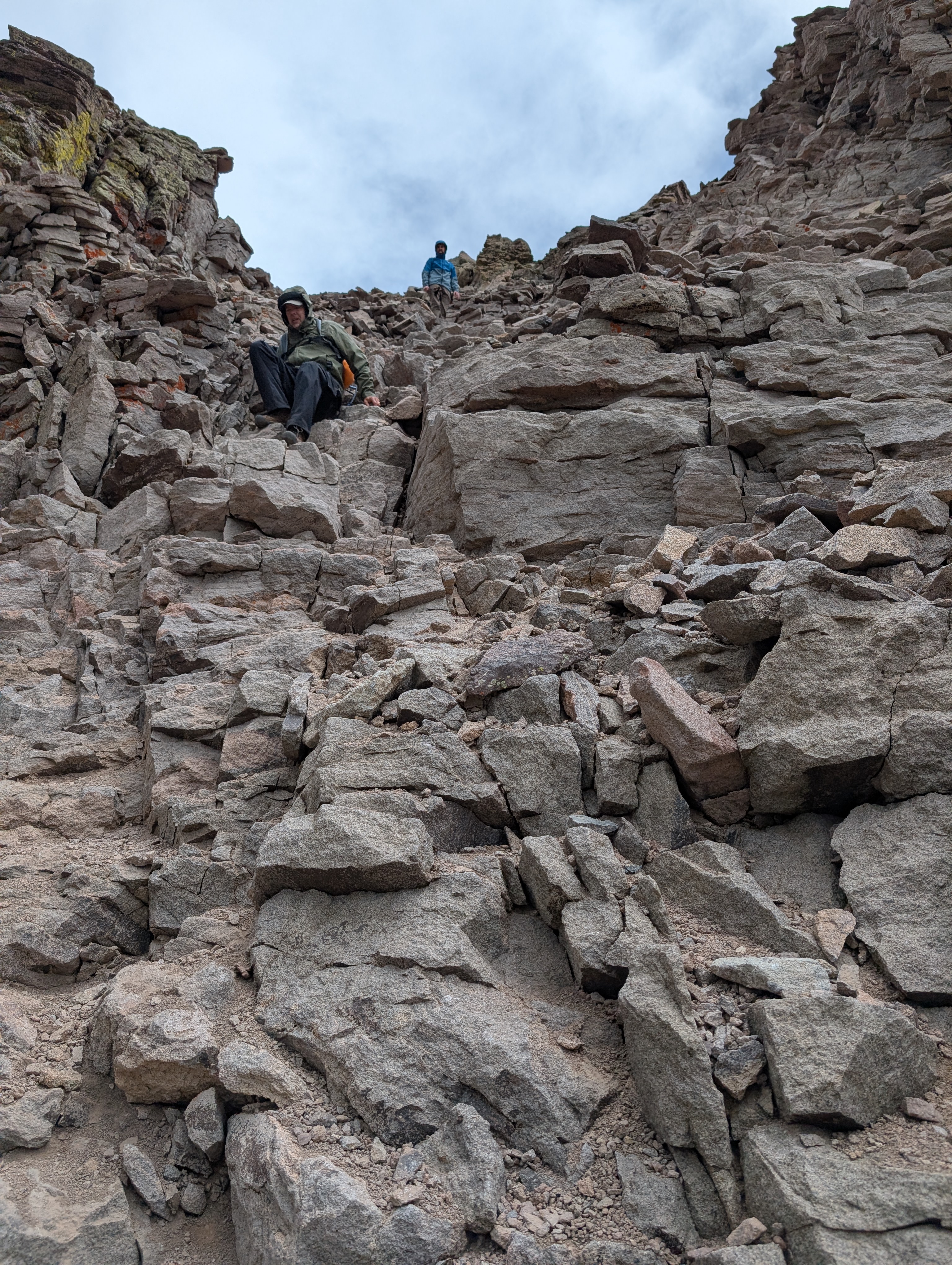
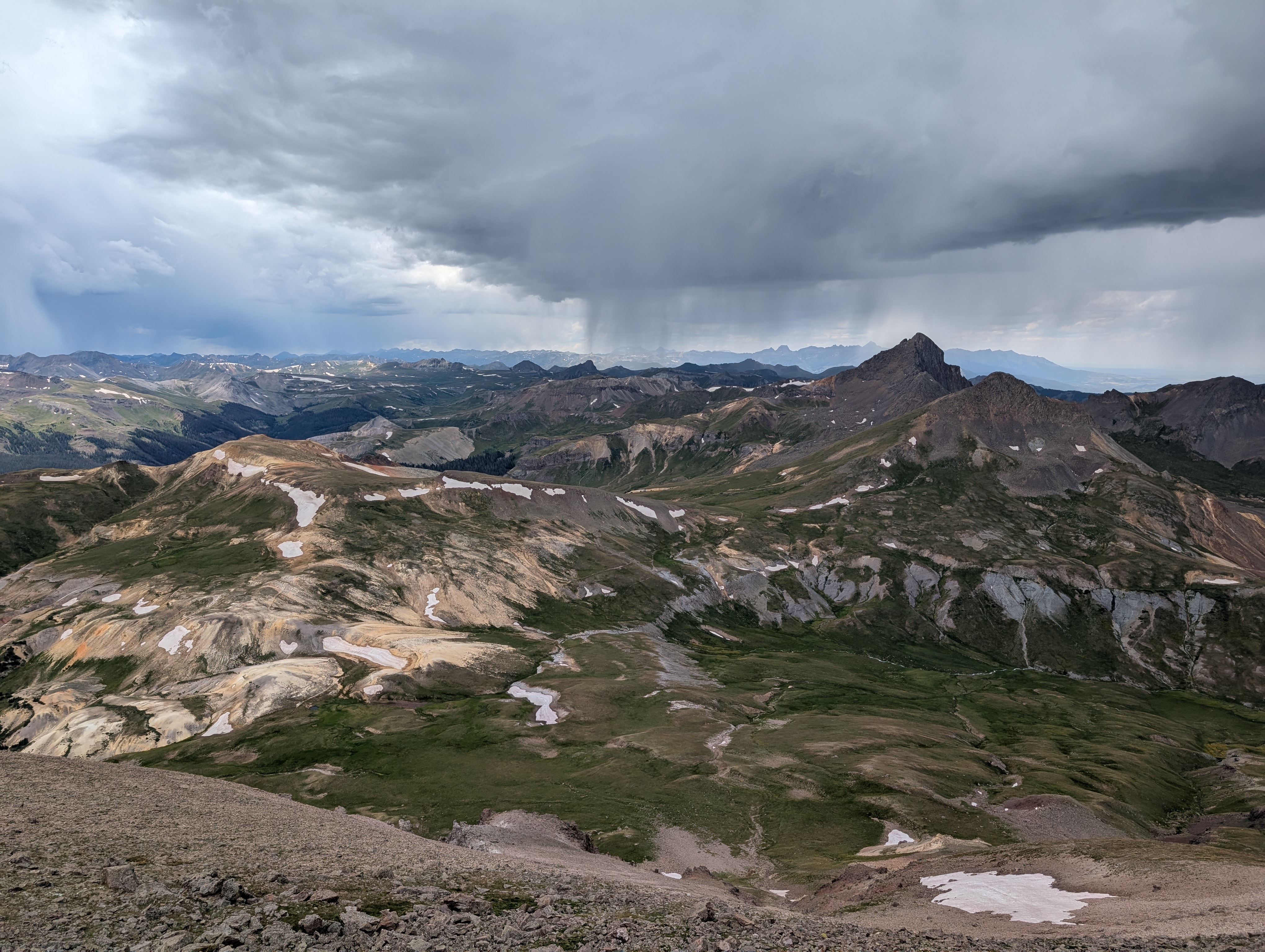
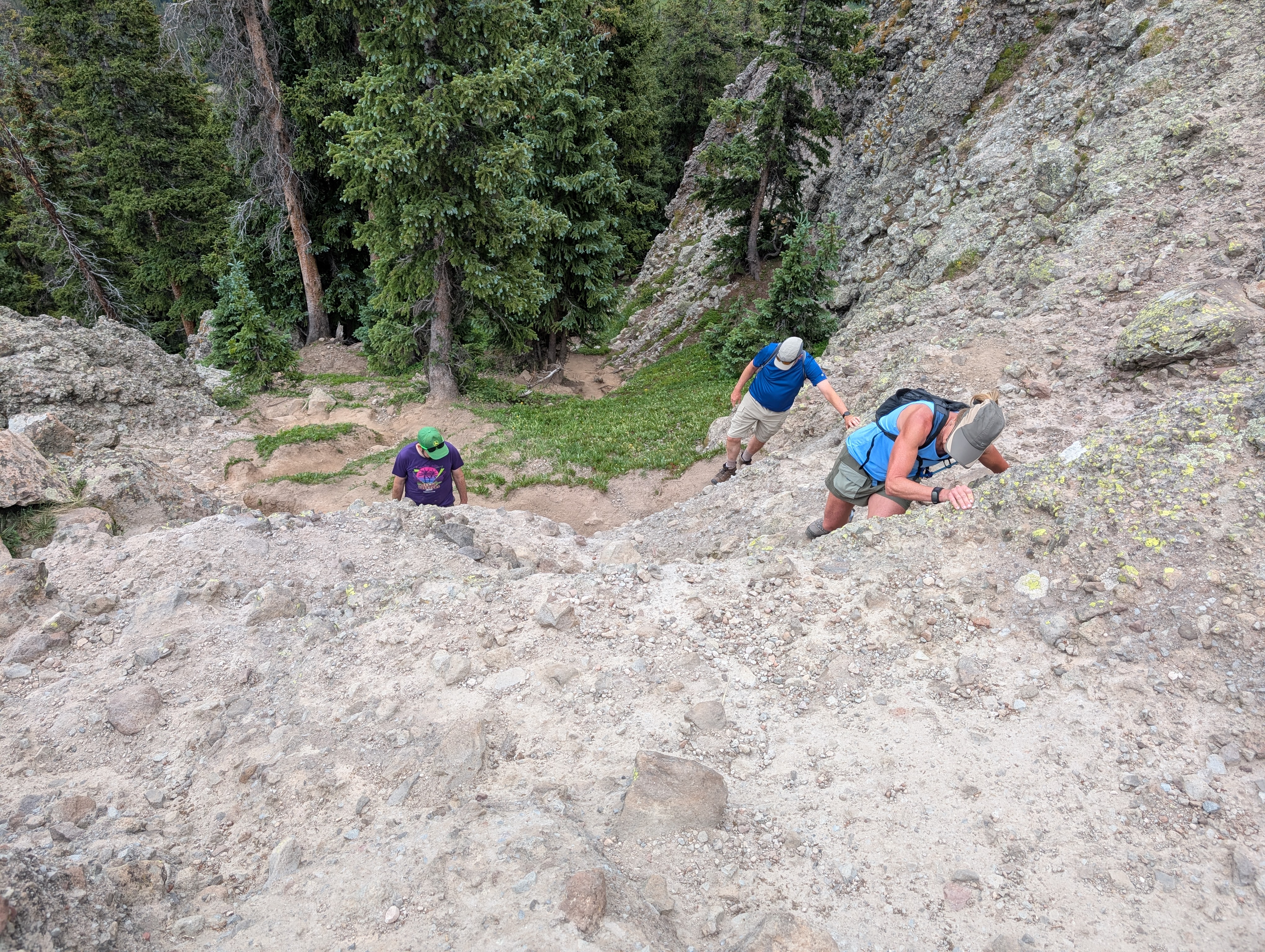
On day three, Bob, Rob, and I set out to bag Uncompahgre Peak. We climb along the creek, up through meadows of yellow and purple and white blooms, an open country trek upward as we circle the peak from northwest to southeast, where the main approach lies. Past the looming Matterhorn, up along sudden tan sands and lingering snow, on up the rolling green ramparts beneath the gothic cathedral spires and concave couloirs of Uncompahgre’s south face. A scramble up a harsh grade begets a long, steady ramp up past pikas and yet more flowers and ground set aside for endangered butterflies. Just shy of 14,000 feet, a wall requires some scrambling, but beyond that is a steady, limited-oxygen stroll to the top. From the summit we have a 360 panorama, sun here and storms there, our arrival just in time: distant thunder rumbles, Rob’s hair on his hand perks straight up as he stands astride the peak, and a few snowflakes start to wander down. Every manner of precipitation falls on our now urgent descent: the snowflakes, some sustained graupel, sleet, a little hail, and finally the rain, which picks up in earnest as we approach camp. When we look back up at Uncompahgre, its upper reaches have a light coating of snow. As day hikes go, this is one of the best I’ve ever done, the looming storm only enhancing the conquest of the summit.

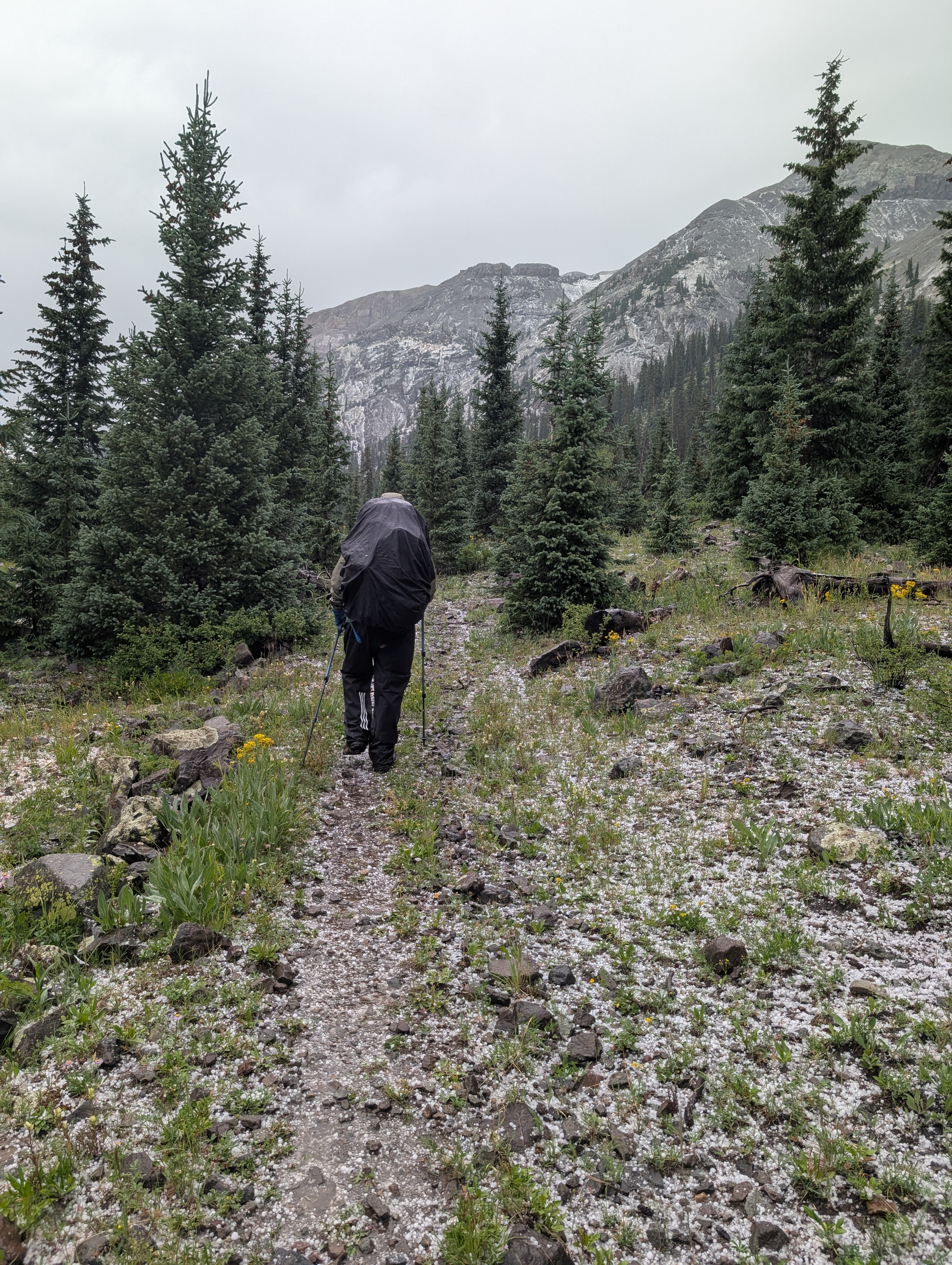
The fickle San Juans weather continues on the hike out on day four. Rain gear goes on and off all day as we descend the East Fork, a graceful vale that proceeds from high peaks to scree fields to avalanche-prone slopes of spruce to red towers reminiscent of Zion. Right at a shaky river crossing, however, comes the coup de grace: a sudden onslaught of hailstones, many as large as chickpeas, comes crashing down and sends us hustling for tree cover. After they have fallen the landscape is strewn with tiny white pellets, the walls to the east coated and glittering and the rutted path below us now a soupy mess of water and floating ice. This is not the least pleasant thing underfoot on the East Fork, however: that title goes to the cowpies, left by a lowing chorus of cattle that harmonizes as we walk by. At least we evaded the sheepdogs.
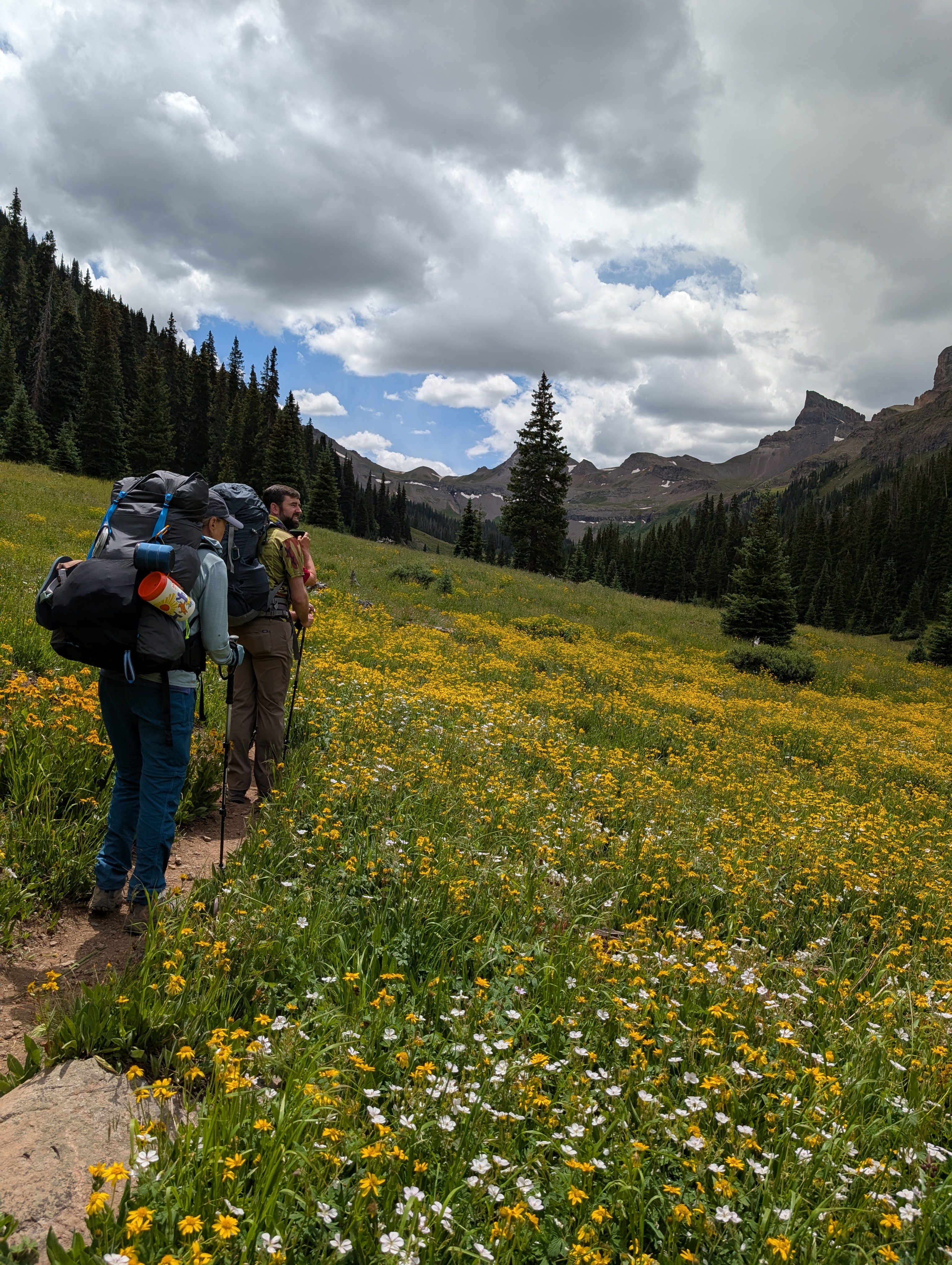
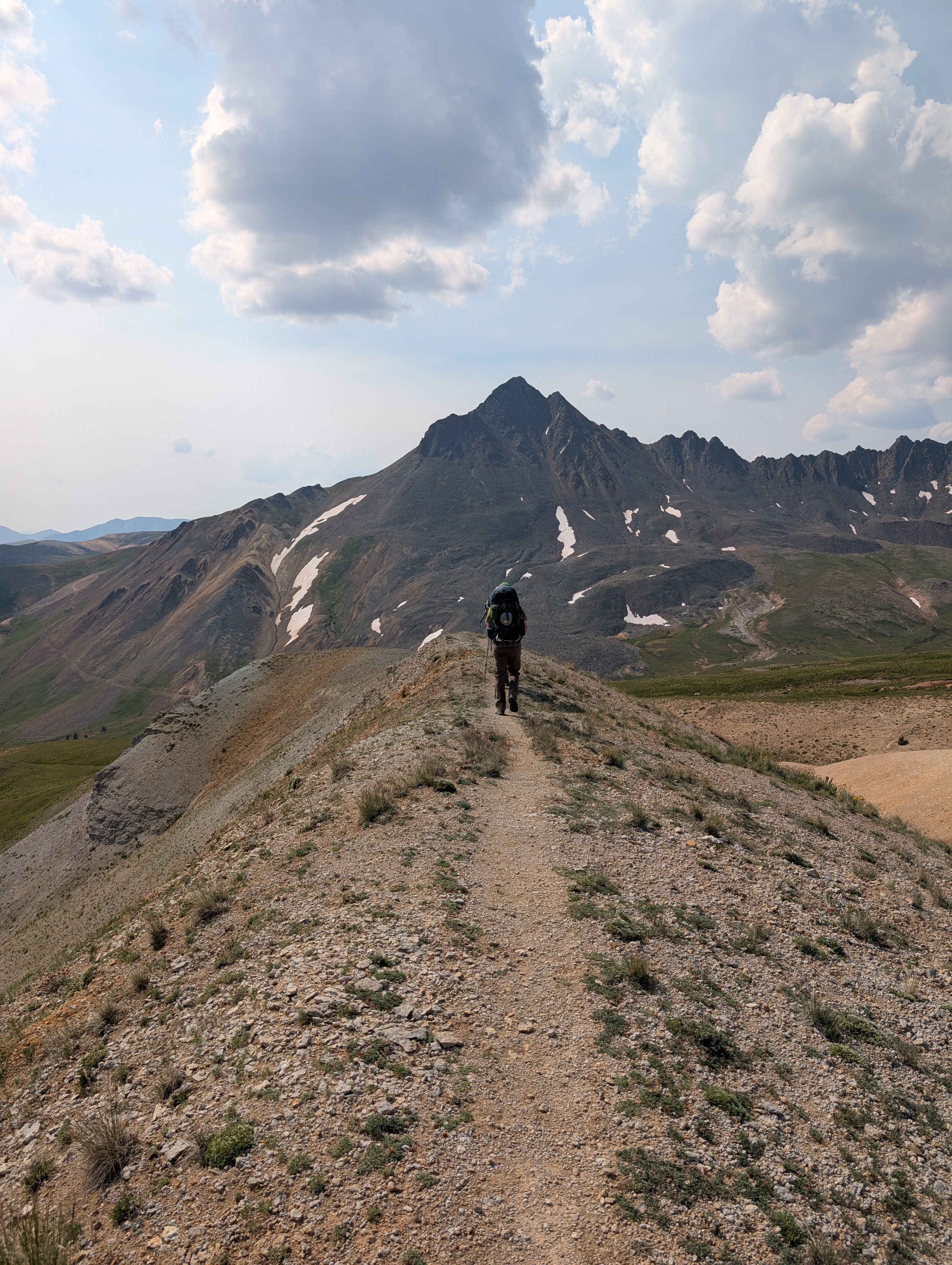
On the final evening we car camp off the Middle Fork, mission accomplished in spite of the absurd hail. Here we have the definition of Type Two Fun, a few minutes of misery that blossom into absurdist laughter and a memory that we can look back on forever, a random Friday on the first of August now immortalized, a remember when we did this, pushed out of comfort and saw a rare new beauty that will only pour gas on this blazing yearning for more of the world. The cattle go quiet and the creek rolls on and Rob and I stand out to watch the stars appear above our stand of aspen, musing on other yearnings we have.

Our two Ford Expedition rentals misbehave on the way back to Denver. The car alarm on Bob’s goes off three times in the night of our final evening, while the one I drive has the tire pressure light go on twice, growing worryingly low after dinner in Denver and prompting an early return. But it is a beautiful ride. We cruise along the Blue Mesa Reservoir, one of those manmade oases that dot the West, both a triumph over and a failure to fully tame nature. Lunch comes in Gunnison, with its bustling downtown, and we then ascend Monarch Pass back over the Continental Divide. The Arkansas River Valley and South Park would look like South Dakota but for the Collegiate Peaks and the backside of the Front Range looming over the high plain. We ascend once more, wind down the Platte Canyon, negotiate our way into Denver for the final night before heading out.

In some ways, Colorado has conquered America. The country vibe that has consumed pop culture this decade may get funneled through places like Nashville, but it has deeper roots in the cowboy west than the history-laden South. This is America as the open frontier, home to the pot-smoking libertine and the fitness-focused weekend warrior. But the frontier is over: after each weekend the chasers of peaks and slopes head back down the passes on I-70 and settle into the creature comforts of the subdivision on the outskirts, the escape to their safe retreats. Something is lost here but we don’t know quite what it is and so we yearn for it, nod to the past and chase a future. In this way, Denver and its environs may be the most American of all cities, spared the extremes of the coastal giants; as a newer city of many transplants, it lacks the particularity of other heartland metropolises, yet maintains a hold on reality absent in the likes of Las Vegas. There is a freshness and youth here, and I get the allure, an American reinvention that avoids the sterility or museumification of older societies. But while I feed off that youth, I need more than it.

My split personality gives me clues to what it misses. I crave communion, relish tapping into these ties old and new, and over the past several months a shared life has been taking shape through careful steps and weekend drives down I-35. And yet I demand solitude, reflexively rebel in contrarian ways, possess within me a deep instinct to disappear into mountains or at the very least drive off into some anonymous western town where no one knows me and where I can be something other than my staid, disciplined, ever so rational self. The constant in all these strains is a rootedness to the land, a spirituality of place that I find more and more at the core of my being, whether that is in ventures outward to new beauty or a return to the North Shore cradle that birthed my oldest friendships and more recent dreams. These landscapes tell the stories of who we are.

The Two Mountains

I use mountain metaphors with a regularity that long ago gave up any pretense of originality. Such allusions come naturally to a hiker, a striver, someone who values both the art of finding the route and exploits of physical skill, to the point that they become rote. They leech through my travel writing, my fiction, and my political advice. “We have other mountains to climb,” I tell a friend who, like me, has suffered a setback in what I have started to call a summer of disappointment. It has been a summer of deferred dreams and stalled-out ambitions, though any frustration is only the product of the lofty heights we have sought for ourselves. The pursuit alone is part of the allure, though after a view from higher up, the same old woods may not feel quite as satisfying.

My annual hiking trip with my uncle Bob, cousin Rob, and friends Amy and Ed takes me to the highest reaches of Colorado. It orbits around Leadville, the only settlement of over 1,000 people at an elevation over 10,000 feet in the United States, and to call Leadville colorful would only start to tell the story. An early silver rush turned it into the second-largest city in Colorado for a spell; even today, a healthy chunk of the world’s molybdenum comes out of the nearby Climax Molybdenum Mine. On the way up, this northern Minnesotan explains tailings basins to his fellow travelers and geeks out on this operation. Large parts of the town look rough, trailers and bedraggled bungalows along some streets that are practically sand, but at its core is some boom era architecture with lively hues, and an outbreak of new construction has created a ski town-style tumor on its northern edge. “Keep Leadville Shitty,” exhorts a local bumper sticker, a window into the battle for its soul now under way.

I am swiftly smitten by this city on an eternal frontier. Our arrival coincides with the closing stages of the Leadville Pack Burro race, the second leg of the pack burro racing triple crown and one of its most daunting courses. It is a magical spectacle. Every five minutes, the town police car circles back through to guide in another exhausted and sweaty human tugging on the rope of a burro, which may or may not have any interest in cooperating with the exercise. Onlookers cheer as the burros amble to the finish line by the booth from the Western Pack Burro Ass-ociation. One collapses into a chair next to us, his fifth 22-mile race complete, spent from the effort of coaxing his mighty steed across the line. The closed-down main street through Leadville hosts grand old architecture, placid burros willing to be petted, and t-shirts spanning the full gamut of ass puns. A week later, on our way out of the wilderness, cyclists for the Leadville 100 have replaced the burros, another reinvigoration for a small, rural town finding its late modern footing.

Our hike covers two segments of the Colorado Trail, a 485-mile path from Denver to Durango that takes its travelers through some of the nation’s most dramatic high country. We begin at the Tennessee Pass between Leadville and Vail and work our way south to a trailhead between Mount Massive and Mount Elbert, the state’s two highest peaks. Our campsites place us at the high-altitude Porcupine Lakes, an alpine meadow beyond Turquoise Lake, and among the wooded roots of Massive. With a tree line at 12,000 feet, the views from this part of the CT are not as stunning as last year’s jaunt on the Beaten Path, but the lodgepole pines provide pleasant hiking cover, and it takes little time for this group to settle into the rhythms of wilderness release.

As trails go, the CT itself is relatively benign. It is wide and well-maintained, sometimes with the feel of a hiking superhighway. On this stretch there is plenty of water, and resupply opportunities are abundant in nearby towns. There are just two great challenges to hiking the CT. The first is elevation, and with the entire hike happening above 10,000 feet, five flatlanders take some time in adjusting to the thin mountain air. Our first day is mercifully easy, but even then sleep comes terribly, and day two beats up the entire party, with me feeling about as gassed as I ever have on a trail after a far-from-awful 400-foot climb midway through the day and fellow hikers collapsing in a grove at the bottom of the following 1,500-foot descent, all before the subsequent 1,000-foot march up to the alpine meadow where we make camp. A constant sense of dehydration looms over the trip, occasional lost appetites and bad sleep turning a routine hiking distance into a genuine chore.

The second looming threat throughout the week is the weather. Colorado has a short hiking season, and even now in midsummer, there is a chance that thunderstorms may roll in off the mountains every day. Early starts are necessary, lest the oncoming storms bear down while on some exposed stretch of trail. Our luck holds on the first three days, and though dime-sized hail does rain down on us high above the tree line on Mount Massive and lightning strikes behind the hulking peak, we make it back to camp without any ill effects and ride out the remainder of the lone storm to hit us. The wettest I got on the trip was on a hike from a restaurant to the hotel in Denver.

Mount Massive is the third-highest American peak outside of Alaska, standing shorter only than Mount Whitney and its immediate neighbor to the south, Mount Elbert. It also lives up to its name: while it may be 12 feet shorter than Elbert, it is far bulkier, a sprawling behemoth of false summits and lengthy approaches feeding up to one great ridge atop it all. We make camp for two nights at Willow Creek, which sits at 11,000 feet and cuts off six miles of the round-trip ascent from the nearest parking lot. The climb starts through the region’s characteristic pine forests, but in time the trees thin out into scrubby willows and then into rocky slopes studded with grasses and mosses. This stretch above the tree line is the longest part of the ascent, a steady march up and up through steadily choppier terrain. A saddle between South Massive and the main peak gives a stunning view down to mountain lakes and smaller mountains below, and a clamber takes the hiker up a ridge to a false summit and then on to the twin logs marking the point 14,427 feet above sea level.

Our group plods at a determined, if hardly speedy, pace. On the way down, we are promptly waylaid by a mountain goat, who takes his sweet time in vacating the path. Twenty feet onward, we encounter mama goat and baby. Baby plops down in the middle of the trail for a spell, and mama takes a leak on the path to further get the point across. By the time they finally move, the clouds are beginning to gather, and the goats provide further entertainment through a lunch stop back at the saddle. The Massive menagerie continues as we head down from there, as ptarmigans stroll past and a crew of marmots, some of them appearing rather obese, trundle about the slopes.

The human zoo on display on this trip, somehow, exceeds the variety of the wildlife. At the parking lot at the start, we get our picture taken by a British cyclist who began in Denver and is now working his way down to Mexico, an adventure that he expects will take him until March of next year. (Excepting the wilderness bits, which include the two segments we hike, the Colorado Trail welcomes cyclists.) When we roll into our camp for our first day, we come across two Missouri Mennonite newlyweds in traditional garb and their salt of the earth cowboy guide, riding horses up and down peaks for their honeymoon. One could mistake the image of the three of them for one taken in 1872. On that first night, we share the site with the Gu Girls, three through-hiking young women who have formed a trail family; on a resupply run in Leadville earlier that day, they chased down a truck distributing Gu, the energy gel for distance athletes, and they share some of their rather large haul with us. It all tastes awful.

We pass twenty Outward Bound kids for whom a 3-mile trek is torture, and later meet a teenage girl councilor for another group of OB boys who decides the route up Mount Massive, which she has just casually summitted in no time flat, will not do for them. A University of Florida biologist acclimates herself to hiking at elevation before she heads to Argentina, where she will work to preserve endangered chinchillas high in the Andes. We pick her brain on the diets of local rodents. Inevitably, we encounter a man wearing a shirt from the Bonfield Express, a now-defunct Thanksgiving 5K in Downers Grove, Illinois that Bob, Rob, and I often ran; this is the second straight year of a Bonfield moment of recognition a thousand miles from suburban Chicago, and we sing the praises of its shirts for hiking. Another Mt. Massive day hiker has just bagged his 27th fourteener this year, while the two guys who summit just behind us crack beers together at the summit. No one, however, can top Nora, the 19-month-old through hiker. Her parents are carrying this intrepid traveler clear from Denver to Durango, each with 42-pound packs (Nora weight included), and report she is in good cheer after the first 185 miles.

The trip begins and ends in Denver, a city that inspires mixed feelings. The airport, a monument to 90s sprawl, is a contender for worst in the country, though Blucifer and the lizard people lair do liven things up. Its rapid growth is apparent everywhere, and at least the dense housing is going up in droves, albeit often in far-flung tracts of identical boxes. There is a charming district of craftsman bungalows south of downtown, and grand institutions like the capitol, Union Station, and a lush botanical garden give some status to the capital of the Mountain West. The food scene, with Rob as our guide through it, is solid, and of course I cannot complain about the beer. The American future on display in Denver is more comforting than that of other western American cities, freed from California world-saving hypocrisy or Vegas alternate reality or Phoenix total defiance of nature, but it remains choked by dust and ozone warnings and unattainable real estate, the sort of qualified success story that defines the nation’s epochal lurch. It’s a fun place to visit, but it isn’t home.

Shortly before this trip, I polished off David Brooks’ The Second Mountain, the columnist’s midlife crisis book in which he distinguishes between the mountain of earthly success and the mountain of moral formation that people can pursue in life. In my tension-obsessed way, I have made efforts to climb both peaks in the first third of my life, striving both for a home life worthy of an American Dream and a well-ordered life where I believe in what I do. At thirty-two, I find myself frustrated with my progress on both, in many ways proud of my progress but still clearly still gazing up at a false summit. I decide it is somehow fitting that my venture left the conquest of a second peak such as Mount Elbert for some future journey. We do, indeed, have other mountains to climb. But we are on a well-maintained path, and we have fellow hikers to go with us.

Climbing Everest: Into Thin Air Revisited

Men play at tragedy because they do not believe in the reality of the tragedy which is actually being staged in the civilized world.

—José Ortega y Gasset, in the epigraph to Into Thin Air

The first snowstorm of the year has engulfed Duluth, and I have rather fittingly spent my snow day re-reading Jon Krakauer’s Into Thin Air, a bestselling account of a 1996 disaster on Mount Everest.

Krakauer, a longtime outdoors writer with a thing for prepositional phrases (Into Thin Air, Into the Wild, Under the Banner of Heaven), was sent to Nepal by Outside magazine to do a piece on the increased commercialization of mountain climbing. It was also a chance for a longtime mountain climber to pursue a life goal, and while he had no Himalayan mountaineering experience prior to his trip, he was clearly one of the strongest client climbers on the mountain that year, being the first to summit on May 10, despite having to wait for and pass countless slower climbers along the way. His piece, however, took an entirely different turn when tragedy struck that day, leading to the deaths of eight mountain climbers.

Of course, Krakauer’s apparent prowess despite his lack of experience points to one of the key issues with the 1996 climbing season: many of the climbers on Everest that year had little business being there. His book centers around two private companies, Adventure Consultants and Mountain Madness, each comprising of three guides and eight client climbers. The clients had some experience, but only one was a real mountaineering champion; most were wealthy doctors with a climbing hobby. The Mountain Madness expedition included Sandy Hill Pittman, a New York socialite and journalist who had Sherpas haul luxuries into base camp and a satellite phone most of the way up the mountain. After the book came out, she was brutally caricatured and ridiculed, but it’s hard not to diagnose naïveté in a woman who set out on a journey known to pose great risks as if it were a sightseeing tour in the Appalachians.

And, all in all, those two firms were better than many of the others. The lead guides, Rob Hall of Adventure Consultants and Scott Fischer of Mountain Madness, were very experienced climbers who had made an art of helping inexperienced climbers up Everest. Many of their fellow expeditions could claim no such expertise. The Montenegrins who attempted to summit the day before were supposed to lay down rope on some of the highest reaches of the mountain, but wasted all their rope on relatively easy stretches. An incompetent Taiwanese leader shrugged off the death of a member of his party the day before and tried to soldier up the mountain on the same day as the two firms, adding to the bottleneck and later needing to be rescued by Sherpas from the Mountain Madness team. And then there was the South African expedition, led by a complete con man who tried to profit off of a post-Apartheid reconciliation scheme; he refused to loan out his satellite phone as people died on the mountain, and a member of his expedition died a few weeks later, on the day he successfully summited. On the Tibetan side of the mountain, a Japanese party climbing the subsequent day ignored three half-dead Indians, with one of their number claiming there was “no room for morality” at that elevation.

Mountain-climbing is frequently employed as a metaphor for many other things in life, and usually in a positive light. It involves the overcoming of obstacles, or even the attainment of grace, as in Martin Luther King’s final address, “I Have Been to the Mountaintop.” I’ve never climbed anything that requires any technical skill, but I can certainly identify with the thrill of racing up a large hill or mountain and standing astride its peak. It taps into some primal human instinct to conquer and lord over things, a drive that we never can get rid of, no matter how hard we may try.

Actually climbing the world’s tallest mountain, however, is an utterly miserable experience. Everest’s summit, at 29,000 feet, is at roughly the same cruising altitude as an airplane. Simply getting to base camp requires a trek at altitude that is enough to cause health problems for many. Nothing grows on the mountain, save a few patches of moss; it is a heap of rock and ice, with glaciers shifting and office tower-size chunks falling unpredictably. The mountain is littered with garbage such as spent oxygen cans, though people have tried to clean it up in recent years. It is also littered with feces: the lodges along the trek to the mountain are absolutely putrid, often causing sickness that has nothing to do with thin air. And then there is the climb, with threats of severe altitude sickness along the way. Many people can only go a few steps without resting once they near the top, and no one can think half as clearly as they can at a lower elevation, even with bottled oxygen. Rescue attempts by helicopter are very dangerous undertakings; there is barely enough air for a chopper’s rotors to generate any lift, and the rescue of two severely frostbitten climbers from 20,000 feet in 1996 was, at the time, the highest rescue ever staged. Temperatures far below zero and near-constant hurricane-force winds make a mockery of this Minnesota winter that’s driven me under a blanket with a cup of tea.

And yet the desire to climb Everest consumes people, even when they know the odds they face. Three of the four deaths in the Adventure Consultants party might be partly attributable to the drive of Doug Hansen, a man who had twice failed to summit Everest and would not stop, despite lagging severely due to several ailments. Hall, perhaps understanding that drive, ignored his own protocols and never tried to turn him around; junior guide Andy Harris, who was already dazed to the point of delirium after losing his oxygen supply, stayed high on the mountain to make an ill-advised rescue attempt. All three men perished when a storm pinned them to Everest’s highest ridges.

Krakauer is meticulous in detailing everything that went wrong on the mountain, as best as he could from the oxygen-starved memories of his fellow climbers. Though he tried not to assign too much fault, his account rankled many people, including the family of the deceased guide Scott Fischer, who thought no one deserved to be blamed. Krakauer makes note of Hall’s criticism of the way Fischer handled his Sherpas (one of whom died of injuries sustained in an avalanche lower on the mountain earlier in the expedition), and also presumes Fischer was responsible for asking his most powerful Sherpa to practically tow Pittman up part of the mountain. (If successful in her climb, Pittman’s celebrity would have been a boon to Fischer’s business.) The Sherpa in question would otherwise have been laying rope at the head of the column, which could have spared the climbers several bottlenecks and conceivably gotten most, if not all, back to Camp Four by the time the storm hit. To be fair, Krakauer also notes that his own presence might have spurred Hall to push his team farther than he should, and also talks of his guilt over failing to notice Harris’s troubles and twice being wrong about his whereabouts.

Perhaps the greatest controversy revolved around Anatoli Boukreev, a Kazakh guide for Mountain Madness who was arguably the most skilled climber on the upper reaches of the mountain that day. Boukreev, claims Krakauer, had a different concept of guiding from everyone else, summiting the mountain without oxygen and sparring with Fischer some over his relative inattention to clients. Still, Boukreev was strong enough to return to camp long before the others, and recharged before heading out on a rescue operation in which he saved two climbers’ lives. Fischer, who was probably very sick before the ascent, was the only person in the Mountain Madness party to die, whereas four Adventure Consultants team members died, and a fifth was left for dead before miraculously wandering back into camp.

The upshot of all of this was the fact that the 1996 climbing season was, in fact, less deadly than the average up to that point. (The average has improved since then due to much higher traffic on the mountain, though the raw number of deaths on the mountain still hovers around 5.4 per year, including ten in each of the past two years.) The trash and the feces are not the most glaring things left behind on the slopes of Everest. Those would be the human bodies frozen in place all along the route up the mountain, a graveyard that only grows as the years pass.

The easy conclusion here is that people who try to climb Everest are insane, and there is some truth to that. But insanity endures. The commercialization of Everest hasn’t slowed one bit since 1996, and with such a high demand, Nepal and China are unlikely to stop issuing as many permits as they can. For many local Sherpas, the mountain offers the only road out of poverty. In an age in which practically everything has been climbed, mountaineers have to contrive increasingly crazy ways to achieve fame: fastest ascents, ascents without oxygen, skiing down the mountain, or summiting at unusually old or young ages. (A 13-year-old made it to the top in 2010, though Nepal and China did crack down on age limits after the controversy surrounding that expedition.) Mountain climbers are creatures apart from the rest of us, perhaps, but they feed off a desire that transcends simple egotism. Anatoli Boukreev died in an avalanche on the world’s deadliest mountain, Annapurna, just one year after the Everest disaster. Here is his memorial at its base camp:


“Mountains are not stadiums where I practice my ambition to achieve. They are cathedrals where I practice my religion.” Lofty words, to be sure. But they also go to the root of that still-poorly-understood part of the human psyche that drives people to achieve great things; that part where our love for some thing or someone becomes a religious drive that gives life meaning. We need not all take it so literally, but we do need mountains to climb, and while we cannot remain at the top for long without running out of air, the moment of victory can last a lifetime.

In the meantime, though, excuse me as I pull the blinds on these gale-force winds and massive waves on Lake Superior, and crawl a bit further under my blanket. The next book I read is going to be about an adventure in the Amazon or the Sahara or something.

Image from Wikimedia Commons.