The Upper Peninsula of Michigan is a land that fades gently into the wild. Culturally it has much in common with northern Minnesota, old mining and timber towns now enjoying the tourism burst of beautiful lakefronts, but it feels a step further from creature comforts, from big city money pouring north. Its towns are old, some them easing back into the woods, back into a Hemingway story and then out of time, like the ghost towns of the west but swallowed by maples and hemlocks and an undergrowth of ferns. These forests feel more capacious and less cloistered than the coniferous northern shores of Superior, less guarded in their secrets. The UP is an open book, no hidden agenda or ambitions: just some remote country surrounded by stunning lakes.
On an unseasonably warm September weekend, I head for the UP with my mom and her partner, Doug. Porcupine Mountains Wilderness State Park, or the Porkies, is Michigan’s largest state park, and it clings to the south shore of Lake Superior not far from the Wisconsin border. There are roads down all the splashing waterfalls on the Presque Isle River on the west end and to Union Bay and Lake of the Clouds on the east end, and a long loop around them to the south, but the vast majority of the park is a wilderness, accessible only by foot.
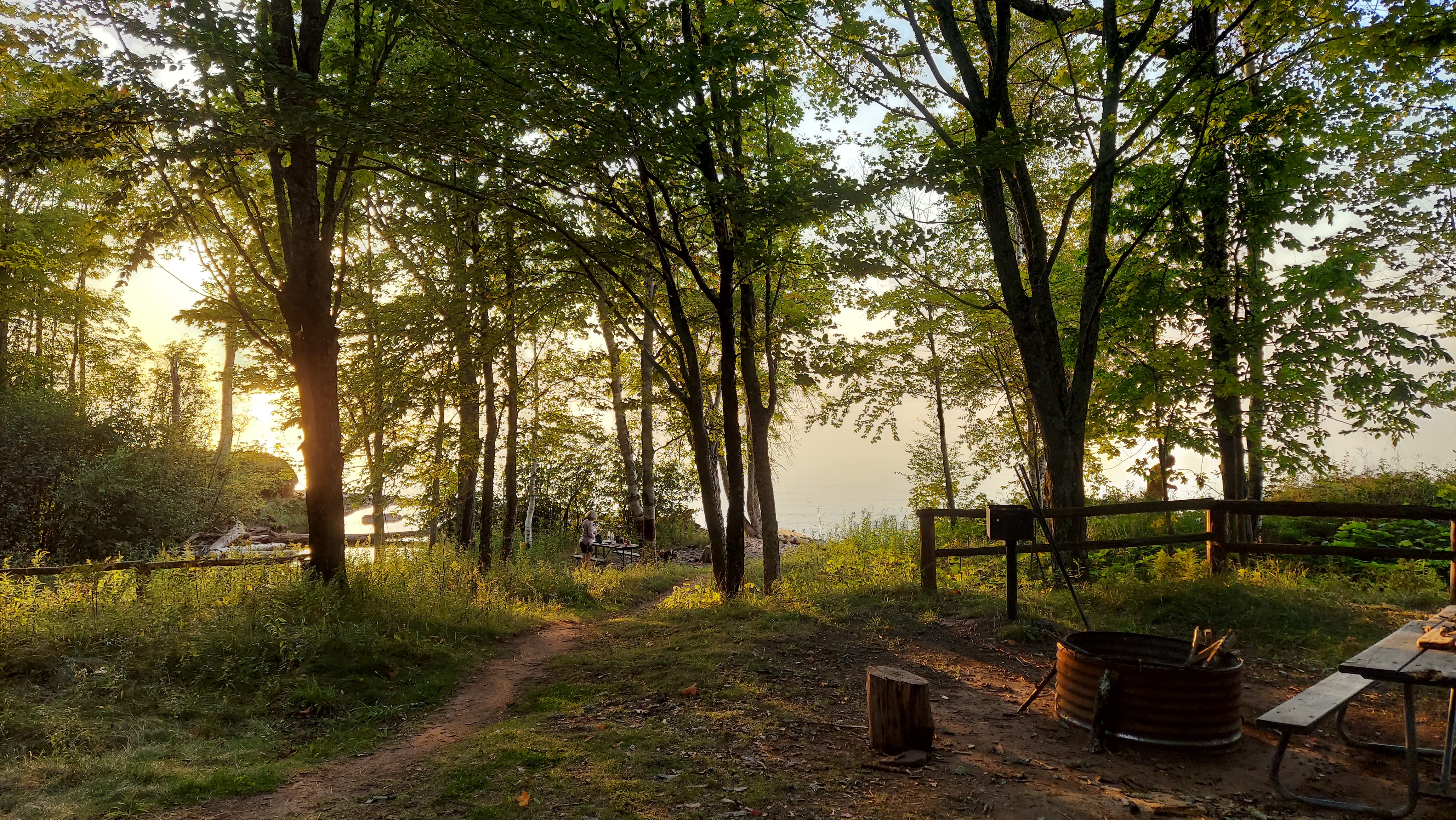
We are in the Porkies for a five-day backpacking trip, but that comes with an asterisk on day one. Cotten cabin sits a mile from the trailhead, tucked in an idyllic maple grove along the lakefront beside a small stream. It is rustic but newly built, large and with two bedrooms extending back off the large great room with a wood-burning fireplace and ample counter space to prepare our freeze-dried meals. Dinner comes at a picnic table down by the lake, and the sunset is stellar. Owls hoot out their persistent questions off in the distance, and the lake sloshes gently, constant but never quite uniform in its rhythms. I write by candlelight and drift into the night, easing into adventure.
The second night brings more of the same. The hike here is a long one, over twelve miles, and while there are regular rises and falls around creeks and ravines, it traces the lakeshore nearly the whole way. Campsites are wedged between a low ridge and the shore, with the trail winding up and down to meet them. Campsite LS-18 is an absolute jewel, tucked away from the trail in the halls of a maple grove that lets just the right amount of light filter through to keep it both inviting and cool. A long stony beach pulls us to the lake, and the seating around the fire ring features a few stone thrones. We could have stayed here for days.

On the third day we have the rare backpacking joy of a leisurely morning, a luxury more accessible in the Midwest than the West: the temperature change will be moderate, there is no threat of afternoon thunderstorms building in the mountains, and our next campsite is guaranteed. We are free to sit on the rocks, swing in a hammock, and read a bit more. The backpacker’s paradox, fleetingly achieved but delectable when it comes, when off the trail and all the camp chores are done: the bliss of nothing to do. It is hard to stop lounging in the looming heat.
When we do get moving, the trail promptly climbs upward past small windows of lake view through ridgeline scrub oak. It is a still day, the air growing sticky, and a road walk from a parking lot to the Lake of the Clouds overlook is momentarily jarring, with motorcycles rumbling by and blaring music. The crowd at the Porkies’ most famous point on a Friday in September does not exactly exude physical fitness, either, but they are here to take in the commanding view over lonely Lake of the Clouds, hemmed in by the Porkies on three sides and emptying down the long river valley of the Big Carp to the west.
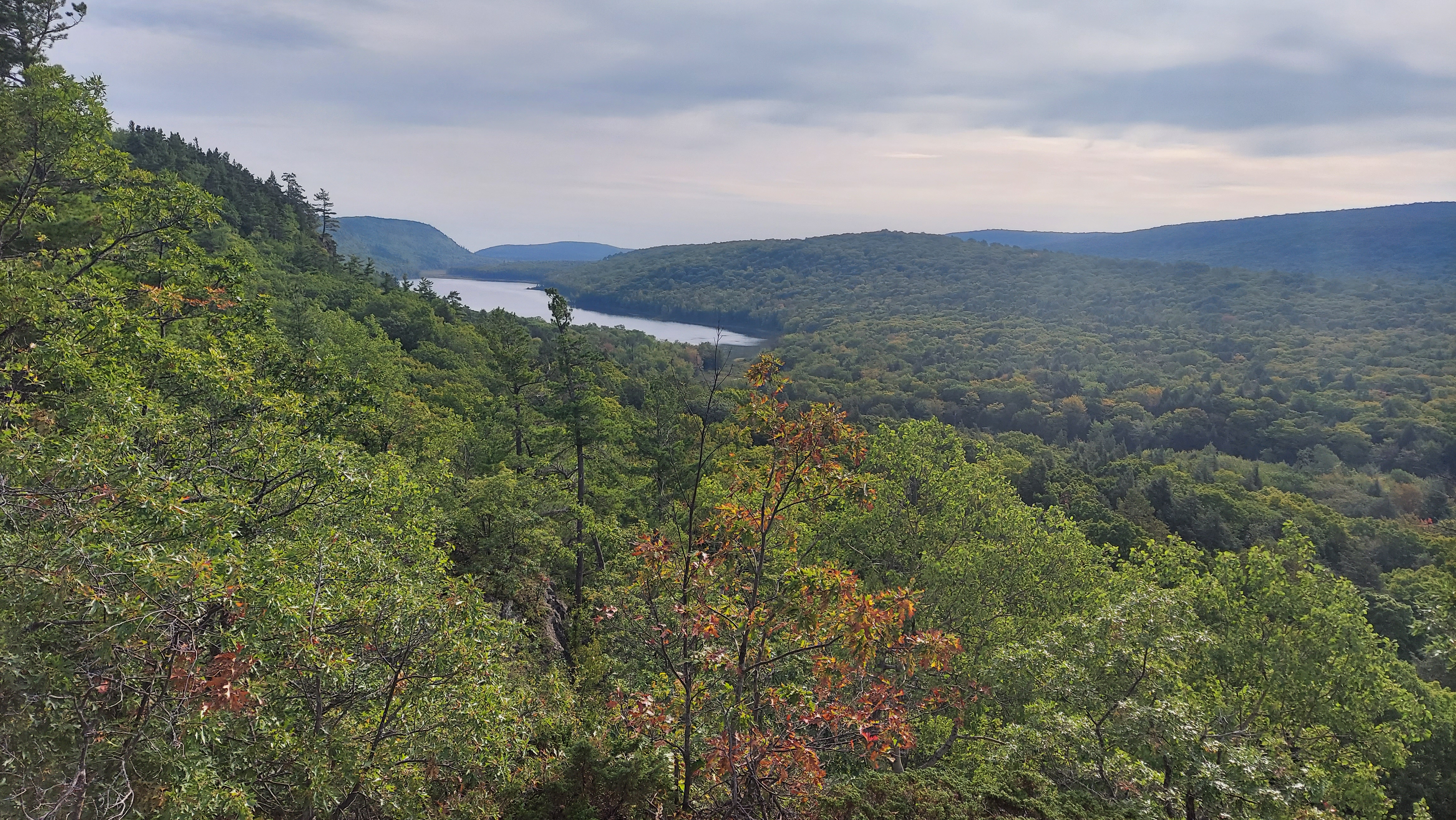
We lose the crowd when we descend and set up camp on the south shore, just back from the water in a hemlock grove. The occasional motorcycle rumble echoes downward and eventually some people at the camper cabin on the opposite shore clunk around in canoes on the lake, but no one passes our site all day. Seven swans are a-swimming in the lake, or rather bobbing up and down, showing us their rears as the seek out food. Instead of the long sunset over Lake Superior of the past two nights, dark comes quickly here behind the ridgeline, and we are content to let the daylight dictate our evening.
On day four we clamber up to the overlooks, drink in the view, and enjoy the upper reaches of the Big Carp River Trail, which tracks the ridgeline between its namesake’s valley as it feeds down from Lake of the Clouds and then makes a right turn into Lake Superior. From there our path sinks through a thick hemlock forest, twice fords the Big Carp, and then tumbles past a series of cascades on the way to the lake. Our site tonight is just far enough from the mouth of the Big Carp back east to be annoying, and although it is well-situated on the lakeshore, it is a bit overused by sloppy campers.
Our final morning is an eighty-degree day, a strange mid-September occurrence that has us baking as we retrace steps back out toward the parking lot. Unseasonable weather aside, this has been a satisfying end to a summer of travel bookended by walks with both of my parents. (As my mom and I toured the Porkies, my dad was somewhere on the opposite side of Superior, undertaking the second half of the Superior Hiking Trail through-hike he began last fall.) It is the first time my mom and I have backpacked together, and while a few moments on this hike call back to her fondness of a childhood family hike at Sleeping Giant in Canada, we also fall back into memories of our earliest camping trips. Sometime very early on she and I camped in Beaver Creek Valley in southern Minnesota (all I remember is mud), and I vividly remember a visit to Rock Island off Door County in Wisconsin, in which I first surveyed the depths of a pit toilet and declared that I would withhold expelling any waste until we got home days later. Whatever form they take, these retreats into the woods are part of who we are.

Perhaps the greatest joy of this trip, however, comes from the logbook in Cotten cabin. Many of the entries are the typical rhapsodies of cabin visitors, but here, the younger authors have taken the genre to a new level. In a trend started by a 16-year-old Leah, many have illustrated their cast of characters for their weekend, with drawing of each actor’s head along with basic descriptors such as their ages or “my best friend” or “needs a haircut.” (In my contribution, our descriptors are “oldest,” “old,” and “younger, but increasingly old.”) There are rival perspectives from dueling siblings and artistic masterpieces devoted to the mice who apparently populate the cabin. (I also add an owl.) “50% annoying, 50% OK, 100% brother,” one kid judges his younger sibling; Ian, meanwhile, recounts how he made a figure out of candle wax that looks like something his mom will not let him name in writing, though the tadpole-like illustration does rather convey the point.
Where do all these gems go when the journal fills up, I wonder. I hope the parents have snapped pictures of a few of these ephemera, these jolts of life in a place and time, moments that can pierce through any forthcoming teenage moods or young adult anxieties. This is the beauty of the written word: to observe life and to leave a record of it, to write a history of what is good in one’s world: honest, insightful, good-natured even when frustrated, to take what might otherwise fade into vague memory and give it narrative form. Here is to all of those memories hikers can make when they head into worlds far from home and daily obligation, to the stories they write that they will forever carry with them, whether faithfully recorded in a logbook or stashed away in a corner of the mind. These journals show exactly why we do this.
 A Patient Cycle