Give my Aunt Trisha this: she knew what she wanted. She was always the rebel of the family, the one prone to a sudden life-changing decision that would leave everyone else scratching their heads. In a family of twelve she lived the hardest of anyone, and her body paid the price. But she remained unapologetic, herself to the end, committed to the paths she chose, and she had plenty of fun along the way.
When I first came into consciousness, Trisha was living with her son Brian at my grandparents’ house in Lombard, Illinois. Not long after, she made one of her sharp turns and picked up and moved to Wisconsin to tend bar, temporarily joining my family in the Badger State. Thanks to that proximity I remember more of Trisha in my earliest years than any other aunt or uncle. I was too young to have many distinct memories; she was just a presence, always there with her big, rolling laugh, free from any pretense.
Aunt Trisha led a different sort of life from most of the family, but her unique path did not stem from any shortage of intelligence or capacity for insight. In those early childhood memories she was very attentive to me, in no way babying, imparting knowledge and logic, the straightforward real talk of someone who knew her course. She had a deep memory and could recall tales from her past with startling specificity, and when she found a willing listener, storytime could last for hours.
As stubborn as she was, the wheels were always churning beneath, maybe questioning, maybe justifying, always moving. I recall sitting with her at my grandmother’s wake some three years ago, not long after Brian had passed, and her poignant statement, offered as a simple fact, that the true loss of her only child had happened years earlier. I do not know how well she coped, deep inside; I’m not sure anyone can, as the mental and physical tolls mounted. In those later years she came back into the family fold after a time of relative absence, a return to those old rhythms she remembered well, perhaps a tacit acknowledgment of the support she needed, that we all need.
In another family Aunt Trisha might have been written off as the black sheep, or her forays met with a resigned shrug. Instead, the most prodigal Maloney always had a safe harbor. When she came home with Brian, her staid and very Catholic parents welcomed her in; whatever judgment there may have been did not leak out into the open. Later, other family members took on thankless work to help a lovable but stubborn soul enjoy some measure of freedom as life caught up with her: the Joneses in her South Bend days, the Downeys when she ventured back into Chicagoland, and everyone else in ways large and small. Keeping the family whole came first.
In the late stages, her deteriorating body did not stop her from continuing the push. Aunt Trisha gutted out last summer’s family trip to Europe despite increasing immobility, somehow surviving an incredibly inaccessible Venice and then mostly parking on the cruise ship deck with margaritas while the rest of us went ashore. (Like her late older sister Kathleen, she simply had to go on that last cruise.) When she came home from that trip she then made one last hard-to-fathom move, this time to Florida. She seemed to know her days were short and wanted to make what she could of them, a fate accepted with typical resolve. The party would continue to the end.
Aunt Trisha’s passing is a blow to our giant family unit, but even though it comes too soon, it comes with peace: she certainly went on her own terms. Somewhere she lingers, parked in a chair, cheap beer and a cigarette at hand, her laugher booming through a crowded room as she spins another yarn for anyone who will listen. She did it her way. The rest of us were along for the ride, doing what we could when we could and hopefully, in the end, finding peace too.
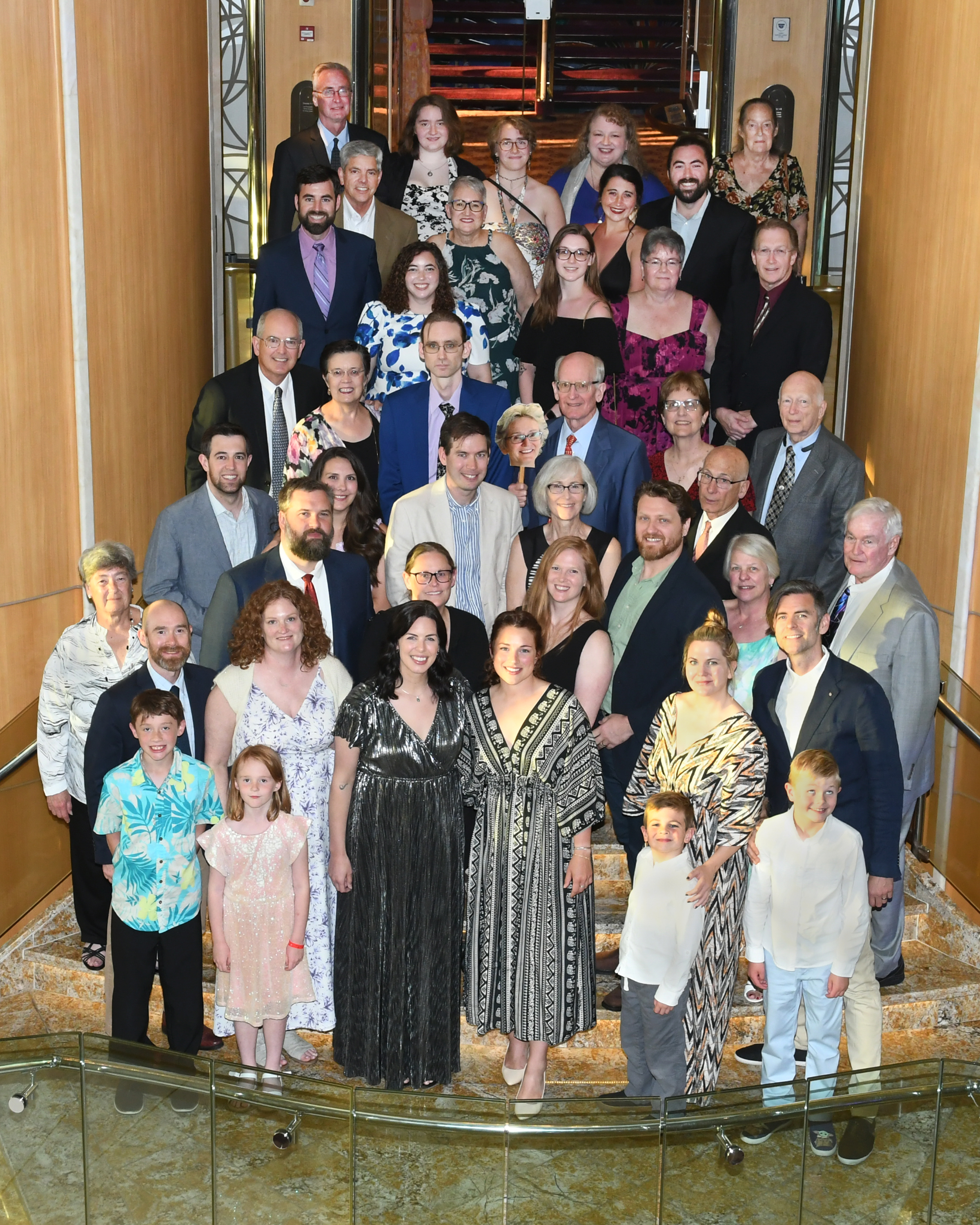
A 42-person family cruise is no enterprise for the faint of heart. My Uncle Chuck and Aunt Monica, the organizing forces behind this whole affair, give us a simultaneous window into a different world while traveling with the people we’ve known the longest. (Fate is cruel to even the best-laid plans: Monica’s broken hip just before our departure leaves her living vicariously, though pictures of Flat Monica heads on popsicle sticks crop up in every destination.) Most importantly, a cruise ship is a vehicle that will allow 42 people with disparate interests to all come together and share in the same thing. Of course we go our different ways: I see some people almost nonstop and only here and there. A cruise ship works for the people who aren’t physically able to do much other than be on the boat, and it works for people like me and my cousin Rob, for whom rest is an afterthought.
We did a version of this in 2004, beginning and ending in Barcelona, and I was fortunate to join a smaller group for a British Isles and Norwegian fjords excursion the following year. I hadn’t been to Europe since. Returning outside of peak awkward teenager phase brings considerable benefits—freedom to roam, legal booze, full choice in activities—though being turned loose on a giant boat is hardly an awful fate for a kid, especially one like me who could appreciate history and culture. Even so, my most enduring memories of that first trip include the discovery of the bidet, the phallic graffiti in Pompeii, a trash Royal Caribbean lasagna meal in Florence, and an exceptionally attractive Roman tour guide. I was fourteen; what can I say?
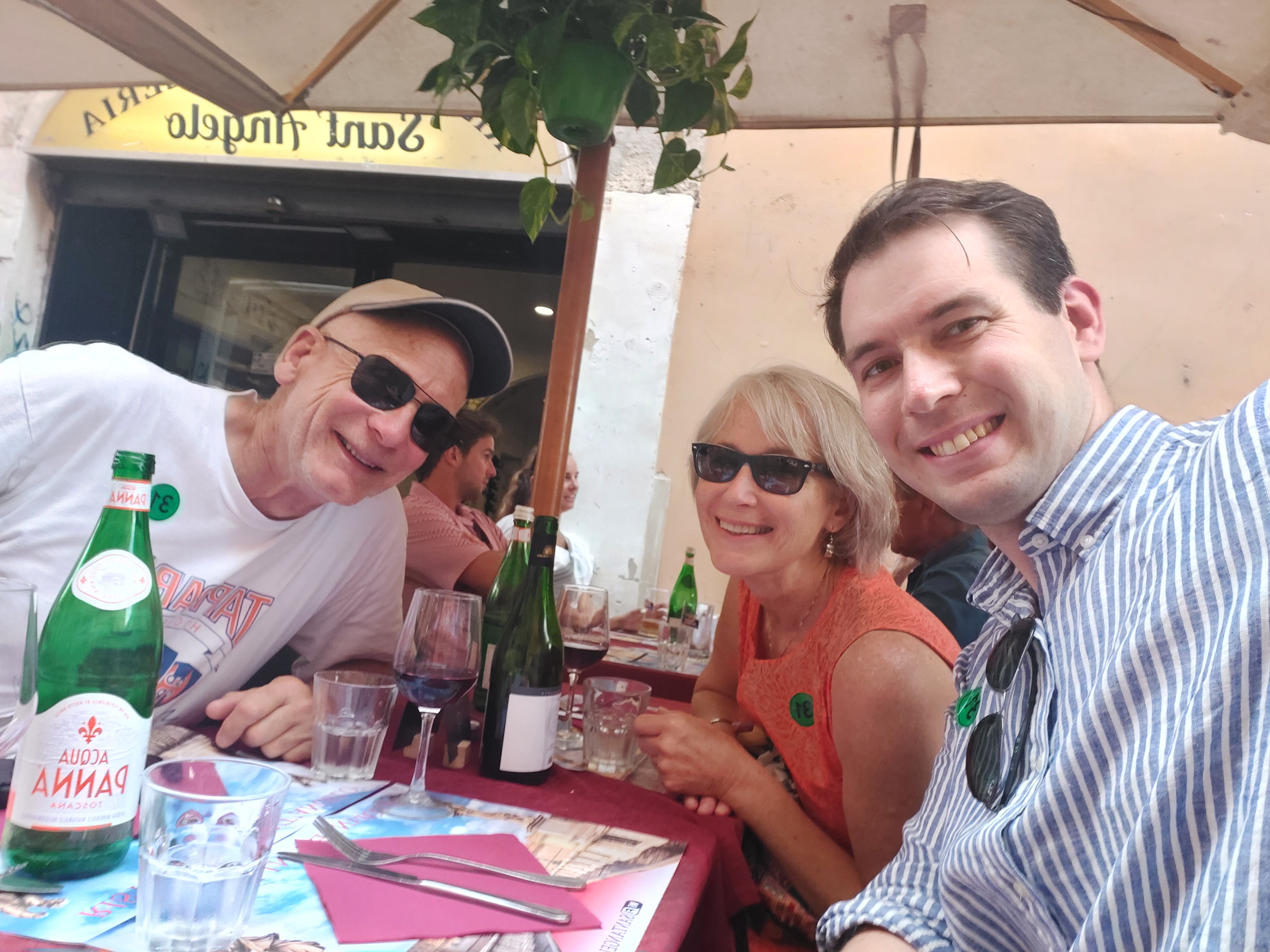
My attitude on cruising didn’t change appreciably in the intervening years. There are few agnostics on cruises, and telling someone about an impending cruise is likely to inspire envy or disdain. But, unless one has a David Foster Wallace level of misanthrope or gets warm tingly feelings at the phrase “organized group activity,” most people probably land somewhere in between. Cruise tourism is like tasting a beer flight; you may not get to immerse yourself in Rome, but you have enough of a flavor to know what you may want to come back for on some future trip. The first cruise showed me enough of Florence to know that any return visit would have to be for more than five hours, full stop, so it was easy to sub in Cinque Terre for the Livorno excursion this time around. As someone who now, improbably, has status with Royal Caribbean, I’ve learned how to bend these trips to my style.
Our vessel for the week is the Enchantment of the Seas, one of the oldest in the Royal Caribbean fleet, and its age shows around the edges: a few brown stains, the finest in 90s décor, a fraction of the absurd features on newer Royal ships. After an early Freudian slip, I take to calling it Endurance of the Seas. And while our fates are far from Ernest Shackleton’s, the whole two weeks do start to feel like a test of fortitude, not because of anything imposed from the outside but because I, aided and abetted by Rob, don’t want to waste one second of this trip: we are ready to go every morning, off on some lengthy excursion every day, seeking out the best food and drink every evening, and the last ones to retire every night. Cruising is, indeed, a feat of endurance.
Though the ship has over 2,500 passengers, it rarely feels crowded except when embarking or disembarking at a busy time It’s not hard to skip shows and gimmicks and choose “on your own” excursions, if you, like me, get relatively little out of comedy acts or following a tour guide with a Royal Caribbean popsicle stick down the streets of Taormina. We have sporadic pool parties in the solarium and play some shuffleboard; as always with this family, there is some euchre and Rummikub. But most nights we stage a takeover of the Viking Crown Lounge and cycle through conversations with one another, with people drifting off from there to bed or to their own activities, which for a few cousins and me means tasting the contraband beers we’ve smuggled aboard the ship. (No, Royal Caribbean, we’re not telling you our methods for getting around your systems to force us to buy your underwhelming drinks.)
The one organized group activity in which I am a regular and enthusiastic participant are the periodic trivia competitions held on board. Our family descends on three of them, and one of our teams wins every time. One afternoon, my team is in a three-way tie for first with two others, and we are instructed to send up one person for the tiebreaker; my team sends me up, and the other two counter with ten-year-olds. They are no slouches, and I don’t elbow them out of the way to answer first as I might have with some of my cousins, but I dispatch of them as politely as my blood-seeking trivia instincts will allow. I claim my Royal Caribbean highlighter prize and beat a hasty retreat to the bar.
The most grating part of the cruise is the extent to which the boat, despite already charging its passengers thousands of dollars, tries to take more and more of their money. The costs of the onboard internet and drinks package are laughable enough to make them easy to turn down, even as someone who remained pretty connected to the outside world and was hardly teetotaling on the trip. (That said, how can a boat with this many passengers serve only one craft beer, a lonely Terrapin fruity IPA that doesn’t even appear on the menu in half the bars where it’s served?) Plenty of people find ways to part with their money in the onboard shops and casinos. There is also the matter of communication, which is this constant dance among us between the glitchy Royal Caribbean app, other messaging apps, and texts for those of us whose cell phone plans work in Europe. T-Mobile, you are a quiet hero.
And then there is the often obsequious service. It is unclear if the fawning attention of the on-board attendants is coached by Royal Caribbean or a cultural characteristic of the Filipinos who dominate the crew or some combination thereof. It would not be hard to lapse into some sort of guilt about all these mostly brown people from scattered island nations waiting on a mostly white American passenger base, but I have of late found myself in revolt against the eternal calibration of morals in situations beyond my control, not to reject awareness of these divides but to find la vita serenissima in the situations we have been gifted. I am here, and giving the crew anything other than the respect they deserve would only make a hash of things. Let us save that anxiety for another day.
In a group of 42, the opportunities to connect with fellow passengers beyond the family are limited. The best gem comes the night after Cinque Terre, when seven of us join two other unsuspecting couples at the Chef’s Table, a five-course meal with wine pairings in a small dining room. As we stuff our faces we get to know Fran and Ed Dorn, a couple from Austin who were both on the faculty at the University of Texas, a Shakespearean actress and the dean of the Lyndon B. Johnson School of Public Affairs. That party goes deep into the night, and later, a few of us make it to the dance floor in the Viking Crown Lounge on Deck 12. Our fellow clubbers include a bunch of Spaniards demanding reggaeton and a clump of 18-to-20-year-olds who mostly stick to the areas by the bar as they revel in their newfound status. When the girl in the white dress vaults over a half-wall and pulls the boy in the “Please Drink Responsibly” t-shirt off down the hall, I drift off into some plaintive space of lamented lost youth that I never quite shake for the rest of the trip.
My catalog of small annoyances aside, a cruise ship offers a new perspective on may great cities, and even a few windows into great beauty. While the ports themselves are rarely scenic, I am of that obscure species that enjoys rolling through an industrial harbor to see the materials moving thorough and gawking at the massive container ships. At times there are stellar passages, never more so than on the day we set out through the Strait of Messina and pass the smoking volcano of Stromboli. The day at sea between Ravenna and Sicily gives a sense of how many other things share these waters with us, from ferries to oil rigs to ships in the night. After the Rome day the family gathers on the pool deck for certainly-not-contraband wine and watches a series of beastly cruise ships make their way out of port of Civitavecchia before we bring up the rear of the procession. As the Enchantment pulls out, the wind picks up and a lightning show kicks off out over the mainland. A near full moon lights up the night, and the sea begins to pitch. The late-night pizza run after what are of course legally brought on board beers brings a wobbliness unrelated to any beverages we consume. That night, the rocking ship soothes me into my deepest sleep in Europe.
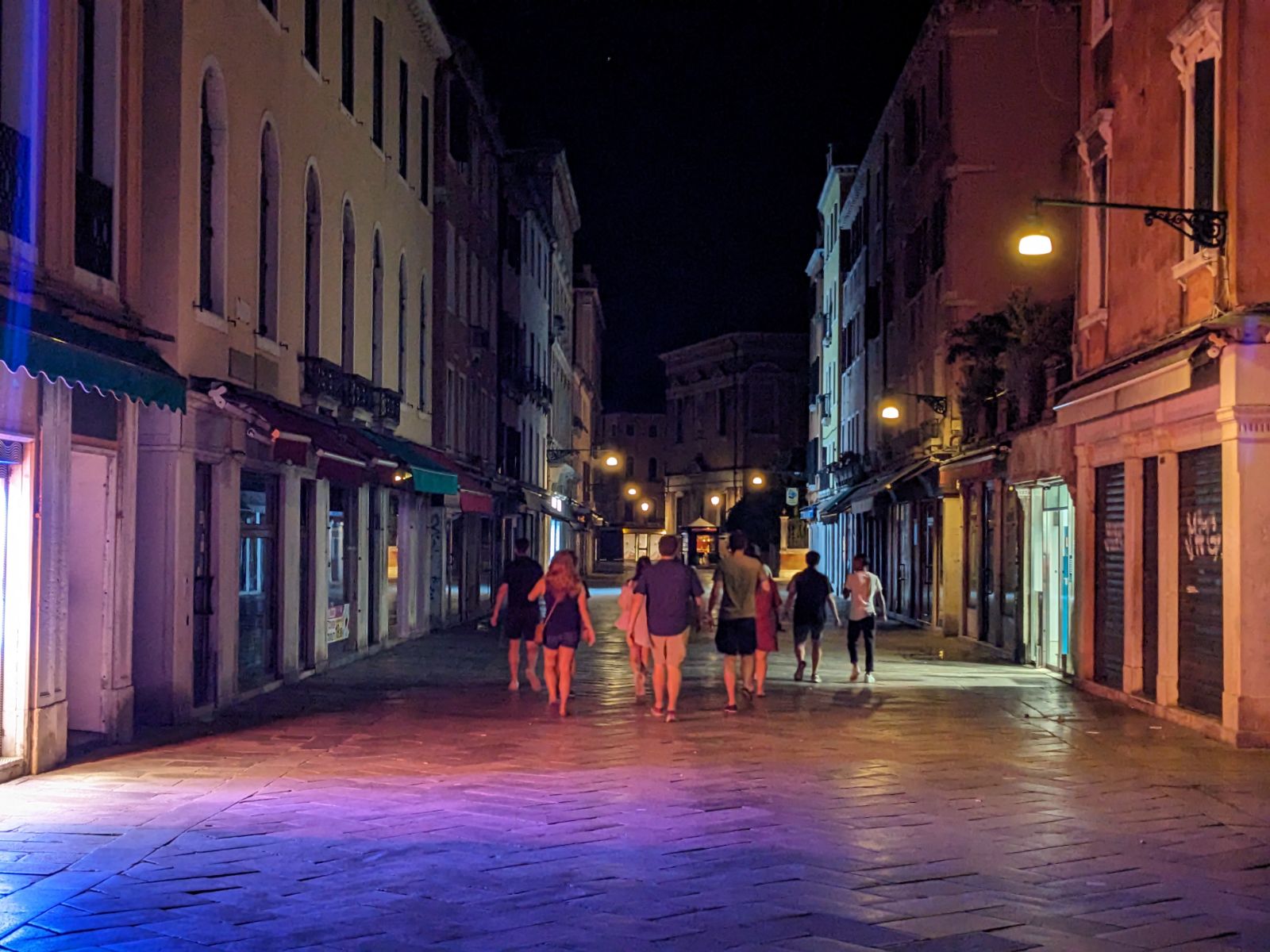
We know we are lucky to live this way. We toast to the lives we’ve lived, we toast to those who can’t be with us, for whatever reason; we toast to our hosts and to the achievements of some of our party and to our freedom to revel in this escape. Nineteen years ago, it was easy to take this sort of opportunity for granted. Now, with my grandparents and an aunt and an uncle and a couple of cousins out of the picture and some others who should be here prevented by life events, it’s not hard to recognize what a treasure this is. I will forever hold close that unique joy of strolling through a completely foreign city and seeing my relatives scattered here and there around the corners, chance encounters on the streets of Venice or Ravenna or Barcelona as we devour everything the world has to offer.
And eat it up we do. It is not uncommon for the discussion to roll until 2 AM on stateroom balconies or over pizza in the solarium. Perhaps we are debating Supreme Court cases and housing policy, or perhaps we are telling bits of our own complex stories; perhaps we are comparing tasting notes on our contraband beer, or simply noting the absurdities of cruise ship life. We are here in this moment, free to forget lost bags or loves or other regrets or anxieties, riding waves with ease.
First and foremost, a thank you to Monica and Chuck for treating us to this adventure, and to Jim, who patiently comes along for my Ravenna shopping excursion and carts things back. Steph and Kyle perfect the art of smuggling beer on board and are Rob and I’s most frequent partners in crime; David is also a regular at our beer tastings, with his wife Monica joining on a few of our shore excursions; Alex and Meghan seem to perfect the balance of deep dives in with us and retreats into their own time. Becca likewise stays close as a stabilizing force, aided in her effort by Amanda, while Molly, now 18, comes out to join the party regularly, and Katie dips in her toes here and there. Bibs and Haley liven up the full day in Venice and any dinner or evening where they join the festivities; now we just need to get your partners out for the fun. A thanks to John and Megan for hosting me in the Twin Cities the night before our departure, and for finding a good blend of good life and retreats. Paul and Laura, it was a pleasure to share some dinners and drinks and see the world through the eyes of your kids. The next generation makes its imprint: Luke is well on his way to being a trivia force, Emma was the queen of the Flat Monicas, and Jack and Liam kept me plenty entertained.
On the last night, Uncle John and I bask in repose with cigars on the windy pool deck, though we stub them out a bit early so he can be back with his co-conspirator at the center of the party, Aunt Reen. Aunt Marge probably won the award for enthusiasm for the whole cruise beforehand, and she and Uncle Steve live it up and foot the bill as we clean out her shipboard balance on the final night. Aunt Mary Beth is forever at the core of things, and along for an uphill trek to a wine tasting too. A thanks to Aunt Lucy and Uncle Bob for letting me be a sort of appendage to their family as I room with their son, and to their help with Aunt Trisha, who we are delighted to see make the trip. Props to Aunt Kristin (and Chris and friend Casey, joining us in Barcelona) for giving their girls a trip of a lifetime after graduation, and for finding ways for Uncle Joe to be a part of it. My Mom and Doug put up with Rob and I’s pace through Madrid, and my abandonment of them in Newark, with aplomb. We Maloneys get to know the McQuaid side a bit: Bill, Rose, Dan, Jan, Stephen, Amy. That adds to forty-two, but we also need to give a shout to Uncle Mike and Aunt Chris, who show us a marvelous time when they come along for the ride in Venice and Ravenna.
I had one goal as a tourist on this trip, and that goal was to see the School of Athens in person. The rest was all negotiable. And when I gaze up at Raphael’s masterpiece in that fleeting rush through the Vatican Museums, I can’t help but think of this sprawling family, always in debate or relating tales, gesticulating toward the clouds or at the things we know, a cacophony of voices where one or two may raise higher from time to time but where we need all of the voices to make it what it is. A reproduction of The School of Athens hangs above my mantelpiece because I live for this conversation, at times a central player and times a peripheral figure but always there for the dialogue until the last bit of sand has run out of the glass at the end of a very long night. That, Raphael shows us, is the essential core of the human condition, seeking and probing and finding community amid all our eccentricities, all our strong beliefs, all these jumbled ways of living that nonetheless stem from a common root. May the project never end.
And yes, I am keeping track of everyone who said they’d pay a visit to Duluth.
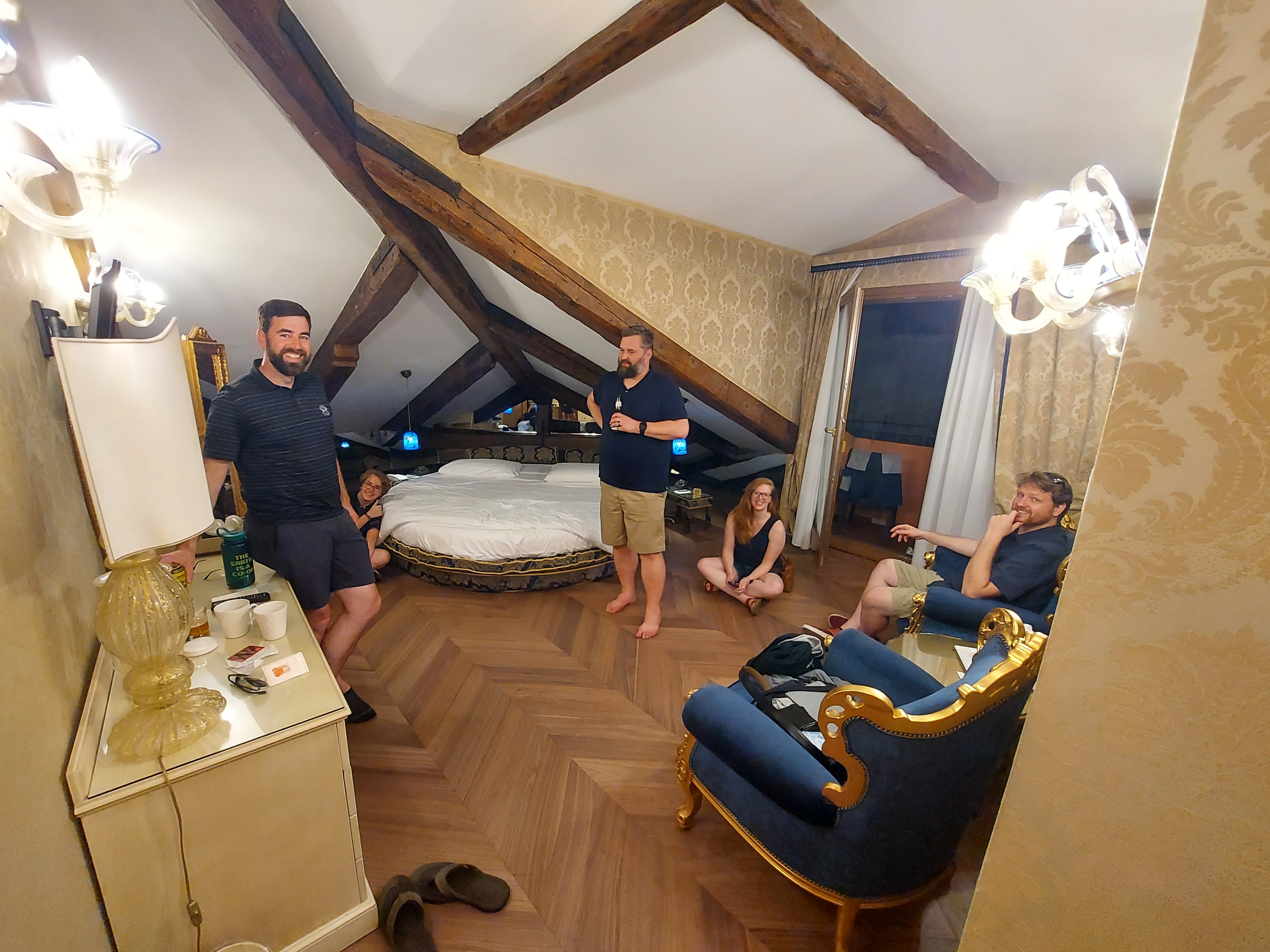
Bring us all together again, one gentle blur of an evening, a dance played out a hundred times over and yet born anew as it if had never been done before. Wine and craft beer flow freely, our lubricant and our vice; clumps of conversation arise in every corner, and we drift from one spot to the next, life updates and stray jokes, some holding down tables for the party to come to them or others bringing the party with them wherever they go, a small court emerging here, yard games over there, a dance floor emerges whether there is one or not, some cigars in one corner, and of course euchre in full force in another. Before long it is late, very late, and there everyone is in your hotel room, nightcaps and literary talk and deeply honest riffs and a bag of Bugles, obligated to host because your body knows not to waste one second, not one chance to descend down the rabbit hole and tease out some old history, some powerfully held opinion, some source of debate we can all drive at but then step away from again because these ties here are much too thick for it to be any other way.
Somewhere amid it all is a moment of clarity, that fleeting instant when you can at once be fully immersed in the full pageant but also able to step out and see it for all it is. A panoramic photo tries but fails to capture it because it is just life, the action instead of the place that makes this all work, each of us moving on an unseen orbit that brings us in and out of one another’s spheres, enriched a little bit by each passing turn. Escape to your room, recharge for a few minutes, flop on the bed or revisit your canon of choice for the words that give you what you need, that reminder to dive right back into all of this at its fullest, back in spite of it because how could you not. The parties grow loud and raucous but we all take that time, escape into our words or our lyrics or our woods, out from suburban comfort or vivacious city-dwelling to see every corner of what this world has to offer and return armed with stories, regale the rest when we meet again on a brewery patio or in the hotel lobby or just in that quiet corner we are apt to share with a few confidantes, each with our own way of casting off the madness before we dive back in.
In the fall of 2021 we gather in the absence of our matriarch, a generation now lost to us, the effort needed to pull together this sprawling expanse somewhat greater than it used to be, your own generation nearly all now into adult phases of our own with its myriad new responsibilities, gardens to tend to and new lives to grow that spring beyond the confines of the past, but you can’t help but think that the utmost we can gift to the members of a next generation is a chance to live a few of these nights themselves. But in the more immediate realm, well, you may go home exhausted, drained from all of that expense of energy and anxious over looming commitments beyond but you may find that in spite of it all here you are writing freely, your torpor finally broken, and the possibilities that these nights make visible spill out in one quick rush, renewed and ready for new beginnings, the faith that makes it all worth it once again.
On the weekend of my senior prom in high school, I took an impromptu trip to Chicago with my mother. For reasons not worth recounting here, my situation with girls was complicated, and I preferred to run away from it all. I had a few other things on my mind, too. The month before, I’d received my acceptance letter to Georgetown, a dream fulfilled; within a month, I’d be out of high school, and my parents’ divorce, long in the works, would be final. I was not exactly in my most stable mental state. I needed an escape, and my grandmother’s 80th birthday party provided a retreat into a safe harbor.
At the party, I had a moment to myself with my grandmother. She proceeded to give me the longest, most heartfelt hug I have ever received. She expressed some pride that I was headed to Georgetown—maybe I’d turn out a good Catholic boy after all!—but it quickly dawned on me that she was saying far more with that hug than a comment on college choice. There are a few people in life with whom I feel deeply in tune, fellow observers of the world passing before us whom I can read and who can read me in an instant. A quick look, even when cryptic, could convey paragraphs. Grandma was one of those people, and it was in that moment that I came to understand the meaning of unconditional love.
Her smile was a window unto an eternal incandescence. Her spirit gushed and overflowed and swept us up, making us forget pity, caution, concern, everything but the pleasure of her presence. -Wallace Stegner, Crossing to Safety
Grandma was something of an expert on the topic. As the mother of twelve children, she shepherded them all through their highs, lows, and all of the tumult that our sprawling clan mustered. If natality, as Hannah Arendt claimed, is indeed the miracle that saves the world, she brought about that destiny time and time again. It all seemed to come with a certain ease. There were, of course, times when it all drained her; times when wayward members of her lineage led her to shake her head and purse her lips. But she knew that the richness of her creation far exceeded its exhaustions, and by the time I came along, she’d seen it all, and knew what we needed in certain moments.
That innate connection appeared once again when I saw her for the final time this past April. Due to the coronavirus it was our first in-person visit in over a year, and she was moving more slowly, thinking more slowly, steadily slipping away into the mists beyond. We both seemed to have the sense this might be the last time we saw each other. We had a long goodbye, and we shared one final significant look that said it all: we would confront what came next, not without a little fear, but also with knowledge, with a certain faith. That was enough to see us through.
Grandma’s death this past week, at the age of 93, came with a characteristic grace. While there were struggles, she always seemed to slide easily and deliberately through life, and there was never a radical turn. When she lost her husband of 67 years, she mourned but moved on, kept up her joyous spirits, tiring more easily but still ready to be part of the endless family party. Unlike Grandpa, she did not crash with age; instead, it was a slow, gentle fade, tinged by the occasional frustration and uncertainty, but never far from her characteristic good humor. My Aunt Mary Beth took her in for the final four years of her life, an act of quiet heroism that made sure my grandfather’s rough decline in sterile hospitals would not befall her. She eased away with a steady stream of family visits and put up with the chaos of weekly Zooms during her final year. When it was time to go, she went quickly, waiting just long enough for Mary Beth to return from a much-needed trip with her son and grandchildren to Cape Cod, muttering a few final phrases in Polish to come full circle, family by her side as the breaths slid away.
Like her husband and so many of her progeny, Grandma possessed a robust mind. This young Polish girl from the city attended the University of Chicago in the 1940s, a feat whose impressiveness did not dawn on me until late in her life. While she didn’t get lost in intellectual tomes and debates the way Grandpa did, she kept herself busy, always ready to exercise a politely judgmental curiosity, whether over some book or movie or adventure of her offspring or in the complete tour of a giant book on art history that she and I once undertook. In coronavirus quarantine I picked up her crossword puzzle habit; toward the end, when that was beyond her, she settled for marathons of Rummikub, which now threatens euchre’s position as the official family game. If Grandpa was the driving force of nature who made their small empire possible, Grandma was its deep guiding core, her mere presence creating a sense that this all should come naturally.
The family Zooms over the final year and a half of her life gave us occasion to bust out old pictures and gifted me a window into the formation of a suburban Chicago matriarch. There were her childhood ventures to Devil’s Lake in Wisconsin, an ever-burgeoning clan filling first the house on Ardmore in Villa Park and then the house on Edgewood in Lombard, and later at the homes of aunts and uncles and out in Huntley. The steady string of lifelong friends, couples on a shared journey: Gingers, Gioias, Fanellas, and so on. Catholic masses, chaotic Christmas parties, Cubs games, a few European cruises, a papal mass. Joy filled it all from start to finish.
Grandma fell in love with the Northwoods of Wisconsin, long a family retreat, and I can still see her contented smile on the deck overlooking East Twin Lake. My Aunt Lucy’s transcription of her Northwoods journals early in the coronavirus pandemic were a revelation, a deeper dive into a mind whose contours felt both new and exactly right. Her work inspired me to start a simple journal with posterity in mind, a daily exercise that got beyond the alternating poles of incredible detachment and deeply personal musing that consume so much of my own output, and settled for easy reflection on the passing days. “I try not to feel apprehension — keep telling myself to just ENJOY what we’ve been given,” she writes on day one of the journal. An ethos we can all take to heart.
What I will remember forever, however, is her laugh. It had a full spectrum, from a quick chuckling eddy to a deep, full-throated roller, a cycle of the tides to fit any occasion. It was always ready, sometimes delighted and sometimes resigned, but always able to light up a room. The punches have come hard for us Maloneys in 2020: first an aunt and then a cousin and now the woman who birthed it all. At least now we can all be together again in the flesh to send her off. So I will dust off my suit, pour myself a Manhattan, and prepare one final do widzenia to the woman whose easy delight at the world around her made possible a life in accord with the rhythms of her world. We multitudes who follow all carry that light.
My Aunt Kathleen, aged 69, passed away this past week.
I knew Aunt Kat least well of my mom’s eleven siblings. I’m not sure how different it could have been, a reality that eats at someone ever inclined to probe the depths. She had suffered, her body broken down by some of the demons she’d faced, and she was who she was. I did not know her before any of that. Her story there is not one I know well, and it is not my place to tell it.
By the time my memory of Aunt Kat starts, she had become a steady constant amid the endless party of my extended family. She arrived early to every family gathering and stuck through them, often settling into a corner with my grandmother or a few other confidantes, ever composed and calm, head propped up by her arm as she held forth with her gravelly voice. Even if she wasn’t okay, she probably said she was okay, taking care of things at her deliberate pace, baking her famed brownies and, of course, collecting yet more Peanuts memorabilia. She diligently sent her nieces and nephews gifts and clip art cards for Christmas and for birthdays, her loyalty to her sprawling extended clan unwavering. (The final one I got still hangs in my kitchen, and will stay there for some time.)
Her faith was her solace and her eternal compass through what she endured, her very literal saving grace. Too many people who fall into holes do not have guides back out, but Aunt Kat did, and it kept her going for decades. Perhaps the only memory of her I have away from a larger family gathering comes from a night when I attended a Midnight Mass with her and my mother as a kid. I remember nothing of the service—I was, if memory serves, enjoying a novel excuse to stay up late—but I remember her at prayer.
Aunt Kat got out and saw much of the world, did a few cruises on her own; she kept that going right up until the end, with a perhaps over-ambitious final voyage not long before Covid shut down the world. In her final year she shared some of those memories on what became a weekly family Zoom, putting up past pictures of journeys I’d never known she’d taken. Thanks to those Zooms, I had the pleasure of seeing her more often over the past year than at any other point in my life, and at some point I registered how pleased she was to see me on those calls semi-regularly, perhaps providing a vicarious window after I bought a house or flitted off to St. Thomas. I never tapped it fully, but there was plenty of wealth tucked away in that mind, rich in experience from her travels and the network of friends I knew little about before the stories shared after her passing.
Aunt Kat’s death was not Covid-driven, but the pandemic still robbed us of a vital ritual, that great outpouring of collective grief that has come with other family deaths. I tuned in to the live-streamed funeral Mass from my home office, where I watched the backs of the heads of a few family members scattered about a church in Illinois; after the pallbearers exited, I clicked out of the video and promptly joined a completely unrelated virtual meeting already in progress. This is not exactly what closure looks like.
Thankfully, the family piled on to another Zoom in the evening for a virtual wake of sorts. A few more memories poured out, interspersed with discussions of the estate; naturally, she’d tidied up her affairs and left things in good order. (The tidiness of the house she left her two godsons, on the other hand, is a different story.) There were pleasant drifts in to topics far more mundane. Many were not quite ready to talk, still processing a looming absence in our midst. The eldest of the nine Maloney sisters is gone now, but she is seared into the minds of her clan.
For me, that final image is of her in the Sculpture Garden in Minneapolis. We were in town for a family wedding, passing the time between functions and touring the town I would soon come to call a temporary home. It was a warm summer day, and she’d walked a long way; she was seated on a chair in the shade, resplendent in red, tired, but content. At the end of a road of uncommon perseverance lies grace. She had arrived.
John Maloney, the co-founder of a family that included a wife of 68 years, 12 children, 20 grandchildren, and four great-grandchildren, passed away over the weekend. My grandfather ruled his clan from his suburban Chicago roost, and in his later years from a lake home in northern Wisconsin as well, always a welcome meeting point for the Duluth-based branch of his family. His obituary spends over half its words listing offspring, a fitting tribute to an expansive legacy. He was a true patriarch, a throwback to a now-rare masculine ideal of a father, a breadwinner, a man of faith, and one whose larger-than-life figure left an indelible mark.
My grandfather had a certain curmudgeonly quality, the sort that intimidated me as a young kid but delighted me as I grew into a person who had more than a few things in common with the man. We shared strong literary interests, fondness for baseball on the radio, pleasure in hosting large parties in spite of our introversion, enjoyment in holding court on weighty affairs, the occasional need to escape to a lake, and some skinny ankles. At the most profound level we both aspired a quiet but firm sense of righteousness stemming from an intellectual worldview, and a desire to leave something that lasts. I don’t aim to copy him, either in his unflinching faith or in his reproductive prowess, but his life is evidence that something akin to what I aspire to can be done, and he is as much an inspiration here as anyone I know.
My grandfather, composed entirely of pictures of his progeny, now hanging in my hallway.
It wasn’t easy to break through the crust with Grandpa. He was firm in his beliefs and set in his ways, a product of both his times and his faith. While he was rarely one to open up or acknowledge that things were not always right, he did live by example, and set a standard whose consistency said what words sometimes could not. Grandpa lost his own family fairly early, and wasn’t going to let the same thing happen to him. The son of an accomplished PR man whose employers included the Museum of Science and Industry before an untimely and alcohol-driven death, he attended the University of Chicago, where he met my grandmother, and married her at age 19. By the time he was 30, he had nine children. He settled into life as an actuary, became an iconic midcentury father figure who put twelve kids through college, and with his wife instilled in so many of them his fondness for letters, music, liquor, and the finer things in life.
Central to Grandpa’s kingdom was the kingdom of God, and his robust Catholic faith was the foundation of his life. That faith produced remarkable marriage, and all of his certainties on family life the he lived out until the end. He savaged me for going to Georgetown—“that’s a Jesuit school, why aren’t you going to a Catholic school?” he asked when I was accepted—but it was all in good fun; perhaps he even hoped Georgetown might guide one of the wayward members of his flock back into the faithful fold. (I think he thought I should have been a priest, which, given my fondness for sermonizing and asking big questions, might well have been my fate in a different era.) The last substantive conversation I remember having with him before his decline was about a former professor of mine who wrote in First Things, a densely intellectual and traditionalist Catholic journal that he read. His belief was profound, both spiritual and intellectual, a totalizing force that left no room for doubt. I never shared it, but I certainly admired it.
The last chapter of his life was not an easy one to watch. Grandpa never did recover from the effects of prolonged anesthesia two years ago, and most traces of his once formidable intellect faded away. His final years were spent slumped in his recliner, or rolling about in wheelchairs through hallways of several homes for the elderly with increasing levels of care, the institutionalized prolongation of desperate dreams that old age has become. I only had glimpses of this life, but it was still a shocking window into this sad decline; a sort of pain and loss of faculty that I cannot fathom and doubt I’d be able to handle without going insane.
Fortunately, though, we can choose what to remember of those who leave us, and with Grandpa, that means focusing on the rich first 85 years instead of the feeble final two. It’s a string of memories that begins with him forcefully squishing his grandchildren, and shaking our hands with his vice-like grip. It has him sitting at the head of the table and carving up the meat at Thanksgiving at the Lombard house, or seated at the piano to lead carols at the Christmas party. It features him heading out on East Twin Lake in his fishing boat or telling tales over drinks and cards late at night to the tune of the loons of the Northwoods. It meant classical music blasting on a Sunday afternoon as he devoured some large tome; Viennese waltzes on New Year’s Day and Garrison Keillor on Saturday nights. Popcorn at four, happy hour at five, bedtime in the little twin beds he and Grandma had side by side. Mumbled blessings before every meal, and the Cubs on a lazy summer afternoon. What a life well-lived. So I’ll toast my wine, pack my bags for an Irish wake and a funeral mass, and bid farewell to a man who built a family to endure through the flux of modern life. We descendants have big shoes to fill.
This weekend, my Uncle Jack passed away. He was always a welcome presence in my life, even if I never got to know him half as well as I should have. He was a man of great wit, and always a steadying presence in the midst of Maloney family holiday bedlam. Whenever one needed a breath of fresh air, one could usually find Uncle Jack tucked away somewhere, safe from the crush of humanity and at ease. And when he did move to insert himself into the middle of it all, it was often memorable: I remember the one year when, to everyone’s surprise, he was the life of the Annual Family Thanksgiving Political Debate, and had us all rolling in laughter. He passed with much of his extended family on hand, there for him in the end. He took his final breaths while wearing his bunny slippers, which he will also wear at his funeral.
My heart goes out to my Aunt Mary Beth, my cousin Paul and his wife Laura, and their children Luke and Emma, who didn’t get to spend nearly enough time with their grandfather. I wish I could have offered up more than a farewell card, send along with my mother as she hastened south to be with him this past weekend. This blog also lost a loyal reader, even though I’m sure that Duluth politics and high school hockey were never topics of great interest to him. He was dedicated to his extended family in his quiet, reliable way, and his absence will loom over future family gatherings. We’ll miss him, but we have much to remember him by, and he left a proud legacy.


 A Patient Cycle