This is Part Two in a four-part series. Part One is here.
Day 1: Wet
It rains. And then it rains. And it rains some more.
We begin the Camino on a riverfront promenade and then cross the long span of the Ponte, built to stay above any flood. The Camino turns out of town and quickly becomes a country lane along a rushing watercourse, and we struggle around a marsh before finding easier paths. At first the Portuguese countryside looks to be in a state of crumbling disrepair, but the town of Arcozelo is well-tended, stone walls and gates holding fine lawns with swimming pools. Garlic-domed churches peek up here and there, their bells tolling out the walk in 15-minute increments, and roosters serenade us through the morning. The rain picks up.
Statistics would suggest about 200 people finish the Camino Portugués on any given day this time of year, but in Portugal, all above and beyond the 100 kilometers necessary for a compostela, the crowds are sparse. The first fellow pilgrims we see are a mother and a 10-year-old son on bicycles, plastic bags on over the kid’s legs to keep off the mud, the scallop shell that identifies a pilgrim strapped to the back of his bike. Later, by a thundering waterfall on the crystal clear Labruja River, two German girls march past, followed by a Frenchwoman who idly twirls a stick like a baton. We catch them all and collect a few more at a stop for coffee and sandwiches and a dry roof at Cunha Nunes in Revolta, the first of the classic Camino cafes that cater to passing pilgrims.
In our infinite wisdom, we have started our Camino on the stage with the biggest ascent on the whole route. Granted, summitting the 1,000-foot climb up the Alto da Portela Grande is no technical struggle for someone who tackles passes in the Rockies with a much heavier pack every summer, but it is long and steady, and did I mention it was wet? We slog upward, fixated only on the muddy path in front of us. Never is this truer than on the last great push up, where the trail has become a flowing cascade the whole way down, a lengthy dance up this dancing brook to a completely obscured overlook.

The descent is speedy, and as we have not booked any lodging between Ponte de Lima and Santiago ahead of time, we are enticed by a sign for an option with heat, private bathrooms, and rides to a restaurant in the otherwise sparse rural hamlet of Rubiães. We cross one last Roman bridge, are overtaken by rapidly marching Germans, and turn to find Sofía’s hideaway, where we arrive just behind the two younger German women we’d seen in Revolta, who have made their way back here after learning the municipal albergue has no heat or hot water. A crew of Taiwanese roll in a bit later, too, and we all populate the bedrooms on the upper level of Sofía’s house.
Despite strong defenses, everything is wet. So wet. We set about rigging everything up to dry, clothing draped all over the place, passports and papers placed over the heater to rescue them. One of the Germans, Ariane, joins us for 5:00 dinner at Bom Retiro, a mile down the road, where we consume heaping portions and a carafe of wine for about the price of a single American glass. The downpours come and go as they please, though we still hopefully note every time the sky grows lighter. The hope is always false. We pass out early in the evening to the soundrack of Sofía’s kid’s faltering trombone practice.
In past hikes I have been in more brutal downpours and I have climbed steeper slopes, but their total effect here makes for one of the most punishing days I’ve ever had on a trail. And yet, with the ability to wring everything out and take a warm shower and clear it all out with a hearty meal and some wine with good company, I am sold. If the Camino can be this enchanting on a day when the trail turns into a waterfall, what can it bring on a good day?
Day Two: The Fortress of Silence
On day two, though the rain threatens occasionally, is liberatory by comparison. We manage to turn the wrong way out of the hostel—we hadn’t realized the access road to Sofía’s was the Camino itself—but before long we’re at a glass box of a snack shop staffed by a woman from Massachusetts beside Rubiães’ main church and a Roman milestone used by later inhabitants as a sarcophagus. Much of today’s route is on the old imperial road, beginning with a big bridge over the River Coura followed by a series of mile markers, those same roads built for legions two thousand years ago still guiding pilgrims today. We wind up through a few hamlets, climbing again past sheep and garlic domes, and we pass a stream that boldly claims the be the troutiest in the universe. Before long we enjoy a steady plunge through a eucalyptus forest and moss-shrouded paths before a grand view of the Minho River valley opens up, our destination of Valença on the Spanish border looming in the distance. The pace differences between pilgrims are obvious on the descent, as we are both passed and overtaken.
At the bottom, the town of Fontoura proves a disappointment: first we are hounded by a Russian woman trying to sell us overpriced snacks, the ATM doesn’t work for me, and the café is closed. (If the Russian had told us this, we might have been more convinced to pay up.) Two Danish pilgrims are swimming off the medieval bridge over the Rio Pedreira, but from here the path is fairly nondescript, tame woods and clusters of homes, and then a long slog through suburban Valença. We stop at a roadside diner, pricey but filling, a pitstop for a bunch of local blue-collar men on their lunch breaks. After two days of pastoral Portuguese countryside Valença is a bit jarring, as we walk up sidewalks with backpacks while city life moves on, the once ubiquitous yellow arrows to guide our path now few and far between, dwarfed by the urban landscape.
A push up a long incline, however, takes us into a new world entirely: the walled medieval compound of old Valença, a fortress town for thousands of years, guarded by great earthen bulwarks below thick stone walls, all from a perch commanding the Minho valley, the bridges to Spain within reach of a good cannon volley. Inside the town are a bunch of narrow streets and a lot of shops, all of which seem to sell towels. Towels, sheets, comforters, pillowcases: this is indeed the historical craft of Valença, and they carry it forward now, selling them all by the kilo. (If you were to ask “who could possibly need a kilo of new towels,” my response might be “most lodging options on the Camino de Santiago.”) We find its 11th century church, groaning with history, and get to know São Teotónio, a native son and Portugal’s first saint. We eat pizza at a trendy little shop staffed by a woman who responds to Portuguese speakers in Spanish.
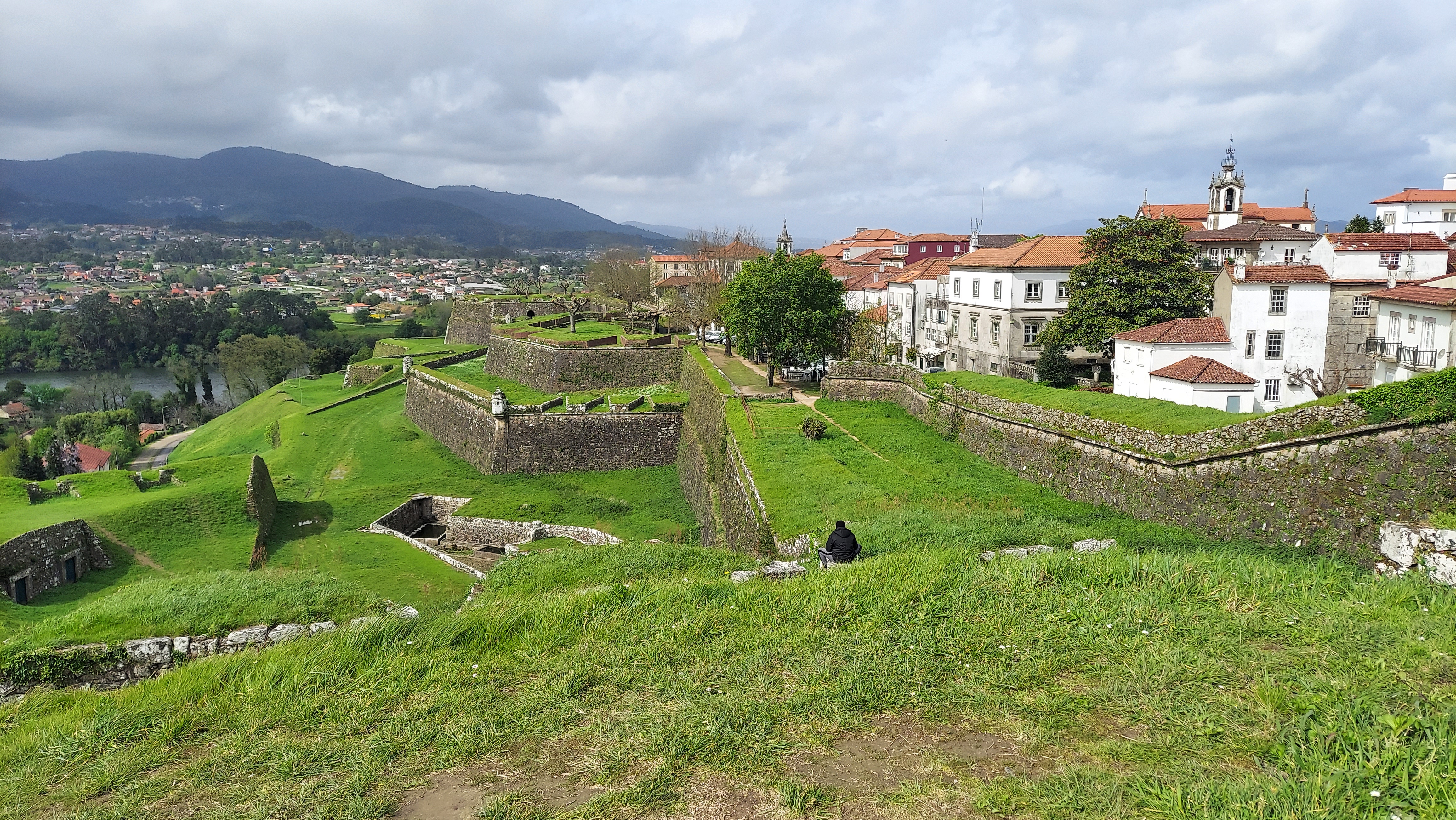
After a rest at the hotel we head out for a drink on the town, but we quickly learn the drawback of turning one’s town into a medieval theme park by day: by night, it achieves zombie apocalypse levels of deadness. No one is out, save for the tame cats by the church. We retreat to the room. My blisters have started to bloom, and I am in a blah mood. Valença is all very lovely, but it is a museum now, the pilgrims as unwitting accoutrements, and while it is perhaps the appropriate use of an old fortress atop a hill, one should not mistake it for Europe’s present. Take this night of quiet retreat, I suppose, and move on to Spain.
Day 3: Spanish Hibbing
After the torrents of day one and a vaguely ominous day two, day three dawns brilliantly, scattered sun and clouds but no hint of rain. An older northern European couple exits our hotel at the same time we do, but otherwise, Valença is as dead as it was the night before. We trudge down out of its dark gates and cross the Minho (or, now, the Miño) into Spain, past an austere Franco era guard station and on into Tui.
Spain is clearly wealthier than its peninsular partner. Fewer homes lie in ruin; there are real drainage systems. The pedestrian infrastructure is significantly better, and drivers actually stop for people. Every drink order comes with a snack. We are in a refined, thoughtful culture. There are trade-offs: gone are the blue tiles and garlic domes of Portugal. Rigid, solid stone now reigns supreme, especially in the locally mined granite, a building block to stand the test of time.
The seeming wealth is all relative, of course. Galicia is a poor corner of Spain, and like much of the country, its rural areas are emptying at such a rate that the moniker España vacía, or Empty Spain, has been slapped upon it. Next to well-tended homes are picturesque ruins, the slow decay of centuries-old structures no longer necessary to house the population here. Rural Europe in general is re-wilding at an unprecedented rate, with more and more greenery and the return of once-failing species such as the Iberian wolf. Of course this rush for the cities is happening in the United States as well, albeit blunted by immigration and somewhat higher birth rates. But immersion in a place where construction is very old gives a sense of just how complicated it can be to live among structures that predate modern technology, and just how much the run to the cities is reshaping the countryside. There is an eternal tension here between preservation and keeping things livable and letting them fade, a blurry spectrum for each small community we visit on this walk.
We rise up to the old city of Tui, a fortress to counter an invasion of towel-wielding Valençans, broad stone cathedral on top. As snake through the streets, we pass herds of pilgrims emerging to blink at the sunlight. At just over 100 kilometers from Santiago, this is the most common starting place on the Camino Portugués, and for the first few miles out of Tui it shows. We are caught up in a clump of 10 Spaniards plus a British expat named Alan, an Aussie herd, and a clump of British girls with unfortunate laughs who cackle at everything. These and other groups begin to leapfrog each other, with Alan and the Spaniards brimming with energy on day one but stopping to photograph everything. We pass another Roman bridge, ford a stream by a cross to a sainted pilgrim who fell fatally ill here, and enjoy placid, leafy lanes. The lack of breakfast in Valença has my dad growing hangry, but we’re delighted to find a snack break at a new establishment in A Magdalena, which manages to space out the pilgrim crew a bit and leave us in tandem with Marcia and Michelle, two American sisters who are good company.

We come to the massive granite works of O Porriño, complete with signs protesting its growth and a bevy of large houses from that very stone built to withstand the millennia. The debate here is familiar to anyone who comes from a place where people pull things out of the ground. There are more gentle lanes up and down wooded hills, a bunch of lazy dogs, a hobbled German pilgrim with a wounded knee, and our Taiwanese friends from night one. Porriño is not the most enchanting place on the Camino, but a river walk into town does some good in crowding out the factories on the opposite bank and the freeway on the near one, and the historic center, while not large, teems with life. Our lodging is basic but well-appointed, its view down over a busy bus stop. After Valença, I appreciate just watching humanity go about its business.
It strikes me, after a couple of beverages at the Underground craft beer bar, that Porriño is just a Spanish Hibbing, the equivalent of a blue-collar Minnesota mining town I know well. It has 17,000 people, a handful of historic buildings in its downtown, and is near enough to some pretty landscapes, but is itself otherwise forgettable in its urban form. And yet there is wonderful food, top notch wine, good craft beer even though that scene here has nothing on America’s, and it teems with life and bustles with families late into the evening, long after any American town of the same size goes dead outside of a couple nondescript bars.
I come away with a soft spot for Porriño, even if it has few clear charms. Here there is none of the museumification that consumes the centers of many small European towns. It is here where Galicia lives in its present, striving, dreaming like our enthusiastic craft beer convert behind the bar at the Underground, caught up in a debate over saving the verdant forests or mining the stone that has built this region’s wealth and newer homes. Kids pour out of a nearby school, bum around squares, settle into social circles even as they dream of a life beyond the bland apartment blocks that surround the old city core. In some deep sense, people in places like this will always be my people, the steady believers in a land that is anything but empty to them.
Day 4: Galifornia
Day four dawns grey and misty. Breakfast is jamón and tomato atop a large slice of bread from a harried woman as Alan and the Spaniards dine a few tables over for the third meal in a row. Porriño departs slowly, long damp streets before a winding road and the 100 kilometer marker to Santiago. The next few kilometers stroll through the town of Mos, a sleepy place that welcomes its pilgrims brightly and then turns them loose on a series of steady ups into the Galician hills. We trudge up with groups of Spaniards, including one jolly older man with a deliberate pace, though we lose him when we turn aside for lunch near the hill’s summit, a sandwich with a killer view. From there we go down, first on gentle slopes with the loud Brits behind us. We escape them at a churrascaria, however, and are alone for the plunge down into the outskirts of Redondela.
This walk down the hill is both incredibly steep and incredibly beautiful, rich green hills dotted with farms and cottages, fruit and flowers, resplendent in sudden sun, a snippet of a Ría Baixa, an inlet off the Atlantic, visible in the distance. Our hostel-keeper for the night calls this region of Galicia Galifornia, and I understand why. Everything is resplendent and lush, all that rain now showing its gifts. Closer to the mouth of the strait sits Vigo, one of the largest cities in Galicia, but our destination is Redondela, a city of 20,000 known for its towering train viaducts and old town on a hill, close to the sea but removed from it.

After a short urban trek we find the old town, and we’ve lucked out with our lodging. A Casa de Herba stands on a small square the middle of narrow stone streets, and our second floor room has a long balcony from which we can survey a small square and the narrow lane the Camino traces through town. The smell of cooking seafood wafts over us, and I sit on the balcony and write as we wait out a slow laundry load. We wander about, meet Julie and Susan from Saskatchewan at a sidewalk table, eat fish, stumble on a place with a craft beer fridge and retire to the balcony. The city life of old town Redondela flits by below us, pilgrims wandering in, locals heading out, kids chasing each other about, even some nuns.
We are halfway to Santiago, at the peak of the walking experience, all the buildup to this point now beginning its release, an exhale as we settle into this way of being, a pace set for the rest of the walk. I have little to write today. I am one with it.
 A Patient Cycle