UPDATE: I’ve took down this post because I got incorrect information. Here are my closing thoughts on Trent Klatt’s resignation and return as head coach in Grand Rapids.
UPDATE: I’ve took down this post because I got incorrect information. Here are my closing thoughts on Trent Klatt’s resignation and return as head coach in Grand Rapids.
Here’s my annual reflection essay on the State Tournament, which first appeared on mnhockeyprospects.com.
Sixteen games across four days, gone in a blur and ending in a daze: another Tourney has come and gone, and as always, I’ll put fingers to keys to find what few words have not yet been said. By early March my mind is all too ready for a trip to some exotic locale, but the vacation I really need takes me just a few miles east. We make our yearly pilgrimage to the spectacle in St. Paul, a dip into tradition that somehow offers a compelling new drama, night after night.
For a second straight year, a first-time champion hoisted a trophy. Wayzata proved all those old clichés about depth and defense true, as they locked down in the first two rounds and rediscovered their game with their backs to the wall in the final. The winning goal came from pure grinding hockey, a steady offensive zone cycle that wore down Eden Prairie, forced a turnover, and a set up a shot from the point. Their hard-nosed effort warmed this Northern boy’s heart, and the relentless push was a vindication for coach Pat O’Leary, who has made an art of overpowering hockey and finally brought his crew along, rolling his four lines right down to the final horn.
The lockdown Trojans were never a given, as their midseason stumbles inspired a sea of skeptics. But by the end Alex Schilling pounced on every loose puck while Hank Sorensen hammered all in sight, and they just managed to find a healthy channel for that simmering fire. They stole the headlines from Casey Mittelstadt, the Eden Prairie golden boy who nearly willed a team to a title. Casey’s dazzling show throughout puts him in elite company, his performance comparable to Besse or Rau in recent years. But he saved his most genuine moments for after the game, pulling himself from tears to speak with poise about his loss; even in defeat, he quickly righted any wrongs, and began to learn the burdens of stardom that will likely follow him for years. His Eagles fell short in the title game for the first time, but gave every last ounce for their teammates and their inspiration behind the bench, Steve Ollinger.
Wayzata’s physical play was far from the only throwback in a Tourney field devoid of its usual suspects. The Halloween Machine from Grand Rapids made its way south for the first time since 2007, and the old northern giants flashed some of their nostalgic magic on their way to a third-place berth. They were no match for Middelstadt, but for a spurt in the second period on Friday night they had all of 218 Territory rising in unison, as the band cranked out one of its impeccably timed Olés and the west end of the arena, painted in orange, bounced in unison. United with the mass of Wayzata yellow on Saturday afternoon, Grand Rapids pulled off one last stirring comeback to bring home another trophy for 7AA.
The Burnsville black and gold also made its way back to St. Paul for only the second time in twenty years, and for one period gave us a hint of past glory. Thief River Falls, another claimant to dynasty in a more distant age, cruised to small-school third place behind a pair of genuine stars. Anoka’s Tornadoes shocked the world by spinning their way back to the Tourney, and the Lumberjacks from Bemidji axed their way through the consolation bracket. Their effort against Rapids gave us the Tourney’s only overtime affair, and its one true thriller before Saturday night. All four northern squads went home with at least two wins and a trophy in tow.
But even as the old guard kept up its proud legacy, newer faces showed the changing tides in hockey and beyond. As the suburbs grow, so goes the high school hockey success, and Farmington and Stillwater gave us glimpses of the future with their tight opening game. There is a learning curve for these teams, as there is for the southerners who got shellacked on the first day of Class A, but whole towns turned out anyway, and who can forget Mankato West’s display on that first skate up to the line? The flow poured forth from buckets left and right, its perfection driving me to self-consciously run a hand through my own mediocre mane at the intermission.
There were no surprises in Class A this year: everything went according to seed, up and down the bracket. But there was sheer, sweet relief, as Hermantown finally threw off a burden worthy of Buffalo and brought a title back to northeast. The Hawks left no doubts, dominating each and every game, and while they’re no longer the scrappy upstart story they were a few years ago, they are out of a long shadow and ready to claim a higher mantel. One hopes they embrace the challenges that may come their way next, and whatever Bruce Plante decides for the future, he has now earned himself a less anxious summer on his lake.
With no Duluth East in the field, I thought it might be a more relaxed Tourney for me, but the infectious nerves still swept through on Saturday night as the Trojans ran the clock down. That emotion never gets old, nor does this yearly dive back in to meet friends old and new, to revisit those Tournament institutions along Seventh Street or opposite Rice Park. I can even enjoy a momentary foray into that cloud of adolescent male hormones that hangs over the upper deck of the X, though before long I’ll beat my hasty retreat back to the land of free popcorn up in the press box. It’s a reminder of who we are and where we come from, even if our immediate alma maters may not have made this trip this year. It’s all timeless, and we can all go back, if only for a little while.
It’s all over now, headed into history books and video vaults and the realm of memory. Memory and that sense of rightness, emblazoned in the mind’s eye, a home where it will stay longer than in any pictures or words that try to capture it. An early spring is already melting away any icy dreams, but there’s work to be done, and it won’t be long before we begin the cycle anew. Thanks, boys, for another memorable year.
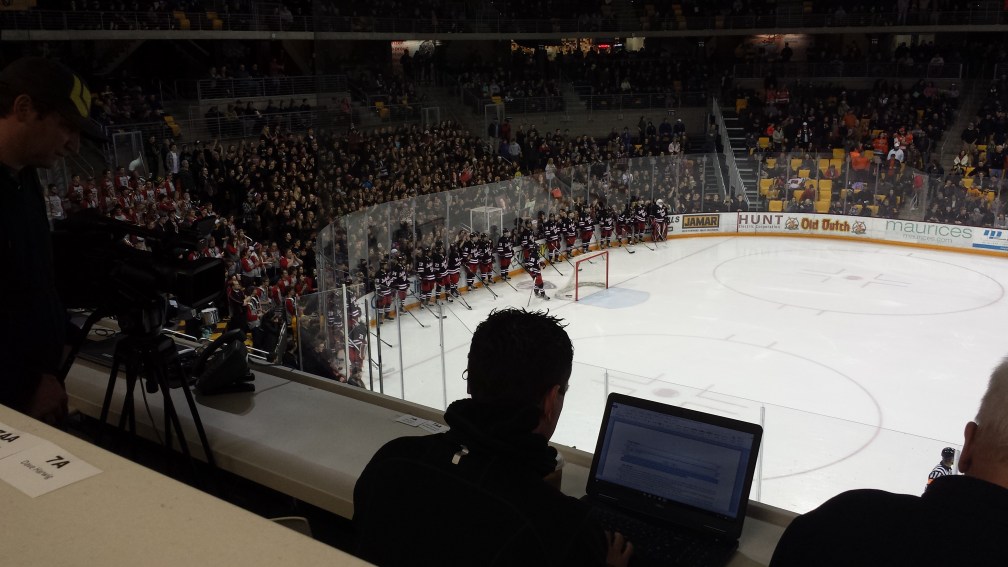
Duluth East’s string of seven consecutive 7AA titles has come to an end, as all great runs must. It came in heart-wrenching fashion, as rival Grand Rapids, so long the Hounds’ whipping boys, snatched away a 6-5 win on Alex Adams’ goal with six seconds left in regulation. East had just killed a late Rapids penalty, and the 7AA final seemed destined for overtime for a third straight year. It only took a momentary lapse; a sense that things might coast on into the sort of extra session that has treated East so well down the years. Instead, a supremely talented Grand Rapids team fulfilled its promise and punched a ticket back to St. Paul. If anyone ever earned the right to end a dynasty, it was this team, and they did it in a way that will go down in Rapids legend.
It was the sort of game that produced bedlam so incoherent that the details, in retrospect, are a blur. The leads went back and forth all night long, and the crowd at Amsoil Arena, 6,100 strong, nearly blew the roof off the building. For a fourth year in a row, the 7AA final gave us high school hockey at its pinnacle, as everyone in the building grinned manically through their nerves. This is how hockey is meant to be. Even when the Hounds grabbed their 5-3 lead in the third period, it never seemed safe. This was the sort of night where coaches’ best-laid plans went out the window, and it all turned on sheer emotion.
Not that Mike Randolph didn’t try. He switched lines and showed occasional glimpses of 2-3, and unlike the regular season game in which the Hounds sat back, they went at it with Rapids all night long. It made for spectacular theater. East used the TV timeouts to give Ash Altmann extra shifts, and by the end he was reunited with Ryan Peterson and Luke Dow, and those three marauded about the ice as the clock wound down. Even though his section final record now has a second blemish, Randolph took it with composure, and seemed downright proud of the Rapids players in the postgame ceremony. This one will sting, no doubt; it was a talented and balanced squad, even if it didn’t have the front-line firepower of Grand Rapids, East may not be able to match this depth again for a few years. But at this point, even someone as intense as Randolph can enjoy the spectacle for what it is.
Unlike some of the other big East senior classes, this one was often an adventure. They had their peaks and valleys, their moments of greatness and times of frustration. But they were playing up to their potential by the end, leaving it all on the ice as they barreled up and down the rink. One couldn’t ask for anything more. Altmann is perhaps the most identifiable name for the Hounds over the past few seasons, and was a force on Thursday night with a pair of powerful individual goals. His game-sealing dagger against Edina last season will remain one of the most indelible images in East hockey history. Peterson, a warrior through injury, likewise led this team, and has last year’s winner over St. Thomas to his name. Alex Spencer has his personal highlight reel of huge hits, Shay Donovan was always a steadying presence, Dow’s speed and dangles played a key role in many a win, and the versatile Nathaniel Benson found the back of the net for the first time all season in the section final. Auston Crist provided much-needed net-front presence, Marcus Skoog made his contributions, on John Orrey held down the backup goalie duties. We thank them for a long string of memories.
We East fans are blessed with eternal relevance, year in and year out. Even when the Hounds lose, it almost always happens in style, in a nail-biter against an elite team, with both teams giving it their all. It is hard to ask for much more. This year’s team was frustrating at times, with both flashes of great talent and head-shaking losses. I preached patience through their struggles, and with good reason: they would have it together by the end, and leave the ice with no shame. This latest batch of East players and their raucous fans in the stands are now members of this exhilarating hockey fraternity, one whose ties linger long past high school days. Whatever befalls the Hounds, be it a magical run like last season or the exploits of our alumni, whether it involves a crushing playoff loss or the rise of rival neighbors, we’re part of something that improbably draws us back, whatever roads we take.
I can now start to prepare for next week’s Tourney, which is East-free for the first time since my senior year of high school. It will be a strange feeling, but will also make it far less nervy, and I expect there will still be a host of Hounds wandering the X and downtown St. Paul. Grand Rapids’ elation at one Tourney berth makes us realize how lucky we are to have enjoyed so many, and as this great run now fades into memory, it will look that much brighter in retrospect. It began when East overpowered in Elk River in 2009, became routine in 2010, carried on through overtime after overtime in 2011, suffered heartbreak with a dream team in 2012, sought redemption in 2013, refused to die in 2014, and went on a magical run for the ages in its final season before Grand Rapids, four times East’s victim in sections over that stretch, broke through.
Some of the beauty of high school hockey comes in how fleeting it all seems, and how quickly it renews itself. There is promise for next year: a very talented junior class returns to take the reins, and as long as they find some depth, they’ll be right there for another run in 7AA. As I wrapped up my business in the press box Thursday night, I caught my enduring image from this season, one that sums up what this game and this sport means to all of us so simply: a lone Hounds player running up and down a flight of stairs in a near-empty Amsoil Arena. Conditioning for next season has already begun.
Just two years ago, I wrote about the departure of a Grand Rapids hockey coach. Now I’m doing it again. John Rothstein lasted just those two seasons in place of Bruce LaRoque, both of them ending abruptly in the section semifinals, and finishes 32-20-2.
Rothstein came in with the heavy burden of high expectations. The Thunderhawks’ religious fan base was hungry for another State Tournament. The talent level was on the rise, raising the stakes even higher. There had been some frustration with LaRoque—he wasn’t exactly subtle in saying that rumor-mongering about his handling of his own sons’ playing time was a key reason he stepped down—so maybe someone new could take the Halloween Machine back to its hallowed past.
It wasn’t to be, and I’ll be frank: I thought Rothstein’s teams did less with more than many of LaRoque’s did. Some in the Rapids fan base criticized LaRoque’s teams for going into a defensive shell in key games, but it usually gave them a fighting chance against more talented competition. In 2014, Rapids fans saw what happened when their team tried to skate straight into the teeth of a Duluth East forecheck, and there was never any effort to help out a very inexperienced defense. The result was their most lopsided section playoff loss in recent memory, despite having Mr. Hockey Avery Peterson and a talented sophomore core in the fold. Hunter Shepard was a fine goalie, but no one can be hung out to dry that often. The 2015 team improved defensively but was maddeningly inconsistent; at times flashing great skill, but far too easily knocked off their game and into mediocrity. Flustered by another disciplined East team, they sleepwalked through their first two periods in the playoff game before finally exploding to life in the final frame. But it was too little, too late, and too incomplete an effort to make any claim to victory, despite the absurd shot total. Rothstein tinkered with its lines a bit over the course of the season, an odd choice when he had a ready-made top line of star juniors at his disposal.
This doesn’t mean the inability to get out of the semis was all Rothstein’s fault. It’s hard to get high schoolers on the same page, and two years is hardly enough time to judge a coach with any finality. Mike Randolph didn’t make State until his third year at East, and only went once in his first five; it takes time to learn the ropes, and to get a whole program on the same page. Rothstein also had the misfortune of sharing a section with Randolph’s Hounds, whose recent teams have executed game plans and performed under pressure as well as anyone in the state, to say nothing of their healthy share of talent.
There were some real positives, too. Rothstein seemed widely liked and respected. He has overseen an overhaul of the Rapids schedule, ramping up what had been a fairly soft slate and giving the Thunderhawks a series of road trips to rival those of Duluth East and Moorhead, a necessary step for a team that wants to be on their level. They beat East in the regular season for the first time in twelve years, ending a long rut and likely ending any aura of invincibility. Unlike the 2014 squad, the 2015 team showed genuine signs of improvement over the course of the season. This Rapids return to glory is a slow process, and one that owes much to past coaches and a talent surge in the youth program, but Rothstein has ushered it along, and as was the case when LaRoque left, the future on the northern reaches of the Mississippi looks bright.
On Saturday morning, Rothstein told KOZY radio that he didn’t realize when he started that being a high school coach is a full-time job. He also told the Duluth News-Tribune that he’d never expected to stay for long, either. The former Rapids and Minnesota-Duluth standout is not a young man, and owns a business and teaches at a community college. His experience is proof once again of the amount of effort it takes to run a top high school hockey program, earning just four figures to do an often thankless job. Rapids’ next coach should be a younger guy who understands what he’s getting himself into, and one who is in it for the long haul. While it would be tough to attract an outside big name, there is more than enough hockey knowledge in town to carry the mantel, and with top-ten talent on board for next season–will this be the most talented Rapids team since the early 90s?–it has to be an alluring position. We’ll see who steps forward to claim it.
On Thursday night, I made the road trip 80 miles west of Duluth to Grand Rapids for a hockey game. The town of 10,000 people has a rather mixed identity: it is part vacationland, part paper mill town, and part gateway to the Iron Range. What isn’t in doubt, of course, is its status as one of Minnesota’s most storied hockey communities.
The Grand Rapids High School Thunderhawks (Indians in less P.C. times) won three titles in six years back in the 70s and 80s, and have produced as many college and NHL players as any school in the state. Recent decades haven’t been nearly as successful, but the program has risen again in the past few years, with two second place finishes in the mid-00s, two narrow section title game losses to Duluth East in the past three years, and a promising youth program feeding in. Thursday’s game had the potential to break Rapids’ long string of frustration against the Hounds, a team they’ve only beaten twice in their past twenty meetings. They entered the game on a six-game winning streak, and a win could have just about locked up the top seed in Section 7AA, something the Thunderhawks have yet to earn in the two-class era. They boast a Mr. Hockey frontrunner in Avery Peterson, one of the state’s best goalies in Hunter Shepard, and a bumper crop of sophomores. A capacity crowd packed its way into the historic IRA Civic Center, ready to blow the wood-trussed roof off the building if Rapids were to win.
Duluth East, however, decided to crash the party, and they did it in style. The Hounds smothered Rapids with superb neutral zone play and a relentless forecheck, grabbing an early goal by Nathaniel Benson for a 1-0 lead. Despite East’s controlling play, Shepard and the inexperienced Rapids defense was doing just enough to keep it close for a while. Rapids took a major penalty late in the period, however, and it was 3-0 by the intermission. “Why so quiet?” the East students taunted a silent Civic Center.
A few power plays gave the Thunderhawks a little more life in the second period, but East goalie Gunnar Howg saved the shots he needed to save, and another bad Rapids penalty set up an East power play goal late in the period. The Hounds went into cruise control in the third, not allowing a shot until over 12 minutes had passed, and adding a fifth goal with .5 seconds to go for some icing on the cake for the Cakeaters of the North.
The game was a total triumph of Mike Randolph hockey. His young Hounds executed his gameplan as well as any Hounds team ever has. They used their depth to their advantage, and the third line of Alex Spencer, Maysen Rust, and Nathaniel Benson—a potential concern I’d cited earlier in the week—was a wrecking crew all night long. The best player on the ice was not Peterson, but East defenseman Phil Beaulieu, who seemed unbothered by his huge amount of ice time, slaloming past countless defenders and shutting down every Rapids rush that came his way. He made some new friends as well, stopping for a photo op with Grand Rapids mites between periods. It was that sort of night for the Hounds.
Tactically, Rapids was a mess, as they tried to skate straight into the heart of the East defense and generated nothing in the way of odd-man rushes. If not for six power plays, they might not have mustered ten shots on goal. It was hard to find any sort of positives for the Thunderhawks; their one recourse, perhaps, is history, as East beat Rapids 5-1 in the regular season meeting in 2007, the year they picked up their sole playoff victory over the Hounds. This team can’t possibly be as bad as it looked on Thursday night, and while there are a bunch of things that would have to go right in a playoff rematch—better discipline, better breakouts, a willingness to do some dirty work on offense, a big night out of Shepard—it’s certainly imaginable that they could get it done.
East, on the other hand, has to make sure this mid-January win isn’t the peak, but only another sign of improvement from a squad that has already grown up a lot since November. They went to the box too often for comfort, and more 5-on-5 scoring wouldn’t hurt, either; they can’t count on major penalties, especially in the playoffs, when referees are more likely to swallow their whistles. But the win certainly put the rest of the state on notice, and we still don’t know how high their ceiling is. They now have a fighting chance at the top seed in 7AA, though every game will matter as they try to atone for their early season loss to Elk River. No matter how the season ends, the big win in enemy territory will go down as one of the highlights.
Bruce LaRoque, who coached Grand Rapids High School hockey for 14 seasons, retired on Monday, citing health and family-related reasons for his abrupt departure. He put together a 215-135-27 record at the helm of one of Minnesota’s most decorated programs in a stint that included six trips to the section final and two State Tournament berths, both of which resulted in second-place finishes. Once the dust has settled, Grand Rapids fans should be able to reflect fondly upon his tenure at the head of the small-town hockey hotbed on one end of the state’s famed Iron Range.
It is worth remembering where the Grand Rapids program was when he took over at the start of the 1999-2000 season. At the time, Rapids hadn’t been to State since 1991, and had only made one section final since. The incredible Rapids dynasty of the 1970s and early 1980s was a distant memory, and though the program still put out a star player every few years, it never mustered up the depth displayed by the rising suburban and private school powers, to say nothing of section rival Duluth East. In his 2001 book Blades of Glory, John Rosengren said that the 2001 Rapids team “played for pride, no longer for glory,” and seemed to be headed for the realm of hockey nostalgia much like their Iron Range neighbors.
LaRoque’s teams changed that. First, they took Duluth East to the brink in a pair of section finals in 2003 and 2004, and in 2006 and 2007, they broke through back to the State Tournament. They represented the program in style while there, knocking off the top-ranked team in the field (Hill-Murray and Edina, respectively) each year. Those Thunderhawk teams were also perhaps some of the last of a dying breed in Class AA hockey: while they had two legitimate high school superstars in Patrick White and Joe Stejskal, very few other players went on to play beyond their senior year. These days, title contenders often have ten-plus players who play after high school; those Rapids teams did it with a group of kids who weren’t hockey specialists, but filled the old northern Minnesota stereotype of hard-working, hard-hitting multi-sport athletes. Grand Rapids proved that small northern towns could still be relevant on the State stage, even with apparent disadvantages in numbers and offseason training.
LaRoque’s final years were weighed down by a series of frustrating playoff defeats. Since 2009, the Thunderhawks have suffered three first-round losses—two of them upsets—and two agonizingly close section final losses to Duluth East. The 2011 loss to East, in which arguably the deepest and best Rapids team of the LaRoque era held the Hounds scoreless until the last two minutes of the third period, was especially galling. Indeed, Duluth East was a constant source of frustration for LaRoque, who had an on-ice record of 3-19-1 against the Hounds, though one of those wins was Rapids’ only victory over East in eight playoff meetings.
Between the disappointment of losing and some of the grumbling that occurred when LaRoque’s sons made the team—whether merited or not, a seemingly inevitable occurrence for any parent-coach—it is not hard to see how stress drove LaRoque from the game. He had to deal with a fiercely loyal but demanding fan base that expects Rapids to add to its storied history regardless of how good the competition might be. Through it all, he leaves the program in better shape than it was when he took the reins; while many other people and outside factors played a role, Rapids’ youth system is now among the strongest in the state, and looks capable of producing high school contenders for years to come.
LaRoque was never an attention-grabbing coach. He didn’t have the personality of other long-term northern Minnesota coaches like Mike Randolph and Bruce Plante, but his even-keeled style made things work. He didn’t blame outside factors for the program’s struggles, and took responsibility for losses instead of passing things off on the referees or other things beyond his control. In an era when many players leave for junior hockey, Rapids has been unique in its ability to keep its star players at home. That is a credit to the power of the community, and LaRoque had a talent for respecting that tradition without over-hyping it or forcing it down anyone’s throat. Whoever succeeds him in overseeing the Halloween Machine will inherit a program that has its house in order as well as any in the state, and that is a testament to LaRoque’s success, no matter how frustrating those narrow losses might have been.
 A Patient Cycle