Duluth’s Divisions, Revisited: 2015 Election Analysis

After a minor delay, here’s a dip into the details of the latest election. As you may notice, my map-making skills have come a long way since I last did this.

Oswald

School Board At-Large race, Alanna Oswald vs. Renee Van Nett (Shown in terms of Oswald’s vote share)

We’ll start with the closest race of the night, the battle between Alanna Oswald and Renee Van Nett for the at-large school board seat. Van Nett’s campaign had a more explicit emphasis on racial equity—even if it was a bit vague on how that was supposed to look in practice—which probably explains her success in the city’s most liberal districts on the east side and in the center of the city. She also may have benefitted from sharing a ticket with the popular David Kirby in District Two in the center-east part of the city. Oswald, meanwhile, focused more directly on east-west equity, which helped her carry the west side. Oswald’s more critical history of the administration and endorsements from the likes of Harry Welty also likely helped her out west, where skepticism of the administration is higher. Still, she was much more than an anti-establishment protest candidate, as evidenced by her success in places like Lakeside and the areas over the hill. She was a nuanced candidate who ran a strong campaign, and gave Duluth a rare upset of a DFL-endorsed candidate in a city-wide race.
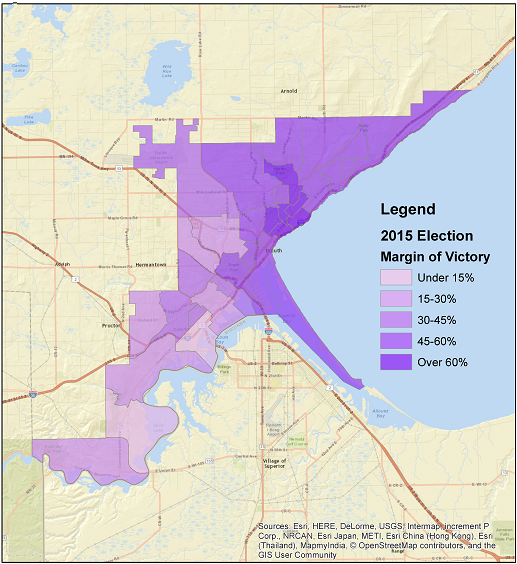
2015 Duluth Mayoral Race, shown as Emily Larson's margin of victory over Chuck Horton

2015 Duluth Mayoral Race, shown as Emily Larson’s margin of victory over Chuck Horton

The main event of the evening doesn’t look all that thrilling; Emily Larson won every precinct in the city in the mayoral race. Still, the margin wasn’t consistent, and reveals the old east-west divide that has punctuated most two-horse races in this city for at least the past decade, if not longer. (Someone with a longer historical memory than a 25-year-old will have to weigh in on the older details.) These results suggest the east side is again driving the agenda, while the west comes along for the ride with varying levels of agreement.
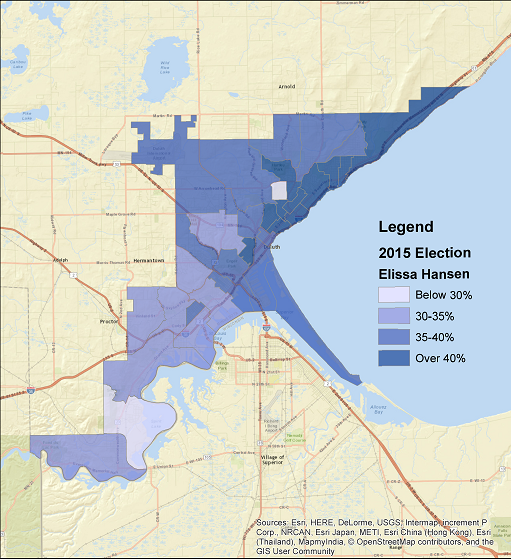
Elissa Hansen's performance, 2015 city council at-large election.

Elissa Hansen’s performance, 2015 city council at-large election.

Noah Hobbs' vote share, 2015 city council at large election.

Noah Hobbs’ performance, 2015 city council at large election.

In the city council at-large race, Elissa Hansen won all but four precincts, though her margins again tend to map on to the east-west divide. Like Larson, she is a poster child for continuing the Ness governing vision with her optimism, youth, and emphasis on inclusion. She lost three precincts to Noah Hobbs, and the two tied in the fourth. All four were pretty predictable: Hobbs, a recent UMD grad, carried the precinct on the UMD campus, and did the rest of his damage on the west side. Hobbs is a died-in-the-wool west-sider, so this only makes sense. (It wasn’t an accident that those lawn signs had Denfeld colors.) This is a second straight election that a younger person has eclipsed the establishment favorite on the west side, but I wouldn’t read anything too deep into this. Zack Filipovich simply had a stronger ground game than Barb Russ on the west side, and Hobbs’ ties carried the day on Tuesday.

Jim Booth's performance, 2015 city council at-large election

Jim Booth’s performance, 2015 city council at-large election

Jim Booth, a Duluth Heights resident, did best up in that region. As the relative conservative in this race, I thought he might do somewhat better on the west side, and while his percentages were somewhat higher, he still ran behind Hobbs nearly everywhere. An explicit west side focus outweighs any ideological loyalty. Anyone who seeks to speak specifically for that side of the city will do well.

Sticking with the west side theme, these trends become more acute with if we hone in on the Fifth District race. Here, Jay Fosle beat Janet Kennedy by a fairly comfortable margin. Still, the district has two clear halves: in the Denfeld and Oneota areas, Kennedy kept things very competitive; she was within 21 votes in the four easternmost precincts in the district. However, she got whipped in the far west precincts, particularly in Fond-du-Lac, Gary-New Duluth, and Morgan Park. This is Fosle’s home base, so it’s not stunning, and across the board, these very far west areas were some of the strongest areas for the more conservative candidates in the field. To the extent that the west side now has an anti-establishment reputation, it is rooted in the very far west.

2015 5th District city council race, Jay Fosle vs. Janet Kennedy, shown in terms of Fosle's vote share

2015 5th District city council race, Jay Fosle vs. Janet Kennedy, shown in terms of Fosle’s vote share

This may be a long-running trend, and the precincts in question are a small enough sample that personal ties for someone like Fosle can make a big difference. Still, this gap endures despite a very intentional effort by the Ness administration to launch a redevelopment effort in this particular corridor over the past two years. That’s significant, and shows that the west side, even if they like the leader of the River Corridor Coalition as a city councilor, still isn’t entirely on board. Once again, the west side wants to talk about west side issues, not the broader liberal ideas one tends to hear from the establishment candidates.

At the risk of conflating a mild political divide and a much deeper discussion, the west side’s demographics hew to a recent attention-grabbing study on the plight of working-class white men. This group feels increasing alienation from the people in power, and whether this involves suicide or more insidious forms such as heavy drinking or drug use—a concern that Fosle, to his great credit, was waving in the face of the Council several years ago—they are dying at a faster rate than before. It’s certainly not hard to see how this affects politics. (See Trump, Donald.) These are somewhat more existential questions on the fate of the American Dream, some of which I’ve explored before, and that theoretical discussion needs to continue. In the meantime, though, cleaning up that steel mill site and other post-industrial dreck, building some new housing on the site of a shuttered school, and bringing some jobs back to the west side will have to do.

In the big picture, however, Fosle’s constituents have themselves a protest vote. Don Ness was not running for office on Tuesday, but he loomed large over the whole race, and his ethos reigns supreme. The city’s government is younger, and solidly on the left side of the political spectrum. Ness’s legacy will last long beyond his eight years in office, and while it will be many years before we can cast final judgment, there’s certainly more cause for optimism now than there was eight years ago. For most Duluthians, the trajectory forward was so obvious that it wasn’t really up for debate in this election cycle.

Still, there is nuance here. Duluth rejected the vogue electoral system because it didn’t get caught up in the latest flashy trend with no actual evidence backing it, and that is a win. A mild upset in the school board at-large race shows some discontent with the direction of the school district, and a refusal to impose a single vision upon it without debate. There is room in the tent for east side liberals and west-side loyalists; for total believers in the Ness vision and a loyal opposition. The more open the process, the greater the odds that a portion of the city won’t get left behind. We’ll see what Emily Larson and friends do with that new mandate.

See two more maps in a follow-up here.

Duluth General Election Results and Comments, 2015

Another election season has come and gone. Your results, with percentages followed by actual vote totals:

Duluth Mayor

Emily Larson 71.9 (15,352)

Chuck Horton 27.5 (5,862)

It’s a long-anticipated coronation, as Larson rolls into office. She’s basically been inevitable since most of the realistic challengers stood down early in the election cycle, and now she finally gets to move toward governance. Her policies will likely be a continuation of those of her predecessor, Don Ness; under Larson, Duluth should continue its re-invention as a creative, energetic city. Still, she’ll certainly have an opportunity to carve out her own legacy outside of Ness’s long shadow, and we’ll see what innovative ideas she brings forward, and how she looks to manage those who aren’t all on board with the Ness agenda. She is Duluth’s first female mayor.

City Council District One

Gary Anderson 61.9 (3,902)

Karl Spring 37.9 (2,389)

No great surprise here, as the far east side elects the more liberal candidate to replace Jennifer Julsrud.

City Council District Two

Joel Sipress (I) 97.5 (2,891)

After an unopposed run, Sipress returns to a council where he is suddenly among the more senior members. First appointed in 2014 after Patrick Boyle was elected to the St. Louis County Board of Commissioners, he now gets a full four-year term.

City Council District Three

Em Westerlund 82.4 (2,278)

Barri Love (withdrew from race) 16.8 (465)

Love’s withdrawal left Westerlund with no competition in this race to replace Sharla Gardner in the center of the city.

City Council District Five

Jay Fosle (I) 56.4 (2,215)

Janet Kennedy 43.4 (1,705)

The far west side of the city retains its contrarian streak and returns Fosle, a frequent skeptic of the Ness governing consensus, for a third term. Kennedy made up some ground on her primary gap, but ultimately failed to break through. Fosle is usually left playing the grumbling protest vote, though I definitely give him credit for occasional independent streak that produces some insights and occasionally highlights some perspectives that wouldn’t otherwise get a seat at the table. He is now the most senior member of the council.

City Council At-Large (Two open seats)

Elissa Hansen 37.8 (12,192)

Noah Hobbs 28.8 (9,271)

Jim Booth 21.5 (6,922)

Kris Osbakken 11.5 (3,699)

This script looks just like the one two years ago, as the two DFL candidates move through, leaving a conservative in third and a local Green Party figure in fourth. Hansen, a dynamic candidate with a background in economic development, was a shoo-in from the start. Hobbs, a younger guy with a lot of passion for the west side, should provide an interesting voice in coming debates over the future of that side of the city. The other two were always long shots.

City Council Big Picture: The Council’s ideological composition didn’t shift at all, as the lone conservative incumbent retained his seat and moderate liberals cleaned up everywhere else. There is on notable shift, though: there’s a youth movement afoot. Three of the nine councilors are now under thirty, and a fourth is in her thirties. In Don Ness’s wake there has been a generational shift in this city, and there’s a lot of young energy making its move into city politics. Do my generation proud, kids.

School Board District Two

David Kirby 59.7 (2,776)

Charles Obije 40.0 (1,857)

Kirby’s big lead from the primary carried through to the general election, and it’s little surprise to see him cruise through in a wealthy district that values its public education. He succeeds the polarizing Judy Seliga-Punyko, and he now gets to negotiate the school board minefield: is his positive talk a genuine desire to move forward from all this past junk, or will he follow his predecessor in staking out the battle lines? I thought Obije appeared a strong candidate, and hope he remains involved in some capacity.

School Board District Three

Nora Sandstad 64.2 (3,111)

Loren Martell 35.2 (1,705)

This makes three elections and three decisive losses for Martell; I thought he had a chance this time around, given his exposure through Reader columns and a more forgiving district. Instead, Sandstad carried the day. Like Kirby, she’s largely kept mum on big issues and said all the right things about staying positive and moving past recent ugliness; the big question now is how her apparent independence will play out in practice.

School Board At-Large

Alanna Oswald 51.5 (9,621)

Renee Van Nett 47.6 (8,910)

The tightest race of the evening also involved its biggest shift from the primary, as Oswald came back from an early deficit to ease past Van Nett. She was probably the most dynamic campaigner of the bunch, and if she can bring this energy to the board, it will be a very different place. If she can retain her independence, she’ll be a force. I also hope Van Nett continues her advocacy in key areas even though she’s not on the board.

School Board Big Picture: It’s a potential changing of the guard in ISD 709, as three consistent votes in the monolithically pro-administration bloc retire and three fairly new faces in Duluth school debates make their way in. Unlike some of the current and outgoing members, they don’t have long records siding with one side of the dead horse Red Plan debates. With two solid pro-administration votes and two staunch critics among the remaining members, these three now have the power to play kingmaker. Whatever they decide, one hopes they will stay above past squabbles, ask tough questions, and dig into the district’s most pressing debates. Color me cautiously optimistic that some new blood will leave the old debates behind and provide a much-needed jolt of energy for the real issues at stake.

Ranked Choice Voting Ballot Question

No 74.7 (15,564)

Yes 25.3 (5,271)

Mission accomplished.

My own opinions aside, this was quite the decisive vote. It shows how a campaign with considerable outside financial backing can fall to a largely grassroots local campaign (though Walter Mondale did weigh in on the ‘no’ side in the final week). It’s also distinctly Duluth, as the city chose not to follow in lockstep with the trend in the Twin Cities. Duluth elections will be a bit simpler for it, and perhaps we’ve finally heard the last of this well-intentioned but poorly supported and ultimately misguided attempt to “improve” democracy. Back to the real issues.

Non-Binding Lakeside Liquor Ban Repeal

Yes 59.3 (11,528)

No 40.7 (7,912)

This was, weirdly, a city-wide question, and the rest of the city had stronger opinions than the Lakeside residents did. Even so, opinion in Lakeside has shifted some since the 2008 referendum on this topic; at that point, it fell one vote short, while the DNT is now reporting the repeal got about 53 percent of the vote. Before I die, I will be able to buy a damn beer in my childhood neighborhood. (No, the 3.2 Coors at Super One does not count.)

Method of Setting City Council Pay Ballot Question

Yes 67.0 (14,031)

No 33.0 (6,917)

This procedural move lets the Charter Commission set council pay, which seems a bit wiser than letting them just vote on it themselves. Any new pay grade will still require Council approval. We’ll see if anything actually comes of this and revisit it if and when that debate starts up.

Time-permitting, I’ll be back with some comments on precinct-by-precinct results in the near future. Stay tuned.