The Big Tent

After the 2023 Duluth election cycle, I feel compelled to write an homage to the big tent. It is a nod to the power of candidates who avoid closing themselves off, the ones who have dialogue with people with whom they don’t agree. This year’s election was not an easy one: there was some blatant misogyny and an influx of outside money, from shadowy PACs to the crude but large arsenal of one state party, and an unsettled electorate made some moves. Those who cast their eyes widest were the ones who positioned themselves the best.

The power of the big tent is increasingly obvious in an era when so many people self-segregate into like-minded social circles and media bubbles. Duluth’s right is now so moribund that it can’t get candidates through primaries; its media echo chambers, while influential in other places, are useless in a city like Duluth. The hard left, after several election cycles of ascendancy, finally took near full control of the local DFL machinery and then saw its vote totals regress to their lowest levels in years, the power of those three letters unable to overcome rhetoric that only appeals to the already converted, especially in a year when it had no standard-bearer at the top of the ticket. Big tents are not exclusively the territory of moderates—figures left and right have figured out how to command them—but the edges of the spectrum are barely having the conversation these days.

The mayoral race illustrated both the allure of the big tent and its pitfalls. After eight years in office, Emily Larson suffered a crushing 20-point defeat. It seemed a shocking fate for someone who occupied the center of Duluth’s political spectrum, a firm liberal voice in a firmly liberal city. In theory she still commanded the big tent, and she had plenty of positive indicators on her side, and she spoke in sweeping terms about Duluth and its collective future. Even four years ago, though, as I knocked doors across the city, it became clear that having Larson as an ally was not a net positive for some similarly aligned candidates; something had gone awry in her relationship with many voters. It was never entirely clear who her sweeping ‘we’ included. Certainly not the right, which did not share all her values; only reluctantly members of the further left, which loved neither candidate but tended to prefer Larson’s messaging and frowned at Reinert’s conservative support. Not necessarily anyone who was struggling to make ends meet, since a two-term incumbent is in a poor place to highlight the things in a city that need fixing. After eight years of ups and downs through budget decisions, her labor allies were likewise lukewarm. She gave it her all after an ugly result in the primary, but two months cannot make up for eight years of people drifting out of the tents in ones and twos.  

Larson’s great strength is as an authentic communicator, and her ability to pull forth powerful rhetoric in the right situations was part of what made her seem like a rising star in the Minnesota DFL. This can seem like a contradiction for someone who was clearly not communicating as well as she could with a large swath of the electorate, but the flip side of authenticity can be a poor poker face. It was never hard for someone in a room with Larson to know when she was paying rapt attention or when she was disinterested, when she felt one’s pain herself and when her claim that she ‘heard’ or ‘saw’ her interlocutors felt pat. I experienced both myself over the years, and if I did as someone who had a modest but real working relationship with her, I can only imagine how that could feel for a rank-and-file city employee or a constituent who does not often speak to people in power. Her debate performance heading into election, in which she seemed to ooze disdain for the upstart on the stage next her, encapsulated her paradox: filled with pride in her record, hurt by the attacks lobbed her way, her time too short to engage in a true inquisition over what went wrong, powering ahead as best she could. It was a Greek tragedy in full, though I am curious to see her next act.

Into this drama stepped Roger Reinert, an empty vessel into which a lot of voters poured a desire for change. He attracted a right that despised Larson’s rhetoric and certain areas of focus, Democrats who’d felt slighted by Larson for one reason or another, people who saw in him a hearkening back to the less contentious Don Ness era when he built his political reputation, and some who just wanted something new after eight years. He stayed vague enough to bring them all in and he threw around some promises to claim more. This election felt intensely personal in part because there was not a lot of ideological space between the two candidates, though contra some narratives, I do think there were some differences between Larson and Reinert that genuinely matter, including their thoughts on what could be done about downtown Duluth, their stances on the Lester Park Golf Course, and the future of the library. Having opened up the tent to so many people and ideas, Reinert has set some lofty expectations; he now needs to stake the tent down into some core grounding so it can stand in harder headwinds off the lake. We’ll see if this peripatetic striver can muster it.

One group of candidates did seem to find that grounding this past election cycle. The clearest winners in 2023 Duluth were in the labor-backed council camp, which saw Arik Forsman, Lynn Nephew, and Janet Kennedy marched to victory by overwhelming margins, and Roz Randorf, who has her idiosyncrasies but is usually a fellow traveler, won unopposed. They, too, cast wide nets, but their campaigns still felt clearly grounded in certain visions. Reinert will need them to move anything forward as mayor, and they are here both to put the brakes on any riskier promises and to move the city in the direction of some sort of Duluth-centered consensus.

Late on election night, as I sat with a group of people from this camp at the Reef, I realized that we had, unwittingly, assembled the diverse sort of coalition many further to the left aspire to, a heterodox group of people sharing stories about how they became who they were: some raised in privilege and others in trailers, some grateful for the support of public institutions in their lives and others motivated to change it by the opposite experiences. Some have organized labor in their veins; others seem far from it, but are children of a lost majority in northeast Minnesota and know the sorts of voters their coalition needs to reclaim it. Everyone there knew that they could not move their own platform forward alone. They would need to negotiate and find some common ground.

The organized labor movement has had its failings over time, and it cannot put back together its 1960s coalition, or for that matter its Duluth area 2008 coalition. But its basic mode of doing politics, of inviting a lot of people into a sometimes rowdy room and collectively sorting out differences, has a lot to offer in an era when others try to live off high-flung rhetoric from a magnetic personality or a narrow plurality and sheer brute force. Somewhere in here lies the politics that can win the large majorities necessary to steer the ship of state. The election, of course, is the easy part: now it is time to do the work.

A Slowly Widening Gyre: Duluth Election Dissection, 2019

First, to explain my silence on local politics to the readers who don’t talk to me regularly: over the past year, I’ve had the pleasure of serving as the campaign manager for Arik Forsman’s at-large city council campaign. This blog’s ethos has always sought distance from any cheerleading I may do in private, and I much prefer to work with people directly than yell things out at the internet in the hope that doing so achieves things. Now that it’s all over, though, I’ll attempt to step back from my role over the past year and find the bigger picture.

Mayor Emily Larson rolled to a second term, though we always knew that was going to happen. David Nolle did manage to win four precincts, all of them in a row along the riverfront out west, from Irving to Fond du Lac. While political winds blow here and there in many of the other races, Larson holds a dominant center in Duluth politics. She’s heard some grumbling to both the left and the right, and her campaign’s efforts to spend a lot of time out west, knowing it had nothing to lose, didn’t yield stronger outcomes than her even more lopsided win four years ago. For now, though, the mayoralty is firmly in her hands, and she has a chance to see results from some of the longer-term projects that were at the center of her first term, such as the new streets tax and the medical district.

Elsewhere, however, some cracks in Duluth’s governing consensus emerged, and they were most evident in the at-large city council race. A somewhat conservative political newcomer, Derek Medved, paced the field, with Labor-endorsed incumbents Arik Forsman and Noah Hobbs coming in second and third. This at-large race was most notable for its surge in bullet voting, with voters on the left and right choosing only one candidate in the hope of getting theirs across the finish line. Forsman survived this new tactic, while the collateral damage in 2019 Duluth was Hobbs, whose low-key style and prolific policy work didn’t match the moment.

A Trump Era left rejects candidates who aren’t in lockstep with its vision. Mike Mayou, the left’s 21-year-old candidate, ran an interesting jumble of a race, at times displaying some real charisma with soaring rhetoric and at times making unforced errors like 6 AM primary election robocalls. Mayou broke through and seized the DFL endorsement, which seemed to have little short-term benefit but certainly emboldened the progressive wing of the party going forward. His general election performance improved somewhat on his somewhat distant primary showing, but in the end he appeared on a smaller percentage of ballots cast than Rich Updegrove did two years ago; his percentage simply looks a little higher due to all of the bullet voting. One moment he was a “UMD student,” and another he was a “community organizer,” which aren’t mutually exclusive but convey very different things; sometimes he seemed to just follow the incumbents’ talking points, even as some of his supporters trashed Hobbs and Forsman relentlessly on social media. Those supporters will no doubt blame Labor, which did not endorse Mayou, though that argument is difficult to sustain in a nonpartisan race in which one’s candidate is running against two incumbents who have delivered for Labor, and when one’s candidate finishes last among the viable candidates in both rounds; after the primary, I mostly stopped paying attention, as I knew the threat, so to speak, would come from the right. The Mayou campaign seemed an apt mirror for the progressive moment: filled with unbridled passion, devoted to national-level talking points, and at times more fixated on shaming its putative allies than the conservatives whose rise it may unwittingly enable.

City Council At-Large Results by Precinct

A well-funded and organized right, meanwhile, is well-positioned to exploit the leftward internal warfare. Still, Medved ran a vague campaign that really didn’t always align with the tighter messaging of his conservative funders. He won not because he was BizPac’s man (though the money didn’t hurt); he won because he made himself the face of the west side, and that east-west divide is increasingly the fault line in Duluth politics. He even won in deep blue Lincoln Park, and I’m not sure any more money or different messaging would have made a difference. While Medved isn’t particularly Trumpy, the tribal loyalty he inspired does have a whiff of national politics to it, and while both Hobbs and Forsman can claim some working class cred and have taken on bureaucratic red tape, it’s much easier to come across as pure on such fronts when one doesn’t have a track record. As a newcomer to politics, Medved now begins his education in governance.

The district races featured a fascinating mix. Becky Hall, a hard-working also-ran, lost by a substantial margin to incumbent Gary Anderson in the first district, while Janet Kennedy, after twice failing to break through in previous cycles, outworked Jeanne Koneczny in the fifth district. Kennedy improved her performance most notably in the Riverside/Smithville/Norton Park areas compared to her showing against Jay Fosle four years ago and became Duluth’s first African-American city councilor. BizPac’s two district candidates came nowhere near matching its at-large candidate. The third district race, which defied easy categories, saw Roz Randorf pull out the win over Labor-endorsed Theresa O’Halloran-Johnson. The gap closed somewhat after a lopsided primary, but Randorf pulled away with strong showings in the higher-income areas atop the hill and out on Park Point. One presumes Randorf’s loyalties lie more with the leftward core that ran her campaign than her initial BizPac donors, but she offers a potentially fascinating wild card on the council.

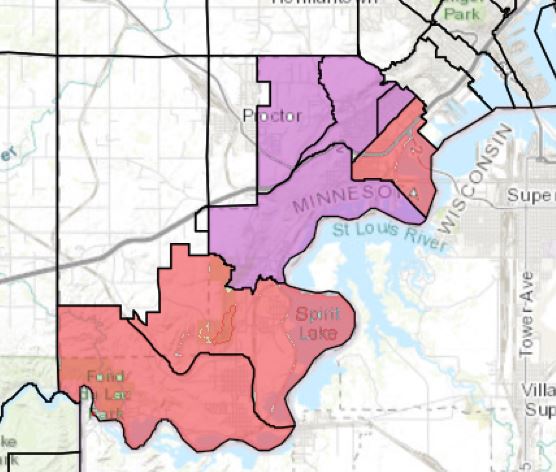
5th District City Council: Janet Kennedy (purple) vs. Jeanne Koneczny (red)

On the school board side of the ledger Alanna Oswald proved resilient, winning a second election against a Labor-endorsed opponent despite enduring health challenges in the closing weeks of the campaign. Her early work got her out ahead of challenger John Schwetman, who kept the race fairly competitive but only won in a high-income east side core of neighborhoods and in a few of the precincts outside of city limits. Oswald’s cross-cutting appeal captures both the old Red Plan critics and a new wave seeking to advance greater equity, and the relative blurriness of school politics allows that pitch to succeed in a way I’m not sure can work in a council race.

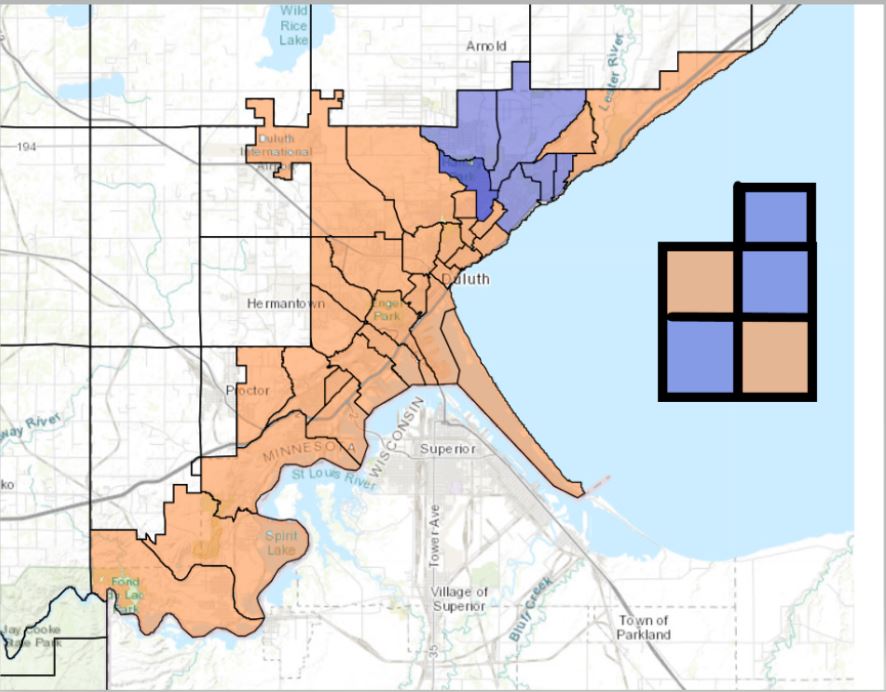
School Board At-Large: Alanna Oswald (orange) vs. John Schwetman (blue)

In the district races, two anti-Red Plan crusaders of the past failed to win, though the margins map on to the traditional east-west divide in Duluth school politics. Incumbent David Kirby rolled past Harry Welty in the second district, while over in the third district, Loren Martell had his best showing in his many races and gave newcomer Paul Sandholm a decent run despite falling short in the end. Martell carried two precincts, one in lower Duluth Heights and one on the near East Hillside. Welty has signaled this campaign, his seventeenth, may have been his last; after a closer call, Martell may yet give it another go. We are firmly on our path in a new era of school board politics now, and after crossing paths with some of the newer members over the past several months, I’m as optimistic about the district’s future as I’ve been in a while. I look forward to seeing what this group can do with its impending superintendent search.

The past few Duluth election cycles have been dominant for Labor, which usually found a way to hold broad left-of-center center of Duluth politics. Its success isn’t some magical formula: over the past 12 years, it’s coupled union work ethic and business support to back a governing consensus focused on collaboration and incremental progress. It’s overseen a substantial rehabilitation of this city’s outward image, surges in investment with no recent precedent, and incomes rising faster than national averages; while far from flawless, it’s hard to argue with the overall trajectory. The Labor machine, in the words of Don Ness, made Duluth politics boring for a spell.

Labor still won a majority of its races in 2019, but there were some significant defeats and narrower margins. National polarization is making its way into local politics, and when that happens, the center does not always hold. As someone who just managed a campaign that made an effort to rise above national level ugliness one of its core tenets, the end results are not overly encouraging. But centrism (or center-leftism) for its own sake isn’t an inspiring platform, and we can talk about “nuance” and “creativity” all day, but at some point those have to manifest themselves in actual, measurable results. I know the candidate I worked for is committed to that, and I can only hope his interesting collection of new colleagues is as well.

In many ways, my job over the past year was easy: the Forsman campaign was very well-resourced, my candidate worked relentlessly, and he brought together a deep, strong team with good diversity of thought that worked as a unit to keep any one task from becoming onerous. I had plenty of fun with it. At the same time, it was my own education in the rigors of a campaign and the unexpected twists it can take, and at times a striking reminder that politics is not for the faint of heart. I’m not sure what comes next for my political life; I’m not one to take deep pleasure at the mere act of being in the arena, but I do enjoy winning, and the real work, of course, is what we can achieve after an election. Time to get to work.