Camino 2024, Part II: Finding a Stride

This is Part Two in a four-part series. Part One is here.

Day 1: Wet

It rains. And then it rains. And it rains some more.

We begin the Camino on a riverfront promenade and then cross the long span of the Ponte, built to stay above any flood. The Camino turns out of town and quickly becomes a country lane along a rushing watercourse, and we struggle around a marsh before finding easier paths. At first the Portuguese countryside looks to be in a state of crumbling disrepair, but the town of Arcozelo is well-tended, stone walls and gates holding fine lawns with swimming pools. Garlic-domed churches peek up here and there, their bells tolling out the walk in 15-minute increments, and roosters serenade us through the morning. The rain picks up.

Statistics would suggest about 200 people finish the Camino Portugués on any given day this time of year, but in Portugal, all above and beyond the 100 kilometers necessary for a compostela, the crowds are sparse. The first fellow pilgrims we see are a mother and a 10-year-old son on bicycles, plastic bags on over the kid’s legs to keep off the mud, the scallop shell that identifies a pilgrim strapped to the back of his bike. Later, by a thundering waterfall on the crystal clear Labruja River, two German girls march past, followed by a Frenchwoman who idly twirls a stick like a baton. We catch them all and collect a few more at a stop for coffee and sandwiches and a dry roof at Cunha Nunes in Revolta, the first of the classic Camino cafes that cater to passing pilgrims.

In our infinite wisdom, we have started our Camino on the stage with the biggest ascent on the whole route. Granted, summitting the 1,000-foot climb up the Alto da Portela Grande is no technical struggle for someone who tackles passes in the Rockies with a much heavier pack every summer, but it is long and steady, and did I mention it was wet? We slog upward, fixated only on the muddy path in front of us. Never is this truer than on the last great push up, where the trail has become a flowing cascade the whole way down, a lengthy dance up this dancing brook to a completely obscured overlook.

The descent is speedy, and as we have not booked any lodging between Ponte de Lima and Santiago ahead of time, we are enticed by a sign for an option with heat, private bathrooms, and rides to a restaurant in the otherwise sparse rural hamlet of Rubiães. We cross one last Roman bridge, are overtaken by rapidly marching Germans, and turn to find Sofía’s hideaway, where we arrive just behind the two younger German women we’d seen in Revolta, who have made their way back here after learning the municipal albergue has no heat or hot water. A crew of Taiwanese roll in a bit later, too, and we all populate the bedrooms on the upper level of Sofía’s house.

Despite strong defenses, everything is wet. So wet. We set about rigging everything up to dry, clothing draped all over the place, passports and papers placed over the heater to rescue them. One of the Germans, Ariane, joins us for 5:00 dinner at Bom Retiro, a mile down the road, where we consume heaping portions and a carafe of wine for about the price of a single American glass. The downpours come and go as they please, though we still hopefully note every time the sky grows lighter. The hope is always false. We pass out early in the evening to the soundrack of Sofía’s kid’s faltering trombone practice.

In past hikes I have been in more brutal downpours and I have climbed steeper slopes, but their total effect here makes for one of the most punishing days I’ve ever had on a trail. And yet, with the ability to wring everything out and take a warm shower and clear it all out with a hearty meal and some wine with good company, I am sold. If the Camino can be this enchanting on a day when the trail turns into a waterfall, what can it bring on a good day?

Day Two: The Fortress of Silence

On day two, though the rain threatens occasionally, is liberatory by comparison. We manage to turn the wrong way out of the hostel—we hadn’t realized the access road to Sofía’s was the Camino itself—but before long we’re at a glass box of a snack shop staffed by a woman from Massachusetts beside Rubiães’ main church and a Roman milestone used by later inhabitants as a sarcophagus. Much of today’s route is on the old imperial road, beginning with a big bridge over the River Coura followed by a series of mile markers, those same roads built for legions two thousand years ago still guiding pilgrims today. We wind up through a few hamlets, climbing again past sheep and garlic domes, and we pass a stream that boldly claims the be the troutiest in the universe. Before long we enjoy a steady plunge through a eucalyptus forest and moss-shrouded paths before a grand view of the Minho River valley opens up, our destination of Valença on the Spanish border looming in the distance. The pace differences between pilgrims are obvious on the descent, as we are both passed and overtaken.

At the bottom, the town of Fontoura proves a disappointment: first we are hounded by a Russian woman trying to sell us overpriced snacks, the ATM doesn’t work for me, and the café is closed. (If the Russian had told us this, we might have been more convinced to pay up.) Two Danish pilgrims are swimming off the medieval bridge over the Rio Pedreira, but from here the path is fairly nondescript, tame woods and clusters of homes, and then a long slog through suburban Valença. We stop at a roadside diner, pricey but filling, a pitstop for a bunch of local blue-collar men on their lunch breaks. After two days of pastoral Portuguese countryside Valença is a bit jarring, as we walk up sidewalks with backpacks while city life moves on, the once ubiquitous yellow arrows to guide our path now few and far between, dwarfed by the urban landscape.

A push up a long incline, however, takes us into a new world entirely: the walled medieval compound of old Valença, a fortress town for thousands of years, guarded by great earthen bulwarks below thick stone walls, all from a perch commanding the Minho valley, the bridges to Spain within reach of a good cannon volley. Inside the town are a bunch of narrow streets and a lot of shops, all of which seem to sell towels. Towels, sheets, comforters, pillowcases: this is indeed the historical craft of Valença, and they carry it forward now, selling them all by the kilo. (If you were to ask “who could possibly need a kilo of new towels,” my response might be “most lodging options on the Camino de Santiago.”) We find its 11th century church, groaning with history, and get to know São Teotónio, a native son and Portugal’s first saint. We eat pizza at a trendy little shop staffed by a woman who responds to Portuguese speakers in Spanish.
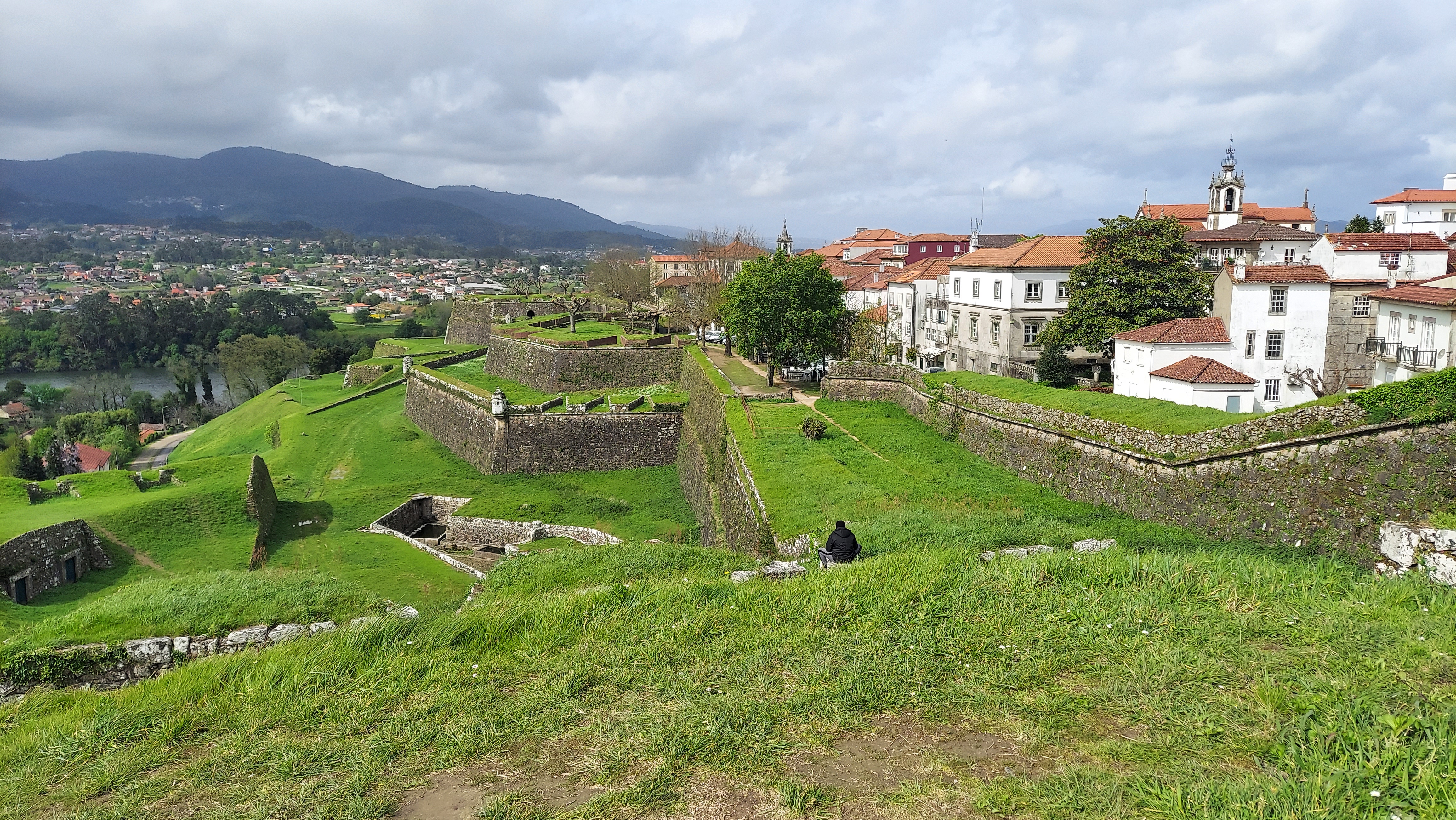
After a rest at the hotel we head out for a drink on the town, but we quickly learn the drawback of turning one’s town into a medieval theme park by day: by night, it achieves zombie apocalypse levels of deadness. No one is out, save for the tame cats by the church. We retreat to the room. My blisters have started to bloom, and I am in a blah mood. Valença is all very lovely, but it is a museum now, the pilgrims as unwitting accoutrements, and while it is perhaps the appropriate use of an old fortress atop a hill, one should not mistake it for Europe’s present. Take this night of quiet retreat, I suppose, and move on to Spain.

Day 3: Spanish Hibbing

After the torrents of day one and a vaguely ominous day two, day three dawns brilliantly, scattered sun and clouds but no hint of rain. An older northern European couple exits our hotel at the same time we do, but otherwise, Valença is as dead as it was the night before. We trudge down out of its dark gates and cross the Minho (or, now, the Miño) into Spain, past an austere Franco era guard station and on into Tui.

Spain is clearly wealthier than its peninsular partner. Fewer homes lie in ruin; there are real drainage systems. The pedestrian infrastructure is significantly better, and drivers actually stop for people. Every drink order comes with a snack. We are in a refined, thoughtful culture. There are trade-offs: gone are the blue tiles and garlic domes of Portugal. Rigid, solid stone now reigns supreme, especially in the locally mined granite, a building block to stand the test of time.

The seeming wealth is all relative, of course. Galicia is a poor corner of Spain, and like much of the country, its rural areas are emptying at such a rate that the moniker España vacía, or Empty Spain, has been slapped upon it. Next to well-tended homes are picturesque ruins, the slow decay of centuries-old structures no longer necessary to house the population here. Rural Europe in general is re-wilding at an unprecedented rate, with more and more greenery and the return of once-failing species such as the Iberian wolf. Of course this rush for the cities is happening in the United States as well, albeit blunted by immigration and somewhat higher birth rates. But immersion in a place where construction is very old gives a sense of just how complicated it can be to live among structures that predate modern technology, and just how much the run to the cities is reshaping the countryside. There is an eternal tension here between preservation and keeping things livable and letting them fade, a blurry spectrum for each small community we visit on this walk.

We rise up to the old city of Tui, a fortress to counter an invasion of towel-wielding Valençans, broad stone cathedral on top. As snake through the streets, we pass herds of pilgrims emerging to blink at the sunlight. At just over 100 kilometers from Santiago, this is the most common starting place on the Camino Portugués, and for the first few miles out of Tui it shows. We are caught up in a clump of 10 Spaniards plus a British expat named Alan, an Aussie herd, and a clump of British girls with unfortunate laughs who cackle at everything. These and other groups begin to leapfrog each other, with Alan and the Spaniards brimming with energy on day one but stopping to photograph everything. We pass another Roman bridge, ford a stream by a cross to a sainted pilgrim who fell fatally ill here, and enjoy placid, leafy lanes. The lack of breakfast in Valença has my dad growing hangry, but we’re delighted to find a snack break at a new establishment in A Magdalena, which manages to space out the pilgrim crew a bit and leave us in tandem with Marcia and Michelle, two American sisters who are good company.

We come to the massive granite works of O Porriño, complete with signs protesting its growth and a bevy of large houses from that very stone built to withstand the millennia. The debate here is familiar to anyone who comes from a place where people pull things out of the ground. There are more gentle lanes up and down wooded hills, a bunch of lazy dogs, a hobbled German pilgrim with a wounded knee, and our Taiwanese friends from night one. Porriño is not the most enchanting place on the Camino, but a river walk into town does some good in crowding out the factories on the opposite bank and the freeway on the near one, and the historic center, while not large, teems with life. Our lodging is basic but well-appointed, its view down over a busy bus stop. After Valença, I appreciate just watching humanity go about its business.

It strikes me, after a couple of beverages at the Underground craft beer bar, that Porriño is just a Spanish Hibbing, the equivalent of a blue-collar Minnesota mining town I know well. It has 17,000 people, a handful of historic buildings in its downtown, and is near enough to some pretty landscapes, but is itself otherwise forgettable in its urban form. And yet there is wonderful food, top notch wine, good craft beer even though that scene here has nothing on America’s, and it teems with life and bustles with families late into the evening, long after any American town of the same size goes dead outside of a couple nondescript bars.

I come away with a soft spot for Porriño, even if it has few clear charms. Here there is none of the museumification that consumes the centers of many small European towns. It is here where Galicia lives in its present, striving, dreaming like our enthusiastic craft beer convert behind the bar at the Underground, caught up in a debate over saving the verdant forests or mining the stone that has built this region’s wealth and newer homes. Kids pour out of a nearby school, bum around squares, settle into social circles even as they dream of a life beyond the bland apartment blocks that surround the old city core. In some deep sense, people in places like this will always be my people, the steady believers in a land that is anything but empty to them.

Day 4: Galifornia

Day four dawns grey and misty. Breakfast is jamón and tomato atop a large slice of bread from a harried woman as Alan and the Spaniards dine a few tables over for the third meal in a row. Porriño departs slowly, long damp streets before a winding road and the 100 kilometer marker to Santiago. The next few kilometers stroll through the town of Mos, a sleepy place that welcomes its pilgrims brightly and then turns them loose on a series of steady ups into the Galician hills. We trudge up with groups of Spaniards, including one jolly older man with a deliberate pace, though we lose him when we turn aside for lunch near the hill’s summit, a sandwich with a killer view. From there we go down, first on gentle slopes with the loud Brits behind us. We escape them at a churrascaria, however, and are alone for the plunge down into the outskirts of Redondela.

This walk down the hill is both incredibly steep and incredibly beautiful, rich green hills dotted with farms and cottages, fruit and flowers, resplendent in sudden sun, a snippet of a Ría Baixa, an inlet off the Atlantic, visible in the distance. Our hostel-keeper for the night calls this region of Galicia Galifornia, and I understand why. Everything is resplendent and lush, all that rain now showing its gifts. Closer to the mouth of the strait sits Vigo, one of the largest cities in Galicia, but our destination is Redondela, a city of 20,000 known for its towering train viaducts and old town on a hill, close to the sea but removed from it.

After a short urban trek we find the old town, and we’ve lucked out with our lodging. A Casa de Herba stands on a small square the middle of narrow stone streets, and our second floor room has a long balcony from which we can survey a small square and the narrow lane the Camino traces through town. The smell of cooking seafood wafts over us, and I sit on the balcony and write as we wait out a slow laundry load. We wander about, meet Julie and Susan from Saskatchewan at a sidewalk table, eat fish, stumble on a place with a craft beer fridge and retire to the balcony. The city life of old town Redondela flits by below us, pilgrims wandering in, locals heading out, kids chasing each other about, even some nuns.

We are halfway to Santiago, at the peak of the walking experience, all the buildup to this point now beginning its release, an exhale as we settle into this way of being, a pace set for the rest of the walk. I have little to write today. I am one with it.

Part 3 is here.

Camino 2024, Part I: Tremors

Lisbon, 1755: the world shakes. An earthquake and subsequent fire destroy the great Portuguese capital, thousands killed, palaces and churches thrown into ruin. For a Europe at the dawn of the Enlightenment, it is a jarring reminder of powerlessness; Voltaire, surveying the wreckage, decides he needs a better way to make sense of a senseless world. Rousseau and Kant follow suit, questioning both modes of living and the mysteries of nature. The earth has shaken, and nothing is quite the same ever again.

It is with no such pretention that I arrive in Lisbon on Easter Sunday, 2024. I do not expect, nor do I necessarily need, seismic changes in thinking. But I am open to the possibility, perhaps never more so than on this venture that begins in a small European capital with a great heritage, from the Age of Discovery to the catastrophe that weighed on the West’s foremost minds of the time. I have the privilege of a mini sabbatical to traverse different continents, to open my mind to whatever may come. It may be nothing, and that would be fine. But it may be more.

Lisbon undulates over a series of low hills north of the estuary of the Tagus River. In a nook between two of them is Baixa, the core of the city grid laid out by the Marqués de Pombal, the post-earthquake Robert Moses and Oliver Cromwell figure who rebuilt the capital in a style that now bears his name. For my one night in Lisbon at the start of a great Iberian adventure, I settle into a quaint hotel on a pedestrian street in the heart of Baixa. The rains that have swamped Portugal for the past two weeks have temporarily lifted, and both tourists and locals tentatively venture out to restaurants on terraces, to sample tapas and what passes for good craft beer in Portugal.

At the end of my street, beneath a triumphant arch, sits the Praça do Comércio, a waterfront square dominated by a statue of King José I atop a horse. A short way down the Tagus from here was the launch point for some of Europe’s greatest voyages of discovery, as this tucked-away kingdom on the edge of the continent unleashed the first tremors in a movement that would eventually upend world history. I content myself with my own morning of discoveries, a hurried push up to the Castelo de São Jorge and then along Avenida da Libertade, the great artery appended to Pombaline Baixa in the late 19th century European tradition of grand, monument-strewn avenues. This little taste will have to do. I have a train to catch and a path to walk.

The Camino de Santiago, literally translated as the Way of St. James, is the collective name given to a network of Catholic pilgrimage routes that lead to Santiago de Compostela, a city in the northwest corner of Spain. It emerged in medieval times as a route to visit the tomb and relics of St. James, who, according to tradition, moved here to preach the gospel after Christ’s crucifixion. The Camino receded in later centuries but has steadily grown in popularity over the past 40 years, including a burst of interest since the 2010 Martin Sheen film The Way. By far the best-known route is the Camino Francés, which begins just across the French border in Saint-Jean-Pied-de-Port and winds 769 kilometers across northern Spain. But there are myriad other routes, some wandering in from very far afield. One emerging path that now accounts for one quarter of all pilgrims is the Camino Portugués, which begins in Lisbon and works its way north to Santiago. It is this route that my dad, on a six-week post-retirement tour of the Iberian Peninsula, has chosen to walk. I go with him.

For official certification, a Camino requires that the pilgrim walk 100 kilometers (or bike or ride a horse 200 kilometers) to Santiago and collect at least two stamps (sellos) per day from businesses, churches, or other points of interest along the way. Given my timeframe, we choose to start in Ponte de Lima, some 160 kilometers south of Santiago and a two-day walk through Portugal before six more through Spain. We will follow a series of yellow arrows and scallop shell images that mark the way up into Galicia, the lush, green autonomous Spanish region noted for its distinct language and fine seafood.

Traditionally, pilgrims stayed in albergues, which offer basic dormitory lodging, and many restaurants along the route offer a menú peregrino for basic, filling fare at a discount. Of course one can also stay in cozy hotel rooms and eat fine meals if one wants, and the Camino draws a wide spectrum of walkers, from purists to people cabbing from place to place, from devout Catholics to leisurely folk who treat it as the world’s most deliberate pub crawl. A Camino is a physical feat for many who achieve it, and even those of us for whom these distances are in no way intimidating contend with new challenges, such as the change in surfaces from paved roads to rough lanes to dirt paths to mountainside trails to those evil, evil cobblestones. I am almost never sore, but the blisters blossom daily.

The Camino’s explosion in popularity suggests a people in search of their own tremors, their own meaning in the face of senselessness. Pilgrims are often searching for something, sometimes within the faith that founded this path but also often not, spiritual seekers with less patience for liturgy or tradition but who cannot shed its trappings, the power of enduring monuments of medieval faith and a shared human ritual, a path both literal and metaphorical. Students of the Camino will tell you everyone has two reasons to walk it: the reason they share with everyone at the start and the real reason hidden beneath, one that may not even be obvious to the pilgrim until some point mid-path or even some months after the return from Santiago.

Pilgrimage is an invitation to strip out all the noise in a life and do one thing: walk. Yes, there are now perks like swanky hotels and luggage transport, but a good Camino invites non-judgment: we are all finding ways to do the thing. The Camino lacks the survival skills of a backpacking trip, and it is inherently social with its albergues and everyone’s steady progress in the same direction. People from all over the world come together on a collective journey, form temporary bonds on a walk, and forever share a path, one whose history and trappings just mean more than, say, a shared trek on the Appalachian Trail. It is a human celebration in a way a wilderness venture is not. We walk together with chosen or random fellow travelers, sharing only the title of pilgrim as we go.

I take a train north to Porto meet my dad, and I swiftly learn the breadth of the gap between Spanish high-speed AVEs and this rickety Portuguese thing, which sits on a lovely bridge outside Coimbra for a spell and gets me to Porto with nearly no time to spare before a bus connection onward. This is part of the package, though: Portugal sits somewhere on the middle of a spectrum between Latin American fun and European comfort. It throws its share of parties, its culture is rich, and it is dirt cheap compared to the rest of the western half of the continent. And yet it has nice things, no serious safety concerns, and the Portuguese try to run things on time, even if they don’t always exactly get there. It is no wonder there is a surge of Americans exploring it and even retiring here.

From Porto we promptly continue by bus to Ponte de Lima, an ancient town now home to about 20,000 residents. This town is named for a bridge, built by the Romans and restored by the medievals, over the Lima River, and that old span is still the center of attention. The town center is a charming little knot of narrow streets around a couple of classic castle turrets, though we have chosen to spend the night in an absolute marvel of peak brutalism just down the river from the center. For any extended time I would die in this youth hostel with a not-particularly-youthful clientele, but for one night I will giggle at this mass of concrete and right angles and slowly shed layers as the heater clanks away all night.

We spend our pre-pilgrimage night wandering Ponte de Lima’s streets, eating at a bustling gem of the Portuguese microbrew scene named Letraria, and appraising the weather forecast with worry. After a few weeks of near-constant rain the Lima has hopped its normal banks, and a mock Roman army marching northward now stands knee-deep in the drink. This, we hope, is not an omen for our hike. But whatever the weather brings, we are set to walk.

Part 2 is here.

That’s Baseball, Suzyn

While I have a lot of writing forthcoming on my recent travels, I would be remiss if I did not pause to acknowledge the great John Sterling, the New York Yankees’ radio play-by-play man for the past 36 years, who sailed into retirement this past week. His abrupt departure is the end of an era. His voice was the background to countless childhood summer nights, his easy cadence and soothing baritone carrying a Yankee fan kid through the ups and downs, a nightly retreat from any school drama or other weighty affairs. After my parents and perhaps Garrison Keillor, no one was heard more in my childhood home.

Sterling was bombastic, a welcome burst of scattershot energy in a franchise that, especially in the Hal Steinbrenner era, has tended toward corporate PR-speak in all other aspects of its managed public image. His personalized home run calls and lengthy “Theeeeeeeee Yankees win” exclamations were both delightful and nutty, sometimes bringing forth an eye roll but always a grin, and the best of them became associated with players long after they left the Yankees. In Sterling’s telling it started with a spontaneous “Bern baby Bern” for Bernie Williams, and it simply took on a life of its own from there. Whether it was an A-Bomb from A-Rod or Jorgie juicing one, a thrilla by Godzilla or Shane Spencer the home run dispenser, the Grandyman showing he can or whatever it was he sang in Italian when Giancarlo Stanton launched one, Sterling calls were an essential part of the Yankee experience.

Sterling brought a relentless exuberance to the job. Blessed with a sterling silver voice box, he seemed ageless, smoothly bringing us the action night after night, including a Gehrig-esque iron man streak of 5,060 games without missing one over a 20-year stretch. He was a professional, and while he clearly wanted the Yankees to win, he had no reservations in calling out failures, and he would give other teams their due when they deserved it. Not once did I ever get the impression he was not enjoying himself immensely. He found the job he was meant to do, and he did it with panache. There was a hint of pretense, as he dressed himself up in fancy suits for the radio and took the Yankee tradition he loved very seriously. But always did his job with the respect and the humility to recognize, even after all those years, what a fortunate man he was to be able to do what he did for so long.

Yes, details were never his strong suit. When I spent chunks of my free time in online Yankee fan spaces back in high school and college, I created a statistic, the FSHRC (Fake Sterling Home Run Call), to track the number of times he drove us all insane by launching into his home run call before ultimately being wrong. (“It is high! It is far! It is…caught at the wall.”) He had little patience for modern analytics, and his pop culture references were, charmingly, stuck on 1950s Broadway. Sterling was a true original, doing it his way and no one else’s, and that was that.

Over the past two decades Sterling developed a brilliant rapport with Suzyn Waldman, the groundbreaking color commentator who shared many of Sterling’s loves and frustrations, able to insert her insights and gently needle him while still maintaining the ethos of the broadcast. They became an indelible pair, to the point where I just sort of assumed that, 30 years from now, if I were to dial up a Yankee broadcast I would hear the two of them, either sighing and philosophizing their way through a tough game or brimming with pride if the team were to win. His sudden departure a few weeks into this season was a surprise, especially since he looked and sounded the same he always had, even a couple months short of 86. But 64 years of broadcasting and 36 years of Yankee baseball meant Sterling knew that nothing was ever predictable, always ready with his line to explain the absurdities before him: “That’s baseball, Suzyn. You just can’t predict baseball.” Nor, indeed, life.

A marathon baseball season carries on, and after the requisite Yankee Stadium pomp and celebration, Sterling will fade into the background. But some people are not replaceable, or at least not with the same style, the same delight, the same firm, confident voice. As I read various homages to Sterling came out this week, a line from The Grand Budapest Hotel came to mind: “His world was gone long before he entered it. But he sustained the illusion with a marvelous grace.”

Big Easy

The trope of the Midwestern kid heading to an East Coast seat of power has typically been one of innocence lost, of bright-eyed illusions dimmed by closed networks and sordid affairs. This story, saddled on succeeding generations of Midwestern boys heading east by F. Scott Fitzgerald, has a certain glamour. It is flattering to imagine oneself the wounded noble soul in a greater story, and wounded noble souls do not usually realize they are doing themselves no good until a few years have drifted by in aimless emoting.

One who has navigated this road with remarkable aplomb, however, is my Georgetown roommate Trent, whose wedding I attended in New Orleans this past weekend. Trent and I first came together in New South 205 as freshmen at Georgetown, two rare Hoyas who did not hail from large metropolitan areas and in the thralls of what Washington had to offer them. We were avid pursuers of the DC political scene and Hoya basketball loyalists, and while our social circles ebbed and flowed as he dove deeper into campus communities from the start than I did, we remained an ideal pairing, drama-free and easygoing. We lived together for all four years of our undergrad experience, New South to Copley to 3731 R Street, though we were abroad in Mexico in opposite semesters of our junior years. By senior year our house, with Phil and Tim added to the mix, crystallized into a cohesive unit.

The journeys since have been long. Trent left DC after graduation, first to teach in Houston and then on to NOLA, where his new wife, Kelly, attended medical school at Tulane. No doubt there have been moments of trouble and deep frustration, especially in those Teach for America years, a crucible that formed many of my Georgetown friends. But for no one did it show outwardly less than for Trent. In the hours before he tied the knot, a group of us sat in his hotel suite and shared stories of Midwest childhoods and Georgetown escapades and teaching travails, and there was no trouble believing these tales all wove their way through the same guy who sat before us. At the core, nothing has changed a bit.

Trent retains a slight Ohio twang, even as he travels higher in professional circles and eyes an impending return to DC. He is relentlessly competent and organized but stays preternaturally upbeat, his work rate nonstop but still grounded in the people around him, whatever their station. It was no secret where those lines about social justice in the prayer of the faithful during the ceremony came from, and he has the art of making such lines feel heartfelt. He has perfected the blend of roots and ambition that has always been my ideal, and he has the magnetic personality to make it all work. And in the meantime, he will have a lot of fun.

I will save a longer discourse on New Orleans for a second visit in May, but this venture was a dive into Trent’s life in the city. And, of course, no trip to the Crescent City can be complete without eating up the rich local culture and the nonstop revelry that make it unlike any other American city. Friday night takes us to the Mid City Yacht Club, a local joint with no pretentions of hosting people who enjoy yachting, tucked in among classic NOLA houses and across from a well-lit ballfield in the neighborhood where Trent and Kelly live. I’d assumed the name was ironic.

The rookie Jesuit presiding over the ceremony, however, tells us the truth: during Katrina this little bar, flooded along with the rest of the neighborhood, acquired the moniker in jest, and a few friends nursed it back, rebuilding it from the detritus of the hurricane. In the homily, the mention of the Yacht Club was a metaphor for love and commitment, but it was also a simple summation of Trent: there for the party often enough to be a regular, but using that tie to make a deeper connection and lift up a story of triumph and rebirth. Trent brings together great people, two new friends and I observe as we stroll up Canal Street toward the church with our roadie martinis in plastic cups.

Since this is a Hoya wedding, the ceremony takes place in a Jesuit church tucked just west of the French Quarter, its grandeur shadowed by the towers around it but resplendent in the Company of Jesus’ quest for the Greater Glory of God on the inside. It is as snappy a Catholic ceremony as one will hear, with no communion to separate out the devout from the apostates, and in time we bus over to the Ogden Museum of Southern Art for the reception. Beneath a cavernous ceiling we mill around and eat a steady stream of hors d’oeuvres, with no formal dining time or seating chart and only the briefest of wedding speeches. The party must go on—unless one goes on the bathroom odyssey, down a staircase and through a gallery and up an elevator past some distracting sensory art.

Photo credit: Vail K.

The DJ lords over the hall at one end, and while the dance floor takes some time to warm up, it eventually explodes with light and flashy light sticks for everyone, and we after we have all swayed in a circle as the lights come up the brass band marches in and the second line begins. We parade down the streets of NOLA, Trent and Kelly waving parasols in front of the procession, the band right behind and the rest of us in tow, waving towels and dancing along, the less mobile of our number rolling along in rickshaws. We are the attraction, filmed by passersby and watched from those classic wrought iron balconies above, and in time we get one of our own atop a bar near the hotels. The good times do indeed roll, onward late into a cool New Orleans night, though a dream of brunch looms in the morning. Even if New Orleans is not in Trent and Kelly’s longer-term plans, it is the ideal city for a group of friends to come together, dispense with the dithering, and commit to making the most of a moment.

On a personal note, Trent’s wedding is an appetizer for what I am calling my sabbatical, a stretch in which I will be away from Duluth for five of six weeks. This stretch starts and ends in New Orleans, with Europe and South America sandwiched in between. It seems right to start it with the people with whom I set out into the adult world, though they will reappear in it on an estancia outside Buenos Aires. If I am going to take a radical break from my day-to-day routines, who better to be with than the people who most revel in this life?

Keeping Hope on Ice

This was a hard season of Duluth East hockey to assess, and I deliberately took my time in penning this annual postmortem. Let’s not pretend otherwise: it was a tough year. In a season that began with high hopes after the last one’s rise from the ashes, the Hounds’ 10-16-1 record was not pretty. While the schedule was one of the toughest out there, not all the frustrating results could be chalked up to superior opponents. It was the sort of season that made it very easy to lapse into frustration or resignation that whatever could go wrong probably would, and staying positive took serious effort. 

Nonetheless, there were some regular season achievements: these Hounds opened well, playing very competitive hockey against quality teams like White Bear Lake and Shakopee, and it seemed like they could contend. Those early good results against the state’s best dried up as the season went along, with the possible exception of a surprisingly competitive showing against superpower Minnetonka. They did, however, play reasonably good hockey within the section and secured a 3-seed with some tight wins against many 7AA rivals, to say nothing of some very close calls with their great rival who went on to become a State Tourney semifinalist. A different break in overtime in the first meeting with Grand Rapids or a held 3-0 third period lead in the second and East might have had a bit more swagger come sections. But what-ifs remain just that.  

This team also deserves some credit for not completely going to pieces. They saved perhaps their best game for the playoffs, when they took apart Duluth Denfeld in the quarterfinals. Thanks to Kole Kronstedt’s acrobatics in goal they stuck around with Andover in the section semis, and if they had ever stopped parading to the box, they might have had a few more chances to bust through that Husky defense and make things interesting. (While this season was a far cry from the debacle of 2021-2022, it never seemed like this group was fully in control, either.) As it was, they seemed to find a level, better than the chase pack but not quite in with the contenders in 7AA, to say nothing of the state powers who left them licking wounds ever so often.  

Thank you to our seniors: Jude Edgerton, Oscar Lundell, Garrett Olek, Stratton Maas, Drew Raukar (whose goalie assist may have been the most entertaining moment of the season); Christian Houser, stepping into a role on defense; Luke Rose, working hard defensively every game. Luke Anderson, who helped shore up a defense that needed it. Kole Kronstedt, the goaltender who found a home at East and stole a few games in two years as a starter. Wyatt Peterson, a four-year reliable workhorse; Noah Teng, a sparkplug and a leader; and Thomas Gunderson, a flashy scorer throughout his time at East who now has a chance to build a strong post-high school career. This class was a major contributor to the thrilling season of East hockey in their junior years, and they carried the bulk of the load this season, salvaging some quality results and offering the occasional glimmer of something more. And thank you to these parents, many of whom have become friends over beers at the bar and over late-night road trips across Minnesota, my fellows in celebration and commiseration and making the most of this wild, all-consuming ride. 

This offseason marks an uncertain place for Duluth East hockey, perhaps even more uncertain than after the last coaching change or the weirdness of 2021-2022; in those cases, it was at least clear who would need to step up to be a contender again. There are useful pieces at hand, of course: Caden Cole and Ian Christian could, with enough development, be very productive seniors, and some younger defensemen showed some promise. There are some other interesting parts making their way toward varsity hockey. One hopes the schedule will be right-sized for the current talent level next season, not to avoid all top-end comers, but simply to give the team a fighting chance in most of the games it plays. Confidence is a valuable thing, and it can’t be willed out of nothing. 

Some things need to change. I do not expect the impossible from what is on hand; all I ask is that a team works hard, adapts to its strengths and weaknesses, and shows improvement over the course of a season. It is not fun to observe that most of a team’s best games were its first few of the season. There are kids on this team who clearly need help, to be put in situations where they can succeed instead of thrown to the wolves for failure, again and again. There are others who need some other method of communication to keep them from the same mistakes over and over; as someone who is not in the locker room and does not know what has been tried, I cannot claim to know what those can be, but there have to be other ways. In general, the community around East hockey felt much more frayed, less in it all together, scattered into small clumps here and there instead of the unified force we saw last winter. 

There needs to be accountability at all levels. From players to parents to coaches to the school itself, actions must match words to show there is an institutional belief that this program can return to greatness, and a willingness to work at it since it won’t happen overnight. It begins this offseason, in those little steps that put in the extra effort, lift kids to better development opportunities, build stronger bonds, and show this team comes first even as some explore what comes next. As any parting senior family will tell you, it is gone all too soon. What do we do with this time we have? 

My annual State Tournament essay is available here on Youth Hockey Hub.

The Sweetening of the Gift

It was the nature of his profession that his experience with death should be greater than for most and he said that while it was true that time heals bereavement it does so only at the cost of the slow extinction of those loved ones from the heart’s memory which is the sole place of their abode then or now. Faces fade, voices dim. Seize them back, whispered the sepulturero. Speak with them. Call their names. Do this and do not let sorrow die for it is the sweetening of every gift. 

-Cormac McCarthy, The Crossing 

One year later, after Andy, certain moments are burdened with memory now. Of course there is a void at family gatherings, the occasional twinge when I glance at a few of his old possessions that have come my way. The weekend before the anniversary of his death is another such reminder of a past era. He visited me this weekend the past two years, the best fit for his Lutsen alpine adventures even though it is also the weekend of Book Across the Bay, the Ashland, Wisconsin Nordic ski race that has become a staple of my winters. After the race the past two years I came home to him, the first year to a lively party with many friends, the second to just him and my mom, chatting away a quiet midwinter night. Now, just quiet. 

This year it is hardly even winter, the ski race reduced to a saunter on foot along shorefront ice and a bare paved path along the beach. Most people make it a casual stroll, but I elect to push, running as fast as I can on a thin layer of snow atop ice, sweat caking beneath layers. I run free, alone along the luminarias. I double back at the fire-breathing dragon that marks halfway point and I part the walkers moving in the other direction, their rippling wave of encouragement carrying me the whole way. I finish well enough to earn a shoutout from the emcee and a handmade mug as a prize at the afterparty. I don’t consciously make any dedications, don’t linger on any specifics, but I do know why I ran harder tonight. 

The next day I trek along Hawk Ridge with a weight-laden pack, a preparation for a venture, now just six weeks out, on what may be the most self-conscious trekking route on earth. I reread a passage from Conor Knighton on those moments that marks shifts in life, quoted by me after a trip to Utah two years ago. Layers in time are not always obvious; jarring moments like Andy’s do not always immediately change a life. But they do, perhaps, have the power to take beliefs out of the theoretical realm where they marinate and encourage one to think about what it really means to live out beliefs, to make the most of precious time. 

If I write little these days, this is why: the urgency of the present consumes me, and while writing remains here as a tool for discernment of the new or the unknown, the capstone on the adventure, a delight when it comes freely, it no longer need be a frustration when it does not. Life is not lived on paper, and even less so in the virtual spaces where I type out words. Here is to now, the sweet, sweet gift of McCarthy’s gravedigger, whose nectar I seek with more thirst than ever before. 

Is There More?

A Duluth East hockey season plods along. It has not been one of joy and great excitement like last season or the decade of the 2010s, but it has also lacked the can’t-turn-away chaos and palace intrigue of 2020-2022. A few wins appear when the schedule eases up, but a signature victory remains elusive, a steady string of more-or-less competitive games that nonetheless result in losses, the offense outgunned and the back end unable to hold up against steady assaults from opponents. Losing games is one thing, but I look for signs of progress, signs of young players stepping up or improved chemistry or lower lines coming together to at least keep opponents off the board even if they are not scoring much themselves. And I find myself frustrated, trying to escape resignation that this is just what this team is. 

It’s not that this team lacks assets. Thomas Gunderson, Noah Teng, and Wyatt Peterson are probably the best line on offer in 7AA. Caden Cole at his best is a second line anchor and a real offensive force. The power play has started to show some real potential. The depth, while a far cry from East teams of previous decades, still features some perfectly capable hockey players who have some strengths in certain roles. If East played the same schedule as Duluth Marshall or Duluth Denfeld or Rock Ridge, the narrative would be very different, a 20-win season probably within reach, and I would rather be associated with a program that reaches for more than that, even if it results in more disappointment. In theory a tough schedule should build resilience, give opportunities for growth, cure bad habits and make those subsequent games with lesser opponents feel easier. There are occasional glimmers, encouraging signs of some heart in overtime wins against the second tier of section opponents, a few pretty goals and solid clears, flashes of steady discipline instead of teetering on the edge. But this team has yet to take that next step into serious contention. 

The glaring culprit to date has been the inexperienced defense. With the noble exception of Luke Anderson, so often running about cleaning up others’ messes, shoddy breakouts and blown coverage have been the norm, too many initial saves left lying there, juicy and ripe for the picking. There is promise in some of the youth here, with Landon Pearce and Henrik Spenningsby playing more and more, but the rebuild has proven a monumental task, and there has been no great adjustment to cover for those shortcomings, which does no one’s confidence any good. If a team cannot break out crisply, it will never be able to hold up in a back-and-forth track meet; they are quite fortunate that 7AA doesn’t include any teams like Champlin Park and Coon Rapids, even if those squads aren’t all that different ranking-wise from 7AA’s crowded middle tier. 

The Hounds have certainly been unlucky at times; an early break against White Bear Lake or Shakopee or in one of the two Grand Rapids games and my tone would lighter. A serious injury to Ian Christian saps the depth and robs them of a second real scorer on a depth line. But luck can also be a byproduct of design. At the risk of hurting some feelings, this program simply does not have the depth to run four lines, even with some double-shifting involved. Either it can continue to play 11 forwards and six D and make everyone happy with playing time, or it can shorten the bench down the stretch and aim to win. This doesn’t mean abusing the top line—I remain a loyal adherent to short shifts and quick changes—but it does mean locking everyone into a very clear role and recognizing those roles will not be equal, and holding the top players accountable if they fail to backcheck or repeatedly try to dangle through four defenders. 

It is of course easy to sit in the stands and gripe and hope a team can add up to more than the sum of its parts; doing it is hard, takes real leadership from players and coaches alike. But it is doable. An example isn’t too far off: two games with Grand Rapids have shown the Thunderhawks are hardly on some different talent level from Duluth East. If this team got a third crack at the presumptive top seed in 7AA, I wouldn’t hate the Hounds’ chances. But the boys in orange are clearly building toward something, playing intense, physical hockey, their belief growing as they play off their strengths and start to collect top-10 wins no one would expect from their talent level. Everyone seems to be rowing in the same direction on Grant Clafton’s very tight ship, but at East I just do not sense that total buy-in at all times. 

For all the lumps, this team is in position to be the 3-seed in 7AA. They will face a hungry opponent in the 7AA quarters, likely either Marshall or Denfeld, and they will need to keep their heads about them. After that, there is a window of opportunity in a down year for the section, and it would be a shame to waste it. We’ve already covered Rapids, whom the Hounds led 3-0 in the third period on the road before the roof caved in. Andover, while deep and a proven winner, has hit some road bumps lately, and is hardly invincible. Neither of those teams has game-breaking scorers, and an East team that can just hold up in its own zone would be well-positioned to poach a couple of goals and steal a playoff win or two at Amsoil. Enough pieces of the formula seem to be there. Is the belief necessary to pull it all together there also? 

The Harbour Mind

The rush from Thanksgiving to Christmas has been its usual series of frenetic weeks, twice to Chicago and once to DC and twice consumed by hockey. It is only Christmas weekend that I finally have time to pause, a reversion to a few days of quiet family time and remote work, a peaceful time only once I look past this embarrassing excuse for a Duluth winter and shrug off the unwelcome reminder of Covid pandemic solitude in the work week that follows. Most people are off but I plug away, either in an empty office or an empty house, no ski trails to escape to, just driving rain outside, achieving in bursts before lapsing into boredom. This inaction suits me less and less as I age.

I manage to finish the one book I set out to read over this month, Adam Nicholson’s How to Be: Life Lessons from the Early Greeks. It traces the emergence of philosophy with the emergence of the trading city-states of ancient Greece, from the god-determined fates of the heroes of the Iliad through Odysseus’ radical agency, from the first interrogations of existence in Miletus to the sense of self emerging in Sappho and her contemporaries in the Aegean basin. Symposiums take place; leisure and thought intertwine. Life emerges as a fire in Heraclitus, an eternal soul in Pythagoras and the Orphic cult, a single reality in Parmenides before Empedocles unites it all, these final thinkers acting as forerunners to Plato and Aristotle, the foundations for basically all Western thought since.

How to Be is more than just pop philosophy, though: it weaves in a journey to the cities that formed these early thinkers. Nicholson wanders these acropolises atop harbors, the temples built to gods who match the questions of their particular age: Athena as city-states form, Demeter as they grow to flourish, Aphrodite as questions of love grow more profound, Persephone as thinkers dig deeper into the meaning of eternity. He parses the relics they have left behind to show how these communities were interconnected with their neighbors, how ideas born on the Aegean coast of Turkey interacted with Ionian Ithaca or colonial Sicily and beyond. All of this flourishing thought, he contends, is the result of a “harbour mind,” a life of commerce and exploration and incipient leisure that was fundamental to making the Greeks the thinkers they were.

These past two years have been a time of deep harbour mind, with many mundane days at sea broken by arrivals in thrilling ports. In 2023 I found literal harbors on a trip up the California coast and an unforgettable family venture to the Mediterranean, and metaphorical ones in treks near and far and as I pushed my body further and relished the results. I also found harbors in times of grief, this sense never more immediate than this past February, and though that scar is still raw it is also a reminder of just what kind of a harbor I can build, both for myself and for other people. It is a strange feeling, to be supremely self-assured in grief; one that requires delicate words to avoid sounding callous. But as I sat through my cousin’s funeral I found myself not burdened by agony but instead consumed by a fire I’d known was there but only rarely let out. It was a fire I tended numerous times in the following months, through late-night euchre vigils and over beers at hockey games, on a wind-blasted deck on a rocking cruise ship and on the slopes of Cloud Peak, on the dance floor at weddings until the last song played and all my muscles ached, only then believing my work was done. These are the moments I feel most myself.

In between the surges I do not lead a bad existence, and I have no trouble listing off the ways in which life has improved in the span since I started this burst outward with a venture to the Virgin Islands deep in the pandemic. But the mundane everydayness gnaws at me, and while it has its small triumphs and defeats, it never brings major change. When I do have events worthy of words they are among the best I’ve ever written, but the act itself does not come often enough, and too often I go to bed without even consulting my writing, plagued by a nagging annoyance that I am not using my greatest gift to its fullest extent. For too long I have been too frozen in routines to unleash it, too frozen by convention or belief in how I had to be, lip service alone to the pursuit I preach.

I will always owe a deep debt to the Greeks. They have framed my life over the past decade-plus now, a necessary port on a stormy sea, and I will never forget that debt, will someday go to pay homage at the sites Nicholson visits, when the time is right. (The time is not yet right. I will know when it is.) The Greeks’ basic insights still form the channel in which I sail. But this holiday season, I find myself drawn to the burning paradoxes of Heraclitus and the love inherent in Empedocles, fueled by that radical turn, and reach once again for Hannah Arendt’s verdict on Greek thought at the end of her chapter on Action in The Human Condition, something I saw in a snippet atop Zion last spring but did not fully process:

The miracle that saves the world, the realm of human affairs, from its normal, “natural” ruin is ultimately the fact of natality, in which the faculty of action is ontologically rooted. It is, in other words, the birth of new men and the new beginning, the action they are capable of by virtue of being born. Only the full experience of this capacity can bestow upon human affairs faith and hope, those two essential characteristics of human existence which Greek antiquity ignored all together, discounting the keeping of faith as a very uncommon and not too important virtue and counting hope among the evils of illusion in Pandora’s box. It is this faith in and hope for the world that found perhaps its most glorious and most succinct expression in the few words with which the Gospels announced their “glad tidings”: “A child has been born unto us.”

If human action is founded on reason and faith, on Athens and Jerusalem, it is time to grapple with Jerusalem again. This is hardly some announcement of bold conversion or spiritual quest; it is merely an acknowledgment of another journey that awaits. In my year-end post last year I said I craved a Renaissance, and while a Renaissance means a rebirth of the Classical it is still rooted profoundly in a faith. In its most obvious form this will come as a pilgrimage, a concept I will grapple with as I head for Santiago de Compostela this April, to say nothing of a subsequent adventure to southern latitudes. The opportunity to rethink things is before me.

I look ahead to the deeper truth-seeking afforded by this sabbatical of sorts in spring, but the true process must begin now, the harbour mind unleashed. It is time to set sail, whether on steely Superior or on the South Atlantic, and find faith in daily routines yet again. Maybe this will lead me to change my life in more significant ways than I have in recent years; maybe it will instead be a stripping away of false desires and a focus on a simpler core that is already right in front of me. But I am ready for a journey once again.

The Home and the World

It is easy to compartmentalize friendships into periods of life, to sort people into specific, fixed stages. High school friends here, college friends there, grad school friends beyond, clumps of people associated with certain cities or hobbies. At my friend Andrew’s wedding this past weekend, however, I realize I know people from all his scattered clumps in some way: his parents and brothers, a few others close to them, the high school crew from our trivia team at Billy’s on Grand, his fellow Minneapolis teachers, the Georgetown set at my table for dinner, and of course his new wife, Kara, from his law school days. We have, through no great design, charted our way together through the past fifteen years, each of our adventures somehow bound up in the other’s, sometimes near and sometimes far but always somewhere down a shared road.

Andrew is the oldest of four brothers, a boisterous clan forever glued to sports and debating issues great and small, a home that welcomes me in easily whenever I pass through their Roseville abode. He is the son of a girl from Willmar and a Filipino boy from Iowa, two Northwestern Wildcats and Minnesota doctors who set their boys off on their respective pursuits. His family’s story is one of everything a country can be, one that left in him in a lifelong dance with dualism and mixed identity, at times weighty but inseparable from who he is and what he stands for. “The world is a complicated place!” was his Minneapolis era slogan, the catchphrase of a kid who lashed out at hard dogmas of any stripe, my fellow trafficker in nuance, at times overwhelming but still a grounding foundation for the long slog through the meritocratic pressure-cooker. Together we have swum through the ebbs and flows, sometimes in fierce debate, sometimes quietly processing as we walk in Minnesota woods, selves constructed as we string together the various strands of our lives.

We met as two Georgetown kids, fresh off the plane and thrown into a pre-orientation program that took us deep into the hidden corners of DC, our ties deepening as two Minnesotans drawn to Latin American affairs who shared sporadic classes and interests. I remember it cementing on a night when we returned from our semesters abroad, Andrew from Buenos Aires and me from Mexico City, gushing about what we’d seen, locked in our own side conversations in the kitchen as an Australian visitor from my Mexico days captivated the crowd and earned my off-campus house its only ever police call. Though he did not live at 3731 R, the site of that night’s festivities, Andrew was such a regular feature that we came to call him the fifth roommate in that tiny rowhouse in Burleith.

Our paths took us back to Minnesota, Andrew for a Teach for America stint, me for whatever it was that I did in those first two years post-graduation, and when he stuck on for more teaching and I went to Minneapolis for grad school, it was obvious enough that we should live together. We settled into 2107 Hennepin, an old brick apartment just south of Downtown, ideally placed for Lake of the Isles strolls and Uptown revelry and right next to Minneapolis institutions such as Sebastian Joe’s Ice Cream and the late, great Liquor Lyle’s. We toured the city and sampled breweries and dashed together halfhearted Trader Joe’s meals, longing for days when we’d have the time and resources for more. Andrew became a regular in my urbanist circles, while I joined his family for soccer games and fall hikes in state parks. We both had our ups and downs in those two years, saw each other in some of our less composed moments, but in retrospect it is a blur of contentment, each of us settling on our subsequent paths and for the time being enjoying everything Minneapolis had to offer. When I think of my 20-something self the frozen image from that age will no doubt involve Andrew and me shuffling back from Lyle’s, deep in debate, never with all the answers but determined to chart our way through.

As two restless searchers, we pushed outward together from our Uptown confines. First there were those fall hikes in pursuit of leaves, up toward Duluth and down the Mississippi and that one sublime trip to Devil’s Lake in Wisconsin, a tradition continued even this year. Early in my time there we took a jaunt to Phoenix and the Grand Canyon, and we capped our time as roommates with a grand road trip across the American West. If two friends can together endure a broken car window in San Francisco and snoring Germans in a Vancouver hostel and generally survive a steady string of ten-hour days on the road with just each other, it is probably something that will stick. When we went back home we went our separate ways, him to Cornell Law and me back home to Duluth. But still we kept crossing paths, him returning to Duluth deep in midwinter and me heading for New York, me dragging him to see the state hockey tournament and him making Covid-era escapes to the freedom of the Northwoods.

Andrew returned to DC two years ago, and his wedding there this past weekend gives me the chance to walk back along all these paths we’ve known. I bring two other newlywed friends along on a Georgetown tour and see this city of my teenage dreams with fresh eyes again. We meander the old haunts, drink a pitcher at the Tombs with a basketball game against Syracuse running in the background, and I reminisce on how this place made me who I am, able to flip the switch between different worlds with ease. I take my own moment on a run up and down the steeper-than-I-remembered hills of Northwest DC, Embassy Row and Rock Creek and the Glover-Archbold Parkway and Dumbarton Oaks, across the checkerboard of lettered and numbered streets where this friendship was forged. Much as I may appreciate my time in Minneapolis or Mexico or the places I have deeper roots, there are only two places I can unabashedly call home: Duluth and here.

Yet again, the dualism, the pushes inward and outward: Andrew and I both nest deeply but are both School of Foreign Service graduates, forever making sense of the broader world around us. The melding of Kara and Andrew’s worlds takes place at the Meridian International Center, a stately manor for a diplomacy thinktank where, on a terrace beneath carefully tended lindens, they found a venue with the class and decorum that befit them. As the night rolls along we sip cocktails in gilded rooms and dine beneath laden bookshelves, but before long the night explodes into energy and a plot hatches to get Andrew airborne on the dance floor and he sails up above all these revelers between different stages, united in celebration of a couple who seem meant to be.

In Kara I saw quickly that Andrew had found someone for him, someone who can both match his pace and pull him out of his head when need be, someone who transfixed him even as they lived apart for a time. She grounded that mixed soul, she turned him into a cat person, and she and I laughed together at some of the quirks that come from living with Andrew. The raw emotion in their vows, filled with sincerity and depth and reminiscences on the Brooklyn Heights Promenade, made it obvious this will last. I wondered if I would get emotional, but instead I just found myself beaming, pleased to know such a good friend, pleased to be in the company of so many fun humans, ready to push this night as far as I could because every second was worth embracing. These are the friendships we build for life, the collective stories that pull together and push us toward the selves we want to be. They give us our homes in the world.

The Long Road

Good vibes can only carry a team so far. The Duluth East Greyhounds put three rough seasons behind them with a confidence-restoring season in 2022-2023, going on a 19-1-1 run before a section final loss to an elite Andover offense, and there was good reason to think that would carry into the current campaign. Back came Thomas Gunderson, East’s finest pure sniper since Garrett Worth; he and sidekick Noah Teng had strong fall Elite League campaigns. Wyatt Peterson, the four-year varsity rock, rounds out a top line that can score some points; Caden Cole has the raw tools to bust out and be a high school star at some point, and Ian Christian can be a load to contend with. The defense was a total rebuild, yes, but they had a returning transfer in Luke Anderson to help shore things up, and some of the younger additions looked promising in summer action. The goaltending was back, too. This team, if not a top-ten force, was at least a legitimate contender, perhaps a chic pick to emerge from a winnable section.

A lot of that optimism unraveled during a very busy first few weeks of the 2023-2024 season. The Hounds are 2-6, winless against top 25 competition, down an early section game to Grand Rapids, humbled by an elite Wayzata squad. The crowning indignity came in a 6-0 defeat at the hands of Holy Family, a team that is capable but by no means overwhelming in its talent. The margin was bad enough, but the game degenerated into thuggery and post-whistle slop, and while said slop had plenty of instigation from the victors, in my time watching East hockey it is surpassed in ugliness only by the Duluth Denfeld debacle two seasons ago. I was left wondering where the swagger had gone, where the leadership might come from, and if there were any buttons to press that might invite a different outcome.

There are not many ways to sugarcoat a 2-6 start, but I will, at least, offer some cause for calm. Two of the losses were bad, but four were one-goal losses (one with an empty-netter) to top 15 teams, each one of them winnable if they had held a lead or finished on late opportunities. Their talent at forward is still arguably the best in the section, and Kole Kronstedt has shown he has the skills to carry a team in goal. Perhaps most reassuringly, there is very recent precedent for this situation: last season’s 18-6-1 season was only one win better than this team after eight games, sitting at 3-5 before a win over Andover spawned the memorable run.

Those same Andover Huskies await the Hounds in their next game after an ammonia leak at the Centennial Sports Arena postponed East’s visit to Circle Pines this week. (After this aggressive early schedule of road games, I am not sad to see a week off to regroup.) Andover is not the same team it was a section ago either, with its exceptional top line now a happy memory and a sub-.500 record of its own, albeit against first rate competition. The Huskies may not be a front-line superpower this season, but with their program depth and a collection of solid talents, they are the frontrunner in this section until someone beats them. East has the chance to prove it can do that next Tuesday.

Beyond that, 7AA is weak at the top, full of the intrigue built by balance. Grand Rapids is not going to overpower anyone with its offense, but between a few solid defensemen and its embarrassment of riches in goal, the Thunderhawks will be a nasty out. Rock Ridge is starting to emerge as a sleeper in its first 7AA season, with a deep core returning from a team that pushed Hermantown hard in the 7A final a season ago. The Wolverines haven’t been seriously tested yet, but the combined forces of Virginia, Mountain Iron, Buhl, Eveleth, Gilbert, Biwabik, Aurora, and Hoyt Lakes have some momentum as they build their program, at once the state’s youngest and oldest. Forest Lake lacks the talent of the top four here, but beat Rapids in spite of that, and looked plenty pesky in losses to other quality teams like East and White Bear Lake. And even Duluth Marshall, bolstered by a strong sophomore core, may now be on the upswing into relevance again.

What might move the needle for this East team? Consistent play and steady breakouts on the back end headline my list. But I am also looking for better chemistry out of the top two forward lines, a feature that appears in flashes but has yet to find the comfort zone that Gunderson and Peterson had with Cole Christian a season ago. Coolness under pressure is also part of the equation, and the ability to keep things from snowballing after the bad goals and sloppy periods that will inevitably happen this season. Last winter’s well-earned praise guarantees nothing, but it is a roadmap, and it is up to these players to step up and follow it.