David Brooks and the Search for Character

David Brooks is one of those talented people who has managed to get himself disliked in many circles. As a resident conservative at the New York Times, he has the unenviable task of defending a political outlook that few of his readers agree with, and makes such an effort to speak to them that he’s pretty easily labeled a Republican In Name Only by the right. Sometimes he pursues balance for its own sake to the extent that seems like one of those annoying kids yelling “yeah, but” on the playground, and his willingness to dabble in anything can lead him to be painfully wrong about some things, most notably foreign policy.

Such is life as a syndicated columnist, as he must churn out new ideas twice a week, every week. Much of his longer work is a far better sample of what his real interests and concerns are, from the acute diagnosis of upper middle class America in Bobos in Paradise to the social science-heavy study of life in The Social Animal. Brooks has been on a steady turn inward as his career has gone along, a process that culminated in his most recent book, The Road to Character. He’s long been capable of profound reflections on the costs of a lack of reflection on one’s own self—see the classic “Organization Kid” essay, which should be required reading for anyone entering an “elite” college—but only recently has he taken the step from detached takedowns of people who don’t do this to exploring what it means to actually do so. (His own recent divorce probably spurred this all along, too.)

I had the good fortune to attend a lecture by Brooks when he was in the early stages of conceiving The Road to Character, a 2011 talk called “The Era of Self-Expansion” put on by Georgetown University’s Tocqueville Forum. In it, he recalled a column he’d written earlier that year, an especially memorable piece for a soon-to-be college graduate in which he talked about how people find their callings. When I asked him about it in the receiving line, he admitted he’d somewhat made it up, but was impressed with how well it had resonated.

In the column, he blasts the tiresome myopia of the follow-your-own-dreams rhetoric so common in life advice today. However noble in its desire to tell us to be ourselves, these words foment a worldview that places the self and its ambition at the center of it all. The universe revolves around me, even as I purport to go forth and do “good” in the world, following the passions I have deemed worthwhile, in my infinite wisdom. And when I do try to do this, life inevitably gets in the way, whether in the form of my own limitations or the failures of other people or forces beyond my control. Suddenly, I’m powerless, and I’m pretty angry about it. Before long, I’m defeated, or perhaps more mundanely, I’ve discovered that the dreams of my younger self are no longer the dreams of my older self, and I’ve spent however many years chasing the wrong thing. The world refuses to cooperate and revolve around me.

The fruits of Brooks’ search don’t come in this takedown of selfishness, though. This is easy, and not terribly original. He needs an alternative, something else to aspire to. He now champions excellence over happiness, and the pursuit of something a bit more complete than just the self-expression celebrated in some of his earlier work. This drive doesn’t come from within, but from something that happens to people: one’s circumstances leave one with passions, and mark people by the things that jar them into awareness, whether as witnesses or the things they endure. It may seem like a small distinction, but it is essential. The turning points in life are rarely moments of great happiness or accomplishment, but instead in suffering and failure, and a desire to overcome it, perhaps even build off of it. This, and not the blind whims of dreams, defines who we become.

It is now fairly easy to go through childhood, and even much further into life, without ever coming face-to-face with this sort of adversity. It’s a triumph of affluence, I suppose, of good health, suburban living, wealthy schools (public or private), and other comforts that allow us to live out that pursuit of happiness extolled in Brooks’ early work. It’s not a bad life, clearly, and I don’t necessarily begrudge anyone for pursuit it.

The trouble comes in pursuing it alone, and nothing else. Deep within this comfort there is a moral poverty: everyone plays out the string as they see fit. Forget complaints about moral relativism; there is no moral dimension at all, as the whole language necessary to even make these distinctions falls away. People become lost and have no means to figure out why. Even the humanities, designed with this express purpose, often fails, aiming instead for aesthetic, utilitarian, or political arguments to justify its existence. It’s no wonder these departments are collapsing left and right. But there are encouraging signs, Brooks’ latest book among them, that people are starting to realize something is missing. Hopefully the new book offers some models, and some ways to cultivate that character necessary to pursue the truly good life. If Brooks can do that for people, it would amount to a legacy far greater than his scattered collection of brief columns.

Sometimes, though, one of the sparks that helps a jaded kid make sense of the disparate threads of life, one that plays off those turning points and fuses them with ongoing interests, comes from an unexpected place. In that lecture I attended four years ago, Brooks dropped in a book recommendation: Jane Jacobs’ The Death and Life of Great American Cities. I jotted it down at the time, picked it up a year or two later, and the rest is history.

Run This Town

I’ve been a Minneapolitan for eight months now, and I’m slowly starting to mark this city as my own. There is much to like here, though I am skeptical as to how real the Miracle really is when one looks into its underbelly, and don’t know how long I’ll stay after my two-year stint here is up. Still, I’ve been coming to know it in my own particular way, as I have in the past with Duluth and Washington: by foot, running its streets in every direction I can, those runs sometimes degenerating into walks when I stray too far afield to keep up the intensity or find something worth watching at a slower pace.

Home base is in a neighborhood known as the Wedge, both for its triangular shape and the way it shoves itself in between the opulent old money homes of Lowry Hill and Lake of the Isles and the diverse, eclectic, and poorer neighborhoods to the east. It gives easy access to downtown to the north or Uptown to the south, the connections all fluid. It’s spring in Minnesota, that time of year we appreciate best, and it’s time to head back out.

My best-worn route sends me on an architecture tour of the fine homes wrapping around the lakes, though someone long ago had the good sense to save the lakeshore for the public, leaving us with promenades for bikers and walkers, there to see the wealth and to be seen themselves. I’ll meander off the running paths and into the quiet streets beyond, past the Mary Tyler Moore house and out to a landing on Cedar Lake, or over the crest of Lowry Hill and down by the Blake School, one whose façade I’d admire if not for my unshakable pride in that brick building overlooking Lake Superior back home. The Walker Art Center is there, complete with sculpture garden and iconic cherry; just beyond is the Parade Ice Garden, home to Minneapolis hockey, such as it is. Beneath the overpass and over a footbridge is Bryn Mawr Meadows, its ballfields turned to cricket pitches by the latest wave of immigrants.

Beyond the dandelion fountain in Loring Park Downtown stirs to life, as the sunlight sucks people out of the skywalks and on to the streets. The restaurants bring back their outdoor seating, and Target Field opens its doors to further Twins mediocrity. Nicollet Mall bustles, though it’s hard to keep up any speed with all the stoplights and traffic; in time, I make my way up along the riverfront, finally open to the city as the centerpiece it deserves to be. Further down, past the scores of new apartments, the Guthrie Theater, and the rising shell of that financial monstrosity of a football stadium lies the University of Minnesota campus, ideal for springtime people-watching, as everyone emerges from whatever room or study hole or bar they’ve ensconced themselves in over the past year and revels in the sunlight.

Cross a bridge and there is St. Anthony Falls or Nicollet Island, those old icons of Minneapolis now dwarfed by the towers around. Old Main has the best patio seating in the city, and Nye’s, that irreplaceable polka bar, beckons me into Northeast, the old realm of European immigrants now filling with immigrants and hipsters and the like. Changes are afoot to the south as well, where a battalion of new loft apartments forms ranks along the Greenway, Uptown’s transformation near-complete. Further along Lake Street is the Midtown Global Market, plus the stretch were I’m apt to go in search of some genuine Mexican deliciousness. And, of course, that damn K-Mart is still there, ruining the flow of traffic along Nicollet but providing a service no one else can in this low-income district.

To the east of home base, across Lydnale, lies Whittier, the apartments growing a bit larger and a bit more frayed around the edges. There is a little bit of everything here, with Eat Street along Nicollet and little pockets of old grandeur, especially around Washburn Fair Oaks Park, home to the Minneapolis Institute of the Arts, the stately Classical museum gazing out upon the center of the city. A pedestrian bridge just a block away lofts me over 35W and into Phillips. Urban farms abound, and curiosities such as the Swedish-American Institute poke their way out of a steadily declining housing stock. Now it’s diverse as can be, with even a Native American strip up along Franklin, and over in Cedar-Riverside, just off the West Bank of the U, is the heart of Somali America. They’re stuffed into Riverside Plaza, that tower block of mismatched Legos that is only one-seventh the size it was supposed to be. Why did we ever think it was a good idea to stuff people into these things, I wonder, though at least some have carved out a little oasis for themselves between the foreignness and ignorance of the broader culture and the allure of al-Shabaab. If people can build community here—and I don’t know whether they can or not—maybe all this grumbling about the offenses of brutalist architecture misses the point.

One day I take a path not yet taken, a bridge beyond 394 that carries me into neighborhoods that few people I know have deigned to visit. My surroundings take a turn for the bizarre in Sumner-Glenwood, one of those hyphenated havens of low-income housing. Twenty years ago this was all projects and towers, but they all came tumbling down in the late 90s. In came the next-generation urban renewal scheme: instead of shoving poor people into towers like sardines, we now scatter them about green New Urbanist landscapes, with cheap housing that tries to look like it’s historic and suburban. The result: far fewer units, and acres upon acres of lifeless, empty grass separating buildings that look like they are pretending to be something that they are not. Harsh, perhaps, but it was hard not to look at this space and not think of the bankruptcy of any theory that thinks the design can rewrite these lives. The only life anywhere along these roads are two decrepit people sitting on their walkers across from their senior housing looking positively miserable, and one lady who yells obscenities at her dog as it chases after me for an entire block. The return route down the next street takes me past Bethune Elementary, one my teacher friends describe as “the worst.” It may not be ugly, but it still seems a wasteland.

To the north is North, though there is plenty of Minneapolis north of North. This is the heart of the ‘inner city,’ the place I’m told fills all the stereotypes of crime and blight and a large black population. It doesn’t entirely look the part: the upkeep of some of the historic homes is better than in Phillips or Whittier, and there is nothing remotely threatening about its streets on a Wednesday morning. In the distance, flashing lights make me wonder what is going on, and before long it’s clear the haze in the air is something more sinister. Several streets have been blocked off, and all that I can see from the corner as I peer past the crowd of onlookers is a fire engine’s cherry-picker looming in the smoke. An entire block has gone up in flames. Not wanting to gawk, I run on, though I circle around the perimeter of the cordons.

Up Broadway, a bustling shopping street laden with fatty food options. Down around the bedraggled football field belonging to North High, then doubling back to pass three more schools: a stately and quiet Catholic school, Elizabeth Hall Elementary with its tame and bustling playground, and a crumbling concrete shell of a former charter school just down the block. Nothing quite conforms here, and the face of 21st-Century urban American poverty just doesn’t show the squalor of the past. The forces at work here are deeper, more subtle, but often every bit as pernicious, the cycles of financial struggle and broken families only perpetuating themselves, here in this city with an achievement gap that ranks among the worst of the worst. The Miracle has a dark side, hard as it may seem to believe on my next run, when I’m cruising down along Lake Harriet, darting in and among the beautiful people finally free to break out their summer finery.

I’m sore now. It’s time to head home, check out my latest route on a map, and plot my next venture outward. Every one of them seems to open up another corner, remind me how little I know of this place, even as I head further afield. There’s always more to discover.

Exit John Rothstein

Just two years ago, I wrote about the departure of a Grand Rapids hockey coach. Now I’m doing it again. John Rothstein lasted just those two seasons in place of Bruce LaRoque, both of them ending abruptly in the section semifinals, and finishes 32-20-2.

Rothstein came in with the heavy burden of high expectations. The Thunderhawks’ religious fan base was hungry for another State Tournament. The talent level was on the rise, raising the stakes even higher. There had been some frustration with LaRoque—he wasn’t exactly subtle in saying that rumor-mongering about his handling of his own sons’ playing time was a key reason he stepped down—so maybe someone new could take the Halloween Machine back to its hallowed past.

It wasn’t to be, and I’ll be frank: I thought Rothstein’s teams did less with more than many of LaRoque’s did. Some in the Rapids fan base criticized LaRoque’s teams for going into a defensive shell in key games, but it usually gave them a fighting chance against more talented competition. In 2014, Rapids fans saw what happened when their team tried to skate straight into the teeth of a Duluth East forecheck, and there was never any effort to help out a very inexperienced defense. The result was their most lopsided section playoff loss in recent memory, despite having Mr. Hockey Avery Peterson and a talented sophomore core in the fold. Hunter Shepard was a fine goalie, but no one can be hung out to dry that often. The 2015 team improved defensively but was maddeningly inconsistent; at times flashing great skill, but far too easily knocked off their game and into mediocrity. Flustered by another disciplined East team, they sleepwalked through their first two periods in the playoff game before finally exploding to life in the final frame. But it was too little, too late, and too incomplete an effort to make any claim to victory, despite the absurd shot total. Rothstein tinkered with its lines a bit over the course of the season, an odd choice when he had a ready-made top line of star juniors at his disposal.

This doesn’t mean the inability to get out of the semis was all Rothstein’s fault. It’s hard to get high schoolers on the same page, and two years is hardly enough time to judge a coach with any finality. Mike Randolph didn’t make State until his third year at East, and only went once in his first five; it takes time to learn the ropes, and to get a whole program on the same page. Rothstein also had the misfortune of sharing a section with Randolph’s Hounds, whose recent teams have executed game plans and performed under pressure as well as anyone in the state, to say nothing of their healthy share of talent.

There were some real positives, too. Rothstein seemed widely liked and respected. He has overseen an overhaul of the Rapids schedule, ramping up what had been a fairly soft slate and giving the Thunderhawks a series of road trips to rival those of Duluth East and Moorhead, a necessary step for a team that wants to be on their level. They beat East in the regular season for the first time in twelve years, ending a long rut and likely ending any aura of invincibility. Unlike the 2014 squad, the 2015 team showed genuine signs of improvement over the course of the season. This Rapids return to glory is a slow process, and one that owes much to past coaches and a talent surge in the youth program, but Rothstein has ushered it along, and as was the case when LaRoque left, the future on the northern reaches of the Mississippi looks bright.

On Saturday morning, Rothstein told KOZY radio that he didn’t realize when he started that being a high school coach is a full-time job. He also told the Duluth News-Tribune that he’d never expected to stay for long, either. The former Rapids and Minnesota-Duluth standout is not a young man, and owns a business and teaches at a community college. His experience is proof once again of the amount of effort it takes to run a top high school hockey program, earning just four figures to do an often thankless job. Rapids’ next coach should be a younger guy who understands what he’s getting himself into, and one who is in it for the long haul. While it would be tough to attract an outside big name, there is more than enough hockey knowledge in town to carry the mantel, and with top-ten talent on board for next season–will this be the most talented Rapids team since the early 90s?–it has to be an alluring position. We’ll see who steps forward to claim it.

Wilderness

“To those devoid of imagination a blank space on the map is a useless waste; to others, the most valuable part.”

—Aldo Leopold

As a native of the North, the wilderness has always enticed me with its immediacy. Some of my most distinct early memories are of Wisconsin State Parks during those pre-Duluth years, and once my family settled in that last great outpost between Minneapolis and the Canadian Border, it was never far away. I have fond memories of canoe trips and hikes with my dad, even if my skills as a woodsman have never come close to his, and as I grew older the woods within walking distance of my childhood home became a retreat, both to share with friends and to have my own little Walden moments from time to time. Without ever really realizing it, I grew up intimately tied to those parts of the map that didn’t have much in the way of detail.

At Georgetown, I began took on a new appreciation for those escapes, even as I dove into Washington. The late Jesuit Fr. Thomas King said it best, counseling us students consumed by fast-paced climbs up the ladder of ambition to seek out escapes into the wilderness from the restless noise of university life. Whether literal or metaphorical, we needed these moments to orient ourselves. I set out to find such spaces for myself, and while D.C. could never quite accommodate the sensibilities of a Northern Minnesotan, I certainly found a few gems during my wanderings there. My thoughts meandered with my steps, and I vacillated between intense commitment and lonely wandering, a duality that now seems extreme.

Other Catholics at Georgetown spoke of a different sort of wilderness; a spiritual and moral wilderness in which they found themselves in a postmodern world, unable to speak the language of the culture around them. I didn’t always agree with the particulars, but they had a point. We’ve lost much in our rush to embrace the newest shiny ideas, too often rushing ahead, unthinking, as we proclaim some lofty ideal that aspires to justice and human greatness. I embraced the greatest teaching of the Judeo-Christian tradition, one of those twin pillars supporting Western thought: we are all in exile, doomed to wander with no hope of permanent peace on earth. Perhaps all we could do was carve out a little spot for ourselves and live in accordance with our conscience, making peace with what we could.

After college I spent two years back in Duluth, still wandering as Athens and Jerusalem waged a silent war in keystrokes on this computer. I was never really a threat to truly go all Into the Wild; I enjoy my creature comforts a bit too much, and take my obligations to family and community a bit too seriously. My cynicism was a bit too meta to take the leap into a “finding myself” journey through the woods or some other country. But a cloistered life of letters had its allure, too, and it wasn’t hard to imagine that sort of future.

In the end, Athens won out. It’s not an unqualified victory, but it is a clear one, and the somewhat more infrequent blog posts here are a sure sign of an increasingly busy life beyond the world of letters. (Very little of my writing happens without some time to think about it beforehand.) I embrace this newfound life in the world, though I will still seek occasional escapes. They’ll come in different degrees, from runs around Minneapolis lakes to returns to the well-trodden parks of my youth to the occasional adventure into genuine backcountry. I need those moments to examine my conscience, to remind myself of my own smallness in the grand scheme of things.  They are reminders of mysteries beyond our grasp, and the falleness of human nature. But mystery gives rise to wonder, and we can still aspire to something in the face of impossibility. This is the great human project in a world beyond the old philosophical absolutes, none of which can reign supreme in this new Rome.

It’s hard to find wilderness anymore in the true sense of the word. Longing for that sort of wilderness can turn into wishes for purity and paradise lost, for a black-and-white worldview that won’t ever quite do its nuance justice. Even pre-Columbian America, we are now learning, was no pristine and untouched paradise, with the natives living in perfect harmony with nature. They certainly respected it more, recognizing the broader connectedness and often believing in a spiritual unity. But they were still very conscious managers, acting as stewards of the world around them, altering landscapes to their will as they saw fit. We have much to learn from them.

Just as we are stewards of the land, we are stewards of our minds. We’ll never have complete control over them; we can’t write off the past or give rise to a new future out of nothing. But we can tend them carefully with moments of retreat from the relentless noise, and with respect for the corners of the world beyond human reason that we will never tame. This takes patience and time, and I won’t begrudge anyone who commits themselves to living in this wilderness fully. For me, though, it is a place to reflect upon everything we do in the public realm, and to make sure that we truly believe whatever it is we’re doing. We must preserve that space with our lives.

A Very Cyclical Double Feature

This past week, courtesy an absent roommate’s Netflix, I enjoyed a rather absurd double feature involving sincere philosophy, adolescent sex, and excessive smoking: Hannah Arendt and Y Tu Mamá También. Neither one is new: I hadn’t yet seen the Arendt film, but I’ve read her work extensively and written about it here and here; I first saw Y Tu Mamá También last summer, and reviewed it here. As this blog reaches its two-year anniversary, what better way could there be to celebrate than with a sprawling synthesis between two wildly different strains of thought?

The Arendt film (2012) is a dramatization of the defining moment in the career of a great thinker, her coverage of the trial of Adolph Eichmann, the worst Nazi war criminal to escape Germany after the war. The Israeli secret police tracked him down in Argentina, and he went on trial in the new Jewish state, locked in a glass box to prevent anyone from finishing the job too soon. Arendt, a German Jew living in America and the first great theorist of totalitarianism, seemed the perfect correspondent, but her ultimate verdict set off a firestorm. She declared that Eichmann was not the embodiment of some demonic form of evil; she called him banal and frighteningly normal, and also pointed out the role of many European Jewish leaders in enabling the Holocaust. She was called a traitor and a self-hating Jew; an arrogant and emotionless woman who used a tragedy to make an esoteric philosophical point.

Trying to make drama out of a philosopher’s work is a formidable task, but one director Margarethe von Trotta achieves ably with smoke-filled rooms and acid dialogue. There are a few moments where it comes off a bit fake, but the circle around Arendt is entirely believable, and Janet McTeer makes a superb Mary McCarthy. The flashbacks to Arendt’s youthful affair with Martin Heidegger, the brilliant existentialist who became an unrepentant Nazi, add another dimension; they run the risk of making her brilliance seem like an offshoot of an old flame gone bad, but they also reveal a greater commitment to an idea, a belief in the centrality of human reason that not even Heidegger could sustain other pressure. He caved to the Nazis, banally accepting his role as university rector under the totalitarian regime. Arendt did not, twice escaping their clutches only to suffer a final exile imposed by many of her old friends for publishing what she believed. But fifty years later, she is the one who achieved immortality, exactly the worldly end she thought public figures should aim for in The Human Condition. Her speech to before a hall of skeptical Princeton students at the film’s climax hearkens to some of the great moments of courtroom dramas, her oratory an impassioned defense and rallying cry for her belief.

The film verges on hagiography, though I’ll leave it to critics who don’t think Arendt was one of the Twentieth Century’s two or three greatest minds to say if it goes too far. It shows the value of her relentless quest, not just to identify the nature of evil but also the pursuit of truth; the recognition of good and evil and beauty and ugliness and other such terms that thoughtful contemporary discourse is often afraid to use for fear of being judgmental. The young Arendt tells Heidegger that the split between reason and passion is a mistake: she believes in impassioned reason, the search for something approaching reality. It’s not hard to see why her political theories tend to reach back to the Greeks. Arendt is on the same fundamental mission for truth, asking questions where others take things for granted, her loyalty only to that truth and those who join her in her search.

A film about spoiled, horny teenage Mexicans may seem as far as one can get from grand philosophical debate about why it is we’re here, but the message of Y tu Mamá También (2001), in the end, isn’t wildly different. In some ways it’s a necessary antidote: “Truth is cool, but unattainable,” one of the boys intones, and they settle for an adolescent manifesto that collapses before them. It taps into a psyche run down by the banality of it all; a narcissistic pursuit of instant gratification. (In one delicious moment, a mutual lover tells the two boys their exploits aren’t worth bragging about because they both come so quickly.) This is banality epitomized, even as it’s dressed up as adolescent swagger.

The story rises above the sex jokes in the character of Luisa, but even then, it’s smart enough not to let them fade into irrelevance. It’s all intermixed, a crucial recognition that those base drives don’t go away. Once again, impassioned reason: we need to understand this side of the human psyche as well, not to repress it but to understand it, and channel it in ways that fuel the fire. The boys are extremes, but they captivate because they hit a bit closer to home than many of us would like to believe. A full life takes these appetites, tames them, guides them, and makes sure there is a place for everything.

This is, of course, a wickedly difficult balance; even those who aspire to it find themselves caught in cycles of blind passion and limp detachment, stronger or weaker depending on their temperaments and personal histories. I have no idea what the end state will look like, if there even is such a thing. But the pursuit is on, and nothing else compares.

Blaising New Paths: NCAA Hockey Regional Roundup

While the rest of the nation watches a sport involving endless fouls and approximately twenty-six timeouts per team in the final two minutes, sixteen universities are playing their way down to their own national championship. It’s the most fickle of tournaments, the NCAA Frozen Four, where top teams go down with regularity, the games played in obscure arenas in all corners of the nation. Four Minnesota schools made the final sixteen this year, but none survived the opening weekend, and the Frozen Four comes down to two longtime favorites, North Dakota and Boston University, and two upstarts, Providence and Nebraska-Omaha.

The most intriguing opening-round matchup took place in Manchester, New Hampshire, where a pair of old rivals, now in separate conferences, went at it for a fifth time this season. There was no drama this time around: Minnesota-Duluth blitzed Minnesota with three first period goals and cruised to a 4-1 win. After a decent open from the Gophers, the Bulldogs poured it on in the second half of the opening frame, unleashing an endless wave of cycles and aggressive pinches, barely letting the opposition out of the zone. They attacked the Gophers where they were weakest, in the corners and along the boards, and cruised once they had the early lead.

It’s hard to spin this Gopher season as anything but a disappointment, and they gave us hockey fans a quality soap opera. A team that returned nearly everyone from last season’s runners-up looked decidedly pedestrian after a 7-1 start, making the tournament largely by virtue of an astonishingly bad Big Ten. There were occasional flashes of their potential, but these Gophers were sloppy on defense and got lackadaisical effort from many of their forwards, leaving goalie Adam Wilcox overexposed. They were routinely outworked and overpowered by teams showing any sense of discipline or sustained pressure, and whatever might have fed into it—players with one foot in the pros, players thinking it would be easy after last season, a here-we-go-again mentality, or those whispers about locker room disputes behind closed doors—there was no fix for a glaring problem.

Naturally, scrutiny will fall on Don Lucia, though his defenders also point out his many successes in recent years; there’s only so much a coach can do to make his players care. His in-game adjustments do indeed usually leave something to be desired, though there it’s also better not to over-coach when one has the more talented team on the ice, as Lucia almost always does. He is not the root of the U of M’s problems, though his stoic demeanor may not be the solution, either. Coaches don’t stay on the job for long tenures without making some adjustments, whether on the ice or off, and this coming year will be a telling one for Lucia’s future. On the ice there were plenty of scapegoats, from reckless Mike Reilly rushes to Taylor Cammarata shying away from contact, but no matter who stays or goes, the Gophers will have the pieces to make another run, and they need to reconnect with that inner fire.

UMD had little time to bask in the big win, as Boston University and their magic man, Jack Eichel, awaited in the regional final. The Bulldogs shut down Eichel, but linemate Evan Rodrigues stole the show with a pair of goals, the second a game-winning power play snipe on which he showed superb patience. That power play came on a fairly soft call, and the Bulldogs were unlucky on a possible game-tying goal in the final minute, when the referees signaled no goal and there was not enough video evidence to overturn it, despite the strong likelihood that the puck was underneath Matt O’Connor’s pads in the net. One can hardly blame the Bulldogs for feeling robbed, but they had their chances, gave up a soft early goal, and were fortunate to sneak in their second tally. It was a strong season for a top ten team, but they weren’t quite on an elite level just yet. If everyone returns they should be a force once again next season, though the Gophers are a clear reminder that these opportunities can be fleeting.

Minnesota State-Mankato came in the surprise top seed in the tournament, though it was a tenuous title. Sure enough, the Mavericks folded under the bright lights of Compton Arena in South Bend, though the Rochester Institute of Technology’s game-winner was even more controversial than anything in the UMD-BU game, with the MSU defender checked into the goaltender by an RIT forward. It’s the first win by a #16 over a #1 in the current tournament format, and while perhaps not quite as monumental as Holy Cross over Minnesota some years back, it was a memorable upset. St. Cloud State, meanwhile, provided some of the best drama of the opening round, winning their Husky war with Michigan Tech with a tying goal from Jonny Brodzinski in the final minute of the 3rd and overtime winner from Duluth native Judd Peterson.

The Huskies’ downfall, however, came at the hands of conference foe North Dakota, which dispatched of them in a methodical 4-1 effort, a scoreline identical to their first-round win against Quinnipiac. The Artists Formerly Known as the Sioux have played with the poise of champions, but they’ll be leaving the friendly confines of Fargo to collide with the other remaining one-seed, Boston University, in Boston in two weeks. The winner of that one will be the odds-on favorite for the crown, as they’ve been the two best power conference teams all season. The right results in the semis could set up a delicious final: Dave Hakstol’s North Dakota versus his old mentor, Dean Blais, the UNO coach whose two titles with the then-Sioux still leave Hak in the shadows. Blais’ squad is the easy rooting choice for Minnesotans, with their veteran coach and bevy of local talent: Jake Guentzel, Justin Parizek, Tanner Lane, Tyler Vesel, Avery Peterson, Luc Snuggerud, and, yes, Jake Randolph, who scored the game-winner in the regional final. Blais’ Minnesota recruiting pipeline has brought a program to new heights, and success should only deepen that connection.

The NCHC, meanwhile, has done exactly what it needed to do in its early years, putting two teams into the Frozen Four this year, with several more coming ever so close. The conference is here to stay, and offers unending displays of great hockey. There’s no good way to spin this year for the Big Ten, but it can only get better from here: Wisconsin was historically bad, Michigan was off, and none of the others really stepped up. Given its resource advantages, this conference will rise, sooner or later. The WCHA put a pair of strong teams into the Tournament, but both bowed out in the first round, making it hard to frame an easy narrative. There is definite promise there, though I still think the WCHA needs to do something big in the next few years lest its schools start to slide further down in the NCAA pecking order.

The four remaining teams now get a week of rest so that we can properly bask in John Calipari’s sleaze, and then go at it next Thursday in Boston.  That gives me time to find some UNO gear in the meantime.

Whatever Happened to the American Dream?

Book Review: Our Kids: The American Dream in Crisis by Robert Putnam

For the past twenty years or so, Harvard professor Robert Putnam has been the most prominent scholar studying arguably the most important, and most worrisome, trends in contemporary America: the decline of civil society and the splitting of society along class lines. The point of the title, Putnam argues, is that we’ve stopped thinking of the children all around us as “our” kids; they are now just kids, and the only ones “we” own are the ones we raise ourselves. There is no shared inheritance or duty here, just each of us living out our isolated, atomized lives, caring for no more than our own progeny. For Putnam, the root of this separation in the fates of kids is not exactly income (though that is related, and very important) nor race (still a real issue, but the trends are slowly but steadily equalizing on that front). It’s parents’ education.

I buy this completely. I’ve lived it: I certainly don’t come from money, but I was fortunate to grow up in a very intellectual milieu, and my childhood, while far from idyllic in some respects, has much more in common with that of the privileged kids described in the book than those of the ones who have been left behind. These commonalities cut across race and region and parents’ professions, and they are self-reinforcing. In every case the gap between those who come from “upper-class,” backgrounds and those who do not grows more extreme, illustrated strikingly in “scissors graphs” that show two lines growing further and further apart. Neighborhood integration, most every financial measure, unmarried motherhood, single parenthood, family dinners, parenting time, school class and extracurricular offerings, college degrees, breadth and usefulness of informal networks, obesity rates, religious activity (which traditionally provides a community and a support network), voting…the list goes on and on. We’re splitting apart.

Most of the information here is not really new; the innovation comes in packaging it all together and intertwining the heaps of data with compelling stories. In each chapter, we meet children from well-off backgrounds who illustrate one particular trend (be it in family stability, parenting style, education, or community) and corresponding children with far less happy life stories. Using kids is a superb storytelling innovation, and one designed to draw out readers’ sympathy: we come to realize just how much things are stacked against the less privileged kids in the book, and how powerless we are to stop these trends (if we even accept our roles as that “we”). There is no one root cause, as everything is tied up in knots and feedback loops that are impossible to untangle. Neither the easy liberal narrative (it’s all the economy) nor the easy conservative narrative (it’s all culture and/or individual choices) hold up, though both are certainly true in places. It’s a master class in mixed-methods research for a popular audience, and most everything points toward a coming decline in social mobility: the death of the American Dream.

The book intentionally avoids blaming anyone for these trends, a choice which will no doubt frustrate some commentators, especially those on the left. The portraits of the upper-class people in the book are just as raw, and the fragility of their own lives, while better cushioned than that of some of the less privileged, is all too clear. Our Kids does propose some public policy solutions, most (but not all) trending toward the left: more mentoring, support for community colleges, parent coaching, greater maternal/paternal leave, daycare subsidies, incentives to get good teachers into bad schools, and expansion of the earned-income tax credit or similar programs. There is nothing radically new here, and most of the ideas are possible but not entirely likely in the current political climate. The New Yorker’s Jill Lepore, in her wide-ranging review of the book, makes a very valid critique when she says its desire to influence policy leads an unwillingness to call out institutional factors at play.

Our Kids even includes a rather daring attempt to make a moral case for action against this widening split, citing both a mildly liberal reading of American history and scripture. I’m not sure it’s robust enough to convince anyone who doesn’t already believe it. This might just be a symptom of my own unfortunate habit of always taking everything to the most existential plane possible, but I think it reflects the ambivalent relationship many Americans have with the American Dream, even as we all claim to believe in it. The most religiously devout among us may like the general ideas, but ultimately have a different endgame in mind, and this is where their loyalties lie. Many on the left like the idea in principle, but think the concept is too deeply caught up in some of the less savory aspects of American history, and place their loyalty in other ideals or groups first. The atomized among us, worn down by the very rat race that Dream creates and tired of the shrill voices around them, don’t really care if other people have it so long as they can guarantee it for their kids. By its very nature, the American Dream makes it hard to have time to care about the fates of others.

What’s the future of the American Dream? For all its troubles I’m still a believer, and may well spend my life fighting to make sure it remains reality, since this is the language most people speak. However, we also need a clear-eyed appreciation of its limits: it will never reach everyone perfectly, proffers no salvation, has historical baggage, and the relentless pursuit it implies grinds people down. It’s a sensible organizing principle for a plural society, but it pulls that off because it’s a base common denominator, not a creed for all to share. Moreover, I’m confident that, in a worst-case scenario, I can still carve out a good life for myself even if it does fail. Instead of lamenting the past Paradise Lost of 1950s Port Clinton or even the 2000s east side of Duluth, perhaps it’s time to come up with a more crisp idea of what “we” want for our kids. The wisdom of the past can be a helpful guide, but the language of the American Dream forgets other bits of wisdom that sometimes provide a more robust idea of what the good life truly entails.

***

As longtime readers know, I think about these questions often in relation to Duluth, because I think its east-west split captures the greater societal split perfectly. And sure enough, Putnam had much the same thought: his research team interviewed people in Duluth for the book. His work on the city got some mention in an August 2013 New York Times column that I blogged about at the time, and used as a basis for some of my points about the east-west tension that will decide Duluth’s fate. Sadly, however, all the Duluth material ended up on the cutting room floor in the final edition.

I’ve contacted Putnam and friends to see if they have any more information on Duluth that I might be able to share, and will pass it along if I do hear back from them. Also, for anyone who notices that line on page 272 that mentions the pseudonymously-named “Tyler in Duluth, whose dad is a college professor and who plays string bass and now studies at a leading Ivy institution” who was interviewed but didn’t make it into the final draft of the book—Georgetown isn’t in the Ivy League, so this is not me, despite the otherwise eerie resemblance. I did reach out to “Tyler” (an acquaintance of mine) for better understanding of the research team’s methods, though, and if the research team ever gets back to me, we can find out if our suspicions about their intent were correct.

A History of Twin Cities Urbanism, As Told by High School Hockey

Want to know the socioeconomic health of a Minnesota town or city? Look no further than its high school hockey teams.

The comparisons are almost too easy to make. The first high school hockey Tourney was in 1945, so the evolution of Minnesota’s sports crown jewel tells the story of postwar American urbanism as well as any economic study. The history of the Tourney and its participants is the same as the history of local economies, from manufacturing collapse to suburban growth to rebirth along economically segregated lines. This is my attempt to tell that story.

Hockey is an expensive sport, and even though Minnesota keeps things relatively cheap with its community-based development model and plethora of municipal rinks, hockey success still tends to follow affluent areas. Wealthy areas with growing populations are typically the places to look for waves of hockey success. The exception to this rule has long been small northern towns—though even here things still more or less line up, with the Iron Range falling off from its early dominance along with the decline in mine employment while towns with more diverse economies (Grand Rapids, Bemidji) or an anchor industry (Polaris in Roseau, Marvin Windows in Warroad) remain relevant despite their size.

To study these trends more properly, I divided all high schools in the state into several categories: (1) Minneapolis and St. Paul public schools; (2) First-ring suburbs—that is, suburbs built in the first wave of suburban migration, from the 1940s-1960s; (3) Second-ring suburbs—suburbs that were built up from the 70s-90s; (4) the urban “periphery,” which includes suburbs/exurbs settled in the past 20 years and small towns in that area that have become part of the Metro as it expands; (5) Twin Cities private schools; (6) small Northern towns; (7) northern city schools—that is, schools that are part of small metro areas such as Duluth, Fargo-Moorhead, and Grand Forks; and (8) the rest of Greater Minnesota, which I realize is a very large catch-all category, but fits together for our purposes due to its relative lack of AA hockey success (with some exceptions) unless given its own weak section.

From there, I looked at the number of State Tournament entrants from each region by decades since the Tournament’s inception in 1945. I ignore the Class A Tournament/Tier II tournaments that began in 1992, as their teams are not necessarily reflective of the strengths of teams in each section relative to the state as a whole. In a perfect world I would have studied teams’ records and ratings over the years—as any sports fan knows, the best team doesn’t win every year, and sometimes a single dominant team can hide the successes of other good teams trapped behind them in their section—but that data just isn’t available for the early years. I’ll present a line graph of each region’s Tourney berths by decade, and then sprinkle in maps of the Twin Cities Metro area by decade.

Tourney Apps by Category tc45-55

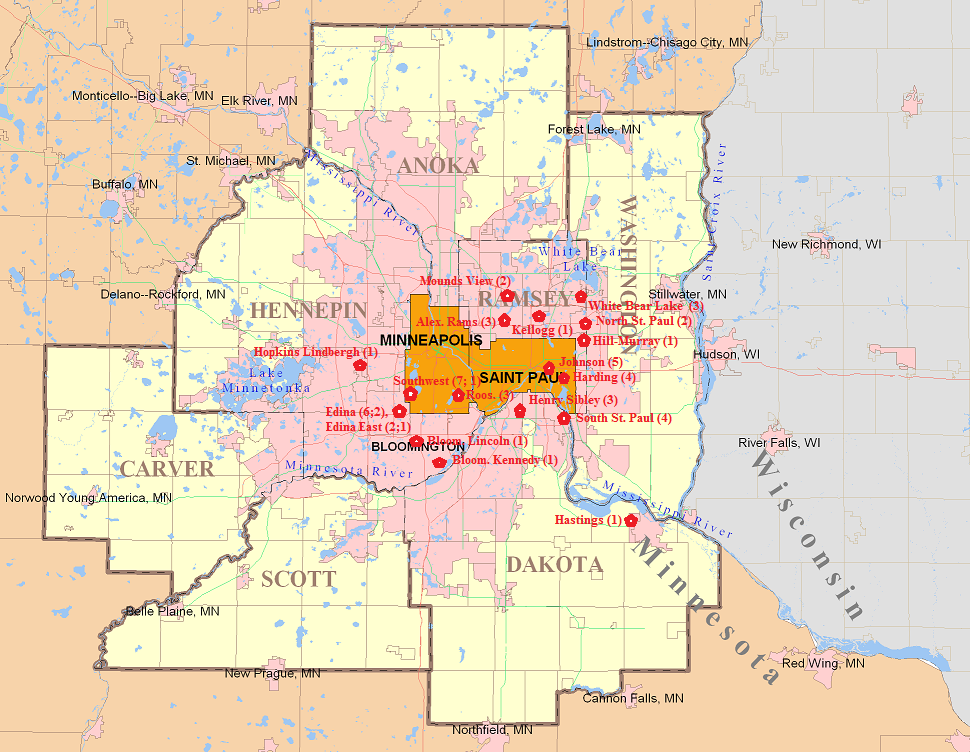
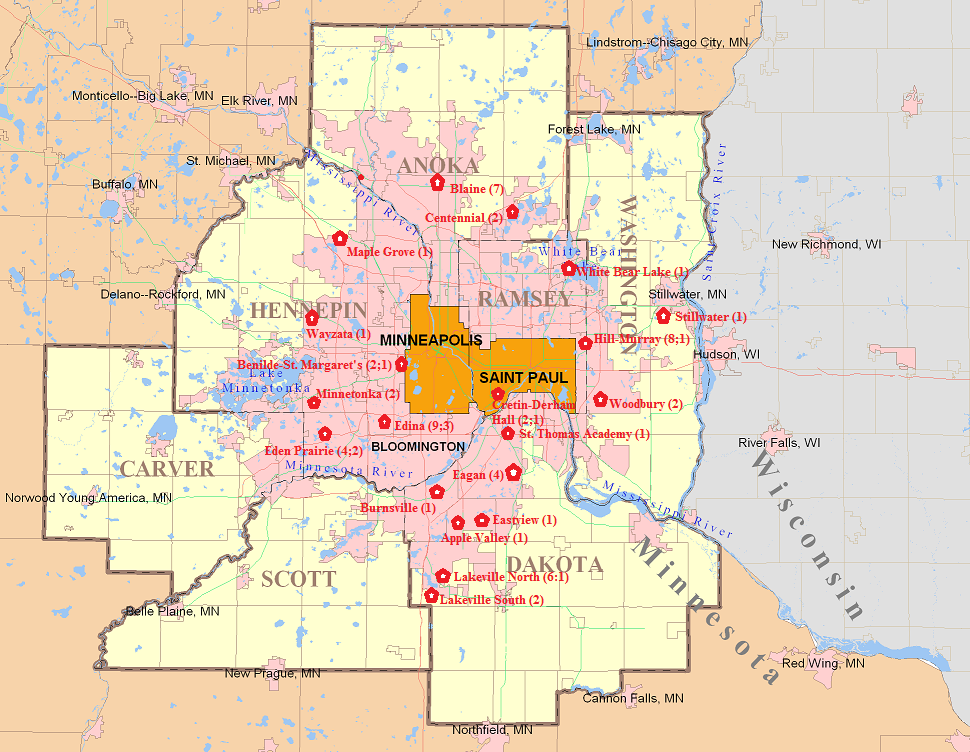
Metro Area State Tourney Entrants,1945-1955. Number indicates State Tournament berths; numbers after semicolons indicate State Championships. Click images for enlargements.

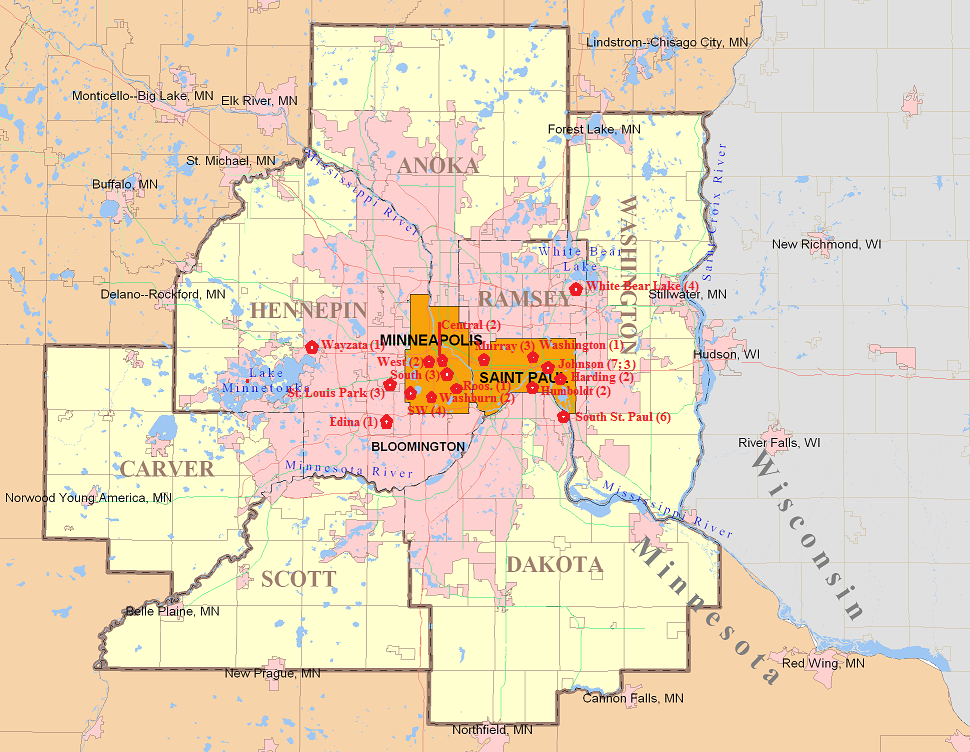
In 1950, most of the Minneapolis-St. Paul metro area population lived in the Twin Cities themselves, though there was a growing ring of suburbs such as Richfield, Bloomington, Edina, Roseville, and South St. Paul. Minneapolis’s population peaked in the 1950 Census, with 521,718 residents; St. Paul’s peaked a decade later, at 313,411. At the time, the cities’ hockey conferences were highly competitive; while St. Paul Johnston established itself as the Twin Cities’ preeminent public hockey school and the one Metro team that could go toe-to-toe with the powers of the North, there was relative parity beyond that, and things were always competitive.

tc55-65

1956-1965

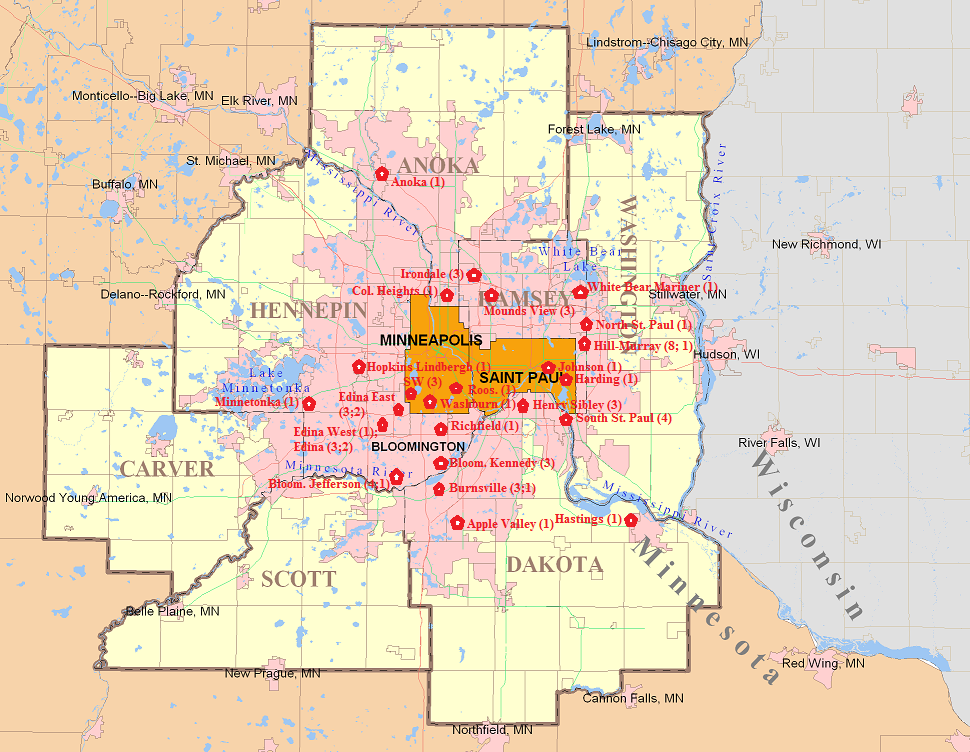
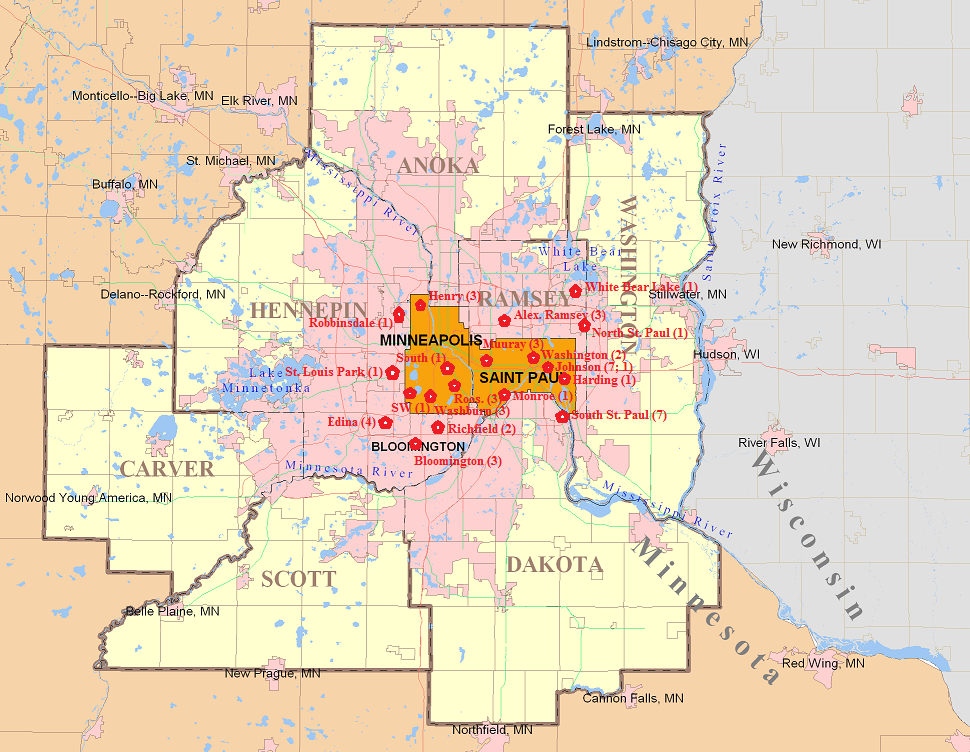
The second half of the twentieth century saw the gradual hollowing out of the inner city. Minneapolis lost 29.39% of its population between its peak year and 1990; St. Paul lost a more modest 13.14%, but the damage was real, and the hockey teams reflected it. By the 1970s, the Minneapolis section had largely devolved into a 2-team race between two of the most affluent schools, Southwest and Roosevelt; similarly, St. Paul was largely ruled by Johnson and Harding. But not even they were safe. Southwest won Minneapolis’s last big-school Tourney berth in 1980; Johnson managed to scrape together two berths in the 1990s, though they came out of weak sections and did nothing once they got to State. All of the Minneapolis public schools now co-op into one middling program; three St. Paul public high schools field hockey teams, with Johnson the only one coming even remotely close to some rare playoff success.

tc65-75

1966-1975

The first-ring suburbs were the early beneficiaries of the cities’ decline. Edina’s triumph in the famed 1969 title game, the one in which Warroad superstar Henry Boucha limped off hurt following an allegedly dirty hit, was the first title for a suburb, and ushered in an era of superb competition between the suburbs and the North. Alongside mighty Edina, South St. Paul established itself as a Tournament regular; Mounds View, Henry Sibley (of Mendota Heights), Irondale, and the Roseville and Bloomington schools all left their mark on the Tourney in the 70s and 80s.
tc75-85

1976-1985

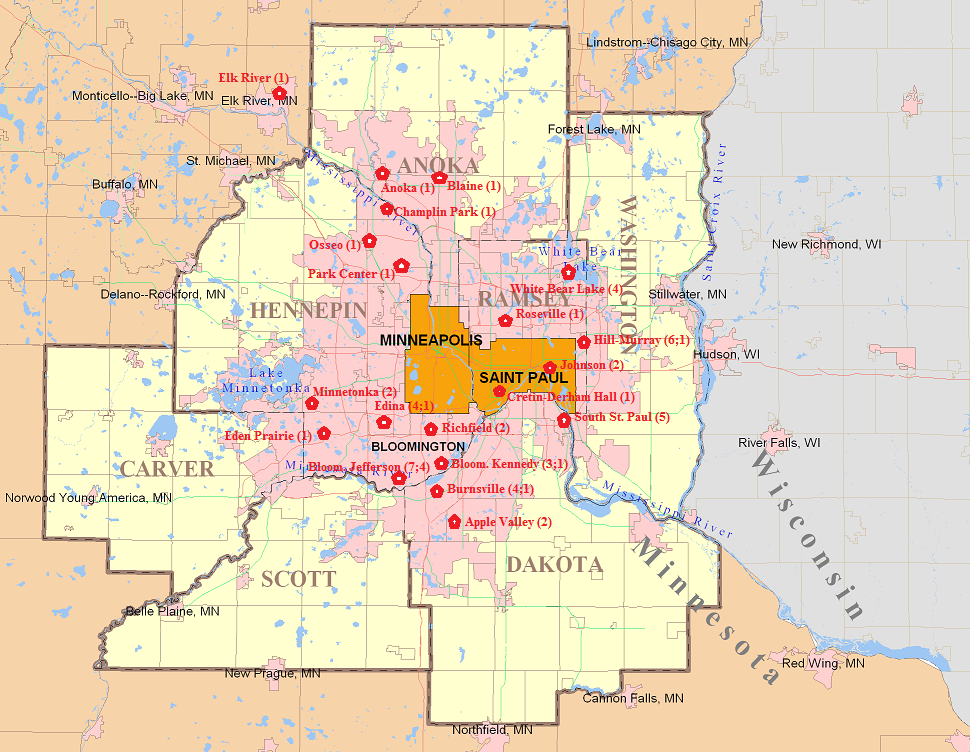
By the 1980s, however, things began to shift yet again. While Edina and the Bloomingtons often ruled the scene and the North had fallen off substantially, schools further afield in the Metro began to appear at State: Anoka, Apple Valley, and Minnetonka made multiple appearances, while Burnsville won back-to-back titles in the middle of the decade. That trend only accelerated into the 1990s, with Blaine and Eden Prairie joining the fun. There were even some berths for far-flung schools out on the Metro periphery, such as Hastings, Elk River, and Lakeville. Blue-collar South St. Paul, still one of the most decorated programs in state history, made its last Tourney in 1996 before dropping to Class A, where it has done little; Richfield, a title threat behind Darby Hendrickson in 1991, now struggles to field a team.

tc85-95

1986-1995

The decline of the first-ring suburbs becomes even more profound when one looks at which first-ring suburban schools have been doing all the winning over the past 25 years. 9 of the 13 berths from 96-05 came from Bloomington Jefferson and Edina, and all 9 from 06-15 belong to Edina. Edina is the exception that proves the rule here, the one first-ring suburb that has used its long-established prestige to maintain economic dominance and continue to attract young, fairly affluent families. In the late 1980s, blue-collar Bloomington Kennedy and Duluth Denfeld were every bit as good as, and often better than, their white-collar counterparts, Bloomington Jefferson and Duluth East. A decade later, Jefferson and East were the state’s premier powers, while Kennedy and Denfeld were struggling to stay relevant. Even the west side of Bloomington, home to Jefferson, has undergone some demographic change in recent years, though the Jaguars remain a relevant program despite the lack of State berths. America’s working class has been hollowed out, and its once-strong hockey teams have felt the strain.

tc95-05

1996-2005

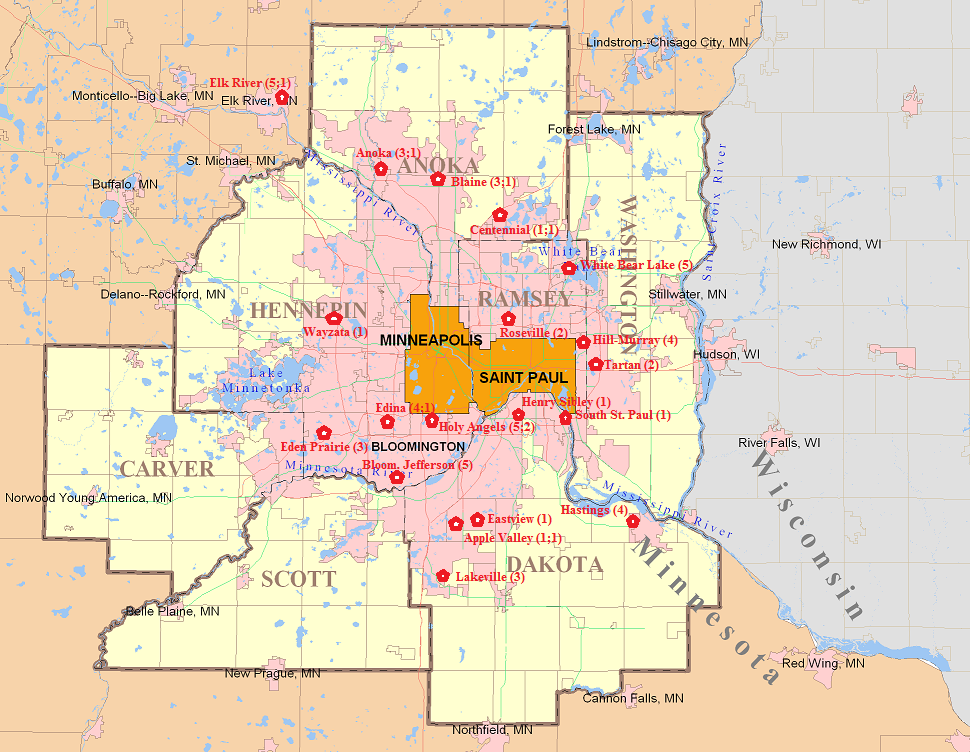
As populations in Minneapolis and St. Paul have started growing again for the first time in 60 years, there have been encouraging signs for the inner city teams; Minneapolis and St. Paul youth programs are climbing toward relevance, and St. Paul Highland Park brought its dead program back to life in 2010. But the most important trend over the past 25 years in these cities and in the first-ring suburbs is the rise of private schools, which tend to be where most of these youth kids wind up playing in high school. (Most, I suspect, have gone to private schools their entire lives.) This might seem to throw off the whole theory, but on the contrary, I’d argue that this only underscores the divisions in 21st-century American cities. While the 1992 two-class split and the story of Greg Trebil (a wildly successful Jefferson youth coach who took over the Academy of Holy Angels in 1996 and brought several top Jefferson youth players with him) may also play roles, the 1990s saw the sudden appearance of the privates (excepting Hill-Murray, which has always been good). This trend fits in with broader narratives of a self-sorting society. Inner cities, while growing, are increasingly divided, with the ultra-rich and the mostly-minority poor split into different neighborhoods, and only a small “middle” class (often involving young people who have yet to start families) serving as a buffer in between. Hockey parents with the means to do so bail on Minneapolis and St. Paul public schools, and often on schools in Richfield, St. Louis Park, or Brooklyn Park as well. There will be no hockey success for inner-city public schools until inner cities find some way to retain or grow their child-bearing middle class families.

tc05-15

2006-2015

So, what might we predict for the future? The second-tier suburbs will peak at some point, with greater success in rising exurbs like Stillwater, Orono, Prior Lake, and St. Michael. Inertia and hockey culture will carry on in places like Edina, and perhaps in some other places whose leadership or natural amenities keep property values high. Communities that build a genuine sense of place, as Edina has, will prove more stable in the face of natural cycles of urban growth and decline. Places along lakes or rivers, from Elk River to Stillwater to Minnetonka, seem likely candidates.

Naturally, there are factors that have nothing to do with urbanism that affect who heads to the State Tourney. The manner in which the State High School League draws boundaries, to say nothing of great coaches or freak individual talents, all play a role. (How many more state berths would exurban Elk River have if it hadn’t been stuck in a section with Duluth East over the past decade?) Decisions to open and close schools or youth programs will leave their mark, and there’s some chance that the repopulation of inner cities might eventually manifest itself in some way. We’ll also have to see how private alternatives to community-based youth hockey progress, and how these might eat into the pools that high schools draw from. But the correlation is undeniable, and I don’t think any of the above trends will do anything to undermine this whole picture.

Statewide trends reveal a more straightforward numbers game, as power has shifted from smaller towns to larger metro areas. In most of the North, culture allows teams to stay relevant and even thrive with smaller numbers, so long as the economy is stable. Duluth operates as a microcosm of the Twin Cities, with “inner city” Duluth Central now closed and working-class Duluth Denfeld fighting to stay alive, while exurban Hermantown grows, private Duluth Marshall consciously moves to collect regional talent, and Duluth East looks to follow the Edina formula and ride the considerable power of past prestige to stay on top of the heap.

There is one last elephant in the room here that I haven’t mentioned: race. Due to its cultural origins in Canada and Scandinavia, hockey is an overwhelmingly white sport. And, as recently as half a century ago, Minnesota was an overwhelmingly white state. But that is changing, and hockey has been slow to follow. Minneapolis proper was 98% white in 1950, and is now 63% white; most first-ring suburbs are now following the same demographic shift. On that note, I’ll make a bold claim: whichever suburb, town, or neighborhood manages to get the most minorities on skates is going to be the model for the future of Minnesotan urbanism. It isn’t that hockey is some magical vehicle to social equity, but it does have considerable cultural cachet, and its adoption by new arrivals would imply genuine integration and social cohesion. If anything is going to resist the unending push outward and into greater self-segregation (or even the privatization of hockey training, a story for an entirely different post), it is to be found here, where there is still low-hanging fruit. Any high school that can get a group of talented minority athletes together on a successful hockey team is going to break down any number of barriers, and will almost certainly win the hearts of the state. Inertia can do the rest.

In the meantime, enjoy the continued rise of the urban periphery and the private schools, and the continued relevance of the old powers with enough economic vitality to keep their numbers going. For everyone else, take it as a challenge to buck the trends and prove that other, more subtle factors matter, too.
Duluth News Roundup: March 2015

Over the past couple months, this blog has neglected any mention of Duluth affairs unrelated to the exploits of one particular hockey team. Time to fix that. I just spent a weekend back home, and Duluth is basking in sunny repose in mid-March, a rare feat that had everyone out enjoying the brownness of it all. (Why do these nice springs only happen when I’m elsewhere?) So, let’s see what’s been in the headlines over the past couple weeks, shall we?

Surprise! Art Johnston Is Suing ISD 709

Okay, maybe nothing much has changed. I saw this coming from a thousand miles away back when the School Board launched its shortsighted inquest into its most stubborn member, and everything has, depressingly, played out according to plan.

I go back and forth on what I think will happen if this does play its way through the courts. Harry Welty, who is the only person providing any insight beyond the most basic talking points, thinks Art has a very strong case in that his freedom of speech has been violated. That said, it’s not hard to see Harry’s biases here, and as the tone of his blog has shown recently, he can’t be trusted to be objective when he has an obvious stake in the outcome. From my very limited perspective, I’m not sure the Johnston camp has a good counterargument to the most salient point against him—that he used his influence as a school board member gave him undue power and a conflict of interest in representing his partner, Ms. Jane Bushey, in discussions with district administration. (Johnston supporters are quick to point out that no police report was ever filed against Johnston’s alleged “assault” of Supt. Gronseth, and I agree that it sounds like a fishy and trumped-up charge, but the “bullying” of Ms. Bushey is just as unsubstantiated at this point.)

I’ll agree with Art and Harry that the state’s law allowing school boards to remove members seems way too loose. I’d support the effort to change that, and bring it in line with the standards used for other elected bodies. But unless his lawyers can prove unconstitutionality, a fight that would involve some very high-level courts, the School Board was within its right to exercise its power of removal so long as it found “proper cause.” The Rice Report as written gave them proper cause, and while Art and Harry have questioned Atty. Rice’s character, they’re going to have a hell of a time proving that. This leaves them with the possibility of questioning some of the testimony she relied on to develop that proper cause. Harry enjoys making dark allusions to the actions of one school administrator, but this would tip the case into a number of accusations in the shadows and he-said, she-saids. Is that really a winning case, especially when the other side actually gets to tell its story? I’m not very convinced. And frankly, if the accused party needs character witnesses, she’ll have some good ones. I could be one of them.

I still think it was dumb of the School Board to go down this road against a mostly powerless Member, as Art will only drag this out in the courts forever and make it an even greater PR nightmare. I don’t know why any sentient voter would support any of the seven incumbents based on their conduct at the moment. But I also don’t think this debacle will prove the vindication that the anti-Red Plan camp seems to hope it will become, either. The whole affair is a pox on everyone’s house.

I should’ve gone into education law. Seems like an awfully lucrative field.

Howie Backs Out

As you might guess, I am crushed, simply crushed, to learn that Howie Hanson has withdrawn from the mayoral race.

It’s actually a pretty shrewd move on Howie’s part, and one that lets him get out of the race with dignity before it gets too heated. His odds were low, and this was not the stage for him. This allows him to dedicate himself to his seat on the City Council. Not having watched much lately I don’t know if he’s getting better or if it’s Same Old Howie, but he means well, cares for his residents, and, as one voice among nine, cannot do too much damage.

This leaves Emily Larson alone in the race at the moment, though we still have eight months before the election. Names like Yvonne Prettner-Solon and Chris Dahlberg continue to drift about, but they’ll need to decide fairly soon if they want to have the resources necessary to mount a successful campaign. In the end, Larson may be the biggest winner from Howie’s very early entry into the race, as her quick answer allowed her to really get ahead of the pack and get her name out there. I still think this election is hers to lose.

Let’s Sell Some Weed…Or Not.

There was some controversy this past week over the creation of marijuana dispensaries in Duluth; the Planning Commission is going full speed ahead here. The City Council, on the other hand, hasn’t been such a big fan in the past. There were a number of proposed sites—near the airpark, Garfield Avenue, Lincoln Park, somewhere in or around Morgan Park. Not coincidentally, these are all on the west side. For the sake of the west side’s image, I hope it ends up in the airpark or on Garfield Avenue.

The defenders of these sites say they’re all heavy-industrial areas anyway, which is true to an extent, but complexities of land use tend not to come into people’s minds when house-shopping. Saying “there is a pot dispensary in Lincoln Park” is probably enough. Granted, that might not be a turn-off for some people…but, let’s be real. Any rehabilitation of Duluth’s west side isn’t going to be led by a rush of people chasing a marijuana dispensary (unless Duluth goes all rogue and tries to become the Boulder of the North, but I don’t think that’s on the table right now). It’s going to need stable families to set down roots and repopulate the schools. Stick it by the airport or on Garfield.

Chartering a School

I’ve talked about this some before, too, but it’s coming to fruition: Duluth’s Edison charter schools are building a high school on the Snowflake Nordic Center site.

My objection isn’t to educational alternatives (which I support in principle, from private and parochial schools to homeschooling), nor necessarily to the idea of charter schools (though there is growing evidence that, in time, they tend to just become destinations for white flight). It’s to the scale of the project. In a metropolitan area the size of Duluth, subtracting 600 students from local high schools is going to cause a fundamental disruption. Of course, the school will draw from numerous districts; ISD 709 Superintendent Bill Gronseth claims most Edison students nowadays go to Marshall, and now seems unconcerned, but I have a sneaking suspicion over who will be the real loser in this new setup: you guessed it, the school that draws from the area of Duluth right by the new school. Denfeld. The poor get poorer.

Time will tell, of course. But the supporters of the Edison project are, in my mind, far too blithe and/or naïve over the likely effects of their new high school. This area is too small, and we are all interconnected. You do not live in a vacuum.

St. Louis River Corridor

Lest this post get too down on the west side, here’s cause for some potential excitement: we have some nice plans for the St. Louis River corridor redevelopment, most of them involving trails. In fact, if there’s a criticism, it’s pretty much all trails; the question becomes one of how to integrate all of these trails with the existing built environment, and how to capitalize on the new attractions. Still, there’s lots of encouraging stuff here, from skiing to rock climbing to horses to river access. There is plenty of ongoing investment in west side amenities. The question is, will genuine economic opportunity follow? Or is this just a cosmetic repair on the surface, one that ignores a collapsed economic base and a declining housing stock? I don’t have the answer there. Time will tell.

For all my grumbling, it was good to be back. Nothing quite matches a Minnesotan’s delight as the coming of spring after the long, cold tunnel of winter. Enjoy your spring, Duluth. I hope to be back again before long.

The Hounds’ Run for the Ages: 2014-2015 in Review

The Duluth East season is at an end, though Greyounds young and old are still trying to figure out what exactly happened over the past two weeks. The Hounds took us on a ride for the ages, as a mediocre season culminated in a second place trophy. The streak included one of the greatest comebacks in State Tournament history and one of the greatest upsets in State Tournament history on back-to-back nights, to say nothing of one heroic goaltending performance and yet another crazy comeback in sections. Much of the praise for the run, some of mine included, has been directed at Mike Randolph, and he certainly deserves the credit for devising a system that turned a defensive sieve into a trapping machine that shut down Edina’s bevy of forward talent. The old Hound found new tricks, even in retirement.

Importantly, though, Randolph gave all of his praise to the players, and it was those players who made it happen. It was largely forgotten after the first half struggles, but East was ranked in or around the top ten by most people in the preseason, and while there may not have been any can’t-miss D-I upperclassmen, over half of the players on this team will have the chance to play some hockey after high school if they so choose, some of them at a fairly high level. This team was deeper than many, including all of 7AA; by the end of the season they had three competent lines that could score, and rolled six defensemen for the first time in several years. As Edina so often shows the rest of the state, depth kills, and any team with confidence in its full bench is in a position to outlast teams that may have a few more front-end stars.

East didn’t score much this season, but the numbers there are a bit misleading. Thirteen different skaters recorded a point in the State Tournament, and while it was only ever a Plan B, they did show some genuine offensive talent when they had to, rallying back against teams like Blaine, Minnetonka, Elk River, and St. Thomas Academy. Luke Dow and the Altmann brothers are high-quality high school forwards, while Ryan Peterson was one of the stars of the Tourney, and Brian Bunten was a consistent presence. Garrett Worth has the potential to become the next in a line of great East snipers, and Ian Mageau and Ryder Donovan will likely join him in some offensive prowess in the coming years.

This East team had its issues, though, with only one returning defenseman who played defense last year. There were signs of promise from the whole corps, but sloppy or boneheaded moments often did them in; a number of East’s losses involved two reasonably good periods that were undone by one abysmal one. In net, Gunnar Howg hit enough speedbumps to see two other goalies cycled through the job before winning it back with a stellar performance against Lakeville North. A young group including three freshmen and a sophomore slowly found its way against that typically brutal schedule. The first half was a laundry list of can-you-top-this frustrating games: a narrow escape against St. Michael-Albertville, a blown lead in Centennial, a 7-1 shellacking (despite nine power plays!) at the hands of Edina, a loss to Eastview in a winless holiday tournament, and then rock-bottom, a 5-1 home loss to rival Grand Rapids.

It is hard to pin down any one turning point in East’s season. Nick Altmann pointed to a narrow loss to Eden Prairie in January, a solid effort in a bounce back from the Grand Rapids game two days prior; immediately after that came Howg’s performance against North. But there were still bumps. A loss to Anoka led to the adoption of the radical 2-3 forecheck that was the star of East’s best regular season game, a tie at Elk River that proved they had a shot at the section. But even though that scheme played a huge role in some of the Hounds’ wins down the stretch, there were other games where they never really got it going or had to drop it to make up for big deficits.

To pull off this run, this team needed to have something else going for it, some intangible quality that takes all of those clichés about sports and makes them real. Grit, heart, character, determination, belief: whichever word you like. Randolph’s line from the 2014 section final reappeared: “deny losing.” They played each of their six playoff opponents during the regular season, and didn’t beat a single one of them. But yet they got it done. They took down a goalie with a bright future who’d flustered them in a regular season tie, an archrival out for their blood that threw everything they had at them, the Mr. Hockey winner and his team of section destiny, high-powered St. Thomas Academy in its AA Tourney debut, and then the two-time defending champions, a team that had lost just once in its previous 37 games.

The heroes were different every night: Howg against Grand Rapids, a couple of third-liners against Elk River, Ryan Peterson against St. Thomas, the Altmann brothers against Edina. A big hit from Bryton Lutzka here, or desperate goal line clearances from back-checkers there; Alex Spencer throwing it down with Parker Mismash, showing Edina that East wasn’t going to take his agitation lying down. It was a total team effort, and while they exceeded my wildest expectations, after each win, the next one didn’t seem like it would be so implausible. They’d done it before, so why not do it again?

Luck played its part, as it must in every miracle run. There were so many pipes, trickling pucks, and convenient bounces. Dylan Malmquist’s injury will forever be an asterisk on the Edina game. Even so, the Hornets had more than enough firepower to win, and the Hounds made Edina’s other stars look ordinary with their discipline. Their reward was, hands down, the best sports memory I have ever had: 21,000 people in a record-breaking crowd, rising to applaud the darlings of the north. (Call it the East fan’s paradox: we spend the entire regular season as the Evil Empire of 7AA, only to come down to St. Paul to adoration.) It helped that they took down two of the most hated teams in the state, but it was a run that reminded many why it is we love this Tournament so much, and why Minnesota high school hockey has no equal.

The final against Lakeville North wasn’t to be: the Panthers were too good, too precise, and too smart to fall into some of the same traps that others before them had. East lost to one of the all-time great teams to come through the state, and did a decent job of hanging in there, giving some faint hope for yet another comeback. There was no shame in the effort, and while the fourth title remains elusive, another big-time trophy is on its way back to Duluth, none more improbable than this one.

And so we bid farewell to our seniors: Nick Funk, Matt Lyttle, and Evan Little, all of whom came into their own as regular forwards down the stretch, and chipped in big plays in the playoffs. Backup goalie Lucas Hedin, who gave a delicious salute to St. Thomas Academy after East finished them off. Bryton Lutzka, whose experience and big hits led the way on an otherwise green defense. Gunnar Howg, a two-time Tournament goalie who found his niche as a Hound. And the captains, Brian Bunten and Nick Altmann, two hardworking longtime linemates who drew their coach’s highest praise: “you see those two guys right there? They drive the bus.” We wish them all the best, whether in hockey or in life beyond dear old East. Together, they made some memories to cherish.

For the rest of the team, meanwhile, it’s back to work: time to hit the weights, plan an offseason regimen, and probably enjoy some free time away from the rink, too. This was a pretty young team, and there will be a lot of talent coming back next year. Grand Rapids will be loaded, Elk River will be out for revenge, Cloquet is still there, and Marshall is joining the AA party. Seven in a row is nice and all, but eight has a pretty good ring to it, don’t you think?

My annual State Tournament reflection essay (which also, unsurprisingly, includes some stuff about East) is available here.