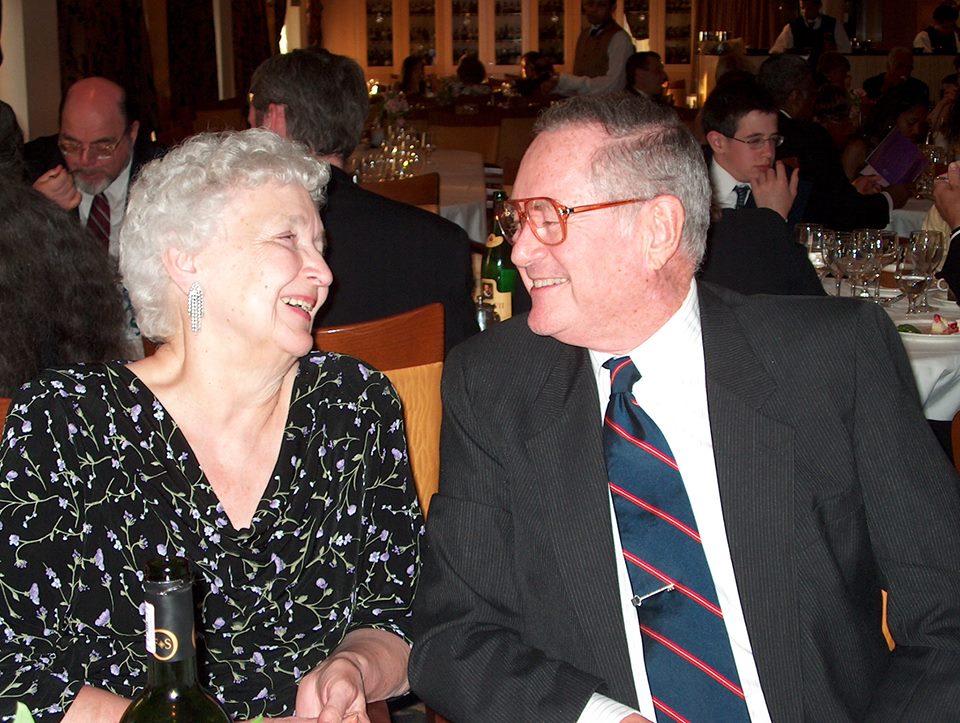
On the weekend of my senior prom in high school, I took an impromptu trip to Chicago with my mother. For reasons not worth recounting here, my situation with girls was complicated, and I preferred to run away from it all. I had a few other things on my mind, too. The month before, I’d received my acceptance letter to Georgetown, a dream fulfilled; within a month, I’d be out of high school, and my parents’ divorce, long in the works, would be final. I was not exactly in my most stable mental state. I needed an escape, and my grandmother’s 80th birthday party provided a retreat into a safe harbor.
At the party, I had a moment to myself with my grandmother. She proceeded to give me the longest, most heartfelt hug I have ever received. She expressed some pride that I was headed to Georgetown—maybe I’d turn out a good Catholic boy after all!—but it quickly dawned on me that she was saying far more with that hug than a comment on college choice. There are a few people in life with whom I feel deeply in tune, fellow observers of the world passing before us whom I can read and who can read me in an instant. A quick look, even when cryptic, could convey paragraphs. Grandma was one of those people, and it was in that moment that I came to understand the meaning of unconditional love.
Her smile was a window unto an eternal incandescence. Her spirit gushed and overflowed and swept us up, making us forget pity, caution, concern, everything but the pleasure of her presence. -Wallace Stegner, Crossing to Safety
Grandma was something of an expert on the topic. As the mother of twelve children, she shepherded them all through their highs, lows, and all of the tumult that our sprawling clan mustered. If natality, as Hannah Arendt claimed, is indeed the miracle that saves the world, she brought about that destiny time and time again. It all seemed to come with a certain ease. There were, of course, times when it all drained her; times when wayward members of her lineage led her to shake her head and purse her lips. But she knew that the richness of her creation far exceeded its exhaustions, and by the time I came along, she’d seen it all, and knew what we needed in certain moments.
That innate connection appeared once again when I saw her for the final time this past April. Due to the coronavirus it was our first in-person visit in over a year, and she was moving more slowly, thinking more slowly, steadily slipping away into the mists beyond. We both seemed to have the sense this might be the last time we saw each other. We had a long goodbye, and we shared one final significant look that said it all: we would confront what came next, not without a little fear, but also with knowledge, with a certain faith. That was enough to see us through.
Grandma’s death this past week, at the age of 93, came with a characteristic grace. While there were struggles, she always seemed to slide easily and deliberately through life, and there was never a radical turn. When she lost her husband of 67 years, she mourned but moved on, kept up her joyous spirits, tiring more easily but still ready to be part of the endless family party. Unlike Grandpa, she did not crash with age; instead, it was a slow, gentle fade, tinged by the occasional frustration and uncertainty, but never far from her characteristic good humor. My Aunt Mary Beth took her in for the final four years of her life, an act of quiet heroism that made sure my grandfather’s rough decline in sterile hospitals would not befall her. She eased away with a steady stream of family visits and put up with the chaos of weekly Zooms during her final year. When it was time to go, she went quickly, waiting just long enough for Mary Beth to return from a much-needed trip with her son and grandchildren to Cape Cod, muttering a few final phrases in Polish to come full circle, family by her side as the breaths slid away.
Like her husband and so many of her progeny, Grandma possessed a robust mind. This young Polish girl from the city attended the University of Chicago in the 1940s, a feat whose impressiveness did not dawn on me until late in her life. While she didn’t get lost in intellectual tomes and debates the way Grandpa did, she kept herself busy, always ready to exercise a politely judgmental curiosity, whether over some book or movie or adventure of her offspring or in the complete tour of a giant book on art history that she and I once undertook. In coronavirus quarantine I picked up her crossword puzzle habit; toward the end, when that was beyond her, she settled for marathons of Rummikub, which now threatens euchre’s position as the official family game. If Grandpa was the driving force of nature who made their small empire possible, Grandma was its deep guiding core, her mere presence creating a sense that this all should come naturally.
The family Zooms over the final year and a half of her life gave us occasion to bust out old pictures and gifted me a window into the formation of a suburban Chicago matriarch. There were her childhood ventures to Devil’s Lake in Wisconsin, an ever-burgeoning clan filling first the house on Ardmore in Villa Park and then the house on Edgewood in Lombard, and later at the homes of aunts and uncles and out in Huntley. The steady string of lifelong friends, couples on a shared journey: Gingers, Gioias, Fanellas, and so on. Catholic masses, chaotic Christmas parties, Cubs games, a few European cruises, a papal mass. Joy filled it all from start to finish.
Grandma fell in love with the Northwoods of Wisconsin, long a family retreat, and I can still see her contented smile on the deck overlooking East Twin Lake. My Aunt Lucy’s transcription of her Northwoods journals early in the coronavirus pandemic were a revelation, a deeper dive into a mind whose contours felt both new and exactly right. Her work inspired me to start a simple journal with posterity in mind, a daily exercise that got beyond the alternating poles of incredible detachment and deeply personal musing that consume so much of my own output, and settled for easy reflection on the passing days. “I try not to feel apprehension — keep telling myself to just ENJOY what we’ve been given,” she writes on day one of the journal. An ethos we can all take to heart.
What I will remember forever, however, is her laugh. It had a full spectrum, from a quick chuckling eddy to a deep, full-throated roller, a cycle of the tides to fit any occasion. It was always ready, sometimes delighted and sometimes resigned, but always able to light up a room. The punches have come hard for us Maloneys in 2020: first an aunt and then a cousin and now the woman who birthed it all. At least now we can all be together again in the flesh to send her off. So I will dust off my suit, pour myself a Manhattan, and prepare one final do widzenia to the woman whose easy delight at the world around her made possible a life in accord with the rhythms of her world. We multitudes who follow all carry that light.
And if, while following him, you ever feel a disapproving cluck rising inside your palate, as I sometimes do, don’t forget that inside most people you read about in history books in a child who fiercely resisted toilet training. Suppose the mess they leave is inseparable from their reach and grasp? Then our judgment depends on what they’re ambitious for—the saving glimmer of wanting something worthy.
-George Packer
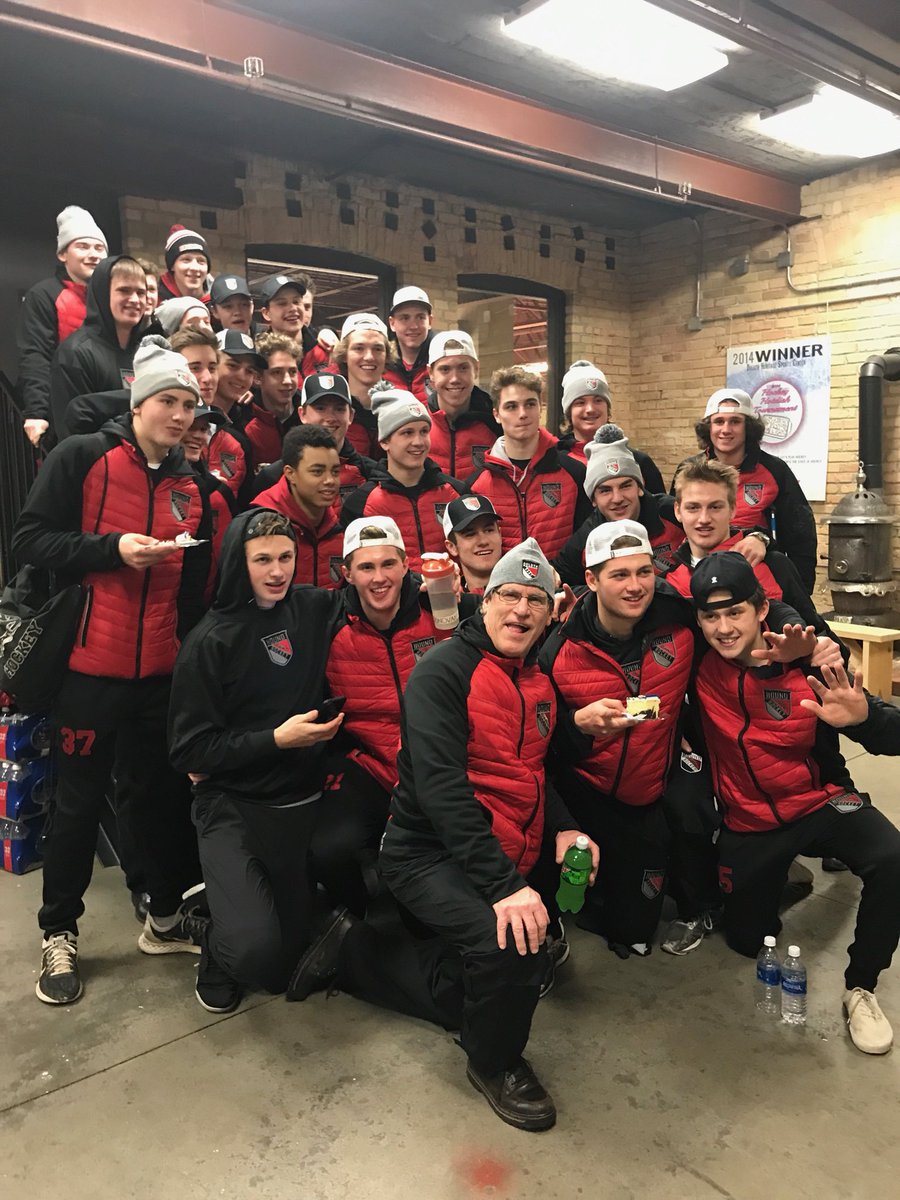
Mike Randolph’s tenure at Duluth East ended not in victory or defeat. In fact, it came in a season in which the Hounds did not play a playoff game. It revealed itself not in one of those emotional roller coasters of hugs and tears on the ice after a big game, but in an odd whimper and a hushed-up meeting with school administrators. The caginess of the whole affair showed how high the stakes were, and how vicious the voices involved could be. Few people feel comfortable being the face of the defense when the sharks are circling, and few are willing to be the prosecution after the axe has come down.
Mike Randolph was one of the most intense coaches to ever stalk the bench of a hockey arena. The ability of players to adapt to that reality both made them and broke them. Some kids would skate through brick walls for him; some said he made their high school years a living hell. It was his show, his formula. His control over every aspect of the game allowed him to pull strings that others would not, and occasionally to get more out of less than any other coach in Minnesota. He rewarded those who met his standard, and those who did etched themselves into the collective consciousness of several generations of kids passing through a school on the east side of Duluth, their coming-of-age rites of passage in packed arenas in Duluth and St. Paul come playoff time.
Over the years I have worked hard, sometimes painfully hard, to offer a voice of detached neutrality when it comes to Mike Randolph. In part that’s who I am, and in part it has served my purpose of staying on good terms with just about everyone around a sport that, for me, is a diversion and an escape, not the serious business of life beyond the rink. This position is at odds with many people I interact with, including both Randolph himself and many of the kids and parents involved in the game. Those lives overflow with devotion and passion in the pursuit of a singular goal. The ability to delight in that world and yet still be able pull oneself out of that cave and see beyond it is not a common gift.
In some ways, my side gig as a hockey commentator was always building until this moment. Never have I been more nervous to send out a Tweet as when I got the go-ahead to share the news of his Randolph’s resignation with the world. On the next day I felt a queasiness my sometimes-weighty day job has never given me when I got to be the fly on the wall at a meeting that supportive current players asked for with their coach. It was raw and emotional: disbelieving kids, parents in search of a solution, and the grizzled coach pulling fewer punches than in his carefully crafted statement to the press a few days later. Randolph left the door open for a return if the political winds were to turn, but he knew the odds were not in his favor, and he told the gathered crowd as much. Some of the players tried to rally, but the reply one of them received from a school board member showed exactly where that course was going to go. There were still glimmers of Randolph’s old scheming, but he himself knew it was time to move on.
Later that evening, on a blissful summer night on the grounds of Glensheen, I stumbled upon a former East hockey parent. She extolled Randolph’s impact on her son’s life and shared the reprehensible and false things some detractors asked her to accuse him of to get him removed. A friend with her, meanwhile, had the exact opposite perspective: he lamented his son’s treatment in his time with the program and said he felt relief upon hearing the news of his resignation. The three of us hashed out a healthy conversation about what the man meant and where the program should go next. I am pleased that I have been able to have these conversations face-to-face with people over the past several years. (The grandstanding from anonymous social media or message board users is another story, and one I happily ignore.) The future of Duluth East hockey depends on them.
I got to know Mike some over the years. I wouldn’t call us intimates, but he was certainly willing to spill out his thoughts when he had the time, and he was bracingly honest when he did so. In those interactions he was only ever gracious, and would offer unsolicited praise for players past and present, including some whose parents I knew to be critics. He had a lot of fun doing what he did. Whatever else Mike Randolph might be, he is a marvelous storyteller possessed of a vicious dry wit. To anyone who enjoys high school hockey, the chance to watch him scribble schemes on napkins and to pick his voluminous memory was a trip down a rabbit hole that was hard to escape. A series of long nights on the town during his last State Tournament at East will forever rank among my favorite high school hockey memories. (I hasten to note that Randolph was completely sober for these encounters, as he has been for many years; he was merely out to suck up the atmosphere of that special week in March.) Over those nights, I saw with my own eyes his ability to pre-script dramatic games, and I got some windows into just how viciously some people treated him. The comparatively drama-free and successful mid-to-late 2010s felt like a valediction to a long career, as a battle-scarred man found peace, received his due, and delighted in the relationships he was building with his players. But history is rarely that easy.
I’ve heard out many parents who did not like Randolph, and I have listened with ears wide open as others talked around me. Their critiques ran the gamut, from line combinations to mind games to some less savory rumors unrelated to hockey. (In 2021, as one of the few non-parents in the pandemic-limited arena, I heard little else.) When I also struggled to see the logic in some of Randolph’s tactical or personnel decisions, I tended to agree with them, and frankly that was not an uncommon occurrence over the past two years. But it was also interesting to see how, once a parent developed an initial beef, perhaps one with some merit, all of the rest tended to follow. It was almost amusing how the same critiques in the same exact phrasing would filter their way down through the rumor mill from year to year. If Randolph was to be guilty of one thing he was to be guilty of everything, a black and white world with little room for Greyhounds in between.
Randolph was no doubt hardened by the attacks upon him over his career. He had an ego, as will most anyone who is driven to win, and was proud of what he had achieved. He surrounded himself with assistants who were full believers, almost exclusively ex-players who bought in to what he preached and sought to replicate it throughout the system. Loyalty, above all else, became central to the Duluth East program. Many people circle the wagons when under duress, and the strain only seemed to grow over recent seasons, the coaching staff set against a growing camp of bitter skeptics. At what point, I wondered in one late-night discussion with a hockey confidante, was the atmosphere around the program too toxic to endure without a change, whatever Randolph’s merits as a coach?
By 2021, it seemed like Randolph’s supporters felt they had to whisper their actual feelings to me in private lest anyone overhear something that went against this brewing narrative. Given the imbalance in what I was hearing, I was almost stunned when I saw the number of current players and parents who showed up to support the man wholeheartedly at the end. The media narrative since Randolph’s fall has likewise been mostly supportive of the coach. Figures large and small have lamented the power of parents to bring him down, and East players from down the years have blasted the softness and blindness of those who, in their minds, could not see Randolph’s tough love as the demanding standard that could illuminate the path to greatness. I don’t quite buy the argument that Randolph is someone whose style got left behind by the times; some very recent classes, including many of the current underclassmen, appeared to value his frank talk. I also know and respect some parents from much earlier years who still nurse hard feelings. Something much deeper and more fundamental was afoot.
The question throughout the drama has been whether Randolph’s purported sins should cost him his job. I have only been able to look at the evidence before me, which at this point is little different from the same things I have been hearing for 15-odd years, supplemented by a few emails from past parents who saw in a new school district administration a fresh opportunity to take the man down. There were some rumblings about the booster club, but a district official, I am told, said there were no lingering issues there at a parents’ meeting after his resignation. Opacity denies us closure. The late-stage pandemic further removed any drama from the final act; I expect the school district is all too pleased its meetings are still on Zoom, depriving us the board room drama that erupted last time around. At some point, the district will, hopefully, comply with the data requests made by the media regarding the complaints against Randolph, and we may learn from the source material if there is anything truly salacious within them. Until then, we are left in a cloud of doubt, sorting through stories that call him the most powerful influence on the lives of some and a source of misery for others, struggling to reconcile the fact that both can be true.
In the moments when hockey has seemed to overwhelm other commitments in my life, I’ve often stopped to wonder why I, a Duluth East alumnus who never skated for the program and the owner of a rich and satisfying life beyond hockey, became such a devoted follower of this sport at this level. The reason, I think, circles back to Mike Randolph: not necessarily to the man himself, but to the idea behind this sometimes brilliant, sometimes intimidating, sometimes flawed human. Life roughed up Randolph in his early years, a tale he told in his final statement: limited resources, his father’s stroke, the care he received from his own high school coach. He bypassed many other roads to wed himself to the little corner of the world that made him, a place where he saw an opportunity and pour out his soul for over three decades. He wrote himself into the lore of a Minnesota tradition and took none of it for granted, scrapping every step of the way, always demanding more.
Perhaps he erred along the way; perhaps his ambition at times took him too far. But the idea he stood for, that glimmer of the worthy pursuit: that lodged in the mind of more than a few teenage strivers in need of some discipline, some fuel for the drive. Thanks for the memories, coach. The young men you formed include a few who never even played for you.
Up until this past weekend, I had seen two moose up close in the wild. One was a tame sighting from a canoe; the other, which wandered in front of the family car during a nighttime drive down the Gunflint Trail when I was young, may have been the closest I have ever come to death. This docile creature, seemingly part deer and part cow, has otherwise been an elusive presence for a resident of northern Minnesota. While a quest for moose is hardly a search for snow leopards in the Himalaya, they are part of the local allure, and a trip to Isle Royale seemed the perfect way to rectify this lack of large, furry, antlered beasts.
Isle Royale is the largest island in Lake Superior. It sits some 20 miles off the coast of Minnesota and Canada, though it is a part of Michigan, leading those who come from the Minnesota entry to eternal time zone confusion. It is the least visited national park in the United States outside of Alaska. Over the past century it has gained some fame for its moose and wolf populations, which often move in relation to one another, though lately the wolves have preferred to wander off across the ice pack in winters and thrown the balance out of whack. The island’s folded rock is the geological twin of Michigan’s Keweenaw Peninsula, its length scarred by the glaciers that formed Lake Superior and created the lake-studded Northwoods that I call home.
After a year in which I kept up my travel pace largely by sacrificing companionship, I am eager to tread trails with other people. My fellow hikers, Connor and Alex, are new to backpacking but well-prepared for this venture. (We are all planners, after all.) Rarely have I been the experienced hand on my group hiking excursions, but as I relate tales of past excursions as part of the steady chatter that takes our minds off our feet, I realize just how much exploration I’ve done in my life. And though I’ve never been to Isle Royale before, it feels like home turf. When my companions, both St. Paul residents, ask me on the drive up if Lake Superior ever gets old, the answer is an easy ‘no.’ This realm is my playground, and these outdoor pursuits are among my fondest pastimes.
The ferry dock for boats to Isle Royale is in Grand Portage, the final settlement on Minnesota’s North Shore. With the Canadian border four miles to the northeast still closed, Highway 61 is quiet, and the settlement nestles sedately around a large bay. Grand Portage is home to an American national monument dedicated to French voyageurs, but it is primarily home for members of the Grand Portage Band of Ojibwe, whose tribal headquarters are here, along with a campground, a general store, and a casino, which provides our lodging the night before the ferry departs. Randomly pressing buttons nets me $6.91 off the free $15 casino voucher I get for being a hotel guest. I consider it a win, though Connor’s haul dwarfs those of Alex and me.
The Voyageur II, our ferry, nears its capacity of about 50 for this jaunt across the strait that separates the island from the Minnesotan and Canadian shoreline. The boat heads first for Windigo, its western port of entry, which is the destination for my travel party and the vast majority of our fellow sailors. From there, it will ply its way around the island, with stops at a few smaller trailheads and an overnight at Rock Harbor on the eastern end before it completes its circuit back to Grand Portage. I pop my Dramamine and settle on to a rigid bench for the two-hour ride.
Isle Royale is not a complete and utter wilderness. A hotel still operates at Rock Harbor, and both Rock Harbor and Windigo are home to additional buildings, including ranger stations, Park Service stores, and bathrooms with actual plumbing. Small motorized vehicles putter about these entry points, seaplanes drone past with some regularity, and after a bad storm rolls through on our final morning, a chorus of chainsaws rings out through camp as the rangers re-open the trails. It would be possible to have a vacation here that is rustic but requires minimal physical exertion, and the day trip ferries, which resume service the day after our departure, no doubt add to the touristy nature of these outposts at each end of the island.
Most visitors to Isle Royale, however, embark on backcountry expeditions, the most famed being the 45-mile hike from Rock Harbor to Windigo across the spine of the island and the opportunity to canoe and portage across a chain of small lakes on the northeastern end. Our hiking loop is a standard 30-plus mile route for those who come from the west end. It begins in Windigo and circles its way counterclockwise through the southwest portion of the island, with tastes of everything it has to offer: inland lakes, Lake Superior waterfront, ridges along the central spine, an old mine, and, of course, moose.
The first day is an eight-mile walk from Windigo to Feldtmann Lake, which looks like prime moose habitat on the map. The trail follows Lake Superior for a spell and then clambers up a ridge with views of a swampy interior, which it then drops to and skirts on its way around to Feldtmann Lake. The trail here is tame and relatively flat, though the underbrush, thinner than on the mainland, is clear evidence of moose activity. Many balsam firs along the path seem stunted, with all the vegetation shorn from their lower branches and only some tufts of needles at the top, away from prying mouths. Later, a ranger tells us that some of these trees can be decades old, and not the saplings they seem to be, due to the constant nibbling. We come to Feldtmann Lake to find the best two campsites occupied, but settle for a respectable one just a short distance away from the lake.
Isle Royale campgrounds are unlike others I’ve encountered before. Often eight to ten miles apart, they are sparser than those on the Superior Hiking Trail or in other backcountry realms I’ve hiked. They make up for their scarcity with clumps of sites in marked campgrounds. My initial reaction to this setup is not one of great love: it’s hardly deep wilderness when there are five other parties within two hundred yards of one’s site, and yet since we are all strewn across our own distinct areas, the conviviality that comes with sharing a site with ten other hikers does not come as easily. Still, over the course of three days, we get to know two 40-something women from the Chicago area who are on the same route; a quieter couple is also on the same circuit, and a few others linger to chat here and there.
There is also some surprising variation in the amenities. Siskiwit Bay, which has its own very new-looking dock, features picnic tables at the sites, while several Feldtmann Lake sites lack even the rudimentary seating log common at deep wilderness camps. Of the four campgrounds we tour, only Island Mine has fire pits, and Washington Creek, a stone’s throw from the ferry dock at Windigo, is more of a collection of wooden shelters with single screened sides, with a few sad tent sites tucked behind them for overflow. Some of these variations are logical enough, but it makes every stop a new adventure.
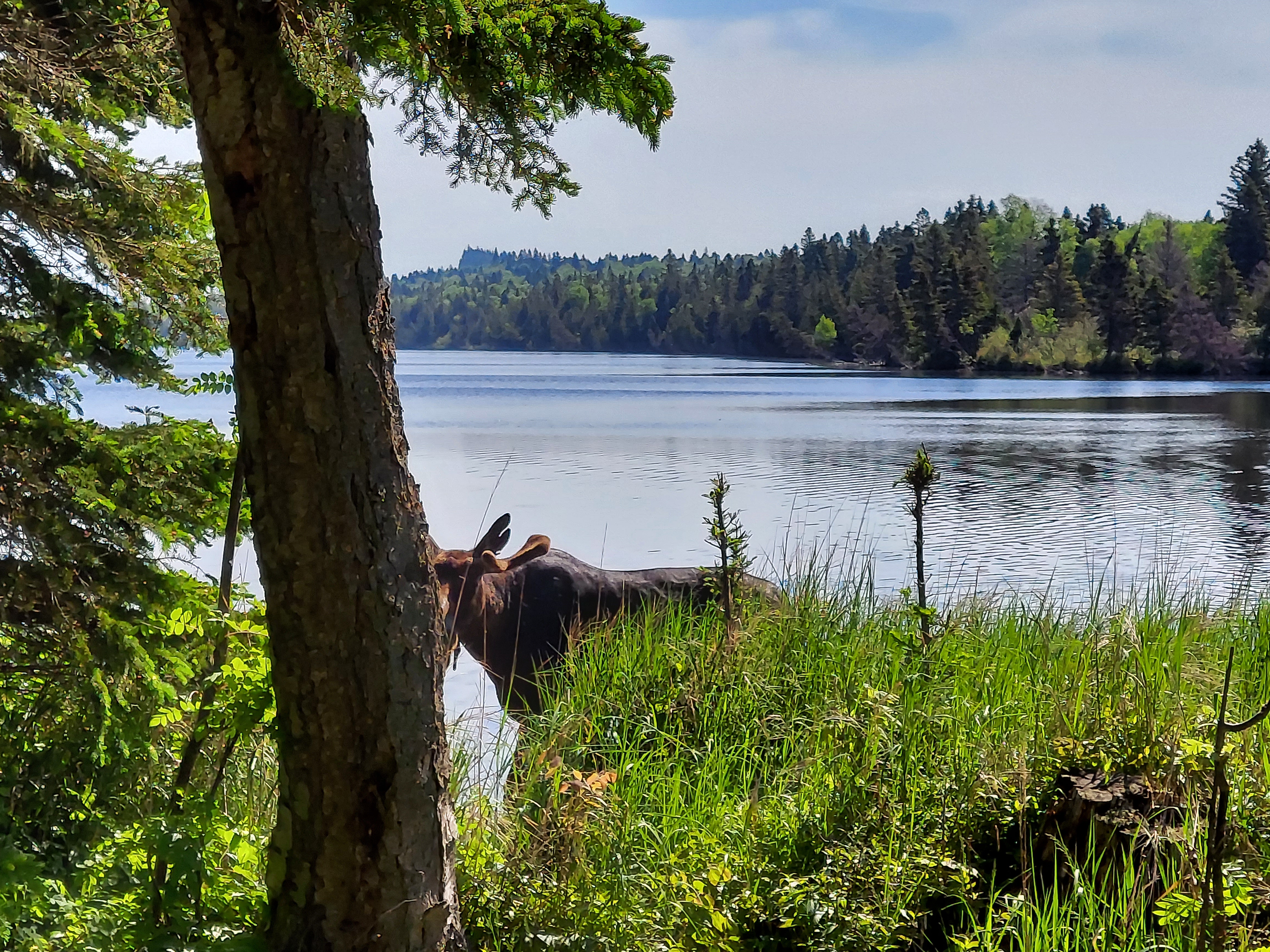
Despite the lack of seating options, a strong breeze off Feldtmann Lake knocks down all the bugs on the first night and gives us a pleasant evening. We take our dinner a short distance away at the placid pebble beach of Rainbow Cove along Lake Superior. Later, back at the site, we deploy a wood-burning stove of questionable legality and stay up late enough to watch the stars come out. A thunderstorm hits while we’re still in tents the next morning, and after it blows over, I peek out of my tent for the first time and am immediately greeted by a female moose plodding past our site down the path. Success! I’m too slow with the camera to get a respectable picture, but I need not worry: a short while later she makes her way back up the shoreline, stopping to chew on plants, and a male friend follows her shortly thereafter. We take our time to admire them from as close a distance as we dare.
The second day’s hike begins with a placid wrap around Feldtmann Lake’s southern shore, the trail high and dry from the surrounding swampland on a short ridge, moose prints dotting the mud. We then charge up a steep climb to Feldtmann Ridge, which offers looks back over the lake and to Superior beyond, a series of false summits offering better and better views before we settle into a ridgetop plod, often in direct sun. Next comes a beaver pond and a gentle trickle of a stream before we come to a defunct fire tower that now serves as a lunch spot, where we meet an older couple heading the opposite direction and the Chicago area women, one of whom gracefully tips over her camp chair while holding a freshly reconstituted bag of freeze-dried chili. We clamber up the tower as far as we can for equal doses of pretty views and vertigo before continuing on our merry way. The trail descends into the largest birch grove I’ve ever seen, though it later degenerates into a buggy, scrubby, scorching hot swampland as we slog across the final miles to Siskiwit Bay.
Siskiwit Bay is a prominent bite into Isle Royale’s southern shoreline. A large vessel, perhaps from the Coast Guard, sits at anchor toward its mouth, and after sunset, a distant lighthouse blinks away. The two shelters are already taken, but we claim the best of the tent sites, open to the wind and with an access down to a small private beach. We while away the afternoon here and eat dinner in a shadier spot down on the main beach by the large new dock, where the pebbles conveniently rest in a seat-height berm. A picnic table at the end of the dock catches a strong breeze, and we stay out here as the sun plunges into the horizon. Our muscles ache and a rodent may have gotten into the cookies, but none of that matters. We are deep into hiking trip bliss.
The next morning dawns in brilliant sun, and we make much better time in breaking down camp. Beaver activity has made the trail impassable around the back of Siskiwit Bay, so we are diverted to the beach, and this next mile and a half, save for a mucky bushwhack to an inland bridge over the Big Siskiwit River, wraps along the shoreline. It is the most beautiful part of the hike. The lake glows golden in the morning sun, and the thick forest to our left keeps us on the straight and narrow path. A few crystal-clear rivulets make their way down across the beach and into the pristine inland sea. The Chicago ladies, headed just a few short miles to Island Mine on this day, are sprawled in chairs and soaking in the sun. I am loath to leave it, but leave it we must, and the next stage of the hike climbs some 800 feet upward, first through mud obstacle courses and then over a series of aggressive ridges that take their toll.
On this stretch of trail we get a window into Isle Royale’s human history. Called Minong by the Ojibwe, a word translating to “the good place” or “the place of abundance,” it was an early source of copper mining, and white settlers later returned for the same purpose. We pass an empty well shaft and a large pile of mining overburden, the remnants of a short-lived 1870s operation here on the hillside. Lunch comes at the Island Mine campground, a series of sites strewn across a low ridge of maples in a valley between two higher rises. We’ve been waffling on whether to spend the night here or press on to Washington Creek, but with our energy restored by lunch and a looming threat of bugs here and the need to be on time for a ferry the next day, Alex convinces us to pound out the last 6.5 miles.
We make the right choice. The trail from Island Mine back toward Windigo is a wide, gentle descent through a shady maple forest, its halls carpeted by a dense layer of blanched-out leaves from down the years. We pass a series of parties going the other direction, all fresh off the ferry and chipper; Island Mine will be crowded on this night. The Washington Creek campground, however, has several open shelters for us to choose from, and once again we choose right. As we laze about the site reading that afternoon, I glance up toward some stray movement in the thicket between our shelter and the next and see a male moose just a few feet from our site making his way down the steep bank toward the creek, which at this point is more of an estuary. We hustle down our own path to the water and tuck in to watch him as he plods about, munching at pond scum and shaking water back and forth off his antlers.
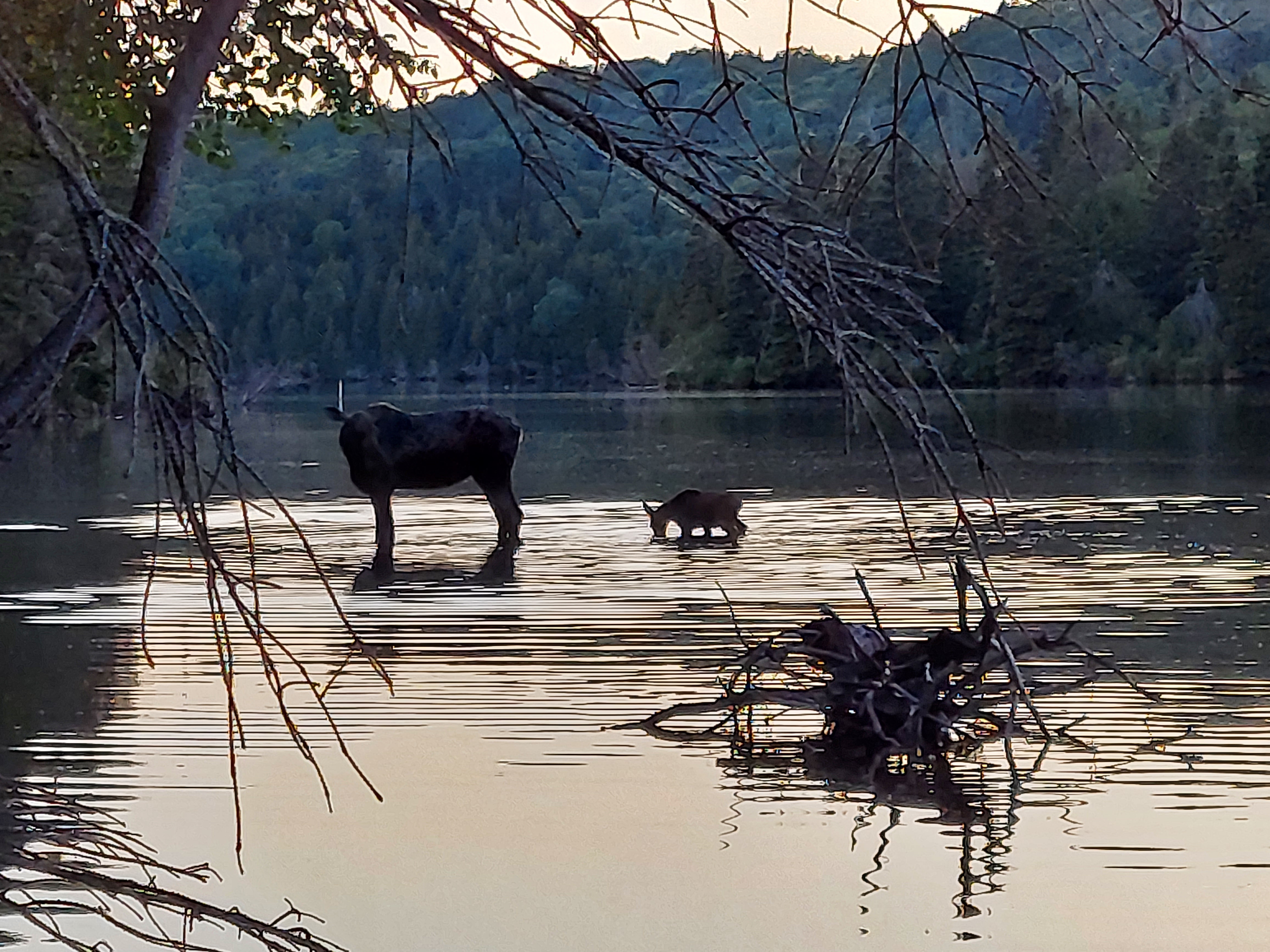
The moose show is only beginning, though. A short while later we pick out a mother and her calf, who cannot be more than two or three weeks old. They pick their way upstream, and, with some urging from its mother, the calf emits some near-human wails as it strikes out across the water to join her. Next, an interlude of amusing ducks and ducklings, which Connor calls the Greek chorus of our trip. Two more moose, including a large bull, wake us early the next morning, and a distant female downstream provides the final act. Mission accomplished.
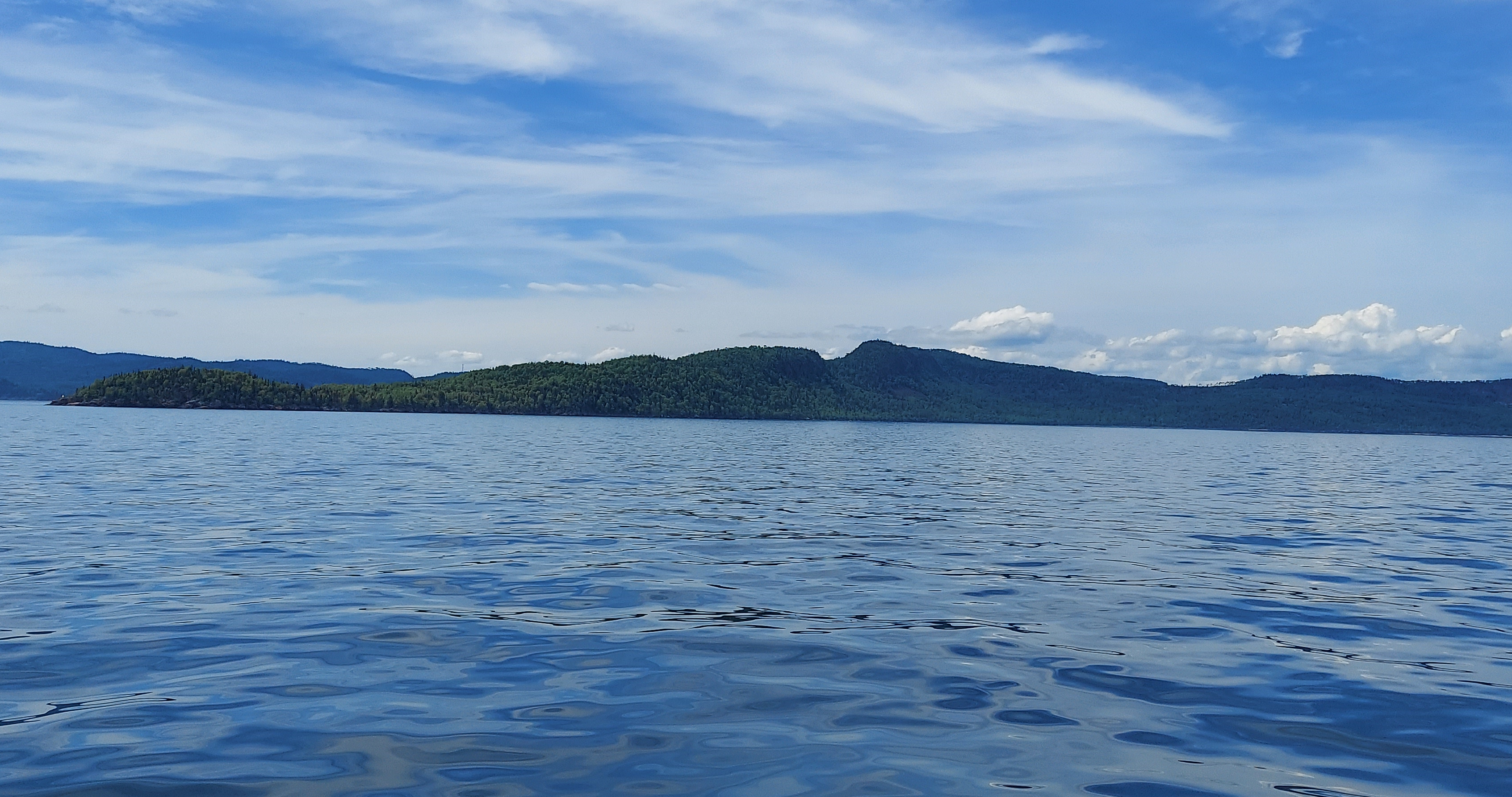
Our travel plan again seems prudent when the when the storm rages across the island on our final morning. The Chicago women, who set out around 5:30 from Island Mine, report a terrifying hike down, with a tree falling next to them and the trail so darkened by the storm that they pull out headlamps. By the time they arrive in Windigo, however, they are free to share a very good story, and a few other familiar faces join us for a ranger lecture before the ferry collects us again. The boat ride back to Grand Portage is as smooth as possible, and Connor and I head to the bow to watch the green North Shore bluffs and Mount Josephine rise up to welcome us back to the mainland, a narrow band of undulating green between two rich, blue expanses of unfathomable depth. I live in one of the most beautiful places on earth.
Mike Randolph’s tenure as head coach of the Duluth East boys’ high school hockey team is over.
The news is not a total shock to anyone who has followed the events of the past few months. The school district had engaged a private investigator to poke around the program following a heap of parent complaints, and the rumor mill swung back and forth from week to week: he was done for, he was fine, or no one knew what was going on. Randolph has been through the ringer in his time with the Hounds; he’s been through countless questioning parents and a purge that removed him from his job for a year before an intense campaign swung a school board election and helped return him to his longtime post. This time, however, he has chosen to make his exit rather than go through it all again.
Let’s get the record out there first: 658 on-ice wins (third-most all-time; 646 of those at East), 18 State Tournament trips (second-most all-time behind Edina’s Willard Ilkola, who has 19), and two state championships. Six second place finishes, four third place finishes, three consolation titles, and a hand in some of the most memorable games ever, such as the Duluth East-Apple Valley five overtime affair in 1996 and the East-Eden Prairie three overtime final in 2011. His presence, both through tactical innovation on the ice and in his fight for his job off it 18 years ago, has driven the narrative around high school hockey far beyond the shores of Lake Superior. With the exception of the 2003-2004 sabbatical, he has been coaching Duluth East hockey my entire life.
I will embargo some of the other things I know until a longer retrospective next week; a planned press conference on Friday will, I expect, provide some added juice. I will also acknowledge there is much I do not know, and may never know, about what happened behind closed doors. I have a lot of thoughts that will take some time to process, and will take some time to filter back through the thousands of conversations I’ve had over the past 16 years with people regarding Mike Randolph. Love him or hate him, he is a fascinating figure, one whose story winds its way through just about every theme one could possibly associate with high school sports, from the glory to the pain and every emotion in between.
The open coaching job is a fascinating one. It’s a position with one of the most illustrious programs in the state and no shortage of history to draw upon. There is some talent to work with, and while we cannot pretend that it is still 1996 or even 2016 (a fact that has been difficult for some to accept), the long-term fundamentals of the program are pretty solid, and a new coach will have a chance to build on deep foundations. On the flip side, this program is also a hornet’s nest, and I will be fascinated to see how long a honeymoon the new regime gets. Duluth East is hardly alone in this; Randolph is just one of several fairly prominent coaches who have headed for the exits this offseason, and while the details vary from place to place, the roots of the purge are always the same. I do not envy anyone who takes a head coaching job these days, and rather hope the next Hound head man is not someone with any immediate tie to the program and the mess it has been the past few years. School board, if you’re reading this, go get someone from the outside with a proven track record.
For those looking for a walk down memory lane, here’s a selection of posts that have focused on him:
“Where you come from is gone, where you thought you were going to was never there, and where you are is no good unless you can get away from it. Where is there a place for you to be? No place… Nothing outside you can give you any place… In yourself right now is all the place you’ve got.”
― Flannery O’Connor
My Memorial Day weekend double feature explored two popular accounts of drifts to the edges of civilization on the road in the American West. First, I reread Into the Wild, the story of Chris McCandless, the young man who died in a remote Alaska van in the early 1990s and was immortalized by a Jon Krakauer book and a later film. Second, I finally got around to the most recent Best Picture winner at the Oscars, Nomadland, a loosely fictionalized version of an award-winning work of non-fiction on people dislocated by the Great Recession who took up a wandering van life. Their adventures tap into a very American thirst for the road, one I ruminated on while road tripping out west last year.
One could draw a sharp distinction between McCandless, a child of suburban privilege who rejected his well-off parents and his Emory degree to go look for something else, and Frances McDormand as Nomadland’s Fern, a woman who, penniless, has just lost both her husband and the employer that was her small town’s raison d’etre. But in each case, the wanderers are haunted by certain scars, and there is an obvious element of agency both in the decision to strike out in the first place and, more weightily, in the decision to stick with an itinerant life despite ample available off ramps. These people are destined to wander, either because they have rejected anything that used to hold them to a place or because whatever that thing was is no longer there.
To strike out like these late capitalist nomads takes a certain headstrong confidence and a rare dose of independence, plus a yearning desire for something that the familiar motions of life cannot offer. No more will they be chained to anything other than a short-term job, and they strip down their possessions to the essentials. Forget any pursuit of wealth; getting by is just fine. In place of a mortgage or rent, a van or even just a tent. Any family they have is ripped from them, and the most wrenching moments in these stories come from the perspective of those who love them: McCandless’s parents and especially his sister, or in Dave, the tender fellow wanderer who asks Fern to join him when he finally settles down. Sadly for their loved ones but grippingly for those of us drawn to their stories, the call for these nomads is too powerful for them to settle down.
There is plenty to admire in the life they choose. Both stories paint a laudatory portrait of the support networks that emerge along the edges of civilization, among the fellow travelers and the kindly souls who take in our vagabonds. Both McCandless and Fern find genuine companionship among fellow itinerants and simple folk who live in scattered outposts across the West. The stray jobs that our protagonists work, in greasy diners and for seasonal harvests and as campground hosts, while low-paying and each offering their own unique indignities, do not come off as hellish: they offer community and stray sources of amusement and sustain the wandering lifestyle. When Fern visits a well-off sister and endures the scorn of her husband and friends, the sister rises to her defense: Fern is taking her place in a long and noble American tradition, freed by her wanderlust to do as she chooses and make the best of a difficult situation. Who are we to judge?
Accounts like Into the Wild and Nomadland can glaze over the risks of a life on the road: robbery, rape, the mental instability that often comes in groups of those on the margins. Most people living some version of the itinerant life do not have fallbacks like Emory degrees or Dave with his well-off son, and some have children or ailing family members or other burdens that shed a different moral light on their wanderings. These stories run the risk of romanticizing an economy built on grueling manual labor for meager returns: Nomadland’s look into Amazon warehouses and farm work is one of light-touch neutrality, with only a vague sense of how backbreaking it can be and not a hint of the immigrants who make up a large chunk of these workforces. There is triumph in making the most of difficult situations, yes, but are we okay with what got us here in the first place?
And sometimes the wanderers wind up dead. McCandless’s story still courts controversy: is he a naïve idiot who wandered unprepared into the Alaskan backcountry, or a folk hero who had the boldness to do what he wanted to do? Krakauer, who had his own bout of youthful wanderlust, is sympathetic to his impulses, if not to all of his actions. For everything modernity has achieved, it has flattened the acceptable outlets for human self-expression and soul-searching, of any experience that goes beyond certain moral and rational bounds that control a society’s definition of a responsible life. This is especially burdensome for the idealists, and for whom a responsible life has given only suffering. Deadened by the world around them, Fern and McCandless look for a shock that goes to the edge and contemplates mortality, that adds urgency back and purpose back into a bourgeois life. Human connection feels rawer here, more meaningful, a chosen community of people who have all taken some version of the same leap. A society that allows for such informality and freedom of movement for those who choose it does not strike me as a bad one, even if the choice of that life can sometimes have grave consequences.
I write these words right before I start in on another summer with its share wandering with tents, of voluntary renunciation of creature comforts for a thin air mattress far from cell service or indoor plumbing. This all happens after a year of extensive nesting into a new home that I am very fond of; the wandering road is one I have now closed off for myself. Perhaps this is because the questions that motivated a McCandless have inserted themselves into my life in other ways and found different answers, or perhaps I am merely intrigued by stories of people who do things I would never be inclined to do.
But there’s still a hint of that tug, which is part of the allure to a northern Minnesota weekend warrior. There is peace in knowing that all that matters is making it to the next camp and then completing the mundane tasks of food and shelter before moving on and doing it all again. The endless to-do list and scheming of next moves is gone, or viewed from a comfortable distance and penned in a notebook. It is not unlike the life of some friends who now have small children: the needs are simple and straightforward, a semi-regular schedule of meeting basic desires and making the rest work from there. The tyranny of choice recedes, though knowledge of other paths may still loom. It is a return to an earlier state of fewer expectations and fewer burdens, disconnected from the hyperactive hive mind of modern work.
It was hard not to see these two works through a lens of another book I just read, Annalee Newitz’s Four Lost Cities, an account of how people in a few great cities of antiquity adapted even as natural and political disasters upended their worlds. The era of monumental construction and close quarters living may have been over, and emperors or local elites may have fallen, but the people mostly went on with life, reverting to earlier forms of subsistence and steadiness to get by. Whether through preparation or necessity, modern-day nomads learn a bevy of essential survival skills, and in the event of any coming ruin, would be among the better guides. A nomadic life is an insightful return to the past in more ways than one.
It is harder and harder to get off the grid now. Even in the early 90s, McCandless was within easy walking distance of civilization if he’d bothered to bring a map with him; his decision not to was both a manufactured act of rebellion and, ultimately, a death sentence. Now, one can trace his whole route meticulously on GoogleMaps, and in 2020, Alaskan authorities airlifted his old bus out to a museum in Fairbanks because too many clueless pilgrims were risking their lives visiting it. A mysterious monument that appeared in the Utah desert in the past year, its location kept intentionally secret, was located within days by enterprising satellite map explorers. We now have the ability to fill every last blank space on a map, to be surveilled every step of the way. But the actual taste of those worlds outside the confines of social expectation and economic perpetual motion, the rawness that can meet some deep animal need in both the ambitious and the bloodied: for those among us who need to look beyond to find ourselves, well, that is something no map can contain. The road beckons.
This post, apropos of nothing, attempts to define different strains of thought that fall under the banner of localism. The first two are what we might call intentional forms of localism, followed by two that are cultural and identity-based, followed by two that are generally the province of local elites.
These categories necessarily overlap, and many localists will have aspects of several. There are, however, distinct motivations that underpin each group, which is why I felt the compunction to categorize them. It’s also worth noting that relatively few people think of themselves as localists above all else; it’s often a secondary feature of one of these more pronounced, if fluid, identities. They are all united, however, by an emphasis on action tied to geography or a social network within one’s immediate sphere. To that end, here are the six varieties.
Crunchy Localism
This category is one of the most straightforward, and may be the one that comes most immediately to mind for casual observers: the co-op shoppers and CSA members and backyard chicken-raisers; the vegetarians or devotees of free-range meat; the local craftspeople who try, to varying degrees, to escape box store shopping and big business in general. Their most fundamental concern is typically a desire to protect our planet, meaning crunchy localism is usually associated with the political left, and it’s somewhat unusual in that its localist platform tends to fit fairly coherently with its national platform. That said, it also contains plenty of people who distrust big things in general (both business and government) and can accommodate some more libertine or religious strains of thought.
Strengths: Crunchy localists are acutely aware of threats to the planet and work hard to counter them. They align their consumption with their belief system and generally try to live within their means. This mindset emphasizes genuine quality of food, of locally made goods, and cultivates a homey, sustainable ethos unafraid of a little dirt. It’s also less prone to excess than some other movements; ecoterrorism isn’t exactly a widespread phenomenon.
Weaknesses: This way of thinking has a tendency to attract some doomsayers, and some of its mid-20th-century antecedents were very wrong about, say, the threat of overpopulation or peak oil or other such concerns. There’s also an occasional problem of scale, as shown when people seek to prevent a certain activity in a developed country only to see it farmed out to poorer locales with no labor standards or environmental safeguards, or those who proclaim climate change is the greatest issue facing the nation and then proceed to spend all their time working to ban plastic straws. Such causes are noble, but rather misses the gravity of the problem: is this really where we want to draw out battle lines? Like any movement with an ideology at the root, it runs the risk of collapsing into infighting.
2. Religious Localism
Like crunchy localism, this brand involves the creation of intentional local communities around shared beliefs, and as noted above, some of its adherents are also pretty environmentally conscious. Adherents to this brand, however, aspire not to some earthly realm of unity, but to a community that gives them access to God or some other higher being or state. Groups come together to share in their traditions, whether through a traditional school or an active community of worship or a cloistered retreat or even the occasional compound. While many major religious faiths have an evangelistic or crusading side that strives to bring the whole world along, most also have a tradition in this vein; whether out of deep commitment to a simple and contemplative life or a sense that the world is to depraved to be redeemed, these localists believe they must first and foremost tend to their own garden.
Strengths: Builds a coherent worldview for believers, and few versions create such strong networks of believers: united not only by a shared vision for this world but of eternity, these people can be very loyal to one another. Some communities, like the Amish or the Mormons or subsets of Buddhism and Islam, have remarkable staying power.
Weaknesses: It can be suffocating to those who don’t fully share the view, or even those who begin to question it some; no version of localism demands more of anyone who would wish to join it. At its most extreme, it can drift into cult creation and all its attendant problems. Of all the versions it is also probably most susceptible to reliance on charismatic individuals, who can either use their power over their flock for questionable ends or just see their communities crumble when they fall out of the picture somehow.
3. Traditionalist Localism
In striking juxtaposition to the crunchy localists we find the traditionalist localists: people who just like things the way they are. They tend to be members of a place’s dominant culture, and they don’t see what all the fuss is about messing with it. They’re prone to nostalgia and may be diligent local historians, carrying on small-town festivals and small civic organizations, and they generally don’t get why anyone would want things to be some other way. There’s some overlap here with religious localism, though the motivation, I would argue, is distinct. The traditionalists’ primary concern is not transcendence or their immortal souls; it is just stability. In this category we find a lot of straightforward small-town folk, though when their mindset starts to coalesce into a political movement it can take on a decidedly different flavor: here we find the Brexiters and the French National Rally, and also the flyers of the Don’t Tread on Me flags and that dude in the hut with a shotgun at the end of the road.
Strengths: It’s simple, and the narrative is consistent and requires little thought. It treads on some of the most basic loyalties and asks little else, and as a result can be a powerful motivator. It has proven it can be a fairly successful political movement, and it can also give some unique life and sustenance to longstanding local quirks and traditions.
Weaknesses: Anyone who doesn’t conform to the traditions of the locality will feel stifled by this culture, and it doesn’t much like people aspiring to much beyond it. This brand of localism can drift into jingoism and violence when threatened. It can also descend into painful defenses of old things that don’t deserve defense, lapsing back to some long-lost era and choosing some strange lines in the stand. These can include major corporate brands or some mysterious “way of life” that is an often limited snapshot of a very specific era, at which point it really ceases to be local at all, and instead just becomes reactionary. Its excesses, taken to their most extreme form, are among the worst of any form of localism.
4. Subaltern Localism
This localism features the breakaway movements composed of groups left out of a dominant culture and their fellow travelers. Here we find the indigenous rights groups, the Black nationalists, the tightly-bound ethnic neighborhoods of major cities, and even things like culturally specific charter schools. These are groups of people who are usually excluded, either explicitly or surreptitiously, from the levers of power in a society, and they seek radical measures to create their own spaces where their voices and traditions have a home. While some in these movements may seek to overthrow the existing order, either through nonviolent reform or violent revolution, the localists in this camp, much like the religious groups, are either so jaded by the broader culture or so enraptured by their local work that they don’t spend much time on that level.
Strengths: These local movements are often very empowering for their members. Some of these can build very dense mutual aid networks that can substitute for the failures of a state that does not or cannot do much for a marginalized group. As much as any of the localisms, this one generates some impressive cultural work, both through a flowering of new creative outbursts or through the resurrection of historic figures within the culture or tradition. The memories it unearths can fundamentally upend the way we tell local histories.
Weaknesses: By its very nature, this localism is at risk of being crushed by the dominant culture if it questions the existing order too much; as a result, it can turn to violence and get caught up in some of its related excesses. It also faces some practical questions over how exactly it fits in to a pluralist society. How much space is enough space, and if it involves the formal drawing of boundaries, who else gets roped in with this group? Does it run the risk of simply re-creating segregation? These groups are also not monoliths, and can be prone to infighting between sub-groups or idealists with competing visions. (It is also the hardest to name, given the alphabet soup of academic terminology for non-dominant cultures facing social exclusion; in this case, I tried to go to the pithiest origins of the general concept, which we owe to Antonio Gramsci.)
5. Civic Greatness Localism
This localism trades on people’s pride in the pride in their homes. It wants to see a local place made great through major civic projects, economic growth, and the development of good publicity. It usually emerges from genuine love for the place and on the surface is one of the least objectionable and most expansive: who doesn’t want their city to look good and have fun things? Civic greatness usually strives to be apolitical, though it can’t always avoid such situations. Its exponents include the local visitor’s bureau and the chamber of commerce, along with many local politicians who do not have any national ambitions. Its members are usually, though not always, members of a place’s dominant culture, and while they can generate mass followings based on the composition of the local population, this is typically an elite-led form of localism.
Strengths: This instinct produces monumental local projects that often come to define cities in the eyes of their residents. It rewards visionaries and unites people behind a vision, and it promotes a positive narrative about the locality. People usually feel good to be behind its efforts. It can take the best of the traditionalist view and put it to good use, and also draws on any of the others if they help feed the narrative.
Weaknesses: As an elite-led movement, this one may not necessarily be very participatory (hey there, Robert Moses). Sometimes its leaders are more into their own projects (or profits, or political futures) than they are into communities. A vague chase of greatness may also lead a place to assume all investment is good, and pursue projects that displace people or have major environmental concerns or undermine actual local businesses as it seeks to bring in non-local money. Because it rather innocently declares that it’s simply out to support a city, its downsides can often be surreptitious, and may not emerge until it’s too late.
6. Liberal Localism
Members of this final category are comfortable with local pluralism and nuance, and cultivate an intense appreciation for their heterodox locales. They thereby escape the traps of the monocultural traditionalists, and while they often share the general goals of the civic greatness localists, they are also willing to be critical and tell the whole history of a place, warts and all. The founders of the urban planning field, from Louis Mumford to Jane Jacobs, reside somewhere in here, as do community development corporations and other organizations that seek to attract plural voices behind a local vision. It has, on rare occasions, been able to rise to something approximating a heterodox national movement: Robert F. Kennedy was a champion before he was gunned down, and a certain brand of British Toryism has done some dabbling here recently. Barack Obama had roots in this world, but did not really govern as a localist.
Strengths: With apologies to some brilliant figures in religious and subaltern localism, this version has the greatest intellectual power behind it. Its appreciation of complexity allows it to see things that other views do not, and its sympathetic but not uncritical view of humanity allows it to both learn from the past and aspire to something better in the future. It pairs a deep diagnosis of local ills with modest but achievable local action plans, and it can point to plenty of concrete projects that its adherent organizations have gotten off the ground. In theory, it can find common ground with any of the other visions.
Weaknesses: This is generally an elite position limited to people with a lot of education (formal or informal) and local passion; it can also lapse into a tendency toward observation and appreciation instead of direct action. While sympathetic to other left-leaning localisms like the subaltern and crunchy flavors, it likely won’t move at the pace that the adherents of those worldviews desire, while the more conservative localisms will be skeptical of its willingness to include many voices. It can sound pretty in theory but be wickedly difficult to deliver in practice.
It’s been a while since I posted something here, making for a rather anticlimactic start to A Patient Cycle 2.0. Generally, pauses on this blog indicate one of three things, all of which are probably partially true at any given point:
Writer’s block is ravaging its author
The author is busy with Life Stuff
The author is painstakingly working his way through a piece of fiction, which is at once the most gratifying, exhausting, and time-consuming form of writing he knows
In this case, I’m pleased(?) to report that #3 is the most prominent of the three. For now, anyway. But tonight, I took a break from hating my writing to take the trip down memory lane that I alluded to in the last post. This is, approximately, the 549th post on this blog. (I am not going to take the time to check my math.) I began a sprawling attempt to categorize them, and aside from frequent distractions to see what my past self thought of certain things, it showed me some interesting trends. Here are the 548 posts preceding this one, categorized and in a table:
Category
2013
2014
2015
2016
2017
2018
2019
2020
2021
Total
Duluth East Hockey
10
6
6
5
5
6
6
3
2
49
General HS Hockey History/Commentary
5
11
7
9
6
2
3
4
1
48
Philosophy/Writing/Quotes
15
6
7
5
6
6
2
47
Travelogues – Present
3
8
4
8
6
8
3
40
Duluth City Council
15
19
1
2
37
Current Affairs
10
4
2
6
2
4
1
6
1
36
Sports – Not HS Hockey
5
14
6
4
2
1
1
1
34
Duluth News Roundups
6
9
7
2
4
1
1
1
31
Duluth History & Commentary
2
7
2
4
5
3
4
3
1
31
Books, Film, TV
4
4
6
2
1
2
6
2
1
28
Duluth Schools
12
10
3
1
1
27
Good Writing
4
1
1
2
8
7
1
24
Stages of Life
2
1
3
5
3
3
2
1
20
HS Hockey Tournament
2
1
2
2
3
3
3
2
18
Obituaries/In Memoriam
1
4
1
1
3
1
1
2
2
16
Fiction
1
1
1
3
7
2
15
Programming Notes
3
3
2
2
1
2
1
14
Travelogues & Homes Past
2
2
6
1
1
12
General Appreciation/Rants
1
4
2
2
3
12
Holidays
2
1
2
1
1
1
1
9
Total
97
108
65
61
55
59
45
43
15
548
I apologize to my grad school data visualization professor for my lazy disinterest in aligning the numbers correctly in this table.
Many aspects of this table are not surprising. I knew the first two years, when I was underemployed and still churning out a lot of stray thoughts that hadn’t come out before, would be my most prolific. The demise of the Duluth political writing, first as I went off to grad school and then as I returned to assume a job with some political sensitivity, was entirely predictable. The decline in not-hockey sports makes sense, both because I have less free time for them now and because those were some of the less original writings of those early years and often lack a natural audience even in this sprawling space. The taper in general high school hockey commentary, meanwhile, likely represents my drift toward using my podcast soapbox to say a lot of the things I want to say in considerably less time.
Some other interesting trends emerge. My writing about travel, whether local or cross-country, has grown in tandem with my disposable income, though I made up for the lack of travel in the early years by reminiscing about prior journeys. The “good writing” genre, which existed as an actual feature of this blog in 2018 and 2019, existed in some proto-form in some earlier years. Current affairs goes for a jump in 2020; it’s as if an interesting thing or two may have happened over the course of that year. Duluth history and commentary is about as stable as can be. Likewise with the East hockey commentary outside of the first year, when I did a long series on the Hounds’ history, and the pandemic-shortened past calendar year.
2018 comes across as my adult peak of creative output. In retrospect, I believe that sense is correct. 2018 was a fun and eventful year, whereas I can only write so many posts about sitting and reading in a spare room or going for runs around the same neighborhoods over and over again, which were my primary activities in 2020. The early rush of philosophical musing was probably a sort of dump of thoughts that I haven’t felt the need to rehash too much, though I was a little surprised to see it fade to zero. Perhaps that’s just because I now tend to weave that sort of thing into travel writing, or choose to treat certain themes more obliquely through fiction. It does make me wonder, though, if there aren’t certain themes worth revisiting from some of those early years, especially since the thinking on that level is among the things that can get lost in the rush of a professional life.
That’s my only real takeaway that maybe could affect future content, though. The blog will go on as inspiration strikes me, and slow its pace as those three factors that I listed at the top rare their heads. Onward and upward.
This blog is now starting its ninth year of existence, and it had gone through its life without much in the way of upgrades. It had stuck with the same old color scheme that I never loved in the first place. The links list on the side was an increasingly dated reflection of my news consumption, and the archives section had grown unwieldy on all but the longest posts. Blogging as a pursuit has changed somewhat since 2013; the golden age is long over, and people have drifted off into new quarters in the changing media environment. Facebook appears to have de-algorithmed me (I guess I need more QAnon content for them to think my stuff is interesting), and my audience, outside of the hockey stuff and the spontaneous WordPress users who stumble upon some of my travel writing, is not growing.
As a result, I’ve decided it’s time for an overhaul. I spent some time considering different approaches to my writing life. I gave a little thought to starting a Substack, but I don’t think I have the time now to scale that up to the point where it would do what I want it to do. I considered spinning things off into their own locations: put the hockey stuff in another place, for example, while leaving this as a more personal sounding board. One of the joys of having varied interests is that they do not always sit comfortably together. For the time being, though, I have decided to stay the course.
That meant that we were at least in line for a cosmetic upgrade. I’ve simplified the design: just a good, old-fashioned serif font that puts all the focus on the text, not on any noise on the sides or the background. Black and white simplicity it is. Under the menu button, I’ve started putting in some links to posts with some of my more frequently used tags. My tagging practices over the years have been spotty, so it may take a while to get it in the sort of shape I want it. It’s hardly a priority.
What does this mean for content? Probably nothing that wasn’t part of this blog’s natural drift already. Hockey during the season and when newsworthy, travelogues when I venture outward, markers for other life events. Fiction when those lurching, months-in-the-making entries reach a point where I do not viscerally hate the idea of other humans reading them. Very, very occasional political commentary, offered in a detached and halfhearted tone; a tone not offered because I do not care, but because I believe that understanding requires that level of distance. And the occasional inane offering, too.
For now, at least, that’s where I am. It could all change next week, but inertia remains a powerful force, and this blog, for good or ill, has a fair amount of that behind it now. Thanks for coming along for the ride.
I wanted not a window on the world but the world itself.
—Joan Didion
Never have I been so delighted to feel a bit off as I did this weekend. My second dose of Moderna left me not sick but exhausted, aching, and free, as if I’d just finished a punishing hike over terrain. A fitting emotion at the end of a strange, long year.
I received my first shot on March 11, the one-year anniversary of the declaration of a global pandemic. My March 2020 had begun with the Minnesota boys’ state high school hockey tournament; here were rumblings of danger on the coasts and a vague sense that maybe we should wash our hands a little more often, but no sense that the world was about to change. (A few people I know insist they got the virus in the Xcel Center petri dish that week.). Just a few days later, a sense of doom lingered over my favorite coffee shop in Aurora, a portent that this time would be different. I stocked up on food and booze just before the mad rush began and settled in to my pandemic existence.
In that changed world, I carried on in the shadow of the two twin specters of the twenty-first century: solitude and existential uncertainty. These afflictions existed before the coronavirus pandemic, and for long periods of the past year, they did not figure in my life. I accepted my fate as a chronicler of interesting times, I ran a lot, and I settled into a slower but diligent routine. But the two malaises festered, dormant in the daily blur but apt to reappear on slow work days or lonely weekend nights.
I will start with the looming uncertainty, which became manageable quickly enough. The virus has not come for me or caused any serious illness in my extended family. No one particularly close to me has died, though I did catch the obituaries of a few more distant acquaintances, including my no-nonsense high school biology teacher, Jeanne Mendoza, whose lessons on mRNA crawled out of some recess of my mind on the drive back from the vaccination site in Eveleth. Like a soldier at war, I will remember this year as one of great tedium punctuated by the occasional outburst of excitement somewhere else.
The year was one of chaos and murkiness, even aside from the social and political turmoil that infected the United States. For all the easy morality tales, our understanding of how the virus spreads and kills remains stunningly poor. The failure to respond fell especially hard on the allegedly developed, scientifically inclined West. Public discourse became consumed by painful, simplistic narratives. On one side, a brash, often spoiled mob too bullheaded to understand any concept of personal sacrifice or common good steamrolled any hope for national solidarity in times of crisis. In response, a less damaging but still insidious crew of dithering scolds invoked capital-S Science for political ends and was deified for meeting the exceedingly low bar of appearing sober-minded. Meanwhile, most humans muddled through somewhere in between, taking reasonable precautions but also finding ways to keep up with family and maintain some semblance of sanity.
Through it all, I am strangely optimistic about the post-pandemic world. Change happens slowly, then all at once, and its shepherds are those who have the shrewdness and good fortune to be in the right place at the right time, not the most strident activists. In one fell swoop, the United States reversed course on its social safety net after 40 years of neglect and now seems willing to spend money to stop the drift toward hollowed-out towns and a caste system in which even the people on top don’t feel secure. Rapid vaccine development showed the power of research and development in a crisis and offers the promise of additional breakthroughs in realms beyond mindless tech stuff. This lurch will no doubt have its own obstacles and excesses, but the collective turn encourages me more than any immediate alternative.
The lingering effects of pandemic isolation, on the other hand, are at once easier to correct for and harder to see. I now head back toward a world of unrestrained gatherings with other people, but I don’t yet entirely know how the coronavirus changed me. People who spend time alone tend to develop a clearer sense of self, and this year has featured a lot of time alone. It accentuates inherent traits, both virtues and vices, and more often in some grey area in between that can be either, depending on the channels they take on their way out to the sea. In my case, I observed the resurgence of drive I have always had, at times a self-defeating stubbornness and at times a life-giving tenacity. It formed in long, dark nights in the back room of my old apartment, on lonely roads across the American West, as I moved to a new home, as work bled over the walls I’d set up to contain it, as I booked a trip to the Caribbean, and as I searched out ways to maintain a semblance of the social life I’d led before.
Isolation increases bipolarities. I have always been one to internalize conflict, and that tendency only became more pronounced when there was no one else to squabble with, even in the mildest of ways. I am now the sort of person who yells a lot of vulgarities at his computer, for wont of better company, and one who occasionally texts friends “fuck Zoom” with no additional context. I work to fight off the fear that post-pandemic life may not be so different after all, that it will take vital effort to resist the continued drift toward the anomie and virtual reality that consume sad, late capitalist lives. A lack of human distraction made me tenser, more likely to sink into doom loops of mindless consumption, and I was not surprised to find myself on blood pressure medication by the end. Even so, I grew increasingly turned off by the therapy-speak that filters through so much of the general media response to the virus. I wonder at what point an obsession with wellness reinforces a sense of unwellness.
This is not an endorsement of raw stoicism or the denial of pain. I have come out of my pandemic tunnel with a few scars, including the literal one on my knee from the day last May when I fell in heap on a run along Chester Creek. I crawled to my feet, bleeding from all four limbs, and assured the concerned walkers who witnessed my graceful dive that I was fine. I was somewhat less than fine, but I ran on home in spite of it. This, I think, is the vital distinction: I never sought to deny any of my own struggles of this past year. I preferred to get up and keep running.
I avoid describing my slowly growing freedom as normal, or worse, a new normal. The world is different now, just as it would have been with the passage of a year without a pandemic. The freedom afforded by a vaccination is not a return to a past life but a new beginning, a chance to appreciate the lessons of that scar on the knee, a chance to see not just more windows on to the world but a chance to once again immerse oneself, to lose oneself in a crowd and to find new value in things that had been beyond our reach. Let us live the way we were meant to live, in community with other people, and make the most of this jolt forward into new possibility.


 A Patient Cycle