Some Artistic License

Lest this blog turn into a hockey-only affair here in the midst of the playoffs, I’ll inject some art to liven things up a bit. The four works that follow are four of my favorites. I can think of plenty of good ones that aren’t here, and a few of my favorite painters don’t have any one single work that really stands above the rest like these do. But these four have captivated me in one way or another over the past four years or so, so they make the cut. Here they are.

I. Scuola di Atene (The School of Athens)

Rafael, 1511

schoolofathens

Anyone who’s bothered to read all of my philosophical ramblings won’t be surprised to see this one leading off the list. It is a fresco in the Vatican, and it pays homage to the philosophical roots of the Western tradition, of which Christianity is also a part. The great minds of the ancient world debate questions great and small. It’s not always entirely clear who is who, but the central subjects of the fresco are obvious enough: Aristotle and Plato, forever in a friendly tension, the real and the ideal juxtaposed against one another. Basically every philosophical debate ever since has its roots in this one, and even the rejection of this debate can be found sitting a few steps below them in the form of Diogenes.

It’s become fashionable in some circles to dismiss Greek philosophy as an anachronism, or a narrow Western imposition. But in many ways, the Greeks had the human condition measured better than anyone who came after, and they can be valuable guides. Of course the Western Canon has its flaws; all who contributed to it were a product of their times. Instead of trashing this self-evident truth, it’s much more useful to see what they got right, and how those simple early thoughts endure far more meaningfully for lived experience than anything in the arsenal of postmodern jargon. In a rare occurrence, I side with Plato over Aristotle: this is the ideal of how debate should look, with respect and camaraderie and deeper search for the truth.

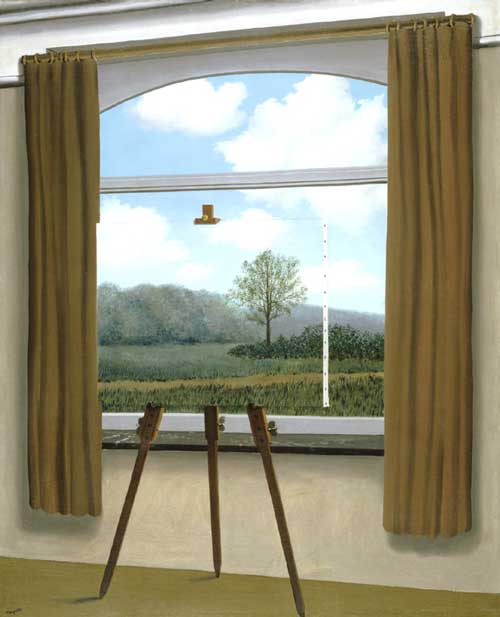
II. La condition humaine (The Human Condition)

René Magritte, 1933

laconditionhumaine

At one point while I was in Washington DC, I wandered through the modern wing of the National Gallery on my own, drifting along from one picture to the next with no particular enthusiasm. Then I came to this one. I stood there, transfixed, for at least a few minutes. It was hard to put into words exactly what it meant, but I got it immediately, and it couldn’t be any more right. From Sara Whitfield’s Magritte (1992):

“This is how we see the world,” René Magritte argued in a 1938 lecture explaining his version of La condition humaine in which a painting has been superimposed over the view it depicts so that the two are continuous and indistinguishable. “We see it as being outside ourselves even though it is only a mental representation of what we experience on the inside.” What lies beyond the windowpane of apprehension, says Magritte, needs a design before we can properly discuss its form, let alone derive pleasure from its perception. And it is culture, convention, and cognition that makes that design; that invests a retinal impression with the quality we experience as beauty.

The point here, I suppose, is not wildly different from the one I was making with The School of Athens: we all come from a certain context, and view things through a certain lens. We are our histories; we embody the people and places we come from, and cannot shake them off as we gaze out upon the world.

III. Sueño de una tarde dominical en la Alameda Central (Dream of a Sunday Afternoon in Alameda Park)

Diego Rivera, 1947

dreamofasundayafternoon(Click image for enlargement)

A high school Spanish teacher showed me this mural long before I’d considered studying abroad in Mexico, and while I probably rolled my eyes at her gushing like most high school kids do, something lingered. By the time I headed south, it had become an essential stop, and on my first free weekend, I hiked up Paseo de la Reforma alone to stand before the mural, which occupies an entire wall in its own museum. It didn’t disappoint. I was riveted.

It tells the story of Mexican history from left to right, from the first conquistadors to the Revolution of the 1910s. The heroes and villains all mingle in the park, strolling down its promenades, forever tied up in a contradiction of a nation. At the center is Rivera as a boy, standing next to the calavera, that reminder that death levels all the differences between these many people, arm-in-arm with its creator, José Guadalupe Posada. National myth, fantasy, and harsh reality all blend together in vibrant color, a crowd that captures the soul of a contradictory nation.

Once I’d drunk my fill, I then spent my own Sunday afternoon wandering the Alameda of 2010 Mexico. It was a chaotic mix of vendors and protesters and pleasure-seekers; none as famous as those portrayed by Rivera, but even if they had been, they would have been lost in the crowd. I sat down on a bench and wrote for a bit, happy to have arrived, but slowly realizing that this fleeting glimpse was only the beginning. I had more work to do. I set out to find a nation and wound up finding myself instead, in large part by coming to understand that wild cast of characters that had wandered through my own life.

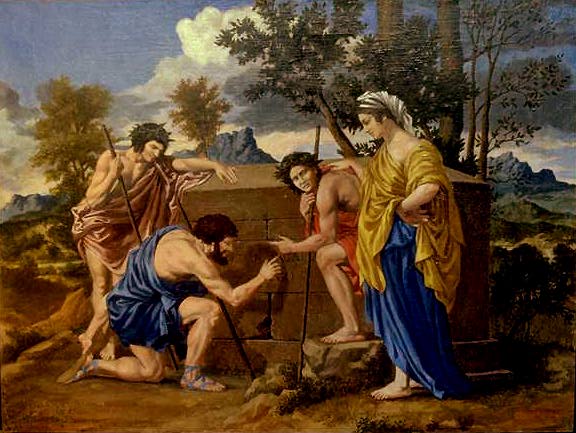
IV. Et in Arcadia ego

Nicolas Poussin, 1638

etinarcadiaego

Even in Arcadia, there am I. The speaker of these words, of course, is Death, and the shepherds of Arcadia have just discovered death in the form of a mysterious tomb. The pastoral lives they live are but a dream, and no one can hide from it forever.  My fatalist impulse comes through here, Posada’s calavera once again underscored: it is all so fleeting, and even in paradise, nothing is eternal.

It’s a somber note to sound, perhaps, but this isn’t to cast a pall over it all. Instead, it shows just how precious those moments of bliss can be, and how we must adapt to their lack of permanence: we must treasure them, and never lose sight of how little time we have to do whatever it is we’re setting out to do. That awareness is at the root of my hunger to figure things out, and to get as much right as I can. We all need our occasional retreats to Arcadia, but we cannot linger: the world calls.

It is no coincidence that two of these four works are filled with people, attempting to sort out their roles within a society or some other social environment. Another looks out from within, at how the individual sees the world; another steps out, while reminding us that we can only do so for a little while. It’s all part of the cycle.

Photo sources:

http://uploads5.wikiart.org/images/raphael/school-of-athens-detail-from-right-hand-side-showing-diogenes-on-the-steps-and-euclid-1511.jpg

http://www.ket.org/painting/images/humaine.jpg

http://www.oh-wie-scha.de/homepage_cipa001.jpg

http://www.parnasse.com/etinarc.jpg

‘Of Miracles and Men’

ESPN’s 30-for-30 series of documentaries rarely delivers a dud, but it outdid itself this past Sunday, with the debut of “Of Miracles and Men,” the story of the supposedly invincible Soviet hockey team that fell to the United States in the 1980 Olympics. The Soviet squad, usually painted as a heartless machine in comparison to Herb Brooks’ plucky college kids, suddenly become humans: stolid but vulnerable men, brusque or wistful as they recollect what went wrong in Lake Placid.

After introducing its main characters, who wander back among Soviet apartment blocks to remember the street corner rinks where they learned the game, “Miracles” travels back in time to the birth of Russian hockey. This means the story of Anatoli Tarasov, a man who knew little of hockey before taking the reins of the national team, and swiftly determined that it was no good trying to beat the Canadians at their own game. And so he reinvented it, and changed hockey forever. He studied ballet and sought to bring its seamless coordination on to the ice, building fluid teams that moved at a pace no opponent could match. Russia and its satellites won every Olympic tournament between the U.S.’s less-remembered shocking run in Squaw Valley in 1960 and Sweden’s emergence in 1994, the first Games in which the former Soviet “Republics” fielded their own teams. All save one, that is.

Of course, Tarasov never got a chance to prove his worth in the 1980 games. He’d been fired some years earlier for failing to follow the party line, and the Soviets rashly chose to abandon the man who’d made them relevant. Tarasov was the architect of the Soviets’ stunning arrival on the hockey scene, the 1972 Summit Series, which matched the Red Army team against an absurd collection of Canadian all-stars and showed the world that Canada had nothing on the USSR. His legacy lived on into the 80s, most prominently in the form of his star goalie disciple, Vladislav Tretiak.

The documentary didn’t go here, but it’s important to remember that Tarasov’s style was an important part of the Soviets’ undoing in 1980. Herb Brooks had many sources for his more open style of play, but Tarasov was certainly one of them, with much of that knowledge coming via Lou Vairo, an advance scout for the U.S. squad who labored in obscurity for many years to study Tarasov and bring his methods to the U.S. Brooks abandoned the North American obsession with lanes and turned hockey into a free-flowing ice dance, coupling violence and grace to create the form of hockey that remains its pinnacle.

It’s probably a mistake to lionize Tarasov too much; he did work his players to absurd limits, and had the full power of the Soviet state backing him. He loved his players, but his control was so absolute that there was no alternative. The narrative pitched by the documentary, in which he represents the purity of the revolutionary ideal before it went sour, is also too simple a reading of Soviet history; Stalin’s depravity was simply the most extreme flare-up of a ruthless totalitarian state, and the very revolution that started it all etched its evil into its DNA. But it fits a certain romantic tale quite nicely, and one can certainly see how Tarasov might have seen himself this way. Just as the revolutionary idealism faded in the face or reality, Soviet hockey’s cynical turn post-Tarasov was all too real.

Still, it’s wrong to make his successor, Viktor Tikhonov, nothing but a villain. He was most clearly a tyrant, but “Miracles” never really stopped to admire just how dominant his teams were. He might not have been all that pleasant, but he sure knew what he was doing, and though he was a strict disciplinarian, he did still allow his teams to play Tarasov’s free-flowing style on the ice. He had plenty of moments of triumph, and his legacy in the USSR goes far beyond the Lake Placid loss. But like so many tyrants, his downfall was his obsessive control. His decision to bench Tretiak after the first period likely cost the Soviets the game against the U.S., and helped to end the goalie’s career at age 32, far too early for the man who many have been the greatest tender of all time.

As the Soviet Union crumbled, Tikhonov’s fist grew ever tighter, as he tried to keep his players from jumping ship to the NHL. Several veterans were axed from the team, and the greatest skater they had, Slava Fetisov, was strung out for years with vague promises of eventual freedom. Fetisov’s story became something out of a spy movie, as he met secretly with New Jersey Devils General Manager Lou Lamoriello in a hotel room, communicating via writing so as to hide from the government bugs, and eventually had a terrifying audience before a livid Dmitry Yazov, the Soviet Minister of Defense. But Yazov did let him go. Finally, in 1989, he brought down hockey’s Iron Curtain and made the leap to the NHL, becoming the first Soviet citizen to ever hold a foreign work visa.

It is perhaps a bit ironic that Fetisov went to the Devils, seeing as Lamoriello’s teams often became, stylistically, the anti-Tarasov. Adam Gopnik called many of the players he acquired en route to three Stanley Cups “Lou-Bots” because they were just plugged into a machine-like system—and a boring one at that, given its reliance on the trap. There was little room for free-flowing, Tarasov-style hockey in Lamoriello’s NHL, though times are changing, as analytics takes hold and the rediscovery of puck possession brings some old ideas back to the fore. Somehow, Fetisov probably didn’t care: he was far more free in a Devils’ trapping machine than he was in the USSR, and after he moved to the Red Wings, he became the first man to bring the Stanley Cup back to Red Square.

Fetisov travels back to Lake Placid for the first time in “Miracles,” wandering the streets with his daughter, making his way back into the locker room, and revisiting the old dormitory—now a prison, a facility so miserable that it offended Soviet sensibilities. He steps back out on to the ice at the Olympic Center—now, the Herb Brooks Arena—and one can still sense those lingering chants of “USA! USA!” in that hallowed sporting ground. Many of the Soviets now try to pooh-pooh the loss; understandably so, given their greatness for such a long time. But they still all know they were on the wrong side of that Miracle, and there are few words to describe that emptiness of stunned defeat. This is the stuff of legend, and Fetisov is left only with a wry smile, this man who stood up to the Soviet Union cast as a villain in the story of American hockey glory. Such are the vagaries of sports. The legacy, however, endures, uniting winners and losers, their stories forever intertwined in a tale that reminds us the impossible can happen.

East Side Ingenuity

The final week of the high school hockey regular season begins next week. For Duluth East fans, this season is lurching oddly toward the finish line, filled with more uncertainty than any time in recent memory. There have been signs of progress along the way, as they’ve held two of the of the state’s best offenses under two goals, and had a few more offensive outbursts lately, but on the whole they are still a .500 team, headed for their first serious section quarterfinal game in over 15 years.

The most encouraging outing came on Saturday night in Elk River, when the Hounds played the Elks dead-even on the road en route to a 1-1 tie. After a slow start, a crushing hit by Alex Spencer jolted East to life, and the Hounds took it to the Elks for a majority of the rest of the game, bottling them up superbly and generating their own share of chances. A shot in the final minute of overtime might just have slipped in under the crossbar—no one will ever really know—but the statement mattered more than the final score: when they play well, East is on par with the section’s best.

The game showcased Mike Randolph’s spurt of ingenuity this season: a 2-3 forecheck, with the center manning the point along the blue line between the two defensemen. It’s something I haven’t seen out of a prominent high school program before, but it makes intuitive sense: with a struggling defense and a lack of talent to maintain the dominant forecheck of years past, the Hounds have resorted to doing everything they can to bottle up the opposition in its own zone. This approach comes at the obvious expense of bodies down low—with only two forwards deep in the zone, the offense runs the risk of becoming a very predictable series of passes around the perimeter—but it can make it difficult for even good teams to break out with any rhythm, and protects the defensemen from overexposure. The presence of the center on the blue line also frees the defensemen to pinch more freely than they might otherwise, keeping some semblance of the classic East cycle alive. To give an idea of its effectiveness, Elk River hadn’t been held under 3 goals all season long, but needed a late power play just to tie this game at one.

That cycle was on display again on Monday. East continued to work the 2-3 in Cloquet, a decision that may have sacrificed a chance at a win in the short term in the interest of preparing the system for the playoffs. They kept Cloquet bottled up for long stretches of the game, to the point that the Jacks’ offense degenerated into a string of icings, but the go-ahead goal never came, as East never generated quite enough in front of the net of sophomore Eric Newman. This is the weakness of the system: it gives East a shot against most anyone, but it also lets less skilled opponents hang around, and that is an especially important concern given the likely first round match-up against Andover, a team built around a great goalie and the occasional offensive surge forward.

The lack of offensive zone presence wasn’t an issue on Thursday against Blaine’s porous defense, but the sloppy defense reared its ugly head again, especially in the opening twelve minutes of the game, when East spotted the Bengals a 3-0 lead. While they showed their mettle as they battled back to twice tie the game, the game was already being played on Blaine’s terms, and that did not bode well for a team built around defense first. It was a second straight toss-up game with a top-ten team, but these track meet games are too volatile, and reminiscent of their most recent losses in sections, a 6-5 loss to Cloquet in 2008 and a 5-4 loss to Grand Rapids the year before, when East lost control for long stretches before coming back and ultimately failing to close the deal. Blaine is a top-ten team and deeper offensively than anyone in 7AA, but Grand Rapids and Elk River certainly have the firepower to get East into that sort of game (as Rapids did in January) and render all of this pining for systems useless.

The East defense remains the most profound concern. There are too many blown assignments and bad decisions leading to odd-man rushes, and occasional long stretches stuck in the defensive zone quickly deflate momentum. Stupid penalties have also been rally-killers at times. Gunnar Howg has won the goalie job back for good and has proven a savior at times, though he can’t do it all himself. I’ll avoid naming names, but a couple of players are frequent culprits, and must avoid the lapses that may end up costing this team its season.

The offense is showing more potential after a slow start. The longtime top line combo of Nick Altmann and Brian Bunten creates the most chances, many of which come agonizingly close but don’t quite make their way into the net. The all-junior second line, after leading the way early on and going a bit cold midway through the season, erupted in the Blaine game, giving some hope there. Luke Dow is certainly the most dynamic of the centers, and can run things from the point when East sets up the 2-3 in the offensive zone. The third line, usually featuring freshmen Ian Mageau and Garrett Worth with Matt Lyttle playing the high center role (with occasional Nick Funk and Ryder Donovan sightings) is now scoring with some regularity as the young snipers come into their own. The three freshmen on the roster have all come along nicely as this season goes on.

And so the Hounds head for their reckoning. They have two games in the final week, both against higher-ranked but beatable teams, Lakeville South and Minnetonka. Between those two games is the 7AA seeding meeting, which should be put on pay-per-view, but is most likely to hand the Hounds a 3-seed and a first round date with Andover. (There’s an outside shot St. Michael-Albertville could poach the 3 and leave East playing Cloquet in the quarterfinals, but I’ll be surprised if their schedule gets much respect at the meeting.) It doesn’t matter a whole lot, since the section is such a mess. Elk River has its best player in Jake Jaremko, but the depth, especially on defense, is not phenomenal, and Amsoil Arena has not been kind to them. Grand Rapids is bipolar, looking like world-beaters one moment and sickly the next; who knows if they can string together three straight wins. STMA is reasonably deep and hungry to prove themselves, but venturing into uncharted territory; Dave Esse has hard-working Cloquet rising to the occasion down the stretch. Andover has a goalie and a handful of skaters who can be difference-makers, and are plenty capable of stealing a game or two. Even Forest Lake, despite a poor year, has a history of doing well against Rapids, whom they are almost certain to play in the first round. And then we have these Hounds, trying to find that right balance and get back that East side energy and confidence that have kept them atop this section for the past six years. We’ll see if this group has it in them.

Notes on a Tainted Election

With apologies to the vast majority of my readers for whom this post will seem like inside baseball, I felt some need to comment on the recent election scandal for the Public Affairs Student Association (PASA) in my graduate school. The election was canceled and restarted after it became obvious that several people had taken advantage of the thing I noticed when I went to vote (once, and once only!): there was nothing to prevent people from stuffing the electronic ballot box with as many votes as they liked.

The aftermath has produced a number of indignant emails from disgusted students and members of the outgoing PASA administration, and has, predictably, earned the nickname “PASAGATE.” (Ugh, ugh, ugh. Can we please retire that obnoxious idiom?) The wrongdoers, presuming they are not soulless blood-sucking vampires, have been thoroughly shamed—unless they simply do not care about PASA and thought it would be funny, which is the most likely reason for this “fraud.”

As a longtime student of international affairs, I’m well-aware of how precious a vote can be, and how much we Americans can take it for granted. Even so, it also bothers me that voting has now become our most sanctified political act. I wondered vaguely how many of the people upset about this election scandal have ever been to a PASA meeting, or have any conception of what it does beyond organizing weekly happy hours and occasional larger parties. Do we have any right to be indignant about the corruption of democracy if we don’t ever act within that democracy beyond a vote once a year?

I include myself in that category; I’m as guilty as anyone. I also recognize the weird status of student government, as it takes on trappings of importance while acting on issues that are mostly very small in the grand scheme of things. As an undergraduate, I served on a student government at one of the most politically-obsessed schools in the country. I’m proud of the work I did there, and admired the efforts of many of my fellow staffers. Still, it was hard not to sigh and groan over some of the posturing and credential-chasing of some people in and around the student government, and even there in Washington DC, the majority of the campus couldn’t be bothered to care about what we did. It was at once both a thrilling political training ground and little league. It’s the nature of student government to struggle with questions of legitimacy, and there will inevitably be people who find it a self-obsessed joke.

An attempt to hunt down and further shame wrongdoers would likely only confirm that suspicion. Perhaps I’m just being my cynical self here, but it’s at least worth asking whether all the righteousness is merited. I want PASA fight on behalf of grad students for resources and encourage inclusivity and get us out into the community more and, yes, throw some good parties. PASA must avoid falling into solipsism. (What does PASA do? It goes after people who disrespect and abuse PASA!) Student governments certainly can do great work, but its members need some sense of perspective about what is really at stake. (Thankfully, the PASA members I’ve gotten to know in my time here have certainly had that sense of perspective.)

Some of the upset emails demand justice. Yes, justice would be nice, but more than anything, I’d hope for a little engagement beyond the election. If we don’t have that, what’s the point of PASA, anyway?

My 2015 Mr. Hockey Finalists

The high school hockey award season is around the corner, so it’s time for every amateur prognosticator to toss out some picks. These are the ten Mr. Hockey finalists I’d pick, not necessarily the ten I think will be picked. Here they are:

Jake Jaremko, Elk River

-Jaremko’s dominant Elite League performance has carried over into the regular season, and this MSU-Mankato recruit has thereby pulled into the top spot. In addition to being one of the state’s top AA scorers with a high ceiling, he has the added bonus of being his team’s clear-cut MVP; while some of the other top players have to share the spotlight some, there is no doubt that Elk River is Jaremko’s team, and it’s on his shoulders to carry a proud program back to State for the first time in ten years. I’ll reserve final judgment until after this Saturday, when I hope to get another look at him against Duluth East, but he’s probably the slight favorite now.

Dylan Malmquist, Edina

-My preseason pick is still right there in the running, though draft status and an inability to distinguish himself from junior teammate Garrett Wait may hurt his chances. I think this is unfortunate, and Malmquist has many strengths that don’t show up on the scoresheet, with his two-way play and unmatched prowess on the penalty kill. If Edina continues to dominate the Lake, he might yet get my nonexistent vote. The only way one of these top two doesn’t win is if draft status counts for a lot more than we think it does, and Jack Sadek pulls it out; I don’t see that happening.

Jack Poehling, Lakeville North

Jack McNeely, Lakeville North

-There’s a debate raging around which two of the four great seniors on undefeated North deserve the nod, and there are good arguments on all sides. The Poehling brothers’ line is dominant, but it’s hard to separate them out for individual recognition; the defensemen, meanwhile, are more likely to be drafted, and Jack Sadek is the highest listed Minnesota high schooler on the NHL Central Scouting midterm report. (Did someone mandate that all Lakeville boys born 18 years ago be named Jack?) Personally, I’d argue for splitting the difference, and taking one of each: the explosive top line and the dominant defense have been equally important for North’s great run this season. The numbers for each are practically identical, so I’ve gone with the two I think have been the slightly better high school players of each pair. Still, I wouldn’t be at all surprised to see it be Sadek and McNeely, and while I might buy an argument for picking more than two if a bunch of them were certain high draft picks, they’re not. They’re all fine players, but there’s a lot of talent in this state beyond Lakeville.

Christiano Versich, St. Thomas Academy

-As with the North kids, there’s no doubt STA will put one or maybe even two players on the list; the question is who. Versich’s lower point total may hurt, but as with Malmquist, I think he does more to make the players around him better, and has been asked to play a more complete role, holding down the second line. Seamus Donohue, a high-scoring defender, is one of the toughest players to leave off this list, and leading scorers Peter Tufto and Alec Broetzman have had fine years worthy of consideration as well.

Dixon Bowen, East Grand Forks

-Bowen is the leading scorer on a team with plenty of offensive talent. I’ll admit to not having seen much of the Green Wave this season, but the North Dakota recruit came into the season as my top senior in Class A, and it doesn’t look like his performance to date has done anything to cause much doubt on that front.

Jacob Olson, Hill-Murray

-The rock-solid Harvard commit has everything you look for in a Mr. Hockey Finalist: D-I commitment, is on the midterm list, and leads a great defense, which is the heart and soul of this Hill team. He’s certainly one of the frontrunners for the Reed Larson Award for the state’s top defenseman, though perhaps that will be thrown the way of one of the North players as a consolation prize.

Will Borgen, Moorhead

-Like Olson, Borgen is a D-I recruit, made the midterm rankings, and an essential piece of a team with a fairly thin offense. He doesn’t quite have the name recognition of some of the others on this list, but he has to be in the conversation.

Jack Ahcan, Burnsville

-Not blessed with the size of the above defensemen, but Ahcan is every bit as dominant in the high school game, and probably deserves a nod here.

Ryan Kero, Hermantown

-Lots of options for the final spot, but there’s a dearth of Class A players on my list, so I’ll give it to the top player on the top team there. He’s got great speed and finishes with style. He and Nate Pionk have been explosive in leading the Hawks’ top line; if they’re viewed as too interchangeable, give this spot to Donohue, whose chances may suffer due to the 4-5 other defensemen in the field.

Honorable mention: in addition to the North and St. Thomas players I’ve already jilted, there are a few others who deserve shoutouts. The unheralded Tommy Giller is having a big year at White Bear Lake, and with their Hill-Murray game looming, he has a chance to make his case on the biggest regular season stage available. Rosemount’s Lukas Gillett has no such stage, but has helped carry a weaker team that may yet make some noise down the stretch. Luke Jaycox and Kobe Roth at Warroad are both good enough, but have been slowed by injury issues. I think it’s wrong to nominate players who’ve missed significant time, but that hasn’t stopped them in the past. Benilde and Blaine have a couple of good players, but no one senior has really had a breakout season that screams “nominate me.”

With the disclaimer that I’m not much of a goalie scout, I’ll also take a stab at the Brimsek Award: Moorhead’s Jacob Dittmer was my favorite coming in, and his performance to date seems to back that up. That said, Hopkins’ Josh Kuehmichel has performed well, and if his numbers hold up down the stretch of a brutal Lake Conference schedule, he’ll have a very good argument. Burnsville’s Dylan Lubbesmeyer rounds out my finalist list, and I think the top three are actually pretty clear-cut here.

I believe nominees will be announced next week, and voting takes place before the State Tournament, though the awards are announced at a banquet immediately after it.

On the Intellectual World

I embarked on my second semester of graduate school this past week. My degree program, urban planning, is a fairly practical one, and the general tenor of most (though not all) classes is entirely different from the high intellectualism I explored as an undergraduate at Georgetown.

I have a complicated relationship with that intellectual world. I was probably as excited as anyone in my Intro to Planning course over opportunities to debate phenomenology and critical theory and Marxism and whatnot, and as a person who comes at all of this from a fairly different philosophical background from most of my classmates, I rather enjoy the occasional opportunity to push the envelope. (They mostly come at things from somewhere on the political left; I come from here, wherever that is.) I’m the sort of person who will, upon seeing someone like Hannah Arendt on my syllabus, stay up two hours later than I intended so as to read her.

Despite my obvious nerdiness, I’ve never self-identified as a nerdy person, and am rather proud of this. This is in part due to my interests outside of intellectual pursuits—as a kid, I much preferred sports to video games, and never got into the faddish card games that came along—but I think there was something deeper at work. It was one of the great benefits of being formed by a high school where it was perfectly normal for kids to pursue academic greatness and still be well-liked, and by a family where reading fat, heavy books was a routine activity. I might have taken it to an extreme, but I was allowed to do that without anyone criticizing that, and am eternally thankful. It’s just one of the things I do sometimes as I play around with this world around me.

Make no mistake: I do think it is crucially important. It’s an essential foundational block without which culture, society, and civilization itself have no true basis. These questions are essential because they are the ones that lead humans to reach toward great heights, dream great dreams, perhaps even quest for utopia. It’s impossible to do so without some idea of where one is going, or at least a vague idea of how to get there. Debating these things with other well-versed people is one of the fires of life, and anyone with any hope of molding the surrounding world must understand what is at stake. This is why I venture in: there is no alternative. I need answers, or, perhaps better said, I need the right questions.

Too many people interested in that intellectual world, however, can get far too wrapped up in it. When I’ve done that, I rarely look back on those periods of time with fondness unless the philosophical inquiry was done in partnership with other people. Along with the very first philosophers came their very first critics, with the likes of Aristophanes and Diogenes pointing out the all-too-real shortcomings of their way of life.

To find out why, we might as well circle back to Hannah Arendt, who made a distinction between active and contemplative life. Both are clearly essential, and Arendt must no doubt have spent many long hours in the contemplative realm to emerge with the insights she found. She likewise accords due respect to private life—another sphere I value greatly—and the need to take care of business at home. Any complete conception of life must include a defense of the mundane, daily things we do, including some simple and even some of the world’s less refined delights. They are part of the human condition as well. But beyond this lies an active, public life, and this is the only realm where humans can find greatness. All of that contemplative thought is useless if it’s never shared with anyone; the private life alone becomes tautological, life for life’s sake and nothing more.

The active life is not always an easy one for those whose first instincts trend inward. I choose my words carefully so as to avoid coming off as a miserably self-absorbed intellectual, and I don’t always pull it off. My abortive novel-writing attempts have, on a certain level, been attempts to take all the philosophy and political theory and filter them down into readily understandable terms, spoken through characters who are nothing like an ancient Greek philosopher, but manage to convey a few of their thoughts in a coherent way. Sooner or later, it had to come out. That call into the arena can’t be written off, despite the many philosophical and religious traditions that try to bracket it, and put it aside.

There are risks, of course: hubris, pride, and a failure to slide back into the reflective cycle. But if the foundation truly is in place, then—and only then—is the well-ordered mind ready to venture out, channel it all in the right direction, and take the lead; with humility, certainly, but also enough confidence to know that, somewhere, things do hold together and make sense, and it’s all being channeled in the proper direction.

Against ‘The West Wing’

Strange kid that I was, I only watched one television show with serious regularity through my teenage years. That show was The West Wing. It was certainly better television than the alternatives, but behind the brilliant acting and clever wordplay was an all too accurate insight into our political world, one covered up by the feel-good veneer of Aaron Sorkin’s scripts. Pete Davis tells the whole story in a fantastic column over on Front Porch Republic. If you’re a Wingnut, click the link and read it.

I won’t rehash too much of the same territory, but my experience was exactly like Davis’s, and at Georgetown, I found myself surrounded by fellow West Wing junkies who would indeed have watch parties and use the show to inspire their political scheming. Its ethos fed Obama-mania, making people think politics was a simple matter of well-heeled liberals using lofty rhetoric and snappy arguments to drive their opponents into submission. Politics becomes something that wise people off in Washington do for us, not something we ourselves actually do. (Unless, of course, we expected to be those people in Washington someday, which many of us did.) Behind the lofty soundtrack we find an administration that has no great vision, yet somehow manages to come across as brilliant in its advancement of wonky, incremental liberal policies. And we wonder why the Obama Administration has had so much trouble being liked.

I don’t think this is a terrible failing of the show that renders it useless; in fact, it is all too illustrative of the siloed nature of the U.S. political elite. It is a pathology especially common among young college grads, in which people like to think they are not elites and care about the people around them, even dedicate their lives to helping them, yet do so from a distance, quickly losing touch. Internet culture aids this phenomenon, as people group together and only read the media they like and interact with like-minded people. Everyone smiles and feels all happy and warm, nodding gravely at the words of one’s fellow travelers. These people then head out into the world and try to do good and show everyone else the right way, and cannot for the life of them understand why their ideas are so harshly rejected. Political opponents are then labeled “dumb” and “crazy,” and the vicious cycle begins anew.

The West Wing is not a window into politics, you see; it is a window into one very narrow, wonkish dreamland conception of politics. The two shows Davis recommends at the end of the piece are far more accurate portraits of politics, despite the relative lack of actual political institutions. They are also the best two shows that have been on television in my lifetime. The raw grittiness of The Wire and the meditative humanity of Friday Night Lights allow TV to do what film cannot, weaving together stories of lives over five seasons, showing how personalities collide and interact and carve out little spaces for themselves, their ‘wins’ and ‘losses’ ever so fleeting. This is politics in the Greek sense, deeply (small-r) republican and lived out in daily life. While not without their flaws, they come much closer to approximating actual political existence within an inner city (The Wire) and exurban/small-town/rural America (FNL) than any explicitly ‘political’ drama ever could.

I don’t think it’s coincidental that the stretch of episodes most West Wing fans would label as its pinnacle is the conclusion of Season Two, when the news of President Bartlet’s long-hidden multiple sclerosis slowly comes out. This stretch is only peripherally about political practice, and is much more about the psychological inner drama of the President’s inner circle and, above all, the President, whose re-election decision hinges on his relationship with a deceased secretary and some daddy issues tied up in his faith. I don’t know if Sorkin and company really intended to create a model for how political culture should work, but on that level, the show fails. The West Wing is at its best when it’s a character study in the vein of Breaking Bad and The Sopranos, examining the decisions people make in response to circumstances in their lives, and in revealing the thought processes of people caught up within a particular silo. Its reach is deep, but it is not broad, and if we try to pretend it is so, we’ve taken a good show too far and ruined it.

Like Davis, I still enjoy aspects of The West Wing, and have it to thank for much of my childhood political interest. In a roundabout way, it led me to where I am now. But its political culture is a terrible guide, and leads toward some sort of humility-free, revenge-of-the-nerds world that will never get us anywhere. The few reality checks are maudlin, and the characters are too caught up in their destinies as political operatives to ever show the rest of us the way. Washington will never change if we continue to think of it as a battleground, or a prize to be won. That process must start at home, and in practicing a humane politics in the places we live. If we’re looking for the good life, the Taylors of Dillon, Texas are far better guides than Josh Lyman or Sam Seaborn.

Learning How to Win

It’s been an unfamiliar sort of season for the Duluth East boys’ hockey team. With a new core and the burden of history, they’re off to a slow start, and there’s been a bit of declinist hysteria (all from outside the program, from what I’ve seen) surrounding a team that would, in a vacuum, simply be finding its way through a difficult schedule. But this is the burden of putting on the jersey of a six-time defending section champion with a target on its back. That burden can also be a source of inspiration, as was the case last season, when 7AA’s confident bluebloods stole a section title away from rising Elk River. Which story will be that of the 2014-2015 Hounds? My visit to Duluth this past week coincided with three of their biggest home games of the year, a stretch that included a decent win, an ugly loss, and a quality effort in a losing cause. As we enter the second half of the regular season, here’s my report on the state of the Hounds—a team that, in the words of its coach, is still “learning how to win.”

The week began in front of a packed Heritage Center for the yearly renewal of the crosstown rivalry with Duluth Denfeld. Long cannon fodder for the Hounds, the Hunters surged to relevance two years ago when they beat East and made the 7A section final, and this year’s team looks to be on par with that one. The Hunters came out fired up and led 2-1 after a strong first period, but East regrouped in the locker room and went on to play solid system hockey the rest of the way. The only real issue from then on was special teams; Denfeld briefly tied the game on a late second period goal, and East squandered numerous power plays in the 3rd before giving the Hunters a breath of life with two late penalties of their own. Even so, they limited chances effectively, and held on for a 4-3 win.

The stakes grew higher on Thursday, when Grand Rapids came to town in a crucial 7AA battle. The Hounds embarrassed the Thunderhawks in Grand Rapids last season, and Rapids was only too pleased to return the favor this year. Once again, a poor first period was East’s undoing, as they were completely worked over by the Rapids forwards and down 2-0 at the intermission. Once again they did a reasonably good job of getting to their systems in the later periods, but another defensive breakdown made it 3-0. The Hounds got one back in the third and the momentum seemed to swing, with history creeping back into everyone’s minds, but an ill-timed penalty allowed Rapids to score the back-breaker, and they added an empty-netter when Mike Randolph pulled his goalie with 3 minutes to go. The power play goal and the empty-netter were Rapids’ only two shots on goal in the third period, showing that the Hounds could stifle Rapids when they did get to their game, but they took far too long in getting there, and it doesn’t take much for the Thunderhawks’ top forwards to leave their mark. The 5-1 final is more reversible than East’s 5-0 win in Rapids last season was, but it’s a mountain to climb.

Things only got more difficult on Saturday, when sixth-ranked Eden Prairie pulled into Duluth. Not only are the Eagles among the state’s elite, they bear a number of similarities to 7AA frontrunner Elk River with their dominant top line; to retain the section crown, East will have to beat a similar team. Finally, East had itself a good first period, grabbing an early goal and playing the Eagles even, and they kept that energy going through most of the rest of the game, ending with the most complete performance I’ve seen out of them this season. They were beaten on two moments of individual brilliance by Casey Mittelstadt, the state’s top sophomore, and despite plenty of chances, the tying goal just wouldn’t come. Mittelstadt finished his hat trick with an empty-netter, giving the Eagles their first ever win over East that did not require three overtimes.

East now sits at 6-7-1, and is at some risk of its first losing season since 1953. The nasty schedule continues on Tuesday, when the team visits undefeated, top-ranked Lakeville North. Things ease up somewhat after that, with five straight opponents outside the top 20, but this team can’t take any of them for granted, and every one will likely be a battle.

In trying to figure out the Hounds’ lurching start, the biggest difference is almost certainly the absence of Phil Beaulieu on the blue line. As Mittelstadt’s performance Saturday showed, a certain D-I player can make all the difference in a tight high school game. It’s also not coincidental that many of Mike Randolph’s greatest overachievers—1991, 1998, 2013, 2014—have been built around a fantastic defenseman or two who could run games from the back. Most fundamentally, the East system requires that defensemen be able to hold up one-on-one against other teams’ top forwards with relative frequency, for those moments when opposing teams do pierce through the clogged neutral zone. The East defense, young and unsettled, is taking baby steps in that direction, but when it has lapses, they are profound, and undo a team that is not built to overcome big deficits.

East’s meager 2.43 goals per game average might suggest offense is their biggest problem, but the numbers can lie. Randolph teams build from the back, and though they have decent forward depth, they don’t quite have the skill to win a shootout against Grand Rapids or Elk River. The Hounds don’t need brilliance from this fairly deep group of defensemen; they just need steadiness and intelligence, with no ill-advised pinches and basic competence in holding the zone. If they can move the puck effectively out of their own zone and limit the odd-man rushes, the chances will come; that’s when East can start worrying about cashing in on those chances, and improving the uncharacteristically poor power play. It’s a very achievable goal, but not a guarantee.

The other big part of the equation is the Hounds’ youth. With three freshmen and an eighth grader seeing ice time, there are going to be some rookie moments, as was the case on Middelstadt’s first two goals in the Eden Prairie game; the first came with an all-bantam-age third line on the ice, while he walked around defenseman Luke LaMaster on the second. The promise is obvious, though, as the young line had a very respectable showing in the offensive zone on Saturday, and LaMaster has shown some flashes as well. East has had some success over the years with the young guns when they grow up quickly enough (1994, 2000, 2005, 2010), though the last two seasons when they were not a top-3 seed—1993 and 1999, neither of which saw deep playoff runs—were also teams that had a couple of freshmen seeing regular ice time.

East has also had some unexpected goaltending intrigue, as incumbent Gunnar Howg’s rocky Elite League carried over into a pedestrian start. Ever decisive, Randolph benched the senior Howg in favor of sophomore Kirk Meierhoff, who has been reasonably good, if not quite a game-changer, ever since. It now seems to be Meierhoff’s job to lose, and we’ll see how he holds up against the Lakeville North assault on Tuesday. As with the young skaters, it is sink or swim for Meierhoff, and he will have to grow up in a hurry.

For all the travails, 7AA is winnable. Elk River is the obvious favorite with the record and ranking to match, but there are questions about its defense and goaltending, and Grand Rapids gave them a one-goal game. Rapids has the firepower, but appears an emotionally volatile squad capable of great peaks and valleys, depending on their psyche. Dave Esse has Cloquet improving, but they need a few more big wins to prove they’re for real; St. Michael-Albertville has a strong record against poor competition. Even Forest Lake and Andover appear modest upset threats.

Under Randolph, the regular season is a 25-game warm-up for three playoff games. It means learning a system, a process exemplified by the performance of Luke Dow, the junior center who had 34 points at Duluth Marshall last season. He has 12 at East so far, to lead the team; of course a tougher schedule makes things difficult—no 4-point games against Eveleth this year—but he’s also being asked to track back far more than before, and be a more complete player. The Hounds have also spread their scoring some, with the top two forwards, Dow and Nick Altmann, on separate lines to generate the depth necessary to keep pace with the top teams in the state. Player point totals do not tell this team’s story.

The goal is to have a balanced machine going by playoff time. It doesn’t work out every year, but as history shows, it does more often than not. The players simply need to keep the faith and keep at it through tough results, building on things like the Eden Prairie game, despite the loss. The margin for error may be smaller than ever, but they have the formula, and have had some sustained moments where they get there. If they continue to build on that and quickly get back to consistent execution when things do go wrong, they can play with nearly anyone, and if the clock is winding down late in a close game at Amsoil Arena, it’s hard not to like the Hounds.

In Defense of Subjectivity

“The idea of rating ballplayers is an arrogant bit of nonsense, incurring inherent intellectual costs which can lead, if unchecked, to intellectual bankruptcy.”

—Bill James, 1984 Baseball Abstract, in an essay prior to his player rankings

If this is true about baseball players, it is no less true about high school hockey teams. As someone who does this on a weekly basis, it’s something I remind myself of, every single week.

High school hockey rankings are a dime a dozen; everyone has their opinions, and it’s not too hard to broadcast them these days. The most notable is the coaches’ poll organized by Let’s Play Hockey, which, at some point in the mists of history remembered only by Lou Nanne and that State Tourney studio guy who looks like a character from Guess Who?, got “official” recognition in the media. To its credit, the LPH poll’s conservatism keeps it from having the wild swings one sees in other places, and I’d say it’s improved drastically even in the past five years.

Even so, LPH’s method is unexplained and seemingly arbitrary at times, leaving readers trying to figure out the logic behind their methods. In response, a whole bunch of people have created math-based computerized rating systems that perform much the same function. I grew up checking those of my fellow forum admins, Lee and Mitch; MyHockeyRankings uses similar principles for hockey nationwide. Some sports use QRF’s system for section seeding (though I find that one flawed beyond use in hockey), and this year, Doug over at FollowThePuck, who had previously done his own subjective rankings, has introduced an algorithm to do his work. I have a lot of respect for these dispassionate rankings, and check my preferred ones regularly. They’re a welcome antidote to the self-proclaimed hockey “experts” who spew out opinions left and right and invent rankings through narrow logic or facile knowledge of the teams.

At the same time, though, I’ve carved out a little niche for myself over on the forum over the past seven years, where I subject myself to weekly flagellation from the masses while trying to carefully explain my subjective rankings. In doing so, I have at times found myself in the unexpected position of being the great defender of subjectivity over the computer rankings. I’m not saying I’m better than the computers, but I do think I can offer things that they cannot.

For starters, let’s stop trying to pretend the computers are “objective.” They’re not. Sure, they don’t play favorites, care nothing for tradition or coaching, or for some of the excuses one often hears out of a losing team. They can see everything, which no human can do. But somewhere behind it all, a human has to decide how much weight to give to each of the results, and at what point we stop caring whether a team wins by 6 or 8 or 10 goals, and how much to value recent games versus old games, and so on. This replaces one form of subjectivity for another, and while people can study and adjust the formulas to give them even more predictive power, it is all backward-looking, and achieves success by narrowing the scope of study, and ignoring large parts of what goes on in a hockey game to fixate on goal difference and strength of schedule.

To illustrate this point, Doug and I had an amiable Twitter tit-for-tat earlier this week on the merits of weighting A vs. AA teams differently in his mathematical rankings. Over the course of the discussion, we found that Hermantown, who most people would consider the top Class A team, was 20 places apart between Mitch’s system and his when ranked against the AA field. Two “objective” systems spat out ridiculously different numbers. I say this not to slight either one, but to point out the poverty of the belief that these methods, which simplify our understanding by reducing everything that goes into a hockey game into a rating, can definitively answer these questions.

James again:

“My work has been described in a lot of ways, and I don’t like most of them, but one that I particularly don’t like is being called a baseball expert. I am not an expert; I am a student…I am not trying to lecture you—I am not trying to lecture anyone—about who is good and who is bad. I have my ideas on the subject, that’s all. I offer those ideas because people expect me to do that, and want me to do it…The ratings provide for an organization and framework for comments, and I do have things I want to say about the players.”

He goes on to explain how good scientific analysis tries to contribute to debates, not settle them (an insight that people would be wise to remember in discussions of topics far more weighty than hockey). This is what I try to do, and why I actually enjoy the give-and-take on the forum. Just this past week, I heard from someone who was upset his team didn’t get a mention—and he had a very good point, at least until his team suffered an unexpected loss on Tuesday night. The rankings are part of an ongoing dialogue as we try to make sense of the statewide hockey scene. The process does need one person to take control and shepherd it along, but because I’m just one person, I can’t possibly see everything. But with some help from a few friends, I can see enough of the complexity that goes into winning hockey games (ignored by the algorithms) to say something valuable that they cannot, even though I’m just some lowly, flawed, biased, Hound-loving human being.

That frees me to say something like this: “Hermantown lost to Hopkins and barely beat Roseville, and plays an offensive style that frees them to run up big scores on middling opponents, so they’re probably not quite a top-5 team. However, they have dominated everyone else in Class A, played powerful Wayzata tight, and the top Class A teams would usually crack a two-class top-ten, so they’re probably noticeably better than #25, too. After their annihilation of Grand Rapids on Tuesday, I’d have them around #7 or so—behind Wayzata, since they lost to them and haven’t beaten anybody better, but they have a few quality wins, and that one mediocre loss isn’t too big of a drag when we have teams like White Bear Lake (who lost to East Ridge) in the top ten.”

That may be right, and it may be wrong; I’d listen to arguments in either direction—preferably on the forum, since it’s hard to make coherent arguments in 140 Twitter characters. I’ve made mistakes, and doubtless I’ll make more, but I find the result far more enlightening than an unexplained list of twenty teams that appears in the paper every week. If you want a ranking to give you a definitive answer, you’ve missed the point.

Halfway Home: High School Hockey 2014-2015

The midway point of the high school hockey season finds me in Duluth, home for a week that conveniently lines up with three crucial home games in Duluth East’s schedule. I’ll write more about these new-look Hounds and their search for an identity—and, oh yes, a seventh straight State Tournament berth—at the end of the week. In the meantime, here’s a tour of the state scene at the moment.

Among the AA schools, two undefeated teams remain. One is no surprise: Lakeville North’s team of destiny has dismissed all challengers. The three Poehling brothers remain a well-oiled machine, while the stellar defense in front of goalie Ryan Edquist holds the keys to the lock that any other title contender will need to crack. The Panthers have allowed just fourteen goals in their eleven games since a season-opening hiccup against Farmington, and with only one top-ten team—and a borderline one at that—left on the schedule, it’s time to unleash the hype machine. This group has a chance at a perfect season, and might be the best team since the Bloomington Jefferson dynasty of the early 90s. The pressure will mount, though, and they’re already starting to see uncommon efforts from the opposition, as limping Eagan gave them a run this past Saturday. The past fifteen years have produced a full graveyard of these so-called great teams that couldn’t close the deal, and we’ll soon learn what these Panthers are made of.

Right on North’s heels are the Cadets of St. Thomas Academy, senior-loaded in their second year in AA and also undefeated—albeit against a somewhat easier schedule. (The Schwan Cup Gold, usually the toughest holiday tournament out there, broke fortuitously for the Cadets, as Edina, Hill-Murray, and Eden Prairie all stumbled before they had a chance to meet the eventual champions.) They’re a well-balanced group, and while they may not have quite the star power of North or the depth of Edina, they have enough of both to beat the top teams if they can soldier through.

Edina, meanwhile, lurks there rounding out the top three, with Curt Giles’ scowl threatening to once more cast its pall over the State scene come March. Yet again, he has a Hornets team in his image: feisty, in-your-face, and there not just to beat the opposition, but to wear it down and bury it in a relentless assault. Their lone loss was a close-fought game with North, though they do also have a couple of ties against two of their bigger Lake Conference rivals. They continue to dodge bullets with penalties, and the defense lacks the game-controlling stars of the past few seasons, but they have the depth, they have the firepower, and they have those Hornets on the front of their jerseys. All three of the big guns are heavy favorites in their sections, and the top three seeds at State are theirs for the taking.

Section 6AA is its usual powerful self, with six of its seven teams in the top 25 in the state. What it lacks this year, however, is a certain state title threat. Wayzata is almost there, but doesn’t seem to have quite the identity of a clear frontrunner yet, and one of the many other contenders could easily derail them. The Trojans are slogging their way through what might be the toughest schedule the state has ever seen, and are good in many departments but not quite great anywhere yet. Eden Prairie is explosive but erratic, while Benilde-St. Margaret’s is deep but hasn’t lived up to the hype quite yet; Holy Family is thin but has some real talent, while Hopkins has a goaltender who can steal a big game. Minnetonka also came to crash the party over the Holidays, tying Edina and beating Eden Prairie to announce its return to relevance after a year-long detour. 5AA, while not nearly as strong as 6AA, is in a similar boat, with Blaine, Centennial, Maple Grove, and Anoka all looking like realistic contenders.

The other three AA sections all have tentative favorites. In 4AA, last year’s darlings, Stillwater, will need a similar miracle run to disrupt a return to the classic Hill-Murray vs. White Bear Lake final. A veteran Bears team, which has rallied together after the defection of Jake Wahlin and the death of senior captain Michael Johnson’s father just before the start of the season, looks to have a serious shot at relatively young Hill, 4AA’s perennial favorite. (In one of those moments that happen only in fairytales and high school sports, Johnson—who is not a prolific scorer—buried a goal on the Bears’ first shift of the season.) I like these Pioneers and their four top-flight defensemen as a serious dark horse at State—perhaps in the mold of 2008, when they went in as the 4-seed and crushed favored Roseau and Edina with a series of relentless hits—but they need to get there first. The most consistently entertaining AA rivalry looks to be headed for a delicious renewal on January 31, when the Bears and Pioneers hold their annual regular season brawl.

With Duluth East and Grand Rapids off to faltering starts, Elk River stands alone at the top of the heap in 7AA, though there is a fairly long list of respectable teams here that could cause the Elks trouble. The Hounds and Thunderhawks collide this week in a clash that will be a pivotal not only for section seeding but also for the psyches of the six-time defending champ Hounds and their longtime whipping boys to the west. If not the Elks, one of these two will likely represent 7AA, and someone needs to take the initiative if the crown is to remain in the north. 8AA also may see a changing of the guard, with surging Bemidji already boasting wins over Roseau and Moorhead, who have owned this section over the past two decades. A State Tourney berth for the Jacks would be their first in 29 years, and should add some fun northern energy to the Xcel Center. They’ve been close before, though, and have a ways to go before they finish the deal.

Class A’s usual suspects are up at the top, with Hermantown sitting pretty after solid wins over the next two highest-ranked teams, East Grand Forks and Duluth Marshall, in a Duluth holiday tournament. Perhaps this could finally be the year the Hawks figure out how to close things out, if their five-year runner-up streak isn’t in their heads. As usual, Breck is in the picture also, and explosive Mahtomedi is the clear favorite in Section 4A. 6A is very competitive and relatively good, with undefeated Alexandria leading the way; down south in 1A, New Prague still looks to be the class of the section despite serious losses to graduation. Luverne is also thinner than last year’s undefeated regular season squad, but the front-end talent there is undeniable, and Hutchinson is probably the only team that can upend them. 5A remains a black hole of section with little hype, but Spring Lake Park is positioning itself for a Tourney debut there.

The scripts are set now: we have our favorites and our underdogs, and know which games will set the stage for the playoffs. Six weeks, and then we’re there.