Why High School Hockey?

Some people who read this blog know me first and foremost as a commentator on high school hockey. Others, who come for the other stuff, tend to skip over it, with reactions ranging from bemusement to downright incomprehension. I don’t blame them; I know this place is eclectic, and a high school sport may seem a strange obsession for someone whose other interests include local politics and intellectual musing. So why do you do it, Karl?

The easiest explanation is that it’s just an accident of history: I grew up on the east side of Duluth during a time when that part of the city put out plenty of hockey talent. I went to a high school blessed with a strong hockey legacy, and even the kids who didn’t much care for the sport would come to a few games and join the party in the stands. The juicy storylines surrounding our coach—Mike Randolph was headline news my eighth grade year when he temporarily lost his job—added to the intrigue when I went to Duluth East. Those stories only got crazier my freshman year, as a tumultuous season on and off the ice resulted in a surprise playoff run. The Hounds missed the Tourney my last three years in high school, but those section losses, each more excruciating than the last, left a feeling of unfinished business. Those years also aligned with the peak of the East’s rivalry with Cloquet, a legitimate war that was on par with any high school sports clash in the country. The program seemed bigger than life, and came to define the East experience.

East has made the State Tournament every year since my graduation, which has made it easy to stay in touch. Even when I lived on the East Coast, I’d fly back for the Tourney, and it was always an impromptu reunion, a way to keep those old ties going as I crashed on friends’ couches, bumped into them in the upper deck, or joined them for drinks after the games. That tradition now has a life of its own, and I expect it to endure no matter the Hounds’ fortunes in the coming years. It’s a ritual that keeps me true to my roots.

And so I’ve been sucked in. I’m not the sort who can half-ass anything, and so I couldn’t just be a casual fan; I had to learn everything I could about every team, and before long I was posting about it on an internet forum, and one thing led to another. I now moonlight as a high school hockey talking head, putting in many hours, compensated only with the occasional beer and some nasty anonymous comments. Those internet ties kept me in touch when I moved away, and are even more important as my own time at East fades into the rear view mirror. There are moments where the madness of it all wears me down, but they never last long, and I’ve built some real connections with people through my work, too.

Still, hockey goes deeper than a mere childhood backstory. It has quirks that are downright fun, from hockey hair to public-private rivalries to opportunities to remind Edina that they’re still cakeaters. Hockey is also a marker of regional identity, and an eternal point of pride for those of us who hail from the North. American hockey was born here, and while the tropes of hard-working northern boys can wear thin, there’s still enough truth to it that we take this mantel seriously, and there’s always that air of allure when an entire town heads south and shocks St. Paul in March.

On another level, the allure is aesthetic. Hockey is a beautiful sport. This will baffle anyone who immediately associates it with fights and lost teeth, but where else can one find such consistently smooth play? It has much longer stretches of action than football or baseball; scoring is neither as incessant as in basketball nor as sparse as in soccer. Two minutes on the clock actually take about two minutes. To even begin, hockey players must master movement on two thin blades of metal and glide easily across a rink. Next come the soft hands and slick passing, the ability to wield a stick and flip a puck across the ice on instinct. Add a layer of strategy, and you have units of players floating about in forty-second spurts, making extreme exertion look seamless. High school skills on all these fronts run the gamut, making it that much easier to enjoy the best of them.

And then, yes, there is the violent side. Hockey combines its grace with some punishing body blows, though unlike other contact sports, it’s possible to play it well without the brutality. While there are obvious limits—no kid with repeated head trauma should stay on the ice—I also think there’s an unfortunate, growing societal stigma around raw, physical activities, as the parental sheltering becomes ever more oppressive. Sports like this are not for everyone, but they are wonderful releases of pent-up forces, particularly young men with an excess of testosterone. It taps into that primal urge without putting it center stage, and channels it toward a greater goal.

So why high school, in particular? College and NHL hockey are also big in Minnesota, and my loyalties could have progressed with my own added years. High school is cleaner in a number of respects, but there’s no shortage of things to decry about the state of youth hockey today, from exorbitant costs to some unseemly searches for greener grass. (Note that I certainly don’t lump all transfers or early departures into that category.) Defenders of the sport, including a famed Sports Illustrated piece from a few years back, point to its purity. To an extent, this is true, though as I’ve noted before, few things are less pure than the minds of teenage boys. But if purity isn’t quite the right word, it does hint at something: the sheer, unbridled joy of doing what one loves. High school hockey has a special panache to it; a combination of raw force and light artistry that fuels a fire on the ice, and taps into a restless hunger that I hope I never lose. At the high school level it spills over into the stands, where student sections let loose and feed an atmosphere that can sweep up an entire community. All of the petty divides that often define high school fall away behind a common mission, if only for a few hours. It helped turn an often awkward stage in life into something I now recollect with nothing but fondness.

A few people are weirded out by the fixation on high school kids, but hockey in Minnesota is cross-generational, something that ropes in parents and grandparents as much as the kids. I also think it’s a healthy thing to take an interest in people outside of one’s often myopic age group, and high school is a particularly formative time. The experiences many of these kids have here are some of the most important forces in shaping a life, and hockey can push them to achieve things they never could have before. Readers of my Tournament reflections will know that some of the most crystallizing moments for me have been those press conferences after losses where I see kids contemplate life beyond high school for the first time, now that a run for one of their greatest passions has come to an end. It’s an essential part of a coming-of-age story, and the commitment and work ethic and sense of camaraderie many of these boys build do indeed serve them well in whatever comes next. The attention we heap on high school students can go far; I’ll admit to some squeamishness about media outlets that fixate pre-high school hockey (especially if they try to rate or hype up individuals), and take my role on the Forum as a defender of high schoolers from slander or libel more seriously than anything else I do in the hockey world. But this is also a time to begin that transition into life in the public eye, and once again, I’m skeptical of anything that shelters anyone for too long.

Hockey intertwines with my own story, too: it can’t be a coincidence that my two greatest sports loyalties crystallized immediately after the two most disruptive incidents in my personal life. For a little while, it was both a release and a distraction, and those bright spots endure. No doubt sports obsessions can grow unhealthy; people make dumb decisions that prioritize sports over life, or fall victim to a broader athletic culture that doesn’t always have its priorities right. But for every skipped test or Twitter dust-up, my hockey work has become one of the healthiest things I do: it puts it all into perspective. Just as it pushes us out into the world, it also lets us retreat from it, if only for a few moments. It’s an entirely different realm from school and work life, and it’s a blessed relief to come down from weighty real world affairs and watch a bunch of kids scoot around in pursuit of a piece of rubber. Anyone wanna join me at a rink this winter?

Two Last 2015 Duluth Election Maps

By popular demand, here’s a quick follow-up to my last post with two more maps: one on the ranked-choice voting ballot initiative, and another on the Lakeside liquor law.

Nonbinding Vote to Repeal the Lakeside Liquor Ban

LakesideLiquor

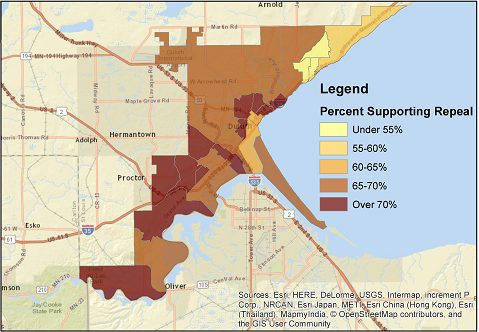
The entire city, for some reason, got a say on whether the Lakeside neighborhood should sell alcohol or not. The initiative had more than 50 percent support in every precinct, but the four precincts that represent Lakeside had the four lowest percentages of people in support. While a narrow majority supported liquor sales in three of the four, and a somewhat larger percentage did so in a fourth, opinion remains divided. The west side, meanwhile, really supports booze on the far east end. The results in Lakeside had a 3 percent shift toward the pro-alcohol side since the 2008 referendum, so things are starting to move, but it’s hardly a mandate from the people of Lakeside.

Cards on the table: I vote absentee in Precinct One (the far east part of Lakeside) and support opening up the neighborhood to liquor sales. However, given this shifting but still divided electorate, I think a compromise is in order. The city already bent the rules once for the area to allow liquor sales at the Lester Park Golf Course clubhouse, so I think it’s perfectly reasonable to do the same for New London Café or any other restaurants that may pop up in the neighborhood, if they so desire. That could even pump some life into the neighborhood’s little downtown. If they want to continue to block liquor stores until there’s broader support, I think that would be a reasonable accommodation of public opinion. Of course, there are arguments that cast aside public opinion in favor of ideals, but this is probably the best way to find some middle ground.

Ranked Choice Voting

RCV

First off, there’s one very clear outlier. RCV had majority approval in the precinct that covers the UMD campus; it didn’t get over 36 percent of the vote anywhere else. To the extent that many UMD students vote from their on-campus address, they tend to be mobilized by student groups or activist organizations, so their support makes some sense. That precinct also had the smallest number of votes of any precinct—less than one-third the average, and one-fifth that of some the largest—making it more vulnerable to swings related to sample size. It could be interesting to see an age breakdown, though I’d add that an informal sampling of my own peer group (mid-20s people) revealed widespread skepticism. I’d guess this is a localized result, and little more.

The other four precincts that mustered over 30 percent support for RCV are on the near east side, and in areas with fairly high poverty rates. While this is still a pretty decisive rejection, the somewhat higher approval rate here might stem from the (highly questionable) claim that the voting system somehow increases the number of diverse voices. Basically everyone else rejected it by a very large margin, and I don’t think one can read much into an east-west narrative here. The unease with it cut across all parts of the city and demographic groups. It’s time to find some methods to increase citizen participation with broader support, even if they may take more work within the community.

That’s all I’ve got for this election cycle. I’ll have some final words on the outgoing politicians when their terms come to an end in January, and we’ll see how the newcomers do when they make their way into office.

Duluth’s Divisions, Revisited: 2015 Election Analysis

After a minor delay, here’s a dip into the details of the latest election. As you may notice, my map-making skills have come a long way since I last did this.

Oswald

School Board At-Large race, Alanna Oswald vs. Renee Van Nett (Shown in terms of Oswald’s vote share)

We’ll start with the closest race of the night, the battle between Alanna Oswald and Renee Van Nett for the at-large school board seat. Van Nett’s campaign had a more explicit emphasis on racial equity—even if it was a bit vague on how that was supposed to look in practice—which probably explains her success in the city’s most liberal districts on the east side and in the center of the city. She also may have benefitted from sharing a ticket with the popular David Kirby in District Two in the center-east part of the city. Oswald, meanwhile, focused more directly on east-west equity, which helped her carry the west side. Oswald’s more critical history of the administration and endorsements from the likes of Harry Welty also likely helped her out west, where skepticism of the administration is higher. Still, she was much more than an anti-establishment protest candidate, as evidenced by her success in places like Lakeside and the areas over the hill. She was a nuanced candidate who ran a strong campaign, and gave Duluth a rare upset of a DFL-endorsed candidate in a city-wide race.

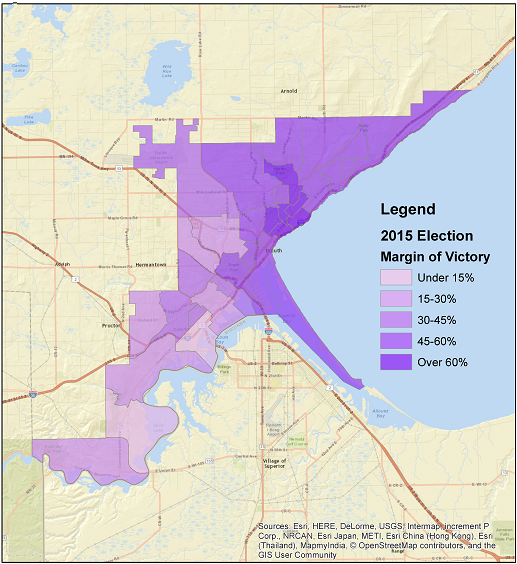
2015 Duluth Mayoral Race, shown as Emily Larson's margin of victory over Chuck Horton

2015 Duluth Mayoral Race, shown as Emily Larson’s margin of victory over Chuck Horton

The main event of the evening doesn’t look all that thrilling; Emily Larson won every precinct in the city in the mayoral race. Still, the margin wasn’t consistent, and reveals the old east-west divide that has punctuated most two-horse races in this city for at least the past decade, if not longer. (Someone with a longer historical memory than a 25-year-old will have to weigh in on the older details.) These results suggest the east side is again driving the agenda, while the west comes along for the ride with varying levels of agreement.

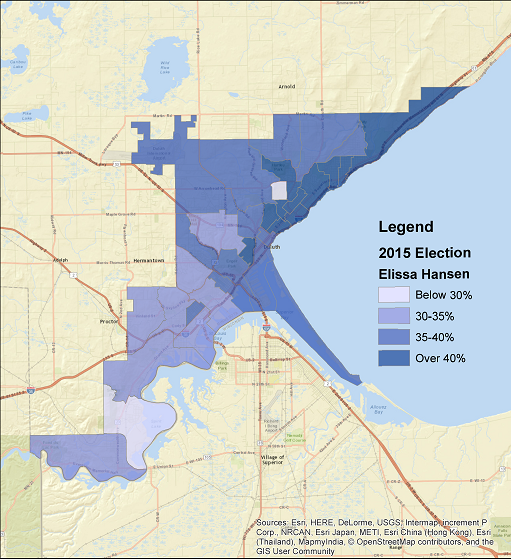
Elissa Hansen's performance, 2015 city council at-large election.

Elissa Hansen’s performance, 2015 city council at-large election.

Noah Hobbs' vote share, 2015 city council at large election.

Noah Hobbs’ performance, 2015 city council at large election.

In the city council at-large race, Elissa Hansen won all but four precincts, though her margins again tend to map on to the east-west divide. Like Larson, she is a poster child for continuing the Ness governing vision with her optimism, youth, and emphasis on inclusion. She lost three precincts to Noah Hobbs, and the two tied in the fourth. All four were pretty predictable: Hobbs, a recent UMD grad, carried the precinct on the UMD campus, and did the rest of his damage on the west side. Hobbs is a died-in-the-wool west-sider, so this only makes sense. (It wasn’t an accident that those lawn signs had Denfeld colors.) This is a second straight election that a younger person has eclipsed the establishment favorite on the west side, but I wouldn’t read anything too deep into this. Zack Filipovich simply had a stronger ground game than Barb Russ on the west side, and Hobbs’ ties carried the day on Tuesday.

Jim Booth's performance, 2015 city council at-large election

Jim Booth’s performance, 2015 city council at-large election

Jim Booth, a Duluth Heights resident, did best up in that region. As the relative conservative in this race, I thought he might do somewhat better on the west side, and while his percentages were somewhat higher, he still ran behind Hobbs nearly everywhere. An explicit west side focus outweighs any ideological loyalty. Anyone who seeks to speak specifically for that side of the city will do well.

Sticking with the west side theme, these trends become more acute with if we hone in on the Fifth District race. Here, Jay Fosle beat Janet Kennedy by a fairly comfortable margin. Still, the district has two clear halves: in the Denfeld and Oneota areas, Kennedy kept things very competitive; she was within 21 votes in the four easternmost precincts in the district. However, she got whipped in the far west precincts, particularly in Fond-du-Lac, Gary-New Duluth, and Morgan Park. This is Fosle’s home base, so it’s not stunning, and across the board, these very far west areas were some of the strongest areas for the more conservative candidates in the field. To the extent that the west side now has an anti-establishment reputation, it is rooted in the very far west.

2015 5th District city council race, Jay Fosle vs. Janet Kennedy, shown in terms of Fosle's vote share

2015 5th District city council race, Jay Fosle vs. Janet Kennedy, shown in terms of Fosle’s vote share

This may be a long-running trend, and the precincts in question are a small enough sample that personal ties for someone like Fosle can make a big difference. Still, this gap endures despite a very intentional effort by the Ness administration to launch a redevelopment effort in this particular corridor over the past two years. That’s significant, and shows that the west side, even if they like the leader of the River Corridor Coalition as a city councilor, still isn’t entirely on board. Once again, the west side wants to talk about west side issues, not the broader liberal ideas one tends to hear from the establishment candidates.

At the risk of conflating a mild political divide and a much deeper discussion, the west side’s demographics hew to a recent attention-grabbing study on the plight of working-class white men. This group feels increasing alienation from the people in power, and whether this involves suicide or more insidious forms such as heavy drinking or drug use—a concern that Fosle, to his great credit, was waving in the face of the Council several years ago—they are dying at a faster rate than before. It’s certainly not hard to see how this affects politics. (See Trump, Donald.) These are somewhat more existential questions on the fate of the American Dream, some of which I’ve explored before, and that theoretical discussion needs to continue. In the meantime, though, cleaning up that steel mill site and other post-industrial dreck, building some new housing on the site of a shuttered school, and bringing some jobs back to the west side will have to do.

In the big picture, however, Fosle’s constituents have themselves a protest vote. Don Ness was not running for office on Tuesday, but he loomed large over the whole race, and his ethos reigns supreme. The city’s government is younger, and solidly on the left side of the political spectrum. Ness’s legacy will last long beyond his eight years in office, and while it will be many years before we can cast final judgment, there’s certainly more cause for optimism now than there was eight years ago. For most Duluthians, the trajectory forward was so obvious that it wasn’t really up for debate in this election cycle.

Still, there is nuance here. Duluth rejected the vogue electoral system because it didn’t get caught up in the latest flashy trend with no actual evidence backing it, and that is a win. A mild upset in the school board at-large race shows some discontent with the direction of the school district, and a refusal to impose a single vision upon it without debate. There is room in the tent for east side liberals and west-side loyalists; for total believers in the Ness vision and a loyal opposition. The more open the process, the greater the odds that a portion of the city won’t get left behind. We’ll see what Emily Larson and friends do with that new mandate.

See two more maps in a follow-up here.

Duluth General Election Results and Comments, 2015

Another election season has come and gone. Your results, with percentages followed by actual vote totals:

Duluth Mayor

Emily Larson 71.9 (15,352)

Chuck Horton 27.5 (5,862)

It’s a long-anticipated coronation, as Larson rolls into office. She’s basically been inevitable since most of the realistic challengers stood down early in the election cycle, and now she finally gets to move toward governance. Her policies will likely be a continuation of those of her predecessor, Don Ness; under Larson, Duluth should continue its re-invention as a creative, energetic city. Still, she’ll certainly have an opportunity to carve out her own legacy outside of Ness’s long shadow, and we’ll see what innovative ideas she brings forward, and how she looks to manage those who aren’t all on board with the Ness agenda. She is Duluth’s first female mayor.

City Council District One

Gary Anderson 61.9 (3,902)

Karl Spring 37.9 (2,389)

No great surprise here, as the far east side elects the more liberal candidate to replace Jennifer Julsrud.

City Council District Two

Joel Sipress (I) 97.5 (2,891)

After an unopposed run, Sipress returns to a council where he is suddenly among the more senior members. First appointed in 2014 after Patrick Boyle was elected to the St. Louis County Board of Commissioners, he now gets a full four-year term.

City Council District Three

Em Westerlund 82.4 (2,278)

Barri Love (withdrew from race) 16.8 (465)

Love’s withdrawal left Westerlund with no competition in this race to replace Sharla Gardner in the center of the city.

City Council District Five

Jay Fosle (I) 56.4 (2,215)

Janet Kennedy 43.4 (1,705)

The far west side of the city retains its contrarian streak and returns Fosle, a frequent skeptic of the Ness governing consensus, for a third term. Kennedy made up some ground on her primary gap, but ultimately failed to break through. Fosle is usually left playing the grumbling protest vote, though I definitely give him credit for occasional independent streak that produces some insights and occasionally highlights some perspectives that wouldn’t otherwise get a seat at the table. He is now the most senior member of the council.

City Council At-Large (Two open seats)

Elissa Hansen 37.8 (12,192)

Noah Hobbs 28.8 (9,271)

Jim Booth 21.5 (6,922)

Kris Osbakken 11.5 (3,699)

This script looks just like the one two years ago, as the two DFL candidates move through, leaving a conservative in third and a local Green Party figure in fourth. Hansen, a dynamic candidate with a background in economic development, was a shoo-in from the start. Hobbs, a younger guy with a lot of passion for the west side, should provide an interesting voice in coming debates over the future of that side of the city. The other two were always long shots.

City Council Big Picture: The Council’s ideological composition didn’t shift at all, as the lone conservative incumbent retained his seat and moderate liberals cleaned up everywhere else. There is on notable shift, though: there’s a youth movement afoot. Three of the nine councilors are now under thirty, and a fourth is in her thirties. In Don Ness’s wake there has been a generational shift in this city, and there’s a lot of young energy making its move into city politics. Do my generation proud, kids.

School Board District Two

David Kirby 59.7 (2,776)

Charles Obije 40.0 (1,857)

Kirby’s big lead from the primary carried through to the general election, and it’s little surprise to see him cruise through in a wealthy district that values its public education. He succeeds the polarizing Judy Seliga-Punyko, and he now gets to negotiate the school board minefield: is his positive talk a genuine desire to move forward from all this past junk, or will he follow his predecessor in staking out the battle lines? I thought Obije appeared a strong candidate, and hope he remains involved in some capacity.

School Board District Three

Nora Sandstad 64.2 (3,111)

Loren Martell 35.2 (1,705)

This makes three elections and three decisive losses for Martell; I thought he had a chance this time around, given his exposure through Reader columns and a more forgiving district. Instead, Sandstad carried the day. Like Kirby, she’s largely kept mum on big issues and said all the right things about staying positive and moving past recent ugliness; the big question now is how her apparent independence will play out in practice.

School Board At-Large

Alanna Oswald 51.5 (9,621)

Renee Van Nett 47.6 (8,910)

The tightest race of the evening also involved its biggest shift from the primary, as Oswald came back from an early deficit to ease past Van Nett. She was probably the most dynamic campaigner of the bunch, and if she can bring this energy to the board, it will be a very different place. If she can retain her independence, she’ll be a force. I also hope Van Nett continues her advocacy in key areas even though she’s not on the board.

School Board Big Picture: It’s a potential changing of the guard in ISD 709, as three consistent votes in the monolithically pro-administration bloc retire and three fairly new faces in Duluth school debates make their way in. Unlike some of the current and outgoing members, they don’t have long records siding with one side of the dead horse Red Plan debates. With two solid pro-administration votes and two staunch critics among the remaining members, these three now have the power to play kingmaker. Whatever they decide, one hopes they will stay above past squabbles, ask tough questions, and dig into the district’s most pressing debates. Color me cautiously optimistic that some new blood will leave the old debates behind and provide a much-needed jolt of energy for the real issues at stake.

Ranked Choice Voting Ballot Question

No 74.7 (15,564)

Yes 25.3 (5,271)

Mission accomplished.

My own opinions aside, this was quite the decisive vote. It shows how a campaign with considerable outside financial backing can fall to a largely grassroots local campaign (though Walter Mondale did weigh in on the ‘no’ side in the final week). It’s also distinctly Duluth, as the city chose not to follow in lockstep with the trend in the Twin Cities. Duluth elections will be a bit simpler for it, and perhaps we’ve finally heard the last of this well-intentioned but poorly supported and ultimately misguided attempt to “improve” democracy. Back to the real issues.

Non-Binding Lakeside Liquor Ban Repeal

Yes 59.3 (11,528)

No 40.7 (7,912)

This was, weirdly, a city-wide question, and the rest of the city had stronger opinions than the Lakeside residents did. Even so, opinion in Lakeside has shifted some since the 2008 referendum on this topic; at that point, it fell one vote short, while the DNT is now reporting the repeal got about 53 percent of the vote. Before I die, I will be able to buy a damn beer in my childhood neighborhood. (No, the 3.2 Coors at Super One does not count.)

Method of Setting City Council Pay Ballot Question

Yes 67.0 (14,031)

No 33.0 (6,917)

This procedural move lets the Charter Commission set council pay, which seems a bit wiser than letting them just vote on it themselves. Any new pay grade will still require Council approval. We’ll see if anything actually comes of this and revisit it if and when that debate starts up.

Time-permitting, I’ll be back with some comments on precinct-by-precinct results in the near future. Stay tuned.

Ranked Choice Voting Is Still Mostly Useless

Duluth has some elections next week, and while I’ve handicapped most of the races at one point or another and don’t have many new things to say about them, I will spend some time on the topic that seems to generate the most debate in the social media world. That topic is…ranked choice voting (RCV). (In past posts I’ve used its other name, IRV, but I’ll use RCV this time since that’s the language on the ballot.) I went into greater depth on its flaws in this past post, and would point anyone interested in learning about RCV in that direction.

First, let’s clear up one misconception particular to the Duluth case: the initiative on the ballot, as currently proposed, will not eliminate those “costly” primary elections in Duluth. It covers only mayoral and city council elections, so the city will still need to roll out the whole show for the school board and anything else requiring a primary. Not only will there be no cost savings, it simply passes the costs off on a cash-strapped school board.

Otherwise, I’ll just point out that all of the claims for it are questionable at best. For every warm and fuzzy Minneapolis IRV election (which had lower turnout anyway), there are frustrations in Oakland. For every claim of empowerment of minorities, there’s a study pointing out that their ballots are more likely to be spoiled. For every San Francisco election (which invariably elects a popular liberal candidate, no matter what), there is another lawsuit and attempt to amend the system. Supporters and opponents can argue turnout numbers for all eternity.

It is most important to judge RCV not by its performance in obvious elections (as was the case in Minneapolis last time around), but by its performance in close ones. Here, things grow much murkier, with (right or wrong) questions of legitimacy and moves to repeal. Once RCV becomes an issue, the controversy never goes away. Just ask the one-third of U.S. municipalities that have repealed it after adoption. Is this really a debate we want to keep having every four years? Or maybe, just maybe, there are more pressing political questions to which we should devote our time and money.

Finally, there’s a claim circulating that the elected officials in Duluth who have come out against it are all just maintaining current power structures because they work for them. This is absurd. First off, most of the politicians who oppose RCV in Duluth won their elections comfortably, and would be in office with any voting method. (The lone exception, perhaps, is Don Ness, who could well have lost out in a crowded 2007 field that he did not lead after the primary.) Also, basically everyone who has come out against it for more than the most basic reasons is doing so because they were educated by a group of concerned UMD professors. (This includes me.) These professors are not politicians, and have nothing to gain personally from their campaign. They went in curious about RCV, learned more than anyone else, and came away unimpressed. Ever since, they’ve been doing their civic duty to inform anyone who will listen. This is the way local politics should work.

The only side in this election using any distinctive political muscle is the “yes” campaign, which is driven by the Twin Cities-based branch of Fair Vote Minnesota, a national organization whose ubiquity in these debates makes it hard to find any neutral voices in popular media. (Just google the term and see how many of the results include comments from Fair Vote or one if its proxies.) Naturally, they’d reject the label of an outside interest group, but that is just what they are here, as they spend a heap of money in a city they do not live in to influence an election. It’s all rather funny: I suspect most of the Fair Vote people are strong proponents of campaign finance reform and keeping big, distant, moneyed interests out of politics, and yet…here they are.

I’m sure the people of Fair Vote think they’re promoting democracy and doing the right thing, despite what the evidence might say. Their civic interest is admirable. Far less admirable is the missionary zeal with which they pitch their cause. The shrill tenor of the debate and dismissal of critics as simpletons or bigots is especially ironic, given the claim that RCV is supposed to reduce negativity in campaigns.  Somehow, RCV has become part of a religious cause; one that is incapable of self-reflection and above any criticism, and considers the cause more important than the deliberative democratic process it needs to go through to become reality. If only it were actually a cause worth fighting for.

Driftless III

Happiness is not, nor can it be, terrestrial. Nor can it be a permanent state. Humans can be happy but for an instant…But its brevity does not matter: an instant can be a window unto eternity.

–Octavio Paz

2015-10-18 13.43.05

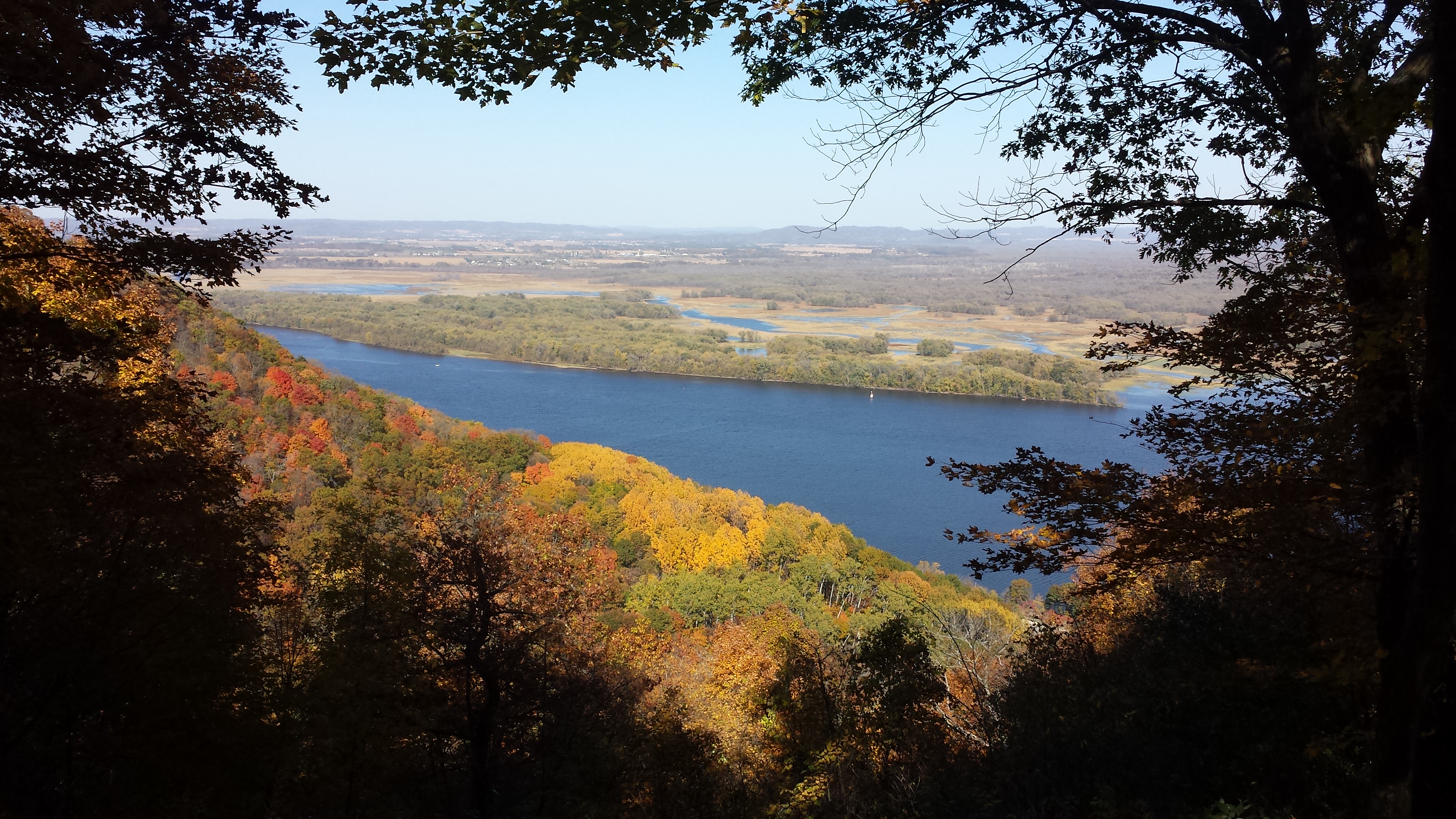
Fall is one of the best times to go hiking in the Upper Midwest. Green hills erupt into flames of red and yellow and orange. The air is crisp enough to invigorate after a summer of languor, but not yet frigid enough to force a retreat beneath the covers. Whether along the ridges of the North Shore or the meandering valleys of the Driftless Area, the countryside beckons. In need of escapes after a long week, we run off into the woods and go barreling up and down bluffs and hills with reckless abandon.

The metaphor here is none too subtle. We’re running up these hills in search of something. It’s a constant hunger, an ambition to push to the top, wherever we may be. It’s an old trope, though its sincerity takes some edge off the cliché. We can only linger at the top for a moment, but the real power comes in the push to the summit, the pursuit of goals at a breathless pace. And the view, even if it lasts only an instant, remains etched in the mind’s eye, that lone memory of this season that will endure.

This fall brings on new levels of relentlessness. And yet those moments still come: those moments when we get closer and realize that the narratives we write aren’t about progress from one thing to the next but instead a ceaseless cycle that brings things in and out, forward and back, the past and the future blurred in some formless thing we call ourselves. This land we walk upon was here long before us, and will be long after. We only have a fleeting window to leave a mark.

And so we push up the peak even faster. Now is the time to remember that it’s all in the service of something, all part of some greater mission, and that the exertion is worth every ounce. Beneath an Indian summer sun and a ceiling of golden boughs, it’s not hard to imagine an order behind it all; some higher power at work. But the true believers run the risk of assuming they have it all figured out; that one view from the summit reveals all. Perhaps the simple beauty of the moment is enough, and we can instead work to preserve it, to make sure that all can enjoy these little glimmers. But a rootless commitment to the good cannot endure; it must be able to perpetuate itself, and to feed the fire anew.

To what end? The answer is buried amid fallen leaves, none too easy to decipher. A glimpse here or there will have to do. The sun sinks toward the horizon, but we still have time to climb one more hill, do we not? Who knows what the next one will reveal. It may not be anything too different. But the push conditions us, and we know that, no matter where the path may twist, we’ll have the energy to finish the journey. Even in autumn, youth: the will to never cease this desire to form a little world where we can reach the apogee of human achievement, in whatever form that may take. Ever upward.

October Hockey Notes: Northern Power

It’s not often one can glance up at the TV in a bar and see a kid he used to bump into in the hallway skating across the ice, but it happened to me this past weekend. Former Duluth East defenseman Derek Forbort made his NHL debut on Friday night, as he registered one shot in 11 minutes of ice time for the Los Angeles Kings in their overtime win over the Wild. Forbort is the sixth ex-Hound to appear in the big show, though he may soon have company in the form of a couple of UMD Bulldogs. It wasn’t the smoothest road to the show for Forbort—most of the other players drafted around him in the 2010 draft made their debuts years ago—but make it he has, and it was just one of a few highlights this past weekend for those of us with our roots in the North.

The NHL have been under way for a couple of weeks now, but the first major college series of the year, an early season home-and-home between Minnesota and Minnesota-Duluth, ushered in the hockey season more properly. The two-game series revealed two teams in decidedly different places, and while the end result wasn’t an overwhelming surprise, the gulf between the two squads was the lingering takeaway. Minnesota Duluth’s 3-1 and 3-0 wins gave them six in a row over Minnesota dating back to last season, their greatest run of dominance over their southern rivals in school history.

The Bulldogs return a veteran core from a team that narrowly missed the Frozen Four a year ago, and after slipping up in their opener at Bemidji State, they looked the part against the Gophers. Two three-goal nights may not seem overwhelming, but their relentless pressure in the offensive zone had them in control for most of the series. It was offense-as-defense at its finest, with gaudy shot counts over the first four periods. Dom Toninato, ever a powerful presence, scored twice on the weekend; freshman Adam Johnson seamlessly slid into the Bulldog top line with Toninato and Alex Iafallo. All four lines were humming along, and the Bulldogs simply owned the neutral zone.

The Friday night performance was even more impressive considering the absence of the suspended Carson Soucy, whose tracer in the Saturday game—with some help from a Karson Kuhlman tip—gave the Bulldogs their second goal. The giant, physical defenseman is an imposing force, and he and Andy Welinski make for a dominating one-two blueline punch. One of the Bulldogs’ most apparent weaknesses this season is a lack of defensive depth, but after some rocky moments early in the first game, the greener UMD defensemen all settled in and had solid series. The difference in comfort of the new arrivals was one of the distinct differences between the Bulldogs and Gophers all weekend long. It’s Frozen Four or bust in Duluth this year.

For their part, the Gophers came out with good energy in the opening ten minutes of both games, pushing the pace and forcing some quality saves out of Kasimir Kaskisuo. Other than that, they only showed life once down 3-0 in the second game. Their two returning stars, Hudson Fasching and Justin Kloos, disappeared for stretches of the first game, at times trying to do too much on their own. Taylor Cammarata, the poster child for the Gophers’ lack of fight a year ago, looked more willing to go into corners, but is ill-equipped to do much once there. Brent Gates Jr. got the lone goal of the weekend, while Tommy Novak was probably the most consistently useful of the freshmen.

This isn’t wildly unexpected. These Gophers are young, and looking to recover from a veteran-laden season that went all wrong. Even so, teams lose as much as they do year to year and get by just fine. They’ve scored just once in three games, and the whole clearly does not match the sum of the parts. There is too much talent here to languish in a cellar. The effort of some of the forwards gets the most flak, but I’ll point to a number of sophomore and junior defensemen who have yet to live up to the hype: they are far too soft in their own zone, and the fluid puck movement that should be the Gophers’ staple has degenerated into blind outlet passes. Add in a coaching staff that doesn’t seem willing to adapt a system to the team they have, and there is a recipe for ugliness. Yes, it’s still early. But they need to turn things around before Big Ten play starts, or the whispers about Don Lucia will grow louder.

On the high school side of things, there’s less than a month until practice opens, and the Elite League is deep into its second half. So far, the league has been owned by Team North, a squad that has just three schools—Grand Rapids, Hermantown, and Duluth East—accounting for the vast majority of its players. With Bemidji looking strong as well, this could be a banner year for the North. East’s Luke Dow and Ash Altmann are flashing their offensive talent and are the top two forwards, though the team’s leading scorer is the sublimely silky Scott Perunovich, a Hibbing defenseman and future Bulldog. He and Hermantown’s Wyatt Aamodt make for a defensive pair no other Elite League team can match.

Future Gopher Casey Mittelstadt is the Metro area’s finest player, though he relinquished the league scoring lead to Breck’s Chase Ellingson while off playing for the national team this past weekend. Team Northeast is Stillwater-heavy, but their two big guns are Luke Notermann of Blaine and Will Garin of Holy Family. Team Southwest, home to the Edina and Prior Lake contingents, has lined the cellar so far, and the Great Plains group shows flashes. Mittelstadt joins the returning Lakeville North crew along with some Hill-Murray boys in leading team Southeast; they’re locked in a battle for second in the standings with Northwest, whose scoring beyond Ellingson is probably the league’s most balanced. They also boast its top goalie to date, Alex Schilling of Wayzata.

The last few weeks of the Elite League will provide a few more clues as I go about readying the preseason AA rankings. I’ve started to comb over team lists in my spare time, and I’ve put a few rough orders on to paper. They’ll be out in less than a month. Yes, Minnesota, hockey season is finally here.

A Patient Cyclist

Fall is kicking in to gear in Minnesota, which means that it will soon be time for those of us who are not ambitious winter bicyclists to stash our steeds away for a few months. For reasons that now elude me, I was never a big biker as a kid; the bike helmet strapped to my bag is a new addition, and given the choice, I’d rather just walk everywhere. But my graduate program contractually obligates me to begin something akin to a Tour de France training regimen, and so I have begun my education.

As Adam Gopnik writes in a recent urban planning omnibus New Yorker piece (alas, it’s behind the paywall), cycling rose to prominence in the 1890s not because it was cheap or necessarily fun, but because it was the fastest way to get around at the time. This became true for me this summer, as construction fouled up traffic between Uptown and Downtown Minneapolis. I took a certain glee in whizzing past the people trapped in their cars along Hennepin Avenue every morning, and Minneapolis’s generally excellent bike infrastructure made the decision to abandon the bus an easy one. When safe lanes are in place, the cyclists will follow.

As the summer went along, though, I began to take a few trips beyond the route of my daily commute. My Tours de Minneapolis never did quite enough to make my runner’s knees totally happy on a bike, but there’s something deeply satisfying in coasting through Theodore Wirth Park or pushing the pace past laboring cyclists on the few inclines this city has to offer. I would around the lakes, cruised along the river, and even made my way over to St. Paul from time to time. A bike camping trip out to the crimson trees of Maple Grove this past weekend seemed the ideal way to cap my first summer as a regular biker. It’s a pleasurable way to cruise about a city, with every corner suddenly at one’s disposal; nimble and versatile, both leisurely and a decent workout, depending on one’s desires.

Defenders of the bicycle are locked in a long-running, low grade war against their great antagonist, the automobile, and no self-conscious cyclist can pedal away from the debate. A lot of drivers are supremely ignorant of cyclists, and I’ve witnessed more than a few cyclists returning the favor by weaving recklessly in and among cars. If this is how rule-conscious, respectful Minnesotans handle things, I can’t imagine the battles elsewhere. As a runner, I’ve also endured countless cyclists who either give no indication of their presence or like to think they own the entirety of a shared path. Such is the grey zone of cycling etiquette, and the frequent imbalance between the letter of the law and what proves good practice on city streets.

In the end, people remain people, often inclined to vent their disgust at other anonymous individuals hurrying off to wherever it is they need to go; sometimes they simply have larger machines with which to express their pathologies. My code on the roads ignores rigid rules and settles for basic common sense. Cyclists need not come to a halt at every stop sign and red stoplight if there is no traffic in sight; a simple yield will do. For pedestrians’ sake, bicyclists should stick to streets when possible, but it is no sin to escape to the sidewalk on particularly dangerous streets. Signaling turns is the polite, and safe, thing to do. Please, cyclists, announce your presence (without sounding passive-aggressive, as if your presence should be self-evident) when approaching pedestrians who appear oblivious or might risk wandering into one’s path. And drivers, open your eyes: you do not have a monopoly on the use of our streets, and never will.

As long as I’m on the topic, I’d be remiss not to add a few stray words on Duluth’s bike controversy this summer. Even though I think the Michigan Street compromise was the most practical option—and for the skeptics of it, I always took Michigan Street both ways on the handful of occasions that I bicycle commuted from my childhood home out east to jobs on the west side of Downtown—I couldn’t help be a bit sad to see the Superior Street push fail. I understand the practical limitations, but it otherwise seems like Duluth is going all in on the bicycle mecca development plan, and the lack of any accommodation for them on the city’s signature street is a glaring miss. (Suggestion for making the Michigan Street corridor work: get a ramp from Lake Place down to the street. Lugging a bike up and down those stairs isn’t ideal.) As long as the network continues to grow and people can learn what a cheap, fast, and valuable form of transport bikes can be, the end result will be a happy one.

How to Maintain Your Sanity While Being Overworked

This blog is lapsing into self-improvement listicles, which should perhaps be a red flag, but ‘blog’ was on my schedule for tonight, so blog I shall. Here are eight suggestions for staying sane if, by chance, you ever find yourself taking a full load of graduate-level courses, running two student organizations, and working two jobs at once. It’s a common problem, right?

I’ll skip over the clichéd advice—get enough sleep, eat healthy, get some exercise—because that’s well-covered ground. Here are eight pieces of advice I’ll allow to flow forth from my fountain of infinite wisdom:

1. Master the art of filling a schedule and following it. We all schedule in different ways. Lots of my colleagues are Google Calendar adherents, with their phones spewing out eternal reminders of where they ought to be. Dinosaur that I am, I still use paper; it’s good to be able to scrawl new tasks or the odd reminder in the margins, and there’s something deeply satisfying about crossing things off the list. The medium doesn’t really matter; what matters is that every little task you need to do is documented so that your scattered mind doesn’t forget it. Check off tasks with gusto and move on to the next thing.

2. Clean out the email inbox right away. Nothing looms like unanswered messages and a sense that other people expect things from you. Not only does getting through them all tend to go faster than you’d think, it takes a load off. Not only that, you’ll find that responding promptly is actually a somewhat rare and valuable skill, and it’s one other people notice. They realize you have things together, or at least are good at projecting that illusion. There is nothing wrong with projecting illusions, so long as they are in the realm of sanity. Project it long enough and it might just become reality.

This doesn’t mean you have to check the damn thing every ten minutes. In fact, I’d highly recommend taking a minimum of a few hours away at times, especially on weekends. But when you do dive back in, plow through it relentlessly. Leave nothing for later—unless, of course, you’ve budgeted time for it on your schedule.

3. Never let work be the last thing you do before bed. No matter what deadline I face, no matter how late it is, I do something blissfully unrelated to school or career before the lights go out. It works wonders.

4. Multitask wisely. Don’t lie, you know you do it. You can’t cut yourself off completely. But if you are going to multitask, make sure it makes sense. If you’re watching TV, do work that requires less intellectual capacity, like spreadsheets or statistics or more inane writing tasks. If you’re drunk, write or work on the creative side of things. If you’re supposed to be reading or writing, distract yourself with other reading or writing, and preferably of a high caliber so that you’re reading good writing.

Enlightened procrastination is a valuable skill, and will serve you well in bar trivia. No, you won’t be as efficient, but you’re a human who has to remain sane, not a cog on an assembly line. If you finish a project two hours more slowly but also watched a football game during that time, chances are you’ll remember it much more fondly. Don’t beat yourself up over a slow pace; build in the breaks, accept them, and then get back to it.

5. Surround yourself with people who fuel your energy. I’ve found I’m particularly prone to channeling the mood of people around me, but everyone does this to some degree. Unless you’re ready to disrupt an organization (which can be good, but choose your battles wisely), you’ll adopt its general means of practice, to varying degrees and with varying levels of awareness. So, make sure the people around you are as committed as you are to getting things done; those who bring out the best in you, and drive you to do more. There are limits, of course, but that’s what #6 is for.

6. Know when to stop. There comes a time when no amount of agonizing will do any good. No one innately knows where this is. It’s a feel, and you have to find it for yourself, be able to recognize it, and enforce it with an iron fist. You are done. No, staring at it for another half hour won’t make it better. No, you will not die if you don’t get to that last reading, even if someone calls you out. You’re done, and you’ve done your best. Now go do something non-work related, and then go to bed.

7. Cycle in and out. Spend time with other people; spend time alone. Plan the future; go back to your roots. Think about the big picture, and lose yourself in the details. Again, surround yourself with people who complete you, and complement your skills. Take time for each of them, lest it seem like you’re spending too much time in one world and neglecting important parts of yourself. And yet…

8. Don’t aim for balance. Balance is lame. Work-life balance, social life balance…these terms all make you feel like a juggler who has to be doing ten things at once, and induce panic. That is exhausting, and leaves you further unbalanced. Instead, aim for excellence. Attack each piece with energy when the opportunities present themselves, and you’ll find the anxieties slip away. Stay hungry, even if you know you’ll never quite satisfy that appetite. It’s what keeps you going. Suddenly, you’re not overworked at all. You’re doing what you are driven to do, and feel weirdly good about yourself, even you should have lost your mind by objective standard. Who knows; maybe you have.

There you go, I solved all of your problems for you. Wasn’t that easy? I’ll start my motivational speaking tour as soon as I find time on my schedule.