This is part two in a four-part series. Part One is here.
Venice, Rome, Barcelona: these famed cities dominate this summer’s Mediterranean cruise. But many of the best days come in somewhat less famous towns, those cozy retreats that give these shores their glamour. Given the tight timelines afforded by any cruise tour, more than a few members of my large party conclude it is best to enjoy some quick samplings of beauty rather than deep immersions in the most renowned attractions, the vibes over the deep dives. We can, hopefully, return and immerse ourselves in the places that demand it when we don’t have a ship to catch. But for now, this is how we travel, and we are here to drink in the great beauty.
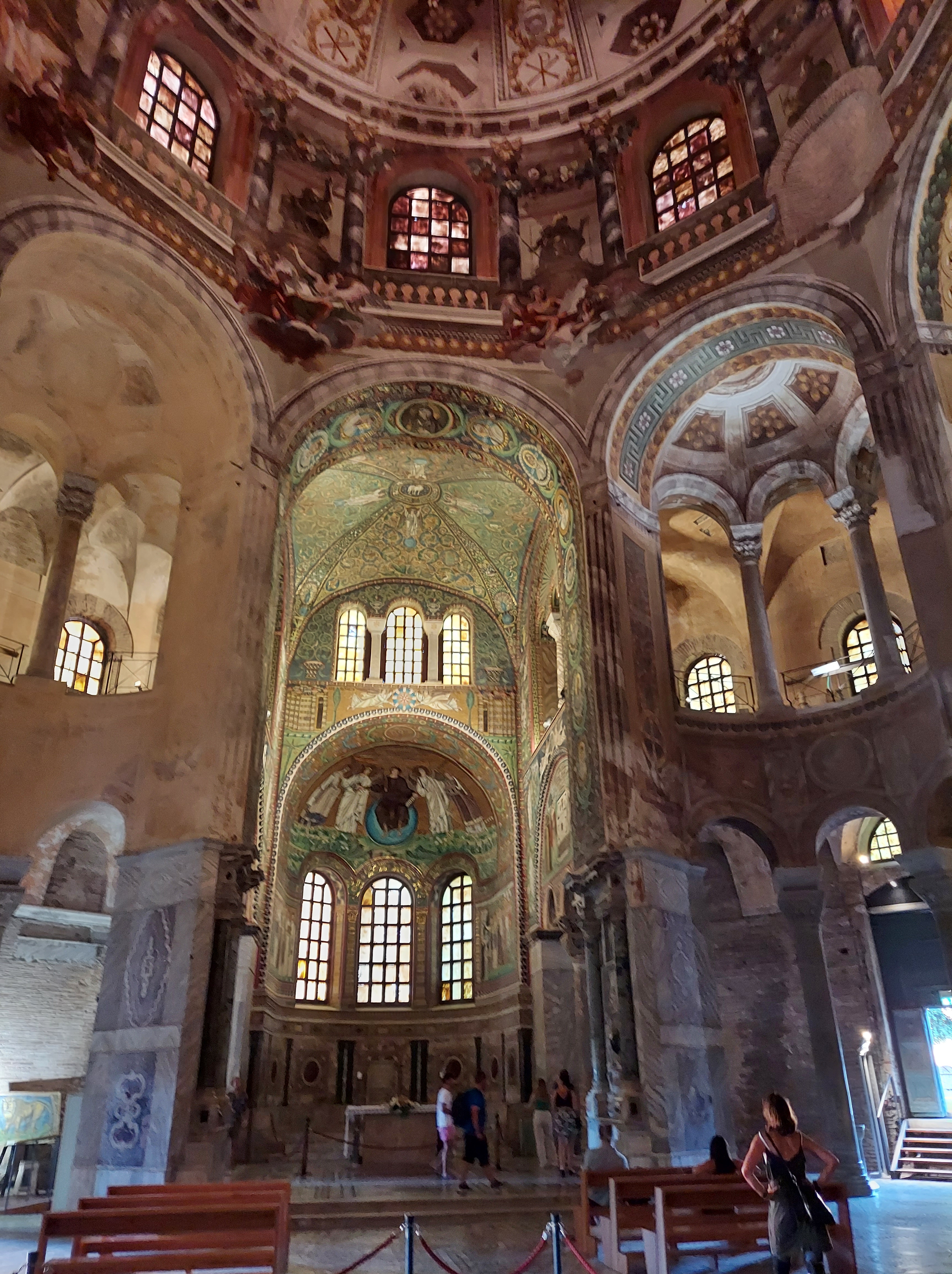
Venice has banned large cruise ships from its harbor, so our cruise starts from the port city of Ravenna two hours to the south. Ravenna has, quietly, slithered its way into world history: it was the Roman capital for a hot second after the sack of Rome, and it serves as the final resting place of Dante Alighieri. Most of all, though, it is known for its mosaics, and four of us make a circuit through the city on our first afternoon there, freed to move at our own pace through sparsely populated streets. We gaze at the art, stop by a café near Dante’s tomb, and pause beneath the cypresses at San Vitale, the cicadas droning in the midsummer heat. We gather ourselves at the Fargo Café, which serves non-Italian craft beer for reasons we will soon come to understand, and then cross paths with an aunt and uncle who aren’t cruising but are along for these first few stops. We endure an unfortunate tasting of Italian beer and then atone for this assault on our palettes with a dinner on a courtyard recommended by a local. The meal proves to be a four-hour affair, so it’s a good thing the cruise ship isn’t going anywhere tonight.
These long nights of food and drink are a staple of this venture, and one my extended family is delighted to inhabit. Moreover, for an American, Europe in 2023 is straight-up cheap. We repeatedly marvel at the cost it takes to feed a large group, all in a transparent price structure free from any pressure to tip. Somewhere in here there is a longer discourse on the relative merits of the high-stakes, higher-growth American economy versus its European counterparts, which are noticeably more sclerotic but nonetheless pay servers living wages and give people the leisure to enjoy nights like this. For a tourist drifting through, though, it’s not hard to eat up this lifestyle.
When I pull open the curtains on my sixth day in Europe, it’s clear I’m in a different land. The ship has nudged directly into the harbor of Messina, the city baked in a brown-gold tinge that blurs both its historic monuments and its newer apartment blocks. Messina clearly lacks Venetian wealth or even Ravenna’s calm, stately history. It does, however, command the strait between Calabria and Sicily, the only stop on this cruise where one can stroll two blocks off the boat and be in the middle of the city instead of some large working port. It is a gateway city, both to the Italian mainland across the whirlpool-filled strait and down the Sicilian coast.
The tour I’ve chosen for this day, Taormina by Land and Sea, is the best Royal Caribbean-organized shore excursion I take on this trip. A bus ride down the coast takes us just past Taormina to the quieter town of Giardini Naxos, the first Greek settlement in Sicily. The tour bus disgorges us into small boats with room for about ten passengers. Our guide, Pepe, takes us from Naxos along the coast, past beaches and grottos and exclusive hotels and villas clinging to rocky promontories over serene waters. He points out the spot where Naxos ends and Taormina begins (“to the left, beer five Euro. To the right, ten Euro”), explains the famous figures we may meet on these beaches (“football stars, movie stars, Pepe”) and acknowledges the most important house on the coast (his birthplace, of course). He pulls out a cooler of Messina beers, and when we look around, we realize our boat is the only one enjoying this perk. After cruising around a point we pause and jump into the cove for a swim, dodging jellyfish in the refreshing water before cannoli and prosecco back on Pepe’s craft. The man knows how to live.

From there the bus takes us up into Taormina, an ancient town fused to a ridge above the sea. This is paradise found: the touring crowds have descended en masse on its one cobblestone thoroughfare, and we hear thirty-six or thirty-seven times about how the city recently hosted a season of The White Lotus. To add to the fun, there is a film fest here this weekend. But the side streets are dead quiet, little stairways up to churches and tucked-away houses and a ruined Greek theater, with views down to the Ionian around every corner; lunch comes at a swordfish panini stand at a far end of the city. The Greeks knew what they were doing when they chose this bit of coast, a distant outpost that proved a Vietnam or Afghanistan for Athenian imperial ambitions.
Sicily’s blend of natural and human beauty sets a very high bar, but if anywhere can clear it, a few towns on the northwest coast of Italy may be the place. The bus ride from Livorno north to La Spezzia is an immersion in Tuscan and Ligurian countryside. The monuments in the Piazza dei Miracoli in Pisa rise up out of the morning haze in the distance, and the mountainous mines of Carrara marble loom below ghostly clouds. Hilltop fortress towns from the Middle Ages stand watch over the autostrade, and in the incredibly compact La Spezzia, the tour bus splits into two mini-buses that can handle the winding roads beyond. We are off to Cinque Terre.
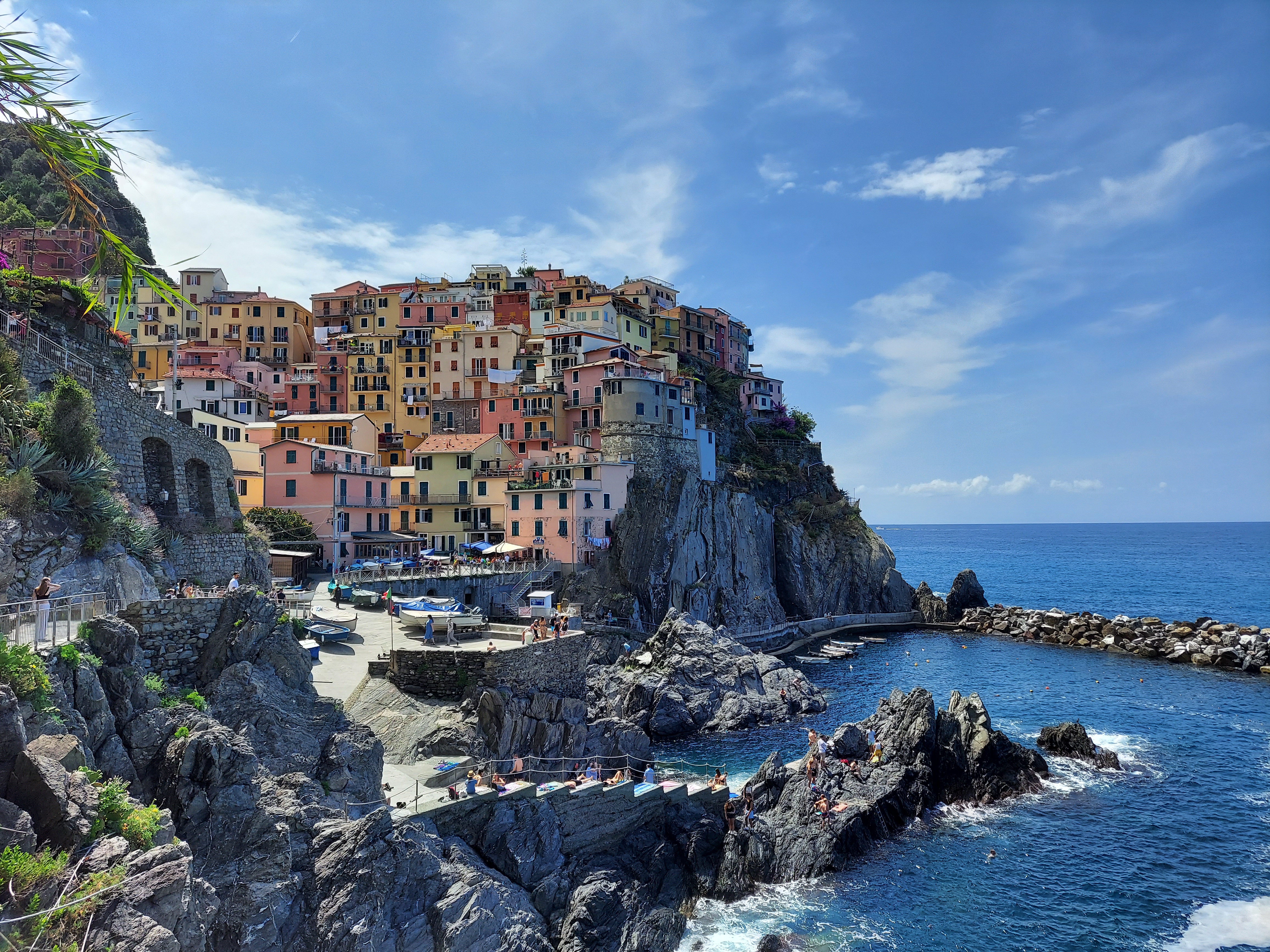
Cinque Terre is a collision of land and water, a Big Sur with 1,500 years of history and an added lushness, lemon trees and flowering shrubs and grapes clinging to terraces at the steepest pitch I’ve ever seen. The wine comes from those very terraces, the pesto from Ligurian basil and pine nuts, the world fresh and alive. In each town, a narrow main road plunges from the highway down to the sea, with inviting side stairs and alleys opening on all sides, a Venice on a slope instead of a lagoon.
A few hours on a small bus can only scratch the surface of a place that demands day, and we see only three of the five lands. Reggiomagiore has the steepest slope down to a small harbor, Manarola has a contender for the world’s best swimming hole and paths that wrap around the cliffs, and Monterosso ends in a beach. I leave Cinque Terre calling it the most Instagrammable place on earth, and it is indeed hard to choose the right selection of shots from these few days to blast out around the world. Venice’s urban form may be unmatched and there are a few places on earth where the natural beauty includes some wonders beyond those of the Italian coastline, but for a combination of the two, I can think of no more impressive place I’ve seen.
Like Venice, Cinque Terre runs the risk of becoming a place no one lives. Our guides tell us that few young people stay here now, loath to cultivate these precarious slopes when more lucrative work abounds. We learn we are fortunate to visit on a day where just one cruise ship passes through, so the crowds are light. But even so, the winding road above the five Ligurian jewels has a fraction of the traffic of an American scenic drive. There is a train down along the water, often in tunnels through sheer cliffs, and most alluringly, there is a trail up and down the terraces that leads from one end to the other. Perhaps more than anywhere else on this trip, the siren song of Cinque Terre summons me back.

Italy is a conundrum of a country. It is a bastion of high fashion, and its people, in my eyes, are among the most consistently beautiful on offer. It is the inheritor and steward of some of the world’s greatest history. But now it shows its age around the edges, worn and creaking, an aging beauty who’s had a few too many plastic surgeries and is still trying to live like it’s 25 instead of 75. It is now a potential European canary in the coal mine as the continent tries to find its way, its great projects stalled out and a revanchist Russia at the doorstep, left to cope with a series of crises: a fumbling economy, a migrant surge, unstable governments lurching toward extremes, near-catastrophic birth rates. But I suspect some of its intangible qualities may help keep it afloat: what a beauty it is, even compared to France, where we spend one brief day on this cruise.
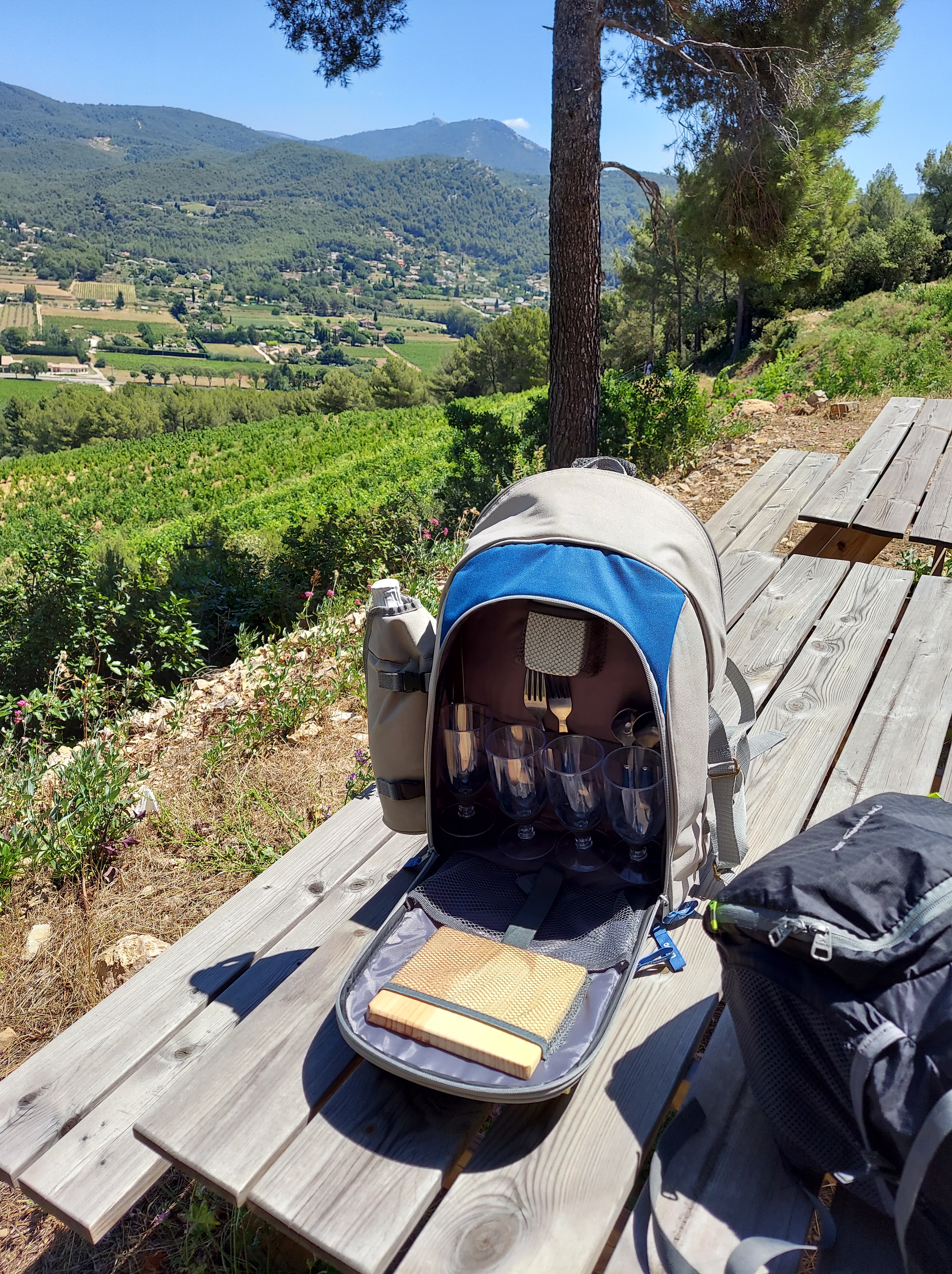
In Toulon, a port and naval base just southeast of Marseille, ten members of our party organize our own tour, which operates under the working title “Something Involving Karl and Wine.” After some momentary fumbling we acquire a motorcade of three cabs for a ride up through the dry Provencal coastal range to Domaine Fonts des Peres, a winery in the Bandol region. Here, the Mourvèdre grapes produce rosés at the bottom of the hill and the designated Bandol reds at the top. A vintner leads us through a tour and a tasting (including some of the best gin I’ve ever had, to go with the wine) before we are presented with picnic backpacks of quiches and focaccia and cheesecakes, and we select a few of the wines we like and stroll off for a leisurely picnic in the middle of the vineyard.
It seems fitting to complete our last shore excursion away from the clutches of the cruise ship, basking in Provencal sun, drinking in the wine and beauty with nine fellow travelers who are equally enamored with the whole enterprise. We’ve had our ups and downs, from travel annoyances to the grand sweep of this family history. But here, on the sea at the center of the world, gazing down at a vineyard and taking a sip of rosé, we have found that very heart of the good life. I suspect we shall return.
 A Patient Cycle