This blog is now starting its ninth year of existence, and it had gone through its life without much in the way of upgrades. It had stuck with the same old color scheme that I never loved in the first place. The links list on the side was an increasingly dated reflection of my news consumption, and the archives section had grown unwieldy on all but the longest posts. Blogging as a pursuit has changed somewhat since 2013; the golden age is long over, and people have drifted off into new quarters in the changing media environment. Facebook appears to have de-algorithmed me (I guess I need more QAnon content for them to think my stuff is interesting), and my audience, outside of the hockey stuff and the spontaneous WordPress users who stumble upon some of my travel writing, is not growing.
As a result, I’ve decided it’s time for an overhaul. I spent some time considering different approaches to my writing life. I gave a little thought to starting a Substack, but I don’t think I have the time now to scale that up to the point where it would do what I want it to do. I considered spinning things off into their own locations: put the hockey stuff in another place, for example, while leaving this as a more personal sounding board. One of the joys of having varied interests is that they do not always sit comfortably together. For the time being, though, I have decided to stay the course.
That meant that we were at least in line for a cosmetic upgrade. I’ve simplified the design: just a good, old-fashioned serif font that puts all the focus on the text, not on any noise on the sides or the background. Black and white simplicity it is. Under the menu button, I’ve started putting in some links to posts with some of my more frequently used tags. My tagging practices over the years have been spotty, so it may take a while to get it in the sort of shape I want it. It’s hardly a priority.
What does this mean for content? Probably nothing that wasn’t part of this blog’s natural drift already. Hockey during the season and when newsworthy, travelogues when I venture outward, markers for other life events. Fiction when those lurching, months-in-the-making entries reach a point where I do not viscerally hate the idea of other humans reading them. Very, very occasional political commentary, offered in a detached and halfhearted tone; a tone not offered because I do not care, but because I believe that understanding requires that level of distance. And the occasional inane offering, too.
For now, at least, that’s where I am. It could all change next week, but inertia remains a powerful force, and this blog, for good or ill, has a fair amount of that behind it now. Thanks for coming along for the ride.
I wanted not a window on the world but the world itself.
—Joan Didion
Never have I been so delighted to feel a bit off as I did this weekend. My second dose of Moderna left me not sick but exhausted, aching, and free, as if I’d just finished a punishing hike over terrain. A fitting emotion at the end of a strange, long year.
I received my first shot on March 11, the one-year anniversary of the declaration of a global pandemic. My March 2020 had begun with the Minnesota boys’ state high school hockey tournament; here were rumblings of danger on the coasts and a vague sense that maybe we should wash our hands a little more often, but no sense that the world was about to change. (A few people I know insist they got the virus in the Xcel Center petri dish that week.). Just a few days later, a sense of doom lingered over my favorite coffee shop in Aurora, a portent that this time would be different. I stocked up on food and booze just before the mad rush began and settled in to my pandemic existence.
In that changed world, I carried on in the shadow of the two twin specters of the twenty-first century: solitude and existential uncertainty. These afflictions existed before the coronavirus pandemic, and for long periods of the past year, they did not figure in my life. I accepted my fate as a chronicler of interesting times, I ran a lot, and I settled into a slower but diligent routine. But the two malaises festered, dormant in the daily blur but apt to reappear on slow work days or lonely weekend nights.
I will start with the looming uncertainty, which became manageable quickly enough. The virus has not come for me or caused any serious illness in my extended family. No one particularly close to me has died, though I did catch the obituaries of a few more distant acquaintances, including my no-nonsense high school biology teacher, Jeanne Mendoza, whose lessons on mRNA crawled out of some recess of my mind on the drive back from the vaccination site in Eveleth. Like a soldier at war, I will remember this year as one of great tedium punctuated by the occasional outburst of excitement somewhere else.
The year was one of chaos and murkiness, even aside from the social and political turmoil that infected the United States. For all the easy morality tales, our understanding of how the virus spreads and kills remains stunningly poor. The failure to respond fell especially hard on the allegedly developed, scientifically inclined West. Public discourse became consumed by painful, simplistic narratives. On one side, a brash, often spoiled mob too bullheaded to understand any concept of personal sacrifice or common good steamrolled any hope for national solidarity in times of crisis. In response, a less damaging but still insidious crew of dithering scolds invoked capital-S Science for political ends and was deified for meeting the exceedingly low bar of appearing sober-minded. Meanwhile, most humans muddled through somewhere in between, taking reasonable precautions but also finding ways to keep up with family and maintain some semblance of sanity.
Through it all, I am strangely optimistic about the post-pandemic world. Change happens slowly, then all at once, and its shepherds are those who have the shrewdness and good fortune to be in the right place at the right time, not the most strident activists. In one fell swoop, the United States reversed course on its social safety net after 40 years of neglect and now seems willing to spend money to stop the drift toward hollowed-out towns and a caste system in which even the people on top don’t feel secure. Rapid vaccine development showed the power of research and development in a crisis and offers the promise of additional breakthroughs in realms beyond mindless tech stuff. This lurch will no doubt have its own obstacles and excesses, but the collective turn encourages me more than any immediate alternative.
The lingering effects of pandemic isolation, on the other hand, are at once easier to correct for and harder to see. I now head back toward a world of unrestrained gatherings with other people, but I don’t yet entirely know how the coronavirus changed me. People who spend time alone tend to develop a clearer sense of self, and this year has featured a lot of time alone. It accentuates inherent traits, both virtues and vices, and more often in some grey area in between that can be either, depending on the channels they take on their way out to the sea. In my case, I observed the resurgence of drive I have always had, at times a self-defeating stubbornness and at times a life-giving tenacity. It formed in long, dark nights in the back room of my old apartment, on lonely roads across the American West, as I moved to a new home, as work bled over the walls I’d set up to contain it, as I booked a trip to the Caribbean, and as I searched out ways to maintain a semblance of the social life I’d led before.
Isolation increases bipolarities. I have always been one to internalize conflict, and that tendency only became more pronounced when there was no one else to squabble with, even in the mildest of ways. I am now the sort of person who yells a lot of vulgarities at his computer, for wont of better company, and one who occasionally texts friends “fuck Zoom” with no additional context. I work to fight off the fear that post-pandemic life may not be so different after all, that it will take vital effort to resist the continued drift toward the anomie and virtual reality that consume sad, late capitalist lives. A lack of human distraction made me tenser, more likely to sink into doom loops of mindless consumption, and I was not surprised to find myself on blood pressure medication by the end. Even so, I grew increasingly turned off by the therapy-speak that filters through so much of the general media response to the virus. I wonder at what point an obsession with wellness reinforces a sense of unwellness.
This is not an endorsement of raw stoicism or the denial of pain. I have come out of my pandemic tunnel with a few scars, including the literal one on my knee from the day last May when I fell in heap on a run along Chester Creek. I crawled to my feet, bleeding from all four limbs, and assured the concerned walkers who witnessed my graceful dive that I was fine. I was somewhat less than fine, but I ran on home in spite of it. This, I think, is the vital distinction: I never sought to deny any of my own struggles of this past year. I preferred to get up and keep running.
I avoid describing my slowly growing freedom as normal, or worse, a new normal. The world is different now, just as it would have been with the passage of a year without a pandemic. The freedom afforded by a vaccination is not a return to a past life but a new beginning, a chance to appreciate the lessons of that scar on the knee, a chance to see not just more windows on to the world but a chance to once again immerse oneself, to lose oneself in a crowd and to find new value in things that had been beyond our reach. Let us live the way we were meant to live, in community with other people, and make the most of this jolt forward into new possibility.
A few hundred fans tuck in along one side of the rink. A few feeble mom yells ring out here and there. A student section of five makes as much noise as it can for the camera. Piped-in noise fills the void, draws more attention to the absence of the world we know. A late-night drive down Seventh Street finds the scene dead. Along comes litigation (unsuccessful) and a mask mandate (sporadically enforced). Groaning institutions built to keep things as they are try to adapt to challenges on the fly. This is the 2021 State Tourney, a strange simulacrum of the most Minnesotan of events. Never has it been like this before, and may it never look like this again.
The 2021 Tourney upended so much of what we assume. It turned Hermantown into the plucky fan favorite upstart and gave redemption to an Eden Prairie team haunted by the near-misses of the past decade. The Class A titlist opened a new era of hockey, the charter school with a not-so-subtle focus that turned a scattered collection of talent into an absolute machine. The two Section One entrants made finals, while the North bowed out early on. Protocols robbed us of two of the state’s great programs, and their absence will forever loom over our memories this year. But the games went on.
The Tourney’s hockey is great but its mystique comes from its pageantry, its simmering energy, the statewide jersey bingo game and the hormones seeping down from the upper deck, the rising cadence of chants and the high school girl scream that arises anytime the puck gets across the blue line late in an important game. Season ticket holders pass traditions down generations, while parties begin in hotel rooms and restaurants and on bus rides to St. Paul. Sure, Lou Nanne and Dave Wright and Jim Carroll were still there, and it all still ended with a video of great hair. Alas, a comfy couch and some Chad Greenway commercials only go so far. But the games, at least, went on.
The 2020 Tourney closed out normal life before the pandemic came to consume everything, and the 2021 version was a signal that this long, dark tunnel is nearing its end. It stripped away everything but the hockey, and thankfully, the hockey delivered. A bleach-blonde crew from Dodge County darted through the field with the elusiveness of its star, Brody Lamb. Little Falls’ feel-good story took home one win and may have nabbed some second if not for zebra intervention. East Grand Forks followed the necessary formula to make things interesting in the de facto Class A championship game, but Gentry Academy’s freight train eventually built up too much momentum, just as it did in every big game the Stars played. Every AA game had at least some level of intrigue into the third period, and the quarterfinals kept me glued, even as the favorites found their way through. Lakeville South, powered by an incisive top line and some surging sophomores, made its deepest run to date.
The most lasting on-ice memories came through Eden Prairie’s two great overtime affairs. Friday’s clash with Maple Grove, the renewal of a youth rivalry that featured the Tourney’s most hyped squads, provided the fastest pace and wildest two minutes of Tourney hockey I can remember. It will go down as one of the greatest games ever played, and sparse crowd will only add to its mystique: who among us made it in for that epic affair? Saturday night offered a more muted but equally nervy sequel, this time with a second extra session to drag the season on deeper into April. In both games the Eagle stars would not be denied, and a senior class that twice saw its dream fall short on Saturday night fulfilled its promise. Lee Smith, the finest players’ coach of his era, asked his ones to win it for him, and win it they did.
The exhaustion and punishment of the Tourney seemed even more obvious this season. First, there was Zam Plante, his face beet-red after fourteen straight minutes on the ice. Zam and his junior varsity Hawks were as gutted as any team after their loss, a quest to keep their teammates’ dream alive that encountered just a bit too much Lamb. In the overtime affairs, Carter Batchelder poured it all out: he put his team on his back in the Maple Grove game and willed his way through the championship game as his body failed him. After the title-winning goal, Jackson Blake looked more anguished than elated, his conquest bringing about a final great release. This was a year of perseverance, of powering through both small annoyances and great uncertainties, of finding ways to win in spite of the troubles that consumed so many of us.
In my own little corner of Tourney life, it is much the same. Among the Youth Hockey Hub crew there are few laments over limited credentials or deprivation of the usual pleasures. We just find new ways to make do and have fun with it, sprawled on a couch in Lowertown. A year of Zoom was adequate preparation for a livestreamed tailgate, and phone calls took the place of press conferences. I miss the spontaneous meet-ups with old friends, but my phone steadily explodes throughout the week and leaves me feebly trying to keep up. I feel more plugged in but less able to appreciate it all, wired into a network rather than full sensory immersion. It is a feeble imitation, but the failure to match the past is no reason not to push in on net with a Barrett Hall power move.
If feels discordant to watch the final day in shorts, this Tourney creeping later than it should, and I head home less tired than ever, spared the usual grind of arena entries and exits and long nights out, freed to keep up on life beyond hockey (yes, Minnesota, it does exist) through morning runs and a Thursday off day. I would say next year will bring us back to normal, but for all the pretense of tradition, no Tourney is ever quite normal. Certain patterns imprint themselves in our minds, come to define this week, but the hockey world shifts beneath us every year. It hurtles along, and we adapt or we die. But along the way there are still signposts, still some anchors in a liquid world that give it order, give it continuity, give off that warm sense of home among one’s own people. This Tourney managed some of them in spite of it all, and next year I will appreciate the rest more than ever.
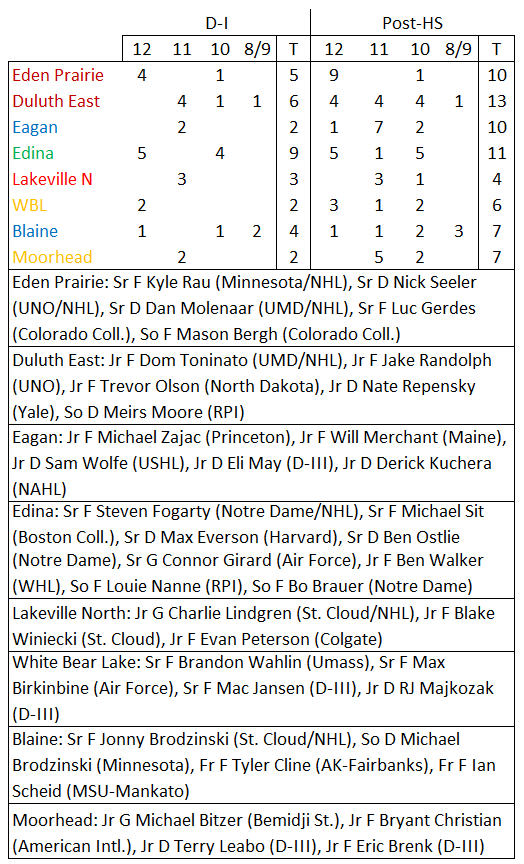
To continue my series of 10-year reviews of past State Tournaments, we revisit 2011 this season. It was a juicy one: a senior-dominated Eden Prairie team of destiny, a powerful defending state champion in Edina, an up-and-coming Duluth East team, and a few genuine surprises such as White Bear Lake. There were four championship bracket overtime games across both classes, plus two more frenetic, high-scoring affairs on the Class A side. The two finals were among the best in either class, with Kyle Rau’s iconic dive coming to be one of the most memorable moments in Tourney history.
Class AA
2011 featured a particularly competitive set of section tournaments. No one team dominated the regular season from start to finish, but Wayzata and Eden Prairie, guided by the state’s top two seniors (Tony Cameranesi and Kyle Rau) traded blows in 6AA over the course of the year. Eden Prairie, the preseason #1, got the last laugh when Rau scored in the second overtime in the section final. By the stretch run Hill-Murray had emerged as the consensus top-ranked team, but in one of the games of the decade, a scrappy White Bear Lake team came together at the right time, dodged an open net bullet in overtime, and went back to State courtesy of Mac Jansen. Defending champion Edina had to fight off an inspired Burnsville team to secure the 2AA title. A Blaine team reloading from a senior-heavy group toppled a top five Maple Grove team for a sixth trip to State in a row, while Grand Rapids fielded one of its deepest teams of the two-class era and saw a 1-0 lead with 1:30 left slip away into an overtime loss to Duluth East. And in another battle of two top ten-ish teams, Eagan held off defending 3AA champion Apple Valley 1-0 to earn a second ever trip to State.
The AA Tourney opened with the second-seeded defending champion Hornets, the star junior class that had carried them the year before now back as seniors, against Blaine. The Bengals weren’t the favorite they were some other seasons in that era, but after one period they were up 2-1, courtesy power play and shorthanded goals by two of the Brodzinski brothers, Michael and Jonny. Edina responded early in the second, though, with goals from Jake Sampson and Andy Jordahl, and generally controlled play from there. The Hornets were back in the semifinals, though not quite in convincing fashion.
Duluth East, which added a strong sophomore class to the now-juniors who had carried them to a fifth place finish the season before, drew the third seed and a meeting with surging White Bear Lake. The Hounds had the edge in play for much of the game, but for every punch, there was a counterpunch, and the Bears took the initiative in the third, very nearly securing that elusive first-round victory. Things settled down in overtime, however, and Zac Schendel slipped in the game-winner shortly into the second overtime. That five-frame affair was just one in a series of marathons for both teams: White Bear had played overtime in its section semifinal, both had played it in their finals, and both would play it again the next two days of the Tourney.
If the afternoon was entertaining, the night billing was something of a snoozefest. Lakeville North, fresh off an upset of Justin Kloos-led Lakeville South in the 1AA playoffs, was never really in the game with top-seeded Eden Prairie. In the nightcap, Moorhead stuck around with fourth-seeded Eagan, largely through the efforts of junior goaltender Michael Bitzer, who made 30 saves in a losing effort. While rarely seriously tested, the Wildcats took an early 1-0 lead and held it until just under five minutes left, when a second tally followed by two empty-netters led to a 4-0 final margin.
Friday night opened with a battle between Duluth East and Edina, the first of four semifinal clashes between the two powerhouses in an eight-year span. If not for what happened the next night, it would have been a true Tournament classic: two loaded teams playing at an elite level, probing back and forth in a tight affair. They traded goals early then settled in to an even battle into overtime, where an Alex Toscano shot caught a defenseman’s stick and soared behind Connor Girard three minutes and 54 second into the bonus frame. East headed to its first title game in 11 years, while a beleaguered Edina lost to Eagan in the third-place game.
The second semifinal, on the other hand, was not much of a contest. Eden Prairie went up 2-0 in the first through Luc Gerdes and Nic Seeler, and the Kyle Rau show followed that, as the Eagles ran the margin to 4-0 after two. The X emptied out as they finished off a 5-1 victory, and their deep senior class had a chance go out with a win for their Mr. Hockey winner, just as their team had done two years prior for Nick Leddy when many of these core players were sophomores.
The 2011 final was one of the greatest title games ever played. The Eagles and Hounds were evenly matched, trading chances back and forth, with Trevor Olson scoring twice for East and the Rath brothers, Mark and David, accounting for both Eagle tallies East defenseman Andrew Kerr put together a highlight reel of hits on Rau. Late in the 3rd, an injury to East defenseman Hunter Bergerson forced the Hounds to press a 4th-line forward, Kyle Campion, into regular shifts on defense. The game marched on through two overtimes and into a third, the two teams’ legs leaded and dragging. A dead-even game broke the only way it could: Rau dove and swatted at a loose puck, which trickled through goaltender JoJo Jeanetta’s legs, ricocheted off the pipe, off Kerr’s skate, and into the net.
Eden Prairie’s title was its second in three years, and the second for one of the most accomplished senior classes in recent high school hockey. It cemented Rau’s place in Minnesota lore and put the Eagles among the state’s elite, a place they would remain for the next decade. It was also a triumph for a group of seniors, many of whom could have played elsewhere during their senior seasons, but chose to come back and live out a dream together. They fulfilled that promise. East, meanwhile, would return almost entirely intact the next year in hopes of revenge; Eagan would return as well, while Edina would head into a quick reload to set the stage for future success.
Class A
In Class A, a relatively deep field emerged, albeit one with a clear pecking order. After two years of upsets at the hands of Mahtomedi, St. Thomas Academy returned to State, loaded as the top seed an in pursuit of a title. Hermantown, after a runner-up finish in 2010, was settling into a rhythm of producing consistent contenders for the crown. Two-time defending champion Breck made the dance as well, though they were somewhat diminished from the titlists of the previous two years. In section 8A, Thief River Falls pulled a mild upset of Warroad to head back to State, while in 6A, Alexandria went as a 5-seed in its section.
2011 turned in one of the most entertaining days of Class A quarterfinals in memory. While St. Thomas pasted New Ulm 13-2 and the Hermantown-Alexandria game is best remembered for a pregame skate to the line, the first day delivered two crowd-pleasing upsets for the first time in the seeded era. First, Hibbing, riding an emerging sophomore star in Adam Johnson, took down third-seeded Rochester Lourdes 4-0, an upset that relied on Johnson’s star power and a strong performance from Nathan Tromp in goal. And then, in the nightcap, Thief River Falls took down Breck 7-5 in a real crowd-pleaser of a game, with Breck building a 4-2 lead after two periods before the Prowlers erupted for four in a row. A late shorthanded goal from Tomas Lindstrom gave Breck some life, but an empty-netter sealed the Prowlers’ first championship bracket win since their 1965 state title.
The first semifinal had a similar flavor. Hermantown trotted out to a 4-1 lead over Hibbing . Adam Johnson then went off, however, scoring a natural hat trick in a span of three minutes over the late second and early third periods. The Hawks had the last laugh, though, as Andrew Mattson scored with just over a minute remaining, and an empty-netter sealed a 6-4 Hermantown win. St. Thomas, meanwhile, steamrolled Thief River Falls 5-0 in the second semi, though the Prowlers would rebound to win the third place game 3-0 the following day.
The 2011 Class A final was the first of three consecutive meetings between the Cadets and Hawks. On paper, it was a mismatch: Hermantown was a little on the young side, while St. Thomas was good everywhere in the lineup. But in the early going, it was all Hawks, as they wee up 3-0 7:05 into the game, largely through the efforts of Jared Thomas. St. Thomas turned up the pressure in a 19-shot second period; they pulled it to 3-2 before giving up another, then scored again with two minutes left in the period to head to the third down 4-3. Andrew Commers tied the game in the third, and the seesawing affair headed to overtime. There, Taylor Fleming proved the Cadets’ hero and gave the school its third Class A championship.
The game was only a preview of fun to come. Hermantown and St. Thomas would collide twice more in the final in the coming years, while Breck, while still a contender, would settle into a third-fiddle status in the following years. But 2011, in very dramatic fashion, belonged to Eden Prairie and St. Thomas Academy.

 A Patient Cycle